

- Market Size (2026)
- USD 19.4 Bn
- Forecast (2036)
- USD 37.5 Bn
- CAGR (2026 to 2036)
- 6.8%
How big is the allen key market in 2026?
USD 19.4 billion in 2026, reaching USD 37.5 billion by 2036 at a 6.8% CAGR
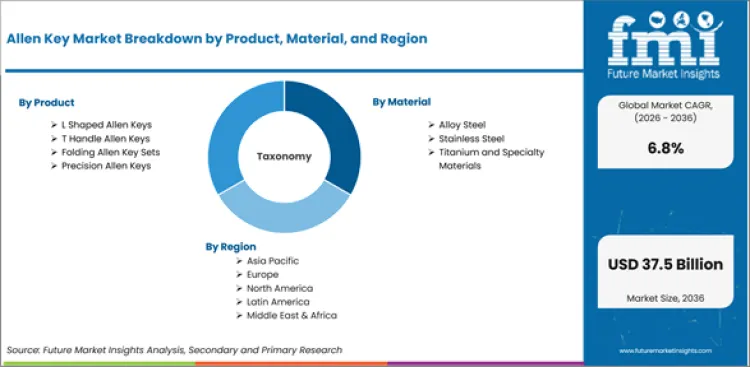
The allen key market was valued at USD 18.2 billion in 2025. The market is set to reach USD 19.4 billion by 2026-end and grow at a CAGR of 6.8% between 2026-2036 to reach USD 37.5 billion by 2036. L Shaped Allen Keys will dominate with a 50.0% share, while Alloy Steel will lead with a 60.0% share.
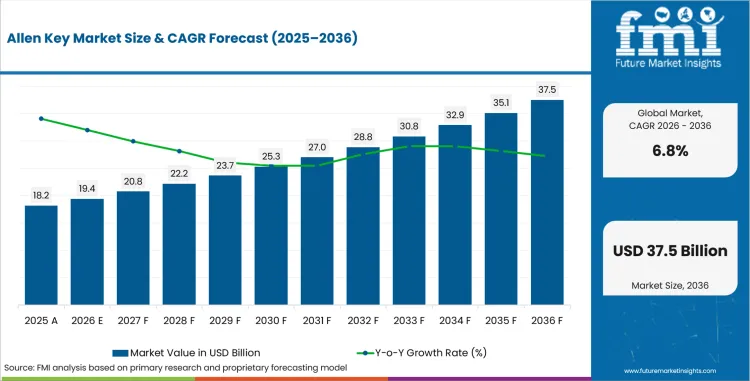
Key Takeaways, Market Size, and Forecast
- Allen Key Market Value (2025): USD 18.2 Bn
- Allen Key Market Forecast Value (2036): USD 37.5 Bn
- Allen Key Market CAGR (2026 TO 2036): 6.8%
- Allen Key Market Leading Product Segment: L Shaped Allen Keys (50.0%)
- Allen Key Market Key Growth Regions: EU, South Korea, USA, Japan, UK
- Allen Key Market Key Players: Apex Tool Group, Stanley Black & Decker, Bondhus Corporation, Wera Tools, Wiha Tools, Other Companies Combined
| Parameter | Details |
|---|---|
| Market Size in 2026 (Value) | USD 19.4 Bn |
| Market Forecast in 2036 (Value) | USD 37.5 Bn |
| CAGR (2026 to 2036) | 6.8% |
| Years Considered | 2021 to 2036 |
| Base Year | 2025 |
| Forecast Period | 2026 to 2036 |
| Units Considered | Value (USD Bn) |
| Leading Sub-Region | USA |
Summary of the Allen Key Market
- Demand and Growth Drivers
- Sustained industrial manufacturing, automotive assembly, and construction activity maintain baseline demand for allen key (hex key) tools across professional and consumer applications.
- Growth in furniture assembly, consumer electronics, and bicycle maintenance applications is expanding allen key consumption beyond traditional industrial and automotive channels.
- Product differentiation through ball-end designs, color-coded sizing, and premium material construction is creating higher-value product segments within the hand tool category.
- Product and Segment View
- L-shaped allen keys account for 50.0% of product share, serving as the standard hand tool format for hex socket fastener applications across industrial, automotive, and consumer use.
- Alloy steel materials hold 60.0% share, providing the hardness and torque resistance required for industrial and automotive fastening applications where fastener integrity is critical.
- Metric sizes hold 65.0% of size standard share, reflecting the global dominance of metric fastener systems in manufacturing, automotive, and industrial applications.
- Geography and Competitive Outlook
- The European Union leads at 6.9% CAGR, reflecting strong manufacturing sector demand, automotive production, and the concentration of premium hand tool manufacturing in Germany.
- South Korea follows at 6.6% CAGR, supported by automotive and electronics manufacturing activity that consumes industrial-grade hex key tools at high volumes.
- Companies with broad size ranges, premium material construction, and professional-grade quality positioning are positioned to serve growing industrial and consumer demand.
- Analyst Opinion
- Nikhil Kaitwade, Principal Consultant at FMI says, 'Tool manufacturers that can deliver precision-machined hex keys with improved torque handling and corrosion resistance are likely to capture growing demand from professional users seeking reduced fastener damage and improved durability over the forecast period.'
- The allen key market is sustained by the ubiquitous use of hex socket fasteners across manufacturing, automotive, construction, and consumer product assembly.
- Adoption of premium tool materials including S2 steel and chrome vanadium is increasing as professional users prioritize torque handling and durability over commodity pricing.
- Demand is supported by the growth of flat-pack furniture and consumer assembly applications that include hex keys as supplied accessories and create replacement tool purchases.
- Growth is attributable to expanding industrial manufacturing activity in emerging markets where hex fastener standardization increases tool consumption.
What is an allen key and what does the market cover?
Hex key hand tools for driving hex-socket fasteners in industrial, automotive, construction and consumer applications
The allen key market encompasses hex key hand tools designed for driving hex socket fasteners in industrial, automotive, construction, and consumer applications. Products include L-shaped allen keys, T-handle allen keys, and folding allen key sets manufactured from alloy steel, stainless steel, and specialty materials in metric and imperial size standards with hex and ball end configurations.
What is included in the allen key market scope?
L-shaped allen keys, T-handle allen keys and folding allen key sets, 2026 to 2036.
Market scope covers all commercially traded allen key products categorized by product (L shaped allen keys, T handle allen keys, folding allen key sets), material (alloy steel, stainless steel, titanium and specialty materials), size standard (metric sizes, imperial sizes), end type (hex end, ball end), application (automotive, industrial and manufacturing, construction), end use (professional users, industrial sector, individual consumers), and distribution channel (online retail, offline retail, direct sales). Revenue is tracked from 2026 to 2036.
What is excluded from the allen key market scope?
Powered hex bit drivers, hex socket bits for power tools, and Torx and other non-hex fastener tools
The scope does not include powered hex bit drivers, hex socket bits for power tools, or Torx and other non-hex fastener tools.
How was the allen key market research conducted?
Primary interviews, desk research, bottom-up sizing, and quarterly validation
- Primary Research: FMI analysts conducted interviews with hand tool manufacturers, industrial supply distributors, automotive tool specialists, and retail hardware buyers across key markets.
- Desk Research: Data was collected from multiple hand tool industry databases, industrial distribution sales data and manufacturer revenue disclosures.
- Market Sizing & Forecasting: Bottom-up aggregation of tool sales by product type, size standard, and geographic market, with forecasts of manufacturing activity.
- Data Validation: Quarterly cross-validated against industrial distributor sales data, retail hardware analytics and manufacturer production records.
Why is the allen key market growing?
Steady industrial and automotive demand and growing flat-pack consumer use
- Allen keys for hex socket fasteners are in steady demand in industrial manufacturing and automotive assembly and construction in professional environments.
- Allen key use is moving from professional industrial channels to consumer applications such as furniture assembly, bicycle maintenance and DIY projects.
- The European Union is the leader with a 6.9% CAGR, driven by strong demand from the manufacturing sector and the concentration of premium hand tool production in Germany, where Wera and Wiha are global leaders.
The demand for allen keys is spurred by the growing use of hex socket fasteners in industrial machinery, automotive components, precision instruments, and consumer products. The product share of L-shaped allen keys is 50.0% providing the standard hand tool format with both short-arm (high torque) and long-arm (extended reach) engagement with hex socket fasteners. Material share: 60.0% alloy steel construction, with chrome vanadium and S2 tool steel for the required hardness and torsional strength in high-torque professional applications.
Metric sizes represent 65.0% of the share of size standard, indicative of the global dominance of metric hex fastener systems across manufacturing, automotive and industrial applications. There is still significant market demand for Imperial sizes in North American markets where some industries use inch-based fastener standards. Ball-end hex keys can be inserted into the fastener at an angle of up to 25 degrees off-axis, which provides access to fasteners in tight spaces that a straight hex key cannot reach.
The most valuable demand segment is composed of professional users in manufacturing, maintenance and automotive service who buy premium-grade tools with documented hardness, torque capacity and dimensional accuracy. Allen keys are bought by individual consumers for furniture assembly, bicycle maintenance and other Do It Yourself applications. Hex keys have become one of the most common consumer hand tools, thanks to the flat-pack furniture of IKEA and others.
How is the allen key market segmented?
By product, material, size standard, end type, application, end use and distribution channel
- L-shaped allen keys are the leaders at 50.0% product share, the standard format for hex socket engagement in industrial, automotive and consumer applications.
- Material share is 60.0%. Alloy steel, chrome vanadium and S2 steel, to achieve torque capacity and hardness for professional use.
- Metric sizes represent 65.0% of the share of size standards, indicating the worldwide standardization of metric hex fastener systems.
Why do L-shaped allen keys lead the allen key market?
They hold 50.0% share, led by cost-effective bent hex-bar designs
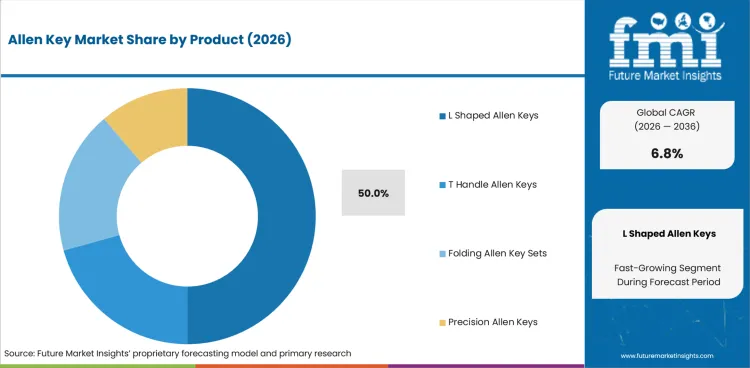
L-shaped allen keys share of the product 50.0% in 2026. The simple bent hex bar design offers a cost effective and reliable tool to engage hex socket fasteners. Short arm for max torque on tight fasteners Long arm for extra reach and finger spin speed for first fastener engagement
L-shaped allen keys are made from alloy steel bar stock. Cold-headed and machined, they have chamfered ends to allow for easier entry into the socket. Surface treatments include black oxide, chrome plating and proprietary coatings for enhanced corrosion resistance and tool identification. The multiple sizes needed by the professional and the consumer users are stored in set packaging in plastic holders or folding cases.
How big is the alloy steel segment in the allen key market?
About 60.0% share, led by chrome-vanadium steel for professional-grade tools
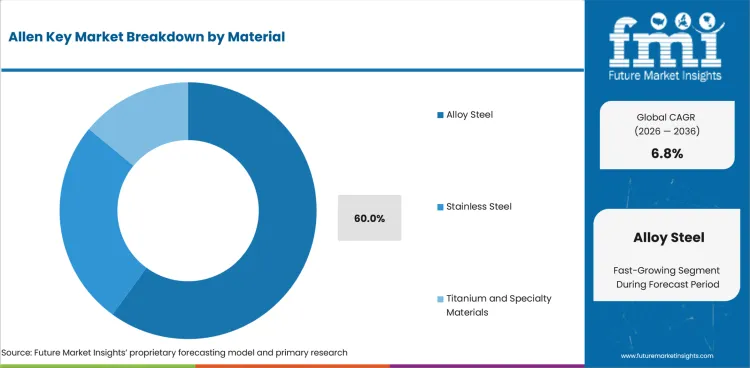
Alloy Steel is holding 60.0% material share in 2026. The standard material used in professional-grade tools is chrome vanadium (CrV) steel, which provides a hardness range of 58 to 62 HRC to resist cam-out and rounding of the hex engagement surfaces. Premium allen keys are made from S2 shock resistant tool steel for impact loading and high torque applications where superior toughness is required.
Stainless steel allen keys are used in applications where corrosion resistance is required, such as in marine, food processing and outdoor use. Titanium and specialty alloys are used in niche applications where the non-magnetic property, weight savings, or extreme corrosion resistance justify the premium material cost over standard alloy steel construction.
What drives and restrains the allen key market?
Driven by steady hex-fastener use across industry; restrained by low-cost import pricing pressure
- The global demand for allen key tools remains steady due to the extensive use of hex fasteners in automotive, consumer and manufacturing applications.
- Low cost imports are putting pressure on commodity pricing and challenging premium tool manufacturer margins in consumer and general industrial distribution channels.
- Premium material advancement and professional-grade quality positioning provide growth opportunities in higher value market segments.
The allen key market is influenced by manufacturing activity, automotive production, and increasing consumer applications. Import pricing competition is squeezing margins in commodity segments but there are higher value growth opportunities to be had from premium tool development and professional user demand.
What drives demand?
Industrial manufacturing operations relying on hex keys as essential tools
The demand is mainly from industrial manufacturing operations that use allen keys as critical hand tools for assembly, maintenance and repair of equipment with hex socket fasteners. Each manufacturer’s facility maintains inventories of hex keys within size ranges. Consumption is from wear and loss replacement.
What constrains the market?
Low-cost imports meeting basic functional requirements
Alternative solutions offered by low cost imports are able to satisfy the basic functional requirements at a fraction of the cost of premium tools. This competition squeezes margins in consumer and general industrial channels while premium professional channels maintain pricing power.
What opportunity does consumer use create?
Growing hex-socket fastener use in flat-pack furniture and consumer goods
Growth signifies the increasing application of hex socket fasteners in consumer products such as furniture, bicycles, electronics and sporting goods. But each product assembly event exposes consumers to hex keys, and creates a potential tool purchase for future maintenance needs.
What opportunity does premium tooling offer?
Professional users valuing durability and fastener-preserving precision
Professional users who appreciate durability, fastener preservation and enhanced performance are clamoring for high-quality allen keys, which feature superior materials, precision manufacturing and ergonomic designs. The premium segment of the engineering-grade tool products is led by German manufacturers such as Wiha and Wera.
Which countries are growing fastest in the allen key market?
EU 6.9%, South Korea 6.6%, USA 6.5%, UK 6.3%, Japan 6.4% through 2036
.webp "Top Country Growth Comparison Allen Key Market Cagr (2026 2036)")
| Country | CAGR |
|---|---|
| USA | 6.5% |
| UK | 6.3% |
| EU | 6.9% |
| Japan | 6.4% |
| South Korea | 6.6% |
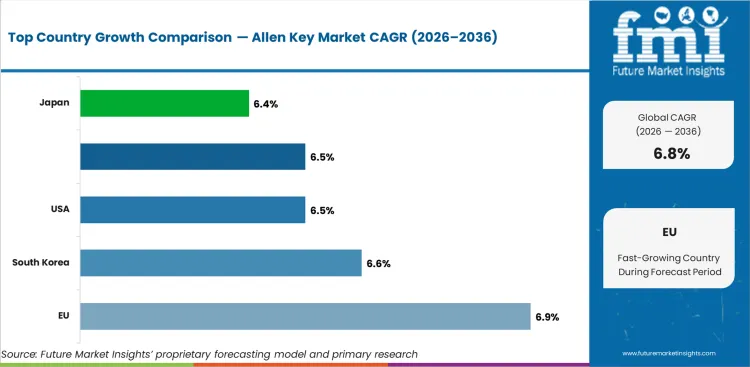
- EU leads at 6.9% CAGR, supported by strong automotive manufacturing activity, industrial production, and the presence of premium hand tool manufacturers across Germany and neighboring countries.
- South Korea follows at 6.6%, driven by electronics manufacturing, automotive production, and growing demand for precision industrial tools.
- USA (6.5%) and USA (6.5%) sustain growth.
The global allen key market is estimated to grow at 6.8% CAGR from 2026 to 2036. The study covers more than 30 countries, and the key markets are listed below.
What is the allen key market outlook in the European Union?
6.9% CAGR, driven by Manufacturing sector demand, automotive production, and premium hand tool manufacturing
The European Union leads at 6.9% CAGR through 2036. Manufacturing sector demand, automotive production, and premium hand tool manufacturing leadership sustain market growth.
- European producers are well placed to take the lead in the global premium allen key market, given the manufacturing excellence of German precision hand tools.
- Automotive production in Germany, France and Eastern Europe drives steady industrial demand for hex key tools in assembly and maintenance operations.
- European industrial distribution networks provide structured procurement channels for professional-grade hex key tools.
What is driving allen key growth in South Korea?
6.6% CAGR, driven by Automotive and electronics manufacturing
South Korea is projected to register 6.6% CAGR through 2036. Automotive and electronics manufacturing drive industrial hex key consumption.
- Automotive manufacturing operations at Hyundai-Kia and supplier facilities consume industrial-grade hex keys at high volumes for assembly and maintenance.
- Precision hex key tools are required for clean room and equipment maintenance applications in the electronics and semiconductor manufacturing sector.
- Efficient procurement channels for industrial tools are used to supply hex keys to domestic manufacturing facilities to satisfy manufacturing facility needs.
How is the allen key market performing in the United States?
6.5% CAGR, driven by diversified demand across industrial manufacturing, automotive service, and consumer applications
The United States is projected to register 6.5% CAGR through 2036. Diversified demand supports industrial manufacturing, automotive service, and consumer applications.
- Alloy steel hex keys are always in demand by the professionals for industrial manufacturing and maintenance jobs for metric and imperial size ranges.
- Automotive service and repair establishments maintain inventories of hex keys for use in vehicle maintenance and component access applications.
- Consumer allen key demand from furniture assembly, bicycle maintenance, and DIY applications is served through hardware retail and online distribution.
What is the allen key market forecast for Japan?
6.4% CAGR, driven by Precision manufacturing and quality-focused tool consumption
Japan is projected to register 6.4% CAGR through 2036. Precision manufacturing and quality-focused tool consumption sustain hex key demand.
- Japanese manufacturing operations require precision grade hex keys to JIS quality standards for use in assembly and maintenance operations.
- Automotive and electronics manufacturing create concentrated industrial demand for hex key tools at high production volumes.
- Domestic tool manufacturers provide precision-machined hex keys that serve Japanese manufacturing quality requirements.
What is the growth outlook for the allen key market in the United Kingdom?
6.3% CAGR, driven by Manufacturing, construction, and consumer applications
The United Kingdom is projected to register 6.3% CAGR through 2036. Manufacturing, construction, and consumer applications sustain diversified demand.
- UK manufacturing and construction sectors create professional demand for hex key tools in assembly, installation, and maintenance operations.
- Consumer market demand from IKEA furniture assembly and bicycle maintenance creates high-frequency allen key usage and replacement purchases.
- Hardware retail chains and online tool suppliers provide broad distribution for both professional and consumer hex key products.
Who are the leading companies in the allen key market?
Apex Tool Group, Stanley Black & Decker, Bondhus Corporation, Wera Tools, and Wiha Tools
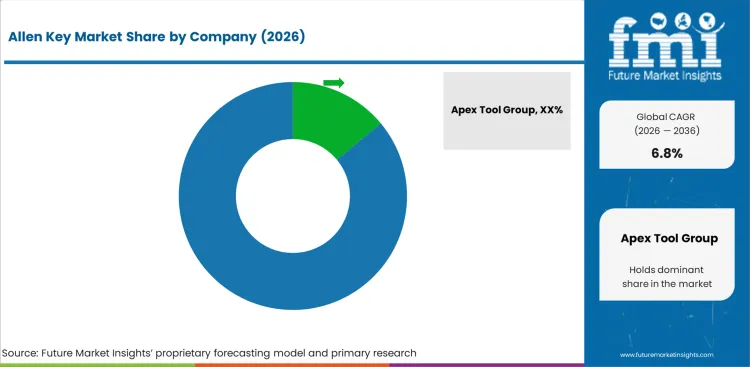
- Wera Tools and Wiha Tools lead the premium allen key segment through precision German manufacturing, advanced material technology, and professional user brand loyalty.
- Stanley Black and Decker and Apex Tool Group serve broad industrial and consumer markets through diversified hand tool portfolios including hex key product lines.
- Bondhus Corporation has established a specialized position through ball-end hex key technology and US manufacturing of professional-grade tools.
- Regional and imported product lines serve the value segment through cost-competitive manufacturing and broad retail distribution.
Who are the key players in the allen key market?
Apex Tool Group, Stanley Black & Decker, Bondhus Corporation, Wera Tools and Wiha Tools, plus regional players
Key global companies leading the allen key market include:
- Apex Tool Group (USA), Stanley Black and Decker (USA), Bondhus Corporation (USA), and Wera Tools (Germany) lead global allen key markets through broad hand tool portfolios, professional-grade quality positioning, and established industrial and retail distribution networks.
- Wiha Tools (Germany) holds a strong position through precision-manufactured professional hex key products with established professional user loyalty across European and global markets.
- Additional hand tool manufacturers are developing specialty hex key products targeting specific professional applications including clean room, marine, and high-torque industrial requirements.
How do top allen key companies compare?
Apex Tool Group and Stanley Black & Decker lead globally; Bondhus Corporation, Wera Tools and Wiha Tools are regional specialists
| Company | Product Range | Manufacturing Quality | Professional Distribution | Geographic Footprint |
|---|---|---|---|---|
| Apex Tool Group | High | High | Strong | Global |
| Stanley Black & Decker | High | High | Strong | Global |
| Bondhus Corporation | Medium | High | Moderate | N. America, Global |
| Wera Tools | High | High | Strong | Europe, Global |
| Wiha Tools | High | High | Strong | Europe, Global |
Source: Future Market Insights competitive analysis, 2026.
Key Developments in Allen Key Market
- In 2025, Stanley Black & Decker continued expanding professional hand tool offerings under the DEWALT and Proto brands, supporting industrial maintenance and assembly applications.
- In 2025, Wiha Tools expanded availability of insulated and precision hex key solutions targeting electronics, electrical maintenance, and industrial users.
Key Players in the Allen Key Market
Major Global Players
- Apex Tool Group
- Stanley Black & Decker
- Bondhus Corporation
- Wera Tools
- Wiha Tools
- PB Swiss Tools
Emerging Players/Startups
- Eklind Tool Company
- Beta Utensili
- Unior Hand Tools
Allen Key Market - Research Methodology
| Method | Description |
|---|---|
| Primary Research | FMI analysts conducted interviews with manufacturers, distributors, procurement specialists, and end-use operators across USA, UK, and EU to validate demand patterns and pricing structures for L Shaped Allen Keys, and T Handle Allen Keys and related product categories. |
| Desk Research | Combined trade statistics, regulatory filings, industry association data, and manufacturer disclosures to establish baseline parameters for Allen Key across product, material, size standard, end, application, end use, and distribution channel segments. |
| Market Sizing & Forecasting | Bottom-up aggregation across L Shaped Allen Keys, T Handle Allen Keys, and Folding Allen Key Sets product categories and Alloy Steel, Stainless Steel, and Titanium and Specialty Materials material segments, triangulated with top-down macro indicators and regional adoption curves. |
| Data Validation | Cross-checked quarterly against production statistics, trade flow data, and manufacturer revenue disclosures for Allen Key products. |
What does the allen key market report cover?
2016 to 2025 history and 2026 to 2036 forecasts across all segments and 30+ countries
| Parameter | Details |
|---|---|
| Market size by 2036 | USD 37.5 Bn |
| Growth rate | 6.8% CAGR (2026 to 2036) |
| Forecast period | 2026 to 2036 |
| Base year value (2025) | USD 18.2 Bn |
| Key Segment Covered | Product, Material, Size Standard, End Type, Application, End Use, Distribution Channel |
| Regions covered | North America, Latin America, Eastern Europe, Western Europe, East Asia, South Asia and Pacific, Middle East and Africa |
| Countries covered | USA, EU, Japan, South Korea, 30 plus countries |
| Key companies profiled | Apex Tool Group, Stanley Black & Decker, Bondhus Corporation, Wera Tools, Wiha Tools |
| Approach | Hybrid bottom-up and top-down methodology starting with verified transaction data, projecting adoption velocity across segments and regions. |
Market Segmentation Analysis
Allen Key Market Segmented by Product:
- L Shaped Allen Keys
- Short Arm Allen Keys
- Metric Size Keys
- Inch Size Keys
- Long Arm Allen Keys
- Ball End Keys
- Straight End Keys
- Short Arm Allen Keys
- T Handle Allen Keys
- Standard T Handle
- Fixed Head Keys
- Ergonomic Grip Keys
- Ratcheting T Handle
- Adjustable Head Keys
- Quick Change Keys
- Standard T Handle
- Folding Allen Key Sets
- Standard Folding Sets
- Compact Sets
- Multi Size Sets
- Heavy Duty Folding Sets
- Industrial Grade Sets
- Reinforced Frames
- Standard Folding Sets
- Precision Allen Keys
- Mini Allen Keys
- Electronics Repair
- Watch Repair
- Insulated Allen Keys
- Electrical Work
- Safety Certified
- Mini Allen Keys
Allen Key Market Segmented by Material:
- Alloy Steel
- Chrome Vanadium Steel
- High Strength Tools
- Corrosion Resistant
- S2 Steel
- Impact Resistant
- High Torque Applications
- Chrome Vanadium Steel
- Stainless Steel
- Standard Stainless Steel
- Rust Resistant
- Outdoor Use
- High Grade Stainless Steel
- Marine Grade
- Premium Tools
- Standard Stainless Steel
- Titanium and Specialty Materials
- Titanium Tools
- Lightweight Tools
- High Durability
- Coated Tools
- Black Oxide Coating
- Nickel Plated
- Titanium Tools
Allen Key Market Segmented by Size Standard:
- Metric Sizes
- Standard Metric Range
- Small Sizes
- Medium Sizes
- Precision Metric Sizes
- Micro Sizes
- Fine Tolerance
- Standard Metric Range
- Imperial Sizes
- Standard Imperial Range
- Fractional Sizes
- Common Sizes
- Precision Imperial Sizes
- Micro Sizes
- Special Applications
- Standard Imperial Range
Allen Key Market Segmented by End Type:
- Hex End
- Standard Hex End
- Straight Tip
- Precision Tip
- Standard Hex End
- Ball End
- Standard Ball End
- Angle Access
- Flexible Use
- Long Reach Ball End
- Extended Access
- Deep Socket Use
- Standard Ball End
Allen Key Market Segmented by Application:
- Automotive
- Vehicle Maintenance
- Engine Components
- Interior Assembly
- Aftermarket Modifications
- Custom Parts
- Performance Tuning
- Vehicle Maintenance
- Industrial and Manufacturing
- Machinery Assembly
- Production Lines
- Heavy Equipment
- Equipment Maintenance
- Repair Operations
- Service Workshops
- Machinery Assembly
- Construction
- Structural Assembly
- Metal Structures
- Furniture Assembly
- Electrical Installation
- Panel Work
- Fixture Installation
- Structural Assembly
- Consumer and DIY
- Home Improvement
- Furniture Assembly
- Appliance Repair
- Hobby and Craft
- Model Building
- Electronics Projects
- Home Improvement
Allen Key Market Segmented by End Use:
- Professional Users
- Mechanics
- Automotive Workshops
- Service Centers
- Technicians
- Industrial Workers
- Maintenance Staff
- Mechanics
- Industrial Sector
- Manufacturing Units
- Production Facilities
- Assembly Plants
- Construction Companies
- Infrastructure Projects
- Building Contractors
- Manufacturing Units
- Individual Consumers
- DIY Users
- Home Projects
- Repair Tasks
- Hobbyists
- Craft Work
- Electronics Repair
- DIY Users
Allen Key Market Segmented by Distribution Channel:
- Online Retail
- E Commerce Platforms
- Direct To Consumer
- Marketplace Platforms
- E Commerce Platforms
- Offline Retail
- Hardware Stores
- Local Retailers
- Tool Shops
- Industrial Supply Stores
- Bulk Suppliers
- B2B Sales
- Hardware Stores
- Direct Sales
- Manufacturer Supply
- OEM Contracts
- Industrial Buyers
- Manufacturer Supply
Allen Key Market by Region:
- North America
- USA
- Canada
- Mexico
- Latin America
- Brazil
- Chile
- Rest of Latin America
- Western Europe
- Germany
- UK
- Italy
- Spain
- France
- Nordic
- BENELUX
- Rest of Western Europe
- Eastern Europe
- Russia
- Poland
- Hungary
- Balkan & Baltic
- Rest of Eastern Europe
- East Asia
- China
- Japan
- South Korea
- South Asia and Pacific
- India
- ASEAN
- Australia & New Zealand
- Rest of South Asia and Pacific
- Middle East & Africa
- Kingdom of Saudi Arabia
- Other GCC Countries
- Türkiye
- South Africa
- Other African Union
- Rest of Middle East & Africa
Research Sources and Bibliography
- International Organization for Standardization. (2025). ISO 2936: Assembly Tools for Hex Socket Fasteners. ISO.
- American National Standards Institute. (2025). ANSI Standards for Hand Tools. ANSI.
- European Committee for Standardization. (2025). CEN Standards for Hand Tools Safety. CEN.
- Deutsches Institut fur Normung. (2025). DIN Standards for Hex Key Tools. DIN.
- International Trade Administration. (2025). ITA Hand Tools Industry Report. ITA.
This bibliography is provided for reader reference.
This Report Answers
- Estimating the size of the allen key market and projected revenue from 2026 to 2036.
- Segmentation by product, material, size standard, end type, application, end use, distribution channel.
- Insights about more than 30 regional markets.
- Analysis of key market dynamics including demand drivers, restraints, and emerging opportunities.
- Assessment of the competitive landscape and strategic positioning of leading companies.
- Identifying investment opportunities across key product segments and geographic markets.
- Supply chain and distribution channel analysis.
- Delivery of data in PDF and Excel formats.
Frequently Asked Questions
How big is the allen key market in 2026?
The global allen key market is estimated to be valued at USD 19.4 billion in 2026.
What will be the size of the allen key market in 2036?
The market size for the allen key market is projected to reach USD 37.5 billion by 2036.
How much will the allen key market growth be between 2026 and 2036?
The allen key market is expected to grow at a 6.8% CAGR between 2026 and 2036.
What are the key products in the allen key market?
The key products in the allen key market are L Shaped Allen Keys, T Handle Allen Keys, Folding Allen Key Sets and Precision Allen Keys.
Which material segment is expected to contribute a significant share in the allen key market in 2026?
In terms of material, the alloy steel segment is expected to command 60.0% share in the allen key market in 2026.
Preview the report firsthand - request a free sample
Get SampleGet the brochure for pricing and purchase details.
Get PDFTable of Content
- Key Takeaways
- Market Size and CAGR
- Top Growth Driver
- Fastest Growing Segment
- Leading Region
- Key Companies
- Emerging Opportunities
- Executive Summary
- Global Market Outlook
- Demand-side Trends
- Supply-side Trends
- Technology Roadmap Analysis
- Analysis and Recommendations
- Analyst Perspective (What is happening? Why now? What should investors know?)
- Key Questions Answered
- How large is the market?
- What is the CAGR?
- What are key trends?
- Which region dominates?
- Who are the leaders?
- Market Overview
- Market Coverage / Taxonomy
- Market Definition / Scope / Limitations
- Research Methodology
- Chapter Orientation
- Analytical Lens and Working Hypotheses
- Market Structure, Signals, and Trend Drivers
- Benchmarking and Cross-market Comparability
- Market Sizing, Forecasting, and Opportunity Mapping
- Research Design and Evidence Framework
- Desk Research Programme (Secondary Evidence)
- Expert Input and Fieldwork (Primary Evidence)
- Tooling, Models, and Reference Databases
- Data Engineering and Model Build
- Quality Assurance and Audit Trail
- Market Background
- Market Dynamics (Drivers, Restraints, Opportunity, Trends)
- Scenario Forecast (Optimistic, Likely, Conservative)
- Impact Analysis
- AI Impact
- Sustainability Impact
- Regulatory Impact
- Technology Impact
- Consumer / Buyer Analysis
- Purchase Drivers
- Adoption Barriers
- Buyer Journey
- Opportunity Map Analysis
- Product Life Cycle Analysis
- Supply Chain Analysis
- Investment Feasibility Matrix
- Value Chain Analysis
- PESTLE and Porter's Analysis
- Regulatory Landscape
- Regional Parent Market Outlook
- Production and Consumption Statistics
- Import and Export Statistics
- Global Market Analysis and Forecast, 2021 to 2036
- Historical Market Size Value (USD Million) Analysis, 2021 to 2025
- Current and Future Market Size Value (USD Million) Projections, 2026 to 2036
- Y-o-Y Growth Trend Analysis
- Absolute $ Opportunity Analysis
- Global Market Pricing Analysis, 2021 to 2036
- Global Market Analysis and Forecast, By Product, 2021 to 2036
- Introduction / Key Findings
- Historical Market Size Value (USD Million) Analysis By Product, 2021 to 2025
- Current and Future Market Size Value (USD Million) Analysis and Forecast By Product, 2026 to 2036
- L Shaped Allen Keys
- Short Arm Allen Keys
- Long Arm Allen Keys
- T Handle Allen Keys
- Standard T Handle
- Ratcheting T Handle
- Folding Allen Key Sets
- Standard Folding Sets
- Heavy Duty Folding Sets
- Precision Allen Keys
- Mini Allen Keys
- Insulated Allen Keys
- L Shaped Allen Keys
- Y-o-Y Growth Trend Analysis By Product, 2021 to 2025
- Absolute $ Opportunity Analysis By Product, 2026 to 2036
- Global Market Analysis and Forecast, By Material, 2021 to 2036
- Introduction / Key Findings
- Historical Market Size Value (USD Million) Analysis By Material, 2021 to 2025
- Current and Future Market Size Value (USD Million) Analysis and Forecast By Material, 2026 to 2036
- Alloy Steel
- Chrome Vanadium Steel
- S2 Steel
- Stainless Steel
- Standard Stainless Steel
- High Grade Stainless Steel
- Titanium and Specialty Materials
- Titanium Tools
- Coated Tools
- Alloy Steel
- Y-o-Y Growth Trend Analysis By Material, 2021 to 2025
- Absolute $ Opportunity Analysis By Material, 2026 to 2036
- Global Market Analysis and Forecast, By Size Standard, 2021 to 2036
- Introduction / Key Findings
- Historical Market Size Value (USD Million) Analysis By Size Standard, 2021 to 2025
- Current and Future Market Size Value (USD Million) Analysis and Forecast By Size Standard, 2026 to 2036
- Metric Sizes
- Standard Metric Range
- Precision Metric Sizes
- Imperial Sizes
- Standard Imperial Range
- Precision Imperial Sizes
- Metric Sizes
- Y-o-Y Growth Trend Analysis By Size Standard, 2021 to 2025
- Absolute $ Opportunity Analysis By Size Standard, 2026 to 2036
- Global Market Analysis and Forecast, By End Type, 2021 to 2036
- Introduction / Key Findings
- Historical Market Size Value (USD Million) Analysis By End Type, 2021 to 2025
- Current and Future Market Size Value (USD Million) Analysis and Forecast By End Type, 2026 to 2036
- Hex End
- Standard Hex End
- Ball End
- Standard Ball End
- Long Reach Ball End
- Hex End
- Y-o-Y Growth Trend Analysis By End Type, 2021 to 2025
- Absolute $ Opportunity Analysis By End Type, 2026 to 2036
- Global Market Analysis and Forecast, By Application, 2021 to 2036
- Introduction / Key Findings
- Historical Market Size Value (USD Million) Analysis By Application, 2021 to 2025
- Current and Future Market Size Value (USD Million) Analysis and Forecast By Application, 2026 to 2036
- Automotive
- Vehicle Maintenance
- Aftermarket Modifications
- Industrial and Manufacturing
- Machinery Assembly
- Equipment Maintenance
- Construction
- Structural Assembly
- Electrical Installation
- Consumer and DIY
- Home Improvement
- Hobby and Craft
- Automotive
- Y-o-Y Growth Trend Analysis By Application, 2021 to 2025
- Absolute $ Opportunity Analysis By Application, 2026 to 2036
- Global Market Analysis and Forecast, By End Use
- Introduction / Key Findings
- Historical Market Size Value (USD Million) Analysis By End Use, 2021 to 2025
- Current and Future Market Size Value (USD Million) Analysis and Forecast By End Use, 2026 to 2036
- Professional Users
- Mechanics
- Technicians
- Industrial Sector
- Manufacturing Value (USD Million)s
- Construction Companies
- Individual Consumers
- DIY Users
- Hobbyists
- Professional Users
- Y-o-Y Growth Trend Analysis By End Use, 2021 to 2025
- Absolute $ Opportunity Analysis By End Use, 2026 to 2036
- Global Market Analysis and Forecast, By Distribution Channel
- Introduction / Key Findings
- Historical Market Size Value (USD Million) Analysis By Distribution Channel, 2021 to 2025
- Current and Future Market Size Value (USD Million) Analysis and Forecast By Distribution Channel, 2026 to 2036
- Online Retail
- E Commerce Platforms
- Offline Retail
- Hardware Stores
- Industrial Supply Stores
- Direct Sales
- Manufacturer Supply
- Online Retail
- Y-o-Y Growth Trend Analysis By Distribution Channel, 2021 to 2025
- Absolute $ Opportunity Analysis By Distribution Channel, 2026 to 2036
- Global Market Analysis and Forecast, By Region, 2021 to 2036
- Introduction
- Historical Market Size Value (USD Million) Analysis By Region, 2021 to 2025
- Current Market Size Value (USD Million) Analysis and Forecast By Region, 2026 to 2036
- North America
- Latin America
- Western Europe
- Eastern Europe
- East Asia
- South Asia and Pacific
- Middle East & Africa
- Market Attractiveness Analysis By Region
- North America Market Analysis and Forecast, By Country, 2021 to 2036
- Historical Market Size Value (USD Million) Trend Analysis By Market Taxonomy, 2021 to 2025
- Market Size Value (USD Million) Forecast By Market Taxonomy, 2026 to 2036
- By Country
- USA
- Canada
- Mexico
- By Product
- By Material
- By Size Standard
- By End Type
- By Application
- By End Use
- By Distribution Channel
- By Country
- Market Attractiveness Analysis
- By Country
- By Product
- By Material
- By Size Standard
- By End Type
- By Application
- By End Use
- By Distribution Channel
- Key Takeaways
- Latin America Market Analysis and Forecast, By Country
- Historical Market Size Value (USD Million) Trend Analysis By Market Taxonomy, 2021 to 2025
- Market Size Value (USD Million) Forecast By Market Taxonomy, 2026 to 2036
- By Country
- Brazil
- Chile
- Rest of Latin America
- By Product
- By Material
- By Size Standard
- By End Type
- By Application
- By End Use
- By Distribution Channel
- By Country
- Market Attractiveness Analysis
- By Country
- By Product
- By Material
- By Size Standard
- By End Type
- By Application
- By End Use
- By Distribution Channel
- Key Takeaways
- Western Europe Market Analysis and Forecast, By Country
- Historical Market Size Value (USD Million) Trend Analysis By Market Taxonomy, 2021 to 2025
- Market Size Value (USD Million) Forecast By Market Taxonomy, 2026 to 2036
- By Country
- Germany
- UK
- Italy
- Spain
- France
- Nordic
- BENELUX
- Rest of Western Europe
- By Product
- By Material
- By Size Standard
- By End Type
- By Application
- By End Use
- By Distribution Channel
- By Country
- Market Attractiveness Analysis
- By Country
- By Product
- By Material
- By Size Standard
- By End Type
- By Application
- By End Use
- By Distribution Channel
- Key Takeaways
- Eastern Europe Market Analysis and Forecast, By Country
- Historical Market Size Value (USD Million) Trend Analysis By Market Taxonomy, 2021 to 2025
- Market Size Value (USD Million) Forecast By Market Taxonomy, 2026 to 2036
- By Country
- Russia
- Poland
- Hungary
- Balkan & Baltic
- Rest of Eastern Europe
- By Product
- By Material
- By Size Standard
- By End Type
- By Application
- By End Use
- By Distribution Channel
- By Country
- Market Attractiveness Analysis
- By Country
- By Product
- By Material
- By Size Standard
- By End Type
- By Application
- By End Use
- By Distribution Channel
- Key Takeaways
- East Asia Market Analysis and Forecast, By Country
- Historical Market Size Value (USD Million) Trend Analysis By Market Taxonomy, 2021 to 2025
- Market Size Value (USD Million) Forecast By Market Taxonomy, 2026 to 2036
- By Country
- China
- Japan
- South Korea
- By Product
- By Material
- By Size Standard
- By End Type
- By Application
- By End Use
- By Distribution Channel
- By Country
- Market Attractiveness Analysis
- By Country
- By Product
- By Material
- By Size Standard
- By End Type
- By Application
- By End Use
- By Distribution Channel
- Key Takeaways
- South Asia and Pacific Market Analysis and Forecast, By Country
- Historical Market Size Value (USD Million) Trend Analysis By Market Taxonomy, 2021 to 2025
- Market Size Value (USD Million) Forecast By Market Taxonomy, 2026 to 2036
- By Country
- India
- ASEAN
- Australia & New Zealand
- Rest of South Asia and Pacific
- By Product
- By Material
- By Size Standard
- By End Type
- By Application
- By End Use
- By Distribution Channel
- By Country
- Market Attractiveness Analysis
- By Country
- By Product
- By Material
- By Size Standard
- By End Type
- By Application
- By End Use
- By Distribution Channel
- Key Takeaways
- Middle East & Africa Market Analysis and Forecast, By Country
- Historical Market Size Value (USD Million) Trend Analysis By Market Taxonomy, 2021 to 2025
- Market Size Value (USD Million) Forecast By Market Taxonomy, 2026 to 2036
- By Country
- Kingdom of Saudi Arabia
- Other GCC Countries
- Türkiye
- South Africa
- Other African Union
- Rest of Middle East & Africa
- By Product
- By Material
- By Size Standard
- By End Type
- By Application
- By End Use
- By Distribution Channel
- By Country
- Market Attractiveness Analysis
- By Country
- By Product
- By Material
- By Size Standard
- By End Type
- By Application
- By End Use
- By Distribution Channel
- Key Takeaways
- Key Countries Market Analysis
- USA
- Pricing Analysis
- Market Share Analysis, 2025
- By Product
- By Material
- By Size Standard
- By End Type
- By Application
- By End Use
- By Distribution Channel
- Canada
- Pricing Analysis
- Market Share Analysis, 2025
- By Product
- By Material
- By Size Standard
- By End Type
- By Application
- By End Use
- By Distribution Channel
- Mexico
- Pricing Analysis
- Market Share Analysis, 2025
- By Product
- By Material
- By Size Standard
- By End Type
- By Application
- By End Use
- By Distribution Channel
- Brazil
- Pricing Analysis
- Market Share Analysis, 2025
- By Product
- By Material
- By Size Standard
- By End Type
- By Application
- By End Use
- By Distribution Channel
- Chile
- Pricing Analysis
- Market Share Analysis, 2025
- By Product
- By Material
- By Size Standard
- By End Type
- By Application
- By End Use
- By Distribution Channel
- Germany
- Pricing Analysis
- Market Share Analysis, 2025
- By Product
- By Material
- By Size Standard
- By End Type
- By Application
- By End Use
- By Distribution Channel
- UK
- Pricing Analysis
- Market Share Analysis, 2025
- By Product
- By Material
- By Size Standard
- By End Type
- By Application
- By End Use
- By Distribution Channel
- Italy
- Pricing Analysis
- Market Share Analysis, 2025
- By Product
- By Material
- By Size Standard
- By End Type
- By Application
- By End Use
- By Distribution Channel
- Spain
- Pricing Analysis
- Market Share Analysis, 2025
- By Product
- By Material
- By Size Standard
- By End Type
- By Application
- By End Use
- By Distribution Channel
- France
- Pricing Analysis
- Market Share Analysis, 2025
- By Product
- By Material
- By Size Standard
- By End Type
- By Application
- By End Use
- By Distribution Channel
- India
- Pricing Analysis
- Market Share Analysis, 2025
- By Product
- By Material
- By Size Standard
- By End Type
- By Application
- By End Use
- By Distribution Channel
- ASEAN
- Pricing Analysis
- Market Share Analysis, 2025
- By Product
- By Material
- By Size Standard
- By End Type
- By Application
- By End Use
- By Distribution Channel
- Australia & New Zealand
- Pricing Analysis
- Market Share Analysis, 2025
- By Product
- By Material
- By Size Standard
- By End Type
- By Application
- By End Use
- By Distribution Channel
- China
- Pricing Analysis
- Market Share Analysis, 2025
- By Product
- By Material
- By Size Standard
- By End Type
- By Application
- By End Use
- By Distribution Channel
- Japan
- Pricing Analysis
- Market Share Analysis, 2025
- By Product
- By Material
- By Size Standard
- By End Type
- By Application
- By End Use
- By Distribution Channel
- South Korea
- Pricing Analysis
- Market Share Analysis, 2025
- By Product
- By Material
- By Size Standard
- By End Type
- By Application
- By End Use
- By Distribution Channel
- Russia
- Pricing Analysis
- Market Share Analysis, 2025
- By Product
- By Material
- By Size Standard
- By End Type
- By Application
- By End Use
- By Distribution Channel
- Poland
- Pricing Analysis
- Market Share Analysis, 2025
- By Product
- By Material
- By Size Standard
- By End Type
- By Application
- By End Use
- By Distribution Channel
- Hungary
- Pricing Analysis
- Market Share Analysis, 2025
- By Product
- By Material
- By Size Standard
- By End Type
- By Application
- By End Use
- By Distribution Channel
- Kingdom of Saudi Arabia
- Pricing Analysis
- Market Share Analysis, 2025
- By Product
- By Material
- By Size Standard
- By End Type
- By Application
- By End Use
- By Distribution Channel
- Türkiye
- Pricing Analysis
- Market Share Analysis, 2025
- By Product
- By Material
- By Size Standard
- By End Type
- By Application
- By End Use
- By Distribution Channel
- South Africa
- Pricing Analysis
- Market Share Analysis, 2025
- By Product
- By Material
- By Size Standard
- By End Type
- By Application
- By End Use
- By Distribution Channel
- USA
- Market Structure Analysis
- Competition Dashboard
- Competition Benchmarking
- Market Share Analysis of Top Players
- By Regional
- By Product
- By Material
- By Size Standard
- By End Type
- By Application
- By End Use
- By Distribution Channel
- Emerging Startups
- Innovation Benchmarking
- Competition Analysis
- Competition Deep Dive
- Apex Tool Group
- Overview
- Product Portfolio
- Profitability by Market Segments (Product/Region/Sales Channel)
- Sales Footprint
- Strategy Overview
- Marketing Strategy
- Product Strategy
- Channel Strategy
- Stanley Black & Decker
- Bondhus Corporation
- Wera Tools
- Wiha Tools
- Other Companies Combined
- Apex Tool Group
- Case Studies
- Success Stories
- Recent Developments
- Competition Deep Dive
- Assumptions & Acronyms Used


