

- Market Size (2026)
- USD 564.0 Mn
- Forecast (2036)
- USD 945.3 Mn
- CAGR (2026 to 2036)
- 5.3%
How big is Ampoule Serums Market in 2026?
USD 564.0 million in 2026 and USD 945.3 million by 2036 at a 5.3% CAGR.
Ampoule serum demand is projected to rise from USD 564.0 million in 2026 to USD 945.3 million by 2036 at 5.3% CAGR. Routine adoption depends on concentrated treatments proving a visible benefit without forcing consumers to rebuild familiar facial-care steps. Unilever reported in April 2026 that its Beauty & Wellbeing teams analyse more than 1,000 external data sources monthly to guide science-led product development. Faster claim and formulation work broadens the range of treatment stories that can reach the skincare category while keeping everyday use understandable.
Commercial conversion differs sharply by country because serum discovery and legal market access do not follow one route. Great Britain recorded 861,686 cosmetic notifications by May 2026 according to the Office for Product Safety and Standards. Brands therefore need local compliance files before digital discovery can become repeat revenue across repairing skin care treatments and other concentrated facial products.
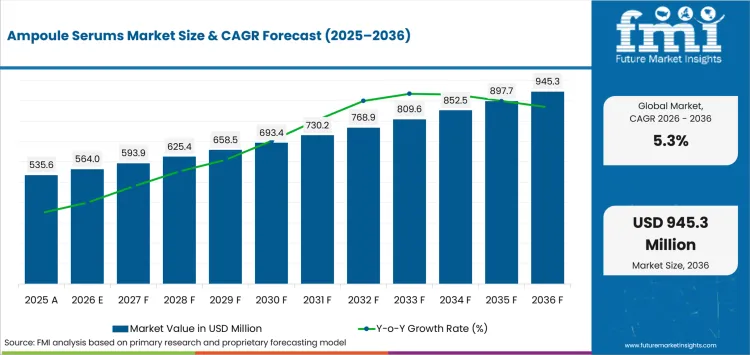
Key Takeaways of Ampoule Serums Market
- Demand is supported by consumers using concentrated skin-care steps for defined concerns that basic moisturizers do not address directly.
- Concentrate serums are estimated to hold 34.0% of product type demand in 2026 because treatment intensity remains easy to communicate.
- Conventional formulations are projected at 52.0% of nature demand in 2026 due to broad ingredient compatibility across accessible and premium ranges.
- Cream & balm formats are anticipated to capture 30.0% of format demand in 2026 as richer textures pair treatment positioning with controlled application.
- Compliance work and irritation risk can reduce launch speed and repeat purchase when active-rich formulas lack clear directions or substantiated claims.
- Some of the key players in this market include Shiseido, Kao Corporation, Beiersdorf, Unilever, Amorepacific, L'Oreal, e.l.f. Beauty, and Estee Lauder Companies.
Analyst Perspective
"Ampoule serums should be evaluated on claim proof, formula tolerance and replenishment economics rather than ingredient novelty alone. Commercial value is earned when a treatment remains credible at the exact price and channel where consumers reorder it."
- Rahul Pandita, Principal Consultant, Future Market Insights
How is the Ampoule Serums Market segmented?
The market is segmented by product type, nature, format, price positioning, sales channel and region.
Product type includes concentrate serums, ampoule formats, booster drops and pressed / balm serums. Nature covers conventional, vegan & cruelty-free, natural & organic, dermocosmetic / clinical and fragrance-free & sensitive. Format covers cream & balm, liquid & serum, stick & solid, spray & mist, sheet & patch and powder. Price positioning includes mass, masstige, premium and professional. Sales channels include e-commerce & DTC, specialty beauty retail, pharmacies & drugstores, supermarkets & hypermarkets and salons & spas.
Why do concentrate serums lead demand within the product type category?
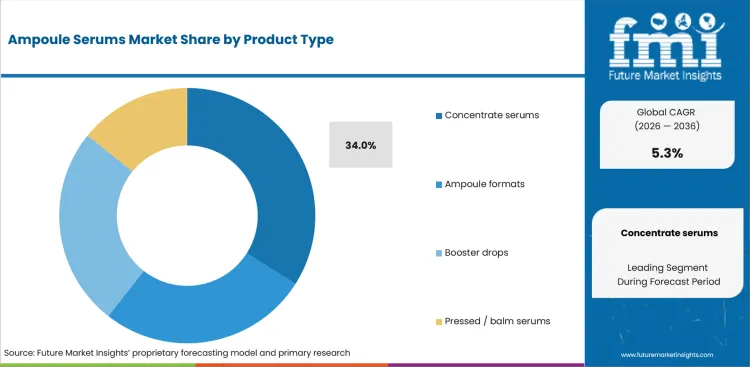
Concentrate serums fit routines that need one clearly defined treatment step between cleansing and moisturization. Amorepacific introduced the IOPE XMD line in North America in March 2026 with XMD Stem III Serum as the hero product and clinical comparison against professional PDRN treatment.
- By product type, concentrate serums are estimated to hold 34.0% in 2026 because dosage and treatment intensity remain easy to explain.
- Brands gain repeat use when efficacy proof supports one defined concern and gives customized skincare a credible treatment route without adding unnecessary application steps.
Why does conventional lead demand within the nature category?
Conventional formulations retain broad freedom across active selection, texture and stability without making an exclusion claim the main reason to purchase. Estee Lauder Companies presented clinical and scientific skin-care research at SCALE in May 2025 across Estée Lauder, Clinique and La Mer franchises.
- Conventional products are projected to represent 52.0% of nature demand in 2026 because established ingredient systems support varied efficacy and sensory targets.
- The format remains commercially durable when brands separate evidence-backed treatment benefits from natural cosmetics claims that answer a different purchasing priority.
Why does mass lead demand within the price positioning category?
Mass positioning lowers the financial risk of adding a concentrated treatment to an everyday routine while preserving room for science-led differentiation. Beiersdorf introduced NIVEA Cellular Epigenetics Rejuvenating Serum in August 2025 and planned availability across 30 countries by year-end.
- Mass products are anticipated to hold 35.0% of price positioning demand in 2026 because accessible pricing supports trial and routine replenishment.
- Retailers still need a specific treatment reason to trade shoppers into facial care products because lower prices alone do not establish durable repeat-use value consistently.
Why does e-commerce & DTC lead demand within the sales channel category?
Serums require explanation at purchase because ingredient logic and application order influence whether a shopper understands the treatment role. e.l.f. Beauty said in May 2025 that rhode had built a direct-to-consumer business with USD 212 million in trailing twelve-month sales before its planned Sephora expansion.
- E-commerce & DTC is estimated to hold 31.0% of sales channel demand in 2026 because digital shelves support education and replenishment in one path.
- Digital conversion improves when product pages explain dosage and texture clearly while showing how a cosmetic dropper or another delivery format fits the routine.
What are the drivers, restraints and opportunities in the Ampoule Serums Market?
Targeted treatment routines support demand, while compliance and tolerance slow some launches, creating room for clinically credible products at accessible price points.
- Driver: Specific efficacy claims make concentrated serum steps easier to compare against generic hydration products.
- Restraint: Registration records, claim substantiation and irritation risk increase the operating burden behind frequent launches.
- Opportunity: Better diagnostic and formulation evidence can support more precise treatments across mass, prestige and sensitive-skin positions.
Specific Treatment Claims Support Routine Adoption
Serum adoption rises when a brand assigns one treatment role to the formula and gives consumers a practical reason to replenish it. Shiseido launched the renewed ULTIMUNE Power Infusing Serum in March 2025 after clinical testing across multiple visible aging measures. That evidence model raises the commercial standard for skin lightening products and other treatment categories that compete for the same routine step.
Compliance Records and Tolerance Limit Launch Speed
Frequent launches require disciplined documentation because cosmetic listings and safety records must remain current as formulas and channels change. The FDA reported about 1.30 million active cosmetic product listings under MoCRA by June 30 2026. Large listing volumes make record control a recurring operating task for national portfolios while irritation concerns still require clear directions and tolerance testing around concentrated formulas.
Better Skin Diagnostics Create More Precise Commercial Routes
The opportunity lies in matching advanced ingredient stories to narrower skin concerns without making the buying decision harder to understand. L'Oreal entered a research partnership with Tru Diagnostic in March 2025 to study relationships between beauty indicators and epigenomic markers. Better targeting can support differentiated ampoule formulas and adjacent encapsulated retinol treatments where evidence must justify a premium or specialist position.
Which country CAGRs are profiled in the Ampoule Serums Market?
| Country | CAGR |
|---|---|
| UAE | 6.6% |
| Saudi Arabia | 6.3% |
| South Korea | 6.0% |
| USA | 5.7% |
| UK | 5.3% |
How do country-level CAGRs compare in the Ampoule Serums Market?
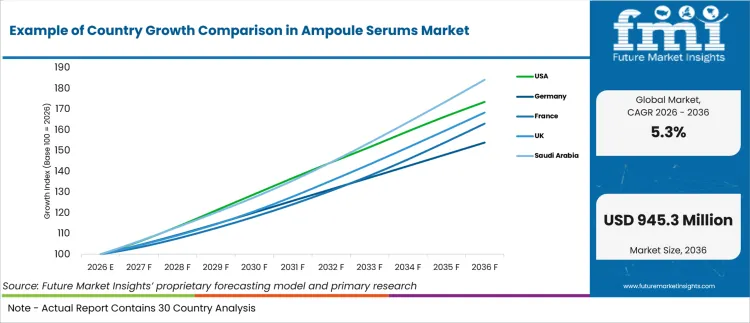
The country outlook spans 1.3 percentage points from UAE at 6.6% to UK at 5.3%. UAE and Saudi Arabia form the faster Gulf group while South Korea follows on shorter launch cycles. USA and UK remain close enough that compliance and retail execution can outweigh narrow forecast differences.
- UAE expansion outlook reflects Dubai’s concentration on premium retail, tourism demand and regional beauty events.
- Saudi Arabia follows as e-commerce oversight raises the value of trusted merchant execution.
- South Korea benefits from export-scale K-beauty and unusually rapid product replacement cycles.
- USA rewards national scale but imposes a large federal product-listing burden on operators.
- UK remains omnichannel while Responsible Person duties raise compliance costs for imported products.
Comparable CAGRs still produce different revenue pools because pricing and channel structures vary. Country CAGR indicates the expected rate of expansion from each country’s own starting point and does not establish absolute market size.
Country-wise Analysis
- UAE beauty distribution is concentrated around premium malls and specialist stores while international trade events give imported serum brands dense discovery opportunities across Dubai and Abu Dhabi. Dubai Media Office reported in October 2025 that Beautyworld Middle East introduced a dedicated Beauty Beginnings zone featuring 18 emerging brands across skincare and adjacent categories for international beauty buyers worldwide. Ampoule serum demand in UAE is forecast to expand at 6.6% CAGR through 2036 as concentrated retail traffic supports launch visibility, yet brands still need verified registration and trusted local partners to prevent authenticity concerns or fragmented merchant execution from weakening repeat purchase.
- Saudi Arabia has a fast-growing online beauty audience that gives serum brands national reach without requiring immediate placement across every physical retail chain or premium mall network. Saudi Arabia is projected to record 6.3% CAGR through 2036 as formal digital channels widen access, although merchant legitimacy and localized product records remain practical entry barriers for imported brands that must protect trust while scaling premium and accessible serum lines nationally. In December 2025 the Ministry of Commerce reported 4,242 anti-concealment inspection visits that included cosmetics retailers and tested whether commercial establishments complied with ownership rules across the Kingdom during November.
- South Korea operates on short beauty launch cycles because domestic trend formation is closely tied to export-oriented K-beauty production and rapid digital feedback from local shoppers. The Ministry of Trade reported in August 2026 that July cosmetics exports reached USD 1.35 billion and increased 37.8% year over year as overseas demand supported another record month. Ampoule serum sales in South Korea are forecast to expand at 6.0% CAGR by 2036 as export scale rewards frequent innovation, but brands face intense replacement pressure and need fast formulation decisions with export-ready documentation before newer active stories divert attention across crowded online channels.
- USA serum brands can scale across mass retail and specialty beauty while direct channels give concentrated treatments rapid national discovery across price tiers and replenishment programmes. USA is estimated to post 5.7% CAGR over the forecast period as channel breadth supports repeat purchasing, yet brands must pair fast launches with substantiated cosmetic claims and dependable inventory so promotional trial converts into replenishment rather than one-time demand across major retailers. The FDA reported 16,398 active cosmetic facility registrations at June 30 2026 as MoCRA made complete federal records a routine requirement behind high-frequency assortment changes across national distribution networks today.
- UK beauty purchasing is strongly omnichannel because shoppers research treatment claims online before buying from specialty stores and high-street retailers with frequent promotions and loyalty programmes. The Office for Product Safety and Standards reported in February 2026 that 168 of 183 sampled cosmetics were non-compliant during its April 2024 to March 2025 testing programme. The UK ampoule serums sector is projected to record 5.3% CAGR during the assessment period as digital discovery widens access, but imported brands need reliable Responsible Person coverage and disciplined product records before broad promotions can generate durable replenishment across national retail accounts consistently over time.
Who are the notable companies in the Ampoule Serums Market?
Shiseido, Kao Corporation, Beiersdorf, Unilever, Amorepacific, L'Oreal, e.l.f. Beauty, and Estee Lauder Companies are the notable companies serving this market.
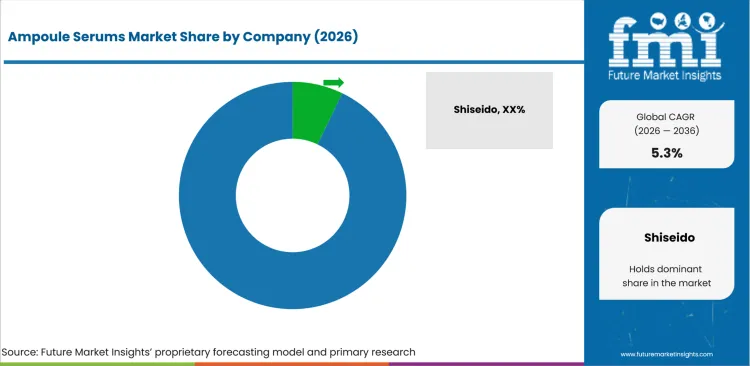
Competition is fragmented across global beauty groups and science-led skin-care franchises beside digitally scaled brands. Entry becomes harder when a new serum lacks clinical support or retail access that can convert launch attention into replenishment. Adjacent solid skin brightening sticks compete for portability-led treatment use across targeted facial-care routines. Facial oil products compete where sensorial richness matters more than concentrated active positioning.
- Shiseido, Kao Corporation, Beiersdorf and Unilever compete with broad research resources and established skin-care distribution.
- Amorepacific, L'Oreal, e.l.f. Beauty and Estee Lauder Companies compete with K-beauty, dermatological, digital-first or prestige serum positions.
Competitive Benchmarking: Ampoule Serums Market
| Company | Serum Portfolio Breadth | Skin-Science Proof | Omnichannel Execution | Geographic Reach |
|---|---|---|---|---|
| Shiseido | Medium | High | High | Global |
| Kao Corporation | Medium | High | Medium | Asia and Europe |
| Beiersdorf | High | High | High | Global |
| Unilever | Medium | High | High | Global |
| Amorepacific | High | High | High | Asia, North America and Europe |
| L'Oreal | High | High | High | Global |
| e.l.f. Beauty | Medium | Medium | High | North America, UK and Europe |
| Estee Lauder Companies | High | High | High | Global |
Key Developments in the Ampoule Serums Market
- In September 2025, Kao Corporation launched Curél Intensive Moisture Care Carbonated Foam Serum in Japan for dry sensitive-skin routines.
- In June 2025, L'Oreal signed an agreement to acquire a majority stake in Medik8 whose premium skin-care portfolio includes Crystal Retinal serum.
- In March 2025, Shiseido launched the renewed ULTIMUNE Power Infusing Serum with Power Fermented Camellia+ technology and refill formats.
Key Players in the Ampoule Serums Market
Global Skin-Science Platforms
- Shiseido
- Kao Corporation
- Beiersdorf
- Unilever
K-Beauty and Dermatological Portfolio Groups
- Amorepacific
- L'Oreal
Digital and Prestige Beauty Platforms
- e.l.f. Beauty
- Estee Lauder Companies
Ampoule Serums Market - Report Scope
| Coverage field | Report scope |
|---|---|
| Market breakdown | By product type, nature, format, price positioning, sales channel and region. |
| Quantitative Units | Revenue in USD million and CAGR In %. |
| Market Definition | Topical facial ampoule serums and concentrated serum-positioned skin treatments sold across the defined product, nature, format, price and sales-channel categories. Raw actives, packaging components, injectable ampoules, devices and professional procedure fees are excluded. |
| Regions Covered | North America, Latin America, Western Europe, Eastern Europe, East Asia, South Asia and Pacific and Middle East and Africa. |
| Countries Covered | UAE, Saudi Arabia, South Korea, USA, UK, and 20+ countries included in the full report. |
| Key Companies Profiled | Shiseido, Kao Corporation, Beiersdorf, Unilever, Amorepacific, L'Oreal, e.l.f. Beauty, Estee Lauder Companies. |
| Forecast Period | 2026 to 2036. |
| Approach | Primary and secondary research with market triangulation. |
Ampoule Serums Market - Research Methodology
| Method | Approach |
|---|---|
| Primary Research | FMI analysts gathered input from manufacturers, service providers, technology developers, distributors, end users, procurement teams, and subject-matter experts. Interviews examined purchasing decisions, product or service evaluation, adoption barriers, approval requirements, pricing considerations, and expectations for technical or commercial support. Respondents were also asked what evidence is required before a trial, pilot, or initial order develops into regular purchasing. |
| Desk Research | Desk research covered government statistics, regulatory publications, trade data, industry associations, technical literature, standards, company filings, product information, and official corporate announcements. Sources were reviewed for relevance, publication date, geographic coverage, and consistency with the defined market scope. Claims relating to performance, applications, approvals, capacity, investment, and commercial activity were retained only when supported by credible public evidence. |
| Market Sizing and Forecasting | The market model combined the baseline value with historical performance, segment structure, pricing and volume indicators, adoption levels, company participation, and country-level demand conditions. Forecast assumptions considered economic activity, investment trends, regulatory developments, technology adoption, purchasing cycles, supply availability, and barriers to wider market use. Segment and regional estimates were reconciled before the final market total was calculated. |
| Data Validation | Estimates were checked against multiple independent indicators, including public data, company activity, trade patterns, industry developments, and findings from primary interviews. Validation also tested whether products, services, applications, and company revenues fell within the defined market boundaries. Adjacent categories, unsupported claims, overlapping revenues, and activities without direct market relevance were excluded to reduce double counting and maintain consistency across segments and countries. |
Ampoule Serums Market by Segments
Ampoule Serums Market segmented by Product Type:
- Concentrate serums
- Ampoule formats
- Booster drops
- Pressed / balm serums
Ampoule Serums Market segmented by Nature:
- Conventional
- Vegan & cruelty-free
- Natural & organic
- Dermocosmetic / clinical
- Fragrance-free & sensitive
Ampoule Serums Market segmented by Format:
- Cream & balm
- Liquid & serum
- Stick & solid
- Spray & mist
- Sheet & patch
- Powder
Ampoule Serums Market segmented by Price Positioning:
- Mass
- Masstige
- Premium
- Professional
Ampoule Serums Market segmented by Sales Channel:
- E-commerce & DTC
- Specialty beauty retail
- Pharmacies & drugstores
- Supermarkets & hypermarkets
- Salons & spas
Ampoule Serums Market by Region:
- North America
- United States
- Canada
- Latin America
- Brazil
- Mexico
- Argentina
- Chile
- Western Europe
- Germany
- France
- United Kingdom
- Italy
- Spain
- Benelux
- Nordics
- Eastern Europe
- Poland
- Czech Republic
- Romania
- Hungary
- East Asia
- China
- Japan
- South Korea
- South Asia and Pacific
- India
- ASEAN
- Australia and New Zealand
- Middle East and Africa
- GCC Countries
- South Africa
- Türkiye
- Israel
Research Sources and Bibliography
- Unilever. (2026, April 27). How AI is transforming innovation in Unilever Beauty & Wellbeing.
- Office for Product Safety and Standards. (2026, July 17). New data on UK cosmetic product safety notifications.
- Amorepacific. (2026, March 18). Clinical Grade IOPE Begins Its Global Journey with Professional PDRN Treatment-level.
- The Estée Lauder Companies. (2025, May 21). ELC Brands Showcase Dermatological Science at SCALE Conference.
- Beiersdorf. (2025, August 13). Beiersdorf brings epigenetic innovation to the mass market: NIVEA serum featuring EPICELLINE.
- e.l.f. Beauty. (2025, May 28). e.l.f. Beauty Announces Definitive Agreement to Acquire rhode.
- Shiseido. (2025, January 22). Backed by world-leading skin research, SHISEIDO’s iconic ULTIMUNE is a serum reborn.
- USA Food and Drug Administration. (2026, July 2). Registration & Listing of Cosmetic Product Facilities and Products.
- L'Oreal Groupe. (2025, March 21). L’Oréal announces strategic research partnership with Tru Diagnostic to advance beauty and longevity science.
- Government of Dubai Media Office. (2025, October 27). Latifa bint Mohammed inaugurates Beautyworld Middle East 2025.
- Saudi Ministry of Commerce. (2025, December 8). National Anti-Commercial Concealment Program Carries Out 4,242 Inspection Visits During November.
- Ministry of Trade, Industry and Resources, Republic of Korea. (2026, August 3). July 2026 Exports Reach USD 98.89 Billion, Second-Highest on Record.
- Office for Product Safety and Standards. (2026, February 18). Product Safety Testing Sampling Protocol Programme: April 2024 to March 2025.
- Kao Corporation. (2025, July 7). Curél Launches Intensive Moisture Care Carbonated Foam Serum.
- L'Oreal Groupe. (2025, June 9). L’Oréal Groupe to acquire a majority stake in Medik8.
- Shiseido. (2026, April 27). Integrated Report 2025.
This bibliography is provided for reader reference and is not exhaustive. The full report contains the complete reference list and detailed citations.
This Report Answers
- How large is the ampoule serums market in 2026 and what value is forecast for 2036?
- What commercial conditions support repeat demand for concentrated facial treatments?
- Which product type holds 34.0% of demand in 2026?
- Why do conventional formulations retain the largest nature share?
- How do price positioning and online channels shape serum replenishment?
- How do growth rates differ across UAE, Saudi Arabia, South Korea, USA and UK?
- Which companies have the strongest serum science and omnichannel reach?
- What compliance and tolerance factors can slow market expansion?
- What should beauty category managers compare before widening ampoule serum assortments?
Frequently Asked Questions
How big is the Ampoule Serums Market in 2026?
The ampoule serums market is estimated at USD 564.0 million in 2026 and is forecast to reach USD 945.3 million by 2036. Concentrated treatment routines support demand across accessible and premium price points where credible claims can sustain routine replenishment.
What is the CAGR of the Ampoule Serums Market from 2026 to 2036?
The ampoule serums market is projected to grow at 5.3% CAGR from 2026 to 2036. Growth depends on credible efficacy claims, routine compatibility and channel execution that converts trial into replenishment.
Which product type leads the Ampoule Serums Market?
The concentrate serums segment is expected to hold 34.0% of the ampoule serums market in 2026, driven by clear treatment positioning and controlled dosing. Routine compatibility supports broad use across mass and prestige ranges where consumers expect a defined treatment step.
Which segment is projected to grow at the fastest pace in the Ampoule Serums Market?
A fastest-growing segment cannot be stated from current share data because no segment-level CAGR is available for the forecast period. Current-share leadership therefore should not be treated as evidence of fastest forecast growth.
Who are the key companies in the Ampoule Serums Market?
Key companies in the ampoule serums market include Shiseido, Kao Corporation, Beiersdorf, Unilever, Amorepacific, L'Oreal, e.l.f. Beauty and Estee Lauder Companies. Their positions span mass and prestige skin care alongside K-beauty and digitally scaled portfolios serving different channel economics.
Preview the report firsthand - request a free sample
Get SampleGet the brochure for pricing and purchase details.
Get PDFTable of Content
- Key Takeaways
- Market Size and CAGR
- Top Growth Driver
- Fastest Growing Segment
- Leading Region
- Key Companies
- Emerging Opportunities
- Executive Summary
- Global Market Outlook
- Demand-side Trends
- Supply-side Trends
- Technology Roadmap Analysis
- Analysis and Recommendations
- Analyst Perspective (What is happening? Why now? What should investors know?)
- Key Questions Answered
- How large is the market?
- What is the CAGR?
- What are key trends?
- Which region dominates?
- Who are the leaders?
- Market Overview
- Market Coverage / Taxonomy
- Market Definition / Scope / Limitations
- Research Methodology
- Chapter Orientation
- Analytical Lens and Working Hypotheses
- Market Structure, Signals, and Trend Drivers
- Benchmarking and Cross-market Comparability
- Market Sizing, Forecasting, and Opportunity Mapping
- Research Design and Evidence Framework
- Desk Research Programme (Secondary Evidence)
- Expert Input and Fieldwork (Primary Evidence)
- Tooling, Models, and Reference Databases
- Data Engineering and Model Build
- Quality Assurance and Audit Trail
- Market Background
- Market Dynamics (Drivers, Restraints, Opportunity, Trends)
- Scenario Forecast (Optimistic, Likely, Conservative)
- Impact Analysis
- AI Impact
- Sustainability Impact
- Regulatory Impact
- Technology Impact
- Consumer / Buyer Analysis
- Purchase Drivers
- Adoption Barriers
- Buyer Journey
- Opportunity Map Analysis
- Product Life Cycle Analysis
- Supply Chain Analysis
- Investment Feasibility Matrix
- Value Chain Analysis
- PESTLE and Porter's Analysis
- Regulatory Landscape
- Regional Parent Market Outlook
- Production and Consumption Statistics
- Import and Export Statistics
- Global Market Analysis and Forecast, 2021 to 2036
- Historical Market Size Value (USD Million) Analysis, 2021 to 2025
- Current and Future Market Size Value (USD Million) Projections, 2026 to 2036
- Y-o-Y Growth Trend Analysis
- Absolute $ Opportunity Analysis
- Global Market Pricing Analysis, 2021 to 2036
- Global Market Analysis and Forecast, By Product Type, 2021 to 2036
- Introduction / Key Findings
- Historical Market Size Value (USD Million) Analysis By Product Type, 2021 to 2025
- Current and Future Market Size Value (USD Million) Analysis and Forecast By Product Type, 2026 to 2036
- Concentrate serums
- Ampoule formats
- Booster drops
- Pressed / balm serums
- Concentrate serums
- Y-o-Y Growth Trend Analysis By Product Type, 2021 to 2025
- Absolute $ Opportunity Analysis By Product Type, 2026 to 2036
- Global Market Analysis and Forecast, By Nature, 2021 to 2036
- Introduction / Key Findings
- Historical Market Size Value (USD Million) Analysis By Nature, 2021 to 2025
- Current and Future Market Size Value (USD Million) Analysis and Forecast By Nature, 2026 to 2036
- Conventional
- Vegan & cruelty-free
- Natural & organic
- Dermocosmetic / clinical
- Fragrance-free & sensitive
- Conventional
- Y-o-Y Growth Trend Analysis By Nature, 2021 to 2025
- Absolute $ Opportunity Analysis By Nature, 2026 to 2036
- Global Market Analysis and Forecast, By Format, 2021 to 2036
- Introduction / Key Findings
- Historical Market Size Value (USD Million) Analysis By Format, 2021 to 2025
- Current and Future Market Size Value (USD Million) Analysis and Forecast By Format, 2026 to 2036
- Cream & balm
- Liquid & serum
- Stick & solid
- Spray & mist
- Sheet & patch
- Powder
- Cream & balm
- Y-o-Y Growth Trend Analysis By Format, 2021 to 2025
- Absolute $ Opportunity Analysis By Format, 2026 to 2036
- Global Market Analysis and Forecast, By Price Positioning, 2021 to 2036
- Introduction / Key Findings
- Historical Market Size Value (USD Million) Analysis By Price Positioning, 2021 to 2025
- Current and Future Market Size Value (USD Million) Analysis and Forecast By Price Positioning, 2026 to 2036
- Mass
- Masstige
- Premium
- Professional
- Mass
- Y-o-Y Growth Trend Analysis By Price Positioning, 2021 to 2025
- Absolute $ Opportunity Analysis By Price Positioning, 2026 to 2036
- Global Market Analysis and Forecast, By Sales Channel, 2021 to 2036
- Introduction / Key Findings
- Historical Market Size Value (USD Million) Analysis By Sales Channel, 2021 to 2025
- Current and Future Market Size Value (USD Million) Analysis and Forecast By Sales Channel, 2026 to 2036
- E-commerce & DTC
- Specialty beauty retail
- Pharmacies & drugstores
- Supermarkets & hypermarkets
- Salons & spas
- E-commerce & DTC
- Y-o-Y Growth Trend Analysis By Sales Channel, 2021 to 2025
- Absolute $ Opportunity Analysis By Sales Channel, 2026 to 2036
- Global Market Analysis and Forecast, By Region, 2021 to 2036
- Introduction
- Historical Market Size Value (USD Million) Analysis By Region, 2021 to 2025
- Current Market Size Value (USD Million) Analysis and Forecast By Region, 2026 to 2036
- North America
- Latin America
- Western Europe
- Eastern Europe
- East Asia
- South Asia and Pacific
- Middle East & Africa
- Market Attractiveness Analysis By Region
- North America Market Analysis and Forecast, By Country, 2021 to 2036
- Historical Market Size Value (USD Million) Trend Analysis By Market Taxonomy, 2021 to 2025
- Market Size Value (USD Million) Forecast By Market Taxonomy, 2026 to 2036
- By Country
- USA
- Canada
- By Product Type
- By Nature
- By Format
- By Price Positioning
- By Sales Channel
- By Country
- Market Attractiveness Analysis
- By Country
- By Product Type
- By Nature
- By Format
- By Price Positioning
- By Sales Channel
- Key Takeaways
- Latin America Market Analysis and Forecast, By Country
- Historical Market Size Value (USD Million) Trend Analysis By Market Taxonomy, 2021 to 2025
- Market Size Value (USD Million) Forecast By Market Taxonomy, 2026 to 2036
- By Country
- Brazil
- Mexico
- Chile
- Rest of Latin America
- By Product Type
- By Nature
- By Format
- By Price Positioning
- By Sales Channel
- By Country
- Market Attractiveness Analysis
- By Country
- By Product Type
- By Nature
- By Format
- By Price Positioning
- By Sales Channel
- Key Takeaways
- Western Europe Market Analysis and Forecast, By Country
- Historical Market Size Value (USD Million) Trend Analysis By Market Taxonomy, 2021 to 2025
- Market Size Value (USD Million) Forecast By Market Taxonomy, 2026 to 2036
- By Country
- Germany
- UK
- Italy
- Spain
- France
- Nordic
- BENELUX
- Rest of Western Europe
- By Product Type
- By Nature
- By Format
- By Price Positioning
- By Sales Channel
- By Country
- Market Attractiveness Analysis
- By Country
- By Product Type
- By Nature
- By Format
- By Price Positioning
- By Sales Channel
- Key Takeaways
- Eastern Europe Market Analysis and Forecast, By Country
- Historical Market Size Value (USD Million) Trend Analysis By Market Taxonomy, 2021 to 2025
- Market Size Value (USD Million) Forecast By Market Taxonomy, 2026 to 2036
- By Country
- Russia
- Poland
- Hungary
- Balkan & Baltic
- Rest of Eastern Europe
- By Product Type
- By Nature
- By Format
- By Price Positioning
- By Sales Channel
- By Country
- Market Attractiveness Analysis
- By Country
- By Product Type
- By Nature
- By Format
- By Price Positioning
- By Sales Channel
- Key Takeaways
- East Asia Market Analysis and Forecast, By Country
- Historical Market Size Value (USD Million) Trend Analysis By Market Taxonomy, 2021 to 2025
- Market Size Value (USD Million) Forecast By Market Taxonomy, 2026 to 2036
- By Country
- China
- Japan
- South Korea
- By Product Type
- By Nature
- By Format
- By Price Positioning
- By Sales Channel
- By Country
- Market Attractiveness Analysis
- By Country
- By Product Type
- By Nature
- By Format
- By Price Positioning
- By Sales Channel
- Key Takeaways
- South Asia and Pacific Market Analysis and Forecast, By Country
- Historical Market Size Value (USD Million) Trend Analysis By Market Taxonomy, 2021 to 2025
- Market Size Value (USD Million) Forecast By Market Taxonomy, 2026 to 2036
- By Country
- India
- ASEAN
- Australia & New Zealand
- Rest of South Asia and Pacific
- By Product Type
- By Nature
- By Format
- By Price Positioning
- By Sales Channel
- By Country
- Market Attractiveness Analysis
- By Country
- By Product Type
- By Nature
- By Format
- By Price Positioning
- By Sales Channel
- Key Takeaways
- Middle East & Africa Market Analysis and Forecast, By Country
- Historical Market Size Value (USD Million) Trend Analysis By Market Taxonomy, 2021 to 2025
- Market Size Value (USD Million) Forecast By Market Taxonomy, 2026 to 2036
- By Country
- Kingdom of Saudi Arabia
- Other GCC Countries
- Türkiye
- South Africa
- Other African Union
- Rest of Middle East & Africa
- By Product Type
- By Nature
- By Format
- By Price Positioning
- By Sales Channel
- By Country
- Market Attractiveness Analysis
- By Country
- By Product Type
- By Nature
- By Format
- By Price Positioning
- By Sales Channel
- Key Takeaways
- Key Countries Market Analysis
- USA
- Pricing Analysis
- Market Share Analysis, 2025
- By Product Type
- By Nature
- By Format
- By Price Positioning
- By Sales Channel
- Canada
- Pricing Analysis
- Market Share Analysis, 2025
- By Product Type
- By Nature
- By Format
- By Price Positioning
- By Sales Channel
- Mexico
- Pricing Analysis
- Market Share Analysis, 2025
- By Product Type
- By Nature
- By Format
- By Price Positioning
- By Sales Channel
- Brazil
- Pricing Analysis
- Market Share Analysis, 2025
- By Product Type
- By Nature
- By Format
- By Price Positioning
- By Sales Channel
- Chile
- Pricing Analysis
- Market Share Analysis, 2025
- By Product Type
- By Nature
- By Format
- By Price Positioning
- By Sales Channel
- Germany
- Pricing Analysis
- Market Share Analysis, 2025
- By Product Type
- By Nature
- By Format
- By Price Positioning
- By Sales Channel
- UK
- Pricing Analysis
- Market Share Analysis, 2025
- By Product Type
- By Nature
- By Format
- By Price Positioning
- By Sales Channel
- Italy
- Pricing Analysis
- Market Share Analysis, 2025
- By Product Type
- By Nature
- By Format
- By Price Positioning
- By Sales Channel
- Spain
- Pricing Analysis
- Market Share Analysis, 2025
- By Product Type
- By Nature
- By Format
- By Price Positioning
- By Sales Channel
- France
- Pricing Analysis
- Market Share Analysis, 2025
- By Product Type
- By Nature
- By Format
- By Price Positioning
- By Sales Channel
- India
- Pricing Analysis
- Market Share Analysis, 2025
- By Product Type
- By Nature
- By Format
- By Price Positioning
- By Sales Channel
- ASEAN
- Pricing Analysis
- Market Share Analysis, 2025
- By Product Type
- By Nature
- By Format
- By Price Positioning
- By Sales Channel
- Australia & New Zealand
- Pricing Analysis
- Market Share Analysis, 2025
- By Product Type
- By Nature
- By Format
- By Price Positioning
- By Sales Channel
- China
- Pricing Analysis
- Market Share Analysis, 2025
- By Product Type
- By Nature
- By Format
- By Price Positioning
- By Sales Channel
- Japan
- Pricing Analysis
- Market Share Analysis, 2025
- By Product Type
- By Nature
- By Format
- By Price Positioning
- By Sales Channel
- South Korea
- Pricing Analysis
- Market Share Analysis, 2025
- By Product Type
- By Nature
- By Format
- By Price Positioning
- By Sales Channel
- Russia
- Pricing Analysis
- Market Share Analysis, 2025
- By Product Type
- By Nature
- By Format
- By Price Positioning
- By Sales Channel
- Poland
- Pricing Analysis
- Market Share Analysis, 2025
- By Product Type
- By Nature
- By Format
- By Price Positioning
- By Sales Channel
- Hungary
- Pricing Analysis
- Market Share Analysis, 2025
- By Product Type
- By Nature
- By Format
- By Price Positioning
- By Sales Channel
- Kingdom of Saudi Arabia
- Pricing Analysis
- Market Share Analysis, 2025
- By Product Type
- By Nature
- By Format
- By Price Positioning
- By Sales Channel
- Türkiye
- Pricing Analysis
- Market Share Analysis, 2025
- By Product Type
- By Nature
- By Format
- By Price Positioning
- By Sales Channel
- South Africa
- Pricing Analysis
- Market Share Analysis, 2025
- By Product Type
- By Nature
- By Format
- By Price Positioning
- By Sales Channel
- USA
- Market Structure Analysis
- Competition Dashboard
- Competition Benchmarking
- Market Share Analysis of Top Players
- By Regional
- By Product Type
- By Nature
- By Format
- By Price Positioning
- By Sales Channel
- Emerging Startups
- Innovation Benchmarking
- Competition Analysis
- Competition Deep Dive
- Shiseido
- Overview
- Product Portfolio
- Profitability by Market Segments
- Sales Footprint
- Strategy Overview
- Marketing Strategy
- Product Strategy
- Channel Strategy
- Kao Corporation
- Beiersdorf
- Coty
- Unilever
- Amorepacific
- L'Oreal
- Procter & Gamble
- e.l.f. Beauty
- Estee Lauder Companies
- Shiseido
- Case Studies
- Success Stories
- Recent Developments
- Competition Deep Dive
- Assumptions & Acronyms Used


