

- Industry Size (2026):
- USD 2.1 Bn
- Forecast (2036):
- USD 7.3 Bn
- CAGR (2026 to 2036)
- 13.3%
BioCircuit Serums Market Forecast and Outlook 2026 to 2036
The global biocircuit serums sector is projected to expand from USD 2.1 billion in 2026 to USD 7.3 billion by 2036, registering a strong CAGR of 13.2% over the forecast period. As per Future Market Insights, expansion is structurally underpinned by dermatological research validating that aged skin exhibits reduced bioelectric activity with diminished transmembrane voltage potentials correlating to decreased cellular function, creating scientific rationale for topical interventions restoring electrical signaling.
L'Oréal Group, parent company of SkinCeuticals, noted in its 2023 Annual Report that the company's active cosmetics division continues advancing research in skin biology and cellular mechanisms, with management highlighting investment in understanding how cells communicate and respond to environmental stressors, though specific bioelectric formulation revenue was not disclosed separately as it represents an emerging segment within the broader professional skincare portfolio.
This scientific foundation compels formulators to develop peptide sequences and bioactive compounds that modulate ion channel activity, cell membrane polarization, and gap junction communication that decline during chronological and photoaging processes. Simultaneously the regulatory landscape requires cosmetic bioelectric claims to avoid crossing into medical device territory, forcing brands to carefully position products around natural cellular function support rather than electrical current application that would trigger FDA or EU medical device classification.
The operational reality for cosmetics manufacturers is defined by formulation complexity where peptide stability, penetration enhancement, and bioelectric activity preservation require sophisticated delivery systems protecting active ingredients from degradation while enabling transdermal migration to viable epidermis and dermis target sites. Clinical substantiation requirements for bioelectric efficacy claims necessitate specialized testing including membrane potential measurement, ion flux quantification, and cellular communication assays beyond standard cosmetic safety and compatibility protocols, creating barriers to entry favoring established brands with research infrastructure.
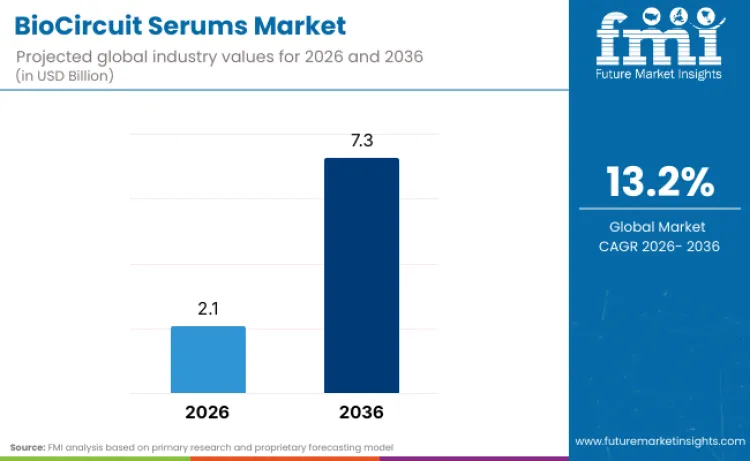
Summary of BioCircuit Serums Market
What Is Growth Outlook for BioCircuit Serums Market as per Future Market Insights Projection?
Future Market Insights projects the biocircuit serums market to expand at a CAGR of 13.2% from 2026 to 2036, increasing from USD 2.1 Billion in 2026 to USD 7.3 Billion by 2036.
FMI Research Approach: FMI proprietary forecasting model based on advanced peptide technology adoption curves, dermatologist-recommended product penetration rates, and bioelectric skincare consumer awareness trajectories informed by microcurrent facial device familiarity.
Which Country Holds Largest Share in Global BioCircuit Serums Market?
The United States holds a significant share supported by dermatology practice recommendations, aesthetic medicine clinic distribution, and consumer receptivity to science-backed innovative technologies following microcurrent facial treatment popularization. Cosmeceuticals market convergence with bioelectric technologies informs advanced active ingredient development.
FMI Research Approach: FMI country-level revenue modeling by professional skincare penetration rates, dermatologist recommendation patterns, and consumer technology adoption in beauty categories.
What Are Globally Unique Trends Shaping BioCircuit Serums Market?
Globally unique trends include companion at-home microcurrent devices that enhance serum bioelectric activity through synchronized electrical stimulation, personalized formulation platforms using skin bioimpedance measurements to customize peptide circuit concentrations, and transdermal patch delivery systems maintaining continuous bioelectric modulation across 8-12 hour overnight application periods. Beauty devices market integration creates synergistic product ecosystems combining topical and electrical interventions.
FMI Research Approach: Beauty technology convergence tracking and transdermal delivery innovation monitoring examining next-generation active ingredient optimization approaches.
BioCircuit Serums Market Key Takeaways
| Metric | Details |
|---|---|
| Industry Size (2026) | USD 2.1 Billion |
| Industry Value (2036) | USD 7.3 Billion |
| CAGR (2026-2036) | 13.2% |
Source: Future Market Insights (FMI) analysis, based on proprietary forecasting model and primary research
Which Factors Propel Adoption of BioCircuit Serums?
Microcurrent facial device proliferation serves as the primary catalyst, as consumer familiarity with bioelectric skin stimulation through at-home and professional treatments establishes conceptual foundation for topical formulations claiming bioelectric benefits. Devices including NuFace, ZIIP Beauty, and CurrentBody generating USD 180-450 retail pricing and achieving mainstream visibility through social media beauty influencer content created consumer awareness that electrical signals influence cellular behavior, reducing education barriers for topical bioelectric serums positioned as complementary or standalone interventions. This device-established precedent enables brands to introduce bioelectric concepts through familiar reference points rather than requiring entirely novel consumer education from zero baseline understanding.
Dermatologist endorsement amplifies adoption as medical aesthetics practices incorporate bioelectric serums into post-procedure protocols where cellular repair acceleration becomes clinically valuable following laser resurfacing, chemical peels, and microneedling treatments that temporarily disrupt skin barrier function and cellular homeostasis. Published research in the Journal of Cosmetic Dermatology demonstrating that peptide-based bioelectric modulators accelerate wound healing and reduce inflammation provides clinical evidence supporting professional recommendations, converting bioelectric serums from cosmetic novelties to evidence-based therapeutic adjuncts within dermatology treatment algorithms.
How is the BioCircuit Serums Market Segmented?
The biocircuit serums market is segmented by product type, technology, skin concern, distribution channel, end user, and region to reflect the multiple pathways through which bioelectric skincare is developed, validated, and adopted. By product type, the market includes skin repair serums, anti-aging serums, hydration-boosting serums, and brightening serums, with repair-oriented formulations forming the core clinical entry point. By technology, segmentation spans bioelectric signal modulation, peptide circuit technology, microcurrent-activated formulations, and cell signaling pathway formulas, highlighting the shift from passive ingredient delivery toward active cellular communication systems.
By skin concern, demand concentrates around wrinkles and fine lines, loss of firmness, hyperpigmentation, dehydration, and sensitive skin, aligning bioelectric intervention with measurable aging and barrier dysfunction outcomes. By distribution channel, adoption is led by online direct-to-consumer platforms and dermatology clinics, while medical spas and premium beauty retail support experiential validation. By end user, home-use consumers dominate, with professional aesthetic use reinforcing credibility.
FMI analysis indicates that while innovation in bioelectric technology is accelerating rapidly, market structure remains anchored in clinically interpretable use cases, where repair-first positioning builds trust before broader aesthetic expansion.
Why Do Skin Repair Formulations Hold Dominant Product Type Share?
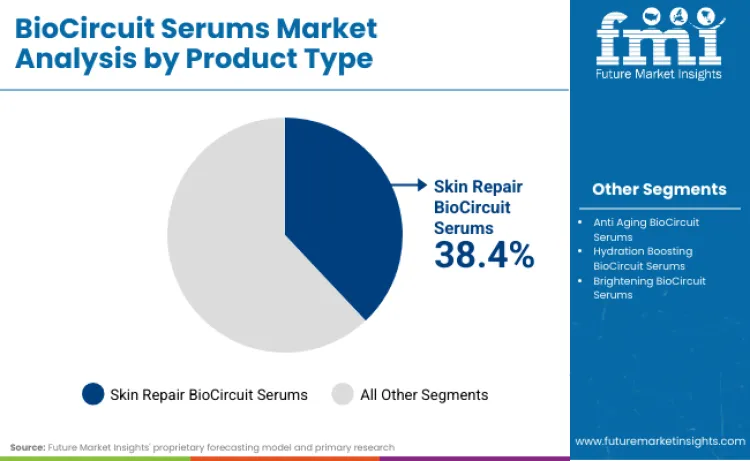
Skin repair biocircuit serums maintain 38.4% share due to strongest clinical evidence where barrier function restoration, wound healing acceleration, and inflammation reduction demonstrate measurable bioelectric activity correlations. Research published in the International Journal of Molecular Sciences validates that disrupted skin barrier exhibits altered transmembrane potentials and reduced gap junction communication, with peptide-mediated electrical gradient restoration showing objective improvements in transepidermal water loss, stratum corneum integrity, and inflammatory marker reduction.
This evidence base enables clinical positioning beyond purely cosmetic claims, attracting dermatologist recommendations for rosacea, atopic dermatitis, and post-procedure recovery where therapeutic rather than aesthetic benefits drive purchasing decisions.
Why Does Bioelectric Signal Modulation Lead Technology Segments?
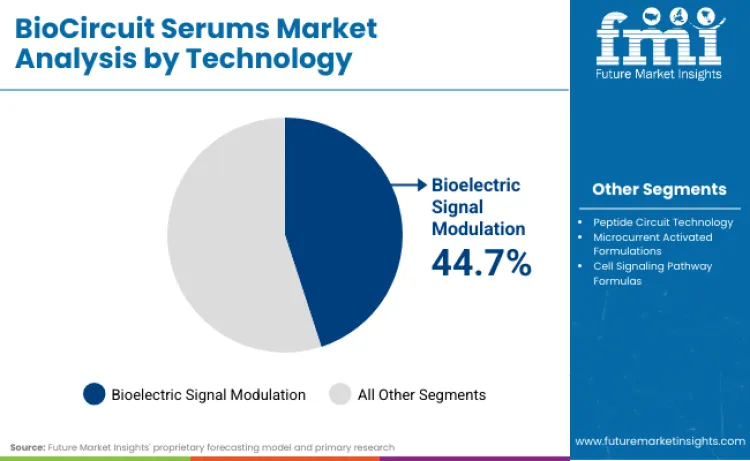
Bioelectric signal modulation captures 44.7% technology share as the most scientifically sophisticated approach utilizing specific peptide sequences designed to interact with voltage-gated calcium channels, potassium channels, and connexin proteins forming gap junctions between cells.
These targeted mechanisms demonstrate superior specificity compared to generalized cell signaling peptides or microcurrent-activated formulations requiring external electrical input. The technology's intellectual property protectability through peptide sequence patents creates competitive advantages where brands secure exclusivity preventing immediate competitor replication, justifying R&D investment in peptide discovery programs and clinical validation studies.
Why Does Online Direct-to-Consumer Lead Distribution?
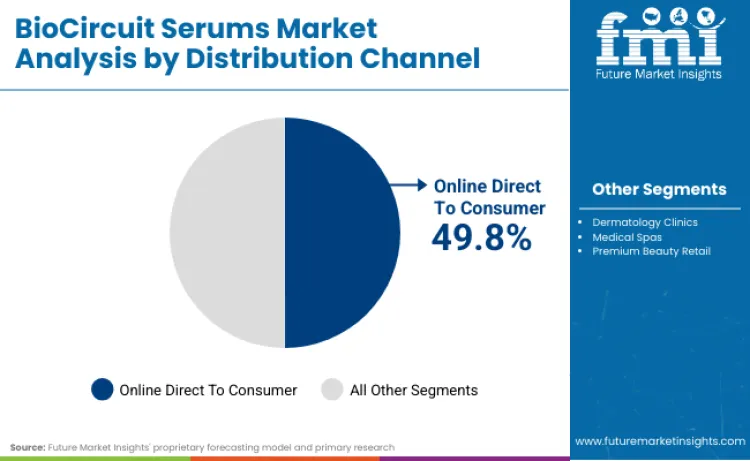
Online DTC channels hold 49.8% distribution share as bioelectric technology complexity requires extensive consumer education through long-form content, video demonstrations, and clinical study summaries that traditional retail shelf placements cannot accommodate within standard package sizing and point-of-sale materials.
Brands including Alastin Skincare, Augustinus Bader, and Zelens built direct-to-consumer businesses specifically enabling detailed mechanism-of-action explanations, before-after case studies, and professional testimonials that educate consumers on bioelectric concepts unfamiliar from conventional skincare experience. Subscription models emerging through direct channels create recurring revenue streams where initial serum purchases convert to automatic monthly replenishment, increasing customer lifetime value beyond one-time retail transactions.
Why Is Science-Driven Consumer Behavior Reshaping BioCircuit Serum Adoption?
Consumer psychology is shifting decisively toward science-driven purchasing, where understanding ingredient mechanisms and cellular-level action increasingly outweighs brand heritage or celebrity endorsement. BioCircuit serums benefit directly from this shift because their value proposition is rooted in explainable biology rather than abstract claims. Educational content explaining peptide sequences, ion channels, and cellular communication transforms serum usage into an active, intellectually engaging process.
Consumers are no longer passive recipients of moisturization but participants in skin optimization, seeking products that demonstrate how and why they work. This preference for mechanistic clarity elevates bioelectric serums above conventional formulations, as they offer measurable, conceptually grounded intervention rather than surface-level cosmetic enhancement.
How Is Diagnostic-Guided Personalization Changing Skincare Application?
Manufacturers are increasingly integrating companion diagnostic tools that measure skin bioimpedance or membrane potential to quantify individual bioelectric status. These measurements enable personalized formulation recommendations, where compromised, high-impedance skin is directed toward intensive repair bioelectric serums, while normal-impedance skin is guided toward anti-aging formulations. This device-guided approach introduces scientific rigor similar to medical treatment protocols, shifting skincare from habitual application to data-informed intervention. Progress can be monitored through objective metrics rather than subjective visual assessment, reinforcing trust in outcomes. As personalization becomes evidence-anchored, bioelectric serums gain credibility as precision tools rather than generic skincare products.
What Role Do Advanced Delivery Systems Play in Sustained Bioelectric Modulation?
Formulation technology is advancing toward time-release systems in which peptide circuits activate sequentially over 8–12 hour periods, delivering sustained bioelectric modulation instead of short-lived exposure from immediate-release serums. This approach aligns with the skin’s natural nocturnal repair cycle, when collagen synthesis and growth factor activity peak. Convergence with the dermatology devices market is accelerating development of overnight bioelectric therapy concepts, where delivery systems protect peptide integrity while extending biological activity during sleep. These advances move bioelectric serums beyond cosmetic routines into chronobiology-aligned cellular repair platforms, strengthening their positioning as next-generation therapeutic skincare solutions.
How Will BioCircuit Serums Market Expansion Unfold Across Key Global Regions?
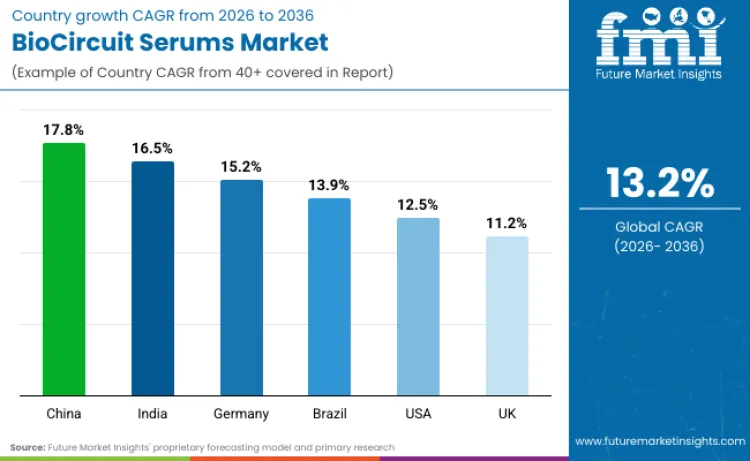
The biocircuit serums market is poised for significant expansion with varying growth rates projected from 2026 to 2036. China leads with 17.8% CAGR driven by medical aesthetics clinic proliferation and consumer appetite for innovative beauty technology following K-beauty and J-beauty bioelectric skincare adoption. India follows at 16.5% benefiting from expanding dermatology practice networks and growing affluent consumer segments seeking premium anti-aging solutions. Germany records 15.2% reflecting European advanced active ingredient preferences and pharmacy-channel professional consultation. Brazil anticipates 13.9% growth from aesthetic medicine popularity and domestic prestige beauty market expansion. The United States at 12.5% maintains substantial scale through dermatologist recommendations and direct-to-consumer brand innovation. The United Kingdom at 11.2% shows steady growth from science-focused beauty retail and clean beauty technology acceptance.
| Country | CAGR (2026-2036) |
|---|---|
| China | 17.8% |
| India | 16.5% |
| Germany | 15.2% |
| Brazil | 13.9% |
| United States | 12.5% |
| United Kingdom | 11.2% |
Source: Future Market Insights (FMI) analysis
Why is India’s Dermatology Network Accelerating Adoption?
India is expanding at a 16.5% CAGR, driven by rapid professionalization of dermatology and aesthetics practice rather than mass consumer marketing alone. The Dermatology, Aesthetics, and Surgery International League (DASIL) identifies India as one of the fastest-growing dermatology and surgical markets globally, reflecting the scale and velocity of clinical expansion. Structured mentoring programs now connect senior international dermatologists with early-career practitioners, standardizing how advanced serums and next-generation aesthetic technologies are administered. This professional alignment reduces variability in treatment protocols and builds clinician confidence in recommending high-performance formulations.
Urban dermatology clinics are increasingly positioned as education hubs, where patients are introduced to advanced serums as part of medically guided routines rather than discretionary cosmetic purchases. FMI analysis indicates that this clinician-led diffusion model is accelerating trust, shortening adoption cycles, and anchoring premium skincare growth in medical authority rather than influencer-driven discovery.
How is China Redefining Skincare Through Biotechnology?
China is growing at a 17.8% CAGR, transitioning decisively from influencer-led skincare consumption toward research-driven product development. Regulatory disclosures from the National Medical Products Administration show that functional cosmetics now account for more than 45% of new skincare filings, with anti-aging, barrier repair, and sensitive-skin products dominating approvals. This shift reflects a deeper structural change in how Chinese consumers evaluate efficacy, favoring biologically grounded claims over aesthetic storytelling alone. Domestic brands are advancing a “BioActive” strategy, integrating biotechnology, artificial intelligence, and refined traditional Chinese medicine inputs into modern formulations. FMI analysis indicates that Chinese skincare brands are no longer positioned as followers of Western or Korean innovation cycles, but as originators of bioelectric and cellular-function-led concepts. This reorientation is redefining China as a global center for biotech-enabled skincare, where laboratory validation increasingly dictates premium market leadership.
How is Germany Enforcing Stringent Bio-Safety Standards?
Germany is advancing at a 15.2% CAGR, shaped by one of the most rigorous cosmetic regulatory environments globally. Under European Cosmetics Regulation (EC) No 1223/2009, every skincare product sold in Germany must undergo comprehensive safety assessments covering ingredient origin, concentration, and cumulative exposure risk. This framework strongly favors pharmacy-grade efficacy and discourages speculative or weakly substantiated claims.
German consumers exhibit high trust in regulatory oversight and professional recommendation, reinforcing demand for clinically validated serums positioned closer to therapeutic care than lifestyle beauty. FMI analysis suggests that Germany’s growth is less about rapid experimentation and more about disciplined scale-up of technologies that meet strict safety and documentation thresholds. As a result, bioelectric and advanced peptide serums gain traction only after passing extensive evaluation, creating a market where credibility, compliance, and pharmacist endorsement drive sustained premium adoption.
Why is Brazil Integrating Aesthetic Medicine and Prestige Beauty?
Brazil is expanding at a 13.9% CAGR, reflecting a cultural shift toward non-invasive facial harmonization and medically guided beauty routines. The country ranks as the third-largest global market for aesthetic medicine, supported by a uniquely broad professional base in which dentists, pharmacists, and biomedical professionals are authorized to perform non-surgical procedures. This structure blurs traditional boundaries between clinical treatment and prestige beauty, accelerating adoption of advanced serums as post-procedure maintenance tools.
Consumers increasingly encounter high-performance skincare within medical contexts, reinforcing trust and willingness to invest in premium formulations. FMI analysis indicates that Brazil’s integration of aesthetics and healthcare is creating a fertile environment for technologically advanced serums, where professional endorsement substitutes for regulatory conservatism and enables faster diffusion across a large, beauty-engaged population.
How is the US Market Stabilizing Under New FDA Quality Regulations?
The United States is growing at a 12.5% CAGR, supported by regulatory stabilization rather than deregulation. The FDA’s Quality Management System Regulation (QMSR), effective February 2026, harmonizes U.S. manufacturing expectations with international quality standards, reinforcing consistency, traceability, and process control. While primarily directed at medical devices, this regulatory clarity indirectly benefits adjacent advanced skincare technologies that operate near the cosmetic–device boundary. Manufacturers now face clearer expectations around quality systems, reducing uncertainty that previously constrained innovation investment. FMI analysis indicates that the U.S. market is entering a maturity phase where growth is driven by disciplined execution, clinical alignment, and quality assurance rather than speculative claims. Dermatologist recommendation, supported by standardized manufacturing practices, is becoming the central mechanism sustaining adoption of advanced serums.
Why is the UK Focusing on Science-Led “Clean Tech” Beauty?
The United Kingdom is advancing at an 11.2% CAGR, driven by a shift toward intentional, science-led beauty and technology-enabled wellness. Industry bodies highlight that beauty technology is becoming increasingly accessible, with devices and advanced formulations moving rapidly from novelty to routine use across salons, clinics, and home settings. Consumers are demonstrating preference for products that combine clean positioning with measurable technological function, reinforcing demand for serums supported by credible scientific narratives. FMI analysis suggests that the UK market is less influenced by aggressive performance claims and more by coherence between sustainability, technology, and evidence. This balance is positioning science-led skincare as a long-term growth vector, where advanced serums are adopted as part of integrated wellness ecosystems rather than isolated cosmetic upgrades.
What Strategic Moves Are Defining Competitive Landscape?
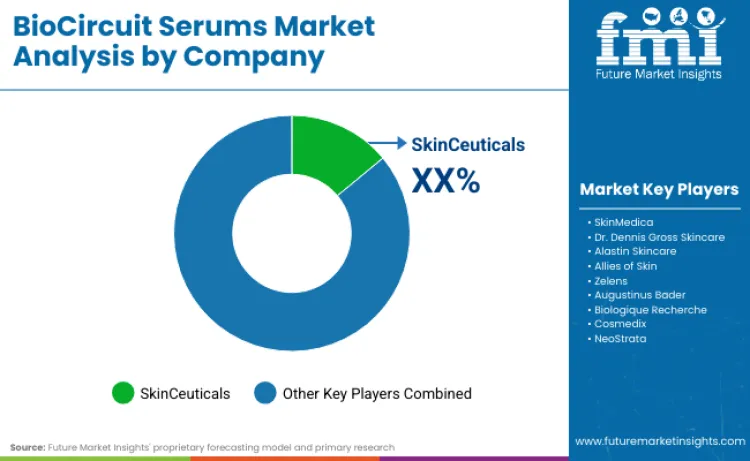
The competitive landscape experiences intellectual property strategy as brands secure peptide sequence patents protecting specific bioelectric formulations from competitor replication, creating exclusivity periods enabling market establishment before generic alternatives emerge. Companies including Alastin Skincare and Augustinus Bader built product portfolios around proprietary peptide complexes developed through academic partnerships, with university-licensed technology providing credibility and legal protection simultaneously.
Partnership models emerge between serum brands and microcurrent device manufacturers where combined product-device protocols create synergistic systems optimizing bioelectric benefit through coordinated topical and electrical interventions. Skin care products market convergence with device technology enables ecosystem positioning where serums become essential consumables rather than standalone products, creating recurring revenue through usage-linked replenishment.
Clinical substantiation investments focus on objective measurement methodologies including bioimpedance spectroscopy, ion flux quantification, and cellular communication assays that generate scientific evidence differentiating bioelectric serums from conventional cosmetic peptides through measurable mechanism-of-action documentation rather than purely visual assessment. Brands conducting robust clinical programs are securing publication in peer-reviewed dermatology journals, creating professional credibility attracting dermatologist recommendations.
Recent Developments:
In October 2025, Allergan Aesthetics, an AbbVie company, announced refreshed SkinMedica® packaging, introducing a modernized logo, premium copper accents, and clearer navigation to enhance consumer experience while advancing sustainability across its professional skincare portfolio.
In February 2024, SkinCeuticals launched an advanced bioelectric peptide serum targeting gap junction communication with proprietary connexin-modulating peptide sequences.
Key Players in BioCircuit Serums Market
- SkinCeuticals (L'Oréal Group)
- SkinMedica (Allergan Aesthetics)
- Dr. Dennis Gross Skincare LLC
- Alastin Skincare Inc.
- Allies of Skin
- Zelens
- Augustinus Bader
- Biologique Recherche
- Cosmedix Inc.
- NeoStrata Company Inc.
Market Definition
The biocircuit serums market represents revenue generated from topical facial serums formulated with bioelectric signal modulating peptides, ion channel targeting compounds, and cellular communication enhancers that influence skin cell membrane potentials, gap junction activity, and voltage-gated channel function to optimize cellular behavior including collagen synthesis, barrier formation, and inflammation resolution. The market measures sales value of premium serums sold through dermatology practices, medical spas, online direct-to-consumer channels, and specialty beauty retail to consumers seeking science-backed anti-aging and skin repair benefits through advanced peptide technology.
Inclusions cover skin repair bioelectric serums targeting barrier restoration and wound healing, anti-aging formulations addressing wrinkles and firmness, hydration boosting products optimizing water channel function, and brightening serums modulating melanocyte electrical activity. Technology categories include bioelectric signal modulation through specific ion channel peptides, peptide circuit systems targeting multiple electrical pathways, microcurrent-activated formulations designed for companion device use, and cell signaling pathway formulas influencing voltage-dependent cellular responses. Skin concerns addressed include wrinkles and fine lines, loss of firmness, hyperpigmentation, dehydration, and sensitive skin requiring gentle bioelectric intervention. Distribution encompasses online direct-to-consumer education-rich platforms, dermatology clinics providing professional recommendations, medical spas incorporating serums into treatment protocols, and premium beauty retail offering consultation services.
Exclusions include conventional peptide serums lacking specific bioelectric mechanism targeting. Microcurrent facial devices applying external electrical current represent separate category despite conceptual overlap. General anti-aging serums without bioelectric activity substantiation fall outside scope. Injectable neuromodulators and dermal fillers addressing aging through invasive intervention are excluded. Body care products focusing on areas other than face are not included. Mass-market serums lacking premium peptide technology and clinical validation are outside market definition.
Scope of Report
| Items | Values |
|---|---|
| Quantitative Units | USD billion |
| Product Type | Skin Repair BioCircuit Serums; Anti-Aging BioCircuit Serums; Hydration Boosting BioCircuit Serums; Brightening BioCircuit Serums |
| Technology | Bioelectric Signal Modulation; Peptide Circuit Technology; Microcurrent-Activated Formulations; Cell Signaling Pathway Formulas |
| Skin Concern | Wrinkles & Fine Lines; Loss of Firmness; Hyperpigmentation; Dehydration; Sensitive Skin |
| Distribution Channel | Online Direct-to-Consumer; Dermatology Clinics; Medical Spas; Premium Beauty Retail |
| End User | Home Use Consumers; Professional Aesthetic Use |
| Formulation & Technology Focus | Ion-Channel Targeting Peptides; Gap Junction Communication Modulators; Bioelectric Gradient Restoration Systems; Time-Release Peptide Circuits; Companion Device-Optimized Serums |
| Regions Covered | North America; Europe; East Asia; South Asia; Latin America; Middle East & Africa |
| Countries Covered | United States; China; India; Germany; Brazil; United Kingdom; Japan; South Korea; France; and 40+ additional countries |
| Key Companies Profiled | SkinCeuticals (L’Oréal Group); SkinMedica (Allergan Aesthetics); Alastin Skincare; Dr. Dennis Gross Skincare; Allies of Skin; Augustinus Bader; Zelens; Biologique Recherche; Cosmedix; NeoStrata |
| Additional Attributes | Dollar sales by product type, technology platform, skin concern, channel, and end user; clinical substantiation benchmarking for membrane potential restoration and cellular communication efficacy; adoption trends for bioelectric peptide technologies and companion device ecosystems; premiumization impact driven by dermatologist endorsement; regulatory influence on bioelectric cosmetic claims; innovation pipeline analysis for patented peptide circuits |
BioCircuit Serums Market by Segments
By Product Type:
- Skin Repair BioCircuit Serums
- Anti-Aging BioCircuit Serums
- Hydration Boosting BioCircuit Serums
- Brightening BioCircuit Serums
By Technology:
- Bioelectric Signal Modulation
- Peptide Circuit Technology
- Microcurrent Activated Formulations
- Cell Signaling Pathway Formulas
By Skin Concern:
- Wrinkles And Fine Lines
- Loss Of Firmness
- Hyperpigmentation
- Dehydration
- Sensitive Skin
By Distribution Channel:
- Online Direct To Consumer
- Dermatology Clinics
- Medical Spas
- Premium Beauty Retail
By End User:
- Home Use Consumers
- Professional Aesthetic Use
By Region:
- North America
- Europe
- East Asia
- South Asia
- Latin America
- Middle East & Africa
Bibliography
- International League of Dermatological Societies (Global Market Trends) ILDS. (2026, January). DERMACON 2026: Empowering Skin Science – Implications, Ingenuity & Inclusivity. IADVL National Conference.
- IJMS. (2025, February). Special Issue: Skin Epidermis and Barrier Function 2.0. MDPI Research Journals.
- Indian Association of Dermatologists (IADVL). (2026, January). DERMACON 2026: Empowering Skin Science – Implications, Ingenuity & Inclusivity. ILDS Global Events.
Frequently Asked Questions
What is the current global market size for BioCircuit Serums?
The global market is valued at USD 2.1 billion in 2026, driven by growing adoption of bioelectric peptide technologies supported by dermatologist validation and microcurrent skincare familiarity.
What is the projected CAGR for the BioCircuit Serums market?
Sales are projected to increase at a 13.2% CAGR from 2026 to 2036, reflecting rapid mainstream acceptance of cellular communication–based skincare solutions.
Which segment currently dominates the industry?
Skin repair BioCircuit serums lead with a 38.4% share, while bioelectric signal modulation technology dominates with 44.7% of the technology segment.
What are the primary drivers for adoption in emerging markets?
Rapid expansion of medical aesthetics clinics, rising dermatology networks, and strong consumer appetite for advanced beauty technologies in China and India are the main growth engines.
Who are the leading players in the BioCircuit Serums space?
SkinCeuticals, SkinMedica, Alastin Skincare, Augustinus Bader, Dr. Dennis Gross Skincare, and Biologique Recherche are leading innovators in this segment.
Preview the report firsthand - request a free sample
Get SampleGet the brochure for pricing and purchase details.
Get PDFTable of Content
- Executive Summary
- Global Market Outlook
- Demand Side Trends
- Supply Side Trends
- Technology Roadmap Analysis
- Analysis and Recommendations
- Market Overview
- Market Coverage / Taxonomy
- Market Definition / Scope / Limitations
- Research Methodology
- Chapter Orientation
- Analytical Lens and Working Hypotheses
- Market Structure, Signals, and Trend Drivers
- Benchmarking and Cross-market Comparability
- Market Sizing, Forecasting, and Opportunity Mapping
- Research Design and Evidence Framework
- Desk Research Programme (Secondary Evidence)
- Company Annual and Sustainability Reports
- Peer-reviewed Journals and Academic Literature
- Corporate Websites, Product Literature, and Technical Notes
- Earnings Decks and Investor Briefings
- Statutory Filings and Regulatory Disclosures
- Technical White Papers and Standards Notes
- Trade Journals, Industry Magazines, and Analyst Briefs
- Conference Proceedings, Webinars, and Seminar Materials
- Government Statistics Portals and Public Data Releases
- Press Releases and Reputable Media Coverage
- Specialist Newsletters and Curated Briefings
- Sector Databases and Reference Repositories
- FMI Internal Knowledge Base and Historical Datasets
- Subscription Datasets and Paid Sources
- Social Channels, Communities, and Digital Listening Inputs
- Additional Desk Sources
- Expert Input and Fieldwork (Primary Evidence)
- Primary Modes
- Qualitative Interviews and Expert Elicitation
- Quantitative Surveys and Structured Data Capture
- Blended Approach
- Why Primary Evidence is Used
- Field Techniques
- Interviews
- Surveys
- Focus Groups
- Observational and In-context Research
- Social and Community Interactions
- Stakeholder Universe Engaged
- C-suite Leaders
- Board Members
- Presidents and Vice Presidents
- R&D and Innovation Heads
- Technical Specialists
- Domain Subject-matter Experts
- Scientists
- Physicians and Other Healthcare Professionals
- Governance, Ethics, and Data Stewardship
- Research Ethics
- Data Integrity and Handling
- Primary Modes
- Tooling, Models, and Reference Databases
- Desk Research Programme (Secondary Evidence)
- Data Engineering and Model Build
- Data Acquisition and Ingestion
- Cleaning, Normalisation, and Verification
- Synthesis, Triangulation, and Analysis
- Quality Assurance and Audit Trail
- Market Background
- Market Dynamics
- Drivers
- Restraints
- Opportunity
- Trends
- Scenario Forecast
- Demand in Optimistic Scenario
- Demand in Likely Scenario
- Demand in Conservative Scenario
- Opportunity Map Analysis
- Product Life Cycle Analysis
- Supply Chain Analysis
- Investment Feasibility Matrix
- Value Chain Analysis
- PESTLE and Porter's Analysis
- Regulatory Landscape
- Regional Parent Market Outlook
- Production and Consumption Statistics
- Import and Export Statistics
- Market Dynamics
- Global Market Analysis 2021 to 2025 and Forecast, 2026 to 2036
- Historical Market Size Value (USD Million) Analysis, 2021 to 2025
- Current and Future Market Size Value (USD Million) Projections, 2026 to 2036
- Y-o-Y Growth Trend Analysis
- Absolute $ Opportunity Analysis
- Global Market Pricing Analysis 2021 to 2025 and Forecast 2026 to 2036
- Y-o-Y Growth Trend Analysis 2021 to 2025
- Absolute $ Opportunity Analysis 2026 to 2036
- Global Market Analysis 2021 to 2025 and Forecast 2026 to 2036, By Product Type
- Introduction / Key Findings
- Historical Market Size Value (USD Million) Analysis By Product Type, 2021 to 2025
- Current and Future Market Size Value (USD Million) Analysis and Forecast By Product Type, 2026 to 2036
- Skin Repair BioCircuit Serums
- Anti-Aging BioCircuit Serums
- Hydration Boosting BioCircuit Serums
- Brightening BioCircuit Serums
- Y-o-Y Growth Trend Analysis By Product Type, 2021 to 2025
- Absolute $ Opportunity Analysis By Product Type, 2026 to 2036
- Global Market Analysis 2021 to 2025 and Forecast 2026 to 2036, By Technology
- Introduction / Key Findings
- Historical Market Size Value (USD Million) Analysis By Technology, 2021 to 2025
- Current and Future Market Size Value (USD Million) Analysis and Forecast By Technology, 2026 to 2036
- Bioelectric Signal Modulation
- Peptide Circuit Technology
- Microcurrent Activated Formulations
- Cell Signaling Pathway Formulas
- Y-o-Y Growth Trend Analysis By Technology, 2021 to 2025
- Absolute $ Opportunity Analysis By Technology, 2026 to 2036
- Global Market Analysis 2021 to 2025 and Forecast 2026 to 2036, By Skin Concern
- Introduction / Key Findings
- Historical Market Size Value (USD Million) Analysis By Skin Concern, 2021 to 2025
- Current and Future Market Size Value (USD Million) Analysis and Forecast By Skin Concern, 2026 to 2036
- Wrinkles and Fine Lines
- Loss of Firmness
- Hyperpigmentation
- Dehydration
- Sensitive Skin
- Y-o-Y Growth Trend Analysis By Skin Concern, 2021 to 2025
- Absolute $ Opportunity Analysis By Skin Concern, 2026 to 2036
- Global Market Analysis 2021 to 2025 and Forecast 2026 to 2036, By Distribution Channel
- Introduction / Key Findings
- Historical Market Size Value (USD Million) Analysis By Distribution Channel, 2021 to 2025
- Current and Future Market Size Value (USD Million) Analysis and Forecast By Distribution Channel, 2026 to 2036
- Online Direct to Consumer
- Dermatology Clinics
- Medical Spas
- Premium Beauty Retail
- Y-o-Y Growth Trend Analysis By Distribution Channel, 2021 to 2025
- Absolute $ Opportunity Analysis By Distribution Channel, 2026 to 2036
- Global Market Analysis 2021 to 2025 and Forecast 2026 to 2036, By End User
- Introduction / Key Findings
- Historical Market Size Value (USD Million) Analysis By End User, 2021 to 2025
- Current and Future Market Size Value (USD Million) Analysis and Forecast By End User, 2026 to 2036
- Home Use Consumers
- Professional Aesthetic Use
- Y-o-Y Growth Trend Analysis By End User, 2021 to 2025
- Absolute $ Opportunity Analysis By End User, 2026 to 2036
- Global Market Analysis 2021 to 2025 and Forecast 2026 to 2036, By Region
- Introduction
- Historical Market Size Value (USD Million) Analysis By Region, 2021 to 2025
- Current Market Size Value (USD Million) Analysis and Forecast By Region, 2026 to 2036
- North America
- Latin America
- Western Europe
- Eastern Europe
- East Asia
- South Asia and Pacific
- Middle East & Africa
- Market Attractiveness Analysis By Region
- North America Market Analysis 2021 to 2025 and Forecast 2026 to 2036, By Country
- Historical Market Size Value (USD Million) Trend Analysis By Market Taxonomy, 2021 to 2025
- Market Size Value (USD Million) Forecast By Market Taxonomy, 2026 to 2036
- By Country
- USA
- Canada
- Mexico
- By Product Type
- By Technology
- By Skin Concern
- By Distribution Channel
- By End User
- By Country
- Market Attractiveness Analysis
- By Country
- By Product Type
- By Technology
- By Skin Concern
- By Distribution Channel
- By End User
- Key Takeaways
- Latin America Market Analysis 2021 to 2025 and Forecast 2026 to 2036, By Country
- Historical Market Size Value (USD Million) Trend Analysis By Market Taxonomy, 2021 to 2025
- Market Size Value (USD Million) Forecast By Market Taxonomy, 2026 to 2036
- By Country
- Brazil
- Argentina
- Chile
- Rest of Latin America
- By Product Type
- By Technology
- By Skin Concern
- By Distribution Channel
- By End User
- By Country
- Market Attractiveness Analysis
- By Country
- By Product Type
- By Technology
- By Skin Concern
- By Distribution Channel
- By End User
- Key Takeaways
- Western Europe Market Analysis 2021 to 2025 and Forecast 2026 to 2036, By Country
- Historical Market Size Value (USD Million) Trend Analysis By Market Taxonomy, 2021 to 2025
- Market Size Value (USD Million) Forecast By Market Taxonomy, 2026 to 2036
- By Country
- Germany
- UK
- France
- Italy
- Spain
- BENELUX
- Rest of Western Europe
- By Product Type
- By Technology
- By Skin Concern
- By Distribution Channel
- By End User
- By Country
- Market Attractiveness Analysis
- By Country
- By Product Type
- By Technology
- By Skin Concern
- By Distribution Channel
- By End User
- Key Takeaways
- Eastern Europe Market Analysis 2021 to 2025 and Forecast 2026 to 2036, By Country
- Historical Market Size Value (USD Million) Trend Analysis By Market Taxonomy, 2021 to 2025
- Market Size Value (USD Million) Forecast By Market Taxonomy, 2026 to 2036
- By Country
- Russia
- Poland
- Hungary
- Balkan & Baltic
- Rest of Eastern Europe
- By Product Type
- By Technology
- By Skin Concern
- By Distribution Channel
- By End User
- By Country
- Market Attractiveness Analysis
- By Country
- By Product Type
- By Technology
- By Skin Concern
- By Distribution Channel
- By End User
- Key Takeaways
- East Asia Market Analysis 2021 to 2025 and Forecast 2026 to 2036, By Country
- Historical Market Size Value (USD Million) Trend Analysis By Market Taxonomy, 2021 to 2025
- Market Size Value (USD Million) Forecast By Market Taxonomy, 2026 to 2036
- By Country
- China
- Japan
- South Korea
- By Product Type
- By Technology
- By Skin Concern
- By Distribution Channel
- By End User
- By Country
- Market Attractiveness Analysis
- By Country
- By Product Type
- By Technology
- By Skin Concern
- By Distribution Channel
- By End User
- Key Takeaways
- South Asia and Pacific Market Analysis 2021 to 2025 and Forecast 2026 to 2036, By Country
- Historical Market Size Value (USD Million) Trend Analysis By Market Taxonomy, 2021 to 2025
- Market Size Value (USD Million) Forecast By Market Taxonomy, 2026 to 2036
- By Country
- India
- Australia
- Southeast Asia
- Rest of South Asia and Pacific
- By Product Type
- By Technology
- By Skin Concern
- By Distribution Channel
- By End User
- By Country
- Market Attractiveness Analysis
- By Country
- By Product Type
- By Technology
- By Skin Concern
- By Distribution Channel
- By End User
- Key Takeaways
- Middle East & Africa Market Analysis 2021 to 2025 and Forecast 2026 to 2036, By Country
- Historical Market Size Value (USD Million) Trend Analysis By Market Taxonomy, 2021 to 2025
- Market Size Value (USD Million) Forecast By Market Taxonomy, 2026 to 2036
- By Country
- Kingdom of Saudi Arabia
- Other GCC Countries
- South Africa
- Other African Union
- Rest of Middle East & Africa
- By Product Type
- By Technology
- By Skin Concern
- By Distribution Channel
- By End User
- By Country
- Market Attractiveness Analysis
- By Country
- By Product Type
- By Technology
- By Skin Concern
- By Distribution Channel
- By End User
- Key Takeaways
- Key Countries Market Analysis
- USA
- Pricing Analysis
- Market Share Analysis, 2025
- By Product Type
- By Technology
- By Skin Concern
- By Distribution Channel
- By End User
- Canada
- Pricing Analysis
- Market Share Analysis, 2025
- By Product Type
- By Technology
- By Skin Concern
- By Distribution Channel
- By End User
- Mexico
- Pricing Analysis
- Market Share Analysis, 2025
- By Product Type
- By Technology
- By Skin Concern
- By Distribution Channel
- By End User
- Brazil
- Pricing Analysis
- Market Share Analysis, 2025
- By Product Type
- By Technology
- By Skin Concern
- By Distribution Channel
- By End User
- Argentina
- Pricing Analysis
- Market Share Analysis, 2025
- By Product Type
- By Technology
- By Skin Concern
- By Distribution Channel
- By End User
- Germany
- Pricing Analysis
- Market Share Analysis, 2025
- By Product Type
- By Technology
- By Skin Concern
- By Distribution Channel
- By End User
- UK
- Pricing Analysis
- Market Share Analysis, 2025
- By Product Type
- By Technology
- By Skin Concern
- By Distribution Channel
- By End User
- France
- Pricing Analysis
- Market Share Analysis, 2025
- By Product Type
- By Technology
- By Skin Concern
- By Distribution Channel
- By End User
- Italy
- Pricing Analysis
- Market Share Analysis, 2025
- By Product Type
- By Technology
- By Skin Concern
- By Distribution Channel
- By End User
- Spain
- Pricing Analysis
- Market Share Analysis, 2025
- By Product Type
- By Technology
- By Skin Concern
- By Distribution Channel
- By End User
- China
- Pricing Analysis
- Market Share Analysis, 2025
- By Product Type
- By Technology
- By Skin Concern
- By Distribution Channel
- By End User
- Japan
- Pricing Analysis
- Market Share Analysis, 2025
- By Product Type
- By Technology
- By Skin Concern
- By Distribution Channel
- By End User
- South Korea
- Pricing Analysis
- Market Share Analysis, 2025
- By Product Type
- By Technology
- By Skin Concern
- By Distribution Channel
- By End User
- India
- Pricing Analysis
- Market Share Analysis, 2025
- By Product Type
- By Technology
- By Skin Concern
- By Distribution Channel
- By End User
- Australia
- Pricing Analysis
- Market Share Analysis, 2025
- By Product Type
- By Technology
- By Skin Concern
- By Distribution Channel
- By End User
- Russia
- Pricing Analysis
- Market Share Analysis, 2025
- By Product Type
- By Technology
- By Skin Concern
- By Distribution Channel
- By End User
- Poland
- Pricing Analysis
- Market Share Analysis, 2025
- By Product Type
- By Technology
- By Skin Concern
- By Distribution Channel
- By End User
- Kingdom of Saudi Arabia
- Pricing Analysis
- Market Share Analysis, 2025
- By Product Type
- By Technology
- By Skin Concern
- By Distribution Channel
- By End User
- South Africa
- Pricing Analysis
- Market Share Analysis, 2025
- By Product Type
- By Technology
- By Skin Concern
- By Distribution Channel
- By End User
- USA
- Market Structure Analysis
- Competition Dashboard
- Competition Benchmarking
- Market Share Analysis of Top Players
- By Regional
- By Product Type
- By Technology
- By Skin Concern
- By Distribution Channel
- By End User
- Competition Analysis
- Competition Deep Dive
- SkinCeuticals (L'Oréal Group)
- SkinMedica (Allergan Aesthetics)
- Dr. Dennis Gross Skincare LLC
- Alastin Skincare Inc.
- Allies of Skin
- Zelens
- Augustinus Bader
- Biologique Recherche
- Cosmedix Inc.
- NeoStrata Company Inc.
- Competition Deep Dive
- Assumptions & Acronyms Used


