

- Market Size (2026)
- USD 287.4 Mn
- Forecast (2036)
- USD 1933.5 Mn
- CAGR (2026 to 2036)
- 21.0%
How big is Animal-Free Egg Protein Market in 2026?
USD 287.4 million in 2026 and USD 1,933.5 million by 2036 at a 21.0% CAGR.
Demand for animal-free egg protein are estimated to rise at 21.0% CAGR through 2036, supported by broader qualification across food applications. Market valuation is projected to increase from USD 287.4 million in 2026 to USD 1,933.5 million by 2036 reflecting broader commercial conversion across applications. Food manufacturers are qualifying alternative egg systems to protect formulations from poultry supply disruption and functional variability. USDA Economic Research Service reported in June 2025 that 50.7 million egg-laying hens were depopulated during the latest avian-influenza wave. The commercial test remains whether precision fermentation ingredients and plant-based systems reproduce required egg functions across routine production batches.
United States ingredient developers can document intended food uses through FDA GRAS notices, yet fermentation-derived ovalbumin remains subject to egg-allergen controls. FDA guidance issued in January 2025 identifies egg as a major food allergen and requires compliant labeling practices. Singapore instead requires pre-market approval for novel foods and asks applicants to document production safety and potential toxicity or allergenicity. The Singapore Food Agency's June 2026 framework creates a structured review route but extends preparation before commercial supply. Manufacturers need local dossiers and application support that match the intended product format throughout every customer qualification stage. The broader plant-based eggs market uses different ingredient and labeling routes, so one qualification package cannot transfer unchanged between jurisdictions.
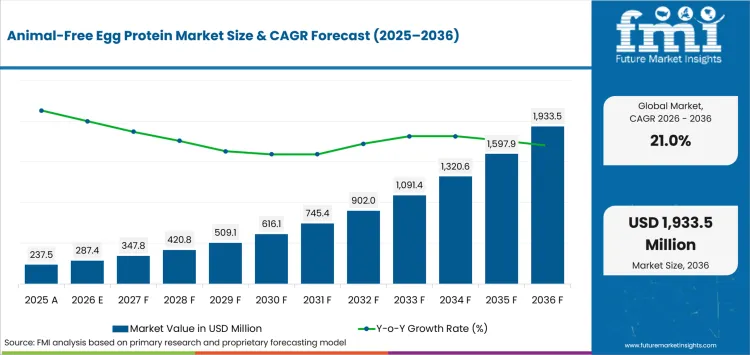
Key Takeaways of Animal-Free Egg Protein Market
- Demand for animal-free egg protein is driven by manufacturers needing repeatable egg functionality without direct exposure to poultry supply disruption, with regulatory and allergen requirements determining how quickly trials convert into routine purchasing.
- By type, precision-fermented ovalbumin holds the leading share at 60.0% in 2026, attributable to its direct egg-white functionality across foaming, binding, and gelation.
- Liquid is the dominant form segment, holding 60.8% share in 2026, owing to ready-to-use handling across commercial kitchens and factories.
- Bakery accounts for 36.8% application share in 2026, attributable to its combined binding and aeration requirements across shared processing equipment.
- Powdered products retain value for ambient storage and controlled industrial dosing, offering an alternative to liquid formats across longer production schedules.
- Singapore, the Netherlands, and the USA record CAGRs of 26.3%, 25.3%, and 24.6% respectively through 2036, while Finland and Germany share European authorization requirements but present different conventional supply conditions.
- Competition centers on The EVERY Company, Onego Bio, Just Food Company, Zero Egg, Plantible Foods, Float Foods, Yo Egg, and Neggst Foods, with vendors differentiating through animal-identical proteins, liquid/prepared formats, industrial functionality, and recognizable foodservice products.
-
Analyst Perspective
Commercial confidence in animal-free egg protein depends on repeatable performance at customer production scale under local compliance requirements, rather than broad category claims. Manufacturers should test each alternative against the exact egg function that controls finished product quality, since binding, aeration, and emulsification behave differently across bakery, sauce, and prepared-food applications. Supply agreements need clear allergen documentation and qualification responsibilities, and expansion should follow verified batch performance and dependable supply rather than laboratory results alone.
- Nandini Roy Choudhury, Principal Analyst at Future Market Insights
Source: FMI's proprietary forecasting model and primary research
How is the Animal-Free Egg Protein Market segmented?
The market is segmented by Type, Form, Application, and Region.
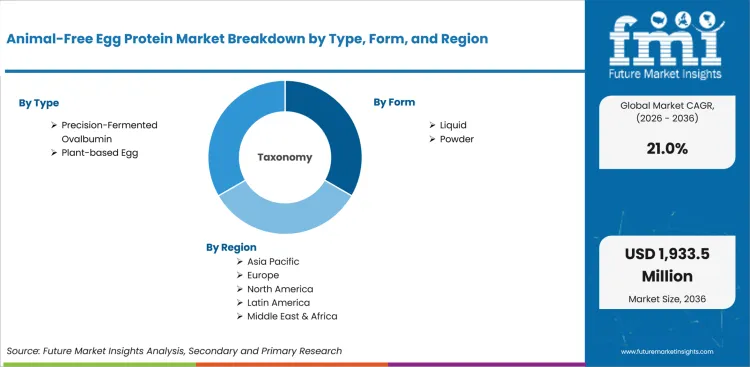
The segmentation framework separates the production route from the supplied form and final food application for commercial analysis. Type analysis distinguishes precision-fermented ovalbumin from plant-based egg systems with different regulatory and functional profiles. Form analysis compares ready-to-use liquids with powders that require hydration and controlled storage during manufacturing. Application analysis covers bakery and sauces alongside confectionery and ready-to-eat foods with different binding or aeration demands.
Regional analysis then tests how approval routes and technical support affect commercial qualification across countries. Category distinctions help food manufacturers compare functional requirements without combining unlike products inside one purchasing decision. Industrial formulators can benchmark those requirements against established protein ingredients used across familiar production systems.
Why is precision-fermented ovalbumin central to the type category?
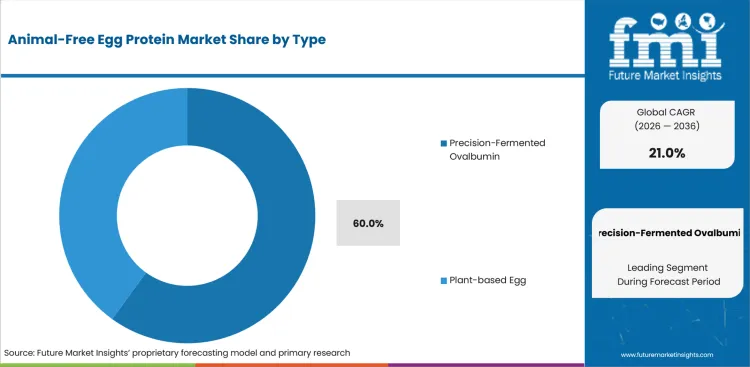
Industrial formulators need a single ingredient that can supply foaming alongside binding and gelation without relying on layer-hen production. Onego Bio identifies Bioalbumen as precision-fermented ovalbumin for bakery and confectionery alongside sauces and prepared foods. The egg white protein pathway competes through a defined molecular function and repeatable specifications across industrial batches. Manufacturers must confirm dosage and allergen controls under intended production conditions before switching recurring volume.
- The type category is forecast to be led by precision-fermented ovalbumin at 60.0% share in 2026 due to its direct egg-white functionality. One standardized protein can support foaming and binding alongside gelation across several established production recipes. Functional breadth reduces reformulation work for manufacturers replacing dried or liquid egg whites with one qualified ingredient.
- Food manufacturers adopt precision-fermented ovalbumin through controlled trials that confirm dosage and allergen handling alongside finished-product performance. Plant managers require repeatable results across normal production batches before approving a recurring ingredient contract. Ingredient developers must support technical documentation and application work throughout the complete customer qualification process across each defined application.
Why is liquid central to the form category?
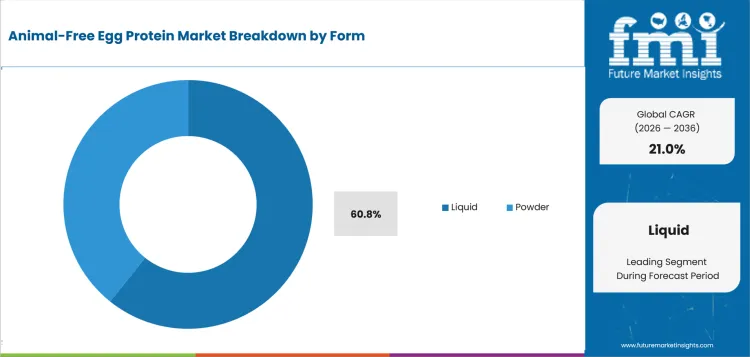
Liquid formats reduce preparation steps for kitchens and factories that need a ready-to-use whole-egg substitute. Just Food Company supplies pourable and prepared products across more than 3,300 North American foodservice points. Its industrial distribution reaches more than 9,000 points that support recurring kitchen and manufacturing orders. The vegan egg format gains commercial value through simple handling and familiar equipment rather than longer ingredient preparation.
- By form, liquid is estimated to hold 60.8% share in 2026 owing to ready-to-use handling across commercial kitchens and factories. Immediate use reduces hydration errors and improves portion control across familiar equipment, although refrigerated distribution and opened-package waste demand disciplined inventory planning across daily production schedules and busy service periods.
- Commercial adoption depends on cold-chain control and shelf-life discipline across distribution networks and back-of-house storage areas. Foodservice operators need package sizes that match daily throughput without creating avoidable open-container waste during service. Ingredient companies gain repeat orders through dependable cooking behavior and training that fits existing kitchen routines across multiple locations.
Why is bakery central to the application category?
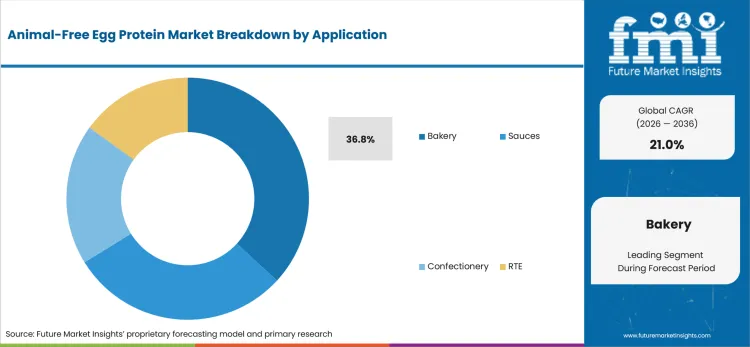
Bakery production exposes egg replacements to aeration and heat, then tests moisture retention and structural stability within the same process. The EVERY Company states that OvoPro can replace egg or egg white in cakes and cookies alongside meringues and rich doughs. Broad functionality makes bakery ingredients a demanding commercial proving ground for animal-free protein developers across industrial production and recurring customer qualification programs.
- Bakery is likely to capture 36.8% share in 2026 attributable to its combined binding and aeration requirements. One qualified ingredient can support several product lines across an industrial bakery that uses shared processing equipment. Demonstrated versatility improves volume potential following confirmation of texture and yield under normal plant conditions and customer production cycles.
- Industrial bakeries require application trials that compare mixing tolerance and bake performance against existing egg specifications across repeated production batches and shared equipment. Fermentation-derived ovalbumin requires egg-allergen segregation throughout handling; plant-based systems avoid egg protein but may need broader formulation work to reproduce several functions without reducing yield or finished-product consistency.
What are the drivers, restraints, and opportunities in the Animal-Free Egg Protein Market?
Supply resilience supports demand while regulation and performance qualification determine the pace of commercial conversion activity.
- Driver: Egg supply volatility encourages food manufacturers to qualify functional alternatives that are independent of poultry disease cycles.
- Restraint: Regulatory approval and egg-allergen labeling can extend qualification work for fermentation-derived ovalbumin across major food applications.
- Opportunity: Application-specific protein systems can replace several egg functions and improve formulation consistency across commercial production lines.
Conventional egg price volatility creates a direct driver for qualifying animal-free alternatives across food manufacturing accounts. A substitute specification protects recipes only if it preserves the required function during normal production. USA Bureau of Labor Statistics reported in March 2025 that producer prices for chicken eggs jumped 53.6% during February. The change shows why manufacturers evaluate egg substitutes before another cost shock interrupts output or changes formulation economics.
European authorization is expected to act as a restraint for fermentation-derived proteins intended for broad regional sale across several food categories. EFSA's current application procedure requires detailed scientific dossiers and safety assessment for European market placement. Ingredient developers must fund compositional and allergen work before manufacturers can begin routine commercial qualification. Extended review periods can delay revenue even after application trials demonstrate acceptable foaming or binding performance.
Application-specific proteins create a commercial opportunity to replace several formulation aids with one functional ingredient system. A useful system must preserve texture and process stability without adding complex preparation steps for manufacturing teams. Comparable fermented ingredients provide established handling practices for functional systems used across commercial food production. Plantible Foods documents Rubi Protein solutions for egg-free binding and foaming across industrial bakery applications. An ingredient producer creates measurable value by proving repeatable performance and dependable commercial supply across recurring production.
Which country CAGRs are profiled in the Animal-Free Egg Protein Market?
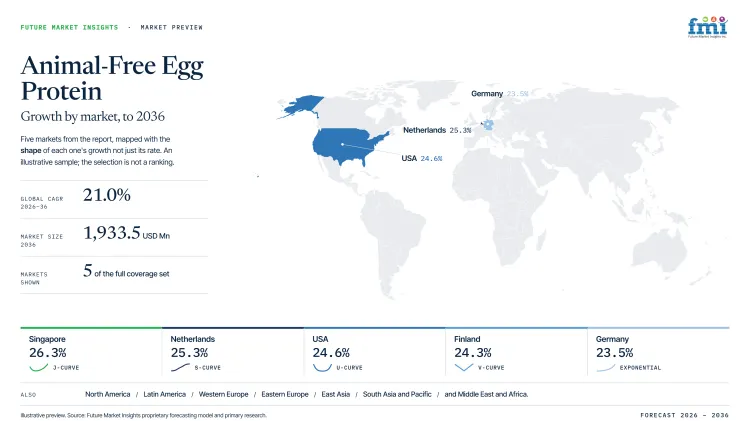
| Country | CAGR |
|---|---|
| USA | 24.6% |
| Finland | 24.3% |
| Germany | 23.5% |
| Singapore | 26.3% |
| Netherlands | 25.3% |
How do country-level CAGRs compare in the Animal-free Egg Protein Market?
The comparison is defined by compact spacing rather than a sharp separation across the five country forecasts. Singapore and the Netherlands form an upper pair with a measured 1.0 percentage-point difference between their rates. The USA and Finland create a close middle pair with a narrow 0.3 percentage-point gap between their rates. Germany follows Finland by 0.8 percentage point and remains connected to the broader five-country forecast range. The complete forecast spread from Singapore to Germany measures 2.8 percentage points across the countries shown. The differences describe expected commercialization speed rather than absolute national revenue or current ingredient volume.
- Singapore benefits from a defined pre-market approval route and local regulatory support that can shorten early product planning.
- The Netherlands combines experienced food processors with cross-border logistics, but approval timing can delay routine purchasing.
- The USA offers domestic regulatory records and application support although allergen controls increase documentation work for fermentation-derived proteins.
- Finland brings fermentation expertise and accessible Nordic technical networks but commercial scale depends on European authorization and dependable supply.
- Germany combines dense food-manufacturing clusters with measurable replacement benchmarks, yet mature purchasing standards raise performance expectations.
Closely aligned CAGRs can produce different entry priorities once service distance and approval effort are assessed together. Ingredient developers should compare customer concentration and qualification cost before assigning production capacity or technical staff. The full report provides country-level CAGR analysis across North America and Latin America together with Europe and East Asia. Coverage extends across South Asia and Oceania as well as the Middle East and Africa within the complete regional framework.
Country-wise Analysis
- United States commercialization can use an FDA-reviewed GRAS record that defines the permitted applications for each fermentation-derived egg protein. Animal-free egg protein demand in the USA is forecast to rise at 24.6% CAGR through 2036, supported by a documented domestic review route. FDA closed GRN 1104 in October 2023 with no questions for defined egg-white protein uses across several foods. The record gives formulators a clear testing boundary for application trials and recurring supply discussions. Onego Bio documents recipe optimization and performance validation through its San Diego test kitchen for commercial customers. Egg-allergen labeling and product-change controls remain material frictions for every packaged-food launch using ovalbumin across customer product lines.
- Finnish food companies must follow the European novel-food route, which blocks unauthorised novel ingredients from commercial sale. Business Finland reported in September 2025 that Onego Bio had created animal-free egg protein through fermentation within the national innovation network. Animal-free egg protein industry in Finland is estimated to expand at 24.3% CAGR from 2026 to 2036, owing to established fermentation expertise. The local company base gives formulators nearby scientific collaboration during application trials and production planning across regional Nordic manufacturing and customer networks. European authorization timing remains a material friction for ingredient developers seeking recurring contracts with Finnish national accounts.
- German food manufacturers require European novel-food authorization and application evidence that fits established bakery or prepared-food processes. Sales of animal-free egg protein in Germany are projected to expand at 23.5% CAGR between 2026 and 2036, influenced by supply-resilience needs. Germany's Federal Institute for Risk Assessment states that authorised novel foods must meet Union-list conditions and labeling requirements. Neggst Foods currently offers four ready-to-use plant-based egg formats for cafés and restaurants alongside hotels and caterers. The local foodservice route reduces preparation work and gives kitchen operators several recognizable product presentations. Mature purchasing standards and separate authorization for fermentation-derived proteins remain material frictions across industrial product lines.
- Singapore requires pre-market approval before a novel food can be manufactured or supplied through local commercial channels. The Singapore Food Agency requires scientific evidence for toxicity and allergenicity as well as production-method safety for each application. Animal-free egg protein sector in Singapore is predicted to advance at 26.3% CAGR by 2036, reinforced by a defined approval route. Guidelines updated in December 2025 estimate a nine-to-twelve-month evaluation period and provide virtual clinics for applicants. Float Foods currently presents OnlyEg as a plant-based whole-egg alternative developed for food applications in Singapore. Regulatory clinics support dossier preparation, and local product activity gives manufacturers a visible route for market testing. The evaluation timeline remains a material friction for launches that depend on rapid customer qualification.
- Netherlands food businesses are expected to sell novel foods following European Commission market access under the applicable authorised conditions. Animal-free egg protein demand in the Netherlands is expected to grow at 25.3% CAGR over the forecast period, shaped by processor access. The NVWA states that unauthorised novel foods cannot be sold and may trigger enforcement action. Foodvalley reported in June 2026 that its updated reformulation guide added plant-based and novel-protein solutions for replacing eggs. The guide gives Dutch development teams supplier information and practical examples that can reduce early formulation screening work. Approval timing and local technical coordination remain material frictions throughout initial commercial qualification and recurring national supply planning.
Who are the notable companies in the Animal-Free Egg Protein market?
The EVERY Company, Onego Bio, Just Food Company, Plantible Foods, Float Foods, Yo Egg, Neggst Foods, and Zero Egg are notable companies shaping this market.
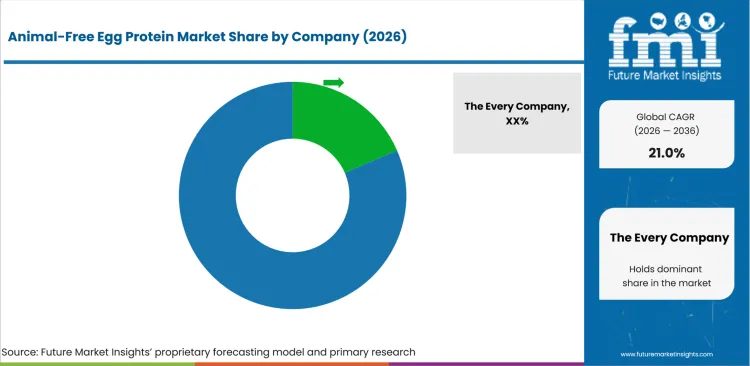
The competitive field combines precision-fermented ingredient developers with plant-based companies serving industrial and foodservice applications. The EVERY Company and Onego Bio supply animal-identical proteins with broad functions for industrial recipes. Just Food Company and Zero Egg offer liquid or prepared formats that fit familiar kitchen workflows. Plantible Foods supplies a functional ingredient; Float Foods develops a separate whole-egg format for regional foodservice use. Yo Egg and Neggst Foods focus on recognizable prepared products across professional kitchens and breakfast menus. The broader alternative protein landscape expands formulation choices across several established commercial food categories and purchasing routes. Commercial strength across the egg protein category depends on application support and reliable supply beyond initial product novelty.
- The EVERY Company and Onego Bio form the precision-fermented egg protein group for industrial food applications. Both companies document broad functional uses and direct technical support for manufacturers evaluating animal-identical proteins. Their main commercial challenge is converting regulatory clearance and customer trials into dependable production volume.
- Just Food Company and Plantible Foods join Float Foods within the plant-based ingredient and liquid platform group. The companies address different use cases through pourable eggs and functional proteins alongside whole-egg alternatives. Egg-free positioning supports their commercial appeal, but formulation depth varies across each product and application.
- Yo Egg and Neggst Foods compete with Zero Egg through foodservice formats designed for familiar preparation. Their products reduce kitchen development work through patties and poached portions alongside liquid or scrambled formats. Distribution scale and back-of-house guidance determine whether trial menus develop into recurring foodservice orders across locations.
Competitive Benchmarking: Animal-Free Egg Protein Market
| Company | Type | Form | Process Integration | Geographic Reach |
|---|---|---|---|---|
| The EVERY Company | High | Low | High | United States |
| Onego Bio | High | Low | Medium | United States and Finland |
| Just Food Company | Medium | High | High | North America |
| Plantible Foods | Medium | Low | Medium | North America |
| Float Foods | Low | Low | Low | Singapore |
| Yo Egg | Low | High | High | United States |
| Neggst Foods | Low | High | Medium | Germany |
| Zero Egg | Medium | High | High | United States and Israel |
Key Developments in the Animal-Free Egg Protein Market
- In March 2025, Onego Bio selected Jefferson County as the location for a planned flagship egg-protein manufacturing facility serving customers in the United States. The proposed site creates a domestic production route near manufacturers that require commercial quantities and application support. Local capacity can shorten sampling and troubleshooting distances following final commissioning and structured customer onboarding programs. Customers must verify specifications and supply terms carefully given that the facility remains planned rather than operational.
- In March 2026, Sigma Foods entered a collaboration with Onego Bio covering feasibility assessment, prototype development, and application trials in commercially relevant food products. The manufacturer-led program moves Bioalbumen beyond isolated laboratory testing and creates direct evidence about functionality within established product formulations. Commercial supply decisions will depend on trial results and contract terms that protect continuity during conventional egg disruptions across customer production networks.
- In January 2025, Just Food Company reported that Just Egg recorded fivefold year-over-year growth during a documented period of conventional egg shortages. The company also reported more than 500 million egg equivalents sold since launch while maintaining stocked plant-based supply. The result demonstrates measurable commercial demand under a supply shock rather than laboratory interest alone. Foodservice operators still need package formats and cooking guidance that fit established kitchen routines across multiple locations.
- In February 2026, Plantible Foods received closure of FDA GRAS Notice 1256 with no questions regarding lemna leaf protein under defined food uses, including baked goods and dressings. The regulatory record gives manufacturers a clearer basis for testing Rubi Protein’s documented binding and gelation functions across commercial production conditions. Adoption will depend on repeatable application results and supply terms that meet each customer’s volume and technical-support requirements.
Key Players in the Animal-Free Egg Protein Market
Precision-Fermented Egg Protein Developers
- The EVERY Company
- Onego Bio
Plant-Based Ingredient and Liquid Egg Platforms
- Just Food Company
- Plantible Foods
- Float Foods
Foodservice Egg Format Specialists
- Yo Egg
- Neggst Foods
- Zero Egg
Animal-Free Egg Protein Market - Report Scope
| Coverage field | Report scope |
|---|---|
| Market breakdown | Type, form, application, and region. |
| Quantitative Units | USD Million, CAGR in %. |
| Market Definition | Revenue covers precision-fermented egg proteins and plant-based egg systems sold as ingredients or prepared formats for direct food production. The scope includes functional proteins and liquid products alongside powders and commercial support tied to the named applications. |
| Regions Covered | North America, Latin America, Western Europe, Eastern Europe, East Asia, South Asia and Pacific, and Middle East and Africa. |
| Countries Covered | USA, Finland, Germany, Singapore, Netherlands, plus more than twenty-five additional countries across the regions covered. |
| Key Companies Profiled | The EVERY Company, Onego Bio, Just Food Company, Plantible Foods, Float Foods, Yo Egg, Neggst Foods, Zero Egg |
| Forecast Period | 2026 to 2036. |
| Approach | Market sizing combines bottom-up and top-down methods across the defined animal-free egg protein revenue boundary. The model uses application demand and company participation alongside regulatory status and form mix across country qualification conditions. |
Animal-Free Egg Protein Market - Research Methodology
| Method | Approach |
|---|---|
| Primary Research | FMI analysts gathered input from manufacturers, service providers, technology developers, distributors, end users, sourcing teams, and subject-matter experts. Interviews examined purchasing decisions, product or service evaluation, adoption barriers, approval requirements, pricing considerations, and expectations for technical or commercial support. Respondents were also asked what evidence is required before a trial, pilot, or initial order develops into regular purchasing. |
| Desk Research | Desk research covered government statistics, regulatory publications, trade data, industry associations, technical literature, standards, company filings, product information, and official corporate announcements. Sources were reviewed for relevance, publication date, geographic coverage, and consistency with the defined market scope. Claims relating to performance, applications, approvals, capacity, investment, and commercial activity were retained only when supported by credible public evidence. |
| Market Sizing and Forecasting | The market model combined the baseline value with historical performance, segment structure, pricing and volume indicators, adoption levels, company participation, and country-level demand conditions. Forecast assumptions considered economic activity, investment trends, regulatory developments, technology adoption, purchasing cycles, supply availability, and barriers to wider market use. Segment and regional estimates were reconciled before the final market total was calculated. |
| Data Validation | Estimates were checked against multiple independent indicators, including public data, company activity, trade patterns, industry developments, and findings from primary interviews. Validation also tested whether products, services, applications, and company revenues fell within the defined market boundaries. Adjacent categories, unsupported claims, overlapping revenues, and activities without direct market relevance were excluded to reduce double counting and maintain consistency across segments and countries. |
Animal-Free Egg Protein Market by Segments
Animal-Free Egg Protein Market segmented by Type:
- Precision-Fermented Ovalbumin
- Plant-based Egg
Animal-Free Egg Protein Market segmented by Form:
- Liquid
- Powder
Animal-Free Egg Protein Market segmented by Application:
- Bakery
- Sauces
- Confectionery
- RTE
Animal-Free Egg Protein Market by Region:
- North America
- United States
- Canada
- Latin America
- Brazil
- Mexico
- Argentina
- Chile
- Western Europe
- Germany
- France
- United Kingdom
- Italy
- Spain
- Benelux
- Nordics
- Eastern Europe
- Poland
- Czech Republic
- Romania
- Hungary
- East Asia
- China
- Japan
- South Korea
- South Asia and Pacific
- India
- ASEAN
- Australia and New Zealand
- Middle East and Africa
- GCC Countries
- South Africa
- Türkiye
- Israel
Research Sources and Bibliography
- Grossen, G. (2025, June 3). Retail egg prices fall, following declining wholesale prices. USA Department of Agriculture, Economic Research Service.
- USA Food and Drug Administration. (2025, January). Guidance for Industry: Questions and Answers Regarding Food Allergen Labeling (Edition 5).
- Singapore Food Agency. (2026, June 17). Overview of Pre-Market Approval Framework for Novel Food.
- Just Food Company. (n.d.). Foodservice | Eggs and meat from plants for restaurants | Just Food Company.
- USA Bureau of Labor Statistics. (2025, March 13). Producer Price Index News Release - 2025 M02 Results.
- European Food Safety Authority. (2026, May 6). Novel food application procedure.
- Plantible Foods. (n.d.). Applications.
- USA Food and Drug Administration. (2023, October 17). GRN No. 1104: Egg-white protein produced by Komagataella phaffii ATCC GSD-1235.
- Onego Bio. (n.d.). FAQ.
- Finnish Food Authority. (n.d.). Novel foods and processes.
- Business Finland. (2025, September 17). From Forests to Fermentation: Finland Creates Sustainable Future with Food.
- German Federal Institute for Risk Assessment. (n.d.). Novel Food.
- Neggst Foods GmbH. (n.d.). Foodservice.
- Singapore Food Agency. (2025, December 8). Guidelines on Applying for Pre-Market Approval for a Novel Food.
- Netherlands Food and Consumer Product Safety Authority. (n.d.). Nieuwe voedingsmiddelen op de markt brengen.
- Foodvalley. (2026, June 16). Press release: Foodvalley launches updated Practical Guide for Reformulation and Innovation with richer industry insights.
- Float Foods. (n.d.). Plant Based Egg | Float Foods | Singapore.
- Yo Egg. (n.d.). About Us.
- Yo Egg. (n.d.). Foodservice.
- Neggst Foods GmbH. (n.d.). Neggst | plant-based egg alternatives.
- Zero Egg. (n.d.). Plant-based egg with real taste and texture.
- Zero Egg. (n.d.). Products - Zero Egg: Plant-based. Real Taste.
- Onego Bio. (2025, March 12). Onego Bio Chooses Jefferson County, Wisconsin for Flagship Egg Protein Manufacturing Facility.
- Onego Bio. (2026, March 5). Onego Bio and Sigma Foods Enter Collaboration to Strengthen Egg Protein Innovation and Supply Resilience.
- Just Food Company. (2025, January). Delicious eggs without all that bird flu.
- USA Food and Drug Administration. (2026, February 5). GRN No. 1256: Lemna leaf protein.
This bibliography is provided for reader reference and is not exhaustive. The full report contains the complete reference list and detailed citations.
This Report Answers
- How large is the animal-free egg protein market in 2026 and 2036?
- Which supply and formulation pressures support investment in animal-free egg protein?
- Why does Precision-Fermented Ovalbumin hold the leading Type share in 2026?
- How does the Liquid form affect preparation and distribution requirements?
- Why does Bakery account for the leading Application share in 2026?
- How do country growth rates differ across the USA, Finland, Germany, Singapore, and the Netherlands?
- Which companies supply precision-fermented proteins or plant-based egg formats?
- What regulatory and allergen requirements can delay commercial qualification?
- How should manufacturers compare functional performance and technical support before contracting supply?
Frequently Asked Questions
How big is the Animal-Free Egg Protein Market in 2026?
The animal-free egg protein market is valued at USD 287.4 million in 2026 and is forecast to reach USD 1933.5 million by 2036. Growth reflects food manufacturers qualifying alternative egg systems to protect formulations from poultry supply disruption and functional variability.
What is the CAGR of the Animal-Free Egg Protein Market from 2026 to 2036?
The animal-free egg protein market grows at a CAGR of 21.0% between 2026 and 2036, supported by manufacturers needing repeatable egg functionality without direct exposure to poultry supply disruption and volatile conventional egg pricing across major global food manufacturing categories.
Which type leads the Animal-Free Egg Protein Market?
Precision-fermented ovalbumin accounts for 60.0% of the animal-free egg protein market by type in 2026, driven by its direct egg-white functionality that lets one standardized protein support foaming, binding, and gelation across established industrial bakery and confectionery production recipes worldwide.
How much will the Animal-Free Egg Protein Market add between 2026 and 2036?
The animal-free egg protein market is set to add USD 1646.1 million between 2026 and 2036, growing from USD 287.4 million to USD 1933.5 million as precision-fermented and plant-based egg systems extend across a widening base of food manufacturing applications worldwide.
Who are the leading companies in the Animal-Free Egg Protein Market?
Five companies lead the animal-free egg protein market, including The EVERY Company, Onego Bio, Just Food Company, Zero Egg, and Plantible Foods, competing through animal-identical proteins, liquid and prepared formats, industrial functionality, and recognizable foodservice products across global commercial markets.
Preview the report firsthand - request a free sample
Get SampleGet the brochure for pricing and purchase details.
Get PDFTable of Content
- Key Takeaways
- Market Size and CAGR
- Top Growth Driver
- Fastest Growing Segment
- Leading Region
- Key Companies
- Emerging Opportunities
- Executive Summary
- Global Market Outlook
- Demand-side Trends
- Supply-side Trends
- Technology Roadmap Analysis
- Analysis and Recommendations
- Analyst Perspective (What is happening? Why now? What should investors know?)
- Key Questions Answered
- How large is the market?
- What is the CAGR?
- What are key trends?
- Which region dominates?
- Who are the leaders?
- Market Overview
- Market Coverage / Taxonomy
- Market Definition / Scope / Limitations
- Research Methodology
- Chapter Orientation
- Analytical Lens and Working Hypotheses
- Market Structure, Signals, and Trend Drivers
- Benchmarking and Cross-market Comparability
- Market Sizing, Forecasting, and Opportunity Mapping
- Research Design and Evidence Framework
- Desk Research Programme (Secondary Evidence)
- Expert Input and Fieldwork (Primary Evidence)
- Tooling, Models, and Reference Databases
- Data Engineering and Model Build
- Quality Assurance and Audit Trail
- Market Background
- Market Dynamics (Drivers, Restraints, Opportunity, Trends)
- Scenario Forecast (Optimistic, Likely, Conservative)
- Impact Analysis
- AI Impact
- Sustainability Impact
- Regulatory Impact
- Technology Impact
- Consumer / Buyer Analysis
- Purchase Drivers
- Adoption Barriers
- Buyer Journey
- Opportunity Map Analysis
- Product Life Cycle Analysis
- Supply Chain Analysis
- Investment Feasibility Matrix
- Value Chain Analysis
- PESTLE and Porter's Analysis
- Regulatory Landscape
- Regional Parent Market Outlook
- Production and Consumption Statistics
- Import and Export Statistics
- Global Market Analysis and Forecast, 2021 to 2036
- Historical Market Size Value (USD Million) Analysis, 2021 to 2025
- Current and Future Market Size Value (USD Million) Projections, 2026 to 2036
- Y-o-Y Growth Trend Analysis
- Absolute $ Opportunity Analysis
- Global Market Pricing Analysis, 2021 to 2036
- Global Market Analysis and Forecast, By Type, 2021 to 2036
- Introduction / Key Findings
- Historical Market Size Value (USD Million) Analysis By Type, 2021 to 2025
- Current and Future Market Size Value (USD Million) Analysis and Forecast By Type, 2026 to 2036
- Precision-Fermented Ovalbumin
- Plant-based Egg
- Precision-Fermented Ovalbumin
- Y-o-Y Growth Trend Analysis By Type, 2021 to 2025
- Absolute $ Opportunity Analysis By Type, 2026 to 2036
- Global Market Analysis and Forecast, By Form, 2021 to 2036
- Introduction / Key Findings
- Historical Market Size Value (USD Million) Analysis By Form, 2021 to 2025
- Current and Future Market Size Value (USD Million) Analysis and Forecast By Form, 2026 to 2036
- Liquid
- Powder
- Liquid
- Y-o-Y Growth Trend Analysis By Form, 2021 to 2025
- Absolute $ Opportunity Analysis By Form, 2026 to 2036
- Global Market Analysis and Forecast, By Application, 2021 to 2036
- Introduction / Key Findings
- Historical Market Size Value (USD Million) Analysis By Application, 2021 to 2025
- Current and Future Market Size Value (USD Million) Analysis and Forecast By Application, 2026 to 2036
- Bakery
- Sauces
- Confectionery
- RTE
- Bakery
- Y-o-Y Growth Trend Analysis By Application, 2021 to 2025
- Absolute $ Opportunity Analysis By Application, 2026 to 2036
- Global Market Analysis and Forecast, By Region, 2021 to 2036
- Introduction
- Historical Market Size Value (USD Million) Analysis By Region, 2021 to 2025
- Current Market Size Value (USD Million) Analysis and Forecast By Region, 2026 to 2036
- North America
- Latin America
- Western Europe
- Eastern Europe
- East Asia
- South Asia and Pacific
- Middle East & Africa
- Market Attractiveness Analysis By Region
- North America Market Analysis and Forecast, By Country, 2021 to 2036
- Historical Market Size Value (USD Million) Trend Analysis By Market Taxonomy, 2021 to 2025
- Market Size Value (USD Million) Forecast By Market Taxonomy, 2026 to 2036
- By Country
- USA
- Canada
- By Type
- By Form
- By Application
- By Country
- Market Attractiveness Analysis
- By Country
- By Type
- By Form
- By Application
- Key Takeaways
- Latin America Market Analysis and Forecast, By Country
- Historical Market Size Value (USD Million) Trend Analysis By Market Taxonomy, 2021 to 2025
- Market Size Value (USD Million) Forecast By Market Taxonomy, 2026 to 2036
- By Country
- Brazil
- Mexico
- Chile
- Rest of Latin America
- By Type
- By Form
- By Application
- By Country
- Market Attractiveness Analysis
- By Country
- By Type
- By Form
- By Application
- Key Takeaways
- Western Europe Market Analysis and Forecast, By Country
- Historical Market Size Value (USD Million) Trend Analysis By Market Taxonomy, 2021 to 2025
- Market Size Value (USD Million) Forecast By Market Taxonomy, 2026 to 2036
- By Country
- Germany
- UK
- Italy
- Spain
- France
- Nordic
- BENELUX
- Rest of Western Europe
- By Type
- By Form
- By Application
- By Country
- Market Attractiveness Analysis
- By Country
- By Type
- By Form
- By Application
- Key Takeaways
- Eastern Europe Market Analysis and Forecast, By Country
- Historical Market Size Value (USD Million) Trend Analysis By Market Taxonomy, 2021 to 2025
- Market Size Value (USD Million) Forecast By Market Taxonomy, 2026 to 2036
- By Country
- Russia
- Poland
- Hungary
- Balkan & Baltic
- Rest of Eastern Europe
- By Type
- By Form
- By Application
- By Country
- Market Attractiveness Analysis
- By Country
- By Type
- By Form
- By Application
- Key Takeaways
- East Asia Market Analysis and Forecast, By Country
- Historical Market Size Value (USD Million) Trend Analysis By Market Taxonomy, 2021 to 2025
- Market Size Value (USD Million) Forecast By Market Taxonomy, 2026 to 2036
- By Country
- China
- Japan
- South Korea
- By Type
- By Form
- By Application
- By Country
- Market Attractiveness Analysis
- By Country
- By Type
- By Form
- By Application
- Key Takeaways
- South Asia and Pacific Market Analysis and Forecast, By Country
- Historical Market Size Value (USD Million) Trend Analysis By Market Taxonomy, 2021 to 2025
- Market Size Value (USD Million) Forecast By Market Taxonomy, 2026 to 2036
- By Country
- India
- ASEAN
- Australia & New Zealand
- Rest of South Asia and Pacific
- By Type
- By Form
- By Application
- By Country
- Market Attractiveness Analysis
- By Country
- By Type
- By Form
- By Application
- Key Takeaways
- Middle East & Africa Market Analysis and Forecast, By Country
- Historical Market Size Value (USD Million) Trend Analysis By Market Taxonomy, 2021 to 2025
- Market Size Value (USD Million) Forecast By Market Taxonomy, 2026 to 2036
- By Country
- Kingdom of Saudi Arabia
- Other GCC Countries
- Türkiye
- South Africa
- Other African Union
- Rest of Middle East & Africa
- By Type
- By Form
- By Application
- By Country
- Market Attractiveness Analysis
- By Country
- By Type
- By Form
- By Application
- Key Takeaways
- Key Countries Market Analysis
- USA
- Pricing Analysis
- Market Share Analysis, 2025
- By Type
- By Form
- By Application
- Canada
- Pricing Analysis
- Market Share Analysis, 2025
- By Type
- By Form
- By Application
- Mexico
- Pricing Analysis
- Market Share Analysis, 2025
- By Type
- By Form
- By Application
- Brazil
- Pricing Analysis
- Market Share Analysis, 2025
- By Type
- By Form
- By Application
- Chile
- Pricing Analysis
- Market Share Analysis, 2025
- By Type
- By Form
- By Application
- Germany
- Pricing Analysis
- Market Share Analysis, 2025
- By Type
- By Form
- By Application
- UK
- Pricing Analysis
- Market Share Analysis, 2025
- By Type
- By Form
- By Application
- Italy
- Pricing Analysis
- Market Share Analysis, 2025
- By Type
- By Form
- By Application
- Spain
- Pricing Analysis
- Market Share Analysis, 2025
- By Type
- By Form
- By Application
- France
- Pricing Analysis
- Market Share Analysis, 2025
- By Type
- By Form
- By Application
- India
- Pricing Analysis
- Market Share Analysis, 2025
- By Type
- By Form
- By Application
- ASEAN
- Pricing Analysis
- Market Share Analysis, 2025
- By Type
- By Form
- By Application
- Australia & New Zealand
- Pricing Analysis
- Market Share Analysis, 2025
- By Type
- By Form
- By Application
- China
- Pricing Analysis
- Market Share Analysis, 2025
- By Type
- By Form
- By Application
- Japan
- Pricing Analysis
- Market Share Analysis, 2025
- By Type
- By Form
- By Application
- South Korea
- Pricing Analysis
- Market Share Analysis, 2025
- By Type
- By Form
- By Application
- Russia
- Pricing Analysis
- Market Share Analysis, 2025
- By Type
- By Form
- By Application
- Poland
- Pricing Analysis
- Market Share Analysis, 2025
- By Type
- By Form
- By Application
- Hungary
- Pricing Analysis
- Market Share Analysis, 2025
- By Type
- By Form
- By Application
- Kingdom of Saudi Arabia
- Pricing Analysis
- Market Share Analysis, 2025
- By Type
- By Form
- By Application
- Türkiye
- Pricing Analysis
- Market Share Analysis, 2025
- By Type
- By Form
- By Application
- South Africa
- Pricing Analysis
- Market Share Analysis, 2025
- By Type
- By Form
- By Application
- USA
- Market Structure Analysis
- Competition Dashboard
- Competition Benchmarking
- Market Share Analysis of Top Players
- By Regional
- By Type
- By Form
- By Application
- Emerging Startups
- Innovation Benchmarking
- Competition Analysis
- Competition Deep Dive
- The Every Company
- Overview
- Product Portfolio
- Profitability by Market Segments
- Sales Footprint
- Strategy Overview
- Marketing Strategy
- Product Strategy
- Channel Strategy
- Onego Bio
- Formo
- Eat Just
- Float Foods
- Yali Bio
- The Every Company
- Case Studies
- Success Stories
- Recent Developments
- Competition Deep Dive
- Assumptions & Acronyms Used


