

- Market Size (2026)
- USD 6.2 Bn
- Forecast (2036)
- USD 10.6 Bn
- CAGR (2026 to 2036)
- 5.6%
How big is Automotive Multi Plate Couplings Market in 2026?
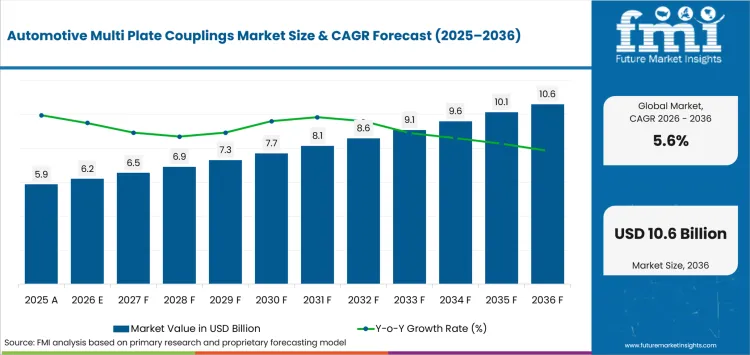
USD 6.2 billion in 2026 and USD 10.6 billion by 2036 at a 5.6% CAGR.
Demand for automotive multi plate couplings is projected to expand at 5.6% CAGR between 2026 and 2036, increasing valuation from USD 6.2 billion in 2026 to USD 10.6 billion by 2036. Multi-plate packs are specified for driveline functions that require one friction interface to modulate torque during launch or axle engagement. ACEA reported in January 2026 that hybrid-electric cars reached 34.5% of EU registrations in 2025, broadening platforms that can use controlled clutch functions. Series revenue depends on nomination timing and thermal validation.
Country demand diverges with vehicle mix and assembly location. The International Trade Administration reported in February 2026 that the United States accounted for 79.7% of Mexico's 2024 light-vehicle exports. The 79.7% export share ties Mexican coupling volume to North American platform awards. Launch changes still pass through program validation.
Key Takeaways
- AWD content and hybrid drivetrains support multi-plate coupling demand for torque control without permanent mechanical engagement.
- By coupling type, wet multi-plate couplings are estimated to hold 31.0% share in 2026 owing to fluid cooling and stable friction behavior under repeated slip.
- AWD systems are expected to account for 32.0% of application demand in 2026 because a controllable pack can meter front-to-rear torque during changing traction conditions.
- The SUVs - crossovers segment is forecast to represent 31.0% of vehicle type demand in 2026 supported by high AWD fitment and higher driveline torque loads.
- Application-specific validation slows switching because friction material must match oil behavior and actuation control inside one driveline module.
- Some of the key players in this market include BorgWarner, GKN Automotive, Magna International, Schaeffler, ZF Friedrichshafen, JTEKT, Dana, Dauch Corporation, Eaton, and EXEDY.
Analyst Perspective
"Multi-plate coupling bids should be compared on torque capacity and thermal stability rather than unit price alone. Commercial value rises once the pack reaches series production with calibration support and service matched to the driveline system."
- Nikhil Kaitwade, Principal Consultant, Future Market Insights
How is the automotive multi plate couplings market segmented?
The market is segmented by coupling type, application, vehicle type, sales channel and control.
The automotive multi plate couplings market is segmented by coupling type, application, vehicle type, sales channel, control and region. Coupling type covers wet multi-plate couplings, dry multi-plate couplings, electronically controlled couplings, AWD coupling packs and torque vectoring clutch packs. Application covers AWD systems, transfer cases, DCT transmissions, hybrid drivetrains and performance differentials. Vehicle type includes SUVs - crossovers, passenger cars, performance vehicles, pickup trucks and hybrid - EV platforms. Sales channel separates OEM direct, driveline Tier-1s, aftermarket replacement and service parts. Control includes hydraulic control, electro-hydraulic control, electromagnetic control and mechanical preload.
What makes wet multi-plate couplings central to the coupling type category?
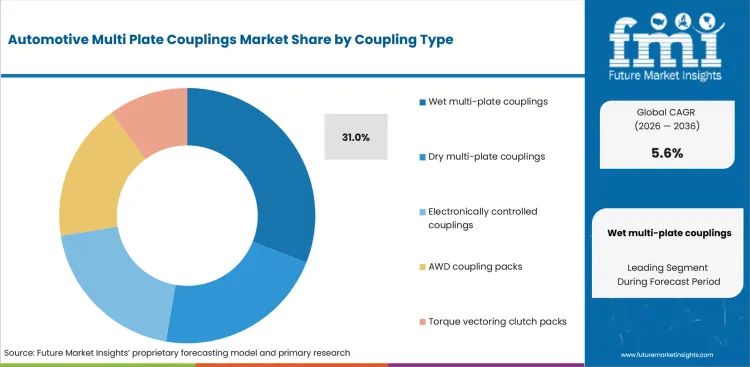
Wet multi-plate couplings dissipate slip heat through oil circulation and keep the friction pack compact for repeated modulation. The same architecture is used in dual-clutch transmissions and hybrid disconnect functions where smooth engagement must survive frequent duty. BorgWarner announced in May 2026 that a Chinese OEM selected its wet dual clutch for an SUV program. The award ties wet-pack volume to a named series platform instead of a stand-alone component order.
- Wet multi-plate couplings account for 31.0% share in 2026, attributable to fluid cooling during repeated torque modulation.
- Series adoption requires friction material and oil chemistry to pass pressure and thermal validation for production release.
Why do AWD systems lead the application category?
AWD modules use a multi-plate pack to vary torque between axles without keeping a rigid mechanical path engaged. The controllable pack becomes part of vehicle-dynamics control because its clamp force changes the available axle torque. At an October 2025 showcase GKN Automotive demonstrated AWD systems with electronic torque management to global OEM engineers. The event focused the all-wheel-drive systems discussion on response quality and system integration.
- AWD systems are set to lead the application category with 32.0% share in 2026 driven by variable axle-torque distribution.
- OEM qualification covers clutch response and coordination with stability controls inside the vehicle-dynamics loop.
How do SUVs - crossovers shape the vehicle type category?
SUVs - crossovers often carry AWD and higher driveline loads than smaller passenger cars. EPA reported in February 2026 that truck SUVs represented 50% of model year 2024 US light-duty production. The vehicle mix keeps vehicle transfer cases and active coupling packs relevant to high-volume utility platforms. Larger torque envelopes also increase the importance of repeatable clamp force and controlled heat rejection.
- In 2026, SUVs - crossovers are projected to hold 31.0% of vehicle type demand due to high AWD availability.
- Platform engineering must scale coupling packs across utility vehicles without losing friction stability or packaging clearance.
What supports OEM direct leadership in the sales channel category?
Coupling geometry and friction material have to match the surrounding automotive transmissions before series production begins. Application engineering places commercial selection inside the vehicle program instead of the service cycle. BorgWarner announced in May 2025 that it secured two dual-clutch programs in China with one seven-year extension and one new program award. The contracts show why nomination timing governs access to series volume.
- OEM direct is expected to lead the sales channel category with 54.0% share in 2026 supported by platform-level specification.
- Direct engagement gives engineering teams time to finish friction tests and calibration ahead of production release.
What drives hydraulic control in the control category?
Wet packs need controlled clamp pressure and continuous heat removal during repeated slip. Hydraulic circuits can supply both functions in the same transmission environment while automotive actuators translate controller commands into clutch pressure. Magna published a March 2025 technical paper on its Eco transmission family that details clutch actuation within a scalable DCT-to-hybrid architecture. The design work keeps hydraulic behavior tied to the complete gearbox control concept.
- Hydraulic control is projected to lead with 32.0% share in 2026, driven by high clamp force and controlled oil flow.
- Validation focuses on pressure response and leakage because control errors can change shift quality or heat generation.
What are the drivers, restraints and opportunities in the Automotive Multi Plate Couplings Market?
AWD and hybrid platform content raise coupling demand. Integrated validation slows supplier switching. Low-drag packs and matched repair kits offer additional revenue routes.
- Driver: Hybrid and AWD platforms preserve mechanical torque-transfer functions that require compact controllable friction packs.
- Restraint: Friction behavior and control software must be validated together for an OEM source change.
- Opportunity: Lower-drag coupling designs and matched repair kits can improve lifecycle economics without changing the full driveline module.
Hybrid and AWD Programs Increase Coupling Content
Powertrain electrification does not remove every mechanical connection from the driveline. ACEA reported in July 2026 that hybrid-electric cars held 37.3% of EU registrations during the first half of 2026, keeping hybrid vehicles relevant to launch clutches and disconnect functions. Revenue remains tied to platforms that use controlled friction interfaces between engines and electric machines.
Integrated Validation Extends Nomination Cycles
A multi-plate coupling is validated together with the driveline control system. In September 2025, GKN Automotive completed a 16-month ISO 21434 certification program covering 44 procedures and more than 200 trained employees. The certification concerns cybersecure development rather than friction durability, so a source change still requires mechanical and interface testing for production release.
Low-Drag Packs and Matched Repair Kits Extend Revenue
Service economics improve when worn clutch parts can be replaced as a matched set instead of changing a larger assembly. Schaeffler launched the LuK RepSet 2CT DMF in June 2025 for selected dry and wet double-clutch applications and placed clutch friction plates inside a matched repair package for workshop installation. Lower-drag designs target new-platform efficiency by reducing parasitic loss during uncoupled operation.
Which country CAGRs are profiled in the Automotive Multi Plate Couplings Market?
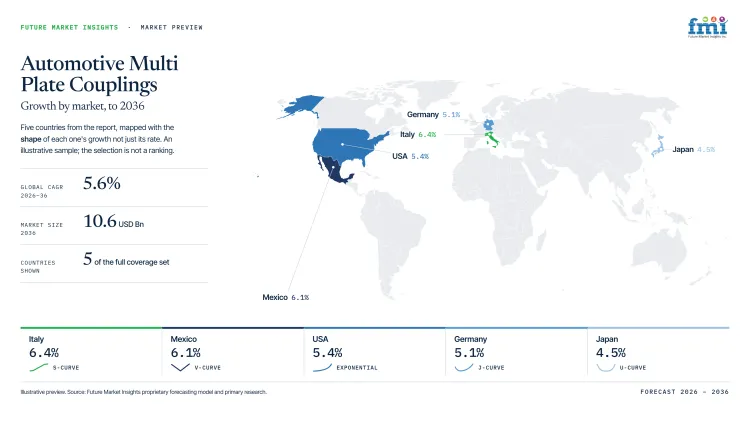
| Country | CAGR |
|---|---|
| Italy | 6.4% |
| Mexico | 6.1% |
| South Korea | 5.7% |
| USA | 5.4% |
| Germany | 5.1% |
| France | 4.8% |
| Japan | 4.5% |
How do country-level CAGRs compare in the Automotive Multi Plate Couplings Market?
CAGRs span 1.9 percentage points from Italy at 6.4% to Japan at 4.5%. Italy and Mexico form the upper band through different demand bases. France and Japan close the profile with mature passenger-car demand and tighter program economics.
- Italy’s growing hybrid vehicle adoption and strong demand for compact SUVs are increasing requirements for advanced driveline systems.
- Mexico’s export-focused light-truck manufacturing base supports steady demand for driveline sourcing and component integration.
- South Korea’s rapid hybrid penetration under major automotive groups is accelerating demand for hybrid-compatible driveline technologies.
- The USA’s large truck and SUV population continues to underpin demand for durable and high-performance driveline systems.
- Germany’s premium automotive engineering strengths are complemented by a growing pipeline of hybrid vehicle programs.
- France is expanding its hybrid vehicle footprint, although lower new-car volumes can limit the scale of individual programs.
- Japan’s mature hybrid market is characterized by rigorous qualification requirements and extended approval timelines for transmission suppliers.
Production scale and platform access remain more useful than CAGR alone. The full report provides country-level CAGR analysis across North America, Latin America, Western Europe, Eastern Europe, East Asia, South Asia and Pacific and Middle East and Africa.
Country-wise Analysis
- Italian registrations put hybrid powertrains and compact SUVs in the same high-volume buying pool. Italy is projected to grow at 6.4% CAGR during the assessment period owing to coupling content in hybrid transmissions and AWD crossovers. UNRAE reported in January 2026 that hybrids reached 44.4% of 2025 registrations and B-segment SUVs accounted for 30.3%. A broad European driveline supply base supports wet-pack integration but weak registration volume limits new program scale. Companies entering Italy need compact packs and torque vectoring systems that fit crossover platforms without adding avoidable parasitic drag losses.
- Mexico operates as an export manufacturing base dominated by light trucks. INEGI reported in May 2025 that light trucks represented 76.6% of January-through-April light-vehicle production. Automotive multi plate coupling demand in Mexico is forecast to rise at 6.1% CAGR over the forecast period driven by North American pickup and SUV programs. Regional assembly capacity gives coupling manufacturers a route into high-volume driveline launches for North American platforms but lost export nominations remove several years of volume. Local engineering support and cost-controlled production therefore carry more weight than a broad domestic sales network.
- South Korean coupling purchases are concentrated among large domestic OEM groups with tightly integrated engineering programs. In South Korea, automotive multi plate coupling demand is predicted to advance at 5.7% CAGR through 2036 supported by rapid hybrid penetration. MOTIE reported in January 2025 that 2024 hybrid sales reached 495,577 units and represented 30% of domestic car sales. Local transmission engineering supports adoption but external manufacturers face short development cycles and entrenched relationships. Entry depends on a friction or control advantage that the OEM can validate early enough to justify changing an established series source.
- US demand is anchored in a large truck and SUV population with widespread AWD availability. FHWA reported in 2026 that 298 million motor vehicles were registered in the United States during 2024. The USA automotive multi plate couplings sector is projected to record 5.4% CAGR during the assessment period attributable to high-torque utility platforms and a deep service base. The installed base supports passenger-car clutch components and driveline repair demand beyond new production but towing and cold starts raise validation loads. Manufacturers need scalable packs that preserve control accuracy under different thermal conditions.
- German OEM programs place low drivetrain loss and repeatable control behavior near the top of component evaluation. Automotive multi plate coupling sales in Germany are forecast to expand at 5.1% CAGR by 2036 reinforced by hybrid penetration and premium AWD architectures. A mature transmission engineering base supports rapid technical review of automotive differentials but efficiency and NVH requirements keep qualification thresholds high. ACEA reported in July 2026 that German hybrid-electric registrations rose 6.9% during the first half of the year. New entrants must prove lower drag without weakening torque capacity or shift consistency in series production.
- French passenger-car demand is moving toward hybrids at the same time that total new-car volume remains under pressure. SDES reported in February 2026 that non-plug-in gasoline hybrids reached 42.5% of 2025 new-car registrations while the overall new-car market fell 5.2%. Hybrid powertrains preserve clutch and disconnect functions despite pressure on vehicle affordability. France is anticipated to advance at 4.8% CAGR over the assessment period shaped by coupling functions inside hybrid transmissions and controlled driveline modules. Modular coupling designs have an advantage if one validated pack can serve several hybridization levels without adding calibration work.
- Japanese powertrain programs already operate with a mature hybrid base and tight packaging expectations. Adoption of automotive multi plate couplings in Japan is projected to expand at 4.5% CAGR through 2036 aided by controlled clutch functions inside compact hybrid drivetrains. JAMA published in 2025 that hybrid passenger-car registrations reached 2,005,781 units in 2024. Established hybrid production provides a large technical reference base but mature engineering standards raise the entry threshold for drag and friction stability. Commercial entry is lucrative for packs that reduce packaging volume or parasitic loss without forcing a new control concept.
Who are the notable companies in the Automotive Multi Plate Couplings Market?
BorgWarner, GKN Automotive, Magna International, Schaeffler, ZF Friedrichshafen, JTEKT, Dana, Dauch Corporation, Eaton and EXEDY are the notable companies profiled in this market.
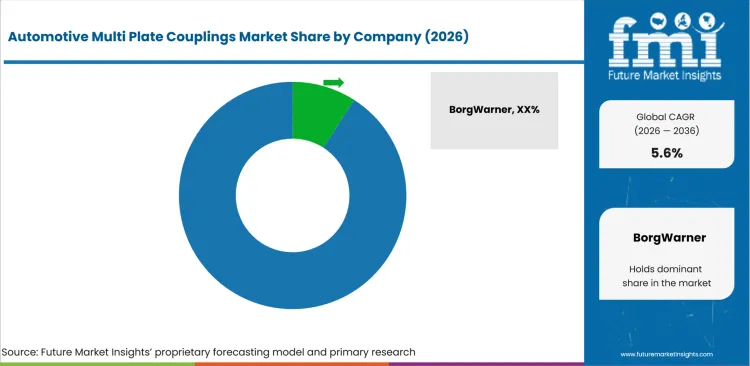
Competition divides between active AWD specialists and transmission-clutch groups. BorgWarner and GKN Automotive carry direct torque-management exposure. Magna International and ZF Friedrichshafen add transmission integration. Dana and Eaton extend the field into broader driveline and service programs.
- AWD torque management: BorgWarner, GKN Automotive, JTEKT and Dauch Corporation.
- Transmission and hybrid clutches: Magna International, Schaeffler, ZF Friedrichshafen and EXEDY.
- Broader driveline exposure: Dana and Eaton.
Competitive Benchmarking: Automotive Multi Plate Couplings Market
| Company | Torque-Management Coverage | Transmission / Hybrid Clutch Coverage | Service / Aftermarket Readiness | Geographic Reach |
|---|---|---|---|---|
| BorgWarner | High | High | Medium | North America, Europe and Asia |
| GKN Automotive | High | Medium | Medium | Europe, North America and Asia |
| Magna International | High | High | Medium | North America, Europe and Asia |
| Schaeffler | Medium | High | High | Europe, North America and Asia |
| ZF Friedrichshafen | Medium | High | Medium | Europe, North America and Asia |
| JTEKT | High | Medium | Medium | Japan, North America, Europe and Asia |
| Dana | Medium | High | Medium | North America, Europe and Asia |
| Dauch Corporation | High | Medium | Low | North America, Europe and Asia |
| Eaton | Medium | Low | High | North America, Europe, Middle East and Africa |
| EXEDY | Low | High | High | Japan, North America, Europe and Asia |
Scoring basis: High torque-management coverage requires multiple verified AWD or differential routes. Medium identifies one family and Low identifies narrow exposure. High transmission - hybrid clutch coverage requires several verified applications. Medium identifies one family and Low identifies limited scope. High service readiness requires multi-region replacement coverage. Medium and Low mark narrower documented service breadth.
Key Developments in the Automotive Multi Plate Couplings Market
- In March 2026, EXEDY established a joint venture with Italy-based FRAP S.p.A. to expand global clutch replacement distribution.
- In February 2026, Dauch Corporation completed its acquisition of Dowlais Group and its GKN Automotive subsidiary to broaden combined driveline coverage.
- In September 2025, ZF Friedrichshafen presented the 8HP evo automatic transmission at IAA Mobility for mild-hybrid and 400 V full-hybrid applications.
Key Players in the Automotive Multi Plate Couplings Market
Active AWD and Torque-Management Platforms
- BorgWarner
- GKN Automotive
- JTEKT
- Dauch Corporation
Transmission and Hybrid Clutch Platforms
- Magna International
- Schaeffler
- ZF Friedrichshafen
- EXEDY
Broader Driveline and Service Platforms
- Dana
- Eaton
Automotive Multi Plate Couplings Market - Report Scope
| Coverage field | Report scope |
|---|---|
| Market breakdown | By coupling type, application, vehicle type, sales channel, control and region. |
| Quantitative Units | USD billion. |
| Market Definition | Revenue from automotive multi plate coupling products and identifiable clutch-pack or coupling modules used in defined driveline applications. Finished-vehicle revenue and unrelated adjacent components are excluded. |
| Regions Covered | North America, Latin America, Western Europe, Eastern Europe, East Asia, South Asia and Pacific and Middle East and Africa. |
| Countries Covered | Italy, Mexico, South Korea, USA, Germany, France, Japan and more than twenty-five additional countries in the full report. |
| Key Companies Profiled | BorgWarner, GKN Automotive, Magna International, Schaeffler, ZF Friedrichshafen, JTEKT, Dana, Dauch Corporation, Eaton, EXEDY. |
| Forecast Period | 2026 to 2036. |
| Approach | Primary and secondary research with market triangulation. |
Automotive Multi Plate Couplings Market - Research Methodology
| Method | Approach |
|---|---|
| Primary Research | FMI analysts gathered input from manufacturers, service providers, technology developers, distributors, end users, procurement teams, and subject-matter experts. Interviews examined purchasing decisions, product or service evaluation, adoption barriers, approval requirements, pricing considerations, and expectations for technical or commercial support. Respondents were also asked what evidence is required before a trial, pilot, or initial order develops into regular purchasing. |
| Desk Research | Desk research covered government statistics, regulatory publications, trade data, industry associations, technical literature, standards, company filings, product information, and official corporate announcements. Sources were reviewed for relevance, publication date, geographic coverage, and consistency with the defined market scope. Claims relating to performance, applications, approvals, capacity, investment, and commercial activity were retained only when supported by credible public evidence. |
| Market Sizing and Forecasting | The market model combined the baseline value with historical performance, segment structure, pricing and volume indicators, adoption levels, company participation, and country-level demand conditions. Forecast assumptions considered economic activity, investment trends, regulatory developments, technology adoption, purchasing cycles, supply availability, and barriers to wider market use. Segment and regional estimates were reconciled before the final market total was calculated. |
| Data Validation | Estimates were checked against multiple independent indicators, including public data, company activity, trade patterns, industry developments, and findings from primary interviews. Validation also tested whether products, services, applications, and company revenues fell within the defined market boundaries. Adjacent categories, unsupported claims, overlapping revenues, and activities without direct market relevance were excluded to reduce double counting and maintain consistency across segments and countries. |
Automotive Multi Plate Couplings Market by Segments
Automotive Multi Plate Couplings Market segmented by Coupling Type:
- Wet multi-plate couplings
- Dry multi-plate couplings
- Electronically controlled couplings
- AWD coupling packs
- Torque vectoring clutch packs
Automotive Multi Plate Couplings Market segmented by Application:
- AWD systems
- Transfer cases
- DCT transmissions
- Hybrid drivetrains
- Performance differentials
Automotive Multi Plate Couplings Market segmented by Vehicle Type:
- SUVs - crossovers
- Passenger cars
- Performance vehicles
- Pickup trucks
- Hybrid - EV platforms
Automotive Multi Plate Couplings Market segmented by Sales Channel:
- OEM direct
- Driveline Tier-1s
- Aftermarket replacement
- Service parts
Automotive Multi Plate Couplings Market segmented by Control:
- Hydraulic control
- Electro-hydraulic control
- Electromagnetic control
- Mechanical preload
Automotive Multi Plate Couplings Market by Region:
- North America
- United States
- Canada
- Latin America
- Brazil
- Mexico
- Argentina
- Chile
- Western Europe
- Germany
- France
- United Kingdom
- Italy
- Spain
- Benelux
- Nordics
- Eastern Europe
- Poland
- Czech Republic
- Romania
- Hungary
- East Asia
- China
- Japan
- South Korea
- South Asia and Pacific
- India
- ASEAN
- Australia and New Zealand
- Middle East and Africa
- GCC Countries
- South Africa
- Türkiye
- Israel
Research Sources and Bibliography
- European Automobile Manufacturers’ Association. (2026, January 27). New car registrations: +1.8% in 2025; battery-electric 17.4% market share.
- European Automobile Manufacturers’ Association. (2026, July 23). New car registrations: +5.7% in H1 2026; battery-electric 20.7% market share.
- United States Environmental Protection Agency. (2026, February 19). Highlights of the Automotive Trends Report.
- Instituto Nacional de Estadística y Geografía. (2025, May 9). Registro Administrativo de la Industria Automotriz de Vehículos Ligeros (RAIAVL).
- UNRAE. (2026, January 2). Mercato auto Italia: dicembre a +2,2%, ma il 2025 chiude in flessione del -2,1% a 1.525.722 unità.
- Ministry of Trade, Industry and Energy, Republic of Korea. (2025, January 16). Korea’s auto exports enter $70 bln thresholds for 2nd year running.
- Japan Automobile Manufacturers Association. (2025, September). The Motor Industry of Japan 2025.
- Federal Highway Administration. (2026). Our Nation’s Highways 2026: Vehicles.
- Service des données et études statistiques. (2026, February 11). Immatriculations de voitures en 2025: le marché du neuf baisse, celui de l’occasion résiste.
- International Trade Administration. (2026, February 11). Mexico - Automotive Industry.
- BorgWarner. (2025, May 6). BorgWarner secures two dual-clutch programs in China.
- BorgWarner. (2026, May 6). BorgWarner wins two conquest awards in Asia for combustion and hybrid powertrain programs.
- GKN Automotive. (2025, September 8). GKN Automotive achieves ISO 21434 certification.
- GKN Automotive. (2025, October 22). GKN Automotive hosts leading OEMs at showcase event.
- Magna International. (2025, March 27). Technical Paper Eco Transmission family.
- Schaeffler. (2025, June 25). Schaeffler Vehicle Lifetime Solutions launches new repair solution for vehicles with double clutch.
- ZF Friedrichshafen. (2025, November 7). Further development for hybrid drive: ZF presents 8HP evo, transmission update at the IAA 2025.
- EXEDY Corporation. (2026, March 25). EXEDY established a joint venture for aftermarket business with Italy based FRAP S.p.A.
- Dauch Corporation. (2026, February 3). Dauch Corporation (formerly AAM) and Dowlais Group (GKN) combination complete.
- BorgWarner. (2025, October 30). BorgWarner expands collaboration with Chery to supply advanced AWD products for global growth.
- Eaton. (2026, September 1). Eaton’s Mobility segment to highlight commercial vehicle transmission expertise at Automechanika Frankfurt.
- Magna International. (2026, March 24). Magna unveils DHD REX hybrid drive for enhanced EV range.
- Schaeffler. (2026, July 8). Integrated portfolio and smart solutions: Schaeffler Vehicle Lifetime Solutions paves the way for greater efficiency and reduced complexity.
- Dana Incorporated. (2026, June 11). Dana Incorporated announces agreement to combine with Eaton’s Mobility business.
- Magna Powertrain. (2026). Facts & figures.
- BorgWarner. (2026). Annual reports.
- Magna International. (2026). Annual reports.
- ZF Friedrichshafen. (2026). Annual report 2025.
- JTEKT Corporation. (2025). JTEKT Report 2025.
- EXEDY Corporation. (2025). Integrated Report 2025.
- JTEKT Corporation. (2026, May 27). Concerning Signing of Definitive Agreement on the Transfer of the European Automotive Business
This bibliography is provided for reader reference and is not exhaustive. The full report contains the complete reference list and detailed citations.
This Report Answers
- How large is the automotive multi plate couplings market in 2026 and 2036?
- Which vehicle conditions support coupling demand?
- Why do wet multi-plate couplings lead coupling type?
- How does AWD-system leadership influence coupling demand?
- Why do SUVs - crossovers hold the leading vehicle type position?
- How do country growth rates differ?
- Which companies supply AWD and clutches?
- What slows supplier switching?
Frequently Asked Questions
How big is the automotive multi plate couplings market in 2026?
The automotive multi plate couplings market is valued at USD 6.2 billion in 2026 and is projected to reach USD 10.6 billion by 2036. AWD and hybrid drivetrains retain controlled torque-transfer functions that use multi-plate packs.
What is the CAGR of the automotive multi plate couplings market from 2026 to 2036?
The automotive multi plate couplings market is projected to grow at a CAGR of 5.6% between 2026 and 2036. Vehicle programs support expansion because compact packs control torque under repeated engagement.
Which coupling type leads the automotive multi plate couplings market?
The wet multi-plate couplings segment is expected to hold 31.0% of the automotive multi plate couplings market in 2026, driven by fluid cooling during repeated slip. Wet operation stabilizes friction under high-duty modulation.
Which application leads the automotive multi plate couplings market?
The AWD systems segment is expected to hold 32.0% of the automotive multi plate couplings market in 2026, supported by variable axle-torque control. Multi-plate packs vary coupling force without permanent engagement.
Which countries are projected to record the highest growth in the automotive multi plate couplings market?
Italy is projected to grow at 6.4% CAGR followed by Mexico at 6.1% and South Korea at 5.7% through 2036. Hybrid registrations support Italy and South Korea while export production supports Mexico.
Which companies are active in the automotive multi plate couplings market?
Key companies operating in the automotive multi plate couplings market include BorgWarner and GKN Automotive alongside Magna International and Schaeffler plus ZF Friedrichshafen and JTEKT. Dana and Dauch Corporation join Eaton and EXEDY in covering AWD control and clutch-related applications.
Preview the report firsthand - request a free sample
Get SampleGet the brochure for pricing and purchase details.
Get PDFTable of Content
- Key Takeaways
- Market Size and CAGR
- Top Growth Driver
- Fastest Growing Segment
- Leading Region
- Key Companies
- Emerging Opportunities
- Executive Summary
- Global Market Outlook
- Demand-side Trends
- Supply-side Trends
- Technology Roadmap Analysis
- Analysis and Recommendations
- Analyst Perspective (What is happening? Why now? What should investors know?)
- Key Questions Answered
- How large is the market?
- What is the CAGR?
- What are key trends?
- Which region dominates?
- Who are the leaders?
- Market Overview
- Market Coverage / Taxonomy
- Market Definition / Scope / Limitations
- Research Methodology
- Chapter Orientation
- Analytical Lens and Working Hypotheses
- Market Structure, Signals, and Trend Drivers
- Benchmarking and Cross-market Comparability
- Market Sizing, Forecasting, and Opportunity Mapping
- Research Design and Evidence Framework
- Desk Research Programme (Secondary Evidence)
- Expert Input and Fieldwork (Primary Evidence)
- Tooling, Models, and Reference Databases
- Data Engineering and Model Build
- Quality Assurance and Audit Trail
- Market Background
- Market Dynamics (Drivers, Restraints, Opportunity, Trends)
- Scenario Forecast (Optimistic, Likely, Conservative)
- Impact Analysis
- AI Impact
- Sustainability Impact
- Regulatory Impact
- Technology Impact
- Consumer / Buyer Analysis
- Purchase Drivers
- Adoption Barriers
- Buyer Journey
- Opportunity Map Analysis
- Product Life Cycle Analysis
- Supply Chain Analysis
- Investment Feasibility Matrix
- Value Chain Analysis
- PESTLE and Porter's Analysis
- Regulatory Landscape
- Regional Parent Market Outlook
- Production and Consumption Statistics
- Import and Export Statistics
- Global Market Analysis and Forecast, 2021 to 2036
- Historical Market Size Value (USD Billion) Analysis, 2021 to 2025
- Current and Future Market Size Value (USD Billion) Projections, 2026 to 2036
- Y-o-Y Growth Trend Analysis
- Absolute $ Opportunity Analysis
- Global Market Pricing Analysis, 2021 to 2036
- Global Market Analysis and Forecast, By Coupling Type, 2021 to 2036
- Introduction / Key Findings
- Historical Market Size Value (USD Billion) Analysis By Coupling Type, 2021 to 2025
- Current and Future Market Size Value (USD Billion) Analysis and Forecast By Coupling Type, 2026 to 2036
- Wet multi-plate couplings
- Dry multi-plate couplings
- Electronically controlled couplings
- AWD coupling packs
- Torque vectoring clutch packs
- Wet multi-plate couplings
- Y-o-Y Growth Trend Analysis By Coupling Type, 2021 to 2025
- Absolute $ Opportunity Analysis By Coupling Type, 2026 to 2036
- Global Market Analysis and Forecast, By Application, 2021 to 2036
- Introduction / Key Findings
- Historical Market Size Value (USD Billion) Analysis By Application, 2021 to 2025
- Current and Future Market Size Value (USD Billion) Analysis and Forecast By Application, 2026 to 2036
- AWD systems
- Transfer cases
- DCT transmissions
- Hybrid drivetrains
- Performance differentials
- AWD systems
- Y-o-Y Growth Trend Analysis By Application, 2021 to 2025
- Absolute $ Opportunity Analysis By Application, 2026 to 2036
- Global Market Analysis and Forecast, By Vehicle Type, 2021 to 2036
- Introduction / Key Findings
- Historical Market Size Value (USD Billion) Analysis By Vehicle Type, 2021 to 2025
- Current and Future Market Size Value (USD Billion) Analysis and Forecast By Vehicle Type, 2026 to 2036
- SUVs/crossovers
- Passenger cars
- Performance vehicles
- Pickup trucks
- Hybrid/EV platforms
- SUVs/crossovers
- Y-o-Y Growth Trend Analysis By Vehicle Type, 2021 to 2025
- Absolute $ Opportunity Analysis By Vehicle Type, 2026 to 2036
- Global Market Analysis and Forecast, By Sales Channel, 2021 to 2036
- Introduction / Key Findings
- Historical Market Size Value (USD Billion) Analysis By Sales Channel, 2021 to 2025
- Current and Future Market Size Value (USD Billion) Analysis and Forecast By Sales Channel, 2026 to 2036
- OEM direct
- Driveline Tier-1s
- Aftermarket replacement
- Service parts
- OEM direct
- Y-o-Y Growth Trend Analysis By Sales Channel, 2021 to 2025
- Absolute $ Opportunity Analysis By Sales Channel, 2026 to 2036
- Global Market Analysis and Forecast, By Control, 2021 to 2036
- Introduction / Key Findings
- Historical Market Size Value (USD Billion) Analysis By Control, 2021 to 2025
- Current and Future Market Size Value (USD Billion) Analysis and Forecast By Control, 2026 to 2036
- Hydraulic control
- Electro-hydraulic control
- Electromagnetic control
- Mechanical preload
- Hydraulic control
- Y-o-Y Growth Trend Analysis By Control, 2021 to 2025
- Absolute $ Opportunity Analysis By Control, 2026 to 2036
- Global Market Analysis and Forecast, By Region, 2021 to 2036
- Introduction
- Historical Market Size Value (USD Billion) Analysis By Region, 2021 to 2025
- Current Market Size Value (USD Billion) Analysis and Forecast By Region, 2026 to 2036
- North America
- Latin America
- Western Europe
- Eastern Europe
- East Asia
- South Asia and Pacific
- Middle East & Africa
- Market Attractiveness Analysis By Region
- North America Market Analysis and Forecast, By Country, 2021 to 2036
- Historical Market Size Value (USD Billion) Trend Analysis By Market Taxonomy, 2021 to 2025
- Market Size Value (USD Billion) Forecast By Market Taxonomy, 2026 to 2036
- By Country
- USA
- Canada
- By Coupling Type
- By Application
- By Vehicle Type
- By Sales Channel
- By Control
- By Country
- Market Attractiveness Analysis
- By Country
- By Coupling Type
- By Application
- By Vehicle Type
- By Sales Channel
- By Control
- Key Takeaways
- Latin America Market Analysis and Forecast, By Country
- Historical Market Size Value (USD Billion) Trend Analysis By Market Taxonomy, 2021 to 2025
- Market Size Value (USD Billion) Forecast By Market Taxonomy, 2026 to 2036
- By Country
- Brazil
- Mexico
- Chile
- Rest of Latin America
- By Coupling Type
- By Application
- By Vehicle Type
- By Sales Channel
- By Control
- By Country
- Market Attractiveness Analysis
- By Country
- By Coupling Type
- By Application
- By Vehicle Type
- By Sales Channel
- By Control
- Key Takeaways
- Western Europe Market Analysis and Forecast, By Country
- Historical Market Size Value (USD Billion) Trend Analysis By Market Taxonomy, 2021 to 2025
- Market Size Value (USD Billion) Forecast By Market Taxonomy, 2026 to 2036
- By Country
- Germany
- UK
- Italy
- Spain
- France
- Nordic
- BENELUX
- Rest of Western Europe
- By Coupling Type
- By Application
- By Vehicle Type
- By Sales Channel
- By Control
- By Country
- Market Attractiveness Analysis
- By Country
- By Coupling Type
- By Application
- By Vehicle Type
- By Sales Channel
- By Control
- Key Takeaways
- Eastern Europe Market Analysis and Forecast, By Country
- Historical Market Size Value (USD Billion) Trend Analysis By Market Taxonomy, 2021 to 2025
- Market Size Value (USD Billion) Forecast By Market Taxonomy, 2026 to 2036
- By Country
- Russia
- Poland
- Hungary
- Balkan & Baltic
- Rest of Eastern Europe
- By Coupling Type
- By Application
- By Vehicle Type
- By Sales Channel
- By Control
- By Country
- Market Attractiveness Analysis
- By Country
- By Coupling Type
- By Application
- By Vehicle Type
- By Sales Channel
- By Control
- Key Takeaways
- East Asia Market Analysis and Forecast, By Country
- Historical Market Size Value (USD Billion) Trend Analysis By Market Taxonomy, 2021 to 2025
- Market Size Value (USD Billion) Forecast By Market Taxonomy, 2026 to 2036
- By Country
- China
- Japan
- South Korea
- By Coupling Type
- By Application
- By Vehicle Type
- By Sales Channel
- By Control
- By Country
- Market Attractiveness Analysis
- By Country
- By Coupling Type
- By Application
- By Vehicle Type
- By Sales Channel
- By Control
- Key Takeaways
- South Asia and Pacific Market Analysis and Forecast, By Country
- Historical Market Size Value (USD Billion) Trend Analysis By Market Taxonomy, 2021 to 2025
- Market Size Value (USD Billion) Forecast By Market Taxonomy, 2026 to 2036
- By Country
- India
- ASEAN
- Australia & New Zealand
- Rest of South Asia and Pacific
- By Coupling Type
- By Application
- By Vehicle Type
- By Sales Channel
- By Control
- By Country
- Market Attractiveness Analysis
- By Country
- By Coupling Type
- By Application
- By Vehicle Type
- By Sales Channel
- By Control
- Key Takeaways
- Middle East & Africa Market Analysis and Forecast, By Country
- Historical Market Size Value (USD Billion) Trend Analysis By Market Taxonomy, 2021 to 2025
- Market Size Value (USD Billion) Forecast By Market Taxonomy, 2026 to 2036
- By Country
- Kingdom of Saudi Arabia
- Other GCC Countries
- Türkiye
- South Africa
- Other African Union
- Rest of Middle East & Africa
- By Coupling Type
- By Application
- By Vehicle Type
- By Sales Channel
- By Control
- By Country
- Market Attractiveness Analysis
- By Country
- By Coupling Type
- By Application
- By Vehicle Type
- By Sales Channel
- By Control
- Key Takeaways
- Key Countries Market Analysis
- USA
- Pricing Analysis
- Market Share Analysis, 2025
- By Coupling Type
- By Application
- By Vehicle Type
- By Sales Channel
- By Control
- Canada
- Pricing Analysis
- Market Share Analysis, 2025
- By Coupling Type
- By Application
- By Vehicle Type
- By Sales Channel
- By Control
- Mexico
- Pricing Analysis
- Market Share Analysis, 2025
- By Coupling Type
- By Application
- By Vehicle Type
- By Sales Channel
- By Control
- Brazil
- Pricing Analysis
- Market Share Analysis, 2025
- By Coupling Type
- By Application
- By Vehicle Type
- By Sales Channel
- By Control
- Chile
- Pricing Analysis
- Market Share Analysis, 2025
- By Coupling Type
- By Application
- By Vehicle Type
- By Sales Channel
- By Control
- Germany
- Pricing Analysis
- Market Share Analysis, 2025
- By Coupling Type
- By Application
- By Vehicle Type
- By Sales Channel
- By Control
- UK
- Pricing Analysis
- Market Share Analysis, 2025
- By Coupling Type
- By Application
- By Vehicle Type
- By Sales Channel
- By Control
- Italy
- Pricing Analysis
- Market Share Analysis, 2025
- By Coupling Type
- By Application
- By Vehicle Type
- By Sales Channel
- By Control
- Spain
- Pricing Analysis
- Market Share Analysis, 2025
- By Coupling Type
- By Application
- By Vehicle Type
- By Sales Channel
- By Control
- France
- Pricing Analysis
- Market Share Analysis, 2025
- By Coupling Type
- By Application
- By Vehicle Type
- By Sales Channel
- By Control
- India
- Pricing Analysis
- Market Share Analysis, 2025
- By Coupling Type
- By Application
- By Vehicle Type
- By Sales Channel
- By Control
- ASEAN
- Pricing Analysis
- Market Share Analysis, 2025
- By Coupling Type
- By Application
- By Vehicle Type
- By Sales Channel
- By Control
- Australia & New Zealand
- Pricing Analysis
- Market Share Analysis, 2025
- By Coupling Type
- By Application
- By Vehicle Type
- By Sales Channel
- By Control
- China
- Pricing Analysis
- Market Share Analysis, 2025
- By Coupling Type
- By Application
- By Vehicle Type
- By Sales Channel
- By Control
- Japan
- Pricing Analysis
- Market Share Analysis, 2025
- By Coupling Type
- By Application
- By Vehicle Type
- By Sales Channel
- By Control
- South Korea
- Pricing Analysis
- Market Share Analysis, 2025
- By Coupling Type
- By Application
- By Vehicle Type
- By Sales Channel
- By Control
- Russia
- Pricing Analysis
- Market Share Analysis, 2025
- By Coupling Type
- By Application
- By Vehicle Type
- By Sales Channel
- By Control
- Poland
- Pricing Analysis
- Market Share Analysis, 2025
- By Coupling Type
- By Application
- By Vehicle Type
- By Sales Channel
- By Control
- Hungary
- Pricing Analysis
- Market Share Analysis, 2025
- By Coupling Type
- By Application
- By Vehicle Type
- By Sales Channel
- By Control
- Kingdom of Saudi Arabia
- Pricing Analysis
- Market Share Analysis, 2025
- By Coupling Type
- By Application
- By Vehicle Type
- By Sales Channel
- By Control
- Türkiye
- Pricing Analysis
- Market Share Analysis, 2025
- By Coupling Type
- By Application
- By Vehicle Type
- By Sales Channel
- By Control
- South Africa
- Pricing Analysis
- Market Share Analysis, 2025
- By Coupling Type
- By Application
- By Vehicle Type
- By Sales Channel
- By Control
- USA
- Market Structure Analysis
- Competition Dashboard
- Competition Benchmarking
- Market Share Analysis of Top Players
- By Regional
- By Coupling Type
- By Application
- By Vehicle Type
- By Sales Channel
- By Control
- Emerging Startups
- Innovation Benchmarking
- Competition Analysis
- Competition Deep Dive
- BorgWarner
- Overview
- Product Portfolio
- Profitability by Market Segments
- Sales Footprint
- Strategy Overview
- Marketing Strategy
- Product Strategy
- Channel Strategy
- GKN Automotive
- Magna International
- Schaeffler
- ZF Friedrichshafen
- JTEKT
- Dana
- American Axle & Manufacturing
- Eaton
- EXEDY
- BorgWarner
- Case Studies
- Success Stories
- Recent Developments
- Competition Deep Dive
- Assumptions & Acronyms Used


