

- Market Size (2026)
- USD 9.3 Bn
- Forecast (2036)
- USD 20.1 Bn
- CAGR (2026 to 2036)
- 8.0%
How big is Automotive Hairpin Stators Market in 2026?
USD 9.3 billion in 2026 and USD 20.1 billion by 2036 at an 8.0% CAGR.
Demand for automotive hairpin stators is projected to expand at 8.0% CAGR between 2026 and 2036, lifting value from USD 9.3 billion to USD 20.1 billion. Series revenue starts once an OEM or Tier-1 locks winding geometry into a validated traction-motor design. In April 2026 BorgWarner disclosed three Asian motor awards covering a South Korean stator assembly and two Chinese winding programs. Production starts were scheduled from June 2026 through September 2027, turning nominated flat-wire designs into specific manufacturing call-offs.
Vehicle programs do not reach hairpin production at the same pace in every major EV market. The IEA's May 2026 outlook put electric cars at 28% of European sales in 2025, versus just under 10% in the United States. The sales gap changes the mix of motor programs available to stator plants. European sourcing enters 2026 with stronger battery-electric pull, while US programs carry more uncertainty after consumer tax credits ended.
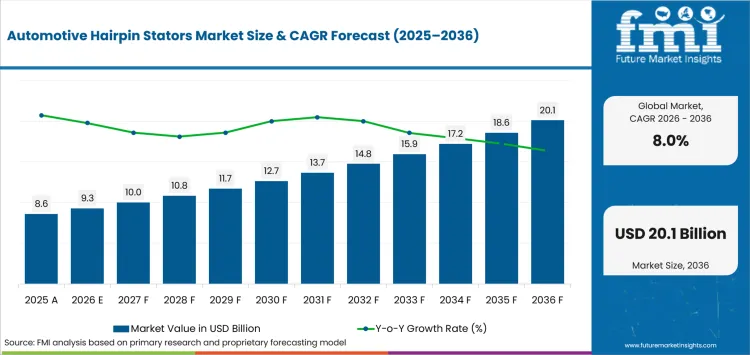
Key Takeaways
- Automotive hairpin stator demand rises after electrified vehicle programs freeze flat-wire winding into traction-motor designs and proceed to series production.
- U-pin hairpin stators are projected to hold 32.0% share in 2026 owing to formed pin geometry suited to indexed insertion and joining.
- The 400-800 V class is likely to capture 47.0% of voltage class demand in 2026 attributable to motor families spanning current and higher-voltage platforms.
- In 2026, battery electric cars are expected to lead vehicle type with 38.0% share because the traction motor carries the vehicle’s full propulsion duty.
- Complex conductor forming and joining can extend qualification time if line yield falls below automotive series-production targets.
- Some of the key players in this market include BorgWarner, Nidec, DENSO, Astemo, Schaeffler, Valeo, Magna International, Marelli, LG Magna e-Powertrain, and ZF.
Analyst Perspective
"Hairpin stators earn program value after winding lines prove copper utilization plus stable weld resistance and insulation results at series yield. Strong bids preserve those controls through ramp-up without forcing a new winding line for every motor family."
- Nikhil Kaitwade, Principal Consultant, Future Market Insights
How is the automotive hairpin stators market segmented?
The automotive hairpin stators market is segmented by stator type, voltage class, vehicle type, cooling and sales channel.
The automotive hairpin stators market is segmented by stator type, voltage class, vehicle type, cooling and sales channel. Stator type covers U-pin, I-pin, continuous hairpin, wave-wound and high-slot-fill designs. Voltage class spans below 400 V, 400-800 V, above 800 V and commercial vehicle high-voltage. Vehicle type, cooling and sales channel follow the complete classifications listed later.
What supports water-jacket cooled designs in the cooling category?
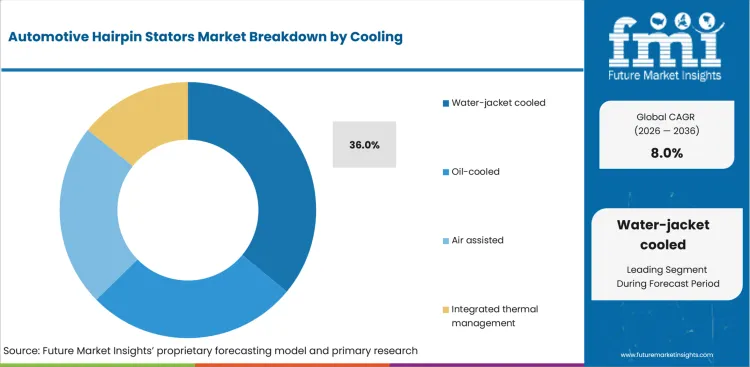
Cooling choice sets how much continuous torque a hairpin motor can carry before insulation temperature reaches its validated limit. Water jackets use familiar coolant circuits, while e-axle cooling components place oil closer to concentrated heat sources. The thermal route changes both validation work and final assembly complexity at the motor plant.
- By cooling, water-jacket cooled designs are forecast to represent 36.0% in 2026 driven by a simpler fluid boundary at the stator.
- BorgWarner documented in April 2025 that its iM-575 pairs a high-voltage hairpin motor with a self-contained oil system and oil-water heat exchangers. The design shows why heavier duty cycles can justify more direct thermal control.
What makes U-pin hairpin stators central to the stator type category?
U-pin hairpin stators fit high-volume electric vehicle drive motors because plants form repeatable rectangular conductors before automated insertion and joining. The geometry gives process engineers clear control points for pin height and weld access without requiring a continuous winding path.
- By stator type, U-pin hairpin stators are estimated to hold 32.0% in 2026 owing to formed conductors that suit indexed insertion and end-turn joining.
- BorgWarner stated in February 2025 that its ultra-short high-voltage hairpin process supports 400 V and 800 V platforms on existing hairpin lines. That compatibility lets plants change motor programs without replacing the full winding process.
Why does 400-800 V lead the voltage class category?
Voltage selection fixes insulation duty and current loading before the motor enters vehicle validation. The 400-800 V band spans mature platforms and newer architectures that place higher switching demands on automotive power electronics.
- In 2026, 400-800 V is expected to lead voltage class with 47.0% share because the range covers the main passenger-EV voltage transition.
- Magna announced in July 2026 that its new Chery award uses a 250 kW 800 V two-speed eDrive produced in Wuhu. The program confirms that 800 V designs are moving into localized series sourcing at the upper end of this class.
How do battery electric cars shape the vehicle type category?
Battery electric cars place the stator in the vehicle’s sole traction path, so motor losses translate directly into range and thermal load. Integration inside electric vehicle e-axles makes motor package length a hard platform constraint. Slot fill and end-turn length therefore enter packaging reviews before design freeze.
- Battery electric cars are set to lead the vehicle type category with 38.0% share in 2026 due to the motor carrying continuous propulsion responsibility.
- DENSO announced in January 2025 that Suzuki’s first mass-produced BEV would use a compact eAxle with a high-power-density motor. The program ties motor packaging and loss reduction to component selection before series launch.
What drives EV motor OEMs in the sales channel category?
Motor manufacturers control winding specification before drive-unit integration because slot geometry and insulation must match rotor and housing requirements. Integrated electric powertrain systems increase the value of keeping motor validation close to final drive-unit assembly. EV motor OEMs therefore retain design responsibility before vehicle-level nomination and final powertrain integration.
- Based on sales channel, EV motor OEMs are projected to account for 34.0% in 2026 due to their control over the stator design freeze.
- Astemo disclosed in June 2026 that its motors and inverters are supplied to JATCO for the Nissan LEAF 3-in-1 powertrain. The arrangement separates component supply from final system integration while preserving motor-level responsibility.
What are the drivers, restraints and opportunities in the Automotive Hairpin Stators Market?
Series electrification awards increase qualified stator demand, joining-intensive production raises break-even risk and modular motor platforms reduce the cost of reusing validated processes.
- Driver: Vehicle-program nominations convert flat-wire winding designs into repeat production requirements for traction-motor plants.
- Restraint: Forming and welding complexity raises equipment cost and can delay qualification if automotive yield targets are missed.
- Opportunity: Reusable motor interfaces can spread tooling and validation work over several voltage or vehicle programs.
Platform nominations matter because EV powertrain programs convert engineering specifications into scheduled motor call-offs. BorgWarner said in July 2025 that a new Chinese award uses ultra-short hairpin welding and shared lines at its Wuhu expansion. Shared production lets one validated process serve battery-electric and hybrid applications without rebuilding the winding line for each vehicle program.
Each hairpin joint introduces an inspection point, so forming accuracy and weld yield directly affect qualification cost. BorgWarner’s May 2025 S-wind contract documented more than 90% fewer welding points than conventional hairpin motors. That comparison explains why a competing winding route can win if program volume does not repay joining equipment.
Process reuse becomes valuable once a motor family spans several voltage classes without rebuilding the winding line. ZF introduced its SELECT platform in June 2025 with an 800 V system and scalable production interfaces. For stator engineering teams the commercial opening lies in reusable interfaces that shorten platform work while preserving application-specific winding validation.
Which country CAGRs are profiled in the Automotive Hairpin Stators Market?
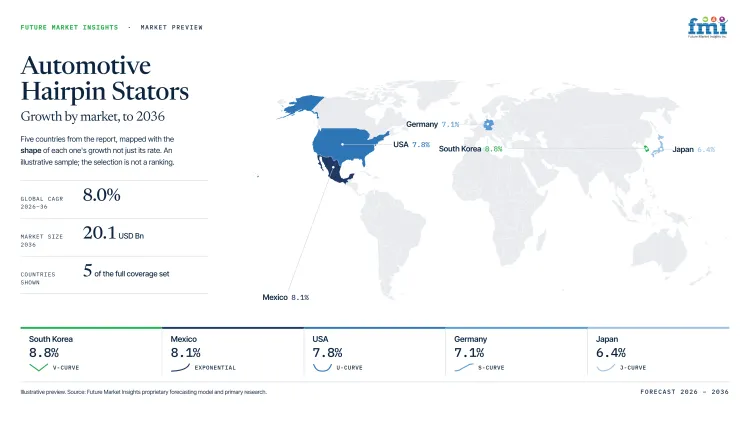
| Country | CAGR |
|---|---|
| South Korea | 8.8% |
| Mexico | 8.1% |
| USA | 7.8% |
| Canada | 7.4% |
| Germany | 7.1% |
| France | 6.8% |
| Japan | 6.4% |
How do country-level CAGRs compare in the Automotive Hairpin Stators Market?
South Korea and Mexico form the upper-growth group. USA and Canada follow while Germany and France occupy the next band. Japan records the slowest approved CAGR.
- South Korea's EV export base raises local program density.
- Mexico's export corridors concentrate e-drive assembly near vehicle plants.
- USA vehicle scale sustains high-output motor content.
- Canada's cross-border assembly links support shared sourcing programs.
- Germany's dense engineering networks shorten traction-motor handoffs.
- France's deep supplier base supports mixed electrified vehicle programs.
- Japan's slower pace penalizes capacity built before confirmed nominations.
The comparison ranks timing, not program value. The full report provides country-level CAGR analysis across North America, Latin America, Western Europe, Eastern Europe, East Asia, South Asia and Pacific, and the Middle East and Africa.
Country-wise Analysis
- South Korean traction-motor programs face efficiency and safety targets that push compact motors toward disciplined series validation. Automotive hairpin stator demand in South Korea is forecast to grow at 8.8% CAGR through 2036, tied to performance-led vehicle qualification. In January 2025 the Ministry of Environment raised the range threshold for medium and large EV subsidy differentiation from 400 km to 440 km. The reform also raised charging-speed incentive thresholds for passenger vehicles with faster charging performance. Longer-range programs give efficient traction motors a clear route into local vehicle specifications. Stator plants still have to hold weld resistance and insulation yield at a cost that survives OEM sourcing.
- After federal clean-vehicle credits ended for acquisitions after September 30 2025, US automakers entered 2026 with greater pressure on platform cost. IRS guidance issued in August 2025 confirmed the termination date for new and used clean-vehicle credits plus qualified commercial credits. The US automotive hairpin stators sector is projected to record 7.8% CAGR during the assessment period, because electrified platform investment continues without that consumer purchase support. North American assembly depth gives stator programs a local route into high-volume launches. Forming and welding costs must be spread together over several vehicle programs. A line built for one uncertain volume plan raises the break-even risk.
- In Japan the next motor cycle still spans BEVs and large hybrid portfolios rather than one dominant electric architecture. Japan is estimated to post 6.4% CAGR over the forecast period, given the need to serve several propulsion duty cycles. JAMA's April 2026 passenger-car survey found BEVs ranked first for just over 20% of respondents considering environmental vehicles. The survey result keeps electric traction motors tied to several powertrain plans, so flexible tooling retains commercial value during plant loading. Deep motor-engineering experience shortens qualification work, but slower BEV conversion limits how far manufacturers can build hairpin capacity ahead of confirmed platform awards.
- German motor sourcing benefits from dense engineering teams, yet specialized stator lines face call-off risk when vehicle demand changes quickly. In January 2026 the BMWE said BEVs reached 19.1% of 2025 new-car registrations after a 13.5% share in 2024. Automotive hairpin stator sales in Germany are predicted to advance at 7.1% CAGR through 2036, propelled by renewed BEV nominations and local engineering capacity. Existing automotive electronics skills shorten technical handoffs between motor design and vehicle integration in major production clusters and plants. The constraint is capital timing because a dedicated winding line may outlive the volume assumptions used to approve it.
- Mexico's export plants place e-drive production close to North American vehicle programs, so localization can reduce logistics and launch-response time. Hairpin stator demand in Mexico is forecast to rise at 8.1% CAGR over the forecast period, aided by existing vehicle and e-drive manufacturing. The Presidency presented Olinia 1 in June 2026 with more than 125 km of range and first deliveries planned for summer 2027. The program gives local engineers another electric-mobility reference point outside export assembly. Affordability is a hard constraint, which means commercial vehicle traction motors and new winding capacity must prove cost savings before higher-specification hairpin geometry earns volume.
- January 2025 registrations in France show why stator capacity cannot be planned against BEVs alone. National transport data put battery-electric cars at 17.0% and plug-in hybrids at 4.1% of new registrations. Non-plug-in gasoline hybrids reached 44.0%, keeping several electric motor duty cycles active in the same passenger-car base. The French automotive hairpin stators sector is anticipated to advance at 6.8% CAGR over the assessment period, supported by battery-electric programs beside continuing hybrid production. Local vehicle engineering gives manufacturers a local route to qualify new winding designs. Capacity allocation stays difficult because dedicated tooling can be stranded if the vehicle mix changes faster than plant loading.
- Provincial incentive timing is a material variable in Canadian EV purchasing because policy changes can move registrations before assembly plans adjust. Statistics Canada reported in June 2025 that first-quarter zero-emission vehicle registrations fell 23.1% year over year. Canada is on track to deliver 7.4% CAGR through 2036, attributable to continued electrification beyond short-term provincial swings. Quebec declined 50.8% during a temporary subsidy suspension and pulled the national result lower. Cross-border assembly gives stator producers a larger customer base than one province alone. The structural risk is uneven program loading, so reusable winding processes are more defensible than capacity built for one local incentive cycle.
Who are the notable companies in the Automotive Hairpin Stators Market?
BorgWarner, Nidec, DENSO, Astemo, Schaeffler, Valeo, Magna International, Marelli, LG Magna e-Powertrain, and ZF are the notable companies profiled in this market.
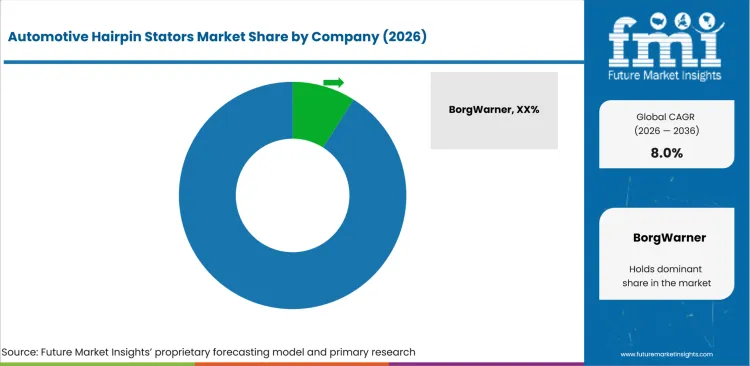
Competition separates direct flat-wire motor producers from integrated e-drive groups that influence stator specification inside complete propulsion systems. Entry depends on forming yield and voltage validation more than corporate scale. Current public evidence keeps Nidec in the comparison for e-Axle scale, while Astemo and Magna International are retained for integrated motor-system roles.
- Direct hairpin and flat-wire motor platforms include BorgWarner and DENSO. Schaeffler and Valeo also compete in this group. Marelli, LG Magna e-Powertrain and ZF extend the set through direct motor-platform programs.
- Integrated e-drive and motor-system positions: Astemo and Magna International.
- E-Axle scale and alternative motor architecture: Nidec, whose July 2025 disclosure documented third-generation 7-in-1 e-Axle mass production and a fourth-generation system under development.
Competitive Benchmarking: Automotive Hairpin Stators Market
| Company | Flat-Wire Stator Evidence | 400-800 V Coverage | e-Drive Integration | Geographic Reach |
|---|---|---|---|---|
| BorgWarner | High | High | High | Global; current Asian programs |
| Nidec | Low | Medium | High | Global |
| DENSO | High | Medium | High | Global |
| Astemo | Medium | Medium | High | Americas, Asia, China, Europe, Japan |
| Schaeffler | High | Medium | High | Global |
| Valeo | High | Medium | High | Global |
| Magna International | Medium | Medium | High | Global |
| Marelli | High | High | High | Global |
| LG Magna e-Powertrain | High | High | High | Asia, North America, Europe |
| ZF | High | High | High | Global |
Scoring basis: High flat-wire evidence requires current direct hairpin or rectangular-wire motor production. Medium reflects narrower current flat-wire evidence, while Low identifies an active e-Axle competitor without a current public hairpin disclosure. High voltage coverage requires evidence spanning 400 V and 800 V programs. Medium covers one high-voltage class. High e-drive integration requires a complete axle or integrated drive route. Medium covers motor-plus-electronics supply.
Key Developments in the Automotive Hairpin Stators Market
- In March 2026, Valeo inaugurated a Pune powertrain line for Mahindra's Born Electric platform with automated U-pin or hairpin stator assembly. Digital traceability links winding inspection to final eAxle production at the same site.
- In February 2026, ZF secured a multi-year Indian city-bus order for several thousand AxTrax 2 LF units. Its 800 V axle uses dual PSM hairpin motors with oil cooling in a direct commercial-vehicle series program.
- In April 2025, Schaeffler presented a volume-ready 800 V heavy-duty motor series with automated coil production and continuous hairpin winding. Oil cooling makes winding quality and thermal control part of the same production qualification.
Key Players in the Automotive Hairpin Stators Market
Direct Hairpin and Flat-Wire Motor Platforms
- BorgWarner
- DENSO
- Schaeffler
- Valeo
- Marelli
- LG Magna e-Powertrain
- ZF
Integrated e-Drive and Motor Systems
- Astemo
- Magna International
Alternative Winding and e-Axle Scale
- Nidec
Automotive Hairpin Stators Market - Report Scope
| Coverage field | Report scope |
|---|---|
| Market breakdown | By stator type, voltage class, vehicle type, cooling, sales channel and region. |
| Quantitative Units | USD billion. |
| Market Definition | Commercial revenue from automotive traction-motor stator assemblies and attributable captive stator value using hairpin, pin-based, continuous-hairpin or related flat-wire winding within the stated segmentation. |
| Regions Covered | North America, Latin America, Western Europe, Eastern Europe, East Asia, South Asia and Pacific, and Middle East and Africa. |
| Countries Covered | South Korea, Mexico, USA, Canada, Germany, France, Japan, and 20+ countries included in the full report. |
| Key Companies Profiled | BorgWarner, Nidec, DENSO, Astemo, Schaeffler, Valeo, Magna International, Marelli, LG Magna e-Powertrain, and ZF. |
| Forecast Period | 2026 to 2036. |
| Approach | Primary and secondary research with market triangulation. |
Automotive Hairpin Stators Market - Research Methodology
| Method | Approach |
|---|---|
| Primary Research | FMI analysts gathered input from manufacturers, service providers, technology developers, distributors, end users, procurement teams, and subject-matter experts. Interviews examined purchasing decisions, product or service evaluation, adoption barriers, approval requirements, pricing considerations, and expectations for technical or commercial support. Respondents were also asked what evidence is required before a trial, pilot, or initial order develops into regular purchasing. |
| Desk Research | Desk research covered government statistics, regulatory publications, trade data, industry associations, technical literature, standards, company filings, product information, and official corporate announcements. Sources were reviewed for relevance, publication date, geographic coverage, and consistency with the defined market scope. Claims relating to performance, applications, approvals, capacity, investment, and commercial activity were retained only when supported by credible public evidence. |
| Market Sizing and Forecasting | The market model combined the baseline value with historical performance, segment structure, pricing and volume indicators, adoption levels, company participation, and country-level demand conditions. Forecast assumptions considered economic activity, investment trends, regulatory developments, technology adoption, purchasing cycles, supply availability, and barriers to wider market use. Segment and regional estimates were reconciled before the final market total was calculated. |
| Data Validation | Estimates were checked against multiple independent indicators, including public data, company activity, trade patterns, industry developments, and findings from primary interviews. Validation also tested whether products, services, applications, and company revenues fell within the defined market boundaries. Adjacent categories, unsupported claims, overlapping revenues, and activities without direct market relevance were excluded to reduce double counting and maintain consistency across segments and countries. |
Automotive Hairpin Stators Market by Segments
Automotive Hairpin Stators Market segmented by Stator Type:
- U-pin hairpin stators
- I-pin hairpin stators
- Continuous hairpin windings
- Wave-wound hairpin stators
- High-slot-fill stators
Automotive Hairpin Stators Market segmented by Voltage Class:
- 400-800 V
- Below 400 V
- Above 800 V
- Commercial vehicle high-voltage
Automotive Hairpin Stators Market segmented by Vehicle Type:
- Battery electric cars
- Plug-in hybrids
- Electric SUVs
- Electric commercial vehicles
- Performance EVs
Automotive Hairpin Stators Market segmented by Cooling:
- Water-jacket cooled
- Oil-cooled
- Air assisted
- Integrated thermal management
Automotive Hairpin Stators Market segmented by Sales Channel:
- EV motor OEMs
- Tier-1 e-drive suppliers
- Automaker captive production
- Specialty winding suppliers
Automotive Hairpin Stators Market by Region:
- North America
- United States
- Canada
- Latin America
- Brazil
- Mexico
- Argentina
- Chile
- Western Europe
- Germany
- France
- United Kingdom
- Italy
- Spain
- Benelux
- Nordics
- Eastern Europe
- Poland
- Czech Republic
- Romania
- Hungary
- East Asia
- China
- Japan
- South Korea
- South Asia and Pacific
- India
- ASEAN
- Australia and New Zealand
- Middle East and Africa
- GCC Countries
- South Africa
- Türkiye
- Israel
Research Sources and Bibliography
- BorgWarner. (2026, April 30). BorgWarner Secures Three Electric Motor Awards in China and South Korea.
- International Energy Agency. (2026, May 20). Global EV Outlook 2026.
- BorgWarner. (2025, February 6). BorgWarner Secures Four New Electric Motor Projects with Three Major Chinese OEMs.
- Magna International. (2026, July 28). Magna Secures 800V eDrive Program Award with Chery.
- DENSO Corporation. (2025, January 20). Suzuki's First BEV "e VITARA" Adopts eAxle.
- BorgWarner. (2025, April 21). BorgWarner Showcases Electric Mobility Technology for Commercial Vehicles at Advanced Clean Transportation Expo 2025.
- Astemo, Ltd. (2026, June 11). Astemo’s motors and inverters adopted for Nissan’s new EV, the “Nissan LEAF”.
- BorgWarner. (2025, July 31). BorgWarner Wins New Electric Motor Business with Major Chinese OEM.
- BorgWarner. (2025, May 6). BorgWarner to Supply eMotor to Major North American OEM.
- ZF Friedrichshafen AG. (2025, June 3). SELECT platform gives car manufacturers a choice: ZF introduces more flexible concept for e-drives.
- Ministry of Environment, Republic of Korea. (2025, January 2). 2025 Electric Vehicle Purchase Subsidy Reform... Enhancing Performance and Safety, and Reducing Purchase Burden.
- Internal Revenue Service. (2025, August 21). FAQs for modification of sections 25C, 25D, 25E, 30C, 30D, 45L, 45W, AND 179D under Public Law 119-21, 139 Stat. 72 (July 4, 2025), commonly known as the One, Big, Beautiful Bill (OBBB).
- Japan Automobile Manufacturers Association. (2026, April 14). 2025
- Federal Ministry for Economic Affairs and Energy, Germany. (2026, January 27). Great prospects for electric mobility.
- Presidencia de la República, Mexico. (2026, June 7). “Olinia es transformación y México está en transformación”: Presidenta Claudia Sheinbaum presenta el vehículo eléctrico Olinia 1.
- Service des données et études statistiques, France. (2025, February 5). Motorisations des véhicules légers neufs - Émissions de CO2 et bonus écologique - Janvier 2025.
- Statistics Canada. (2025, June 12). New motor vehicle registrations, first quarter 2025.
- DENSO Corporation. (2025, March 27).
- LG Magna e-Powertrain. (2025, August 12). LG Magna Sustainability Report 2025.
- Valeo. (2026, March 30). Valeo Inaugurates New Electric Powertrain Manufacturing Line in Pune.
- ZF Friedrichshafen AG. (2026, February 16). AxTrax 2 LF: ZF Secures Major India City Bus Order.
- Schaeffler AG. (2025, April 3). On the road to decarbonization: Schaeffler presents e-motors with outputs of up to 315 kW.
- Schaeffler AG. (2025, September 3). Shaping the future of mobility with electric axle drives, hybrid solutions, steer-by-wire technologies, and software.
- Nidec Corporation. (2025, July 11). TECHNO×FRONTIER 2025.
- DENSO Corporation. (2025, August 1). Isuzu's first battery-electric pickup “D-MAX EV” adopts eAxle.
- BorgWarner. (2025, October 30). BorgWarner to Supply Leading Chinese OEM with 7-in-1 Integrated Drive Module.
- Marelli. (2025, November 13). Marelli awarded for its new front axle for electric racing vehicles at the Professional MotorSport World Expo 2025.
- DENSO Corporation. (2025, October 10). Newly developed eAxle adopted for TOYOTA's new “bZ4X”.
- Astemo, Ltd. (2025, October 27). Astemo develops new rare-earth-free motor that reduces resource risks.
- Magna International. (2025, November 19). Magna Deepens China Footprint to Meet Growing EV Demand.
- Marelli. (2026, March 25). Marelli to unveil more than 20 innovations at Auto China 2026, advancing localization, affordability and speed.
- BorgWarner. (2026, August 4). BorgWarner Wins Major Program with Next Generation Integrated Drive Module Technology.
- Nidec Corporation. (2026, July 10). TECHNO×FRONTIER 2026.
- Schaeffler AG. (2026, January 16). Schaeffler set to head ReDriveS research project for sustainable and circular use of electric axle drives.
- Valeo. (2026, June 17). Valeo Accelerates the Energy Transition with First 48V 2-Speed eAxle for Dacia Duster, Bigster & Striker.
- LG Electronics. (2025, April 7). LG Releases Preliminary Earnings for First-Quarter 2025.
- ZF Friedrichshafen AG. (2025, June 26). ZF Next-Generation Asynchronous E-Motor (ASM) Enters Mass Production in China.
This bibliography is provided for reader reference and is not exhaustive. The full report contains the complete reference list and detailed citations.
This Report Answers
- How large is the automotive hairpin stators market in 2026 and 2036?
- Which vehicle-program conditions convert hairpin stator designs into series demand?
- Why do U-pin hairpin stators hold the leading position within stator type?
- How do country growth rates differ across South Korea, Mexico, USA, Canada, Germany, France and Japan?
- Which companies compete through flat-wire motors, integrated e-drives or alternative winding routes?
- What manufacturing constraints can limit return on specialized hairpin winding lines?
Frequently Asked Questions
How big is the automotive hairpin stators market in 2026?
The automotive hairpin stators market is valued at USD 9.3 billion in 2026 and is projected to reach USD 20.1 billion by 2036. Series vehicle programs convert qualified flat-wire designs into repeated production revenue for traction-motor plants.
What is the CAGR of the automotive hairpin stators market from 2026 to 2036?
The automotive hairpin stators market is projected to grow at a CAGR of 8.0% between 2026 and 2036. Expansion depends on traction-motor nominations that convert winding specifications into repeated production call-offs.
Which stator type leads the automotive hairpin stators market?
The U-pin hairpin stators segment is expected to hold 32.0% of the automotive hairpin stators market in 2026, attributable to formed conductor geometry that suits indexed insertion and end-turn joining. Series yield determines whether that geometry keeps its cost advantage after launch.
Which countries are projected to record the highest growth in the automotive hairpin stators market?
South Korea is projected to grow at 8.8% CAGR, followed by Mexico at 8.1% and USA at 7.8% through 2036. Performance incentives and localization economics change how those rates convert into stator programs.
Which companies are active in the automotive hairpin stators market?
Key companies operating in the market include BorgWarner, Nidec, DENSO, Astemo, Schaeffler, Valeo, Magna International, Marelli, LG Magna e-Powertrain and ZF. Their positions differ through flat-wire manufacturing depth plus voltage coverage and e-drive integration.
Preview the report firsthand - request a free sample
Get SampleGet the brochure for pricing and purchase details.
Get PDFTable of Content
- Key Takeaways
- Market Size and CAGR
- Top Growth Driver
- Fastest Growing Segment
- Leading Region
- Key Companies
- Emerging Opportunities
- Executive Summary
- Global Market Outlook
- Demand-side Trends
- Supply-side Trends
- Technology Roadmap Analysis
- Analysis and Recommendations
- Analyst Perspective (What is happening? Why now? What should investors know?)
- Key Questions Answered
- How large is the market?
- What is the CAGR?
- What are key trends?
- Which region dominates?
- Who are the leaders?
- Market Overview
- Market Coverage / Taxonomy
- Market Definition / Scope / Limitations
- Research Methodology
- Chapter Orientation
- Analytical Lens and Working Hypotheses
- Market Structure, Signals, and Trend Drivers
- Benchmarking and Cross-market Comparability
- Market Sizing, Forecasting, and Opportunity Mapping
- Research Design and Evidence Framework
- Desk Research Programme (Secondary Evidence)
- Expert Input and Fieldwork (Primary Evidence)
- Tooling, Models, and Reference Databases
- Data Engineering and Model Build
- Quality Assurance and Audit Trail
- Market Background
- Market Dynamics (Drivers, Restraints, Opportunity, Trends)
- Scenario Forecast (Optimistic, Likely, Conservative)
- Impact Analysis
- AI Impact
- Sustainability Impact
- Regulatory Impact
- Technology Impact
- Consumer / Buyer Analysis
- Purchase Drivers
- Adoption Barriers
- Buyer Journey
- Opportunity Map Analysis
- Product Life Cycle Analysis
- Supply Chain Analysis
- Investment Feasibility Matrix
- Value Chain Analysis
- PESTLE and Porter's Analysis
- Regulatory Landscape
- Regional Parent Market Outlook
- Production and Consumption Statistics
- Import and Export Statistics
- Global Market Analysis and Forecast, 2021 to 2036
- Historical Market Size Value (USD Billion) Analysis, 2021 to 2025
- Current and Future Market Size Value (USD Billion) Projections, 2026 to 2036
- Y-o-Y Growth Trend Analysis
- Absolute $ Opportunity Analysis
- Global Market Pricing Analysis, 2021 to 2036
- Global Market Analysis and Forecast, By Stator Type, 2021 to 2036
- Introduction / Key Findings
- Historical Market Size Value (USD Billion) Analysis By Stator Type, 2021 to 2025
- Current and Future Market Size Value (USD Billion) Analysis and Forecast By Stator Type, 2026 to 2036
- U-pin hairpin stators
- I-pin hairpin stators
- Continuous hairpin windings
- Wave-wound hairpin stators
- High-slot-fill stators
- U-pin hairpin stators
- Y-o-Y Growth Trend Analysis By Stator Type, 2021 to 2025
- Absolute $ Opportunity Analysis By Stator Type, 2026 to 2036
- Global Market Analysis and Forecast, By Voltage Class, 2021 to 2036
- Introduction / Key Findings
- Historical Market Size Value (USD Billion) Analysis By Voltage Class, 2021 to 2025
- Current and Future Market Size Value (USD Billion) Analysis and Forecast By Voltage Class, 2026 to 2036
- 400–800 V
- Below 400 V
- Above 800 V
- Commercial vehicle high-voltage
- 400–800 V
- Y-o-Y Growth Trend Analysis By Voltage Class, 2021 to 2025
- Absolute $ Opportunity Analysis By Voltage Class, 2026 to 2036
- Global Market Analysis and Forecast, By Vehicle Type, 2021 to 2036
- Introduction / Key Findings
- Historical Market Size Value (USD Billion) Analysis By Vehicle Type, 2021 to 2025
- Current and Future Market Size Value (USD Billion) Analysis and Forecast By Vehicle Type, 2026 to 2036
- Battery electric cars
- Plug-in hybrids
- Electric SUVs
- Electric commercial vehicles
- Performance EVs
- Battery electric cars
- Y-o-Y Growth Trend Analysis By Vehicle Type, 2021 to 2025
- Absolute $ Opportunity Analysis By Vehicle Type, 2026 to 2036
- Global Market Analysis and Forecast, By Cooling, 2021 to 2036
- Introduction / Key Findings
- Historical Market Size Value (USD Billion) Analysis By Cooling, 2021 to 2025
- Current and Future Market Size Value (USD Billion) Analysis and Forecast By Cooling, 2026 to 2036
- Water-jacket cooled
- Oil-cooled
- Air assisted
- Integrated thermal management
- Water-jacket cooled
- Y-o-Y Growth Trend Analysis By Cooling, 2021 to 2025
- Absolute $ Opportunity Analysis By Cooling, 2026 to 2036
- Global Market Analysis and Forecast, By Sales Channel, 2021 to 2036
- Introduction / Key Findings
- Historical Market Size Value (USD Billion) Analysis By Sales Channel, 2021 to 2025
- Current and Future Market Size Value (USD Billion) Analysis and Forecast By Sales Channel, 2026 to 2036
- EV motor OEMs
- Tier-1 e-drive suppliers
- Automaker captive production
- Specialty winding suppliers
- EV motor OEMs
- Y-o-Y Growth Trend Analysis By Sales Channel, 2021 to 2025
- Absolute $ Opportunity Analysis By Sales Channel, 2026 to 2036
- Global Market Analysis and Forecast, By Region, 2021 to 2036
- Introduction
- Historical Market Size Value (USD Billion) Analysis By Region, 2021 to 2025
- Current Market Size Value (USD Billion) Analysis and Forecast By Region, 2026 to 2036
- North America
- Latin America
- Western Europe
- Eastern Europe
- East Asia
- South Asia and Pacific
- Middle East & Africa
- Market Attractiveness Analysis By Region
- North America Market Analysis and Forecast, By Country, 2021 to 2036
- Historical Market Size Value (USD Billion) Trend Analysis By Market Taxonomy, 2021 to 2025
- Market Size Value (USD Billion) Forecast By Market Taxonomy, 2026 to 2036
- By Country
- USA
- Canada
- By Stator Type
- By Voltage Class
- By Vehicle Type
- By Cooling
- By Sales Channel
- By Country
- Market Attractiveness Analysis
- By Country
- By Stator Type
- By Voltage Class
- By Vehicle Type
- By Cooling
- By Sales Channel
- Key Takeaways
- Latin America Market Analysis and Forecast, By Country
- Historical Market Size Value (USD Billion) Trend Analysis By Market Taxonomy, 2021 to 2025
- Market Size Value (USD Billion) Forecast By Market Taxonomy, 2026 to 2036
- By Country
- Brazil
- Mexico
- Chile
- Rest of Latin America
- By Stator Type
- By Voltage Class
- By Vehicle Type
- By Cooling
- By Sales Channel
- By Country
- Market Attractiveness Analysis
- By Country
- By Stator Type
- By Voltage Class
- By Vehicle Type
- By Cooling
- By Sales Channel
- Key Takeaways
- Western Europe Market Analysis and Forecast, By Country
- Historical Market Size Value (USD Billion) Trend Analysis By Market Taxonomy, 2021 to 2025
- Market Size Value (USD Billion) Forecast By Market Taxonomy, 2026 to 2036
- By Country
- Germany
- UK
- Italy
- Spain
- France
- Nordic
- BENELUX
- Rest of Western Europe
- By Stator Type
- By Voltage Class
- By Vehicle Type
- By Cooling
- By Sales Channel
- By Country
- Market Attractiveness Analysis
- By Country
- By Stator Type
- By Voltage Class
- By Vehicle Type
- By Cooling
- By Sales Channel
- Key Takeaways
- Eastern Europe Market Analysis and Forecast, By Country
- Historical Market Size Value (USD Billion) Trend Analysis By Market Taxonomy, 2021 to 2025
- Market Size Value (USD Billion) Forecast By Market Taxonomy, 2026 to 2036
- By Country
- Russia
- Poland
- Hungary
- Balkan & Baltic
- Rest of Eastern Europe
- By Stator Type
- By Voltage Class
- By Vehicle Type
- By Cooling
- By Sales Channel
- By Country
- Market Attractiveness Analysis
- By Country
- By Stator Type
- By Voltage Class
- By Vehicle Type
- By Cooling
- By Sales Channel
- Key Takeaways
- East Asia Market Analysis and Forecast, By Country
- Historical Market Size Value (USD Billion) Trend Analysis By Market Taxonomy, 2021 to 2025
- Market Size Value (USD Billion) Forecast By Market Taxonomy, 2026 to 2036
- By Country
- China
- Japan
- South Korea
- By Stator Type
- By Voltage Class
- By Vehicle Type
- By Cooling
- By Sales Channel
- By Country
- Market Attractiveness Analysis
- By Country
- By Stator Type
- By Voltage Class
- By Vehicle Type
- By Cooling
- By Sales Channel
- Key Takeaways
- South Asia and Pacific Market Analysis and Forecast, By Country
- Historical Market Size Value (USD Billion) Trend Analysis By Market Taxonomy, 2021 to 2025
- Market Size Value (USD Billion) Forecast By Market Taxonomy, 2026 to 2036
- By Country
- India
- ASEAN
- Australia & New Zealand
- Rest of South Asia and Pacific
- By Stator Type
- By Voltage Class
- By Vehicle Type
- By Cooling
- By Sales Channel
- By Country
- Market Attractiveness Analysis
- By Country
- By Stator Type
- By Voltage Class
- By Vehicle Type
- By Cooling
- By Sales Channel
- Key Takeaways
- Middle East & Africa Market Analysis and Forecast, By Country
- Historical Market Size Value (USD Billion) Trend Analysis By Market Taxonomy, 2021 to 2025
- Market Size Value (USD Billion) Forecast By Market Taxonomy, 2026 to 2036
- By Country
- Kingdom of Saudi Arabia
- Other GCC Countries
- Türkiye
- South Africa
- Other African Union
- Rest of Middle East & Africa
- By Stator Type
- By Voltage Class
- By Vehicle Type
- By Cooling
- By Sales Channel
- By Country
- Market Attractiveness Analysis
- By Country
- By Stator Type
- By Voltage Class
- By Vehicle Type
- By Cooling
- By Sales Channel
- Key Takeaways
- Key Countries Market Analysis
- USA
- Pricing Analysis
- Market Share Analysis, 2025
- By Stator Type
- By Voltage Class
- By Vehicle Type
- By Cooling
- By Sales Channel
- Canada
- Pricing Analysis
- Market Share Analysis, 2025
- By Stator Type
- By Voltage Class
- By Vehicle Type
- By Cooling
- By Sales Channel
- Mexico
- Pricing Analysis
- Market Share Analysis, 2025
- By Stator Type
- By Voltage Class
- By Vehicle Type
- By Cooling
- By Sales Channel
- Brazil
- Pricing Analysis
- Market Share Analysis, 2025
- By Stator Type
- By Voltage Class
- By Vehicle Type
- By Cooling
- By Sales Channel
- Chile
- Pricing Analysis
- Market Share Analysis, 2025
- By Stator Type
- By Voltage Class
- By Vehicle Type
- By Cooling
- By Sales Channel
- Germany
- Pricing Analysis
- Market Share Analysis, 2025
- By Stator Type
- By Voltage Class
- By Vehicle Type
- By Cooling
- By Sales Channel
- UK
- Pricing Analysis
- Market Share Analysis, 2025
- By Stator Type
- By Voltage Class
- By Vehicle Type
- By Cooling
- By Sales Channel
- Italy
- Pricing Analysis
- Market Share Analysis, 2025
- By Stator Type
- By Voltage Class
- By Vehicle Type
- By Cooling
- By Sales Channel
- Spain
- Pricing Analysis
- Market Share Analysis, 2025
- By Stator Type
- By Voltage Class
- By Vehicle Type
- By Cooling
- By Sales Channel
- France
- Pricing Analysis
- Market Share Analysis, 2025
- By Stator Type
- By Voltage Class
- By Vehicle Type
- By Cooling
- By Sales Channel
- India
- Pricing Analysis
- Market Share Analysis, 2025
- By Stator Type
- By Voltage Class
- By Vehicle Type
- By Cooling
- By Sales Channel
- ASEAN
- Pricing Analysis
- Market Share Analysis, 2025
- By Stator Type
- By Voltage Class
- By Vehicle Type
- By Cooling
- By Sales Channel
- Australia & New Zealand
- Pricing Analysis
- Market Share Analysis, 2025
- By Stator Type
- By Voltage Class
- By Vehicle Type
- By Cooling
- By Sales Channel
- China
- Pricing Analysis
- Market Share Analysis, 2025
- By Stator Type
- By Voltage Class
- By Vehicle Type
- By Cooling
- By Sales Channel
- Japan
- Pricing Analysis
- Market Share Analysis, 2025
- By Stator Type
- By Voltage Class
- By Vehicle Type
- By Cooling
- By Sales Channel
- South Korea
- Pricing Analysis
- Market Share Analysis, 2025
- By Stator Type
- By Voltage Class
- By Vehicle Type
- By Cooling
- By Sales Channel
- Russia
- Pricing Analysis
- Market Share Analysis, 2025
- By Stator Type
- By Voltage Class
- By Vehicle Type
- By Cooling
- By Sales Channel
- Poland
- Pricing Analysis
- Market Share Analysis, 2025
- By Stator Type
- By Voltage Class
- By Vehicle Type
- By Cooling
- By Sales Channel
- Hungary
- Pricing Analysis
- Market Share Analysis, 2025
- By Stator Type
- By Voltage Class
- By Vehicle Type
- By Cooling
- By Sales Channel
- Kingdom of Saudi Arabia
- Pricing Analysis
- Market Share Analysis, 2025
- By Stator Type
- By Voltage Class
- By Vehicle Type
- By Cooling
- By Sales Channel
- Türkiye
- Pricing Analysis
- Market Share Analysis, 2025
- By Stator Type
- By Voltage Class
- By Vehicle Type
- By Cooling
- By Sales Channel
- South Africa
- Pricing Analysis
- Market Share Analysis, 2025
- By Stator Type
- By Voltage Class
- By Vehicle Type
- By Cooling
- By Sales Channel
- USA
- Market Structure Analysis
- Competition Dashboard
- Competition Benchmarking
- Market Share Analysis of Top Players
- By Regional
- By Stator Type
- By Voltage Class
- By Vehicle Type
- By Cooling
- By Sales Channel
- Emerging Startups
- Innovation Benchmarking
- Competition Analysis
- Competition Deep Dive
- BorgWarner
- Overview
- Product Portfolio
- Profitability by Market Segments
- Sales Footprint
- Strategy Overview
- Marketing Strategy
- Product Strategy
- Channel Strategy
- Nidec
- Denso
- Hitachi Astemo
- Schaeffler
- Valeo
- Magna International
- Marelli
- LG Magna e-Powertrain
- Vitesco Technologies
- BorgWarner
- Case Studies
- Success Stories
- Recent Developments
- Competition Deep Dive
- Assumptions & Acronyms Used


