

- Market Size (2026)
- USD 9.6 Bn
- Forecast (2036)
- USD 14.4 Bn
- CAGR (2026 to 2036)
- 4.2%
How big is the Automotive Parts and Aftermarket Packaging Market in 2026?
Sales of automotive parts and aftermarket packaging are estimated to rise at 4.2% CAGR through 2036. Market valuation increases from USD 9.2 billion in 2025 to USD 9.6 billion in 2026 and is estimated to reach USD 14.4 billion by 2036.
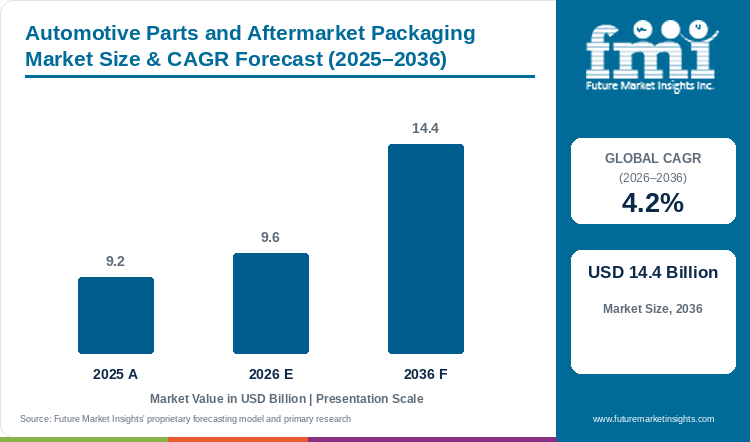
The global automotive parts and aftermarket packaging market was valued at USD 9.2 billion in 2025 and is projected to grow from USD 9.6 billion in 2026 to USD 14.4 billion by 2036, at 4.2% CAGR from 2026 to 2036. Boxes and cartons led packaging type with 38.5% of demand in 2026, owing to its stack strength and availability for small as well as oversized parts. The United States produced 10.4 million vehicles in 2025, equal to 68% of USMCA production, while vehicle and parts manufacturing provided more than 900,000 direct jobs.[1] This output keeps filters, brakes, sensors and service parts moving through factories, dealers and workshops. Thailand also secured USD 4.1 billion across 198 EV-chain projects in July 2026, including annual battery-electric vehicle capacity of more than 370,000 units.[2] New battery and electronic output is expected to widen demand for fitted cartons, electrostatic protection and traceable packs.
Key Market Trends & Insights
- By packaging type, boxes and cartons led with 38.5% of demand in 2026, supported by stackability, printed identification and broad size availability.
- By material, corrugated fiberboard accounted for 42.1% in 2026, as the material can be converted for parcel as well as pallet movement and is becoming important under packaging-minimization rules.
- By component type, engine components represented 24.4% of demand in 2026, owing to requirement for blocking, cushioning and corrosion protection for dense metal parts.
- By vehicle type, passenger cars held a 46.3% share in 2026, since frequent replacement of filters, brakes, lamps and sensors supports recurring packaging volume.
Regional Highlights
- Fastest-growing profiled country: Thailand, at 6.3% CAGR from 2026 to 2036.
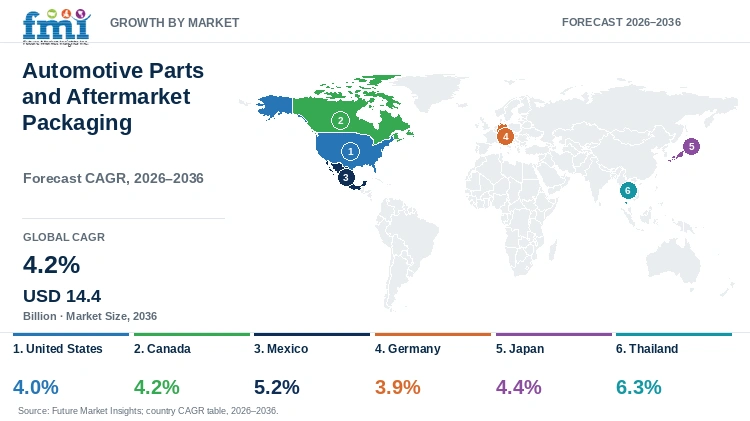
- By country: Mexico (5.2%), Japan (4.4%), Canada (4.2%), and the United States (4.0%) follow, while Germany records the lowest profiled CAGR at 3.9%.
- Thailand growth is supported by EV-chain investment, whereas Mexico receives demand from established cross-border parts movement and repeat export packaging.
Market Size & Forecast
Table 1: Market Size and Forecast for the Automotive Parts and Aftermarket Packaging Market (USD billion and percentage), 2025 to 2036
| Metric | Value |
|---|---|
| 2025 Market Size | USD 9.2 billion |
| Estimated Market Size in 2026 | USD 9.6 billion |
| Projected Market Size by 2036 | USD 14.4 billion |
| CAGR, 2026 to 2036 | 4.2% |
| Added Revenue, 2026 to 2036 | USD 4.8 billion |
| Market Expansion Multiple | 1.5x |
Automotive parts pass through warehouses, borders and parcel networks before installation, due to which packaging is used more than once across the distribution route. Mexico recorded USD 3.56 billion in motor vehicle parts exports and USD 2.91 billion in imports during July 2026.[3] This two-way trade is supporting use of export cartons, pallet formats, corrosion barriers and labels. Regulation (EU) 2025/40 entered into force in February 2025 and generally applies from August 2026, adding recyclability and packaging-minimization requirements.[4] In response to this, suppliers are reducing empty space while maintaining protection for heavy and irregular parts. Passenger cars hold 46.3% of vehicle-type demand in 2026, according to FMI, whereas engine components at 24.4% require stronger blocking and corrosion protection. These factors are expected to shift demand from one standard box towards part-specific fiber packs, reusable systems and adaptable packing equipment.
Vehicle Output and Packaging Demand Intensity
Vehicle production, replacement-part circulation and the number of handling points are supporting automotive packaging demand. Using the 2026 market value against 10.4 million vehicles produced in the United States during 2025 gives a directional benchmark of about USD 923 per produced vehicle. This is not packaging spend on one vehicle, as the global market also includes aftermarket parts for the installed fleet and production outside the United States. The calculation provides an activity comparison and indicates why fitted protection, export documents and repeated warehouse handling creates higher-value demand.
Table 2: Vehicle Output and Packaging Demand Indicators for the Automotive Parts and Aftermarket Packaging Market (vehicles, percentages, USD billion, and USD per vehicle), mixed reporting years from 2025 to 2036
| Indicator | Data Point | Reporting Period | Market Meaning | Source or Basis |
|---|---|---|---|---|
| U.S. vehicle production | 10.4 million vehicles | 2025 | Large production base supports line-side and service-part packaging | [1] |
| USMCA production share | 68% | 2025 | Shows concentration of North American vehicle output | [1] |
| Thailand EV-chain projects | 198 projects; USD 4.1 billion | July 2026 | Adds battery, motor and electronic packaging requirements | [2] |
| Thailand BEV capacity | More than 370,000 units annually | 2026 reported capacity | Supports electrostatic and traceable packaging demand | [2] |
| Mexico parts trade | USD 3.56 billion exports; USD 2.91 billion imports | July 2026 | Supports recurring export cartons, pallets and labels | [3] |
| Directional market intensity | About USD 923 per vehicle | 2026 market value / 2025 U.S. output | Directional benchmark, not package spend per vehicle | Calculated: USD 9.6 billion / 10.4 million |
Basis: The directional intensity divides the global 2026 market value by 2025 U.S. vehicle production. It is used only as an activity benchmark and does not allocate global packaging revenue to U.S.-produced vehicles.
Analyst Perspective
“Fitted packaging will receive repeat demand where expensive replacement parts passes through several handling points before installation. Suppliers proving lower damage with faster packing will gain orders as fiber conversion expands across aftermarket channels.”
- Nandini Roy Choudhury, Principal Consultant, Future Market Insights.
How is the automotive parts and aftermarket packaging market segmented?
Automotive parts and aftermarket packaging is segmented by four primary commercial axes and region: packaging type, material, component type, vehicle type, and region. In 2026, boxes and cartons are projected at 38.5%, corrugated fiberboard at 42.1%, engine components at 24.4%, and passenger cars at 46.3%.
By packaging type: boxes and cartons, protective films and tapes, clamshells and blisters, labels, fluid pouches, and hazardous-material containers.
By material: corrugated fiberboard, plastics, paperboard, molded pulp, and metals.
By component type: engine components, electronic modules, brake and suspension, body panels, fluids, diagnostic tools and sensors, and interior trim.
By vehicle type: passenger cars, two-wheelers, light commercial vehicles, heavy commercial vehicles, and off-highway vehicles.
By region: North America, Latin America, Western Europe, Eastern Europe, East Asia, South Asia and Pacific, and Middle East and Africa.
Why do boxes and cartons retain a notable packaging share?
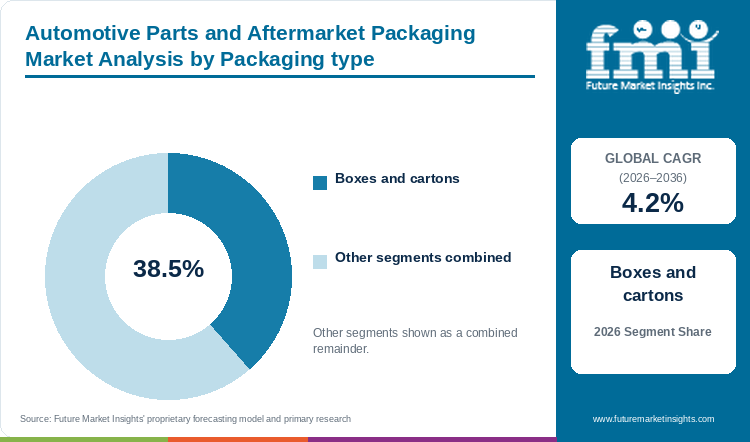
Based on packaging type, boxes and cartons are projected to account for 38.5% in 2026, driven by modular handling needs.
Table 3: Packaging Type Share for the Automotive Parts and Aftermarket Packaging Market (percentage share), 2026
| Packaging Type | Share (2026) |
|---|---|
| Boxes and Cartons | 38.5% |
| Other Segments Combined | 61.5%* |
| Total | 100.0% |
*Calculated as the balance remaining after deducting the leading segment's reported share from 100.0%.
Table 4: Packaging Type Leadership and Market Growth for the Automotive Parts and Aftermarket Packaging Market (segment and CAGR percentage), 2026 to 2036
| Metric | Value |
|---|---|
| Global CAGR (2026 to 2036) | 4.2% |
| Leading Segment | Boxes and Cartons |
Boxes and cartons are one of the highly used packaging types for automotive parts owing to its stack strength, printable surface and availability in different sizes. Boxes and cartons can be used for small sensors, brake parts, filters, lamps as well as large body components. In May 2026, Mondi developed a fitted car bumper pack which reduced unit packaging cost by up to 42% in the reported application.[5] The pack was prepared according to the shape of bumper, due to which empty space and material use were reduced. Boxes and cartons are projected to account for 38.5% of packaging type demand in 2026. Increasing e-commerce sale of replacement parts along with requirement for simple parcel handling is expected to drive the boxes and cartons segment growth.
- Boxes and cartons are projected to hold 38.5% of packaging type demand in 2026, owing to stackability, printable identification and availability in different dimensions.
- Fitted corrugated structures are gaining preference for oversized parts as they reduce empty space and simplify warehouse handling.
What supports corrugated fiberboard as the preferred material choice?
By material, corrugated fiberboard is estimated to hold 42.1% in 2026, supported by light weight and easy conversion.
Corrugated fiberboard is estimated to hold 42.1% of material demand in 2026, owing to its light weight, printability and easy conversion into different packaging sizes. Corrugated fiberboard can be folded into small cartons and can also be reinforced for heavy automotive parts. It is widely used for parcel, pallet and warehouse movement, which increases its application across the aftermarket network. In 2025, FEFCO reported that approximately 88% of European corrugated packaging is derived from recycled content, supported by updated recyclability guidelines.[6] In response to this, automotive suppliers are increasing use of fiber-based structures where protection of the component can be maintained. Availability of recyclable corrugated formats is anticipated to support the segment growth during the forecast period.
- Corrugated fiberboard is estimated to hold 42.1% of material demand in 2026, supported by low weight, easy conversion and increasing requirement for recyclable packaging.
- Corrugated fiberboard can be converted for parcel as well as pallet movement, due to which the material has wider application across aftermarket channels.
Why do engine components create concentrated packaging demand?
In 2026, engine components are expected to lead component type with 24.4% share, owing to weight and surface-protection needs.
Engine components are expected to account for 24.4% of component type demand in 2026. Engine components include dense metal parts, machined surfaces, threaded areas and products which can corrode during storage. These parts require strong outer packaging along with blocking, cushioning and corrosion protection. In April 2025, Pregis reported an automotive headlamp case where a 3% damage rate was linked with USD 800,000 in monthly losses before packaging redesign.[7] This development indicates that even a lower damage rate can increase the cost when high-value automotive components are handled in large volume. Increasing requirement to protect heavy and irregular components is projected to drive packaging demand for engine components.
- Engine components are expected to account for 24.4% of component type demand in 2026, supported by the requirement for blocking, cushioning, and corrosion protection for dense metal parts.
- Engine components require blocking, surface barriers and cushioning according to their weight, corrosion risk and handling frequency.
How do passenger cars sustain aftermarket packaging volume?
Passenger cars are set to lead vehicle type with 46.3% share in 2026, underpinned by broad replacement-part circulation.
Passenger cars are anticipated to hold 46.3% of vehicle type demand in 2026, attributed to frequent replacement of filters, brake parts, sensors, lamps, repair kits and interior components. Passenger cars are available in high numbers and every vehicle requires different replacement parts during its service life. The Canada automotive industry profile updated in 2026 reported more than 125,000 direct automotive jobs and about 427,000 supported jobs.[8] Presence of broad manufacturing, dealership and service network keeps automotive parts moving between warehouses, workshops and parcel channels. Due to difference in part size and replacement cycle, passenger cars require cartons, films, labels and protective inserts in large volumes. These factors are expected to fuel the passenger cars segment growth.
- Passenger cars are projected to hold 46.3% of vehicle-type demand in 2026 because maintenance channels handle many part sizes and replacement cycles.
- Passenger cars use several replacement-part sizes and cycles, which supports demand for cartons, films, labels and protective inserts.
What are the drivers, restraints, and opportunities in the automotive parts and aftermarket packaging market?
In the automotive parts and aftermarket packaging market, the key driver is parts circulation, the key restraint is specification complexity, and the key opportunity is circular pack design.
- Driver: Wider aftermarket and cross-border parts flows expand the need for protective, traceable, and channel-ready packaging.
- Restraint: Part variety, hazardous classifications, corrosion risk, and return-loop economics limit one-format standardization.
- Opportunity: Recyclable fiber structures, right-sized automation, reusable systems, and pack tracking can reduce material and handling work.
Parts Circulation Expands Pack Demand
Increasing circulation of automotive parts through factories, warehouses, dealers, workshops and parcel networks is boosting demand for protective packaging. In July 2026, the U.S. Bureau of Transportation Statistics reported that North American transborder freight reached USD 157.6 billion, with motor vehicles and parts accounting for USD 22.0 billion.[9] Two-way movement of parts requires cartons, labels, films, pallets, corrosion barriers and returnable packaging according to the handling route. Packaging demand increases when a component passes through several distribution points before installation. An FMI analyst notes that cross-border parts circulation expands protective packaging requirements before components reach the point of installation.
Specification Complexity Limits Standardization
Wide difference in size, weight and handling condition of automotive parts is a major factor limiting the use of one packaging format. Engine parts need high load resistance, whereas sensors and electronic modules require cushioning and electrostatic protection. Fluids need leak-resistant packs, while battery modules require hazardous-material marking and additional testing. Effective January 2025, IATA requires specified lithium battery packages to withstand the weight of a three-metre stack for 24 hours.[10] Such requirements can increase testing, marking and documentation cost before battery-related components enter air transport. High specification cost and difference in component protection requirement may hamper standardization in automotive parts packaging market.
Circular Design Opens New Routes
Recyclable fiber packaging, right-sized automation and reusable systems are creating growth opportunities in the market. In August 2026, Sealed Air expanded its paper cushioning portfolio with the ProPad Mini system for compact packing stations.[11] The equipment allows paper cushioning to be produced near the packing operation and can support distributors handling different component sizes. Apart from that, fitted dimensions can reduce unused space without affecting labeling and component restraint. Increasing adoption of paper systems, compact automation, and corrugated shippers is expected to create new avenues for automotive parts and aftermarket packaging suppliers.
Which country CAGRs are profiled in the automotive parts and aftermarket packaging market?
Table 6: Competitive Benchmarking for the Automotive Parts and Aftermarket Packaging Market (qualitative capability ratings), 2026
| Country | CAGR |
|---|---|
| United States | 4.0% |
| Canada | 4.2% |
| Mexico | 5.2% |
| Germany | 3.9% |
| Japan | 4.4% |
| Thailand | 6.3% |
How do country-level CAGRs compare in the automotive parts and aftermarket packaging market?
Country demand conditions differ as vehicle production, parts movement, recycling requirements, and electric vehicle supply chains develop at different rates. In the FMI report, Thailand is projected to grow at 6.3% CAGR, which is higher than Mexico at 5.2%, Japan at 4.4%, Canada at 4.2%, the United States at 4.0% and Germany at 3.9% through 2036. Thailand growth is attributed to EV, battery, motor and electronics projects, whereas Mexico demand is supported by frequent cross-border parts trade. Mature automotive countries will continue using packaging owing to large service networks and regular replacement of automotive components.
As noted by FMI, demand is expected to remain high for packaging which can move through factory, aftermarket and regulatory routes without repeated handling changes.
- United States demand follows large motor-vehicle and parts shipment, wholesale, retail, and cross-border trade systems.
- Canada combines vehicle and parts exports with public policy that is redirecting investment toward electric and connected vehicles.
- Mexico uses dense cross-border supplier routes that require export-ready protection, labels, and stable pallet patterns.
- Germany must align automotive logistics with the EU packaging framework and its documentation, minimization, and recyclability requirements.
- Japan connects mature service-part distribution with national work on vehicle recycling and recycled-plastic markets.
- Thailand gains from EV, battery, electronics, and component projects that create new packaging and handling specifications.
Full report country CAGRs cover: North America; Latin America; Western Europe; Eastern Europe; East Asia; South Asia and Pacific; Middle East and Africa.
Country-wise Analysis
- Demand in the United States automotive parts and aftermarket packaging market is projected to grow at 4.0% CAGR through 2036, underpinned by an extensive vehicle fleet and broad aftermarket distribution networks. In September 2026, the U.S. Census Bureau automotive dashboard covered manufacturing, trade, wholesale, retail and repair activity.[12] High movement of automotive products through these channels creates demand for different packaging formats. Brake assemblies require dense restraint, whereas electronic modules need cushioning and electrostatic protection. FMI research indicates that presence of dealers, workshops and parcel networks will continue to support United States market growth.
- Canada's automotive parts and aftermarket packaging market is anticipated to advance at 4.2% CAGR over the assessment period, supported by close automotive trade and parts integration with the United States. Vehicles and components pass through repeated border and warehouse handling across North American transport routes. In February 2026, the Government of Canada reported that more than 90% of domestically produced vehicles and 60% of automotive parts were exported to the United States.[13] High export concentration increases requirement for consistent cartons, labels, pallet formats and protective inserts. Expansion of electric and connected vehicles is also adding battery assemblies and electronic parts. These factors are likely to fuel packaging demand in Canada.
- Automotive parts and aftermarket packaging demand in Mexico is forecast to rise at 5.2% CAGR through 2036, driven by cross-border manufacturing and regular assembly trade. Mexico is an important manufacturing and cross-border supply location for automotive parts. The country recorded USD 3.56 billion in automotive parts exports and USD 2.91 billion in imports during July 2026.[14] Frequent parts movement requires export cartons, pallet systems, corrosion barriers, labels and returnable containers. Oversized packaging can increase freight cost, due to which suppliers are focusing on fitted dimensions and standard pallet footprints. Expansion of automotive parts trade is expected to drive Mexico market growth.
- The Germany automotive parts and aftermarket packaging market is projected to record 3.9% CAGR during the assessment period, supported by dense automotive manufacturing and component supplier networks. Regular use of industrial and aftermarket packaging is maintained across domestic plants. Regulation (EU) 2025/40 entered into force on February 11, 2025 and generally applies from August 12, 2026, setting common rules for recyclability, packaging minimization, labeling, and producer responsibility.[15] German suppliers therefore require material documents along with protection performance. Increasing redesign of transport packs towards recyclable fiber structures is anticipated to support packaging demand in Germany.
- Demand for automotive parts and aftermarket packaging in Japan is predicted to advance at 4.4% CAGR through 2036, sustained by a mature vehicle production base and an established service-part network. This infrastructure maintains demand for small precision packs as well as industrial transport packaging. In August 2026, Japan Ministry of Economy, Trade and Industry published an evaluation of the automobile recycling system.[16] A related national plan states that the country generates about 8 million tonnes of plastic waste every year, with about 70% used in incineration and energy recovery. Increasing focus on material recovery is supporting interest in reusable transport packs and one-way fiber formats. This is expected to create growth opportunities for automotive packaging suppliers in Japan.
- Thailand is estimated to post 6.3% CAGR over the forecast period, bolstered by the expansion of electric vehicle and battery manufacturing platforms. Increasing production of electric vehicles and related components is creating requirement for new packaging specifications in the country. In June 2026, the Government of Thailand reported that monthly vehicle production reached 133,413 units, supported by a 47.6% rise in domestic battery-electric vehicle sales.[17] These components require export protection, electrostatic control and traceability during transportation. FMI data suggests that the expansion of EV and component production will propel Thailand market growth.
Who are the notable companies in the automotive parts and aftermarket packaging market?
Table 7: Report Scope for the Automotive Parts and Aftermarket Packaging Market (coverage fields and definitions), 2026 to 2036
Sealed Air Corporation, DS Smith, Sonoco Products Company, Mondi, Smurfit WestRock, Amcor, Pregis, and Nefab are notable companies profiled in this market.
As per the analysis from FMI, the automotive parts and aftermarket packaging market is moderately fragmented with presence of global packaging companies, industrial packaging specialists, and regional converters. Sealed Air Corporation, Pregis and Amcor provide films, cushioning materials and equipment, whereas DS Smith, Mondi and Smurfit WestRock focus on corrugated and paper-based structures. Nefab and Sonoco Products Company supply engineered formats for heavy, sensitive and irregular parts. Presence of different component sizes is resulting in demand for fiber, plastics, films, molded structures and reusable containers. Prominent players are expanding product portfolios and regional converting capacity in order to cater to growing demand.
- Integrated protective systems: Sealed Air Corporation, Pregis, and Amcor supply films, cushioning, flexible formats, or automated packing systems.
- Fiber and paper platforms: DS Smith, Mondi, and Smurfit WestRock provide corrugated, paper-based, and converted structures for industrial distribution.
- Industrial engineering and mixed-material capability: Nefab and Sonoco Products Company combine designed packaging, testing, plastics, fiber, or service support.
Competitive Benchmarking: Automotive Parts and Aftermarket Packaging Market
Table 8: Research Methodology for the Automotive Parts and Aftermarket Packaging Market (research methods and approach), 2026 edition
| Company | Automotive fit | Material breadth | Current activity | Geographic reach |
|---|---|---|---|---|
| Sealed Air Corporation | High | High | High | High |
| DS Smith | High | High | High | High |
| Sonoco Products Company | Medium | High | High | High |
| Mondi | Medium | High | High | High |
| Smurfit WestRock | High | High | High | High |
| Amcor | Medium | High | High | High |
| Pregis | High | High | High | Medium |
| Nefab | High | High | High | High |
High represents broad public evidence across the stated capability, Medium represents narrower evidence and Low represents limited documented breadth. Ratings describe public capability and does not indicate product quality, revenue share or company ranking.
Key Developments in the Automotive Parts and Aftermarket Packaging Market
- In August 2026, Sealed Air expanded its paper cushioning portfolio with the ProPad Mini system for compact packing stations.
- In April 2026, Nefab acquired Vallos in Slovakia, adding corrugated capacity and complete packaging capability for industrial customers.
- In April 2026, Sealed Air completed its acquisition by CD&R, changing ownership while retaining its protective-packaging platform.
- In September 2025, Sealed Air launched the AUTOBAG 850HB hybrid machine, which runs both paper and poly mailers.
Key Players in the Automotive Parts and Aftermarket Packaging Market
Protective packaging and automation providers
- Sealed Air Corporation
- Pregis
- Amcor
Fiber-based and corrugated packaging providers
- DS Smith
- Mondi
- Smurfit WestRock
Industrial and engineered packaging providers
- Nefab
- Sonoco Products Company
Automotive Parts and Aftermarket Packaging Market - Report Scope
| Coverage field | Report scope |
|---|---|
| Market breakdown | Packaging type, material, component type, vehicle type, and region. |
| Quantitative units | USD billion. |
| Market definition | Supplier revenue from packaging used to protect, identify, store, transport, or dispense automotive parts and aftermarket products. Finished-vehicle value and unrelated consumer packaging are excluded. |
| Regions covered | North America; Latin America; Western Europe; Eastern Europe; East Asia; South Asia and Pacific; Middle East and Africa. |
| Countries covered | United States, Canada, Mexico, Germany, Japan, Thailand, and additional countries in the full report. |
| Key companies profiled | Sealed Air Corporation, DS Smith, Sonoco Products Company, Mondi, Smurfit WestRock, Amcor, Pregis, and Nefab. |
| Forecast period | 2026 to 2036. |
| Approach | The Future Market Insights report covers supplier activity, segment structure, packaging routes, and country adoption conditions within the stated boundary. |
Automotive Parts and Aftermarket Packaging Market - Research Methodology
| Method | Approach |
|---|---|
| Primary Research | The research study includes primary interviews with manufacturers, packaging suppliers, distributors, workshops, procurement teams and industry experts. Interviews covers purchasing decision, product evaluation, price, adoption barriers and packaging approval requirement. Respondents are also asked about evidence required before trial packaging moves into regular purchasing. |
| Desk Research | Desk research includes government statistics, trade data, regulations, standards, industry publications, company reports, product information and official announcements. Sources are checked according to publication date, geographic coverage and direct relevance with automotive parts packaging market. Unsupported and unrelated claims are excluded from the report. |
| Market Sizing and Forecasting | Market sizing combines baseline value with historical performance, segment structure, price and volume indicators, company participation and country demand conditions. Forecast considers vehicle production, parts trade, regulatory development, material adoption and barriers to wider use. Segment and regional estimates are reconciled with the final market value. |
| Data Validation | Market estimates are checked with public data, trade movement, company activity, industry developments and primary interviews. Products and company revenues are included only when they falls within the defined market boundary. Adjacent categories and overlapping revenues are excluded in order to reduce double counting. |
Automotive Parts and Aftermarket Packaging Market by Segments
Packaging type
- Boxes and cartons
- Protective films and tapes
- Clamshells and blisters
- Labels
- Fluid pouches
- Hazardous-material containers
Material
- Corrugated fiberboard
- Plastics
- Paperboard
- Molded pulp
- Metals
Component type
- Engine components
- Electronic modules
- Brake and suspension
- Body panels
- Fluids
- Diagnostic tools and sensors
- Interior trim
Vehicle type
- Passenger cars
- Two-wheelers
- Light commercial vehicles
- Heavy commercial vehicles
- Off-highway vehicles
Automotive Parts and Aftermarket Packaging Market by Region
- North America
- United States
- Canada
- Latin America
- Mexico
- Brazil
- Argentina
- Chile
- Western Europe
- Germany
- France
- United Kingdom
- Italy
- Spain
- Benelux
- Nordics
- Eastern Europe
- Poland
- Czech Republic
- Romania
- Hungary
- East Asia
- Japan
- South Korea
- South Asia and Pacific
- Thailand
- ASEAN
- Australia and New Zealand
- Middle East and Africa
- GCC Countries
- South Africa
- Türkiye
- Israel
Research Sources and Bibliography
- [1] Autos Drive America. (2026). USMCA and the future of the U.S. auto industry. https://autosdriveamerica.org/wp-content/uploads/2026/08/USMCA-Coalition-Leave-Behind_FINAL.pdf
- [2] Thailand Board of Investment. (2026, July 3). Thailand secures USD 4.1 billion in EV chain investments as Southeast Asia auto hub pivots to next-generation technology. https://osos.boi.go.th/article_attach/PR101_2569EN.pdf
- [3] Secretaría de Economía. (2026). Parts and accessories of motor vehicles: Commercial exchange.
- [4] European Parliament and Council of the European Union. (2025, January 22). Regulation (EU) 2025/40 on packaging and packaging waste. https://eur-lex.europa.eu/eli/reg/2025/40/oj/eng
- [5] Mondi. (2026, May 18). Ovoko cuts eCommerce packaging costs for car bumpers by up to 42% with Mondi.
- [6] European Federation of Corrugated Board Manufacturers (FEFCO). (2025). FEFCO corrugated packaging recyclability guidelines and European production report.
- [7] Pregis. (2025, April 4). From USD 9.8 million in losses to USD 5 million in savings: Solving the costly challenge of headlamp returns.
- [8] Innovation, Science and Economic Development Canada. (2026). Canadian automotive industry.
- [9] Bureau of Transportation Statistics. (2026, September 23). North American transborder freight valued at $157.6 billion in July 2026. U.S. Department of Transportation. https://www.bts.gov/newsroom/north-american-transborder-freight-valued-1576-billion-july-2026-188-july-2025
- [10] International Air Transport Association. (2025, January 1). Packaging requirement: Lithium batteries, navigating the 3 m stack test.
- [11] Sealed Air Corporation. (2026, August 24). Sealed Air expands paper cushioning portfolio with new ProPad Mini system.
- [12] U.S. Census Bureau. (2026, September 14). Automotive statistics: Manufacturing, trade, retail, and wholesale indicators. https://www.census.gov/econ/indviz/auto/main.html
- [13] Employment and Social Development Canada. (2026, February 18). Government of Canada’s new auto strategy.
- [14] Secretaría de Economía. (2026). Parts and accessories of motor vehicles: July 2026 trade.
- [15] Publications Office of the European Union. (2026). Packaging and Packaging Waste Regulation: Frequently asked questions.
- [16] Ministry of Economy, Trade and Industry, Japan. (2026, August 7). Report on evaluation of the automobile recycling system.
- [17] Government of Thailand. (2026, June 4). Thailand’s auto industry shows signs of recovery as EVs and hybrids drive March growth.
- [18] Pregis. (2026, July 14). Pregis releases 2025 sustainability report.
- [19] Amcor. (2025, April 30). Amcor completes combination with Berry Global.
- [20] Smurfit WestRock. (2025, January 9). Paper pallet wrap set to drive down supply chain emissions.
- [21] Nefab Group. (2025, November 12). Nefab Group acquires Jase Packaging B.V. and Heuman Verpakkingen B.V.
This bibliography is provided for reader reference. Sources are matched with the numbered statements used in the report.
This Report Answers
- What is Automotive Parts and Aftermarket Packaging Market worth during 2026?
- What value is Automotive Parts and Aftermarket Packaging Market projected by 2036?
- Which packaging type holds notable market share during 2026?
- Which material holds notable automotive aftermarket packaging share during 2026?
- Which countries have notable automotive packaging growth through 2036?
- Which companies are notable in automotive parts packaging today?
Frequently Asked Questions
How large is the Automotive Parts and Aftermarket Packaging Market in 2026?
The automotive parts and aftermarket packaging market is valued at USD 9.6 billion in 2026, up from USD 9.2 billion in 2025, and is projected to reach USD 14.4 billion by 2036.
What CAGR is forecast for the market through 2036?
As per FMI, the automotive parts and aftermarket packaging market is projected to expand at a 4.2% CAGR between 2026 and 2036. Demand is supported by increasing circulation of replacement parts and cross-border assembly logistics.
Which packaging type holds a notable market share in 2026?
Boxes and cartons are projected to hold 38.5% of packaging type demand in 2026, supported by stackability, printed identification, and broad dimensional availability across parcel channels.
Which material holds a notable market share in 2026?
Corrugated fiberboard is estimated to hold 42.1% of material demand in 2026, supported by light weight, easy conversion, and alignment with packaging-minimization standards.
Which country has a notable expansion outlook through 2036?
FMI finds that Thailand demand will expand at a 6.3% CAGR from 2026 to 2036, driven by investments in electric vehicle, battery, and electronic component supply chains.
Which companies are active in this market during 2026?
Notable companies include Sealed Air Corporation, DS Smith, Sonoco Products Company, Mondi, Smurfit WestRock, Amcor, Pregis, and Nefab. These companies focus on sustainable fiber conversion, engineered protective cushioning, and automated packaging equipment.
Preview the report firsthand - request a free sample
Get SampleGet the brochure for pricing and purchase details.
Get PDFTable of Content
- Key Takeaways
- Market Size and CAGR
- Top Growth Driver
- Fastest Growing Segment
- Leading Region
- Key Companies
- Emerging Opportunities
- Executive Summary
- Global Market Outlook
- Demand-side Trends
- Supply-side Trends
- Technology Roadmap Analysis
- Analysis and Recommendations
- Analyst Perspective (What is happening? Why now? What should investors know?)
- Key Questions Answered
- How large is the market?
- What is the CAGR?
- What are key trends?
- Which region dominates?
- Who are the leaders?
- Market Overview
- Market Coverage / Taxonomy
- Market Definition / Scope / Limitations
- Research Methodology
- Chapter Orientation
- Analytical Lens and Working Hypotheses
- Market Structure, Signals, and Trend Drivers
- Benchmarking and Cross-market Comparability
- Market Sizing, Forecasting, and Opportunity Mapping
- Research Design and Evidence Framework
- Desk Research Programme (Secondary Evidence)
- Expert Input and Fieldwork (Primary Evidence)
- Tooling, Models, and Reference Databases
- Data Engineering and Model Build
- Quality Assurance and Audit Trail
- Market Background
- Market Dynamics (Drivers, Restraints, Opportunity, Trends)
- Scenario Forecast (Optimistic, Likely, Conservative)
- Impact Analysis
- AI Impact
- Sustainability Impact
- Regulatory Impact
- Technology Impact
- Consumer / Buyer Analysis
- Purchase Drivers
- Adoption Barriers
- Buyer Journey
- Opportunity Map Analysis
- Product Life Cycle Analysis
- Supply Chain Analysis
- Investment Feasibility Matrix
- Value Chain Analysis
- PESTLE and Porter's Analysis
- Regulatory Landscape
- Regional Parent Market Outlook
- Production and Consumption Statistics
- Import and Export Statistics
- Global Market Analysis and Forecast, 2021 to 2036
- Historical Market Size Value (USD Billion) Analysis, 2021 to 2025
- Current and Future Market Size Value (USD Billion) Projections, 2026 to 2036
- Y-o-Y Growth Trend Analysis
- Absolute $ Opportunity Analysis
- Global Market Pricing Analysis, 2021 to 2036
- Global Market Analysis and Forecast, By Packaging type, 2021 to 2036
- Introduction / Key Findings
- Historical Market Size Value (USD Billion) Analysis By Packaging type, 2021 to 2025
- Current and Future Market Size Value (USD Billion) Analysis and Forecast By Packaging type, 2026 to 2036
- Boxes and cartons
- Protective films and tapes
- Clamshells and blisters
- Labels
- Fluid pouches
- Hazardous-material containers
- Y-o-Y Growth Trend Analysis By Packaging type, 2021 to 2025
- Absolute $ Opportunity Analysis By Packaging type, 2026 to 2036
- Global Market Analysis and Forecast, By Material, 2021 to 2036
- Introduction / Key Findings
- Historical Market Size Value (USD Billion) Analysis By Material, 2021 to 2025
- Current and Future Market Size Value (USD Billion) Analysis and Forecast By Material, 2026 to 2036
- Corrugated fiberboard
- Plastics
- Paperboard
- Molded pulp
- Metals
- Y-o-Y Growth Trend Analysis By Material, 2021 to 2025
- Absolute $ Opportunity Analysis By Material, 2026 to 2036
- Global Market Analysis and Forecast, By Component type, 2021 to 2036
- Introduction / Key Findings
- Historical Market Size Value (USD Billion) Analysis By Component type, 2021 to 2025
- Current and Future Market Size Value (USD Billion) Analysis and Forecast By Component type, 2026 to 2036
- Engine components
- Electronic modules
- Brake and suspension
- Body panels
- Fluids
- Diagnostic tools and sensors
- Interior trim
- Y-o-Y Growth Trend Analysis By Component type, 2021 to 2025
- Absolute $ Opportunity Analysis By Component type, 2026 to 2036
- Global Market Analysis and Forecast, By Vehicle type, 2021 to 2036
- Introduction / Key Findings
- Historical Market Size Value (USD Billion) Analysis By Vehicle type, 2021 to 2025
- Current and Future Market Size Value (USD Billion) Analysis and Forecast By Vehicle type, 2026 to 2036
- Passenger cars
- Two-wheelers
- Light commercial vehicles
- Heavy commercial vehicles
- Off-highway vehicles
- Y-o-Y Growth Trend Analysis By Vehicle type, 2021 to 2025
- Absolute $ Opportunity Analysis By Vehicle type, 2026 to 2036
- Global Market Analysis and Forecast, By Region, 2021 to 2036
- Introduction
- Historical Market Size Value (USD Billion) Analysis By Region, 2021 to 2025
- Current Market Size Value (USD Billion) Analysis and Forecast By Region, 2026 to 2036
- North America
- Latin America
- Western Europe
- Eastern Europe
- East Asia
- South Asia and Pacific
- Middle East and Africa
- Market Attractiveness Analysis By Region
- North America Market Analysis and Forecast, By Country, 2021 to 2036
- Historical Market Size Value (USD Billion) Trend Analysis By Market Taxonomy, 2021 to 2025
- Market Size Value (USD Billion) Forecast By Market Taxonomy, 2026 to 2036
- By Country
- United States
- Canada
- By Packaging type
- By Material
- By Component type
- By Vehicle type
- By Country
- Market Attractiveness Analysis
- By Country
- By Packaging type
- By Material
- By Component type
- By Vehicle type
- Key Takeaways
- Latin America Market Analysis and Forecast, By Country
- Historical Market Size Value (USD Billion) Trend Analysis By Market Taxonomy, 2021 to 2025
- Market Size Value (USD Billion) Forecast By Market Taxonomy, 2026 to 2036
- By Country
- Mexico
- Brazil
- Argentina
- Chile
- By Packaging type
- By Material
- By Component type
- By Vehicle type
- By Country
- Market Attractiveness Analysis
- By Country
- By Packaging type
- By Material
- By Component type
- By Vehicle type
- Key Takeaways
- Western Europe Market Analysis and Forecast, By Country
- Historical Market Size Value (USD Billion) Trend Analysis By Market Taxonomy, 2021 to 2025
- Market Size Value (USD Billion) Forecast By Market Taxonomy, 2026 to 2036
- By Country
- Germany
- France
- United Kingdom
- Italy
- Spain
- Benelux
- Nordics
- By Packaging type
- By Material
- By Component type
- By Vehicle type
- By Country
- Market Attractiveness Analysis
- By Country
- By Packaging type
- By Material
- By Component type
- By Vehicle type
- Key Takeaways
- Eastern Europe Market Analysis and Forecast, By Country
- Historical Market Size Value (USD Billion) Trend Analysis By Market Taxonomy, 2021 to 2025
- Market Size Value (USD Billion) Forecast By Market Taxonomy, 2026 to 2036
- By Country
- Poland
- Czech Republic
- Romania
- Hungary
- By Packaging type
- By Material
- By Component type
- By Vehicle type
- By Country
- Market Attractiveness Analysis
- By Country
- By Packaging type
- By Material
- By Component type
- By Vehicle type
- Key Takeaways
- East Asia Market Analysis and Forecast, By Country
- Historical Market Size Value (USD Billion) Trend Analysis By Market Taxonomy, 2021 to 2025
- Market Size Value (USD Billion) Forecast By Market Taxonomy, 2026 to 2036
- By Country
- Japan
- South Korea
- By Packaging type
- By Material
- By Component type
- By Vehicle type
- By Country
- Market Attractiveness Analysis
- By Country
- By Packaging type
- By Material
- By Component type
- By Vehicle type
- Key Takeaways
- South Asia and Pacific Market Analysis and Forecast, By Country
- Historical Market Size Value (USD Billion) Trend Analysis By Market Taxonomy, 2021 to 2025
- Market Size Value (USD Billion) Forecast By Market Taxonomy, 2026 to 2036
- By Country
- Thailand
- ASEAN
- Australia and New Zealand
- By Packaging type
- By Material
- By Component type
- By Vehicle type
- By Country
- Market Attractiveness Analysis
- By Country
- By Packaging type
- By Material
- By Component type
- By Vehicle type
- Key Takeaways
- Middle East and Africa Market Analysis and Forecast, By Country
- Historical Market Size Value (USD Billion) Trend Analysis By Market Taxonomy, 2021 to 2025
- Market Size Value (USD Billion) Forecast By Market Taxonomy, 2026 to 2036
- By Country
- GCC Countries
- South Africa
- Türkiye
- Israel
- By Packaging type
- By Material
- By Component type
- By Vehicle type
- By Country
- Market Attractiveness Analysis
- By Country
- By Packaging type
- By Material
- By Component type
- By Vehicle type
- Key Takeaways
- Key Countries Market Analysis
- United States
- Pricing Analysis
- Market Share Analysis, 2025
- By Packaging type
- By Material
- By Component type
- By Vehicle type
- Canada
- Pricing Analysis
- Market Share Analysis, 2025
- By Packaging type
- By Material
- By Component type
- By Vehicle type
- Mexico
- Pricing Analysis
- Market Share Analysis, 2025
- By Packaging type
- By Material
- By Component type
- By Vehicle type
- Brazil
- Pricing Analysis
- Market Share Analysis, 2025
- By Packaging type
- By Material
- By Component type
- By Vehicle type
- Chile
- Pricing Analysis
- Market Share Analysis, 2025
- By Packaging type
- By Material
- By Component type
- By Vehicle type
- Germany
- Pricing Analysis
- Market Share Analysis, 2025
- By Packaging type
- By Material
- By Component type
- By Vehicle type
- United Kingdom
- Pricing Analysis
- Market Share Analysis, 2025
- By Packaging type
- By Material
- By Component type
- By Vehicle type
- Italy
- Pricing Analysis
- Market Share Analysis, 2025
- By Packaging type
- By Material
- By Component type
- By Vehicle type
- Spain
- Pricing Analysis
- Market Share Analysis, 2025
- By Packaging type
- By Material
- By Component type
- By Vehicle type
- France
- Pricing Analysis
- Market Share Analysis, 2025
- By Packaging type
- By Material
- By Component type
- By Vehicle type
- ASEAN
- Pricing Analysis
- Market Share Analysis, 2025
- By Packaging type
- By Material
- By Component type
- By Vehicle type
- Australia and New Zealand
- Pricing Analysis
- Market Share Analysis, 2025
- By Packaging type
- By Material
- By Component type
- By Vehicle type
- Japan
- Pricing Analysis
- Market Share Analysis, 2025
- By Packaging type
- By Material
- By Component type
- By Vehicle type
- South Korea
- Pricing Analysis
- Market Share Analysis, 2025
- By Packaging type
- By Material
- By Component type
- By Vehicle type
- Poland
- Pricing Analysis
- Market Share Analysis, 2025
- By Packaging type
- By Material
- By Component type
- By Vehicle type
- Hungary
- Pricing Analysis
- Market Share Analysis, 2025
- By Packaging type
- By Material
- By Component type
- By Vehicle type
- Türkiye
- Pricing Analysis
- Market Share Analysis, 2025
- By Packaging type
- By Material
- By Component type
- By Vehicle type
- South Africa
- Pricing Analysis
- Market Share Analysis, 2025
- By Packaging type
- By Material
- By Component type
- By Vehicle type
- Thailand
- Pricing Analysis
- Market Share Analysis, 2025
- By Packaging type
- By Material
- By Component type
- By Vehicle type
- United States
- Market Structure Analysis
- Competition Dashboard
- Competition Benchmarking
- Market Share Analysis of Top Players
- By Regional
- By Packaging type
- By Material
- By Component type
- By Vehicle type
- Emerging Startups
- Innovation Benchmarking
- Competition Analysis
- Competition Deep Dive
- Sealed Air Corporation
- Overview
- Product Portfolio
- Profitability by Market Segments
- Sales Footprint
- Strategy Overview
- Marketing Strategy
- Product Strategy
- Channel Strategy
- DS Smith
- Sonoco Products Company
- Mondi
- Smurfit WestRock
- Amcor
- Pregis
- Nefab
- Sealed Air Corporation
- Case Studies
- Success Stories
- Recent Developments
- Competition Deep Dive
- Assumptions & Acronyms Used


