

- Industry Size (2026)
- USD 188.97 Bn
- Forecast (2036)
- USD 188.97 Bn
- CAGR (2026 to 2036)
- 5.1%
Corrugated Shippers Market Size, Market Forecast and Outlook By FMI
The corrugated shippers market was valued at USD 179.80 billion in 2025. Based on Future Market Insights' analysis, demand is estimated to reach USD 188.97 billion in 2026 and USD 310.76 billion by 2036. FMI projects a CAGR of 5.1% during the forecast period. The incremental opportunity from 2026 to 2036 stands at USD 121.79 billion. Corrugated sheet holds 52.0% of demand by material in 2026, rigid corrugated shippers command 48.0% of product type consumption, flexographic printing leads at 55.0% of printing technology demand, and food and beverages accounts for 38.0% of end-user consumption, as per FMI. Corrugated shippers are transit packaging containers designed to protect products during warehouse handling, distribution, and last-mile delivery across industrial and consumer supply chains.
Summary of Corrugated Shippers Market
- By 2036, the market is projected to be worth USD 310.76 billion.
- A 5.1% compound annual growth rate is anticipated between 2026 and 2036.
- Market size in 2025 was estimated at USD 179.80 billion.
- An absolute dollar opportunity of USD 121.79 billion is anticipated between 2026 and 2036.
- Corrugated Sheet leads by Material with 52% share in 2026.
- Rigid Corrugated Shippers leads by Product Type with 48% share in 2026.
- The market is the largest corrugated packaging category by value, where demand is anchored by food and beverage transit logistics and incrementally driven by e-commerce parcel volumes, sustainability-mandated material substitution, and the shift toward digitally printed customised shippers.
- Among key countries, India at 7%, China at 6.5%, USA at 4.5%, Canada at 4.2%, UK at 3.9%, Germany at 3.7%, Japan at 3.3% CAGR respectively.
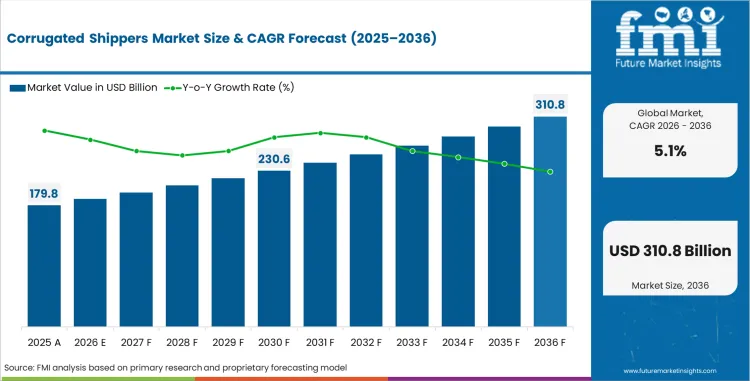
The market is the largest single category within the corrugated packaging sector, with demand anchored by food and beverage distribution logistics and incrementally driven by e-commerce parcel volume growth. FMI analysts observe that rigid corrugated shippers lead product type demand because they provide the stacking strength required for palletised warehouse storage and multi-tier truck loading. Flexographic printing dominates because it delivers functional print quality at the production speeds required for high-volume shipper manufacturing, while digital printing is gaining share for short-run customised shippers serving direct-to-consumer brands. The ongoing shift from plastic shrink wrap and strapping to corrugated shipper-based unitisation reflects Extended Producer Responsibility regulations that penalise non-recyclable transit packaging materials.
India leads at 7% CAGR, driven by the expansion of organised food retail, cold chain logistics infrastructure, and e-commerce fulfilment centre construction. China follows at 6.5%, supported by domestic parcel volume growth and government mandates promoting recyclable packaging over single-use plastics. The United States registers 4.5% growth, anchored by the entrenched position of corrugated shippers in food and beverage supply chains and the growth of direct-to-consumer subscription shipping. Canada tracks at 4.2%, the United Kingdom at 3.9%, Germany at 3.7%, and Japan at 3.3%, where mature markets sustain consumption through packaging format optimisation and sustainability-driven material substitution.
Corrugated Shippers Market Key Takeaways
| Metric | Details |
|---|---|
| Industry Size (2026) | USD 188.97 billion |
| Industry Value (2036) | USD 310.76 billion |
| CAGR (2026-2036) | 5.1% |
Source: Future Market Insights, 2026
Corrugated Shippers Market Definition
Corrugated shippers are transit packaging containers manufactured from corrugated fibreboard, designed to protect products during storage, distribution, and last-mile delivery. Product types include rigid, slotted, folder, and telescopic configurations manufactured from corrugated sheet and linerboard substrates. These containers serve food and beverages, electronics, cosmetics and personal care, healthcare and pharmaceuticals, and other end-user industries requiring protective secondary packaging for supply chain transit.
Corrugated Shippers Market Inclusions
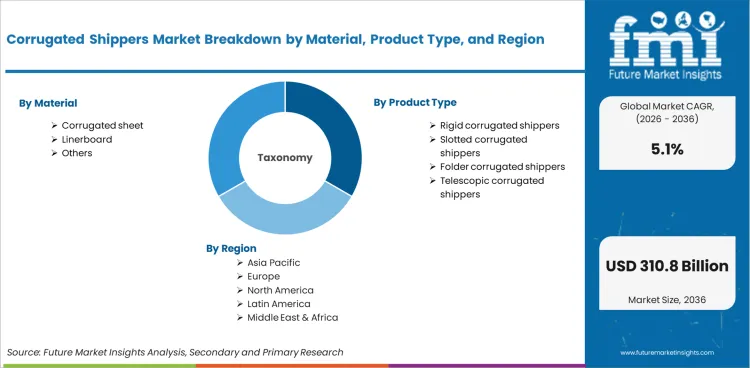
Market scope covers global and regional market sizes for corrugated shippers from 2026 to 2036. Segmentation spans material (corrugated sheet, linerboard, others), product type (rigid, slotted, folder, telescopic), printing technology (flexographic, digital, lithographic, others), and end-user (food & beverages, electronics & electricals, cosmetics & personal care, healthcare & pharmaceuticals, others). The analysis includes e-commerce impact assessments, sustainability regulation tracking, and material substitution trend analysis.
Corrugated Shippers Market Exclusions
The scope excludes corrugated display packaging and shelf-ready packaging designed for retail presentation rather than transit protection. Reusable plastic totes and crates are omitted. Void fill materials, cushioning inserts, and pallet wrap used alongside corrugated shippers fall outside analytical parameters.
Corrugated Shippers Market Research Methodology
- Primary Research: Analysts engaged with procurement specialists, plant operators, and technology leads to map decision gates triggering purchases and upgrades.
- Desk Research: Data collection aggregated regulatory filings, government records, industry association publications, and company financial disclosures.
- Market-Sizing and Forecasting: Baseline values derive from bottom-up aggregation of shipment and consumption records, applying region-specific adoption curves.
- Data Validation and Update Cycle: Projections are tested against publicly reported guidance and cross-referenced with government statistical data.
What are the Key Trends Impacting Growth of the Corrugated Shippers Market?
A box-on-demand system or fit-to-product (FTP) or from the e-commerce sector allows the manufacturing of customized secondary packaging which are based on the actual size of the product being packed, including irregular shapes.
This eliminates the requirement for large inventories standard-sized corrugated shippers which need large space to store along with the huge amount of copious filler material. Expanded polystyrene foams (EPS) are simpler to recycle and reuse over the polymer-based alternatives which are used in the protection and safeguarding of the product in the corrugated shippers, especially during transportation.
How Corrugated Shippers are increasing the Demand as compared to Cardboard Shippers?
Corrugated shippers are made up of three layers which are ruffled and clubbed between the inner and the outer layers of cardboard that provides an outstanding strength thereby durability that can withstand severe wear and tear throughout the packaging and transportation. Unlike traditional cardboard shippers, corrugated shippers are recyclable which offers sustainability.
A variety of combinations and customizations can be done in the corrugated shippers which are increasing the demand for the corrugated shippers market.
What are the Key Challenges that may restrain the Growth of the Corrugated Shippers Market?
Corrugated shipper does not prove the suitable packaging option in case of extreme weatherproofing, like extreme rains where there are high chances of water to seep inside the corrugated shipper which can lead to damage the product.
Also, the corrugated shippers can deform if they are stacked or when exposed to extreme pressure, which eventually will lead to product damage. Corrugated shippers cannot carry heavy weight products owing to their light to moderate level tensile strength and are suitable for the packaging of light-weight items.
What Strategies are the Key Players adopting for Increasing their Market Share in the Corrugated Shippers Market?
The manufacturers involved in the manufacturing of corrugated shippers are involved in the expansion of the production facilities and the merging as a strategy for enhancing development and innovations through a new product launch.
- In March 2021, International Paper Company acquired two corrugated box plants in Madrid and Catalonia in Spain, which will offer customers high-quality packaging solutions in the industrial, e-commerce and fresh produce segments.
Why is the U.S. a Big Market for Corrugated Shippers Market?
The majority of the key corrugated shippers' manufacturers are having their presence in the U.S. which is a driving factor for the corrugated shippers market. Also, the presence of the latest technology is enhancing the production activities of the corrugated shippers along with the developments in the research area of the company.
Also, the changing approach of the customers towards attaining sustainability in the product along with the packaging material is the factor bolstering the growth for the corrugated shippers market.
Competitive Landscape
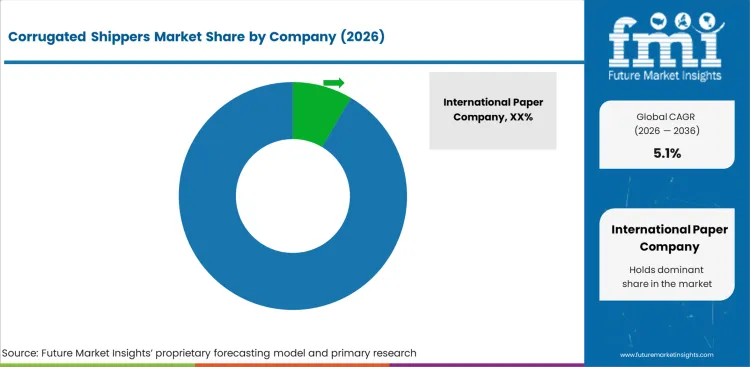
The following global key players such as:
- International Paper Company
- Nefab Packaging Inc.
- WestRock Company
- Eurobox Polska Sp. z o.o.
- Packaging Corporation of America
- Mondi Group Plc
- D.S. Smith Plc
- Georgia-Pacific LLC
- and Smurfit Kappa Group.
Key Asian players manufacturing corrugated shippers are:
- MultiPack
- Asian Packaging Industries
- TGI Packaging Pvt. Ltd.
- Trident Paper Box Industries
- Ningbo YOOFE Packaging Co Ltd
- Dynapac Corporation
- Rengo Co.Ltd.
- Mitsui Bussan Packaging Co.Ltd.
Scope of the Report
| Metric | Value |
|---|---|
| Quantitative Units | USD 188.97 billion to USD 310.76 billion, at a CAGR of 5.1% |
| Market Definition | Corrugated shippers are transit packaging containers manufactured from corrugated fibreboard, designed to protect products during storage, distribution, and last-mile delivery. Product types include rigid, slotted, folder, and telescopic configurations manufactured from corrugated sheet and linerboard substrates. |
| Material Segmentation | Corrugated Sheet, Linerboard, Others |
| Product Type Segmentation | Rigid Corrugated Shippers, Slotted Corrugated Shippers, Folder Corrugated Shippers, Telescopic Corrugated Shippers |
| Printing Technology Segmentation | Flexographic Printing, Digital Printing, Lithographic Printing, Others |
| End-User Segmentation | Food & Beverages, Electronics & Electricals, Cosmetics & Personal Care, Healthcare & Pharmaceuticals, Others |
| Regions Covered | North America, Latin America, Europe, East Asia, South Asia, Oceania, Middle East & Africa |
| Countries Covered | India, China, USA, Canada, UK, Germany, Japan, and 40 plus countries |
| Key Companies Profiled | International Paper Company, Nefab Packaging Inc., WestRock Company, Eurobox Polska Sp. z o.o., Packaging Corporation of America, Mondi Group Plc, D.S. Smith Plc, Georgia-Pacific LLC, Smurfit Kappa Group |
| Forecast Period | 2026 to 2036 |
| Approach | Forecasting models apply a bottom-up methodology starting with installed base metrics and projecting adoption rates using region-specific demand curves. |
Key Segments of Corrugated Shippers Market Covered in the Report
Based on Material:
- Corrugated sheet
- Linerboard
- Others (recycled woodchips, leftover shavings from mill waste, etc.)
Based on Product Type:
- Rigid corrugated shippers
- Slotted corrugated shippers
- Folder corrugated shippers
- Telescopic corrugated shippers
Based on the Printing Technology:
- Flexographic printing
- Digital printing
- Lithographic printing
- Others (Screen printing, offset printing, etc.)
Based on End-User:
- Food & Beverages
- Electronics & Electricals
- Cosmetics & Personal care
- Healthcare & Pharmaceuticals
- Others (homecare, automotive)
Based on the Region:
- North America
- Latin America
- Europe
- South Asia
- East Asia
- Oceania
- Middle East & Africa
Bibliography
- 1. Confederation of Corrugated Board Manufacturers. (2025). Annual Statistics Report: Corrugated Shipper Production 2024. FEFCO.
- 2. European Commission. (2024). Packaging and Packaging Waste Regulation: Extended Producer Responsibility. European Commission.
- 3. International Paper Company. (2024). Annual Report 2024. International Paper.
- 4. Food Safety and Standards Authority of India. (2024). Food Packaging and Labelling Compliance Update. FSSAI.
- 5. United States Environmental Protection Agency. (2025). Sustainable Materials Management: Corrugated Recovery Rates. EPA.
This bibliography is provided for reader reference. The full Future Market Insights report contains the complete reference list with primary research documentation.
Frequently Asked Questions
How large is the demand for Corrugated Shippers in the global market in 2026?
Demand for Corrugated Shippers in the global market is estimated to be valued at USD 188.97 billion in 2026.
What will be the market size of Corrugated Shippers by 2036?
Market size for Corrugated Shippers is projected to reach USD 310.76 billion by 2036.
What is the expected demand growth between 2026 and 2036?
Demand for Corrugated Shippers is expected to grow at a CAGR of 5.1% between 2026 and 2036.
Which Material is poised to lead global sales by 2026?
Corrugated Sheet accounts for 52% share in 2026.
How is Product Type structured in 2026?
Rigid Corrugated Shippers holds 48% of segment share in 2026.
What is driving demand in India?
India is projected to grow at a CAGR of 7% during 2026 to 2036.
What is Corrugated Shippers and what is it mainly used for?
Corrugated shippers are transit packaging containers manufactured from corrugated fibreboard, designed to protect products during storage, distribution, and last-mile delivery. Product types include rigid, slotted, folder, and telescopic configurations manufactured from corrugated sheet and linerboard substrates.
What is included in the scope of this report?
Market scope covers global and regional market sizes for corrugated shippers from 2026 to 2036. Segmentation spans material (corrugated sheet, linerboard, others), product type (rigid, slotted, folder, telescopic), printing technology (flexographic, digital, lithographic, others), and end-user (food & beverages, electronics & electricals, cosmetics & personal care, healthcare & pharmaceuticals, others).
Preview the report firsthand - request a free sample
Get SampleGet the brochure for pricing and purchase details.
Get PDFTable of Content
- Executive Summary
- Global Market Outlook
- Demand-side Trends
- Supply-side Trends
- Technology Roadmap Analysis
- Analysis and Recommendations
- Market Overview
- Market Coverage / Taxonomy
- Market Definition / Scope / Limitations
- Research Methodology
- Chapter Orientation
- Analytical Lens and Working Hypotheses
- Market Structure, Signals, and Trend Drivers
- Benchmarking and Cross-market Comparability
- Market Sizing, Forecasting, and Opportunity Mapping
- Research Design and Evidence Framework
- Desk Research Programme (Secondary Evidence)
- Company Annual and Sustainability Reports
- Peer-reviewed Journals and Academic Literature
- Corporate Websites, Product Literature, and Technical Notes
- Earnings Decks and Investor Briefings
- Statutory Filings and Regulatory Disclosures
- Technical White Papers and Standards Notes
- Trade Journals, Industry Magazines, and Analyst Briefs
- Conference Proceedings, Webinars, and Seminar Materials
- Government Statistics Portals and Public Data Releases
- Press Releases and Reputable Media Coverage
- Specialist Newsletters and Curated Briefings
- Sector Databases and Reference Repositories
- FMI Internal Proprietary Databases and Historical Market Datasets
- Subscription Datasets and Paid Sources
- Social Channels, Communities, and Digital Listening Inputs
- Additional Desk Sources
- Expert Input and Fieldwork (Primary Evidence)
- Primary Modes
- Qualitative Interviews and Expert Elicitation
- Quantitative Surveys and Structured Data Capture
- Blended Approach
- Why Primary Evidence is Used
- Field Techniques
- Interviews
- Surveys
- R&D and Innovation Heads
- Technical Specialists
- Domain Subject-matter Experts
- Scientists
- Physicians and Other Healthcare Professionals
- Governance, Ethics, and Data Stewardship
- Research Ethics
- Data Integrity and Handling
- Primary Modes
- Tooling, Models, and Reference Databases
- Desk Research Programme (Secondary Evidence)
- Data Engineering and Model Build
- Data Acquisition and Ingestion
- Cleaning, Normalisation, and Verification
- Synthesis, Triangulation, and Analysis
- Quality Assurance and Audit Trail
- Market Background
- Market Dynamics
- Drivers
- Restraints
- Opportunity
- Trends
- Scenario Forecast
- Demand in Optimistic Scenario
- Demand in Likely Scenario
- Demand in Conservative Scenario
- Opportunity Map Analysis
- Product Life Cycle Analysis
- Supply Chain Analysis
- Investment Feasibility Matrix
- Value Chain Analysis
- PESTLE and Porter’s Analysis
- Regulatory Landscape
- Regional Parent Market Outlook
- Production and Consumption Statistics
- Import and Export Statistics
- Market Dynamics
- Global Market Analysis 2021 to 2025 and Forecast, 2026 to 2036
- Historical Market Size Value (USD Million) Analysis, 2021 to 2025
- Current and Future Market Size Value (USD Million) Projections, 2026 to 2036
- Y-o-Y Growth Trend Analysis
- Absolute $ Opportunity Analysis
- Global Market Pricing Analysis 2021 to 2025 and Forecast 2026 to 2036
- Global Market Analysis 2021 to 2025 and Forecast 2026 to 2036, By Material
- Introduction / Key Findings
- Historical Market Size Value (USD Million) Analysis By Material , 2021 to 2025
- Current and Future Market Size Value (USD Million) Analysis and Forecast By Material , 2026 to 2036
- Corrugated sheet
- Linerboard
- Others
- Corrugated sheet
- Y-o-Y Growth Trend Analysis By Material , 2021 to 2025
- Absolute $ Opportunity Analysis By Material , 2026 to 2036
- Global Market Analysis 2021 to 2025 and Forecast 2026 to 2036, By Product Type
- Introduction / Key Findings
- Historical Market Size Value (USD Million) Analysis By Product Type, 2021 to 2025
- Current and Future Market Size Value (USD Million) Analysis and Forecast By Product Type, 2026 to 2036
- Rigid corrugated shippers
- Slotted corrugated shippers
- Folder corrugated shippers
- Telescopic corrugated shippers
- Rigid corrugated shippers
- Y-o-Y Growth Trend Analysis By Product Type, 2021 to 2025
- Absolute $ Opportunity Analysis By Product Type, 2026 to 2036
- Global Market Analysis 2021 to 2025 and Forecast 2026 to 2036, By Printing Technology
- Introduction / Key Findings
- Historical Market Size Value (USD Million) Analysis By Printing Technology, 2021 to 2025
- Current and Future Market Size Value (USD Million) Analysis and Forecast By Printing Technology, 2026 to 2036
- Flexographic printing
- Digital printing
- Lithographic printing
- Others
- Flexographic printing
- Y-o-Y Growth Trend Analysis By Printing Technology, 2021 to 2025
- Absolute $ Opportunity Analysis By Printing Technology, 2026 to 2036
- Global Market Analysis 2021 to 2025 and Forecast 2026 to 2036, By End-User
- Introduction / Key Findings
- Historical Market Size Value (USD Million) Analysis By End-User, 2021 to 2025
- Current and Future Market Size Value (USD Million) Analysis and Forecast By End-User, 2026 to 2036
- Food & Beverages
- Electronics & Electricals
- Cosmetics & Personal care
- Healthcare & Pharmaceuticals
- Others
- Food & Beverages
- Y-o-Y Growth Trend Analysis By End-User, 2021 to 2025
- Absolute $ Opportunity Analysis By End-User, 2026 to 2036
- Global Market Analysis 2021 to 2025 and Forecast 2026 to 2036, By Region
- Introduction
- Historical Market Size Value (USD Million) Analysis By Region, 2021 to 2025
- Current Market Size Value (USD Million) Analysis and Forecast By Region, 2026 to 2036
- North America
- Latin America
- Western Europe
- Eastern Europe
- East Asia
- South Asia and Pacific
- Middle East & Africa
- Market Attractiveness Analysis By Region
- North America Market Analysis 2021 to 2025 and Forecast 2026 to 2036, By Country
- Historical Market Size Value (USD Million) Trend Analysis By Market Taxonomy, 2021 to 2025
- Market Size Value (USD Million) Forecast By Market Taxonomy, 2026 to 2036
- By Country
- USA
- Canada
- Mexico
- By Material
- By Product Type
- By Printing Technology
- By End-User
- By Country
- Market Attractiveness Analysis
- By Country
- By Material
- By Product Type
- By Printing Technology
- By End-User
- Key Takeaways
- Latin America Market Analysis 2021 to 2025 and Forecast 2026 to 2036, By Country
- Historical Market Size Value (USD Million) Trend Analysis By Market Taxonomy, 2021 to 2025
- Market Size Value (USD Million) Forecast By Market Taxonomy, 2026 to 2036
- By Country
- Brazil
- Chile
- Rest of Latin America
- By Material
- By Product Type
- By Printing Technology
- By End-User
- By Country
- Market Attractiveness Analysis
- By Country
- By Material
- By Product Type
- By Printing Technology
- By End-User
- Key Takeaways
- Western Europe Market Analysis 2021 to 2025 and Forecast 2026 to 2036, By Country
- Historical Market Size Value (USD Million) Trend Analysis By Market Taxonomy, 2021 to 2025
- Market Size Value (USD Million) Forecast By Market Taxonomy, 2026 to 2036
- By Country
- Germany
- UK
- Italy
- Spain
- France
- Nordic
- BENELUX
- Rest of Western Europe
- By Material
- By Product Type
- By Printing Technology
- By End-User
- By Country
- Market Attractiveness Analysis
- By Country
- By Material
- By Product Type
- By Printing Technology
- By End-User
- Key Takeaways
- Eastern Europe Market Analysis 2021 to 2025 and Forecast 2026 to 2036, By Country
- Historical Market Size Value (USD Million) Trend Analysis By Market Taxonomy, 2021 to 2025
- Market Size Value (USD Million) Forecast By Market Taxonomy, 2026 to 2036
- By Country
- Russia
- Poland
- Hungary
- Balkan & Baltic
- Rest of Eastern Europe
- By Material
- By Product Type
- By Printing Technology
- By End-User
- By Country
- Market Attractiveness Analysis
- By Country
- By Material
- By Product Type
- By Printing Technology
- By End-User
- Key Takeaways
- East Asia Market Analysis 2021 to 2025 and Forecast 2026 to 2036, By Country
- Historical Market Size Value (USD Million) Trend Analysis By Market Taxonomy, 2021 to 2025
- Market Size Value (USD Million) Forecast By Market Taxonomy, 2026 to 2036
- By Country
- China
- Japan
- South Korea
- By Material
- By Product Type
- By Printing Technology
- By End-User
- By Country
- Market Attractiveness Analysis
- By Country
- By Material
- By Product Type
- By Printing Technology
- By End-User
- Key Takeaways
- South Asia and Pacific Market Analysis 2021 to 2025 and Forecast 2026 to 2036, By Country
- Historical Market Size Value (USD Million) Trend Analysis By Market Taxonomy, 2021 to 2025
- Market Size Value (USD Million) Forecast By Market Taxonomy, 2026 to 2036
- By Country
- India
- ASEAN
- Australia & New Zealand
- Rest of South Asia and Pacific
- By Material
- By Product Type
- By Printing Technology
- By End-User
- By Country
- Market Attractiveness Analysis
- By Country
- By Material
- By Product Type
- By Printing Technology
- By End-User
- Key Takeaways
- Middle East & Africa Market Analysis 2021 to 2025 and Forecast 2026 to 2036, By Country
- Historical Market Size Value (USD Million) Trend Analysis By Market Taxonomy, 2021 to 2025
- Market Size Value (USD Million) Forecast By Market Taxonomy, 2026 to 2036
- By Country
- Kingdom of Saudi Arabia
- Other GCC Countries
- Turkiye
- South Africa
- Other African Union
- Rest of Middle East & Africa
- By Material
- By Product Type
- By Printing Technology
- By End-User
- By Country
- Market Attractiveness Analysis
- By Country
- By Material
- By Product Type
- By Printing Technology
- By End-User
- Key Takeaways
- Key Countries Market Analysis
- USA
- Pricing Analysis
- Market Share Analysis, 2025
- By Material
- By Product Type
- By Printing Technology
- By End-User
- Canada
- Pricing Analysis
- Market Share Analysis, 2025
- By Material
- By Product Type
- By Printing Technology
- By End-User
- Mexico
- Pricing Analysis
- Market Share Analysis, 2025
- By Material
- By Product Type
- By Printing Technology
- By End-User
- Brazil
- Pricing Analysis
- Market Share Analysis, 2025
- By Material
- By Product Type
- By Printing Technology
- By End-User
- Chile
- Pricing Analysis
- Market Share Analysis, 2025
- By Material
- By Product Type
- By Printing Technology
- By End-User
- Germany
- Pricing Analysis
- Market Share Analysis, 2025
- By Material
- By Product Type
- By Printing Technology
- By End-User
- UK
- Pricing Analysis
- Market Share Analysis, 2025
- By Material
- By Product Type
- By Printing Technology
- By End-User
- Italy
- Pricing Analysis
- Market Share Analysis, 2025
- By Material
- By Product Type
- By Printing Technology
- By End-User
- Spain
- Pricing Analysis
- Market Share Analysis, 2025
- By Material
- By Product Type
- By Printing Technology
- By End-User
- France
- Pricing Analysis
- Market Share Analysis, 2025
- By Material
- By Product Type
- By Printing Technology
- By End-User
- India
- Pricing Analysis
- Market Share Analysis, 2025
- By Material
- By Product Type
- By Printing Technology
- By End-User
- ASEAN
- Pricing Analysis
- Market Share Analysis, 2025
- By Material
- By Product Type
- By Printing Technology
- By End-User
- Australia & New Zealand
- Pricing Analysis
- Market Share Analysis, 2025
- By Material
- By Product Type
- By Printing Technology
- By End-User
- China
- Pricing Analysis
- Market Share Analysis, 2025
- By Material
- By Product Type
- By Printing Technology
- By End-User
- Japan
- Pricing Analysis
- Market Share Analysis, 2025
- By Material
- By Product Type
- By Printing Technology
- By End-User
- South Korea
- Pricing Analysis
- Market Share Analysis, 2025
- By Material
- By Product Type
- By Printing Technology
- By End-User
- Russia
- Pricing Analysis
- Market Share Analysis, 2025
- By Material
- By Product Type
- By Printing Technology
- By End-User
- Poland
- Pricing Analysis
- Market Share Analysis, 2025
- By Material
- By Product Type
- By Printing Technology
- By End-User
- Hungary
- Pricing Analysis
- Market Share Analysis, 2025
- By Material
- By Product Type
- By Printing Technology
- By End-User
- Kingdom of Saudi Arabia
- Pricing Analysis
- Market Share Analysis, 2025
- By Material
- By Product Type
- By Printing Technology
- By End-User
- Turkiye
- Pricing Analysis
- Market Share Analysis, 2025
- By Material
- By Product Type
- By Printing Technology
- By End-User
- South Africa
- Pricing Analysis
- Market Share Analysis, 2025
- By Material
- By Product Type
- By Printing Technology
- By End-User
- USA
- Market Structure Analysis
- Competition Dashboard
- Competition Benchmarking
- Market Share Analysis of Top Players
- By Regional
- By Material
- By Product Type
- By Printing Technology
- By End-User
- Competition Analysis
- Competition Deep Dive
- International Paper Company
- Overview
- Product Portfolio
- Profitability by Market Segments (Product/Age /Sales Channel/Region)
- Sales Footprint
- Strategy Overview
- Marketing Strategy
- Product Strategy
- Channel Strategy
- Nefab Packaging Inc.
- WestRock Company
- Eurobox Polska Sp. z o.o.
- Packaging Corporation of America
- Mondi Group Plc
- D.S. Smith Plc
- Georgia-Pacific LLC
- Smurfit Kappa Group
- International Paper Company
- Competition Deep Dive
- Assumptions & Acronyms Used


