

- Market Size (2026)
- USD 17.2 Mn
- Forecast (2036)
- USD 84.8 Mn
- CAGR (2026 to 2036)
- 17.3%
How big is Barocaloric Cooling Systems Market in 2026?
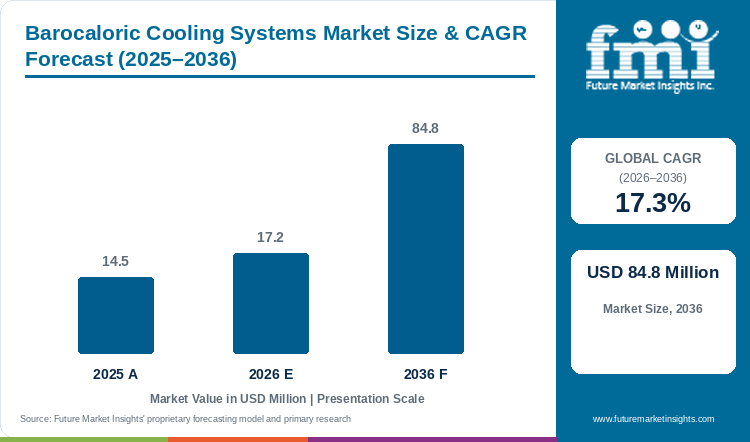
Global barocaloric cooling systems sales are estimated to rise from USD 14.5 million in 2025 to USD 17.2 million during 2026 and are projected to reach USD 84.8 million by 2036 at an anticipated 17.3% CAGR.
Starting from a 2025 valuation of USD 14.5 million, global barocaloric cooling systems revenue is estimated at USD 17.2 million in 2026 and is projected to climb to USD 84.8 million by 2036, expanding at an anticipated 17.3% CAGR that yields USD 67.6 million in incremental equipment opportunity. Plastic Crystals (Neopentylglycol NPG / Pentaglycerine) are expected to command 58.6% of colossal barocaloric phase-change material demand in 2026 because orientationally disordered hydroxyl lattices deliver reversible entropy changes of 380 to 500 joules per kilogram-kelvin without rare-earth metals. Supermarket refrigeration directors and commercial building engineers specify these hydraulic solid-state regenerators over direct-expansion hydrofluorocarbon racks to eliminate greenhouse-gas leak penalties while avoiding indoor propane flammability limits across solid-state cooling modules installations. Corroborating this transition from laboratory discovery to commercial cold-room deployment, Cambridge Enterprise reported in May 2026 that University of Cambridge spin-out Barocal raised USD 10 million (EUR 8.6 million) led by World Fund alongside Breakthrough Energy Discovery and IP Group to scale solid-state cooling production [1].
Key Market Trends & Insights
- By colossal barocaloric phase-change material: Plastic Crystals (Neopentylglycol NPG / Pentaglycerine) are projected to command 58.6% of 2026 material demand because orientationally disordered hydroxyl lattices deliver isothermal entropy changes exceeding 380 joules per kilogram-kelvin.
- By hydrostatic actuation pressure: Moderate Pressure (200 - 1,000 bar) Hydraulic Piston Regenerator designs are estimated to secure 66.2% of 2026 pressure-class revenue since off-the-shelf hydraulic manifolds avoid thick-walled autoclave vessels.
- By target cooling application: Commercial Supermarket & Cold-Room Zero-GWP Refrigeration is expected to account for 47.4% of 2026 application sales as food retailers replace leaky direct-expansion hydrofluorocarbon racks.
- By system architecture & coupling mode: Pressure-Only Active Barocaloric Regenerators (ABR) are expected to capture 88.5% of 2026 system installations because hydrostatic fluid coupling drives reversible plastic-crystal phase transitions without requiring high-voltage dielectric insulation.
Regional Highlights
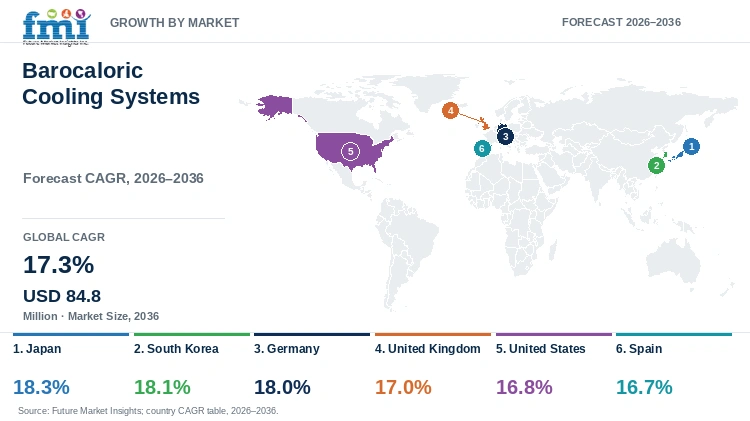
- Top national expansion pace: Japan is projected to lead major national markets with an 18.3% compound annual growth rate from 2026 to 2036 under strict fluorocarbon lifecycle rules.
- Close East Asian and European followers: South Korea is anticipated to advance at 18.1% annually and Germany is forecast to expand at 18.0% as heat pump manufacturers test solid-state caloric regenerators.
- Western European and North American baselines: British installations are expected to grow at 17.0% per year compared with 16.8% predicted across the United States and 16.7% estimated in Spain.
Market Size & Forecast
Table 1: Market Size and Forecast for the Barocaloric Cooling Systems Market (USD million and CAGR percentage), 2025 to 2036
| Metric | Value |
|---|---|
| 2025 Market Size | USD 14.5 million |
| Estimated Market Size in 2026 | USD 17.2 million |
| Projected Market Size by 2036 | USD 84.8 million |
| CAGR, 2026 to 2036 | 17.3% |
| Added Revenue, 2026 to 2036 | USD 67.6 million |
Mandatory hydrofluorocarbon quota step-downs across the European Union and North America are accelerating commercial trials of solid-state barocaloric chillers. U.S. EPA regulators finalized Technology Transitions reconsiderations under the AIM Act in May 2026 and updated regulatory guidance in July 2026 governing hydrofluorocarbon limits across supermarket remote condensing units and cold storage warehouses [2]. Because propane and ammonia alternatives face strict indoor charge limits or toxicity codes, grocery engineering teams are piloting hydraulic plastic-crystal regenerators paired with commercial refrigeration systems secondary glycol loops. Equipment vendors that pre-package neopentylglycol cartridges with closed-loop water-glycol heat exchangers shorten store retrofit schedules while eliminating refrigerant leak inspections.
Active Caloric Cartridge Mass and Thermal Capacity Sizing
Table 2: Active Caloric Cartridge Mass and Installed Cooling Capacity for the Barocaloric Cooling Systems Market (USD million, metric tons, and megawatts), 2025 to 2036
| Metric | 2025 | 2026 | 2036 |
|---|---|---|---|
| Market size (USD million) | 14.5 | 17.2 | 84.8 |
| Active barocaloric PCM mass deployed (metric tons) | 42.0 to 48.0 | 51.0 to 58.0 | 290.0 to 330.0 |
| Installed thermal cooling capacity (MW thermal) | 11.5 to 13.2 | 14.0 to 16.2 | 78.5 to 89.0 |
| System capital intensity (USD per kW thermal) | 1,120 to 1,260 | 1,060 to 1,210 | 940 to 1,070 |
Operational note: Active phase-change material tonnage and thermal megawatt ranges reflect pilot and early commercial regenerator beds cycling between 0.5 and 2.0 hertz with 15 to 25 kelvin adiabatic temperature spans.
Maximizing specific cooling power inside hydraulic regenerator cylinders requires balancing plastic-crystal bed porosity against heat-transfer fluid pressure drop. In July 2026, Eurostat reported that space-cooling energy consumption across European Union households nearly doubled from 40.5 thousand terajoules in 2018 to 80.4 thousand terajoules in 2024 led by Italy at 26.3 thousand terajoules and Spain at 14.3 thousand terajoules [3]. To serve this rising thermal load without expanding peak electrical draw, system designers encapsulate micronized neopentylglycol spheres within conductive copper foams fed by neopentyl glycol feedstocks from European and Asian polyol plants. Higher cycling frequencies reduce the active crystal mass needed per kilowatt of cooling and trim hydraulic cylinder footprint inside mechanical plant rooms.
Thermodynamic Regenerator Benchmarks and Pressure-Cycle Economics
Table 3: Regenerator Cycle Life and Hydraulic Efficiency Indicators for the Barocaloric Cooling Systems Market (bar, kelvin, and cycle counts), 2025 to 2036
| Metric | 2025 | 2026 | 2036 |
|---|---|---|---|
| Mean operating pressure range (bar) | 350 to 650 | 320 to 600 | 220 to 450 |
| Adiabatic temperature change per cycle (K) | 16.0 to 22.0 | 18.0 to 24.5 | 24.0 to 32.0 |
| Qualified seal durability (million cycles) | 3.5 to 5.0 | 4.5 to 6.5 | 10.0 to 15.0 |
| Regenerator thermal hysteresis loss (%) | 14.0 to 18.0 | 12.5 to 16.0 | 7.5 to 10.5 |
Table 4: Institutional and Regulatory Reference Benchmarks for the Barocaloric Cooling Systems Market (metrics, values, and reference bodies), 2026
| Benchmark Indicator | Reported / Modeled Value | Institutional Reference Basis |
|---|---|---|
| Market size, 2026 | USD 17.2 million | FMI baseline valuation |
| Plastic Crystals (NPG) share, 2026 | 58.6% (USD 10.1 million) | Colossal barocaloric material segment |
| EU F-Gas stationary refrigeration GWP cap | GWP < 150 mandatory threshold | European Commission Regulation (EU) 2024/573 |
| U.S. AIM Act supermarket GWP ceiling | 150 to 300 GWP limit | U.S. EPA Technology Transitions Program |
Lowering the hydrostatic pressure needed to trigger colossal phase transitions directly reduces hydraulic pump parasitic losses and extends elastomeric seal life. In February 2026, ASHRAE and the United Nations Environment Programme approved their 2026 to 2027 biennial work plan at the ASHRAE Winter Conference in Las Vegas focused on Life Cycle Refrigerant Management across 147 developing countries [4]. By doping neopentylglycol crystals with polar additives or tailoring binary neopentylglycol-pentaglycerine solid solutions, materials engineers shift transition thresholds below 400 bar for industrial chiller packages operating in continuous process plants. Reduced operating pressures allow equipment builders to substitute heavy forged-steel cylinders with lighter aluminum-bronze manifolds.
Analyst Perspective
"Supermarket and heat-pump OEMs are funding barocaloric regenerators because bulk neopentylglycol crystals cost a fraction of magnetocaloric rare-earth alloys. Commercial scale-up now hinges on lowering phase-transition hysteresis below 300 bar while proving ten-million-cycle hydraulic seal reliability."
- Nikhil Kaitwade, Principal Consultant, Future Market Insights.
How is the barocaloric cooling systems market segmented?
The barocaloric cooling systems market is segmented by colossal barocaloric phase-change material, hydrostatic actuation pressure, target cooling application, and system architecture & coupling mode. In 2026, Plastic Crystals (Neopentylglycol NPG / Pentaglycerine) are projected to lead at 58.6%, Moderate Pressure (200 - 1,000 bar) Hydraulic Piston Regenerator leads at 66.2%, Commercial Supermarket & Cold-Room Zero-GWP Refrigeration leads at 47.4%, and Pressure-Only Active Barocaloric Regenerators (ABR) lead at 88.5%.
By colossal barocaloric phase-change material: Plastic Crystals (Neopentylglycol NPG / Pentaglycerine), Hybrid Organic-Inorganic Perovskites & Spin-Crossover Complexes, and n-Alkanes & Fatty-Acid Barocaloric Phase-Change Liquids.
By hydrostatic actuation pressure: Moderate Pressure (200 - 1,000 bar) Hydraulic Piston Regenerator and High Pressure (>1,000 bar) Solid-Compression Bed.
By target cooling application: Commercial Supermarket & Cold-Room Zero-GWP Refrigeration, Residential Air-to-Water Heat Pumps, and Industrial Process & Data Center Chilled Water.
By system architecture & coupling mode: Pressure-Only Active Barocaloric Regenerators (ABR), Direct-Compression Solid-Bed Heat Exchangers, and Experimental Electro-Barocaloric Dual-Stimulus Prototypes.
Why Do Plastic Crystals (Neopentylglycol NPG / Pentaglycerine) Anchor Phase-Change Material Selection?
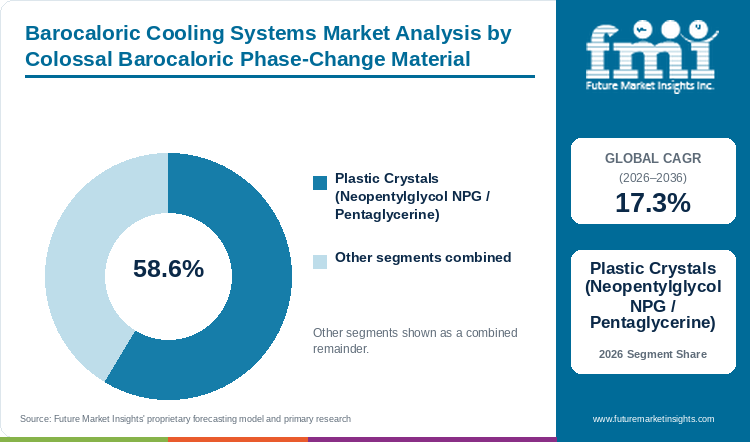
Plastic Crystals (Neopentylglycol NPG / Pentaglycerine) are estimated to hold 58.6% of barocaloric phase-change material in 2026, supported by giant entropy.
Table 5: Colossal Barocaloric Phase-Change Material Share for the Barocaloric Cooling Systems Market (percentage share), 2026
| Colossal Barocaloric Phase-Change Material Segment | Share (2026) |
|---|---|
| Plastic Crystals (Neopentylglycol NPG / Pentaglycerine) | 58.6% |
| Hybrid Organic-Inorganic Perovskites & Spin-Crossover Complexes | 24.2% |
| n-Alkanes & Fatty-Acid Barocaloric Phase-Change Liquids | 17.2% |
| Total | 100.0% |
*Note: Combined share of remaining colossal barocaloric phase-change material categories totaling 100.0% of 2026 market demand.
Table 6: Colossal Barocaloric Phase-Change Material Leadership and Market Growth for the Barocaloric Cooling Systems Market (segment and CAGR percentage), 2026 to 2036
| Metric | Value |
|---|---|
| Global CAGR (2026 to 2036) | 17.3% |
| Leading Segment | Plastic Crystals (Neopentylglycol NPG / Pentaglycerine) |
Reorienting globular neopentylglycol molecules across their monoclinic-to-face-centered-cubic transition liberates latent entropy comparable to vapor-liquid fluorocarbon boiling while keeping the working medium entirely solid. Because neopentylglycol is already synthesized in hundred-thousand-tonne volumes for powder coatings alongside industrial cooling systems supply chains, caloric system builders avoid the supply bottlenecks of gadolinium or lanthanum alloys. Hybrid perovskites (projected at 24.2%) and n-alkane liquids (estimated at 17.2%) together account for the remaining 41.4% of 2026 material demand where narrower hysteresis or pumpable slurries are required.
- Plastic Crystals (Neopentylglycol NPG / Pentaglycerine) are projected to account for 58.6% of 2026 material revenue as polyhydric alcohols combine 380 to 500 J/kg-K entropy changes with bulk industrial availability.
- In October 2025, BASF SE inaugurated an 80,000 metric ton per year neopentylglycol plant at its Zhanjiang Verbund site in China that raised its global capacity to 335,000 metric tons and launched NEOL NPG with a reduced product carbon footprint [5].
How Does Moderate Pressure (200 - 1,000 bar) Hydraulic Piston Regeneration Capture Two-Thirds of System Builds?
Moderate Pressure (200 - 1,000 bar) Hydraulic Piston Regenerator is expected to claim 66.2% of actuation pressure in 2026, reflecting standard seals.
Operating hydraulic piston intensifiers between 200 and 1,000 bar enables chiller assemblers to use commercial servo-valves and polyurethane rod seals rated for continuous industrial duty. Wait-free pressure recovery across twin opposed hydraulic cylinders recycles mechanical compression work on each stroke, keeping electrical input competitive with variable-speed screw compressors in commercial refrigeration equipment plant rooms. High-pressure solid-compression beds above 1,000 bar are projected to represent the remaining 33.8% of 2026 revenue and remain confined to laboratory test rigs and specialty cryocoolers.
- Moderate Pressure (200 - 1,000 bar) Hydraulic Piston Regenerator designs are estimated to secure 66.2% of 2026 actuation revenue by avoiding specialized autofrettaged pressure vessels.
- Under a Horizon Europe EIC Accelerator project running from July 2025 through June 2027 backed by EUR 2.45 million in European Union funding, Barocal Ltd. is scaling 1,000-watt commercial barocaloric prototypes operating across a 40-degree-Celsius temperature span [6].
What Places Commercial Supermarket & Cold-Room Zero-GWP Refrigeration Ahead Among End-Use Applications?
Commercial Supermarket & Cold-Room Zero-GWP Refrigeration is projected to capture 47.4% of target cooling application in 2026, driven by fluorocarbon bans.
Grocery display cases and walk-in cold rooms suffer annual refrigerant leak rates of 10% to 20%, exposing supermarket operators to escalating carbon taxes and quota shortages. Replacing centralized hydrofluorocarbon compressor racks with modular barocaloric chillers circulating non-toxic water-glycol brine eliminates both high-pressure CO2 transcritical piping and flammable propane charge limits across data center liquid cooling and commercial secondary cooling layouts. Residential air-to-water heat pumps (estimated at 28.6%) and industrial process and data center chilled water (projected at 24.0%) make up the 52.6% balance of 2026 application demand.
- Commercial Supermarket & Cold-Room Zero-GWP Refrigeration is expected to generate 47.4% of 2026 application sales because food retailers prioritize leak-free zero-GWP backroom chillers.
- In January 2026, Daikin Industries unveiled its Magnitude WME-C 2,000-to-3,000-ton magnetic-bearing chiller and Pathfinder AWV-C heat-recovery architectures at the 2026 AHR Expo for commercial buildings and data centers [7].
Why Do Pressure-Only Active Barocaloric Regenerators Anchor System Architecture Selection?
Pressure-Only Active Barocaloric Regenerators (ABR) are anticipated to secure 88.5% of system architecture selection in 2026, owing to hydraulic reliability.
Commercial barocaloric cooling relies on hydrostatic pressure as the primary thermodynamic driver to compress orientationally disordered plastic crystals inside fluid-coupled regenerator cylinders. Pressure-Only Active Barocaloric Regenerators (ABR) eliminate the dielectric breakdown hazards and multilayer capacitor fabrication complexity associated with experimental electro-barocaloric dual-stimulus testbeds. Active regenerator vessels circulate water-glycol heat-transfer fluid directly through packed neopentylglycol beds alongside commercial data-center chiller heat rejection loops to achieve temperature spans exceeding 25 degrees Celsius.
- Hydrostatic fluid compression across packed neopentylglycol beds achieves uniform stress distribution without high-voltage electrode delamination.
- Eastman Chemical Company supplies Neopentyl Glycol (NPG) in 25-kilogram solid platelet bags, heated bulk molten tank trucks, and NPG 90 aqueous solutions maintained above 38 degrees Celsius for industrial resin and crystalline phase-change synthesis [8].
- Experimental electro-barocaloric coupling remains restricted to laboratory multicaloric research rigs investigating hysteresis reduction in polar nanocomposites.
What are the drivers, restraints, and opportunities in the barocaloric cooling systems market?
Statutory hydrofluorocarbon phase-downs accelerate barocaloric cooling adoption, while plastic-crystal thermal conductivity and hysteresis restrain cycling speed, and data-center liquid cooling creates new commercial demand.
- Driver: Binding F-gas bans and hydrofluorocarbon quota cuts across European and North American markets alongside East Asia compel commercial refrigeration buyers to fund zero-GWP solid-state cooling.
- Restraint: Intrinsic thermal hysteresis and low lattice thermal conductivity inside organic plastic crystals restrict hydraulic cycling frequencies unless conductive matrices are embedded.
- Opportunity: Coupling barocaloric water-glycol regenerators with direct-to-chip data center cooling loops opens high-margin thermal management contracts.
Growth Analysis and Future Potential: Qualitative Demand Catalysts
International treaties and national climate laws are systematically pricing synthetic hydrofluorocarbons out of commercial refrigeration and building heat-pump service. In January 2026, the United Nations Environment Programme Ozone Secretariat and the UNEP-led Cool Coalition released a new Sustainable Cooling Policy Toolkit mapping Kigali Amendment hydrofluorocarbon phase-down schedules and minimum energy performance standards worldwide [9]. Unlike hydrofluoroolefin blends that face atmospheric trifluoroacetic acid scrutiny across European water agencies, neopentylglycol and pentaglycerine crystals are non-volatile solids with zero ozone depletion and zero global warming potential. HVAC manufacturers are co-investing in barocaloric cartridge modules to complement air source heat pumps where indoor flammability codes restrict propane charges.
Risk Assessment of the Barocaloric Cooling Systems Market: Operational and Formulation Friction
Organic plastic crystals exhibit low intrinsic thermal conductivity near 0.2 to 0.4 watts per meter-kelvin alongside pressure hysteresis between compression and decompression strokes. When heat cannot diffuse rapidly out of thick neopentylglycol beds, regenerator cycling frequencies stall below 1 hertz and require larger hydraulic cylinders to deliver rated cooling tonnage. In April 2025, ASHRAE Journal published technical research examining safety and technology barriers in transitioning commercial cooling systems toward ultralow-GWP refrigerants under the AIM Act 30% step-downs toward a 15% baseline by 2036 [10]. Furthermore, chemical suppliers such as BASF Corporation announced a USD 155 per metric ton (USD 0.07 per pound) price increase on NEOL neopentylglycol in North America in February 2026, requiring cartridge builders to optimize polyol loading alongside data center chillers heat exchangers.
Commercial Opportunity Analysis: Formulation Differentiation and Value-Add Formats
Hyperscale artificial-intelligence server clusters reject extreme rack heat loads into warm-water loops between 30 and 45 degrees Celsius, matching the optimal solid-to-solid phase transition window of neopentylglycol and pentaglycerine blends. In December 2025, Daikin Applied invested USD 163 million in a 71,000-square-foot advanced R&D test laboratory with nine specialized test cells in Plymouth, Minnesota to validate next-generation data center and commercial heat-pump cooling systems [11]. Integrating barocaloric hydraulic regenerators directly with ai datacenter liquid cooling distribution manifolds allows server hall operators to reject heat without rooftop fluorocarbon chillers. Chemical formulators that supply pre-compounded plastic-crystal and graphite composites with sub-200-bar transition pressures secure high-margin material supply agreements.
Barocaloric Cooling Systems Market by Country (2026 to 2036)
East Asian and Western European industrial economies are projected to set the pace for barocaloric cooling commercialization as appliance majors and chemical groups co-develop zero-refrigerant heat pumps. Japan is forecast to lead major national markets at an 18.3% CAGR through 2036 ahead of South Korea projected at 18.1% and Germany estimated at 18.0%. Meanwhile, the United Kingdom (anticipated at 17.0%) alongside the United States (expected at 16.8%) and Spain (predicted at 16.7%) are slated to scale supermarket and commercial HVAC pilot installations.
Table 7: Country CAGR and Primary Growth Levers for the Barocaloric Cooling Systems Market (CAGR percentage and operational drivers), 2026 to 2036
| Country | CAGR (2026 to 2036) | Primary Growth Lever |
|---|---|---|
| Japan | 18.3% | Fluorocarbon lifecycle mandates and appliance OEM caloric R&D |
| South Korea | 18.1% | Data-center chiller efficiency rules and electronics HVAC integration |
| Germany | 18.0% | EU F-Gas stationary bans and Verbund neopentylglycol supply |
| United Kingdom | 17.0% | Cambridge spin-out commercialization and DESNZ heat-pump grants |
| United States | 16.8% | EPA AIM Act supermarket GWP caps and DOE caloric funding |
| Spain | 16.7% | Fluorinated gas excise taxes and Mediterranean cold-storage retrofits |
Source: Future Market Insights analysis
Japan Barocaloric Cooling Systems Market Outlook (2026 to 2036)
Whereas global barocaloric demand is heavily weighted toward supermarket cold rooms, Japan's market is uniquely structured around high-rise district heat pumps and domestic HVAC OEM caloric R&D. Japanese energy policymakers at METI secured Cabinet approval in February 2025 for the Seventh Strategic Energy Plan alongside the GX2040 Vision targeting a 73% greenhouse-gas reduction by fiscal 2040 through industrial thermal electrification [12]. Domestic revenue is projected to expand at a leading 18.3% compound pace from 2026 to 2036 as Daikin Industries and partner laboratories test solid-state regenerators across Tokyo and Osaka. Strict seismic equipment weight ceilings on commercial rooftops nevertheless penalize heavy hydraulic cylinders, prompting Japanese engineers to specify compact neopentylglycol beds reinforced with aluminum-matrix heat exchangers.
Key takeaway: In Japan, national fluorocarbon lifecycle mandates and OEM caloric R&D are projected to support 18.3% annual growth toward compact rooftop-ready hydraulic regenerators.
South Korea Barocaloric Cooling Systems Market Outlook (2026 to 2036)
Bilateral trade and energy ministries in Seoul and Tokyo issued a joint economic cooperation release in May 2026 expanding Republic of Korea and Japan collaboration on clean energy security and resilient industrial supply chains [13]. Unlike Western European markets driven by grocery cold-storage retrofits, South Korea's barocaloric demand is uniquely concentrated inside Gyeonggi semiconductor cleanrooms and hyperscale artificial-intelligence server parks. National sales in South Korea are anticipated to rise by 18.1% annually through 2036 as electronics conglomerates integrate solid-state water chillers into high-density chip and district cooling loops. Steep industrial peak electricity tariffs still squeeze operating budgets when hydraulic pumps suffer pressure-drop losses, pushing Korean system integrators to favor low-hysteresis plastic-crystal formulations operating below 400 bar.
Key takeaway: In South Korea, clean-energy industrial cooperation and semiconductor cleanroom cooling needs are anticipated to support 18.1% yearly growth for low-hysteresis barocaloric chillers.
Germany Barocaloric Cooling Systems Market Outlook (2026 to 2036)
German barocaloric system turnover is forecast to advance at an 18.0% yearly pace between 2026 and 2036, supported by domestic neopentylglycol synthesis from BASF SE and OQ Chemicals in Ludwigshafen and Oberhausen. Germany differs fundamentally from import-dependent cooling markets because local Verbund chemical plants supply high-purity plastic crystals directly to domestic mechanical equipment builders under EU F-Gas stationary bans. Confirming this regulatory timeline across German equipment plants, Brussels climate officials under Regulation (EU) 2024/573 cap hydrofluorocarbon production at 60% of baseline in 2025 and step quotas down to 15% by 2036 [14]. Stringent municipal acoustic limits in dense residential quarters still restrict outdoor hydraulic pump noise, compelling German engineers to enclose piston intensifiers inside vibration-damped skids.
Key takeaway: In Germany, EU F-Gas bans and domestic neopentylglycol feedstock integration are forecast to anchor 18.0% annual growth for low-noise indoor regenerator skids.
United Kingdom Barocaloric Cooling Systems Market Outlook (2026 to 2036)
In contrast to global markets reliant on external technology licensing, the United Kingdom serves as the primary intellectual-property and pilot-manufacturing hub for barocaloric cooling around the University of Cambridge cluster. Britain's DESNZ energy ministry published its June 2026 deployment bulletin during September 2026, recording 20,895 MCS-certified retrofit heat-pump installations across the first half of 2026 under the Warm Homes Plan [15]. United Kingdom revenues are expected to climb 17.0% per annum from 2026 to 2036 as Cambridge-based Barocal Ltd. fields commercial supermarket and heat-pump prototypes with British grocery chains. Shortages of HVAC technicians trained on high-pressure hydraulic regenerators remain a local bottleneck, leading British suppliers to deliver factory-sealed cartridge modules with automated diagnostics.
Key takeaway: In the United Kingdom, Cambridge spin-out deployments and public decarbonization grants are expected to back 17.0% annual expansion for factory-sealed barocaloric modules.
United States Barocaloric Cooling Systems Market Outlook (2026 to 2036)
FEMP procurement officials at the U.S. Energy Department updated acquisition guidance in October 2026 for energy-efficient heat pumps under 65,000 Btu/h, showing that 24 SEER2 units cut annual electricity consumption to 7,683 kilowatt-hours [16]. Whereas European adopters favor compact hydronic monoblocks, the United States market is uniquely shaped by large-tonnage rooftop grocery refrigeration racks and state-level hydrofluorocarbon caps in California and New York. United States demand is predicted to expand at a 16.8% annual pace from 2026 through 2036, anchored by Carrier Global Corporation's strategic venture backing and cold-storage warehouse retrofits. Fragmented state mechanical codes for 500-bar hydraulic plumbing still slow local permitting, so American OEMs package barocaloric beds inside ASME-certified vessels with low-pressure glycol building loops.
Key takeaway: In the United States, federal procurement standards and supermarket HFC limits are predicted to drive 16.8% yearly growth for ASME-certified barocaloric chiller skids.
Spain Barocaloric Cooling Systems Market Outlook (2026 to 2036)
Spanish market revenue is estimated to climb at a 16.7% annual pace through 2036 as fruit packhouses and grocery chains seek tax-exempt solid-state cooling systems alongside university materials research in Barcelona. Spain stands apart from northern European heating-led markets because national demand is driven by extreme 40-degree-Celsius summer refrigeration loads and direct per-kilogram excise taxes on fluorinated refrigerant refills. Corroborating this fiscal pressure, Spain's Agencia Tributaria tax agency published Orden HAC/56/2026 in February 2026 updating Form 587 self-assessment and Form A23 refund rules for the Spanish Fluorinated Greenhouse Gases Tax effective July 2026 [17]. High summer ambient temperatures challenge heat-rejection exchangers across Andalusia and Murcia, requiring Spanish installers to pair neopentylglycol beds with adiabatic dry coolers.
Key takeaway: In Spain, fluorinated gas excise taxes and cold-chain retrofit demand are estimated to sustain 16.7% annual growth for high-ambient barocaloric refrigeration units.
Full report country CAGRs cover: North America; Latin America; Western Europe; Eastern Europe; East Asia; South Asia and Pacific; Middle East and Africa.
Who are the notable companies in the barocaloric cooling systems market?
Barocal Ltd., Carrier Global Corporation, Daikin Industries, Ltd., Perstorp Holding AB, BASF SE, Eastman Chemical Company, OQ Chemicals GmbH, and LG Electronics Inc. are the notable companies in the barocaloric cooling systems market.
Future Market Insights analysts observe that industry participation spans three interdependent operational tiers linking solid-state regenerator pioneers with multinational HVAC OEMs and polyhydric alcohol chemical producers. Dedicated caloric hardware developers design the hydraulic piston regenerators and copper-foam cartridge geometries that convert neopentylglycol phase transitions into chilled water-glycol loops. Global air-conditioning and commercial refrigeration conglomerates provide multi-megawatt test benches and supermarket service networks alongside corporate venture capital, while upstream oxo-chemical manufacturers control world-scale propylene-isobutyraldehyde synthesis and high-purity neopentylglycol crystallization.
- Solid-State Barocaloric Regenerator Pioneers: Barocal Ltd. commercializes hydraulic neopentylglycol cooling modules spun out of University of Cambridge materials research.
- Global HVAC & Commercial Refrigeration Integrators: Carrier Global Corporation and Daikin Industries alongside LG Electronics Inc. integrate non-vapor-compression caloric modules into commercial chillers and heat pumps.
- Neopentylglycol & Caloric Phase-Change Chemical Producers: Perstorp Holding AB and BASF SE alongside Eastman Chemical Company and OQ Chemicals GmbH supply bulk and trace-certified neopentylglycol platelets and molten polyols.
Competitive Benchmarking: Barocaloric Cooling Systems Market
Table 8: Competitive Benchmarking for the Barocaloric Cooling Systems Market (qualitative capability ratings), 2026
| Company | Caloric Material & Cartridge IP | Hydraulic Regenerator Integration | Commercial HVAC & Cold-Room Access | Geographic Reach |
|---|---|---|---|---|
| Barocal Ltd. | High | High | Medium | Medium |
| Carrier Global Corporation | Medium | High | High | High |
| Daikin Industries, Ltd. | Medium | High | High | High |
| Perstorp Holding AB | High | Low | Medium | High |
| BASF SE | High | Low | Medium | High |
| Eastman Chemical Company | Medium | Low | Medium | High |
| OQ Chemicals GmbH | High | Low | Medium | Medium |
| LG Electronics Inc. | Medium | High | High | High |
Scoring basis: Caloric Material & Cartridge IP is rated High for companies holding patented barocaloric crystal formulations or world-scale neopentylglycol synthesis, and Medium for system-level R&D adopters. Hydraulic Regenerator Integration is High for firms engineering complete pressure-cycling chillers or heat pumps, and Low for raw chemical feedstock suppliers. Commercial HVAC & Cold-Room Access and Geographic Reach reflect documented multi-region distribution and field service networks.
Key Developments in the Barocaloric Cooling Systems Market
- In March 2026, Cambridge Enterprise documented that University of Cambridge spin-out Barocal won the USD 1 million gold TERA-Award in July 2025 and scaled its organic plastic-crystal barocaloric prototypes to address global heating and cooling energy demand [18].
- In February 2026, BASF Corporation announced a price increase of USD 0.07 per pound (USD 155 per metric ton) for NEOL neopentylglycol across the United States and Canada effective March 12, 2026 [19].
- In May 2026, Daikin Industries inaugurated its EUR 300 million European heat pump manufacturing plant in Lodz in Poland linked to its Ghent R&D hub to expand low-carbon residential and commercial thermal equipment capacity [20].
Key Players in the Barocaloric Cooling Systems Market
Solid-State Barocaloric Regenerator Pioneers
- Barocal Ltd.
Global HVAC & Commercial Refrigeration Integrators
- Carrier Global Corporation
- Daikin Industries, Ltd.
- LG Electronics Inc.
Neopentylglycol & Caloric Phase-Change Material Suppliers
- Perstorp Holding AB
- BASF SE
- Eastman Chemical Company
- OQ Chemicals GmbH
Barocaloric Cooling Systems Market - Report Scope
Table 9: Report Scope for the Barocaloric Cooling Systems Market (coverage fields and definitions), 2026 to 2036
| Coverage field | Report scope |
|---|---|
| Market breakdown | Colossal Barocaloric Phase-Change Material; Hydrostatic Actuation Pressure; Target Cooling Application; System Architecture & Coupling Mode; Region |
| Quantitative Units | USD Million (2025, 2026, and 2036) |
| Market Definition | Includes commercial and pilot revenues from solid-state barocaloric cooling and heat-pump systems, hydraulic pressure regenerator skids, and encapsulated barocaloric phase-change cartridges. Category Scope Note: Excludes conventional vapor-compression fluorocarbon chillers, magnetocaloric gadolinium coolers, and bulk commodity neopentylglycol sold for powder coatings or lubricants. |
| Regions Covered | North America; Latin America; Western Europe; Eastern Europe; East Asia; South Asia and Pacific; Middle East and Africa |
| Countries Covered | Japan, South Korea, Germany, United Kingdom, United States, Spain, and additional regional markets |
| Key Companies Covered | Barocal Ltd., Carrier Global Corporation, Daikin Industries, Ltd., Perstorp Holding AB, BASF SE, Eastman Chemical Company, OQ Chemicals GmbH, LG Electronics Inc. |
| Forecast Period | 2026 to 2036 (Base Year: 2026; Historical Baseline: 2025) |
| Approach | Primary and secondary research triangulated with hydraulic regenerator capacity and caloric material loading models. |
Barocaloric Cooling Systems Market - Research Methodology
Table 10: Research Methodology for the Barocaloric Cooling Systems Market (research methods and approach), 2026 edition
| Method | Approach |
|---|---|
| Primary Research | Structured interviews with solid-state caloric cooling engineers, hydraulic regenerator designers, supermarket refrigeration directors, and polyol chemical producers to validate pressure-cycle life, adiabatic temperature spans, and OEM qualification timelines. |
| Secondary Research | Analysis of corporate filings, patent registries, University of Cambridge and national laboratory publications, U.S. EPA AIM Act rulemakings, European Commission F-Gas regulations, and ASHRAE lifecycle refrigerant standards. |
| Market Sizing and Forecasting | Bottom-up modeling of active barocaloric cartridge tonnage (metric tons), thermal megawatt capacity (MWt), and system capital intensity (USD per kWt) cross-checked against commercial cold-room and heat-pump retrofit budgets. |
| Country Forecasting Model | Econometric country CAGRs (ranging from 16.7% in Spain to 18.3% in Japan around the 17.3% global CAGR) calibrated against national F-gas tax schedules, heat-pump deployment statistics, and domestic polyol feedstock infrastructure. |
| Operational Benchmark Traceability | Physical and regulatory benchmarks in Tables 2, 3, and 4 traced to U.S. EPA AIM Act Technology Transitions limits, European Commission Regulation (EU) 2024/573, Eurostat cooling energy statistics, and ASHRAE/UNEP work plans. |
| Data Triangulation and Validation | Reconciliation of upstream neopentylglycol crystal loading against downstream chiller skid shipments to prevent double counting between raw chemical feedstocks and integrated HVAC equipment. |
Barocaloric Cooling Systems Market by Segments
Barocaloric Cooling Systems Market segmented by Colossal Barocaloric Phase-Change Material:
- Plastic Crystals (Neopentylglycol NPG / Pentaglycerine)
- Hybrid Organic-Inorganic Perovskites & Spin-Crossover Complexes
- n-Alkanes & Fatty-Acid Barocaloric Phase-Change Liquids
Barocaloric Cooling Systems Market segmented by Hydrostatic Actuation Pressure:
- Moderate Pressure (200 - 1,000 bar) Hydraulic Piston Regenerator
- High Pressure (>1,000 bar) Solid-Compression Bed
Barocaloric Cooling Systems Market segmented by Target Cooling Application:
- Commercial Supermarket & Cold-Room Zero-GWP Refrigeration
- Residential Air-to-Water Heat Pumps
- Industrial Process & Data Center Chilled Water
Barocaloric Cooling Systems Market segmented by System Architecture & Coupling Mode:
- Pressure-Only Active Barocaloric Regenerators (ABR)
- Direct-Compression Solid-Bed Heat Exchangers
- Experimental Electro-Barocaloric Dual-Stimulus Prototypes
Barocaloric Cooling Systems Market by Region
- North America
- United States
- Canada
- Latin America
- Brazil
- Mexico
- Argentina
- Chile
- Western Europe
- Germany
- France
- United Kingdom
- Italy
- Spain
- Benelux
- Nordics
- Eastern Europe
- Poland
- Czech Republic
- Romania
- Hungary
- East Asia
- China
- Japan
- South Korea
- South Asia and Pacific
- India
- ASEAN
- Australia and New Zealand
- Middle East and Africa
- GCC Countries
- South Africa
- Türkiye
- Israel
Research Sources and Bibliography
- [1] Cambridge Enterprise. (2026, May 5). Sustainability pioneer Barocal raises $10M to disrupt century-old cooling industry with breakthrough materials technology. University of Cambridge.
- [2] U.S. Environmental Protection Agency. (2026, July 28). Regulatory Actions for Technology Transitions. US EPA.
- [3] Eurostat. (2026, July 8). Energy use for cooling in EU households doubled in 6 years. European Commission.
- [4] ASHRAE. (2026, February 19). ASHRAE and UNEP Approve Two-Year Work Plan Focused on Life Cycle Refrigerant Management. American Society of Heating, Refrigerating and Air-Conditioning Engineers.
- [5] BASF SE. (2025, October 20). BASF inaugurates new NPG plant at Zhanjiang Verbund site and launches NEOL® NPG with reduced product carbon footprint. BASF Media Center.
- [6] European Commission. (2025, September 23). Advanced Barocaloric Systems for Sustainable Commercial Cooling Applications. CORDIS EU Research Results.
- [7] Daikin Industries, Ltd. (2026, January 28). Daikin Unveils High-Performance Innovations at 2026 AHR Expo to Tackle Industry's Toughest Challenges. Daikin Global Press.
- [8] Eastman Chemical Company. (2026, January 15). Neopentyl Glycol (NPG) 90 Product Specification. Eastman Chemical Company.
- [9] United Nations Environment Programme. (2026, January 23). New sustainable cooling policy toolkit. UNEP Ozone Secretariat.
- [10] ASHRAE. (2025, April 1). Safety Technology Barriers to Adoption of Ultralow GWP Refrigerants. ASHRAE Journal.
- [11] Daikin Industries, Ltd. (2025, December 9). Daikin Applied Invests $163M in Advanced R&D Test Lab to Bolster HVAC Innovation for Data Centers and Beyond. Daikin Global Press.
- [12] Ministry of Economy, Trade and Industry. (2025, February 18). Cabinet Decision on the Seventh Strategic Energy Plan. METI Japan.
- [13] Ministry of Economy, Trade and Industry. (2026, May 19). Republic of Korea / METI Ministry of Economy, Trade and Industry. METI Japan.
- [14] European Commission. (2025, May 22). EU-Rules - Fluorinated Greenhouse Gases – Climate Action. Directorate-General for Climate Action.
- [15] Department for Energy Security and Net Zero. (2026, September 10). Heat pump deployment statistics: June 2026 – summary. GOV.UK.
- [16] U.S. Department of Energy. (2026, October 8). Purchasing Energy-Efficient Residential Air-Source Heat Pumps. DOE Federal Energy Management Program.
- [17] Agencia Tributaria. (2026, February 5). Novedades en el Impuesto sobre los Gases Fluorados de Efecto Invernadero. Ministerio de Hacienda Espana.
- [18] Cambridge Enterprise. (2026, March 31). Barocal: Powering zero-carbon heating and cooling systems of the future. University of Cambridge.
- [19] BASF Corporation. (2026, February 26). BASF to increase its price for neopentylglycol in the United States and Canada. BASF North America Market News.
- [20] Daikin Industries, Ltd. (2026, May 21). Daikin inaugurates new heat pump production site in Poland. Daikin Global Press.
- [21] Perstorp Holding AB. (2025, March 14). Sustainability Report 2024. Perstorp Group.
- [22] Carrier Global Corporation. (2026, April 29). Carrier Ventures Expands Investment in ZutaCore to Scale Liquid Cooling for AI Data Centers. Carrier Corporate News.
This bibliography is provided for reader reference and is not exhaustive. The full report contains the complete reference list and detailed citations.
This Report Answers
- How large is the barocaloric cooling systems market in 2026 and what is the 2036 projection?
- Why do Plastic Crystals (Neopentylglycol NPG / Pentaglycerine) capture 58.6% of phase-change material demand?
- How do 200 to 1,000 bar hydraulic piston regenerators lower equipment cost relative to ultra-high-pressure beds?
- Why do Pressure-Only Active Barocaloric Regenerators (ABR) account for 88.5% of system architecture selection?
- How does the 50 to 100 V/µm multilayer electric-field regime prevent dielectric breakdown during multicaloric cycling?
- Why do Japan (18.3% CAGR), South Korea (18.1%), and Germany (18.0%) outpace other industrial economies?
- What technical bottlenecks around thermal hysteresis and plastic-crystal heat transfer limit cycling frequency?
- How are Barocal Ltd., Carrier, Daikin, Perstorp, and BASF positioning across hardware and feedstock tiers?
Frequently Asked Questions
What is the 2026 market size and 2036 forecast for barocaloric cooling systems?
Future Market Insights estimates 2026 barocaloric cooling systems demand at USD 17.2 million above the USD 14.5 million recorded during 2025. Sector shipments are projected to reach USD 84.8 million by 2036 and generate an anticipated USD 67.6 million in added equipment sales.
What compound annual growth rate is projected from 2026 to 2036?
Annual barocaloric equipment installations are projected to climb at a 17.3% compound clip over the ten-year horizon through 2036. Supermarket cold-room retrofits and statutory F-gas phase-down rules drive this expected expansion.
Which phase-change material segment holds the largest share in 2026?
Plastic Crystals (Neopentylglycol NPG / Pentaglycerine) are estimated to command 58.6% of phase-change material demand in 2026. Disordered tetrahedral lattices deliver giant entropy changes above 380 J/kg-K using widely produced industrial polyols.
Why do moderate-pressure hydraulic piston regenerators lead actuation architectures?
Moderate Pressure (200 - 1,000 bar) Hydraulic Piston Regenerator systems are expected to account for 66.2% of 2026 actuation revenue. Operating below 1,000 bar allows engineers to use standard industrial hydraulic seals and manifolds.
Which country registers the fastest growth through 2036?
FMI projects Japan to post the highest national growth rate at an 18.3% CAGR from 2026 to 2036. Strict fluorocarbon lifecycle management laws and domestic heat-pump OEM investments support Japanese adoption.
Who are the notable companies operating in the barocaloric cooling systems market?
Key participants include Barocal Ltd., Carrier Global Corporation, Daikin Industries, Ltd., Perstorp Holding AB, BASF SE, Eastman Chemical Company, OQ Chemicals GmbH, and LG Electronics Inc. These firms span solid-state regenerator design and HVAC integration alongside neopentylglycol synthesis.
Preview the report firsthand - request a free sample
Get SampleGet the brochure for pricing and purchase details.
Get PDFTable of Content
- Key Takeaways
- Market Size and CAGR
- Top Growth Driver
- Fastest Growing Segment
- Leading Region
- Key Companies
- Emerging Opportunities
- Executive Summary
- Global Market Outlook
- Demand-side Trends
- Supply-side Trends
- Technology Roadmap Analysis
- Analysis and Recommendations
- Analyst Perspective (What is happening? Why now? What should investors know?)
- Key Questions Answered
- How large is the market?
- What is the CAGR?
- What are key trends?
- Which region dominates?
- Who are the leaders?
- Market Overview
- Market Coverage / Taxonomy
- Market Definition / Scope / Limitations
- Research Methodology
- Chapter Orientation
- Analytical Lens and Working Hypotheses
- Market Structure, Signals, and Trend Drivers
- Benchmarking and Cross-market Comparability
- Market Sizing, Forecasting, and Opportunity Mapping
- Research Design and Evidence Framework
- Desk Research Programme (Secondary Evidence)
- Expert Input and Fieldwork (Primary Evidence)
- Tooling, Models, and Reference Databases
- Data Engineering and Model Build
- Quality Assurance and Audit Trail
- Market Background
- Market Dynamics (Drivers, Restraints, Opportunity, Trends)
- Scenario Forecast (Optimistic, Likely, Conservative)
- Impact Analysis
- AI Impact
- Sustainability Impact
- Regulatory Impact
- Technology Impact
- Consumer / Buyer Analysis
- Purchase Drivers
- Adoption Barriers
- Buyer Journey
- Opportunity Map Analysis
- Product Life Cycle Analysis
- Supply Chain Analysis
- Investment Feasibility Matrix
- Value Chain Analysis
- PESTLE and Porter's Analysis
- Regulatory Landscape
- Regional Parent Market Outlook
- Production and Consumption Statistics
- Import and Export Statistics
- Global Market Analysis and Forecast, 2021 to 2036
- Historical Market Size Value (USD Million) Analysis, 2021 to 2025
- Current and Future Market Size Value (USD Million) Projections, 2026 to 2036
- Y-o-Y Growth Trend Analysis
- Absolute $ Opportunity Analysis
- Global Market Pricing Analysis, 2021 to 2036
- Global Market Analysis and Forecast, By Colossal Barocaloric Phase-Change Material, 2021 to 2036
- Introduction / Key Findings
- Historical Market Size Value (USD Million) Analysis By Colossal Barocaloric Phase-Change Material, 2021 to 2025
- Current and Future Market Size Value (USD Million) Analysis and Forecast By Colossal Barocaloric Phase-Change Material, 2026 to 2036
- Plastic Crystals (Neopentylglycol NPG / Pentaglycerine)
- Hybrid Organic-Inorganic Perovskites & Spin-Crossover Complexes
- n-Alkanes & Fatty-Acid Barocaloric Phase-Change Liquids
- Y-o-Y Growth Trend Analysis By Colossal Barocaloric Phase-Change Material, 2021 to 2025
- Absolute $ Opportunity Analysis By Colossal Barocaloric Phase-Change Material, 2026 to 2036
- Global Market Analysis and Forecast, By Hydrostatic Actuation Pressure, 2021 to 2036
- Introduction / Key Findings
- Historical Market Size Value (USD Million) Analysis By Hydrostatic Actuation Pressure, 2021 to 2025
- Current and Future Market Size Value (USD Million) Analysis and Forecast By Hydrostatic Actuation Pressure, 2026 to 2036
- Moderate Pressure (200 - 1,000 bar) Hydraulic Piston Regenerator
- High Pressure (>1,000 bar) Solid-Compression Bed
- Y-o-Y Growth Trend Analysis By Hydrostatic Actuation Pressure, 2021 to 2025
- Absolute $ Opportunity Analysis By Hydrostatic Actuation Pressure, 2026 to 2036
- Global Market Analysis and Forecast, By Target Cooling Application, 2021 to 2036
- Introduction / Key Findings
- Historical Market Size Value (USD Million) Analysis By Target Cooling Application, 2021 to 2025
- Current and Future Market Size Value (USD Million) Analysis and Forecast By Target Cooling Application, 2026 to 2036
- Commercial Supermarket & Cold-Room Zero-GWP Refrigeration
- Residential Air-to-Water Heat Pumps
- Industrial Process & Data Center Chilled Water
- Y-o-Y Growth Trend Analysis By Target Cooling Application, 2021 to 2025
- Absolute $ Opportunity Analysis By Target Cooling Application, 2026 to 2036
- Global Market Analysis and Forecast, By System Architecture & Coupling Mode, 2021 to 2036
- Introduction / Key Findings
- Historical Market Size Value (USD Million) Analysis By System Architecture & Coupling Mode, 2021 to 2025
- Current and Future Market Size Value (USD Million) Analysis and Forecast By System Architecture & Coupling Mode, 2026 to 2036
- Pressure-Only Active Barocaloric Regenerators (ABR)
- Direct-Compression Solid-Bed Heat Exchangers
- Experimental Electro-Barocaloric Dual-Stimulus Prototypes
- Y-o-Y Growth Trend Analysis By System Architecture & Coupling Mode, 2021 to 2025
- Absolute $ Opportunity Analysis By System Architecture & Coupling Mode, 2026 to 2036
- Global Market Analysis and Forecast, By Region, 2021 to 2036
- Introduction
- Historical Market Size Value (USD Million) Analysis By Region, 2021 to 2025
- Current Market Size Value (USD Million) Analysis and Forecast By Region, 2026 to 2036
- North America
- Latin America
- Western Europe
- Eastern Europe
- East Asia
- South Asia and Pacific
- Middle East and Africa
- Market Attractiveness Analysis By Region
- North America Market Analysis and Forecast, By Country, 2021 to 2036
- Historical Market Size Value (USD Million) Trend Analysis By Market Taxonomy, 2021 to 2025
- Market Size Value (USD Million) Forecast By Market Taxonomy, 2026 to 2036
- By Country
- United States
- Canada
- By Colossal Barocaloric Phase-Change Material
- By Hydrostatic Actuation Pressure
- By Target Cooling Application
- By System Architecture & Coupling Mode
- By Country
- Market Attractiveness Analysis
- By Country
- By Colossal Barocaloric Phase-Change Material
- By Hydrostatic Actuation Pressure
- By Target Cooling Application
- By System Architecture & Coupling Mode
- Key Takeaways
- Latin America Market Analysis and Forecast, By Country
- Historical Market Size Value (USD Million) Trend Analysis By Market Taxonomy, 2021 to 2025
- Market Size Value (USD Million) Forecast By Market Taxonomy, 2026 to 2036
- By Country
- Brazil
- Mexico
- Argentina
- Chile
- By Colossal Barocaloric Phase-Change Material
- By Hydrostatic Actuation Pressure
- By Target Cooling Application
- By System Architecture & Coupling Mode
- By Country
- Market Attractiveness Analysis
- By Country
- By Colossal Barocaloric Phase-Change Material
- By Hydrostatic Actuation Pressure
- By Target Cooling Application
- By System Architecture & Coupling Mode
- Key Takeaways
- Western Europe Market Analysis and Forecast, By Country
- Historical Market Size Value (USD Million) Trend Analysis By Market Taxonomy, 2021 to 2025
- Market Size Value (USD Million) Forecast By Market Taxonomy, 2026 to 2036
- By Country
- Germany
- France
- United Kingdom
- Italy
- Spain
- Benelux
- Nordics
- By Colossal Barocaloric Phase-Change Material
- By Hydrostatic Actuation Pressure
- By Target Cooling Application
- By System Architecture & Coupling Mode
- By Country
- Market Attractiveness Analysis
- By Country
- By Colossal Barocaloric Phase-Change Material
- By Hydrostatic Actuation Pressure
- By Target Cooling Application
- By System Architecture & Coupling Mode
- Key Takeaways
- Eastern Europe Market Analysis and Forecast, By Country
- Historical Market Size Value (USD Million) Trend Analysis By Market Taxonomy, 2021 to 2025
- Market Size Value (USD Million) Forecast By Market Taxonomy, 2026 to 2036
- By Country
- Poland
- Czech Republic
- Romania
- Hungary
- By Colossal Barocaloric Phase-Change Material
- By Hydrostatic Actuation Pressure
- By Target Cooling Application
- By System Architecture & Coupling Mode
- By Country
- Market Attractiveness Analysis
- By Country
- By Colossal Barocaloric Phase-Change Material
- By Hydrostatic Actuation Pressure
- By Target Cooling Application
- By System Architecture & Coupling Mode
- Key Takeaways
- East Asia Market Analysis and Forecast, By Country
- Historical Market Size Value (USD Million) Trend Analysis By Market Taxonomy, 2021 to 2025
- Market Size Value (USD Million) Forecast By Market Taxonomy, 2026 to 2036
- By Country
- China
- Japan
- South Korea
- By Colossal Barocaloric Phase-Change Material
- By Hydrostatic Actuation Pressure
- By Target Cooling Application
- By System Architecture & Coupling Mode
- By Country
- Market Attractiveness Analysis
- By Country
- By Colossal Barocaloric Phase-Change Material
- By Hydrostatic Actuation Pressure
- By Target Cooling Application
- By System Architecture & Coupling Mode
- Key Takeaways
- South Asia and Pacific Market Analysis and Forecast, By Country
- Historical Market Size Value (USD Million) Trend Analysis By Market Taxonomy, 2021 to 2025
- Market Size Value (USD Million) Forecast By Market Taxonomy, 2026 to 2036
- By Country
- India
- ASEAN
- Australia and New Zealand
- By Colossal Barocaloric Phase-Change Material
- By Hydrostatic Actuation Pressure
- By Target Cooling Application
- By System Architecture & Coupling Mode
- By Country
- Market Attractiveness Analysis
- By Country
- By Colossal Barocaloric Phase-Change Material
- By Hydrostatic Actuation Pressure
- By Target Cooling Application
- By System Architecture & Coupling Mode
- Key Takeaways
- Middle East and Africa Market Analysis and Forecast, By Country
- Historical Market Size Value (USD Million) Trend Analysis By Market Taxonomy, 2021 to 2025
- Market Size Value (USD Million) Forecast By Market Taxonomy, 2026 to 2036
- By Country
- GCC Countries
- South Africa
- Türkiye
- Israel
- By Colossal Barocaloric Phase-Change Material
- By Hydrostatic Actuation Pressure
- By Target Cooling Application
- By System Architecture & Coupling Mode
- By Country
- Market Attractiveness Analysis
- By Country
- By Colossal Barocaloric Phase-Change Material
- By Hydrostatic Actuation Pressure
- By Target Cooling Application
- By System Architecture & Coupling Mode
- Key Takeaways
- Key Countries Market Analysis
- United States
- Pricing Analysis
- Market Share Analysis, 2025
- By Colossal Barocaloric Phase-Change Material
- By Hydrostatic Actuation Pressure
- By Target Cooling Application
- By System Architecture & Coupling Mode
- Canada
- Pricing Analysis
- Market Share Analysis, 2025
- By Colossal Barocaloric Phase-Change Material
- By Hydrostatic Actuation Pressure
- By Target Cooling Application
- By System Architecture & Coupling Mode
- Mexico
- Pricing Analysis
- Market Share Analysis, 2025
- By Colossal Barocaloric Phase-Change Material
- By Hydrostatic Actuation Pressure
- By Target Cooling Application
- By System Architecture & Coupling Mode
- Brazil
- Pricing Analysis
- Market Share Analysis, 2025
- By Colossal Barocaloric Phase-Change Material
- By Hydrostatic Actuation Pressure
- By Target Cooling Application
- By System Architecture & Coupling Mode
- Chile
- Pricing Analysis
- Market Share Analysis, 2025
- By Colossal Barocaloric Phase-Change Material
- By Hydrostatic Actuation Pressure
- By Target Cooling Application
- By System Architecture & Coupling Mode
- Germany
- Pricing Analysis
- Market Share Analysis, 2025
- By Colossal Barocaloric Phase-Change Material
- By Hydrostatic Actuation Pressure
- By Target Cooling Application
- By System Architecture & Coupling Mode
- United Kingdom
- Pricing Analysis
- Market Share Analysis, 2025
- By Colossal Barocaloric Phase-Change Material
- By Hydrostatic Actuation Pressure
- By Target Cooling Application
- By System Architecture & Coupling Mode
- Italy
- Pricing Analysis
- Market Share Analysis, 2025
- By Colossal Barocaloric Phase-Change Material
- By Hydrostatic Actuation Pressure
- By Target Cooling Application
- By System Architecture & Coupling Mode
- Spain
- Pricing Analysis
- Market Share Analysis, 2025
- By Colossal Barocaloric Phase-Change Material
- By Hydrostatic Actuation Pressure
- By Target Cooling Application
- By System Architecture & Coupling Mode
- France
- Pricing Analysis
- Market Share Analysis, 2025
- By Colossal Barocaloric Phase-Change Material
- By Hydrostatic Actuation Pressure
- By Target Cooling Application
- By System Architecture & Coupling Mode
- India
- Pricing Analysis
- Market Share Analysis, 2025
- By Colossal Barocaloric Phase-Change Material
- By Hydrostatic Actuation Pressure
- By Target Cooling Application
- By System Architecture & Coupling Mode
- ASEAN
- Pricing Analysis
- Market Share Analysis, 2025
- By Colossal Barocaloric Phase-Change Material
- By Hydrostatic Actuation Pressure
- By Target Cooling Application
- By System Architecture & Coupling Mode
- Australia and New Zealand
- Pricing Analysis
- Market Share Analysis, 2025
- By Colossal Barocaloric Phase-Change Material
- By Hydrostatic Actuation Pressure
- By Target Cooling Application
- By System Architecture & Coupling Mode
- China
- Pricing Analysis
- Market Share Analysis, 2025
- By Colossal Barocaloric Phase-Change Material
- By Hydrostatic Actuation Pressure
- By Target Cooling Application
- By System Architecture & Coupling Mode
- Japan
- Pricing Analysis
- Market Share Analysis, 2025
- By Colossal Barocaloric Phase-Change Material
- By Hydrostatic Actuation Pressure
- By Target Cooling Application
- By System Architecture & Coupling Mode
- South Korea
- Pricing Analysis
- Market Share Analysis, 2025
- By Colossal Barocaloric Phase-Change Material
- By Hydrostatic Actuation Pressure
- By Target Cooling Application
- By System Architecture & Coupling Mode
- Poland
- Pricing Analysis
- Market Share Analysis, 2025
- By Colossal Barocaloric Phase-Change Material
- By Hydrostatic Actuation Pressure
- By Target Cooling Application
- By System Architecture & Coupling Mode
- Hungary
- Pricing Analysis
- Market Share Analysis, 2025
- By Colossal Barocaloric Phase-Change Material
- By Hydrostatic Actuation Pressure
- By Target Cooling Application
- By System Architecture & Coupling Mode
- Türkiye
- Pricing Analysis
- Market Share Analysis, 2025
- By Colossal Barocaloric Phase-Change Material
- By Hydrostatic Actuation Pressure
- By Target Cooling Application
- By System Architecture & Coupling Mode
- South Africa
- Pricing Analysis
- Market Share Analysis, 2025
- By Colossal Barocaloric Phase-Change Material
- By Hydrostatic Actuation Pressure
- By Target Cooling Application
- By System Architecture & Coupling Mode
- United States
- Market Structure Analysis
- Competition Dashboard
- Competition Benchmarking
- Market Share Analysis of Top Players
- By Regional
- By Colossal Barocaloric Phase-Change Material
- By Hydrostatic Actuation Pressure
- By Target Cooling Application
- By System Architecture & Coupling Mode
- Emerging Startups
- Innovation Benchmarking
- Competition Analysis
- Competition Deep Dive
- Barocal Ltd.
- Overview
- Product Portfolio
- Profitability by Market Segments
- Sales Footprint
- Strategy Overview
- Marketing Strategy
- Product Strategy
- Channel Strategy
- Carrier Global Corporation
- Daikin Industries, Ltd.
- Perstorp Holding AB
- BASF SE
- Eastman Chemical Company
- OQ Chemicals GmbH
- LG Electronics Inc.
- Barocal Ltd.
- Case Studies
- Success Stories
- Recent Developments
- Competition Deep Dive
- Assumptions & Acronyms Used


