

- Market Size (2026)
- USD 580.8 Mn
- Forecast (2036)
- USD 1919.9 Mn
- CAGR (2026 to 2036)
- 12.7%
How big is AI Cooling Boiling Stability Monitoring Systems Market in 2026?
USD 580.8 million in 2026 and USD 1,919.9 million by 2036 at a 12.7% CAGR.
The market is projected to rise from USD 580.8 million in 2026 to USD 1,919.9 million by 2036 at 12.7% CAGR. Higher rack density raises the cost of thermal drift because each cooling loop protects more accelerator capacity. The International Energy Agency reported in April 2025 that data centers used about 415 TWh during 2024 and identified accelerated servers as a major source of higher power density. Higher accelerator density therefore raises the value of AI datacenter liquid cooling telemetry because unstable flow or temperature can throttle more compute before room sensors expose the problem.
Facility conditions alter monitoring requirements even in national markets that carry similarly dense AI compute loads. Lawrence Berkeley National Laboratory estimated in June 2026 that data centers could reach 11.8% of United States electricity use by 2030. Rising load concentration increases the operating penalty from poorly instrumented data center liquid cooling loops because a single fault affects more energized equipment. Retrofit sites also need alarm logic that works with existing facility controls without duplicating fault notifications.
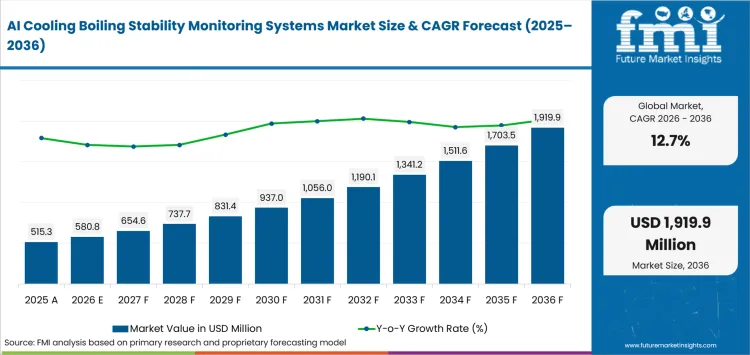
Key Takeaways of Ai Cooling Boiling Stability Monitoring Systems Market
- High-density AI racks increase the cost of unstable coolant flow and temperature, making rack-level telemetry part of commissioning and uptime protection.
- Based on cooling architecture, direct-to-chip liquid cooling is projected to account for 44.0% in 2026 due to cold plates placing sensors nearest the main chip heat path.
- Dry coolers are likely to capture 29.0% share in 2026 attributable to warmer facility-water operation extending economizer hours in suitable climates.
- In 2026, the 251-500 kW band is expected to lead rack density with 34.0% share because concentrated loads require faster flow and pressure control.
- Fluid compatibility and control-interface qualification lengthen engineering review because alarm thresholds must match the selected cooling architecture and existing facility systems.
- Some of the key players in this market include Accelsius, ZutaCore, Parker Hannifin Corporation, The Chemours Company, Schneider Electric SE, Vertiv Holdings Co, Ecolab Inc., and Trane Technologies plc.
Analyst Perspective
"The purchase decision should start with alarm behavior under realistic load swings instead of the unit price of each sensor. A monitoring package earns its place only if operators can trace faults from rack telemetry into facility controls without losing raw data."
- Nikhil Kaitwade, Principal Consultant, Future Market Insights
How is the AI Cooling Boiling Stability Monitoring Systems Market segmented?
The ai cooling boiling stability monitoring systems market is segmented by cooling architecture, heat rejection - secondary loop, rack density, data center type, route to market and region.
Cooling architecture covers direct-to-chip liquid cooling, rear-door heat exchangers, immersion cooling and hybrid air-liquid systems. Heat rejection covers dry coolers, chillers, cooling towers or evaporative systems, facility water or district interfaces and hybrid systems. Rack density spans below 100 kW through above 500 kW. Data center type covers hyperscale AI, colocation AI, enterprise AI or HPC and research or sovereign compute. Route to market covers cooling OEM direct, MEP or EPC integrators, server or rack OEM bundles and service or retrofit channels.
What makes Direct-to-chip liquid Cooling central to the Cooling Architecture category?
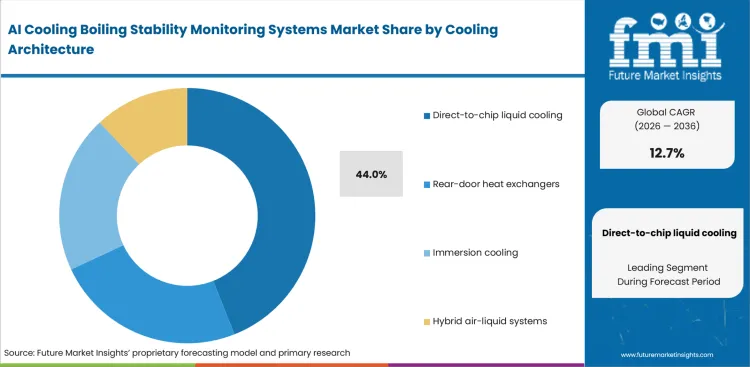
Direct-to-chip systems place flow and temperature measurement near the accelerator heat source so controls can react to abrupt load changes. In March 2026, ZutaCore introduced HyperCool Cloud with near-real-time CDU telemetry and fleet-level alarm workflows. The announcement links direct-to-chip cooling hardware with operating data that separates load-driven thermal swings from faults.
- Direct-to-chip liquid cooling is projected to hold 44.0% share in 2026 owing to cold plates exposing temperature and pressure changes before room sensors register them.
- Cooling teams qualify alarms against server load swings and coolant behavior so normal two-phase boiling does not trigger unnecessary intervention.
Why do Dry Coolers lead the heat rejection - Secondary Loop category?
Dry coolers gain value once chip-side systems tolerate warmer facility water without losing the required thermal margin. Accelsius documented in July 2026 that NeuCool matched single-phase performance at 54°C facility water during roughly 40,000 operating points. Facility engineers use that warm-water envelope to test control behavior before extending economizer operation.
- The heat rejection - secondary loop category is forecast to be led by dry coolers at 29.0% share in 2026 due to warmer facility water extending compressor-free operation in suitable climates.
- Rack supply monitoring must respect data center chillers and dry-cooler limits so warmer facility water does not hide local flow instability.
How does 251-500 kW define the Rack Density category?
At 251-500 kW the protection problem shifts from room observability toward fast control of concentrated compute loads. ZutaCore launched 1.2 MW and 2 MW end-of-row CDUs in November 2025 with rack-level monitoring for multiple liquid-cooled racks. Shared row control reduces duplicated hardware but each rack still needs enough telemetry to isolate a fault.
- By rack density, the 251-500 kW segment is forecast to represent 34.0% in 2026 driven by larger accelerator capacity behind each rack-level thermal circuit.
- Shared CDUs reduce duplicated equipment while per-rack monitoring preserves fault isolation within dense rack server infrastructure rows during a common loop event.
What supports Hyperscale AI within the Data Center Type category?
Hyperscale operators repeat cooling designs over many racks, so common telemetry and control interfaces become a fleet requirement. Schneider Electric announced integrated power and liquid-cooling controls in September 2025 for NVIDIA Mission Control. Its GB300 NVL72 reference design supports rack density up to 142 kW and gives engineering teams a tested baseline before repeated deployment.
- Hyperscale AI is likely to capture 48.0% share in 2026 attributable to standardized controls simplifying repeated deployment and fault handling.
- Reference designs give engineering teams tested interfaces between cooling controls and AI server chassis before the same architecture is repeated at campus scale.
What are the drivers, restraints and opportunities in the AI Cooling Boiling Stability Monitoring Systems Market?
Higher rack power increases the cost of thermal excursions, fluid and control qualification slows commissioning, and continuous monitoring extends telemetry into predictive operating control.
- Driver: Higher rack power makes flow or temperature excursions more costly because each monitored loop protects greater accelerator capacity.
- Restraint: Fluid compatibility and control-interface testing extend engineering approval before alarms can be trusted during live operation.
- Opportunity: Continuous commissioning turns cooling telemetry into early fault detection that can reduce manual checks during changing AI workloads.
Higher Rack Power Makes Thermal Excursions More Costly
Rack power is rising faster than room-level monitoring can resolve during abrupt accelerator load changes. Schneider Electric introduced its 2.5 MW Motivair MCDU-70 in January 2026 with centralized controls and real-time monitoring. A larger CDU places more cooling duty behind one control layer, so operators need cooling management systems that isolate flow or pressure drift before compute throttles.
Fluid and Control Qualification Extends Engineering Review
Alarm thresholds depend on the fluid properties and server configuration that each monitoring scheme is intended to protect. Chemours and 2CRSi signed a joint development agreement in February 2026 after Opteon fluid qualification in current-generation servers. Server-level qualification makes fluid choice an engineering gate for immersion cooling systems and two-phase direct-to-chip monitoring before commissioning.
Continuous Commissioning Turns Telemetry into Operating Value
Monitoring earns operating value if telemetry continues after acceptance testing and follows fluid condition during normal operation. Vertiv introduced PurgeRite NearZero in June 2026 with continuous water-quality monitoring during closed-loop hydronic commissioning. Continuous water-quality data gives infrastructure management platforms an earlier signal of facility-side drift before rack controls reach protective limits.
Which country CAGRs are profiled in the AI Cooling Boiling Stability Monitoring Systems Market?
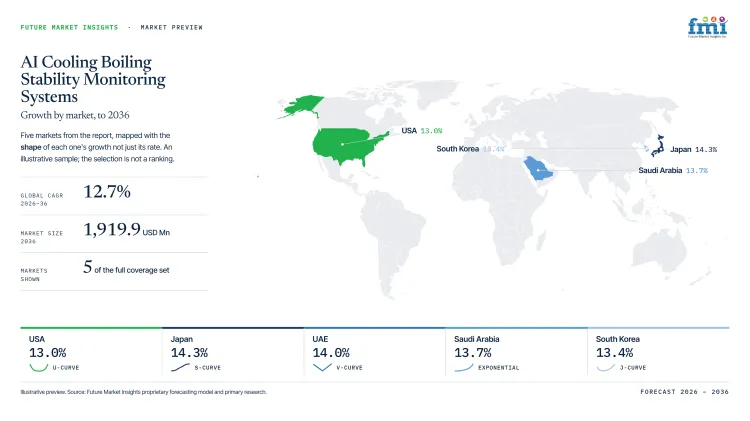
| Country | CAGR |
|---|---|
| Japan | 14.3% |
| United Arab Emirates | 14.0% |
| Saudi Arabia | 13.7% |
| South Korea | 13.4% |
| United States | 13.0% |
How do country-level CAGRs compare in the AI Cooling Boiling Stability Monitoring Systems Market?
The five country forecasts span 1.3 percentage points from Japan at 14.3% to the United States at 13.0%. Japan and the United Arab Emirates form the upper band because greenfield capacity can specify monitoring before installation. Saudi Arabia and South Korea follow while the United States carries greater retrofit exposure.
- Japan ties data-center locations to power planning that requires early cooling-control qualification.
- United Arab Emirates campuses specify thermal telemetry before each phased rack deployment begins.
- Saudi Arabia needs repeatable alarm logic while developers commission new AI capacity.
- South Korea uses modular diagnostics as public compute expands beyond established hubs.
- The United States values open interfaces during data center retrofits involving mixed equipment generations.
Those differences change alarm design, service needs, and purchase specifications across national markets. The full report provides country-level CAGR analysis across North America, Latin America, Europe, East Asia, South Asia, Oceania and the Middle East and Africa.
Country-wise Analysis
- Japanese data-center planning ties proposed sites to electricity and telecommunications capacity before developers finalize cooling layouts for hyperscale AI projects. Adoption of ai cooling boiling stability monitoring systems in Japan is estimated to expand at 14.3% CAGR through 2036 owing to coordinated site planning and formal qualification. METI published Watt-Bit Collaboration Report 1.0 in June 2025 to coordinate power and telecom infrastructure for future data centers before connection bottlenecks delay construction. Long grid-connection lead times remain the local friction for planned hyperscale facilities during early site development. Cooling providers therefore need documented control interfaces and local commissioning support before monitoring becomes part of repeatable Japanese facility designs.
- Greenfield AI campuses in the United Arab Emirates let engineering teams define rack telemetry while facility loops are still being designed. Abu Dhabi Media Office announced Stargate UAE in May 2025 within a 5 GW UAE-US AI campus and said its first 200 MW cluster is expected during 2026. Demand for ai cooling boiling stability monitoring systems is forecast to rise at 14.0% CAGR through 2036 reflecting this clean-sheet capacity pipeline. The friction is consistency during phased commissioning because alarm hierarchies must work from the first cluster onward. Central diagnostics therefore become more valuable as each new cluster joins the operating campus.
- Saudi Arabia is moving from a small operating base toward a multi-operator data-center market that needs common commissioning practices for dense liquid loops. Saudi Press Agency stated in April 2026 that operational capacity exceeded 440 MW during 2025 and more than 60 data centers were active nationwide. Local service depth has to expand with the project pipeline because uneven troubleshooting skills can delay alarm validation during handover between different operators. The Saudi market is projected to record 13.7% CAGR through 2036 helped by rapid capacity additions and expanding AI infrastructure. Local commissioning depth limits how quickly rapid construction converts into stable monitored operations.
- South Korea is expanding public AI compute while national policy addresses the power supply and site allocation needed for capacity outside Seoul. Demand is projected to advance at 13.4% CAGR through 2036 tied to distributed compute programs that require comparable thermal controls at multiple facilities. MSIT stated in February 2025 that the government aimed to secure 18,000 advanced GPUs by the first half of 2026 for national AI infrastructure. Power-system impact and site allocation remain practical frictions for operators placing new capacity outside established hubs. Modular remote diagnostics fit this dispersed build pattern better than site-specific control stacks that require separate commissioning logic.
- United States operators must integrate new liquid cooling beside large installed fleets that use different controls and commissioning practices at rack and facility levels. DOE selected four federal sites in July 2025 for proposed AI data-center and power infrastructure development, providing a greenfield route beside the retrofit base. The United States is estimated to post 13.0% CAGR through 2036 because both project types need instrumentation that can enter existing operations without duplicating alarms. Mature sites face an interoperability constraint caused by legacy alarm logic that varies between equipment generations. Maintenance teams evaluate open telemetry during staged commissioning so fault tracing remains visible across equipment generations.
Who are the notable companies in the AI Cooling Boiling Stability Monitoring Systems Market?
Accelsius, ZutaCore, Parker Hannifin Corporation, The Chemours Company, Schneider Electric SE, Vertiv Holdings Co, Ecolab Inc., and Trane Technologies plc are the notable companies serving this market.
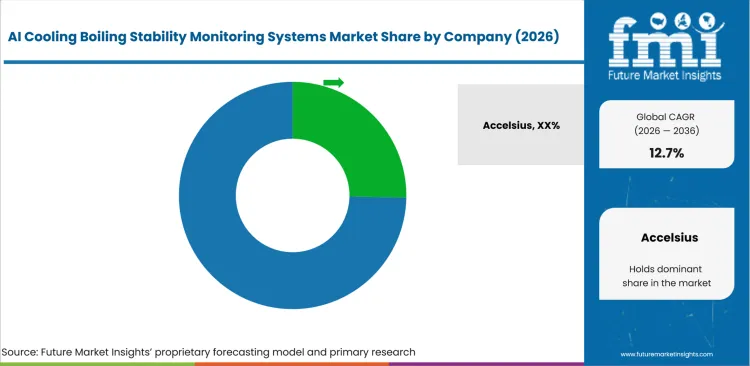
Competition includes two-phase platforms and facility controls alongside sensing components and thermal-fluid portfolios that require different proof at purchase. Entry barriers exceed sensor availability because operators expect server-level evidence and loop-level qualification. Field service also matters because commissioning interfaces must expose usable data without duplicating alarms.
- Integrated cooling and controls: Accelsius, ZutaCore, Schneider Electric SE and Vertiv Holdings Co pair liquid-cooling hardware with monitoring or control functions.
- Instrumentation and fluid qualification: Parker Hannifin Corporation and The Chemours Company address sensing or dielectric-fluid qualification around liquid loops.
- Full-stack expansion: Ecolab Inc. and Trane Technologies plc entered direct liquid cooling via 2026 acquisitions that extend existing facility-service positions.
Competitive Benchmarking: AI Cooling Boiling Stability Monitoring Systems Market
| Company | Real-Time Cooling Telemetry | Liquid-Loop Control Integration | High-Density Qualification Depth | Geographic Reach |
|---|---|---|---|---|
| Accelsius | High | High | High | North America and selected international deployments |
| ZutaCore | High | High | High | Americas, Europe and Asia |
| Parker Hannifin Corporation | Medium | Medium | Medium | Global |
| The Chemours Company | Low | Low | High | Global |
| Schneider Electric SE | High | High | High | Global |
| Vertiv Holdings Co | High | High | High | Global |
| Ecolab Inc. | Medium | Medium | High | Global |
| Trane Technologies plc | Medium | High | High | Global |
Scoring basis: High telemetry requires real-time monitoring at multiple cooling layers while Medium indicates one principal loop layer and Low indicates a narrow measurement role. High control integration reaches rack-to-facility operation while Medium covers one loop interface and Low denotes upstream participation. High qualification requires multiple validated high-density routes while Medium requires one route and Low denotes limited qualification depth. Geographic reach records regions where official company evidence confirms current cooling operations or deployments for each company.
Key Developments in the AI Cooling Boiling Stability Monitoring Systems Market
- In July 2026, Ecolab Inc. closed its acquisition of CoolIT Systems and placed direct liquid-cooling hardware beside its fluid-management and digital-monitoring services.
- In May 2026, Vertiv Holdings Co expanded its EMEA liquid-cooling portfolio with the CoolChip CDU 2300 and Fluid Network Row Manifolds for high-density deployments.
- In April 2026, Accelsius announced general availability of the NeuCool IR150 and launched HyperStart to support structured validation of two-phase direct-to-chip cooling.
Key Players in the AI Cooling Boiling Stability Monitoring Systems Market
Integrated Liquid-Cooling and Stability Platforms
- Accelsius
- ZutaCore
Instrumentation and Fluid Qualification
- Parker Hannifin Corporation
- The Chemours Company
Facility Control and Thermal Platforms
- Schneider Electric SE
- Vertiv Holdings Co
Expanded Thermal-Management Platforms
- Ecolab Inc.
- Trane Technologies plc
AI Cooling Boiling Stability Monitoring Systems Market - Report Scope
| Coverage field | Report scope |
|---|---|
| Market breakdown | By cooling architecture, heat rejection - secondary loop, rack density, data center type, route to market and region. |
| Quantitative Units | USD million. |
| Market Definition | Revenue from purpose-built sensors, controllers, instrumented monitoring modules, telemetry software and stability analytics that keep AI cooling loops inside validated thermal and hydrodynamic limits. |
| Regions Covered | North America, Latin America, Europe, East Asia, South Asia and Pacific, and Middle East and Africa. |
| Countries Covered | Japan, United Arab Emirates, Saudi Arabia, South Korea, United States, and 20+ countries included in the full report. |
| Key Companies Profiled | Accelsius, ZutaCore, Parker Hannifin Corporation, The Chemours Company, Schneider Electric SE, Vertiv Holdings Co, Ecolab Inc., Trane Technologies plc. |
| Forecast Period | 2026 to 2036. |
| Approach | Primary and secondary research with market triangulation. |
AI Cooling Boiling Stability Monitoring Systems Market - Research Methodology
| Method | Approach |
|---|---|
| Primary Research | FMI analysts gathered input from manufacturers, service providers, technology developers, distributors, end users, procurement teams, and subject-matter experts. Interviews examined purchasing decisions, product or service evaluation, adoption barriers, approval requirements, pricing considerations, and expectations for technical or commercial support. Respondents were also asked what evidence is required before a trial, pilot, or initial order develops into regular purchasing. |
| Desk Research | Desk research covered government statistics, regulatory publications, trade data, industry associations, technical literature, standards, company filings, product information, and official corporate announcements. Sources were reviewed for relevance, publication date, geographic coverage, and consistency with the defined market scope. Claims relating to performance, applications, approvals, capacity, investment, and commercial activity were retained only when supported by credible public evidence. |
| Market Sizing and Forecasting | The market model combined the baseline value with historical performance, segment structure, pricing and volume indicators, adoption levels, company participation, and country-level demand conditions. Forecast assumptions considered economic activity, investment trends, regulatory developments, technology adoption, purchasing cycles, supply availability, and barriers to wider market use. Segment and regional estimates were reconciled before the final market total was calculated. |
| Data Validation | Estimates were checked against multiple independent indicators, including public data, company activity, trade patterns, industry developments, and findings from primary interviews. Validation also tested whether products, services, applications, and company revenues fell within the defined market boundaries. Adjacent categories, unsupported claims, overlapping revenues, and activities without direct market relevance were excluded to reduce double counting and maintain consistency across segments and countries. |
AI Cooling Boiling Stability Monitoring Systems Market by Segments
AI Cooling Boiling Stability Monitoring Systems Market segmented by Cooling Architecture:
- Direct-to-Chip Liquid Cooling
- Rear-Door Heat Exchangers
- Immersion Cooling
- Hybrid Air-Liquid Systems
AI Cooling Boiling Stability Monitoring Systems Market segmented by Heat Rejection - secondary Loop:
- Dry Coolers
- Chillers
- Cooling Towers / Evaporative
- Facility Water Loop / District Interface
- Hybrid Systems
AI Cooling Boiling Stability Monitoring Systems Market segmented by Rack Density:
- 251-500 kW
- 100-250 kW
- Below 100 kW
- Above 500 kW
AI Cooling Boiling Stability Monitoring Systems Market segmented by Data Center Type:
- Hyperscale AI
- Colocation AI
- Enterprise AI/HPC
- Research / Sovereign Compute
AI Cooling Boiling Stability Monitoring Systems Market segmented by Route to Market:
- Cooling OEM Direct
- MEP / EPC Integrator
- Server / Rack OEM Bundle
- Service & Retrofit Channel
AI Cooling Boiling Stability Monitoring Systems Market by Region:
- North America
- United States
- Canada
- Latin America
- Brazil
- Mexico
- Chile
- Rest of Latin America
- Western Europe
- Germany
- United Kingdom
- Italy
- Spain
- France
- Nordics
- Benelux
- Rest of Western Europe
- Eastern Europe
- Russia
- Poland
- Hungary
- Balkan and Baltic States
- Rest of Eastern Europe
- East Asia
- China
- Japan
- South Korea
- South Asia and Pacific
- India
- ASEAN
- Australia and New Zealand
- Rest of South Asia and Pacific
- Middle East and Africa
- Kingdom of Saudi Arabia
- Other GCC Countries
- Türkiye
- South Africa
- Other African Union Countries
- Rest of Middle East and Africa
Research Sources and Bibliography
- International Energy Agency. (2025, April 10). Energy and AI
- Lawrence Berkeley National Laboratory. (2026, June). United States Data Center Energy Usage Report: 2025 Update
- ZutaCore. (2026, March 16). Announcing ZutaCore OmniTherm™ for the NVIDIA RTX PRO™ 6000 Blackwell Server Edition
- Accelsius. (2026, July 21). Independent Benchmarks Show Accelsius Two-Phase Direct-to-Chip Cooling Delivers 9°C Lower NVIDIA B200 Junction Temperatures Than Single-Phase in Warm-Water Conditions
- ZutaCore. (2025, November 12). ZutaCore Unveils Waterless End-of-Row CDU Family to Power the Next Generation of AI Data Centers
- Schneider Electric. (2025, September 18). Schneider Electric Announces New Reference Designs, Featuring Integrated Power Management and Liquid Cooling Controls, Supporting NVIDIA Mission Control and NVIDIA GB300 NVL72
- Schneider Electric. (2026, January 21). Motivair by Schneider Electric Announces New CDU with Capability to Scale to 10MW and Beyond for Next-Gen AI Factories
- The Chemours Company. (2026, February 24). Following Successful Fluid Qualification Chemours & 2CRSi Join Forces to Accelerate Deployment of Two-Phase Liquid Cooling for High-Density Servers & IT Equipment
- Vertiv. (2026, June 3). Vertiv launches Vertiv™ PurgeRite™ NearZero™ service
- Ministry of Economy, Trade and Industry. (2025, June 12). Report 1.0 of the Public-Private Advisory Council on Watt-Bit Collaboration Published
- Abu Dhabi Media Office. (2025, May 22). Global Tech Alliance Launches Stargate UAE
- Saudi Press Agency. (2026, April 27). Saudi Arabia Strengthens Its Global Position in Artificial Intelligence Through Data Center Growth and Accelerated Smart Manufacturing
- Ministry of Science and ICT. (2025, February 20). Korea to Expand AI Computing Infrastructure to Strengthen National AI Capabilities and Achieve Global Leadership
- USA Department of Energy. (2025, July 24). DOE Announces Site Selection for AI Data Center and Energy Infrastructure Development on Federal Lands
- Open Compute Project. (2025, February 14). Pumped 2P Refrigerant-Based Direct Liquid Cooling (DLC) Technology for Next Generation AI Clusters with High TDP Accelerators
- Ecolab Inc. (2026, July 2). Ecolab Closes CoolIT Acquisition and Expands AI Cooling Platform as Global High Tech Business Targets $4 Billion by 2030
- Vertiv. (2026, May 26). Vertiv Expands Liquid Cooling Portfolio in EMEA to Accelerate AI-Ready Data Centre Deployments
- Accelsius. (2026, April 20). Accelsius Announces General Availability of NeuCool IR150 and Launches NeuCool HyperStart Program at Data Center World 2026
- The Chemours Company. (2025, May 19). Chemours and DataVolt Announce Agreement to Accelerate Adoption of Liquid Cooling Solutions & Support Broader Innovation for Future-Ready AI Data Centers
- ZutaCore. (2025, February 28). SoftBank Corp., ZutaCore and Foxconn Collaborate on Design and Development of Rack-Integrated Solution
- Accelsius. (2025, November 17). DarkNX Enters Agreement with Accelsius to Deploy 300MW NeuCool-Enabled AI Data Center Campus in Ontario
- Hon Hai Technology Group. (2026, June 15). Hon Hai Technology Group (Foxconn) and Schneider Electric in Strategic Collaboration to Accelerate Next-Generation AI Data Centers
- Vertiv. (2026, July 23). Vertiv Infrastructure Helps Bring NVIDIA AI Computing Capability to the Naval Postgraduate School
- Trane Technologies plc. (2026, March 3). Trane Technologies Completes Acquisition of LiquidStack
- Trane Technologies plc. (2026, March 16). Trane Technologies Optimizes Industry-First Thermal Management Reference Design for AI Factories, Introduces Two New Designs
- Munters Group AB. (2025, March 6). Munters Advances Data Center Cooling Portfolio with LCX Liquid-to-Liquid Coolant Distribution Units
- Carrier Global Corporation. (2025, February 18). Carrier Announces Investment in Thermal Solutions Provider ZutaCore, Advancing the Development of Next-Gen Data Center Cooling Solutions
This bibliography is provided for reader reference and is not exhaustive. The full report contains the complete reference list and detailed citations
This Report Answers
- How large is the market through 2036?
- What is increasing thermal monitoring demand?
- Why does direct-to-chip liquid cooling lead?
- How does 251-500 kW change monitoring?
- Which profiled countries grow fastest?
- Which qualification issues slow commissioning?
- How do major companies differ?
- Where does continuous telemetry earn value?
Frequently Asked Questions
How big is the AI Cooling Boiling Stability Monitoring Systems Market in 2026?
The ai cooling boiling stability monitoring systems market is valued at USD 580.8 million in 2026 and is projected to reach USD 1,919.9 million by 2036. Growth is driven by denser AI racks requiring faster thermal and flow visibility near liquid-cooling loops.
What is the CAGR of the AI Cooling Boiling Stability Monitoring Systems Market from 2026 to 2036?
The ai cooling boiling stability monitoring systems market is projected to grow at a CAGR of 12.7% between 2026 and 2036. Expansion is supported by higher rack power that raises the monitoring burden on each cooling loop.
Which cooling architecture leads the AI Cooling Boiling Stability Monitoring Systems Market?
The direct-to-chip liquid cooling segment is expected to hold 44.0% of the ai cooling boiling stability monitoring systems market in 2026, driven by cold plates placing sensors near chip heat. Shorter detection paths help controllers react before room sensors register thermal excursions.
Which data center type leads the AI Cooling Boiling Stability Monitoring Systems Market?
The hyperscale AI segment is expected to hold 48.0% of the ai cooling boiling stability monitoring systems market in 2026, supported by rack designs that use standardized telemetry and controls. Common control interfaces simplify fleet commissioning and remote fault handling at large sites.
Which countries are projected to record the highest growth in the AI Cooling Boiling Stability Monitoring Systems Market?
Japan is projected to grow at 14.3% CAGR, followed by the United Arab Emirates at 14.0% and Saudi Arabia at 13.7% through 2036. Growth is supported by greenfield AI campuses that specify instrumented liquid cooling during initial facility design.
Which companies are active in the AI Cooling Boiling Stability Monitoring Systems Market?
Key companies operating in the ai cooling boiling stability monitoring systems market include Accelsius, ZutaCore, Parker Hannifin Corporation, The Chemours Company, Schneider Electric SE, Vertiv Holdings Co, Ecolab Inc., and Trane Technologies plc. Their portfolios cover cooling hardware, controls and fluid management for AI facilities.
Preview the report firsthand - request a free sample
Get SampleGet the brochure for pricing and purchase details.
Get PDFTable of Content
- Key Takeaways
- Market Size and CAGR
- Top Growth Driver
- Fastest Growing Segment
- Leading Region
- Key Companies
- Emerging Opportunities
- Executive Summary
- Global Market Outlook
- Demand-side Trends
- Supply-side Trends
- Technology Roadmap Analysis
- Analysis and Recommendations
- Analyst Perspective (What is happening? Why now? What should investors know?)
- Key Questions Answered
- How large is the market?
- What is the CAGR?
- What are key trends?
- Which region dominates?
- Who are the leaders?
- Market Overview
- Market Coverage / Taxonomy
- Market Definition / Scope / Limitations
- Research Methodology
- Chapter Orientation
- Analytical Lens and Working Hypotheses
- Market Structure, Signals, and Trend Drivers
- Benchmarking and Cross-market Comparability
- Market Sizing, Forecasting, and Opportunity Mapping
- Research Design and Evidence Framework
- Desk Research Programme (Secondary Evidence)
- Expert Input and Fieldwork (Primary Evidence)
- Tooling, Models, and Reference Databases
- Data Engineering and Model Build
- Quality Assurance and Audit Trail
- Market Background
- Market Dynamics (Drivers, Restraints, Opportunity, Trends)
- Scenario Forecast (Optimistic, Likely, Conservative)
- Impact Analysis
- AI Impact
- Sustainability Impact
- Regulatory Impact
- Technology Impact
- Consumer / Buyer Analysis
- Purchase Drivers
- Adoption Barriers
- Buyer Journey
- Opportunity Map Analysis
- Product Life Cycle Analysis
- Supply Chain Analysis
- Investment Feasibility Matrix
- Value Chain Analysis
- PESTLE and Porter's Analysis
- Regulatory Landscape
- Regional Parent Market Outlook
- Production and Consumption Statistics
- Import and Export Statistics
- Global Market Analysis and Forecast, 2021 to 2036
- Historical Market Size Value (USD Million) Analysis, 2021 to 2025
- Current and Future Market Size Value (USD Million) Projections, 2026 to 2036
- Y-o-Y Growth Trend Analysis
- Absolute $ Opportunity Analysis
- Global Market Pricing Analysis, 2021 to 2036
- Global Market Analysis and Forecast, By Cooling Architecture, 2021 to 2036
- Introduction / Key Findings
- Historical Market Size Value (USD Million) Analysis By Cooling Architecture, 2021 to 2025
- Current and Future Market Size Value (USD Million) Analysis and Forecast By Cooling Architecture, 2026 to 2036
- Direct-to-chip liquid cooling
- Rear-door heat exchangers
- Immersion cooling
- Hybrid air-liquid systems
- Direct-to-chip liquid cooling
- Y-o-Y Growth Trend Analysis By Cooling Architecture, 2021 to 2025
- Absolute $ Opportunity Analysis By Cooling Architecture, 2026 to 2036
- Global Market Analysis and Forecast, By Heat Rejection / Secondary Loop, 2021 to 2036
- Introduction / Key Findings
- Historical Market Size Value (USD Million) Analysis By Heat Rejection / Secondary Loop, 2021 to 2025
- Current and Future Market Size Value (USD Million) Analysis and Forecast By Heat Rejection / Secondary Loop, 2026 to 2036
- Dry coolers
- Chillers
- Cooling towers / evaporative
- Facility water loop / district interface
- Hybrid systems
- Dry coolers
- Y-o-Y Growth Trend Analysis By Heat Rejection / Secondary Loop, 2021 to 2025
- Absolute $ Opportunity Analysis By Heat Rejection / Secondary Loop, 2026 to 2036
- Global Market Analysis and Forecast, By Rack Density, 2021 to 2036
- Introduction / Key Findings
- Historical Market Size Value (USD Million) Analysis By Rack Density, 2021 to 2025
- Current and Future Market Size Value (USD Million) Analysis and Forecast By Rack Density, 2026 to 2036
- 251-500 kW
- 100-250 kW
- Below 100 kW
- Above 500 kW
- 251-500 kW
- Y-o-Y Growth Trend Analysis By Rack Density, 2021 to 2025
- Absolute $ Opportunity Analysis By Rack Density, 2026 to 2036
- Global Market Analysis and Forecast, By Data Center Type, 2021 to 2036
- Introduction / Key Findings
- Historical Market Size Value (USD Million) Analysis By Data Center Type, 2021 to 2025
- Current and Future Market Size Value (USD Million) Analysis and Forecast By Data Center Type, 2026 to 2036
- Hyperscale AI
- Colocation AI
- Enterprise AI/HPC
- Research / sovereign compute
- Hyperscale AI
- Y-o-Y Growth Trend Analysis By Data Center Type, 2021 to 2025
- Absolute $ Opportunity Analysis By Data Center Type, 2026 to 2036
- Global Market Analysis and Forecast, By Route to Market, 2021 to 2036
- Introduction / Key Findings
- Historical Market Size Value (USD Million) Analysis By Route to Market, 2021 to 2025
- Current and Future Market Size Value (USD Million) Analysis and Forecast By Route to Market, 2026 to 2036
- Cooling OEM direct
- MEP / EPC integrator
- Server / rack OEM bundle
- Service & retrofit channel
- Cooling OEM direct
- Y-o-Y Growth Trend Analysis By Route to Market, 2021 to 2025
- Absolute $ Opportunity Analysis By Route to Market, 2026 to 2036
- Global Market Analysis and Forecast, By Region, 2021 to 2036
- Introduction
- Historical Market Size Value (USD Million) Analysis By Region, 2021 to 2025
- Current Market Size Value (USD Million) Analysis and Forecast By Region, 2026 to 2036
- North America
- Latin America
- Western Europe
- Eastern Europe
- East Asia
- South Asia and Pacific
- Middle East & Africa
- Market Attractiveness Analysis By Region
- North America Market Analysis and Forecast, By Country, 2021 to 2036
- Historical Market Size Value (USD Million) Trend Analysis By Market Taxonomy, 2021 to 2025
- Market Size Value (USD Million) Forecast By Market Taxonomy, 2026 to 2036
- By Country
- USA
- Canada
- By Cooling Architecture
- By Heat Rejection / Secondary Loop
- By Rack Density
- By Data Center Type
- By Route to Market
- By Country
- Market Attractiveness Analysis
- By Country
- By Cooling Architecture
- By Heat Rejection / Secondary Loop
- By Rack Density
- By Data Center Type
- By Route to Market
- Key Takeaways
- Latin America Market Analysis and Forecast, By Country
- Historical Market Size Value (USD Million) Trend Analysis By Market Taxonomy, 2021 to 2025
- Market Size Value (USD Million) Forecast By Market Taxonomy, 2026 to 2036
- By Country
- Brazil
- Mexico
- Chile
- Rest of Latin America
- By Cooling Architecture
- By Heat Rejection / Secondary Loop
- By Rack Density
- By Data Center Type
- By Route to Market
- By Country
- Market Attractiveness Analysis
- By Country
- By Cooling Architecture
- By Heat Rejection / Secondary Loop
- By Rack Density
- By Data Center Type
- By Route to Market
- Key Takeaways
- Western Europe Market Analysis and Forecast, By Country
- Historical Market Size Value (USD Million) Trend Analysis By Market Taxonomy, 2021 to 2025
- Market Size Value (USD Million) Forecast By Market Taxonomy, 2026 to 2036
- By Country
- Germany
- UK
- Italy
- Spain
- France
- Nordic
- BENELUX
- Rest of Western Europe
- By Cooling Architecture
- By Heat Rejection / Secondary Loop
- By Rack Density
- By Data Center Type
- By Route to Market
- By Country
- Market Attractiveness Analysis
- By Country
- By Cooling Architecture
- By Heat Rejection / Secondary Loop
- By Rack Density
- By Data Center Type
- By Route to Market
- Key Takeaways
- Eastern Europe Market Analysis and Forecast, By Country
- Historical Market Size Value (USD Million) Trend Analysis By Market Taxonomy, 2021 to 2025
- Market Size Value (USD Million) Forecast By Market Taxonomy, 2026 to 2036
- By Country
- Russia
- Poland
- Hungary
- Balkan & Baltic
- Rest of Eastern Europe
- By Cooling Architecture
- By Heat Rejection / Secondary Loop
- By Rack Density
- By Data Center Type
- By Route to Market
- By Country
- Market Attractiveness Analysis
- By Country
- By Cooling Architecture
- By Heat Rejection / Secondary Loop
- By Rack Density
- By Data Center Type
- By Route to Market
- Key Takeaways
- East Asia Market Analysis and Forecast, By Country
- Historical Market Size Value (USD Million) Trend Analysis By Market Taxonomy, 2021 to 2025
- Market Size Value (USD Million) Forecast By Market Taxonomy, 2026 to 2036
- By Country
- China
- Japan
- South Korea
- By Cooling Architecture
- By Heat Rejection / Secondary Loop
- By Rack Density
- By Data Center Type
- By Route to Market
- By Country
- Market Attractiveness Analysis
- By Country
- By Cooling Architecture
- By Heat Rejection / Secondary Loop
- By Rack Density
- By Data Center Type
- By Route to Market
- Key Takeaways
- South Asia and Pacific Market Analysis and Forecast, By Country
- Historical Market Size Value (USD Million) Trend Analysis By Market Taxonomy, 2021 to 2025
- Market Size Value (USD Million) Forecast By Market Taxonomy, 2026 to 2036
- By Country
- India
- ASEAN
- Australia & New Zealand
- Rest of South Asia and Pacific
- By Cooling Architecture
- By Heat Rejection / Secondary Loop
- By Rack Density
- By Data Center Type
- By Route to Market
- By Country
- Market Attractiveness Analysis
- By Country
- By Cooling Architecture
- By Heat Rejection / Secondary Loop
- By Rack Density
- By Data Center Type
- By Route to Market
- Key Takeaways
- Middle East & Africa Market Analysis and Forecast, By Country
- Historical Market Size Value (USD Million) Trend Analysis By Market Taxonomy, 2021 to 2025
- Market Size Value (USD Million) Forecast By Market Taxonomy, 2026 to 2036
- By Country
- Kingdom of Saudi Arabia
- Other GCC Countries
- Türkiye
- South Africa
- Other African Union
- Rest of Middle East & Africa
- By Cooling Architecture
- By Heat Rejection / Secondary Loop
- By Rack Density
- By Data Center Type
- By Route to Market
- By Country
- Market Attractiveness Analysis
- By Country
- By Cooling Architecture
- By Heat Rejection / Secondary Loop
- By Rack Density
- By Data Center Type
- By Route to Market
- Key Takeaways
- Key Countries Market Analysis
- USA
- Pricing Analysis
- Market Share Analysis, 2025
- By Cooling Architecture
- By Heat Rejection / Secondary Loop
- By Rack Density
- By Data Center Type
- By Route to Market
- Canada
- Pricing Analysis
- Market Share Analysis, 2025
- By Cooling Architecture
- By Heat Rejection / Secondary Loop
- By Rack Density
- By Data Center Type
- By Route to Market
- Mexico
- Pricing Analysis
- Market Share Analysis, 2025
- By Cooling Architecture
- By Heat Rejection / Secondary Loop
- By Rack Density
- By Data Center Type
- By Route to Market
- Brazil
- Pricing Analysis
- Market Share Analysis, 2025
- By Cooling Architecture
- By Heat Rejection / Secondary Loop
- By Rack Density
- By Data Center Type
- By Route to Market
- Chile
- Pricing Analysis
- Market Share Analysis, 2025
- By Cooling Architecture
- By Heat Rejection / Secondary Loop
- By Rack Density
- By Data Center Type
- By Route to Market
- Germany
- Pricing Analysis
- Market Share Analysis, 2025
- By Cooling Architecture
- By Heat Rejection / Secondary Loop
- By Rack Density
- By Data Center Type
- By Route to Market
- UK
- Pricing Analysis
- Market Share Analysis, 2025
- By Cooling Architecture
- By Heat Rejection / Secondary Loop
- By Rack Density
- By Data Center Type
- By Route to Market
- Italy
- Pricing Analysis
- Market Share Analysis, 2025
- By Cooling Architecture
- By Heat Rejection / Secondary Loop
- By Rack Density
- By Data Center Type
- By Route to Market
- Spain
- Pricing Analysis
- Market Share Analysis, 2025
- By Cooling Architecture
- By Heat Rejection / Secondary Loop
- By Rack Density
- By Data Center Type
- By Route to Market
- France
- Pricing Analysis
- Market Share Analysis, 2025
- By Cooling Architecture
- By Heat Rejection / Secondary Loop
- By Rack Density
- By Data Center Type
- By Route to Market
- India
- Pricing Analysis
- Market Share Analysis, 2025
- By Cooling Architecture
- By Heat Rejection / Secondary Loop
- By Rack Density
- By Data Center Type
- By Route to Market
- ASEAN
- Pricing Analysis
- Market Share Analysis, 2025
- By Cooling Architecture
- By Heat Rejection / Secondary Loop
- By Rack Density
- By Data Center Type
- By Route to Market
- Australia & New Zealand
- Pricing Analysis
- Market Share Analysis, 2025
- By Cooling Architecture
- By Heat Rejection / Secondary Loop
- By Rack Density
- By Data Center Type
- By Route to Market
- China
- Pricing Analysis
- Market Share Analysis, 2025
- By Cooling Architecture
- By Heat Rejection / Secondary Loop
- By Rack Density
- By Data Center Type
- By Route to Market
- Japan
- Pricing Analysis
- Market Share Analysis, 2025
- By Cooling Architecture
- By Heat Rejection / Secondary Loop
- By Rack Density
- By Data Center Type
- By Route to Market
- South Korea
- Pricing Analysis
- Market Share Analysis, 2025
- By Cooling Architecture
- By Heat Rejection / Secondary Loop
- By Rack Density
- By Data Center Type
- By Route to Market
- Russia
- Pricing Analysis
- Market Share Analysis, 2025
- By Cooling Architecture
- By Heat Rejection / Secondary Loop
- By Rack Density
- By Data Center Type
- By Route to Market
- Poland
- Pricing Analysis
- Market Share Analysis, 2025
- By Cooling Architecture
- By Heat Rejection / Secondary Loop
- By Rack Density
- By Data Center Type
- By Route to Market
- Hungary
- Pricing Analysis
- Market Share Analysis, 2025
- By Cooling Architecture
- By Heat Rejection / Secondary Loop
- By Rack Density
- By Data Center Type
- By Route to Market
- Kingdom of Saudi Arabia
- Pricing Analysis
- Market Share Analysis, 2025
- By Cooling Architecture
- By Heat Rejection / Secondary Loop
- By Rack Density
- By Data Center Type
- By Route to Market
- Türkiye
- Pricing Analysis
- Market Share Analysis, 2025
- By Cooling Architecture
- By Heat Rejection / Secondary Loop
- By Rack Density
- By Data Center Type
- By Route to Market
- South Africa
- Pricing Analysis
- Market Share Analysis, 2025
- By Cooling Architecture
- By Heat Rejection / Secondary Loop
- By Rack Density
- By Data Center Type
- By Route to Market
- USA
- Market Structure Analysis
- Competition Dashboard
- Competition Benchmarking
- Market Share Analysis of Top Players
- By Regional
- By Cooling Architecture
- By Heat Rejection / Secondary Loop
- By Rack Density
- By Data Center Type
- By Route to Market
- Emerging Startups
- Innovation Benchmarking
- Competition Analysis
- Competition Deep Dive
- Accelsius
- Overview
- Product Portfolio
- Profitability by Market Segments
- Sales Footprint
- Strategy Overview
- Marketing Strategy
- Product Strategy
- Channel Strategy
- ZutaCore
- Parker Hannifin
- Chemours
- Accelsius
- Case Studies
- Success Stories
- Recent Developments
- Competition Deep Dive
- Assumptions & Acronyms Used


