

- Market Size (2026)
- USD 1120.6 Mn
- Forecast (2036)
- USD 2123.4 Mn
- CAGR (2026 to 2036)
- 6.6%
How big is Bayonet Coupling Connectors Market in 2026?
USD 1120.6 million in 2026 and USD 2123.4 million by 2036 at a 6.6% CAGR.
Demand for bayonet coupling connectors is projected to expand at 6.6% CAGR between 2026 and 2036, increasing valuation from USD 1120.6 million in 2026 to USD 2123.4 million by 2036. Aircraft wiring programs add qualified interfaces as production volume rises and electrical architecture becomes more distributed across platforms. GAMA reported 3,230 airplane shipments for 2025 in February 2026 across its annual industry delivery review. Those deliveries require approved interconnects across avionics and controls throughout every newly built aircraft platform.
Platform engineers select aviation connectors through qualification records and maintainability evidence instead of broad catalog choice. Bayonet coupling supports rapid engagement during line maintenance and environmental sealing limits contamination across vibration-prone installations. Manufacturers that coordinate connector geometry with cable routing can reduce drawing changes during qualification and later replacement.
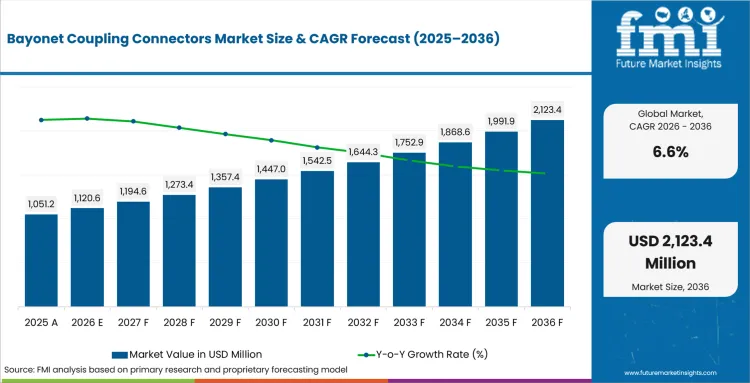
Key Takeaways of Bayonet Coupling Connectors Market
- Aircraft and defense programs require circular interfaces that preserve electrical continuity during vibration and repeated maintenance access.
- MIL-DTL-26482 style is projected to represent 29.0% share in 2026 through established qualification routes and broad insert availability.
- Signal contacts are estimated to account for 39.0% share in 2026 as aircraft platforms add sensing and communication circuits.
- Standard shells are forecast to capture 57.0% share in 2026 owing to familiar panel cutouts that simplify replacement and retrofit work.
- Platform approvals and specialized crimp tooling prolong substitution cycles across installed aircraft and defense systems.
- ITT Cannon, Amphenol, TE Connectivity, Eaton, Glenair, Radiall, Bulgin and Weald Electronics compete through qualified portfolios and regional support.
Analyst Perspective
“Platform teams evaluate bayonet connectors as part of a qualified system that includes compatible backshells and tooling. Manufacturers preserving drawing continuity and shorter replacement lead times can capture repeat orders across programs lasting decades.”
- Sudip saha, Principal Consultant, Future Market Insights
How is the Bayonet Coupling Connectors Market segmented?
The bayonet coupling connectors market is segmented by connector series, contact layout, shell size, application, termination and region.
The market is organized by connector series, contact layout, shell size, application, termination and region. Connector series includes MIL-DTL-26482, MIL-DTL-5015, MIL-DTL-38999 bayonet, industrial and miniature designs, while contact layouts cover signal, power, mixed power/signal and coaxial/RF options. Standard, miniature and heavy-duty shell sizes support aircraft, defense, sensor, rail, marine and test applications, and termination options include crimp, solder, PCB mount and field-wireable designs.
Why does MIL-DTL-26482 style lead the connector series category?
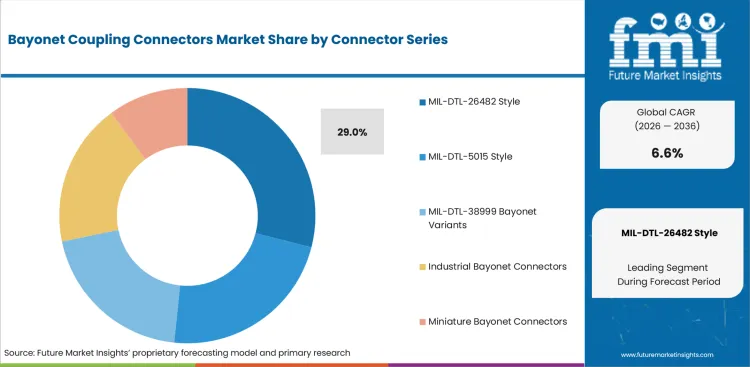
MIL-DTL-26482 style provides a compact bayonet interface for rapid mating and controlled environmental performance across approved panel layouts used in new builds and replacement programs.
- By connector series, MIL-DTL-26482 style is estimated to hold 29.0% in 2026 owing to recognized qualification routes and broad insert availability.
- Regional availability supports repeat adoption across maintenance programs using compatible wire harnesses and established tooling through regional channels. Weald Electronics documented nine shell sizes and two to 61 contact positions in June 2025, reducing redesign work across approved mounting patterns.
Why do signal contacts lead the contact layout category?
Signal contacts carry command and monitoring circuits that require stable low-current transmission during platform vibration. Weald Electronics listed signal and power bayonet configurations in its September 2025 line card, giving engineers one documented family for layout comparisons.
- The signal contacts segment is likely to capture 39.0% share in 2026 attributable to expanding data paths across aircraft control and diagnostic systems.
- Design teams compare contact density against shielding and nearby RF connectors during cable-assembly drawing release. Higher channel counts support added sensing functions without enlarging connector envelopes or changing established equipment panels.
How do standard shells support the shell size category?
Standard shells align with familiar panel cutouts and backshell tooling across long-running aerospace programs, preserving contact access during inspection and field replacement.
- In 2026, standard shells are expected to lead shell size with 57.0% share because familiar mounting dimensions reduce replacement complexity. Weald Electronics expanded compatible sealing and strain-relief options through its LMA backshell catalogue in August 2025.
- Maintenance organizations restore damaged assemblies faster through widely available receptacles and proven crimp tooling across regional service networks. Compatible accessories also reduce enclosure changes during retrofit qualification across depot and field service locations.
What supports aircraft systems within the application category?
Aircraft systems expose connectors to vibration and limited access around avionics racks, requiring secure coupling and repeatable disconnection during scheduled inspections across maintenance cycles.
- The application category is forecast to be led by aircraft systems at 31.0% share in 2026 due to qualified wiring across commercial and defense platforms.
- Engineering teams validate bayonet interfaces alongside aerospace avionics and cable routing during installation drawing release. Consistent connector geometry helps program managers control spare inventories across equipment variants as maintenance crews retain familiar mating and inspection procedures across service locations.
What are the drivers, restraints and opportunities in the Bayonet Coupling Connectors Market?
Driver: Aircraft electrification raises qualified connection counts across distributed power and data networks. Restraint: Platform approvals and specialized assembly tooling prolong substitution cycles. Opportunity: Complete sealing records and regional service support improve repeat purchasing across long-running programs.
- Driver: Higher aircraft electrical content increases qualified connector counts across power distribution and data communication systems.
- Restraint: Platform approvals and specialized assembly tooling delay connector substitutions across installed aircraft and defense fleets.
- Opportunity: Complete sealing records and regional service support improve repeat purchasing throughout long operating programs.
Aircraft electrification expands power and data interfaces across distributed architectures, so engineering groups compare bayonet families with cable routing during final connector selection.
Harsh-environment wiring depends on compatible backshells and approved crimp tooling across maintenance locations, with mismatches requiring new drawings or repeated platform qualification.
Manufacturers improve repeat-order performance by combining sealing evidence with clear assembly instructions and regional stock, reducing installation variation across long service cycles.
Which country CAGRs are profiled in the Bayonet Coupling Connectors Market?
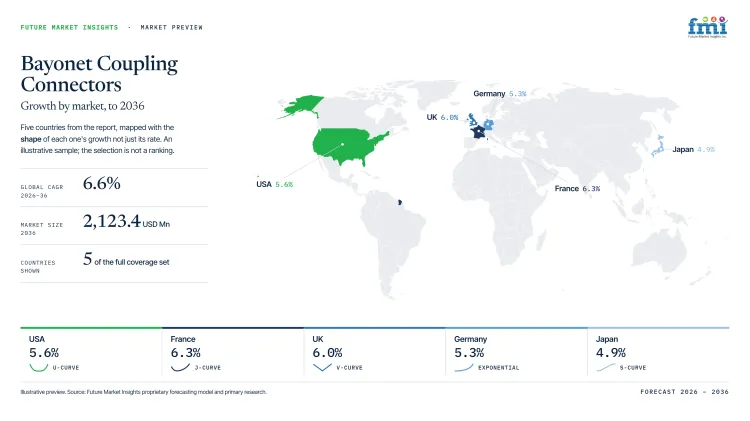
| Country | CAGR |
|---|---|
| France | 6.3% |
| United Kingdom | 6.0% |
| United States | 5.6% |
| Germany | 5.3% |
| Japan | 4.9% |
How do country-level CAGRs compare in the Bayonet Coupling Connectors Market?
The country forecasts remain relatively close across the bayonet coupling connectors market, with only 1.4 percentage points separating France and Japan. The pattern suggests that growth is being driven by increasing requirements for ruggedized connectivity, equipment reliability and harsh-environment performance rather than significant differences in industrial activity.
- France benefits from its established aerospace and defense sectors, where bayonet coupling connectors are widely used in mission-critical electrical systems.
- The United Kingdom supports market expansion through demand from military equipment, transportation infrastructure and industrial automation applications.
- The United States reflects steady adoption across defense, aerospace, telecommunications and heavy-duty industrial environments.
- Germany maintains growth through its strong engineering and manufacturing base, which requires reliable connector solutions for industrial equipment and machinery.
- Japan continues to support the market through advanced electronics manufacturing and increasing use of high-performance interconnect systems in specialized applications.
Comparable CAGRs may still reflect different market conditions because end-use industries, military procurement programs, connector specifications and industrial automation requirements vary across countries. The full report provides country-level CAGR analysis across North America, Latin America, Europe, East Asia, South Asia, Oceania and the Middle East and Africa.
Country-wise Analysis
- French aerospace manufacturers cluster around major assembly and defense programs that provide nearby engineering validation, local specialized repair channels and direct access to platform specialists during connector qualification and fleet-support planning. Adoption of bayonet coupling connectors in France is estimated to expand at 6.3% CAGR through 2036, supported by dense program coordination and established aerospace maintenance capacity across national civil and defense programs. Succession risk threatens that advantage across smaller specialists as GIFAS reported in May 2026 that 44% of aerospace SME leaders were older than sixty, requiring connector producers to protect technical knowledge and distributor continuity during planned ownership transitions.
- United Kingdom aerospace factories serve civil and defense fleets through established repair organizations, approved cable-assembly providers and accessible engineering support across major aviation clusters during fleet upgrades and scheduled maintenance across long-running commercial and military aircraft programs. In June 2026, ADS reported an order backlog of 16,683 aircraft that extends qualification and replacement-stock planning across major production and repair programs with limited documentation capacity. United Kingdom's bayonet coupling connectors outlook is anticipated to advance at 6.0% CAGR over the assessment period, reinforced by long order books and mature avionics repair services despite constrained approval resources and long component lead times.
- United States aerospace and defense programs use federal qualification databases that connect approved parts with controlled drawings, domestic distribution and traceable replacement routes across long service lives at depot and field locations. The United States bayonet coupling connectors sector is projected to record 5.6% CAGR during the assessment period, driven by broad mission-system production and established aviation test equipment capacity across new aircraft and legacy fleet upgrades. Qualification depth raises entry friction as the Defense Logistics Agency listed 24,677 MIL-DTL-26482 parts in May 2026 and new manufacturers must prove exact configuration coverage without confusing approval breadth with immediate program access.
- German aerospace manufacturers combine civil production with defense electronics and industrial engineering capabilities, giving connector producers experienced validation teams and specialized cable-assembly partners through series production and scheduled overhaul work across civil aircraft lines and defense electronics programs. BDLI reported 130,000 aerospace employees in May 2026 as a large technical labor base supporting production validation and scheduled maintenance across national civil and defense programs. Bayonet coupling connector sales in Germany are forecast to expand at 5.3% CAGR by 2036, supported by established certification practices and deep engineering capacity despite lengthy approvals for aircraft sensor manufacturers without local documentation or service partners.
- Japanese equipment programs emphasize detailed technical documentation and controlled sample evaluation, supporting dependable connector qualification across aircraft electronics and precision industrial systems through production and long-term maintenance networks across domestic manufacturing clusters. By 2036, Japan is projected to grow at 4.9% CAGR, shaped by domestic engineering capability and long service continuity requirements across aerospace and high-reliability industrial applications with extended replacement cycles. METI opened supply-chain modernization support in September 2025 for equipment investment and production demonstrations tied to new-process certification across domestic aerospace supply chains, although connector substitutions remain subject to separate tooling and drawing approvals across individual installations and maintenance organizations.
Who are the notable companies in the Bayonet Coupling Connectors Market?
ITT Cannon, Amphenol, TE Connectivity, Eaton, Glenair, Radiall, Bulgin and Weald Electronics are the notable companies shaping this market.
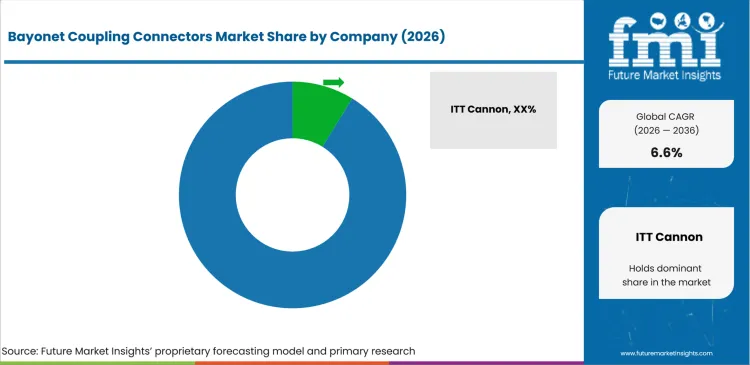
The competitive field is moderately fragmented as military-specification portfolios overlap with industrial sealed ranges and program-specific connector families. Entry depends on qualification records alongside tooling support and regional stock, which favors established specialists without excluding focused regional manufacturers.
- ITT Cannon, Amphenol and TE Connectivity combine broad military circular portfolios with global engineering and distribution support.
- Eaton and Glenair compete with Radiall through qualified families serving aerospace programs and selected defense or industrial applications.
- Bulgin and Weald Electronics address compact sealed systems or MIL-DTL-26482 alternatives through focused ranges and regional service coverage.
Competitive Benchmarking: Bayonet Coupling Connectors Market
| Company | Qualified Series Coverage | Environmental Sealing | Contact Layout Range | Geographic Reach |
|---|---|---|---|---|
| ITT Cannon | High | High | Medium | Global |
| Amphenol | High | High | High | Global |
| TE Connectivity | High | High | High | Global |
| Eaton | Medium | High | Medium | Global |
| Glenair | High | High | High | Global |
| Radiall | High | High | High | Global |
| Bulgin | Low | High | Medium | Global |
| Weald Electronics | High | High | Medium | United Kingdom and selected export markets |
Scoring basis: Series coverage is High for three verified families, Medium for two and Low for one. Sealing is High for immersion or IP68, Medium for protection and Low for splash resistance. Contact range is High for three types, Medium for two and Low for one based on official company pages.
Key Developments in the Bayonet Coupling Connectors Market
- In July 2026, ITT completed its acquisition of Aerospace Contacts LLC and added precision contacts and connector components for harsh aerospace and defense environments.
- In October 2025, Amphenol Industrial Operations expanded its LPT line with the LPT XII and added a compact metal connector using quick positive bayonet coupling.
- In February 2025, Radiall introduced Fortero as a sealed MPO circular connector with a high-cycle bayonet mechanism for demanding defense applications.
Bayonet Coupling Connectors Market - Report Scope
| Coverage field | Report scope |
|---|---|
| Market breakdown | By connector series, contact layout, shell size, application, termination and region. |
| Quantitative Units | Revenue in USD million and CAGR in %. |
| Market Definition | The market covers revenue from bayonet coupling connectors sold for aerospace, defense, industrial, rail, marine and test applications. |
| Regions Covered | North America, Latin America, Europe, East Asia, South Asia and Pacific, and Middle East and Africa. |
| Countries Covered | France, United Kingdom, United States, Germany, Japan, and 20+ countries included in the full report. |
| Key Companies Profiled | ITT Cannon, Amphenol, TE Connectivity, Eaton, Glenair, Radiall, Bulgin and Weald Electronics. |
| Forecast Period | 2026 to 2036. |
| Approach | Primary and secondary research with market triangulation. |
Bayonet Coupling Connectors Market - Research Methodology
| Method | Approach |
|---|---|
| Primary Research | FMI analysts gathered input from manufacturers, service providers, technology developers, distributors, end users, procurement teams, and subject-matter experts. Interviews examined purchasing decisions, product or service evaluation, adoption barriers, approval requirements, pricing considerations, and expectations for technical or commercial support. Respondents were also asked what evidence is required before a trial, pilot, or initial order develops into regular purchasing. |
| Desk Research | Desk research covered government statistics, regulatory publications, trade data, industry associations, technical literature, standards, company filings, product information, and official corporate announcements. Sources were reviewed for relevance, publication date, geographic coverage, and consistency with the defined market scope. Claims relating to performance, applications, approvals, capacity, investment, and commercial activity were retained only when supported by credible public evidence. |
| Market Sizing and Forecasting | The market model combined the baseline value with historical performance, segment structure, pricing and volume indicators, adoption levels, company participation, and country-level demand conditions. Forecast assumptions considered economic activity, investment trends, regulatory developments, technology adoption, purchasing cycles, supply availability, and barriers to wider market use. Segment and regional estimates were reconciled before the final market total was calculated. |
| Data Validation | Estimates were checked against multiple independent indicators, including public data, company activity, trade patterns, industry developments, and findings from primary interviews. Validation also tested whether products, services, applications, and company revenues fell within the defined market boundaries. Adjacent categories, unsupported claims, overlapping revenues, and activities without direct market relevance were excluded to reduce double counting and maintain consistency across segments and countries. |
Bayonet Coupling Connectors Market by Segments
Bayonet Coupling Connectors Market segmented by Connector Series:
- MIL-DTL-26482 Style
- MIL-DTL-5015 Style
- MIL-DTL-38999 Bayonet Variants
- Industrial Bayonet Connectors
- Miniature Bayonet Connectors
Bayonet Coupling Connectors Market segmented by Contact Layout:
- Signal Contacts
- Power Contacts
- Mixed Power / Signal
- Coaxial / RF Contacts
Bayonet Coupling Connectors Market segmented by Shell Size:
- Standard
- Miniature
- Heavy Duty
Bayonet Coupling Connectors Market segmented by Application:
- Aircraft Systems
- Ground Defense Equipment
- Industrial Sensors
- Rail / Marine Equipment
- Test & Measurement
Bayonet Coupling Connectors Market segmented by Termination:
- Crimp
- Solder
- PCB Mount
- Field Wireable
Bayonet Coupling Connectors Market by Region:
- North America
- United States
- Canada
- Latin America
- Brazil
- Chile
- Mexico
- Rest of Latin America
- Western Europe
- Germany
- United Kingdom
- Italy
- Spain
- France
- Nordics
- Benelux
- Rest of Western Europe
- Eastern Europe
- Russia
- Poland
- Hungary
- Balkan and Baltic States
- Rest of Eastern Europe
- East Asia
- China
- Japan
- South Korea
- South Asia and Pacific
- India
- ASEAN
- Australia and New Zealand
- Rest of South Asia and Pacific
- Middle East and Africa
- Kingdom of Saudi Arabia
- Other GCC Countries
- Türkiye
- South Africa
- Other African Union Countries
- Rest of Middle East and Africa
Research Sources and Bibliography
- General Aviation Manufacturers Association. (2026, February 18). GAMA Releases 2025 Aircraft Shipment and Billing Report.
- Weald Electronics. (2025, June). Reliable MIL-DTL-26482 Type Connectors from Weald Electronics - Available When You Need Them.
- Weald Electronics. (2025, September). Our latest Interconnect Solutions Line Card is now available.
- Weald Electronics. (2025, August). Introducing Our New LMA Circular Connector Backshell Catalogue.
- Defense Logistics Agency Land and Maritime. (2026, May 28). QPD Search.
- ADS Group. (2026, June 3). Record backlog follows eightfold increase in aircraft orders, ADS reveals.
- BDLI. (2026, May 27). BDLI Industry Data 2026: Aerospace Industry Sets New Records for Revenue and Employment.
- GIFAS. (2026, May 11). 2025 Results: The French Aerospace Industry Remains Strongly Positioned for the Future.
- Ministry of Economy, Trade and Industry. (2025, September 2).[Call for applications for the FY2025 next-generation aircraft development support program: Supply-chain modernization investment support].
- ITT Inc. (2026, July 6). ITT Completes Acquisition of Aerospace Contacts LLC.
- Amphenol Industrial Operations. (2025, October 30). Amphenol Industrial Operations Expands LPT Product Line with LPT XII.
- Radiall. (2025, February 18). Introducing a New MPO Circular Connector for Demanding Applications.
- ITT Cannon. (n.d.). Heavy and Off Road Product Selection Guide.
- Amphenol Aerospace. (n.d.). MIL-DTL-26482 Series II Connectors.
- TE Connectivity. (n.d.). Bayonet Connectors: MIL-DTL-26482 Standard Series II.
This bibliography is provided for reader reference and is not exhaustive. The full report contains the complete reference list and detailed citations
This Report Answers
- How large is the bayonet coupling connectors market in 2026 and 2036?
- Which operating conditions support bayonet coupling connector demand across aerospace programs?
- Which connector series represents the largest approved share during 2026?
- How does contact layout influence qualified cable-assembly design across aircraft systems?
- Which shell size remains the main specification route during replacement programs?
- How do profiled country growth rates differ through national qualification routes?
- Which companies serve bayonet coupling connector programs across major operating regions?
- What limits connector substitutions across installed aircraft and defense equipment?
- How should engineering teams compare connector options during qualification and replacement planning?
Frequently Asked Questions
How big is the Bayonet Coupling Connectors Market in 2026?
The bayonet coupling connectors market is valued at USD 1120.6 million in 2026 and is forecast to reach USD 2123.4 million by 2036. Growth is supported by aircraft wiring programs that require qualified interconnects as production volume rises and electrical architecture becomes more distributed across platforms and maintenance networks.
What is the CAGR of the Bayonet Coupling Connectors Market from 2026 to 2036?
The bayonet coupling connectors market grows at a CAGR of 6.6% between 2026 and 2036, driven by aircraft electrification that raises qualified connector counts across distributed power and data networks, with platform approvals prolonging substitution cycles across installed aircraft and defense systems.
Which connector series leads the Bayonet Coupling Connectors Market?
MIL-DTL-26482 style leads the bayonet coupling connectors market by connector series, holding 29.0% share in 2026 through recognized qualification routes and broad insert availability. Regional availability supports repeat adoption across maintenance programs using compatible wire harnesses and established tooling through regional service channels worldwide.
How much will the Bayonet Coupling Connectors Market add between 2026 and 2036?
The bayonet coupling connectors market is set to add USD 1002.8 million between 2026 and 2036, growing from USD 1120.6 million to USD 2123.4 million as aircraft electrification programs expand qualified connector counts across distributed power and data communication systems within long-running aerospace and defense platforms.
Who are the leading companies in the Bayonet Coupling Connectors Market?
Eight companies lead the bayonet coupling connectors market, including ITT Cannon, Amphenol, TE Connectivity, Eaton, Glenair, Radiall, Bulgin, and Weald Electronics, competing through qualified circular connector portfolios, environmental sealing capabilities, and regional distribution support across aerospace, defense, and industrial cable-assembly programs worldwide.
Preview the report firsthand - request a free sample
Get SampleGet the brochure for pricing and purchase details.
Get PDFTable of Content
- Key Takeaways
- Market Size and CAGR
- Top Growth Driver
- Fastest Growing Segment
- Leading Region
- Key Companies
- Emerging Opportunities
- Executive Summary
- Global Market Outlook
- Demand-side Trends
- Supply-side Trends
- Technology Roadmap Analysis
- Analysis and Recommendations
- Analyst Perspective (What is happening? Why now? What should investors know?)
- Key Questions Answered
- How large is the market?
- What is the CAGR?
- What are key trends?
- Which region dominates?
- Who are the leaders?
- Market Overview
- Market Coverage / Taxonomy
- Market Definition / Scope / Limitations
- Research Methodology
- Chapter Orientation
- Analytical Lens and Working Hypotheses
- Market Structure, Signals, and Trend Drivers
- Benchmarking and Cross-market Comparability
- Market Sizing, Forecasting, and Opportunity Mapping
- Research Design and Evidence Framework
- Desk Research Programme (Secondary Evidence)
- Expert Input and Fieldwork (Primary Evidence)
- Tooling, Models, and Reference Databases
- Data Engineering and Model Build
- Quality Assurance and Audit Trail
- Market Background
- Market Dynamics (Drivers, Restraints, Opportunity, Trends)
- Scenario Forecast (Optimistic, Likely, Conservative)
- Impact Analysis
- AI Impact
- Sustainability Impact
- Regulatory Impact
- Technology Impact
- Consumer / Buyer Analysis
- Purchase Drivers
- Adoption Barriers
- Buyer Journey
- Opportunity Map Analysis
- Product Life Cycle Analysis
- Supply Chain Analysis
- Investment Feasibility Matrix
- Value Chain Analysis
- PESTLE and Porter's Analysis
- Regulatory Landscape
- Regional Parent Market Outlook
- Production and Consumption Statistics
- Import and Export Statistics
- Global Market Analysis and Forecast, 2021 to 2036
- Historical Market Size Value (USD Million) Analysis, 2021 to 2025
- Current and Future Market Size Value (USD Million) Projections, 2026 to 2036
- Y-o-Y Growth Trend Analysis
- Absolute $ Opportunity Analysis
- Global Market Pricing Analysis, 2021 to 2036
- Global Market Analysis and Forecast, By Connector Series, 2021 to 2036
- Introduction / Key Findings
- Historical Market Size Value (USD Million) Analysis By Connector Series, 2021 to 2025
- Current and Future Market Size Value (USD Million) Analysis and Forecast By Connector Series, 2026 to 2036
- MIL-DTL-26482 Style
- MIL-DTL-5015 Style
- MIL-DTL-38999 Bayonet Variants
- Industrial Bayonet Connectors
- Miniature Bayonet Connectors
- MIL-DTL-26482 Style
- Y-o-Y Growth Trend Analysis By Connector Series, 2021 to 2025
- Absolute $ Opportunity Analysis By Connector Series, 2026 to 2036
- Global Market Analysis and Forecast, By Contact Layout, 2021 to 2036
- Introduction / Key Findings
- Historical Market Size Value (USD Million) Analysis By Contact Layout, 2021 to 2025
- Current and Future Market Size Value (USD Million) Analysis and Forecast By Contact Layout, 2026 to 2036
- Signal Contacts
- Power Contacts
- Mixed Power / Signal
- Coaxial / RF Contacts
- Signal Contacts
- Y-o-Y Growth Trend Analysis By Contact Layout, 2021 to 2025
- Absolute $ Opportunity Analysis By Contact Layout, 2026 to 2036
- Global Market Analysis and Forecast, By Shell Size, 2021 to 2036
- Introduction / Key Findings
- Historical Market Size Value (USD Million) Analysis By Shell Size, 2021 to 2025
- Current and Future Market Size Value (USD Million) Analysis and Forecast By Shell Size, 2026 to 2036
- Standard
- Miniature
- Heavy Duty
- Standard
- Y-o-Y Growth Trend Analysis By Shell Size, 2021 to 2025
- Absolute $ Opportunity Analysis By Shell Size, 2026 to 2036
- Global Market Analysis and Forecast, By Application, 2021 to 2036
- Introduction / Key Findings
- Historical Market Size Value (USD Million) Analysis By Application, 2021 to 2025
- Current and Future Market Size Value (USD Million) Analysis and Forecast By Application, 2026 to 2036
- Aircraft Systems
- Ground Defense Equipment
- Industrial Sensors
- Rail / Marine Equipment
- Test & Measurement
- Aircraft Systems
- Y-o-Y Growth Trend Analysis By Application, 2021 to 2025
- Absolute $ Opportunity Analysis By Application, 2026 to 2036
- Global Market Analysis and Forecast, By Termination, 2021 to 2036
- Introduction / Key Findings
- Historical Market Size Value (USD Million) Analysis By Termination, 2021 to 2025
- Current and Future Market Size Value (USD Million) Analysis and Forecast By Termination, 2026 to 2036
- Crimp
- Solder
- PCB Mount
- Field Wireable
- Crimp
- Y-o-Y Growth Trend Analysis By Termination, 2021 to 2025
- Absolute $ Opportunity Analysis By Termination, 2026 to 2036
- Global Market Analysis and Forecast, By Region, 2021 to 2036
- Introduction
- Historical Market Size Value (USD Million) Analysis By Region, 2021 to 2025
- Current Market Size Value (USD Million) Analysis and Forecast By Region, 2026 to 2036
- North America
- Latin America
- Western Europe
- Eastern Europe
- East Asia
- South Asia and Pacific
- Middle East & Africa
- Market Attractiveness Analysis By Region
- North America Market Analysis and Forecast, By Country, 2021 to 2036
- Historical Market Size Value (USD Million) Trend Analysis By Market Taxonomy, 2021 to 2025
- Market Size Value (USD Million) Forecast By Market Taxonomy, 2026 to 2036
- By Country
- USA
- Canada
- By Connector Series
- By Contact Layout
- By Shell Size
- By Application
- By Termination
- By Country
- Market Attractiveness Analysis
- By Country
- By Connector Series
- By Contact Layout
- By Shell Size
- By Application
- By Termination
- Key Takeaways
- Latin America Market Analysis and Forecast, By Country
- Historical Market Size Value (USD Million) Trend Analysis By Market Taxonomy, 2021 to 2025
- Market Size Value (USD Million) Forecast By Market Taxonomy, 2026 to 2036
- By Country
- Brazil
- Mexico
- Chile
- Rest of Latin America
- By Connector Series
- By Contact Layout
- By Shell Size
- By Application
- By Termination
- By Country
- Market Attractiveness Analysis
- By Country
- By Connector Series
- By Contact Layout
- By Shell Size
- By Application
- By Termination
- Key Takeaways
- Western Europe Market Analysis and Forecast, By Country
- Historical Market Size Value (USD Million) Trend Analysis By Market Taxonomy, 2021 to 2025
- Market Size Value (USD Million) Forecast By Market Taxonomy, 2026 to 2036
- By Country
- Germany
- UK
- Italy
- Spain
- France
- Nordic
- BENELUX
- Rest of Western Europe
- By Connector Series
- By Contact Layout
- By Shell Size
- By Application
- By Termination
- By Country
- Market Attractiveness Analysis
- By Country
- By Connector Series
- By Contact Layout
- By Shell Size
- By Application
- By Termination
- Key Takeaways
- Eastern Europe Market Analysis and Forecast, By Country
- Historical Market Size Value (USD Million) Trend Analysis By Market Taxonomy, 2021 to 2025
- Market Size Value (USD Million) Forecast By Market Taxonomy, 2026 to 2036
- By Country
- Russia
- Poland
- Hungary
- Balkan & Baltic
- Rest of Eastern Europe
- By Connector Series
- By Contact Layout
- By Shell Size
- By Application
- By Termination
- By Country
- Market Attractiveness Analysis
- By Country
- By Connector Series
- By Contact Layout
- By Shell Size
- By Application
- By Termination
- Key Takeaways
- East Asia Market Analysis and Forecast, By Country
- Historical Market Size Value (USD Million) Trend Analysis By Market Taxonomy, 2021 to 2025
- Market Size Value (USD Million) Forecast By Market Taxonomy, 2026 to 2036
- By Country
- China
- Japan
- South Korea
- By Connector Series
- By Contact Layout
- By Shell Size
- By Application
- By Termination
- By Country
- Market Attractiveness Analysis
- By Country
- By Connector Series
- By Contact Layout
- By Shell Size
- By Application
- By Termination
- Key Takeaways
- South Asia and Pacific Market Analysis and Forecast, By Country
- Historical Market Size Value (USD Million) Trend Analysis By Market Taxonomy, 2021 to 2025
- Market Size Value (USD Million) Forecast By Market Taxonomy, 2026 to 2036
- By Country
- India
- ASEAN
- Australia & New Zealand
- Rest of South Asia and Pacific
- By Connector Series
- By Contact Layout
- By Shell Size
- By Application
- By Termination
- By Country
- Market Attractiveness Analysis
- By Country
- By Connector Series
- By Contact Layout
- By Shell Size
- By Application
- By Termination
- Key Takeaways
- Middle East & Africa Market Analysis and Forecast, By Country
- Historical Market Size Value (USD Million) Trend Analysis By Market Taxonomy, 2021 to 2025
- Market Size Value (USD Million) Forecast By Market Taxonomy, 2026 to 2036
- By Country
- Kingdom of Saudi Arabia
- Other GCC Countries
- Türkiye
- South Africa
- Other African Union
- Rest of Middle East & Africa
- By Connector Series
- By Contact Layout
- By Shell Size
- By Application
- By Termination
- By Country
- Market Attractiveness Analysis
- By Country
- By Connector Series
- By Contact Layout
- By Shell Size
- By Application
- By Termination
- Key Takeaways
- Key Countries Market Analysis
- USA
- Pricing Analysis
- Market Share Analysis, 2025
- By Connector Series
- By Contact Layout
- By Shell Size
- By Application
- By Termination
- Canada
- Pricing Analysis
- Market Share Analysis, 2025
- By Connector Series
- By Contact Layout
- By Shell Size
- By Application
- By Termination
- Mexico
- Pricing Analysis
- Market Share Analysis, 2025
- By Connector Series
- By Contact Layout
- By Shell Size
- By Application
- By Termination
- Brazil
- Pricing Analysis
- Market Share Analysis, 2025
- By Connector Series
- By Contact Layout
- By Shell Size
- By Application
- By Termination
- Chile
- Pricing Analysis
- Market Share Analysis, 2025
- By Connector Series
- By Contact Layout
- By Shell Size
- By Application
- By Termination
- Germany
- Pricing Analysis
- Market Share Analysis, 2025
- By Connector Series
- By Contact Layout
- By Shell Size
- By Application
- By Termination
- UK
- Pricing Analysis
- Market Share Analysis, 2025
- By Connector Series
- By Contact Layout
- By Shell Size
- By Application
- By Termination
- Italy
- Pricing Analysis
- Market Share Analysis, 2025
- By Connector Series
- By Contact Layout
- By Shell Size
- By Application
- By Termination
- Spain
- Pricing Analysis
- Market Share Analysis, 2025
- By Connector Series
- By Contact Layout
- By Shell Size
- By Application
- By Termination
- France
- Pricing Analysis
- Market Share Analysis, 2025
- By Connector Series
- By Contact Layout
- By Shell Size
- By Application
- By Termination
- India
- Pricing Analysis
- Market Share Analysis, 2025
- By Connector Series
- By Contact Layout
- By Shell Size
- By Application
- By Termination
- ASEAN
- Pricing Analysis
- Market Share Analysis, 2025
- By Connector Series
- By Contact Layout
- By Shell Size
- By Application
- By Termination
- Australia & New Zealand
- Pricing Analysis
- Market Share Analysis, 2025
- By Connector Series
- By Contact Layout
- By Shell Size
- By Application
- By Termination
- China
- Pricing Analysis
- Market Share Analysis, 2025
- By Connector Series
- By Contact Layout
- By Shell Size
- By Application
- By Termination
- Japan
- Pricing Analysis
- Market Share Analysis, 2025
- By Connector Series
- By Contact Layout
- By Shell Size
- By Application
- By Termination
- South Korea
- Pricing Analysis
- Market Share Analysis, 2025
- By Connector Series
- By Contact Layout
- By Shell Size
- By Application
- By Termination
- Russia
- Pricing Analysis
- Market Share Analysis, 2025
- By Connector Series
- By Contact Layout
- By Shell Size
- By Application
- By Termination
- Poland
- Pricing Analysis
- Market Share Analysis, 2025
- By Connector Series
- By Contact Layout
- By Shell Size
- By Application
- By Termination
- Hungary
- Pricing Analysis
- Market Share Analysis, 2025
- By Connector Series
- By Contact Layout
- By Shell Size
- By Application
- By Termination
- Kingdom of Saudi Arabia
- Pricing Analysis
- Market Share Analysis, 2025
- By Connector Series
- By Contact Layout
- By Shell Size
- By Application
- By Termination
- Türkiye
- Pricing Analysis
- Market Share Analysis, 2025
- By Connector Series
- By Contact Layout
- By Shell Size
- By Application
- By Termination
- South Africa
- Pricing Analysis
- Market Share Analysis, 2025
- By Connector Series
- By Contact Layout
- By Shell Size
- By Application
- By Termination
- USA
- Market Structure Analysis
- Competition Dashboard
- Competition Benchmarking
- Market Share Analysis of Top Players
- By Regional
- By Connector Series
- By Contact Layout
- By Shell Size
- By Application
- By Termination
- Emerging Startups
- Innovation Benchmarking
- Competition Analysis
- Competition Deep Dive
- ITT Cannon
- Overview
- Product Portfolio
- Profitability by Market Segments
- Sales Footprint
- Strategy Overview
- Marketing Strategy
- Product Strategy
- Channel Strategy
- Amphenol
- TE Connectivity
- Eaton
- Glenair
- Radiall
- Bulgin
- Hirose Electric
- Weald Electronics
- Binder
- ITT Cannon
- Case Studies
- Success Stories
- Recent Developments
- Competition Deep Dive
- Assumptions & Acronyms Used


