
- Market Size (2026)
- USD 1.1 Bn
- Forecast (2036)
- USD 2.0 Bn
- CAGR (2026 to 2036)
- 6.2%
How Big Is the Bee Pollen Market in 2026?
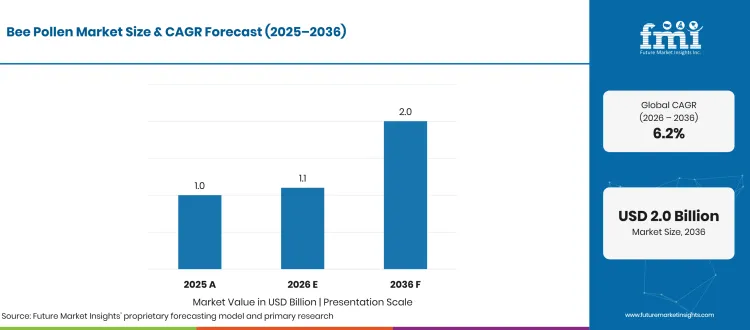
Global bee pollen market held a valuation of USD 1.0 billion in 2025, grew to USD 1.1 billion in 2026, and is projected to reach USD 2.0 billion by 2036, expanding at a steady 6.2% CAGR over the decade. Rising consumer adoption of unheated apiculture superfoods generates an incremental market opportunity of USD 0.9 billion. Functional food processors and retail health brand owners anchor this long-term demand momentum through convenient nutritional formats.
| Market Metric | Valuation / Share / Forecast Benchmark |
|---|---|
| 2025 Market Size (Historical) | USD 1.0 billion |
| 2026 Market Size (Estimated) | USD 1.1 billion |
| 2036 Market Size (Projected) | USD 2.0 billion |
| Compound Annual Growth Rate (2026 to 2036) | 6.2% CAGR |
| Incremental Dollar Opportunity (2026 to 2036) | USD 0.9 billion |
| Dominant Type Segment (2026 Share) | Wild Flower Bee Pollen (42.0% share in 2026) | Other Segment Combined (58.0%) |
| Leading Application Segment (2026 Share) | Food (49.0% share in 2026) | Other Segment Combined (51.0%) |
| Key Commercial Formats | Dried Granules, Portioned Sticks, Refrigerated Fresh Pollen, 400 mg to 500 mg Capsules |
| Fastest-Growing Country Markets (2026 to 2036) | India (9.3% CAGR), USA (6.0% CAGR), China (5.8% CAGR) |
| European & Latin American Benchmarks | UK (5.1% CAGR), Germany (4.9% CAGR), Mexico (4.8% CAGR), Italy (3.7% CAGR) |
| Leading Tier-1 Companies | Apicoltura Burato, YS Bee Farms, Beekeeper's Naturals, Swanson Health Products, NOW Foods, BeeVital, Honey Pacifica, Sattvic Foods, Livemoor, Crockett Honey Co. |
Source: Future Market Insights analysis of the bee pollen market, 2026.
This Report Answers
- How large the bee pollen market is in 2026 and what it reaches by 2036
- Which type and application segments lead in 2026
- What is driving demand and what is holding the category back
- Which countries grow fastest between 2026 and 2036
- What Apicoltura Burato and other leading players have launched
- How the bee pollen market is defined, segmented and measured
Executive Market Overview
Functional food processors and nutraceutical formulators are expanding bulk procurement of clean-label bee pollen, incorporating nutrient-dense botanical bioactives into daily wellness bars and fortified smoothies. Repeat B2B ingredient contracts depend on botanical origin documentation and contaminant testing across superfoods and superfood powders, especially as floral phenolic density varies by harvest season. Formulation trials published by Nemś et al., Scientific Reports (July 2025) confirmed that incorporating 3% multifloral bee pollen into extruded snack formulations achieved strong sensory acceptance while boosting antioxidant properties. Growing food industry interest in whole-food nutrition encourages brands to expand their clean-label apiculture formulations.
Unprocessed raw pollen faces rapid lipid oxidation and mold risk unless apiaries control drying temperatures or maintain refrigerated cold chains, which limits commodity price competition. Brand owners are lifting revenue per kilogram by moving portioned pollen sticks into mainstream grocery aisles and certifying pyrrolizidine alkaloid compliance with nutraceutical ingredients. Retail expansion gained momentum when Beekeeper's Naturals (February 2025) launched single-serve Bee Pollen Sticks across Whole Foods Market stores, while research by Parrotta and Del Duca (August 2026) confirmed that functional pollen requires strict screening for environmental contaminants. Market sizing covers raw dried granules and pure capsule formulations, while excluding liquid honey and blended herbal remedies.
Analyst Perspective
"Bee pollen suppliers will expand margin faster than raw hive volume by offering laboratory-certified, low-alkaloid lots in portioned stick packs and standardized 500 mg capsules. The decisive commercial risk is batch rejection under European Union 500 ug/kg pyrrolizidine alkaloid limits and allergen labeling enforcement."
- Nandini Roy Choudhury, Principal Consultant, Future Market Insights (FMI)
Key Market Trends & Insights
- Portioned Stick Packs and Capsule Standardization Expand Mainstream Retail Placement: Brands are moving bee pollen beyond bulk apiculture jars into measured single-serve sticks and vegetarian capsules that fit daily consumer routines. Portioned formats reduce consumer dosing uncertainty across herbal supplements by featuring clear allergy advisories and portable packaging. Federal filings in the National Institutes of Health, Office of Dietary Supplements (July 2025) document NOW Foods Bee Pollen Caps delivering 500 mg unaltered bee pollen per capsule, while Beekeeper's Naturals (February 2025) secured widespread grocery placement in early 2025. Standardized formats make apiculture supplements accessible for on-the-go lifestyle consumers.
- Automated UHPLC-MS/MS Alkaloid Screening Formalizes B2B Lot Qualification: European and Asian food manufacturers increasingly require quantitative certificates of analysis for pyrrolizidine alkaloids and trace metals before approving bulk pollen shipments. Rapid chromatographic testing lowers compliance delays across botanical ingredients by verifying batch purity before export customs clearance. Research published in PubMed / Journal of Chromatography (November 2025) quantified 28 pyrrolizidine alkaloids in commercial bee pollen and revealed that 21.2% of screened lots exceeded European safety limits. Stringent quality testing separates professional apiculture exporters from uncertified commodity traders.
- Botanical Fingerprinting Validates Regional Provenance and Bioactive Phenolics: Specialty food and personal-care formulators are replacing unverified mixed pollen with botanically characterized lots that guarantee consistent flavonoid and amino-acid profiles. Chemical fingerprinting supports premium pricing within botanical extracts by demonstrating reproducible antioxidant performance in topical and dietary products. Research published by MDPI Molecules (November 2026) profiled the phytochemical signature of central Italian apiary pollen, while the U.S. Department of Agriculture Agricultural Research Service (February 2026) demonstrated how honey-bee handling transforms floral pollen into stable hive nutrition. Origin verification gives food formulators reliable bioactive ingredients for clean-label product claims.
What Are the Main Drivers, Restraints, and Opportunities?
Clean-label food enrichment and national beekeeping infrastructure programs drive commercial pollen collection, whereas pyrrolizidine alkaloid limits and heavy-metal contamination risks restrain unverified lots, creating opportunities for traceable monofloral and cold-chain formats.
Driver: Functional Food Enrichment and Government Apiculture Infrastructure Support
Bakery and snack processors incorporate bee pollen granules to add natural polyphenols and carotenoid pigments without synthetic additives. Government investments in scientific hive management and post-harvest drying facilities are expanding commercial supply within coloring foodstuffs as beekeepers diversify farm revenues beyond liquid honey. Official updates from the Press Information Bureau, India (November 2025) document National Beekeeping and Honey Mission funding for post-harvest bee-product infrastructure, while Nemś et al., Scientific Reports (July 2025) verified functional snack fortification at calibrated inclusion levels. Expanding commercial processing capacity provides food manufacturers with dependable supplies of food-grade pollen.
Restraint: Pyrrolizidine Alkaloid Rejections, Trace Element Risks, and Allergenicity
Foraging bees inadvertently collect toxic pyrrolizidine alkaloids from regional weeds in addition to environmental residues, creating significant batch contamination risks that can disrupt food export approvals. Food authorities enforce strict residue ceilings for pyrrolizidine alkaloids, requiring exporters to audit apiary flora zones and adjust their formulations of botanical supplements. Surveillance studies published in PubMed / Journal of Chromatography (November 2025) confirm that commercial pollen lots frequently trigger customs rejections unless tested by validated chromatography methods. Complex botanical screening requirements raise testing overhead and complicate bulk apiculture procurement.
Opportunity: Botanically Characterized Grading and Cold-Chain Fresh Pollen Supply
Apiary aggregators and supplement brands including Honey Pacifica (2026) can capture premium contract pricing by supplying lot-certified wildflower and camellia pollen to premium wellness manufacturers. Growing consumer preference for traceable hive superfoods creates lucrative B2B supply agreements within nutraceuticals for suppliers who certify pesticide-free origin. Food formulators partner with certified beekeeping cooperatives to secure high-flavonoid pollen lots for premium herbal nutraceuticals and sports nutrition bars. Establishing traceable farm-to-shelf supply networks enables ingredient processors to command higher wholesale prices across international specialty channels.
How Is the Bee Pollen Market Segmented?
Bee Pollen Market is segmented by Type and Application categories as well as Region. Forecast period from 2026 to 2036.
| Segmentation Axis | Sub-Segments Covered | 2026 Leading Segment & Share | Other Segment Combined & Total |
|---|---|---|---|
| Type | Wild Flower Bee Pollen, Camellia Bee Pollen, Rape Bee Pollen, Others | Wild Flower Bee Pollen (42.0% share in 2026) | Other Segment Combined (58.0%) | Total (100.0%) |
| Application | Food, Pharmaceutical, Cosmetic and Personal Care | Food (49.0% share in 2026) | Other Segment Combined (51.0%) | Total (100.0%) |
| Region | North America, Latin America, Western Europe, Eastern Europe, East Asia, South Asia and Pacific, Middle East and Africa | North America & East Asia Lead Volume; India Fastest (9.3% CAGR) | Global Coverage Across 7 Core Countries (100.0%) |
Source: Future Market Insights analysis of the bee pollen market, 2026.
Why Does the Wild Flower Bee Pollen Segment Anchor the Type Category?
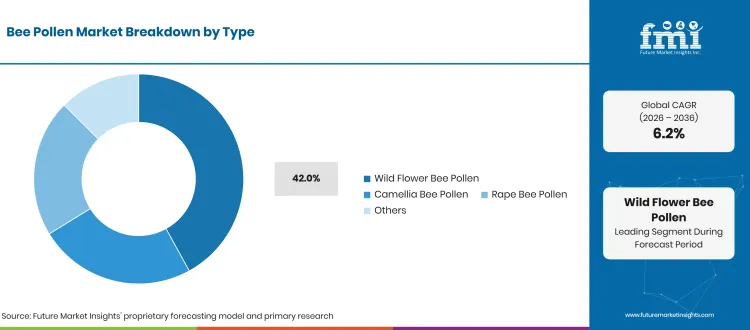
Wild Flower varieties secure a leading 42.0% share of Type revenue in 2026, favored by apiaries and consumer brands for multi-floral harvest resilience and smooth sensory blending across smoothies and functional foods. Food formulators prefer multifloral granules because their balanced flavor profile blends smoothly into snack bars and smoothies without masking primary ingredients. Fortification studies by Nemś et al., Scientific Reports (July 2025) confirmed that 3% multifloral pollen additions delivered superior sensory acceptance compared to single-crop harvests, while Honey Pacifica (2026) supplies raw wildflower pollen directly to retail grocers. Broad floral availability and versatile kitchen application will keep Wild Flower pollen ahead of single-botanical varieties through 2036.
What Keeps the Food Segment Ahead Among Bee Pollen Applications?
Food applications represent 49.0% of category demand in 2026, serving as the primary commercial engine because culinary granules and portioned sticks reach retail shelves without requiring pharmaceutical licenses. Health-conscious shoppers regularly sprinkle nutrient-dense granules over breakfast bowls, yogurt parfaits, and cereal bowls to boost daily protein and vitamin intake. Demonstrating retail expansion, Beekeeper's Naturals (February 2025) placed portioned Bee Pollen Sticks into Whole Foods Market grocery aisles, while Livemoor (2026) and Sattvic Foods supply culinary loose granules for artisan bakeries. Expanding consumer demand for whole-food nutritional toppers will keep food and beverage uses central to overall volume through 2036.
Regional & Country Outlook
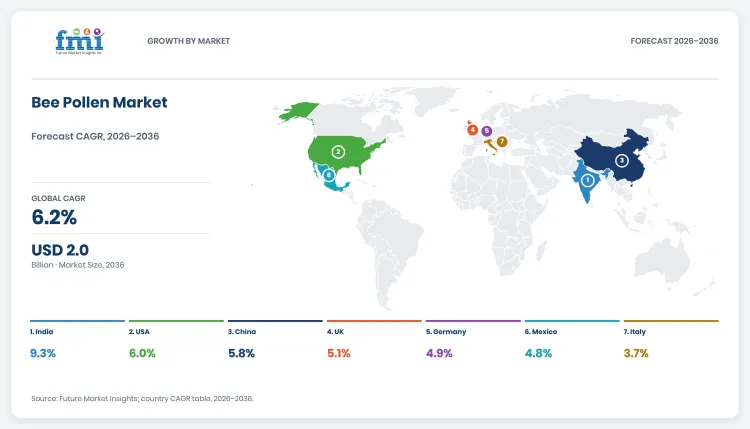
North America, East Asia, and Western Europe represent the largest commercial markets for packaged bee pollen, while South Asia posts the fastest percentage expansion through 2036. FMI projects India to lead national growth rates at a 9.3% CAGR from 2026 to 2036, followed by the USA at 6.0% and China at 5.8%. Across European markets, the UK advances at 5.1%, Germany at 4.9%, Mexico at 4.8%, and Italy at 3.7%, creating a 5.6 percentage point growth spread shaped by national beekeeping subsidies, import health certificates, and European contaminant screening.
| Country | 2026 Revenue | 2036 Revenue | 10-Year Addition | 2026 to 2036 CAGR | Global Share (2026 -> 2036) |
|---|---|---|---|---|---|
| India | USD 99.0 million | USD 241.0 million | +USD 142.0 million | 9.3% | 9.0% -> 12.1% |
| USA | USD 308.0 million | USD 551.6 million | +USD 243.6 million | 6.0% | 28.0% -> 27.6% |
| China | USD 242.0 million | USD 425.3 million | +USD 183.3 million | 5.8% | 22.0% -> 21.3% |
| UK | USD 77.0 million | USD 126.6 million | +USD 49.6 million | 5.1% | 7.0% -> 6.3% |
| Germany | USD 121.0 million | USD 195.2 million | +USD 74.2 million | 4.9% | 11.0% -> 9.8% |
| Mexico | USD 55.0 million | USD 87.9 million | +USD 32.9 million | 4.8% | 5.0% -> 4.4% |
| Italy | USD 66.0 million | USD 94.9 million | +USD 28.9 million | 3.7% | 6.0% -> 4.7% |
Source: Future Market Insights analysis of the bee pollen market, 2026.
India
Demand for bee pollen in India is projected to rise from USD 99.0 million in 2026 to USD 241.0 million by 2036, advancing at a 9.3% CAGR and adding USD 142.0 million in new revenue. FMI finds that domestic expansion in India is fueled by federal post-harvest collection centers and direct-to-consumer wellness brands such as Sattvic Foods (2026) marketing packaged granules to urban households. In November 2025, the Press Information Bureau, India (November 2025) detailed National Beekeeping and Honey Mission investments in scientific hive management and post-harvest processing infrastructure. FMI expects standardized drying and lot-traceability upgrades across Indian apiaries to unlock recurring ingredient orders through 2036.
USA
Buyer adoption of bee pollen across USA is estimated to expand from USD 308.0 million in 2026 to USD 551.6 million by 2036, spurred by a 6.0% CAGR and generating USD 243.6 million in commercial expansion. In FMI's assessment, USA demand is driven by omnichannel availability of measured 400 mg and 500 mg capsules with portioned grocery sticks and bulk apiary packs. Federal label filings in the National Institutes of Health, Office of Dietary Supplements (July 2025) document NOW Foods 500 mg capsules with explicit pollen-allergy cautions, while U.S. Department of Agriculture Agricultural Research Service (February 2026) published new 2026 research on corbicular honey-bee pollen biology. FMI projects supermarket stick-pack expansion and GMP-verified capsule lines to sustain USA sales growth through 2036.
China
Bee pollen industry across China is set to scale from USD 242.0 million in 2026 to USD 425.3 million by 2036, driven by a 5.8% CAGR and adding USD 183.3 million in incremental market value. Commercial volume in China is anchored by licensed apiculture facilities and state-level manufacturing standards for domestic and export dietary supplements. Production regulations from the State Administration for Market Regulation, China (2023) classify bee pollen under dedicated processing codes with mandatory chilled storage for fresh lots, while NCBI PMC (2026) validated modern alkaloid testing in Chinese apiary lots. Licensed sterilization facilities and certified export batches will drive Chinese wholesale shipments through 2036.
UK
Sales of bee pollen throughout the UK are projected to increase from USD 77.0 million in 2026 to USD 126.6 million by 2036, progressing at a 5.1% CAGR and generating USD 49.6 million in commercial revenue. British retail demand expands through online subscription channels and specialty health food stores operating under strict post-Brexit border inspection protocols. Import notices published by the Department for Environment, Food & Rural Affairs, UK (April 2025) establish health certification and border inspection rules for apiculture products entering Great Britain. Maintaining certified import documentation and airtight packaging will allow premium brands like BeeVital (2026) to expand their UK customer base through 2036.
Germany
Consumption of bee pollen across Germany is estimated to climb from USD 121.0 million in 2026 to USD 195.2 million by 2036, reflecting a 4.9% CAGR that contributes USD 74.2 million over the forecast decade. German procurement centers on strict analytical compliance with European pyrrolizidine alkaloid limits across traditional Reformhaus health stores. Health assessments from the Federal Institute for Risk Assessment (BfR) (2025) highlight why German importers test incoming shipments against the 500 ug/kg European regulatory limit. Verified low-alkaloid batches and transparent floral origin certificates will maintain steady German commercial purchasing through 2036.
Mexico
Revenue generated by bee pollen suppliers across Mexico is forecast to expand from USD 55.0 million in 2026 to USD 87.9 million by 2036, anchored by a 4.8% CAGR and generating USD 32.9 million in new category value. Mexican commercial production benefits from regional beekeeping cooperatives that collect pollen in addition to honey to diversify rural farm income. Agricultural reports published by the Secretaría de Agricultura y Desarrollo Rural, Mexico (December 2025) document commercial harvesting across Guerrero apiaries supporting rural economic development. Cooperative drying facilities and organized lot aggregation will expand Mexican export sales through 2036.
Italy
Buyer procurement of bee pollen within Italy is tracking from USD 66.0 million in 2026 to USD 94.9 million by 2036, exhibiting a 3.7% CAGR that contributes USD 28.9 million to national market value. Italian value growth stems from artisan beekeepers like Apicoltura Burato (2026) marketing fresh refrigerated pollen and botanically characterized regional harvests. Scientific research in MDPI Molecules (November 2026) confirms that Italian apiary pollen features distinct regional phytochemical markers that appeal to gourmet culinary buyers. Traceable geographic origin and gentle post-harvest drying will sustain steady Italian specialty retail demand through 2036.
Competitive Environment and Notable Companies
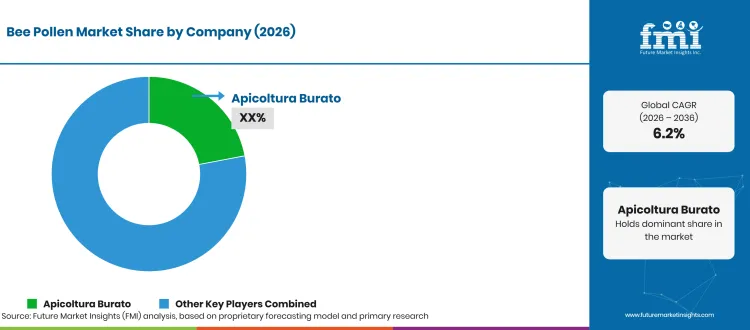
Notable companies operating in the global bee pollen market include Apicoltura Burato, YS Bee Farms, Beekeeper's Naturals, Swanson Health Products, NOW Foods, BeeVital, Honey Pacifica, Sattvic Foods, Livemoor, as well as Crockett Honey Co. Competition is structured across three commercial tiers covering apiary-linked fresh and loose pollen producers, consumer-ready granule and portioned stick-pack distributors, and standardized capsule supplement brands.
How Are Companies Positioned in the Bee Pollen Market?
Apiary-anchored suppliers including Apicoltura Burato (2026), Honey Pacifica, Sattvic Foods, and Crockett Honey Co. (2026) market loose and refrigerated fresh pollen across farm-direct and regional grocery channels. Beekeeper's Naturals (2026), BeeVital, and Livemoor position portioned sticks and resealable granule packs for daily culinary use, while YS Bee Farms, Swanson Health Products (2026), and NOW Foods (2026) compete in the measured capsule supplement aisle.
What Matters When a Buyer Selects a Bee Pollen Supplier?
Ingredient buyers and retail category managers evaluate suppliers on moisture content (typically below 6% to 8% for ambient dried granules), quantitative pyrrolizidine alkaloid and heavy-metal test certificates, cold-chain integrity for fresh or undried pollen, and prominent pollen-allergy warning labels. B2B food processors also test granule solubility and phenolic retention during baking or extrusion before committing to annual supply contracts.
Which Capabilities Distinguish Product Offers?
Portfolio differentiation centers on portion convenience, capsule standardization, and harvest handling. Beekeeper's Naturals (2026) packages multifloral granules into single-serve sticks for on-the-go use, while Swanson Health Products (2026) lists both Y.S. Eco Bee Farms 500 mg capsules and Swanson Premium 400 mg capsules. Honey Pacifica and Apicoltura Burato preserve heat-sensitive enzymes through unheated coastal and fresh-hive handling.
How Does Geographic Reach Affect Competition?
Strict animal-byproduct import rules and contaminant limits segment regional competition. NOW Foods, Swanson Health Products, YS Bee Farms, Beekeeper's Naturals, Honey Pacifica, and Crockett Honey Co. anchor United States grocery and supplement channels. BeeVital and Livemoor serve UK online and health-store buyers under DEFRA import compliance, Apicoltura Burato serves Italian fresh-pollen buyers, and Sattvic Foods serves Indian e-commerce consumers.
| Verified Company Evidence (2025 to 2026) | Commercial Effect | Buyer Action |
|---|---|---|
| February 2025: Beekeeper's Naturals launched its portioned Bee Pollen Sticks into Whole Foods Market grocery stores across the United States (Beekeeper's Naturals, February 2025). | Moves bee pollen from bulk jars into mainstream physical grocery single-serve stick formats. | Evaluate portion-controlled stick packs for natural grocery and checkout impulse sets. |
| July 2025: NIH Dietary Supplement Label Database recorded updated label specifications for NOW Foods Bee Pollen Caps 500 mg in 100% PCR recycled resin bottles (NIH ODS, July 2025). | Reinforces GMP quality assurance, Kosher/Halal certification, and explicit pollen-allergy warnings. | Require standardized allergen cautions and GMP documentation on private-label and branded capsules. |
| July 2025: Nemś et al. published controlled snack formulation trials showing 3% multifloral pollen additions optimize phenolic content and sensory acceptance (Nemś et al., July 2025). | Provides food manufacturers with validated inclusion thresholds for extruded snacks and bakery items. | Qualify 1% to 3% multifloral pollen inclusion rates during commercial snack pilot runs. |
Source: Verified corporate disclosures and Future Market Insights analysis, 2026.
| Company | Core Positioning | Verified Activity & Source Attribution |
|---|---|---|
| Apicoltura Burato | Italian farm-direct fresh bee pollen and hive supplements | Supplies refrigerated Polline Fresco and hive products in Italy under EU contaminant controls (Apicoltura Burato, 2026). |
| YS Bee Farms | US supplement brand offering 500 mg bee pollen capsules and whole granules | Distributes Y.S. Eco Bee Farms 500 mg capsules through national supplement retailers (Swanson Health Products, 2026). |
| Beekeeper's Naturals | Portioned Bee Pollen Sticks and culinary granule jars | Expanded Bee Pollen Sticks into Whole Foods Market physical retail stores in February 2025 (Beekeeper's Naturals, February 2025). |
| Swanson Health Products | Direct-to-consumer 400 mg bee pollen capsules and third-party brands | Markets Swanson Premium Bee Pollen 400 mg (300 capsules) and partner hive lines (Swanson Health Products, 2026). |
| NOW Foods | GMP-assured 500 mg bee pollen capsules in 100% PCR bottles | Updated 500 mg capsule label record 335207 in the NIH DSLD in July 2025 with Kosher and Halal certifications (NIH ODS, July 2025). |
| BeeVital | UK propolis and bee pollen granule specialist with analytical research | Supplies consumer Bee Pollen Granules across UK online retail channels (BeeVital, 2026). |
| Honey Pacifica | Southern California apiary supplying unheated coastal bee pollen | Markets cold-packed Coastal Bee Pollen jars preserving natural hive moisture and aroma (Honey Pacifica, 2026). |
| Sattvic Foods | Indian direct-to-consumer superfood brand offering loose bee pollen | Distributes culinary Bee Pollen granules across Indian e-commerce platforms for breakfast and smoothie use (Sattvic Foods, 2026). |
| Livemoor | UK online supplier of loose organic-harvest bee pollen granules | Markets consumer and bulk pouches of loose bee pollen granules in the United Kingdom (Livemoor, 2026). |
| Crockett Honey Co. | Arizona apiary supplying 1.25 lb jars and 12-pack commercial cases | Supplies 1.25 lb loose bee pollen containers and wholesale case packs in the United States (Crockett Honey Co., 2026). |
Source: Verified corporate disclosures and Future Market Insights analysis, 2026.
Key takeaways
- Valued at USD 1.1 billion in 2026, on course for USD 2.0 billion by 2036.
- The decade adds USD 0.9 billion in new value at a 6.2% CAGR.
- The type segment is led by Wild Flower Bee Pollen at 42.0% of 2026 revenue.
- 49.0% of application revenue goes to Food in 2026.
- India grows fastest at 9.3% CAGR, ahead of the USA at 6.0%.
Bee Pollen Market Report Scope and Research Methodology
FMI sizes the global bee pollen market through primary interviews with commercial apiaries, bulk bee-product aggregators, food formulators, and supplement brand managers, cross-checked against national apiculture mission budgets, import health guidelines, and analytical food-safety studies. core 2025 and 2026 valuations reconcile revenue from distinct raw or dried stick-pack capsule products across all seven profiled countries and regional clusters. Segment shares across Type and Application are validated against commercial product listings and licensing categories, while excluding finished downstream foods, liquid honey, propolis, royal jelly, and multi-ingredient herbal remedies to prevent double counting.
| Coverage Field | Report Scope |
|---|---|
| Market Definition | Commercial revenue from bee pollen sold as a distinct raw, fresh, dried, granular, stick-pack, or pollen-only capsule product. |
| Type Segments | Wild Flower Bee Pollen, Camellia Bee Pollen, Rape Bee Pollen, and Others. |
| Application Segments | Food, Pharmaceutical, and Cosmetic and Personal Care. |
| Commercial Formats | Dried granules, portioned single-serve sticks, refrigerated fresh pollen, and 400 mg to 500 mg capsules. |
| Exclusions | Finished downstream foods, medicines, cosmetics, blended multi-herb supplements, honey, propolis, royal jelly, and beeswax. |
| Quantitative Units | USD Billion for global market sizing; USD Million for country-level breakdowns. |
| Historical & Base Years | 2025 (Historical) and 2026 (Estimated Base Year). |
| Forecast Period | 2026 to 2036 (10-Year Projection Window). |
| Regions Covered | North America, Latin America, Western Europe, Eastern Europe, East Asia, South Asia and Pacific, and Middle East and Africa. |
| Countries Profiled | India, USA, China, UK, Germany, Mexico, and Italy. |
| Companies Covered | Apicoltura Burato, YS Bee Farms, Beekeeper's Naturals, Swanson Health Products, NOW Foods, BeeVital, Honey Pacifica, Sattvic Foods, Livemoor, and Crockett Honey Co. |
| Research Approach | Primary apiary and buyer interviews combined with secondary agricultural, customs, and peer-reviewed analytical triangulation. |
Source: Future Market Insights analysis of the bee pollen market, 2026.
Research Sources and Bibliography
- Apicoltura Burato. (2026). Polline e Integratori Product Category Overview. https://www.apicolturaburato.it/product-category/polline-e-integratori/
- Apicoltura Burato. (2026). Polline Fresco Refrigerated Italian Bee Pollen. https://www.apicolturaburato.it/product/polline-fresco/
- Beekeeper's Naturals. (2025, February). Our Bee Pollen Sticks Are Now Available in Whole Foods Market. https://www.linkedin.com/posts/beekeeper%27s-naturals_our-bee-pollen-sticks-are-now-available-in-activity-7291838877089075200-X45j
- Beekeeper's Naturals. (2026). Bee Pollen Sticks Product Information. https://www.beekeepersnaturals.com/products/bee-pollen-sticks
- Beekeeper's Naturals. (2026). Honey and Bee Pollen Supplements Collection. https://www.beekeepersnaturals.com/collections/honey-pollen
- BeeVital. (2026). Bee Pollen Granules Product Information. https://beevitalpropolis.com/products/pollen-granules
- Crockett Honey Co.. (2026). Bee Pollen 1.25 lb Retail and Wholesale Case Specification. https://crocketthoney.com/store/bee-pollen-1-25-lb/
- Department for Environment, Food & Rural Affairs, UK. (2025, April 25). Import of Honey, Royal Jelly and Other Apiculture Products for Human Consumption: IIN BAL/2B. https://www.gov.uk/government/publications/other-animal-products-for-human-consumption-import-information-notes/import-of-honey-royal-jelly-and-other-apiculture-products-for-human-consumption-import-information-note-iin-bal2b
- Environmental Toxicology and Chemistry. (2026, August 1). Potentially Toxic Trace Elements in Bee Pollen Collected Around a Former Municipal Waste Deposit Site. https://pubmed.ncbi.nlm.nih.gov/42085508/
- European Commission. (2023, April 25). Commission Regulation (EU) 2023/915 on Maximum Levels for Certain Contaminants in Food. https://eur-lex.europa.eu/eli/reg/2023/915/eng
- Federal Institute for Risk Assessment (BfR). (2025). Fragen und Antworten zu Pyrrolizidinalkaloiden in Lebensmitteln. https://www.bfr.bund.de/fragen-und-antworten/thema/fragen-und-antworten-zu-pyrrolizidinalkaloiden-in-lebensmitteln/
- Honey Pacifica. (2026). Coastal Bee Pollen Unheated Hive Product Information. https://www.honeypacifica.com/coastal-bee-pollen/
- Livemoor. (2026). Premium Quality Bee Pollen Granules Product Specification. https://www.livemoor.co.uk/products/premium-quality-bee-pollen-organic-harvest-fresh-from-the-hive-1
- MDPI Molecules. (2026, November 12). Unveiling the Chemical Signature of Abruzzo Bee Pollen. https://www.mdpi.com/1420-3049/31/22/4077
- National Center for Biotechnology Information, PMC. (2026). Determination of Pyrrolizidine Alkaloids and Their N-Oxides in Bee Pollen by Accelerated Solvent Extraction and UHPLC-MS/MS. https://pmc.ncbi.nlm.nih.gov/articles/PMC13353145/
- National Institutes of Health, Office of Dietary Supplements. (2025, July 24). Bee Pollen Caps 500 mg (NOW Foods): Dietary Supplement Label Database Record 335207. https://dsld.od.nih.gov/label/335207
- Nemś, A., et al., Scientific Reports. (2025, July 7). Bee Pollen as a Source of Phenolic Compounds in Potato Snacks. https://www.nature.com/articles/s41598-025-09776-4
- NOW Foods. (2026). Bee Pollen 500 mg Capsules Product Information. https://www.nowfoods.com/products/supplements/bee-pollen-500-mg-capsules
- Parrotta, L., and Del Duca, S.. (2026, August 9). Bee Pollen as Functional Food and Environmental Bioindicator: Current Evidence and Future Challenges. https://pubmed.ncbi.nlm.nih.gov/42572146/
- Press Information Bureau, India. (2025, November 2). National Beekeeping and Honey Mission: Bringing Sweet Revolution. https://www.pib.gov.in/PressReleasePage.aspx?PRID=2185400&lang=2®=3
- PubMed / Journal of Chromatography. (2025, November 30). Online-SPE Configured UHPLC-MS/MS Analysis of 28 Pyrrolizidine Alkaloids in Honey and Bee Pollen. https://pubmed.ncbi.nlm.nih.gov/40882429/
- Sattvic Foods. (2026). Bee Pollen: Nature's Complete Superfood Product Specification. https://www.sattvicfoods.in/products/bee-pollen-natures-complete-superfood
- Secretaría de Agricultura y Desarrollo Rural, Mexico. (2025, December 19). De la Colmena a la Mesa: La Miel que Impulsa el Desarrollo Economico de Guerrero. https://www.gob.mx/agricultura/es/articulos/de-la-colmena-a-la-mesa-la-miel-que-impulsa-el-desarrollo-economico-de-guerrero?idiom=es
- State Administration for Market Regulation, China. (2023). Production-License Review Rules for Bee Products (Category 2603 Bee Pollen). https://www.samr.gov.cn/spscs/tzgg/art/2023/art_607b9e9b4c4242d88117fc991abe64bd.html
- Swanson Health Products. (2026). Swanson Premium Bee Pollen 400 mg 300 Capsules. https://www.swansonvitamins.com/p/swanson-premium-bee-pollen-400-mg-300-caps?variant=46319069495434
- Swanson Health Products. (2026). Y.S. Eco Bee Farms Bee Pollen 500 mg 200 Capsules. https://www.swansonvitamins.com/p/y-s-eco-bee-farm-bee-pollen-500-mg-200-caps
- U.S. Department of Agriculture Agricultural Research Service. (2026, February 13). Honey Bees Reduce Pollen Viability While Foraging. https://www.ars.usda.gov/research/publications/publication/?seqNo115=427751
Table of Content
- Key Takeaways
- Market Size and CAGR
- Top Growth Driver
- Fastest Growing Segment
- Leading Region
- Key Companies
- Emerging Opportunities
- Executive Summary
- Global Market Outlook
- Demand-side Trends
- Supply-side Trends
- Technology Roadmap Analysis
- Analysis and Recommendations
- Analyst Perspective (What is happening? Why now? What should investors know?)
- Key Questions Answered
- How large is the market?
- What is the CAGR?
- What are key trends?
- Which region dominates?
- Who are the leaders?
Read More...
- Market Overview
- Market Coverage / Taxonomy
- Market Definition / Scope / Limitations
- Research Methodology
- Chapter Orientation
- Analytical Lens and Working Hypotheses
- Market Structure, Signals, and Trend Drivers
- Benchmarking and Cross-market Comparability
- Market Sizing, Forecasting, and Opportunity Mapping
- Research Design and Evidence Framework
- Desk Research Programme (Secondary Evidence)
- Expert Input and Fieldwork (Primary Evidence)
- Tooling, Models, and Reference Databases
- Data Engineering and Model Build
- Quality Assurance and Audit Trail
- Market Background
- Market Dynamics (Drivers, Restraints, Opportunity, Trends)
- Scenario Forecast (Optimistic, Likely, Conservative)
- Impact Analysis
- AI Impact
- Sustainability Impact
- Regulatory Impact
- Technology Impact
- Consumer / Buyer Analysis
- Purchase Drivers
- Adoption Barriers
- Buyer Journey
- Opportunity Map Analysis
- Product Life Cycle Analysis
- Supply Chain Analysis
- Investment Feasibility Matrix
- Value Chain Analysis
- PESTLE and Porter's Analysis
- Regulatory Landscape
- Regional Parent Market Outlook
- Production and Consumption Statistics
- Import and Export Statistics
- Global Market Analysis and Forecast, 2021 to 2036
- Historical Market Size Value (USD Billion) Analysis, 2021 to 2025
- Current and Future Market Size Value (USD Billion) Projections, 2026 to 2036
- Y-o-Y Growth Trend Analysis
- Absolute $ Opportunity Analysis
- Global Market Pricing Analysis, 2021 to 2036
- Global Market Analysis and Forecast, By Type, 2021 to 2036
- Introduction / Key Findings
- Historical Market Size Value (USD Billion) Analysis By Type, 2021 to 2025
- Current and Future Market Size Value (USD Billion) Analysis and Forecast By Type, 2026 to 2036
- Wild Flower Bee Pollen
- Camellia Bee Pollen
- Rape Bee Pollen
- Others
- Y-o-Y Growth Trend Analysis By Type, 2021 to 2025
- Absolute $ Opportunity Analysis By Type, 2026 to 2036
- Global Market Analysis and Forecast, By Application, 2021 to 2036
- Introduction / Key Findings
- Historical Market Size Value (USD Billion) Analysis By Application, 2021 to 2025
- Current and Future Market Size Value (USD Billion) Analysis and Forecast By Application, 2026 to 2036
- Food
- Pharmaceutical
- Cosmetic and Personal Care
- Y-o-Y Growth Trend Analysis By Application, 2021 to 2025
- Absolute $ Opportunity Analysis By Application, 2026 to 2036
- Global Market Analysis and Forecast, By Region, 2021 to 2036
- Introduction
- Historical Market Size Value (USD Billion) Analysis By Region, 2021 to 2025
- Current Market Size Value (USD Billion) Analysis and Forecast By Region, 2026 to 2036
- North America
- Western Europe
- East Asia
- South Asia and Pacific
- Market Attractiveness Analysis By Region
- North America Market Analysis and Forecast, By Country, 2021 to 2036
- Historical Market Size Value (USD Billion) Trend Analysis By Market Taxonomy, 2021 to 2025
- Market Size Value (USD Billion) Forecast By Market Taxonomy, 2026 to 2036
- By Country
- United States
- Canada
- By Type
- By Application
- By Country
- Market Attractiveness Analysis
- By Country
- By Type
- By Application
- Key Takeaways
- Western Europe Market Analysis and Forecast, By Country
- Historical Market Size Value (USD Billion) Trend Analysis By Market Taxonomy, 2021 to 2025
- Market Size Value (USD Billion) Forecast By Market Taxonomy, 2026 to 2036
- By Country
- United Kingdom
- Germany
- France
- By Type
- By Application
- By Country
- Market Attractiveness Analysis
- By Country
- By Type
- By Application
- Key Takeaways
- East Asia Market Analysis and Forecast, By Country
- Historical Market Size Value (USD Billion) Trend Analysis By Market Taxonomy, 2021 to 2025
- Market Size Value (USD Billion) Forecast By Market Taxonomy, 2026 to 2036
- By Country
- China
- Japan
- South Korea
- By Type
- By Application
- By Country
- Market Attractiveness Analysis
- By Country
- By Type
- By Application
- Key Takeaways
- South Asia and Pacific Market Analysis and Forecast, By Country
- Historical Market Size Value (USD Billion) Trend Analysis By Market Taxonomy, 2021 to 2025
- Market Size Value (USD Billion) Forecast By Market Taxonomy, 2026 to 2036
- By Country
- India
- Australia
- Rest of world aggregate
- By Type
- By Application
- By Country
- Market Attractiveness Analysis
- By Country
- By Type
- By Application
- Key Takeaways
- Key Countries Market Analysis
- United States
- Pricing Analysis
- Market Share Analysis, 2025
- By Type
- By Application
- Canada
- Pricing Analysis
- Market Share Analysis, 2025
- By Type
- By Application
- Germany
- Pricing Analysis
- Market Share Analysis, 2025
- By Type
- By Application
- United Kingdom
- Pricing Analysis
- Market Share Analysis, 2025
- By Type
- By Application
- France
- Pricing Analysis
- Market Share Analysis, 2025
- By Type
- By Application
- India
- Pricing Analysis
- Market Share Analysis, 2025
- By Type
- By Application
- China
- Pricing Analysis
- Market Share Analysis, 2025
- By Type
- By Application
- Japan
- Pricing Analysis
- Market Share Analysis, 2025
- By Type
- By Application
- South Korea
- Pricing Analysis
- Market Share Analysis, 2025
- By Type
- By Application
- Australia
- Pricing Analysis
- Market Share Analysis, 2025
- By Type
- By Application
- United States
- Market Structure Analysis
- Competition Dashboard
- Competition Benchmarking
- Market Share Analysis of Top Players
- By Regional
- By Type
- By Application
- Emerging Startups
- Innovation Benchmarking
- Competition Analysis
- Competition Deep Dive
- Apicoltura Burato
- Overview
- Product Portfolio
- Profitability by Market Segments
- Sales Footprint
- Strategy Overview
- Marketing Strategy
- Product Strategy
- Channel Strategy
- YS Bee Farms
- Beekeeper's Naturals
- Swanson Health Products
- NOW Foods
- BeeVital
- Honey Pacifica
- Sattvic Foods
- Livemoor
- Crockett Honey Co.
- Apicoltura Burato
- Case Studies
- Success Stories
- Recent Developments
- Competition Deep Dive
- Assumptions & Acronyms Used
List of Tables
- Table 1: Global Market Value (USD Billion) Forecast by Region, 2021 to 2036
- Table 2: Global Market Value (USD Billion) Forecast by Type, 2021 to 2036
- Table 3: Global Market Value (USD Billion) Forecast by Application, 2021 to 2036
- Table 4: North America Market Value (USD Billion) Forecast by Country, 2021 to 2036
- Table 5: North America Market Value (USD Billion) Forecast by Type, 2021 to 2036
- Table 6: North America Market Value (USD Billion) Forecast by Application, 2021 to 2036
- Table 7: Western Europe Market Value (USD Billion) Forecast by Country, 2021 to 2036
- Table 8: Western Europe Market Value (USD Billion) Forecast by Type, 2021 to 2036
- Table 9: Western Europe Market Value (USD Billion) Forecast by Application, 2021 to 2036
- Table 10: East Asia Market Value (USD Billion) Forecast by Country, 2021 to 2036
- Table 11: East Asia Market Value (USD Billion) Forecast by Type, 2021 to 2036
- Table 12: East Asia Market Value (USD Billion) Forecast by Application, 2021 to 2036
- Table 13: South Asia and Pacific Market Value (USD Billion) Forecast by Country, 2021 to 2036
- Table 14: South Asia and Pacific Market Value (USD Billion) Forecast by Type, 2021 to 2036
- Table 15: South Asia and Pacific Market Value (USD Billion) Forecast by Application, 2021 to 2036
List of Figures
- Figure 1: Global Market Pricing Analysis
- Figure 2: Global Market Value (USD Billion) Forecast 2021-2036
- Figure 3: Global Market Value Share and BPS Analysis by Type, 2026 and 2036
- Figure 4: Global Market Y-o-Y Growth Comparison by Type, 2026-2036
- Figure 5: Global Market Attractiveness Analysis by Type
- Figure 6: Global Market Value Share and BPS Analysis by Application, 2026 and 2036
- Figure 7: Global Market Y-o-Y Growth Comparison by Application, 2026-2036
- Figure 8: Global Market Attractiveness Analysis by Application
- Figure 9: Global Market Value (USD Billion) Share and BPS Analysis by Region, 2026 and 2036
- Figure 10: Global Market Y-o-Y Growth Comparison by Region, 2026-2036
- Figure 11: Global Market Attractiveness Analysis by Region
- Figure 12: North America Market Incremental Dollar Opportunity, 2026-2036
- Figure 13: Western Europe Market Incremental Dollar Opportunity, 2026-2036
- Figure 14: East Asia Market Incremental Dollar Opportunity, 2026-2036
- Figure 15: South Asia and Pacific Market Incremental Dollar Opportunity, 2026-2036
- Figure 16: North America Market Value Share and BPS Analysis by Country, 2026 and 2036
- Figure 17: North America Market Value Share and BPS Analysis by Type, 2026 and 2036
- Figure 18: North America Market Y-o-Y Growth Comparison by Type, 2026-2036
- Figure 19: North America Market Attractiveness Analysis by Type
- Figure 20: North America Market Value Share and BPS Analysis by Application, 2026 and 2036
- Figure 21: North America Market Y-o-Y Growth Comparison by Application, 2026-2036
- Figure 22: North America Market Attractiveness Analysis by Application
- Figure 23: Western Europe Market Value Share and BPS Analysis by Country, 2026 and 2036
- Figure 24: Western Europe Market Value Share and BPS Analysis by Type, 2026 and 2036
- Figure 25: Western Europe Market Y-o-Y Growth Comparison by Type, 2026-2036
- Figure 26: Western Europe Market Attractiveness Analysis by Type
- Figure 27: Western Europe Market Value Share and BPS Analysis by Application, 2026 and 2036
- Figure 28: Western Europe Market Y-o-Y Growth Comparison by Application, 2026-2036
- Figure 29: Western Europe Market Attractiveness Analysis by Application
- Figure 30: East Asia Market Value Share and BPS Analysis by Country, 2026 and 2036
- Figure 31: East Asia Market Value Share and BPS Analysis by Type, 2026 and 2036
- Figure 32: East Asia Market Y-o-Y Growth Comparison by Type, 2026-2036
- Figure 33: East Asia Market Attractiveness Analysis by Type
- Figure 34: East Asia Market Value Share and BPS Analysis by Application, 2026 and 2036
- Figure 35: East Asia Market Y-o-Y Growth Comparison by Application, 2026-2036
- Figure 36: East Asia Market Attractiveness Analysis by Application
- Figure 37: South Asia and Pacific Market Value Share and BPS Analysis by Country, 2026 and 2036
- Figure 38: South Asia and Pacific Market Value Share and BPS Analysis by Type, 2026 and 2036
- Figure 39: South Asia and Pacific Market Y-o-Y Growth Comparison by Type, 2026-2036
- Figure 40: South Asia and Pacific Market Attractiveness Analysis by Type
- Figure 41: South Asia and Pacific Market Value Share and BPS Analysis by Application, 2026 and 2036
- Figure 42: South Asia and Pacific Market Y-o-Y Growth Comparison by Application, 2026-2036
- Figure 43: South Asia and Pacific Market Attractiveness Analysis by Application
- Figure 44: Global Market - Tier Structure Analysis
- Figure 45: Global Market - Company Share Analysis
Frequently Asked Questions
How big is the bee pollen market in 2026?
Future Market Insights estimates the global bee pollen market valuation at USD 1.1 billion in 2026, advancing from USD 1.0 billion in 2025 across food and supplement channels.
What is the projected value and CAGR of the bee pollen market by 2036?
Global bee pollen sales are projected to reach USD 2.0 billion by 2036, expanding at a 6.2% CAGR from 2026 to 2036 and generating USD 0.9 billion in incremental revenue.
Which Type segment leads the bee pollen market in 2026?
Wild Flower Bee Pollen leads the Type axis with a 42.0% revenue share in 2026, spurred by broad floral biodiversity and versatile use across superfood recipes.
Which Application segment captures the largest share of bee pollen revenue?
Food applications hold 49.0% of Application revenue in 2026, supported by direct granule consumption and functional snack fortification across healthy lifestyle demographics.
Which countries are projected to grow fastest in the bee pollen market?
India leads national growth at a 9.3% CAGR from 2026 to 2036, followed by the USA at 6.0% and China at 5.8% as post-harvest infrastructure and retail formats scale.
What regulatory limits affect bee pollen sales in Europe?
European Commission Regulation 2023/915 enforces a maximum level of 500 ug/kg for pyrrolizidine alkaloids in pollen products and pollen-based food supplements.
Which commercial formats are most common in the bee pollen market?
Suppliers market bee pollen as dried loose granules, portioned single-serve sticks, refrigerated fresh pollen, and standardized 400 mg to 500 mg capsules.
Which companies are profiled as key players in the bee pollen market?
Profiled companies include Apicoltura Burato, YS Bee Farms, Beekeeper's Naturals, Swanson Health Products, NOW Foods, BeeVital, Honey Pacifica, Sattvic Foods, Livemoor as well as Crockett Honey Co.
Preview the report firsthand - request a free sample
Get SampleGet the brochure for pricing and purchase details.
Get PDF
