

- Industry Size (2026)
- USD 1.26 Bn
- Forecast (2036)
- USD 2.12 Bn
- CAGR (2026 to 2036)
- 5.30%
Benzoic Acid Market Size, Market Forecast and Outlook by FMI
Summary of the Benzoic Acid Market
- Demand and Growth Drivers
- The growth of processed food production and the use of feed additives are making demand grow across the food, chemical, and agricultural value chains.
- The price of toluene feedstock changes a lot, and there is a lot of scrutiny of synthetic food additives by environmental groups. This makes it hard to make money and position yourself in the market.
- Feed additive approval expansion and clean label reformulation using natural benzoic acid sources are creating new market opportunities.
- Product and Segment View
- Production Method: Friedel-Crafts Reaction is expected to lead, accounting for 57.9% of the production method segment in 2026.
- Application: Food Preservatives is expected to lead, accounting for 37.0% of the application segment in 2026.
- End-Use: Food & Beverages is expected to lead, accounting for 39.7% of the end-use segment in 2026.
- Geography and Competitive Outlook
- China has the highest CAGR at 7.0%, thanks to the scale of its processed food production, the demand for chemical intermediates, and the capacity of its own benzoic acid factories.
- India comes next with a 6.6% CAGR, thanks to growth in the food processing industry, demand for pharmaceutical intermediates, and the use of feed additives in livestock operations.
- Specialty chemical and food ingredient companies hold leading positions, with competitive differentiation based on food-grade certification, production scale, and downstream derivative integration.
- Analyst Opinion
- Nandini Roy Choudhury, Principal Consultant at FMI says, “Companies that can navigate the evolving benzoic acid landscape — the benzoic acid market is shaped by chemical manufacturers and food ingredient suppliers - are likely to strengthen their position over the forecast period.”
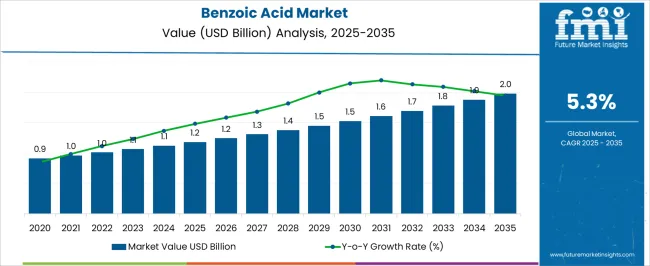
Key Takeaways, Market Size, and Forecast
- Benzoic Acid Market is projected to grow from USD 1.3 billion in 2026 to USD 2.1 billion by 2036, at a CAGR of 5.3%.
- The benzoic acid market was valued at USD 1.2 billion in 2025.
- By 2036, the Benzoic Acid Market is expected to be worth USD 2.1 billion.
- From 2026 to 2036, the market is projected to expand at a CAGR of 5.3%.
- The market is projected to create an incremental opportunity of USD 0.9 billion between 2026 and 2036.
- In 2026, Friedel-Crafts Reaction is expected to account for 57.9% of the production method segment.
- China (7.2%) and India (6.6%) are two of the fastest growing markets.
The benzoic acid market is evolving across application categories, with demand shaped by end-use sector investment, regulatory developments, and technology advancement through the forecast period from 2026 to 2036.
Benzoic Acid Market Definition
The benzoic acid market encompasses the aromatic carboxylic acid compound (C6H5COOH) produced through Friedel-Crafts toluene oxidation and Grignard reagent processes. Benzoic acid serves as a food preservative, corrosion inhibitor, alkyd resin component, chemical synthesis intermediate, plasticizer ingredient, and animal feed additive across food & beverage, chemical, cosmetic, and pharmaceutical end-uses.
Benzoic Acid Market Inclusions
Market scope includes all commercially traded benzoic acid segmented by production method (Friedel-Crafts reaction, Grignard reagents), application (food preservatives, corrosive inhibitors, alkyd resins, synthesis intermediates, plasticizers, feed additives), end-use (food & beverages, chemicals, cosmetics and personal care, pharmaceuticals), and region.
Benzoic Acid Market Exclusions
The scope excludes sodium benzoate traded as a separate chemical product, finished food and beverage products containing benzoic acid, and benzoic acid esters classified under separate chemical markets.
Benzoic Acid Market Research Methodology
FMI analysts did primary research by talking to food ingredient procurement managers, chemical company strategists, and feed additive suppliers from food manufacturers, chemical producers, and agricultural companies in Asia-Pacific, Europe, and North America.
Desk Research: The data collection included trade data for food ingredients, statistics on chemical production, and annual reports from companies.
Market Sizing and Forecasting: We get baseline values by adding up the production and trade volumes of benzoic acid from the bottom up. Then, we use region-specific food production growth and chemical intermediate demand curves to make predictions through 2036.
Every three months, projections are checked against statistics from the food industry, chemical production data, and information from manufacturers. This is called the data validation and update cycle.
Why is the Benzoic Acid Market Growing?
- The need for sodium benzoate preservative grows as more processed foods are made. Benzoic acid is still the least expensive way to kill germs in drinks and ready-to-eat meals.
- As industrial production grows, the need for chemical synthesis intermediates grows as well. This is because benzoic acid precursors are used to make benzoyl chloride, benzyl alcohol, and pharmaceutical intermediates.
More and more farmers are using benzoic acid to make their animals' guts healthier and use fewer antibiotics in responsible farming programs. This means that a lot of people are using additives in animal feed.
The market for benzoic acid is steadily growing because of the need to preserve food, the use of chemical intermediates, and the adoption of feed additives. The main derivative, sodium benzoate, is the most common antimicrobial preservative used in food and drinks around the world. The FDA, EU, and Codex Alimentarius all approve it for use in acidic foods and drinks.
There is a lot of demand for chemical intermediate applications. Benzoic acid is used to make benzoyl chloride, which is used in making drugs and polymers, benzyl alcohol, which is used as a solvent and preservative, and other specialty chemicals. Each downstream application has its own demand dynamics, which means that market revenue comes from a variety of sources.
Feed additive consumption is an emerging growth vector. European and Asian livestock producers are adopting benzoic acid as a gut acidifier that improves feed efficiency and reduces pathogenic bacterial load, supporting antibiotic reduction programmes. EU approval of benzoic acid as a feed additive has established regulatory precedent that is expanding to other jurisdictions.
Why is the Benzoic Acid Market Growing?
- The need for sodium benzoate preservative grows as more processed foods are made. Benzoic acid is still the least expensive way to kill germs in drinks and ready-to-eat meals.
- As industrial production grows, the need for chemical synthesis intermediates grows as well. This is because benzoic acid precursors are used to make benzoyl chloride, benzyl alcohol, and pharmaceutical intermediates.
More and more farmers are using benzoic acid to make their animals' guts healthier and use fewer antibiotics in responsible farming programs. This means that a lot of people are using additives in animal feed.
The market for benzoic acid is steadily growing because of the need to preserve food, the use of chemical intermediates, and the adoption of feed additives. The main derivative, sodium benzoate, is the most common antimicrobial preservative used in food and drinks around the world. The FDA, EU, and Codex Alimentarius all approve it for use in acidic foods and drinks.
There is a lot of demand for chemical intermediate applications. Benzoic acid is used to make benzoyl chloride, which is used in making drugs and polymers, benzyl alcohol, which is used as a solvent and preservative, and other specialty chemicals. Each downstream application has its own demand dynamics, which means that market revenue comes from a variety of sources.
Feed additive consumption is an emerging growth vector. European and Asian livestock producers are adopting benzoic acid as a gut acidifier that improves feed efficiency and reduces pathogenic bacterial load, supporting antibiotic reduction programmes. EU approval of benzoic acid as a feed additive has established regulatory precedent that is expanding to other jurisdictions.
Market Segmentation Analysis
- Friedel-Crafts reaction will still make up 57.9% of production methods in 2026. This is because of the established economics, production scale, and infrastructure for toluene oxidation at major chemical manufacturing sites.
- Food preservatives make up 37% of all uses. This is because the global production of processed foods and drinks needs cheap ways to extend their shelf life.
- Food and drinks make up 39.7% of end-use, which shows that benzoic acid is the most common antimicrobial preservative because it has been approved by regulators and is cheaper.
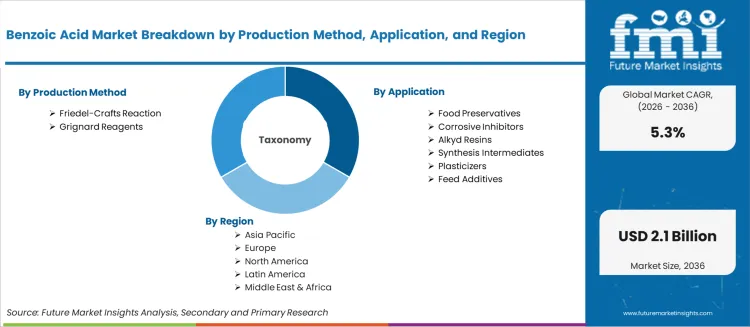
The benzoic acid market is divided into groups based on how it is made, how it is used, and what it is used for. The market is split into Friedel-Crafts reaction and Grignard reagents based on how they are made. The market is divided into food preservatives, corrosive inhibitors, alkyd resins, synthesis intermediates, plasticizers, and feed additives based on how they are used. The market is divided into four groups based on how the products are used: food and drinks, chemicals, cosmetics and personal care, and drugs.
Insights into the Friedel-Crafts Reaction Production Method Segment
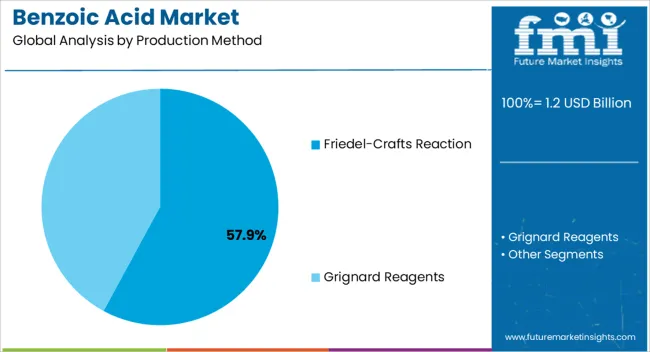
The Friedel-Crafts reaction is expected to have the biggest share of the production method segment in 2026, with 57.9%. This dominance is due to the established economics and scale of catalytic toluene oxidation, which is the main industrial way to make benzoic acid. The process uses cheap toluene as a feedstock, works at mild conditions, and makes high-purity benzoic acid that is safe for food use. Friedel-Crafts-based processes are used in large production facilities in China, India, and Europe that make more than 50,000 tonnes of goods each year.
Insights into the Food Preservatives Application Segment
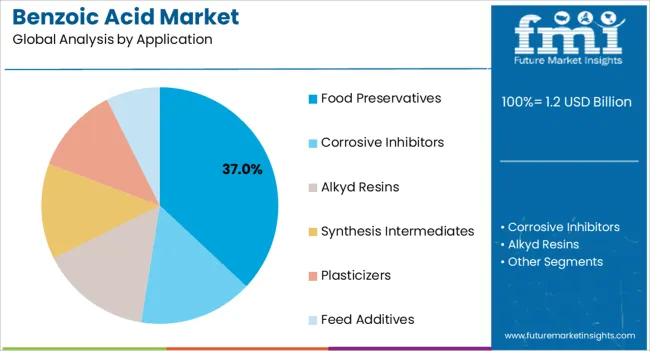
Food preservatives are likely to make up 37.0% of the application segment in 2026. Benzoic acid and its sodium salt are the best preservatives for acidic foods and drinks like fruit juices, soft drinks, pickled foods, and condiments. Sodium benzoate is the best choice for food manufacturers who want to extend the shelf life of their products because it is approved by regulators in more than 150 countries and has been shown to work against yeasts and molds at low concentrations.
Benzoic Acid Market Drivers, Restraints, and Opportunities
- The growth of processed food production and the use of feed additives are making demand grow across the food, chemical, and agricultural value chains.
- The price of toluene feedstock changes a lot, and there is a lot of scrutiny of synthetic food additives by environmental groups. This makes it hard to make money and position yourself in the market.
- Feed additive approval expansion and clean label reformulation using natural benzoic acid sources are creating new market opportunities.
The benzoic acid market is advancing steadily, shaped by food preservation demand, chemical intermediate consumption, and feed additive growth. Manufacturers face feedstock volatility and clean label reformulation pressure. Growth opportunities exist across feed additive expansion, pharmaceutical intermediate demand, and natural-source benzoic acid development.
Processed Food Production and Preservative Demand
The cost of toluene feedstock, which is tied to crude oil prices, puts pressure on growth margins. Because people want clean label products that don't have synthetic additives, there is a long-term risk of reformulation in premium food segments. However, benzoic acid is still a strong choice for value-oriented and institutional food production.
Feedstock Price Volatility and Clean Label Pressure
Growth faces margin pressure from toluene feedstock cost fluctuations linked to crude oil prices. Consumer preference for clean label products without synthetic additives creates long-term reformulation risk in premium food segments, though benzoic acid maintains strong positioning in value-oriented and institutional food production.
Feed Additive Expansion and Natural Source Development
Growth reflects expanding regulatory approval for benzoic acid as a livestock feed additive beyond the EU into Asian and Latin American markets. Natural benzoic acid extracted from gum benzoin resin creates a premium, clean-label positioned product for organic and natural food applications.
Analysis of Benzoic Acid Market By Key Countries
.webp "Top Country Growth Comparison Benzoic Acid Market Cagr (2026 2036)")
| Country | CAGR |
|---|---|
| China | 7.0% |
| India | 6.6% |
| Germany | 6.1% |
| France | 5.6% |
| UK | 5.0% |
| USA | 4.5% |
| Brazil | 4.0% |
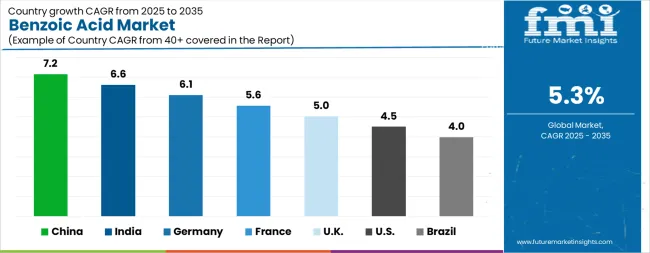
- China has the highest CAGR at 7.0%, thanks to the scale of its processed food production, the demand for chemical intermediates, and the capacity of its own benzoic acid factories.
- India comes next with a 6.6% CAGR, thanks to growth in the food processing industry, demand for pharmaceutical intermediates, and the use of feed additives in livestock operations.
- Germany's 6.1% CAGR is due to demand from the chemical industry, food safety standards, and its advanced chemical manufacturing position.
- The US economy grows at a rate of 4.5% per year, which shows that food processing is becoming more mature and the demand for preservatives and feed additives is growing.
The benzoic acid market is projected to grow globally at a CAGR of 5.3% from 2026 to 2036. Among the top markets, China leads at 7.0%. The analysis spans over 30 countries, with the leading markets detailed below.
Demand Outlook for Benzoic Acid Market in the United States
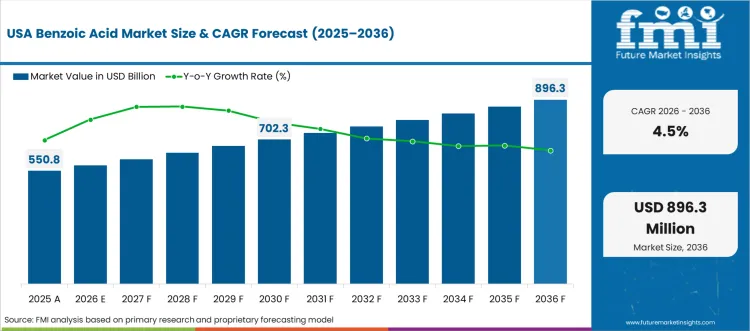
The United States is projected to grow at a CAGR of 4.5% through 2036, shaped by food and beverage preservation demand, pharmaceutical intermediate requirements, and feed additive adoption in livestock production.
- Food preservation demand sustains steady consumption.
- Pharmaceutical intermediate applications create diversified demand.
- Feed additive adoption adds emerging consumption growth.
Future Outlook for Benzoic Acid Market in the United Kingdom
The United Kingdom is projected to grow at a CAGR of 5.0% through 2036, supported by food manufacturing preservation requirements, chemical industry demand, and feed additive growth.
- Food manufacturing sustains preservative consumption.
- Chemical industry creates intermediate demand.
- Feed additive growth adds new application revenue.
Opportunity Analysis of Benzoic Acid Market in Germany
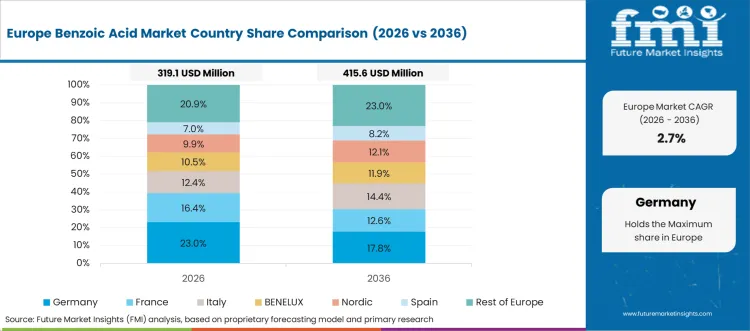
Germany demonstrates strong growth at 6.1% CAGR through 2036 as chemical industry demand, food safety standards, and advanced manufacturing positioning drive expansion.
- Chemical industry demand sustains intermediate consumption.
- Food safety standards drive preservative-grade procurement.
- Advanced manufacturing supports production efficiency.
In-depth Analysis of Benzoic Acid Market in Japan
Japan is projected to grow steadily through 2036, reflecting food industry preservation requirements, chemical manufacturing demand, and quality standards supporting premium-grade benzoic acid procurement.
- Food industry preservation sustains steady demand.
- Chemical manufacturing creates intermediate consumption.
- Quality standards support premium product positioning.
Sales Analysis of Benzoic Acid Market in China
China is expected to lead growth at 7.0% CAGR through 2036, propelled by processed food production scale, chemical intermediate demand, and the world's largest benzoic acid manufacturing base.
- Processed food scale creates largest preservative demand base.
- Chemical intermediate consumption drives production growth.
- Manufacturing base provides cost-competitive global supply.
In-depth Analysis of Benzoic Acid Market in India
India demonstrates strong growth at 6.6% CAGR through 2036, supported by food processing industry growth, pharmaceutical production expansion, and livestock feed additive adoption.
- Food processing growth drives preservative demand expansion.
- Pharmaceutical production creates intermediate consumption.
- Feed additive adoption adds new application demand.
Competitive Landscape and Strategic Positioning
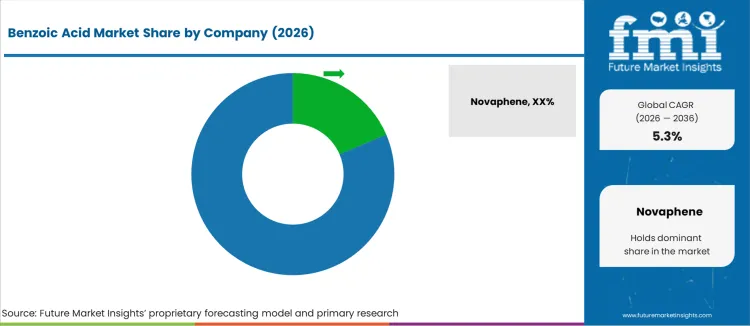
- Specialty chemical and food ingredient companies hold leading positions, with competitive differentiation based on food-grade certification, production scale, and downstream derivative integration.
- Chinese and Indian producers dominate volume production with cost advantages, while European producers command premium pricing through food safety certification and pharmaceutical-grade quality.
- Feed additive market entry requires separate regulatory approval and animal nutrition expertise, creating barriers that protect early movers in this growing application.
The benzoic acid market is shaped by chemical manufacturers and food ingredient suppliers. Merck KGaA provides pharmaceutical and food-grade benzoic acid through integrated chemical production. Emerald Performance Materials offers performance chemical solutions including benzoic acid derivatives. IG Petrochemicals Ltd maintains large-scale production in India.
Novaphene and Sinteza S.A. operate benzoic acid production focused on European and Asian food and chemical markets. Chinese manufacturers including Huangshi Taihua Industry and Wuhan Youji Industries provide cost-competitive volume production serving global commodity demand.
Barriers to entry include food-grade manufacturing certification, environmental compliance for toluene oxidation processes, and established supply relationships with food and chemical manufacturers.
Key Companies in the Benzoic Acid Market
Key global companies leading the benzoic acid market include:
- Merck KGaA (Germany), Emerald Performance Materials (USA), IG Petrochemicals Ltd (India), and Novaphene (India) were identified as some of the star players in the benzoic acid market (global), given their strong chemical manufacturing scale, established food and pharmaceutical industry relationships, and production spanning food-grade, pharmaceutical-grade, and industrial quality specifications.
- Sinteza S.A. (Romania), Chemcrux Enterprises Ltd (India), and Shri Hari Chemicals (India) have established strong regional positions by specializing in cost-effective benzoic acid manufacturing, serving food, chemical, and pharmaceutical companies that prioritize competitive pricing and reliable supply across their respective markets.
- Huangshi Taihua Industry (China), Wuhan Youji Industries (China), and San Fu (China), among others, have distinguished themselves among startups and SMEs by securing strong footholds in high-volume production and export-oriented benzoic acid supply, underscoring their potential as emerging market leaders.
Competitive Benchmarking: Benzoic Acid Market
| Company | Production Scale | Food-Grade Certification | Derivative Integration | Geographic Reach |
|---|---|---|---|---|
| Merck KGaA | High | Strong | High | Global |
| Emerald Performance Materials | Medium | Strong | Medium | Americas |
| IG Petrochemicals Ltd | High | Strong | Medium | South Asia, Global |
| Novaphene | Medium | Strong | Medium | South Asia |
| Sinteza S.A. | Medium | Medium | Low | Europe |
| Huangshi Taihua Industry | High | Medium | Low | East Asia |
| Wuhan Youji Industries | High | Medium | Low | East Asia |
Source: Future Market Insights competitive analysis, 2026.
Key Developments in Benzoic Acid Market
- In 2025, Merck KGaA maintained its strong position as a leading global supplier of high-purity food-grade benzoic acid and sodium benzoate, supporting growing demand for preservatives in processed foods across Asia, Europe, and Latin America.
- In 2025, IG Petrochemicals Ltd continued production of benzoic acid as a value-added by-product from its phthalic anhydride operations at the Taloja facility in India, serving domestic food preservation and industrial export markets.
Key Players in the Benzoic Acid Market:
Major Global Players:
- Merck KGaA
- Emerald Performance Materials
- IG Petrochemicals Ltd
- Novaphene
- Sinteza S.A.
Emerging Players/Startups
- Huangshi Taihua Industry
- Shri Hari Chemicals
- Chemcrux Enterprises Ltd
- Wuhan Youji Industries
- San Fu
Report Scope and Coverage
| Metric | Value |
|---|---|
| Quantitative Units | USD 1.3 billion to USD 2.1 billion, at a CAGR of 5.3% |
| Market Definition | The benzoic acid market encompasses the aromatic carboxylic acid compound (C6H5COOH) produced through Friedel-Crafts toluene oxidation and Grignard reagent processes. Benzoic acid serves as a food preservative, corrosion inhibitor, alkyd resin component, chemical synthesis intermediate, plasticizer ingredient, and animal feed additive across food & beverage, chemical, cosmetic, and pharmaceutical end-uses. |
| Segmentation | Pharmaceuticals |
| Regions Covered | North America, Latin America, Western Europe, Eastern Europe, East Asia, South Asia and Pacific, Middle East & Africa |
| Countries Covered | China, India, Germany, France, UK, USA, Brazil, 30 plus countries |
| Key Companies Profiled | Merck KGaA, Emerald Performance Materials, IG Petrochemicals Ltd, Novaphene, Sinteza S.A., Huangshi Taihua Industry, Shri Hari Chemicals, Chemcrux Enterprises Ltd |
| Forecast Period | 2026 to 2036 |
| Approach | Hybrid bottom-up and top-down methodology starting with verified transaction data, projecting adoption velocity across segments and regions. |
Benzoic Acid Market by Segments
Benzoic Acid Market Segmented by Production Method:
- Friedel-Crafts Reaction
- Grignard Reagents
Benzoic Acid Market Segmented by Application:
- Food Preservatives
- Corrosive Inhibitors
- Alkyd Resins
- Synthesis Intermediates
- Plasticizers
- Feed Additives
Benzoic Acid Market Segmented by End-Use:
- Food & Beverages
- Chemicals
- Cosmetics And Personal Care
- Pharmaceuticals
Benzoic Acid Market by Region:
- North America
- USA
- Canada
- Mexico
- Latin America
- Brazil
- Chile
- Rest of Latin America
- Western Europe
- Germany
- UK
- Italy
- Spain
- France
- Nordic
- BENELUX
- Rest of Western Europe
- Eastern Europe
- Russia
- Poland
- Hungary
- Balkan & Baltic
- Rest of Eastern Europe
- East Asia
- China
- Japan
- South Korea
- South Asia and Pacific
- India
- ASEAN
- Australia & New Zealand
- Rest of South Asia and Pacific
- Middle East & Africa
- Kingdom of Saudi Arabia
- Other GCC Countries
- Turkiye
- South Africa
- Other African Union
- Rest of Middle East & Africa
Research Sources and Bibliography
- 1. Codex Alimentarius Commission. (2025). Codex GSFA: Benzoic Acid and Sodium Benzoate Usage Standards. FAO/WHO.
- 2. USA Food and Drug Administration. (2024). FDA GRAS: Benzoic Acid and Sodium Benzoate Safety Assessment. FDA.
- 3. European Food Safety Authority. (2025). EFSA Re-evaluation of Benzoic Acid as Food Additive. EFSA.
- 4. European Commission. (2024). EU Feed Additive Regulation: Benzoic Acid Approval. EC.
- 5. American Chemistry Council. (2025). ACC Aromatic Acid Market Assessment. ACC.
This bibliography is provided for reader reference. The full FMI report contains the complete reference list with primary research documentation.
This Report Answers
- Market sizing and revenue forecasting from 2026 to 2036.
- Segmentation analysis across production method, application, end-use, and region.
- Regional and country-level insights covering over 30 markets.
- Regulatory analysis covering food additive and feed additive approvals.
- Competitive landscape assessment and recent developments.
- Data delivery in PDF and Excel formats with quarterly refresh access.
Frequently Asked Questions
What is the size of the demand in 2026?
The demand for benzoic acid is expected to reach USD 1.26 billion by 2026, thanks to its growing use in food preservation, chemical intermediates, and feed additives.
How big will the market be in 2036?
The market is expected to grow steadily in the production of processed foods and the use of industrial chemicals, reaching USD 2.12 billion by 2036.
What kind of growth do you expect?
The market is expected to grow at a CAGR of 5.3% from 2026 to 2036. This is because demand for food, chemicals, and agriculture is stable.
Which way of making things is the most popular?
The Friedel-Crafts production method is the most popular, with a 57.9% market share. This is because it is cost-effective, can be used to make a lot of products, and has a well-known toluene oxidation process.
How is the need for food preservation driving demand?
Food preservatives make up 37% of total demand. Sodium benzoate is still the most cost-effective antimicrobial solution used in drinks, sauces, and processed foods.
What is making China grow?
China's economy is growing at a 7.0% CAGR because it has a large processed food industry, a strong demand for chemical intermediates, and a lot of production capacity at home.
What does the market mean?
The benzoic acid market is the market for the aromatic carboxylic acid (C6H5COOH) that is used in many different ways, including as a food preservative, a corrosion inhibitor, a chemical intermediate, a plasticizer, and a feed additive.
How does FMI check the data?
FMI checks market data against verified production and trade statistics, which are then compared to food industry data, chemical production metrics, and primary research inputs.
Preview the report firsthand - request a free sample
Get SampleGet the brochure for pricing and purchase details.
Get PDFTable of Content
- Executive Summary
- Global Market Outlook
- Demand-side Trends
- Supply-side Trends
- Technology Roadmap Analysis
- Analysis and Recommendations
- Market Overview
- Market Coverage / Taxonomy
- Market Definition / Scope / Limitations
- Research Methodology
- Chapter Orientation
- Analytical Lens and Working Hypotheses
- Market Structure, Signals, and Trend Drivers
- Benchmarking and Cross-market Comparability
- Market Sizing, Forecasting, and Opportunity Mapping
- Research Design and Evidence Framework
- Desk Research Programme (Secondary Evidence)
- Company Annual and Sustainability Reports
- Peer-reviewed Journals and Academic Literature
- Corporate Websites, Product Literature, and Technical Notes
- Earnings Decks and Investor Briefings
- Statutory Filings and Regulatory Disclosures
- Technical White Papers and Standards Notes
- Trade Journals, Industry Magazines, and Analyst Briefs
- Conference Proceedings, Webinars, and Seminar Materials
- Government Statistics Portals and Public Data Releases
- Press Releases and Reputable Media Coverage
- FMI Internal Proprietary Databases and Historical Market Datasets
- Subscription Datasets and Paid Sources
- Social Channels, Communities, and Digital Listening Inputs
- Additional Desk Sources
- Expert Input and Fieldwork (Primary Evidence)
- Primary Modes
- Qualitative Interviews and Expert Elicitation
- Quantitative Surveys and Structured Data Capture
- Blended Approach
- Why Primary Evidence is Used
- Field Techniques
- Interviews
- Surveys
- Focus Groups
- Observational and In-context Research
- Social and Community Interactions
- Stakeholder Universe Engaged
- C-suite Leaders
- Board Members
- Presidents and Vice Presidents
- R&D and Innovation Heads
- Technical Specialists
- Domain Subject-matter Experts
- Scientists
- Physicians and Other Healthcare Professionals
- Governance, Ethics, and Data Stewardship
- Research Ethics
- Data Integrity and Handling
- Primary Modes
- Tooling, Models, and Reference Databases
- Desk Research Programme (Secondary Evidence)
- Data Engineering and Model Build
- Data Acquisition and Ingestion
- Cleaning, Normalisation, and Verification
- Synthesis, Triangulation, and Analysis
- Quality Assurance and Audit Trail
- Market Background
- Market Dynamics
- Drivers
- Restraints
- Opportunity
- Trends
- Scenario Forecast
- Demand in Optimistic Scenario
- Demand in Likely Scenario
- Demand in Conservative Scenario
- Opportunity Map Analysis
- Product Life Cycle Analysis
- Supply Chain Analysis
- Investment Feasibility Matrix
- Value Chain Analysis
- PESTLE and Porter’s Analysis
- Regulatory Landscape
- Regional Parent Market Outlook
- Production and Consumption Statistics
- Import and Export Statistics
- Market Dynamics
- Global Market Analysis 2021 to 2025 and Forecast, 2026 to 2036
- Historical Market Size Value (USD Million) Analysis, 2021 to 2025
- Current and Future Market Size Value (USD Million) Projections, 2026 to 2036
- Y-o-Y Growth Trend Analysis
- Absolute $ Opportunity Analysis
- Global Market Pricing Analysis 2021 to 2025 and Forecast 2026 to 2036
- Global Market Analysis 2021 to 2025 and Forecast 2026 to 2036, By Production Method
- Introduction / Key Findings
- Historical Market Size Value (USD Million) Analysis By Production Method , 2021 to 2025
- Current and Future Market Size Value (USD Million) Analysis and Forecast By Production Method , 2026 to 2036
- Friedel-Crafts Reaction
- Grignard Reagents
- Friedel-Crafts Reaction
- Y-o-Y Growth Trend Analysis By Production Method , 2021 to 2025
- Absolute $ Opportunity Analysis By Production Method , 2026 to 2036
- Global Market Analysis 2021 to 2025 and Forecast 2026 to 2036, By Application
- Introduction / Key Findings
- Historical Market Size Value (USD Million) Analysis By Application, 2021 to 2025
- Current and Future Market Size Value (USD Million) Analysis and Forecast By Application, 2026 to 2036
- Food Preservatives
- Corrosive Inhibitors
- Alkyd Resins
- Synthesis Intermediates
- Plasticizers
- Feed Additives
- Food Preservatives
- Y-o-Y Growth Trend Analysis By Application, 2021 to 2025
- Absolute $ Opportunity Analysis By Application, 2026 to 2036
- Global Market Analysis 2021 to 2025 and Forecast 2026 to 2036, By End-Use
- Introduction / Key Findings
- Historical Market Size Value (USD Million) Analysis By End-Use, 2021 to 2025
- Current and Future Market Size Value (USD Million) Analysis and Forecast By End-Use, 2026 to 2036
- Food & Beverages
- Chemicals
- Cosmetics And Personal Care
- Pharmaceuticals
- Food & Beverages
- Y-o-Y Growth Trend Analysis By End-Use, 2021 to 2025
- Absolute $ Opportunity Analysis By End-Use, 2026 to 2036
- Global Market Analysis 2021 to 2025 and Forecast 2026 to 2036, By Region
- Introduction
- Historical Market Size Value (USD Million) Analysis By Region, 2021 to 2025
- Current Market Size Value (USD Million) Analysis and Forecast By Region, 2026 to 2036
- North America
- Latin America
- Western Europe
- Eastern Europe
- East Asia
- South Asia and Pacific
- Middle East & Africa
- Market Attractiveness Analysis By Region
- North America Market Analysis 2021 to 2025 and Forecast 2026 to 2036, By Country
- Historical Market Size Value (USD Million) Trend Analysis By Market Taxonomy, 2021 to 2025
- Market Size Value (USD Million) Forecast By Market Taxonomy, 2026 to 2036
- By Country
- USA
- Canada
- Mexico
- By Production Method
- By Application
- By End-Use
- By Country
- Market Attractiveness Analysis
- By Country
- By Production Method
- By Application
- By End-Use
- Key Takeaways
- Latin America Market Analysis 2021 to 2025 and Forecast 2026 to 2036, By Country
- Historical Market Size Value (USD Million) Trend Analysis By Market Taxonomy, 2021 to 2025
- Market Size Value (USD Million) Forecast By Market Taxonomy, 2026 to 2036
- By Country
- Brazil
- Chile
- Rest of Latin America
- By Production Method
- By Application
- By End-Use
- By Country
- Market Attractiveness Analysis
- By Country
- By Production Method
- By Application
- By End-Use
- Key Takeaways
- Western Europe Market Analysis 2021 to 2025 and Forecast 2026 to 2036, By Country
- Historical Market Size Value (USD Million) Trend Analysis By Market Taxonomy, 2021 to 2025
- Market Size Value (USD Million) Forecast By Market Taxonomy, 2026 to 2036
- By Country
- Germany
- UK
- Italy
- Spain
- France
- Nordic
- BENELUX
- Rest of Western Europe
- By Production Method
- By Application
- By End-Use
- By Country
- Market Attractiveness Analysis
- By Country
- By Production Method
- By Application
- By End-Use
- Key Takeaways
- Eastern Europe Market Analysis 2021 to 2025 and Forecast 2026 to 2036, By Country
- Historical Market Size Value (USD Million) Trend Analysis By Market Taxonomy, 2021 to 2025
- Market Size Value (USD Million) Forecast By Market Taxonomy, 2026 to 2036
- By Country
- Russia
- Poland
- Hungary
- Balkan & Baltic
- Rest of Eastern Europe
- By Production Method
- By Application
- By End-Use
- By Country
- Market Attractiveness Analysis
- By Country
- By Production Method
- By Application
- By End-Use
- Key Takeaways
- East Asia Market Analysis 2021 to 2025 and Forecast 2026 to 2036, By Country
- Historical Market Size Value (USD Million) Trend Analysis By Market Taxonomy, 2021 to 2025
- Market Size Value (USD Million) Forecast By Market Taxonomy, 2026 to 2036
- By Country
- China
- Japan
- South Korea
- By Production Method
- By Application
- By End-Use
- By Country
- Market Attractiveness Analysis
- By Country
- By Production Method
- By Application
- By End-Use
- Key Takeaways
- South Asia and Pacific Market Analysis 2021 to 2025 and Forecast 2026 to 2036, By Country
- Historical Market Size Value (USD Million) Trend Analysis By Market Taxonomy, 2021 to 2025
- Market Size Value (USD Million) Forecast By Market Taxonomy, 2026 to 2036
- By Country
- India
- ASEAN
- Australia & New Zealand
- Rest of South Asia and Pacific
- By Production Method
- By Application
- By End-Use
- By Country
- Market Attractiveness Analysis
- By Country
- By Production Method
- By Application
- By End-Use
- Key Takeaways
- Middle East & Africa Market Analysis 2021 to 2025 and Forecast 2026 to 2036, By Country
- Historical Market Size Value (USD Million) Trend Analysis By Market Taxonomy, 2021 to 2025
- Market Size Value (USD Million) Forecast By Market Taxonomy, 2026 to 2036
- By Country
- Kingdom of Saudi Arabia
- Other GCC Countries
- Turkiye
- South Africa
- Other African Union
- Rest of Middle East & Africa
- By Production Method
- By Application
- By End-Use
- By Country
- Market Attractiveness Analysis
- By Country
- By Production Method
- By Application
- By End-Use
- Key Takeaways
- Key Countries Market Analysis
- USA
- Pricing Analysis
- Market Share Analysis, 2025
- By Production Method
- By Application
- By End-Use
- Canada
- Pricing Analysis
- Market Share Analysis, 2025
- By Production Method
- By Application
- By End-Use
- Mexico
- Pricing Analysis
- Market Share Analysis, 2025
- By Production Method
- By Application
- By End-Use
- Brazil
- Pricing Analysis
- Market Share Analysis, 2025
- By Production Method
- By Application
- By End-Use
- Chile
- Pricing Analysis
- Market Share Analysis, 2025
- By Production Method
- By Application
- By End-Use
- Germany
- Pricing Analysis
- Market Share Analysis, 2025
- By Production Method
- By Application
- By End-Use
- UK
- Pricing Analysis
- Market Share Analysis, 2025
- By Production Method
- By Application
- By End-Use
- Italy
- Pricing Analysis
- Market Share Analysis, 2025
- By Production Method
- By Application
- By End-Use
- Spain
- Pricing Analysis
- Market Share Analysis, 2025
- By Production Method
- By Application
- By End-Use
- France
- Pricing Analysis
- Market Share Analysis, 2025
- By Production Method
- By Application
- By End-Use
- India
- Pricing Analysis
- Market Share Analysis, 2025
- By Production Method
- By Application
- By End-Use
- ASEAN
- Pricing Analysis
- Market Share Analysis, 2025
- By Production Method
- By Application
- By End-Use
- Australia & New Zealand
- Pricing Analysis
- Market Share Analysis, 2025
- By Production Method
- By Application
- By End-Use
- China
- Pricing Analysis
- Market Share Analysis, 2025
- By Production Method
- By Application
- By End-Use
- Japan
- Pricing Analysis
- Market Share Analysis, 2025
- By Production Method
- By Application
- By End-Use
- South Korea
- Pricing Analysis
- Market Share Analysis, 2025
- By Production Method
- By Application
- By End-Use
- Russia
- Pricing Analysis
- Market Share Analysis, 2025
- By Production Method
- By Application
- By End-Use
- Poland
- Pricing Analysis
- Market Share Analysis, 2025
- By Production Method
- By Application
- By End-Use
- Hungary
- Pricing Analysis
- Market Share Analysis, 2025
- By Production Method
- By Application
- By End-Use
- Kingdom of Saudi Arabia
- Pricing Analysis
- Market Share Analysis, 2025
- By Production Method
- By Application
- By End-Use
- Turkiye
- Pricing Analysis
- Market Share Analysis, 2025
- By Production Method
- By Application
- By End-Use
- South Africa
- Pricing Analysis
- Market Share Analysis, 2025
- By Production Method
- By Application
- By End-Use
- USA
- Market Structure Analysis
- Competition Dashboard
- Competition Benchmarking
- Market Share Analysis of Top Players
- By Regional
- By Production Method
- By Application
- By End-Use
- Competition Analysis
- Competition Deep Dive
- Novaphene
- Overview
- Product Portfolio
- Profitability by Market Segments (Product/Age /Sales Channel/Region)
- Sales Footprint
- Strategy Overview
- Marketing Strategy
- Product Strategy
- Channel Strategy
- Huangshi Taihua Industry
- Shri Hari Chemicals
- Chemcrux Enterprises Ltd
- Sinteza S.A
- Wuhan Youji Industries; Fushimi
- San Fu
- Huayin Jinqiancheng
- Nantong Haiers
- Merck KGaA
- Emerald Performance Materials
- IG Petrochemicals Ltd
- Novaphene
- Competition Deep Dive
- Assumptions & Acronyms Used


