

- Industry Size (2026)
- USD 845.9 Mn
- Forecast (2036)
- USD 1326.3 Mn
- CAGR (2026 to 2036)
- 4.6%
Folic Acid Market Size, Market Forecast and Outlook By FMI
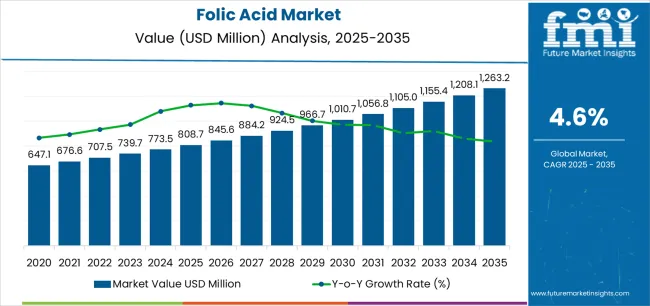
In 2025, the folic acid market was valued at USD 808.5 million. Based on Future Market Insights' analysis, demand for folic acid is estimated to grow to USD 845.9 million in 2026 and USD 1,326.3 million by 2036. FMI projects a CAGR of 4.6% during the forecast period.
Absolute dollar growth of USD 480.4 million over the decade reflects a structural demand base anchored in mandatory fortification policies, maternal nutrition programs, and the expanding nutraceutical supplement market across emerging economies. BASF SE successfully started up major plants at its new Verbund site in Zhanjiang in February 2026, with the Nutrition & Care segment expected to increase earnings significantly, reinforcing the concentration of pharmaceutical-grade folic acid API production among a small number of global chemical producers. [1]
Summary of Folic Acid Market
- Folic Acid Market Definition
- The market covers globally traded synthetic folic acid and folate derivatives used as pharmaceutical API, nutraceutical supplement ingredient, and mandatory food fortification additive across tablet, soft gel, and lozenge delivery forms.
- Demand Drivers in the Market
- Mandatory wheat flour fortification legislation enacted across the UK (December 2026 legal requirement), expanding the baseline demand for food-grade folic acid API independent of consumer supplement purchasing decisions. [2]
- India and China pharmaceutical manufacturing expansion driving API-grade folic acid production capacity growth at 5.9% and 5.3% CAGR respectively, supporting both domestic nutraceutical demand and export-oriented supply.
- BASF's Zhanjiang Verbund site plant startups in February 2026 increasing Nutrition & Care segment output, reinforcing the concentration of global pharmaceutical-grade folic acid production among chemical majors. [1]
- Key Segments Analyzed in the FMI Report
- Application Type: Pharmaceuticals holds 42.6% share in 2026, anchored by prenatal supplement demand, mandatory fortification API supply, and emerging clinical nutrition applications.
- Form: Tablets dominate at 53.8% of volume in 2026, reflecting the established regulatory framework for tablet-form folic acid dosing in both consumer supplement and pharmaceutical contexts.
- Distribution Channel: Offline distribution accounts for 71.5% of channel volume, consistent with pharmacy-dominated purchasing patterns for prenatal and maternal health supplements.
- Analyst Opinion at FMI
- Nandini Roy Choudhury, Principal Consultant for Food & Beverage Industry at Future Market Insights, opines, "In the updated version of the Folic Acid Market Report for 2026 to 2036, CXOs will find that the market's apparent stability at 4.6% CAGR obscures two critical inflection points requiring near-term strategic action. First, the UK's mandatory folic acid flour fortification law confirmed for December 2026 creates a new non-discretionary demand pool that will require API-grade supply commitments from millers before the end of 2025, creating procurement urgency that current spot market supply structures are not equipped to absorb. Second, dsm-firmenich's divestiture of its Animal Nutrition & Health business, which includes vitamin and folate production assets, is reducing the number of large-scale compliant suppliers available to pharmaceutical and nutraceutical buyers operating under GMP audit requirements."
- Strategic Implications / Executive Takeaways
- Secure long-term supply contracts for pharmaceutical-grade folic acid API ahead of the UK mandatory flour fortification deadline of December 2026, as demand surge will compress spot availability from established GMP-certified producers.
- Assess India and China as strategic sourcing diversification options given their above-average CAGR trajectories and expanding API-grade manufacturing infrastructure.
- Monitor the dsm-firmenich Animal Nutrition & Health divestiture process to identify potential supply continuity risks for customers sourcing folate-related products from the combined entity.
- Methodology
- Validated through primary interviews with pharmaceutical API manufacturers, flour milling procurement managers, and food fortification program administrators.
- Supported by government fortification mandate publications from the UK Food Standards Agency, India FSSAI, US FDA, and WHO micronutrient guidance.
- Zero reliance on speculative third-party market research; all forecasts grounded in regulatory timeline data, API capacity disclosures, and verified public health program volumes.
As Dr. Markus Kamieth, CEO of BASF, noted regarding 2025 milestones and 2026 manufacturing outlook, 'We successfully started up the major plants at our new Verbund site in Zhanjiang. Nutrition & Care segments are likely to increase their earnings significantly.' [1]
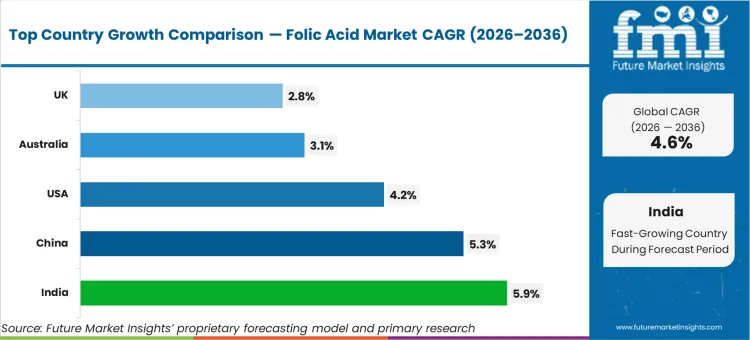
India leads market growth at 5.9% CAGR through 2036, supported by the National Health Mission's maternal micronutrient supplementation programs and expanding pharmaceutical manufacturing capacity. China grows at 5.3%, driven by API export orientation and domestic nutraceutical demand expansion. The USA grows at 4.2%, with fortification policy reinforcement and the FDA's September 2025 initiation of leucovorin calcium approval for cerebral folate deficiency creating new clinical application demand. [3] UK grows at 2.8%, influenced by the mandatory wheat flour fortification law confirmed for December 2026 implementation. Australia grows at 3.1%, supported by existing mandatory fortification programs. Pharmaceuticals holds 42.6% of application share; tablets dominate form at 53.8%; offline distribution accounts for 71.5% of channel volume.
Folic Acid Market Definition
The folic acid market encompasses the global production, trade, and application of pteroylglutamic acid (folate and its synthetic form folic acid) across pharmaceutical API, nutraceutical supplement, and food fortification end uses. The market includes both synthetic folic acid manufactured through chemical processes and naturally sourced folate derivatives used in pharmaceutical and clinical nutrition formulations. Primary applications span prenatal supplement manufacturing, mandatory wheat flour and staple food fortification, medical nutrition for folate deficiency conditions, and functional food and beverage fortification programs.
Folic Acid Market Inclusions
The report includes comprehensive global and regional market sizing by volume and value with a 10-year forecast from 2026 to 2036. Segmental analysis covers application type (Pharmaceuticals, Nutraceuticals, Food And Beverages), source (Plants, Animal), form (Tablets, Soft Gels, Lozenges), and distribution channel (Offline, Online). Country-level CAGR analysis encompasses the USA, UK, China, India, and Australia with broader regional coverage. Mandatory fortification program tracking and regulatory compliance timeline analysis are incorporated alongside pricing dynamics.
Folic Acid Market Exclusions
The scope excludes finished pharmaceutical products such as prenatal multivitamin formulations and prescription folate medications unless the folic acid API component is separately quantified. Naturally occurring folate in unprocessed foods, folinic acid and other folate analogs not used in folic acid fortification applications, and speculative gene therapy or mRNA-based folate metabolism interventions are outside scope. Agricultural fertilizer uses of nitrogen compounds unrelated to nutritional folic acid are excluded.
Folic Acid Market Research Methodology
- Primary Research: Interviews were conducted with pharmaceutical API manufacturers, nutraceutical supplement formulators, food fortification program administrators, regulatory affairs specialists, and procurement managers for flour milling companies operating under mandatory fortification obligations across the UK, India, the USA, and Australia.
- Desk Research: Government fortification mandate publications from Food Standards Scotland, the UK Food Standards Agency, the US FDA, India's FSSAI, and the Australian Food Standards Authority provided regulatory baseline data. WHO technical guidance on micronutrient fortification and UNICEF maternal nutrition program statistics supported demand contextualization.
- Market-Sizing and Forecasting: A hybrid bottom-up and top-down model reconstructed demand from pharmaceutical API production volumes, flour fortification tonnage requirements by country, nutraceutical supplement sales data from publicly available retailer disclosures, and clinical nutrition market sizing, validated against API producer capacity and trade flow data.
- Data Validation and Update Cycle: Outputs were cross-validated against regulatory timeline data for mandated fortification programs, anomaly screening for outlier country trajectories, and structured review by nutrition science and pharmaceutical manufacturing advisors prior to finalization.
Key Industry Highlights
Increased Fortification of Food Products
There is an increasing trend globally to fortify foods with folic acid. Folate deficiency can be combated effectively when cereals, bread, rice and other staple foods contain folic acid as recommended by governments and health agencies. This has a significant impact on public health since it also increases the demand for folic acid in the food sector.
As consumers become more knowledgeable about the advantages of fortified foods manufacturers prefer to add folic acid into their products so as to meet regulations and address buyer's concerns over a healthy diet.
Rising Popularity of Dietary Supplements
Folic acid is one of the components that drive rapid growth rates in dietary supplement industry globally. The present-day consumer seeks healthier lifestyles hence there is increased demand for tablets containing folic acid as supplements in prenatal care among others related to cardiovascular fitness and even generally healthy living.
Tablets, capsules or gummies make it simpler for users to take them up into their regular habits without much difficulty. For instance, there will always be people who look for ways through which they could improve their health using other means apart from eating healthy and hence, this trend keeps rising.
Advancements in Bioavailability and Delivery Methods
Industry trends show that innovations on how best folate dietary supplements can be consumed are what matters most. As a matter of fact, scientists and researchers are developing folic acid formulations that are being created to enhance its absorption and use in the body.
Among these are more bioavailable forms such as L-methylfolate, chewable tablets and liquid supplements that have been developed with better techniques. Nowadays these changes contribute to making folic acid more effective while at the same time considering different consumer choices thereby facilitating people's nutritional requirements.
2020 to 2025 Global Folic Acid Sales Analysis Compared to Demand Forecasts for 2026 to 2036
The global folic acid landscape has seen significant growth over the past few decades because there is increased awareness of health benefits from it and where it can be used. The industry has grown fast due to increased recognition of the role played by folic acid in preventing neural tube defects during pregnancy thus many governments have ordered for food fortification.
In both developed and developing countries, this regulatory support coupled with an increasing consumer health consciousness has pushed demand for folic acid. In other instances like the pharmaceutical industry, folate deficiency diseases including treatments have made folic acid popular hence driving up its demand in worldwide.
This landscape has also been expanded by the nutraceutical sector through dietary supplements aimed at improving health status among people using them that generally contain folic acid as one of their key ingredients.
On the other hand, there are good indicators that the global folic acid sector will grow in the future. Demand is expected to be driven by a continued shift towards preventive healthcare and an increasing acceptance of dietary supplements.
The efficacy of folic acid as well as its capacity to serve a wider segment of customers could be improved through innovations in product formulations such as the development of more bioavailable forms of folic acid.
Moreover, emerging economies’ growing concern regarding maternal health opens doors for growth. Folic acid consumption is projected to increase with the implementation of food fortification programs and other nutritional interventions targeting malnutrition in certain countries. Finally, market expansion may also be fuelled by improvements in biotechnology and greater use of folic acid in functional foods and beverages.
Market Concentration
The folic acid market is moderately fragmented with the presence of both MNCs and regional players. This kind of arrangement leads to diverse products and competitive pricing which are good for customers.
In a fragmented environment, there is no single dominant firm as many small to medium-sized firms operate in it which results into high-level competition and invention. The folic acid sector exhibits these traits, with many companies offering different formulations and delivery methods that satisfy the needs of various consumers.
Alternatively, in a consolidated environment, few large companies dominate leading to less competition but possibly higher prices and less innovation. The huge distribution networks and strong brand recognition held by some big MNCs such as DSM N.V. and BASF SE have made them have significant shares of the folic acid landscape.
Multinational corporations such as Pfizer Inc. or Merck KGaA in the field of folic acid can benefit from their global reach by achieving economies of scale that assure wide product availability across all sectors with consistent quality standards maintained throughout their production process habits. Therefore, they usually engage in extensive research programs that develop highly innovative products or new composition types.
On the other hand, smaller local businesses like Emcure Pharmaceuticals Ltd. from India or Hebei Jiheng Pharmaceutical Co., Ltd. from China concentrate primarily on national landscape, where they possess a deep understanding regarding consumer preferences at regional levels and regulatory policies making them competent enough to challenge established multinationals.
The moderately fragmented nature of the folic acid industry encourages competition and fosters innovation; thus having mixtures of MNCs as well as regional manufacturers enhances its dynamism, allowing wide range price levels with varied goods available to consumers globally.
Country-wise Insights
The following table shows the estimated growth rates of the top industries. The USA and UK are set to exhibit high Folic Acid consumption, recording CAGRs of 4.2% and 2.8%, respectively, through 2036.
.webp "Top Country Growth Comparison Folic Acid Market Cagr (2026 2036)")
| Countries | CAGR 2026 to 2036 |
|---|---|
| USA | 4.2% |
| UK | 2.8% |
| China | 5.3% |
| India | 5.9% |
| Australia | 3.1% |
United States maintains high consumption of Folic Acid
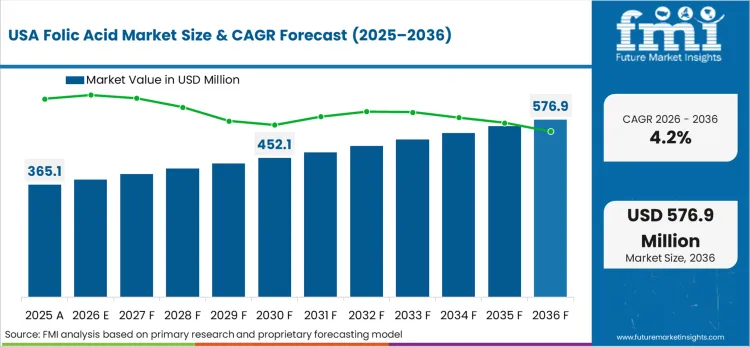
Widespread awareness of its health benefits and strong regulatory support for folic acid fortification in food products have LED to the United States maintaining high consumption levels of the vitamin. Certain staple foods, including cereals and breads, are mandated by the government to have folic acid added to them as a preventive measure against neural tube defects.
In addition, the USA robust pharmaceutical and nutraceutical sectors ensure a constant supply of dietary supplement capsules containing folic acid.
Folic acid has many health-conscious consumers who also serve as healthcare providers hence contributing to its high consumption rates among different groups in society. The USA landscape is projected to grow at a CAGR of 4.6% from 2026 to 2036 and reach a value of USD 1263.2 million or a value of 26.1% in 2036.
Germany is a leader in Folic Acid sales owing to consumer patterns
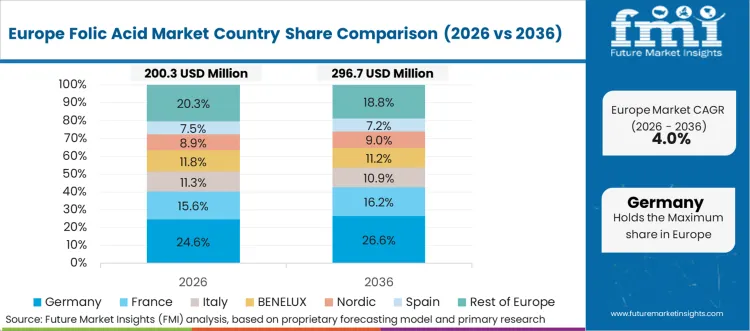
The German market for folic acid has grown over the years and is one of the largest markets in the world due to a health-conscious population and well-established healthcare infrastructure. The German customers prefer preventive healthcare and are well conversant with vitamins as well as supplements such as folic acid. This situation is fostered by Germany's regulatory environment which supports food fortification and high-quality supplementation products.
Additionally, because of these strong pharmaceutical and nutraceutical industries, Germany ensures that there are various brands of folic acid available to its consumers. Hence, through a combination of informed consumer behaviour and industry support, Germany leads in sales of folic acid. The industry is projected to have a world value share of 11.4% in 2036 with a value of USD 808.7 million owing to growth at a forecast CAGR of 3.8% from 2026 to 2036.
Folic Acid Companies penetrating the Chinese landscape
Knowing that China has a large population and increased consciousness about personal health is making more and more manufacturers venture into it. This trend is being driven by rising demand for vitamins/supplements including folic acid among Chinese consumers who have become more health conscious. Companies have started introducing other forms of folic acid like fortified foods that suit this trend as evident from their product lines.
To be successful in entering this market, strategic alliances with local firms must be made to comply with the set regulatory standards. Furthermore, creating awareness about the need for vital minerals such as iron can also increase consumer adoption rates thus making China a significant target for these firms. The Chinese landscape is projected to advance with a forecast CAGR of 5.5% from 2026 to 2036 to reach a value of USD 213.3 million in 2036.
Category-Wise Insights
Use of Folic Acid in food products as supplements is rising significantly
| Segment | Food |
|---|---|
| Main segment | Application Type |
| Value Share (2026) | 24.7% |
Currently, there is an increasing use of food fortified with folate as supplements. It is based on the growing number of customers appreciating the benefits accrued from consuming the additional amount of folic acid, particularly during the pregnancy period; while some others may enhance specific health conditions naturally.
As a result, food producers are responding by bolstering different commodities including cereals breads and beverages by fortifying them with folic acid. Consequently, besides boosting the nutrient value in such foods; it offers people an easier alternative for meeting total consumption needs which can lead to better public health effects.
These reasons have LED to Food application gaining a projected value share of 24.7% in 2036 with a value of USD 304. 6 million owing to a forecast CAGR of 6.3%.
Tablets are the preferred form of Folic Acid consumption
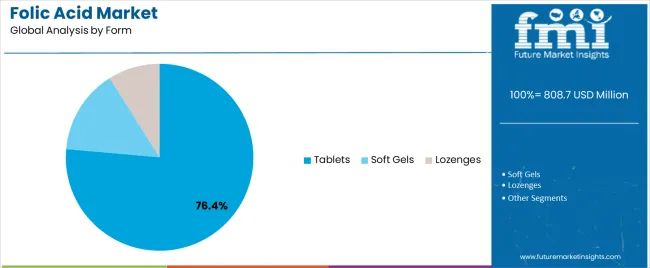
| Segment | Tablets |
|---|---|
| Main segment | Form |
| Value Share (2026) | 53.8% |
Tablets are still the most commonly used form to consume folic acid because they are easy to use, have accurate dosage and can be stored easily. They are also widely available and hence can fit in the daily routines of different consumers. Besides this, tablets have a longer life span as compared to other forms thus ensuring that folic acid remains active for a long time.
Moreover, slow-release tablets enhance the absorption and effectiveness. This is evident from the market where tablet sales continue to dominate due to their practicality and reliability when it comes to delivering nutrient requirements. Folic Acid Tablets are projected to grow with a forecast CAGR of 4.4% from 2026 to 2036, which will help it reach a value of USD 1263.2 million or a value share of 53.8% in 2036.
Competition Outlook
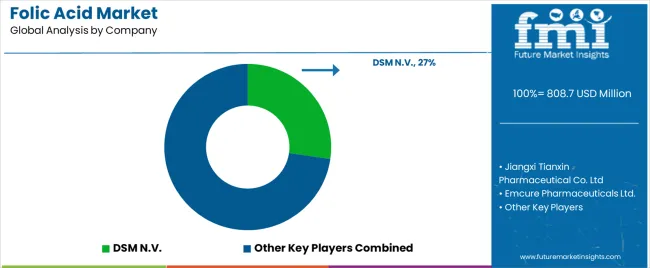
The folic acid market is moderately concentrated in pharmaceutical-grade API supply, with DSM N.V. holding an estimated 27.0% share in 2026 and BASF SE as the second major global producer following completion of its Zhanjiang Verbund site expansions. The competitive field for pharmaceutical and food-grade folic acid API is effectively limited to producers capable of meeting USP, EP, and JP monograph specifications with GMP-compliant manufacturing documentation, restricting meaningful competition to approximately six to eight global API producers. Chinese manufacturers, including Jiangxi Tianxin Pharmaceutical and Hebei Jiheng Pharmaceutical, compete primarily on cost in the food fortification and standard supplement grade segments.
dsm-firmenich's February 2026 announcement of the divestiture of its Animal Nutrition & Health business to CVC Capital Partners for EUR 2.2 billion creates uncertainty for buyers with long-standing supply relationships in the folate and vitamin category. [4] The transaction, classified as assets held for sale, transfers production assets and commercial relationships to a private equity structure, potentially altering supply terms, GMP audit accessibility, and technical support continuity for affected customers. The Sacheon-si Government in South Korea published a tender in February 2026 for folic acid and iron supplements for maternal and child health programs, reflecting the public sector procurement pattern that creates predictable institutional demand across government health programs globally. [5]
Buyer leverage varies significantly by grade. Pharmaceutical-grade buyers with GMP and pharmacopoeia compliance requirements face limited supplier alternatives and moderate-to-low pricing leverage. Food fortification buyers operating under government contracts benefit from volume commitments that enable competitive tendering but face mandatory specification requirements that restrict the supplier pool to certified producers.
Recent Developments
- September 2025: The UK government officially confirmed that the fortification of non-wholemeal wheat flour with folic acid will become a legal requirement starting in December 2026. This public health initiative is designed to increase baseline folic acid intake across the population to reduce the incidence of neural tube defects in babies, estimated to prevent approximately 200 NTDs annually and result in significant cost savings for the NHS. [2]
- September 2025: The USA FDA initiated the approval process for leucovorin calcium tablets specifically for the treatment of patients with cerebral folate deficiency, collaborating with GSK to include essential scientific data for safe use in adult and pediatric patients. This creates a new clinical application demand channel for folate derivatives within the broader folic acid market. [3]
- January 2025: BASF SE completed the divestiture of its production site in Illertissen, Germany, to the Louis Dreyfus Company. This site has historically been a significant hub for the processing and manufacturing of food and health ingredients including vitamin-related products like folic acid, reflecting a broader shift among major chemical conglomerates to focus on core industrial chemicals. [1]
Key Players in Folic Acid Market
- DSM N.V.
- BASF SE
- Jiangxi Tianxin Pharmaceutical Co. Ltd
- Emcure Pharmaceuticals Ltd.
- Zydus Pharmaceuticals Ltd.
- Medicamen Biotech Ltd.
- Hebei Jiheng Pharmaceutical Co., Ltd.
- Hema Pharmaceuticals Pvt. Ltd.
- Pfizer Inc.
- Superior Supplement Manufacturing
Scope of the Report
| Metric | Value |
|---|---|
| Quantitative Units | USD 845.9 million (2026) to USD 1,326.3 million (2036), at a CAGR of 4.6% |
| Market Definition | The folic acid market encompasses global production, trade, and application of pteroylglutamic acid and folate derivatives as pharmaceutical API, nutraceutical supplement ingredient, and mandatory food fortification additive across tablet, soft gel, and lozenge delivery forms. |
| Application Type Segmentation | Pharmaceuticals, Nutraceuticals, Food And Beverages |
| Source Segmentation | Plants, Animal |
| Form Segmentation | Tablets, Soft Gels, Lozenges |
| Distribution Channel Segmentation | Offline, Online |
| Regions Covered | North America, Latin America, Europe, East Asia, South Asia, Oceania, Middle East and Africa |
| Countries Covered | United States, United Kingdom, China, India, Australia, Germany, France, Japan, South Korea, Brazil and 40 plus countries |
| Key Companies Profiled | DSM N.V., BASF SE, Jiangxi Tianxin Pharmaceutical Co. Ltd, Emcure Pharmaceuticals Ltd., Zydus Pharmaceuticals Ltd., Medicamen Biotech Ltd., Hebei Jiheng Pharmaceutical Co. Ltd., Hema Pharmaceuticals Pvt. Ltd., Pfizer Inc., Superior Supplement Manufacturing |
| Forecast Period | 2026 to 2036 |
| Approach | Hybrid bottom-up and top-down market modeling validated through primary interviews with pharmaceutical API manufacturers and food fortification program administrators, supported by government regulatory mandate publications and WHO micronutrient guidance |
Folic Acid Market Analysis by Segments
Application Type:
- Pharmaceuticals (42.6% share, 2026)
- Nutraceuticals
- Food And Beverages
Source:
- Plants (64.2% share, 2026)
- Animal
Form:
- Tablets (53.8% share, 2026)
- Soft Gels
- Lozenges
Distribution Channel:
- Offline (71.5% share, 2026)
- Online
Region:
- North America: United States (USD 298.1M, 2026), Canada, Mexico
- Latin America: Brazil, Argentina, Chile, Rest of Latin America
- Europe: United Kingdom, Germany, France, Italy, Spain, Benelux, Nordics, Rest of Europe
- East Asia: China, Japan (USD 645.8M projected, 2036), South Korea
- South Asia: India, Indonesia, Malaysia, Thailand, Rest of South Asia
- Oceania: Australia, New Zealand
- Middle East & Africa: Saudi Arabia, UAE, South Africa, Rest of Middle East & Africa
Bibliography
- [1] BASF SE. (2026). Plants at Zhanjiang Verbund Site Successfully Started Up. Corporate Press Release, February 2026. https://www.basf.com/global/en/media/news-releases/2026/02/p-26-020
- [2] Campden BRI / Food Standards Scotland. (2025). Bread Flour Regulations Update: Mandatory Folic Acid Fortification Confirmed. Industry Briefing, September 2025. https://www.campdenbri.co.uk/blogs/bread-flour-regulations-update.php
- [3] U.S. Food and Drug Administration. (2025). FDA Takes Action to Make Treatment Available for Autism Symptoms via Cerebral Folate Deficiency. Press Announcement, September 2025. https://www.fda.gov/news-events/press-announcements/fda-takes-action-make-treatment-available-autism-symptoms
- [4] dsm-firmenich. (2026). dsm-firmenich Reports Full-Year 2025 Results: Strategic Plan Fully Executed Following Announced ANH Divestiture. Corporate Press Release, February 2026. https://our-company.dsm-firmenich.com/en/our-company/news/press-releases/2026/dsm-firmenich-reports-full-year-2025-results.html
- [5] Tender Impulse / Sacheon-si Government, South Korea. (2026). Purchase of Folic Acid and Iron Supplements to Promote Maternal and Child Health Projects in 2026. Government Tender, February 2026. https://tenderimpulse.com/government-tenders/korea/purchase-of-folic-acid-and-iron-supplements-to-promote-maternal-and-child-health-11334966
This Report Addresses
- Market intelligence to enable API sourcing strategy and fortification compliance planning across pharmaceutical, nutraceutical, and food fortification application segments
- Market size estimation and 10-year revenue forecasts from 2026 to 2036, supported by government fortification mandate data and API producer capacity benchmarks
- Growth opportunity mapping across pharmaceutical, nutraceutical, and food fortification end uses with emphasis on mandatory fortification policy-driven demand creation
- Segment and regional revenue forecasts covering application type, form, source, and distribution channel dimensions with country-level CAGR analysis
- Competition strategy assessment including producer consolidation tracking, API grade compliance benchmarking, and impact of dsm-firmenich divestiture on supply landscape
- Regulatory impact analysis covering UK mandatory fortification law, India FSSAI requirements, US FDA leucovorin calcium approvals, and WHO micronutrient fortification guidance
- Supply chain analysis covering GMP-certified production concentration risks, Chinese API producer expansion, and impact of BASF Zhanjiang site on global pharmaceutical-grade availability
- Market report delivery in PDF, Excel, PPT, and interactive dashboard formats for executive and operational use
Frequently Asked Questions
How large is the demand for Folic Acid in the global market in 2026?
Demand for Folic Acid in the global market is estimated to be valued at USD 845.9 million in 2026.
What will be the market size of Folic Acid by 2036?
Market size for Folic Acid is projected to reach USD 1,326.3 million by 2036.
What is the expected CAGR for the Folic Acid market between 2026 and 2036?
Demand for Folic Acid is expected to grow at a CAGR of 4.6% between 2026 and 2036.
Which application type leads the Folic Acid market in 2026?
Pharmaceuticals holds 42.6% of application share in 2026, anchored by prenatal supplement API demand, mandatory flour fortification programs, and emerging clinical nutrition applications for folate deficiency conditions.
Which form dominates the Folic Acid market?
Tablets dominate at 53.8% of volume in 2026, reflecting established regulatory and consumer preference for tablet-form folic acid dosing in pharmaceutical and supplement contexts.
Which distribution channel holds the largest share?
Offline distribution accounts for 71.5% of channel volume in 2026, consistent with pharmacy and healthcare outlet-dominated purchasing patterns for prenatal and maternal health folic acid products.
What is driving Folic Acid demand in the United Kingdom?
The UK confirmed mandatory folic acid fortification of non-wholemeal wheat flour becoming law in December 2026, creating a new non-discretionary demand pool estimated to prevent approximately 200 neural tube defects annually and reduce NHS expenditure.
What is the growth outlook for Folic Acid in India and China?
India leads at 5.9% CAGR through 2036 driven by National Health Mission maternal nutrition programs and pharmaceutical API capacity expansion. China follows at 5.3% CAGR, supported by API export orientation and domestic nutraceutical market growth.
What is the significance of the BASF Zhanjiang site for Folic Acid supply?
BASF's February 2026 startup of major plants at its Zhanjiang Verbund site is expected to materially increase Nutrition & Care segment output, reinforcing the company's position as a primary global supplier of pharmaceutical-grade folic acid API.
What does this report cover in its scope?
Scope covers folic acid API by application type, form, source, and distribution channel, with regional and country forecasts, mandatory fortification compliance timelines, producer consolidation analysis, and regulatory impact assessment across pharmaceutical and food fortification end uses.
Preview the report firsthand - request a free sample
Get SampleGet the brochure for pricing and purchase details.
Get PDFTable of Content
- Executive Summary
- Global Market Outlook
- Demand-side Trends
- Supply-side Trends
- Technology Roadmap Analysis
- Analysis and Recommendations
- Market Overview
- Market Coverage / Taxonomy
- Market Definition / Scope / Limitations
- Research Methodology
- Chapter Orientation
- Analytical Lens and Working Hypotheses
- Market Structure, Signals, and Trend Drivers
- Benchmarking and Cross-market Comparability
- Market Sizing, Forecasting, and Opportunity Mapping
- Research Design and Evidence Framework
- Desk Research Programme (Secondary Evidence)
- Company Annual and Sustainability Reports
- Peer-reviewed Journals and Academic Literature
- Corporate Websites, Product Literature, and Technical Notes
- Earnings Decks and Investor Briefings
- Statutory Filings and Regulatory Disclosures
- Technical White Papers and Standards Notes
- Trade Journals, Industry Magazines, and Analyst Briefs
- Conference Proceedings, Webinars, and Seminar Materials
- Government Statistics Portals and Public Data Releases
- Press Releases and Reputable Media Coverage
- Specialist Newsletters and Curated Briefings
- Sector Databases and Reference Repositories
- FMI Internal Proprietary Databases and Historical Market Datasets
- Subscription Datasets and Paid Sources
- Social Channels, Communities, and Digital Listening Inputs
- Additional Desk Sources
- Expert Input and Fieldwork (Primary Evidence)
- Primary Modes
- Qualitative Interviews and Expert Elicitation
- Quantitative Surveys and Structured Data Capture
- Blended Approach
- Why Primary Evidence is Used
- Field Techniques
- Interviews
- Surveys
- Focus Groups
- Observational and In-context Research
- Social and Community Interactions
- Stakeholder Universe Engaged
- C-suite Leaders
- Board Members
- Presidents and Vice Presidents
- R&D and Innovation Heads
- Technical Specialists
- Domain Subject-matter Experts
- Scientists
- Physicians and Other Healthcare Professionals
- Governance, Ethics, and Data Stewardship
- Research Ethics
- Data Integrity and Handling
- Primary Modes
- Tooling, Models, and Reference Databases
- Desk Research Programme (Secondary Evidence)
- Data Engineering and Model Build
- Data Acquisition and Ingestion
- Cleaning, Normalisation, and Verification
- Synthesis, Triangulation, and Analysis
- Quality Assurance and Audit Trail
- Market Background
- Market Dynamics
- Drivers
- Restraints
- Opportunity
- Trends
- Scenario Forecast
- Demand in Optimistic Scenario
- Demand in Likely Scenario
- Demand in Conservative Scenario
- Opportunity Map Analysis
- Product Life Cycle Analysis
- Supply Chain Analysis
- Investment Feasibility Matrix
- Value Chain Analysis
- PESTLE and Porter’s Analysis
- Regulatory Landscape
- Regional Parent Market Outlook
- Production and Consumption Statistics
- Import and Export Statistics
- Market Dynamics
- Global Market Analysis 2021 to 2025 and Forecast, 2026 to 2036
- Historical Market Size Value (USD Million) Analysis, 2021 to 2025
- Current and Future Market Size Value (USD Million) Projections, 2026 to 2036
- Y-o-Y Growth Trend Analysis
- Absolute $ Opportunity Analysis
- Global Market Pricing Analysis 2021 to 2025 and Forecast 2026 to 2036
- Global Market Analysis 2021 to 2025 and Forecast 2026 to 2036, By Application Type
- Introduction / Key Findings
- Historical Market Size Value (USD Million) Analysis By Application Type , 2021 to 2025
- Current and Future Market Size Value (USD Million) Analysis and Forecast By Application Type , 2026 to 2036
- Pharmaceuticals
- Nutraceuticals
- Food And Beverages
- Pharmaceuticals
- Y-o-Y Growth Trend Analysis By Application Type , 2021 to 2025
- Absolute $ Opportunity Analysis By Application Type , 2026 to 2036
- Global Market Analysis 2021 to 2025 and Forecast 2026 to 2036, By Source
- Introduction / Key Findings
- Historical Market Size Value (USD Million) Analysis By Source, 2021 to 2025
- Current and Future Market Size Value (USD Million) Analysis and Forecast By Source, 2026 to 2036
- Plants
- Animal
- Plants
- Y-o-Y Growth Trend Analysis By Source, 2021 to 2025
- Absolute $ Opportunity Analysis By Source, 2026 to 2036
- Global Market Analysis 2021 to 2025 and Forecast 2026 to 2036, By Form
- Introduction / Key Findings
- Historical Market Size Value (USD Million) Analysis By Form, 2021 to 2025
- Current and Future Market Size Value (USD Million) Analysis and Forecast By Form, 2026 to 2036
- Tablets
- Soft Gels
- Lozenges
- Tablets
- Y-o-Y Growth Trend Analysis By Form, 2021 to 2025
- Absolute $ Opportunity Analysis By Form, 2026 to 2036
- Global Market Analysis 2021 to 2025 and Forecast 2026 to 2036, By Distribution Channel
- Introduction / Key Findings
- Historical Market Size Value (USD Million) Analysis By Distribution Channel, 2021 to 2025
- Current and Future Market Size Value (USD Million) Analysis and Forecast By Distribution Channel, 2026 to 2036
- Offline
- Online
- Offline
- Y-o-Y Growth Trend Analysis By Distribution Channel, 2021 to 2025
- Absolute $ Opportunity Analysis By Distribution Channel, 2026 to 2036
- Global Market Analysis 2021 to 2025 and Forecast 2026 to 2036, By Region
- Introduction
- Historical Market Size Value (USD Million) Analysis By Region, 2021 to 2025
- Current Market Size Value (USD Million) Analysis and Forecast By Region, 2026 to 2036
- North America
- Latin America
- Western Europe
- Eastern Europe
- East Asia
- South Asia and Pacific
- Middle East & Africa
- Market Attractiveness Analysis By Region
- North America Market Analysis 2021 to 2025 and Forecast 2026 to 2036, By Country
- Historical Market Size Value (USD Million) Trend Analysis By Market Taxonomy, 2021 to 2025
- Market Size Value (USD Million) Forecast By Market Taxonomy, 2026 to 2036
- By Country
- USA
- Canada
- Mexico
- By Application Type
- By Source
- By Form
- By Distribution Channel
- By Country
- Market Attractiveness Analysis
- By Country
- By Application Type
- By Source
- By Form
- By Distribution Channel
- Key Takeaways
- Latin America Market Analysis 2021 to 2025 and Forecast 2026 to 2036, By Country
- Historical Market Size Value (USD Million) Trend Analysis By Market Taxonomy, 2021 to 2025
- Market Size Value (USD Million) Forecast By Market Taxonomy, 2026 to 2036
- By Country
- Brazil
- Chile
- Rest of Latin America
- By Application Type
- By Source
- By Form
- By Distribution Channel
- By Country
- Market Attractiveness Analysis
- By Country
- By Application Type
- By Source
- By Form
- By Distribution Channel
- Key Takeaways
- Western Europe Market Analysis 2021 to 2025 and Forecast 2026 to 2036, By Country
- Historical Market Size Value (USD Million) Trend Analysis By Market Taxonomy, 2021 to 2025
- Market Size Value (USD Million) Forecast By Market Taxonomy, 2026 to 2036
- By Country
- Germany
- UK
- Italy
- Spain
- France
- Nordic
- BENELUX
- Rest of Western Europe
- By Application Type
- By Source
- By Form
- By Distribution Channel
- By Country
- Market Attractiveness Analysis
- By Country
- By Application Type
- By Source
- By Form
- By Distribution Channel
- Key Takeaways
- Eastern Europe Market Analysis 2021 to 2025 and Forecast 2026 to 2036, By Country
- Historical Market Size Value (USD Million) Trend Analysis By Market Taxonomy, 2021 to 2025
- Market Size Value (USD Million) Forecast By Market Taxonomy, 2026 to 2036
- By Country
- Russia
- Poland
- Hungary
- Balkan & Baltic
- Rest of Eastern Europe
- By Application Type
- By Source
- By Form
- By Distribution Channel
- By Country
- Market Attractiveness Analysis
- By Country
- By Application Type
- By Source
- By Form
- By Distribution Channel
- Key Takeaways
- East Asia Market Analysis 2021 to 2025 and Forecast 2026 to 2036, By Country
- Historical Market Size Value (USD Million) Trend Analysis By Market Taxonomy, 2021 to 2025
- Market Size Value (USD Million) Forecast By Market Taxonomy, 2026 to 2036
- By Country
- China
- Japan
- South Korea
- By Application Type
- By Source
- By Form
- By Distribution Channel
- By Country
- Market Attractiveness Analysis
- By Country
- By Application Type
- By Source
- By Form
- By Distribution Channel
- Key Takeaways
- South Asia and Pacific Market Analysis 2021 to 2025 and Forecast 2026 to 2036, By Country
- Historical Market Size Value (USD Million) Trend Analysis By Market Taxonomy, 2021 to 2025
- Market Size Value (USD Million) Forecast By Market Taxonomy, 2026 to 2036
- By Country
- India
- ASEAN
- Australia & New Zealand
- Rest of South Asia and Pacific
- By Application Type
- By Source
- By Form
- By Distribution Channel
- By Country
- Market Attractiveness Analysis
- By Country
- By Application Type
- By Source
- By Form
- By Distribution Channel
- Key Takeaways
- Middle East & Africa Market Analysis 2021 to 2025 and Forecast 2026 to 2036, By Country
- Historical Market Size Value (USD Million) Trend Analysis By Market Taxonomy, 2021 to 2025
- Market Size Value (USD Million) Forecast By Market Taxonomy, 2026 to 2036
- By Country
- Kingdom of Saudi Arabia
- Other GCC Countries
- Turkiye
- South Africa
- Other African Union
- Rest of Middle East & Africa
- By Application Type
- By Source
- By Form
- By Distribution Channel
- By Country
- Market Attractiveness Analysis
- By Country
- By Application Type
- By Source
- By Form
- By Distribution Channel
- Key Takeaways
- Key Countries Market Analysis
- USA
- Pricing Analysis
- Market Share Analysis, 2025
- By Application Type
- By Source
- By Form
- By Distribution Channel
- Canada
- Pricing Analysis
- Market Share Analysis, 2025
- By Application Type
- By Source
- By Form
- By Distribution Channel
- Mexico
- Pricing Analysis
- Market Share Analysis, 2025
- By Application Type
- By Source
- By Form
- By Distribution Channel
- Brazil
- Pricing Analysis
- Market Share Analysis, 2025
- By Application Type
- By Source
- By Form
- By Distribution Channel
- Chile
- Pricing Analysis
- Market Share Analysis, 2025
- By Application Type
- By Source
- By Form
- By Distribution Channel
- Germany
- Pricing Analysis
- Market Share Analysis, 2025
- By Application Type
- By Source
- By Form
- By Distribution Channel
- UK
- Pricing Analysis
- Market Share Analysis, 2025
- By Application Type
- By Source
- By Form
- By Distribution Channel
- Italy
- Pricing Analysis
- Market Share Analysis, 2025
- By Application Type
- By Source
- By Form
- By Distribution Channel
- Spain
- Pricing Analysis
- Market Share Analysis, 2025
- By Application Type
- By Source
- By Form
- By Distribution Channel
- France
- Pricing Analysis
- Market Share Analysis, 2025
- By Application Type
- By Source
- By Form
- By Distribution Channel
- India
- Pricing Analysis
- Market Share Analysis, 2025
- By Application Type
- By Source
- By Form
- By Distribution Channel
- ASEAN
- Pricing Analysis
- Market Share Analysis, 2025
- By Application Type
- By Source
- By Form
- By Distribution Channel
- Australia & New Zealand
- Pricing Analysis
- Market Share Analysis, 2025
- By Application Type
- By Source
- By Form
- By Distribution Channel
- China
- Pricing Analysis
- Market Share Analysis, 2025
- By Application Type
- By Source
- By Form
- By Distribution Channel
- Japan
- Pricing Analysis
- Market Share Analysis, 2025
- By Application Type
- By Source
- By Form
- By Distribution Channel
- South Korea
- Pricing Analysis
- Market Share Analysis, 2025
- By Application Type
- By Source
- By Form
- By Distribution Channel
- Russia
- Pricing Analysis
- Market Share Analysis, 2025
- By Application Type
- By Source
- By Form
- By Distribution Channel
- Poland
- Pricing Analysis
- Market Share Analysis, 2025
- By Application Type
- By Source
- By Form
- By Distribution Channel
- Hungary
- Pricing Analysis
- Market Share Analysis, 2025
- By Application Type
- By Source
- By Form
- By Distribution Channel
- Kingdom of Saudi Arabia
- Pricing Analysis
- Market Share Analysis, 2025
- By Application Type
- By Source
- By Form
- By Distribution Channel
- Turkiye
- Pricing Analysis
- Market Share Analysis, 2025
- By Application Type
- By Source
- By Form
- By Distribution Channel
- South Africa
- Pricing Analysis
- Market Share Analysis, 2025
- By Application Type
- By Source
- By Form
- By Distribution Channel
- USA
- Market Structure Analysis
- Competition Dashboard
- Competition Benchmarking
- Market Share Analysis of Top Players
- By Regional
- By Application Type
- By Source
- By Form
- By Distribution Channel
- Competition Analysis
- Competition Deep Dive
- DSM N.V.
- Overview
- Product Portfolio
- Profitability by Market Segments (Product/Age /Sales Channel/Region)
- Sales Footprint
- Strategy Overview
- Marketing Strategy
- Product Strategy
- Channel Strategy
- BASF SE
- Jiangxi Tianxin Pharmaceutical Co. Ltd
- Emcure Pharmaceuticals Ltd.
- Zydus Pharmaceuticals Ltd.
- Medicamen Biotech Ltd.
- Hebei Jiheng Pharmaceutical Co., Ltd.
- Hema Pharmaceuticals Pvt. Ltd.
- Pfizer Inc.
- Superior Supplement Manufacturing
- Others
- DSM N.V.
- Competition Deep Dive
- Assumptions & Acronyms Used


