

- Market Size (2026)
- USD 448.5 Mn
- Forecast (2036)
- USD 1308.3 Mn
- CAGR (2026 to 2036)
- 11.3%
How big is Breadsticks & Grissini Market in 2026?
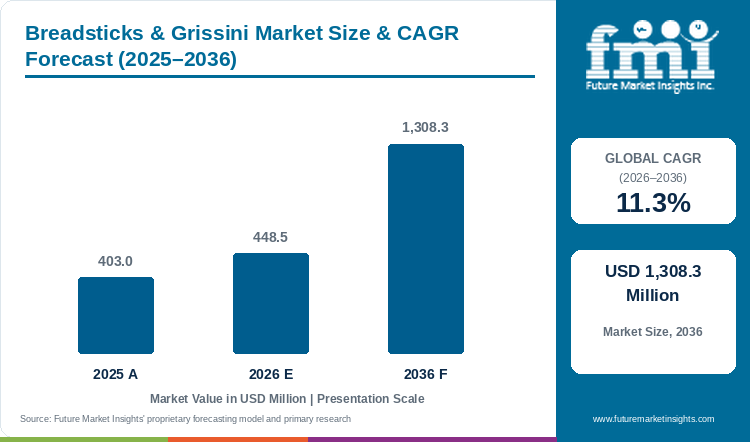
The global breadsticks & grissini market establishes its foundation at USD 403.0 million in 2025, advances to USD 448.5 million in 2026, and is forecast to scale to USD 1,308.3 million by 2036 at a CAGR of 11.3%.
Transit rod breakage sets the margin arithmetic for breadsticks, since a snapped grissini case is written off whole and the deduction lands on the packer rather than the bakery shelf. The global breadsticks & grissini market was valued at USD 403.0 million in 2025 and is estimated to reach USD 448.5 million in 2026. The market is projected to reach USD 1,308.3 million by 2036, expanding at a compound annual growth rate (CAGR) of 11.3% between 2026 and 2036. Classic original rods claim 40.0% of 2026 product demand because plain salted wheat pairs with soups and cured meats at deli economics. Demand growth runs ahead of the extruded snacks market at 5.5% CAGR, as grissini ride restaurant plate formats that reward protected carton geometry while vending multipacks compete on price alone. The growth in breadstick consumption is also reflected in bakery capacity moves, with ARYZTA opening a EUR 40 million Portugal bakery while advancing Perth capacity for August 2026 [23], and Vandemoortele completing its 41-site Délifrance combination in October 2026 to generate EUR 2.2 billion in annual frozen and artisan bakery revenue. Retailers award the standing orders to plants that ship unbroken rods at case economics, not to the widest assortments.
Key Market Trends & Insights
- By product type: Classic / original offerings claim 40.0% of 2026 product demand because plain salted wheat rods pair cleanly with soups and cured meats.
- By claim / nature: Conventional recipes represent 52.0% of 2026 volume since standard enriched wheat flour and culinary vegetable oils keep retail unit pricing accessible.
- By format: Fresh breadsticks and grissini command 32.0% of 2026 format turnover through daily in-store bakery production and restaurant table service.
- By packaging format: Multipack configurations secure 28.0% of 2026 packaging volume by sealing individual portion sleeves against atmospheric humidity after opening.
- By sales channel: Supermarkets & hypermarkets account for 30.0% of 2026 channel sales via perimeter deli cross-merchandising and private-label artisan bakery tiers in Italy.
Regional Highlights
- Top national expansion: The UAE paces global growth with a 12.7% CAGR through 2036 on the strength of luxury hotel banquet catering and gourmet grocery openings.
- Broader country progression: Saudi Arabia follows at a 12.3% CAGR ahead of South Korea at 12.0% and the USA at 11.7% due to casual dining chain rollouts.
Market Size & Forecast
Table 1: Market Size and Forecast for the Breadsticks & Grissini Market (USD million and CAGR percentage), 2025 to 2036
| Metric | Value |
|---|---|
| 2025 Market Size | USD 403.0 million |
| Estimated Market Size in 2026 | USD 448.5 million |
| Projected Market Size by 2036 | USD 1,308.3 million |
| CAGR, 2026 to 2036 | 11.3% |
| Added Revenue, 2026 to 2036 | USD 859.8 million |
Supermarket category buyers are tightening clean-label standards on baked snacks by penalizing excess acrylamide browning and synthetic colorants during annual supplier reviews. High-temperature baking of thin dough cylinders to low residual moisture can trigger Maillard acrylamide spikes unless millers and bakers control reducing sugars and sprouting times. In October 2025, baking chemistry research published in Food Chemistry demonstrated that capping wheat sprouting at 48 hours controlled free asparagine and acrylamide formation while boosting roasted aroma volatiles in low-moisture baked snacks [2]. Major wholesale bakers are simultaneously removing synthetic additives to defend shelf space across breadsticks and artisan savory crackers. In July 2025, Grupo Bimbo disclosed that 99% of its daily bread and roll and breadstick portfolio is free from artificial flavors and colorants ahead of full synthetic dye removal by year-end 2026 [3]. These formulation upgrades enable commercial bakeries to capture USD 859.8 million in net revenue additions between 2026 and 2036.
Production Volume and Tunnel-Oven Throughput Sizing
Table 2: Production Volume and Tunnel-Oven Throughput Sizing for the Breadsticks & Grissini Market (kilotonnes and operational units), 2025 to 2036
| Metric | 2025 | 2026 | 2036 |
|---|---|---|---|
| Market size (USD million) | 403.0 | 448.5 | 1,308.3 |
| Commercial breadsticks & grissini volume (kilotonnes) | 96.0 to 103.5 | 106.5 to 114.8 | 294.0 to 318.0 |
| Dedicated wire-cut, stretched & fresh breadstick lines | 145 to 162 | 160 to 178 | 385 to 420 |
| Average factory-gate realization (USD per kilogram) | 3.89 to 4.20 | 3.91 to 4.21 | 4.11 to 4.45 |
Operational note: Volume estimates reconcile factory-gate revenues against wholesale realizations across fresh bakery rods and ambient multipack grissini.
Unit profitability in high-speed breadstick manufacturing requires uninterrupted wire-cut extrusion and uniform moisture removal across multi-zone tunnel ovens. When dough hydration or total solids drift outside target tolerances, slender rods warp on the oven band and jam downstream flow-wrapping chutes. Under federal bakery identity rules in 21 CFR 136.110 revised in October 2026, standardized bread and roll items must contain at least 62% total solids fermented by yeast [4]. Strict solids and extrusion pressure controls allow contract plants producing breadsticks and packaged biscuits and crackers to expand global breadstick tonnage from 106.5–114.8 kilotonnes in 2026 up to 294.0–318.0 kilotonnes in 2036.
Per Capita & Foodservice Outlet Spending Indicators
Table 3: Per Capita and Foodservice Spending Indicators for the Breadsticks & Grissini Market (USD), 2025 to 2036
| Metric | 2025 | 2026 | 2036 |
|---|---|---|---|
| Global population reference (billion) | 8.2 | 8.3 | 9.0 |
| Spend per 1,000 people (USD) | 49.1 | 54.0 | 145.4 |
| Casual dining, Italy restaurant & hospitality outlets (million) | 1.8 | 1.9 | 2.9 |
| Annual breadstick procurement per active hospitality outlet (USD) | 223.9 | 236.1 | 451.1 |
Table 4: Formulation & Baking Quality Reference Indicators for the Breadsticks & Grissini Market (technical benchmarks), 2026
| Metric | Value | Institutional Reference Basis |
|---|---|---|
| Market size, 2026 | USD 448.5 million | 2026 global factory-gate revenue baseline |
| Minimum standardized solids | >= 62.0% w/w (fresh) / >= 90.0% w/w (dry grissini) | 21 CFR 136.110 statutory bakery solids threshold |
| Whole-wheat sourdough inclusion ceiling | 20.0% w/w fermented grist | 2025 Journal of Food Science texture & volume benchmark |
| Discrete unit serving weight window | 67% to 200% of federal RACC | 21 CFR 101.9 single-unit bakery nutrition labeling rule |
Elevated menu prices at full-service restaurants are motivating households to assemble Mediterranean grazing boards and soup accompaniments at home. Consumers looking to trim dining-out bills purchase specialty grissini and crispy rice paper snacks in grocery deli aisles to recreate restaurant courses for family gatherings. In June 2025, the USDA Economic Research Service confirmed that retail food-at-home price inflation slowed to 1.2% in 2024 while food-away-from-home prices rose 4.1% [5]. This retail cost advantage lifts global breadstick spending per 1,000 people from USD 54.0 in 2026 to reach USD 145.4 in 2036, although olive-oil price swings still test supermarket promotional margins.
Analyst Perspective
"Category expansion in breadsticks and grissini depends on balancing two distinct consumption occasions: daily fresh and par-baked table breadsticks for casual dining chains, and crisp olive-oil or seeded grissini in moisture-barrier multipacks for grocery charcuterie boards. Bakers that combine clean-label sourdough fermentation with crush-resistant tray packaging win space across both perimeter delis and hospitality commissaries."
- Nandini Roy Choudhury, Principal Consultant, Future Market Insights.
How is the breadsticks & grissini market segmented?
The breadsticks & grissini market is segmented by product type, claim / nature, format, packaging format, sales channel, and region. In 2026, Classic / original is projected at 40.0% of the product type segment, Conventional at 52.0% of the claim / nature segment, Fresh at 32.0% of the format segment, Multipack at 28.0% of the packaging format segment, and Supermarkets & hypermarkets at 30.0% of the sales channel segment.
By product type: Classic / original, whole grain & seeded, flavored & filled, mini & snacking formats, and premium / artisan.
By claim / nature: Conventional, clean label, organic, gluten-free, and high-protein / fortified.
By format: Fresh, frozen, ambient packaged, chilled, and par-baked / thaw-and-serve.
By packaging format: Multipack, single-serve, family / loaf pack, and bulk foodservice.
By sales channel: Supermarkets & hypermarkets, artisan & specialty bakeries, convenience & forecourt, online & DTC, and foodservice distributors.
Why does Classic / original lead the product type category?
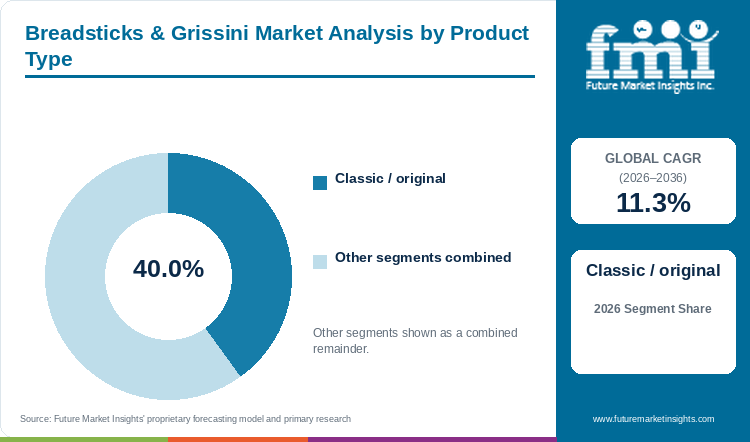
Classic / original breadsticks and grissini account for 40.0% of 2026 product type revenue because unflavored wheat rods run continuously on high-speed lines without allergen washdowns and pair with every savory dip or soup.
Table 5: Product Type Share for the Breadsticks & Grissini Market (percentage share), 2026
| Product Type | Share (2026) |
|---|---|
| Classic / original | 40.0% |
| Other Segments Combined | 60.0% |
| Total | 100.0% |
Calculated as the balance remaining after deducting the leading segment's reported share from 100.0%.
Table 6: Product Type Leadership and Market Growth for the Breadsticks & Grissini Market (segment and CAGR percentage), 2026 to 2036
| Metric | Value |
|---|---|
| Global CAGR (2026 to 2036) | 11.3% |
| Leading Segment | Classic / original |
Plain salted torinesi and classic soft restaurant breadsticks avoid line stoppages for cheese or sesame allergen washdowns in plants producing baked savory snacks. Because unflavored dough formulations run continuously across multi-shift schedules, wholesale bakeries achieve lower unit conversion costs than on specialty filled lines. Supermarket buyers and casual dining chains therefore allocate their largest standing orders to classic / original SKUs that pair with minestrone soups or charcuterie spreads, while specialty rosemary and cheese inclusions face higher scrap rates during wire-cut shaping.
- Classic / original lines generate 40.0% of 2026 product type turnover through uninterrupted extrusion efficiency and broad meal-pairing utility.
- Updated federal nutrition provisions under 21 CFR 101.9 from October 2026 require discrete unit serving declarations and standardized sodium disclosures across packaged bakery items [6].
Why does Conventional define the largest claim / nature segment?
Conventional formulations capture 52.0% of 2026 claim / nature revenue due to predictable forward wheat contracting and cost discipline in mainstream supermarket and restaurant supply.
High-volume grocery private labels and institutional caterers prioritize predictable unit pricing when contracting annual breadstick supply. Industrial bakeries rely on conventional enriched wheat flour and standard culinary oils to keep everyday retail packs below psychological price thresholds. Full plant conversion to certified organic or dedicated gluten-free production requires segregated grain silos and raises raw-material costs by more than one-third, which limits mass-market switching even while clean-label plant-based snacks expand in natural grocery doors.
- Conventional production represents 52.0% of 2026 claim / nature sales because high-volume grocery private labels and institutional caterers prioritize unit cost stability.
- In February 2025, Flowers Foods completed its acquisition of Simple Mills to complement its USD 5.1 billion conventional bakery base with clean-label crackers and snack bars across 30,000 retail stores [7].
What keeps Fresh ahead by format?
Fresh formats represent 32.0% of 2026 format demand as in-store supermarket bakeries and casual Mediterranean dining chains bake warm garlic-brushed and rustic stretched breadsticks throughout the day.
Perimeter grocery bakeries and full-service pasta and Mediterranean restaurants use warm, freshly baked breadsticks as a sensory traffic driver that long-life shelf cartoons cannot replicate. Shoppers picking up prepared rotisserie entrees or pasta meals gravitate toward warm batch-baked rods packaged in perforated crust-preserving bags or resealable bread packaging for same-day dinners. However, fresh breadsticks stale within 24 to 48 hours without preservatives, forcing in-store bakeries to manage afternoon batch sizes carefully to avoid evening write-offs.
- Fresh breadsticks and grissini hold 32.0% of 2026 format volume on the strength of perimeter grocery bakery tables and restaurant dine-in baskets.
- In April 2025, DEFRA updated statutory UK bread and flour composition guidance governing wholemeal naming and fortification exemptions across commercial bakery formats [8].
Why does Multipack lead the packaging format category?
Multipack configurations secure 28.0% of 2026 packaging format sales by dividing crisp grissini and snack rods into individually sealed moisture-barrier pouches that prevent post-opening staling.
Direct exposure of low-moisture grissini to humid kitchen or dining-room air causes gelatinized starch to absorb moisture and lose its crisp snap within hours. To solve this staling problem, commercial bakers divide 250-gram and 360-gram retail boxes into four to eight portion sleeves wrapped in barrier food packaging. This portioned structure keeps remaining sleeves factory-fresh for school lunchboxes and restaurant table service, whereas single-bag family packs suffer rapid humidity uptake in coastal markets.
- Multipack units account for 28.0% of 2026 packaging format revenue because portion-sealed sleeves eliminate humidity staling and table waste.
- In March 2026, Warburtons unveiled a comprehensive packaging redesign across more than 70 bakery lines to mark its 150th anniversary and sharpen multipack shelf navigation [9].
What gives Supermarkets & hypermarkets the leading position in sales channel?
Supermarkets & hypermarkets generate 30.0% of 2026 sales channel revenue by merchandising breadsticks across perimeter in-store bakeries, deli cheese counters, and ambient cracker fixtures.
Large grocery chains hold a structural merchandising advantage over single-format bakeries because they cross-display breadsticks in multiple high-traffic zones. Store placement of artisan grissini tubs beside specialty cheeses and olives captures high-margin entertaining baskets while perimeter bakery tables capture weeknight dinner shoppers. Tiered private-label ranges from value plain breadsticks to organic seeded grissini further lock in supermarket volume, though slotting fees and promotional discount mandates compress margins for smaller regional brands.
- Supermarkets & hypermarkets capture 30.0% of 2026 retail and hospitality distribution through multi-zone store displays and expanding private-label bakery assortments.
- In April 2025 Flowers Foods broadened its branded supermarket bakery catalog with Organic Snack Bites from Dave's Killer Bread plus Canyon Bakehouse Sourdough-Style Bread [10].
What are the drivers, restraints, and opportunities in the breadsticks & grissini market?
In the breadsticks & grissini market, Mediterranean casual dining growth and clean-label fiber fortification propel demand, whereas transit rod breakage and grain-import inflation challenge operating margins.
- Driver: Casual Mediterranean restaurant expansion and at-home charcuterie entertaining elevate year-round orders for classic and seeded snacking breadsticks.
- Restraint: Mechanical rod snapping during palletized freight and moisture-induced loss of crispness trigger retail unsaleable write-offs.
- Opportunity: Formulating sourdough-fermented whole-grain and high-fiber breadsticks unlocks health-conscious grocery and hospitality contracts.
Growth Analysis and Future Potential: Qualitative Demand Catalysts
Consumer demand for gut-friendly dietary fiber and clean-label ingredients is pushing commercial bakers to replace synthetic dough conditioners with natural sourdough fermentation. Addition of whole-wheat sourdough into breadstick and toasted cake rusks doughs improves mineral bioavailability while softening coarse bran particles. in August 2025, fermentation trials published in the journal Foods established that substituting 20% unsprouted whole-wheat flour with sourdough lowered phytic acid content and improved baked volume and crumb texture [11]. Retail bakery leaders are commercializing this fiber shift at scale. In January 2026, Warburtons introduced its Fibre Fix line with 4.0 grams of fiber per 50-gram serving while pledging to make 60% of its portfolio fiber-rich by 2030 [12].
Risk Assessment of the Breadsticks & Grissini Market: Operational and Formulation Friction
Thin dough rods with diameters under 10 millimeters are highly vulnerable to mechanical snapping during highway and ocean freight, which leads to retailer chargebacks and unsaleable inventory. At the same time, persistent food-input and energy inflation across Europe has squeezed wholesale bakery operating margins. In September 2025, the UK Office for National Statistics reported that annual food and non-alcoholic beverage inflation reached 5.1% in August 2025 during elevated utility and ingredient costs [13]. To prevent oven warping and packaging jams without raising scrap rates, industrial bakers dose bakery xylanase enzymes and install optical sorting conveyors ahead of thermoformed tray loaders.
Commercial Opportunity Analysis: Formulation Differentiation and Value-Add Formats
Hospitality operators facing acute shortages of skilled night-shift bakers are shifting procurement toward frozen par-baked breadsticks that finish in five minutes in restaurant ovens. To capture this cross-border foodservice demand, major European bakery groups are consolidating manufacturing and cold-chain distribution networks. In October 2026, Vandemoortele and Délifrance joined forces to establish a global bakery enterprise with 6,000 associates across 41 production sites and EUR 2.2 billion in annual turnover [14]. This combined manufacturing footprint enables rapid rollout of par-baked and artisan breadsticks to restaurant chains and supermarket in-store bakeries across Europe and North America.
Breadsticks & Grissini Market by Country (2026 to 2036)
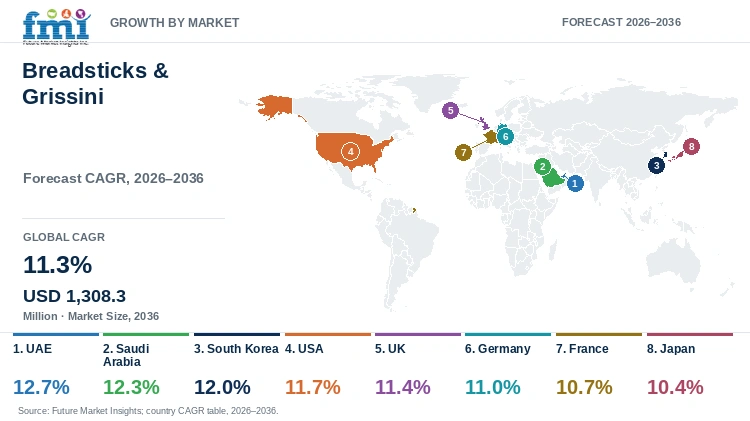
The UAE leads national expansion with a 12.7% CAGR through 2036, followed by Saudi Arabia at 12.3% and South Korea at 12.0% whereas the USA registers 11.7%.
Table 7: Country CAGR and Primary Growth Levers for the Breadsticks & Grissini Market (CAGR percentage and operational drivers), 2026 to 2036
| Country | CAGR (2026 to 2036) | Primary Growth Lever |
|---|---|---|
| UAE | 12.7% | Record international tourism, luxury hotel catering, and gourmet supermarket delicatessens |
| Saudi Arabia | 12.3% | Mega-project hospitality openings, expanding food retail chains, and single-serve catering packs |
| South Korea | 12.0% | Omnichannel grocery snacking, wine-pairing charcuterie demand, and mini filled formats |
| USA | 11.7% | Italy casual dining chains, perimeter supermarket bakery cross-displays, and multipack snacking |
| UK | 11.4% | High private-label grocery share, fiber-enriched bakery launches, and lunchtime multipacks |
| Germany | 11.0% | Record organic retail bakery sales, seeded whole-grain adoption, and discount grocer promotions |
| France | 10.7% | Evening aperitif entertaining, artisan bakery specialty formats, and clean-label olive-oil recipes |
| Japan | 10.4% | Inbound tourism hotel dining, convenience store single-serve packs, and precision moisture packaging |
Source: Future Market Insights analysis
UAE Breadsticks & Grissini Market Outlook (2026 to 2036)
Unlike mature European markets where household grocery purchases dominate volume, demand in the UAE is propelled by five-star hotel banquet kitchens and international airline catering hubs in Dubai and Abu Dhabi. This hospitality procurement drives commercial breadstick sales in the UAE at a 12.7% CAGR between 2026 and 2036. Gulf retail footfall gains reported through 2025 and 2026 continued to lift savory in-store snack placements, including breadstick formats in hypermarket delis. However, extreme summer heat and coastal humidity across the Gulf rapidly soften unprotected baked goods, forcing importers to specify metallized multipack sleeves and nitrogen-flushed canisters.
Key takeaway: In the UAE, record international visitor arrivals and humidity-sealed hospitality multipacks support a top national 12.7% CAGR through 2036.
Saudi Arabia Breadsticks & Grissini Market Outlook (2026 to 2036)
Rapid expansion of Red Sea coastal resorts and Western casual-dining chains in Riyadh and Jeddah is shifting breadstick consumption in Saudi Arabia from occasional gourmet imports to mainstream hospitality and hypermarket staples. In June 2025, the Ministry of Tourism of Saudi Arabia reported that combined domestic and inbound tourist visits exceeded 116 million in 2024, including 30 million international arrivals [16]. Fueled by these hospitality openings and modern grocery rollouts, category revenue in Saudi Arabia expands at a 12.3% CAGR through 2036. Even so, suppliers must navigate strict Halal certification rules that prohibit animal-derived L-cysteine dough relaxers and require deactivated yeast alternatives.
Key takeaway: In Saudi Arabia, expanding tourism hospitality capacity and Halal-certified retail multipacks sustain a 12.3% CAGR through 2036.
South Korea Breadsticks & Grissini Market Outlook (2026 to 2036)
Bakery snack demand in South Korea registers a 12.0% CAGR from 2026 to 2036 since urban single-person households and e-commerce shoppers purchase mini and cheese-filled breadsticks for home wine entertaining. Department store food halls in Seoul and Busan cross-merchandise imported Italy rubata next to European cheese assortments, while dawn-delivery platforms ship portioned snack packs to apartment complexes. In October 2026, the USDA Foreign Agricultural Service highlighted rapid omnichannel and cold-chain e-commerce expansion across South Korea with USD 6.0 billion in imported retail food items [17]. Yet heavy reliance on imported milling wheat and long ocean transit times from Europe expose distributors in South Korea to currency swings and container breakage risks.
Key takeaway: In South Korea, omnichannel snacking growth and department store wine-pairing displays underpin a 12.0% CAGR through 2036.
USA Breadsticks & Grissini Market Outlook (2026 to 2036)
Demand in the USA splits between high-volume soft garlic breadsticks baked on site at casual pasta and pizzeria dining chains and dry-baked artisan grissini sold in supermarket delicatessen counters. Grocery retailers across the USA position thermoformed trays of rosemary and sesame grissini directly beside specialty charcuterie fixtures to capture high-margin entertaining baskets. In June 2026, USDA Economic Research Service trade statistics showed that processed food and beverage imports into the USA—led by baked goods and snack items—totaled USD 136 billion or 64% of agricultural import value in 2025 [18]. Supported by this dual restaurant and grocery deli engine, factory-gate sales in the USA post an 11.7% CAGR over the 10-year forecast period, though port tariffs and state-level synthetic dye bans require continuous supply-chain adjustment.
Key takeaway: In the USA, supermarket charcuterie cross-displays and casual-dining table bread programs generate an 11.7% CAGR through 2036.
UK Breadsticks & Grissini Market Outlook (2026 to 2036)
Grocery retailers in the UK have integrated portion-packed breadsticks into lunchtime meal-deal fixtures and children's snacking multipacks, differentiating the UK from continental dinner-table traditions. Supported by these everyday snacking occasions and premium Mediterranean tiers, breadstick turnover across the UK grows at an 11.4% CAGR through 2036. Specifically, in October 2026, UK Retail Foods reporting by the USDA Foreign Agricultural Service noted that UK retail grocery turnover hit USD 343 billion in 2026 with private-label lines capturing a record 52.2% share of grocery spending [19]. Because supermarkets control over half of category volume, UK contract bakers face intense private-label margin pressure and strict HFSS sodium and fiber reformulation mandates.
Key takeaway: In the UK, record 52.2% private-label grocery penetration and fiber-enriched snack packs drive an 11.4% CAGR through 2036.
Germany Breadsticks & Grissini Market Outlook (2026 to 2036)
Buyer behavior in Germany is shaped by deep-rooted consumer preference for certified organic whole-grain and spelt-sesame baked snacks sold through discount and full-line supermarkets. In January 2026, USDA Foreign Agricultural Service organic market tracking showed that organic food sales in Germany’s certified organic category expanded from EUR 17 billion in 2024 through 2025 under the expansion of supermarket and discounter private-label organic tiers [20]. Through this mainstream organic conversion and Italy promotional weeks at major grocers, retail and hospitality orders in Germany advance at an 11.0% CAGR across 2026 to 2036. Nevertheless, hard-discounter price negotiations and strict acrylamide testing tolerances challenge smaller Italy export bakeries.
Key takeaway: In Germany, deep organic grocery demand and discounter private-label Mediterranean bakery tiers sustain an 11.0% CAGR through 2036.
France Breadsticks & Grissini Market Outlook (2026 to 2036)
Traditional aperitif occasions (l'apéro) across households and neighborhood bistros anchor breadstick consumption in France, where shoppers favor extra-virgin olive oil and Provençal herb recipes over plain white rods. Specialized delicatessens and commercial artisans play a much larger distribution role in France than in North America. In September 2026, France Retail Foods analysis published by the USDA Foreign Agricultural Service confirmed that large general food retailers accounted for 58.6% of retail food sales in France in 2025 while specialized food stores and commercial artisans held 20.4% [21]. Anchored by this specialty retail base and aperitif culture, national demand in France increases at a 10.7% CAGR through 2036, even though national anti-waste packaging rules require costly transitions from plastic trays to paperboard sleeves.
Key takeaway: In France, household aperitif entertaining and artisan bakery olive-oil recipes support a 10.7% CAGR through 2036.
Japan Breadsticks & Grissini Market Outlook (2026 to 2036)
In Japan, convenience store alcohol-snack aisles and urban trattoria and pasta dining chains drive demand for bite-sized and single-serve blister-trayed grissini tailored to compact households. Fueled by inbound hotel dining recovery and convenience retail merchandising in Tokyo and Osaka, grissini and snack-rod revenue in Japan rises at a 10.4% CAGR across the 10-year forecast period. December 2025 foodservice analysis from the USDA Foreign Agricultural Service confirms that hotel and restaurant institutional sales in Japan rose 5.2% to USD 228 billion on booming international tourism [22]. However, zero-tolerance buyer inspections against broken rods and lipid rancidity require suppliers in Japan to invest in rigid internal trays and high-barrier film overwraps.
Key takeaway: In Japan, strong hotel dining recovery and breakage-proof single-serve packs deliver a 10.4% CAGR through 2036.
Full report country CAGRs cover: North America; Latin America; Western Europe; Eastern Europe; East Asia; South Asia and Pacific; Middle East and Africa.
Who are the notable companies in the breadsticks & grissini market?
Grupo Bimbo, Flowers Foods, Aryzta, Lantmannen Unibake, Vandemoortele, Yamazaki Baking, Warburtons, King's Hawaiian, Europastry, and St Pierre Groupe anchor global production and distribution across retail and foodservice channels.
Competition across the global breadsticks & grissini sector connects multinational wholesale bakery groups with European frozen and par-baked foodservice specialists.
- Global Wholesale & Retail Bakery Leaders: Grupo Bimbo and Flowers Foods as well as Yamazaki Baking and Warburtons operate multi-plant baking networks supplying supermarkets and convenience chains.
- European Par-Baked & Savory Bakery Specialists: Aryzta and Lantmannen Unibake as well as Vandemoortele and Europastry supply par-baked table breadsticks and hospitality bakery assortments.
- Branded Specialty & Enriched Bakery Innovators: King's Hawaiian and St Pierre Groupe expand perimeter grocery bakery fixtures and snackable stick occasions across retail chains.
Competitive Benchmarking: Breadsticks & Grissini Market
Table 8: Competitive Benchmarking for the Breadsticks & Grissini Market (qualitative capability ratings), 2026
| Company | Product Type & Format Breadth | Clean-Label & Fortified Formulation | Multipack & Foodservice Packaging | Geographic Reach |
|---|---|---|---|---|
| Grupo Bimbo | High | High | High | High |
| Flowers Foods | High | High | High | Medium |
| Aryzta | High | Medium | High | High |
| Lantmannen Unibake | High | High | High | High |
| Vandemoortele | High | High | High | High |
| Yamazaki Baking | High | Medium | High | Medium |
| Warburtons | Medium | High | High | Medium |
| King's Hawaiian | Medium | High | High | Medium |
| Europastry | High | High | High | High |
| St Pierre Groupe | Medium | High | High | High |
Methodology note: Capability scores assess verified product variety across fresh and par-baked breadsticks; clean-label and fiber reformulation; and multipack and foodservice reach.
Key Developments in the Breadsticks & Grissini Market
- In January 2026, ARYZTA reported that it achieved its full-year 2025 operational targets while opening a new EUR 40 million Portugal bakery and advancing new bakery capacity in Perth for August 2026 [23].
- In October 2026, Vandemoortele and Délifrance completed their combination to form a 41-site global bakery enterprise generating EUR 2.2 billion in annual revenue across frozen and artisan bakery lines.
- In July 2025, Grupo Bimbo advanced its global wellness roadmap by confirming that 99% of its everyday breads and rolls and breadsticks exclude artificial flavors and colorants ahead of a complete dye phase-out by late 2026.
Key Players in the Breadsticks & Grissini Market
Global Wholesale & Retail Bakery Platforms
- Grupo Bimbo
- Flowers Foods
- Yamazaki Baking
- Warburtons
European Frozen, Par-Baked & Foodservice Bakery Specialists
- Aryzta
- Lantmannen Unibake
- Vandemoortele
- Europastry
Branded Specialty & Perimeter Bakery Leaders
- King's Hawaiian
- St Pierre Groupe
Breadsticks & Grissini Market - Report Scope
Table 9: Report Scope for the Breadsticks & Grissini Market (coverage fields and definitions), 2026 to 2036
| Coverage field | Report scope |
|---|---|
| Market breakdown | Product Type; Claim / Nature; Format; Packaging Format; Sales Channel; Region |
| Quantitative Units | USD Million |
| Market Definition | Commercial factory-gate and in-store bakery sales of classic/original, whole grain & seeded, flavored & filled, mini/snacking, and premium/artisan breadsticks and grissini across fresh, frozen, ambient packaged, chilled, and par-baked formats. |
| Regions Covered | North America; Latin America; Western Europe; Eastern Europe; East Asia; South Asia and Pacific; Middle East and Africa |
| Countries Covered | UAE, Saudi Arabia, South Korea, USA, UK, Germany, France, Japan, and 35+ additional countries |
| Key Companies Covered | Grupo Bimbo, Flowers Foods, Aryzta, Lantmannen Unibake, Vandemoortele, Yamazaki Baking, Warburtons, King's Hawaiian, Europastry, St Pierre Groupe |
| Forecast Period | 2026 to 2036 (Base Year: 2025) |
| Approach | Bottom-up bakery line throughput and retail/foodservice SKU value aggregation cross-validated against USDA ERS/FAS trade audits and corporate financial disclosures |
Breadsticks & Grissini Market - Research Methodology
Table 10: Research Methodology for the Breadsticks & Grissini Market (research methods and approach), 2026 edition
| Method | Approach |
|---|---|
| Primary Research | Structured interviews with commercial bakery plant directors, tunnel-oven process engineers, supermarket deli-bakery buyers, and hospitality catering procurement managers across Europe, North America, the Gulf, and East Asia. |
| Secondary Research | Direct verification of eCFR Title 21 bakery standards (21 CFR 136.110, 21 CFR 101.9), USDA ERS and FAS country retail/HRI reports, UK DEFRA bread and flour guidance, PubMed cereal fermentation studies, and official company press releases. |
| Market Sizing and Forecasting | Bottom-up aggregation of fresh, ambient packaged, frozen, chilled, and par-baked breadstick line output and wholesale price realizations from 2025 through 2036. |
| Country Forecasting Model | Country-level demand modeling weighted by international tourism arrivals, casual Italy dining outlet growth, supermarket private-label share, and organic/clean-label adoption. |
| Operational Benchmark Traceability | Cross-checking of statutory total solids (>=62%), discrete unit serving weights, and whole-wheat sourdough fermentation inclusion ceilings against official regulatory and peer-reviewed records. |
| Data Triangulation and Validation | Reconciliation of top-down bakery expenditure statistics with bottom-up manufacturer revenue disclosures from Grupo Bimbo, Flowers Foods, Aryzta, Vandemoortele, and Warburtons. |
Breadsticks & Grissini Market by Segments
Breadsticks & Grissini Market segmented by Product Type:
- Classic / original
- Whole grain & seeded
- Flavored & filled
- Mini & snacking formats
- Premium / artisan
Breadsticks & Grissini Market segmented by Claim / Nature:
- Conventional
- Clean label
- Organic
- Gluten-free
- High-protein / fortified
Breadsticks & Grissini Market segmented by Format:
- Fresh
- Frozen
- Ambient packaged
- Chilled
- Par-baked / thaw-and-serve
Breadsticks & Grissini Market segmented by Packaging Format:
- Multipack
- Single-serve
- Family / loaf pack
- Bulk foodservice
Breadsticks & Grissini Market segmented by Sales Channel:
- Supermarkets & hypermarkets
- Artisan & specialty bakeries
- Convenience & forecourt
- Online & DTC
- Foodservice distributors
Breadsticks & Grissini Market by Region
- North America
- USA
- Canada
- Latin America
- Brazil
- Mexico
- Argentina
- Chile
- Western Europe
- Germany
- France
- UK
- Italy
- Spain
- Benelux
- Nordics
- Eastern Europe
- Poland
- Czech Republic
- Romania
- Hungary
- East Asia
- China
- Japan
- South Korea
- South Asia and Pacific
- India
- ASEAN
- Australia and New Zealand
- Middle East and Africa
- GCC Countries (UAE, Saudi Arabia)
- South Africa
- Türkiye
- Israel
Research Sources and Bibliography
- [1] U.S. Department of Agriculture, Economic Research Service. (2026, June 1). Ag and Food Statistics: Charting the Essentials - Food Prices and Spending | Economic Research Service. USDA Economic Research Service.
- [2] Kocadağlı, T., Göncüoğlu Taş, N., Hamzalıoğlu, A., & Gökmen, V. (2025, October 15). Formation of acrylamide and aroma compounds in biscuits and crackers prepared with sprouted wheat wholemeal. Food Chemistry, 489, 145032 (PubMed NCBI).
- [3] Grupo Bimbo, S.A.B. de C.V. (2025, July 29). We are committed to removing artificial colorants from all our products by the end of 2026 | Grupo Bimbo. Grupo Bimbo Official Press Releases.
- [4] National Archives and Records Administration. (2026, October 15). 21 CFR 136.110 -- Bread, rolls, and buns. - eCFR. Electronic Code of Federal Regulations, Title 21 Part 136.
- [5] U.S. Department of Agriculture, Economic Research Service. (2025, June 11). Food-at-home price growth began to slow in 2023; food-away-from-home prices grew steadily through 2024 | Economic Research Service. USDA Economic Research Service Chart Gallery.
- [6] National Archives and Records Administration. (2026, October 20). 21 CFR 101.9 -- Nutrition labeling of food. - eCFR. Electronic Code of Federal Regulations, Title 21 Part 101.
- [7] Flowers Foods, Inc. (2025, February 21). FLOWERS FOODS, INC. COMPLETES ACQUISITION OF SIMPLE MILLS - Flowers Foods. Flowers Foods Official News Releases.
- [8] Department for Environment, Food & Rural Affairs and Food Standards Agency. (2025, April 23). Bread and flour: labelling and composition - GOV.UK. UK Government Official Guidance.
- [9] Warburtons Ltd. (2026, March 30). Packaging Redesign Unveiled | News | Warburtons. Warburtons Official Corporate Newsroom.
- [10] Flowers Foods, Inc. (2025, April 16). Flowers Foods Launches New Products and Line Expansions to Meet Consumer Needs - Flowers Foods. Flowers Foods Official News Releases.
- [11] Navarro, J. L., López, M. S., Salvucci, E., León, A. E., & Steffolani, M. E. (2025, August 13). Chemical and Nutritional Characterization of Sourdoughs Made with Sprouted and Unsprouted Whole-Wheat Flour and Their Effects on the Technological Quality of Bread. Foods, 14(16), 2805 (PubMed NCBI).
- [12] Warburtons Ltd. (2026, January 22). Fibre Black Holes | News | Warburtons. Warburtons Official Corporate Newsroom.
- [13] Office for National Statistics. (2025, September 17). Consumer price inflation, UK - Office for National Statistics. UK Office for National Statistics Statistical Bulletin.
- [14] Vandemoortele NV. (2026, October 6). Vandemoortele and Délifrance unite to shape the future of Bakery | Vandemoortele. Vandemoortele Official Newsroom.
- [15] Dubai Department of Economy and Tourism. (2026, January 7). Tourism Performance Report January - December 2025. Government of Dubai Official Statistics.
- [16] Ministry of Tourism of Saudi Arabia. (2025, June 22). Ministry of Tourism Saudi Arabia. Kingdom of Saudi Arabia Ministry of Tourism Media Center.
- [17] U.S. Department of Agriculture, Foreign Agricultural Service. (2026, October 5). South Korea: Retail Foods Annual | USDA Foreign Agricultural Service. USDA Foreign Agricultural Service GAIN Report.
- [18] U.S. Department of Agriculture, Economic Research Service. (2026, June 30). Ag and Food Statistics: Charting the Essentials - Agricultural Trade | Economic Research Service. USDA Economic Research Service.
- [19] U.S. Department of Agriculture, Foreign Agricultural Service. (2026, October 1). United Kingdom: Retail Foods Annual | USDA Foreign Agricultural Service. USDA Foreign Agricultural Service GAIN Report.
- [20] U.S. Department of Agriculture, Foreign Agricultural Service. (2026, January 29). Germany: Large Retail Chains Support Record Year for German Organic Sales | USDA Foreign Agricultural Service. USDA Foreign Agricultural Service GAIN Report.
- [21] U.S. Department of Agriculture, Foreign Agricultural Service. (2026, September 30). France: Retail Foods Annual | USDA Foreign Agricultural Service. USDA Foreign Agricultural Service GAIN Report.
- [22] U.S. Department of Agriculture, Foreign Agricultural Service. (2025, December 31). Japan: Food Service - Hotel Restaurant Institutional Annual | USDA Foreign Agricultural Service. USDA Foreign Agricultural Service GAIN Report.
- [23] ARYZTA AG. (2026, January 22). Full year 2025 targets achieved; Revenue growth & improved performance expected in 2026; New €40m bun bakery in Portugal. ARYZTA AG Ad Hoc Announcement Pursuant to Art. 53 LR.
This bibliography is provided for reader reference and is not exhaustive. The full report contains the complete reference list and primary research documentation.
This Report Answers
- What is the global breadsticks & grissini valuation in 2026 and the revenue projection for 2036?
- Which Mediterranean restaurant and grocery charcuterie shifts boost breadstick consumption?
- What factors allow Classic / original varieties to top the product type breakdown?
- Why do conventional recipes retain the majority share of claim / nature demand?
- How do country-level growth rates differ across Gulf hospitality hubs and European grocers?
- Which bakery enterprises lead commercial grissini and table breadstick output?
- What packaging and transit breakage hurdles constrain breadsticks & grissini margins?
- Which tunnel-oven and clean-label criteria guide retail buyer qualification of breadstick bakeries?
Frequently Asked Questions
How big is the breadsticks & grissini market in 2026, and what is forecast for 2036?
Global breadsticks & grissini revenue reaches USD 448.5 million in 2026 up from USD 403.0 million in 2025 and climbs to a projected USD 1,308.3 million by 2036.
What is the CAGR for the breadsticks & grissini market from 2026 to 2036?
Global sales expand at an 11.3% CAGR between 2026 and 2036, adding USD 859.8 million in new category turnover.
Which product type segment leads the breadsticks & grissini market?
Classic / original varieties lead product type segmentation with 40.0% of 2026 revenue because neutral wheat rods run continuously on wire-cut lines and accompany both soups and antipasto platters.
Which claim / nature segment leads the breadsticks & grissini market?
Conventional offerings capture 52.0% of 2026 claim / nature volume through stable forward contracting on standard wheat flour and culinary oils across retail and foodservice accounts.
Which country has a notable growth outlook during the assessment period?
The UAE leads country growth with a 12.7% CAGR through 2036 due to luxury hotel banquet catering and gourmet grocery expansion.
Who are the key players in the market?
Notable companies include Grupo Bimbo; Flowers Foods; Aryzta; Lantmannen Unibake; Vandemoortele; Yamazaki Baking; Warburtons; King's Hawaiian; Europastry; and St Pierre Groupe.
Preview the report firsthand - request a free sample
Get SampleGet the brochure for pricing and purchase details.
Get PDFTable of Content
- Key Takeaways
- Market Size and CAGR
- Top Growth Driver
- Fastest Growing Segment
- Leading Region
- Key Companies
- Emerging Opportunities
- Executive Summary
- Global Market Outlook
- Demand-side Trends
- Supply-side Trends
- Technology Roadmap Analysis
- Analysis and Recommendations
- Analyst Perspective (What is happening? Why now? What should investors know?)
- Key Questions Answered
- How large is the market?
- What is the CAGR?
- What are key trends?
- Which region dominates?
- Who are the leaders?
- Market Overview
- Market Coverage / Taxonomy
- Market Definition / Scope / Limitations
- Research Methodology
- Chapter Orientation
- Analytical Lens and Working Hypotheses
- Market Structure, Signals, and Trend Drivers
- Benchmarking and Cross-market Comparability
- Market Sizing, Forecasting, and Opportunity Mapping
- Research Design and Evidence Framework
- Desk Research Programme (Secondary Evidence)
- Expert Input and Fieldwork (Primary Evidence)
- Tooling, Models, and Reference Databases
- Data Engineering and Model Build
- Quality Assurance and Audit Trail
- Market Background
- Market Dynamics (Drivers, Restraints, Opportunity, Trends)
- Scenario Forecast (Optimistic, Likely, Conservative)
- Impact Analysis
- AI Impact
- Sustainability Impact
- Regulatory Impact
- Technology Impact
- Consumer / Buyer Analysis
- Purchase Drivers
- Adoption Barriers
- Buyer Journey
- Opportunity Map Analysis
- Product Life Cycle Analysis
- Supply Chain Analysis
- Investment Feasibility Matrix
- Value Chain Analysis
- PESTLE and Porter's Analysis
- Regulatory Landscape
- Regional Parent Market Outlook
- Production and Consumption Statistics
- Import and Export Statistics
- Global Market Analysis and Forecast, 2021 to 2036
- Historical Market Size Value (USD Million) Analysis, 2021 to 2025
- Current and Future Market Size Value (USD Million) Projections, 2026 to 2036
- Y-o-Y Growth Trend Analysis
- Absolute $ Opportunity Analysis
- Global Market Pricing Analysis, 2021 to 2036
- Global Market Analysis and Forecast, By Product Type, 2021 to 2036
- Introduction / Key Findings
- Historical Market Size Value (USD Million) Analysis By Product Type, 2021 to 2025
- Current and Future Market Size Value (USD Million) Analysis and Forecast By Product Type, 2026 to 2036
- Classic / original
- Whole grain & seeded
- Flavored & filled
- Mini & snacking formats
- Premium / artisan
- Y-o-Y Growth Trend Analysis By Product Type, 2021 to 2025
- Absolute $ Opportunity Analysis By Product Type, 2026 to 2036
- Global Market Analysis and Forecast, By Claim / Nature, 2021 to 2036
- Introduction / Key Findings
- Historical Market Size Value (USD Million) Analysis By Claim / Nature, 2021 to 2025
- Current and Future Market Size Value (USD Million) Analysis and Forecast By Claim / Nature, 2026 to 2036
- Conventional
- Clean label
- Organic
- Gluten-free
- High-protein / fortified
- Y-o-Y Growth Trend Analysis By Claim / Nature, 2021 to 2025
- Absolute $ Opportunity Analysis By Claim / Nature, 2026 to 2036
- Global Market Analysis and Forecast, By Format, 2021 to 2036
- Introduction / Key Findings
- Historical Market Size Value (USD Million) Analysis By Format, 2021 to 2025
- Current and Future Market Size Value (USD Million) Analysis and Forecast By Format, 2026 to 2036
- Fresh
- Frozen
- Ambient packaged
- Chilled
- Par-baked / thaw-and-serve
- Y-o-Y Growth Trend Analysis By Format, 2021 to 2025
- Absolute $ Opportunity Analysis By Format, 2026 to 2036
- Global Market Analysis and Forecast, By Packaging Format, 2021 to 2036
- Introduction / Key Findings
- Historical Market Size Value (USD Million) Analysis By Packaging Format, 2021 to 2025
- Current and Future Market Size Value (USD Million) Analysis and Forecast By Packaging Format, 2026 to 2036
- Multipack
- Single-serve
- Family / loaf pack
- Bulk foodservice
- Y-o-Y Growth Trend Analysis By Packaging Format, 2021 to 2025
- Absolute $ Opportunity Analysis By Packaging Format, 2026 to 2036
- Global Market Analysis and Forecast, By Sales Channel, 2021 to 2036
- Introduction / Key Findings
- Historical Market Size Value (USD Million) Analysis By Sales Channel, 2021 to 2025
- Current and Future Market Size Value (USD Million) Analysis and Forecast By Sales Channel, 2026 to 2036
- Supermarkets & hypermarkets
- Artisan & specialty bakeries
- Convenience & forecourt
- Online & DTC
- Foodservice distributors
- Y-o-Y Growth Trend Analysis By Sales Channel, 2021 to 2025
- Absolute $ Opportunity Analysis By Sales Channel, 2026 to 2036
- Global Market Analysis and Forecast, By Region, 2021 to 2036
- Introduction
- Historical Market Size Value (USD Million) Analysis By Region, 2021 to 2025
- Current Market Size Value (USD Million) Analysis and Forecast By Region, 2026 to 2036
- North America
- Latin America
- Western Europe
- Eastern Europe
- East Asia
- South Asia and Pacific
- Middle East and Africa
- Market Attractiveness Analysis By Region
- North America Market Analysis and Forecast, By Country, 2021 to 2036
- Historical Market Size Value (USD Million) Trend Analysis By Market Taxonomy, 2021 to 2025
- Market Size Value (USD Million) Forecast By Market Taxonomy, 2026 to 2036
- By Country
- USA
- Canada
- By Product Type
- By Claim / Nature
- By Format
- By Packaging Format
- By Sales Channel
- By Country
- Market Attractiveness Analysis
- By Country
- By Product Type
- By Claim / Nature
- By Format
- By Packaging Format
- By Sales Channel
- Key Takeaways
- Latin America Market Analysis and Forecast, By Country
- Historical Market Size Value (USD Million) Trend Analysis By Market Taxonomy, 2021 to 2025
- Market Size Value (USD Million) Forecast By Market Taxonomy, 2026 to 2036
- By Country
- Brazil
- Mexico
- Argentina
- Chile
- By Product Type
- By Claim / Nature
- By Format
- By Packaging Format
- By Sales Channel
- By Country
- Market Attractiveness Analysis
- By Country
- By Product Type
- By Claim / Nature
- By Format
- By Packaging Format
- By Sales Channel
- Key Takeaways
- Western Europe Market Analysis and Forecast, By Country
- Historical Market Size Value (USD Million) Trend Analysis By Market Taxonomy, 2021 to 2025
- Market Size Value (USD Million) Forecast By Market Taxonomy, 2026 to 2036
- By Country
- Germany
- France
- UK
- Italy
- Spain
- Benelux
- Nordics
- By Product Type
- By Claim / Nature
- By Format
- By Packaging Format
- By Sales Channel
- By Country
- Market Attractiveness Analysis
- By Country
- By Product Type
- By Claim / Nature
- By Format
- By Packaging Format
- By Sales Channel
- Key Takeaways
- Eastern Europe Market Analysis and Forecast, By Country
- Historical Market Size Value (USD Million) Trend Analysis By Market Taxonomy, 2021 to 2025
- Market Size Value (USD Million) Forecast By Market Taxonomy, 2026 to 2036
- By Country
- Poland
- Czech Republic
- Romania
- Hungary
- By Product Type
- By Claim / Nature
- By Format
- By Packaging Format
- By Sales Channel
- By Country
- Market Attractiveness Analysis
- By Country
- By Product Type
- By Claim / Nature
- By Format
- By Packaging Format
- By Sales Channel
- Key Takeaways
- East Asia Market Analysis and Forecast, By Country
- Historical Market Size Value (USD Million) Trend Analysis By Market Taxonomy, 2021 to 2025
- Market Size Value (USD Million) Forecast By Market Taxonomy, 2026 to 2036
- By Country
- China
- Japan
- South Korea
- By Product Type
- By Claim / Nature
- By Format
- By Packaging Format
- By Sales Channel
- By Country
- Market Attractiveness Analysis
- By Country
- By Product Type
- By Claim / Nature
- By Format
- By Packaging Format
- By Sales Channel
- Key Takeaways
- South Asia and Pacific Market Analysis and Forecast, By Country
- Historical Market Size Value (USD Million) Trend Analysis By Market Taxonomy, 2021 to 2025
- Market Size Value (USD Million) Forecast By Market Taxonomy, 2026 to 2036
- By Country
- India
- ASEAN
- Australia and New Zealand
- By Product Type
- By Claim / Nature
- By Format
- By Packaging Format
- By Sales Channel
- By Country
- Market Attractiveness Analysis
- By Country
- By Product Type
- By Claim / Nature
- By Format
- By Packaging Format
- By Sales Channel
- Key Takeaways
- Middle East and Africa Market Analysis and Forecast, By Country
- Historical Market Size Value (USD Million) Trend Analysis By Market Taxonomy, 2021 to 2025
- Market Size Value (USD Million) Forecast By Market Taxonomy, 2026 to 2036
- By Country
- GCC Countries (UAE, Saudi Arabia)
- South Africa
- Türkiye
- Israel
- By Product Type
- By Claim / Nature
- By Format
- By Packaging Format
- By Sales Channel
- By Country
- Market Attractiveness Analysis
- By Country
- By Product Type
- By Claim / Nature
- By Format
- By Packaging Format
- By Sales Channel
- Key Takeaways
- Key Countries Market Analysis
- USA
- Pricing Analysis
- Market Share Analysis, 2025
- By Product Type
- By Claim / Nature
- By Format
- By Packaging Format
- By Sales Channel
- Canada
- Pricing Analysis
- Market Share Analysis, 2025
- By Product Type
- By Claim / Nature
- By Format
- By Packaging Format
- By Sales Channel
- Mexico
- Pricing Analysis
- Market Share Analysis, 2025
- By Product Type
- By Claim / Nature
- By Format
- By Packaging Format
- By Sales Channel
- Brazil
- Pricing Analysis
- Market Share Analysis, 2025
- By Product Type
- By Claim / Nature
- By Format
- By Packaging Format
- By Sales Channel
- Chile
- Pricing Analysis
- Market Share Analysis, 2025
- By Product Type
- By Claim / Nature
- By Format
- By Packaging Format
- By Sales Channel
- Germany
- Pricing Analysis
- Market Share Analysis, 2025
- By Product Type
- By Claim / Nature
- By Format
- By Packaging Format
- By Sales Channel
- UK
- Pricing Analysis
- Market Share Analysis, 2025
- By Product Type
- By Claim / Nature
- By Format
- By Packaging Format
- By Sales Channel
- Italy
- Pricing Analysis
- Market Share Analysis, 2025
- By Product Type
- By Claim / Nature
- By Format
- By Packaging Format
- By Sales Channel
- Spain
- Pricing Analysis
- Market Share Analysis, 2025
- By Product Type
- By Claim / Nature
- By Format
- By Packaging Format
- By Sales Channel
- France
- Pricing Analysis
- Market Share Analysis, 2025
- By Product Type
- By Claim / Nature
- By Format
- By Packaging Format
- By Sales Channel
- India
- Pricing Analysis
- Market Share Analysis, 2025
- By Product Type
- By Claim / Nature
- By Format
- By Packaging Format
- By Sales Channel
- ASEAN
- Pricing Analysis
- Market Share Analysis, 2025
- By Product Type
- By Claim / Nature
- By Format
- By Packaging Format
- By Sales Channel
- Australia and New Zealand
- Pricing Analysis
- Market Share Analysis, 2025
- By Product Type
- By Claim / Nature
- By Format
- By Packaging Format
- By Sales Channel
- China
- Pricing Analysis
- Market Share Analysis, 2025
- By Product Type
- By Claim / Nature
- By Format
- By Packaging Format
- By Sales Channel
- Japan
- Pricing Analysis
- Market Share Analysis, 2025
- By Product Type
- By Claim / Nature
- By Format
- By Packaging Format
- By Sales Channel
- South Korea
- Pricing Analysis
- Market Share Analysis, 2025
- By Product Type
- By Claim / Nature
- By Format
- By Packaging Format
- By Sales Channel
- Poland
- Pricing Analysis
- Market Share Analysis, 2025
- By Product Type
- By Claim / Nature
- By Format
- By Packaging Format
- By Sales Channel
- Hungary
- Pricing Analysis
- Market Share Analysis, 2025
- By Product Type
- By Claim / Nature
- By Format
- By Packaging Format
- By Sales Channel
- Türkiye
- Pricing Analysis
- Market Share Analysis, 2025
- By Product Type
- By Claim / Nature
- By Format
- By Packaging Format
- By Sales Channel
- South Africa
- Pricing Analysis
- Market Share Analysis, 2025
- By Product Type
- By Claim / Nature
- By Format
- By Packaging Format
- By Sales Channel
- UAE
- Pricing Analysis
- Market Share Analysis, 2025
- By Product Type
- By Claim / Nature
- By Format
- By Packaging Format
- By Sales Channel
- Saudi Arabia
- Pricing Analysis
- Market Share Analysis, 2025
- By Product Type
- By Claim / Nature
- By Format
- By Packaging Format
- By Sales Channel
- USA
- Market Structure Analysis
- Competition Dashboard
- Competition Benchmarking
- Market Share Analysis of Top Players
- By Regional
- By Product Type
- By Claim / Nature
- By Format
- By Packaging Format
- By Sales Channel
- Emerging Startups
- Innovation Benchmarking
- Competition Analysis
- Competition Deep Dive
- Grupo Bimbo
- Overview
- Product Portfolio
- Profitability by Market Segments
- Sales Footprint
- Strategy Overview
- Marketing Strategy
- Product Strategy
- Channel Strategy
- Flowers Foods
- Aryzta
- Lantmannen Unibake
- Vandemoortele
- Yamazaki Baking
- Warburtons
- King's Hawaiian
- Europastry
- St Pierre Groupe
- Grupo Bimbo
- Case Studies
- Success Stories
- Recent Developments
- Competition Deep Dive
- Assumptions & Acronyms Used


