

- Industry Size (2026)
- USD 306.2 Mn
- Forecast (2036)
- USD 618.5 Mn
- CAGR (2026 to 2036)
- 7.3%
Buttermilk Phospholipids Market Size, Market Forecast and Outlook By FMI
The buttermilk phospholipids market was valued at USD 285.4 million in 2025. The industry is expected to cross USD 306.2 million in 2026 at a CAGR of 7.3% during the forecast period. Continuous investment propels the valuation to USD 618.5 million through 2036 as early life nutrition formulators systematically replace plant-based lecithins with dairy-derived milk fat globule membrane fractions to achieve strict biomimicry with human breast milk profiles.
Procurement directors at tier-1 pediatric nutrition brands are currently facing a critical supply chain calculation. They must decide whether to secure long-term material contracts now or risk being completely priced out of the active ingredient pool. Delaying this qualification means ceding premium label claims regarding cognitive development to competitors who have already locked in pediatric nutrition supply lines. The reality is that buying these phospholipids means tying ingredient security directly to the global butter churning output, creating a volatile price environment that penalizes spot buyers.
Summary of Buttermilk Phospholipids Market
- Buttermilk Phospholipids Market Definition:
- The market consists of high-value polar lipids recovered from butter manufacturing by-products. It is defined by the specialized ultrafiltration and drying infrastructure required to isolate these biologically active milk fat globule membrane fractions from raw dairy streams.
- Demand Drivers in the Market:
- The push for exact human breast milk biomimicry forces pediatric nutrition formulators to abandon soy lecithins for dairy-derived sphingomyelin sources.
- Aging population demographics compel functional food manufacturers to secure ingredients that support cognitive retention and neurological health.
- Clean label formulation mandates obligate cosmetics formulators to replace synthetic emulsifiers with natural dairy-derived lipid structures.
- Key Segments Analyzed in the FMI Report:
- Powder: Powder formats are expected to account for 62.4% share in 2026, driven by their critical ability to stabilize highly oxidative phospholipid fractions against rancidity during extended global shipping cycles.
- Infant Formula: This segment is expected to hold 38.6% share in 2026, as brands prioritize ingredients that deliver verifiable cognitive and immune system development markers.
- B2B Direct Sales: Expected to dominate distribution, as the technical complexity of integrating these active lipids requires custom specification engineering between dairy extractors and final formulators.
- India: 10.2% compound growth, driven by rapid investments in centralized dairy processing that enable the commercial recovery of previously discarded whey and buttermilk streams.
- Analyst Opinion at FMI:
- Nandini Roy Choudhury, Principal Analyst, Food and Beverage, at FMI, opines, "The general consensus is that demand for functional dairy lipids will automatically incentivize higher production. This ignores a fundamental physical constraint: you cannot synthesize buttermilk phospholipids without churning butter. As formula brands aggressively scale their specialized lipid requirements, they are colliding with a stagnant global butter output, which guarantees supply bottlenecks and premium pricing regardless of how efficiently extraction technology improves."
- Strategic Implications / Executive Takeaways:
- Formulation scientists must aggressively qualify multiple regional suppliers to protect against localized milk fat shortages.
- Dairy cooperative executives should invest in advanced membrane filtration to monetize their liquid by-products before competitors lock in premium off-take agreements.
- Quality assurance managers face an immediate requirement to adopt standardized sphingolipid testing protocols to defend their premium on-pack functional claims.
- Methodology:
- Research parameters focus on primary interviews with dairy process engineers and pediatric formulation directors. The volume baseline is derived from global butter production constraints and cross-validated against independent pediatric nutrition launch data.
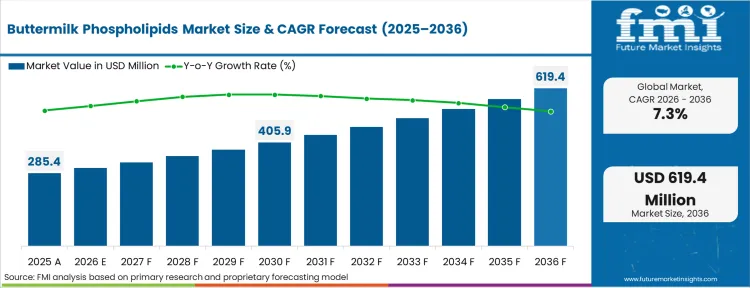
Before growth becomes entirely self-reinforcing, the industry must cross a specific analytical standardization gate. Once regulatory bodies finalize harmonized testing methods for identifying distinct sphingomyelin and phosphatidylcholine ratios, major brands will be able to substantiate on-pack cognitive claims without fearing regional compliance audits. Analytical equipment manufacturers and dairy cooperatives are actively collaborating to close this testing gap.
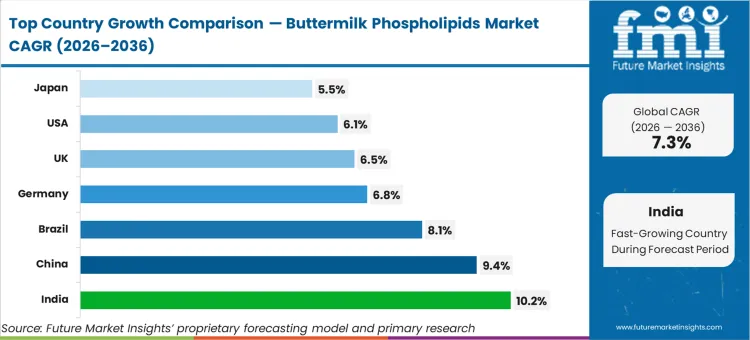
FMI expects India to expand at 10.2%, followed by China at 9.4%, Brazil at 8.1%, Germany at 6.8%, the United Kingdom at 6.5%, the United States at 6.1%, and Japan at 5.5%. The divergence across this range stems directly from the underlying consolidation of local dairy processing infrastructure, allowing emerging regions to finally capture and dry buttermilk streams that were historically lost to unorganized liquid milk distribution.
Buttermilk Phospholipids Market Key Takeaways
| Metric | Details |
|---|---|
| Industry Size (2026) | USD 306.2 million |
| Industry Value (2036) | USD 618.5 million |
| CAGR (2026-2036) | 7.3% |
Source: Future Market Insights (FMI) analysis, based on proprietary forecasting model and primary research
Buttermilk Phospholipids Market Definition
The buttermilk phospholipids market encompasses the extraction, purification, and commercialization of complex polar lipid fractions derived specifically from the aqueous phase of butter churning. It is functionally distinct from general soy, sunflower, or egg lecithins because dairy phospholipids contain unique sphingolipids and a lipid membrane architecture that closely mirrors human physiological structures. This specific biological origin defines its value and its processing constraints.
Buttermilk Phospholipids Market Inclusions
This market includes all concentrated phospholipid ingredients sourced directly from sweet cream buttermilk, cultured buttermilk, or butter serum. It covers liquid concentrates, granulated extracts, and spray-dried powders utilized in commercial formulations. The scope integrates specialized fractions enriched for milk fat globule membrane components deployed specifically across the specialty food ingredients sector for targeted nutritional interventions.
Buttermilk Phospholipids Market Exclusions
The market explicitly excludes plant-derived lecithins, egg yolk phospholipids, and synthetic lipid structures. It also excludes raw, unconcentrated buttermilk intended for standard beverage consumption or basic baking applications. These exclusions are applied because unconcentrated buttermilk does not meet the functional dosage requirements for fortification, and non-dairy phospholipids cannot support the specific sphingolipid label claims that define this commercial category.
Buttermilk Phospholipids Market Research Methodology
- Primary Research: Procurement directors at global infant formula brands, process engineers at cooperative dairy extraction facilities, and regulatory compliance officers in clinical nutrition.
- Desk Research: Dairy export volume registries, GRAS notification filings, pediatric clinical trial outcomes, and proprietary equipment installation records for dairy ultrafiltration.
- Market-Sizing and Forecasting: Baseline anchored to global butter production volumes combined with commercial ultrafiltration capacity ratios at major dairy processing hubs.
- Data Validation and Update Cycle: Forecasts triangulated against bulk dairy ingredient pricing indices and independent import records for specialized infant formula premixes.
Segmental Analysis
Buttermilk Phospholipids Market Analysis by Product Form
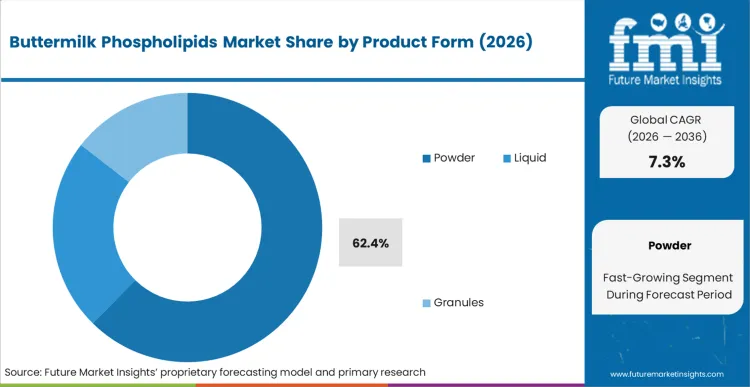
The reason powder holds a dominant 62.4% share is entirely rooted in lipid oxidation mechanics, not simply mixing convenience. According to FMI's estimates, preserving the delicate double bonds in milk-derived phospholipids requires stringent moisture control that liquid concentrates cannot economically maintain across global transit routes. Plant managers formulating premium infant nutrition require an ingredient that can survive two years of ambient shelf life without developing off-flavors that cause product rejection. Liquid formats mandate expensive cold-chain logistics and shorter production runs, eroding the margin profile for high-volume manufacturers. Brands that attempt to cut costs by utilizing liquid fractions in dry-blend facilities face catastrophic fat oxidation failures in the final consumer product.
- Storage stability: Powdering effectively locks the sensitive lipid fractions within a protective matrix. Formulators capture this stability to extend final product shelf life without resorting to synthetic antioxidants.
- Handling integration: Dry ingredients flow seamlessly into the existing powder-handling infrastructure of major food facilities. Plant managers avoid the capital expense of installing heated liquid dosing systems.
- Logistics footprint: Removing the water weight drastically reduces bulk shipping expenses. Procurement teams leverage this density to source high-purity lipids from isolated global dairy ingredients hubs.
Buttermilk Phospholipids Market Analysis by Application
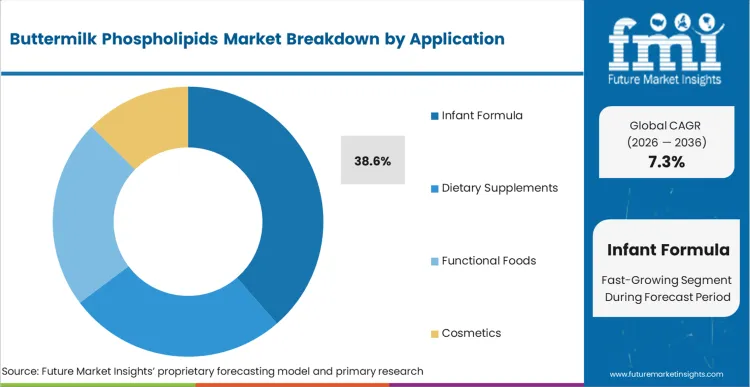
Pediatric nutrition brands are currently being forced to decide whether their next-generation products will feature standard plant lecithins or biologically accurate milk fat globule membranes. According to FMI's estimates, the infant formula holds a dominant 38.6% share. Infant formula dictates the market direction because it represents the only sector where regulatory bodies explicitly recognize the physiological necessity of specific dietary lipid structures for cognitive development. FMI analysts opine that formulators are aggressively rewriting recipes to include these dairy fractions, transitioning them from a premium niche additive to a baseline requirement for tier-1 product qualification. Brands relying entirely on legacy plant-based emulsifiers face an unbridgeable commercial gap when competing against products bearing clinically substantiated neurological development claims.
- Biomimetic matching: Dairy phospholipids contain the precise sphingomyelin architecture absent in soy alternatives. Pediatric brands utilize this exact match to secure premium retail positioning.
- Clinical validation: Ongoing pediatric trials continuously validate the immune and cognitive benefits of MFGM fractions. Medical marketing teams deploy this clinical nutrition data to win recommendations from healthcare professionals.
- Brand differentiation: Including these specific milk lipids provides a defensible scientific narrative. Marketing directors leverage this complexity to justify sustained price premiums in saturated retail aisles.
Buttermilk Phospholipids Market Analysis by Distribution Channel
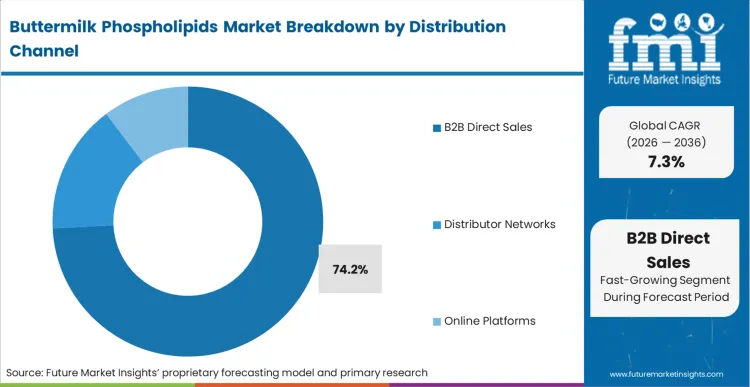
The commercial outcome of utilizing advanced dairy lipids forces formulators into highly collaborative relationships with primary extractors, explaining why B2B direct sales completely dominate the distribution architecture. These are not standardized commodity ingredients that can be purchased through fragmented broker networks based on a generic specification sheet. As per FMI's projection, the highly variable nature of raw buttermilk requires dairy processors to custom-calibrate their membrane filtration to meet the exact phospholipid ratios demanded by individual pharmaceutical and nutritional clients. According to FMI's estimates, the B2B direct sales holds a dominant 74.2% share. Relying on third-party distributors introduces unacceptable variability into the supply chain, severing the vital technical feedback loop between the extraction plant and the final product formulation laboratory.
- Technical alignment: Direct sales allow dairy engineers to match specific extraction batches to a buyer's unique application requirements. Processors capture higher margins by selling customized functional solutions rather than bulk powder.
- Volume security: Direct contracts enable long-term forecasting for both the dairy cooperative and the nutritional brand. Procurement directors secure this visibility to protect against sudden milk fat shortages.
- Quality tracing: Establishing a direct pipeline ensures unbroken chain-of-custody documentation from the churning vat to the finished formula. Compliance officers mandate this transparency to satisfy stringent pediatric safety audits.
Buttermilk Phospholipids Market Drivers, Restraints, and Opportunities
The pressure to replicate human physiological profiles precisely requires early life nutrition brands to upgrade their lipid sourcing strategies. Plant-based lecithins fulfill the basic emulsification requirement but fail to deliver the distinct neurological building blocks found exclusively in mammalian milk fat. This forces formulation directors to actively seek out and qualify dairy-derived alternatives, regardless of the higher base cost. The commercial stakes of delaying this transition are severe, as parents and healthcare providers increasingly base purchasing decisions on the presence of advanced cognitive support ingredients, penalizing legacy formulations.
The primary operational obstacle restricting market expansion is the absolute physical limitation of raw material supply. Buttermilk is exclusively a by-product of butter churning, meaning the maximum theoretical yield of dairy phospholipids is permanently capped by global butter consumption rates. This friction cannot be solved by simply building more extraction facilities. Processors are currently attempting to mitigate this by developing specialized extraction techniques to pull polar lipids directly from broader whey streams, but these alternative methods currently yield lower concentrations and require significantly higher energy inputs to achieve commercial purity.
Opportunities in the Buttermilk Phospholipids Market
- Direct whey extraction: Membrane technology advancements allow facilities to capture polar lipids from cheese whey rather than just butter by-products. Dairy cooperatives capture this capability to effectively decouple their premium lipid output from stagnant butter churning volumes.
- Cognitive aging formulations: The biological mechanisms that support infant brain development also demonstrate efficacy in preserving adult neurological function. Functional food formulators capture this dynamic to open entirely new high-margin product categories targeting the aging demographic.
- Clean label texturants: The inherent emulsifying strength of dairy phospholipids provides a natural alternative to synthetic stabilizers in premium food formulations. Culinary scientists deploy these fractions to clean up ingredient declarations while maintaining optimal mouthfeel.
Regional Analysis
Based on the regional analysis, the Buttermilk Phospholipids market is segmented into North America, Latin America, Western Europe, Eastern Europe, Asia Pacific, and Middle East & Africa across 40 plus countries.
.webp "Top Country Growth Comparison Buttermilk Phospholipids Market Cagr (2026 2036)")
| Country | CAGR (2026 to 2036) |
|---|---|
| India | 10.2% |
| China | 9.4% |
| Brazil | 8.1% |
| Germany | 6.8% |
| United Kingdom | 6.5% |
| United States | 6.1% |
| Japan | 5.5% |
Source: Future Market Insights (FMI) analysis, based on proprietary forecasting model and primary research
North America Buttermilk Phospholipids Market Analysis
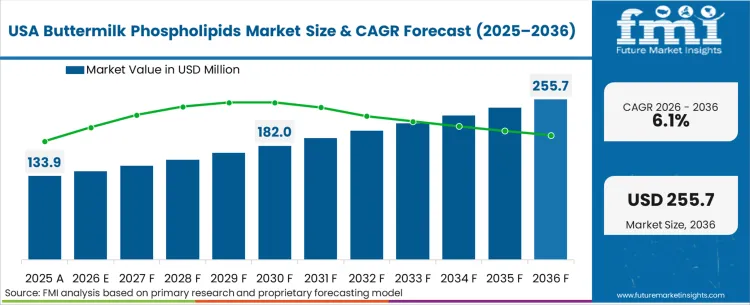
The regulatory framework surrounding pediatric nutrition specifically shapes how buyers operate in the North American landscape. The stringent GRAS notification process and FDA infant formula guidelines obligate manufacturers to produce overwhelming clinical evidence before integrating new lipid structures into commercial product lines. Based on FMI's assessment, this compliance burden slows the initial speed of formulation updates but creates a massive competitive moat for the specialized dairy processors who successfully navigate the qualification protocols. Procurement teams in this region prioritize unassailable quality documentation over raw material pricing, effectively locking out low-tier international suppliers who cannot maintain rigorous audit trails.
- United States: The intense concentration of tier-1 pediatric nutrition headquarters in the US dictates a highly risk-averse procurement environment. Formulators here must integrate new active lipids without triggering regulatory reformulations that could stall production lines. The market for buttermilk phospholipids in the United States is forecast to register a CAGR of 6.1%. Early adopters establish a profound competitive positioning advantage, setting the ingredient standards that smaller domestic competitors are eventually forced to match.
FMI's report includes extensive analysis of the Canadian and Mexican dairy extraction sectors. These adjacent markets are rapidly upgrading their membrane filtration capabilities to serve as secondary supply nodes for US-based pediatric brands seeking geographic supply chain redundancy.
Europe Buttermilk Phospholipids Market Analysis
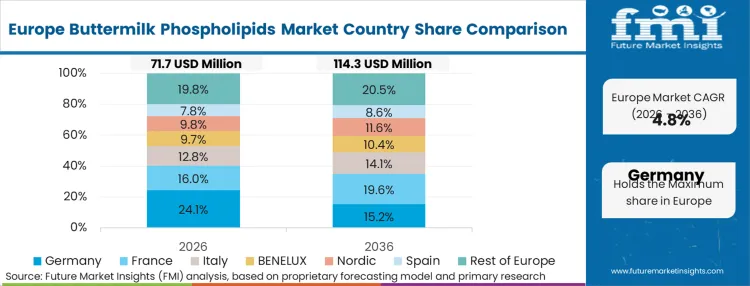
The density and maturity of Western Europe's cooperative dairy infrastructure completely define this region's operational advantage. Unlike markets that must build extraction facilities from scratch, European processors are leveraging decades of installed ultrafiltration capacity, adapting existing milk protein concentrate lines to isolate high-value polar lipids. In FMI's view, this infrastructure density allows European suppliers to dominate global export volumes for premium infant formula ingredients. Operations heads here focus entirely on optimizing yield from existing buttermilk streams rather than securing new raw milk sources.
- Germany: Germany's highly optimized butter production network provides a massive, consistent volume of raw sweet cream buttermilk for advanced fractionation. Plant managers in this country operate under continuous pressure to extract maximum commercial value from every liter of dairy byproduct. Demand for buttermilk phospholipids in Germany is set to grow at 6.8%. Successfully isolating these specific lipids translates directly into an operational outcome where waste streams are converted into the most profitable product line in the facility.
- United Kingdom: The advanced clinical research network in UK continuously publishes data supporting the inclusion of milk fat globule membranes in early life nutrition. Medical marketing teams require this constant stream of peer-reviewed validation to maintain their premium retail pricing structures. The UK landscape in buttermilk phospholipids is set to achieve a CAGR of 6.5%. The reality on the ground is that UK buyers are highly sensitive to the specific sphingolipid ratios of the raw material, frequently rejecting batches that meet basic purity standards but fail specialized lipid profiling.
FMI's report includes detailed tracking of specialized lipid extraction projects across France, Denmark, and the Netherlands. These nations represent the technical epicenter for dairy fractionation, consistently dictating the global baseline for ingredient purity and functional performance.
Asia Pacific Buttermilk Phospholipids Market Analysis
Cost structures and the availability of uncommitted capital define the adoption trajectory across the Asia Pacific region. Historic reliance on imported premium infant formula is driving massive domestic investments to replicate Western formulation standards utilizing local dairy resources. According to FMI's estimates, the ability to fund large-scale membrane filtration installations determines which local players can upgrade from generic milk powders to high-margin functional ingredients. Procurement practices here are intensely focused on securing technical partnerships with established Western equipment manufacturers to accelerate domestic production capabilities.
- India: Rapid consolidation of its massive but historically fragmented dairy cooperative sector is finally bringing sufficient volumes of raw buttermilk into centralized processing environments. Facility directors now have the scale required to justify the capital expenditure for advanced lipid recovery systems. The Indian buttermilk phospholipids sector is poised to expand at 10.2%. Buyers who rapidly secure these newly available domestic supply lines capture an immediate commercial opportunity, drastically reducing their exposure to volatile European import tariffs.
- China: The domestic mandate to achieve self-sufficiency in critical pediatric nutrition ingredients forces Chinese dairy conglomerates to aggressively commercialize advanced lipid extraction technologies. Formulators in this country are abandoning legacy soy lecithins at an unprecedented rate to comply with updated national infant formula standards. A CAGR of 9.4% is expected for buttermilk phospholipids in China over the forecast period. Brands that fail to integrate these dairy-derived structures forfeit massive commercial opportunities within a domestic market that actively penalizes outdated nutritional profiles.
- Japan: Japan's aging demographic completely inverts the standard application model, with buyers funneling premium dairy lipids directly into functional foods targeting adult cognitive decline. Research directors in this country possess a advantage in deploying sophisticated sensory masking techniques to incorporate high doses of marine and dairy lipids into everyday food formats. The Japanese market for buttermilk phospholipids is likely to post a CAGR of 5.5%. This unique demographic focus establishes a trajectory where adult functional nutrition eventually overtakes pediatric applications as the primary volume driver.
FMI's report includes analysis of the rapidly evolving dairy processing landscapes in Oceania and Southeast Asia. These sub-regions are strategically pivoting their export focus away from bulk commodity powders toward specialized functional lipid fractions.
Competitive Aligners for Market Players
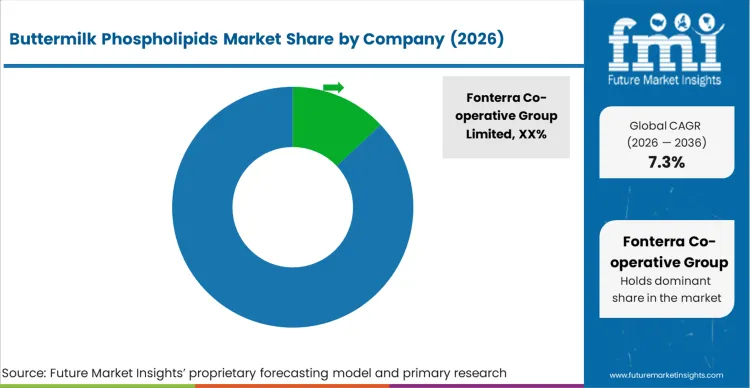
The buttermilk phospholipids market operates under severe concentration because the barrier to entry extends far beyond basic capital expenditure. Establishing a viable commercial presence requires deep physical integration with massive butter churning operations, effectively locking out standalone ingredient manufacturers who lack direct access to raw dairy streams. Leading companies like Arla Foods Ingredients and Fonterra dominate because they control the entire custody chain, from the raw milk collection to the final membrane filtration. Buyers utilize this exact level of supply chain control as their primary variable for distinguishing qualified long-term partners from opportunistic spot vendors.
To challenge the established incumbents, new entrants must build sophisticated, multi-stage fractionation capabilities that can reliably separate specific sphingomyelin ratios without degrading the delicate lipid structures. Incumbents maintain their advantage because they have spent decades optimizing the thermal and mechanical parameters of their dairy separation equipment, a advantage that protects them from sudden price undercutting. A challenger cannot simply purchase standard filtration membranes: they must develop the proprietary engineering knowledge to handle highly viscous, lipid-rich dairy retentates without constantly fouling their processing lines.
Major pediatric brands actively resist this vendor concentration by aggressively funding clinical trials on alternative lipid sources and funding capacity expansions at tier-2 cooperative dairies. The tension between the buyers' need for diversified, low-cost supply and the dominant processors' incentive to limit capacity and maintain premium pricing will define the commercial landscape through 2036. FMI anticipates the market will remain highly consolidated at the extraction level, forcing buyers to secure volume through long-term strategic joint ventures rather than traditional transactional purchasing.
Key Players in Buttermilk Phospholipids Market
- Fonterra Co-operative Group Limited
- Arla Foods Ingredients Group P/S
- Royal FrieslandCampina N.V.
- Lactalis Ingredients
- Valio Ltd.
- Glanbia Nutritionals
- Agropur Dairy Cooperative
- Epi Ingredients
Scope of the Report
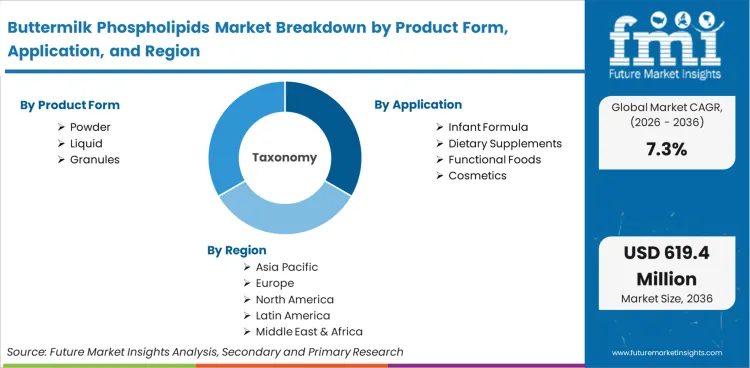
| Metric | Value |
|---|---|
| Quantitative Units | USD 306.2 million to USD 618.5 million, at a CAGR of 7.3% |
| Market Definition | The market covers concentrated polar lipid fractions extracted from butter processing byproducts. It focuses strictly on biologically active dairy components utilized for advanced nutritional and functional fortification. |
| Product Form Segmentation | Powder, Liquid, Granules |
| Application Segmentation | Infant Formula, Dietary Supplements, Functional Foods, Cosmetics |
| Distribution Channel Segmentation | B2B Direct Sales, Distributor Networks, Online Platforms |
| Regions Covered | North America, Latin America, Western Europe, Eastern Europe, Asia Pacific, Middle East and Africa |
| Countries Covered | United States, Germany, China, Japan, United Kingdom, India, Brazil, and 40 plus countries |
| Key Companies Profiled | Arla Foods Ingredients Group P/S, Fonterra Co-operative Group Limited, Lactalis Ingredients, Valio Ltd., Royal FrieslandCampina N.V., Glanbia Nutritionals, Agropur Dairy Cooperative, Epi Ingredients |
| Forecast Period | 2026 to 2036 |
| Approach | Primary interviews targeted procurement heads at pediatric nutrition firms and dairy process engineers. The volume baseline anchored to global butter production ratios and ultrafiltration installation capacities. Forecasts were cross-validated against specialized infant formula import records. |
Source: Future Market Insights (FMI) analysis, based on proprietary forecasting model and primary research
Buttermilk Phospholipids Market Analysis by Segments
Product Form:
- Powder
- Liquid
- Granules
Application:
- Infant Formula
- Dietary Supplements
- Functional Foods
- Cosmetics
Distribution Channel:
- B2B Direct Sales
- Distributor Networks
- Online Platforms
Region:
- North America
- United States
- Canada
- Latin America
- Brazil
- Mexico
- Western Europe
- Germany
- United Kingdom
- France
- Eastern Europe
- Poland
- Russia
- Asia Pacific
- China
- India
- Japan
- Australia
- Middle East and Africa
- South Africa
- GCC
Bibliography
- Zhao, Y., Liu, X., & Chen, H. (2024, October). Milk fat globule membrane phospholipids and their nutritional significance in dairy systems. International Dairy Journal.
- Krakowska-Sieprawska, A., et al. (2025, May). Compositional dynamics of lipid and phospholipid fractions in dairy processing. ACS Food Science & Technology.
- Di Paolo, M., et al. (2025, August). Effect of technological processing on phospholipid distribution in dairy by-products including buttermilk. Foods.
- Señoráns, M., Calvo, M. V., & Castejón, N. (2025, June). Formulations based on milk fat globule membrane as delivery systems for bioactive lipids. European Food Research and Technology.
- Nie, C., Zhao, Y., Wang, X., Li, Y., Fang, B., Wang, R., & Liu, R. (2024). Structure, biological functions, separation, properties, and potential applications of milk fat globule membrane (MFGM): A review. Nutrients, 16(5), 587.
This bibliography is provided for reader reference. The full FMI report contains the complete reference list with primary source documentation.
This Report Addresses
- Market intelligence to support strategic decision making across dairy-derived lipid extracts and specialized pediatric nutritional ingredients
- Market size estimation and 10-year revenue forecasts from 2026 to 2036, supported by volumetric butter production baselines and ultrafiltration capacity metrics
- Growth opportunity mapping across specific powder formats and infant formula applications with emphasis on the analytical testing standardization gate
- Segment and regional revenue forecasts covering critical functional food sub-segments across the highly regulated North American pediatric compliance environment
- Competition strategy assessment including supply chain integration, raw material access, and proprietary membrane filtration capabilities
- Technology development tracking including direct whey extraction techniques, advanced sphingolipid testing protocols, and low-temperature drying frameworks
- Market access analysis covering FDA GRAS notification pathways, EFSA pediatric nutrition standards, and global cooperative dairy procurement structures
- Market report delivery in PDF, Excel, PPT, and interactive dashboard formats for executive strategy, global ingredient procurement planning, and operational benchmarking use
Frequently Asked Questions
How large is the buttermilk phospholipids market in 2026?
The industry is expected to cross USD 306.2 million in 2026. This figure signals the baseline volume required to support the current transition of tier-1 pediatric nutrition brands moving away from plant-based lecithins toward accurate human milk biomimicry.
What will it be valued at by 2036?
Sustained investment propels the valuation to USD 618.5 million by 2036. This doubling reflects the aggressive scaling of membrane filtration infrastructure at cooperative dairies attempting to capture value from previously discarded buttermilk streams.
What CAGR is projected?
The market is set to expand at a 7.3% CAGR. This rate is strictly constrained by the global output of butter churning facilities, which effectively caps the maximum theoretical volume of extractable raw material regardless of downstream demand.
Which product form segment leads?
The powder segment dominates the market structure. Powdering locks the highly oxidative lipid fractions inside a protective matrix, allowing formulators to achieve the extended ambient shelf life required to survive global infant formula distribution networks.
Which Application segment leads?
Infant formula holds the primary volume share. Formulators in this sector use dairy phospholipids to deliver the precise sphingomyelin architecture required to substantiate premium on-pack cognitive development claims that soy alternatives cannot legally support.
Which Distribution Channel segment leads?
B2B direct sales completely dominate the supply architecture. The technical complexity of custom-calibrating lipid ratios requires a direct, unbroken feedback loop between the dairy processing engineer and the final pharmaceutical formulation laboratory.
What drives rapid growth?
The overwhelming regulatory and consumer push for precise physiological biomimicry in early life nutrition actively forces pediatric brands to abandon legacy plant emulsifiers in favor of biologically accurate milk fat globule membranes.
What is the primary restraint?
The physical reliance on butter manufacturing creates a rigid supply ceiling. Because these specific lipids are solely derived from the aqueous phase of churning, production volumes are inextricably tied to global milk fat demand rather than specialized nutritional requirements.
Which country grows fastest?
India expands at 10.2%, outpacing China's 9.4%. The rapid consolidation of India's historically fragmented dairy sector finally provides the centralized volume scale necessary to install commercial ultrafiltration equipment, whereas China is already modernizing its established infrastructure.
How do specific regional compliance frameworks shape the North American landscape?
The intense FDA GRAS notification process forces procurement teams to prioritize unassailable documentation trails over raw ingredient pricing. This regulatory burden creates a massive operational moat for established European cooperative dairies that already possess the required clinical validation archives.
Why is direct whey extraction critical to the trajectory of this market?
Processors are adapting membrane technology to pull polar lipids directly from cheese whey, attempting to decouple their premium ingredient output from stagnant global butter churning volumes and solve the industry's most severe supply bottleneck.
How do large pediatric brands resist vendor consolidation at the extraction level?
Global formula manufacturers actively combat the leverage held by dominant dairy cooperatives like Arla and Fonterra by funding independent clinical trials on alternative lipid sources and underwriting the capital expenditure required to install filtration membranes at tier-2 regional dairies.
Why do cosmetic formulators utilize these dairy lipids?
The inherent complexity of milk fat globule membranes provides powerful natural emulsification properties, allowing clean-label personal care brands to replace synthetic stabilizers while maintaining optimal topical texture.
What specific analytical challenge must the industry overcome?
Current growth is hindered by the lack of globally harmonized testing methods for identifying distinct sphingomyelin ratios. Standardizing these analytical protocols is the gate required for brands to confidently assert neurological claims without failing regional compliance audits.
Why does Germany act as the primary export hub for these ingredients?
Germany's highly optimized, high-volume butter production network generates massive, consistent pools of raw sweet cream buttermilk. Local process engineers focus entirely on extracting maximum commercial margin from this existing waste stream rather than sourcing new milk supplies.
How does the Japanese market diverge from the global application standard?
Unlike Western markets dominated by pediatric formulation, Japan's aging demographic forces buyers to funnel these premium lipids into specialized functional foods targeting adult cognitive preservation, indicating where the global market application balance will eventually shift.
What does the absolute volume dominance in B2B Direct Sales indicate about product standardization?
It confirms that these are highly customized active ingredients, not interchangeable commodities. Buyers refuse to source through fragmented broker networks because third-party distributors disrupt the chain-of-custody documentation required for stringent pediatric safety compliance.
Why cannot liquid phospholipid concentrates capture greater market share?
Liquid formats mandate expensive, continuous cold-chain logistics and shorter factory production runs. The margin erosion caused by preventing rapid lipid oxidation in liquid state makes the format commercially unviable for high-volume global formulators.
What role does the United Kingdom play in the market's expansion?
The UK provides the critical clinical validation engine for the industry. Its advanced pediatric research network continuously generates the peer-reviewed data that global medical marketing teams require to justify the massive price premiums of MFGM-enhanced formula.
Why do formulators face a penalty for delaying the transition to dairy lipids?
Brands that cling to legacy soy lecithins are being systematically removed from preferred pediatric healthcare recommendation lists. The penalty is not regulatory; it is a permanent loss of retail shelf positioning to competitors who can legally advertise cognitive and immune system biomimicry.
Why do formulators face a penalty for delaying the transition to dairy lipids?
Brands that cling to legacy soy lecithins are being systematically removed from preferred pediatric healthcare recommendation lists. The penalty is not regulatory; it is a permanent loss of retail shelf positioning to competitors who can legally advertise cognitive and immune system biomimicry.
Preview the report firsthand - request a free sample
Get SampleGet the brochure for pricing and purchase details.
Get PDFTable of Content
- Executive Summary
- Global Market Outlook
- Demand-side Trends
- Supply-side Trends
- Technology Roadmap Analysis
- Analysis and Recommendations
- Market Overview
- Market Coverage / Taxonomy
- Market Definition / Scope / Limitations
- Research Methodology
- Chapter Orientation
- Analytical Lens and Working Hypotheses
- Market Structure, Signals, and Trend Drivers
- Benchmarking and Cross-market Comparability
- Market Sizing, Forecasting, and Opportunity Mapping
- Research Design and Evidence Framework
- Desk Research Programme (Secondary Evidence)
- Company Annual and Sustainability Reports
- Peer-reviewed Journals and Academic Literature
- Corporate Websites, Product Literature, and Technical Notes
- Earnings Decks and Investor Briefings
- Statutory Filings and Regulatory Disclosures
- Technical White Papers and Standards Notes
- Trade Journals, Industry Magazines, and Analyst Briefs
- Conference Proceedings, Webinars, and Seminar Materials
- Government Statistics Portals and Public Data Releases
- Press Releases and Reputable Media Coverage
- Specialist Newsletters and Curated Briefings
- Sector Databases and Reference Repositories
- FMI Internal Proprietary Databases and Historical Market Datasets
- Subscription Datasets and Paid Sources
- Social Channels, Communities, and Digital Listening Inputs
- Additional Desk Sources
- Expert Input and Fieldwork (Primary Evidence)
- Primary Modes
- Qualitative Interviews and Expert Elicitation
- Quantitative Surveys and Structured Data Capture
- Blended Approach
- Why Primary Evidence is Used
- Field Techniques
- Interviews
- Surveys
- Focus Groups
- Observational and In-context Research
- Social and Community Interactions
- Stakeholder Universe Engaged
- C-suite Leaders
- Board Members
- Presidents and Vice Presidents
- R&D and Innovation Heads
- Technical Specialists
- Domain Subject-matter Experts
- Scientists
- Physicians and Other Healthcare Professionals
- Governance, Ethics, and Data Stewardship
- Research Ethics
- Data Integrity and Handling
- Primary Modes
- Tooling, Models, and Reference Databases
- Desk Research Programme (Secondary Evidence)
- Data Engineering and Model Build
- Data Acquisition and Ingestion
- Cleaning, Normalisation, and Verification
- Synthesis, Triangulation, and Analysis
- Quality Assurance and Audit Trail
- Market Background
- Market Dynamics
- Drivers
- Restraints
- Opportunity
- Trends
- Scenario Forecast
- Demand in Optimistic Scenario
- Demand in Likely Scenario
- Demand in Conservative Scenario
- Opportunity Map Analysis
- Product Life Cycle Analysis
- Supply Chain Analysis
- Investment Feasibility Matrix
- Value Chain Analysis
- PESTLE and Porter’s Analysis
- Regulatory Landscape
- Regional Parent Market Outlook
- Production and Consumption Statistics
- Import and Export Statistics
- Market Dynamics
- Global Market Analysis 2021 to 2025 and Forecast, 2026 to 2036
- Historical Market Size Value (USD Million) Analysis, 2021 to 2025
- Current and Future Market Size Value (USD Million) Projections, 2026 to 2036
- Y-o-Y Growth Trend Analysis
- Absolute $ Opportunity Analysis
- Global Market Pricing Analysis 2021 to 2025 and Forecast 2026 to 2036
- Global Market Analysis 2021 to 2025 and Forecast 2026 to 2036, By Product Form
- Introduction / Key Findings
- Historical Market Size Value (USD Million) Analysis By Product Form , 2021 to 2025
- Current and Future Market Size Value (USD Million) Analysis and Forecast By Product Form , 2026 to 2036
- Powder
- Liquid
- Granules
- Powder
- Y-o-Y Growth Trend Analysis By Product Form , 2021 to 2025
- Absolute $ Opportunity Analysis By Product Form , 2026 to 2036
- Global Market Analysis 2021 to 2025 and Forecast 2026 to 2036, By Application
- Introduction / Key Findings
- Historical Market Size Value (USD Million) Analysis By Application, 2021 to 2025
- Current and Future Market Size Value (USD Million) Analysis and Forecast By Application, 2026 to 2036
- Infant Formula
- Dietary Supplements
- Functional Foods
- Cosmetics
- Infant Formula
- Y-o-Y Growth Trend Analysis By Application, 2021 to 2025
- Absolute $ Opportunity Analysis By Application, 2026 to 2036
- Global Market Analysis 2021 to 2025 and Forecast 2026 to 2036, By Distribution Channel
- Introduction / Key Findings
- Historical Market Size Value (USD Million) Analysis By Distribution Channel, 2021 to 2025
- Current and Future Market Size Value (USD Million) Analysis and Forecast By Distribution Channel, 2026 to 2036
- B2B Direct Sales
- Distributor Networks
- Online Platforms
- B2B Direct Sales
- Y-o-Y Growth Trend Analysis By Distribution Channel, 2021 to 2025
- Absolute $ Opportunity Analysis By Distribution Channel, 2026 to 2036
- Global Market Analysis 2021 to 2025 and Forecast 2026 to 2036, By Region
- Introduction
- Historical Market Size Value (USD Million) Analysis By Region, 2021 to 2025
- Current Market Size Value (USD Million) Analysis and Forecast By Region, 2026 to 2036
- North America
- Latin America
- Western Europe
- Eastern Europe
- East Asia
- South Asia and Pacific
- Middle East & Africa
- Market Attractiveness Analysis By Region
- North America Market Analysis 2021 to 2025 and Forecast 2026 to 2036, By Country
- Historical Market Size Value (USD Million) Trend Analysis By Market Taxonomy, 2021 to 2025
- Market Size Value (USD Million) Forecast By Market Taxonomy, 2026 to 2036
- By Country
- USA
- Canada
- Mexico
- By Product Form
- By Application
- By Distribution Channel
- By Country
- Market Attractiveness Analysis
- By Country
- By Product Form
- By Application
- By Distribution Channel
- Key Takeaways
- Latin America Market Analysis 2021 to 2025 and Forecast 2026 to 2036, By Country
- Historical Market Size Value (USD Million) Trend Analysis By Market Taxonomy, 2021 to 2025
- Market Size Value (USD Million) Forecast By Market Taxonomy, 2026 to 2036
- By Country
- Brazil
- Chile
- Rest of Latin America
- By Product Form
- By Application
- By Distribution Channel
- By Country
- Market Attractiveness Analysis
- By Country
- By Product Form
- By Application
- By Distribution Channel
- Key Takeaways
- Western Europe Market Analysis 2021 to 2025 and Forecast 2026 to 2036, By Country
- Historical Market Size Value (USD Million) Trend Analysis By Market Taxonomy, 2021 to 2025
- Market Size Value (USD Million) Forecast By Market Taxonomy, 2026 to 2036
- By Country
- Germany
- UK
- Italy
- Spain
- France
- Nordic
- BENELUX
- Rest of Western Europe
- By Product Form
- By Application
- By Distribution Channel
- By Country
- Market Attractiveness Analysis
- By Country
- By Product Form
- By Application
- By Distribution Channel
- Key Takeaways
- Eastern Europe Market Analysis 2021 to 2025 and Forecast 2026 to 2036, By Country
- Historical Market Size Value (USD Million) Trend Analysis By Market Taxonomy, 2021 to 2025
- Market Size Value (USD Million) Forecast By Market Taxonomy, 2026 to 2036
- By Country
- Russia
- Poland
- Hungary
- Balkan & Baltic
- Rest of Eastern Europe
- By Product Form
- By Application
- By Distribution Channel
- By Country
- Market Attractiveness Analysis
- By Country
- By Product Form
- By Application
- By Distribution Channel
- Key Takeaways
- East Asia Market Analysis 2021 to 2025 and Forecast 2026 to 2036, By Country
- Historical Market Size Value (USD Million) Trend Analysis By Market Taxonomy, 2021 to 2025
- Market Size Value (USD Million) Forecast By Market Taxonomy, 2026 to 2036
- By Country
- China
- Japan
- South Korea
- By Product Form
- By Application
- By Distribution Channel
- By Country
- Market Attractiveness Analysis
- By Country
- By Product Form
- By Application
- By Distribution Channel
- Key Takeaways
- South Asia and Pacific Market Analysis 2021 to 2025 and Forecast 2026 to 2036, By Country
- Historical Market Size Value (USD Million) Trend Analysis By Market Taxonomy, 2021 to 2025
- Market Size Value (USD Million) Forecast By Market Taxonomy, 2026 to 2036
- By Country
- India
- ASEAN
- Australia & New Zealand
- Rest of South Asia and Pacific
- By Product Form
- By Application
- By Distribution Channel
- By Country
- Market Attractiveness Analysis
- By Country
- By Product Form
- By Application
- By Distribution Channel
- Key Takeaways
- Middle East & Africa Market Analysis 2021 to 2025 and Forecast 2026 to 2036, By Country
- Historical Market Size Value (USD Million) Trend Analysis By Market Taxonomy, 2021 to 2025
- Market Size Value (USD Million) Forecast By Market Taxonomy, 2026 to 2036
- By Country
- Kingdom of Saudi Arabia
- Other GCC Countries
- Turkiye
- South Africa
- Other African Union
- Rest of Middle East & Africa
- By Product Form
- By Application
- By Distribution Channel
- By Country
- Market Attractiveness Analysis
- By Country
- By Product Form
- By Application
- By Distribution Channel
- Key Takeaways
- Key Countries Market Analysis
- USA
- Pricing Analysis
- Market Share Analysis, 2025
- By Product Form
- By Application
- By Distribution Channel
- Canada
- Pricing Analysis
- Market Share Analysis, 2025
- By Product Form
- By Application
- By Distribution Channel
- Mexico
- Pricing Analysis
- Market Share Analysis, 2025
- By Product Form
- By Application
- By Distribution Channel
- Brazil
- Pricing Analysis
- Market Share Analysis, 2025
- By Product Form
- By Application
- By Distribution Channel
- Chile
- Pricing Analysis
- Market Share Analysis, 2025
- By Product Form
- By Application
- By Distribution Channel
- Germany
- Pricing Analysis
- Market Share Analysis, 2025
- By Product Form
- By Application
- By Distribution Channel
- UK
- Pricing Analysis
- Market Share Analysis, 2025
- By Product Form
- By Application
- By Distribution Channel
- Italy
- Pricing Analysis
- Market Share Analysis, 2025
- By Product Form
- By Application
- By Distribution Channel
- Spain
- Pricing Analysis
- Market Share Analysis, 2025
- By Product Form
- By Application
- By Distribution Channel
- France
- Pricing Analysis
- Market Share Analysis, 2025
- By Product Form
- By Application
- By Distribution Channel
- India
- Pricing Analysis
- Market Share Analysis, 2025
- By Product Form
- By Application
- By Distribution Channel
- ASEAN
- Pricing Analysis
- Market Share Analysis, 2025
- By Product Form
- By Application
- By Distribution Channel
- Australia & New Zealand
- Pricing Analysis
- Market Share Analysis, 2025
- By Product Form
- By Application
- By Distribution Channel
- China
- Pricing Analysis
- Market Share Analysis, 2025
- By Product Form
- By Application
- By Distribution Channel
- Japan
- Pricing Analysis
- Market Share Analysis, 2025
- By Product Form
- By Application
- By Distribution Channel
- South Korea
- Pricing Analysis
- Market Share Analysis, 2025
- By Product Form
- By Application
- By Distribution Channel
- Russia
- Pricing Analysis
- Market Share Analysis, 2025
- By Product Form
- By Application
- By Distribution Channel
- Poland
- Pricing Analysis
- Market Share Analysis, 2025
- By Product Form
- By Application
- By Distribution Channel
- Hungary
- Pricing Analysis
- Market Share Analysis, 2025
- By Product Form
- By Application
- By Distribution Channel
- Kingdom of Saudi Arabia
- Pricing Analysis
- Market Share Analysis, 2025
- By Product Form
- By Application
- By Distribution Channel
- Turkiye
- Pricing Analysis
- Market Share Analysis, 2025
- By Product Form
- By Application
- By Distribution Channel
- South Africa
- Pricing Analysis
- Market Share Analysis, 2025
- By Product Form
- By Application
- By Distribution Channel
- USA
- Market Structure Analysis
- Competition Dashboard
- Competition Benchmarking
- Market Share Analysis of Top Players
- By Regional
- By Product Form
- By Application
- By Distribution Channel
- Competition Analysis
- Competition Deep Dive
- Fonterra Co-operative Group Limited
- Overview
- Product Portfolio
- Profitability by Market Segments (Product/Age /Sales Channel/Region)
- Sales Footprint
- Strategy Overview
- Marketing Strategy
- Product Strategy
- Channel Strategy
- Arla Foods Ingredients Group P/S
- Royal FrieslandCampina N.V.
- Lactalis Ingredients
- Valio Ltd.
- Glanbia Nutritionals
- Agropur Dairy Cooperative
- Epi Ingredients
- Fonterra Co-operative Group Limited
- Competition Deep Dive
- Assumptions & Acronyms Used


