

- Market Size (2026)
- USD 2.0 Bn
- Forecast (2036)
- USD 3.68 Bn
- CAGR (2026 to 2036)
- 6.2%
Bypass Fat Supplement Market Size, Market Forecast and Outlook By FMI
Summary of the Bypass Fat Supplement Market
- Demand and Growth Drivers
- The growing commercial dairy herds in India, China, and Latin America are creating a structural need for rumen-bypass energy supplementation to help meet higher production goals.
- Dairy productivity optimization programs that focus on milk yield and fertility outcomes are forcing operators to switch from traditional feed ingredients to performance-based bypass supplements.
- Plant-based bypass fat capacity, especially palm and soy-based, is growing around feedstocks that are cheaper, which makes it easier for dairy farms of all sizes to enter new markets.
- Product and Segment View
- Plant-based sources make up 70.0% of the market, thanks to a well-established manufacturing infrastructure and consistent functional performance in ruminant nutrition.
- Flakes are the most popular form, making up 40.0% of the total. This is because they are easy to handle, mix, and add to automated dairy feeding systems.
- Geography and Competitive Outlook
- North America and Western Europe drive premium consumption through high-yield dairy production models, while Asia-Pacific and Latin America are the regions with the highest absolute volume growth driven by herd expansion.
- To set their products apart in a market that is becoming more sensitive to milk quality, companies are moving from selling large quantities of commodities to focusing on R&D to improve energy density and rumen stability performance.
- Analyst Opinion
- Nandini Roy Choudhury, at FMI says, “The market is transitioning toward performance-driven nutrition, where the ability of bypass supplements to directly influence milk quality metrics and herd fertility is becoming the primary metric for supplier selection.”
- Market evolution is defined by a shift from crude fat supplementation toward highly targeted rumen-protected energy solutions that align with specific dairy life-cycle stages.
- The professionalization of dairy management in emerging markets is a major factor in key adoption. In these markets, yield-per-cow metrics are becoming more important than raw herd scale.
- Product innovation is moving toward specialized hydrogenated and calcium-salt mixes that reduce rumen interference while increasing absorption in the intestines.
- Strategic growth factors include getting consistent, cost-advantaged plant-based feedstock. This helps manufacturers deal with price sensitivity in very competitive dairy input markets.
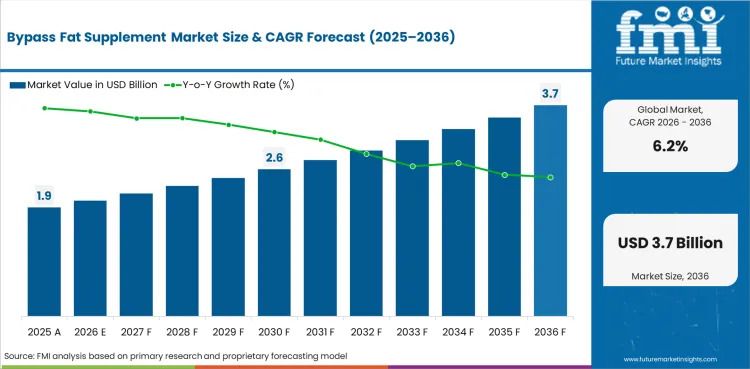
Key Takeaways, Market Size, and Forecast
- The bypass fat supplement market was valued at USD 1.90 billion in 2025.
- The market is projected to reach USD 2.0 billion in 2026 and USD 3.68 billion by 2036, growing at a CAGR of 6.2%.
- By 2036, the bypass fat supplement market is expected to be worth USD 3.68 billion.
- From 2026 to 2036, the market is projected to expand at a CAGR of 6.2%.
- The market is projected to create an incremental opportunity of USD 1.66 billion between 2026 and 2036.
- Plant-based products are expected to dominate the type segment with a 70.0% share.
- Flakes are expected to lead the form segment with a 40.0% share.
- Milk yield improvement accounts for 34.8% of the application segment, making it the leading demand driver.
- The United States is expected to be the fastest growing market with a CAGR of 12.93%.
Bypass Fat Supplement Market Definition
The bypass fat supplement market encompasses commercially produced rumen-protected fat additives including calcium salts of fatty acids, hydrogenated fats, and coated fat products supplied to dairy cattle, beef cattle, sheep, and goat nutrition applications for energy supplementation, milk yield enhancement, fertility support, and heat stress management.
Bypass Fat Supplement Market Inclusions
Market scope includes all commercially traded bypass fat supplement products segmented by source (plant-based, animal-based), form (flakes, granules, pellets, powder), livestock type (dairy cattle, beef cattle, sheep, goats), application purpose (milk yield improvement, energy enhancement, fertility support, heat stress management), and sales channel (direct B2B, distributors and dealers, online sales, co-operative supply chains). Revenue sizing spans the 2026 to 2036 forecast period.
Bypass Fat Supplement Market Exclusions
The scope excludes unprotected fat supplements that do not deliver rumen bypass functionality, industrial fatty acid products outside of animal nutrition applications, and non-ruminant animal fat supplements for poultry, swine, or aquaculture.
Bypass Fat Supplement Market Research Methodology
- Primary Research: FMI analysts conducted interviews with dairy nutrition converter operations leaders, commercial dairy farm procurement managers, veterinary nutrition consultants, and dairy cooperative feed supply leaders across India, North America, Europe, China, and Brazil.
- Desk Research: Data collection aggregated dairy feed additive trade statistics, dairy productivity research publications, company annual reports, and dairy cooperative procurement data to establish verifiable baseline parameters.
- Market Sizing and Forecasting: Baseline values derive from a bottom-up aggregation of bypass fat supplement transaction volumes, applying region-specific dairy herd size growth and milk yield productivity improvement curves to project demand through 2036.
- Data validation and update cycle: Projections are tested against bypass fat shipment disclosures, dairy output statistics, and dairy cooperative feed procurement data on a quarterly refresh schedule.
Why is the Bypass Fat Supplement Market Growing?
- Expanding commercial dairy herd sizes in India, China, and Latin America drive structural demand for rumen-bypass supplementation.
- Dairy productivity optimization programmes consolidate bypass fat procurement across cooperatives and large-scale farms.
- Plant-based palm and soy bypass fat capacity scaling changes the economics of supply and helps converter margins.
The market for bypass fat supplements is growing steadily. This is due to the growth of commercial dairy herds, programs to improve dairy productivity, and the ability to scale up plant-based feedstock. Bypass fat supplements give high-producing dairy cows concentrated energy without stopping rumen fermentation. This helps with milk production, fertility, and heat stress management, all of which lead to measurable improvements in farm profitability.
Commercial dairy consolidation is adding a layer of size that helps established converters. In India, China, and Latin America, large commercial dairy farms are buying feed additives from branded bypass fat suppliers that can give nutritional advice and have proof that their products work. In India and South America, cooperative supply chains keep structural volume purchase programs going across all member farms.
The growth of plant-based feedstocks is both a source of growth and a source of supply. In Malaysia, Indonesia, India, and Latin America, palm-based and soy-based bypass fat capacity scaling is giving dairy customers in emerging markets a supply that is cheaper. At the same time, European converters are able to keep their higher-specification positions by making long-term commitments to sustainable palm sourcing through RSPO certification frameworks.
Segmental Analysis
- Plant-based sources will have a 70.0% share in 2026, thanks to lower costs, programs that promote sustainable sourcing, and acceptance of religious compliance in dairy markets around the world.
- Flakes form at 40.0 percent of form segment, dairy cattle at 65.0 percent of livestock type, and milk yield improvement at 34.8 percent of application purpose reflect the dominance of dairy-focused energy supplementation in scaled flake format.
- Direct B2B sales at 46.2 percent of sales channel reflect the commercial dairy farm and cooperative procurement structure that anchors converter-customer relationships.
The bypass fat supplement market is segmented by source, form, livestock type, application purpose, and geographic regions. Segment shares in 2026 reflect the dominant use cases, format preferences, and channel structures that characterise the category across mature and emerging geographies.
Insights into the Plant-Based Segment
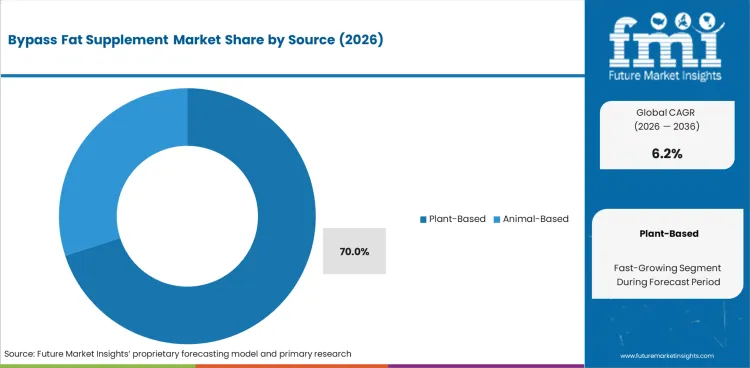
Plant-Based is projected to lead the source segment with a 70.0% share in 2026. This leadership reflects established manufacturing and supply infrastructure, competitive unit economics, and functional superiority in meeting core customer requirements across the dominant application channels.
Within this category, adjacent sub-segments are gaining share as customers respond to reformulation, regulatory, and consumer preference shifts. Converters and suppliers with format breadth and regional capacity are best positioned to capture this subsegment rotation.
Insights into the Flakes Segment
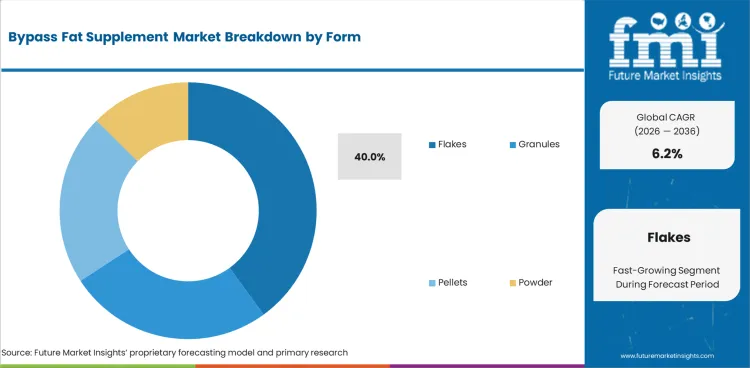
Flakes is projected to lead the form segment with a 40.0% share in 2026. This leadership reflects established manufacturing and supply infrastructure, competitive unit economics, and functional superiority in meeting core customer requirements across the dominant application channels.
Insights into the Dairy Cattle Segment
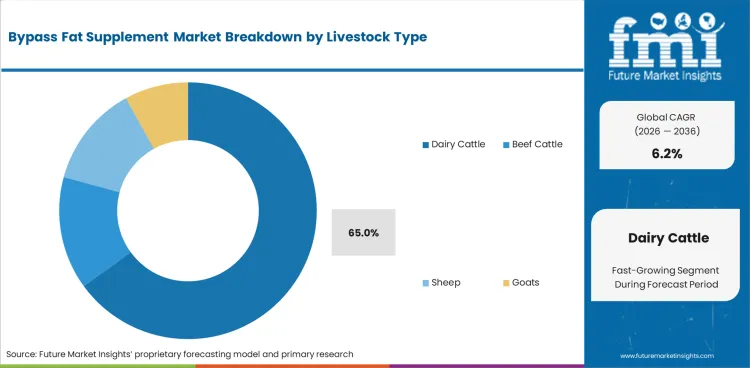
Dairy Cattle is projected to lead the livestock type segment with a 65.0% share in 2026. This leadership reflects established manufacturing and supply infrastructure, competitive unit economics, and functional superiority in meeting core customer requirements across the dominant application channels.
Bypass Fat Supplement Market Drivers, Restraints, and Opportunities
- Expanding commercial dairy herd sizes drive structural demand for rumen-bypass supplementation.
- Dairy productivity optimization programmes consolidate bypass fat procurement at scale.
- Plant-based feedstock capacity scaling reshapes global supply economics and converter positioning.
The bypass fat supplement market is shaped by three concurrent dynamics: category expansion pulling baseline demand, regulatory and reformulation pressure reshaping specification, and advanced method or format innovation expanding premium pricing bands. Manufacturers and suppliers are responding by investing in reformulation, capacity expansion, and retailer or regulatory certification partnerships.
Commercial Dairy Herd Expansion
The growing size of commercial dairy herds in India, China, Brazil, and other developing Asian markets is affecting demand. High-producing dairy cows need more energy than just forage and grain diets. Bypass fat gives them concentrated energy without disrupting rumen fermentation. Big commercial dairy farms buy more from branded converter suppliers.
Dairy Productivity Optimization
Growth is the result of programs at commercial farms and cooperative supply chains that aim to improve milk yield, fertility, and heat stress management. Supplementing bypass fat can increase the milk yield of high-producing cattle by 1.5 to 3.5 kg per day, which justifies the higher prices for converters and the long-term relationships with suppliers.
Plant-Based Feedstock Capacity Scaling
Plant-based palm and soy bypass fat capacity scaling in Malaysia, Indonesia, India, and Latin America supports adoption. Plant-based supply that is cheaper is helping dairy customers in emerging markets at prices that speed up adoption curves. At the same time, converters in Europe and North America maintain a premium position by sourcing sustainable palm from RSPO-certified sources.
Heat Stress and Fertility Management Applications
There is a lot of room for improvement in heat stress and fertility management, where adding bypass fat helps cows stay productive during times of thermal and reproductive stress. These applications have higher specification requirements and help position specialty products at the top of premium converter portfolios.
Analysis of Bypass Fat Supplement Market By Key Countries
.webp "Top Country Growth Comparison Bypass Fat Supplement Market Cagr (2026 2036)")
| Country | CAGR |
|---|---|
| China | 18.37% |
| India | 17.01% |
| Germany | 15.65% |
| Brazil | 14.29% |
| United States | 12.93% |
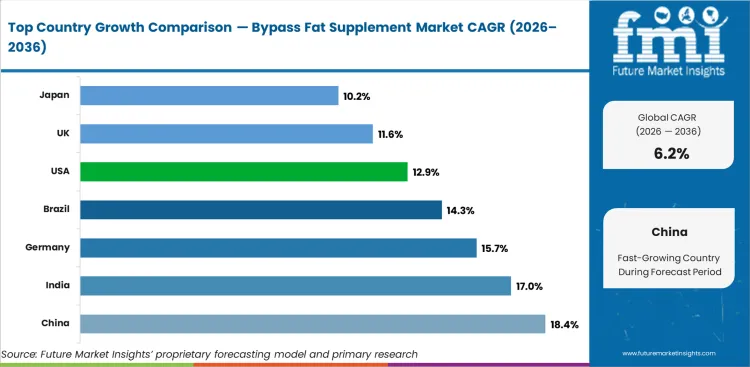
- Asia-Pacific and Latin America are seeing the most absolute growth because they are expanding their commercial dairy herds. North America and Western Europe, on the other hand, are keeping up with premium specification demand by optimizing their sourcing and getting it certified as sustainable.
- China is in the lead with an 18.37 percent CAGR, thanks to the consolidation of commercial dairies, higher targets for milk yield productivity, and the professionalization of dairy farm management.
- Next is India, which has the largest dairy herd in the world, a dominant cooperative supply chain, and an increasing number of commercial farms.
- Brazil and Latin America are seeing strong growth thanks to the expansion of the dairy industry, the optimization of productivity, and investments in localized converter capacity.
From 2026 to 2036, the global market for bypass fat supplements is expected to grow at a rate of 6.2% per year. China is the biggest market, with 18.37%, followed by India with 17.01%. Germany is next with 15.65%, Brazil with 14.29%, and the United States with 12.93%. The study covers more than 30 countries, and the main markets are listed below.
Demand Outlook for Bypass Fat Supplement Market in United States
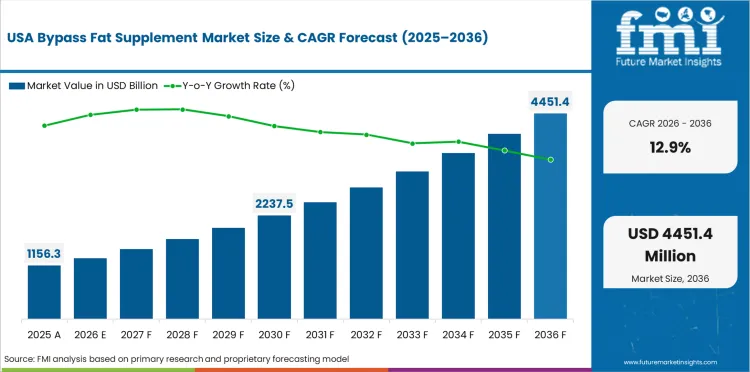
The United States is projected to grow at a 12.93 percent CAGR through 2036, shaped by commercial dairy consolidation, high-producing Holstein productivity targets, and rising heat stress management programmes across southern states. Volac Wilmar Feed Ingredients, ADM, and Kemin Industries anchor domestic bypass fat supplement supply with scaled commercial dairy customer relationships.
- Commercial dairy consolidation drives scaled converter procurement relationships.
- Holstein productivity targets sustain bypass fat specification demand.
- Heat stress management programmes expand specialty converter applications.
Future Outlook for Bypass Fat Supplement Market in United Kingdom
The United Kingdom is projected to grow at an 11.56 percent CAGR through 2036, with demand supported by premium dairy productivity programmes, sustainable sourcing requirements under RSPO certification, and rising bypass fat adoption across commercial dairy segments. Volac Wilmar leads UK-based converter supply with integrated production and nutritional consulting capability.
- Premium dairy productivity programmes consolidate converter procurement.
- Sustainable sourcing requirements drive RSPO-certified supply investment.
- Commercial dairy adoption expands across the British Isles.
Opportunity Analysis for Bypass Fat Supplement Market in Germany
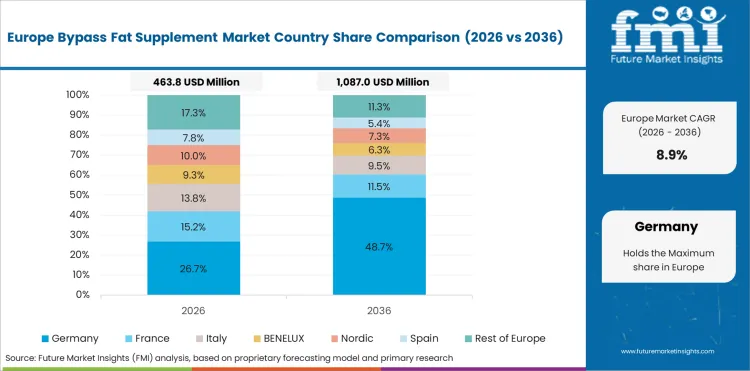
Germany demonstrates steady growth through 2036 as the country's scaled commercial dairy industry, strong sustainability certification preference, and established nutritional consulting infrastructure support consistent bypass fat demand. Berg and Schmidt anchor German domestic supply with deep dairy cooperative and commercial farm customer relationships.
- Scaled commercial dairy industry sustains baseline converter procurement.
- Sustainability certification preference drives RSPO-certified supply adoption.
- Established nutritional consulting infrastructure supports specification positioning.
In-depth Analysis for Bypass Fat Supplement Market in Japan
Japan is projected to grow at a 10.20 percent CAGR through 2036, reflecting mature dairy industry depth, high per-cow productivity targets, and rising heat stress management programmes across dairy regions. Japanese distributors and feed mills favour high-specification bypass fat with documented efficacy data and sustainable sourcing certification.
- High per-cow productivity targets sustain bypass fat specification demand.
- Heat stress management programmes drive specialty application growth.
- Sustainable sourcing preference supports premium certified supply positioning.
Sales Analysis for Bypass Fat Supplement Market in China
China is expected to demonstrate strong growth through 2036, propelled by commercial dairy consolidation, rising milk yield productivity targets, and dairy farm management professionalization. Chinese commercial dairy farms are consolidating feed additive procurement toward branded converter suppliers with nutritional consulting capability.
- Commercial dairy consolidation drives scaled converter procurement.
- Rising milk yield productivity targets sustain bypass fat demand.
- Dairy farm management professionalization expands specification positioning.
In-depth Analysis for Bypass Fat Supplement Market in India
India is the largest dairy producing country and demonstrates structural growth through 2036, supported by the world's largest dairy herd, cooperative supply chain dominance under Amul and state-level federations, and rising commercial farm segment adoption. Indian converters and international entrants are scaling capacity to serve cooperative procurement programmes.
- Cooperative supply chain dominance drives scaled procurement programmes.
- Rising commercial farm segment expands premium converter relationships.
- World's largest dairy herd sustains structural baseline demand.
Competitive Landscape and Strategic Positioning
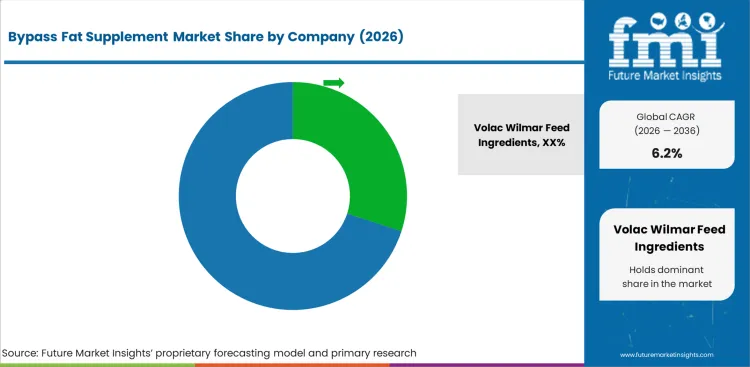
- The top converters collectively hold material share, with competitive differentiation shifting from unit cost to reformulation capability, certification depth, and customer-relationship tenure.
- Regional specialists are gaining share where local regulatory mandates and customer preference favour certified or specialised product and service offerings.
- Start-ups and SMEs are carving niche positions in climate, clean-label, and digital-channel categories targeting premium customer segments.
The bypass fat supplement market is shaped by specialist dairy nutrition converters and integrated feed additive houses. Volac Wilmar Feed Ingredients leads the global bypass fat category with scaled production capacity, integrated palm and vegetable fat feedstock access, and strong commercial dairy customer relationships across multiple geographies.
Berg and Schmidt GmbH and Co. KG operates as a leading European bypass fat specialist with scaled production capacity serving dairy cooperatives and commercial farms across Europe, Middle East, and emerging markets. ADM leverages integrated oilseed processing to deliver bypass fat supply across North American and Latin American dairy customers.
Kemin Industries anchors the global animal nutrition specialist segment with broad feed additive portfolio positioning that combines bypass fat with complementary dairy productivity ingredients. Jiangxi Fineway Biotechnology Co. Ltd. operates in the Asia-Pacific regional converter segment with cost-competitive positioning serving Chinese and Southeast Asian dairy customers.
Barriers to entry include palm and soy feedstock access, rumen-protection processing capital requirements, sustainability certification depth under RSPO and equivalent frameworks, and the multi-year commercial dairy customer qualification cycles typical of nutritional efficacy-based supply relationships. Strategic priorities across leading converters include RSPO-certified feedstock investment, heat stress management application development, and commercial dairy customer consulting capability expansion.
Major Industry Players
Key global companies leading the bypass fat supplement market include:
- Volac Wilmar Feed Ingredients (UK), Berg and Schmidt GmbH and Co. KG (Germany), ADM (USA), and Kemin Industries (USA) were identified as leading players in the bypass fat supplement market, given their scaled production capacity, integrated feedstock access, and established commercial dairy customer relationships across global markets.
- Jiangxi Fineway Biotechnology Co. Ltd. (China) operates as a scaled Asia-Pacific regional converter with cost-competitive positioning serving Chinese and Southeast Asian commercial dairy and cooperative customers.
- Emerging regional specialists across India, Brazil, and other dairy-producing markets have established strong positions in cooperative supply chain programmes and commercial farm procurement with localised cost-advantaged production.
Competitive Benchmarking: Bypass Fat Supplement Market
| Company | Product Breadth | Feedstock Integration | Commercial Dairy Access | Geographic Footprint |
|---|---|---|---|---|
| Volac Wilmar Feed Ingredients | High | High | Strong | Global |
| Berg + Schmidt GmbH & Co. KG | High | Medium | Strong | Europe, Global |
| ADM | High | High | Strong | Global |
| Kemin Industries | High | Medium | Strong | Global |
| Jiangxi Fineway Biotechnology Co., Ltd. | Medium | Medium | Moderate | Asia-Pacific |
Source: Future Market Insights competitive analysis, 2026.
Key Developments in Bypass Fat Supplement Market
- The global bypass fat supplement market is valued at USD 1,900 million in 2025 and projected to grow at a 6.2% CAGR to USD 3,473 million by 2035, driven by dairy and livestock energy needs.
- Dairy consumption and production are surging in Asia, especially India, China, and Southeast Asia, boosting demand for supplements like rumen bypass fats amid rising per capita intake and imports.
Key Players in the Bypass Fat Supplement Market
Major Global Players
- Volac Wilmar Feed Ingredients
- Berg + Schmidt GmbH & Co. KG
- ADM
- Kemin Industries
- Jiangxi Fineway Biotechnology Co., Ltd.
Emerging Players/Startups
- RSPO-Certified Palm Converter A
- Indian Cooperative-Focused Specialist B
- Heat Stress Management Specialty Brand C
Scope of the report
| Metric | Value |
|---|---|
| Quantitative Units | USD 2.02 billion to USD 3.68 billion, at a CAGR of 6.2% |
| Market Definition | The bypass fat supplement market encompasses commercially produced rumen-protected fat additives including calcium salts of fatty acids, hydrogenated fats, and coated fat products supplied to dairy cattle, beef cattle, sheep, and goat nutrition applications for energy supplementation, milk yield enhancement, fertility support, and heat stress management. |
| Regions Covered | North America, Latin America, Europe, East Asia, South Asia and Pacific, Middle East and Africa |
| Countries Covered | India, China, USA, UK, Germany, Japan, South Korea, Brazil, 30 plus countries |
| Key Companies Profiled | Volac Wilmar Feed Ingredients, Berg + Schmidt GmbH & Co. KG, ADM, Kemin Industries, Jiangxi Fineway Biotechnology Co., Ltd. |
| Forecast Period | 2026 to 2036 |
| Approach | Hybrid bottom-up and top-down methodology starting with verified bypass fat supplement market transaction data, projecting adoption velocity across segments and regions. |
Market Segmentation Analysis
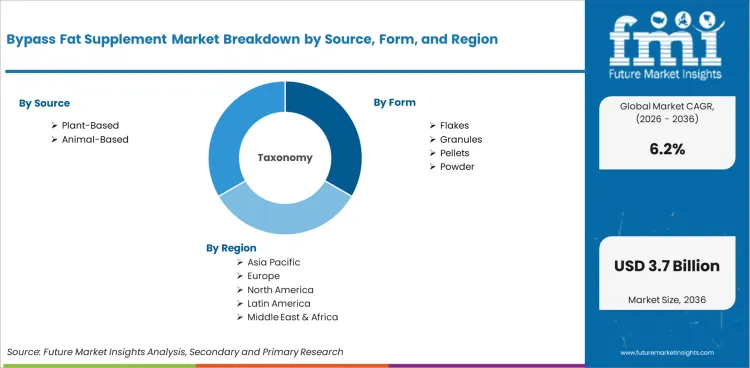
Bypass Fat Supplement Market Market Segmented by Source:
- Plant-Based
- Animal-Based
Bypass Fat Supplement Market Market Segmented by Form:
- Flakes
- Granules
- Pellets
- Powder
Bypass Fat Supplement Market Market Segmented by Livestock Type:
- Dairy Cattle
- Beef Cattle
- Sheep
- Goats
Bypass Fat Supplement Market Market Segmented by Application Purpose:
- Milk Yield Improvement
- Energy Enhancement
- Fertility Support
- Heat Stress Management
Bypass Fat Supplement Market Market Segmented by Sales Channel:
- Direct Sales (B2B)
- Distributors & Dealers
- Online Sales
- Co-operative Supply Chains
Bypass Fat Supplement Market Market by Region:
- North America
- USA
- Canada
- Mexico
- Latin America
- Brazil
- Chile
- Rest of Latin America
- Western Europe
- Germany
- UK
- Italy
- Spain
- France
- Nordic
- BENELUX
- Rest of Western Europe
- Eastern Europe
- Russia
- Poland
- Hungary
- Balkan & Baltic
- Rest of Eastern Europe
- East Asia
- China
- Japan
- South Korea
- South Asia and Pacific
- India
- ASEAN
- Australia & New Zealand
- Rest of South Asia and Pacific
- Middle East & Africa
- Kingdom of Saudi Arabia
- Other GCC Countries
- Turkiye
- South Africa
- Other African Union
- Rest of Middle East & Africa
Bibliography
- 1. Food and Agriculture Organization of the United Nations. (2025). FAOSTAT Dairy Production Statistics. FAO.
- 2. International Dairy Federation. (2024). Bulletin of the IDF on Dairy Nutrition Additives. IDF.
- 3. National Research Council. (2021). Nutrient Requirements of Dairy Cattle. National Academies Press.
- 4. Roundtable on Sustainable Palm Oil. (2024). RSPO Principles and Criteria. RSPO.
- 5. European Food Safety Authority. (2024). Scientific Opinion on Feed Additives for Dairy Cattle. EFSA.
This bibliography is provided for reader reference.
This Report Addresses
- Market sizing and revenue forecasting for bypass fat supplement market from 2026 to 2036.
- Segmentation analysis across the primary axes and regional geographies.
- Regional and country-level insights covering over 30 markets with comparative growth analysis.
- Regulatory and compliance analysis covering key multilateral, national, and industry frameworks.
- Competitive landscape assessment covering market structure, vendor positioning, and recent developments.
- Investment opportunity mapping across growth verticals and geographic regions.
- Supply chain tracking from input sourcing to finished product distribution.
- Data delivery in PDF and Excel formats with quarterly refresh access.
Frequently Asked Questions
How large is the demand for Bypass Fat Supplement Market in the global market in 2026?
Demand for bypass fat supplement market in the global market is estimated to be valued at USD 2.02 billion in 2026.
What will be the market size of Bypass Fat Supplement Market by 2036?
Market size for bypass fat supplement market is projected to reach USD 3.68 billion by 2036.
What is the expected demand growth for Bypass Fat Supplement Market between 2026 and 2036?
Demand for bypass fat supplement market is expected to grow at a CAGR of 6.2% between 2026 and 2036.
Which Source is poised to lead global sales by 2026?
Plant-Based accounts for 70.0% in 2026, reflecting established manufacturing infrastructure and functional performance advantages.
How is the Milk Yield Improvement segment driving Bypass Fat Supplement Market adoption?
Milk Yield Improvement represents 34.8% of the application purpose demand as leading operators drive procurement volumes.
What does Bypass Fat Supplement Market definition mean in this report?
The bypass fat supplement market The bypass fat supplement market encompasses commercially produced rumen-protected fat additives including calcium salts of fatty acids, hydrogenated fats, and coated fat products supplied to dairy cattle, beef cattle, sheep, and goat nutrition applications for energy supplementation, milk yield enhancement, fertility support, and heat stress management.
How does FMI build and validate the Bypass Fat Supplement Market forecast?
Forecasting models apply a hybrid bottom-up methodology starting with verified transaction data, cross-validated against industry sales statistics and manufacturer financial disclosures.
Preview the report firsthand - request a free sample
Get SampleGet the brochure for pricing and purchase details.
Get PDFTable of Content
- Executive Summary
- Global Market Outlook
- Demand-side Trends
- Supply-side Trends
- Technology Roadmap Analysis
- Analysis and Recommendations
- Market Overview
- Market Coverage / Taxonomy
- Market Definition / Scope / Limitations
- Research Methodology
- Chapter Orientation
- Analytical Lens and Working Hypotheses
- Market Structure, Signals, and Trend Drivers
- Benchmarking and Cross-market Comparability
- Market Sizing, Forecasting, and Opportunity Mapping
- Research Design and Evidence Framework
- Desk Research Programme (Secondary Evidence)
- Company Annual and Sustainability Reports
- Peer-reviewed Journals and Academic Literature
- Corporate Websites, Product Literature, and Technical Notes
- Earnings Decks and Investor Briefings
- Statutory Filings and Regulatory Disclosures
- Technical White Papers and Standards Notes
- Trade Journals, Industry Magazines, and Analyst Briefs
- Conference Proceedings, Webinars, and Seminar Materials
- Government Statistics Portals and Public Data Releases
- Press Releases and Reputable Media Coverage
- Specialist Newsletters and Curated Briefings
- Sector Databases and Reference Repositories
- FMI Internal Proprietary Databases and Historical Market Datasets
- Subscription Datasets and Paid Sources
- Social Channels, Communities, and Digital Listening Inputs
- Additional Desk Sources
- Expert Input and Fieldwork (Primary Evidence)
- Primary Modes
- Qualitative Interviews and Expert Elicitation
- Quantitative Surveys and Structured Data Capture
- Blended Approach
- Why Primary Evidence is Used
- Field Techniques
- Interviews
- Surveys
- Focus Groups
- Observational and In-context Research
- Social and Community Interactions
- Stakeholder Universe Engaged
- C-suite Leaders
- Board Members
- Presidents and Vice Presidents
- R&D and Innovation Heads
- Technical Specialists
- Domain Subject-matter Experts
- Scientists
- Physicians and Other Healthcare Professionals
- Governance, Ethics, and Data Stewardship
- Research Ethics
- Data Integrity and Handling
- Primary Modes
- Tooling, Models, and Reference Databases
- Desk Research Programme (Secondary Evidence)
- Data Engineering and Model Build
- Data Acquisition and Ingestion
- Cleaning, Normalisation, and Verification
- Synthesis, Triangulation, and Analysis
- Quality Assurance and Audit Trail
- Market Background
- Demand in Conservative Scenario
- Opportunity Map Analysis
- Product Life Cycle Analysis
- Supply Chain Analysis
- Investment Feasibility Matrix
- Value Chain Analysis
- PESTLE and Porter’s Analysis
- Regulatory Landscape
- Regional Parent Market Outlook
- Production and Consumption Statistics
- Import and Export Statistics
- Global Market Analysis 2021 to 2025 and Forecast, 2026 to 2036
- Historical Market Size Value (USD Million) Analysis, 2021 to 2025
- Current and Future Market Size Value (USD Million) Projections, 2026 to 2036
- Y-o-Y Growth Trend Analysis
- Absolute $ Opportunity Analysis
- Global Market Pricing Analysis 2021 to 2025 and Forecast 2026 to 2036
- Global Market Analysis 2021 to 2025 and Forecast 2026 to 2036, By Source
- Introduction / Key Findings
- Historical Market Size Value (USD Million) Analysis By Source , 2021 to 2025
- Current and Future Market Size Value (USD Million) Analysis and Forecast By Source , 2026 to 2036
- Plant-Based
- Animal-Based
- Plant-Based
- Y-o-Y Growth Trend Analysis By Source , 2021 to 2025
- Absolute $ Opportunity Analysis By Source , 2026 to 2036
- Global Market Analysis 2021 to 2025 and Forecast 2026 to 2036, By Form
- Introduction / Key Findings
- Historical Market Size Value (USD Million) Analysis By Form, 2021 to 2025
- Current and Future Market Size Value (USD Million) Analysis and Forecast By Form, 2026 to 2036
- Flakes
- Granules
- Pellets
- Powder
- Flakes
- Y-o-Y Growth Trend Analysis By Form, 2021 to 2025
- Absolute $ Opportunity Analysis By Form, 2026 to 2036
- Global Market Analysis 2021 to 2025 and Forecast 2026 to 2036, By Livestock Type
- Introduction / Key Findings
- Historical Market Size Value (USD Million) Analysis By Livestock Type, 2021 to 2025
- Current and Future Market Size Value (USD Million) Analysis and Forecast By Livestock Type, 2026 to 2036
- Dairy Cattle
- Beef Cattle
- Sheep
- Goats
- Dairy Cattle
- Y-o-Y Growth Trend Analysis By Livestock Type, 2021 to 2025
- Absolute $ Opportunity Analysis By Livestock Type, 2026 to 2036
- Global Market Analysis 2021 to 2025 and Forecast 2026 to 2036, By Application Purpose
- Introduction / Key Findings
- Historical Market Size Value (USD Million) Analysis By Application Purpose, 2021 to 2025
- Current and Future Market Size Value (USD Million) Analysis and Forecast By Application Purpose, 2026 to 2036
- Milk Yield Improvement
- Energy Enhancement
- Fertility Support
- Heat Stress Management
- Milk Yield Improvement
- Y-o-Y Growth Trend Analysis By Application Purpose, 2021 to 2025
- Absolute $ Opportunity Analysis By Application Purpose, 2026 to 2036
- Global Market Analysis 2021 to 2025 and Forecast 2026 to 2036, By Sales Channel
- Introduction / Key Findings
- Historical Market Size Value (USD Million) Analysis By Sales Channel, 2021 to 2025
- Current and Future Market Size Value (USD Million) Analysis and Forecast By Sales Channel, 2026 to 2036
- Direct Sales (B2B)
- Distributors & Dealers
- Online Sales
- Co-operative Supply Chains
- Direct Sales (B2B)
- Y-o-Y Growth Trend Analysis By Sales Channel, 2021 to 2025
- Absolute $ Opportunity Analysis By Sales Channel, 2026 to 2036
- Global Market Analysis 2021 to 2025 and Forecast 2026 to 2036, By Region
- Introduction
- Historical Market Size Value (USD Million) Analysis By Region, 2021 to 2025
- Current Market Size Value (USD Million) Analysis and Forecast By Region, 2026 to 2036
- North America
- Latin America
- Western Europe
- Eastern Europe
- East Asia
- South Asia and Pacific
- Middle East & Africa
- Market Attractiveness Analysis By Region
- North America Market Analysis 2021 to 2025 and Forecast 2026 to 2036, By Country
- Historical Market Size Value (USD Million) Trend Analysis By Market Taxonomy, 2021 to 2025
- Market Size Value (USD Million) Forecast By Market Taxonomy, 2026 to 2036
- By Country
- USA
- Canada
- Mexico
- By Source
- By Form
- By Livestock Type
- By Application Purpose
- By Sales Channel
- By Country
- Market Attractiveness Analysis
- By Country
- By Source
- By Form
- By Livestock Type
- By Application Purpose
- By Sales Channel
- Key Takeaways
- Latin America Market Analysis 2021 to 2025 and Forecast 2026 to 2036, By Country
- Historical Market Size Value (USD Million) Trend Analysis By Market Taxonomy, 2021 to 2025
- Market Size Value (USD Million) Forecast By Market Taxonomy, 2026 to 2036
- By Country
- Brazil
- Chile
- Rest of Latin America
- By Source
- By Form
- By Livestock Type
- By Application Purpose
- By Sales Channel
- By Country
- Market Attractiveness Analysis
- By Country
- By Source
- By Form
- By Livestock Type
- By Application Purpose
- By Sales Channel
- Key Takeaways
- Western Europe Market Analysis 2021 to 2025 and Forecast 2026 to 2036, By Country
- Historical Market Size Value (USD Million) Trend Analysis By Market Taxonomy, 2021 to 2025
- Market Size Value (USD Million) Forecast By Market Taxonomy, 2026 to 2036
- By Country
- Germany
- UK
- Italy
- Spain
- France
- Nordic
- BENELUX
- Rest of Western Europe
- By Source
- By Form
- By Livestock Type
- By Application Purpose
- By Sales Channel
- By Country
- Market Attractiveness Analysis
- By Country
- By Source
- By Form
- By Livestock Type
- By Application Purpose
- By Sales Channel
- Key Takeaways
- Eastern Europe Market Analysis 2021 to 2025 and Forecast 2026 to 2036, By Country
- Historical Market Size Value (USD Million) Trend Analysis By Market Taxonomy, 2021 to 2025
- Market Size Value (USD Million) Forecast By Market Taxonomy, 2026 to 2036
- By Country
- Russia
- Poland
- Hungary
- Balkan & Baltic
- Rest of Eastern Europe
- By Source
- By Form
- By Livestock Type
- By Application Purpose
- By Sales Channel
- By Country
- Market Attractiveness Analysis
- By Country
- By Source
- By Form
- By Livestock Type
- By Application Purpose
- By Sales Channel
- Key Takeaways
- East Asia Market Analysis 2021 to 2025 and Forecast 2026 to 2036, By Country
- Historical Market Size Value (USD Million) Trend Analysis By Market Taxonomy, 2021 to 2025
- Market Size Value (USD Million) Forecast By Market Taxonomy, 2026 to 2036
- By Country
- China
- Japan
- South Korea
- By Source
- By Form
- By Livestock Type
- By Application Purpose
- By Sales Channel
- By Country
- Market Attractiveness Analysis
- By Country
- By Source
- By Form
- By Livestock Type
- By Application Purpose
- By Sales Channel
- Key Takeaways
- South Asia and Pacific Market Analysis 2021 to 2025 and Forecast 2026 to 2036, By Country
- Historical Market Size Value (USD Million) Trend Analysis By Market Taxonomy, 2021 to 2025
- Market Size Value (USD Million) Forecast By Market Taxonomy, 2026 to 2036
- By Country
- India
- ASEAN
- Australia & New Zealand
- Rest of South Asia and Pacific
- By Source
- By Form
- By Livestock Type
- By Application Purpose
- By Sales Channel
- By Country
- Market Attractiveness Analysis
- By Country
- By Source
- By Form
- By Livestock Type
- By Application Purpose
- By Sales Channel
- Key Takeaways
- Middle East & Africa Market Analysis 2021 to 2025 and Forecast 2026 to 2036, By Country
- Historical Market Size Value (USD Million) Trend Analysis By Market Taxonomy, 2021 to 2025
- Market Size Value (USD Million) Forecast By Market Taxonomy, 2026 to 2036
- By Country
- Kingdom of Saudi Arabia
- Other GCC Countries
- Turkiye
- South Africa
- Other African Union
- Rest of Middle East & Africa
- By Source
- By Form
- By Livestock Type
- By Application Purpose
- By Sales Channel
- By Country
- Market Attractiveness Analysis
- By Country
- By Source
- By Form
- By Livestock Type
- By Application Purpose
- By Sales Channel
- Key Takeaways
- Key Countries Market Analysis
- USA
- Pricing Analysis
- Market Share Analysis, 2025
- By Source
- By Form
- By Livestock Type
- By Application Purpose
- By Sales Channel
- Canada
- Pricing Analysis
- Market Share Analysis, 2025
- By Source
- By Form
- By Livestock Type
- By Application Purpose
- By Sales Channel
- Mexico
- Pricing Analysis
- Market Share Analysis, 2025
- By Source
- By Form
- By Livestock Type
- By Application Purpose
- By Sales Channel
- Brazil
- Pricing Analysis
- Market Share Analysis, 2025
- By Source
- By Form
- By Livestock Type
- By Application Purpose
- By Sales Channel
- Chile
- Pricing Analysis
- Market Share Analysis, 2025
- By Source
- By Form
- By Livestock Type
- By Application Purpose
- By Sales Channel
- Germany
- Pricing Analysis
- Market Share Analysis, 2025
- By Source
- By Form
- By Livestock Type
- By Application Purpose
- By Sales Channel
- UK
- Pricing Analysis
- Market Share Analysis, 2025
- By Source
- By Form
- By Livestock Type
- By Application Purpose
- By Sales Channel
- Italy
- Pricing Analysis
- Market Share Analysis, 2025
- By Source
- By Form
- By Livestock Type
- By Application Purpose
- By Sales Channel
- Spain
- Pricing Analysis
- Market Share Analysis, 2025
- By Source
- By Form
- By Livestock Type
- By Application Purpose
- By Sales Channel
- France
- Pricing Analysis
- Market Share Analysis, 2025
- By Source
- By Form
- By Livestock Type
- By Application Purpose
- By Sales Channel
- India
- Pricing Analysis
- Market Share Analysis, 2025
- By Source
- By Form
- By Livestock Type
- By Application Purpose
- By Sales Channel
- ASEAN
- Pricing Analysis
- Market Share Analysis, 2025
- By Source
- By Form
- By Livestock Type
- By Application Purpose
- By Sales Channel
- Australia & New Zealand
- Pricing Analysis
- Market Share Analysis, 2025
- By Source
- By Form
- By Livestock Type
- By Application Purpose
- By Sales Channel
- China
- Pricing Analysis
- Market Share Analysis, 2025
- By Source
- By Form
- By Livestock Type
- By Application Purpose
- By Sales Channel
- Japan
- Pricing Analysis
- Market Share Analysis, 2025
- By Source
- By Form
- By Livestock Type
- By Application Purpose
- By Sales Channel
- South Korea
- Pricing Analysis
- Market Share Analysis, 2025
- By Source
- By Form
- By Livestock Type
- By Application Purpose
- By Sales Channel
- Russia
- Pricing Analysis
- Market Share Analysis, 2025
- By Source
- By Form
- By Livestock Type
- By Application Purpose
- By Sales Channel
- Poland
- Pricing Analysis
- Market Share Analysis, 2025
- By Source
- By Form
- By Livestock Type
- By Application Purpose
- By Sales Channel
- Hungary
- Pricing Analysis
- Market Share Analysis, 2025
- By Source
- By Form
- By Livestock Type
- By Application Purpose
- By Sales Channel
- Kingdom of Saudi Arabia
- Pricing Analysis
- Market Share Analysis, 2025
- By Source
- By Form
- By Livestock Type
- By Application Purpose
- By Sales Channel
- Turkiye
- Pricing Analysis
- Market Share Analysis, 2025
- By Source
- By Form
- By Livestock Type
- By Application Purpose
- By Sales Channel
- South Africa
- Pricing Analysis
- Market Share Analysis, 2025
- By Source
- By Form
- By Livestock Type
- By Application Purpose
- By Sales Channel
- USA
- Market Structure Analysis
- Competition Dashboard
- Competition Benchmarking
- Market Share Analysis of Top Players
- By Regional
- By Source
- By Form
- By Livestock Type
- By Application Purpose
- By Sales Channel
- Competition Analysis
- Competition Deep Dive
- Volac Wilmar Feed Ingredients
- Overview
- Product Portfolio
- Profitability by Market Segments (Product/Age /Sales Channel/Region)
- Sales Footprint
- Strategy Overview
- Marketing Strategy
- Product Strategy
- Channel Strategy
- Berg + Schmidt GmbH & Co. KG
- ADM
- Kemin Industries
- Jiangxi Fineway Biotechnology Co., Ltd.
- Volac Wilmar Feed Ingredients
- Competition Deep Dive
- Assumptions & Acronyms Used


