

- Market Size (2026)
- USD 96.3 Mn
- Forecast (2036)
- USD 200.3 Mn
- CAGR (2026 to 2036)
- 7.6%
How big is Calamansi Concentrate Market in 2026?
USD 96.3 million in 2026 and USD 200.3 million by 2036 at a 7.6% CAGR.
Demand for calamansi concentrate is projected to expand at 7.6% CAGR between 2026 and 2036, increasing valuation from USD 96.3 million to USD 200.3 million. Food processors convert fresh calamansi into standardized fruit and vegetable ingredients that support repeat dosing across beverage and culinary production. Equipment reliability becomes commercially relevant once processors commit to recurring batches and tighter product specifications. DOST Region VI reported in January 2025 that Mc Nester Food Products increased production volume after upgrading its bottling and pasteurization equipment. The completed upgrade links processing control with the capacity required for recurring local and international orders.
Country routes differ as Philippine processors operate near calamansi production, while import-dependent markets require registration ahead of commercial release. Import documentation affects release timing for beverage and foodservice accounts that need a qualified ingredient ahead of scheduled production. Dubai Municipality reported in July 2025 that 34,700 food inspections were conducted and that 77,700 new food products were registered during the first half of 2025, as part of a broader food safety milestone in which 34,700 inspection visits were also conducted across the emirate."A registration volume at that scale makes complete product files commercially relevant in the UAE, whereas Philippine processors can qualify closer to fruit collection and extraction.
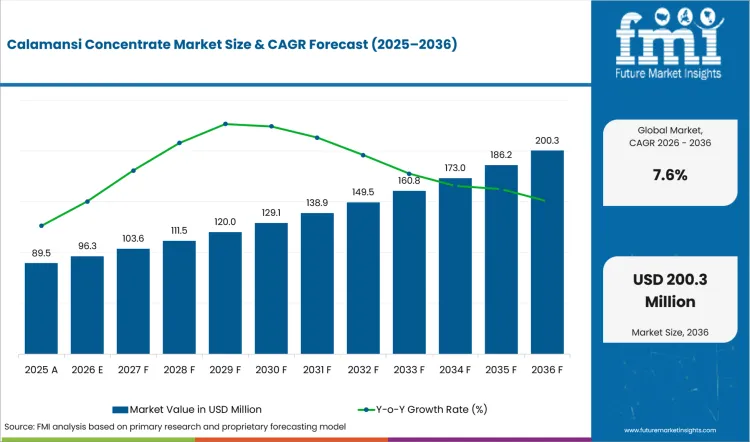
Key Takeaways of Calamansi Concentrate Market
- Demand is rising as processors convert seasonal calamansi into specification-based ingredients that support repeat dosing across beverage and culinary production.
- Based on product type, juice concentrate is projected to account for 38.0% in 2026 due to broad compatibility with repeat liquid dosing.
- The single-strength segment is likely to capture 26.0% share in 2026 attributable to direct use that reduces reconstitution work for formulators.
- Conventional is projected to hold 64.0% share in 2026 owing to broader fruit sourcing without organic chain-of-custody requirements.
- Seasonal fruit variation raises processing costs and qualification risk if processors cannot maintain acidity or sensory consistency across commercial production lots.
- Fruit Concept Co., Jaidal Tropical Fruit Juice Manufacturing, Hapijess Food Products Manufacturing, Tagudin Samahan ng Magkakalamansi Producers Cooperative, Zigmund Enterprises, Good Sense Food & Juices Corp., Mc Nester Food Products and Squeezed 4 U 168 Inc. are profiled in the calamansi concentrate market.
Analyst Perspective
"Calamansi concentrate earns repeat orders when processors hold acidity and aroma inside a usable specification across changing fruit lots. The stronger commercial offer pairs documented pasteurization and stable pack performance with enough fruit-sourcing flexibility to protect that specification across seasonal harvests."
- Nandini Roy Choudhury, Principal Consultant, Future Market Insights
How is the Calamansi Concentrate Market segmented?
The calamansi concentrate market is segmented by product type, concentration, nature, application, packaging, sales channel and region.
Taxonomy covers product type, concentration, nature, application, packaging and sales channel. Product types are juice concentrate, puree concentrate, frozen concentrate, powder concentrate and blended citrus concentrate. Concentration includes single-strength, 2x-4x concentrate and 5x and above. Nature includes conventional, organic and preservative-free or clean label. Applications are beverages, sauces and marinades, bakery and desserts, foodservice and nutraceutical or wellness drinks. Packaging covers drums, aseptic bags, frozen pails and retail bottles/sachets. Packaging covers drums, aseptic bags, frozen pails, and retail bottles or sachets. Sales channels are ingredient distributors, direct processor supply, foodservice distributors and retail or e-commerce.
How do beverages shape demand within the application category?
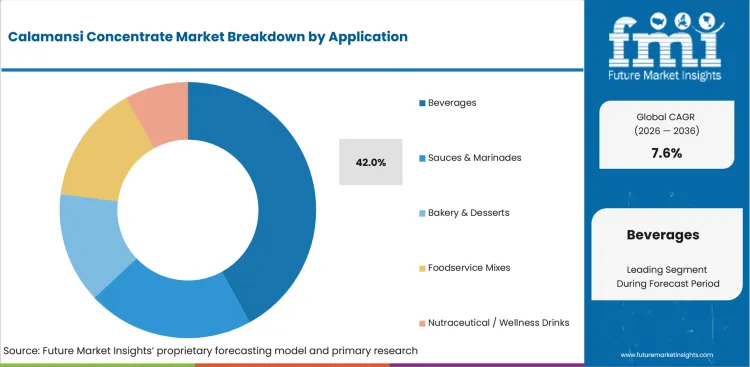
Beverage formulations use calamansi acidity and aroma as measurable beverage ingredients across repeated filling runs and controlled commercial recipes.
- In 2026, beverages are expected to lead the application category with 42.0% share because liquid concentrate fits repeat formulation and filling workflows.
- Commercial beverage use requires a registered formulation that can advance from laboratory tasting into routine production. Philippine FDA records issued in March 2025 registered Hapijess Food Products Manufacturing's calamansi lemonade juice drink until March 2030. The record links calamansi processing with a beverage route that requires stable handling and consistent natural flavors across scheduled production.
What makes juice concentrate central to the product type category?
Juice concentrate gives formulators a standardized liquid input that carries calamansi acidity without repeated fresh-fruit sorting. Philippine FDA records issued in February 2025 registered Hapijess Food Products Manufacturing's calamansi extract concentrate until February 2030.
- By product type, juice concentrate is estimated to hold 38.0% in 2026 owing to compatibility with liquid processing and repeat dosing.
- Commercial availability becomes decisive as manufacturers shift from formulation trials toward recurring plant purchasing for approved beverage and culinary recipes. A registered liquid format reduces fresh-fruit handling and gives food manufacturers a stable reference for repeat acidity checks against customer specifications.
Why does single-strength lead the concentration category?
Single-strength reduces reconstitution work during sensory evaluation at facilities qualifying calamansi concentrate for beverage or culinary use. FDA's current Import Alert 20-07 lists an April 2025 citrus juice concentrate case whose HACCP plan lacked controls for a consistent five-log pathogen reduction, illustrating the documentation standard that calamansi processors must meet for US commercial entry.
- Single-strength is set to lead the concentration category with 26.0% share in 2026 due to direct usability during routine formulation work.
- Philippine FDA records issued in May 2025 registered Squeezed 4 U 168 Inc.'s calamansi extract until May 2031. A registered direct-use extract reduces higher-solids water control during plant preparation and makes single-strength evaluation easier for smaller receiving sites. Commercial qualification then centers on sensory fit and batch consistency instead of reconstitution accuracy during purchasing reviews.
What supports conventional within the nature category?
Philippine FDA records issued in January 2025 registered Tagudin Samahan ng Magkakalamansi Producers Cooperative's Healthy-C calamansi concentrate until January 2027. Conventional supply gives processors wider fruit sourcing flexibility than certified organic foods routes during seasonal intake and contracted production scheduling.
- The nature category is forecast to be led by conventional at 64.0% share in 2026 due to broader sourcing without organic chain-of-custody controls.
- A current registered concentrate route lets processors qualify conventional material without adding organic chain-of-custody requirements to every transaction. Seasonal fruit intake requires acidity and sensory checks as broader sourcing flexibility does not remove raw-material variation.
What are the drivers, restraints and opportunities in the Calamansi Concentrate Market?
Standardized processing increases repeat-use demand while heat and raw-fruit variability raise conversion costs, and format breadth gives processors additional commercial routes.
- Driver: Standardized calamansi inputs let beverage and culinary manufacturers flavor targets without handling fresh fruit at every production site.
- Restraint: Heat control and fruit variability can raise conversion costs if processors must protect both food safety and sensory quality.
- Opportunity: Concentrate blends and alternative formats let processors serve applications with different dosing requirements or lower dependence on refrigerated liquid handling.
Standardized Processing Converts Fresh Fruit into Repeatable Formulas
Food manufacturers favor standardized calamansi inputs once recipes require repeat acidity across scheduled production runs. Philippine FDA records from July 2025 registered Good Sense Food & Juices Corp.'s Real Squeeze calamansi extract until July 2030. The regulated format gives processors a direct route from fresh-fruit conversion into repeatable food and beverage additives for commercial formulations.
Heat Control and Raw-Fruit Variation Raise Processing Burden
DOST Region IX reported in October 2025 that Picker's added a pasteurizing kettle targeting 80°C with up to 30% higher processing efficiency. Calamansi processors need heat control that reduces microbial risk without flattening the acidity and aroma expected in finished foods. Aseptic packaging can protect the product later, but it cannot correct inconsistent pasteurization or variable incoming fruit.
Format Breadth Extends Calamansi beyond Straight Concentrate
Dry citrus powder reduces liquid handling for foodservice mixes and shelf-stable formulations that need measured citrus dosing. Fruit powders let processors serve several handling and storage requirements from the same fruit supply base. The Department of Agriculture documented in April 2025 that MARCCO produced ginger-honey concentrate beside pure extract and ready-to-drink calamansi products, giving processors several qualification routes from one operation.
Which country CAGRs are profiled in the Calamansi Concentrate Market?
| Country | CAGR |
|---|---|
| Philippines | 8.8% |
| United Arab Emirates | 7.5% |
| Australia | 7.3% |
| Japan | 6.9% |
| United States | 6.8% |
How do country-level CAGRs compare in the Calamansi Concentrate Market?
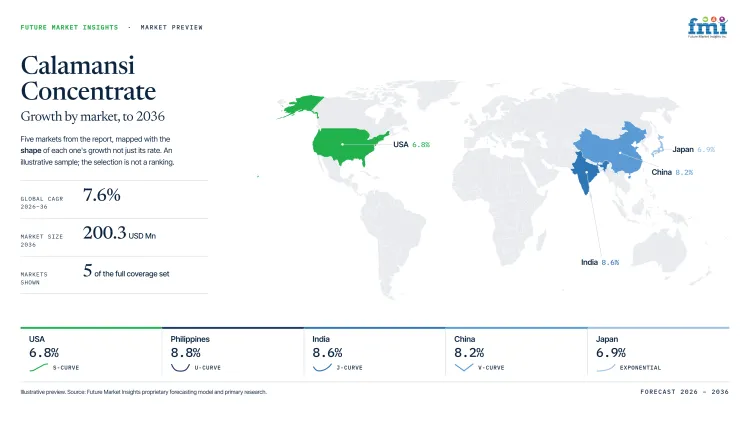
The country comparison spans 2.0 percentage points and reveals three distinct growth groups across the calamansi concentrate market. The Philippines leads clearly at 8.8%, followed by the UAE and Australia at 7.5% and 7.3%. Japan and the USA form the lower group, separated by 0.1 percentage points.
- The Philippines leads the comparison at an 8.8% CAGR through 2036, supported by strong domestic familiarity with calamansi, food and beverage applications, and expanding demand for convenient citrus-based ingredients.
- The United Arab Emirates follows at a 7.5% CAGR, remaining 1.3 percentage points below the Philippines. Foodservice expansion, beverage innovation and demand for distinctive citrus flavors support calamansi concentrate adoption.
- Australia records a 7.3% CAGR, 0.2 percentage points below the UAE. Growing interest in tropical flavors, premium beverages and natural fruit ingredients supports demand across foodservice and packaged products.
- Japan grows at a 6.9% CAGR, creating a 0.4-percentage-point gap from Australia. Interest in novel fruit flavors, premium beverages and convenient food ingredients supports gradual market expansion.
- The United States records a 6.8% CAGR, 0.1 percentage points below Japan and the lowest among the profiled countries. Expanding specialty beverage applications and consumer interest in tropical citrus flavors support continued calamansi concentrate demand.
Comparable CAGRs can still produce different market conditions. Differences in consumer preferences, foodservice activity, beverage innovation, import availability and familiarity with calamansi influence concentrate demand across countries. The full report provides country-level CAGR analysis across major regions and individual markets within the calamansi concentrate market.
Country-wise Analysis
- Philippine processors work closest to domestic calamansi farms and can organize collection around short harvest windows that otherwise increase sorting loss and fruit variability during extraction preparation at local plants within nearby processing districts. The Department of Agriculture reported in June 2025 that LACAFA grouped 67 farmer-members across about 119 hectares with processing access, strengthening the route from farm collection into current commercial concentrate production. The Philippine calamansi concentrate sector is projected to record 8.8% CAGR during the assessment period, supported by crop proximity although harvest swings require disciplined intake planning and storage to protect batch consistency and delivery schedules.
- UAE ingredient importers rely on digital registration and port-clearance systems for specialty citrus products entering distributor inventories that serve hotel kitchens, beverage plants and foodservice operators across the emirates under local importer responsibility. The UAE calamansi concentrate outlook is anticipated to advance at 7.5% CAGR over the assessment period, aided by a Montaji+ platform that Dubai Municipality reported in February 2025 contained more than 1.7 million registered products. Organized import systems reduce administrative handling, but unfamiliar calamansi profiles require complete shelf-life files and local application support as initial trials progress toward recurring distributor purchase orders in Dubai and Abu Dhabi.
- Australian food importers can review safety obligations inside BICON beside biosecurity conditions, and the Department of Agriculture reported in June 2025 that imported-food requirements now include pre-import documents plus possible arrival testing for regulated food consignments. Australia is estimated to post 7.3% CAGR over the forecast period, supported by searchable import conditions that help importers plan compliance across long international lead times and broker-managed international shipments into Australia. Calamansi must justify sensory differentiation and dependable local replenishment as manufacturers compare it with familiar citrus inputs for recurring beverage and culinary production schedules across major urban food-processing centers nationwide during scheduled manufacturing.
- Japanese ingredient importers operate under a formal notification system that places composition and processing records ahead of commercial sale for unfamiliar overseas citrus ingredients entering beverage manufacturing channels across major ports and distribution hubs. Adoption of calamansi concentrate in Japan is estimated to expand at 6.9% CAGR through 2036, supported by a predictable review route that gives importers clear documentation requirements for routine commercial entry. The Ministry of Health reported in March 2025 that its fiscal-year plan called for about 100,000 imported-food inspections, and calamansi formulations need clear sensory specifications as beverage manufacturers evaluate recurring production volumes across domestic drink and foodservice manufacturing programs across Japan.
- United States beverage manufacturers and importers require validated juice HACCP controls for foreign concentrates entering routine industrial and foodservice purchasing programs that release repeated lots across national distribution networks and regional warehouses. FDA's current Import Alert 20-07 lists an April 2025 lemon juice concentrate case whose HACCP plan lacked controls for a consistent five-log pathogen reduction during commercial processing under routine production conditions. Calamansi concentrate sales in the United States are forecast to expand at 6.8% CAGR by 2036, supported by established beverage processing although overseas processors need dependable hazard documentation and domestic replenishment as distributors evaluate recurring commercial volumes.
Who are the notable companies in the Calamansi Concentrate Market?
Fruit Concept Co., Jaidal Tropical Fruit Juice Manufacturing, Hapijess Food Products Manufacturing, Tagudin Samahan ng Magkakalamansi Producers Cooperative, Zigmund Enterprises, Good Sense Food & Juices Corp., Mc Nester Food Products and Squeezed 4 U 168 Inc. are the notable companies serving this market.
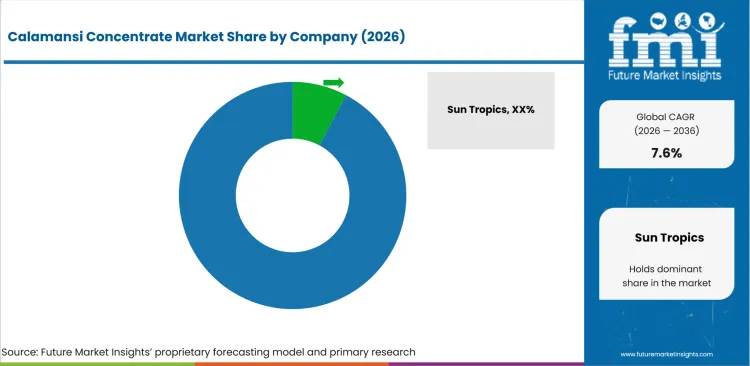
Competition remains fragmented among Philippine processors and cooperatives supplying straight or blended calamansi formats across domestic channels. Entry depends on food registration and processing control, while fruit access determines whether smaller firms can sustain recurring commercial volumes.
- Fruit Concept Co., Jaidal Tropical Fruit Juice Manufacturing and Hapijess Food Products Manufacturing compete with current concentrate registrations.
- Tagudin Samahan ng Magkakalamansi Producers Cooperative, Zigmund Enterprises and Good Sense Food & Juices Corp. serve distinct registered formulation routes.
- Mc Nester Food Products adds government-documented processing upgrades while Squeezed 4 U 168 Inc. maintains a current registered extract route.
Competitive Benchmarking: Calamansi Concentrate Market
| Company | Commercial Readiness | Formulation Breadth | Processing Control Evidence | Geographic Reach |
|---|---|---|---|---|
| Fruit Concept Co. | High | Medium | Medium | Philippines |
| Jaidal Tropical Fruit Juice Manufacturing | High | Medium | Medium | Philippines |
| Hapijess Food Products Manufacturing | High | High | Medium | Philippines |
| Tagudin Samahan ng Magkakalamansi Producers Cooperative | High | Medium | Medium | Philippines |
| Zigmund Enterprises | High | High | Medium | Philippines |
| Good Sense Food & Juices Corp. | High | High | Medium | Philippines |
| Mc Nester Food Products | Medium | High | High | Philippines and export customers |
| Squeezed 4 U 168 Inc. | High | Medium | Medium | Philippines |
Key Developments in the Calamansi Concentrate Market
- In December 2025, Fruit Concept Co. received Philippine FDA registration for a honey-sweetened calamansi drink concentrate valid until December 2028.
- In September 2025, Jaidal Tropical Fruit Juice Manufacturing received Philippine FDA registration for calamansi concentrate valid until September 2028.
- In May 2025, Zigmund Enterprises received Philippine FDA registration for pineapple-calamansi juice concentrate with sugar and honey until May 2028.
Key Players in the Calamansi Concentrate Market
Registered Concentrate Processors
- Jaidal Tropical Fruit Juice Manufacturing
- Hapijess Food Products Manufacturing
- Tagudin Samahan ng Magkakalamansi Producers Cooperative
Blended Concentrate Producers
- Fruit Concept Co.
- Zigmund Enterprises
- Good Sense Food & Juices Corp.
- Squeezed 4 U 168 Inc.
Documented Small-Enterprise Processor
- Mc Nester Food Products
Calamansi Concentrate Market - Report Scope
| Coverage field | Report scope |
|---|---|
| Market breakdown | By product type, concentration, nature, application, packaging, sales channel and region. |
| Quantitative Units | Revenue in USD million and CAGR in %. |
| Market Definition | Commercial calamansi concentrates and extract-based concentrate formats sold for beverage and culinary applications plus foodservice or related formulated use. |
| Regions Covered | North America, Latin America, Europe, East Asia, South Asia and Pacific, and Middle East and Africa. |
| Countries Covered | Philippines, United Arab Emirates, Australia, Japan, United States, and 20+ countries included in the full report. |
| Key Companies Profiled | Fruit Concept Co., Jaidal Tropical Fruit Juice Manufacturing, Hapijess Food Products Manufacturing, Tagudin Samahan ng Magkakalamansi Producers Cooperative, Zigmund Enterprises, Good Sense Food & Juices Corp., Mc Nester Food Products, Squeezed 4 U 168 Inc. |
| Forecast Period | 2026 to 2036. |
| Approach | Primary and secondary research with market triangulation. |
Calamansi Concentrate Market - Research Methodology
| Method | Approach |
|---|---|
| Primary Research | FMI analysts gathered input from manufacturers, service providers, technology developers, distributors, end users, procurement teams, and subject-matter experts. Interviews examined purchasing decisions, product or service evaluation, adoption barriers, approval requirements, pricing considerations, and expectations for technical or commercial support. Respondents were also asked what evidence is required before a trial, pilot, or initial order develops into regular purchasing. |
| Desk Research | Desk research covered government statistics, regulatory publications, trade data, industry associations, technical literature, standards, company filings, product information, and official corporate announcements. Sources were reviewed for relevance, publication date, geographic coverage, and consistency with the defined market scope. Claims relating to performance, applications, approvals, capacity, investment, and commercial activity were retained only when supported by credible public evidence. |
| Market Sizing and Forecasting | The market model combined the baseline value with historical performance, segment structure, pricing and volume indicators, adoption levels, company participation, and country-level demand conditions. Forecast assumptions considered economic activity, investment trends, regulatory developments, technology adoption, purchasing cycles, supply availability, and barriers to wider market use. Segment and regional estimates were reconciled before the final market total was calculated. |
| Data Validation | Estimates were checked against multiple independent indicators, including public data, company activity, trade patterns, industry developments, and findings from primary interviews. Validation also tested whether products, services, applications, and company revenues fell within the defined market boundaries. Adjacent categories, unsupported claims, overlapping revenues, and activities without direct market relevance were excluded to reduce double counting and maintain consistency across segments and countries. |
Calamansi Concentrate Market by Segments
Calamansi Concentrate Market segmented by Product Type:
- Juice Concentrate
- Puree Concentrate
- Frozen Concentrate
- Powder Concentrate
- Blended Citrus Concentrate
Calamansi Concentrate Market segmented by Concentration:
- Single-strength
- 2x-4x Concentrate
- 5x and Above
Calamansi Concentrate Market segmented by Nature:
- Conventional
- Organic
- Preservative-free / Clean Label
Calamansi Concentrate Market segmented by Application:
- Beverages
- Sauces & Marinades
- Bakery & Desserts
- Foodservice Mixes
- Nutraceutical / Wellness Drinks
Calamansi Concentrate Market segmented by Packaging:
- Drums
- Aseptic Bags
- Frozen Pails
- Retail Bottles / Sachets
Calamansi Concentrate Market segmented by Sales Channel:
- Ingredient Distributors
- Direct Processor Supply
- Foodservice Distributors
- Retail / E-commerce
Calamansi Concentrate Market by Region:
- North America
- United States
- Canada
- Latin America
- Brazil
- Mexico
- Chile
- Rest of Latin America
- Western Europe
- Germany
- United Kingdom
- Italy
- Spain
- France
- Nordics
- Benelux
- Rest of Western Europe
- Eastern Europe
- Russia
- Poland
- Hungary
- Balkan and Baltic States
- Rest of Eastern Europe
- East Asia
- China
- Japan
- South Korea
- South Asia and Pacific
- India
- ASEAN
- Australia and New Zealand
- Rest of South Asia and Pacific
- Middle East and Africa
- Kingdom of Saudi Arabia
- Other GCC Countries
- Türkiye
- South Africa
- Other African Union Countries
- Rest of Middle East and Africa
Research Sources and Bibliography
- Department of Science and Technology Regional Office VI. (2025, January 30). Mc Nester Food Products: A Legacy of Innovation and Local Flavors.
- Dubai Municipality. (2025, July 30). Over 34,000 food inspections conducted in first half of 2025.
- Food and Drug Administration Philippines. (2025, February 25). FDA Verification Portal [Registration FR-4000009838277].
- Food and Drug Administration Philippines. (2025, May 8). FDA Verification Portal [Registration FR-4000014341326].
- Food and Drug Administration Philippines. (2025, January 6). FDA Verification Portal [Registration FR-4000013421485].
- Food and Drug Administration Philippines. (2025, March 26). All Food Products [Registration FR-4000013170404].
- Food and Drug Administration Philippines. (2025, July 9). FDA Verification Portal [Registration FR-4000014819247].
- Department of Science and Technology Regional Office IX. (2025, October 24). From Orchard to Opportunity: DOST-IX Boosts Picker’s Calamansi Food Productsthrough SETUP.
- Madrigal, J. (2025, April 15). Mula Calamansi Patungo sa Tagumpay: Ang Kwento ng MARCCO. Department of Agriculture MIMAROPA.
- Department of Agriculture Regional Field Office 5. (2025, June 19). Jollibee Group Foundation validates Calamansi Farmers’ Coop coop in Cam. Sur.
- Dubai Municipality. (2025, February 17). Latest digital food safety services showcased at Gulfood 2025.
- Australian Government Department of Agriculture, Fisheries and Forestry. (2025, June 17). 193-2025: Imported food safety requirements now in BICON.
- Ministry of Health, Labour and Welfare. (2025, March 27).
- USA Food and Drug Administration. (2026, March 13). Import Alert 20-07.
- Food and Drug Administration Philippines. (2025, December 16). Medium Risk Food Products View [Registration FR-4000015525684].
- Food and Drug Administration Philippines. (2025, September 4). All Food Products View [Registration FR-4000015043773].
- Food and Drug Administration Philippines. (2025, May 27). FDA Verification Portal [Registration FR-4000014485006].
- Food and Drug Administration Philippines. (2025, July 17). FDA Verification Portal [Registration FR-4000014842063].
This bibliography is provided for reader reference and is not exhaustive. The full report contains the complete reference list and detailed citations.
This Report Answers
- How large is the calamansi concentrate market in 2026 and 2036?
- What processing condition converts seasonal fruit into repeatable concentrate?
- Why does juice concentrate hold 38.0% of product type demand?
- How do concentration and nature choices change manufacturing requirements?
- Why do beverages hold 42.0% of application demand?
- How do profiled country growth rates reflect different operating conditions?
- Which companies have verified current calamansi concentrate activity?
- Which recent registrations confirm commercial concentrate availability?
Frequently Asked Questions
How big is the calamansi concentrate market in 2026?
The calamansi concentrate market is estimated at USD 96.3 million in 2026. Growth is driven by increasing demand for standardized citrus ingredients in beverages, sauces, and food processing applications.
What is the CAGR of the calamansi concentrate market from 2026 to 2036?
The calamansi concentrate market is projected to grow at a CAGR of 7.6% between 2026 and 2036. Expansion is supported by rising use of concentrate formats that offer consistent quality, storage stability, and processing efficiency.
Which product type segment is projected to account for 38.0% of the calamansi concentrate market?
Juice concentrate is projected to account for 38.0% of the market in 2026. Its leading share is supported by ease of handling, standardized dosing, and broad use across commercial food and beverage production.
How much will the calamansi concentrate market add between 2026 and 2036?
The calamansi concentrate market is expected to add USD 104.0 million in value between 2026 and 2036. Growth reflects expanding commercial adoption and continued demand for consistent citrus flavoring ingredients.
Which companies are active in the calamansi concentrate market?
Key companies operating in the market include Fruit Concept Co., Jaidal Tropical Fruit Juice Manufacturing, Hapijess Food Products Manufacturing, Tagudin Samahan ng Magkakalamansi Producers Cooperative, Zigmund Enterprises, Good Sense Food & Juices Corp., Mc Nester Food Products, and Squeezed 4 U 168 Inc. These companies supply calamansi concentrate products for food, beverage, and ingredient manufacturing applications.
Preview the report firsthand - request a free sample
Get SampleGet the brochure for pricing and purchase details.
Get PDFTable of Content
- Key Takeaways
- Market Size and CAGR
- Top Growth Driver
- Fastest Growing Segment
- Leading Region
- Key Companies
- Emerging Opportunities
- Executive Summary
- Global Market Outlook
- Demand-side Trends
- Supply-side Trends
- Technology Roadmap Analysis
- Analysis and Recommendations
- Analyst Perspective (What is happening? Why now? What should investors know?)
- Key Questions Answered
- How large is the market?
- What is the CAGR?
- What are key trends?
- Which region dominates?
- Who are the leaders?
- Market Overview
- Market Coverage / Taxonomy
- Market Definition / Scope / Limitations
- Research Methodology
- Chapter Orientation
- Analytical Lens and Working Hypotheses
- Market Structure, Signals, and Trend Drivers
- Benchmarking and Cross-market Comparability
- Market Sizing, Forecasting, and Opportunity Mapping
- Research Design and Evidence Framework
- Desk Research Programme (Secondary Evidence)
- Expert Input and Fieldwork (Primary Evidence)
- Tooling, Models, and Reference Databases
- Data Engineering and Model Build
- Quality Assurance and Audit Trail
- Market Background
- Market Dynamics (Drivers, Restraints, Opportunity, Trends)
- Scenario Forecast (Optimistic, Likely, Conservative)
- Impact Analysis
- AI Impact
- Sustainability Impact
- Regulatory Impact
- Technology Impact
- Consumer / Buyer Analysis
- Purchase Drivers
- Adoption Barriers
- Buyer Journey
- Opportunity Map Analysis
- Product Life Cycle Analysis
- Supply Chain Analysis
- Investment Feasibility Matrix
- Value Chain Analysis
- PESTLE and Porter's Analysis
- Regulatory Landscape
- Regional Parent Market Outlook
- Production and Consumption Statistics
- Import and Export Statistics
- Global Market Analysis and Forecast, 2021 to 2036
- Historical Market Size Value (USD Million) & Volume (Unit) Analysis, 2021 to 2025
- Current and Future Market Size Value (USD Million) & Volume (Unit) Projections, 2026 to 2036
- Y-o-Y Growth Trend Analysis
- Absolute $ Opportunity Analysis
- Global Market Pricing Analysis, 2021 to 2036
- Global Market Analysis and Forecast, By Product Type, 2021 to 2036
- Introduction / Key Findings
- Historical Market Size Value (USD Million) & Volume (Unit) Analysis By Product Type, 2021 to 2025
- Current and Future Market Size Value (USD Million) & Volume (Unit) Analysis and Forecast By Product Type, 2026 to 2036
- Juice Concentrate
- Puree Concentrate
- Frozen Concentrate
- Powder Concentrate
- Blended Citrus Concentrate
- Juice Concentrate
- Y-o-Y Growth Trend Analysis By Product Type, 2021 to 2025
- Absolute $ Opportunity Analysis By Product Type, 2026 to 2036
- Global Market Analysis and Forecast, By Concentration, 2021 to 2036
- Introduction / Key Findings
- Historical Market Size Value (USD Million) & Volume (Unit) Analysis By Concentration, 2021 to 2025
- Current and Future Market Size Value (USD Million) & Volume (Unit) Analysis and Forecast By Concentration, 2026 to 2036
- Single-strength
- 2x-4x Concentrate
- 5x and Above
- Single-strength
- Y-o-Y Growth Trend Analysis By Concentration, 2021 to 2025
- Absolute $ Opportunity Analysis By Concentration, 2026 to 2036
- Global Market Analysis and Forecast, By Nature, 2021 to 2036
- Introduction / Key Findings
- Historical Market Size Value (USD Million) & Volume (Unit) Analysis By Nature, 2021 to 2025
- Current and Future Market Size Value (USD Million) & Volume (Unit) Analysis and Forecast By Nature, 2026 to 2036
- Conventional
- Organic
- Preservative-free / Clean Label
- Conventional
- Y-o-Y Growth Trend Analysis By Nature, 2021 to 2025
- Absolute $ Opportunity Analysis By Nature, 2026 to 2036
- Global Market Analysis and Forecast, By Application, 2021 to 2036
- Introduction / Key Findings
- Historical Market Size Value (USD Million) & Volume (Unit) Analysis By Application, 2021 to 2025
- Current and Future Market Size Value (USD Million) & Volume (Unit) Analysis and Forecast By Application, 2026 to 2036
- Beverages
- Sauces & Marinades
- Bakery & Desserts
- Foodservice Mixes
- Nutraceutical / Wellness Drinks
- Beverages
- Y-o-Y Growth Trend Analysis By Application, 2021 to 2025
- Absolute $ Opportunity Analysis By Application, 2026 to 2036
- Global Market Analysis and Forecast, By Packaging, 2021 to 2036
- Introduction / Key Findings
- Historical Market Size Value (USD Million) & Volume (Unit) Analysis By Packaging, 2021 to 2025
- Current and Future Market Size Value (USD Million) & Volume (Unit) Analysis and Forecast By Packaging, 2026 to 2036
- Drums
- Aseptic Bags
- Frozen Pails
- Retail Bottles / Sachets
- Drums
- Y-o-Y Growth Trend Analysis By Packaging, 2021 to 2025
- Absolute $ Opportunity Analysis By Packaging, 2026 to 2036
- Global Market Analysis and Forecast, By Sales Channel
- Introduction / Key Findings
- Historical Market Size Value (USD Million) & Volume (Unit) Analysis By Sales Channel, 2021 to 2025
- Current and Future Market Size Value (USD Million) & Volume (Unit) Analysis and Forecast By Sales Channel, 2026 to 2036
- Ingredient Distributors
- Direct Processor Supply
- Foodservice Distributors
- Retail / E-commerce
- Ingredient Distributors
- Y-o-Y Growth Trend Analysis By Sales Channel, 2021 to 2025
- Absolute $ Opportunity Analysis By Sales Channel, 2026 to 2036
- Global Market Analysis and Forecast, By Region, 2021 to 2036
- Introduction
- Historical Market Size Value (USD Million) & Volume (Unit) Analysis By Region, 2021 to 2025
- Current Market Size Value (USD Million) & Volume (Unit) Analysis and Forecast By Region, 2026 to 2036
- North America
- Latin America
- Western Europe
- Eastern Europe
- East Asia
- South Asia and Pacific
- Middle East & Africa
- Market Attractiveness Analysis By Region
- North America Market Analysis and Forecast, By Country, 2021 to 2036
- Historical Market Size Value (USD Million) & Volume (Unit) Trend Analysis By Market Taxonomy, 2021 to 2025
- Market Size Value (USD Million) & Volume (Unit) Forecast By Market Taxonomy, 2026 to 2036
- By Country
- USA
- Canada
- By Product Type
- By Concentration
- By Nature
- By Application
- By Packaging
- By Sales Channel
- By Country
- Market Attractiveness Analysis
- By Country
- By Product Type
- By Concentration
- By Nature
- By Application
- By Packaging
- By Sales Channel
- Key Takeaways
- Latin America Market Analysis and Forecast, By Country
- Historical Market Size Value (USD Million) & Volume (Unit) Trend Analysis By Market Taxonomy, 2021 to 2025
- Market Size Value (USD Million) & Volume (Unit) Forecast By Market Taxonomy, 2026 to 2036
- By Country
- Brazil
- Mexico
- Chile
- Rest of Latin America
- By Product Type
- By Concentration
- By Nature
- By Application
- By Packaging
- By Sales Channel
- By Country
- Market Attractiveness Analysis
- By Country
- By Product Type
- By Concentration
- By Nature
- By Application
- By Packaging
- By Sales Channel
- Key Takeaways
- Western Europe Market Analysis and Forecast, By Country
- Historical Market Size Value (USD Million) & Volume (Unit) Trend Analysis By Market Taxonomy, 2021 to 2025
- Market Size Value (USD Million) & Volume (Unit) Forecast By Market Taxonomy, 2026 to 2036
- By Country
- Germany
- UK
- Italy
- Spain
- France
- Nordic
- BENELUX
- Rest of Western Europe
- By Product Type
- By Concentration
- By Nature
- By Application
- By Packaging
- By Sales Channel
- By Country
- Market Attractiveness Analysis
- By Country
- By Product Type
- By Concentration
- By Nature
- By Application
- By Packaging
- By Sales Channel
- Key Takeaways
- Eastern Europe Market Analysis and Forecast, By Country
- Historical Market Size Value (USD Million) & Volume (Unit) Trend Analysis By Market Taxonomy, 2021 to 2025
- Market Size Value (USD Million) & Volume (Unit) Forecast By Market Taxonomy, 2026 to 2036
- By Country
- Russia
- Poland
- Hungary
- Balkan & Baltic
- Rest of Eastern Europe
- By Product Type
- By Concentration
- By Nature
- By Application
- By Packaging
- By Sales Channel
- By Country
- Market Attractiveness Analysis
- By Country
- By Product Type
- By Concentration
- By Nature
- By Application
- By Packaging
- By Sales Channel
- Key Takeaways
- East Asia Market Analysis and Forecast, By Country
- Historical Market Size Value (USD Million) & Volume (Unit) Trend Analysis By Market Taxonomy, 2021 to 2025
- Market Size Value (USD Million) & Volume (Unit) Forecast By Market Taxonomy, 2026 to 2036
- By Country
- China
- Japan
- South Korea
- By Product Type
- By Concentration
- By Nature
- By Application
- By Packaging
- By Sales Channel
- By Country
- Market Attractiveness Analysis
- By Country
- By Product Type
- By Concentration
- By Nature
- By Application
- By Packaging
- By Sales Channel
- Key Takeaways
- South Asia and Pacific Market Analysis and Forecast, By Country
- Historical Market Size Value (USD Million) & Volume (Unit) Trend Analysis By Market Taxonomy, 2021 to 2025
- Market Size Value (USD Million) & Volume (Unit) Forecast By Market Taxonomy, 2026 to 2036
- By Country
- India
- ASEAN
- Australia & New Zealand
- Rest of South Asia and Pacific
- By Product Type
- By Concentration
- By Nature
- By Application
- By Packaging
- By Sales Channel
- By Country
- Market Attractiveness Analysis
- By Country
- By Product Type
- By Concentration
- By Nature
- By Application
- By Packaging
- By Sales Channel
- Key Takeaways
- Middle East & Africa Market Analysis and Forecast, By Country
- Historical Market Size Value (USD Million) & Volume (Unit) Trend Analysis By Market Taxonomy, 2021 to 2025
- Market Size Value (USD Million) & Volume (Unit) Forecast By Market Taxonomy, 2026 to 2036
- By Country
- Kingdom of Saudi Arabia
- Other GCC Countries
- Türkiye
- South Africa
- Other African Union
- Rest of Middle East & Africa
- By Product Type
- By Concentration
- By Nature
- By Application
- By Packaging
- By Sales Channel
- By Country
- Market Attractiveness Analysis
- By Country
- By Product Type
- By Concentration
- By Nature
- By Application
- By Packaging
- By Sales Channel
- Key Takeaways
- Key Countries Market Analysis
- USA
- Pricing Analysis
- Market Share Analysis, 2025
- By Product Type
- By Concentration
- By Nature
- By Application
- By Packaging
- By Sales Channel
- Canada
- Pricing Analysis
- Market Share Analysis, 2025
- By Product Type
- By Concentration
- By Nature
- By Application
- By Packaging
- By Sales Channel
- Mexico
- Pricing Analysis
- Market Share Analysis, 2025
- By Product Type
- By Concentration
- By Nature
- By Application
- By Packaging
- By Sales Channel
- Brazil
- Pricing Analysis
- Market Share Analysis, 2025
- By Product Type
- By Concentration
- By Nature
- By Application
- By Packaging
- By Sales Channel
- Chile
- Pricing Analysis
- Market Share Analysis, 2025
- By Product Type
- By Concentration
- By Nature
- By Application
- By Packaging
- By Sales Channel
- Germany
- Pricing Analysis
- Market Share Analysis, 2025
- By Product Type
- By Concentration
- By Nature
- By Application
- By Packaging
- By Sales Channel
- UK
- Pricing Analysis
- Market Share Analysis, 2025
- By Product Type
- By Concentration
- By Nature
- By Application
- By Packaging
- By Sales Channel
- Italy
- Pricing Analysis
- Market Share Analysis, 2025
- By Product Type
- By Concentration
- By Nature
- By Application
- By Packaging
- By Sales Channel
- Spain
- Pricing Analysis
- Market Share Analysis, 2025
- By Product Type
- By Concentration
- By Nature
- By Application
- By Packaging
- By Sales Channel
- France
- Pricing Analysis
- Market Share Analysis, 2025
- By Product Type
- By Concentration
- By Nature
- By Application
- By Packaging
- By Sales Channel
- India
- Pricing Analysis
- Market Share Analysis, 2025
- By Product Type
- By Concentration
- By Nature
- By Application
- By Packaging
- By Sales Channel
- ASEAN
- Pricing Analysis
- Market Share Analysis, 2025
- By Product Type
- By Concentration
- By Nature
- By Application
- By Packaging
- By Sales Channel
- Australia & New Zealand
- Pricing Analysis
- Market Share Analysis, 2025
- By Product Type
- By Concentration
- By Nature
- By Application
- By Packaging
- By Sales Channel
- China
- Pricing Analysis
- Market Share Analysis, 2025
- By Product Type
- By Concentration
- By Nature
- By Application
- By Packaging
- By Sales Channel
- Japan
- Pricing Analysis
- Market Share Analysis, 2025
- By Product Type
- By Concentration
- By Nature
- By Application
- By Packaging
- By Sales Channel
- South Korea
- Pricing Analysis
- Market Share Analysis, 2025
- By Product Type
- By Concentration
- By Nature
- By Application
- By Packaging
- By Sales Channel
- Russia
- Pricing Analysis
- Market Share Analysis, 2025
- By Product Type
- By Concentration
- By Nature
- By Application
- By Packaging
- By Sales Channel
- Poland
- Pricing Analysis
- Market Share Analysis, 2025
- By Product Type
- By Concentration
- By Nature
- By Application
- By Packaging
- By Sales Channel
- Hungary
- Pricing Analysis
- Market Share Analysis, 2025
- By Product Type
- By Concentration
- By Nature
- By Application
- By Packaging
- By Sales Channel
- Kingdom of Saudi Arabia
- Pricing Analysis
- Market Share Analysis, 2025
- By Product Type
- By Concentration
- By Nature
- By Application
- By Packaging
- By Sales Channel
- Türkiye
- Pricing Analysis
- Market Share Analysis, 2025
- By Product Type
- By Concentration
- By Nature
- By Application
- By Packaging
- By Sales Channel
- South Africa
- Pricing Analysis
- Market Share Analysis, 2025
- By Product Type
- By Concentration
- By Nature
- By Application
- By Packaging
- By Sales Channel
- USA
- Market Structure Analysis
- Competition Dashboard
- Competition Benchmarking
- Market Share Analysis of Top Players
- By Regional
- By Product Type
- By Concentration
- By Nature
- By Application
- By Packaging
- By Sales Channel
- Emerging Startups
- Innovation Benchmarking
- Competition Analysis
- Competition Deep Dive
- Sun Tropics
- Overview
- Product Portfolio
- Profitability by Market Segments
- Sales Footprint
- Strategy Overview
- Marketing Strategy
- Product Strategy
- Channel Strategy
- Mama Sita's
- Philippine Brand
- Celebes Coconut
- FruitBuys Vietnam
- KLT Fruits
- Döhler
- Kiril Mischeff
- Kanegrade
- Sun Tropics
- Case Studies
- Success Stories
- Recent Developments
- Competition Deep Dive
- Assumptions & Acronyms Used


