

- Market Size (2026)
- USD 180.7 Mn
- Forecast (2036)
- USD 291.5 Mn
- CAGR (2026 to 2036)
- 4.9%
How big is Capillary Suction Timers Market in 2026?
USD 180.7 million in 2026 and USD 291.5 million by 2036 at a 4.9% CAGR.
Sales in the capillary suction timers market is projected to rise from USD 180.7 million in 2026 to USD 291.5 million by 2036 at a 4.9% CAGR. Drilling programs keep comparative fluid testing active as engineers adjust formulations before longer filtration studies. USA Energy Information Administration data published in July 2026 put 2025 crude production at 13.6 million barrels per day. That operating base sustains replacement demand for compact comparative instruments used during routine fluid checks.
Sludge-conditioning work gives wastewater laboratories a second demand route by requiring quick comparisons ahead of longer dewatering studies. USA Environmental Protection Agency data updated in September 2025 estimated about four million dry metric tons of sewage sludge from reporting facilities during 2024. The volume sustains municipal sludge dewatering programs using CST as an initial screen for compliance testing.
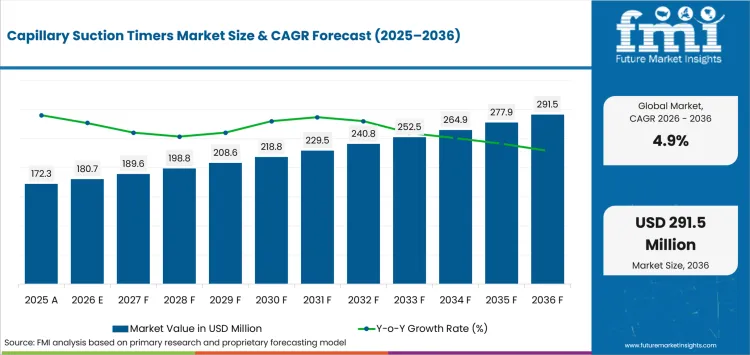
Key Takeaways
- Routine drilling-fluid adjustment and sludge-conditioning work sustain CST demand by requiring quick comparative readings ahead of longer filtration studies.
- Portable CST instruments are estimated to hold 29.0% of product type demand in 2026 because one compact unit can serve field and bench workflows.
- In 2026, drilling mud is expected to lead sample type with 31.0% share because mud engineers repeat formulation checks during shale-control and fluid-treatment programs.
- By application, fluid loss characterization is forecast to represent 28.0% in 2026 driven by CST giving laboratories a rapid comparative index ahead of longer filtration testing.
- Results depend on consistent paper orientation and sample preparation, so qualification slows in laboratories that cannot reproduce handling between operators and locations.
- Some of the key players in this market include OFI Testing Equipment, Inc., Fann Instrument Company, Triton Electronics Ltd, A K V Enterprises, Shale Tech Solutions, Hilton Instruments, Hach, and DKK-TOA Corporation.
Analyst Perspective
"Capillary suction timer purchases should be judged on repeatability and service response instead of unit price alone. A laboratory earns value when different operators obtain comparable readings and replacement paper, test heads and technical support stay available."
- Nikhil Kaitwade, Principal Consultant, Future Market Insights
How is the Capillary Suction Timers Market segmented?
The capillary suction timers market is segmented by product type, sample type, application, end use, sales channel and region.
Market taxonomy covers product type, sample type, application, end use, sales channel and region. Product types include portable, benchtop, digital and multi-sample instruments. Samples include drilling mud, sludge, cement slurry, clay suspensions and wastewater. Applications cover fluid loss characterization, sludge dewaterability, mud additive screening and laboratory quality control. End use and sales channel categories follow the taxonomy below.
What makes Portable CST instruments central to the Product type category?
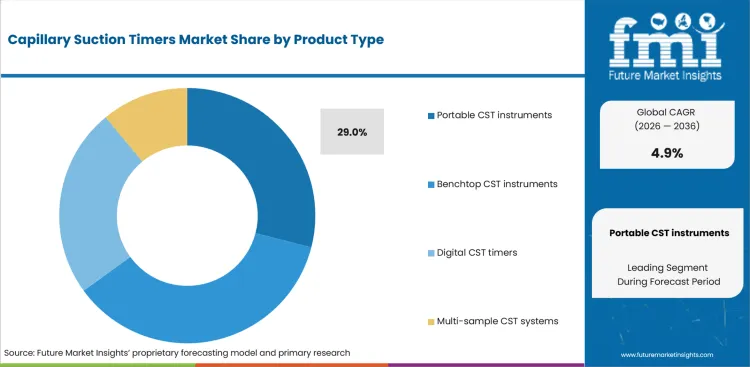
Portable units fit laboratories that need one comparative method near sampling points and later on a bench. The format also fits drilling and completion fluids workflows by letting mud engineers shift between field checks and technical centers without changing the CST procedure.
- By product type, portable CST instruments are estimated to hold 29.0% in 2026 owing to mobility that broadens instrument use between field and laboratory settings.
- Oil India recorded a January 2025 purchase order for a linear swell meter and capillary suction timer after an open tender. The award provides procurement evidence for oilfield laboratory instruments without proving the modelled 29.0% share.
Why does Drilling mud lead the Sample type category?
Electrolyte and polymer changes alter shale interaction and generate repeated CST work during active fluid programs. The same laboratories use onshore drilling fluids testing as a preliminary step for longer test sequences or field adjustments.
- In 2026, drilling mud is expected to lead sample type with 31.0% share because formulation changes require repeated comparative screening during shale-control and fluid-treatment work.
- OFI Testing Equipment introduced its Advanced Digital Wettability Tester in April 2026 for recorded comparisons between spacers and nonaqueous drilling fluids. The launch documents continuing investment in laboratory tools that turn changing fluid behavior into reviewable evidence for formulation decisions.
How does Fluid loss characterization shape the Application category?
Fluid loss characterization fits CST by giving laboratories a quick directional reading ahead of pressure-based filtration testing. The reading also informs water treatment chemicals evaluations during initial checks of water release and solids behavior.
- By application, fluid loss characterization is forecast to represent 28.0% in 2026 driven by CST translating filtrate movement into a rapid comparative time measurement.
- OFI Testing Equipment introduced the Free Flow LCM Receiver in January 2026 for filtration tests involving unusually large lost-circulation particles. The release illustrates why laboratories retain quick screening methods ahead of pressure equipment built for more demanding filtration conditions.
What supports Oilfield labs in the End use category?
Oilfield laboratories repeat tests as fluid chemistry changes between wells and operating intervals. The same testing base supports oil and gas field services companies maintaining mud programs near drilling operations and requiring consistent field-to-laboratory comparisons.
- Oilfield labs are set to lead the end use category with 34.0% share in 2026 due to frequent drilling-fluid formulation checks used to approve or adjust field treatments.
- USA Energy Information Administration data published in March 2026 showed Lower 48 production outside the federal Gulf supplied 83% of national crude output during 2025. Concentrated shale activity places fluid laboratories close to operating areas with frequently changing treatment programs.
What are the drivers, restraints and opportunities in the Capillary Suction Timers Market?
Frequent comparative testing supports demand while handling sensitivity limits reproducibility, and digital recording offers the clearest upgrade route for established laboratories.
- Driver: Drilling-fluid and sludge-conditioning programs require quick comparative screening between treatment changes ahead of longer filtration work.
- Restraint: CST readings shift with sample preparation and paper conditions, which raises qualification effort between operators and separate laboratory sites.
- Opportunity: Digital timers and recorded workflows can reduce transcription errors and give technical teams a clearer basis for cross-site review.
Repeated fluid decisions sustain comparative testing
Mud engineers and wastewater technologists repeatedly decide whether a treatment change altered filterability enough to justify deeper laboratory filtration testing. The USA EPA announced a March 2025 review of oil and gas extraction wastewater rules that included treatment for beneficial reuse. The review places oilfield chemicals and fluid-treatment decisions under closer scrutiny during compliance testing and beneficial-reuse approval decisions.
Method sensitivity raises the cost of qualification
CST comparisons are useful only if laboratories reproduce sample handling closely enough for readings to stay consistent between operators. The USA EPA released a draft biosolids PFAS risk assessment in January 2025 that separated chemical-specific risk evaluation from routine sludge handling. The distinction ties industrial wastewater treatment chemicals programs to controlled preparation and preserves separate analytical evidence for regulated contaminants.
Digital laboratory practices offer a practical upgrade route
Established laboratories have stronger reasons to replace CST timers if digital capture removes manual transcription and preserves test history. DKK-TOA renewed its Japanese DX certification in May 2026 after a formal review of company-wide digital governance. CST manufacturers can meet the same operating expectation with exportable records for routine review within sludge handling equipment workflows without changing the comparative test itself.
Which country CAGRs are profiled in the Capillary Suction Timers Market?
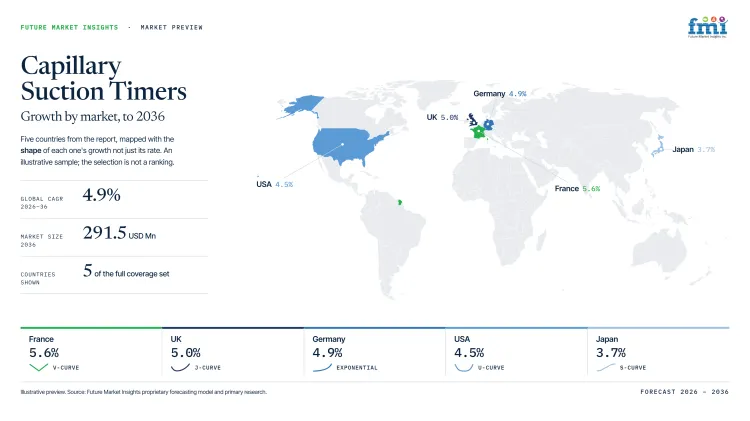
| Country | CAGR |
|---|---|
| France | 5.6% |
| UK | 5.0% |
| Germany | 4.9% |
| Brazil | 4.8% |
| Canada | 4.6% |
| USA | 4.5% |
| Japan | 3.7% |
How do country-level CAGRs compare in the Capillary Suction Timers Market?
The 1.9 percentage-point spread separates France at 5.6% from Japan at 3.7%. The UK, Germany and Brazil form a narrow middle group despite different investment conditions. Mature laboratory networks place Canada and the USA close together by making replacement service more important than first-time installation in this testing category.
- France's CST demand benefits from engineering studies that move between treatment sites.
- UK water companies can standardize one qualified instrument model across treatment works.
- Germany’s phosphorus-recovery deadlines raise demand for repeatable sludge-dewaterability screening ahead of downstream treatment.
- Brazil’s sanitation expansion broadens the operator base requiring formal wastewater laboratory screening.
- Canada’s service territories favor portable units shared between central and satellite laboratories.
- USA replacement demand can draw on drilling-fluid budgets and municipal laboratory programs.
- Japan’s long instrument lives make digital upgrades compete with familiar installed units.
CAGR measures pace rather than laboratory depth, so installed workflows shape commercial priority. The full report provides country-level CAGR analysis across North America, Latin America, Europe, East Asia, South Asia, Oceania and the Middle East and Africa.
Country-wise Analysis
- French wastewater engineering teams are evaluating coastal reuse projects that require sludge handling to be understood as reclaimed-water systems reach detailed design approval. The Ministry for Ecological Transition reported in March 2025 that feasibility-study areas covered 288 wastewater treatment plants within 33 coastal territories. France is projected to grow at 5.6% CAGR through 2036 because that project pipeline gives laboratories more reasons to compare conditioning changes during downstream equipment selection. Project-specific procurement slows under requirements for reproducible procedures plus French-language documentation whenever existing methods are changed. CST companies seeking repeat orders need local service and reliable filter-paper supply beside the timer itself.
- In formal investment cycles, UK water-company laboratories tie instrument changes directly to permit limits and documented operating evidence. Capillary suction timer demand in the UK is forecast to rise at 5.0% CAGR over the forecast period tied to treatment programs requiring practical sludge-conditioning checks. The Environmental Improvement Plan published in December 2025 requires upgrades at 440 wastewater treatment works by 2030 to meet stricter phosphorus limits. Approved-vendor frameworks remain a commercial friction because instrument changes must fit purchasing and validation routes. Regional service coverage improves method transfer between central laboratories and treatment sites though framework schedules can delay replacement timing.
- A dense municipal treatment network gives German wastewater laboratories routine local sludge-handling work at many operating sites. The Federal Environment Agency reported in April 2025 that 8,659 public treatment plants handled more than 8.33 billion cubic metres of wastewater during 2022. New equipment faces demanding qualification against existing laboratory procedures for routine use. The German capillary suction timers sector is projected to record 4.9% CAGR during the assessment period given an installed base that sustains replacement demand for repeatable dewaterability checks. Stable filter-paper specifications and local technical service favor established replacement programs more than greenfield CST placements.
- Common sewerage rules are reaching more regulated Brazilian municipalities even though laboratory capacity differs sharply between regional operators. The National Water and Basic Sanitation Agency reported in December 2025 that 21 regulatory entities covering 1,598 municipalities met assessed sewerage reference norms. Service distance and uneven technical staffing can slow instrument qualification outside stronger laboratory clusters. Brazil is forecast to expand at 4.8% CAGR during the assessment period aided by wider regulatory alignment and sanitation investment. The strongest entry route is a distributor that holds consumables locally and trains technicians without requiring each treatment site to maintain specialist instrument support.
- Smaller communities have fewer specialized wastewater technicians nearby, so long service routes shape CST support outside Canada’s large urban utilities. Adoption of capillary suction timers in Canada is estimated to expand at 4.6% CAGR through 2036 supported by active treatment infrastructure and routine equipment replacement. Local service capacity makes replacement timing differ between large utilities and remote systems. Environment and Climate Change Canada reported in September 2025 that municipal wastewater systems served 85.9% of the population during 2023. For laboratories far from major regional service centers, local spare-parts availability can reduce downtime more effectively than broader feature lists.
- USA CST demand divides between oilfield laboratories and municipal wastewater operations, giving manufacturers two service models with different qualification routines. USA Energy Information Administration data published in March 2026 showed the Lower 48 outside the federal Gulf supplied 83% of national crude production during 2025. Mature instrument fleets limit greenfield placements and put more weight on replacement service quality. The USA is estimated to post 4.5% CAGR over the forecast period attributable to active shale testing plus an existing municipal sludge laboratory base. Companies with field service and consistent consumables can reduce method variation between operating sites and central technical centers.
- Japanese municipal and industrial laboratories favor long equipment life and require documented procedures for any change to a familiar analytical method. Extensive wastewater coverage provides a large technical base but conservative replacement practices slow conversion to unfamiliar digital formats. Capillary suction timer sales in Japan are forecast to expand at 3.7% CAGR by 2036 propelled by replacement demand within existing treatment infrastructure. Japan's infrastructure ministry reported in August 2026 that wastewater treatment coverage reached 94.0% at fiscal-year end. Laboratory requirements for reproducible readings give local documentation and distributor continuity greater weight as routine procedures change between instrument generations and service contracts.
Who are the notable companies in the Capillary Suction Timers Market?
OFI Testing Equipment, Inc., Fann Instrument Company, Triton Electronics Ltd, A K V Enterprises, Shale Tech Solutions, Hilton Instruments, Hach, and DKK-TOA Corporation are notable companies serving this market.
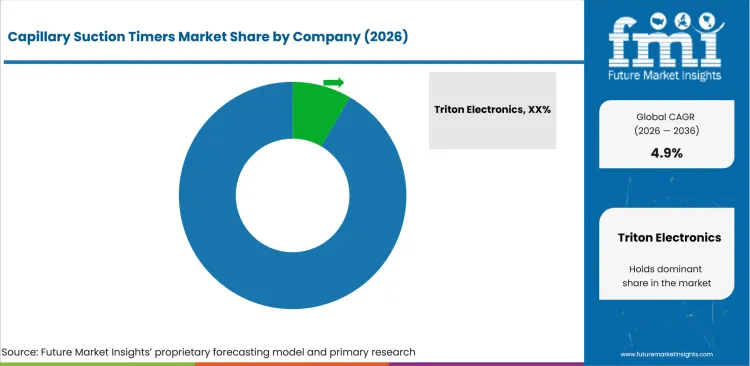
CST competition turns on hardware repeatability, consumable continuity and method support at each site. Direct manufacturers face oilfield distributors and water-analysis companies that influence purchasing within wastewater treatment chemicals programs. Entry barriers in water treatment laboratories come from local service and method qualification instead of corporate scale.
- OFI Testing Equipment, Inc., Fann Instrument Company and Triton Electronics Ltd hold direct CST positions. Oil India documented A K V Enterprises in a January 2025 CST procurement award.
- Shale Tech Solutions and Hilton Instruments serve oilfield laboratories with authorized distribution, technical support and complementary fluid-testing equipment.
- Hach and DKK-TOA Corporation serve wastewater laboratories with water-analysis instruments plus regional service and technical support.
Competitive Benchmarking: Capillary Suction Timers Market
| Company | CST-Specific Offering | Workflow Support | Channel and Service Coverage | Geographic Reach |
|---|---|---|---|---|
| OFI Testing Equipment, Inc. | High | High | High | North America and international oilfield markets |
| Fann Instrument Company | High | High | High | Global oilfield markets |
| Triton Electronics Ltd | High | Medium | Medium | UK and international laboratories |
| A K V Enterprises | Medium | Medium | Low | India oilfield procurement |
| Shale Tech Solutions | High | High | High | Argentina and USA |
| Hilton Instruments | Medium | High | Medium | UK and international oilfield markets |
| Hach | Low | High | High | Global water-analysis markets |
| DKK-TOA Corporation | Low | High | Medium | Japan and selected international markets |
Scoring basis: High CST-specific offering requires a documented CST route, Medium requires authorized distribution and Low identifies adjacent analytical equipment without direct CST hardware. High workflow support requires drilling-fluid or wastewater depth, Medium requires one relevant workflow and Low covers adjacent laboratory use without direct workflow depth. High channel coverage requires multi-region service, Medium requires regional support and Low identifies one procurement or service route. Geographic reach is descriptive and stays separate from the three capability ratings above.
Key Developments in the Capillary Suction Timers Market
- In September 2025, DKK-TOA Corporation broke ground on a new building at its Iwate production base.
- In August 2025, OFI Testing Equipment introduced static ovens for drilling-fluid laboratories using its existing specialist service channels.
- In February 2025, Hach introduced the NH6000sc ammonia analyzer, featuring automatic calibration, validation, and cleaning to simplify ammonia monitoring and reduce maintenance requirements.
Key Players in the Capillary Suction Timers Market
CST instruments and oilfield channels
- OFI Testing Equipment, Inc.
- Fann Instrument Company
- Triton Electronics Ltd
- A K V Enterprises
Oilfield laboratory support
- Shale Tech Solutions
- Hilton Instruments
Water-analysis suppliers
- Hach
- DKK-TOA Corporation
Capillary Suction Timers Market - Report Scope
| Coverage field | Report scope |
|---|---|
| Market breakdown | By product type, sample type, application, end use, sales channel and region. |
| Quantitative Units | USD Million. |
| Market Definition | Revenue includes capillary suction timer instruments sold as portable, benchtop, digital or multi-sample systems plus instrument-specific service and replacement transactions. Downstream dewatering equipment, drilling-fluid chemicals and substitute analytical equipment are excluded. |
| Regions Covered | North America, Latin America, Europe, East Asia, South Asia and Pacific, and Middle East and Africa. |
| Countries Covered | France, UK, Germany, Brazil, Canada, USA, Japan, and 20+ countries included in the full report. |
| Key Companies Profiled | OFI Testing Equipment, Inc., Fann Instrument Company, Triton Electronics Ltd, A K V Enterprises, Shale Tech Solutions, Hilton Instruments, Hach, DKK-TOA Corporation. |
| Forecast Period | 2026 to 2036. |
| Approach | Primary and secondary research with market triangulation. |
Capillary Suction Timers Market - Research Methodology
| Method | Approach |
|---|---|
| Primary Research | FMI analysts gathered input from manufacturers, service providers, technology developers, distributors, end users, procurement teams, and subject-matter experts. Interviews examined purchasing decisions, product or service evaluation, adoption barriers, approval requirements, pricing considerations, and expectations for technical or commercial support. Respondents were also asked what evidence is required before a trial, pilot, or initial order develops into regular purchasing. |
| Desk Research | Desk research covered government statistics, regulatory publications, trade data, industry associations, technical literature, standards, company filings, product information, and official corporate announcements. Sources were reviewed for relevance, publication date, geographic coverage, and consistency with the defined market scope. Claims relating to performance, applications, approvals, capacity, investment, and commercial activity were retained only when supported by credible public evidence. |
| Market Sizing and Forecasting | The market model combined the baseline value with historical performance, segment structure, pricing and volume indicators, adoption levels, company participation, and country-level demand conditions. Forecast assumptions considered economic activity, investment trends, regulatory developments, technology adoption, purchasing cycles, supply availability, and barriers to wider market use. Segment and regional estimates were reconciled before the final market total was calculated. |
| Data Validation | Estimates were checked against multiple independent indicators, including public data, company activity, trade patterns, industry developments, and findings from primary interviews. Validation also tested whether products, services, applications, and company revenues fell within the defined market boundaries. Adjacent categories, unsupported claims, overlapping revenues, and activities without direct market relevance were excluded to reduce double counting and maintain consistency across segments and countries. |
Capillary Suction Timers Market by Segments
Capillary Suction Timers Market segmented by Product Type:
- Portable CST instruments
- Benchtop CST instruments
- Digital CST timers
- Multi-sample CST systems
Capillary Suction Timers Market segmented by Sample Type:
- Drilling mud
- Sludge
- Cement slurry
- Clay suspensions
- Wastewater samples
Capillary Suction Timers Market segmented by Application:
- Fluid loss characterization
- Sludge dewaterability
- Mud additive screening
- Lab quality control
Capillary Suction Timers Market segmented by End Use:
- Oilfield labs
- Wastewater labs
- Research institutes
- Chemical suppliers
Capillary Suction Timers Market segmented by Sales Channel:
- Lab equipment OEMs
- Scientific distributors
- Direct institutional sales
- Aftermarket service
Capillary Suction Timers Market by Region:
- North America
- United States
- Canada
- Latin America
- Brazil
- Mexico
- Argentina
- Chile
- Western Europe
- Germany
- France
- UK
- Italy
- Spain
- BENELUX
- Nordics
- Eastern Europe
- Poland
- Hungary
- Romania
- Balkan and Baltic Countries
- East Asia
- Japan
- South Korea
- China
- South Asia and Pacific
- Australia
- New Zealand
- ASEAN
- India
- Middle East and Africa
- GCC Countries
- South Africa
- Türkiye
- Rest of Middle East and Africa
Research Sources and Bibliography
- USA Energy Information Administration. (2026, July 9). The United States produced more crude oil than any other country in 2025.
- USA Energy Information Administration. (2026, March 31). USA crude oil production rose in 2025, setting new record.
- USA Environmental Protection Agency. (2025, September 26). Basic information about sewage sludge and biosolids.
- USA Environmental Protection Agency. (2025, March 12). EPA Will Revise Wastewater Regulations for Oil and Gas Extraction to Help Unleash American Energy (ELGs: Oil and Gas)
- USA Environmental Protection Agency. (2025, January 14). Draft sewage sludge risk assessment for perfluorooctanoic acid and perfluorooctane sulfonic acid.
- Ministère de la Transition écologique. (2025, March 31). Réutilisation des eaux usées traitées sur le littoral : 21 nouveaux lauréats.
- Umweltbundesamt. (2025, April 9). Öffentliche Abwasserentsorgung.
- Ministry of Land, Infrastructure, Transport and Tourism. (2026, August 24). 令和7年度末の汚水処理人口普及状況について.
- Environment and Climate Change Canada. (2025, September 25). Municipal wastewater treatment.
- Department for Environment, Food & Rural Affairs. (2025, December 1). Environmental Improvement Plan 2025.
- Agência Nacional de Águas e Saneamento Básico. (2025, December 22). Agência divulga lista positiva de entidades reguladoras e municípios que atenderam às Normas de Referência do saneamento em 2025.
- OFI Testing Equipment, Inc. (2026, April 24). New advances in spacer wettability testing.
- OFI Testing Equipment, Inc. (2026, January 16). Introducing the Free Flow LCM Receiver.
- OFI Testing Equipment, Inc. (2025, August 15). Introducing OFITE Static Ovens.
- DKK-TOA Corporation. (2026, May 7). DX certification renewed under the program defined by Japan’s Ministry of Economy, Trade and Industry.
- DKK-TOA Corporation. (2025, September 1). Groundbreaking ceremony held for new Iwate factory building.
- DKK-TOA Corporation. (2026, March 6). New Iwate factory building receives ZEB certification.
- Hach. (2025, February 5). Hach unveils the NH6000sc ammonia analyzer.
- Hach. (2026, May 6). Hach launches next-generation DR4900 spectrophotometer.
- Fann Instrument Company. (2026). About us.
- Shale Tech Solutions. (2026). Representations.
- Hilton Instruments. (2026). About us.
- Waters Corporation. (2025, February 4). Waters ElectroForce Apex 1 instrument offers increased versatility, simplicity, and speed to mechanical testing of advanced polymer materials.
- Waters Corporation. (2026, March 9). Waters flagship ARES-G3 rheometer sets new benchmark for data quality at breakthrough speed.
- Anton Paar. (2025, October 14). A new era in rheometry.
- Xylem. (2025, May 1). From waterless chip cooling to AI-powered leak detection: breakthrough technologies are increasing water security for communities, businesses.
- Thermo Fisher Scientific Inc. (2025, March 18). Thermo Fisher Scientific introduces the Vulcan Automated Lab to transform semiconductor analysis.
- Metrohm. (2025, October). Introducing the Metrohm i-Raman NxG.
- Agilent Technologies. (2025, May 27). Agilent unveils the next generation in LC-mass detection: the InfinityLab Pro iQ Series.
- Oil India Limited. (2025, January). Details of purchase orders placed during January 2025.
- Thermo Fisher Scientific Inc. (2026, January 12). Thermo Fisher Scientific announces strategic collaboration with NVIDIA leveraging AI to advance scientific instrumentation and accelerate laboratory performance.
- Agilent Technologies. (2025, July 29). Agilent and Nanyang Technological University’s NEWRI sign agreement to enhance water contaminant research in Singapore.
- Malvern Panalytical. (2025, October 6). SDCOM launch & MP technologies workshop at Thapar University.
This bibliography is provided for reader reference and is not exhaustive. The full report contains the complete reference list and detailed citations
This Report Answers
- What is the market size through 2036?
- What CAGR is projected through 2036?
- Why do portable CST instruments lead?
- Why does drilling mud lead?
- Why does fluid loss characterization lead applications?
- Which profiled countries record the highest CAGRs?
- What operating conditions increase CST demand?
- Which companies participate in this market?
Frequently Asked Questions
How big is the capillary suction timers market in 2026?
The capillary suction timers market is valued at USD 180.7 million in 2026 and is projected to reach USD 291.5 million by 2036. Repeated drilling-fluid and sludge-conditioning tests sustain demand for fast comparative filtration readings.
What is the CAGR of the capillary suction timers market from 2026 to 2036?
The capillary suction timers market is projected to grow at a CAGR of 4.9% between 2026 and 2036. Replacement in installed laboratories and repeated fluid-testing work support continued market expansion.
Which product type leads the capillary suction timers market?
The portable CST instruments segment is expected to hold 29.0% of the capillary suction timers market in 2026, driven by mobility between field and laboratory testing. The same instrument supports repeated comparisons without changing the underlying CST procedure.
Which sample type leads the capillary suction timers market?
The drilling mud segment is expected to hold 31.0% of the capillary suction timers market in 2026, attributable to repeated formulation and shale-interaction checks. Mud engineers use CST readings ahead of fluid tests or field adjustments.
Which countries are projected to record the highest growth in the capillary suction timers market?
France is projected to grow at 5.6% CAGR, followed by the UK at 5.0% and Germany at 4.9% through 2036. Reuse projects, treatment upgrades and mature laboratory replacement cycles account for their different growth routes.
Which companies are active in the capillary suction timers market?
Key companies operating in the capillary suction timers market include OFI Testing Equipment, Inc., Fann Instrument Company, Triton Electronics Ltd, A K V Enterprises, Shale Tech Solutions, Hilton Instruments, Hach, and DKK-TOA Corporation. They compete through CST hardware, oilfield laboratory support and water-analysis service networks.
Preview the report firsthand - request a free sample
Get SampleGet the brochure for pricing and purchase details.
Get PDFTable of Content
- Key Takeaways
- Market Size and CAGR
- Top Growth Driver
- Fastest Growing Segment
- Leading Region
- Key Companies
- Emerging Opportunities
- Executive Summary
- Global Market Outlook
- Demand-side Trends
- Supply-side Trends
- Technology Roadmap Analysis
- Analysis and Recommendations
- Analyst Perspective (What is happening? Why now? What should investors know?)
- Key Questions Answered
- How large is the market?
- What is the CAGR?
- What are key trends?
- Which region dominates?
- Who are the leaders?
- Market Overview
- Market Coverage / Taxonomy
- Market Definition / Scope / Limitations
- Research Methodology
- Chapter Orientation
- Analytical Lens and Working Hypotheses
- Market Structure, Signals, and Trend Drivers
- Benchmarking and Cross-market Comparability
- Market Sizing, Forecasting, and Opportunity Mapping
- Research Design and Evidence Framework
- Desk Research Programme (Secondary Evidence)
- Expert Input and Fieldwork (Primary Evidence)
- Tooling, Models, and Reference Databases
- Data Engineering and Model Build
- Quality Assurance and Audit Trail
- Market Background
- Market Dynamics (Drivers, Restraints, Opportunity, Trends)
- Scenario Forecast (Optimistic, Likely, Conservative)
- Impact Analysis
- AI Impact
- Sustainability Impact
- Regulatory Impact
- Technology Impact
- Consumer / Buyer Analysis
- Purchase Drivers
- Adoption Barriers
- Buyer Journey
- Opportunity Map Analysis
- Product Life Cycle Analysis
- Supply Chain Analysis
- Investment Feasibility Matrix
- Value Chain Analysis
- PESTLE and Porter's Analysis
- Regulatory Landscape
- Regional Parent Market Outlook
- Production and Consumption Statistics
- Import and Export Statistics
- Global Market Analysis and Forecast, 2021 to 2036
- Historical Market Size Value (USD Million) Analysis, 2021 to 2025
- Current and Future Market Size Value (USD Million) Projections, 2026 to 2036
- Y-o-Y Growth Trend Analysis
- Absolute $ Opportunity Analysis
- Global Market Pricing Analysis, 2021 to 2036
- Global Market Analysis and Forecast, By Product Type, 2021 to 2036
- Introduction / Key Findings
- Historical Market Size Value (USD Million) Analysis By Product Type, 2021 to 2025
- Current and Future Market Size Value (USD Million) Analysis and Forecast By Product Type, 2026 to 2036
- Portable CST instruments
- Benchtop CST instruments
- Digital CST timers
- Multi-sample CST systems
- Portable CST instruments
- Y-o-Y Growth Trend Analysis By Product Type, 2021 to 2025
- Absolute $ Opportunity Analysis By Product Type, 2026 to 2036
- Global Market Analysis and Forecast, By Sample Type, 2021 to 2036
- Introduction / Key Findings
- Historical Market Size Value (USD Million) Analysis By Sample Type, 2021 to 2025
- Current and Future Market Size Value (USD Million) Analysis and Forecast By Sample Type, 2026 to 2036
- Drilling mud
- Sludge
- Cement slurry
- Clay suspensions
- Wastewater samples
- Drilling mud
- Y-o-Y Growth Trend Analysis By Sample Type, 2021 to 2025
- Absolute $ Opportunity Analysis By Sample Type, 2026 to 2036
- Global Market Analysis and Forecast, By Application, 2021 to 2036
- Introduction / Key Findings
- Historical Market Size Value (USD Million) Analysis By Application, 2021 to 2025
- Current and Future Market Size Value (USD Million) Analysis and Forecast By Application, 2026 to 2036
- Fluid loss characterization
- Sludge dewaterability
- Mud additive screening
- Lab quality control
- Fluid loss characterization
- Y-o-Y Growth Trend Analysis By Application, 2021 to 2025
- Absolute $ Opportunity Analysis By Application, 2026 to 2036
- Global Market Analysis and Forecast, By End Use, 2021 to 2036
- Introduction / Key Findings
- Historical Market Size Value (USD Million) Analysis By End Use, 2021 to 2025
- Current and Future Market Size Value (USD Million) Analysis and Forecast By End Use, 2026 to 2036
- Oilfield labs
- Wastewater labs
- Research institutes
- Chemical suppliers
- Oilfield labs
- Y-o-Y Growth Trend Analysis By End Use, 2021 to 2025
- Absolute $ Opportunity Analysis By End Use, 2026 to 2036
- Global Market Analysis and Forecast, By Sales Channel, 2021 to 2036
- Introduction / Key Findings
- Historical Market Size Value (USD Million) Analysis By Sales Channel, 2021 to 2025
- Current and Future Market Size Value (USD Million) Analysis and Forecast By Sales Channel, 2026 to 2036
- Lab equipment OEMs
- Scientific distributors
- Direct institutional sales
- Aftermarket service
- Lab equipment OEMs
- Y-o-Y Growth Trend Analysis By Sales Channel, 2021 to 2025
- Absolute $ Opportunity Analysis By Sales Channel, 2026 to 2036
- Global Market Analysis and Forecast, By Region, 2021 to 2036
- Introduction
- Historical Market Size Value (USD Million) Analysis By Region, 2021 to 2025
- Current Market Size Value (USD Million) Analysis and Forecast By Region, 2026 to 2036
- North America
- Latin America
- Western Europe
- Eastern Europe
- East Asia
- South Asia and Pacific
- Middle East & Africa
- Market Attractiveness Analysis By Region
- North America Market Analysis and Forecast, By Country, 2021 to 2036
- Historical Market Size Value (USD Million) Trend Analysis By Market Taxonomy, 2021 to 2025
- Market Size Value (USD Million) Forecast By Market Taxonomy, 2026 to 2036
- By Country
- USA
- Canada
- By Product Type
- By Sample Type
- By Application
- By End Use
- By Sales Channel
- By Country
- Market Attractiveness Analysis
- By Country
- By Product Type
- By Sample Type
- By Application
- By End Use
- By Sales Channel
- Key Takeaways
- Latin America Market Analysis and Forecast, By Country
- Historical Market Size Value (USD Million) Trend Analysis By Market Taxonomy, 2021 to 2025
- Market Size Value (USD Million) Forecast By Market Taxonomy, 2026 to 2036
- By Country
- Brazil
- Mexico
- Chile
- Rest of Latin America
- By Product Type
- By Sample Type
- By Application
- By End Use
- By Sales Channel
- By Country
- Market Attractiveness Analysis
- By Country
- By Product Type
- By Sample Type
- By Application
- By End Use
- By Sales Channel
- Key Takeaways
- Western Europe Market Analysis and Forecast, By Country
- Historical Market Size Value (USD Million) Trend Analysis By Market Taxonomy, 2021 to 2025
- Market Size Value (USD Million) Forecast By Market Taxonomy, 2026 to 2036
- By Country
- Germany
- UK
- Italy
- Spain
- France
- Nordic
- BENELUX
- Rest of Western Europe
- By Product Type
- By Sample Type
- By Application
- By End Use
- By Sales Channel
- By Country
- Market Attractiveness Analysis
- By Country
- By Product Type
- By Sample Type
- By Application
- By End Use
- By Sales Channel
- Key Takeaways
- Eastern Europe Market Analysis and Forecast, By Country
- Historical Market Size Value (USD Million) Trend Analysis By Market Taxonomy, 2021 to 2025
- Market Size Value (USD Million) Forecast By Market Taxonomy, 2026 to 2036
- By Country
- Russia
- Poland
- Hungary
- Balkan & Baltic
- Rest of Eastern Europe
- By Product Type
- By Sample Type
- By Application
- By End Use
- By Sales Channel
- By Country
- Market Attractiveness Analysis
- By Country
- By Product Type
- By Sample Type
- By Application
- By End Use
- By Sales Channel
- Key Takeaways
- East Asia Market Analysis and Forecast, By Country
- Historical Market Size Value (USD Million) Trend Analysis By Market Taxonomy, 2021 to 2025
- Market Size Value (USD Million) Forecast By Market Taxonomy, 2026 to 2036
- By Country
- China
- Japan
- South Korea
- By Product Type
- By Sample Type
- By Application
- By End Use
- By Sales Channel
- By Country
- Market Attractiveness Analysis
- By Country
- By Product Type
- By Sample Type
- By Application
- By End Use
- By Sales Channel
- Key Takeaways
- South Asia and Pacific Market Analysis and Forecast, By Country
- Historical Market Size Value (USD Million) Trend Analysis By Market Taxonomy, 2021 to 2025
- Market Size Value (USD Million) Forecast By Market Taxonomy, 2026 to 2036
- By Country
- India
- ASEAN
- Australia & New Zealand
- Rest of South Asia and Pacific
- By Product Type
- By Sample Type
- By Application
- By End Use
- By Sales Channel
- By Country
- Market Attractiveness Analysis
- By Country
- By Product Type
- By Sample Type
- By Application
- By End Use
- By Sales Channel
- Key Takeaways
- Middle East & Africa Market Analysis and Forecast, By Country
- Historical Market Size Value (USD Million) Trend Analysis By Market Taxonomy, 2021 to 2025
- Market Size Value (USD Million) Forecast By Market Taxonomy, 2026 to 2036
- By Country
- Kingdom of Saudi Arabia
- Other GCC Countries
- Türkiye
- South Africa
- Other African Union
- Rest of Middle East & Africa
- By Product Type
- By Sample Type
- By Application
- By End Use
- By Sales Channel
- By Country
- Market Attractiveness Analysis
- By Country
- By Product Type
- By Sample Type
- By Application
- By End Use
- By Sales Channel
- Key Takeaways
- Key Countries Market Analysis
- USA
- Pricing Analysis
- Market Share Analysis, 2025
- By Product Type
- By Sample Type
- By Application
- By End Use
- By Sales Channel
- Canada
- Pricing Analysis
- Market Share Analysis, 2025
- By Product Type
- By Sample Type
- By Application
- By End Use
- By Sales Channel
- Mexico
- Pricing Analysis
- Market Share Analysis, 2025
- By Product Type
- By Sample Type
- By Application
- By End Use
- By Sales Channel
- Brazil
- Pricing Analysis
- Market Share Analysis, 2025
- By Product Type
- By Sample Type
- By Application
- By End Use
- By Sales Channel
- Chile
- Pricing Analysis
- Market Share Analysis, 2025
- By Product Type
- By Sample Type
- By Application
- By End Use
- By Sales Channel
- Germany
- Pricing Analysis
- Market Share Analysis, 2025
- By Product Type
- By Sample Type
- By Application
- By End Use
- By Sales Channel
- UK
- Pricing Analysis
- Market Share Analysis, 2025
- By Product Type
- By Sample Type
- By Application
- By End Use
- By Sales Channel
- Italy
- Pricing Analysis
- Market Share Analysis, 2025
- By Product Type
- By Sample Type
- By Application
- By End Use
- By Sales Channel
- Spain
- Pricing Analysis
- Market Share Analysis, 2025
- By Product Type
- By Sample Type
- By Application
- By End Use
- By Sales Channel
- France
- Pricing Analysis
- Market Share Analysis, 2025
- By Product Type
- By Sample Type
- By Application
- By End Use
- By Sales Channel
- India
- Pricing Analysis
- Market Share Analysis, 2025
- By Product Type
- By Sample Type
- By Application
- By End Use
- By Sales Channel
- ASEAN
- Pricing Analysis
- Market Share Analysis, 2025
- By Product Type
- By Sample Type
- By Application
- By End Use
- By Sales Channel
- Australia & New Zealand
- Pricing Analysis
- Market Share Analysis, 2025
- By Product Type
- By Sample Type
- By Application
- By End Use
- By Sales Channel
- China
- Pricing Analysis
- Market Share Analysis, 2025
- By Product Type
- By Sample Type
- By Application
- By End Use
- By Sales Channel
- Japan
- Pricing Analysis
- Market Share Analysis, 2025
- By Product Type
- By Sample Type
- By Application
- By End Use
- By Sales Channel
- South Korea
- Pricing Analysis
- Market Share Analysis, 2025
- By Product Type
- By Sample Type
- By Application
- By End Use
- By Sales Channel
- Russia
- Pricing Analysis
- Market Share Analysis, 2025
- By Product Type
- By Sample Type
- By Application
- By End Use
- By Sales Channel
- Poland
- Pricing Analysis
- Market Share Analysis, 2025
- By Product Type
- By Sample Type
- By Application
- By End Use
- By Sales Channel
- Hungary
- Pricing Analysis
- Market Share Analysis, 2025
- By Product Type
- By Sample Type
- By Application
- By End Use
- By Sales Channel
- Kingdom of Saudi Arabia
- Pricing Analysis
- Market Share Analysis, 2025
- By Product Type
- By Sample Type
- By Application
- By End Use
- By Sales Channel
- Türkiye
- Pricing Analysis
- Market Share Analysis, 2025
- By Product Type
- By Sample Type
- By Application
- By End Use
- By Sales Channel
- South Africa
- Pricing Analysis
- Market Share Analysis, 2025
- By Product Type
- By Sample Type
- By Application
- By End Use
- By Sales Channel
- USA
- Market Structure Analysis
- Competition Dashboard
- Competition Benchmarking
- Market Share Analysis of Top Players
- By Regional
- By Product Type
- By Sample Type
- By Application
- By End Use
- By Sales Channel
- Emerging Startups
- Innovation Benchmarking
- Competition Analysis
- Competition Deep Dive
- Triton Electronics
- Overview
- Product Portfolio
- Profitability by Market Segments
- Sales Footprint
- Strategy Overview
- Marketing Strategy
- Product Strategy
- Channel Strategy
- OFI Testing Equipment
- Fann Instrument Company
- Triton Electronics Ltd
- DKK-TOA
- Hach
- Thermo Fisher Scientific
- VWR / Avantor
- Labtron Equipment
- Controls Group
- Triton Electronics
- Case Studies
- Success Stories
- Recent Developments
- Competition Deep Dive
- Assumptions & Acronyms Used


