

- Market Size (2026)
- USD 53.5 Mn
- Forecast (2036)
- USD 151.9 Mn
- CAGR (2026 to 2036)
- 11.0%
How big is Carborane Polymers Market in 2026?
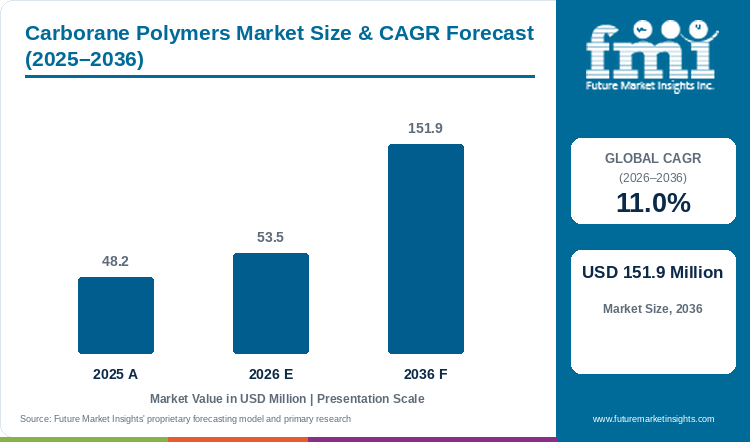
The Carborane Polymers Market establishes its foundation at USD 48.2 million in 2025, advances to USD 53.5 million in 2026, and is forecast to scale to USD 151.9 million by 2036 at a CAGR of 11.0%.
Rising demand for heat-resistant seals and radiation shielding across aerospace and compact nuclear reactor programs is accelerating buyer adoption of boron-cage polymers, as conventional silicone and organic resins break down above 300 degrees Celsius. Research published by Friedrich Schiller University Jena and the Academy of Sciences in the Czech Republic in February 2025 showed that cross-linked carborane polymer membranes maintain structural integrity under intense thermal and chemical stress where standard elastomers fail [1]. Because their boron-carbon cage structure prevents chain breakdown during high-speed flight heating, Meta-Carborane Siloxane Elastomers are projected to account for 56.4% of cage isomer demand in 2026, helping the market grow more than twice as fast as the bismaleimide resins market. FMI estimates show that global carborane polymers market valuation grew from USD 48.2 million in 2025 to USD 53.5 million in 2026 and is on track to reach USD 151.9 million by 2036 at an 11.0% CAGR. However, strict defense export controls and the high cost of handling volatile boron precursors continue to act as major commercial hurdles for wider industrial use.
Key Market Trends & Insights
- By cage isomer: Meta-Carborane Siloxane Elastomers are projected to capture 56.4% in 2026 because separating the two carbon vertices at the 1,7-positions enables high-molecular-weight linear siloxane polycondensation without exocyclic ring closure.
- By backbone architecture: Polycarborane-Siloxane Elastomers are estimated to command 62.8% in 2026 as aerospace and petrochemical engineers specify Dexsil-class elastomers that form self-healing borosilicate glazes above 500°C.
- By thermal regime: Ultra-High Oxidative Char is expected to concentrate 58.2% in 2026 because hypersonic glide vehicles and rocket motor liners require 78% to 92% ceramic char retention at 500°C to 800°C.
- By end-use sector: Hypersonic Radome Seals is forecast to generate 46.5% in 2026 owing to the need for RF radar-transparent (tan δ < 0.008) elastomeric perimeter seals on Mach 5+ missiles.
- By sales channel: Direct Defense Contracts are anticipated to account for 71.5% in 2026 through sole-source ITAR-qualified hypersonic and SMR qualification programs.
Regional Highlights
- Top national expansion: South Korea is projected to lead global growth at a 12.4% CAGR through 2036 as hospital accelerator Boron Neutron Capture Therapy (BNCT) centers, indigenous hypersonic missile programs, and i-SMR nuclear shielding scale simultaneously.
- Broader country progression: Japan is expected to expand at an 11.9% CAGR ahead of Czech Republic at 11.8% and China at 11.5%, while the USA is forecast to advance at a 10.6% CAGR.
Market Size & Forecast
Table 1: Market Size and Forecast for the Carborane Polymers Market (USD million and CAGR percentage), 2025 to 2036
| Metric | Value |
|---|---|
| 2025 Market Size | USD 48.2 million |
| Estimated Market Size in 2026 | USD 53.5 million |
| Projected Market Size by 2036 | USD 151.9 million |
| CAGR, 2026 to 2036 | 11.0% |
| Added Value, 2026 to 2036 | USD 98.4 million |
Hypersonic aerospace primes, small modular nuclear reactor (SMR) designers, and clinical oncology centers operate across thermal and radiation regimes where carbon-only and standard silicone polymers disintegrate. Perfluoroelastomers (FFKM) hit an irreversible thermal scission ceiling at 325°C, while borated polyethylene neutron shields soften above 95°C and suffer from filler settling. In October 2025, thermogravimetric and neutron-attenuation evaluations published in ACS Applied Materials & Interfaces confirmed that carborane-grafted phenylethynyl polyimides cure at 329.20°C while achieving a glass transition temperature of 480.1°C, a 5 wt% weight-loss threshold of 557.5°C and 75.4% thermal neutron shielding at 5 mm thickness [4]. So specialty compounders within the performance elastomer market are expanding carborane polymer output at an 11.0% CAGR through 2036.
Decaborane Precursor and Finished Polymer Sizing
Table 2: Decaborane Precursor and Finished Polymer Sizing for the Carborane Polymers Market (USD million and physical ranges), 2025 to 2036
| Metric | 2025 | 2026 | 2036 |
|---|---|---|---|
| Market size (USD million) | 48.2 | 53.5 | 151.9 |
| Decaborane & closo-carborane monomer input (metric tons) | 19.5 to 22.0 | 21.5 to 24.5 | 58.0 to 65.0 |
| Finished carborane polymer shipments (metric tons) | 14.0 to 15.2 | 15.5 to 16.8 | 42.5 to 46.0 |
| Weighted average selling price (USD per kg) | 3,380 to 3,520 | 3,400 to 3,550 | 3,480 to 3,650 |
Operational note: Monomer-to-polymer conversion ranges incorporate 80% to 87% alkyne cycloaddition yields from decaborane (B10H14) to ortho-carborane and 78% to 85% recovery during 470°C thermal isomerization to meta-carborane and 55% to 64% recovery at 620°C for para-carborane.
Commercial synthesis requires specialized hydride-handling reactors and high-temperature isomerization autoclaves concentrated in Czech Republic, the USA, and Japan. Producers widely pair meta-carborane siloxane condensation with enriched Boron-10 (>95% Boron-10) feedstocks to serve high-margin accounts in the polymer seals market and nuclear radiation shielding.
Hypersonic Program & Nuclear/BNCT Facility Sizing
Table 3: Defense Program and Nuclear/Clinical Facility Indicators for the Carborane Polymers Market (USD), 2025 to 2036
| Metric | 2025 | 2026 | 2036 |
|---|---|---|---|
| Active hypersonic, SMR & BNCT programs globally (units) | 142 | 160 | 385 |
| Carborane polymer spend per program (USD thousand) | 339.4 | 334.4 | 394.5 |
| Annual radome & ablative spend per missile program (USD thousand) | 420.0 to 510.0 | 450.0 to 550.0 | 680.0 to 820.0 |
| Sole-source defense & ITAR-qualified contract share (%) | 74.0% to 78.0% | 76.0% to 80.0% | 80.0% to 84.0% |
Table 4: Program & Sector Allocation Indicators for the Carborane Polymers Market (USD and percentages), 2026
| Metric | Value | Institutional / Industrial Reference Basis |
|---|---|---|
| Market size, 2026 | USD 53.5 million | 2026 global market value baseline |
| Qualified hypersonic, SMR, GC & BNCT facilities | 160 programs/centers | Global defense, nuclear, chromatography & oncology registry |
| Average carborane polymer spend per facility | USD 334,375 | Annualized ultra-high-temp & Boron-10 polymer expenditure |
| Hypersonic radome seals value, 2026 | USD 24.9 million | 46.5% end-use sector allocation |
Specifying icosahedral boron-cluster polymers inside Mach 5+ glide vehicles or small modular reactors requires balancing high per-kilogram monomer prices against mission-critical survival above 500°C. Aerospace and nuclear instrumentation engineers pair carborane-siloxane seals and Boron-10 methacrylate shields with electronics from the radiation hardened microcontrollers market to guarantee system survivability.
Analyst Perspective
"Perfluoroelastomers and standard silicones hit an irreversible thermal decomposition wall between 315 and 350 degrees Celsius. Manufacturers with captive decaborane synthesis, 470-degree meta-carborane isomerization, and enriched Boron-10 isotope access hold a virtual monopoly over 500-degree hypersonic radome seals; SMR neutron shields and hospital BNCT oncology nanocarriers."
- Nikhil Kaitwade, Principal Consultant, Future Market Insights.
How is the carborane polymers market segmented?
The carborane polymers market is segmented by cage isomer, backbone architecture, thermal regime, end-use sector, and sales channel. In 2026, Meta-Carborane Siloxane Elastomers is projected at 56.4%, Polycarborane-Siloxane Elastomers at 62.8%, Ultra-High Oxidative Char at 58.2%, Hypersonic Radome Seals at 46.5%, and Direct Defense Contracts at 71.5%.
By cage isomer: Meta-Carborane Siloxane Elastomers, Para-Carborane Ultra-Stable Polymers, and Ortho-Carborane Preceramic Resins.
By backbone architecture: Polycarborane-Siloxane Elastomers, Carborane Phenolic Ablatives, and Boron-Rich Methacrylate Networks.
By thermal regime: Ultra-High Oxidative Char, Continuous Elastomeric Sealing, and Cryogenic Propellant Binders.
By end-use sector: Hypersonic Radome Seals, SMR Neutron Shielding, Gas Chromatography Phases, and BNCT Polymeric Carriers.
By sales channel: Direct Defense Contracts, Specialty Chemical Distributors, Clinical Oncology Supply, and Academic Research Catalogs.
Why do Meta-Carborane Siloxane Elastomers lead the cage isomer category?
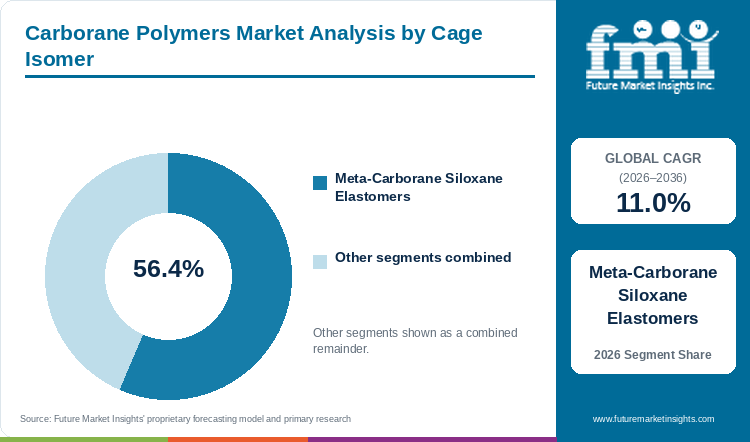
Meta-Carborane Siloxane Elastomers are projected to capture 56.4% of cage isomer demand in 2026, supported by non-cyclizing 1,7-carbon vertex geometry and 500 degrees Celsius oxidative stability.
Table 5: Cage Isomer Share for the Carborane Polymers Market (percentage share), 2026
| Cage Isomer | Share (2026) |
|---|---|
| Meta-Carborane Siloxane Elastomers | 56.4% |
| Other Segments Combined | 43.6% |
| Total | 100.0% |
*Note: Remaining cage isomer categories sum to 100.0% of 2026 commercial volume.
Table 6: Cage Isomer Leadership and Market Growth for the Carborane Polymers Market (segment and CAGR percentage), 2026 to 2036
| Metric | Value |
|---|---|
| Global CAGR (2026 to 2036) | 11.0% |
| Leading Segment | Meta-Carborane Siloxane Elastomers |
Elastomer processors favor Meta-Carborane Siloxane Elastomers (1,7-C2B10H12, dipole moment 2.85 D) because separating the two carbon vertices by a boron atom prevents the intramolecular five-membered ring cyclization that blocks linear polymerization in ortho-carborane (1,2-isomer), while avoiding the costly 620°C autoclave pyrolysis required for para-carborane (1,12-isomer). This stereochemical balance delivers linear Dexsil-class gums that outperform every fluorinated compound in the fluoroelastomer market above 325°C.
- Meta-Carborane Siloxane Elastomers are projected to secure 56.4% of cage isomer market value in 2026 across hypersonic radome perimeter seals and 480°C simulated distillation chromatography columns.
- Crosslinked Dexsil 300 and Dexsil 400 meta-carborane siloxane stationary phases withstand isothermal operation at 430°C to 480°C under ASTM D7169 heavy-crude simulated distillation without column bleed, while February 2025 ACS Nano studies extended carborane cross-linking to free-standing 2D nanomembranes [8].
Why do Polycarborane-Siloxane Elastomers define the largest backbone architecture segment?
Polycarborane-Siloxane Elastomers are estimated to secure 62.8% of the backbone architecture category in 2026, driven by steric suppression of cyclic siloxane back-biting above 350 degrees Celsius.
Unmodified dimethylsilicone chains undergo thermally induced back-biting fragmentation above 300°C, volatilizing completely into cyclic trimers and tetramers (D3 and D4). Alternating icosahedral -CB10H10C- cages with dimethylsiloxane repeat units in Polycarborane-Siloxane Elastomers sterically blocks ring closure and forms an impermeable borosilicate (B2O3-SiO2) protective glaze above 500°C, complementing high-durability polymers in the specialty polymers market.
- Polycarborane-Siloxane Elastomers are estimated to command 62.8% of the backbone architecture segment in 2026 as the only commercial elastomer class capable of continuous dynamic sealing between 350°C and 500°C.
- Thermogravimetric oxidation testing confirms that surface methyl groups on carborane-siloxane vulcanizates oxidize above 500°C into a self-healing borosilicate glass barrier that retains 78% to 90% mass at 800°C [12].
What keeps Ultra-High Oxidative Char ahead by thermal regime?
Ultra-High Oxidative Char is expected to command 58.2% of thermal regime volume in 2026, reflecting mandatory 500 to 800 degrees Celsius ceramic char retention in hypersonic and rocket propulsion barriers.
Aerothermal surfaces on hypersonic glide vehicles, solid rocket motor nozzles, and nuclear containment penetrations exposed to 500°C to 800°C oxidative heat fluxes cannot rely on organic polymers in the high performance fluoropolymer market that volatilize completely. In the Ultra-High Oxidative Char regime, icosahedral B10 cages oxidize exothermically to molten boron trioxide (B2O3), sealing char pores against oxygen diffusion.
- Ultra-High Oxidative Char is expected to hold 58.2% of thermal regime market value in 2026 across Mach 5+ thermal protection seals, rocket nozzle throats, and fire-safe nuclear barriers.
- An October 2025 ACS Applied Materials & Interfaces study demonstrated that grafting carborane nanocages onto phenylethynyl-terminated polyimide resins pushed the 5 wt% oxidative weight-loss temperature (T5%) to 557.5°C and compressive strength to 126.3 MPa [20].
Why do Hypersonic Radome Seals lead the end-use sector category?
Hypersonic Radome Seals are forecast to generate 46.5% of end-use sector demand in 2026, owing to RF radar-transparent borosilicate char formation during Mach 5+ atmospheric flight.
Hypersonic cruise missiles and boost-glide vehicles require radar-transparent (low dielectric loss tan δ < 0.008 at X- and Ka-band) elastomeric radome perimeter seals and antenna window gaskets that survive 500°C to 800°C stagnation heating. Unlike carbon-phenolic ablatives whose conductive graphitic char blinds RF radar seekers during terminal guidance, Hypersonic Radome Seals oxidize into electrically insulating borosilicate chars that preserve seeker transmission and zero-halogen barriers in the halogen-free flame retardant systems market.
- Hypersonic Radome Seals are forecast to account for 46.5% of end-use sector demand in 2026 across missile seeker window gaskets, aerodynamic gap fillers, and high-energy boron propellant systems.
- May 2025 propulsion trials published in Molecules confirmed that liquid ortho-carborane cluster derivatives (BEMCB, synthesized at 80% yield) in mixed amine-50 fuel maintain a freezing point below -55°C and boost theoretical specific impulse to 346–347 s [5].
What gives Direct Defense Contracts the leading position in sales channel?
Direct Defense Contracts are anticipated to account for 71.5% of sales channel market value in 2026, reinforced by sole-source ITAR hypersonic and nuclear reactor qualification programs.
Hypersonic missile primes and small modular reactor fabricators procure meta-carborane siloxane elastomers and boron-10 shielding resins through direct multi-year lot qualification agreements rather than spot chemical catalogs. Stringent ITAR export licensing and batch-level thermogravimetric char certification lock in sole-source direct manufacturer supply.
- Direct Defense Contracts are anticipated to capture 71.5% of sales channel market value (USD 38.3 million) in 2026, while Specialty Chemical Distributors and clinical/academic channels account for 28.5%.
- In January 2026, clinical BNCT trial reviews in Cancers confirmed that hospital accelerator oncology centers procure boron-10 polymeric nanocarriers under direct GMP clinical supply agreements [6].
What are the drivers, restraints, and opportunities in the carborane polymers market?
In the carborane polymers market, Mach 5+ hypersonic radome sealing and hospital Boron Neutron Capture Therapy (BNCT) rollouts expand high-margin demand whereas pyrophoric decaborane synthesis hazards and ITAR export controls restrain merchant supply and 2D carborane nanomembranes create new electronics opportunities.
- Driver: Hypersonic glide vehicle radome seal procurement, compact Boron-10 neutron shielding in small modular reactors (SMRs), and reimbursed hospital accelerator BNCT oncology treatments drive rapid adoption.
- Restraint: Pyrophoric and neurotoxic decaborane (B10H14) precursor handling hazards, 470°C to 620°C cage isomerization energy costs, and strict ITAR defense export controls restrict merchant polymer supply.
- Opportunity: Electron-beam cross-linked 2D Carborane Nanomembranes, 95.8% quantum-yield boron-cluster X-ray scintillators, and ABCG2 multidrug-resistance oncology polymers open high-value commercial niches.
Growth Analysis and Future Potential: Qualitative Demand Catalysts
Defense aerospace contractors, nuclear microreactor developers, and oncology hospitals are expanding procurement of carborane polymers because no carbon-chain polymer can match the 26-electron 3D sigma-aromatic stability of the C2B10H12 cage or the 3,835-barn thermal neutron capture cross-section of Boron-10. In small modular reactors (SMRs), chemically binding carborane cages into methacrylate or polyimide networks prevents the thermal slumping (>95°C) and particle settling seen in inorganic B4C-filled polyethylene. Future Market Insights notes that these high-temperature boron polymers complement thermal management compounds in the battery thermal interface gels market. In 2026, researchers demonstrated in International Journal of Nanomedicine that porphyrinic covalent organic polymer nanoparticles loaded with ortho-carborane (T-COP@o-CB) achieved a 28.82 wt% boron payload and 73.04% breast tumor growth inhibition under neutron irradiation [3]. Concurrently, February 2026 trials in Pharmaceutics validated GO@Carborane@Au hybrid frameworks delivering 20 to 50 µg Boron-10/g selectively to T98G glioblastoma cells.
Risk Assessment of the Carborane Polymers Market: Operational and Formulation Friction
Precursor scarcity around decaborane (B10H14), energy-intensive thermal cage isomerization, and sovereign export licensing represent the primary barriers restricting commercial volume growth [9]. Synthesizing closo-1,2-dicarbadodecaborane (ortho-carborane) requires reacting pyrophoric and neurotoxic decaborane with acetylene in specialized blast-rated reactors. Because the adjacent C-H vertices of ortho-carborane cyclize into exocyclic rings during siloxane condensation, producers must thermally isomerize the cage at 470°C to obtain meta-carborane (1,7-isomer) or at 620°C in sealed autoclaves to obtain para-carborane (1,12-isomer). These multi-step conversions keep industrial carborane polymer prices between USD 1,650 and USD 3,450/kg and push enriched Boron-10 and para-carborane grades above USD 15,000/kg. Also US International Traffic in Arms Regulations (ITAR) and European dual-use export controls require end-user certificates (EUCs) that add 4 to 9 months to cross-border deliveries.
Commercial Opportunity Analysis: Formulation Differentiation and Value-Add Formats
Materials scientists and specialty chemical producers capture ultra-premium margins by extending icosahedral boron clusters into 2D nanoelectronic membranes, flexible X-ray scintillators, and targeted oncology resistance inhibitors. Conventional organic dielectric films and inorganic BGO scintillator crystals suffer from mechanical brittleness or radiation damage in next-generation imaging systems and UV-cured films in the radiation curable coatings market. In February 2025, researchers at Friedrich Schiller University Jena and the Academy of Sciences in Czech Republic (Husinec-Řež) reported in ACS Nano the fabrication of mechanically reliable 2D Carborane Nanomembranes via electron-irradiation cross-linking of self-assembled para-carborane (1-HS-bis-pCB) and ortho-carborane monolayers [7]. In January 2026, Angewandte Chemie trials demonstrated boron-cluster polymeric X-ray scintillators achieving a 95.8% photoluminescence quantum yield and a 76 nGy/s detection limit, outperforming inorganic BGO crystals (105 nGy/s). Meanwhile, 2026 medicinal chemistry studies confirmed that carborane pharmacophores potently inhibit the breast cancer resistance protein (ABCG2) and modulate mitotic catastrophe in paclitaxel analogues.
Carborane Polymers Market by Country (2026 to 2036)
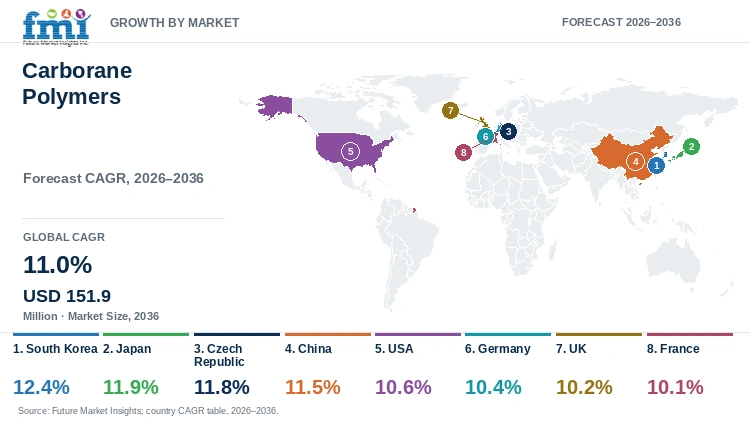
As per FMI, South Korea is projected to lead carborane polymers expansion across analyzed national markets at a 12.4% CAGR through 2036, whereas France is forecast to advance at a 10.1% CAGR. Commercial growth across East Asia, Europe, and North America tracks sovereign hypersonic thermal-protection programs, small modular nuclear reactor builds, and hospital Boron Neutron Capture Therapy rollouts.
Table 7: Country CAGR and Primary Growth Levers for the Carborane Polymers Market (CAGR percentage and operational drivers), 2026 to 2036
| Country | CAGR (2026 to 2036) | Primary Growth Lever |
|---|---|---|
| South Korea | 12.4% | Accelerator BNCT oncology centers, hypersonic missile radome seals and i-SMR nuclear shielding |
| Japan | 11.9% | Stella Chemifa Boron-10 isotope feedstock, reimbursed hospital BNCT and Tsukuba radio-immunotherapy |
| Czech Republic | 11.8% | Katchem decaborane/carborane synthesis hub, CAS Husinec-Řež 2D nanomembranes and Olomouc BNCT |
| China | 11.5% | Sichuan Univ./NPIC carborane-polyimide SMR neutron shields and clinical BNCT nanocarrier trials |
| USA | 10.6% | DoD hypersonic radomes and Boron Specialties/Dexsil/Gelest/Strem/3M Ceradyne synthesis hubs |
| Germany | 10.4% | FSU Jena 2D carborane nanomembranes, Leipzig ABCG2 oncology and Wacker high-temp silicones |
| UK | 10.2% | Rolls-Royce SMR neutron shielding, UCL BNCT boron transport research and hypersonic defense |
| France | 10.1% | MBDA/ArianeGroup V-MAX hypersonic thermal protection, Nuward SMR shielding and CEA nuclear polymer R&D |
Source: Future Market Insights analysis
South Korea Carborane Polymers Market Outlook (2026 to 2036)
South Korea leads global expansion at a 12.4% CAGR between 2026 and 2036, driven by simultaneous commercialization of hospital accelerator Boron Neutron Capture Therapy (BNCT) and indigenous tactical hypersonic missiles [17]. Clinical oncology centers in Incheon and Seoul are conducting patient trials with BNCT Polymeric Carriers and enriched Boron-10 nanomedicines to treat recurrent glioblastoma and head-and-neck carcinomas. At the same time, the Agency for Defense Development (ADD) and domestic defense primes specify Meta-Carborane Siloxane Elastomers (Dexsil class) for high-Mach radome perimeter seals, while Korea Hydro & Nuclear Power's i-SMR reactor program incorporates Boron-Rich Methacrylate Networks. Reliance on imported decaborane monomers from Czech Republic and the USA nevertheless moderates local compounding margins.
Key takeaway: In South Korea, supplying enriched Boron-10 polymeric nanocarriers to clinical BNCT centers and high-char siloxane seals to defense primes captures a 12.4% CAGR.
Japan Carborane Polymers Market Outlook (2026 to 2036)
Unlike North America and Europe where defense aerospace dominates demand, Japan's market is uniquely anchored by nationally reimbursed hospital accelerator BNCT oncology care and domestic boron-10 (Boron-10) isotopic separation by Stella Chemifa Corporation in Osaka. Industry valuation in Japan grows at an 11.9% CAGR from 2026 to 2036, propelled by oncology hospitals across Osaka, Fukushima and Tsukuba adopting high-payload BNCT Polymeric Carriers over small-molecule BPA infusions. In 2026, University of Tsukuba researchers demonstrated that combining BNCT with PD-1/PD-L1 and CTLA-4 checkpoint inhibitors triggers systemic antitumor immunity [18], while Mitsubishi Heavy Industries qualifies Polycarborane-Siloxane Elastomers for hypersonic defense. Strict PMDA pharmaceutical approval timelines remain the main pacing constraint.
Key takeaway: In Japan, long-term supply agreements with Stella Chemifa for enriched Boron-10 isotopes and hospital BNCT centers anchor an 11.9% CAGR through 2036.
Czech Republic Carborane Polymers Market Outlook (2026 to 2036)
Production and domestic demand in Czech Republic expand at an 11.8% CAGR over 2026-2036, driven by global monomer export contracts and Řež nuclear reactor shielding trials. Batch reactor scale-up safety rules remain the primary capacity constraint. Katchem spol. S r.o. In Prague and the Institute of Inorganic Chemistry of the Academy of Sciences in Czech Republic (Husinec-Řež) form Europe's sole commercial and scientific synthesis hub for decaborane (B10H14), ortho/meta/para-carboranes, and metallacarboranes (COSAN). In February 2025, Husinec-Řež and FSU Jena scientists synthesized free-standing 2D Carborane Nanomembranes via electron-beam cross-linking of para- and ortho-carborane monolayers, while in February 2026 Palacký University Olomouc validated GO@Carborane@Au theranostic nanoplatforms delivering 20–50 µg Boron-10/g to glioblastoma cells [2].
Key takeaway: In Czech Republic, Katchem's commercial decaborane and carborane cage reactor capacity is the primary European supply lifeline for aerospace and BNCT customers.
China Carborane Polymers Market Outlook (2026 to 2036)
China is projected to expand at an 11.5% CAGR between 2026 and 2036 as domestic aerospace institutes and hospital neutron-capture oncology centers scale indigenous organoboron synthesis. In July 2026, clinical oncology reviews documented expanding polymeric boron nanocarrier trials across medical centers in China [19], while Sichuan University and the Nuclear Power Institute of China fabricated carborane-grafted phenylethynyl polyimide resins achieving 75.4% fast-neutron shielding at 329.2 degrees Celsius curing. Beijing Institute of Technology propulsion teams also validated liquid ortho-carborane cluster additives for hypergolic aerospace fuels. Export controls on high-purity decaborane equipment remain the primary domestic scaling constraint.
Key takeaway: In China, indigenous carborane-polyimide neutron shielding for modular reactors and hospital BNCT nanocarrier trials anchor an 11.5% CAGR through 2036.
USA Carborane Polymers Market Outlook (2026 to 2036)
Department of Defense Mach 5+ hypersonic strike programs, space launch thermal protection, and domestic borane synthesis is expected to make the USA the largest national market for carborane polymers through 2036. Boron Specialties in Valencia, Dexsil Corporation in Hamden, Gelest in Morrisville; Strem Chemicals (Ascensus Specialties) in Newburyport and 3M Company (Ceradyne Boron-10 enrichment plant in Quapaw in Oklahoma) provide an integrated domestic supply chain from decaborane to finished elastomers [21]. Defense primes specify Hypersonic Radome Seals and Carborane Phenolic Ablatives to maintain RF seeker transparency and prevent oxidative char recession between 500°C and 800°C. Market value in the USA advances at a 10.6% CAGR over 2026–2036, although ITAR export licensing restricts merchant overseas shipments.
Key takeaway: In the USA, ITAR-compliant domestic synthesis of meta-carborane siloxane elastomers and Boron-10-enriched SMR shielding networks secures high-margin DoD and space contracts.
Germany Carborane Polymers Market Outlook (2026 to 2036)
Germany is expected to record a 10.4% CAGR from 2026 to 2036, differentiated by its leadership in 2D organoboron nanoelectronics in Jena, medicinal carborane pharmacology in Leipzig and high-temperature analytical chromatography in Burghausen and analytical instrument hubs [13]. In February 2025, Friedrich Schiller University Jena researchers pioneered electron-irradiation cross-linked para- and ortho-carborane monolayers to produce mechanically reliable 2D Carborane Nanomembranes. In 2026, Leipzig University medicinal chemists demonstrated that C2B10H12 carborane pharmacophores (borcalein and carboranylquinazoline amides) potently inhibit the breast cancer resistance protein (ABCG2) to reverse chemotherapy resistance. Chemical and Sustainable Aviation Fuel (SAF) refineries across Germany also consume Dexsil-class Gas Chromatography Phases, although Germany's nuclear power phase-out limits domestic SMR shielding demand.
Key takeaway: In Germany, 2D carborane dielectric nanomembranes and ABCG2 multidrug-resistance oncology polymers drive high-value R&D and specialty polymer demand.
UK Carborane Polymers Market Outlook (2026 to 2036)
Compact nuclear neutron shielding for Rolls-Royce SMR in Derby and sovereign hypersonic propulsion research across Farnborough and Filton distinguish demand in the UK from continental European markets. Market value in the UK expands at a 10.2% CAGR between 2026 and 2036, propelled by small modular reactor biological shield specifications and Royal Navy nuclear submarine compartment radiation barriers. In 2026, University College London (UCL) oncology researchers mapped active membrane transporters (LAT1 and GLUT) to optimize BNCT Polymeric Carriers for selective Boron-10 accumulation across the blood-brain barrier [16]. However, the absence of domestic decaborane synthesis requires UK compounders to import carborane monomers from Katchem in Czech Republic and US suppliers.
Key takeaway: In the UK, Rolls-Royce SMR neutron shielding specifications and sovereign hypersonic radome seal programs sustain a 10.2% CAGR through 2036.
France Carborane Polymers Market Outlook (2026 to 2036)
Hypersonic glide vehicle (V-MAX) and strategic missile thermal protection engineering by ArianeGroup and MBDA and Nuward small modular reactor development by EDF and CEA anchor demand in France. Defense aerospace contractors specify Carborane Phenolic Ablatives and Meta-Carborane Siloxane Elastomers to prevent oxidative char spallation and RF radome seal leakage at stagnation temperatures between 500°C and 800°C. Industry valuation in France advances at a 10.1% CAGR over the 2026-2036 forecast period, reinforced by CEA Marcoule nuclear materials testing and Normandy refinery demand for 480°C SimDis Gas Chromatography Phases [10]. Long sovereign defense qualification cycles spanning 36 to 48 months at DGA procurement test centers nevertheless moderate near-term commercial volume acceleration across domestic aerospace contractors.
Key takeaway: In France, qualifying carborane-phenolic ablatives and siloxane seals with ArianeGroup, MBDA and CEA nuclear laboratories locks in multi-year sovereign defense demand.
Full report country CAGRs cover: North America; Latin America; Western Europe; Eastern Europe; East Asia; South Asia and Pacific; Middle East and Africa.
Who are the notable companies in the carborane polymers market?
Katchem spol. S r.o., Boron Specialties LLC, Dexsil Corporation, Gelest Inc. (Mitsubishi Chemical Group), Strem Chemicals Inc. (Ascensus Specialties), 3M Company (Ceradyne), Stella Chemifa Corporation, and Wacker Chemie AG are the notable companies in the carborane polymers market.
FMI analysis indicates that the competitive arena divides between dedicated decaborane and carborane cage synthesizers, enriched Boron-10 (Boron-10) isotope specialists, and multinational high-temperature silicone compounders. Dedicated borane cluster producers synthesize ortho-, meta-, and para-carborane monomers and Dexsil-class polycarborane-siloxane elastomers under strict process-safety and export-control permits. Isotopic separation leaders supply >95% Boron-10-enriched precursors for SMR nuclear shielding and hospital BNCT oncology nanocarriers, whereas global silicone groups compound ablative and space-grade elastomers.
- Dedicated Carborane Cage & Siloxane Elastomer Leaders: Katchem spol. S r.o., Boron Specialties LLC, Dexsil Corporation and Gelest Inc. (Mitsubishi Chemical Group) control commercial decaborane, o/m/p-carborane monomer, and Dexsil siloxane elastomer production (61.5% combined share).
- Boron-10 Isotope & Organoboron Precursor Specialists: Strem Chemicals Inc. (Ascensus Specialties), 3M Company (Ceradyne Boron-10 Feedstock), and Stella Chemifa Corporation supply enriched Boron-10 isotopic precursors and cGMP borane intermediates (25.0% share).
- High-Temperature Silicone & Aerospace Compounders: Wacker Chemie AG, Momentive Performance Materials Inc., and Shin-Etsu Chemical Co. Ltd. Formulate ceramifiable, ablative, and radiation-hardened silicone compounds (13.5% share).
Competitive Benchmarking: Carborane Polymers Market
Table 8: Competitive Benchmarking for the Carborane Polymers Market (qualitative capability ratings), 2026
| Company | o/m/p-Carborane & Dexsil Breadth | Decaborane & Boron-10 Isotope Depth | Defense, SMR & BNCT Access | Geographic Reach |
|---|---|---|---|---|
| Katchem spol. S r.o. | High | High | High | High |
| Boron Specialties LLC | High | High | High | Medium |
| Dexsil Corporation | High | Medium | High | High |
| Gelest Inc. (Mitsubishi Chemical Group) | High | Medium | High | High |
| Strem Chemicals Inc. (Ascensus Specialties) | Medium | High | High | High |
| 3M Company (Ceradyne) | Low | High | High | High |
| Stella Chemifa Corporation | Low | High | High | Medium |
| Wacker Chemie AG | Medium | Low | Medium | High |
Scoring basis: Capability tiers evaluate documented product breadth across 1,2-, 1,7-, and 1,12-C2B10H12 isomers and Dexsil siloxane elastomers; captive decaborane (B10H14) synthesis and >95% Boron-10 isotopic enrichment capacity; direct qualification on hypersonic defense; SMR nuclear and hospital BNCT programs and international export-licensed distribution.
Key Developments in the Carborane Polymers Market
- Sichuan University & Nuclear Power Institute engineers fabricated low-curing (329.20°C) carborane-grafted phenylethynyl polyimide resins in October 2025 (ACS Applied Materials & Interfaces) achieving Tg = 480.1°C, T5% = 557.5°C, and 75.4% thermal neutron shielding at 5 mm thickness [14].
- Friedrich Schiller University Jena & Academy of Sciences in Czech Republic (Husinec-Řež) researchers fabricated mechanically reliable 2D Carborane Nanomembranes in February 2025 (ACS Nano) from cross-linked para- and ortho-carborane monolayers using Katchem precursors [15].
- Palacký University Olomouc researchers validated a GO@Carborane@Au hybrid theranostic framework in February 2026 (Pharmaceutics) delivering 20 to 50 µg Boron-10/g selectively to T98G glioblastoma cells for targeted BNCT [11].
Key Players in the Carborane Polymers Market
Dedicated Carborane Cage and Siloxane Elastomer Leaders
- Katchem spol. S r.o.
- Boron Specialties LLC
- Dexsil Corporation
Boron-10 Isotope and Organoboron Precursor Specialists
- Gelest Inc. (Mitsubishi Chemical Group)
- Strem Chemicals Inc. (Ascensus Specialties)
- 3M Company (Ceradyne)
High-Temperature Silicone and Aerospace Compounders
- Stella Chemifa Corporation
- Wacker Chemie AG
Carborane Polymers Market - Report Scope
Table 9: Report Scope for the Carborane Polymers Market (coverage fields and definitions), 2026 to 2036
| Coverage field | Report scope |
|---|---|
| Market breakdown | Cage Isomer; Backbone Architecture; Thermal Regime; End-Use Sector; Sales Channel |
| Quantitative Units | USD Million |
| Market Definition | Includes commercial supplier market value from polycarborane-siloxane elastomers (Dexsil class), carborane-grafted phenolic and polyimide ablatives, boron-rich methacrylate networks, 2D carborane nanomembranes, and polymeric BNCT nanocarriers incorporating icosahedral C2B10H12 or metallacarborane (COSAN) cages. Category Scope Note: Excludes inorganic boron carbide (B4C) ceramic plates, elemental boron fibers, and un-polymerized small-molecule BPA/BSH drugs. |
| Regions Covered | North America; Latin America; Western Europe; Eastern Europe; East Asia; South Asia and Pacific; Middle East and Africa |
| Countries Covered | South Korea, Japan, Czech Republic, China, USA, Germany, UK, France, and additional countries in the full report |
| Key Companies Covered | Katchem spol. S r.o., Boron Specialties LLC, Dexsil Corporation, Gelest Inc. (Mitsubishi Chemical Group), Strem Chemicals Inc. (Ascensus Specialties), 3M Company (Ceradyne), Stella Chemifa Corporation, Wacker Chemie AG |
| Forecast Period | 2026 to 2036 |
| Approach | Primary and secondary research with top-down parent-market cap checks and bottom-up decaborane-to-carborane reactor yield triangulation. |
Carborane Polymers Market - Research Methodology
Table 10: Research Methodology for the Carborane Polymers Market (research methods and approach), 2026 edition
| Method | Approach |
|---|---|
| Primary Research | Structured interviews with decaborane and carborane cage synthesis directors, defense hypersonic thermal-protection engineers, SMR nuclear radiation-shielding designers, and hospital accelerator BNCT physicists to validate isomerization yields and per-kilogram pricing. |
| Secondary Research | Analysis of corporate disclosures (3M, Stella Chemifa, Ascensus/Strem, Katchem), PubMed and PMC carborane polymer and BNCT clinical studies, and global boron/BF3 industry benchmarks. |
| Market Sizing and Forecasting | Top-down parent Silicone Elastomer Market (USD 6,596.8 million in 2026) and Global Boron Market (USD 10,909.5 million in 2026) models reconciled against bottom-up decaborane reactor outputs and 470°C/620°C cage isomerization yields (~15.5 MT finished polymer output at USD 3,450/kg weighted ASP = USD 53.5 million in 2026) from 2026 to 2036. |
| Country Forecasting Model | Econometric country projections weight sovereign hypersonic missile budgets, SMR microreactor build schedules, hospital accelerator BNCT treatment capacity, and SimDis petrochemical GC column demand across seven national markets. |
| Operational Benchmark Traceability | Decaborane batch and defense/nuclear facility indicators in Tables 2, 3, and 4 trace to ACS Applied Materials & Interfaces polyimide shielding data, ACS Nano 2D nanomembrane studies, and Molecules liquid carborane propellant yields. |
| Data Triangulation and Validation | Demand estimates are cross-checked against ITAR defense procurement lots, ASTM D7169 SimDis GC column replacements, and clinical BNCT nanocarrier trials without double counting inorganic B4C ceramics or small-molecule BPA. |
Carborane Polymers Market by Segments
Carborane Polymers Market segmented by Cage Isomer:
- Meta-Carborane Siloxane Elastomers
- Para-Carborane Ultra-Stable Polymers
- Ortho-Carborane Preceramic Resins
- Metallacarborane COSAN Networks
Carborane Polymers Market segmented by Backbone Architecture:
- Polycarborane-Siloxane Elastomers
- Carborane Phenolic Ablatives
- Boron-Rich Methacrylate Networks
Carborane Polymers Market segmented by Thermal Regime:
- Ultra-High Oxidative Char
- Continuous Elastomeric Sealing
- Cryogenic Propellant Binders
Carborane Polymers Market segmented by End-Use Sector:
- Hypersonic Radome Seals
- SMR Neutron Shielding
- Gas Chromatography Phases
- BNCT Polymeric Carriers
Carborane Polymers Market segmented by Sales Channel:
- Direct Defense Contracts
- Specialty Chemical Distributors
- Clinical Oncology Supply
- Academic Research Catalogs
- Other Institutional Channels
Carborane Polymers Market by Region
- North America
- United States
- Canada
- Latin America
- Brazil
- Mexico
- Argentina
- Chile
- Western Europe
- Germany
- France
- United Kingdom
- Italy
- Spain
- Benelux
- Nordics
- Eastern Europe
- Poland
- Czech Republic
- Romania
- Hungary
- East Asia
- China
- Japan
- South Korea
- South Asia and Pacific
- India
- ASEAN
- Australia and New Zealand
- Middle East and Africa
- GCC Countries
- South Africa
- Türkiye
- Israel
Research Sources and Bibliography
- [1] Frey, M., Picker, J., Neumann, C., Višňák, J., Macháček, J., Tok, O. L., Bábor, P., Base, T., & Turchanin, A. (2025, February 18). Carborane Nanomembranes. ACS Nano.
- [2] Ranc, V., & Žárská, L. (2026, February 4). Boron Theranostic Nanoplatform Using a GO@Carborane@Au Hybrid Framework for Targeted Delivery. Pharmaceutics, 18(2), 188.
- [3] Ren, J., Wang, T., Zuo, C., Zhang, R., & Li, L. (2026, March 12). A Porphyrinic Covalent Organic Polymer Nanoplatform for Carborane Delivery and Multifunctional Imaging-Guided Boron Neutron Capture Therapy of Breast Cancer. International Journal of Nanomedicine, 21, 607839.
- [4] Zhou, L., Chen, Y., Peng, M., Yin, X., Liang, H., Mo, J., Zhang, W., & Liu, Z. (2025, December 15). Clinical application of boron neutron capture therapy for cancer treatment: A systematic review. Precision Radiation Oncology, 9(4), 304–313.
- [5] Mu, X., Wang, S., Yang, F., & Li, H. (2025, May 2). Liquid Carbon-Boron Cluster Additives for Mixed Amine-50. Molecules, 30(9), 2037.
- [6] Wang, W., Zhang, E., Shan, J., Zhang, M., Cai, R., Li, R., Pang, L., Li, B., & Zang, D. (2026, January 1). Advanced boron clusters for boron neutron-capture therapy. Theranostics, 16(1), 417–464.
- [7] Stockmann, P., & Hey-Hawkins, E. (2026, April 10). Carborane-Based Derivatives as Inhibitors of the Breast Cancer Resistance Protein (ABCG2). Handbook of Experimental Pharmacology.
- [8] Szathmári, B., Gao, Y., Buzsáki, D., Zámbó, D., Holczbauer, T., Udvardy, A., Szabó, P., Kertész, J., Hessz, D., & Kelemen, Z. (2026, January 22). Reimagining o-Carborane-Based Fluorophores: Charge-Transfer from Boron Substituents Triggers Aggregation- and Crystallization-Induced Emission. Angewandte Chemie International Edition, e21741.
- [9] Olejniczak, A. B. (2026, March 28). Carboranes as Modulators of Biologically Active Compounds: Case Studies of DNA-Intercalating Agents, Penicillin G and Isoniazid. Handbook of Experimental Pharmacology.
- [10] Ferrer-Ugalde, A., Muñoz-Juan, A., Laromaine, A., Curotto, P., Nievas, S., Dagrosa, M. A., Couto, M., & Núñez, R. (2025, April 14). Improving Boron Neutron Capture Therapy (BNCT) with Materials Based on COSAN-Functionalized Nanoparticles. Pharmaceuticals (Basel), 18(4), 466.
- [11] Marforio, T. D., Carboni, A., Mazzei, L., Cascone, S., Lovatti, L., Mattioli, E. J., Valle, F., Di Giosia, M., Ciurli, S., & Calvaresi, M. (2026, January 18). Structural determinants underlying the supramolecular binding between carborane and proteins in water. Journal of Colloid and Interface Science, 708, 139798.
- [12] Xu, X., Zhao, X., Xu, S., Zhang, X., Wang, Q., Wu, L., Li, X., Shi, J., Ma, J., Ji, L., & Huang, W. (2025, October 20). Achieving Charge-Transfer from the Boron-Vertices of o-Carborane: Dual-Emission with a Shift of 505 nm (2.1 eV). Angewandte Chemie International Edition, e21735.
- [13] Rykowski, S., Różycka, D., Orlicka-Płocka, M., Gurda-Woźna, D., Denel-Bobrowska, M., Fedoruk-Wyszomirska, A., Bąk, A., Wyszko, E., & Olejniczak, A. B. (2026, April 2). Carborane-modified paclitaxel analogues: Position-dependent modulation of mitotic catastrophe and lysosomal function. European Journal of Medicinal Chemistry, 319, 119244.
- [14] Wang, M., Liu, Y., Wang, M., Zhou, N., Tao, Y., Fan, Z., Tu, D., Lu, C. S., & Yan, H. (2026, March 19). Boron Cluster-Based X-Ray Scintillators for Highly Efficient Radioluminescence. Angewandte Chemie International Edition, 65(39), e1428276.
- [15] Li, X., Liu, Z., Liu, K., Wang, C., Liu, Z., & Xu, X. (2026, January 16). Advances in Clinical Trials of Boron Neutron Capture Therapy. Research (Wash D C), 9, 0988.
- [16] Wei, Y., Zhu, W., Chen, Q., Alnufaei, H., Li, Y., & Ricketts, K. (2026, March 14). Potential targets for boron transport in boron neutron capture therapy. Frontiers in Oncology, 16, 1817038.
- [17] Chen, C., Yang, M., Wang, J., Zhang, L., Huang, S., Xu, X., & Liu, Y. (2026, March 20). Emerging agents for boron neutron capture therapy: Biomolecular carriers enabling precision radiotherapy. Precision Radiation Oncology, 10(2), 254–264.
- [18] Abulimiti, M., Sugawara, Y., Li, Y., Sakurai, H., & Matsumoto, Y. (2026, March 11). Beyond radiation: immunological potentials of boron neutron capture therapy. Cancer Immunology, Immunotherapy.
- [19] Xie, H., et al. (2026). Nanoparticle Boron Carrier for Boron Neutron Capture Therapy: Research Progress and Perspectives in China.. Nanomaterials (Basel, Switzerland), 16(14), 845 (PMC13414665).
- [20] Meng, H., Liao, X., Qian, R., Sun, B., Ni, L., Wu, Y., Luo, Y., Pan, X., Zou, H., & Liang, M. (2025, October 15). Low-Curing Temperature Phenylethynyl-Terminated Polyimide Resin Grafted with Carborane Nanocages: Improved Heat Resistance and Neutron Shielding. ACS Applied Materials & Interfaces, 17(41), 57558–57568.
- [21] U.S. Geological Survey (USGS). (2026, January 30). Mineral Commodity Summaries 2026: Boron. U.S. Department of the Interior.
- [22] Katchem spol. S r.o. (2025, November 14). Carborane, Decaborane, and Boron Cluster Specialty Synthesis Portfolio for Nuclear and BNCT Applications. Katchem Corporate Technical Disclosures.
- [23] 3M Company. (2026, October 20). 3M Reports Third-Quarter 2026 Results; Raises Full-Year EPS Guidance. 3M Company Investor Relations.
This bibliography is provided for reader reference and is not exhaustive. The full report contains the complete reference list and detailed citations.
This Report Answers
- How large is the carborane polymers market in 2026 and what is forecast for 2036?
- Which hypersonic aerothermal sealing and nuclear neutron-shielding pressures support demand for carborane polymers?
- Why do Meta-Carborane Siloxane Elastomers lead the cage isomer category?
- Why do Polycarborane-Siloxane Elastomers lead the backbone architecture category globally?
- How do growth rates differ across South Korea, Japan, Czech Republic, and the USA?
- Which leading companies supply decaborane, carborane monomers, Dexsil elastomers, and Boron-10 isotopes today?
- What limits adoption or supplier switching in the carborane polymers market?
- What should buyers evaluate before qualifying a carborane polymer compound?
Frequently Asked Questions
How big is the carborane polymers market in 2026, and what is forecast for 2036?
The global Carborane Polymers Market establishes its foundation at USD 48.2 million in 2025, advances to USD 53.5 million in 2026, and is forecast to scale to USD 151.9 million by 2036 at a CAGR of 11.0%.
What is the CAGR for the carborane polymers market from 2026 to 2036?
Future Market Insights projects an 11.0% compound annual growth rate between 2026 and 2036, generating USD 98.4 million in incremental market value over the 10-year forecast period.
Which cage isomer segment leads the carborane polymers market?
Meta-Carborane Siloxane Elastomers (1,7-C2B10H12) are projected to capture 56.4% of cage isomer demand (USD 30.2 million) in 2026 and grow at an 11.2% CAGR through 2036 because separating the two carbon vertices prevents intramolecular ring cyclization during siloxane polycondensation.
Which backbone architecture segment leads the carborane polymers market?
Polycarborane-Siloxane Elastomers (Dexsil class) are estimated to secure 62.8% of the backbone architecture category (USD 33.6 million) in 2026 by suppressing cyclic siloxane volatilization and forming a self-healing borosilicate glaze above 500°C.
Why are carborane polymers used in hypersonic missile radome seals and SMR neutron shields?
Hypersonic Radome Seals (46.5% share, 11.3% CAGR) withstand 500°C to 800°C stagnation heating while forming an electrically insulating borosilicate char that remains transparent to RF radar guidance signals, while SMR Neutron Shielding (24.5% share) use Boron-10's 3,835-barn capture cross-section to achieve 75.4% thermal neutron attenuation at 5 mm thickness.
Who are the key players in the market?
Katchem spol. S r.o., Boron Specialties LLC, Dexsil Corporation; Gelest Inc. (Mitsubishi Chemical Group), Strem Chemicals Inc. (Ascensus Specialties), 3M Company (Ceradyne), Stella Chemifa Corporation; Wacker Chemie AG; Momentive Performance Materials Inc. and Shin-Etsu Chemical Co. Ltd. Are the key players evaluated in the market.
Preview the report firsthand - request a free sample
Get SampleGet the brochure for pricing and purchase details.
Get PDFTable of Content
- Key Takeaways
- Market Size and CAGR
- Top Growth Driver
- Fastest Growing Segment
- Leading Region
- Key Companies
- Emerging Opportunities
- Executive Summary
- Global Market Outlook
- Demand-side Trends
- Supply-side Trends
- Technology Roadmap Analysis
- Analysis and Recommendations
- Analyst Perspective (What is happening? Why now? What should investors know?)
- Key Questions Answered
- How large is the market?
- What is the CAGR?
- What are key trends?
- Which region dominates?
- Who are the leaders?
- Market Overview
- Market Coverage / Taxonomy
- Market Definition / Scope / Limitations
- Research Methodology
- Chapter Orientation
- Analytical Lens and Working Hypotheses
- Market Structure, Signals, and Trend Drivers
- Benchmarking and Cross-market Comparability
- Market Sizing, Forecasting, and Opportunity Mapping
- Research Design and Evidence Framework
- Desk Research Programme (Secondary Evidence)
- Expert Input and Fieldwork (Primary Evidence)
- Tooling, Models, and Reference Databases
- Data Engineering and Model Build
- Quality Assurance and Audit Trail
- Market Background
- Market Dynamics (Drivers, Restraints, Opportunity, Trends)
- Scenario Forecast (Optimistic, Likely, Conservative)
- Impact Analysis
- AI Impact
- Sustainability Impact
- Regulatory Impact
- Technology Impact
- Consumer / Buyer Analysis
- Purchase Drivers
- Adoption Barriers
- Buyer Journey
- Opportunity Map Analysis
- Product Life Cycle Analysis
- Supply Chain Analysis
- Investment Feasibility Matrix
- Value Chain Analysis
- PESTLE and Porter's Analysis
- Regulatory Landscape
- Regional Parent Market Outlook
- Production and Consumption Statistics
- Import and Export Statistics
- Global Market Analysis and Forecast, 2021 to 2036
- Historical Market Size Value (USD Million) Analysis, 2021 to 2025
- Current and Future Market Size Value (USD Million) Projections, 2026 to 2036
- Y-o-Y Growth Trend Analysis
- Absolute $ Opportunity Analysis
- Global Market Pricing Analysis, 2021 to 2036
- Global Market Analysis and Forecast, By Cage Isomer, 2021 to 2036
- Introduction / Key Findings
- Historical Market Size Value (USD Million) Analysis By Cage Isomer, 2021 to 2025
- Current and Future Market Size Value (USD Million) Analysis and Forecast By Cage Isomer, 2026 to 2036
- Meta-Carborane Siloxane Elastomers
- Para-Carborane Ultra-Stable Polymers
- Ortho-Carborane Preceramic Resins
- Metallacarborane COSAN Networks
- Y-o-Y Growth Trend Analysis By Cage Isomer, 2021 to 2025
- Absolute $ Opportunity Analysis By Cage Isomer, 2026 to 2036
- Global Market Analysis and Forecast, By Backbone Architecture, 2021 to 2036
- Introduction / Key Findings
- Historical Market Size Value (USD Million) Analysis By Backbone Architecture, 2021 to 2025
- Current and Future Market Size Value (USD Million) Analysis and Forecast By Backbone Architecture, 2026 to 2036
- Polycarborane-Siloxane Elastomers
- Carborane Phenolic Ablatives
- Boron-Rich Methacrylate Networks
- Y-o-Y Growth Trend Analysis By Backbone Architecture, 2021 to 2025
- Absolute $ Opportunity Analysis By Backbone Architecture, 2026 to 2036
- Global Market Analysis and Forecast, By Thermal Regime, 2021 to 2036
- Introduction / Key Findings
- Historical Market Size Value (USD Million) Analysis By Thermal Regime, 2021 to 2025
- Current and Future Market Size Value (USD Million) Analysis and Forecast By Thermal Regime, 2026 to 2036
- Ultra-High Oxidative Char
- Continuous Elastomeric Sealing
- Cryogenic Propellant Binders
- Y-o-Y Growth Trend Analysis By Thermal Regime, 2021 to 2025
- Absolute $ Opportunity Analysis By Thermal Regime, 2026 to 2036
- Global Market Analysis and Forecast, By End-Use Sector, 2021 to 2036
- Introduction / Key Findings
- Historical Market Size Value (USD Million) Analysis By End-Use Sector, 2021 to 2025
- Current and Future Market Size Value (USD Million) Analysis and Forecast By End-Use Sector, 2026 to 2036
- Hypersonic Radome Seals
- SMR Neutron Shielding
- Gas Chromatography Phases
- BNCT Polymeric Carriers
- Y-o-Y Growth Trend Analysis By End-Use Sector, 2021 to 2025
- Absolute $ Opportunity Analysis By End-Use Sector, 2026 to 2036
- Global Market Analysis and Forecast, By Sales Channel, 2021 to 2036
- Introduction / Key Findings
- Historical Market Size Value (USD Million) Analysis By Sales Channel, 2021 to 2025
- Current and Future Market Size Value (USD Million) Analysis and Forecast By Sales Channel, 2026 to 2036
- Direct Defense Contracts
- Specialty Chemical Distributors
- Clinical Oncology Supply
- Academic Research Catalogs
- Other Institutional Channels
- Y-o-Y Growth Trend Analysis By Sales Channel, 2021 to 2025
- Absolute $ Opportunity Analysis By Sales Channel, 2026 to 2036
- Global Market Analysis and Forecast, By Region, 2021 to 2036
- Introduction
- Historical Market Size Value (USD Million) Analysis By Region, 2021 to 2025
- Current Market Size Value (USD Million) Analysis and Forecast By Region, 2026 to 2036
- North America
- Latin America
- Western Europe
- Eastern Europe
- East Asia
- South Asia and Pacific
- Middle East and Africa
- Market Attractiveness Analysis By Region
- North America Market Analysis and Forecast, By Country, 2021 to 2036
- Historical Market Size Value (USD Million) Trend Analysis By Market Taxonomy, 2021 to 2025
- Market Size Value (USD Million) Forecast By Market Taxonomy, 2026 to 2036
- By Country
- United States
- Canada
- By Cage Isomer
- By Backbone Architecture
- By Thermal Regime
- By End-Use Sector
- By Sales Channel
- By Country
- Market Attractiveness Analysis
- By Country
- By Cage Isomer
- By Backbone Architecture
- By Thermal Regime
- By End-Use Sector
- By Sales Channel
- Key Takeaways
- Latin America Market Analysis and Forecast, By Country
- Historical Market Size Value (USD Million) Trend Analysis By Market Taxonomy, 2021 to 2025
- Market Size Value (USD Million) Forecast By Market Taxonomy, 2026 to 2036
- By Country
- Brazil
- Mexico
- Argentina
- Chile
- By Cage Isomer
- By Backbone Architecture
- By Thermal Regime
- By End-Use Sector
- By Sales Channel
- By Country
- Market Attractiveness Analysis
- By Country
- By Cage Isomer
- By Backbone Architecture
- By Thermal Regime
- By End-Use Sector
- By Sales Channel
- Key Takeaways
- Western Europe Market Analysis and Forecast, By Country
- Historical Market Size Value (USD Million) Trend Analysis By Market Taxonomy, 2021 to 2025
- Market Size Value (USD Million) Forecast By Market Taxonomy, 2026 to 2036
- By Country
- Germany
- France
- United Kingdom
- Italy
- Spain
- Benelux
- Nordics
- By Cage Isomer
- By Backbone Architecture
- By Thermal Regime
- By End-Use Sector
- By Sales Channel
- By Country
- Market Attractiveness Analysis
- By Country
- By Cage Isomer
- By Backbone Architecture
- By Thermal Regime
- By End-Use Sector
- By Sales Channel
- Key Takeaways
- Eastern Europe Market Analysis and Forecast, By Country
- Historical Market Size Value (USD Million) Trend Analysis By Market Taxonomy, 2021 to 2025
- Market Size Value (USD Million) Forecast By Market Taxonomy, 2026 to 2036
- By Country
- Poland
- Czech Republic
- Romania
- Hungary
- By Cage Isomer
- By Backbone Architecture
- By Thermal Regime
- By End-Use Sector
- By Sales Channel
- By Country
- Market Attractiveness Analysis
- By Country
- By Cage Isomer
- By Backbone Architecture
- By Thermal Regime
- By End-Use Sector
- By Sales Channel
- Key Takeaways
- East Asia Market Analysis and Forecast, By Country
- Historical Market Size Value (USD Million) Trend Analysis By Market Taxonomy, 2021 to 2025
- Market Size Value (USD Million) Forecast By Market Taxonomy, 2026 to 2036
- By Country
- China
- Japan
- South Korea
- By Cage Isomer
- By Backbone Architecture
- By Thermal Regime
- By End-Use Sector
- By Sales Channel
- By Country
- Market Attractiveness Analysis
- By Country
- By Cage Isomer
- By Backbone Architecture
- By Thermal Regime
- By End-Use Sector
- By Sales Channel
- Key Takeaways
- South Asia and Pacific Market Analysis and Forecast, By Country
- Historical Market Size Value (USD Million) Trend Analysis By Market Taxonomy, 2021 to 2025
- Market Size Value (USD Million) Forecast By Market Taxonomy, 2026 to 2036
- By Country
- India
- ASEAN
- Australia and New Zealand
- By Cage Isomer
- By Backbone Architecture
- By Thermal Regime
- By End-Use Sector
- By Sales Channel
- By Country
- Market Attractiveness Analysis
- By Country
- By Cage Isomer
- By Backbone Architecture
- By Thermal Regime
- By End-Use Sector
- By Sales Channel
- Key Takeaways
- Middle East and Africa Market Analysis and Forecast, By Country
- Historical Market Size Value (USD Million) Trend Analysis By Market Taxonomy, 2021 to 2025
- Market Size Value (USD Million) Forecast By Market Taxonomy, 2026 to 2036
- By Country
- GCC Countries
- South Africa
- Türkiye
- Israel
- By Cage Isomer
- By Backbone Architecture
- By Thermal Regime
- By End-Use Sector
- By Sales Channel
- By Country
- Market Attractiveness Analysis
- By Country
- By Cage Isomer
- By Backbone Architecture
- By Thermal Regime
- By End-Use Sector
- By Sales Channel
- Key Takeaways
- Key Countries Market Analysis
- United States
- Pricing Analysis
- Market Share Analysis, 2025
- By Cage Isomer
- By Backbone Architecture
- By Thermal Regime
- By End-Use Sector
- By Sales Channel
- Canada
- Pricing Analysis
- Market Share Analysis, 2025
- By Cage Isomer
- By Backbone Architecture
- By Thermal Regime
- By End-Use Sector
- By Sales Channel
- Mexico
- Pricing Analysis
- Market Share Analysis, 2025
- By Cage Isomer
- By Backbone Architecture
- By Thermal Regime
- By End-Use Sector
- By Sales Channel
- Brazil
- Pricing Analysis
- Market Share Analysis, 2025
- By Cage Isomer
- By Backbone Architecture
- By Thermal Regime
- By End-Use Sector
- By Sales Channel
- Chile
- Pricing Analysis
- Market Share Analysis, 2025
- By Cage Isomer
- By Backbone Architecture
- By Thermal Regime
- By End-Use Sector
- By Sales Channel
- Germany
- Pricing Analysis
- Market Share Analysis, 2025
- By Cage Isomer
- By Backbone Architecture
- By Thermal Regime
- By End-Use Sector
- By Sales Channel
- United Kingdom
- Pricing Analysis
- Market Share Analysis, 2025
- By Cage Isomer
- By Backbone Architecture
- By Thermal Regime
- By End-Use Sector
- By Sales Channel
- Italy
- Pricing Analysis
- Market Share Analysis, 2025
- By Cage Isomer
- By Backbone Architecture
- By Thermal Regime
- By End-Use Sector
- By Sales Channel
- Spain
- Pricing Analysis
- Market Share Analysis, 2025
- By Cage Isomer
- By Backbone Architecture
- By Thermal Regime
- By End-Use Sector
- By Sales Channel
- France
- Pricing Analysis
- Market Share Analysis, 2025
- By Cage Isomer
- By Backbone Architecture
- By Thermal Regime
- By End-Use Sector
- By Sales Channel
- India
- Pricing Analysis
- Market Share Analysis, 2025
- By Cage Isomer
- By Backbone Architecture
- By Thermal Regime
- By End-Use Sector
- By Sales Channel
- ASEAN
- Pricing Analysis
- Market Share Analysis, 2025
- By Cage Isomer
- By Backbone Architecture
- By Thermal Regime
- By End-Use Sector
- By Sales Channel
- Australia and New Zealand
- Pricing Analysis
- Market Share Analysis, 2025
- By Cage Isomer
- By Backbone Architecture
- By Thermal Regime
- By End-Use Sector
- By Sales Channel
- China
- Pricing Analysis
- Market Share Analysis, 2025
- By Cage Isomer
- By Backbone Architecture
- By Thermal Regime
- By End-Use Sector
- By Sales Channel
- Japan
- Pricing Analysis
- Market Share Analysis, 2025
- By Cage Isomer
- By Backbone Architecture
- By Thermal Regime
- By End-Use Sector
- By Sales Channel
- South Korea
- Pricing Analysis
- Market Share Analysis, 2025
- By Cage Isomer
- By Backbone Architecture
- By Thermal Regime
- By End-Use Sector
- By Sales Channel
- Poland
- Pricing Analysis
- Market Share Analysis, 2025
- By Cage Isomer
- By Backbone Architecture
- By Thermal Regime
- By End-Use Sector
- By Sales Channel
- Hungary
- Pricing Analysis
- Market Share Analysis, 2025
- By Cage Isomer
- By Backbone Architecture
- By Thermal Regime
- By End-Use Sector
- By Sales Channel
- Türkiye
- Pricing Analysis
- Market Share Analysis, 2025
- By Cage Isomer
- By Backbone Architecture
- By Thermal Regime
- By End-Use Sector
- By Sales Channel
- South Africa
- Pricing Analysis
- Market Share Analysis, 2025
- By Cage Isomer
- By Backbone Architecture
- By Thermal Regime
- By End-Use Sector
- By Sales Channel
- Czech Republic
- Pricing Analysis
- Market Share Analysis, 2025
- By Cage Isomer
- By Backbone Architecture
- By Thermal Regime
- By End-Use Sector
- By Sales Channel
- United States
- Market Structure Analysis
- Competition Dashboard
- Competition Benchmarking
- Market Share Analysis of Top Players
- By Regional
- By Cage Isomer
- By Backbone Architecture
- By Thermal Regime
- By End-Use Sector
- By Sales Channel
- Emerging Startups
- Innovation Benchmarking
- Competition Analysis
- Competition Deep Dive
- Katchem spol. S r.o.
- Overview
- Product Portfolio
- Profitability by Market Segments
- Sales Footprint
- Strategy Overview
- Marketing Strategy
- Product Strategy
- Channel Strategy
- Boron Specialties LLC
- Dexsil Corporation
- Gelest Inc. (Mitsubishi Chemical Group)
- Strem Chemicals Inc. (Ascensus Specialties)
- 3M Company (Ceradyne)
- Stella Chemifa Corporation
- Wacker Chemie AG
- Katchem spol. S r.o.
- Case Studies
- Success Stories
- Recent Developments
- Competition Deep Dive
- Assumptions & Acronyms Used


