

- Market Size (2026)
- USD 4.5 Bn
- Forecast (2036)
- USD 7.5 Bn
- CAGR (2026 to 2036)
- 5.2%
How big is Bismaleimide Resins Market in 2026?
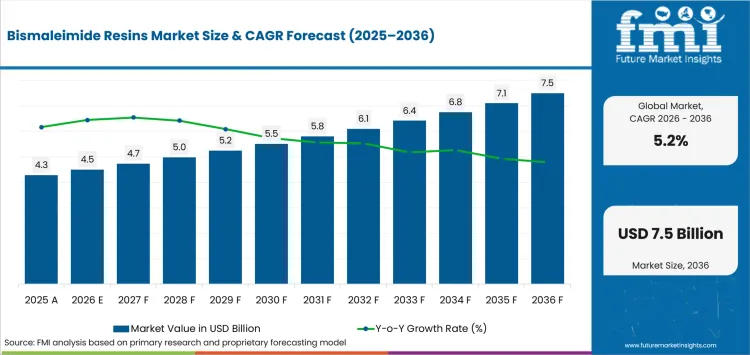
USD 4.5 billion in 2026 and USD 7.5 billion by 2036 at a 5.2% CAGR.
Demand for bismaleimide resins is projected to rise at a 5.2% CAGR by 2036, driving industry valuation from USD 4.5 billion in 2026 to USD 7.5 billion during the forecast period. BMI remains relevant where high-temperature composite structures need temperature capability beyond common structural epoxy ranges. In May 2025, Syensqo and Boeing demonstrated CYCOM 5250-4HT bismaleimide prepreg on an MQ-25 exhaust-nozzle concept as a titanium replacement. The program links resin selection to a defined heat and weight requirement in propulsion-adjacent structures.
Country demand depends on qualified aerospace manufacturing that can absorb high-temperature composite materials into approved programs. The National Research Council Canada stated in May 2025 that aerospace manufacturing contributes 60% of the Canadian aerospace sector's GDP. Manufacturing depth expands the number of qualification routes available to BMI producers. Material entry still depends on cure behavior, hot-wet retention and lot consistency within each approved process.
Key Takeaways
- High-temperature aerospace, defense and space structures provide the clearest demand route because BMI retains useful properties beyond common structural epoxy ranges.
- By resin type, thermoset BMI resins are estimated to hold 31.0% in 2026 owing to their established role in high-temperature composite matrices.
- In 2026, prepreg matrix resin is expected to lead form demand with 31.0% share because controlled resin content reduces variation during composite lay-up.
- By end use, aerospace composites are forecast to represent 44.0% in 2026 driven by concentrated heat exposure and formal material qualification.
- Long qualification cycles and elevated cure schedules raise switching costs because a new resin must prove material performance and process repeatability before specification entry.
- Some of the key players in this market include Syensqo, Toray Advanced Composites, Renegade Materials, Hexcel, Evonik, Kaneka Aerospace, Axiom Materials, and SHD Composites.
Analyst Perspective
"BMI procurement is decided by usable temperature margin, qualification cost and cure burden rather than resin price alone. The strongest material position keeps thermal performance inside an approved production route without forcing unnecessary tooling or cycle changes."
- Nikhil Kaitwade, Principal Consultant, Future Market Insights
How is the bismaleimide resins market segmented?
The bismaleimide resins market is segmented by resin type, form, end use, cure temperature, sales channel and region.
Resin type separates thermoset, modified, high-temperature, toughened and prepreg-grade BMI systems. Form covers prepreg matrix resin, powder, film adhesive resin, liquid resin and custom systems. End use includes aerospace composites, defense structures, electronics laminates, high-performance adhesives and automotive or motorsport composites. Cure temperature covers high-, medium- and low-temperature cure plus post-cure systems. Sales channels include composite material suppliers, aerospace OEM qualification, distributors or formulators and direct specialty resin supply.
Why do thermoset BMI resins lead the resin type category?
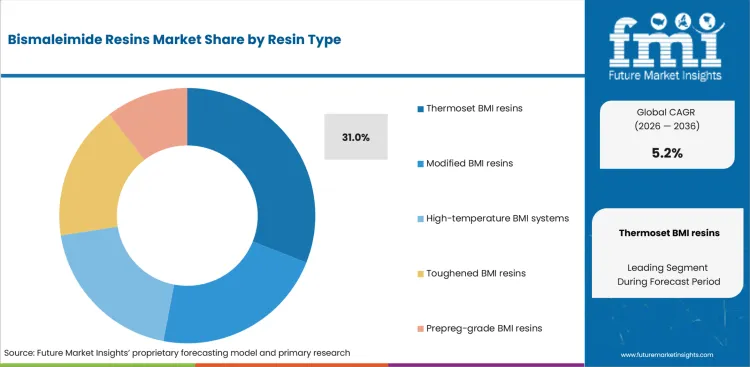
Thermoset BMI chemistry earns specification space where a matrix must preserve stiffness beyond the practical service range of structural epoxies. Its qualification value comes from retaining those properties after the full cure schedule for composite resin systems.
- By resin type, thermoset BMI resins are estimated to hold 31.0% in 2026 owing to their established role in high-temperature composite matrices.
- In February 2026, Toray Advanced Composites introduced its 4000 BMI prepreg for aerospace, defense and space applications with higher damage tolerance and improved resin flow. The development gives qualification teams a current thermoset route that addresses processing behavior alongside temperature capability.
Why does prepreg matrix resin lead the form category?
Prepreg matrix resin gives aerospace processors a controlled resin fraction before lay-up and removes shop-floor mixing variation. Tape dimensions and resin uniformity also determine how well automated placement holds material tolerances.
- Prepreg matrix resin is projected to hold 31.0% share in 2026 owing to repeatable fiber-resin integration in specification-led composite production.
- In July 2025, Toray Advanced Composites signed a long-term agreement to supply six-inch unidirectional prepreg tape for automated satellite-panel production. Automated satellite-panel production therefore raises the commercial value of prepreg format control, storage records and processing consistency at scale.
Why do aerospace composites lead the end use category?
Aerospace programs absorb BMI cost where temperature margin and structural weight are tied directly to mission performance. Material approval also has to fit production-rate controls instead of laboratory property targets alone.
- By end use, aerospace composites are forecast to represent 44.0% in 2026 driven by concentrated heat exposure and formal material qualification.
- NASA's May 2025 HiCAM review brought together teams from 22 organizations to evaluate composite manufacturing rate, cost and performance. The work puts production evidence beside material performance, which is why a high-temperature resin needs repeatable processing data before technical capability becomes a production specification.
Why does high-temperature cure lead the cure temperature category?
High-temperature cure remains common because many BMI networks need elevated thermal input and post-cure to reach target service properties. The manufacturing penalty appears directly in autoclave time, tool availability and energy use.
- High-temperature cure is likely to capture 39.0% share in 2026 attributable to established aerospace systems with elevated cure schedules.
- Janicki Industries disclosed in February 2026 that evaluations of Kaneka TP2230 BMI tooling prepreg reduced lead time by more than 25% and tool cost by more than 20%. The result shows how cure-route changes can materially alter tooling economics without removing the final high-temperature requirement.
What are the drivers, restraints and opportunities in the Bismaleimide Resins Market?
High-temperature lightweight structures support demand, qualification and cure requirements slow substitution, and lower-burden processing offers the clearest route to wider use.
- Driver: Aerospace and defense programs require lightweight matrices that retain structural properties in elevated-temperature zones near propulsion and other heat sources.
- Restraint: Qualification data and elevated cure schedules increase the time and manufacturing cost required to replace an approved resin system.
- Opportunity: Lower-cure BMI formulations and wider prepreg formats can reduce processing penalties without surrendering the service-temperature requirement.
Aircraft and propulsion programs use BMI where removing structural mass cannot reduce temperature margin near engines or other hot zones. NASA's June 2026 HiCAM review brought about 150 participants from a 22-member public-private partnership to select technologies that improve composite manufacturing rate. Resin producers therefore need thermal property retention plus production evidence before a formulation can enter new aircraft or propulsion work.
An aerospace material change has to survive design, test and production controls before it reaches an approved bill of material. Hexcel completed NCAMP qualification of its M91 composite system in July 2026 across unidirectional tape and plain-weave fabric. Although M91 is epoxy, the qualification step makes test and production-data costs part of substitution economics beyond material price.
Wider prepreg formats can reduce lay-up interfaces on large tools or structures without changing the resin's required service-temperature envelope. In February 2026, SHD Composites commissioned 1,500 mm prepreg and film-coating lines for larger structures and higher-volume programs. The same wider-format manufacturing logic applies to BMI films used beside industrial adhesives where fewer handling interfaces can simplify qualification.
Which country CAGRs are profiled in the Bismaleimide Resins Market?
| Country | CAGR |
|---|---|
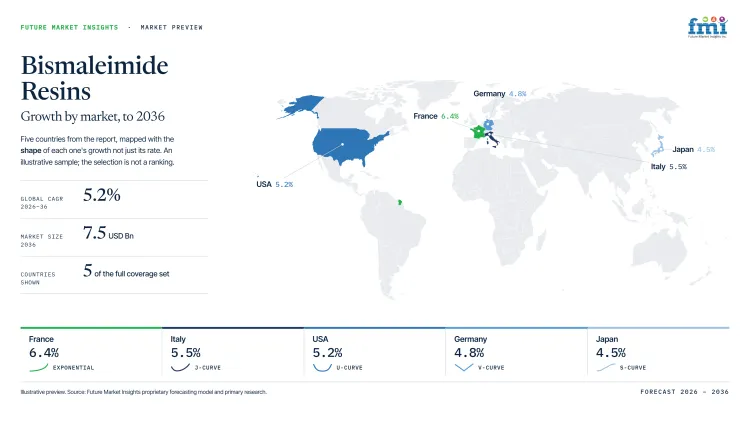
| France | 6.4% |
| South Korea | 6.1% |
| Canada | 5.8% |
| Italy | 5.5% |
| USA | 5.1% |
| Germany | 4.8% |
| Japan | 4.5% |
How do country-level CAGRs compare in the Bismaleimide Resins Market?
The seven profiled countries span a 1.9 percentage-point CAGR range between France at 6.4% and Japan at 4.5% from 2026 to 2036. France and South Korea form the upper band above 6%. Canada and Italy sit in a second band at 5.8% and 5.5%. The USA grows at 5.1% from 2026 to 2036.
- France draws on aerospace engineering and material-testing networks serving European aircraft programs.
- South Korea pairs fighter industrialization with domestic composite manufacturing and aerospace investment.
- Canada combines deep aerostructure engineering with a smaller domestic aircraft production base.
- Italy concentrates high-value aerospace manufacturing among export-oriented Tier-1 companies and specialized clusters.
- The USA carries a mature program base with long-established qualified material specifications.
- Japanese adoption is influenced by aircraft material programs that place equal emphasis on high performance and manufacturability.
- Germany german composite purchasing is strongly influenced by process automation, rate capability, and evidence that a material can fit industrialized aircraft manufacturing.
Similar CAGRs conceal different order timing and material-substitution barriers. The full report provides country-level CAGR analysis across North America, Latin America, Europe, East Asia, South Asia, Oceania and the Middle East and Africa.
Country-wise Analysis
- French BMI opportunities sit inside long-cycle defense and aerospace programs whose approved material lists change slowly after primes lock fabrication controls and service-life data for flight-critical structures and tooling. The DGA reported in February 2026 that 11 Rafale aircraft were delivered to the French Air and Space Force during 2025, keeping qualification work tied to an active domestic fighter program. France's bismaleimide resins outlook is anticipated to advance at 6.4% CAGR over the assessment period owing to continued military-aircraft production, but new formulations still need local engineering response and dependable batch continuity before they can displace an approved material.
- South Korean material programs are moving from prototype support into repeatable series-production controls as the KF-21 shifts toward sustained manufacturing and deeper domestic supply-chain participation at local assembly sites. Bismaleimide resin demand in South Korea is forecast to rise at 6.1% CAGR over the forecast period because domestic fighter industrialization requires disciplined material control, yet each new formulation must fit defense qualification and technology-transfer constraints. DAPA confirmed in June 2026 that the KF-21 met all 745 airworthiness inspection items in 14 fields, so companies with traceable aerospace data and in-country engineering response now hold an advantage during production qualification.
- Canadian aerospace programs draw on strong research and manufacturing capability, but domestic aircraft volume is smaller than in the USA or France and many material opportunities depend on export programs. Adoption of bismaleimide resins in Canada is estimated to expand at 5.8% CAGR through 2036 aided by applied composite research, while regular resin orders still depend on a named aircraft or tooling program reaching qualification. The National Research Council Canada's 2026 SNAP Composites program targets integrated thermoset parts with cycle times below two minutes using RTM-compression and prepreg-compression routes, but moving that research into repeat BMI orders still requires a named aircraft program and export certification.
- Italian BMI demand is concentrated in aerostructure, propulsion and space programs where composite parts move through tightly scheduled qualification milestones in Piedmont, Campania and Lazio instead of broad spot-market purchasing. Avio documented the April 2025 qualification firing of the P160C motor, a one-piece carbon-fiber booster containing 157 tons of propellant and a clear example of Italy's high-temperature composite engineering base. Italy's bismaleimide resin sector is projected to record 5.5% CAGR during the assessment period attributable to continuing aerospace and space work, though concentrated program timing can delay order conversion between major qualification or production milestones for specialist resin systems.
- US BMI purchasing sits within a large aerospace and defense installed base where many materials are carried forward under established program specifications and supplier quality systems. The FAA stated in April 2026 that aircraft approval follows a seven-phase process ending with certification and production, which gives qualified materials a defined route into service but makes speculative substitutions expensive. The USA is estimated to post 5.1% CAGR over the forecast period given its mature program base, and new BMI systems compete best when validated allowables and lot control reduce the requalification work required for a high-temperature design change at scale.
- German composite purchasing is strongly influenced by process automation, rate capability, and evidence that a material can fit industrialized aircraft manufacturing. Demand for Bismaleimide Resins in Germany is forecast to expand at 4.8% CAGR from 2026 to 2036. In October 2024, DLR presented manufacturing work on the eight-meter Multifunctional Fuselage Demonstrator upper shell in Bremen, showing the country’s focus on automated composite production. That demonstrator used thermoplastic technology, so it is a process benchmark rather than direct BMI proof. The friction for BMI is meeting similar cost and automation expectations at higher cure temperature. Suppliers need process-friendly prepreg and qualification data tied to repeatable production economics.
- Japanese adoption is influenced by aircraft material programs that place equal emphasis on high performance and manufacturability. Demand for Bismaleimide Resins in Japan is forecast to expand at 4.5% CAGR from 2026 to 2036. In April 2024, Japan’s Ministry of Economy, Trade and Industry released an Aircraft Industry Strategy that emphasized next-generation materials and production capability. Related policy work highlights lightweighting and heat resistance as technical priorities. The main constraint is the evidence burden required to justify material and process changes inside tightly controlled supply chains. Suppliers need to provide detailed processing windows and collaboration pathways that fit Japanese qualification and production-development practices.
Who are the notable companies in the Bismaleimide Resins Market?
Syensqo, Toray Advanced Composites, Renegade Materials, Hexcel, Evonik, Kaneka Aerospace, Axiom Materials, SHD Composites are the notable companies profiled in this market.
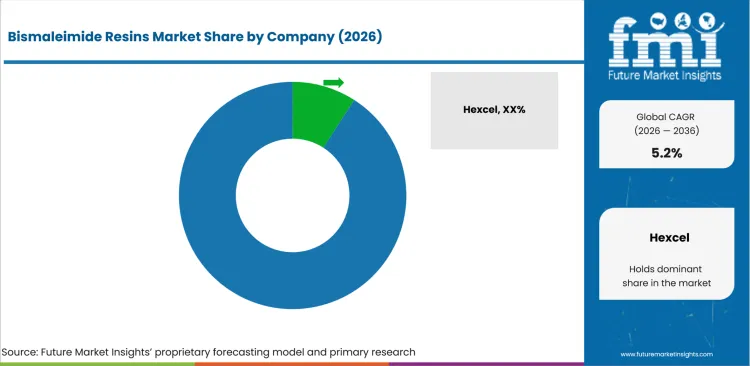
Competition is concentrated in aerospace prepreg systems, BMI chemistry and high-temperature tooling, while company size alone explains little. Syensqo, Toray Advanced Composites, Renegade Materials and Hexcel carry the deepest aerospace-facing material positions. Evonik supplies BMI chemistry, while Kaneka Aerospace, Axiom Materials and SHD Composites cover specialist prepreg, tooling and formulation routes. Qualification records and batch continuity remain the main barriers to entry in advanced polymer composites.
- Aerospace BMI material systems: Syensqo, Toray Advanced Composites, Renegade Materials and Hexcel.
- BMI chemistry and formulation: Evonik and Kaneka Aerospace.
- Specialty prepreg and tooling: Axiom Materials and SHD Composites.
Competitive Benchmarking: Bismaleimide Resins Market
| Company | BMI System Breadth | Aerospace Qualification Evidence | Processing Route Breadth | Geographic Reach |
|---|---|---|---|---|
| Syensqo | High | High | Medium | Global |
| Toray Advanced Composites | Medium | Medium | Medium | North America, Europe and Asia-Pacific |
| Renegade Materials | High | High | High | North America with global aerospace supply |
| Hexcel | High | High | High | Global |
| Evonik | High | Medium | High | Global |
| Kaneka Aerospace | Medium | Medium | Medium | North America and Asia with international aerospace channels |
| Axiom Materials | Medium | Medium | High | North America with global customer support |
| SHD Composites | Low | Medium | Medium | Europe and North America |
Scoring basis: High BMI system breadth requires three or more documented BMI forms or chemistry roles. Medium requires two, while Low identifies one current BMI role. High aerospace qualification evidence requires a named program or formal qualification record. Medium requires current aerospace deployment or quality evidence. High processing breadth requires three or more documented routes. Medium requires two, while Low identifies one route. Low always means a documented narrow position and never missing evidence.
Key Developments in the Bismaleimide Resins Market
- In July 2026, Syensqo broke ground on a Havre de Grace expansion that will add more than 30% manufacturing capacity for aerospace adhesives and surfacing materials.
- In July 2026, Hexcel expanded long-term agreements with Boeing covering commercial, defense and space programs under an enterprise composite-material supply framework.
- In July 2026, SHD Composites announced a 60,000-square-foot North Carolina facility designed to quadruple US capacity for resin mixing, film, prepreg, testing and development.
Key Players in the Bismaleimide Resins Market
Aerospace BMI Material Systems
- Syensqo
- Toray Advanced Composites
- Renegade Materials
- Hexcel
BMI Chemistry and Formulation
- Evonik
- Kaneka Aerospace
Specialty Prepreg and Tooling
- Axiom Materials
- SHD Composites
Bismaleimide Resins Market - Report Scope
| Coverage field | Report scope |
|---|---|
| Market breakdown | By resin type, form, end use, cure temperature, sales channel and region. |
| Quantitative Units | USD billion. |
| Market Definition | Commercial revenue from bismaleimide resin systems, prepregs, liquid and powder resins, BMI film adhesives and custom formulated BMI materials. Downstream finished aircraft, defense systems and substitute resin chemistries are excluded. |
| Regions Covered | North America, Latin America, Western Europe, Eastern Europe, East Asia, South Asia and Pacific, Middle East and Africa. |
| Countries Covered | France, South Korea, Canada, Italy, USA, and 20+ countries included in the full report. |
| Key Companies Profiled | Syensqo, Toray Advanced Composites, Renegade Materials, Hexcel, Evonik, Kaneka Aerospace, Axiom Materials, SHD Composites. |
| Forecast Period | 2026 to 2036. |
| Approach | Primary and secondary research with market triangulation. |
Bismaleimide Resins Market - Research Methodology
| Method | Approach |
|---|---|
| Primary Research | FMI analysts gathered input from manufacturers, service providers, technology developers, distributors, end users, procurement teams, and subject-matter experts. Interviews examined purchasing decisions, product or service evaluation, adoption barriers, approval requirements, pricing considerations, and expectations for technical or commercial support. Respondents were also asked what evidence is required before a trial, pilot, or initial order develops into regular purchasing. |
| Desk Research | Desk research covered government statistics, regulatory publications, trade data, industry associations, technical literature, standards, company filings, product information, and official corporate announcements. Sources were reviewed for relevance, publication date, geographic coverage, and consistency with the defined market scope. Claims relating to performance, applications, approvals, capacity, investment, and commercial activity were retained only when supported by credible public evidence. |
| Market Sizing and Forecasting | The market model combined the baseline value with historical performance, segment structure, pricing and volume indicators, adoption levels, company participation, and country-level demand conditions. Forecast assumptions considered economic activity, investment trends, regulatory developments, technology adoption, purchasing cycles, supply availability, and barriers to wider market use. Segment and regional estimates were reconciled before the final market total was calculated. |
| Data Validation | Estimates were checked against multiple independent indicators, including public data, company activity, trade patterns, industry developments, and findings from primary interviews. Validation also tested whether products, services, applications, and company revenues fell within the defined market boundaries. Adjacent categories, unsupported claims, overlapping revenues, and activities without direct market relevance were excluded to reduce double counting and maintain consistency across segments and countries. |
Bismaleimide Resins Market by Segments
Bismaleimide Resins Market segmented by Resin Type:
- Thermoset BMI resins
- Modified BMI resins
- High-temperature BMI systems
- Toughened BMI resins
- Prepreg-grade BMI resins
Bismaleimide Resins Market segmented by Form:
- Prepreg matrix resin
- Powder resin
- Film adhesive resin
- Liquid resin
- Custom formulated systems
Bismaleimide Resins Market segmented by End Use:
- Aerospace composites
- Defense structures
- Electronics laminates
- High-performance adhesives
- Automotive/motorsport composites
Bismaleimide Resins Market segmented by Cure Temperature:
- High-temperature cure
- Medium-temperature cure
- Low-temperature cure
- Post-cure systems
Bismaleimide Resins Market segmented by Sales Channel:
- Composite material suppliers
- Aerospace OEM qualification
- Distributors/formulators
- Direct specialty resin supply
Bismaleimide Resins Market by Region:
- North America
- United States
- Canada
- Latin America
- Brazil
- Mexico
- Chile
- Rest of Latin America
- Western Europe
- Germany
- United Kingdom
- Italy
- Spain
- France
- Nordics
- Benelux
- Rest of Western Europe
- Eastern Europe
- Russia
- Poland
- Hungary
- Balkan and Baltic States
- Rest of Eastern Europe
- East Asia
- China
- Japan
- South Korea
- South Asia and Pacific
- India
- ASEAN
- Australia and New Zealand
- Rest of South Asia and Pacific
- Middle East and Africa
- Kingdom of Saudi Arabia
- Other GCC Countries
- Türkiye
- South Africa
- Other African Union Countries
- Rest of Middle East and Africa
Research Sources and Bibliography
- Syensqo. (2025, May 21). Syensqo’s composites demonstrate titanium replacement on Boeing applications.
- National Research Council Canada. (2025, May 14). Aerospace manufacturing efficiency.
- Toray Advanced Composites. (2026, February 18). Toray Group to Exhibit at JEC World 2026.
- Toray Advanced Composites. (2025, July 15). Toray Advanced Composites to Supply Proven Space-Grade Composite Materials for Constellation Solar Arrays.
- National Aeronautics and Space Administration. (2025, May 13). Hi-Rate Composite Aircraft Manufacturing Project 2025 Spring Review.
- Janicki Industries. (2026, February 25). Janicki featured in Composites World for BMI tooling evaluation.
- National Aeronautics and Space Administration. (2026, June 4). NASA Hosts 2026 Review on Advanced Composite Manufacturing.
- Hexcel Corporation. (2026, July 21). Hexcel Announces NCAMP Qualification of HexPly M91 Composite Material System.
- SHD Composites. (2026, February 17). SHD Composites announces expansion in manufacturing capabilities with commissioning of wide format lines.
- Direction générale de l’armement. (2026, February 6). Un niveau historique de commandes passées par la DGA en 2025.
- Defense Acquisition Program Administration, Republic of Korea. (2026, June 17). KF-21 obtains initial type certification and nationally recognized flight safety.
- National Research Council Canada. (2026, June 18). SNAP Composites industrial R&D group.
- Avio. (2025, April 24). P160C fires up successfully, a new chapter for Ariane 6 and Vega launchers.
- Federal Aviation Administration. (2026, April 23). How it Works: Aircraft Certification.
- Syensqo. (2026, July 9). Syensqo breaks ground on manufacturing expansion at its site in Havre de Grace, MD, USA.
- Hexcel Corporation. (2026, July 20). Hexcel Announces Expanded Long-Term Agreements with Boeing.
- SHD Composites. (2026, July 16). Cambium and SHD Quadruple US Manufacturing Platform in North Carolina.
- Syensqo. (2026, April 14). Syensqo and Toray Group strengthen aerospace supply security through strategic partnership.
- Janicki Industries. (2026, April 16). Janicki Announces Multi-State Growth Plan, Expanding in and Beyond Washington and Utah.
- Syensqo. (2026, March 9). Syensqo secures new long-term agreement with Boeing, reinforcing aerospace as a core growth driver.
- Hexcel Corporation. (2026, June 12). Deutsche Aircraft and Hexcel Announce Long-Term Composite Partnership for the D328eco Regional Aircraft Programme.
- SHD Composites. (2025, December 2). SHD Group is acquired by Cambium Biomaterials Inc.
- Syensqo. (2025, December 8). Syensqo partners with Vertical Aerospace to support industrialization plan for the VX4 aircraft.
- Toray Advanced Composites. (2026, May 27). Toray Advanced Composites Expands NCAMP Qualifications of High-Performance Low Melt PAEK Composite Material System.
- Renegade Materials Corporation. (2025, October 29). Renegade Materials Expands Operations with Facility Acquisition.
- Hexcel Corporation. (2025, September 9). Hexcel Expands Official Americas Aerospace Distribution Network.
- Evonik Industries. (2025, September 2). Evonik launches Next Markets Program to tap into new growth areas.
- Kaneka Aerospace. (2025, December 18). Kaneka Aerospace Webinar: Tool Smarter, Repair Stronger.
- Kordsa. (2026, April 29). 1Q'26 Financial Results Earnings Release.
- SHD Composites. (2026, August 5). SHD Composites Launches CEM101 - A New Cyanate Ester with Enhanced Service Temperature and Dielectric Performance.
This bibliography is provided for reader reference and is not exhaustive. The full report contains the complete reference list and detailed citations
This Report Answers
- How large is the bismaleimide resins market in 2026 and what value is forecast by 2036?
- Which high-temperature aerospace and defense requirements support bismaleimide resin demand?
- Why do thermoset BMI resins account for 31.0% of resin type demand in 2026?
- Why does prepreg matrix resin account for 31.0% of form demand in 2026?
- Why do aerospace composites represent 44.0% of end use in 2026?
- How do growth rates compare for France, South Korea, Canada, Italy and the USA?
- Which companies supply BMI prepregs, formulated resins, tooling systems and related high-temperature materials?
- How do qualification cycles, cure schedules and manufacturing economics affect material switching?
- Which processing changes can reduce BMI manufacturing burden without reducing thermal performance?
Frequently Asked Questions
How big is the bismaleimide resins market in 2026?
The bismaleimide resins market is valued at USD 4.5 billion in 2026 and is projected to reach USD 7.5 billion by 2036. Growth is driven by high-temperature aerospace, defense and space composite requirements.
What is the CAGR of the bismaleimide resins market from 2026 to 2036?
The bismaleimide resins market is projected to grow at a CAGR of 5.2% between 2026 and 2036. Expansion is supported by qualified high-temperature structures and material systems that retain performance beyond common structural epoxies.
Which resin type leads the bismaleimide resins market?
The thermoset BMI resins segment is expected to hold 31.0% of the bismaleimide resins market in 2026, driven by its established role in high-temperature composite matrices. Qualification records and cure performance support specification retention.
Which countries are projected to record the highest growth in the bismaleimide resins market?
France is projected to grow at 6.4% CAGR, followed by South Korea at 6.1% and Canada at 5.8% through 2036. Growth is tied to aerospace production, qualification access and composite manufacturing depth.
Which companies are active in the bismaleimide resins market?
Key companies operating in the bismaleimide resins market include Syensqo, Toray Advanced Composites, Renegade Materials, Hexcel, Evonik, Kaneka Aerospace, Axiom Materials, and SHD Composites. They compete through qualification depth, BMI chemistry, prepreg manufacturing and high-temperature tooling support.
Preview the report firsthand - request a free sample
Get SampleGet the brochure for pricing and purchase details.
Get PDFTable of Content
- Key Takeaways
- Market Size and CAGR
- Top Growth Driver
- Fastest Growing Segment
- Leading Region
- Key Companies
- Emerging Opportunities
- Executive Summary
- Global Market Outlook
- Demand-side Trends
- Supply-side Trends
- Technology Roadmap Analysis
- Analysis and Recommendations
- Analyst Perspective (What is happening? Why now? What should investors know?)
- Key Questions Answered
- How large is the market?
- What is the CAGR?
- What are key trends?
- Which region dominates?
- Who are the leaders?
- Market Overview
- Market Coverage / Taxonomy
- Market Definition / Scope / Limitations
- Research Methodology
- Chapter Orientation
- Analytical Lens and Working Hypotheses
- Market Structure, Signals, and Trend Drivers
- Benchmarking and Cross-market Comparability
- Market Sizing, Forecasting, and Opportunity Mapping
- Research Design and Evidence Framework
- Desk Research Programme (Secondary Evidence)
- Expert Input and Fieldwork (Primary Evidence)
- Tooling, Models, and Reference Databases
- Data Engineering and Model Build
- Quality Assurance and Audit Trail
- Market Background
- Market Dynamics (Drivers, Restraints, Opportunity, Trends)
- Scenario Forecast (Optimistic, Likely, Conservative)
- Impact Analysis
- AI Impact
- Sustainability Impact
- Regulatory Impact
- Technology Impact
- Consumer / Buyer Analysis
- Purchase Drivers
- Adoption Barriers
- Buyer Journey
- Opportunity Map Analysis
- Product Life Cycle Analysis
- Supply Chain Analysis
- Investment Feasibility Matrix
- Value Chain Analysis
- PESTLE and Porter's Analysis
- Regulatory Landscape
- Regional Parent Market Outlook
- Production and Consumption Statistics
- Import and Export Statistics
- Global Market Analysis and Forecast, 2021 to 2036
- Historical Market Size Value (USD Billion) Analysis, 2021 to 2025
- Current and Future Market Size Value (USD Billion) Projections, 2026 to 2036
- Y-o-Y Growth Trend Analysis
- Absolute $ Opportunity Analysis
- Global Market Pricing Analysis, 2021 to 2036
- Global Market Analysis and Forecast, By Resin Type, 2021 to 2036
- Introduction / Key Findings
- Historical Market Size Value (USD Billion) Analysis By Resin Type, 2021 to 2025
- Current and Future Market Size Value (USD Billion) Analysis and Forecast By Resin Type, 2026 to 2036
- Thermoset BMI resins
- Modified BMI resins
- High-temperature BMI systems
- Toughened BMI resins
- Prepreg-grade BMI resins
- Thermoset BMI resins
- Y-o-Y Growth Trend Analysis By Resin Type, 2021 to 2025
- Absolute $ Opportunity Analysis By Resin Type, 2026 to 2036
- Global Market Analysis and Forecast, By Form, 2021 to 2036
- Introduction / Key Findings
- Historical Market Size Value (USD Billion) Analysis By Form, 2021 to 2025
- Current and Future Market Size Value (USD Billion) Analysis and Forecast By Form, 2026 to 2036
- Prepreg matrix resin
- Powder resin
- Film adhesive resin
- Liquid resin
- Custom formulated systems
- Prepreg matrix resin
- Y-o-Y Growth Trend Analysis By Form, 2021 to 2025
- Absolute $ Opportunity Analysis By Form, 2026 to 2036
- Global Market Analysis and Forecast, By End Use, 2021 to 2036
- Introduction / Key Findings
- Historical Market Size Value (USD Billion) Analysis By End Use, 2021 to 2025
- Current and Future Market Size Value (USD Billion) Analysis and Forecast By End Use, 2026 to 2036
- Aerospace composites
- Defense structures
- Electronics laminates
- High-performance adhesives
- Automotive/motorsport composites
- Aerospace composites
- Y-o-Y Growth Trend Analysis By End Use, 2021 to 2025
- Absolute $ Opportunity Analysis By End Use, 2026 to 2036
- Global Market Analysis and Forecast, By Cure Temperature, 2021 to 2036
- Introduction / Key Findings
- Historical Market Size Value (USD Billion) Analysis By Cure Temperature, 2021 to 2025
- Current and Future Market Size Value (USD Billion) Analysis and Forecast By Cure Temperature, 2026 to 2036
- High-temperature cure
- Medium-temperature cure
- Low-temperature cure
- Post-cure systems
- High-temperature cure
- Y-o-Y Growth Trend Analysis By Cure Temperature, 2021 to 2025
- Absolute $ Opportunity Analysis By Cure Temperature, 2026 to 2036
- Global Market Analysis and Forecast, By Sales Channel, 2021 to 2036
- Introduction / Key Findings
- Historical Market Size Value (USD Billion) Analysis By Sales Channel, 2021 to 2025
- Current and Future Market Size Value (USD Billion) Analysis and Forecast By Sales Channel, 2026 to 2036
- Composite material suppliers
- Aerospace OEM qualification
- Distributors/formulators
- Direct specialty resin supply
- Composite material suppliers
- Y-o-Y Growth Trend Analysis By Sales Channel, 2021 to 2025
- Absolute $ Opportunity Analysis By Sales Channel, 2026 to 2036
- Global Market Analysis and Forecast, By Region, 2021 to 2036
- Introduction
- Historical Market Size Value (USD Billion) Analysis By Region, 2021 to 2025
- Current Market Size Value (USD Billion) Analysis and Forecast By Region, 2026 to 2036
- North America
- Latin America
- Western Europe
- Eastern Europe
- East Asia
- South Asia and Pacific
- Middle East & Africa
- Market Attractiveness Analysis By Region
- North America Market Analysis and Forecast, By Country, 2021 to 2036
- Historical Market Size Value (USD Billion) Trend Analysis By Market Taxonomy, 2021 to 2025
- Market Size Value (USD Billion) Forecast By Market Taxonomy, 2026 to 2036
- By Country
- USA
- Canada
- By Resin Type
- By Form
- By End Use
- By Cure Temperature
- By Sales Channel
- By Country
- Market Attractiveness Analysis
- By Country
- By Resin Type
- By Form
- By End Use
- By Cure Temperature
- By Sales Channel
- Key Takeaways
- Latin America Market Analysis and Forecast, By Country
- Historical Market Size Value (USD Billion) Trend Analysis By Market Taxonomy, 2021 to 2025
- Market Size Value (USD Billion) Forecast By Market Taxonomy, 2026 to 2036
- By Country
- Brazil
- Mexico
- Chile
- Rest of Latin America
- By Resin Type
- By Form
- By End Use
- By Cure Temperature
- By Sales Channel
- By Country
- Market Attractiveness Analysis
- By Country
- By Resin Type
- By Form
- By End Use
- By Cure Temperature
- By Sales Channel
- Key Takeaways
- Western Europe Market Analysis and Forecast, By Country
- Historical Market Size Value (USD Billion) Trend Analysis By Market Taxonomy, 2021 to 2025
- Market Size Value (USD Billion) Forecast By Market Taxonomy, 2026 to 2036
- By Country
- Germany
- UK
- Italy
- Spain
- France
- Nordic
- BENELUX
- Rest of Western Europe
- By Resin Type
- By Form
- By End Use
- By Cure Temperature
- By Sales Channel
- By Country
- Market Attractiveness Analysis
- By Country
- By Resin Type
- By Form
- By End Use
- By Cure Temperature
- By Sales Channel
- Key Takeaways
- Eastern Europe Market Analysis and Forecast, By Country
- Historical Market Size Value (USD Billion) Trend Analysis By Market Taxonomy, 2021 to 2025
- Market Size Value (USD Billion) Forecast By Market Taxonomy, 2026 to 2036
- By Country
- Russia
- Poland
- Hungary
- Balkan & Baltic
- Rest of Eastern Europe
- By Resin Type
- By Form
- By End Use
- By Cure Temperature
- By Sales Channel
- By Country
- Market Attractiveness Analysis
- By Country
- By Resin Type
- By Form
- By End Use
- By Cure Temperature
- By Sales Channel
- Key Takeaways
- East Asia Market Analysis and Forecast, By Country
- Historical Market Size Value (USD Billion) Trend Analysis By Market Taxonomy, 2021 to 2025
- Market Size Value (USD Billion) Forecast By Market Taxonomy, 2026 to 2036
- By Country
- China
- Japan
- South Korea
- By Resin Type
- By Form
- By End Use
- By Cure Temperature
- By Sales Channel
- By Country
- Market Attractiveness Analysis
- By Country
- By Resin Type
- By Form
- By End Use
- By Cure Temperature
- By Sales Channel
- Key Takeaways
- South Asia and Pacific Market Analysis and Forecast, By Country
- Historical Market Size Value (USD Billion) Trend Analysis By Market Taxonomy, 2021 to 2025
- Market Size Value (USD Billion) Forecast By Market Taxonomy, 2026 to 2036
- By Country
- India
- ASEAN
- Australia & New Zealand
- Rest of South Asia and Pacific
- By Resin Type
- By Form
- By End Use
- By Cure Temperature
- By Sales Channel
- By Country
- Market Attractiveness Analysis
- By Country
- By Resin Type
- By Form
- By End Use
- By Cure Temperature
- By Sales Channel
- Key Takeaways
- Middle East & Africa Market Analysis and Forecast, By Country
- Historical Market Size Value (USD Billion) Trend Analysis By Market Taxonomy, 2021 to 2025
- Market Size Value (USD Billion) Forecast By Market Taxonomy, 2026 to 2036
- By Country
- Kingdom of Saudi Arabia
- Other GCC Countries
- Türkiye
- South Africa
- Other African Union
- Rest of Middle East & Africa
- By Resin Type
- By Form
- By End Use
- By Cure Temperature
- By Sales Channel
- By Country
- Market Attractiveness Analysis
- By Country
- By Resin Type
- By Form
- By End Use
- By Cure Temperature
- By Sales Channel
- Key Takeaways
- Key Countries Market Analysis
- USA
- Pricing Analysis
- Market Share Analysis, 2025
- By Resin Type
- By Form
- By End Use
- By Cure Temperature
- By Sales Channel
- Canada
- Pricing Analysis
- Market Share Analysis, 2025
- By Resin Type
- By Form
- By End Use
- By Cure Temperature
- By Sales Channel
- Mexico
- Pricing Analysis
- Market Share Analysis, 2025
- By Resin Type
- By Form
- By End Use
- By Cure Temperature
- By Sales Channel
- Brazil
- Pricing Analysis
- Market Share Analysis, 2025
- By Resin Type
- By Form
- By End Use
- By Cure Temperature
- By Sales Channel
- Chile
- Pricing Analysis
- Market Share Analysis, 2025
- By Resin Type
- By Form
- By End Use
- By Cure Temperature
- By Sales Channel
- Germany
- Pricing Analysis
- Market Share Analysis, 2025
- By Resin Type
- By Form
- By End Use
- By Cure Temperature
- By Sales Channel
- UK
- Pricing Analysis
- Market Share Analysis, 2025
- By Resin Type
- By Form
- By End Use
- By Cure Temperature
- By Sales Channel
- Italy
- Pricing Analysis
- Market Share Analysis, 2025
- By Resin Type
- By Form
- By End Use
- By Cure Temperature
- By Sales Channel
- Spain
- Pricing Analysis
- Market Share Analysis, 2025
- By Resin Type
- By Form
- By End Use
- By Cure Temperature
- By Sales Channel
- France
- Pricing Analysis
- Market Share Analysis, 2025
- By Resin Type
- By Form
- By End Use
- By Cure Temperature
- By Sales Channel
- India
- Pricing Analysis
- Market Share Analysis, 2025
- By Resin Type
- By Form
- By End Use
- By Cure Temperature
- By Sales Channel
- ASEAN
- Pricing Analysis
- Market Share Analysis, 2025
- By Resin Type
- By Form
- By End Use
- By Cure Temperature
- By Sales Channel
- Australia & New Zealand
- Pricing Analysis
- Market Share Analysis, 2025
- By Resin Type
- By Form
- By End Use
- By Cure Temperature
- By Sales Channel
- China
- Pricing Analysis
- Market Share Analysis, 2025
- By Resin Type
- By Form
- By End Use
- By Cure Temperature
- By Sales Channel
- Japan
- Pricing Analysis
- Market Share Analysis, 2025
- By Resin Type
- By Form
- By End Use
- By Cure Temperature
- By Sales Channel
- South Korea
- Pricing Analysis
- Market Share Analysis, 2025
- By Resin Type
- By Form
- By End Use
- By Cure Temperature
- By Sales Channel
- Russia
- Pricing Analysis
- Market Share Analysis, 2025
- By Resin Type
- By Form
- By End Use
- By Cure Temperature
- By Sales Channel
- Poland
- Pricing Analysis
- Market Share Analysis, 2025
- By Resin Type
- By Form
- By End Use
- By Cure Temperature
- By Sales Channel
- Hungary
- Pricing Analysis
- Market Share Analysis, 2025
- By Resin Type
- By Form
- By End Use
- By Cure Temperature
- By Sales Channel
- Kingdom of Saudi Arabia
- Pricing Analysis
- Market Share Analysis, 2025
- By Resin Type
- By Form
- By End Use
- By Cure Temperature
- By Sales Channel
- Türkiye
- Pricing Analysis
- Market Share Analysis, 2025
- By Resin Type
- By Form
- By End Use
- By Cure Temperature
- By Sales Channel
- South Africa
- Pricing Analysis
- Market Share Analysis, 2025
- By Resin Type
- By Form
- By End Use
- By Cure Temperature
- By Sales Channel
- USA
- Market Structure Analysis
- Competition Dashboard
- Competition Benchmarking
- Market Share Analysis of Top Players
- By Regional
- By Resin Type
- By Form
- By End Use
- By Cure Temperature
- By Sales Channel
- Emerging Startups
- Innovation Benchmarking
- Competition Analysis
- Competition Deep Dive
- Hexcel
- Overview
- Product Portfolio
- Profitability by Market Segments
- Sales Footprint
- Strategy Overview
- Marketing Strategy
- Product Strategy
- Channel Strategy
- Solvay
- Huntsman
- Toray Advanced Composites
- Mitsubishi Chemical Group
- Evonik
- Renegade Materials
- HOS-Technik
- Kane Ace / Kaneka
- ABR Organics
- Hexcel
- Case Studies
- Success Stories
- Recent Developments
- Competition Deep Dive
- Assumptions & Acronyms Used


