

- Market Size (2026)
- USD 2.1 Bn
- Forecast (2036)
- USD 3.5 Bn
- CAGR (2026 to 2036)
- 5.0%
How big is Cart Tipper Mechanisms Market in 2026?
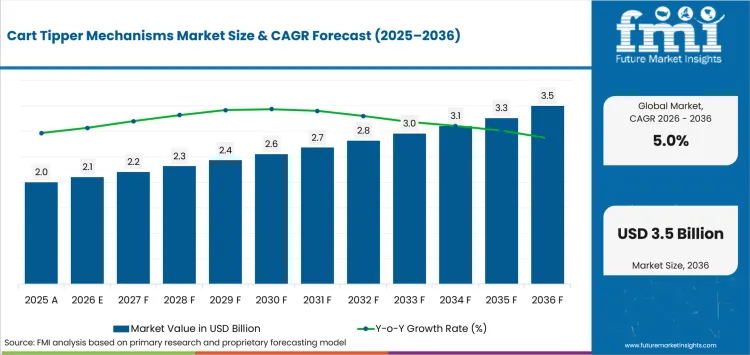
USD 2.1 billion in 2026 and USD 3.5 billion by 2036 at a 5.0% CAGR.
Demand for cart tipper mechanisms is projected to rise at a 5.0% CAGR by 2036, driving industry valuation from USD 2.1 billion in 2026 to USD 3.5 billion during the forecast period. Mechanized lifting earns budget where fleets can reduce repetitive manual handling without replacing serviceable garbage truck bodies. The USA Bureau of Labor Statistics listed 156,400 refuse and recyclable material collectors in 2025 and notes that many still empty cans by hand. The labor exposure gives fleet managers a safety case for lift packages, provided cart geometry and daily cycle demand justify installation.
Local collection rules prevent one lift package from fitting every route. Defra reported in March 2026 that household recycling rates among England’s 321 local authorities ranged from 17.0% to 63.9% in 2024/25. The figure confirms collection practices differ enough to affect cart mix and equipment interfaces. Firms serving waste management programs need modular mounts and service coverage that fit different municipal specifications without redesigning each installation.
Key Takeaways
- Demand rises as collection fleets transfer repetitive cart lifting from workers to controlled mechanical cycles.
- By mechanism type, hydraulic cart tippers are estimated to hold 35.0% in 2026 owing to existing refuse-body hydraulics and familiar field service.
- In 2026, 120-240 L is expected to lead cart capacity with 42.0% share because household programs standardize manageable two-wheeled carts.
- Rear-loader refuse trucks are set to lead vehicle type with 41.0% share in 2026 due to mixed-route flexibility with mechanized cart handling.
- Retrofit economics weaken if cart geometry, mounting, hydraulic settings, or service access differ within an installed fleet.
- Some of the key players in this market include Dennis Eagle, Terberg Matec UK, McNeilus, Labrie Enviroquip, New Way Trucks, Wastequip, Heil Environmental, and Toter.
Analyst Perspective
"A cart tipper should be specified at the cart-to-body interface because lifting force alone does not prevent mis-picks, hopper interference, or long repair delays. Fleet approval becomes easier once cart geometry, cycle duty, power demand, and local parts support are documented before installation."
- Nikhil Kaitwade, Principal Consultant, Future Market Insights
How is the cart tipper mechanisms market segmented?
The cart tipper mechanisms market is segmented by mechanism type, cart capacity, vehicle type, sales channel, end use, and region.
Mechanism type covers hydraulic cart tippers, semi-automatic lifters, dual cart tippers, rotary cart tippers, and electric-assisted tippers. Cart capacity includes below 120 L, 120-240 L, 240-660 L, and above 660 L. Vehicle type covers rear-loader refuse trucks, side-loader trucks, mini compactors, and stationary compactors. Sales channels comprise refuse body OEMs, aftermarket retrofit, municipal tenders, and fleet maintenance. End use covers residential collection, commercial collection, municipal sanitation, and private haulers.
Why does 120-240 L lead the cart capacity category?
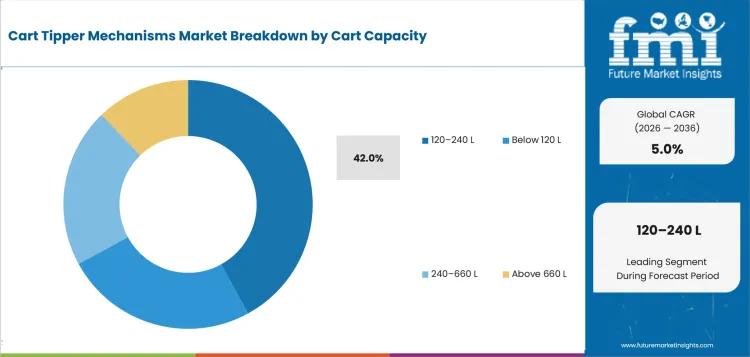
For weekly household set-out, municipalities need carts residents can move and lifters can capture repeatedly. Andover’s Select Board approved standardized automated collection in February 2025 with a 64-gallon default trash cart and a 34-gallon smaller option. Those sizes narrow the interfaces a tipper must qualify. Like automated material handling equipment, cart lifting performs best with a repeatable load interface.
- In 2026, 120-240 L is expected to lead cart capacity with 42.0% share because household collection commonly uses mid-sized wheeled carts.
- Adoption improves once municipalities standardize wheel position, handle geometry, and cart volume because manufacturers can qualify fewer pickup interfaces for repeated route use.
What makes hydraulic cart tippers central to the mechanism type category?
Hydraulic lifters fit refuse bodies with pumps, hoses, valves, and hydraulic cylinder service routines. Installation still requires correct pressure, flow, mounting height, and cart engagement geometry for each body.
- By mechanism type, hydraulic cart tippers are projected to account for 35.0% in 2026 due to familiar power architecture and repair practices on conventional refuse vehicles.
- In May 2025, Biffa put 14 Dennis Eagle RCVs into service for its Cannock Chase contract, with every vehicle specified with Terberg hydraulic bin lifts for roughly 56,000 weekly lifts. That duty profile explains why hydraulic systems stay relevant where route volume and technician familiarity justify repeatable lifting.
What supports rear-loader refuse trucks in the vehicle type category?
Mixed-route work keeps rear loaders relevant because crews can handle carts, bags, and irregular commercial stops from the same body. McNeilus delivered 13 vehicles to Meridian Waste in June 2026, including six heavy-duty rear loaders and seven automated side loaders, showing one municipal startup can require several collection architectures.
- Rear-loader refuse trucks are set to lead the vehicle type category with 41.0% share in 2026 due to mixed-route flexibility and mechanized cart handling.
- Adoption requires body-specific mounting because the tipper must stay clear of the hopper and refuse compactor cycle during repeated dumps on municipal routes.
How do refuse body OEMs shape the sales channel category?
During body specification, refuse body OEMs can fix lift location, controls, hydraulic supply, and hopper clearance. Factory integration as material handling equipment keeps commissioning responsibility with fewer parties than a retrofit. CTS Hire selected Dennis Eagle and Terberg Matec UK in September 2025 for vehicles carrying several body-and-lift combinations, including Terberg bin lifts and OmniDEL split lifts.
- The refuse body OEM segment is likely to capture 40.0% share in 2026 attributable to factory-stage decisions on controls, mounting, and hopper clearance.
- OEM-stage adoption reduces retrofit work because lift controls and mounting can be checked against the chosen refuse body before the completed vehicle enters service.
What are the drivers, restraints and opportunities in the Cart Tipper Mechanisms Market?
Demand grows with standardized cart collection and safer lifting, whereas interface qualification limits retrofit economics and diagnostics widen lifecycle service revenue.
- Driver: Municipal conversion to standardized carts increases the number of stops that can be handled by repeatable mechanical lifting.
- Restraint: Cart, body, hydraulic, and control differences can turn a straightforward lift purchase into a vehicle-specific engineering exercise.
- Opportunity: Diagnostic-enabled lift packages give manufacturers a route to sell uptime support, fault visibility, and replacement services with the mechanism.
A standardized cart gives the truck the same pickup geometry at thousands of household stops. Reading, Massachusetts announced in May 2026 that its July transition would use mechanical-arm collection with standardized trash and recycling cart sizes. Fewer interface exceptions make mechanical lifting easier to schedule and strengthen the case for recycling equipment and machinery at collection points.
Retrofit risk concentrates at the cart-to-truck interface, and mixed cart generations may require brackets or control changes beyond ordinary compaction machines service work. Oakland, Florida’s January 2025 specification requires roll carts to work with semi-automated and fully automated collection systems and prevents carts from falling into the hopper during inversion. That requirement makes interface qualification a procurement step before installation.
Lift downtime is expensive enough that fault visibility can support a paid service relationship. Dennis Eagle stated in October 2025 that Terberg Connect had been integrated into new vehicles and Terberg Matec UK automatic bin lifts for remote real-time diagnostics. Service teams can pair lift data with planned parts replacement without extending the offer into downstream sorting equipment, which falls outside the collection-stage mechanism scope.
Which country CAGRs are profiled in the Cart Tipper Mechanisms Market?
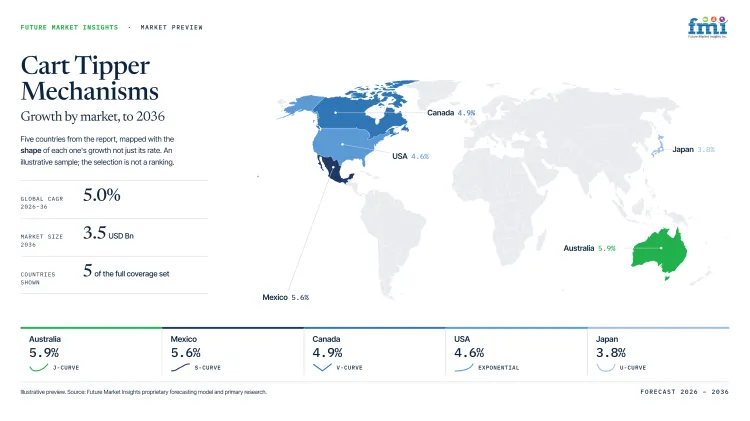
| Country | CAGR |
|---|---|
| Australia | 5.9% |
| Mexico | 5.6% |
| Brazil | 5.2% |
| Canada | 4.9% |
| USA | 4.6% |
| Germany | 4.2% |
| Japan | 3.8% |
How do country-level CAGRs compare in the Cart Tipper Mechanisms Market?
The forecasts form three distinct bands. Australia and Mexico lead at 5.9% and 5.6%. Brazil and Canada hold the middle at 5.2% and 4.9%. The USA, Germany, and Japan form the slower group at 4.6%, 4.2%, and 3.8%. The 2.1-point endpoint spread separates faster replacement markets from more mature fleet cycles.
- Australia's dispersed routes raise the value of regional parts coverage.
- Mexico's largest cities can aggregate lift orders at greater scale.
- Brazil's municipal procurement scale can support larger fleet orders.
- Canada's service networks influence municipal equipment awards.
- USA private haulers can standardize equipment within owned route networks.
- Germany's mature dealer base strengthens replacement support.
- Japan's municipal variation limits uniform national fleet packages.
CAGR ranks growth pace, not current revenue or installed-base size. The full report provides country-level CAGR analysis across North America, Latin America, Europe, East Asia, South Asia, Oceania and the Middle East and Africa.
Country-wise Analysis
- Council collection contracts often replace vehicles in stages, leaving new cart programs to operate beside older refuse bodies and lifters during the same renewal cycle. DCCEEW data current to June 2025 show 77% of Australians had access to an organics kerbside service, giving route operators a large base of scheduled cart lifts and making standardized engagement points commercially useful. Cart tipper mechanism demand in Australia is forecast to rise at 5.9% CAGR over the forecast period, aided by council fleet renewal even though municipal rollout timing favors manufacturers that can qualify one lift family for several cart and body interfaces.
- Municipal collection models range from house-to-house pickup to fixed collection points, so cart geometry and vehicle age can differ materially between neighboring service areas and contractors. Mexico is estimated to post 5.6% CAGR over the forecast period, propelled by formal collection coverage and city fleet renewal that can shift repeated household stops toward wheeled carts with compatible lifting equipment. INEGI's March 2026 municipal census recorded waste collection service in 2,322 municipalities and territorial districts, equal to 93.7% during 2024, but the broad service base does not guarantee one cart interface and keeps qualification and regional dealer coverage city-specific.
- Dense metropolitan routes give mechanical cart handling a stronger operating case than lower-density service areas, where collection methods and container sizes vary more sharply between operators. In August 2025, IBGE published data showing direct waste collection reached 86.9% of Brazil's housing units in 2024, with much lower rural coverage and a fleet opportunity concentrated in urban territories. Cart tipper mechanism sales in Brazil are forecast to expand at 5.2% CAGR by 2036, tied to wider formal collection and high-frequency urban routes even as rural service gaps make metropolitan dealer coverage the more practical route to recurring equipment and service orders.
- Standardized municipal carts are common, but winter exposure and long vehicle lives put hose routing, corrosion protection, and local repair response into every lift decision. Canada's cart tipper mechanisms outlook is anticipated to advance at 4.9% CAGR over the assessment period, supported by repetitive residential routes that require replacement lifts and local parts coverage on heavily used urban collection routes during winter. Residential waste reached 11.1 million tonnes in 2024 and rose 1.4% from 2022, according to Statistics Canada's August 2026 release, confirming a persistent collection workload even though slow municipal capital cycles keep annual order timing uneven each year.
- Split municipal and private-hauler ownership leaves the USA market with wide variation in body age, cart specifications, and dealer coverage between service territories. In February 2026, SWANA stated that refuse and recyclable material collectors recorded a 2024 fatality rate of 37.4 per 100,000 full-time-equivalent workers, making safety a direct procurement issue for fleets with repetitive manual handling. In the USA, cart tipper mechanism demand is predicted to advance at 4.6% CAGR through 2036, helped by a large installed collection fleet even though specification fragmentation rewards documented cart fit, field support, and regional parts access on high-frequency residential collection routes.
- Replacement economics dominate mature separate-waste routes, making lift purchases depend on maintenance time and stream-specific body design more than first-time automation. Germany is estimated to post 4.2% CAGR over the forecast period, attributable to replacement and route-specific needs despite long equipment lives that slow purchase frequency and raise scrutiny of lifecycle cost. Umweltbundesamt's April 2026 guidance states that separate biowaste collection can reduce residual waste by roughly one-third, reinforcing dedicated organic-waste routes and putting greater tender weight on local parts availability, documented service response, and maintenance time where service interruptions disrupt scheduled organics collection and raise fleet operating cost.
- Local collection rules vary by municipality, so compact route design and integrator support usually carry more weight than national fleet standardization. FY2024 municipal waste totaled 38.11 million tonnes and fell 2.2% from FY2023, according to the Ministry of the Environment's March 2026 release, limiting the case for blanket capacity expansion and directing spending toward selective replacement. Adoption of cart tipper mechanisms in Japan is estimated to expand at 3.8% CAGR through 2036, given repetitive routes where manual handling or vehicle renewal justifies mechanization even though compact streets and varied local practices keep replacement selective instead of uniform for most fleets.
Who are the notable companies in the Cart Tipper Mechanisms Market?
Dennis Eagle, Terberg Matec UK, McNeilus, Labrie Enviroquip, New Way Trucks, Wastequip, Heil Environmental, and Toter are the notable companies profiled in this market.
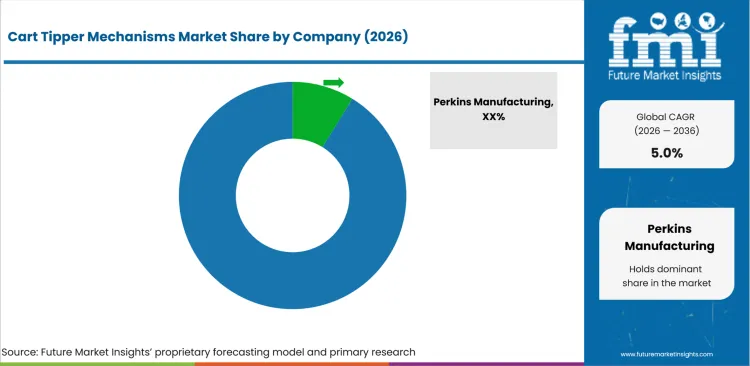
Competition separates into integrated RCV groups, bin-lift specialists, and broader waste-equipment platforms. Dennis Eagle and Terberg Matec UK coordinate vehicle and lift specifications. McNeilus, Labrie Enviroquip, New Way Trucks, and Heil Environmental compete from the refuse-body side. Wastequip and Toter bring cart or service exposure. Cart tippers occupy the collection stage and differ from downstream metal recycling equipment. Municipal contracts therefore reward documented fit, nearby parts, and dealer support.
- Integrated vehicle and bin-lift platforms: Dennis Eagle, Terberg Matec UK, McNeilus, and Labrie Enviroquip tie lift integration to body or vehicle specification.
- Fleet equipment and service platforms: New Way Trucks, Wastequip, Heil Environmental, and Toter differentiate through vehicle breadth, cart interfaces, dealer coverage, or parts.
Competitive Benchmarking: Cart Tipper Mechanisms Market
| Company | Cart-Lift Integration Depth | Refuse-Body Integration | Aftermarket Service Coverage | Geographic Reach |
|---|---|---|---|---|
| Dennis Eagle | High | High | High | United Kingdom, Western Europe, Australia, and United States |
| Terberg Matec UK | High | High | High | United Kingdom, Western Europe, and international markets |
| McNeilus | Medium | High | High | North America |
| Labrie Enviroquip | Medium | High | High | United States and Canada |
| New Way Trucks | Medium | High | High | United States and Canada |
| Wastequip | Medium | High | High | United States, Canada, and Mexico |
| Heil Environmental | Medium | High | High | North America with international dealer support |
| Toter | Medium | Low | High | United States and Canada |
Scoring basis: High cart-lift integration requires multiple lift configurations, Medium one documented route, and Low no direct lift capability. High refuse-body integration requires multiple factory-coordinated architectures, Medium one documented route, and Low no body control. High aftermarket coverage requires documented parts and service networks, Medium regional support, and Low limited service coverage. Geographic reach is descriptive.
Key Developments in the Cart Tipper Mechanisms Market
- In November 2025, Federal Signal completed its acquisition of New Way Trucks. New Way joined Federal Signal's Environmental Solutions Group as a refuse-vehicle manufacturer.
- In December 2025, Heil Environmental appointed Driveline Truck and Trailer as its authorized dealer for Atlantic Canada. The appointment extends local access to sales, parts, service, and technician training.
- In July 2026, Hiab completed its acquisition of Labrie Environmental Group. Hiab placed Labrie in its Environmental Vehicle Solutions business area for refuse collection vehicles.
Key Players in the Cart Tipper Mechanisms Market
Integrated RCV and bin-lift platforms
- Dennis Eagle
- Terberg Matec UK
- McNeilus
- Labrie Enviroquip
Fleet equipment and collection-service platforms
- New Way Trucks
- Wastequip
- Heil Environmental
- Toter
Cart Tipper Mechanisms Market - Report Scope
| Coverage field | Report scope |
|---|---|
| Market breakdown | By mechanism type, cart capacity, vehicle type, sales channel, end use, and region. |
| Quantitative Units | USD billion. |
| Market Definition | Revenue from standalone or integrated cart tipper mechanisms within the defined segment scope. Finished refuse vehicles, carts, and adjacent lifting equipment outside cart tipping are excluded. |
| Regions Covered | North America, Latin America, Western Europe, Eastern Europe, East Asia, South Asia and Pacific, Middle East and Africa. |
| Countries Covered | Australia, Mexico, Brazil, Canada, USA, Germany, Japan, and 20+ countries included in the full report. |
| Key Companies Profiled | Dennis Eagle, Terberg Matec UK, McNeilus, Labrie Enviroquip, New Way Trucks, Wastequip, Heil Environmental, Toter. |
| Forecast Period | 2026 to 2036. |
| Approach | Primary and secondary research with market triangulation. |
Cart Tipper Mechanisms Market - Research Methodology
| Method | Approach |
|---|---|
| Primary Research | FMI analysts gathered input from manufacturers, service providers, technology developers, distributors, end users, procurement teams, and subject-matter experts. Interviews examined purchasing decisions, product or service evaluation, adoption barriers, approval requirements, pricing considerations, and expectations for technical or commercial support. Respondents were also asked what evidence is required before a trial, pilot, or initial order develops into regular purchasing. |
| Desk Research | Desk research covered government statistics, regulatory publications, trade data, industry associations, technical literature, standards, company filings, product information, and official corporate announcements. Sources were reviewed for relevance, publication date, geographic coverage, and consistency with the defined market scope. Claims relating to performance, applications, approvals, capacity, investment, and commercial activity were retained only when supported by credible public evidence. |
| Market Sizing and Forecasting | The market model combined the baseline value with historical performance, segment structure, pricing and volume indicators, adoption levels, company participation, and country-level demand conditions. Forecast assumptions considered economic activity, investment trends, regulatory developments, technology adoption, purchasing cycles, supply availability, and barriers to wider market use. Segment and regional estimates were reconciled before the final market total was calculated. |
| Data Validation | Estimates were checked against multiple independent indicators, including public data, company activity, trade patterns, industry developments, and findings from primary interviews. Validation also tested whether products, services, applications, and company revenues fell within the defined market boundaries. Adjacent categories, unsupported claims, overlapping revenues, and activities without direct market relevance were excluded to reduce double counting and maintain consistency across segments and countries. |
Cart Tipper Mechanisms Market by Segments
Cart Tipper Mechanisms Market segmented by Mechanism Type:
- Hydraulic cart tippers
- Semi-automatic lifters
- Dual cart tippers
- Rotary cart tippers
- Electric-assisted tippers
Cart Tipper Mechanisms Market segmented by Cart Capacity:
- 120-240 L
- Below 120 L
- 240-660 L
- Above 660 L
Cart Tipper Mechanisms Market segmented by Vehicle Type:
- Rear-loader refuse trucks
- Side-loader trucks
- Mini compactors
- Stationary compactors
Cart Tipper Mechanisms Market segmented by Sales Channel:
- Refuse body OEMs
- Aftermarket retrofit
- Municipal tenders
- Fleet maintenance
Cart Tipper Mechanisms Market segmented by End Use:
- Residential collection
- Commercial collection
- Municipal sanitation
- Private haulers
Cart Tipper Mechanisms Market by Region:
- North America
- United States
- Canada
- Latin America
- Brazil
- Mexico
- Argentina
- Chile
- Western Europe
- Germany
- France
- United Kingdom
- Italy
- Spain
- Benelux
- Nordics
- Eastern Europe
- Poland
- Czech Republic
- Romania
- Hungary
- East Asia
- China
- Japan
- South Korea
- South Asia and Pacific
- India
- ASEAN
- Australia and New Zealand
- Middle East and Africa
- GCC Countries
- South Africa
- Türkiye
- Israel
Research Sources and Bibliography
- USA Bureau of Labor Statistics. (2026, August 27). Hand laborers and material movers. Occupational Outlook Handbook.
- Department for Environment, Food & Rural Affairs. (2026, March 31). Local authority collected waste management - annual results 2024/25.
- Town of Reading, Massachusetts. (2026, May 19). Automated trash and recycling collection update.
- Town of Oakland, Florida. (2025, January 28). Town Commission regular meeting packet: Solid waste collection franchise agreement.
- Town of Andover, Massachusetts. (2025, February 10). Select Board meeting: Automated collection transition.
- Dennis Eagle. (2025, May 8). Biffa continues to choose Dennis Eagle as it commences Cannock Chase contract renewal.
- McNeilus Truck and Manufacturing. (2026, June 9). Meridian Waste deploys 13 new McNeilus refuse and recycling collection vehicles for South Carolina operations.
- Dennis Eagle. (2025, September 29). CTS Hire selects Dennis Eagle and Terberg Matec UK to fulfil fleet expansion.
- Dennis Eagle. (2025, October 21). Time to get acquainted with Terberg Connect.
- Australian Government Department of Climate Change, Energy, the Environment and Water. (2025, September 30). Recovering organic waste.
- Instituto Nacional de Estadística y Geografía. (2026, March 19). Censo Nacional de Gobiernos Municipales y Demarcaciones Territoriales de la Ciudad de México 2025: Resultados.
- Brazilian Institute of Geography and Statistics. (2025, August 22). In 2024, waste collection reaches 93% of housing units, but 4.7 million still burn waste.
- Statistics Canada. (2026, August 6). Overall, more trash is at Canadian curbs-but what parts of the country are tossing out less?
- Umweltbundesamt. (2026, April 13). Bioabfall verwerten und Kompost für den eigenen Garten gewinnen.
- Ministry of the Environment, Government of Japan. (2026, March 27). 一般廃棄物の排出及び処理状況等(令和6年度)について.
- Solid Waste Association of North America. (2026, February 19). SWANA Statement on BLS 2024 National Census of Fatal Occupational Injuries.
- Federal Signal Corporation. (2025, November 26). Federal Signal completes acquisition of New Way Trucks, raises full-year 2025 outlook.
- Wastequip. (2025, June 10). Wastequip acquires Foster Hydraulics.
- Hiab. (2026, July 1). Hiab completes the acquisition of Labrie Environmental Group, Michael Eastabrook joins Hiab Leadership Team.
- McNeilus Truck and Manufacturing. (2025, May 14). McNeilus expands side loader manufacturing capabilities to meet growing demand for industry-leading refuse vehicles.
- Dennis Eagle and Terberg Matec UK. (2025, December 17). One team, one vision: Dennis Eagle and Terberg Matec UK’s Aftermarket teams are combining.
- Labrie Group. (2026, March 25). Labrie Group with E360S developing a 4-compartment truck.
- New Way Trucks. (2026, March 5). New Way expands support and service network in the United States with Joe Johnson Equipment.
- Heil. (2026, April 28). Heil, Autocar, and Recology announce fully integrated electric refuse truck for Issaquah, Washington.
- Dennis Eagle. (2026, May 21). Keeping Cherwell District Council’s charming countryside clean.
- Dennis Eagle and Terberg Matec UK. (2026, March 18). Collaboration at the heart of our partnership with East Riding of Yorkshire Council.
- McNeilus Truck and Manufacturing. (2026, June 30). McNeilus Truck and Manufacturing expands parts distribution within Murfreesboro, Tennessee facility.
- Labrie Group. (2025, October 21). Superior North America, exclusive distributor for Manitoba, Canada.
- New Way Trucks. (2025, December 11). New Way elevates presence in Canada with Joe Johnson Equipment.
- Heil. (2025, December 1). Heil further expands dealer network with Driveline Truck and Trailer serving Atlantic Canada.
- Toter. (2025, March 11). Toter 96-gallon fully automated, bear resistant carts receive IGBC certification.
- Heil Environmental. (2025, April 1). Heil Environmental expands dealer network in the Pacific Northwest with Enviro-Clean Equipment.
- Dennis Eagle and Terberg Matec UK. (2026, May 21). ISO 45001: A Monumental Milestone.
- Dennis Eagle. (2025, November 24). Electric bin lifts: proven, sustainable, and cost-effective waste collection.
This bibliography is provided for reader reference and is not exhaustive. The full report contains the complete reference list and detailed citations.
This Report Answers
- What is the forecast for cart tipper mechanisms market in2026 and 2036?
- Which operating conditions support demand?
- Why do hydraulic cart tippers lead mechanism type?
- How does 120-240 L capacity shape lift requirements?
- Why do rear-loader refuse trucks lead vehicle type?
- How do the seven country growth rates compare?
- Which companies provide lifts, bodies, carts, or service?
- Which compatibility issues delay retrofit approval?
Frequently Asked Questions
How big is the cart tipper mechanisms market in 2026?
The cart tipper mechanisms market is valued at USD 2.1 billion in 2026 and is projected to reach USD 3.5 billion by 2036. Standardized cart programs shift repetitive lifting from crews to mechanical collection systems.
What is the CAGR of the cart tipper mechanisms market from 2026 to 2036?
The cart tipper mechanisms market is projected to grow at a CAGR of 5.0% between 2026 and 2036. Fleet replacement and standardized cart collection sustain purchases for integrated and retrofit lift packages.
Which mechanism type leads the cart tipper mechanisms market?
The hydraulic cart tippers segment is expected to hold 35.0% of the cart tipper mechanisms market in 2026, driven by existing refuse-body hydraulic power. Familiar field service also lowers integration risk for conventional collection vehicles.
Which cart capacity leads the cart tipper mechanisms market?
The 120-240 L segment is expected to hold 42.0% of the cart tipper mechanisms market in 2026, attributable to common household cart sizes. Standardized municipal carts reduce the interface variation that lift manufacturers must qualify.
Which companies are active in the cart tipper mechanisms market?
Key companies active in the cart tipper mechanisms market include Dennis Eagle, Terberg Matec UK, McNeilus, Labrie Enviroquip, New Way Trucks, Wastequip, Heil Environmental, and Toter. Their positions differ by vehicle integration, bin-lift specialization, dealer coverage, and cart-interface support.
Preview the report firsthand - request a free sample
Get SampleGet the brochure for pricing and purchase details.
Get PDFTable of Content
- Key Takeaways
- Market Size and CAGR
- Top Growth Driver
- Fastest Growing Segment
- Leading Region
- Key Companies
- Emerging Opportunities
- Executive Summary
- Global Market Outlook
- Demand-side Trends
- Supply-side Trends
- Technology Roadmap Analysis
- Analysis and Recommendations
- Analyst Perspective (What is happening? Why now? What should investors know?)
- Key Questions Answered
- How large is the market?
- What is the CAGR?
- What are key trends?
- Which region dominates?
- Who are the leaders?
- Market Overview
- Market Coverage / Taxonomy
- Market Definition / Scope / Limitations
- Research Methodology
- Chapter Orientation
- Analytical Lens and Working Hypotheses
- Market Structure, Signals, and Trend Drivers
- Benchmarking and Cross-market Comparability
- Market Sizing, Forecasting, and Opportunity Mapping
- Research Design and Evidence Framework
- Desk Research Programme (Secondary Evidence)
- Expert Input and Fieldwork (Primary Evidence)
- Tooling, Models, and Reference Databases
- Data Engineering and Model Build
- Quality Assurance and Audit Trail
- Market Background
- Market Dynamics (Drivers, Restraints, Opportunity, Trends)
- Scenario Forecast (Optimistic, Likely, Conservative)
- Impact Analysis
- AI Impact
- Sustainability Impact
- Regulatory Impact
- Technology Impact
- Consumer / Buyer Analysis
- Purchase Drivers
- Adoption Barriers
- Buyer Journey
- Opportunity Map Analysis
- Product Life Cycle Analysis
- Supply Chain Analysis
- Investment Feasibility Matrix
- Value Chain Analysis
- PESTLE and Porter's Analysis
- Regulatory Landscape
- Regional Parent Market Outlook
- Production and Consumption Statistics
- Import and Export Statistics
- Global Market Analysis and Forecast, 2021 to 2036
- Historical Market Size Value (USD Billion) Analysis, 2021 to 2025
- Current and Future Market Size Value (USD Billion) Projections, 2026 to 2036
- Y-o-Y Growth Trend Analysis
- Absolute $ Opportunity Analysis
- Global Market Pricing Analysis, 2021 to 2036
- Global Market Analysis and Forecast, By Mechanism Type, 2021 to 2036
- Introduction / Key Findings
- Historical Market Size Value (USD Billion) Analysis By Mechanism Type, 2021 to 2025
- Current and Future Market Size Value (USD Billion) Analysis and Forecast By Mechanism Type, 2026 to 2036
- Hydraulic cart tippers
- Semi-automatic lifters
- Dual cart tippers
- Rotary cart tippers
- Electric-assisted tippers
- Hydraulic cart tippers
- Y-o-Y Growth Trend Analysis By Mechanism Type, 2021 to 2025
- Absolute $ Opportunity Analysis By Mechanism Type, 2026 to 2036
- Global Market Analysis and Forecast, By Cart Capacity, 2021 to 2036
- Introduction / Key Findings
- Historical Market Size Value (USD Billion) Analysis By Cart Capacity, 2021 to 2025
- Current and Future Market Size Value (USD Billion) Analysis and Forecast By Cart Capacity, 2026 to 2036
- 120-240 L
- Below 120 L
- 240-660 L
- Above 660 L
- 120-240 L
- Y-o-Y Growth Trend Analysis By Cart Capacity, 2021 to 2025
- Absolute $ Opportunity Analysis By Cart Capacity, 2026 to 2036
- Global Market Analysis and Forecast, By Vehicle Type, 2021 to 2036
- Introduction / Key Findings
- Historical Market Size Value (USD Billion) Analysis By Vehicle Type, 2021 to 2025
- Current and Future Market Size Value (USD Billion) Analysis and Forecast By Vehicle Type, 2026 to 2036
- Rear-loader refuse trucks
- Side-loader trucks
- Mini compactors
- Stationary compactors
- Rear-loader refuse trucks
- Y-o-Y Growth Trend Analysis By Vehicle Type, 2021 to 2025
- Absolute $ Opportunity Analysis By Vehicle Type, 2026 to 2036
- Global Market Analysis and Forecast, By Sales Channel, 2021 to 2036
- Introduction / Key Findings
- Historical Market Size Value (USD Billion) Analysis By Sales Channel, 2021 to 2025
- Current and Future Market Size Value (USD Billion) Analysis and Forecast By Sales Channel, 2026 to 2036
- Refuse body OEMs
- Aftermarket retrofit
- Municipal tenders
- Fleet maintenance
- Refuse body OEMs
- Y-o-Y Growth Trend Analysis By Sales Channel, 2021 to 2025
- Absolute $ Opportunity Analysis By Sales Channel, 2026 to 2036
- Global Market Analysis and Forecast, By End Use, 2021 to 2036
- Introduction / Key Findings
- Historical Market Size Value (USD Billion) Analysis By End Use, 2021 to 2025
- Current and Future Market Size Value (USD Billion) Analysis and Forecast By End Use, 2026 to 2036
- Residential collection
- Commercial collection
- Municipal sanitation
- Private haulers
- Residential collection
- Y-o-Y Growth Trend Analysis By End Use, 2021 to 2025
- Absolute $ Opportunity Analysis By End Use, 2026 to 2036
- Global Market Analysis and Forecast, By Region, 2021 to 2036
- Introduction
- Historical Market Size Value (USD Billion) Analysis By Region, 2021 to 2025
- Current Market Size Value (USD Billion) Analysis and Forecast By Region, 2026 to 2036
- North America
- Latin America
- Western Europe
- Eastern Europe
- East Asia
- South Asia and Pacific
- Middle East & Africa
- Market Attractiveness Analysis By Region
- North America Market Analysis and Forecast, By Country, 2021 to 2036
- Historical Market Size Value (USD Billion) Trend Analysis By Market Taxonomy, 2021 to 2025
- Market Size Value (USD Billion) Forecast By Market Taxonomy, 2026 to 2036
- By Country
- USA
- Canada
- By Mechanism Type
- By Cart Capacity
- By Vehicle Type
- By Sales Channel
- By End Use
- By Country
- Market Attractiveness Analysis
- By Country
- By Mechanism Type
- By Cart Capacity
- By Vehicle Type
- By Sales Channel
- By End Use
- Key Takeaways
- Latin America Market Analysis and Forecast, By Country
- Historical Market Size Value (USD Billion) Trend Analysis By Market Taxonomy, 2021 to 2025
- Market Size Value (USD Billion) Forecast By Market Taxonomy, 2026 to 2036
- By Country
- Brazil
- Mexico
- Chile
- Rest of Latin America
- By Mechanism Type
- By Cart Capacity
- By Vehicle Type
- By Sales Channel
- By End Use
- By Country
- Market Attractiveness Analysis
- By Country
- By Mechanism Type
- By Cart Capacity
- By Vehicle Type
- By Sales Channel
- By End Use
- Key Takeaways
- Western Europe Market Analysis and Forecast, By Country
- Historical Market Size Value (USD Billion) Trend Analysis By Market Taxonomy, 2021 to 2025
- Market Size Value (USD Billion) Forecast By Market Taxonomy, 2026 to 2036
- By Country
- Germany
- UK
- Italy
- Spain
- France
- Nordic
- BENELUX
- Rest of Western Europe
- By Mechanism Type
- By Cart Capacity
- By Vehicle Type
- By Sales Channel
- By End Use
- By Country
- Market Attractiveness Analysis
- By Country
- By Mechanism Type
- By Cart Capacity
- By Vehicle Type
- By Sales Channel
- By End Use
- Key Takeaways
- Eastern Europe Market Analysis and Forecast, By Country
- Historical Market Size Value (USD Billion) Trend Analysis By Market Taxonomy, 2021 to 2025
- Market Size Value (USD Billion) Forecast By Market Taxonomy, 2026 to 2036
- By Country
- Russia
- Poland
- Hungary
- Balkan & Baltic
- Rest of Eastern Europe
- By Mechanism Type
- By Cart Capacity
- By Vehicle Type
- By Sales Channel
- By End Use
- By Country
- Market Attractiveness Analysis
- By Country
- By Mechanism Type
- By Cart Capacity
- By Vehicle Type
- By Sales Channel
- By End Use
- Key Takeaways
- East Asia Market Analysis and Forecast, By Country
- Historical Market Size Value (USD Billion) Trend Analysis By Market Taxonomy, 2021 to 2025
- Market Size Value (USD Billion) Forecast By Market Taxonomy, 2026 to 2036
- By Country
- China
- Japan
- South Korea
- By Mechanism Type
- By Cart Capacity
- By Vehicle Type
- By Sales Channel
- By End Use
- By Country
- Market Attractiveness Analysis
- By Country
- By Mechanism Type
- By Cart Capacity
- By Vehicle Type
- By Sales Channel
- By End Use
- Key Takeaways
- South Asia and Pacific Market Analysis and Forecast, By Country
- Historical Market Size Value (USD Billion) Trend Analysis By Market Taxonomy, 2021 to 2025
- Market Size Value (USD Billion) Forecast By Market Taxonomy, 2026 to 2036
- By Country
- India
- ASEAN
- Australia & New Zealand
- Rest of South Asia and Pacific
- By Mechanism Type
- By Cart Capacity
- By Vehicle Type
- By Sales Channel
- By End Use
- By Country
- Market Attractiveness Analysis
- By Country
- By Mechanism Type
- By Cart Capacity
- By Vehicle Type
- By Sales Channel
- By End Use
- Key Takeaways
- Middle East & Africa Market Analysis and Forecast, By Country
- Historical Market Size Value (USD Billion) Trend Analysis By Market Taxonomy, 2021 to 2025
- Market Size Value (USD Billion) Forecast By Market Taxonomy, 2026 to 2036
- By Country
- Kingdom of Saudi Arabia
- Other GCC Countries
- Türkiye
- South Africa
- Other African Union
- Rest of Middle East & Africa
- By Mechanism Type
- By Cart Capacity
- By Vehicle Type
- By Sales Channel
- By End Use
- By Country
- Market Attractiveness Analysis
- By Country
- By Mechanism Type
- By Cart Capacity
- By Vehicle Type
- By Sales Channel
- By End Use
- Key Takeaways
- Key Countries Market Analysis
- USA
- Pricing Analysis
- Market Share Analysis, 2025
- By Mechanism Type
- By Cart Capacity
- By Vehicle Type
- By Sales Channel
- By End Use
- Canada
- Pricing Analysis
- Market Share Analysis, 2025
- By Mechanism Type
- By Cart Capacity
- By Vehicle Type
- By Sales Channel
- By End Use
- Mexico
- Pricing Analysis
- Market Share Analysis, 2025
- By Mechanism Type
- By Cart Capacity
- By Vehicle Type
- By Sales Channel
- By End Use
- Brazil
- Pricing Analysis
- Market Share Analysis, 2025
- By Mechanism Type
- By Cart Capacity
- By Vehicle Type
- By Sales Channel
- By End Use
- Chile
- Pricing Analysis
- Market Share Analysis, 2025
- By Mechanism Type
- By Cart Capacity
- By Vehicle Type
- By Sales Channel
- By End Use
- Germany
- Pricing Analysis
- Market Share Analysis, 2025
- By Mechanism Type
- By Cart Capacity
- By Vehicle Type
- By Sales Channel
- By End Use
- UK
- Pricing Analysis
- Market Share Analysis, 2025
- By Mechanism Type
- By Cart Capacity
- By Vehicle Type
- By Sales Channel
- By End Use
- Italy
- Pricing Analysis
- Market Share Analysis, 2025
- By Mechanism Type
- By Cart Capacity
- By Vehicle Type
- By Sales Channel
- By End Use
- Spain
- Pricing Analysis
- Market Share Analysis, 2025
- By Mechanism Type
- By Cart Capacity
- By Vehicle Type
- By Sales Channel
- By End Use
- France
- Pricing Analysis
- Market Share Analysis, 2025
- By Mechanism Type
- By Cart Capacity
- By Vehicle Type
- By Sales Channel
- By End Use
- India
- Pricing Analysis
- Market Share Analysis, 2025
- By Mechanism Type
- By Cart Capacity
- By Vehicle Type
- By Sales Channel
- By End Use
- ASEAN
- Pricing Analysis
- Market Share Analysis, 2025
- By Mechanism Type
- By Cart Capacity
- By Vehicle Type
- By Sales Channel
- By End Use
- Australia & New Zealand
- Pricing Analysis
- Market Share Analysis, 2025
- By Mechanism Type
- By Cart Capacity
- By Vehicle Type
- By Sales Channel
- By End Use
- China
- Pricing Analysis
- Market Share Analysis, 2025
- By Mechanism Type
- By Cart Capacity
- By Vehicle Type
- By Sales Channel
- By End Use
- Japan
- Pricing Analysis
- Market Share Analysis, 2025
- By Mechanism Type
- By Cart Capacity
- By Vehicle Type
- By Sales Channel
- By End Use
- South Korea
- Pricing Analysis
- Market Share Analysis, 2025
- By Mechanism Type
- By Cart Capacity
- By Vehicle Type
- By Sales Channel
- By End Use
- Russia
- Pricing Analysis
- Market Share Analysis, 2025
- By Mechanism Type
- By Cart Capacity
- By Vehicle Type
- By Sales Channel
- By End Use
- Poland
- Pricing Analysis
- Market Share Analysis, 2025
- By Mechanism Type
- By Cart Capacity
- By Vehicle Type
- By Sales Channel
- By End Use
- Hungary
- Pricing Analysis
- Market Share Analysis, 2025
- By Mechanism Type
- By Cart Capacity
- By Vehicle Type
- By Sales Channel
- By End Use
- Kingdom of Saudi Arabia
- Pricing Analysis
- Market Share Analysis, 2025
- By Mechanism Type
- By Cart Capacity
- By Vehicle Type
- By Sales Channel
- By End Use
- Türkiye
- Pricing Analysis
- Market Share Analysis, 2025
- By Mechanism Type
- By Cart Capacity
- By Vehicle Type
- By Sales Channel
- By End Use
- South Africa
- Pricing Analysis
- Market Share Analysis, 2025
- By Mechanism Type
- By Cart Capacity
- By Vehicle Type
- By Sales Channel
- By End Use
- USA
- Market Structure Analysis
- Competition Dashboard
- Competition Benchmarking
- Market Share Analysis of Top Players
- By Regional
- By Mechanism Type
- By Cart Capacity
- By Vehicle Type
- By Sales Channel
- By End Use
- Emerging Startups
- Innovation Benchmarking
- Competition Analysis
- Competition Deep Dive
- Perkins Manufacturing
- Overview
- Product Portfolio
- Profitability by Market Segments
- Sales Footprint
- Strategy Overview
- Marketing Strategy
- Product Strategy
- Channel Strategy
- Bayne Thinline
- The Curotto-Can
- Heil Environmental
- McNeilus
- Labrie Enviroquip
- New Way Trucks
- Wastequip
- Dennis Eagle
- Toter
- Perkins Manufacturing
- Case Studies
- Success Stories
- Recent Developments
- Competition Deep Dive
- Assumptions & Acronyms Used


