

- Industry Size (2025)
- USD 563.6 Mn
- Forecast (2035)
- USD 1216.9 Mn
- CAGR (2025 to 2035)
- 8.0%
Centella Asiatica Extract Market Forecast and Outlook 2025 to 2035
In 2025, the centella asiatica extract market is valued at USD 563.6 million and is projected to reach USD 1,216.9 million by 2035 at a CAGR of 8.0%. Early expansion is shaped by sustained demand from skin care, derma formulations, and OTC wound management products where triterpenoid content supports repair and barrier function claims. Extract use is concentrated in creams, serums, and ointments positioned for sensitive, irritated, and post-procedure skin. Asia-based cultivation and large-scale extraction facilities anchor raw material supply, while global cosmetic manufacturers drive standardized demand. Product consistency, asiaticoside content, and residue control remain central purchasing criteria for brands operating across regulated international personal care markets.
After 2030, market growth reflects deeper penetration across medical-adjacent skin care and therapeutic topical segments rather than cosmetic expansion alone. Market value advances from about USD 828.1 million in 2030 toward USD 1,216.9 million by 2035 as dermatology-led formulations, scar management products, and post-laser recovery treatments raise extract loading per unit. Oral supplement applications also gain momentum within beauty-from-within and vascular support categories. Pharmaceutical-grade extraction and higher purity specifications command premium pricing. Supplier strategies emphasize controlled farming, solvent-free extraction, and batch-to-batch molecular standardization. Long-term value creation is shaped by clinical validation depth, reputation in dermal efficacy, and reliable agronomic supply under tightening quality and traceability requirements.
Quick Stats of the Centella Asiatica Extract Market
- Centella Asiatica Extract Market Value (2025): USD 563.6 million
- Centella Asiatica Extract Market Forecast Value (2035): USD 1,216.9 million
- Centella Asiatica Extract Market Forecast CAGR (2025 to 2035): 8.0%
- Leading Product Form in Centella Asiatica Extract Market: Powder (14.9%)
- Key Growth Regions in Centella Asiatica Extract Market: Asia Pacific, Europe
- Top Players in Centella Asiatica Extract Market: BASF SE, Croda International, Evonik Industries, Symrise (incl. IFF/Givaudan actives), Dow / Dow Inc., Ashland, Clariant, Seppic / Others

What is the Growth Forecast for the Centella Asiatica Extract Market through 2035?
The global Centella asiatica extract market expands from USD 563.6 million in 2025 to USD 828.1 million by 2030, registering an absolute increase of USD 264.5 million in the first half of the forecast period. This phase is shaped by the consolidation of Centella as a core active in dermocosmetics, wound healing products, and inflammatory skin condition treatments rather than as a niche botanical ingredient. Demand growth is led by prescription-grade skincare, hospital wound care, and mass-premium cosmetic brands integrating standardized triterpene profiles for skin barrier repair and collagen stimulation. Expansion is also supported by rising use in oral supplements targeting circulation and joint health. During this phase, value growth is driven by clinical positioning, extract standardization, and widening pharmaceutical and cosmetic cross-application.
From 2030 to 2035, the market accelerates from USD 828.1 million to USD 1,216.9 million, adding USD 388.8 million in the second half of the decade. This back-weighted expansion reflects broader incorporation into regenerative dermatology, post-surgical recovery products, and advanced scar management formulations that significantly raise per-unit extract intensity. Demand also strengthens across ingestible beauty, stress-response nutrition, and age-defense supplement platforms. As large-scale cultivation expands beyond Asia into controlled farming systems and extraction yields improve, Centella asiatica extract transitions from a high-growth cosmetic active into a structurally embedded bio-therapeutic ingredient, materially lifting global market value through 2035.
Centella Asiatica Extract Industry Key Takeaways
| Metric | Value |
|---|---|
| Industry Value (2025) | USD 563.6 million |
| Forecast Value (2035) | USD 1,216.9 million |
| Forecast CAGR (2025-2035) | 8.0% |
How Is the Centella Asiatica Extract Market Developing Across Skincare, Nutrition, and Therapeutic Applications?
The centella asiatica extract market developed from long standing traditional use in wound care, skin soothing, and circulation support across Asian medical systems. Commercial expansion began when cosmetic and dermatology formulators recognized its ability to support skin barrier repair, calm irritation, and improve hydration balance. Early demand was concentrated in creams, serums, and post procedure skincare used for sensitive or compromised skin. As extraction and standardization methods improved, centella moved beyond niche herbal products into mainstream personal care and derma cosmetic portfolios. Its plant based origin and compatibility with gentle formulation strategies strengthened adoption among brands targeting sensitive skin, acne recovery, and post treatment healing routines.
Future growth of the centella asiatica extract market will be shaped by rising focus on skin barrier health, reactive skin management, and long term skin maintenance rather than short term cosmetic effects. Expansion is expected across functional beverages, supplements, medical nutrition, and scar care products where its traditional applications align with preventive health positioning. Barriers include variation in raw plant quality, differences in active compound composition across growing regions, and rising demand for traceable, contamination free botanical sourcing. Regulatory scrutiny around therapeutic claims and competition from other calming botanical extracts will also influence adoption. Long term market expansion will depend on consistent extract standardization, clinical acceptance, and reliable agricultural supply chains.
How Are End Use Application and Product Form Structuring the Demand for Centella Asiatica Extract?
The demand for Centella asiatica extract is structured by end use application and product form. Skin care represents 10.2% of total demand, followed by body care, hair care, sun care, color cosmetics, men grooming, baby and kids care, and dermocosmetic and professional care. By product form, powder accounts for 14.9% of total consumption, followed by granules and agglomerates, flakes, pellets and prills, liquid solutions, high active concentrates, dispersions and suspensions, emulsions, pastes, gels, wax or solid block formats, and oils. Demand behavior is shaped by wound healing performance, anti-inflammatory activity, collagen stimulation efficiency, stability under formulation stress, and compatibility with therapeutic and daily care topical systems.
Why Does Skin Care Lead the Centella Asiatica Extract End Use Demand?
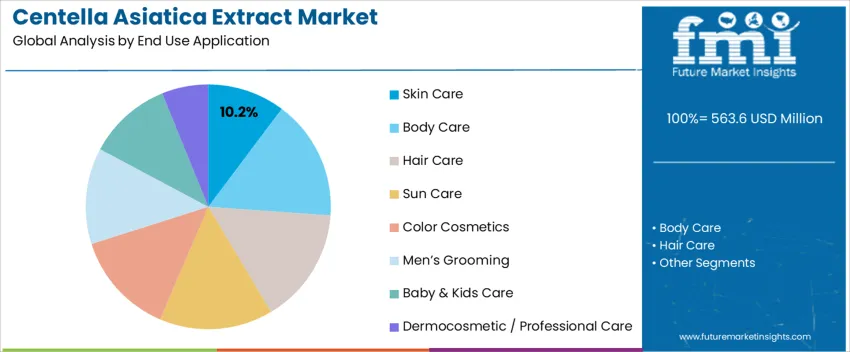
Skin care accounts for 10.2% of total Centella asiatica extract demand due to its established role in skin repair, redness control, and compromised barrier recovery. The extract contains asiaticoside, madecassoside, and triterpenoids that support fibroblast activity and collagen synthesis. These mechanisms make it widely used in scar care creams, post procedure serums, calming emulsions, and acne recovery formulations where tissue regeneration and inflammation control are required.
Skin care producers value Centella asiatica for its strong compatibility with sensitive skin positioning and minimal irritation profile. It integrates smoothly into both alcohol free gels and oil in water emulsions without destabilizing structure. Its suitability for long contact leave on products further expands usage across daily moisturizers and overnight treatments. These repair focused mechanisms, safety positioning, and formulation reliability sustain skin care as the leading end use segment within Centella asiatica extract demand.
Why Does Powder Lead the Centella Asiatica Extract Product Form Demand?
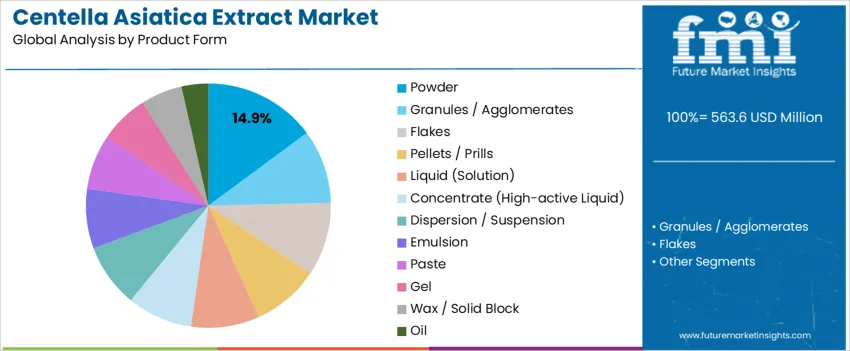
Powder accounts for 14.9% of total Centella asiatica extract demand due to its superior chemical stability, low moisture exposure risk, and accurate dosing control during manufacturing. Powdered extracts allow precise standardization of asiaticoside and madecassoside content, which is essential for maintaining consistent therapeutic performance across repeated production batches. Low water activity improves resistance to microbial degradation during long term storage.
Powder form also supports efficient dispersion during the active phase of cream, gel, and serum manufacturing without sedimentation risk. It enables manufacturers to adjust extract concentration without altering viscosity or texture response. Packaging in moisture barrier sacks and lined drums preserves potency during transport across extended supply chains. These formulation accuracy, storage reliability, and batch consistency advantages position powder as the leading product form within the centella asiatica extract demand structure.
Why Is Centella Asiatica Treated as a Tissue-Regulation Extract Rather Than a Simple Herbal Soother?
Global demand for centella asiatica extract is driven by its ability to regulate connective tissue behavior rather than by its reputation as a mild calming herb. The extract influences fibroblast activity, collagen alignment, and microvascular reinforcement at the cellular level. These effects position it as a biological repair modulator used in wound recovery, scar control, and barrier restoration. Unlike aroma-driven botanicals, its value lies in structural tissue signaling. This makes centella a functional regulator of skin architecture rather than a sensory or comfort-focused plant ingredient.
How Do Tropical Cultivation Zones and Post-Harvest Enzyme Control Shape Supply Quality?
Centella asiatica grows primarily in warm, high-humidity regions where soil saturation and microbial exposure affect active compound stability. Once harvested, enzymatic degradation accelerates unless rapid drying or extraction occurs. Variability in asiaticoside and madecassoside content depends on water stress, harvest timing, and leaf maturity. Wild collection introduces further inconsistency. Controlled cultivation improves uniformity but limits geographic expansion. These agricultural and biochemical sensitivities make Centella supply a quality-controlled botanical flow rather than a freely scalable field crop input.
What Absorption Limits, Stability Constraints, and Regulatory Classification Slow Formulation Expansion?
Centella extract faces formulation limits tied to its molecular stability and dermal penetration profile. Key triterpenes degrade under prolonged heat and UV exposure, which complicates high-temperature processing. Skin absorption requires optimized carrier systems for consistent performance. Regulatory classification also varies between cosmetic, nutraceutical, and medicinal categories depending on claim language. These boundaries slow aggressive extension into mass food and beverage systems. As a result, Centella remains concentrated in controlled-dose topical and ingestible formats rather than unrestricted everyday consumer goods.
How Are Scar Biology, Neural Inflammation Research, and Post-Procedure Recovery Redefining Demand?
Future demand for Centella asiatica extract is shifting toward scar remodeling, nerve inflammation modulation, and post-procedure tissue normalization. Recovery protocols following laser therapy, surgical resurfacing, and microneedling increasingly specify Centella for controlled collagen reformation. Neuro-dermal research also links it to reduced sensory irritation and stress-induced inflammation signaling. Oral formulations now target vascular fragility and cognitive fatigue. These shifts show Centella evolving from traditional skin calming into a precision recovery and structural regulation extract across dermatologic and neurological interfaces.
What Is the Global Growth Outlook for the Centella Asiatica Extract Industry by Country?

| Country | CAGR (%) |
|---|---|
| India | 10.8% |
| China | 10% |
| Japan | 9.2% |
| UK | 8.4% |
| Germany | 7.6% |
| USA | 6.8% |
The Centella asiatica extract industry is expanding steadily across both Asian and Western markets, led by India at a 10.8% CAGR. Growth in India is supported by rising demand for herbal skincare, traditional medicine formulations, and botanical based nutraceuticals. China follows at 10%, driven by large scale botanical extraction capacity, strong personal care manufacturing, and growing domestic use in cosmetic and pharmaceutical products. Japan at 9.2% reflects stable adoption in dermatology focused skincare, functional beverages, and health supplements. The UK and Germany record 8.4% and 7.6% growth, supported by clean label cosmetics, dermocosmetic formulations, and plant based wellness products. The USA at 6.8% reflects a mature but steadily expanding market driven by premium skincare, wound care formulations, and dietary supplement applications.
What Is Driving Centella Asiatica Extract Growth in India?
Expansion in India is progressing at a CAGR of 10.8% through 2035 for Centella asiatica extract demand, driven by rising use in herbal skincare, wound healing formulations, and Ayurvedic supplements. Dermatology brands integrate Centella for skin repair, hydration balance, and anti-inflammation positioning. Nutraceutical companies apply the extract in capsules and stress relief blends. Domestic cultivation supports partial supply, while standardized extracts still rely on imports. Demand remains formulation led and tradition supported, shaped by strong herbal medicine acceptance, expanding clinical skincare adoption, and steady growth in wellness retail distribution across urban centers.
- Herbal skincare products anchor primary formulation demand
- Wound healing applications support medical usage
- Domestic cultivation supports partial raw material sourcing
- Wellness retail strengthens national product access
How Is China Expanding Large Scale Processing of Centella Asiatica?
Growth in China reflects a CAGR of 10% through 2035 for Centella asiatica extract utilization, supported by botanical ingredient manufacturing, cosmetic active processing, and pharmaceutical herbal integration. Centella is used in scar treatment creams, hydration serums, and microcirculation supplements. Large scale farming and extraction facilities ensure cost efficiency and standardized quality. Export oriented processors also supply international cosmetic and nutraceutical brands. Demand remains production driven and volume oriented, aligned with botanical extraction capacity growth, rising clean beauty exports, and steady penetration of herbal actives across regulated health and personal care manufacturing.
- Botanical extraction plants stabilize bulk supply
- Scar care and microcirculation products drive usage
- Export oriented processing supports global offtake
- Cosmetic actives dominate high volume applications
Why Does Japan Maintain Strong Adoption of Centella Asiatica Extract?
Demand in Japan is increasing at a CAGR of 9.2% through 2035 for Centella asiatica extract usage, sustained by advanced dermaceutical development, clinical wound care products, and preventive skincare traditions. Centella appears in post procedure recovery creams, barrier repair formulations, and microvascular support supplements. Dermatology clinics support controlled professional application. Domestic refinement ensures high purity and safety consistency. Demand stays innovation driven and quality focused, supported by aging population skincare needs, physician guided cosmetic therapies, and strong consumer trust in botanical actives for skin regeneration and repair.
- Post procedure skincare drives clinical grade consumption
- Barrier repair products sustain cosmetic formulation demand
- Domestic refinement supports purity control
- Dermatology supervision strengthens professional uptake
What Is Supporting Centella Asiatica Extract Market Expansion in the United Kingdom?
Growth in the UK is advancing at a CAGR of 8.4% through 2035 for Centella asiatica extract demand, supported by clean beauty positioning, vegan skincare expansion, and stress relief supplement adoption. Centella is used in calming serums, redness reduction creams, and mental wellness tinctures. Specialty beauty retailers and online wellness platforms expand national accessibility. Imports dominate raw material sourcing. Demand remains retail driven and ingredient led, shaped by rising sensitive skin treatment needs, steady growth in vegan beauty products, and strong penetration of botanical actives across premium personal care brands.
- Clean beauty products drive retail extract uptake
- Sensitive skin treatments sustain cosmetic demand
- Online platforms expand national product visibility
- Imported sourcing dominates supply structure
How Is Germany Integrating Centella Asiatica into Regulated Skin and Health Products?
Growth in Germany reflects a CAGR of 7.6% through 2035 for Centella asiatica extract consumption, driven by certified dermaceuticals, pharmacy grade wound care, and regulated herbal supplements. Centella is applied in scar management gels, vascular support formulations, and post-surgical topical products. Strict testing, documentation, and labeling standards guide sourcing decisions. Imports remain the primary supply route. Demand stays quality focused and regulation aligned, supported by preventive skin health practices, controlled supplement usage, and steady expansion of plant based actives across pharmacy and medical retail distribution networks.
- Scar and vascular care drive dermaceutical demand
- Pharmacy grade products sustain regulated usage
- Testing standards shape extract qualification
- Medical retail channels stabilize long term demand
What Is Driving Measured Centella Asiatica Extract Growth in the United States?
Expansion in the United States is moving at a CAGR of 6.8% through 2035 for Centella asiatica extract demand, supported by clean skincare trends, stress relief supplementation, and post procedure cosmetic recovery care. Centella appears in barrier repair creams, calming masks, anxiety support tinctures, and scar minimization products. Dermatology clinics and medical spas lead early adoption. Imports supply most raw material. Demand remains application driven and innovation supported, shaped by sensitive skin treatment demand, growing acceptance of botanical actives, and steady expansion of wellness focused personal care brands.
- Medical spas drive early professional adoption
- Calming skincare products support retail demand
- Stress relief supplements add nutraceutical volume
- Import based sourcing dominates national procurement
What Is Driving the Global Demand for Centella Asiatica Extract and Who Are the Key Suppliers Shaping the Market

Global demand for Centella asiatica extract is increasing as manufacturers in skincare, cosmetics, nutraceuticals, and wellness sectors focus on natural, plant-based ingredients with multifunctional benefits. The extract contains bioactive compounds such as triterpenoids, including madecassoside and asiaticoside, which promote collagen synthesis, support skin barrier repair, accelerate wound healing, reduce inflammation, and improve hydration. Rising consumer awareness of sensitive skin, aging concerns, and preventive skincare supports its adoption in moisturizers, serums, anti-aging creams, and post-procedure care products. Clean-label and naturally derived formulations are gaining popularity, further driving demand. Extraction technologies and standardized formulations enhance product quality, stability, and regulatory compliance, enabling wider adoption across global skincare, personal care, and wellness applications, including topical and functional product formats.
Key global suppliers shaping the Centella asiatica extract market include BASF SE, Croda International, Evonik Industries, Symrise including IFF/Givaudan actives, Dow Inc., Ashland, Clariant, and specialized firms such as Seppic, Lubrizol, Lonza, and Inolex. Large ingredient producers supply bulk extracts and standardized formulations suitable for mass-market skincare, cosmetics, and personal-care applications, ensuring scale, consistent quality, and supply-chain reliability. Specialty firms offer high-purity, application-specific extracts tailored for premium, natural, or eco-certified products. Together, these suppliers provide a diversified, multi-tiered supply base that meets varying needs across global markets, supporting product innovation, formulation flexibility, and widespread adoption in skincare, cosmetic, and wellness segments.
Key Players in the Centella Asiatica Extract Market
- BASF SE
- Croda International
- Evonik Industries
- Symrise (incl. IFF/Givaudan actives)
- Dow / Dow Inc.
- Ashland
- Clariant
- Seppic / Others (Seppic, Lubrizol, Lonza, Inolex etc.)
- Others
Scope of the Report
| Items | Values |
|---|---|
| Quantitative Units (2025) | USD million |
| End-Use Applications | Skin Care, Body Care, Hair Care, Sun Care, Color Cosmetics, Men’s Grooming, Baby & Kids Care, Dermocosmetic / Professional Care |
| Product Forms | Powder, Granules/Agglomerates, Flakes, Pellets/Prills, Liquid (Solution), Concentrate (High-active Liquid), Dispersion/Suspension, Emulsion, Paste, Gel, Wax / Solid Block, Oil |
| Regions Covered | Asia Pacific, Europe, North America, Latin America, Middle East & Africa |
| Countries Covered | China, Japan, South Korea, India, Australia & New Zealand, ASEAN, Germany, United Kingdom, France, Italy, Spain, Nordic, BENELUX, USA, Canada, Mexico, Brazil, Chile, Saudi Arabia, Turkey, South Africa, plus 40+ additional countries globally |
| Key Companies Profiled | BASF SE, Croda International, Evonik Industries, Symrise (incl. IFF/Givaudan actives), Dow Inc., Ashland, Clariant, Seppic, Lubrizol, Lonza, Inolex |
| Additional Attributes | Dollar by sales breakdown by region, country, end-use, and product form; global growth projections; multi-sector adoption (cosmetic, nutraceutical, functional food); extract bioactivity profiling; iodine and polyphenol standardization; contract harvesting; vertical integration; supply chain stability; regulatory compliance; sensory and bioavailability performance |
Centella Asiatica Extract Market Segmentation
End Use Application:
- Skin Care
- Body Care
- Hair Care
- Sun Care
- Color Cosmetics
- Men’s Grooming
- Baby & Kids Care
- Dermocosmetic / Professional Care
Product Form:
- Powder
- Granules / Agglomerates
- Flakes
- Pellets / Prills
- Liquid (Solution)
- Concentrate (High-active Liquid)
- Dispersion / Suspension
- Emulsion
- Paste
- Gel
- Wax / Solid Block
- Oil
Region
- Asia Pacific
- China
- Japan
- South Korea
- India
- Australia & New Zealand
- ASEAN
- Rest of Asia Pacific
- Europe
- Germany
- United Kingdom
- France
- Italy
- Spain
- Nordic
- BENELUX
- Rest of Europe
- North America
- United States
- Canada
- Mexico
- Latin America
- Brazil
- Chile
- Rest of Latin America
- Middle East & Africa
- Kingdom of Saudi Arabia
- Other GCC Countries
- Turkey
- South Africa
- Other African Union
- Rest of Middle East & Africa
Frequently Asked Questions
How big is the centella asiatica extract market in 2025?
The global centella asiatica extract market is estimated to be valued at USD 563.6 million in 2025.
What will be the size of centella asiatica extract market in 2035?
The market size for the centella asiatica extract market is projected to reach USD 1,216.9 million by 2035.
How much will be the centella asiatica extract market growth between 2025 and 2035?
The centella asiatica extract market is expected to grow at a 8.0% CAGR between 2025 and 2035.
What are the key product types in the centella asiatica extract market?
The key product types in centella asiatica extract market are skin care, body care, hair care, sun care, color cosmetics, men’s grooming, baby & kids care and dermocosmetic / professional care.
Which product form segment to contribute significant share in the centella asiatica extract market in 2025?
In terms of product form , powder segment to command 14.9% share in the centella asiatica extract market in 2025.
Preview the report firsthand - request a free sample
Get SampleGet the brochure for pricing and purchase details.
Get PDFTable of Content
- Executive Summary
- Global Market Outlook
- Demand-side Trends
- Supply-side Trends
- Technology Roadmap Analysis
- Analysis and Recommendations
- Market Overview
- Market Coverage / Taxonomy
- Market Definition / Scope / Limitations
- Market Background
- Market Dynamics
- Drivers
- Restraints
- Opportunity
- Trends
- Scenario Forecast
- Demand in Optimistic Scenario
- Demand in Likely Scenario
- Demand in Conservative Scenario
- Opportunity Map Analysis
- Product Life Cycle Analysis
- Supply Chain Analysis
- Investment Feasibility Matrix
- Value Chain Analysis
- PESTLE and Porter’s Analysis
- Regulatory Landscape
- Regional Parent Market Outlook
- Production and Consumption Statistics
- Import and Export Statistics
- Market Dynamics
- Global Market Analysis 2020 to 2024 and Forecast, 2025 to 2035
- Historical Market Size Value (USD Million) Analysis, 2020 to 2024
- Current and Future Market Size Value (USD Million) Projections, 2025 to 2035
- Y-o-Y Growth Trend Analysis
- Absolute $ Opportunity Analysis
- Global Market Pricing Analysis 2020 to 2024 and Forecast 2025 to 2035
- Global Market Analysis 2020 to 2024 and Forecast 2025 to 2035, By End Use Application
- Introduction / Key Findings
- Historical Market Size Value (USD Million) Analysis By End Use Application , 2020 to 2024
- Current and Future Market Size Value (USD Million) Analysis and Forecast By End Use Application , 2025 to 2035
- Skin Care
- Body Care
- Hair Care
- Sun Care
- Color Cosmetics
- Men’s Grooming
- Baby & Kids Care
- Dermocosmetic / Professional Care
- Y-o-Y Growth Trend Analysis By End Use Application , 2020 to 2024
- Absolute $ Opportunity Analysis By End Use Application , 2025 to 2035
- Global Market Analysis 2020 to 2024 and Forecast 2025 to 2035, By Product Form
- Introduction / Key Findings
- Historical Market Size Value (USD Million) Analysis By Product Form, 2020 to 2024
- Current and Future Market Size Value (USD Million) Analysis and Forecast By Product Form, 2025 to 2035
- Powder
- Granules / Agglomerates
- Flakes
- Pellets / Prills
- Liquid (Solution)
- Concentrate (High-active Liquid)
- Dispersion / Suspension
- Emulsion
- Paste
- Gel
- Wax / Solid Block
- Y-o-Y Growth Trend Analysis By Product Form, 2020 to 2024
- Absolute $ Opportunity Analysis By Product Form, 2025 to 2035
- Global Market Analysis 2020 to 2024 and Forecast 2025 to 2035, By Region
- Introduction
- Historical Market Size Value (USD Million) Analysis By Region, 2020 to 2024
- Current Market Size Value (USD Million) Analysis and Forecast By Region, 2025 to 2035
- North America
- Latin America
- Western Europe
- Eastern Europe
- East Asia
- South Asia and Pacific
- Middle East & Africa
- Market Attractiveness Analysis By Region
- North America Market Analysis 2020 to 2024 and Forecast 2025 to 2035, By Country
- Historical Market Size Value (USD Million) Trend Analysis By Market Taxonomy, 2020 to 2024
- Market Size Value (USD Million) Forecast By Market Taxonomy, 2025 to 2035
- By Country
- USA
- Canada
- Mexico
- By End Use Application
- By Product Form
- By Country
- Market Attractiveness Analysis
- By Country
- By End Use Application
- By Product Form
- Key Takeaways
- Latin America Market Analysis 2020 to 2024 and Forecast 2025 to 2035, By Country
- Historical Market Size Value (USD Million) Trend Analysis By Market Taxonomy, 2020 to 2024
- Market Size Value (USD Million) Forecast By Market Taxonomy, 2025 to 2035
- By Country
- Brazil
- Chile
- Rest of Latin America
- By End Use Application
- By Product Form
- By Country
- Market Attractiveness Analysis
- By Country
- By End Use Application
- By Product Form
- Key Takeaways
- Western Europe Market Analysis 2020 to 2024 and Forecast 2025 to 2035, By Country
- Historical Market Size Value (USD Million) Trend Analysis By Market Taxonomy, 2020 to 2024
- Market Size Value (USD Million) Forecast By Market Taxonomy, 2025 to 2035
- By Country
- Germany
- UK
- Italy
- Spain
- France
- Nordic
- BENELUX
- Rest of Western Europe
- By End Use Application
- By Product Form
- By Country
- Market Attractiveness Analysis
- By Country
- By End Use Application
- By Product Form
- Key Takeaways
- Eastern Europe Market Analysis 2020 to 2024 and Forecast 2025 to 2035, By Country
- Historical Market Size Value (USD Million) Trend Analysis By Market Taxonomy, 2020 to 2024
- Market Size Value (USD Million) Forecast By Market Taxonomy, 2025 to 2035
- By Country
- Russia
- Poland
- Hungary
- Balkan & Baltic
- Rest of Eastern Europe
- By End Use Application
- By Product Form
- By Country
- Market Attractiveness Analysis
- By Country
- By End Use Application
- By Product Form
- Key Takeaways
- East Asia Market Analysis 2020 to 2024 and Forecast 2025 to 2035, By Country
- Historical Market Size Value (USD Million) Trend Analysis By Market Taxonomy, 2020 to 2024
- Market Size Value (USD Million) Forecast By Market Taxonomy, 2025 to 2035
- By Country
- China
- Japan
- South Korea
- By End Use Application
- By Product Form
- By Country
- Market Attractiveness Analysis
- By Country
- By End Use Application
- By Product Form
- Key Takeaways
- South Asia and Pacific Market Analysis 2020 to 2024 and Forecast 2025 to 2035, By Country
- Historical Market Size Value (USD Million) Trend Analysis By Market Taxonomy, 2020 to 2024
- Market Size Value (USD Million) Forecast By Market Taxonomy, 2025 to 2035
- By Country
- India
- ASEAN
- Australia & New Zealand
- Rest of South Asia and Pacific
- By End Use Application
- By Product Form
- By Country
- Market Attractiveness Analysis
- By Country
- By End Use Application
- By Product Form
- Key Takeaways
- Middle East & Africa Market Analysis 2020 to 2024 and Forecast 2025 to 2035, By Country
- Historical Market Size Value (USD Million) Trend Analysis By Market Taxonomy, 2020 to 2024
- Market Size Value (USD Million) Forecast By Market Taxonomy, 2025 to 2035
- By Country
- Kingdom of Saudi Arabia
- Other GCC Countries
- Turkiye
- South Africa
- Other African Union
- Rest of Middle East & Africa
- By End Use Application
- By Product Form
- By Country
- Market Attractiveness Analysis
- By Country
- By End Use Application
- By Product Form
- Key Takeaways
- Key Countries Market Analysis
- USA
- Pricing Analysis
- Market Share Analysis, 2024
- By End Use Application
- By Product Form
- Canada
- Pricing Analysis
- Market Share Analysis, 2024
- By End Use Application
- By Product Form
- Mexico
- Pricing Analysis
- Market Share Analysis, 2024
- By End Use Application
- By Product Form
- Brazil
- Pricing Analysis
- Market Share Analysis, 2024
- By End Use Application
- By Product Form
- Chile
- Pricing Analysis
- Market Share Analysis, 2024
- By End Use Application
- By Product Form
- Germany
- Pricing Analysis
- Market Share Analysis, 2024
- By End Use Application
- By Product Form
- UK
- Pricing Analysis
- Market Share Analysis, 2024
- By End Use Application
- By Product Form
- Italy
- Pricing Analysis
- Market Share Analysis, 2024
- By End Use Application
- By Product Form
- Spain
- Pricing Analysis
- Market Share Analysis, 2024
- By End Use Application
- By Product Form
- France
- Pricing Analysis
- Market Share Analysis, 2024
- By End Use Application
- By Product Form
- India
- Pricing Analysis
- Market Share Analysis, 2024
- By End Use Application
- By Product Form
- ASEAN
- Pricing Analysis
- Market Share Analysis, 2024
- By End Use Application
- By Product Form
- Australia & New Zealand
- Pricing Analysis
- Market Share Analysis, 2024
- By End Use Application
- By Product Form
- China
- Pricing Analysis
- Market Share Analysis, 2024
- By End Use Application
- By Product Form
- Japan
- Pricing Analysis
- Market Share Analysis, 2024
- By End Use Application
- By Product Form
- South Korea
- Pricing Analysis
- Market Share Analysis, 2024
- By End Use Application
- By Product Form
- Russia
- Pricing Analysis
- Market Share Analysis, 2024
- By End Use Application
- By Product Form
- Poland
- Pricing Analysis
- Market Share Analysis, 2024
- By End Use Application
- By Product Form
- Hungary
- Pricing Analysis
- Market Share Analysis, 2024
- By End Use Application
- By Product Form
- Kingdom of Saudi Arabia
- Pricing Analysis
- Market Share Analysis, 2024
- By End Use Application
- By Product Form
- Turkiye
- Pricing Analysis
- Market Share Analysis, 2024
- By End Use Application
- By Product Form
- South Africa
- Pricing Analysis
- Market Share Analysis, 2024
- By End Use Application
- By Product Form
- USA
- Market Structure Analysis
- Competition Dashboard
- Competition Benchmarking
- Market Share Analysis of Top Players
- By Regional
- By End Use Application
- By Product Form
- Competition Analysis
- Competition Deep Dive
- BASF SE
- Overview
- Product Portfolio
- Profitability by Market Segments (Product/Age /Sales Channel/Region)
- Sales Footprint
- Strategy Overview
- Marketing Strategy
- Product Strategy
- Channel Strategy
- Croda International
- Evonik Industries
- Symrise (incl. IFF/Givaudan actives)
- Dow / Dow Inc.
- Ashland
- Clariant
- Seppic
- Others
- BASF SE
- Competition Deep Dive
- Assumptions & Acronyms Used
- Research Methodology


