

- Market Size (2026)
- USD 640 Mn
- Forecast (2036)
- USD 1179 Mn
- CAGR (2026 to 2036)
- 6.3%
How big is Chicken Meat Shredder Market in 2026?
USD 640 million in 2026 and USD 1179 million by 2036 at a 6.3% CAGR.
Sales of chicken meat shredders are estimated to rise at 6.3% CAGR through 2036, increasing market value from USD 640 million in 2026 to USD 1179 million by 2036. Recurring poultry preparation creates the clearest demand route across the food processing equipment market and the poultry processing equipment market. Repeated recipes expose the labor cost and texture variation created by hand pulling across foodservice production schedules. The United States Department of Agriculture reported in June 2026 that food-away-from-home spending reached USD 1.41 trillion during 2025. That spending does not establish shredder purchases but it identifies kitchens that can compare labor minutes with cleaning time. Dedicated equipment gains commercial value as scheduled batches exceed the practical output of forks or multipurpose mixers.
United States operators often favor measurable throughput across restaurant groups and centralized production kitchens with repeated chicken menus. Japanese operations place greater weight on compact footprints and consistent fibers across smaller work areas with formal equipment evaluation. The physical demands of food preparation make repetitive pulling a practical labor issue rather than a general convenience concern. The United States Bureau of Labor Statistics reported in January 2026 that food preparation and serving workers spent 97.2% of their workday standing during 2025. Investment in commercial cooking equipment can reduce repeated handling but sanitation effort determines the net operating benefit. Restaurant equipment decisions therefore require separate measurements for shredding time and complete cleaning time across representative service batches.
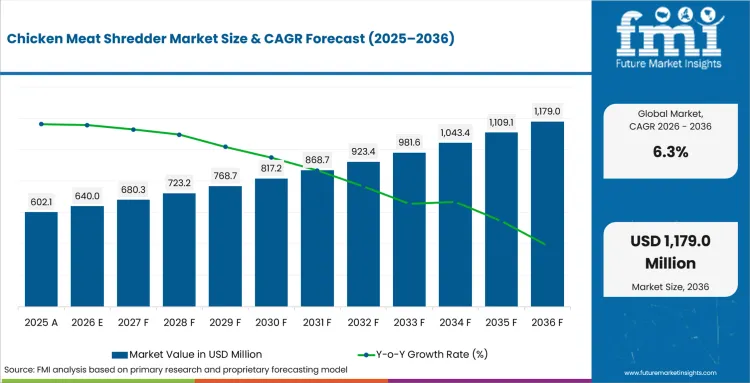
Key Takeaways of Chicken Meat Shredder Market
- Demand strengthens as repeated hand pulling restricts preparation output or creates uneven strands across scheduled chicken recipes.
- Manual chicken meat shredders are expected to represent 39.0% share in 2026 due to low entry cost and direct texture control.
- Food processing is projected to capture 35.0% by application in 2026 owing to scheduled throughput and portion requirements across prepared poultry lines.
- Commercial kitchens are anticipated to account for 37.0% of end user in 2026 supported by recurring menus and measurable preparation labor.
- Multipurpose mixers and hand tools limit dedicated purchases while difficult disassembly can erase labor savings during short production runs.
- Marlen and Fusion Tech serve industrial lines; Pacific Food Machinery and Orved Brock span several capacities; Food Technology Thielemann and Koneteollisuus join Jiaxing EXPRO and KitchenAid across narrower routes.
Analyst Perspective
"Chicken meat shredders earn their place through a narrow operating calculation rather than broad poultry demand. A restaurant or processor must save enough preparation time to cover cleaning and storage without damaging the expected fiber texture. Manufacturers that prove output with cooked chicken and provide realistic service coverage are positioned to convert testing into repeat installations."
- Nandini Roy Choudhury, Principal Analyst, Future Market Insights
How is the Chicken Meat Shredder Market segmented?
The Chicken Meat Shredder industry is segmented by Product Type, Application, End User, Distribution Channel, Material Type, and Region.
The chicken meat shredder market is assessed by product type, application, end user, distribution channel, material type, and region. Product type separates manual tools, electric appliances, batch machines, multipurpose systems, and portable designs by operating intensity. Application distinguishes food processing, restaurants and foodservice, household cooking, catering services, and hotels according to batch frequency and texture requirements. End user identifies the organization that controls equipment budgets, cleaning routines, and maintenance responsibility across each operating location. Distribution channel separates online retail from specialist stores, commercial dealers, supermarkets, and wholesale distributors across consumer purchasing routes. Material type compares stainless steel with food-grade plastic, aluminum, composite, and mixed constructions across different cleaning and workload requirements. Regional analysis tests these categories against poultry output, commercial kitchen density, power requirements, service distance, and local equipment availability.
What keeps manual chicken meat shredders ahead within product type?
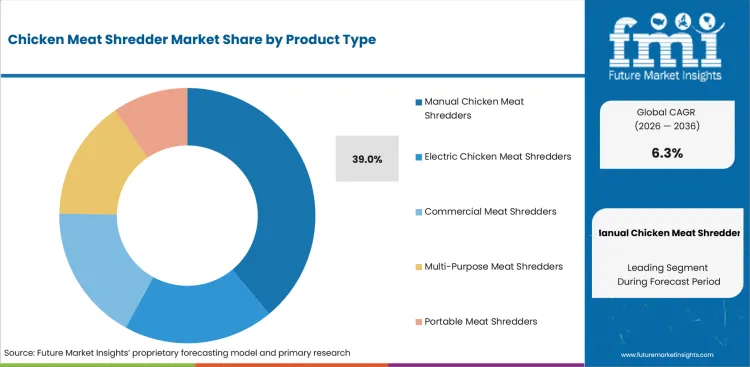
Small kitchens need a controllable method for separating cooked chicken fibers without assigning permanent counter space to powered machinery. Manual tools preserve direct texture control and avoid voltage or maintenance requirements across occasional preparation. The operating threshold becomes clearer through method comparison across recurring preparation rather than general kitchen activity. Orved Brock explained in September 2025 that manual shredding preserves fibers but carries the greatest labor cost across repeated batches. The same guidance recommends dedicated continuous equipment at approximately 20 kilograms of chicken per day.
- In 2026, manual chicken meat shredders are expected to lead product type with 39.0% share because low purchase cost and direct control over small batches. Kitchen staff can inspect strand size throughout operation and stop without processing an entire vessel. The position weakens as daily volume makes repetitive effort more expensive than a compact powered alternative.
- Households and small restaurants adopt manual designs through low storage needs and immediate use without electrical installation. Secure lids and comfortable handles improve repeated operation across warm cooked chicken during frequent preparation batches. Demand shifts toward powered systems as daily schedules require several batches or employee fatigue begins affecting preparation speed and texture consistency.
Which operating need supports food processing within the application category?
Food processors require uniform strands that enter fillings and prepared meals without repeated hand correction or variable portion weights. Scheduled production raises the cost of inconsistent pulling across products that follow fixed recipes and packing times. Plant engineers compare measured output with cleaning access and transfer compatibility during equipment trials using cooked poultry.
- The application category is forecast to be led by food processing at 35.0% share in 2026 due to portion-controlled poultry output. National poultry output shows the operating base for scheduled cooked-chicken production across established commercial processing plants. The UK government reported in July 2026 that poultry production reached 174.2 thousand tonnes during June. Processors turn part of that output into fillings and meals that justify measured shredding capacity.
- Processing plants adopt shredders that connect with batch carts or conveyors without adding another lifting or handling stage. Sanitation teams require safe access around shafts and guards throughout routine cleaning across regular production shifts. A high-output machine loses commercial value if disassembly extends downtime beyond the preparation time saved during regular production.
What supports commercial kitchens within the end user category?
Commercial kitchens repeat preparations across service periods that leave limited time for slow hand pulling or variable technique. Recurring menus allow managers to compare preparation minutes with cleaning and storage requirements before approving equipment. Sales across full-service and limited-service outlets show the operating scale behind recurring daily poultry production. The United States Department of Agriculture reported in July 2026 that establishments recorded inflation-adjusted 2025 sales of USD 488.4 billion and USD 516.1 billion. Dedicated shredders must improve labor output without duplicating commercial appliances already installed in each kitchen.
- By end user, commercial kitchens are estimated to hold 37.0% in 2026 owing to recurring menu production and measurable labor savings. Managers can compare preparation minutes per batch with sanitation time across sandwiches and salads before wider installation. Dedicated equipment loses preference if staff cannot reproduce the required strand size without additional handling or product correction.
- Central kitchens adopt shredders to standardize cooked chicken across commissaries and multiunit restaurant networks with fixed portion requirements. Demand follows the ready-to-eat food market through repeated fillings and prepared meals that require stable texture. Adoption remains slower in small kitchens that lack counter space or local technical support for powered equipment.
Why does online retail lead the distribution channel category?
Households and smaller restaurants compare compact shredders through demonstrations and reviews that show texture and cleaning steps. Digital access has the strongest fit for products that ship without installation or a specialist site assessment. Videos can show batch size and operation while reviews expose weak handles or difficult disassembly. Larger commercial machines retain stronger dealer involvement because electrical requirements and application testing influence the purchase.
- By distribution channel, online retail is forecast to represent 38.0% in 2026 driven by broad product comparison and direct household access. Compact manual designs can move through standard parcel networks without commissioning support or specialized technical setup. Clear descriptions of cooked-meat temperature and target strand size reduce unsuitable purchases across competing low-cost products.
- Online ordering broadens product discovery across locations without specialist kitchen stores or commercial equipment dealers. National retail data shows the scale of this purchasing route during routine consumer equipment purchasing. The United States Census Bureau reported in May 2026 that e-commerce represented 16.9% of national retail sales during the first quarter. The same access intensifies competition from stand mixers and basic hand tools across households and smaller kitchens.
How does stainless steel shape demand within material type?
Repeated food contact requires surfaces that tolerate washing without trapping cooked meat around shafts or guards. Material choice therefore works with disassembly access and hygienic processing equipment rather than visible housing alone. Federal sampling rules make food-contact sanitation a direct operating concern across ready-to-eat poultry facilities during routine production. The Food Safety and Inspection Service implemented broader Listeria species testing in January 2025 across product and food-contact surface samples. The change strengthens attention to cleanable zones across post-cook equipment and final product handling during routine production.
- The stainless steel segment is likely to capture 46.0% share in 2026 attributable to cleaning durability and repeated food-contact use. Processors value construction that tolerates regular washing without early corrosion or alignment loss under scheduled production. The position depends on internal access because polished exterior panels cannot compensate for difficult product-contact parts.
- Frequent washing and heavier operating loads support stainless systems across regular production schedules with recurring cooked batches. Households can accept food-grade plastic across lighter and less frequent preparation with lower purchase costs. Stainless steel gains preference as utilization increases and replacement risk becomes more expensive than the original material price difference.
What are the drivers, restraints, and opportunities in the Chicken Meat Shredder Market?
Recurring poultry production supports demand, while appliance substitution and sanitation effort limit conversion. Compact easy-clean systems create the clearest opening across moderate recurring batches.
- Driver: Recurring poultry production creates cooked batches that require consistent strands and predictable preparation time across scheduled recipes.
- Restraint: Existing appliances weaken equipment payback while difficult disassembly can extend sanitation beyond the labor saved during shredding.
- Opportunity: Compact commercial systems can serve moderate-volume operations that need stable texture without installing a continuous industrial line.
Recurring poultry output is one of the significant demand driver as it increases the number of cooked batches that require repeatable texture. Quarterly production data shows the operating base available to processors and foodservice companies with scheduled recipes. The Australian Bureau of Statistics reported in May 2026 that chicken meat production reached 395,020 tonnes during the March quarter. Dedicated shredders become commercially relevant as facilities convert part of that output into fillings and prepared meals. The investment case depends on documented labor savings and acceptable product yield across representative cooked poultry batches.
Substitution and sanitation create a material restraint across kitchens with low or irregular shredding volume. Meat mincers and multipurpose mixers offer broader utility but often produce a different texture from separated chicken fibers. Current inspection instructions show the operating burden attached to ready-to-eat poultry environments during routine commercial production. The Food Safety and Inspection Service issued a January 2025 directive covering Listeria and Salmonella sampling across ready-to-eat meat and poultry products. Equipment that slows access to product-contact surfaces can therefore lose its labor advantage during routine cleaning.
A practical opportunity sits between household tools and continuous lines for operations with moderate recurring volume. Butcher equipment dealers can demonstrate compact machines with real cooked chicken and define local service responsibility. Orved Brock published a DFC 10 start-up guide in September 2025 covering electrical connection and safety checks for its compact continuous model. The guidance shows how commissioning support can reduce adoption risk across restaurants and commissaries without large engineering teams. Manufacturers can capture this opening through verified batch capacity and simple cleaning access rather than oversized industrial specifications.
Which country CAGRs are profiled in the Chicken Meat Shredder Market?
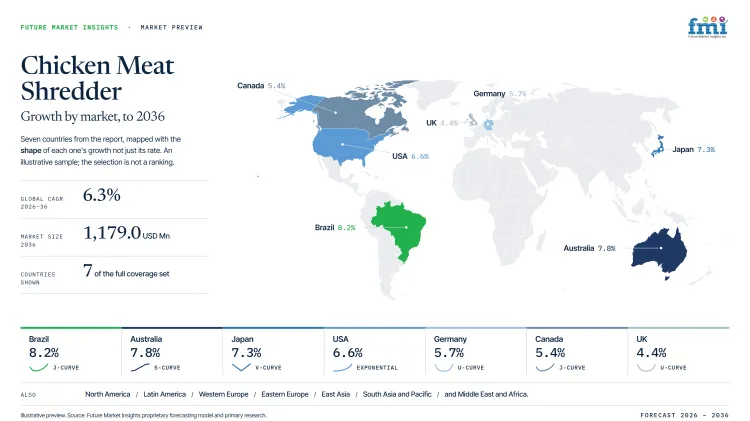
| Country | CAGR |
|---|---|
| Brazil | 8.2% |
| Australia | 7.8% |
| Japan | 7.3% |
| USA | 6.6% |
| Germany | 5.7% |
| Canada | 5.4% |
| UK | 4.4% |
How do country-level CAGRs compare in the Chicken Meat Shredder Market?
The country rates span 3.8 percentage points and form three practical groups across the assessed markets. Brazil and Australia remain closely spaced through large poultry-processing bases with different service-distance requirements across commercial routes. Japan and the United States occupy the middle range but their equipment decisions differ across footprint and labor economics. Germany and Canada follow through established processing clusters with formal maintenance expectations across recurring processor accounts. The United Kingdom remains separated by the widest adjacent gap as mature equipment access strengthens substitution from installed appliances. Comparable growth therefore does not create a uniform entry route across the chicken meat shredder market.
- Brazil exceeds Australia by 0.4 percentage point as its poultry-processing base creates more recurring volume for prepared chicken products.
- Australia follows closely but wider service distances make distributor coverage and technician travel more important during commercial equipment selection.
- Japan remains 0.5 percentage point below Australia as compact layouts support smaller machinery and formal evaluation lengthens purchasing decisions.
- The United States trails Japan by 0.7 percentage point despite broader foodservice scale because payback depends on measurable labor savings.
- Germany trails the United States by 0.9 percentage point as hygienic engineering accompanies longer qualification and service requirements.
- Canada follows Germany by 0.3 percentage point through concentrated production clusters that support demonstrations near major processing facilities.
- The United Kingdom remains 1.0 percentage point below Canada as established equipment access strengthens competition from multipurpose kitchen machinery.
Country CAGR differences provide limited guidance without service coverage and realistic utilization assumptions for each operating location. Manufacturers should compare local batch schedules and maintenance routes before prioritizing expansion from the forecast alone. The full report provides country-level CAGR analysis across North America, Latin America, Western Europe, Eastern Europe, East Asia, South Asia and Pacific, and the Middle East and Africa.
Country-wise Analysis
- Brazilian poultry processors operate around large production clusters that can aggregate cooked chicken into repeatable industrial batches. The Brazil chicken meat shredder sector is projected to record 8.2% CAGR during the assessment period, reinforced by recurring prepared-poultry output. The Brazilian Institute of Geography and Statistics reported in March 2026 that 6.69 billion chickens were slaughtered during 2025. That production base supports equipment trials across facilities with regular cooked-product schedules and sufficient daily utilization. Regional processing concentration provides a direct adoption enabler through larger reference sites and specialized technical partners. Long service distances and imported replacement parts remain a material friction outside established poultry-producing states. New entrants need demonstration capacity and maintenance coverage near the main processing corridors rather than broad national distribution alone.
- Australian processing and foodservice sites operate across wide distances that increase the value of dependable local technical coverage. Specialist distributors provide an adoption route through equipment demonstrations and local electrical guidance across commercial installations. By 2036, chicken meat shredder demand in Australia is projected to grow at 7.8% CAGR, supported by recurring domestic poultry output. The Australian Bureau of Statistics reported in February 2026 that chicken meat production reached 391,018 tonnes during the December quarter. That volume supports recurring batches across processors and commissaries with defined shredding requirements and planned menu cycles. Three-phase power and technician travel costs create material friction outside major cities and established processing clusters. Manufacturers need clear voltage specifications and realistic service-response commitments across regional operating locations and distant processing sites.
- Japanese kitchens and processors often work within compact production areas that reward precise texture without excessive machine footprint. The Ministry of Economy, Trade and Industry reported in May 2026 that restaurant and foodservice activity increased 3.2% during 2025. The increase supports recurring preparation across operators that can measure labor savings within limited work areas. Chicken meat shredder demand in Japan is forecast to rise at 7.3% CAGR over the forecast period, shaped by compact processing needs. Compact commercial systems and local demonstrations provide the direct adoption enabler across formal equipment evaluations. Exacting quality expectations and specialized maintenance requirements create a material friction that can extend qualification. Manufacturers need clear texture trials and footprint data rather than general claims about processing speed.
- United States demand develops through multiunit restaurants and processors that can measure preparation labor across repeated poultry menus. Domestic equipment manufacturers and broad dealer networks provide a direct route for demonstrations and replacement-part support. the United States' chicken meat shredder outlook is anticipated to advance at 6.6% CAGR over the assessment period, underpinned by measurable labor pressure. The United States Bureau of Labor Statistics reported in May 2026 that food preparation and serving occupations employed 13.68 million workers. The workforce scale makes preparation time commercially visible across repeated service and production schedules during equipment reviews. Irregular batch volume and sanitation time remain material frictions across smaller locations with dispersed menu use. Multiunit operators need separate measurements for labor minutes and cleaning time before extending equipment across an entire network.
- German processors operate within an established food-machinery base that places strong emphasis on hygienic design and documented performance. The Federal Statistical Office reported in August 2025 that Germany produced 779,900 tonnes of poultry meat during the first half. Domestic machinery expertise and local engineering support provide a direct adoption enabler for integration and sanitation review. Chicken meat shredder sales in Germany are forecast to expand at 5.7% CAGR by 2036, linked to commercial poultry processing. Formal documentation requirements and long-term service expectations create a material friction across qualification and manufacturer selection. Commercial entry depends on cleanable construction and dependable spare-parts access rather than broad processing capability. Manufacturers with local testing support can shorten evaluation across processors that handle recurring cooked-poultry products.
- Canadian chicken production is concentrated around provincial processing clusters that support focused equipment demonstrations and service coverage. In Canada, chicken meat shredder demand is predicted to advance at 5.4% CAGR through 2036, aided by recurring processor demand across major poultry-producing provinces. Regional concentration provides a direct adoption enabler through qualified reference sites and shorter travel between major facilities. Provincial output patterns also determine whether a service team can support enough installations at reasonable cost. Statistics Canada reported in February 2026 that Ontario and Quebec represented 61.1% of national chicken production during 2025. Long distances outside these provinces create a material friction through slower technical response and higher ownership costs. Manufacturers need regional spare-parts planning rather than one national service promise across distant processing locations.
- United Kingdom operators work within a mature poultry supply chain and an established network of foodservice equipment distributors. Dealer access provides a direct adoption enabler through equipment comparison and local maintenance across processors and central kitchens. Adoption of chicken meat shredder equipment in the United Kingdom is estimated to expand at 4.4% CAGR through 2036, influenced by recurring commercial preparation. The Department for Environment, Food and Rural Affairs reported in July 2026 that home-fed poultry production reached 2.0 million tonnes during 2025. The domestic base supports dedicated trials across recipes with repeat weekly volume and scheduled commercial production. Multipurpose appliances remain a material friction across kitchens with irregular menu use and limited storage. Manufacturers need applications that repeat throughout the week to offset sanitation effort and equipment space.
Who are the notable companies in the Chicken Meat Shredder Market?
Marlen, Fusion Tech Integrated, Pacific Food Machinery, Orved Brock, Food Technology Thielemann, Koneteollisuus, Jiaxing EXPRO, and KitchenAid are notable companies shaping this market.
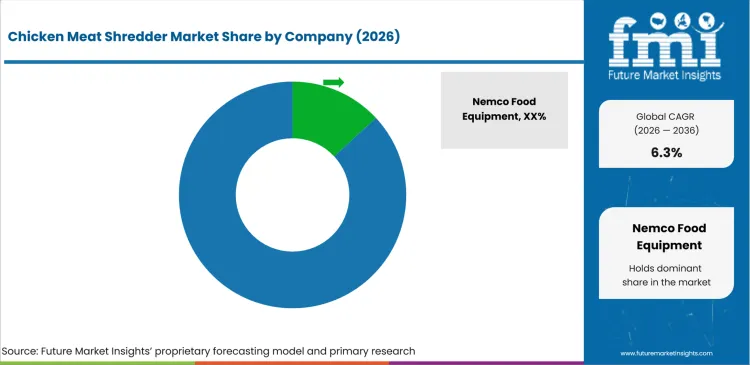
The competitive landscape remains fragmented across capacity tiers as no single platform serves household preparation and continuous industrial production equally well. Industrial meat cutting machines and dedicated shredders compete through capacity and cleanability across processing lines. Marlen and Fusion Tech compete through dedicated shredding systems with stronger integration and service support for processors. Orved Brock and Pacific Food Machinery cover compact and high-output requirements through broader capacity ranges. Food Technology Thielemann addresses industrial pulled-meat production while Koneteollisuus and Jiaxing EXPRO serve narrower commercial installations. KitchenAid creates indirect competition through an installed multipurpose appliance base across households and small commercial kitchens. Entry remains practical around medium-volume applications but processors expect cooked-chicken trials and clear sanitation access before changing established workflows.
- Marlen and Fusion Tech address processors that need dedicated shredding with documented batch capacity and integration into surrounding handling equipment. Food Technology Thielemann competes through industrial continuous output and adjustable fiber size across cooked products. These companies face the highest expectations for sanitation access and technical support across scheduled production lines.
- Orved Brock and Pacific Food Machinery cover several capacity levels from compact commercial use to larger continuous production. Koneteollisuus offers a defined batch option for professional kitchens while Jiaxing EXPRO serves export-oriented installations with simpler pass-through machinery. Their competitive position depends on distributor support and realistic commissioning requirements across regional sites and export installations.
- KitchenAid competes through appliance versatility instead of a dedicated commercial shredding platform for occasional preparation requirements. The substitution route remains strongest across households and small kitchens that value storage efficiency across several preparation tasks. Dedicated shredders must therefore prove better fiber control and sufficient daily labor savings to justify another machine and cleaning routine.
Competitive Benchmarking: Chicken Meat Shredder Market
| Company | Small-Batch Shredding | Continuous Industrial Throughput | Sanitary Integration and Service | Geographic Reach |
|---|---|---|---|---|
| Marlen | High | High | High | Global |
| Fusion Tech Integrated | High | High | High | North America and selected international markets |
| Pacific Food Machinery | High | High | High | Australia and export markets |
| Orved Brock | High | High | Medium | International direct sales |
| Food Technology Thielemann | Low | High | High | Europe and export markets |
| Koneteollisuus | High | Medium | Medium | International distributor network |
| Jiaxing EXPRO | Medium | Medium | Medium | China and overseas service markets |
| KitchenAid | High | Low | Low | Global consumer markets |
Key Developments in the Chicken Meat Shredder Market
- In January 2026, Duravant presented Marlen’s DuraKut sizing system at IPPE 2026 within an integrated protein-processing equipment display. The system supports slicing, dicing and shredding cooked products while linking size reduction with inspection and downstream handling. This positioning strengthens adoption among poultry processors seeking flexible machinery within coordinated production lines rather than isolated equipment purchases.
- In May 2025, Food Technology Thielemann showcased its IMS-6 Industrial Meat Shredder at the IFFA exhibition in Frankfurt. The continuous-flow machine processes cooked boneless meat at capacities reaching 2,000 kilograms per hour with independently adjustable belt and shredding speeds. The presentation increased commercial visibility for high-capacity pulled-chicken production across convenience foods and catering applications requiring controlled strand sizes.
Key Players in the Chicken Meat Shredder Market
Industrial Continuous Shredding Providers
- Marlen
- Fusion Tech Integrated, Inc.
- Food Technology Thielemann GmbH & Co. KG
- Orved Brock
Commercial Batch and Specialist Providers
- Pacific Food Machinery Pty Ltd
- Koneteollisuus Oy
- Jiaxing EXPRO Industrial Co., Ltd.
Household and Multipurpose Providers
- KitchenAid, a Whirlpool Corporation brand
Chicken Meat Shredder Market - Report Scope
| Coverage field | Report scope |
|---|---|
| Market breakdown | Product Type, Application, End User, Distribution Channel, Material Type, and Region. |
| Market Definition | Manual and powered equipment used to separate cooked chicken into strands across households, restaurants, caterers, commercial kitchens, and food-processing operations. |
| Regions Covered | North America, Latin America, Western Europe, Eastern Europe, East Asia, South Asia and Pacific, and Middle East and Africa. |
| Countries Covered | Brazil, Australia, Japan, USA, Germany, Canada, and UK. |
| Key Companies Profiled | Marlen, Fusion Tech Integrated, Pacific Food Machinery, Orved Brock, Food Technology Thielemann, Koneteollisuus, Jiaxing EXPRO, and KitchenAid. |
| Forecast Period | 2026 to 2036 |
| Approach | Hybrid bottom-up and top-down market sizing supported by category share analysis, country-level growth assessment, company participation mapping, and technology validation based on throughput performance, sanitation access assessment, fiber-texture consistency, and batch-to-batch yield evaluation. |
Chicken Meat Shredder Market - Research Methodology
| Method | Approach |
|---|---|
| Primary Research | FMI analysts gathered input from manufacturers, service providers, technology developers, distributors, end users, procurement teams, and subject-matter experts. Interviews examined purchasing decisions, product or service evaluation, adoption barriers, approval requirements, pricing considerations, and expectations for technical or commercial support. Respondents were also asked what evidence is required before a trial, pilot, or initial order develops into regular purchasing. |
| Desk Research | Desk research covered government statistics, regulatory publications, trade data, industry associations, technical literature, standards, company filings, product information, and official corporate announcements. Sources were reviewed for relevance, publication date, geographic coverage, and consistency with the defined market scope. Claims relating to performance, applications, approvals, capacity, investment, and commercial activity were retained only when supported by credible public evidence. |
| Market Sizing and Forecasting | The market model combined the baseline value with historical performance, segment structure, pricing and volume indicators, adoption levels, company participation, and country-level demand conditions. Forecast assumptions considered economic activity, investment trends, regulatory developments, technology adoption, purchasing cycles, supply availability, and barriers to wider market use. Segment and regional estimates were reconciled before the final market total was calculated. |
| Data Validation | Estimates were checked against multiple independent indicators, including public data, company activity, trade patterns, industry developments, and findings from primary interviews. Validation also tested whether products, services, applications, and company revenues fell within the defined market boundaries. Adjacent categories, unsupported claims, overlapping revenues, and activities without direct market relevance were excluded to reduce double counting and maintain consistency across segments and countries. |
Chicken Meat Shredder Market by Segments
Chicken Meat Shredder Market segmented by Product Type:
- Manual Chicken Meat Shredders
- Electric Chicken Meat Shredders
- Commercial Meat Shredders
- Multi-Purpose Meat Shredders
- Portable Meat Shredders
Chicken Meat Shredder Market segmented by Application:
- Food Processing
- Restaurants & Foodservice
- Household Cooking
- Catering Services
- Hotels
Chicken Meat Shredder Market segmented by End User:
- Commercial Kitchens
- Households
- Food Processing Companies
- Catering Companies
- Hospitality Industry
Chicken Meat Shredder Market segmented by Distribution Channel:
- Online Retail
- Specialty Kitchen Stores
- Hypermarkets & Supermarkets
- Commercial Equipment Dealers
- Wholesale Distributors
Chicken Meat Shredder Market segmented by Material Type:
- Stainless Steel
- Food Grade Plastic
- Aluminum
- Composite Materials
- Mixed Materials
Chicken Meat Shredder Market by Region:
- North America
- United States
- Canada
- Latin America
- Brazil
- Mexico
- Argentina
- Chile
- Western Europe
- Germany
- France
- United Kingdom
- Italy
- Spain
- Benelux
- Nordics
- Eastern Europe
- Poland
- Czech Republic
- Romania
- Hungary
- East Asia
- China
- Japan
- South Korea
- South Asia and Pacific
- India
- ASEAN
- Australia and New Zealand
- Middle East and Africa
- GCC Countries
- South Africa
- Türkiye
- Israel
Research Sources and Bibliography
- Zeballos, E., & Sinclair, W. (2026, June 11).
- USA Bureau of Labor Statistics. (2026, January 16).
- Orved Brock. (2025, September 29).
- Department for Environment, Food & Rural Affairs. (2026, July 23).
- USA Department of Agriculture, Economic Research Service. (2026, July 8).
- USA Census Bureau. (2026, May 18).
- Food Safety and Inspection Service. (2024, December 20).
- Australian Bureau of Statistics. (2026, May 19).
- Food Safety and Inspection Service. (2025, January 17).
- Orved Brock. (2025, September 2).
- Brazilian Institute of Geography and Statistics. (2026, March 18).
- Australian Bureau of Statistics. (2026, February 20).
- Ministry of Economy, Trade and Industry. (2026, May 27).
- USA Bureau of Labor Statistics. (2026, May 15).
- Federal Statistical Office of Germany. (2025, August 7).
- Statistics Canada. (2026, February 10).
- Department for Environment, Food & Rural Affairs. (2026, July 16).
- Food Technology Thielemann GmbH & Co. KG. (n.d.).
- Duravant. (2025, November 19).
- Orved Brock. (2025, August 27).
- Pacific Food Machinery Pty Ltd. (n.d.).
- Pacific Food Machinery Pty Ltd. (n.d.).
- Duravant. (2026, January 15). Duravant Showcases Integrated Protein Processing and Packaging Automation Solutions at IPPE 2026.
- Food Technology Thielemann GmbH & Co. KG. (2025, May). IMS-6 Industrial Meat Shredder. Messe Frankfurt IFFA 2025.
- Orved Brock. (n.d.).
- Jiaxing EXPRO Industrial Co., Ltd. (n.d.).
- KitchenAid. (n.d.).
This bibliography is provided for reader reference and is not exhaustive. The full report contains the complete reference list and detailed citations
This Report Answers
- How large is the chicken meat shredder market in 2026 and 2036?
- Which operating conditions convert cooked-poultry preparation into demand for dedicated shredding equipment?
- Why do manual chicken meat shredders represent the largest product type share during 2026?
- How does food processing support the largest application share across prepared poultry production?
- Why do commercial kitchens account for the largest end user share during 2026?
- How do country growth rates differ across Brazil, Australia, Japan, the USA, Germany, Canada, and the UK?
- Which companies provide household, commercial, and industrial cooked-meat shredding systems?
- What sanitation and substitution risks can weaken the return on dedicated shredding equipment?
- How should operators compare batch capacity and service coverage before selecting an equipment manufacturer?
Frequently Asked Questions
How big is the Chicken Meat Shredder Market in 2026?
The chicken meat shredder market is valued at USD 640 million in 2026 and is forecast to reach USD 1179 million by 2036, reflecting growing demand from food processors and commercial kitchens seeking consistent strand texture and measurable labor savings across recurring cooked-poultry preparation schedules.
What is the CAGR of the Chicken Meat Shredder Market from 2026 to 2036?
The chicken meat shredder market is projected to grow at a CAGR of 6.3% between 2026 and 2036, supported by recurring poultry production that creates cooked batches requiring consistent strands and predictable preparation time across scheduled foodservice and food processing recipes.
Which application leads the Chicken Meat Shredder Market?
Food processing accounts for 35.0% of the chicken meat shredder market by application in 2026, driven by portion-controlled poultry output requirements across prepared meal and filling production lines where scheduled throughput and consistent strand size directly affect packing efficiency and product yield.
Which country is growing fastest in the Chicken Meat Shredder Market?
The chicken meat shredder market in Brazil is projected to expand at a CAGR of 8.2% through 2036, ahead of Australia at 7.8%, Japan at 7.3%, the USA at 6.6%, Germany at 5.7%, Canada at 5.4%, and the UK at 4.4%, reflecting a large recurring poultry-processing base that supports equipment trials across facilities with regular cooked-product schedules.
Who are the leading companies in the Chicken Meat Shredder Market?
Leading companies in the chicken meat shredder market include Marlen, Fusion Tech Integrated, Pacific Food Machinery, Orved Brock, Food Technology Thielemann, Koneteollisuus, Jiaxing EXPRO, and KitchenAid, spanning industrial continuous shredding systems, commercial batch equipment, and household multipurpose platforms across global foodservice and processing markets.
Preview the report firsthand - request a free sample
Get SampleGet the brochure for pricing and purchase details.
Get PDFTable of Content
- Key Takeaways
- Market Size and CAGR
- Top Growth Driver
- Fastest Growing Segment
- Leading Region
- Key Companies
- Emerging Opportunities
- Executive Summary
- Global Market Outlook
- Demand-side Trends
- Supply-side Trends
- Technology Roadmap Analysis
- Analysis and Recommendations
- Analyst Perspective (What is happening? Why now? What should investors know?)
- Key Questions Answered
- How large is the market?
- What is the CAGR?
- What are key trends?
- Which region dominates?
- Who are the leaders?
- Market Overview
- Market Coverage / Taxonomy
- Market Definition / Scope / Limitations
- Research Methodology
- Chapter Orientation
- Analytical Lens and Working Hypotheses
- Market Structure, Signals, and Trend Drivers
- Benchmarking and Cross-market Comparability
- Market Sizing, Forecasting, and Opportunity Mapping
- Research Design and Evidence Framework
- Desk Research Programme (Secondary Evidence)
- Expert Input and Fieldwork (Primary Evidence)
- Tooling, Models, and Reference Databases
- Data Engineering and Model Build
- Quality Assurance and Audit Trail
- Market Background
- Market Dynamics (Drivers, Restraints, Opportunity, Trends)
- Scenario Forecast (Optimistic, Likely, Conservative)
- Impact Analysis
- AI Impact
- Sustainability Impact
- Regulatory Impact
- Technology Impact
- Consumer / Buyer Analysis
- Purchase Drivers
- Adoption Barriers
- Buyer Journey
- Opportunity Map Analysis
- Product Life Cycle Analysis
- Supply Chain Analysis
- Investment Feasibility Matrix
- Value Chain Analysis
- PESTLE and Porter's Analysis
- Regulatory Landscape
- Regional Parent Market Outlook
- Production and Consumption Statistics
- Import and Export Statistics
- Global Market Analysis and Forecast, 2021 to 2036
- Historical Market Size Value (USD Million) Analysis, 2021 to 2025
- Current and Future Market Size Value (USD Million) Projections, 2026 to 2036
- Y-o-Y Growth Trend Analysis
- Absolute $ Opportunity Analysis
- Global Market Pricing Analysis, 2021 to 2036
- Global Market Analysis and Forecast, By Product Type, 2021 to 2036
- Introduction / Key Findings
- Historical Market Size Value (USD Million) Analysis By Product Type, 2021 to 2025
- Current and Future Market Size Value (USD Million) Analysis and Forecast By Product Type, 2026 to 2036
- Manual Chicken Meat Shredders
- Hand Twist Shredders
- Pull Handle Shredders
- Electric Chicken Meat Shredders
- Countertop Electric Shredders
- Commercial Electric Shredders
- Commercial Meat Shredders
- High Capacity Shredders
- Industrial Shredders
- Multi-Purpose Meat Shredders
- Multi-Meat Shredders
- Vegetable & Meat Shredders
- Portable Meat Shredders
- Compact Shredders
- Foldable Shredders
- Manual Chicken Meat Shredders
- Y-o-Y Growth Trend Analysis By Product Type, 2021 to 2025
- Absolute $ Opportunity Analysis By Product Type, 2026 to 2036
- Global Market Analysis and Forecast, By Application, 2021 to 2036
- Introduction / Key Findings
- Historical Market Size Value (USD Million) Analysis By Application, 2021 to 2025
- Current and Future Market Size Value (USD Million) Analysis and Forecast By Application, 2026 to 2036
- Food Processing
- Commercial Food Production
- Meat Processing Facilities
- Restaurants & Foodservice
- Quick Service Restaurants
- Full Service Restaurants
- Household Cooking
- Home Meal Preparation
- BBQ & Grilling
- Catering Services
- Event Catering
- Institutional Catering
- Hotels
- Hotel Kitchens
- Resort Food Services
- Food Processing
- Y-o-Y Growth Trend Analysis By Application, 2021 to 2025
- Absolute $ Opportunity Analysis By Application, 2026 to 2036
- Global Market Analysis and Forecast, By End User, 2021 to 2036
- Introduction / Key Findings
- Historical Market Size Value (USD Million) Analysis By End User, 2021 to 2025
- Current and Future Market Size Value (USD Million) Analysis and Forecast By End User, 2026 to 2036
- Commercial Kitchens
- Restaurants
- Central Kitchens
- Households
- Home Cooks
- Food Enthusiasts
- Food Processing Companies
- Meat Processors
- Ready-to-Eat Food Manufacturers
- Catering Companies
- Corporate Caterers
- Event Caterers
- Hospitality Industry
- Hotels
- Resorts
- Commercial Kitchens
- Y-o-Y Growth Trend Analysis By End User, 2021 to 2025
- Absolute $ Opportunity Analysis By End User, 2026 to 2036
- Global Market Analysis and Forecast, By Distribution Channel, 2021 to 2036
- Introduction / Key Findings
- Historical Market Size Value (USD Million) Analysis By Distribution Channel, 2021 to 2025
- Current and Future Market Size Value (USD Million) Analysis and Forecast By Distribution Channel, 2026 to 2036
- Online Retail
- E-Commerce Marketplaces
- Brand Websites
- Specialty Kitchen Stores
- Cookware Retailers
- Kitchen Equipment Stores
- Hypermarkets & Supermarkets
- Hypermarkets
- Supermarkets
- Commercial Equipment Dealers
- Food Equipment Distributors
- Authorized Dealers
- Wholesale Distributors
- B2B Suppliers
- Industrial Distributors
- Online Retail
- Y-o-Y Growth Trend Analysis By Distribution Channel, 2021 to 2025
- Absolute $ Opportunity Analysis By Distribution Channel, 2026 to 2036
- Global Market Analysis and Forecast, By Material Type, 2021 to 2036
- Introduction / Key Findings
- Historical Market Size Value (USD Million) Analysis By Material Type, 2021 to 2025
- Current and Future Market Size Value (USD Million) Analysis and Forecast By Material Type, 2026 to 2036
- Stainless Steel
- 304 Stainless Steel
- 316 Stainless Steel
- Food Grade Plastic
- BPA-Free Plastic
- Reinforced Plastic
- Aluminum
- Anodized Aluminum
- Cast Aluminum
- Composite Materials
- Fiber Reinforced Composite
- High Impact Polymer
- Mixed Materials
- Metal-Plastic Hybrid
- Silicone Grip Components
- Stainless Steel
- Y-o-Y Growth Trend Analysis By Material Type, 2021 to 2025
- Absolute $ Opportunity Analysis By Material Type, 2026 to 2036
- Global Market Analysis and Forecast, By Region, 2021 to 2036
- Introduction
- Historical Market Size Value (USD Million) Analysis By Region, 2021 to 2025
- Current Market Size Value (USD Million) Analysis and Forecast By Region, 2026 to 2036
- North America
- Latin America
- Western Europe
- Eastern Europe
- East Asia
- South Asia and Pacific
- Middle East & Africa
- Market Attractiveness Analysis By Region
- North America Market Analysis and Forecast, By Country, 2021 to 2036
- Historical Market Size Value (USD Million) Trend Analysis By Market Taxonomy, 2021 to 2025
- Market Size Value (USD Million) Forecast By Market Taxonomy, 2026 to 2036
- By Country
- USA
- Canada
- By Product Type
- By Application
- By End User
- By Distribution Channel
- By Material Type
- By Country
- Market Attractiveness Analysis
- By Country
- By Product Type
- By Application
- By End User
- By Distribution Channel
- By Material Type
- Key Takeaways
- Latin America Market Analysis and Forecast, By Country
- Historical Market Size Value (USD Million) Trend Analysis By Market Taxonomy, 2021 to 2025
- Market Size Value (USD Million) Forecast By Market Taxonomy, 2026 to 2036
- By Country
- Brazil
- Mexico
- Chile
- Rest of Latin America
- By Product Type
- By Application
- By End User
- By Distribution Channel
- By Material Type
- By Country
- Market Attractiveness Analysis
- By Country
- By Product Type
- By Application
- By End User
- By Distribution Channel
- By Material Type
- Key Takeaways
- Western Europe Market Analysis and Forecast, By Country
- Historical Market Size Value (USD Million) Trend Analysis By Market Taxonomy, 2021 to 2025
- Market Size Value (USD Million) Forecast By Market Taxonomy, 2026 to 2036
- By Country
- Germany
- UK
- Italy
- Spain
- France
- Nordic
- BENELUX
- Rest of Western Europe
- By Product Type
- By Application
- By End User
- By Distribution Channel
- By Material Type
- By Country
- Market Attractiveness Analysis
- By Country
- By Product Type
- By Application
- By End User
- By Distribution Channel
- By Material Type
- Key Takeaways
- Eastern Europe Market Analysis and Forecast, By Country
- Historical Market Size Value (USD Million) Trend Analysis By Market Taxonomy, 2021 to 2025
- Market Size Value (USD Million) Forecast By Market Taxonomy, 2026 to 2036
- By Country
- Russia
- Poland
- Hungary
- Balkan & Baltic
- Rest of Eastern Europe
- By Product Type
- By Application
- By End User
- By Distribution Channel
- By Material Type
- By Country
- Market Attractiveness Analysis
- By Country
- By Product Type
- By Application
- By End User
- By Distribution Channel
- By Material Type
- Key Takeaways
- East Asia Market Analysis and Forecast, By Country
- Historical Market Size Value (USD Million) Trend Analysis By Market Taxonomy, 2021 to 2025
- Market Size Value (USD Million) Forecast By Market Taxonomy, 2026 to 2036
- By Country
- China
- Japan
- South Korea
- By Product Type
- By Application
- By End User
- By Distribution Channel
- By Material Type
- By Country
- Market Attractiveness Analysis
- By Country
- By Product Type
- By Application
- By End User
- By Distribution Channel
- By Material Type
- Key Takeaways
- South Asia and Pacific Market Analysis and Forecast, By Country
- Historical Market Size Value (USD Million) Trend Analysis By Market Taxonomy, 2021 to 2025
- Market Size Value (USD Million) Forecast By Market Taxonomy, 2026 to 2036
- By Country
- India
- ASEAN
- Australia & New Zealand
- Rest of South Asia and Pacific
- By Product Type
- By Application
- By End User
- By Distribution Channel
- By Material Type
- By Country
- Market Attractiveness Analysis
- By Country
- By Product Type
- By Application
- By End User
- By Distribution Channel
- By Material Type
- Key Takeaways
- Middle East & Africa Market Analysis and Forecast, By Country
- Historical Market Size Value (USD Million) Trend Analysis By Market Taxonomy, 2021 to 2025
- Market Size Value (USD Million) Forecast By Market Taxonomy, 2026 to 2036
- By Country
- Kingdom of Saudi Arabia
- Other GCC Countries
- Türkiye
- South Africa
- Other African Union
- Rest of Middle East & Africa
- By Product Type
- By Application
- By End User
- By Distribution Channel
- By Material Type
- By Country
- Market Attractiveness Analysis
- By Country
- By Product Type
- By Application
- By End User
- By Distribution Channel
- By Material Type
- Key Takeaways
- Key Countries Market Analysis
- USA
- Pricing Analysis
- Market Share Analysis, 2025
- By Product Type
- By Application
- By End User
- By Distribution Channel
- By Material Type
- Canada
- Pricing Analysis
- Market Share Analysis, 2025
- By Product Type
- By Application
- By End User
- By Distribution Channel
- By Material Type
- Mexico
- Pricing Analysis
- Market Share Analysis, 2025
- By Product Type
- By Application
- By End User
- By Distribution Channel
- By Material Type
- Brazil
- Pricing Analysis
- Market Share Analysis, 2025
- By Product Type
- By Application
- By End User
- By Distribution Channel
- By Material Type
- Chile
- Pricing Analysis
- Market Share Analysis, 2025
- By Product Type
- By Application
- By End User
- By Distribution Channel
- By Material Type
- Germany
- Pricing Analysis
- Market Share Analysis, 2025
- By Product Type
- By Application
- By End User
- By Distribution Channel
- By Material Type
- UK
- Pricing Analysis
- Market Share Analysis, 2025
- By Product Type
- By Application
- By End User
- By Distribution Channel
- By Material Type
- Italy
- Pricing Analysis
- Market Share Analysis, 2025
- By Product Type
- By Application
- By End User
- By Distribution Channel
- By Material Type
- Spain
- Pricing Analysis
- Market Share Analysis, 2025
- By Product Type
- By Application
- By End User
- By Distribution Channel
- By Material Type
- France
- Pricing Analysis
- Market Share Analysis, 2025
- By Product Type
- By Application
- By End User
- By Distribution Channel
- By Material Type
- India
- Pricing Analysis
- Market Share Analysis, 2025
- By Product Type
- By Application
- By End User
- By Distribution Channel
- By Material Type
- ASEAN
- Pricing Analysis
- Market Share Analysis, 2025
- By Product Type
- By Application
- By End User
- By Distribution Channel
- By Material Type
- Australia & New Zealand
- Pricing Analysis
- Market Share Analysis, 2025
- By Product Type
- By Application
- By End User
- By Distribution Channel
- By Material Type
- China
- Pricing Analysis
- Market Share Analysis, 2025
- By Product Type
- By Application
- By End User
- By Distribution Channel
- By Material Type
- Japan
- Pricing Analysis
- Market Share Analysis, 2025
- By Product Type
- By Application
- By End User
- By Distribution Channel
- By Material Type
- South Korea
- Pricing Analysis
- Market Share Analysis, 2025
- By Product Type
- By Application
- By End User
- By Distribution Channel
- By Material Type
- Russia
- Pricing Analysis
- Market Share Analysis, 2025
- By Product Type
- By Application
- By End User
- By Distribution Channel
- By Material Type
- Poland
- Pricing Analysis
- Market Share Analysis, 2025
- By Product Type
- By Application
- By End User
- By Distribution Channel
- By Material Type
- Hungary
- Pricing Analysis
- Market Share Analysis, 2025
- By Product Type
- By Application
- By End User
- By Distribution Channel
- By Material Type
- Kingdom of Saudi Arabia
- Pricing Analysis
- Market Share Analysis, 2025
- By Product Type
- By Application
- By End User
- By Distribution Channel
- By Material Type
- Türkiye
- Pricing Analysis
- Market Share Analysis, 2025
- By Product Type
- By Application
- By End User
- By Distribution Channel
- By Material Type
- South Africa
- Pricing Analysis
- Market Share Analysis, 2025
- By Product Type
- By Application
- By End User
- By Distribution Channel
- By Material Type
- USA
- Market Structure Analysis
- Competition Dashboard
- Competition Benchmarking
- Market Share Analysis of Top Players
- By Regional
- By Product Type
- By Application
- By End User
- By Distribution Channel
- By Material Type
- Emerging Startups
- Innovation Benchmarking
- Competition Analysis
- Competition Deep Dive
- Nemco Food Equipment
- Overview
- Product Portfolio
- Profitability by Market Segments
- Sales Footprint
- Strategy Overview
- Marketing Strategy
- Product Strategy
- Channel Strategy
- VEVOR
- LEM Products
- Weston Brands
- The Sausage Maker Inc.
- Torrey USA
- KitchenAid
- Chef'n
- OXO
- Cuisinart
- Nemco Food Equipment
- Case Studies
- Success Stories
- Recent Developments
- Competition Deep Dive
- Assumptions & Acronyms Used


