

- Market Size (2026)
- USD 213.8 Mn
- Forecast (2036)
- USD 345.0 Mn
- CAGR (2026 to 2036)
- 4.9%
How big is Child-Resistant Tins Market in 2026?
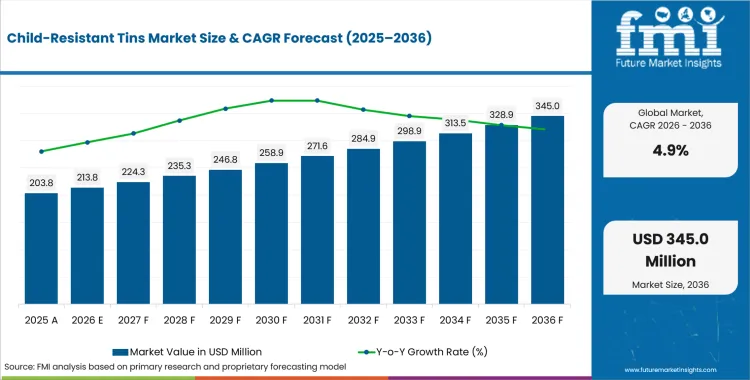
USD 213.8 million in 2026 and USD 345.0 million by 2036 at a 4.9% CAGR.
Demand for child-resistant tins is projected to expand at 4.9% CAGR between 2026 and 2036, increasing valuation from USD 213.8 million in 2026 to USD 345.0 million by 2036. Regulated products translate that growth into package specifications because the closure and container must control access together. In July 2025, the USA CPSC warned about roughly 2,300 Aemerry minoxidil serum units sold without required child-resistant packaging. The recall makes package-level performance a sourcing condition.
Material economics change the qualification path if controlled access alters the recovery route. UK waste data published in July 2025 put provisional 2024 recycling rates at 80.4% for metal packaging and 53.7% for plastic packaging. UK programs therefore have a stronger reason to test whether locking components change recyclability or disposal cost. Similar safety rules can produce different material choices even with the same access-control function.
Key Takeaways
- Regulated products and brand safety policies raise demand for controlled access that ordinary reclosable containers cannot document.
- By format type, standard formats are estimated to hold 40.0% in 2026 owing to familiar neck finishes that reduce qualification work.
- In 2026, PET & rPET are expected to lead material demand with 37.0% share because rigid clarity fits mature conversion routes.
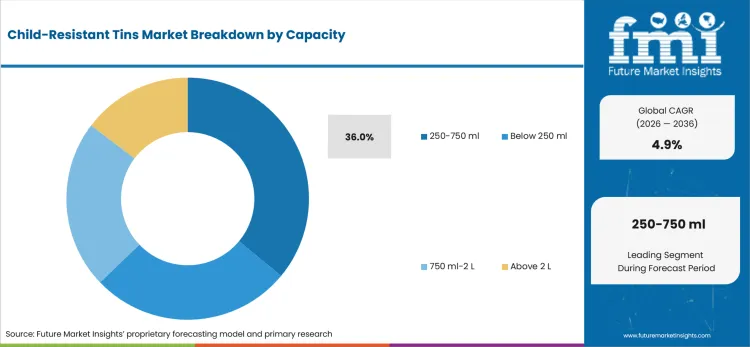
- The 250-750 ml segment is projected to hold 36.0% of capacity demand in 2026 due to fit with common retail filling equipment.
- Package approval slows if a locking feature changes adult usability, filled-product compatibility or the recovery route enough to require new testing.
- Some of the key players in this market include Greiner Packaging, ALPLA, Silgan Holdings, AptarGroup, Inc., Comar, Ball Corporation, Crown Holdings, CANPACK, Ardagh Group, and Amcor.
Analyst Perspective
"Child-resistant tins earn margin at the handoff between access control and line qualification because a closure change can reopen testing on the whole package. Strong offers keep opening force, adult usability and material recovery stable enough for brands to reuse approved tooling across product families."
- Nandini Roy Choudhury, Principal Consultant, Future Market Insights
How is the child-resistant tins market segmented?
The child-resistant tins market is segmented by format type, material, capacity, end use, sales channel and region.
The child-resistant tins market is segmented by format type, material, capacity, end use, sales channel and region. Format type covers standard, recyclable-optimized, premium & branded and custom-engineered formats. Material includes PET & rPET, PP & HDPE, metal and glass & other. Capacity spans below 250 ml, 250-750 ml, 750 ml-2 L and above 2 L. End use covers food, beverage, home & personal care and pharma & industrial. Sales channel includes direct brand contracts, distributors and online B2B.
Why does 250-750 ml lead capacity demand?
Mid-capacity packs leave enough body area for grip, labels and controlled opening without the handling penalty of large bulk containers. In May 2026, Greiner Packaging industrialized a reusable syrup bottle by engineering the bottle, cap and dosing feature as one package. The project shows why component fit is resolved ahead of high-volume production.
- The 250-750 ml segment is forecast to account for 36.0% of capacity demand in 2026 driven by fit with common retail filling and closure equipment.
- Smaller packs serve concentrated or travel products, whereas larger packs use more material and shelf space during routine fulfillment.
Why do standard formats lead format type?
Standard formats preserve familiar neck finishes and opening sequences, which limits the variables packaging engineers must requalify. The USA CPSC recalled about 25,000 Ruahouine minoxidil serum bottles in January 2026 for failing child-resistant packaging requirements. That enforcement point keeps proven closure geometry valuable on routine rigid formats.
- By format type, standard formats are estimated to hold 40.0% in 2026 owing to repeatable interfaces that reduce tooling and test changes.
- Custom-engineered formats remain useful for unusual products, but familiar closure families shorten approval and replenishment for routine brand programs during repeat launches and replenishment orders.
Why do PET & rPET lead material demand?
PET & rPET give packaging engineers a transparent rigid body with familiar molding and neck-finish routes. Material selection becomes harder once recycled content must preserve dimensional stability and the chosen closure must keep the same opening behavior. The material route therefore stays attractive only if recycled resin does not force a fresh closure qualification.
- PET & rPET are projected to represent 37.0% of material demand in 2026 attributable to conversion capacity and a recycled-content pathway.
- Eurostat published in October 2025 that EU residents generated 35.3 kg of plastic packaging waste per person in 2023 and recycled 14.8 kg. Those volumes make recovery performance a visible material-qualification criterion.
Why does food lead the end use category?
Food applications include supplements and gummies that can require controlled access alongside food-contact performance. The USA CPSC recalled about 356,140 iron supplement bottles and packets in April 2026 for failing mandatory child-resistant requirements. That scale makes closure performance commercially relevant during initial retail supplement qualification and routine replenishment orders.
- Food is likely to capture 32.0% of end use demand in 2026 attributable to the large base of rigid supplement and specialty food formats.
- Beverage programs emphasize lightweight convenience, while home care and pharmaceutical uses place greater weight on chemical compatibility or formal package qualification.
Why do direct brand contracts lead the sales channel category?
Direct contracts give package engineers one technical route for settling neck finish, torque and filling-line fit during tooling approval. The channel becomes more valuable as packaging groups add local engineering capacity and clean-room options forregulated products.
- Direct brand contracts are set to lead sales channel demand with 56.0% share in 2026 due to the qualification work handled in one accountable relationship.
- Precision Concepts International acquired Comar in November 2025, creating a larger North American rigid-packaging platform for healthcare and consumer customers. Direct brand programs gain more engineering routes from that combined platform, with qualification still package-specific.
What are the drivers, restraints and opportunities in the Child-Resistant Tins Market?
Safety rules sustain demand, package-level qualification slows conversion and recyclable locking structures offer the clearest route to reduce redesign risk.
- Driver: Mandatorycontrolled accessturns the closure-container system into a compliance purchase for regulated medicines and hazardous consumer products.
- Restraint: Adult usability, filled-product compatibility and repeat-close performance can extend approval once a locking feature changes the package system.
- Opportunity: Simpler recyclable constructions can lower redesign work if the body and closure retain validated access control under the local recovery route.
Regulatory Enforcement Makes Access Control a Purchase Requirement
Enforcement converts a packaging rule into immediate replacement work once a noncompliant product must leave sale. In April 2026, the USA CPSC recalled about 786,100 travel-size Afrin nasal spray bottles for lacking required child-resistant packaging. Regulated brands therefore pay for documented package performance during distribution approval, not for an untested closure claim.
Package Qualification Can Extend Conversion Timelines
Child resistance must remain effective with the filled product and repeated adult use, so a closure change can reopen package testing. The USA CPSC recalled about 4,200 Liizousuda paint thinner bottles in July 2026 and directed consumers toward replacement bottles with child-resistant closures. Approval time is spent proving the revised container, cap and contents still meet the intended safety requirement.
Recyclability Rules Reward Simpler Locking Structures
Packaging engineers can reduce redesign work by avoiding locking components that weaken a proven recycling route. Germany’s Central Agency Packaging Register published the 2026 minimum standard in August 2026 and excludes non-recycled components from boosting a package assessment. Designs that separate cleanly can preserve access-control qualification and recyclability evidence during customer approval, giving simpler structures a clearer commercialization route.
Which country CAGRs are profiled in the Child-Resistant Tins Market?
| Country | CAGR |
|---|---|
| Saudi Arabia | 6.3% |
| UAE | 6.0% |
| South Korea | 5.7% |
| USA | 5.4% |
| Germany | 5.1% |
| UK | 4.8% |
| France | 4.5% |
| Japan | 4.0% |
How do country-level CAGRs compare in the Child-Resistant Tins Market?
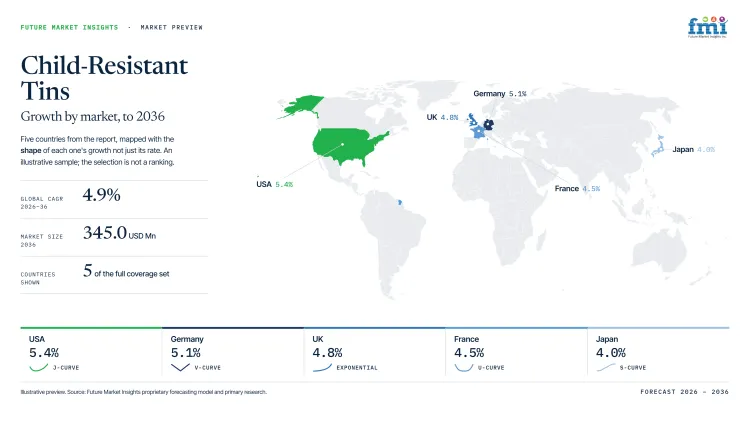
The 2.3 percentage-point spread separates a Gulf-led upper tier from a slower European-Japanese group, with South Korea and the USA between them. Higher forecasts cluster where qualification activity is still expanding. Mature markets rely more on replacement programs, so the pattern describes commercial conversion speed rather than current revenue scale.
- Saudi local-fill programs shorten technical-response distances.
- UAE re-export channels favor adaptable pack specifications.
- South Korean redesign cycles reward flexible tooling.
- USA contract packers favor reusable closure families.
- German converter density shortens component trial cycles.
- UK retailers demand documented specifications at listing.
- French pharmacy channels favor stable approved formats.
- Japanese brand programs retain qualified tooling longer.
Comparable CAGRs therefore carry different service and approval costs. The full report provides country-level CAGR analysis across North America, Latin America, Western Europe, Eastern Europe, East Asia, South Asia and Pacific and Middle East and Africa.
Country-wise Analysis
- Saudi medicine registration treats the closure as part of the approved package for listed reclosable products, giving tested systems a clear route into domestic pharmaceutical programs nationwide. The SFDA child-resistant packaging requirement reached its implementation date on February 6, 2025 and specifies repeated opening-and-closing performance for imported and locally filled medicines. Saudi Arabia is projected to grow at 6.3% CAGR through 2036, attributable to formal qualification demand and expanding local support for regulated packaging. Registration variations add work after component or filling changes, so companies that keep test records and local technical response close to customers can shorten reapproval cycles.
- Dubai brand programs now screen material choice more closely as specified single-use plastic items leave consumer and healthcare channels. Child-resistant tins demand in the UAE is forecast to rise at 6.0% CAGR over the forecast period, tied to safety-led applications that can use durable recyclable formats. Dubai Municipality confirmed in December 2025 that the final ban phase took effect on January 1, 2026 and covers plastic cups, lids, plates and related tableware. The rule does not create a child-resistant mandate, but it raises the cost of unnecessary components and favors designs that preserve access control with a simpler material route.
- South Korean packaging decisions increasingly account for recyclability at product design review, placing labels and separability beside closure performance during high-volume national consumer redesign. The Ministry of Environment revised its packaging recyclability grading standard on January 7, 2025, keeping material and structure assessment inside the compliance process. South Korea is estimated to post 5.7% CAGR over the forecast period, supported by frequent consumer-format changes and strong domestic packaging engineering capacity. A locking part that lowers the recyclability grade can weaken a redesign case, so entrants need resin choices and separation instructions that survive safety review and resource-circulation requirements during qualification.
- USA brand owners operate under mature Poison Prevention Packaging Act enforcement, so package engineers treat the bottle, closure and filled product as one qualification decision. The USA child-resistant tins sector is projected to record 5.4% CAGR during the assessment period, driven by replacement demand in regulated health and household products. In January 2026, the CPSC recalled about 148,370 mindbodygreen multivitamin bottles after finding their eight-ounce glass containers lacked child-resistant packaging in national retail channels. Mature rules limit first-time regulatory upside, but they reward companies that keep tooling stable and provide package-level evidence quickly following formulation, liner or component changes.
- German packaging teams increasingly evaluate controlled access beside material recovery, particularly if a lock introduces parts with different recycling behavior. In May 2026, the German Environment Agency reported a 69.4% packaging recycling rate for 2023, giving brand programs a measurable recovery benchmark during redesign. In Germany, child-resistant tins demand is predicted to advance at 5.1% CAGR through 2036, owing to replacement activity and continued scrutiny of recyclable structures. Component separation is the practical constraint because a safe closure can lose commercial appeal if its materials weaken the package assessment. Proven fastening designs with documented recovery routes gain a clear commercial advantage.
- UK packaging approvals increasingly place producer-cost exposure beside safety performance, making recyclability a commercial variable as household packs reach national scale. The UK outlook is anticipated to advance at 4.8% CAGR over the assessment period, aided by compliance-led replacement and long-running brand qualification routines. PackUK’s February 2026 policy sets a 1.2 modulation factor for red-rated packaging in 2026-2027 and gives medical packaging separate reporting treatment. Multi-material locks can raise disposal-cost exposure unless a regulatory exception applies to the finished household package. Simpler designs preserve the safety function without pushing the pack into a weaker recyclability rating or avoidable disposal fees.
- French brand programs are testing more reusable packaging routes, so controlled-access designs must survive repeated handling without making collection or sorting harder. ADEME reported in October 2025 that France’s packaging reuse rate reached 1.82% in 2024, showing the route is growing from a low national base. Adoption of child-resistant tins in France is estimated to expand at 4.5% CAGR through 2036, given steady safety-led conversion and broader recovery requirements. Reuse does not remove the need for child resistance, and packaging companies gain value by offering durable reclosure with materials that withstand washing, sorting and repeated consumer handling in national programs.
- Japanese packaging programs favor stable specifications and long-standing packaging partnerships, so a closure change must justify access control and compatibility with an existing package. Child-resistant tin sales in Japan are forecast to expand at 4.0% CAGR by 2036, reflecting selective safety demand and slow format turnover. In March 2026, Japan’s Ministry of the Environment reported that 82.4% of municipalities planned separate collection for plastic containers and packaging in fiscal 2026. Broad collection coverage rewards familiar material routes during local package review cycles. Conservative change control slows switching if a new locking feature requires extra barrier, stability or adult-usability evidence during qualification.
Who are the notable companies in the Child-Resistant Tins Market?
Greiner Packaging, ALPLA, Silgan Holdings, AptarGroup, Inc., Comar, Ball Corporation, Crown Holdings, CANPACK, Ardagh Group, and Amcor are the notable companies profiled in this market.
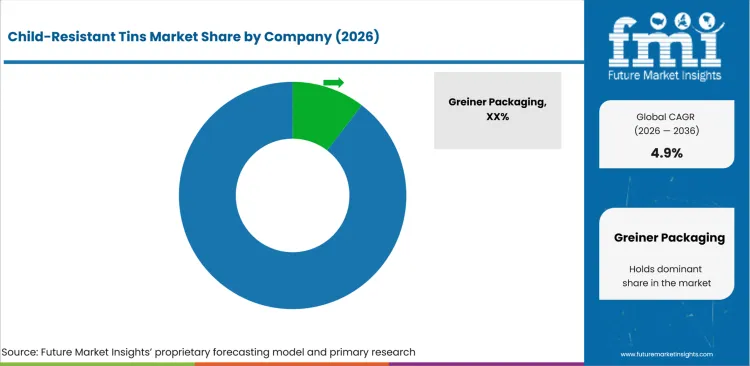
Competition separates closure and healthcare rigid-packaging specialists from metal, glass and broad consumer-packaging groups. ALPLA, AptarGroup, Inc., Comar and Silgan Holdings provide the deepest closure evidence. Greiner Packaging and Amcor bring integrated rigid-package engineering. Ball Corporation, Crown Holdings, CANPACK and Ardagh Group contribute container scale that still requires a qualified child-resistant closure.
- Closure and healthcare specialists: Greiner Packaging, ALPLA, Silgan Holdings, AptarGroup, Inc. and Comar.
- Metal and glass platforms: Ball Corporation, Crown Holdings, CANPACK and Ardagh Group.
- Broad rigid platform: Amcor.
Competitive Benchmarking: Child-Resistant Tins Market
| Company | Closure & Package Integration | Rigid Format Breadth | Regulated End-Use Depth | Geographic Reach |
|---|---|---|---|---|
| Greiner Packaging | Medium | High | High | Europe, North America and selected international programs |
| ALPLA | High | High | High | Global |
| Silgan Holdings | High | High | High | Americas, Europe and Asia |
| AptarGroup, Inc. | High | Medium | High | Global |
| Comar | Medium | High | High | North America and European healthcare programs |
| Ball Corporation | Low | Medium | Low | Global |
| Crown Holdings | Medium | High | Medium | Americas, Europe and Asia-Pacific |
| CANPACK | Low | High | Low | Europe, Americas, Middle East, Asia and Africa |
| Ardagh Group | Low | High | Medium | 16-country metal and glass network |
| Amcor | High | High | High | Global |
Scoring basis: High closure integration requires documented closure-plus-container or dosing-system evidence, Medium requires a specialty-closure route and Low denotes verified standard can-end or container-interface engineering. High rigid-format breadth covers three or more verified routes, Medium two and Low one. High regulated end-use depth covers three or more compliance-sensitive end uses, Medium two and Low one.
Key Developments in the Child-Resistant Tins Market
- In August 2025, AptarGroup, Inc. launched the TSP all-plastic trigger spray with an optional child-resistant feature for home-care packaging applications.
- In June 2025, ALPLA announced its planned acquisition of KM Packaging, covering six closure sites and remaining subject to competition approval.
- In April 2025, Amcor completed its combination with Berry Global, broadening its rigid-container, closure and healthcare-packaging capabilities under one company.
Key Players in the Child-Resistant Tins Market
Closure and Healthcare Packaging Specialists
- Greiner Packaging
- ALPLA
- Silgan Holdings
- AptarGroup, Inc.
- Comar
Metal and Glass Container Platforms
- Ball Corporation
- Crown Holdings
- CANPACK
- Ardagh Group
Broad Rigid Packaging Platform
- Amcor
Child-Resistant Tins Market - Report Scope
| Coverage field | Report scope |
|---|---|
| Market breakdown | By format type, material, capacity, end use, sales channel and region. |
| Quantitative Units | USD million. |
| Market Definition | Revenue includes rigid tins and tin-style containers sold with a child-resistant or controlled-access closure configuration within the listed taxonomy. Ordinary non-child-resistant rigid packaging is excluded. |
| Regions Covered | North America, Latin America, Western Europe, Eastern Europe, East Asia, South Asia and Pacific and Middle East and Africa. |
| Countries Covered | Saudi Arabia, UAE, South Korea, USA, Germany, UK, France, Japan, and 20+ countries included in the full report. |
| Key Companies Profiled | Greiner Packaging, ALPLA, Silgan Holdings, AptarGroup, Inc., Comar, Ball Corporation, Crown Holdings, CANPACK, Ardagh Group, Amcor. |
| Forecast Period | 2026 to 2036. |
| Approach | Primary and secondary research with market triangulation. |
Child-Resistant Tins Market - Research Methodology
| Method | Approach |
|---|---|
| Primary Research | FMI analysts gathered input from manufacturers, service providers, technology developers, distributors, end users, procurement teams, and subject-matter experts. Interviews examined purchasing decisions, product or service evaluation, adoption barriers, approval requirements, pricing considerations, and expectations for technical or commercial support. Respondents were also asked what evidence is required before a trial, pilot, or initial order develops into regular purchasing. |
| Desk Research | Desk research covered government statistics, regulatory publications, trade data, industry associations, technical literature, standards, company filings, product information, and official corporate announcements. Sources were reviewed for relevance, publication date, geographic coverage, and consistency with the defined market scope. Claims relating to performance, applications, approvals, capacity, investment, and commercial activity were retained only when supported by credible public evidence. |
| Market Sizing and Forecasting | The market model combined the baseline value with historical performance, segment structure, pricing and volume indicators, adoption levels, company participation, and country-level demand conditions. Forecast assumptions considered economic activity, investment trends, regulatory developments, technology adoption, purchasing cycles, supply availability, and barriers to wider market use. Segment and regional estimates were reconciled before the final market total was calculated. |
| Data Validation | Estimates were checked against multiple independent indicators, including public data, company activity, trade patterns, industry developments, and findings from primary interviews. Validation also tested whether products, services, applications, and company revenues fell within the defined market boundaries. Adjacent categories, unsupported claims, overlapping revenues, and activities without direct market relevance were excluded to reduce double counting and maintain consistency across segments and countries. |
Child-Resistant Tins Market by Segments
Child-Resistant Tins Market segmented by Format Type:
- Standard formats
- Recyclable-optimized formats
- Premium & branded formats
- Custom-engineered formats
Child-Resistant Tins Market segmented by Material:
- PET & rPET
- PP & HDPE
- Metal
- Glass & other
Child-Resistant Tins Market segmented by Capacity:
- Below 250 ml
- 250-750 ml
- 750 ml-2 L
- Above 2 L
Child-Resistant Tins Market segmented by End Use:
- Food
- Beverage
- Home & personal care
- Pharma & industrial
Child-Resistant Tins Market segmented by Sales Channel:
- Direct brand contracts
- Distributors
- Online B2B
Child-Resistant Tins Market by Region:
- North America
- United States
- Canada
- Latin America
- Brazil
- Mexico
- Argentina
- Chile
- Rest of Latin America
- Western Europe
- Germany
- France
- United Kingdom
- Italy
- Spain
- Benelux
- Nordics
- Rest of Western Europe
- Eastern Europe
- Poland
- Czech Republic
- Romania
- Hungary
- Rest of Eastern Europe
- East Asia
- China
- Japan
- South Korea
- South Asia and Pacific
- India
- ASEAN
- Australia and New Zealand
- Rest of South Asia and Pacific
- Middle East and Africa
- Kingdom of Saudi Arabia
- Other GCC Countries
- Türkiye
- Israel
- South Africa
- Other African Union Countries
- Rest of Middle East and Africa
Research Sources and Bibliography
- USA Consumer Product Safety Commission. (2025, July 31). CPSC warns consumers to immediately stop using Aemerry hair growth serums due to risk of serious injury or death to young children from poisoning; violates mandatory standard for child-resistant packaging.
- Department for Environment, Food & Rural Affairs. (2025, July 23). UK statistics on waste.
- USA Consumer Product Safety Commission. (2026, January 15). Ruahouine hair growth serum bottles recalled due to risk of serious injury or death from child poisoning; violates mandatory standard for child-resistant packaging.
- Eurostat. (2025, October 22). Plastic packaging waste in the EU: 35.3 kg per person.
- Greiner Packaging. (2026, May 5). Greiner Packaging’s innovative Syrup Bottle with integrated dosing system for HOLY.
- USA Consumer Product Safety Commission. (2026, April 9). Vitaquest International recalls multiple iron supplement bottles and packets due to risk of serious injury or death from poisoning to young children; violates mandatory standard for child-resistant packaging.
- Comar. (2025, November 12). Precision Concepts International acquires Comar.
- USA Consumer Product Safety Commission. (2026, April 30). Bayer recalls 6 mL size Afrin Original Nasal Spray bottles due to risk of serious injury or illness from child poisoning; violates mandatory standard for child-resistant packaging.
- USA Consumer Product Safety Commission. (2026, July 16). Liizousuda paint thinner bottles recalled due to risk of serious injury or death from child poisoning; violate mandatory standard for child-resistant packaging.
- Central Agency Packaging Register. (2026, August 31). Minimum standard for recycling-friendly packaging: Edition 2026.
- Saudi Food and Drug Authority. (2023, August 6). Child Resistant Packaging requirements.
- Dubai Municipality. (2025, December 24). Dubai to enforce final phase of single-use plastic ban from 2026.
- Ministry of Environment, Republic of Korea. (2025, January 7). Packaging recyclability grading standard.
- USA Consumer Product Safety Commission. (2026, January 29). Mindbodygreen recalls Ultimate Multivitamin dietary supplement bottles due to risk of serious injury or death from child poisoning; violates mandatory standard for child-resistant packaging.
- German Environment Agency. (2026, May 13). Verpackungsverbrauch 2023 gesunken, Recyclingquote gestiegen.
- PackUK. (2026, February 17). PackUK extended producer responsibility (EPR) for packaging: producer disposal fees modulation statement.
- ADEME. (2025, October 27). Réemploi des emballages : données 2024.
- Ministry of the Environment, Japan. (2026, March 31).
- AptarGroup, Inc. (2025, August 21). Aptar Beauty launches TSP, a trigger spray pump with soft actuation.
- ALPLA. (2025, June 24). ALPLA acquires closure specialist KM Packaging.
- Amcor. (2025, April 30). Amcor completes combination with Berry Global; positioned to significantly enhance value for customers and shareholders.
- Silgan Holdings Inc. (2026, February 4). Silgan announces fourth quarter and full year 2025 results; expects continued growth in 2026.
- Greiner Packaging. (2026, May 5). Greiner publishes 2025 Annual and Sustainability Report.
- ALPLA. (2026, March 20). Packaging solutions for the Philippines: ALPLA opens plant in Calamba City.
- AptarGroup, Inc. (2025, December 1). Aptar acquires Sommaplast, a specialized provider of oral dosing pharma packaging solutions.
- Comar. (2025, March 31). Comar introduces new Glass Ball Tip Dropper Assemblies.
- Ball Corporation. (2025, November 5). Packaging progress: Ball and allies launch carbon-free aerosol can ahead of COP30.
- Crown Holdings, Inc. (2026, April 23). Crown Holdings, Inc. to establish state-of-the-art beverage can facility in Northern India, marking strategic expansion into high-growth market.
- CANPACK Group. (2025, September 18). CANPACK Group to invest in the second aluminum beverage can plant in Colombia.
- Ardagh Group. (2026, June 30). Ardagh Glass Packaging awarded ENERGY STAR plant certification for California production facility.
- Amcor. (2026, June 3). Amcor expands production capability in India to meet growing healthcare packaging demand.
- ALPLA. (2025, November 3). Acquisition in Serbia: ALPLA strengthens its role as a system provider in South-East Europe.
- Greiner Packaging. (2025, November 17). Greiner Packaging to produce cups with recycled PS content in Switzerland from 2026 in collaboration with Swiss dairy processors.
- CANPACK Group. (2026, June 2). Canovation and CANPACK formalize collaboration to accelerate CanReseal toward commercial launch.
- Amcor. (2026, April 24). Amcor opens advanced healthcare packaging coating facility in Malaysia.
- Comar. (2025, July 9). Comar sets the standard with CE UDI labeling capability and EU MDR compliance.
- TÜV NORD CERT GmbH. (2024, August 6). Certificate: Aptar Villingen GmbH ISO 15378:2018.
This bibliography is provided for reader reference and is not exhaustive. The full report contains the complete reference list and detailed citations
This Report Answers
- How large is the child-resistant tins market in 2026 and by 2036?
- Which conditions support controlled-access packaging demand?
- Why do standard formats lead format type?
- Why do PET & rPET lead material demand?
- Why does 250-750 ml lead capacity demand?
- How do growth rates differ among the eight profiled countries?
- Which companies provide closure engineering and rigid container platforms?
- Which qualification and recyclability constraints delay conversion?
Frequently Asked Questions
How big is the Child-Resistant Tins Market in 2026?
The child-resistant tins market is valued at USD 213.8 million in 2026 and is projected to reach USD 345.0 million by 2036. Regulated access control and brand safety requirements support demand for qualified package systems.
What is the CAGR of the Child-Resistant Tins Market from 2026 to 2036?
The child-resistant tins market is projected to grow at a CAGR of 4.9% between 2026 and 2036. Expansion is supported by compliance-led replacement, package qualification and redesigns that preserve material recovery.
Which format type leads the Child-Resistant Tins Market?
The standard formats segment is expected to hold 40.0% of the child-resistant tins market in 2026, attributable to familiar neck finishes and repeatable opening geometry. Common interfaces reduce tooling changes and repeat-testing work during package qualification cycles.
Which countries are projected to record the highest growth in the Child-Resistant Tins Market?
Saudi Arabia is projected to grow at 6.3% CAGR, followed by the UAE at 6.0% and South Korea at 5.7% through 2036. Qualification demand and changing material rules support the faster outlook in these markets.
Which companies are active in the Child-Resistant Tins Market?
Key companies operating in the market include Greiner Packaging, ALPLA, Silgan Holdings, AptarGroup, Inc., Comar, Ball Corporation, Crown Holdings, CANPACK, Ardagh Group, and Amcor. Their roles span closure engineering, rigid packaging and metal or glass container production.
Preview the report firsthand - request a free sample
Get SampleGet the brochure for pricing and purchase details.
Get PDFTable of Content
- Key Takeaways
- Market Size and CAGR
- Top Growth Driver
- Fastest Growing Segment
- Leading Region
- Key Companies
- Emerging Opportunities
- Executive Summary
- Global Market Outlook
- Demand-side Trends
- Supply-side Trends
- Technology Roadmap Analysis
- Analysis and Recommendations
- Analyst Perspective (What is happening? Why now? What should investors know?)
- Key Questions Answered
- How large is the market?
- What is the CAGR?
- What are key trends?
- Which region dominates?
- Who are the leaders?
- Market Overview
- Market Coverage / Taxonomy
- Market Definition / Scope / Limitations
- Research Methodology
- Chapter Orientation
- Analytical Lens and Working Hypotheses
- Market Structure, Signals, and Trend Drivers
- Benchmarking and Cross-market Comparability
- Market Sizing, Forecasting, and Opportunity Mapping
- Research Design and Evidence Framework
- Desk Research Programme (Secondary Evidence)
- Expert Input and Fieldwork (Primary Evidence)
- Tooling, Models, and Reference Databases
- Data Engineering and Model Build
- Quality Assurance and Audit Trail
- Market Background
- Market Dynamics (Drivers, Restraints, Opportunity, Trends)
- Scenario Forecast (Optimistic, Likely, Conservative)
- Impact Analysis
- AI Impact
- Sustainability Impact
- Regulatory Impact
- Technology Impact
- Consumer / Buyer Analysis
- Purchase Drivers
- Adoption Barriers
- Buyer Journey
- Opportunity Map Analysis
- Product Life Cycle Analysis
- Supply Chain Analysis
- Investment Feasibility Matrix
- Value Chain Analysis
- PESTLE and Porter's Analysis
- Regulatory Landscape
- Regional Parent Market Outlook
- Production and Consumption Statistics
- Import and Export Statistics
- Global Market Analysis and Forecast, 2021 to 2036
- Historical Market Size Value (USD Million) Analysis, 2021 to 2025
- Current and Future Market Size Value (USD Million) Projections, 2026 to 2036
- Y-o-Y Growth Trend Analysis
- Absolute $ Opportunity Analysis
- Global Market Pricing Analysis, 2021 to 2036
- Global Market Analysis and Forecast, By Format Type, 2021 to 2036
- Introduction / Key Findings
- Historical Market Size Value (USD Million) Analysis By Format Type, 2021 to 2025
- Current and Future Market Size Value (USD Million) Analysis and Forecast By Format Type, 2026 to 2036
- Standard formats
- Recyclable-optimized formats
- Premium & branded formats
- Custom-engineered formats
- Standard formats
- Y-o-Y Growth Trend Analysis By Format Type, 2021 to 2025
- Absolute $ Opportunity Analysis By Format Type, 2026 to 2036
- Global Market Analysis and Forecast, By Material, 2021 to 2036
- Introduction / Key Findings
- Historical Market Size Value (USD Million) Analysis By Material, 2021 to 2025
- Current and Future Market Size Value (USD Million) Analysis and Forecast By Material, 2026 to 2036
- PET & rPET
- PP & HDPE
- Metal
- Glass & other
- PET & rPET
- Y-o-Y Growth Trend Analysis By Material, 2021 to 2025
- Absolute $ Opportunity Analysis By Material, 2026 to 2036
- Global Market Analysis and Forecast, By Capacity, 2021 to 2036
- Introduction / Key Findings
- Historical Market Size Value (USD Million) Analysis By Capacity, 2021 to 2025
- Current and Future Market Size Value (USD Million) Analysis and Forecast By Capacity, 2026 to 2036
- 250-750 ml
- Below 250 ml
- 750 ml-2 L
- Above 2 L
- 250-750 ml
- Y-o-Y Growth Trend Analysis By Capacity, 2021 to 2025
- Absolute $ Opportunity Analysis By Capacity, 2026 to 2036
- Global Market Analysis and Forecast, By End Use, 2021 to 2036
- Introduction / Key Findings
- Historical Market Size Value (USD Million) Analysis By End Use, 2021 to 2025
- Current and Future Market Size Value (USD Million) Analysis and Forecast By End Use, 2026 to 2036
- Food
- Beverage
- Home & personal care
- Pharma & industrial
- Food
- Y-o-Y Growth Trend Analysis By End Use, 2021 to 2025
- Absolute $ Opportunity Analysis By End Use, 2026 to 2036
- Global Market Analysis and Forecast, By Sales Channel, 2021 to 2036
- Introduction / Key Findings
- Historical Market Size Value (USD Million) Analysis By Sales Channel, 2021 to 2025
- Current and Future Market Size Value (USD Million) Analysis and Forecast By Sales Channel, 2026 to 2036
- Direct brand contracts
- Distributors
- Online B2B
- Direct brand contracts
- Y-o-Y Growth Trend Analysis By Sales Channel, 2021 to 2025
- Absolute $ Opportunity Analysis By Sales Channel, 2026 to 2036
- Global Market Analysis and Forecast, By Region, 2021 to 2036
- Introduction
- Historical Market Size Value (USD Million) Analysis By Region, 2021 to 2025
- Current Market Size Value (USD Million) Analysis and Forecast By Region, 2026 to 2036
- North America
- Latin America
- Western Europe
- Eastern Europe
- East Asia
- South Asia and Pacific
- Middle East & Africa
- Market Attractiveness Analysis By Region
- North America Market Analysis and Forecast, By Country, 2021 to 2036
- Historical Market Size Value (USD Million) Trend Analysis By Market Taxonomy, 2021 to 2025
- Market Size Value (USD Million) Forecast By Market Taxonomy, 2026 to 2036
- By Country
- USA
- Canada
- By Format Type
- By Material
- By Capacity
- By End Use
- By Sales Channel
- By Country
- Market Attractiveness Analysis
- By Country
- By Format Type
- By Material
- By Capacity
- By End Use
- By Sales Channel
- Key Takeaways
- Latin America Market Analysis and Forecast, By Country
- Historical Market Size Value (USD Million) Trend Analysis By Market Taxonomy, 2021 to 2025
- Market Size Value (USD Million) Forecast By Market Taxonomy, 2026 to 2036
- By Country
- Brazil
- Mexico
- Chile
- Rest of Latin America
- By Format Type
- By Material
- By Capacity
- By End Use
- By Sales Channel
- By Country
- Market Attractiveness Analysis
- By Country
- By Format Type
- By Material
- By Capacity
- By End Use
- By Sales Channel
- Key Takeaways
- Western Europe Market Analysis and Forecast, By Country
- Historical Market Size Value (USD Million) Trend Analysis By Market Taxonomy, 2021 to 2025
- Market Size Value (USD Million) Forecast By Market Taxonomy, 2026 to 2036
- By Country
- Germany
- UK
- Italy
- Spain
- France
- Nordic
- BENELUX
- Rest of Western Europe
- By Format Type
- By Material
- By Capacity
- By End Use
- By Sales Channel
- By Country
- Market Attractiveness Analysis
- By Country
- By Format Type
- By Material
- By Capacity
- By End Use
- By Sales Channel
- Key Takeaways
- Eastern Europe Market Analysis and Forecast, By Country
- Historical Market Size Value (USD Million) Trend Analysis By Market Taxonomy, 2021 to 2025
- Market Size Value (USD Million) Forecast By Market Taxonomy, 2026 to 2036
- By Country
- Russia
- Poland
- Hungary
- Balkan & Baltic
- Rest of Eastern Europe
- By Format Type
- By Material
- By Capacity
- By End Use
- By Sales Channel
- By Country
- Market Attractiveness Analysis
- By Country
- By Format Type
- By Material
- By Capacity
- By End Use
- By Sales Channel
- Key Takeaways
- East Asia Market Analysis and Forecast, By Country
- Historical Market Size Value (USD Million) Trend Analysis By Market Taxonomy, 2021 to 2025
- Market Size Value (USD Million) Forecast By Market Taxonomy, 2026 to 2036
- By Country
- China
- Japan
- South Korea
- By Format Type
- By Material
- By Capacity
- By End Use
- By Sales Channel
- By Country
- Market Attractiveness Analysis
- By Country
- By Format Type
- By Material
- By Capacity
- By End Use
- By Sales Channel
- Key Takeaways
- South Asia and Pacific Market Analysis and Forecast, By Country
- Historical Market Size Value (USD Million) Trend Analysis By Market Taxonomy, 2021 to 2025
- Market Size Value (USD Million) Forecast By Market Taxonomy, 2026 to 2036
- By Country
- India
- ASEAN
- Australia & New Zealand
- Rest of South Asia and Pacific
- By Format Type
- By Material
- By Capacity
- By End Use
- By Sales Channel
- By Country
- Market Attractiveness Analysis
- By Country
- By Format Type
- By Material
- By Capacity
- By End Use
- By Sales Channel
- Key Takeaways
- Middle East & Africa Market Analysis and Forecast, By Country
- Historical Market Size Value (USD Million) Trend Analysis By Market Taxonomy, 2021 to 2025
- Market Size Value (USD Million) Forecast By Market Taxonomy, 2026 to 2036
- By Country
- Kingdom of Saudi Arabia
- Other GCC Countries
- Türkiye
- South Africa
- Other African Union
- Rest of Middle East & Africa
- By Format Type
- By Material
- By Capacity
- By End Use
- By Sales Channel
- By Country
- Market Attractiveness Analysis
- By Country
- By Format Type
- By Material
- By Capacity
- By End Use
- By Sales Channel
- Key Takeaways
- Key Countries Market Analysis
- USA
- Pricing Analysis
- Market Share Analysis, 2025
- By Format Type
- By Material
- By Capacity
- By End Use
- By Sales Channel
- Canada
- Pricing Analysis
- Market Share Analysis, 2025
- By Format Type
- By Material
- By Capacity
- By End Use
- By Sales Channel
- Mexico
- Pricing Analysis
- Market Share Analysis, 2025
- By Format Type
- By Material
- By Capacity
- By End Use
- By Sales Channel
- Brazil
- Pricing Analysis
- Market Share Analysis, 2025
- By Format Type
- By Material
- By Capacity
- By End Use
- By Sales Channel
- Chile
- Pricing Analysis
- Market Share Analysis, 2025
- By Format Type
- By Material
- By Capacity
- By End Use
- By Sales Channel
- Germany
- Pricing Analysis
- Market Share Analysis, 2025
- By Format Type
- By Material
- By Capacity
- By End Use
- By Sales Channel
- UK
- Pricing Analysis
- Market Share Analysis, 2025
- By Format Type
- By Material
- By Capacity
- By End Use
- By Sales Channel
- Italy
- Pricing Analysis
- Market Share Analysis, 2025
- By Format Type
- By Material
- By Capacity
- By End Use
- By Sales Channel
- Spain
- Pricing Analysis
- Market Share Analysis, 2025
- By Format Type
- By Material
- By Capacity
- By End Use
- By Sales Channel
- France
- Pricing Analysis
- Market Share Analysis, 2025
- By Format Type
- By Material
- By Capacity
- By End Use
- By Sales Channel
- India
- Pricing Analysis
- Market Share Analysis, 2025
- By Format Type
- By Material
- By Capacity
- By End Use
- By Sales Channel
- ASEAN
- Pricing Analysis
- Market Share Analysis, 2025
- By Format Type
- By Material
- By Capacity
- By End Use
- By Sales Channel
- Australia & New Zealand
- Pricing Analysis
- Market Share Analysis, 2025
- By Format Type
- By Material
- By Capacity
- By End Use
- By Sales Channel
- China
- Pricing Analysis
- Market Share Analysis, 2025
- By Format Type
- By Material
- By Capacity
- By End Use
- By Sales Channel
- Japan
- Pricing Analysis
- Market Share Analysis, 2025
- By Format Type
- By Material
- By Capacity
- By End Use
- By Sales Channel
- South Korea
- Pricing Analysis
- Market Share Analysis, 2025
- By Format Type
- By Material
- By Capacity
- By End Use
- By Sales Channel
- Russia
- Pricing Analysis
- Market Share Analysis, 2025
- By Format Type
- By Material
- By Capacity
- By End Use
- By Sales Channel
- Poland
- Pricing Analysis
- Market Share Analysis, 2025
- By Format Type
- By Material
- By Capacity
- By End Use
- By Sales Channel
- Hungary
- Pricing Analysis
- Market Share Analysis, 2025
- By Format Type
- By Material
- By Capacity
- By End Use
- By Sales Channel
- Kingdom of Saudi Arabia
- Pricing Analysis
- Market Share Analysis, 2025
- By Format Type
- By Material
- By Capacity
- By End Use
- By Sales Channel
- Türkiye
- Pricing Analysis
- Market Share Analysis, 2025
- By Format Type
- By Material
- By Capacity
- By End Use
- By Sales Channel
- South Africa
- Pricing Analysis
- Market Share Analysis, 2025
- By Format Type
- By Material
- By Capacity
- By End Use
- By Sales Channel
- USA
- Market Structure Analysis
- Competition Dashboard
- Competition Benchmarking
- Market Share Analysis of Top Players
- By Regional
- By Format Type
- By Material
- By Capacity
- By End Use
- By Sales Channel
- Emerging Startups
- Innovation Benchmarking
- Competition Analysis
- Competition Deep Dive
- Greiner Packaging
- Overview
- Product Portfolio
- Profitability by Market Segments
- Sales Footprint
- Strategy Overview
- Marketing Strategy
- Product Strategy
- Channel Strategy
- Alpla
- Silgan Holdings
- Pactiv Evergreen
- Ball Corporation
- Berry Global
- Crown Holdings
- CANPACK
- Ardagh Group
- Amcor
- Greiner Packaging
- Case Studies
- Success Stories
- Recent Developments
- Competition Deep Dive
- Assumptions & Acronyms Used


