

- Market Size (2026)
- USD 130.7 Mn
- Forecast (2036)
- USD 194.9 Mn
- CAGR (2026 to 2036)
- 4.1%
How big is Citrus Fiber Pectin Market in 2026?
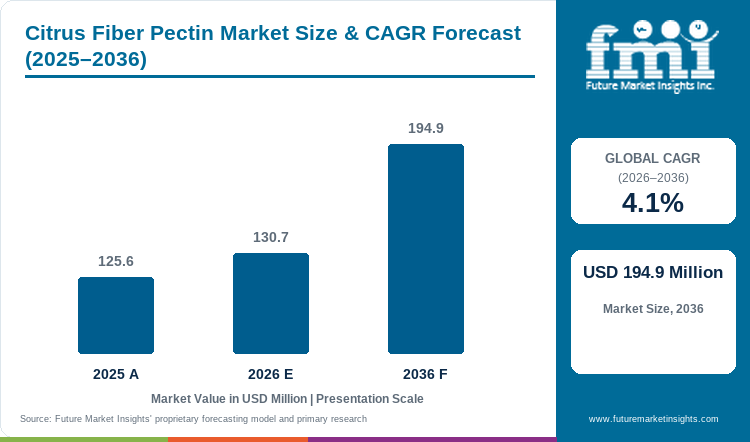
USD 130.7 million in 2026 and USD 194.9 million by 2036, expanding at 4.1% CAGR.
Sales of citrus fiber pectin are estimated to rise at 4.1% CAGR through 2036, increasing valuation from USD 125.6 million in 2025 to USD 130.7 million in 2026, and reaching USD 194.9 million by 2036. Food manufacturers are using pectin for stabilization and texturizing in formulations that require controlled texture under current labeling constraints. The U.S. Food and Drug Administration lists pectin for stabilizing or thickening and texturizing effects. Stabilizing and texturizing functions keep food texturing agents relevant as sugar or fat reduction changes mouthfeel and water control.
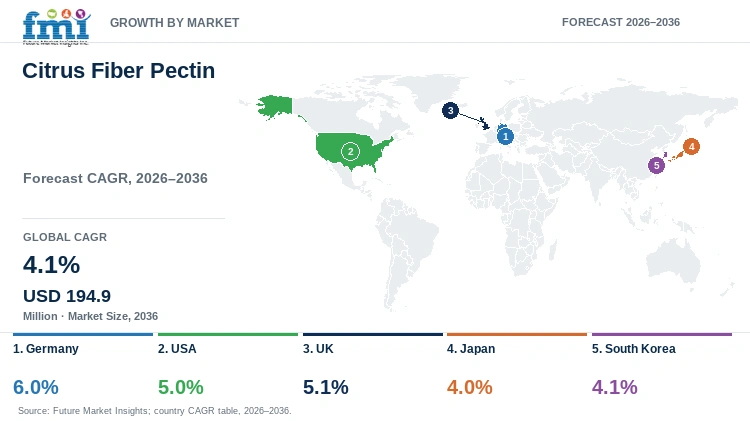
Germany is projected to grow at 6.0% CAGR through 2036 while the USA is forecast at 5.0% CAGR. Destatis recorded 31 German enterprises with sold production in the national category covering plant extracts and pectic substances during 2025. German manufacturers can pair that domestic production base with local application support during commercial formulation and grade qualification. US suppliers manage a different route because citrus feedstock availability varies by crop and growing region. These operating differences are shaping qualification decisions and supply planning for repeat citrus pectin orders under established customer specifications.
Key Takeaways
- Food formulators are increasing citrus fiber pectin use because sugar and fat reduction can alter texture inside existing processing conditions.
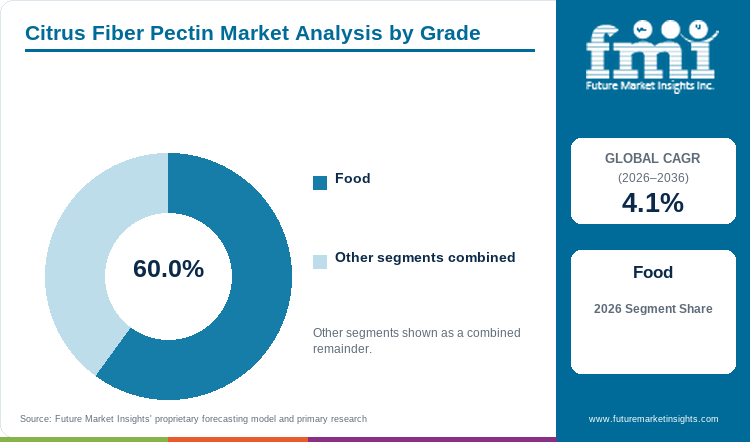
- By grade, food is estimated to hold 60.0% of citrus fiber pectin demand in 2026. Regular stabilizing and texturizing work in commercial food production supports its position during repeated formulation decisions.
- Based on source, oranges are projected to account for 54.0% of citrus fiber pectin demand in 2026. Juice-processing streams concentrate peel near extraction routes and support orange-linked supply for continuous commercial production.
- In 2026, bakery is expected to lead application with 17.0% share of citrus fiber pectin demand. Moisture-control and bake-stability requirements support repeated use in commercial production under established bakery processing conditions.
- Application qualification and peel-linked supply variability can slow switching because formulators require reproducible viscosity before changing approved ingredient systems.
- Some of the key players in this market include Cargill, Incorporated, Ingredion Incorporated, DSM-Firmenich AG, Tate & Lyle PLC, International Flavors & Fragrances Inc., Fiberstar, Inc., CEAMSA, J. Rettenmaier & Söhne GmbH + Co KG, Herbafood Ingredients GmbH, and Foodchem International Corporation.
Analyst Perspective
"Commercial conversion depends on proving texture performance inside the customer process before citrus-derived ingredients replace approved gums or starches. Suppliers that pair stable peel sourcing with application support can protect repeat orders without relying on ingredient-label claims alone."
- Nandini Roy Choudhury, Principal Consultant, Future Market Insights
How is the citrus fiber pectin market segmented?
Citrus Fiber Pectin Market is segmented by Grade, Source, Application, Function, and Region. Forecast period from 2026 to 2036.
The citrus fiber pectin market is segmented by grade, source, application, function and region. Grade includes food, pharmaceutical and other commercial grades used within the defined ingredient scope. Source covers oranges, tangerines - mandarins, grapefruit, lemon and lime as the citrus feedstocks represented in the model. Application spans bakery, desserts and ice cream, sauces and seasonings, meat and egg replacement, beverages, flavoring and coatings, snacks and meals, personal care, pharmaceutical and other applications. Function covers water binder and fat replacer, thickening gums and gelling gums within the defined functional taxonomy.
What makes food central to the grade category?
Food formulations place citrus fiber pectin directly against texture problems that recur during sugar reduction and label simplification. Cargill’s 2026 sugar-reduction portfolio lists UniPECTINE pectin for maintaining texture and body in reduced-sugar formulations. The same work places pectin beside other clean-label ingredients that manufacturers evaluate for familiar declarations and repeatable processing.
- By grade, food is estimated to hold 60.0% of citrus fiber pectin demand in 2026. Repeated stabilizing and texturizing work supports food-grade use in commercial production under established formulation requirements.
- Food manufacturers qualify citrus-derived systems against existing recipes because viscosity and mouthfeel must remain stable before recurring production volumes change.
Why do oranges lead the source category?
Orange processing produces concentrated peel streams beside juice operations that already handle large fruit volumes. Cargill locates its Brazilian pectin plant in a citrus-growing region and identifies fresh fruit peel as the required raw material. Source proximity links pectin extraction with citrus pulp fiber operations that use the same processing residue.
- Based on source, oranges are projected to account for 54.0% of citrus fiber pectin demand in 2026. Established juice-processing streams and source-proximate collection support orange-linked peel supply for commercial pectin extraction.
- Processors prefer organized peel supply because freshness and transport conditions affect extraction planning before raw material enters pectin production.
How does bakery shape application demand?
Bakery formulations expose texturizers to mixing heat and shelf-life requirements that make moisture control commercially visible. Cargill’s 2026 portfolio positions pectin in reduced-sugar products that must retain texture and body despite lower sugar content. Formulators compare these functions with other bakery ingredients before changing an approved recipe or filling system.
- In 2026, bakery is expected to lead application demand with 17.0% share of citrus fiber pectin revenue. Moisture management and texture retention support repeated bakery use under established mixing and baking conditions.
- Bakery users test pectin against starches and other gums because bake stability and filling texture determine whether substitution reduces total formulation cost.
How does water binding shape the function category?
Water binding gives citrus fiber a measurable role in viscosity and emulsion stability without restricting the ingredient to one food format. JRS documented VITACEL citrus fiber in a January 2026 plant-based beverage formulation for viscosity and stabilization. Manufacturers compare citrus fiber with food hydrocolloids on water retention and dosage under practical processing conditions.
- By function, water binder and fat replacer is forecast to represent 48.0% of citrus fiber pectin demand in 2026. Moisture retention and lower-fat formulation requirements support its position in commercial recipes using multifunctional texturizers.
- The same fiber network can support body and emulsion stability as lower fat content alters texture inside existing production processes.
What are the drivers, restraints and opportunities in the Citrus Fiber Pectin Market?
Texture recovery during reformulation supports demand, peel availability and qualification slow switching, and multifunctional citrus fibers widen ingredient-replacement options.
- Driver: Sugar or fat reduction changes mouthfeel and water behavior, increasing use of citrus-derived texturizers in approved recipes.
- Restraint: Citrus peel supply and application validation can extend qualification because approved viscosity must remain stable under customer processing conditions.
- Opportunity: Multifunctional citrus fibers can replace selected gums or emulsifiers by meeting several documented texture requirements with one ingredient system.
Sugar or fat reduction can weaken texture and raise demand for label-friendly reformulation aids. Fiberstar launched Citri-Fi Pro in February 2026 as a citrus-fiber alternative to acacia gum for beverage emulsions. Citri-Fi Pro gives beverage formulators another route beside conventional food stabilizers as they balance emulsion performance against sourcing risk.
Peel-linked supply introduces a separate constraint because extraction depends on agricultural output that varies between seasons. USDA estimated 2026 US orange production at 2.53 million tons, with grapefruit and lemon output below the prior season. Diversified sourcing helps citrus fiber suppliers maintain stable commercial volumes while customer specifications require consistent functional performance.
Multifunctional citrus fibers widen substitution options by replacing several texture inputs without requiring a major process redesign. CEAMSA acquired PeelPioneers’ fiber line in January 2026 and integrated the technology into its CEAMFIBRE range. The expanded range gives formulators more functional fiber texturants to compare with gums or starches in defined applications.
Which country CAGRs are profiled in the Citrus Fiber Pectin Market?
| Country | CAGR |
|---|---|
| Germany | 6.0% |
| USA | 5.0% |
| UK | 5.1% |
| Japan | 4.0% |
| South Korea | 4.1% |
How do country-level CAGRs compare in the Citrus Fiber Pectin Market?
Germany carries the upper displayed rate at 6.0% CAGR during the 2026 to 2036 forecast period. The USA carries 5.0%, the UK 5.1%, Japan 4.0%, and South Korea 4.1%. The two-point range compares forecast speed rather than current market size because supply structure and regulatory handling differ by country.
- Germany combines domestic pectin production with local application support that can reduce technical iteration during grade selection for established food manufacturers.
- US citrus supply gives local formulators a domestic peel stream while seasonal output changes keep sourcing diversity relevant to ingredient planning.
- Great Britain gives pectin users a current E 440 authorization reference that shifts commercial comparison toward function and supplier documentation.
- Japan retains pectin on its existing food-additives list so importers can work from a defined additive classification during formulation review.
- South Korea maintains a current Food Additives Code that requires suppliers to reconcile specifications with the legally effective Korean text.
Comparable CAGRs can still produce different buying conditions because technical support and supply structure interact with regulatory review during commercial conversion. The full report provides country-level CAGR analysis across North America, Latin America, Western Europe, Eastern Europe, East Asia, South Asia and Pacific, and the Middle East and Africa.
Country-wise Analysis
- Germany’s citrus fiber pectin outlook is anticipated to advance at 6.0% CAGR over the assessment period, supported by domestic pectin production and application-support capacity. Destatis recorded 31 German enterprises with sold production in the national category covering plant extracts and pectic substances during 2025. Tate & Lyle also operates pectin production at Großenbrode and provides application support through its German facilities. Food manufacturers still require formulation trials before changing an approved hydrocolloid system used in routine commercial production. Local technical access can shorten iteration for dietary fibers and pectin systems that must match existing processing conditions.
- US food formulators use pectin under federal ingredient records while domestic citrus supply remains variable by crop. The USA is estimated to post 5.0% CAGR over the forecast period, influenced by recognized technical uses and domestic peel availability. USDA estimated national 2026 US orange production at 2.53 million tons in its April citrus production release. FDA lists pectin for stabilizing or thickening and texturizing effects within current federal food ingredient records. Supplier qualification depends on stable functional performance and sourcing plans that are not tied to one growing region.
- UK food manufacturers work under additive rules that differ between Great Britain and Northern Ireland. The UK citrus fiber pectin sector is projected to record 5.1% CAGR during the assessment period, shaped by E 440 authorization and destination-specific documentation. Food Standards Agency guidance published in June 2026 lists E 440 pectins for England, Northern Ireland and Wales. The Great Britain register separately confirms pectin authorization in England, Scotland and Wales under current conditions of use. Suppliers need documents that match the destination before customer trials move into regular production.
- Japanese food manufacturers work within a national additive system that permits substances listed as existing food additives. Japan’s citrus fiber pectin outlook is anticipated to advance at 4.0% CAGR over the assessment period, linked to stable additive classification and formulation demand. The Consumer Affairs Agency confirms that existing food additives remain permitted under the Food Sanitation Act and links the current compliance list. The linked compliance list includes pectin among existing food additives permitted under the national system. Importers still need Japanese technical documentation before customer trials advance into routine commercial production.
- South Korean importers reconcile ingredient specifications with the legally effective Korean Food Additives Code before commercial use. Adoption of citrus fiber pectin in South Korea is estimated to expand at 4.1% CAGR through 2036, tied to current additive compliance and imported ingredient qualification. MFDS published Notification No. 2026-50 on July 14 2026 and directs users to the current Korean code. Imported products require local document control before customer trials begin under current Korean additive requirements. Suppliers need Korean-ready specifications before qualified applications progress into repeat orders within regulated food production.
Who are the notable companies in the Citrus Fiber Pectin Market?
Cargill, Incorporated, Ingredion Incorporated, DSM-Firmenich AG, Tate & Lyle PLC, International Flavors & Fragrances Inc., Fiberstar, Inc., CEAMSA, J. Rettenmaier & Söhne GmbH + Co KG, Herbafood Ingredients GmbH, and Foodchem International Corporation are active within the defined citrus fiber pectin supply boundary.
Competition includes pectin manufacturers and citrus-fiber specialists with different levels of extraction control and application support. Entry depends on reproducible food-grade performance plus access to citrus peel or proven pectin capacity.
- Cargill and DSM-Firmenich AG operate direct pectin businesses with documented citrus-derived production and product capability. Tate & Lyle PLC and IFF also document direct pectin activity with application support for commercial food formulation work.
- Ingredion and Fiberstar supply multifunctional citrus fibers for water binding and ingredient replacement in commercial food formulations. CEAMSA and JRS add texture-focused citrus-fiber systems for sauces, beverages and other food applications. Herbafood and Foodchem extend the supplier set through fruit-fiber and export-oriented ingredient portfolios for commercial food manufacturers.
- Foodchem International Corporation supplies a citrus-fiber portfolio for food applications and broadens competition among export-oriented ingredient suppliers.
Competitive Benchmarking: Citrus Fiber Pectin Market
| Company | Direct Citrus-Derived Offering | Water-Binding & Gelling Functions | Application Integration Support | Geographic Reach |
|---|---|---|---|---|
| Cargill, Incorporated | High | High | High | Global |
| Ingredion Incorporated | High | High | High | North America, EMEA and Asia-Pacific |
| DSM-Firmenich AG | High | High | Medium | Asia, Europe and multinational customer coverage |
| Tate & Lyle PLC | High | High | High | Europe, Americas and Asia-Pacific |
| International Flavors & Fragrances Inc. | High | High | High | Global |
| Fiberstar, Inc. | High | High | High | North America with international distribution |
| CEAMSA | High | High | High | Europe, Americas and Asia |
| J. Rettenmaier & Söhne GmbH + Co KG | High | High | High | Europe with international food-ingredient distribution |
| Herbafood Ingredients GmbH | High | High | Medium | Europe with export-oriented specialty ingredient sales |
| Foodchem International Corporation | Medium | High | Medium | Asia with global export coverage |
Scoring basis: High requires current documentation that directly supports the stated criterion and market-specific capability. Medium identifies narrower documented capability or application support while Low records a documented limitation against the same criterion. Geographic reach describes documented operating coverage and remains separate from the three capability scores.
Key Developments in the Citrus Fiber Pectin Market
- In June 2026, International Flavors & Fragrances Inc. launched Danisco Grindsted DuoGel in EMEA as a pectin and carrageenan stabilizer system for plant-based gummies.
- In June 2026, Foodchem International Corporation launched a citrus-fiber portfolio spanning beverage and dairy applications alongside processed meat and bakery uses with water-binding and stabilization functions.
- In March 2026, Tate & Lyle PLC extended its Van Triest CirQlar agreement to include citrus-pulp co-products from pectin production at Großenbrode in Germany.
Key Players in the Citrus Fiber Pectin Market
Direct pectin manufacturers
- Cargill, Incorporated
- DSM-Firmenich AG
- Tate & Lyle PLC
- International Flavors & Fragrances Inc.
Multifunctional citrus-fiber specialists
- Ingredion Incorporated
- Fiberstar, Inc.
- CEAMSA
- J. Rettenmaier & Söhne GmbH + Co KG
- Herbafood Ingredients GmbH
Export-oriented citrus-fiber supplier
- Foodchem International Corporation
Citrus Fiber Pectin Market - Report Scope
| Coverage field | Report scope |
|---|---|
| Market breakdown | By grade, source, application, function and region. |
| Quantitative Units | USD million. |
| Market Definition | Commercial revenue from citrus-derived pectin and pectin-rich citrus fiber ingredients sold for the stated grades, sources, applications and functional roles. Downstream finished products and non-citrus hydrocolloids are excluded. |
| Regions Covered | North America, Latin America, Western Europe, Eastern Europe, East Asia, South Asia and Pacific, and Middle East and Africa. |
| Countries Covered | Germany, USA, UK, Japan, South Korea, and 20+ countries included in the full report. |
| Key Companies Profiled | Cargill, Incorporated, Ingredion Incorporated, DSM-Firmenich AG, Tate & Lyle PLC, International Flavors & Fragrances Inc., Fiberstar, Inc., CEAMSA, J. Rettenmaier & Söhne GmbH + Co KG, Herbafood Ingredients GmbH, and Foodchem International Corporation. |
| Forecast Period | 2026 to 2036. |
| Approach | Primary and secondary research with market triangulation. |
Citrus Fiber Pectin Market - Research Methodology
| Method | Approach |
|---|---|
| Primary Research | FMI analysts gathered input from manufacturers, service providers, technology developers, distributors, end users, procurement teams, and subject-matter experts. Interviews examined purchasing decisions, product or service evaluation, adoption barriers, approval requirements, pricing considerations, and expectations for technical or commercial support. Respondents were also asked what evidence is required before a trial, pilot, or initial order develops into regular purchasing. |
| Desk Research | Desk research covered government statistics, regulatory publications, trade data, industry associations, technical literature, standards, company filings, product information, and official corporate announcements. Sources were reviewed for relevance, publication date, geographic coverage, and consistency with the defined market scope. Claims relating to performance, applications, approvals, capacity, investment, and commercial activity were retained only when supported by credible public evidence. |
| Market Sizing and Forecasting | The market model combined the baseline value with historical performance, segment structure, pricing and volume indicators, adoption levels, company participation, and country-level demand conditions. Forecast assumptions considered economic activity, investment trends, regulatory developments, technology adoption, purchasing cycles, supply availability, and barriers to wider market use. Segment and regional estimates were reconciled before the final market total was calculated. |
| Data Validation | Estimates were checked against multiple independent indicators, including public data, company activity, trade patterns, industry developments, and findings from primary interviews. Validation also tested whether products, services, applications, and company revenues fell within the defined market boundaries. Adjacent categories, unsupported claims, overlapping revenues, and activities without direct market relevance were excluded to reduce double counting and maintain consistency across segments and countries. |
Citrus Fiber Pectin Market by Segments
Citrus Fiber Pectin Market segmented by Grade:
- Food
- Pharma
- Others
Citrus Fiber Pectin Market segmented by Source:
- Oranges
- Tangerines - Mandarins
- Grapefruit
- Lemon and Lime
Citrus Fiber Pectin Market segmented by Application:
- Bakery
- Dessert and Ice Cream
- Sauces and Seasonings
- Meat and Egg Replacement
- Beverages
- Flavoring and Coatings
- Snacks and Meals
- Personal Care
- Pharmaceutical
- Other Applications
Citrus Fiber Pectin Market segmented by Function:
- Water Binder and Fat Replacer
- Thickening Gums
- Gelling Gums
Citrus Fiber Pectin Market by Region:
- North America
- United States
- Canada
- Latin America
- Brazil
- Mexico
- Argentina
- Chile
- Rest of Latin America
- Western Europe
- Germany
- United Kingdom
- France
- Italy
- Spain
- Nordics
- Benelux
- Rest of Western Europe
- Eastern Europe
- Russia
- Poland
- Czech Republic
- Romania
- Hungary
- Balkan and Baltic States
- Rest of Eastern Europe
- East Asia
- China
- Japan
- South Korea
- South Asia and Pacific
- India
- ASEAN
- Australia and New Zealand
- Rest of South Asia and Pacific
- Middle East and Africa
- Kingdom of Saudi Arabia
- Other GCC Countries
- Türkiye
- South Africa
- Other African Union Countries
- Rest of Middle East and Africa
Research Sources and Bibliography
- USA Food and Drug Administration. (n.d.). Substances Added to Food (formerly EAFUS) - PECTIN.
- USDA National Agricultural Statistics Service. (2026, April 9). April 2026 Citrus Utilized Production.
- Cargill, Incorporated. (2026). Sugar Reduction Ingredient Portfolio.
- Cargill, Incorporated. (n.d.). Our new Brazilian pectin plant.
- J. Rettenmaier & Söhne GmbH + Co KG. (2026, January 9). Plant based Beverage.
- Fiberstar, Inc. (2026, February 4). A Natural Alternative to Acacia Gum in Beverages.
- CEAMSA. (2026, January 27). CEAMSA expands its fibre portfolio with the acquisition of PeelPioneers’ fibre line.
- Federal Statistical Office of Germany (Destatis). (2026, August 21). Produktion im Verarbeitenden Gewerbe: Deutschland, Jahre, Güterverzeichnis (9-Steller).
- Food Standards Agency. (2026, June 25). Approved additives and E numbers.
- DSM-Firmenich AG. (2026). Integrated Annual Report 2025 - Taste, Texture & Health: The year in review.
- Food Standards Agency. (2025, April 1). Authorised Regulated Food and Feed Products for Great Britain - Pectins.
- Consumer Affairs Agency, Government of Japan. (n.d.). Food Additives.
- The Japan Food Chemical Research Foundation. (2025, August 25). List of Existing Food Additives.
- Ministry of Food and Drug Safety, Republic of Korea. (2026, July 14). Food Additives Code, Notification No. 2026-50.
- International Flavors & Fragrances Inc.. (n.d.). Hydrocolloids & Texturants - Pectin.
- International Flavors & Fragrances Inc.. (2026, June 23). IFF launches first-of-its-kind stabilizer system in Europe, the Middle East and Africa.
- Foodchem International Corporation. (2026, June 5). Foodchem Launches Citrus Fiber Portfolio.
- Tate & Lyle PLC. (2026, March 30). Tate & Lyle and Van Triest CirQlar extend partnership to advance circular food systems.
- Ingredion Incorporated. (2026, June 8). Ingredion Announces Recommended All-Cash Acquisition of Tate & Lyle.
- J. Rettenmaier & Söhne GmbH + Co KG. (2026, August 21). Fiber takes priority.
- J. Rettenmaier & Söhne GmbH + Co KG. (2026, September 3). Beyond Freshkeeping: Discover the Versatility of Citrus Fiber in Bakery.
- Herbafood Ingredients GmbH. (2026, June 25). Herbacel Classic and Herbacel Classic Plus - Halal Quality Control Certificate.
- Cargill, Incorporated. (n.d.). Pectin - UniPECTINE solutions.
- Ingredion Incorporated. (2026, July 28). Ingredion’s 595 pence All-Cash Offer to Acquire Tate & Lyle Accepted by Their Shareholders.
- CEAMSA. (2026, March 18). CEAMSA advances in the development of its new intelligent and sustainable pilot line within the FABRINTYSO project.
- CEAMSA. (2026, May 4). Could a citrus fibre support digestive wellness?.
- CEAMSA. (2026, June 19). FABRINTYSO moves into its testing and validation phase.
- J. Rettenmaier & Söhne GmbH + Co KG. (2026, May 15). Sweet Kaya Spread (coconut jam) VITACEL® Citrus Fiber.
- Fiberstar, Inc. (2026, September 16-18). 2026 Fi Asia: Fiberstar, Inc. Workshop.
- Tate & Lyle PLC. (2026, May 21). Tate & Lyle PLC: Results for the Year Ended 31 March 2026.
This bibliography is provided for reader reference and is not exhaustive. The full report contains the complete reference list and detailed citations
This Report Answers
- How does the 2026 market value translate into the 2036 forecast for citrus fiber pectin?
- Which formulation requirements are supporting recurring demand for citrus-derived texturizers in commercial food production?
- Why does food account for the dominant share within the grade category during the 2026 base year?
- Why do oranges account for the dominant share within the source category during the 2026 base year?
- How does bakery use affect application demand for moisture control and reduced-sugar formulation?
- Which function makes water binding commercially relevant when formulators compare citrus fiber with alternative hydrocolloids?
- How do the five displayed country CAGRs differ without implying differences in current market size?
- Which operating constraints can delay supplier switching or scale-up for citrus fiber pectin ingredients?
- Which companies are active in direct pectin production or multifunctional citrus-fiber supply for this market?
- What recent company actions are changing product options, feedstock use and application support in this market?
Frequently Asked Questions
How big is the citrus fiber pectin market in 2026?
The citrus fiber pectin market is valued at USD 130.7 million in 2026 and is projected to reach USD 194.9 million by 2036. Formulation work for texture and water management supports the forecast because suppliers are broadening application-specific citrus systems.
What is the CAGR of the citrus fiber pectin market from 2026 to 2036?
The citrus fiber pectin market is projected to grow at a 4.1% CAGR between 2026 and 2036. Expansion depends on repeatable application performance because customers generally validate viscosity and process tolerance before changing approved ingredient systems.
Which grade segment leads the citrus fiber pectin market?
The food segment is expected to hold 60.0% of the citrus fiber pectin market by grade in 2026, supported by regular texture and stabilization use. Food manufacturers evaluate performance within approved recipes before moving qualified systems into routine production.
Which function segment holds the leading current share in the citrus fiber pectin market?
The water binder and fat replacer segment is forecast to represent 48.0% of the citrus fiber pectin market by function in 2026, influenced by moisture-retention and lower-fat formulation requirements. Manufacturers compare its performance with gums and starches under existing process conditions before approving substitutions.
Which source segment leads the citrus fiber pectin market?
The oranges segment is expected to hold 54.0% of the citrus fiber pectin market by source in 2026, supported by concentrated peel streams from juice processing. Source-proximate collection can reduce handling friction before fresh peel enters pectin extraction at commercial processing sites.
Which countries carry the upper displayed growth rates in the citrus fiber pectin market?
Germany is projected at 6.0% CAGR while the USA is projected at 5.0% and the UK at 5.1% through 2036. These rates describe forecast speed because supply structure and regulatory handling differ among the five displayed countries.
Which companies are active in the citrus fiber pectin market?
Key companies active in the citrus fiber pectin market include Cargill, Incorporated, Ingredion Incorporated, DSM-Firmenich AG, Tate & Lyle PLC, International Flavors & Fragrances Inc., Fiberstar, Inc., CEAMSA, J. Rettenmaier & Söhne GmbH + Co KG, Herbafood Ingredients GmbH, and Foodchem International Corporation. Their current roles span direct pectin production and multifunctional citrus-fiber supply with application support and documented food-grade quality systems.
Preview the report firsthand - request a free sample
Get SampleGet the brochure for pricing and purchase details.
Get PDFTable of Content
- Key Takeaways
- Market Size and CAGR
- Top Growth Driver
- Fastest Growing Segment
- Leading Region
- Key Companies
- Emerging Opportunities
- Executive Summary
- Global Market Outlook
- Demand-side Trends
- Supply-side Trends
- Technology Roadmap Analysis
- Analysis and Recommendations
- Analyst Perspective (What is happening? Why now? What should investors know?)
- Key Questions Answered
- How large is the market?
- What is the CAGR?
- What are key trends?
- Which region dominates?
- Who are the leaders?
- Market Overview
- Market Coverage / Taxonomy
- Market Definition / Scope / Limitations
- Research Methodology
- Chapter Orientation
- Analytical Lens and Working Hypotheses
- Market Structure, Signals, and Trend Drivers
- Benchmarking and Cross-market Comparability
- Market Sizing, Forecasting, and Opportunity Mapping
- Research Design and Evidence Framework
- Desk Research Programme (Secondary Evidence)
- Expert Input and Fieldwork (Primary Evidence)
- Tooling, Models, and Reference Databases
- Data Engineering and Model Build
- Quality Assurance and Audit Trail
- Market Background
- Market Dynamics (Drivers, Restraints, Opportunity, Trends)
- Scenario Forecast (Optimistic, Likely, Conservative)
- Impact Analysis
- AI Impact
- Sustainability Impact
- Regulatory Impact
- Technology Impact
- Consumer / Buyer Analysis
- Purchase Drivers
- Adoption Barriers
- Buyer Journey
- Opportunity Map Analysis
- Product Life Cycle Analysis
- Supply Chain Analysis
- Investment Feasibility Matrix
- Value Chain Analysis
- PESTLE and Porter's Analysis
- Regulatory Landscape
- Regional Parent Market Outlook
- Production and Consumption Statistics
- Import and Export Statistics
- Global Market Analysis and Forecast, 2021 to 2036
- Historical Market Size Value (USD Million) Analysis, 2021 to 2025
- Current and Future Market Size Value (USD Million) Projections, 2026 to 2036
- Y-o-Y Growth Trend Analysis
- Absolute $ Opportunity Analysis
- Global Market Pricing Analysis, 2021 to 2036
- Global Market Analysis and Forecast, By Grade, 2021 to 2036
- Introduction / Key Findings
- Historical Market Size Value (USD Million) Analysis By Grade, 2021 to 2025
- Current and Future Market Size Value (USD Million) Analysis and Forecast By Grade, 2026 to 2036
- Food
- Pharma
- Others
- Y-o-Y Growth Trend Analysis By Grade, 2021 to 2025
- Absolute $ Opportunity Analysis By Grade, 2026 to 2036
- Global Market Analysis and Forecast, By Source, 2021 to 2036
- Introduction / Key Findings
- Historical Market Size Value (USD Million) Analysis By Source, 2021 to 2025
- Current and Future Market Size Value (USD Million) Analysis and Forecast By Source, 2026 to 2036
- Oranges
- Tangerines - Mandarins
- Grapefruit
- Lemon and Lime
- Y-o-Y Growth Trend Analysis By Source, 2021 to 2025
- Absolute $ Opportunity Analysis By Source, 2026 to 2036
- Global Market Analysis and Forecast, By Application, 2021 to 2036
- Introduction / Key Findings
- Historical Market Size Value (USD Million) Analysis By Application, 2021 to 2025
- Current and Future Market Size Value (USD Million) Analysis and Forecast By Application, 2026 to 2036
- Bakery
- Dessert and Ice Cream
- Sauces and Seasonings
- Meat and Egg Replacement
- Beverages
- Flavoring and Coatings
- Snacks and Meals
- Personal Care
- Pharmaceutical
- Other Applications
- Y-o-Y Growth Trend Analysis By Application, 2021 to 2025
- Absolute $ Opportunity Analysis By Application, 2026 to 2036
- Global Market Analysis and Forecast, By Function, 2021 to 2036
- Introduction / Key Findings
- Historical Market Size Value (USD Million) Analysis By Function, 2021 to 2025
- Current and Future Market Size Value (USD Million) Analysis and Forecast By Function, 2026 to 2036
- Water Binder and Fat Replacer
- Thickening Gums
- Gelling Gums
- Y-o-Y Growth Trend Analysis By Function, 2021 to 2025
- Absolute $ Opportunity Analysis By Function, 2026 to 2036
- Global Market Analysis and Forecast, By Region, 2021 to 2036
- Introduction
- Historical Market Size Value (USD Million) Analysis By Region, 2021 to 2025
- Current Market Size Value (USD Million) Analysis and Forecast By Region, 2026 to 2036
- North America
- Latin America
- Western Europe
- Eastern Europe
- East Asia
- South Asia and Pacific
- Middle East and Africa
- Market Attractiveness Analysis By Region
- North America Market Analysis and Forecast, By Country, 2021 to 2036
- Historical Market Size Value (USD Million) Trend Analysis By Market Taxonomy, 2021 to 2025
- Market Size Value (USD Million) Forecast By Market Taxonomy, 2026 to 2036
- By Country
- United States
- Canada
- By Grade
- By Source
- By Application
- By Function
- By Country
- Market Attractiveness Analysis
- By Country
- By Grade
- By Source
- By Application
- By Function
- Key Takeaways
- Latin America Market Analysis and Forecast, By Country
- Historical Market Size Value (USD Million) Trend Analysis By Market Taxonomy, 2021 to 2025
- Market Size Value (USD Million) Forecast By Market Taxonomy, 2026 to 2036
- By Country
- Brazil
- Mexico
- Argentina
- Chile
- Rest of Latin America
- By Grade
- By Source
- By Application
- By Function
- By Country
- Market Attractiveness Analysis
- By Country
- By Grade
- By Source
- By Application
- By Function
- Key Takeaways
- Western Europe Market Analysis and Forecast, By Country
- Historical Market Size Value (USD Million) Trend Analysis By Market Taxonomy, 2021 to 2025
- Market Size Value (USD Million) Forecast By Market Taxonomy, 2026 to 2036
- By Country
- Germany
- United Kingdom
- France
- Italy
- Spain
- Nordics
- Benelux
- Rest of Western Europe
- By Grade
- By Source
- By Application
- By Function
- By Country
- Market Attractiveness Analysis
- By Country
- By Grade
- By Source
- By Application
- By Function
- Key Takeaways
- Eastern Europe Market Analysis and Forecast, By Country
- Historical Market Size Value (USD Million) Trend Analysis By Market Taxonomy, 2021 to 2025
- Market Size Value (USD Million) Forecast By Market Taxonomy, 2026 to 2036
- By Country
- Russia
- Poland
- Czech Republic
- Romania
- Hungary
- Balkan and Baltic States
- Rest of Eastern Europe
- By Grade
- By Source
- By Application
- By Function
- By Country
- Market Attractiveness Analysis
- By Country
- By Grade
- By Source
- By Application
- By Function
- Key Takeaways
- East Asia Market Analysis and Forecast, By Country
- Historical Market Size Value (USD Million) Trend Analysis By Market Taxonomy, 2021 to 2025
- Market Size Value (USD Million) Forecast By Market Taxonomy, 2026 to 2036
- By Country
- China
- Japan
- South Korea
- By Grade
- By Source
- By Application
- By Function
- By Country
- Market Attractiveness Analysis
- By Country
- By Grade
- By Source
- By Application
- By Function
- Key Takeaways
- South Asia and Pacific Market Analysis and Forecast, By Country
- Historical Market Size Value (USD Million) Trend Analysis By Market Taxonomy, 2021 to 2025
- Market Size Value (USD Million) Forecast By Market Taxonomy, 2026 to 2036
- By Country
- India
- ASEAN
- Australia and New Zealand
- Rest of South Asia and Pacific
- By Grade
- By Source
- By Application
- By Function
- By Country
- Market Attractiveness Analysis
- By Country
- By Grade
- By Source
- By Application
- By Function
- Key Takeaways
- Middle East and Africa Market Analysis and Forecast, By Country
- Historical Market Size Value (USD Million) Trend Analysis By Market Taxonomy, 2021 to 2025
- Market Size Value (USD Million) Forecast By Market Taxonomy, 2026 to 2036
- By Country
- Kingdom of Saudi Arabia
- Other GCC Countries
- Türkiye
- South Africa
- Other African Union Countries
- Rest of Middle East and Africa
- By Grade
- By Source
- By Application
- By Function
- By Country
- Market Attractiveness Analysis
- By Country
- By Grade
- By Source
- By Application
- By Function
- Key Takeaways
- Key Countries Market Analysis
- United States
- Pricing Analysis
- Market Share Analysis, 2025
- By Grade
- By Source
- By Application
- By Function
- Canada
- Pricing Analysis
- Market Share Analysis, 2025
- By Grade
- By Source
- By Application
- By Function
- Mexico
- Pricing Analysis
- Market Share Analysis, 2025
- By Grade
- By Source
- By Application
- By Function
- Brazil
- Pricing Analysis
- Market Share Analysis, 2025
- By Grade
- By Source
- By Application
- By Function
- Chile
- Pricing Analysis
- Market Share Analysis, 2025
- By Grade
- By Source
- By Application
- By Function
- Germany
- Pricing Analysis
- Market Share Analysis, 2025
- By Grade
- By Source
- By Application
- By Function
- United Kingdom
- Pricing Analysis
- Market Share Analysis, 2025
- By Grade
- By Source
- By Application
- By Function
- Italy
- Pricing Analysis
- Market Share Analysis, 2025
- By Grade
- By Source
- By Application
- By Function
- Spain
- Pricing Analysis
- Market Share Analysis, 2025
- By Grade
- By Source
- By Application
- By Function
- France
- Pricing Analysis
- Market Share Analysis, 2025
- By Grade
- By Source
- By Application
- By Function
- India
- Pricing Analysis
- Market Share Analysis, 2025
- By Grade
- By Source
- By Application
- By Function
- ASEAN
- Pricing Analysis
- Market Share Analysis, 2025
- By Grade
- By Source
- By Application
- By Function
- Australia and New Zealand
- Pricing Analysis
- Market Share Analysis, 2025
- By Grade
- By Source
- By Application
- By Function
- China
- Pricing Analysis
- Market Share Analysis, 2025
- By Grade
- By Source
- By Application
- By Function
- Japan
- Pricing Analysis
- Market Share Analysis, 2025
- By Grade
- By Source
- By Application
- By Function
- South Korea
- Pricing Analysis
- Market Share Analysis, 2025
- By Grade
- By Source
- By Application
- By Function
- Russia
- Pricing Analysis
- Market Share Analysis, 2025
- By Grade
- By Source
- By Application
- By Function
- Poland
- Pricing Analysis
- Market Share Analysis, 2025
- By Grade
- By Source
- By Application
- By Function
- Hungary
- Pricing Analysis
- Market Share Analysis, 2025
- By Grade
- By Source
- By Application
- By Function
- Kingdom of Saudi Arabia
- Pricing Analysis
- Market Share Analysis, 2025
- By Grade
- By Source
- By Application
- By Function
- Türkiye
- Pricing Analysis
- Market Share Analysis, 2025
- By Grade
- By Source
- By Application
- By Function
- South Africa
- Pricing Analysis
- Market Share Analysis, 2025
- By Grade
- By Source
- By Application
- By Function
- United States
- Market Structure Analysis
- Competition Dashboard
- Competition Benchmarking
- Market Share Analysis of Top Players
- By Regional
- By Grade
- By Source
- By Application
- By Function
- Emerging Startups
- Innovation Benchmarking
- Competition Analysis
- Competition Deep Dive
- Cargill, Incorporated
- Overview
- Product Portfolio
- Profitability by Market Segments
- Sales Footprint
- Strategy Overview
- Marketing Strategy
- Product Strategy
- Channel Strategy
- Ingredion Incorporated
- DSM-Firmenich AG
- Tate & Lyle PLC
- International Flavors & Fragrances Inc.
- Fiberstar, Inc.
- CEAMSA
- J. Rettenmaier & Söhne GmbH + Co KG
- Herbafood Ingredients GmbH
- Foodchem International Corporation
- Cargill, Incorporated
- Case Studies
- Success Stories
- Recent Developments
- Competition Deep Dive
- Assumptions & Acronyms Used


