

- Market Size (2026)
- USD 274.3 Mn
- Forecast (2036)
- USD 1460.2 Mn
- CAGR (2026 to 2036)
- 18.2%
How big is Cocoa-Free & Alternative Chocolate Market in 2026?
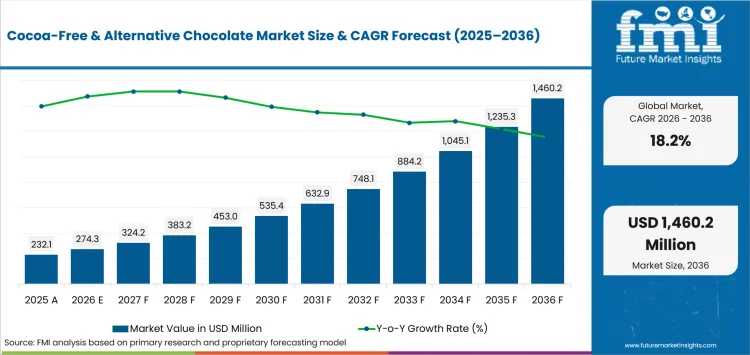
USD 274.3 million in 2026 and USD 1460.2 million by 2036 at an 18.2% CAGR.
Demand for cocoa-free and alternative chocolate is projected to expand at an 18.2% CAGR between 2026 and 2036. The industry valuation is expected to rise from USD 274.3 million in 2026 to USD 1460.2 million by 2036 as manufacturers reduce cocoa supply exposure without rebuilding production lines. The International Cocoa Organization estimated a 48 thousand tonne cocoa surplus for 2024/25 in May 2026, but the reversal from the previous deficit keeps dual-source qualification relevant. Formulators compare cocoa butter inputs with alternative fats and masses on delivered cost and melt behavior before approving recurring orders.
Local price pressure and application qualification shape country conversion independently of small differences in forecast pace across profiled markets. Insee placed France’s harmonized chocolate and cocoa consumer-price index at 105.74 in May 2026 against a 2025 base of 100, keeping cost pressure visible during reformulation decisions. Germany and the Netherlands offer dense chocolate-processing networks, whereas the USA and UK require separate naming or technical review. Cocoa-free ingredient developers that document food flavor systems and plant compatibility can shorten trials across these different routes.
Key Takeaways of Cocoa-Free & Alternative Chocolate Market
- Cocoa volatility gives manufacturers a reason to qualify alternatives that preserve familiar processing and reduce dependence on conventional cocoa inputs.
- In 2026, fermentation is expected to lead technology with 53.9% share because controlled processing builds chocolate-like flavor from non-cocoa feedstocks.
- The product category is forecast to be led by cocoa-free chocolate at 58.7% share in 2026 due to direct substitution in established formulations.
- Confectionery is set to lead the application category with 45.6% share in 2026 owing to concentrated sensory requirements across bars and coatings.
- Sensory parity and naming compliance can extend qualification cycles as manufacturers require repeatable line performance before alternatives enter regular production.
- Döhler, Nukoko, Planet A Foods, Voyage Foods, Cargill, WNWN Food Labs, Foreverland and California Cultured are active across the profiled competitive field.
Analyst Perspective
"Food manufacturers should compare cocoa-free ingredients on flavor stability and melt behavior under their own line conditions before discussing scale. Repeat business favors developers that pair plant-trial evidence with dependable volume and clear naming guidance for each target market."
- Nandini Roy Choudhury, Principal Consultant, Future Market Insights
How is the Cocoa-Free & Alternative Chocolate Market segmented?
The cocoa-free & alternative chocolate market is segmented by technology, product, application and region.
The cocoa-free and alternative chocolate market is segmented by technology, product, application and region for global analysis. Technology includes fermentation, upcycled seeds and precision pathways, while product covers cocoa-free chocolate and compound formats. Application includes confectionery, bakery and ice cream, and region follows the standard FMI country taxonomy used throughout the report.
How does confectionery hold the leading application position?
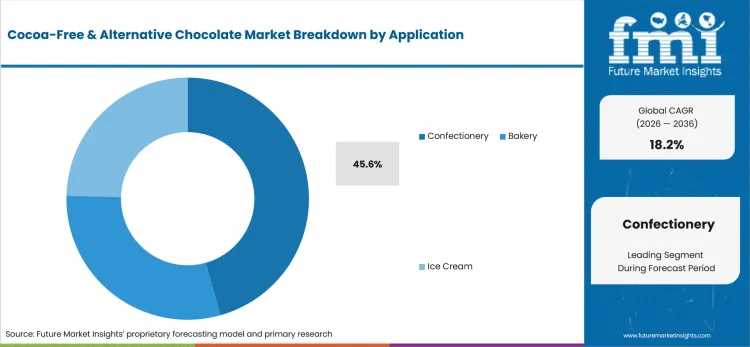
Confectionery concentrates the snap and coating behavior that alternatives must reproduce in visible consumer formats. Bars and coated wafers expose flavor and melt differences directly, making confectionery ingredients a demanding application-testing route.
- By application, confectionery is forecast to represent 45.6% in 2026 driven by bars and coatings that convert chocolate functionality directly into ingredient demand. Planet A Foods reported in March 2026 that Nestlé Germany planned three ChoViva-coated Choco Crossies varieties for an April launch.
- Manufacturers require stable depositing performance and sensory acceptance across repeated production runs before seasonal confectionery trials develop into routine supply programs.
What makes fermentation central to the technology category?
Fermentation converts grains and legumes into flavor-building bases that can enter familiar chocolate finishing steps without changing downstream equipment. Martin Braun reported in June 2025 that two WNWN products made with fermented ingredients entered Germany’s professional bakery market. Their 1:1 couverture processing gives German bakers direct evidence that fermented ingredient systems can fit established production workflows.
- By technology, fermentation is estimated to hold 53.9% in 2026 owing to controlled roasting and flavor development from non-cocoa feedstocks.
- Manufacturers also test color and melt behavior on customer equipment since fermentation alone does not determine finished-product performance at industrial scale.
Why does cocoa-free chocolate lead the product category?
Cocoa-free chocolate lets manufacturers test a full replacement against conventional chocolate without redesigning the finished product. Liquid masses and chip formats let formulators use plant-based ingredient platforms with familiar mixing, depositing and coating steps.
- Based on product, cocoa-free chocolate is projected to account for 58.7% in 2026 due to full-replacement formats reducing direct cocoa dependence.
- Planet A Foods reported in November 2025 that ChoViva was produced at scale in more than 70 products across more than eight countries. That footprint gives food manufacturers evidence that full-replacement formats can progress from pilot batches to repeat production across several markets.
What are the drivers, restraints and opportunities in the Cocoa-Free & Alternative Chocolate Market?
Cocoa-supply volatility pushes manufacturers to qualify alternatives, while sensory and naming requirements delay conversion and drop-in formats provide the clearest route to scale.
- Driver: Manufacturers qualify alternative ingredients to reduce exposure to cocoa availability and pricing changes across recurring confectionery production.
- Restraint: Products must clear sensory and legal naming requirements prior to customer trials that could convert into routine purchasing.
- Opportunity: Drop-in masses and compounds scale faster by fitting existing coating and bakery equipment without major capital changes.
Cocoa Volatility Raises the Value of Dual Sourcing
Cocoa price and availability swings make dual sourcing more relevant for confectionery manufacturers that depend on stable ingredient costs. The International Cocoa Organization reported a 494 thousand tonne deficit for 2023/24 in August 2025, keeping supply risk central during cocoa powder alternatives qualification. Alternative ingredients must then pass cost and sensory checks before manufacturers include them in approved formulations.
Naming and Sensory Tests Extend Qualification
Legal product names and sensory performance impose separate approval gates between technical samples and recurring commercial orders. In July 2026, the Food Standards Agency found labelling issues in 17 of 40 sampled chocolate bars, With ten products failing the legal chocolate definition. Food manufacturers therefore require distinct naming plus melt and shelf-life data before adding cocoa-free food coating ingredients to routine production.
Drop-In Formats Reduce Manufacturing Disruption
Food manufacturers can test cocoa-free masses within existing bakery ingredient lines without installing a separate processing system. Foreverland expanded its cocoa-free portfolio in June 2026 with confectionery and bakery formats, adding another route for industrial plant trials. Liquid and drop formats also extend testing into frozen dessert applications, but viscosity and flavor still require plant-level validation.
Which country CAGRs are profiled in the Cocoa-Free & Alternative Chocolate Market?
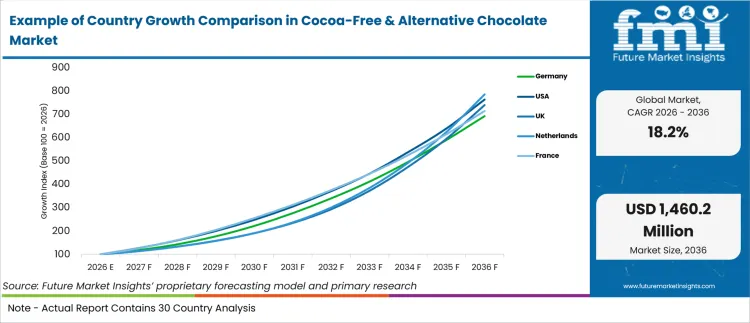
| Country | CAGR |
|---|---|
| Netherlands | 23.0% |
| USA | 22.6% |
| UK | 22.2% |
| France | 21.8% |
| Germany | 21.4% |
How do country-level CAGRs compare in the Cocoa-Free & Alternative Chocolate Market?
The 1.6 percentage-point spread forms a narrow overall forecast band with the Netherlands and USA as an upper pair. Ingredient access and manufacturing scale can shorten qualification in those markets. UK and France remain close to the upper pair and Germany’s established processing base raises the proof required for substitution.
- Netherlands combines cocoa trading with short cross-border sampling routes for manufacturers.
- USA rewards formulators that manage specification review across multi-plant food networks.
- UK conversion depends on naming review and imported-input economics before production approval.
- France uses seasonal confectionery launches to validate alternative ingredient performance publicly.
- Germany requires strong process evidence as established chocolate manufacturing raises expectations.
CAGR measures expansion pace and does not measure current revenue, leaving qualification costs as the practical separator.
The full report provides country-level CAGR analysis across North America, Latin America, Europe, East Asia, South Asia, Oceania and the Middle East and Africa.
Country-wise Analysis
- Cocoa-free ingredients already have documented commercial availability in the Netherlands, giving food manufacturers a local route to sample alternatives for confectionery and bakery programs without waiting for a first national market launch. Planet A Foods reported in September 2025 that ChoViva was available in the Netherlands within a commercial footprint exceeding 70 products across eight countries, confirming supply had moved beyond isolated pilot programs. Cocoa-free and alternative chocolate demand in the Netherlands is forecast to rise at 23.0% CAGR over the forecast period, but manufacturers must validate viscosity and flavor across varied finished-product specifications before multi-format programs convert into repeat orders.
- Branded-food manufacturers route ingredient changes through specification review and multi-plant trials so plant-level application data must clear production approval across national bakery and confectionery programs with separate signoff across major manufacturing sites and regional plants. The USA cocoa-free and alternative chocolate sector is projected to record 22.6% CAGR during the assessment period, aided by large manufacturing networks and established ingredient distribution across major customer regions. Cargill and Voyage Foods announced in May 2026 that NextCoa would launch first in the United States for bakery and confectionery applications, but standards-of-identity and quality review can lengthen recurring-volume approval across national accounts.
- Domestic cocoa-free production gives manufacturers an alternative to imported trials, but professional bakery and private-label programs still require plant testing across familiar equipment and customer specifications before routine repeat ordering at scale. Oetker Collection reported in July 2025 that WNWN Food Labs’ Win-Win business closed £3 million in Series A funding for UK growth and new product lines, extending domestic development capacity for commercial customers. Cocoa-free and alternative chocolate sales in the UK are forecast to expand at 22.2% CAGR by 2036, but naming review and sensory expectations can delay repeat purchasing across national customer portfolios after plant qualification.
- Seasonal confectionery programs give manufacturers a visible route to test cocoa-free formulations across supermarkets and specialist retail as established production partners measure consumer response during high-volume promotional periods and recurring seasonal launches nationwide. Adoption of cocoa-free and alternative chocolate in France is estimated to expand at 21.8% CAGR through 2036, aided by established confectionery channels and recurring seasonal product qualification across national retail programs. Planet A Foods reported in March 2025 that Chocolaterie ABTEY launched eight ChoViva-based products across French retail channels, but strong expectations around chocolate identity and sensory quality can lengthen commercial approval for repeat national orders.
- Established bakery processors and professional distribution networks give manufacturers credible trial routes for cocoa-free formulations, but industrial customers expect repeatable melt behavior and detailed application data across several production settings before regular volume approval. Planet A Foods announced in May 2025 that three ChoViva bakery products would become available from BÄKO in June, establishing a professional channel for routine sampling and technical review in Austria. Germany is estimated to post 21.4% CAGR over the forecast period, influenced by industrial qualification capacity as experienced processors require dependable volume and consistent sensory performance across recurring reformulation programs and industrial customer specifications.
Who are the notable companies in the Cocoa-Free & Alternative Chocolate Market?
Döhler, Nukoko, Planet A Foods, Voyage Foods, Cargill, WNWN Food Labs, Foreverland and California Cultured are the notable companies profiled in this market.
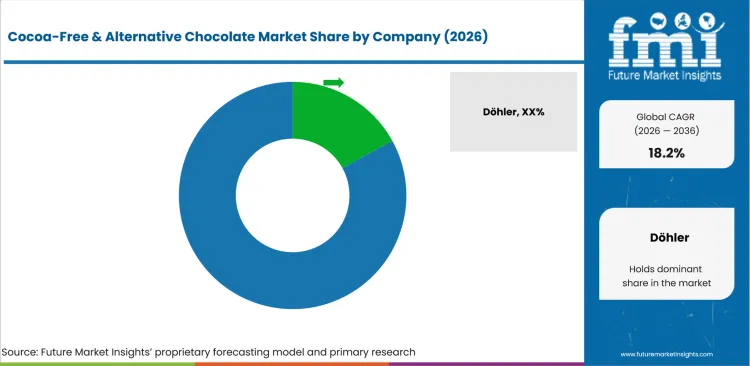
Competition remains fragmented across fermentation, alternative-crop and plant-cell cocoa routes that sit at different commercial stages. Sensory performance and manufacturing proof determine entry and distribution reach separates scaled ingredient platforms from pilot or pre-commercial developers.
- Döhler, Planet A Foods, Voyage Foods and Cargill combine cocoa-free formulation work with B2B distribution or large-scale ingredient channels.
- Nukoko and WNWN Food Labs use fermentation-led flavor development for cocoa-free bakery and confectionery applications that need familiar processing behavior.
- Foreverland uses alternative crop feedstocks and California Cultured develops plant-cell cocoa for manufacturers evaluating precision production routes.
Competitive Benchmarking: Cocoa-Free & Alternative Chocolate Market
| Company | Drop-in Manufacturing Fit | Bioprocess or Feedstock Differentiation | Commercial Scale Evidence | Geographic Reach |
|---|---|---|---|---|
| Döhler | High | High | Medium | Global ingredient network with European cocoa-free integration |
| Nukoko | High | High | Medium | United Kingdom with wider ingredient-market access |
| Planet A Foods | High | High | High | Europe and international commercial channels |
| Voyage Foods | High | High | High | United States and international partner markets |
| Cargill | High | Medium | High | Global including North American cocoa-free distribution |
| WNWN Food Labs | High | High | Medium | United Kingdom and European professional bakery |
| Foreverland | High | High | Medium | Italy and wider European commercial activity |
| California Cultured | Low | High | Low | United States with customer and research partnerships |
Key Developments in the Cocoa-Free & Alternative Chocolate Market
- In June 2026, Döhler acquired Nukoko and added its fava-bean fermentation platform to Döhler’s ingredient development network for confectionery and bakery customers.
- In June 2026, Planet A Foods launched ChoViva No Added Sugar for B2B confectionery and bakery customers seeking cocoa-free formulations with an added sugar-reduction objective.
- In October 2025, Foreverland opened a full-scale Puglia plant with annual capacity for 500 tonnes of cocoa-free chocolate and facilities for industrial customer trials.
Key Players in the Cocoa-Free & Alternative Chocolate Market
Scaled Ingredient and Distribution Platforms
- Döhler
- Planet A Foods
- Voyage Foods
- Cargill
Fermentation-Led Cocoa-Free Specialists
- Nukoko
- WNWN Food Labs
Alternative Feedstock and Cell-Culture Pathways
- Foreverland
- California Cultured
Cocoa-Free & Alternative Chocolate Market - Report Scope
| Coverage field | Report scope |
|---|---|
| Market breakdown | By technology, product, application and region. |
| Quantitative Units | Revenue in USD million and CAGR in %. |
| Market Definition | Commercial cocoa-free and alternative chocolate ingredients or compounds sold for food manufacturing within the defined technology, product and application segments. |
| Regions Covered | North America, Latin America, Europe, East Asia, South Asia and Pacific and Middle East and Africa. |
| Countries Covered | Netherlands, USA, UK, France, Germany, and 20+ countries included in the full report. |
| Key Companies Profiled | Döhler, Nukoko, Planet A Foods, Voyage Foods, Cargill, WNWN Food Labs, Foreverland, California Cultured. |
| Forecast Period | 2026 to 2036. |
| Approach | Primary and secondary research with market triangulation. |
Cocoa-Free & Alternative Chocolate Market - Research Methodology
| Method | Approach |
|---|---|
| Primary Research | FMI analysts gathered input from manufacturers, service providers, technology developers, distributors, end users, procurement teams, and subject-matter experts. Interviews examined purchasing decisions, product or service evaluation, adoption barriers, approval requirements, pricing considerations, and expectations for technical or commercial support. Respondents were also asked what evidence is required before a trial, pilot, or initial order develops into regular purchasing. |
| Desk Research | Desk research covered government statistics, regulatory publications, trade data, industry associations, technical literature, standards, company filings, product information, and official corporate announcements. Sources were reviewed for relevance, publication date, geographic coverage, and consistency with the defined market scope. Claims relating to performance, applications, approvals, capacity, investment, and commercial activity were retained only when supported by credible public evidence. |
| Market Sizing and Forecasting | The market model combined the baseline value with historical performance, segment structure, pricing and volume indicators, adoption levels, company participation, and country-level demand conditions. Forecast assumptions considered economic activity, investment trends, regulatory developments, technology adoption, purchasing cycles, supply availability, and barriers to wider market use. Segment and regional estimates were reconciled before the final market total was calculated. |
| Data Validation | Estimates were checked against multiple independent indicators, including public data, company activity, trade patterns, industry developments, and findings from primary interviews. Validation also tested whether products, services, applications, and company revenues fell within the defined market boundaries. Adjacent categories, unsupported claims, overlapping revenues, and activities without direct market relevance were excluded to reduce double counting and maintain consistency across segments and countries. |
Cocoa-Free & Alternative Chocolate Market by Segments
Cocoa-Free & Alternative Chocolate Market segmented by Technology:
- Fermentation
- Upcycled Seeds
- Precision
Cocoa-Free & Alternative Chocolate Market segmented by Product:
- Cocoa-free Chocolate
- Compound
Cocoa-Free & Alternative Chocolate Market segmented by Application:
- Confectionery
- Bakery
- Ice Cream
Cocoa-Free & Alternative Chocolate Market by Region:
- North America
- United States
- Canada
- Latin America
- Brazil
- Mexico
- Chile
- Rest of Latin America
- Western Europe
- Germany
- United Kingdom
- Italy
- Spain
- France
- Nordics
- Benelux
- Rest of Western Europe
- Eastern Europe
- Russia
- Poland
- Hungary
- Balkan and Baltic States
- Rest of Eastern Europe
- East Asia
- China
- Japan
- South Korea
- South Asia and Pacific
- India
- ASEAN
- Australia and New Zealand
- Rest of South Asia and Pacific
- Middle East and Africa
- Kingdom of Saudi Arabia
- Other GCC Countries
- Türkiye
- South Africa
- Other African Union Countries
- Rest of Middle East and Africa
Research Sources and Bibliography
- International Cocoa Organization. (2026, May 29). May 2026 Quarterly Bulletin of Cocoa Statistics.
- Insee. (2026, June 12). Indice des prix à la consommation harmonisé - Base 2025 - Ensemble des ménages - France - Nomenclature Coicop : 01.1.8.5 - Chocolat, cacao et produits alimentaires à base de cacao (ND).
- Martin Braun-Gruppe. (2025, June 3). Martin Braun setzt auf kakaofreie Alternative zu Schokolade.
- Planet A Foods. (2025, November 5). Barry Callebaut and Planet A Foods Partner to Pioneer Sustainable Chocolate Alternatives Without Cocoa.
- Planet A Foods. (2026, March 5). Nestlé Partnership.
- International Cocoa Organization. (2025, August 29). August 2025 Quarterly Bulletin of Cocoa Statistics.
- Food Standards Agency, Scarrett, A., Cooke, S., & Bachelor, J. (2026, July 2). Retail Surveillance Survey Sampling Programme 2025/26.
- Foreverland Food. (2026, June 16). Foreverland Expands Portfolio with new Functional Line.
- Planet A Foods. (2025, September 17). ChoViva in Asia.
- Cargill. (2026, May 12). Cargill and Voyage Foods to bring NextCoa™ cocoa-free confectionery alternatives to North America.
- Oetker Collection. (2025, July 23). WIN-WIN raises £3 million in Series A funding round - Oetker Collection continues to invest in cocoa-free chocolate alternative.
- Planet A Foods. (2025, March 25). ChoViva Easter Launch.
- Planet A Foods. (2025, May 8). Zukunftsweisende Partnerschaft.
- Gautam, N. (2026, May 11). Could Cultured Chocolate Unlock the Next Food Revolution?
- Döhler. (2026, June 18). Döhler Acquires Nukoko and Accelerates Cocoa-Free Chocolate Alternative Innovation.
- Planet A Foods. (2026, June 25). ChoViva No Added Sugar.
- Foreverland Food. (2026, March 25). Italy’s Foreverland Raises $7M to Sweeten the Deal for Cocoa-Free Chocolate.
This bibliography is provided for reader reference and is not exhaustive. The full report contains the complete reference list and detailed citations
This Report Answers
- What are the cocoa-free & alternative chocolate market values in 2026 and 2036?
- Which cocoa-supply conditions lead manufacturers to qualify alternative chocolate ingredients?
- Why does fermentation account for the largest technology share in 2026?
- How does cocoa-free chocolate reduce direct exposure to conventional cocoa inputs?
- Why does confectionery represent the largest application share in 2026?
- How do forecast CAGRs compare across the five profiled countries?
- Which commercial routes distinguish the eight profiled cocoa-free and alternative chocolate companies?
- What sensory and naming requirements can delay conversion from trials to repeat orders?
- What should manufacturers compare before approving cocoa-free ingredients for regular production?
Frequently Asked Questions
How big is the Cocoa-Free & Alternative Chocolate Market in 2026?
The cocoa-free & alternative chocolate market is expected to be valued at USD 274.3 million in 2026. Manufacturers are testing alternatives that reduce cocoa exposure without requiring a separate production system.
What is the CAGR of the Cocoa-Free & Alternative Chocolate Market from 2026 to 2036?
The cocoa-free & alternative chocolate market is projected to expand at an 18.2% CAGR from 2026 to 2036. Cocoa supply risk and wider commercial trials are expanding the use of alternatives that retain familiar processing behavior.
Which technology is projected to account for 53.9% of the Cocoa-Free & Alternative Chocolate Market?
The cocoa-free & alternative chocolate market is estimated to record fermentation at 53.9% of technology demand in 2026. Controlled fermentation builds chocolate-like flavor from non-cocoa feedstocks and retains familiar finishing steps used by industrial confectionery lines.
Which product segment is projected to hold a leading share of the Cocoa-Free & Alternative Chocolate Market?
The cocoa-free & alternative chocolate market is estimated to record cocoa-free chocolate at 58.7% of product demand in 2026. Full-replacement formats let manufacturers reduce cocoa dependence and retain established finished-product designs with familiar processing steps.
Which companies are active in the Cocoa-Free & Alternative Chocolate Market?
The cocoa-free & alternative chocolate market includes Döhler, Nukoko, Planet A Foods, Voyage Foods, Cargill, WNWN Food Labs, Foreverland and California Cultured. Their roles span scaled distribution, fermentation, alternative feedstocks and plant-cell cultivation across different commercial stages.
Preview the report firsthand - request a free sample
Get SampleGet the brochure for pricing and purchase details.
Get PDFTable of Content
- Key Takeaways
- Market Size and CAGR
- Top Growth Driver
- Fastest Growing Segment
- Leading Region
- Key Companies
- Emerging Opportunities
- Executive Summary
- Global Market Outlook
- Demand-side Trends
- Supply-side Trends
- Technology Roadmap Analysis
- Analysis and Recommendations
- Analyst Perspective (What is happening? Why now? What should investors know?)
- Key Questions Answered
- How large is the market?
- What is the CAGR?
- What are key trends?
- Which region dominates?
- Who are the leaders?
- Market Overview
- Market Coverage / Taxonomy
- Market Definition / Scope / Limitations
- Research Methodology
- Chapter Orientation
- Analytical Lens and Working Hypotheses
- Market Structure, Signals, and Trend Drivers
- Benchmarking and Cross-market Comparability
- Market Sizing, Forecasting, and Opportunity Mapping
- Research Design and Evidence Framework
- Desk Research Programme (Secondary Evidence)
- Expert Input and Fieldwork (Primary Evidence)
- Tooling, Models, and Reference Databases
- Data Engineering and Model Build
- Quality Assurance and Audit Trail
- Market Background
- Market Dynamics (Drivers, Restraints, Opportunity, Trends)
- Scenario Forecast (Optimistic, Likely, Conservative)
- Impact Analysis
- AI Impact
- Sustainability Impact
- Regulatory Impact
- Technology Impact
- Consumer / Buyer Analysis
- Purchase Drivers
- Adoption Barriers
- Buyer Journey
- Opportunity Map Analysis
- Product Life Cycle Analysis
- Supply Chain Analysis
- Investment Feasibility Matrix
- Value Chain Analysis
- PESTLE and Porter's Analysis
- Regulatory Landscape
- Regional Parent Market Outlook
- Production and Consumption Statistics
- Import and Export Statistics
- Global Market Analysis and Forecast, 2021 to 2036
- Historical Market Size Value (USD Million) Analysis, 2021 to 2025
- Current and Future Market Size Value (USD Million) Projections, 2026 to 2036
- Y-o-Y Growth Trend Analysis
- Absolute $ Opportunity Analysis
- Global Market Pricing Analysis, 2021 to 2036
- Global Market Analysis and Forecast, By Technology, 2021 to 2036
- Introduction / Key Findings
- Historical Market Size Value (USD Million) Analysis By Technology, 2021 to 2025
- Current and Future Market Size Value (USD Million) Analysis and Forecast By Technology, 2026 to 2036
- Fermentation
- Upcycled Seeds
- Precision
- Fermentation
- Y-o-Y Growth Trend Analysis By Technology, 2021 to 2025
- Absolute $ Opportunity Analysis By Technology, 2026 to 2036
- Global Market Analysis and Forecast, By Product, 2021 to 2036
- Introduction / Key Findings
- Historical Market Size Value (USD Million) Analysis By Product, 2021 to 2025
- Current and Future Market Size Value (USD Million) Analysis and Forecast By Product, 2026 to 2036
- Cocoa-free Chocolate
- Compound
- Cocoa-free Chocolate
- Y-o-Y Growth Trend Analysis By Product, 2021 to 2025
- Absolute $ Opportunity Analysis By Product, 2026 to 2036
- Global Market Analysis and Forecast, By Application, 2021 to 2036
- Introduction / Key Findings
- Historical Market Size Value (USD Million) Analysis By Application, 2021 to 2025
- Current and Future Market Size Value (USD Million) Analysis and Forecast By Application, 2026 to 2036
- Confectionery
- Bakery
- Ice Cream
- Confectionery
- Y-o-Y Growth Trend Analysis By Application, 2021 to 2025
- Absolute $ Opportunity Analysis By Application, 2026 to 2036
- Global Market Analysis and Forecast, By Region, 2021 to 2036
- Introduction
- Historical Market Size Value (USD Million) Analysis By Region, 2021 to 2025
- Current Market Size Value (USD Million) Analysis and Forecast By Region, 2026 to 2036
- North America
- Latin America
- Western Europe
- Eastern Europe
- East Asia
- South Asia and Pacific
- Middle East & Africa
- Market Attractiveness Analysis By Region
- North America Market Analysis and Forecast, By Country, 2021 to 2036
- Historical Market Size Value (USD Million) Trend Analysis By Market Taxonomy, 2021 to 2025
- Market Size Value (USD Million) Forecast By Market Taxonomy, 2026 to 2036
- By Country
- USA
- Canada
- By Technology
- By Product
- By Application
- By Country
- Market Attractiveness Analysis
- By Country
- By Technology
- By Product
- By Application
- Key Takeaways
- Latin America Market Analysis and Forecast, By Country
- Historical Market Size Value (USD Million) Trend Analysis By Market Taxonomy, 2021 to 2025
- Market Size Value (USD Million) Forecast By Market Taxonomy, 2026 to 2036
- By Country
- Brazil
- Mexico
- Chile
- Rest of Latin America
- By Technology
- By Product
- By Application
- By Country
- Market Attractiveness Analysis
- By Country
- By Technology
- By Product
- By Application
- Key Takeaways
- Western Europe Market Analysis and Forecast, By Country
- Historical Market Size Value (USD Million) Trend Analysis By Market Taxonomy, 2021 to 2025
- Market Size Value (USD Million) Forecast By Market Taxonomy, 2026 to 2036
- By Country
- Germany
- UK
- Italy
- Spain
- France
- Nordic
- BENELUX
- Rest of Western Europe
- By Technology
- By Product
- By Application
- By Country
- Market Attractiveness Analysis
- By Country
- By Technology
- By Product
- By Application
- Key Takeaways
- Eastern Europe Market Analysis and Forecast, By Country
- Historical Market Size Value (USD Million) Trend Analysis By Market Taxonomy, 2021 to 2025
- Market Size Value (USD Million) Forecast By Market Taxonomy, 2026 to 2036
- By Country
- Russia
- Poland
- Hungary
- Balkan & Baltic
- Rest of Eastern Europe
- By Technology
- By Product
- By Application
- By Country
- Market Attractiveness Analysis
- By Country
- By Technology
- By Product
- By Application
- Key Takeaways
- East Asia Market Analysis and Forecast, By Country
- Historical Market Size Value (USD Million) Trend Analysis By Market Taxonomy, 2021 to 2025
- Market Size Value (USD Million) Forecast By Market Taxonomy, 2026 to 2036
- By Country
- China
- Japan
- South Korea
- By Technology
- By Product
- By Application
- By Country
- Market Attractiveness Analysis
- By Country
- By Technology
- By Product
- By Application
- Key Takeaways
- South Asia and Pacific Market Analysis and Forecast, By Country
- Historical Market Size Value (USD Million) Trend Analysis By Market Taxonomy, 2021 to 2025
- Market Size Value (USD Million) Forecast By Market Taxonomy, 2026 to 2036
- By Country
- India
- ASEAN
- Australia & New Zealand
- Rest of South Asia and Pacific
- By Technology
- By Product
- By Application
- By Country
- Market Attractiveness Analysis
- By Country
- By Technology
- By Product
- By Application
- Key Takeaways
- Middle East & Africa Market Analysis and Forecast, By Country
- Historical Market Size Value (USD Million) Trend Analysis By Market Taxonomy, 2021 to 2025
- Market Size Value (USD Million) Forecast By Market Taxonomy, 2026 to 2036
- By Country
- Kingdom of Saudi Arabia
- Other GCC Countries
- Türkiye
- South Africa
- Other African Union
- Rest of Middle East & Africa
- By Technology
- By Product
- By Application
- By Country
- Market Attractiveness Analysis
- By Country
- By Technology
- By Product
- By Application
- Key Takeaways
- Key Countries Market Analysis
- USA
- Pricing Analysis
- Market Share Analysis, 2025
- By Technology
- By Product
- By Application
- Canada
- Pricing Analysis
- Market Share Analysis, 2025
- By Technology
- By Product
- By Application
- Mexico
- Pricing Analysis
- Market Share Analysis, 2025
- By Technology
- By Product
- By Application
- Brazil
- Pricing Analysis
- Market Share Analysis, 2025
- By Technology
- By Product
- By Application
- Chile
- Pricing Analysis
- Market Share Analysis, 2025
- By Technology
- By Product
- By Application
- Germany
- Pricing Analysis
- Market Share Analysis, 2025
- By Technology
- By Product
- By Application
- UK
- Pricing Analysis
- Market Share Analysis, 2025
- By Technology
- By Product
- By Application
- Italy
- Pricing Analysis
- Market Share Analysis, 2025
- By Technology
- By Product
- By Application
- Spain
- Pricing Analysis
- Market Share Analysis, 2025
- By Technology
- By Product
- By Application
- France
- Pricing Analysis
- Market Share Analysis, 2025
- By Technology
- By Product
- By Application
- India
- Pricing Analysis
- Market Share Analysis, 2025
- By Technology
- By Product
- By Application
- ASEAN
- Pricing Analysis
- Market Share Analysis, 2025
- By Technology
- By Product
- By Application
- Australia & New Zealand
- Pricing Analysis
- Market Share Analysis, 2025
- By Technology
- By Product
- By Application
- China
- Pricing Analysis
- Market Share Analysis, 2025
- By Technology
- By Product
- By Application
- Japan
- Pricing Analysis
- Market Share Analysis, 2025
- By Technology
- By Product
- By Application
- South Korea
- Pricing Analysis
- Market Share Analysis, 2025
- By Technology
- By Product
- By Application
- Russia
- Pricing Analysis
- Market Share Analysis, 2025
- By Technology
- By Product
- By Application
- Poland
- Pricing Analysis
- Market Share Analysis, 2025
- By Technology
- By Product
- By Application
- Hungary
- Pricing Analysis
- Market Share Analysis, 2025
- By Technology
- By Product
- By Application
- Kingdom of Saudi Arabia
- Pricing Analysis
- Market Share Analysis, 2025
- By Technology
- By Product
- By Application
- Türkiye
- Pricing Analysis
- Market Share Analysis, 2025
- By Technology
- By Product
- By Application
- South Africa
- Pricing Analysis
- Market Share Analysis, 2025
- By Technology
- By Product
- By Application
- USA
- Market Structure Analysis
- Competition Dashboard
- Competition Benchmarking
- Market Share Analysis of Top Players
- By Regional
- By Technology
- By Product
- By Application
- Emerging Startups
- Innovation Benchmarking
- Competition Analysis
- Competition Deep Dive
- Döhler
- Overview
- Product Portfolio
- Profitability by Market Segments
- Sales Footprint
- Strategy Overview
- Marketing Strategy
- Product Strategy
- Channel Strategy
- Nukoko
- Planet A Foods
- Voyage Foods
- WNWN Food Labs
- Foreverland
- California Cultured
- Döhler
- Case Studies
- Success Stories
- Recent Developments
- Competition Deep Dive
- Assumptions & Acronyms Used


