

- Market Size (2026)
- USD 492.6 Mn
- Forecast (2036)
- USD 1361.4 Mn
- CAGR (2026 to 2036)
- 10.7%
How big is the Colored Grain & Botanical Color-Carrier Ingredients Market in 2026?
USD 492.6 million in 2026 and USD 1,361.4 million by 2036 at a 10.7% CAGR.
Sales in colored grain & botanical color-carrier ingredients market are forecast to rise from USD 492.6 million in 2026 to USD 1,361.4 million by 2036 at a 10.7% CAGR shaped by reformulation and botanical color adoption. Food manufacturers are evaluating plant-based food colors as reformulation programs reduce selected petroleum-derived dyes without sacrificing familiar product appearance. The FDA stated in July 2025 that manufacturers could accelerate Red No. 3 replacement through approved alternatives derived from fruits and vegetables. Colored grains provide a direct route for snacks and tortillas because pigmentation enters through an ingredient already serving structural and flavor functions.
European commercialization follows a different decision path because additive authorization and labeling depend on the ingredient function and permitted conditions. The European Commission explains that authorized food additives require a demonstrated technological need and must appear through a functional class plus a specific name or E-number. Manufacturers of natural food colors therefore need application records that distinguish intrinsic grain identity from deliberate coloring use. Local technical support can shorten qualification by aligning extraction conditions and label language with the chosen recipe. The main commercial friction remains pigment stability across pH and heat conditions that can shift anthocyanin hue during production.
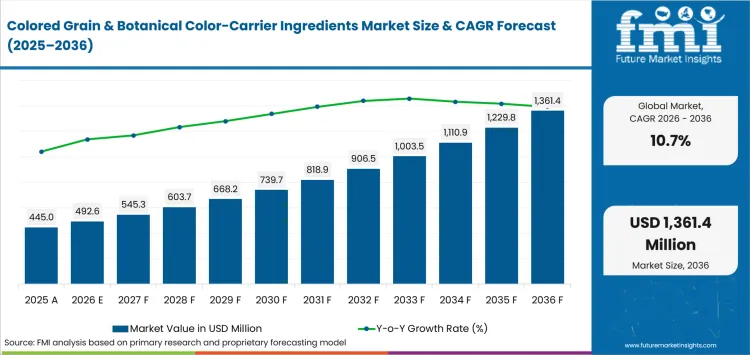
Key Takeaways of Colored Grain & Botanical Color-Carrier Ingredients Market
- Demand for colored grain and botanical color-carrier ingredients is driven by manufacturers replacing selected petroleum-derived dyes and simplifying ingredient statements through reformulation and wider use of naturally colored grains.
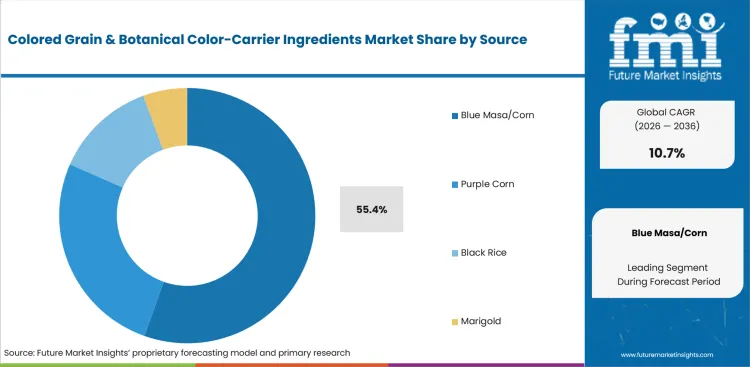
- By source, blue masa/corn holds the leading share at 55.4% in 2026, due to its direct role in colored tortillas and corn snacks.
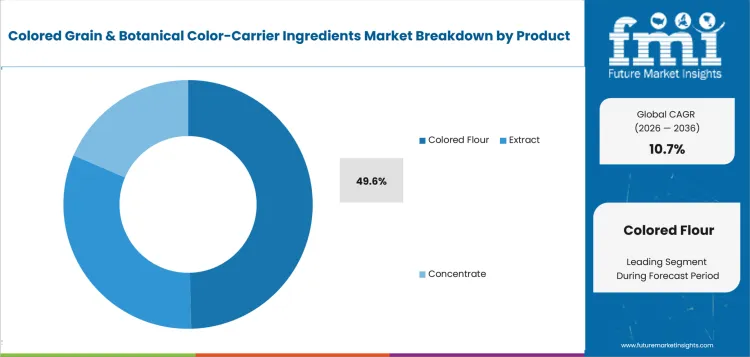
- Colored flour is the dominant product segment, holding 49.6% share in 2026, driven by compatibility with dry batching and familiar storage systems.
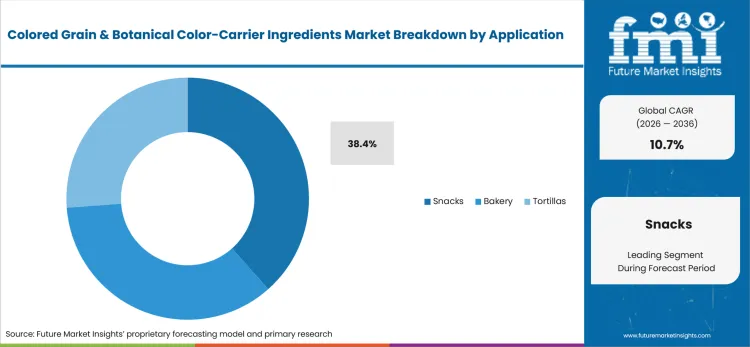
- Snacks account for 38.4% application share in 2026, due to shelf differentiation and common grain bases that support frequent product rotation.
- Regulatory classification remains application-specific and can change documentation requirements for the same botanical source, with recent developments like the FDA's spirulina extract order illustrating how authorization timing shapes which shades enter commercial recipes.
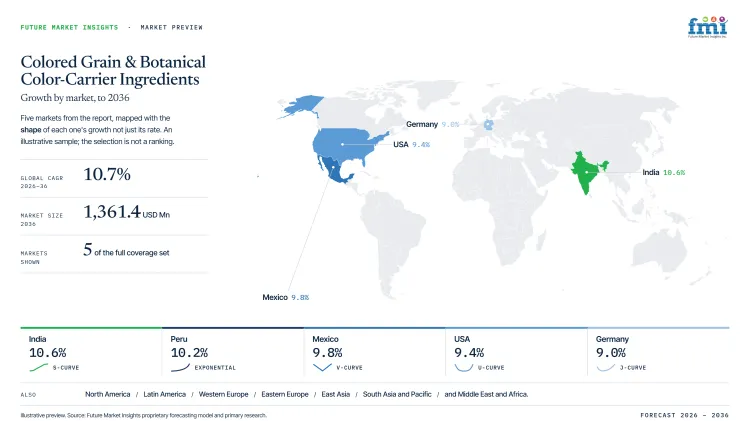
- India, Peru, and Mexico record CAGRs of 10.6%, 10.2%, and 9.8% respectively through 2036, while Germany offers slower forecast growth but provides nearby production and application support for European customers.
- Competition centers on Limagrain Ingredients, Healthy Food Ingredients, GNT, Sensient Technologies, Oterra, Kalsec, ADM, and Döhler, with vendors differentiating through grain sourcing and milling capabilities, broad botanical palettes with stability testing, and multi-format natural-color systems.
Analyst Perspective
The commercial risk with botanical color carriers isn't securing an authorized pigment source but proving it survives the customer's actual thermal process without drifting in hue or affecting flavor neutrality. Milling mesh size and particle specification matter more than source selection alone, since coarser blue corn flour has shown better anthocyanin retention through storage than finer grinds carrying the same pigment. Supply agreements should build in contingency routes for seasonal pigment variation, since a specification that performs in one harvest lot can shift enough by the next delivery to trigger a finished-color mismatch on the retail shelf.
-Nandini Roy Choudhury, Principal Analyst at Future Market Insights
Source: FMI's proprietary forecasting model and primary research
How is the Colored Grain & Botanical Color-Carrier Ingredients Market segmented?
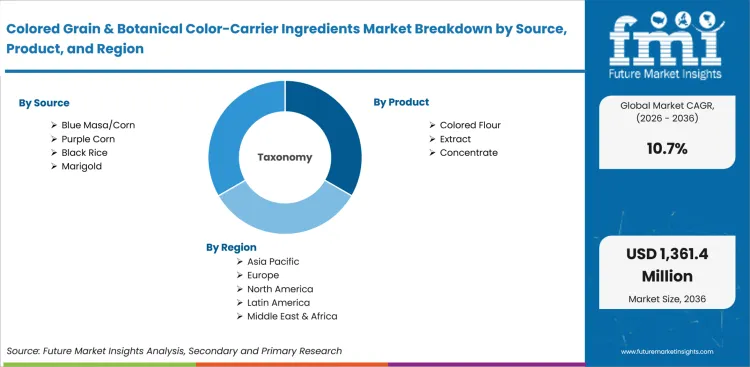
The colored grain and botanical color-carrier ingredients industry is segmented by source, product, application, and region.
The segmentation framework separates agricultural source from sold format and final food use across one commercial chain. Source analysis distinguishes blue masa or corn from purple corn and black rice alongside marigold materials. Product analysis compares colored flour with extract and concentrate formats that require different handling and documentation. Application analysis covers snacks and bakery products together with tortillas that can preserve visible grain identity. Manufacturers using clean-label ingredients assess whether a botanical color can replace a discrete additive without changing flavor or process economics. Regional analysis tracks crop availability and regulatory classification plus access to application support across each country.
Why is blue masa/corn central to the source category?
Blue masa and related colored corn systems enter production through nixtamalized or milled grain workflows instead of separate liquid dosing equipment. A September 2025 Journal of Texture Studies investigation tested extruded nixtamalized blue corn flour across four milling mesh sizes. Coarser flour improved tortilla texture and rollability while retaining more anthocyanin through forty-eight hours of storage. The result makes particle-size control a direct qualification variable for corn flour formats rather than a routine milling specification.
- The source category is forecast to be led by blue masa/corn at 55.4% share in 2026 due to its direct role in colored tortillas and corn snacks. The format combines visible differentiation with a base ingredient that contributes structure and recognizable flavor. Its share position reflects simpler formulation across existing mixing and extrusion lines in commercial food plants.
- Tortilla and snack processors favor blue masa systems that arrive with defined particle size and moisture specifications for existing equipment. Adoption can weaken whenever pigment variation changes finished color across successive commercial production lots and seasonal crop deliveries. Ingredient manufacturers should connect crop controls with milling records and application testing before routine purchasing begins.
How is colored flour positioned within the product category?
Colored flour must retain pigment and predictable starch behavior through extrusion before processors can scale dry-format applications. Thermal processing can alter color intensity and dough behavior differently across several pigmented grain varieties. Bakery ingredient teams therefore need flour specifications that connect pigment source with moisture response and final texture. A stable dry format reduces separate dosing steps, but qualification must reproduce the intended heating profile and storage conditions.
- By product, colored flour is forecast to represent 49.6% share in 2026 driven by compatibility with dry batching and familiar storage systems. The format carries intrinsic pigment through a recognized ingredient and removes separate dosing equipment across established commercial plants. Its position therefore reflects process fit during routine production rather than universal source performance claims.
- An August 2025 study in Innovative Food Science & Emerging Technologies evaluated mild extrusion across four pigmented corn flour phenotypes. The process preserved volatile profiles and anthocyanin stability in red and purple samples while changing starch digestibility across phenotypes. Bakery and snack plants should therefore qualify each flour against the intended thermal process rather than assume comparable performance across colored grains.
What makes snacks central to the application category?
Snack reformulation is gaining new color options, but regulatory timing determines which botanical shades can enter commercial recipes. The FDA issued a February 2026 order that would expand spirulina extract across human foods generally. The agency delayed the order's effective date during March 2026 while evaluating objections to the amendment. The development gives snack teams a wider potential natural-blue route, although current specifications must follow the effective authorization until review concludes. Developers of better-for-you snacks therefore need stability trials and regulatory checks before converting visible concepts into repeatable commercial launches.
- Snacks are set to lead the Application category with 38.4% share in 2026 due to shelf differentiation and common grain bases. Frequent product rotation supports limited launches that test new shades without permanent line changes across regional plants. Distinctive color improves shelf recognition across chips and baked snack assortments during active promotional cycles. The share position depends on repeatable shelf-life performance rather than temporary novelty across retail channels.
- Snack manufacturers adopt botanical color carriers through extrusion and baking trials that compare hue retention against flavor neutrality under full production conditions. Commercial expansion follows shelf-life and packaging tests that confirm oil exposure plus thermal processing will not create unacceptable color changes during distribution across multiple retail channels and product formats.
What are the drivers, restraints, and opportunities in the Colored Grain & Botanical Color-Carrier Ingredients Market?
Reformulation pressure supports demand for botanical color carriers while purity controls and application stability determine the pace of commercial conversion.
- Driver: Food manufacturers need approved alternatives that can replace selected petroleum-derived dyes without weakening familiar product appearance.
- Restraint: Botanical pigments require identity and purity controls plus application testing across heat and pH conditions.
- Opportunity: Integrated grain carriers can combine color with structural functionality across snacks and tortilla formulations.
Regulatory reformulation programs are creating a direct demand driver for approved colors derived from plant sources. The FDA approved three natural-source colors in May 2025 as the agency encouraged manufacturers to expand alternatives to petroleum-derived dyes. The change gives color developers additional formulation options yet each approved source retains specific use conditions. Food companies can use food colors more confidently once color developers connect regulatory status with stability data for the intended application.
Purity and specification controls create a material restraint even for color additives that do not require batch certification. The FDA reminded manufacturers in February 2026 that exempt colors must meet identity and purity specifications plus applicable restrictions. Botanical extracts can carry variable impurities or microbial risk without controlled agricultural sourcing and validated processing conditions. Botanical extract processors must document contaminant limits and solvent conditions before a food manufacturer can approve routine use.
Delivery technology creates an opportunity for ingredient developers that can protect botanical pigments without adding difficult handling steps. Kalsec documents natural-color powders plus patented stabilization and emulsification systems for applications that need dry or dispersible formats. The capability shows how integrated food ingredients can address heat and light exposure through delivery design rather than higher pigment loading. Colored grain specialists can compete by pairing familiar dry carriers with application evidence that limits color drift during scale-up.
Which country CAGRs are profiled in the Colored Grain & Botanical Color-Carrier Ingredients Market?
| Country | CAGR |
|---|---|
| USA | 9.4% |
| Mexico | 9.8% |
| Peru | 10.2% |
| Germany | 9.0% |
| India | 10.6% |
How do country-level CAGRs compare in the Colored Grain & Botanical Color-Carrier Ingredients Market?
The country growth rates span 1.6 percentage points from Germany at 9.0% to India at 10.6%. India stands 0.4 percentage points above Peru and Peru stands the same distance above Mexico. Mexico remains 0.4 percentage points above the USA and the USA holds the same gap over Germany. The narrow spacing makes local approval routes and service coverage more important than small forecast differences during commercial sequencing.
- India and Peru occupy the upper growth band, but their entry routes differ through processing investment and native maize supply.
- Mexico and the USA sit within the central band although their approval routes and technical-service networks differ materially.
- Germany sits 0.4 percentage points below the USA while local production and application support can reduce service distance for qualified customers.
- Country forecasts compare commercialization speed and do not establish absolute revenue or purchasing scale across these economies during commercial planning.
Commercial teams should compare permitted uses and crop sourcing with distributor coverage and technical-service distance before assigning launch resources. Similar CAGRs can produce different payback periods once testing and documentation costs enter the account plan. The full report provides country-level CAGR analysis across seven regions that span the Americas and Europe through Asia and Africa.
Country-wise Analysis
- United States commercialization begins with the FDA listing for each color additive and its permitted food uses. Colored grain and botanical color-carrier ingredient sales in the USA are forecast to expand at a 9.4% CAGR by 2036, supported by reformulation activity and domestic technical capacity. FDA guidance states that certification-exempt colors remain subject to identity and purity specifications plus use restrictions and labeling requirements. GNT lists a United States sales and production site in North Carolina that provides a domestic route for samples and technical support. Domestic production shortens sample and support routes, but each recipe requires an application-specific regulatory review.
- Mexico regulates food colorants through a national additive agreement that defines permitted substances and sanitary conditions. Colored grain and botanical color-carrier ingredient demand in Mexico is forecast to rise at a 9.8% CAGR over the forecast period, influenced by established maize processing and regulatory qualification. CONABIO identifies the Azul maize race as a blue-to-violet grain used for tortillas and pigment extraction. The same official record notes applications in pinole and atole alongside totopos and fried snacks. Native blue maize provides a direct local raw-material route for colored tortilla and snack concepts. Commercial scale remains constrained by crop variation and the need to confirm each coloring use against national additive requirements.
- Peru requires sanitary authorization for food additives and formal registration for industrialized foods sold through domestic channels. DIGESA publishes an authorization procedure for companies that process or fractionate food additives for national commerce. MIDAGRI reported in May 2026 that Peru had 239,000 maize producers during the previous year. Adoption of colored grain and botanical color-carrier ingredients in Peru is estimated to expand at a 10.2% CAGR through 2036, underpinned by local crop knowledge. The producers generated 856,000 tonnes during 2025 and purple corn represented 2% of national output. GNT identifies a distributor in Lima that provides a local ordering route for processors seeking imported botanical colors. Native crop knowledge supports sourcing conversations with processors, yet industrial orders remain sensitive to color specifications across farming regions and harvests.
- Germany places botanical color systems inside a regulated European additive framework with strong documentation and labeling expectations. The German colored grain and botanical color-carrier ingredient sector is projected to record a 9.0% CAGR during the assessment period, shaped by reformulation demand and established technical infrastructure. European Commission rules require authorized additives and defined conditions of use across the European Union. GNT lists German sales and production locations that reduce service distance for formulation trials and supply support. Nearby application support allows German manufacturers to test shade stability before committing volume across multiple recipes. German customers can use local production support during qualification, although legal classification must be confirmed for every commercial use.
- India regulates food colors through national product standards and food-additive rules administered by the Food Safety and Standards Authority of India. The Indian colored grain and botanical color-carrier ingredient outlook is anticipated to advance at a 10.6% CAGR over the assessment period, aided by local blending and application support. FSSAI lists the Food Products Standards and Food Additives Regulations among current quality and safety requirements. Oterra opened a color blending and application center in Kerala during February 2025 for regional customer support. The facility supplies common natural shades locally and supports customers through blending and application laboratories with shorter lead times. Local capability strengthens scale-up for food manufacturers while each recipe must remain within national additive permissions and perform consistently under intended processing conditions.
Who are the notable companies in the Colored Grain & Botanical Color-Carrier Ingredients Market?
Limagrain Ingredients, Healthy Food Ingredients, GNT, Sensient Technologies, Oterra, Kalsec, ADM, and Döhler are the notable companies shaping this market.
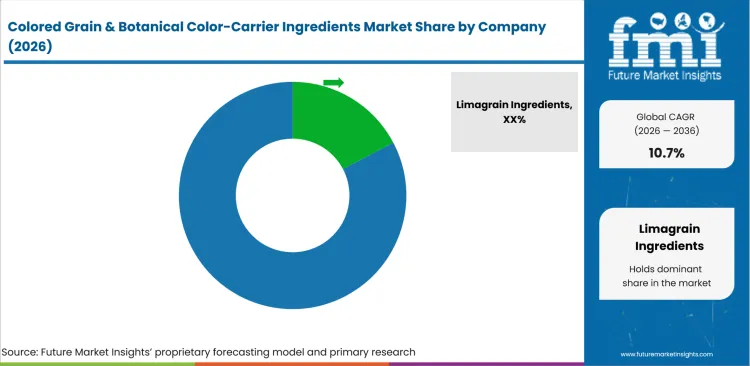
The competitive field combines grain processors with natural-color specialists that control broader botanical portfolios and application services. Limagrain Ingredients and Healthy Food Ingredients support dry grain formats through crop sourcing and milling infrastructure. Sensient documents liquid and powder colors alongside dispersions and granular formats for different manufacturing requirements. GNT and Oterra extend formulation choices through broad botanical source libraries and application services across commercial food categories. Kalsec and ADM support multiple delivery systems while Döhler supplies powder and liquid colors with global application expertise. Several suppliers support food coating ingredients through powders or dispersions for snacks and baked products. Competitive advantage depends on consistent color performance inside each customer’s actual manufacturing process and documented support route.
- Limagrain Ingredients and Healthy Food Ingredients use dry processing routes for functional and colored grain flours. Their documented formats support applications that need familiar grain behavior and controlled particle size during existing production. Commercial differentiation depends on crop specifications and application evidence that connect intrinsic color with finished performance under thermal processing.
- GNT and Sensient compete through broad source libraries and dedicated formulation support across major food categories worldwide. Oterra adds encapsulated colors plus powder and liquid systems for varied food-processing requirements across commercial applications. Their laboratories support shade matching and stability testing beside regulatory documentation during customer formulation and scale-up programs.
- Kalsec and ADM provide broad botanical source libraries with liquid and powder formats for multiple food applications. Döhler adds powder and liquid colors supported by global sourcing and application services across commercial food development programs. Their operating scale can improve supply continuity across multi-site reformulation programs and regional production networks. Smaller grain specialists compete through dry-format functionality and crop-specific knowledge that broader color platforms may not prioritize.
Competitive Benchmarking: Colored Grain & Botanical Color-Carrier Ingredients Market
| Company | Source | Product | Process Integration | Geographic Reach |
|---|---|---|---|---|
| Limagrain Ingredients | Low | Low | High | Europe and selected international markets |
| Healthy Food Ingredients | Medium | High | High | North America |
| GNT | High | High | High | Global |
| Sensient Technologies | High | High | High | Global |
| Oterra | High | High | High | Global |
| Kalsec | High | High | High | Global |
| ADM | High | High | High | Global |
| Döhler | High | Medium | High | Global |
Key Developments in the Colored Grain & Botanical Color-Carrier Ingredients Market
- In January 2026, ADM announced a USD 26 million investment at its Erlanger facility to expand capacity for naturally derived color and flavor solutions. The project adds raw-material handling capabilities along with digital and automated process upgrades intended to improve consistency during scaled reformulation work. The investment increases domestic production support for food and beverage manufacturers that require dependable regional supply and faster application development.
- In April 2026, GNT opened its first dedicated China sales and application office for plant-based EXBERRY colors. The Shanghai laboratory provides formulation support, stability testing, and customer training for local food and beverage manufacturers across major categories. The office reduces reliance on distant regional resources and gives Chinese development teams a local route for color matching and scale-up support.
- In December 2025, GNT opened a Dubai application laboratory to serve the Middle East and Indian subcontinent with color matching and stability testing services. The site provides technical consultations, product demonstrations, and training for formulation teams across regional customer development projects. The expansion shortens service distance for manufacturers that need plant-based color support across varied commercial recipes and distinct local processing conditions.
- In July 2026, Oterra launched liquid versions of Jungle Blue and Arctic Blue for food and beverage applications. The new liquid formats disperse without premixing and reduce powder dust during commercial food and beverage manufacturing. Jungle Blue expands acid-stable options, while Arctic Blue adds a spirulina-based source produced through renewable energy. The launch broadens natural blue delivery choices for manufacturers evaluating handling efficiency and color stability.
Key Players in the Colored Grain & Botanical Color-Carrier Ingredients Market
Colored Grain and Flour Specialists
- Limagrain Ingredients
- Healthy Food Ingredients
Plant-Based Color System Developers
- GNT
- Sensient Technologies
- Oterra
Scaled Botanical Ingredient Suppliers
- Kalsec
- ADM
- Döhler
Colored Grain & Botanical Color-Carrier Ingredients Market - Report Scope
| Coverage field | Report scope |
|---|---|
| Market breakdown | Source, product, application, and region. |
| Quantitative Units | USD Million, CAGR in %. |
| Market Definition | Revenue from colored grain flours and botanical color carriers sold for direct use in food formulation. The scope includes named source and product formats that provide visible color through grain or plant materials and excludes unrelated synthetic colorants. |
| Regions Covered | North America, Latin America, Western Europe, Eastern Europe, East Asia, South Asia and Pacific, and Middle East and Africa. |
| Countries Covered | USA, Mexico, Peru, Germany, India, plus more than twenty-five additional countries across the regions covered. |
| Key Companies Profiled | Limagrain Ingredients, Healthy Food Ingredients, GNT, Sensient Technologies, Oterra, Kalsec, ADM, and Döhler. |
| Forecast Period | 2026 to 2036. |
| Approach | Hybrid bottom-up and top-down market sizing supported by primary interviews and official desk research. |
Colored Grain & Botanical Color-Carrier Ingredients Market - Research Methodology
| Method | Approach |
|---|---|
| Primary Research | FMI analysts gathered input from manufacturers, service providers, technology developers, distributors, end users, procurement teams, and subject-matter experts. Interviews examined purchasing decisions, product or service evaluation, adoption barriers, approval requirements, pricing considerations, and expectations for technical or commercial support. Respondents were also asked what evidence is required before a trial, pilot, or initial order develops into regular purchasing. |
| Desk Research | Desk research covered government statistics, regulatory publications, trade data, industry associations, technical literature, standards, company filings, product information, and official corporate announcements. Sources were reviewed for relevance, publication date, geographic coverage, and consistency with the defined market scope. Claims relating to performance, applications, approvals, capacity, investment, and commercial activity were retained only when supported by credible public evidence. |
| Market Sizing and Forecasting | The market model combined the baseline value with historical performance, segment structure, pricing and volume indicators, adoption levels, company participation, and country-level demand conditions. Forecast assumptions considered economic activity, investment trends, regulatory developments, technology adoption, purchasing cycles, supply availability, and barriers to wider market use. Segment and regional estimates were reconciled before the final market total was calculated. |
| Data Validation | Estimates were checked against multiple independent indicators, including public data, company activity, trade patterns, industry developments, and findings from primary interviews. Validation also tested whether products, services, applications, and company revenues fell within the defined market boundaries. Adjacent categories, unsupported claims, overlapping revenues, and activities without direct market relevance were excluded to reduce double counting and maintain consistency across segments and countries. |
Colored Grain & Botanical Color-Carrier Ingredients Market by Segments
Colored Grain & Botanical Color-Carrier Ingredients Market segmented by Source:
- Blue Masa/Corn
- Purple Corn
- Black Rice
- Marigold
Colored Grain & Botanical Color-Carrier Ingredients Market segmented by Product:
- Colored Flour
- Extract
- Concentrate
Colored Grain & Botanical Color-Carrier Ingredients Market segmented by Application:
- Snacks
- Bakery
- Tortillas
Colored Grain & Botanical Color-Carrier Ingredients Market by Region:
- North America
- United States
- Canada
- Latin America
- Brazil
- Mexico
- Argentina
- Chile
- Western Europe
- Germany
- France
- United Kingdom
- Italy
- Spain
- Benelux
- Nordics
- Eastern Europe
- Poland
- Czech Republic
- Romania
- Hungary
- East Asia
- China
- Japan
- South Korea
- South Asia and Pacific
- India
- ASEAN
- Australia and New Zealand
- Middle East and Africa
- GCC Countries
- South Africa
- Türkiye
- Israel
Research Sources and Bibliography
- USA Food and Drug Administration. (2025, May 9). FDA approves three food colors from natural sources.
- USA Food and Drug Administration. (2025, July 14). FDA encourages food manufacturers to accelerate phasing out use of FD&C Red No. 3 in foods ahead of 2027 deadline.
- USA Food and Drug Administration. (2026, February 5). FDA reminds manufacturers of color additives exempt from certification to comply with identity and purity requirements.
- USA Food and Drug Administration. (n.d.). Color additives in foods.
- USA Food and Drug Administration. (2026, July 10). Listing of color additives exempt from certification; spirulina extract.
- European Commission. (2026). Additives.
- European Commission. (n.d.). EU rules - food additives.
- Secretaría de Salud. (2012, July 16). Acuerdo por el que se determinan los aditivos y coadyuvantes en alimentos, bebidas y suplementos alimenticios, su uso y disposiciones sanitarias (Continúa en la Cuarta Sección).
- Comisión Nacional para el Conocimiento y Uso de la Biodiversidad. (2025, July 8). Azul.
- Dirección General de Salud Ambiental e Inocuidad Alimentaria. (n.d.). Requisitos para obtener autorización de comercialización de aditivos.
- Ministerio de Desarrollo Agrario y Riego. (2026, May 5). El maíz peruano conquista el mundo: MIDAGRI celebra a 239 mil productores en su día nacional.
- Food Safety and Standards Authority of India. (n.d.). Product Standards.
- Healthy Food Ingredients. (2020, June 17). Old grains, new formats bring innovation.
- Gerardo-Rodríguez, J. E., Menchaca-Armenta, M., Chan-Higuera, J. E., Montaño-Leyva, B., Ledesma-Osuna, A. I., Silvas García, M. I., Buitimea-Cantúa, N. E., López-Ahumada, G. A., Enríquez-Castro, C. M., & Quintero-Ramos, A. (2025). Exploring the impact of milling on the texture and anthocyanin preservation in tortillas made from extruded nixtamalized blue corn (Zea mays L.) flour. Journal of Texture Studies, 56(5), e70044.
- Limagrain Ingredients. (n.d.). Functional flours.
- Pejcz, E., Tiupova, A., Lachowicz-Wiśniewska, S., Wiśniewski, R., Wojciechowicz-Budzisz, A., & Harasym, J. P. (2025). Mild extrusion enhances bioactive retention and starch digestibility in pigmented corn: Phenotype-dependent effects for functional food development. Innovative Food Science & Emerging Technologies, 104, 104165.
- Healthy Food Ingredients. (n.d.). IntegriPure® Microbial Reduction.
- GNT Group. (n.d.). About EXBERRY.
- GNT Group. (n.d.). Food color manufacturer.
- Sensient Technologies. (n.d.). Infinite Spectrum™ Natural Color Solutions.
- Kalsec. (n.d.). Technology & Delivery Systems.
- ADM. (n.d.). Naturally derived colors for food.
- ADM. (2026, January 15). ADM’s $26M investment in Erlanger facility strengthens capabilities for growing reformulation demand.
- GNT Group. (2026, April 24). GNT announces first dedicated China office for plant-based EXBERRY colors.
- GNT Group. (2025, December 17). GNT expands Middle East operations with new application laboratory for plant-based EXBERRY colors.
- Oterra. (2026, July 7). Oterra launches liquid natural blue colors to give food and beverage brands a broader, brighter choice.
- Oterra. (2025, February 20). New color blending center supports growth of natural alternatives in India, Asia Pacific and Middle East.
- Döhler. (n.d.). Natural colours for the food & beverage industry.
- Döhler. (n.d.). Colors from natural sources.
- Sensient Technologies. (n.d.). Color Formats and Why They Matter.
- Kalsec. (n.d.). Natural Food Coloring Hues & Pigments.
This bibliography is provided for reader reference and is not exhaustive. The full report contains the complete reference list and detailed citations
This Report Answers
- How large is the colored grain and botanical color-carrier ingredients market in 2026 and 2036?
- Which regulatory changes support reformulation toward plant-derived food color systems?
- Why does Blue Masa/Corn hold the leading source share during 2026?
- How does Colored Flour reduce handling complexity across dry food production systems?
- Why do snack applications represent the leading application share during 2026?
- How do country growth rates compare across India, Peru, Mexico, the USA, and Germany?
- Which companies provide grain processing or broad botanical color capabilities?
- What purity and stability risks can delay commercial qualification?
- How should manufacturers compare application support and service distance across suppliers?
Frequently Asked Questions
How big is the Colored Grain & Botanical Color-Carrier Ingredients Market in 2026?
The colored grain and botanical color-carrier ingredients market is valued at USD 492.6 million in 2026 and is forecast to reach USD 1361.4 million by 2036. Growth reflects food manufacturers evaluating plant-based colors as reformulation programs reduce selected petroleum-derived dyes without sacrificing familiar product appearance.
What is the CAGR of the Colored Grain & Botanical Color-Carrier Ingredients Market from 2026 to 2036?
The colored grain and botanical color-carrier ingredients market grows at a CAGR of 10.7% between 2026 and 2036, supported by food manufacturers needing approved alternatives that replace selected petroleum-derived dyes without weakening familiar product appearance across major food categories.
Which source leads the Colored Grain & Botanical Color-Carrier Ingredients Market?
Blue masa/corn accounts for 55.4% of the colored grain and botanical color-carrier ingredients market by source in 2026, driven by its direct role in colored tortillas and corn snacks that combine visible differentiation with recognizable structural functionality.
How much will the Colored Grain & Botanical Color-Carrier Ingredients Market add between 2026 and 2036?
The colored grain and botanical color-carrier ingredients market is set to add USD 868.8 million between 2026 and 2036, growing from USD 492.6 million to USD 1361.4 million as botanical color reformulation extends across a widening base of snack and bakery applications.
Who are the leading companies in the Colored Grain & Botanical Color-Carrier Ingredients Market?
Five companies lead the colored grain and botanical color-carrier ingredients market, including Limagrain Ingredients, Healthy Food Ingredients, GNT, Sensient Technologies, and Oterra, competing through grain sourcing and milling capabilities, broad botanical palettes with stability testing, and multi-format natural-color systems.
Preview the report firsthand - request a free sample
Get SampleGet the brochure for pricing and purchase details.
Get PDFTable of Content
- Key Takeaways
- Market Size and CAGR
- Top Growth Driver
- Fastest Growing Segment
- Leading Region
- Key Companies
- Emerging Opportunities
- Executive Summary
- Global Market Outlook
- Demand-side Trends
- Supply-side Trends
- Technology Roadmap Analysis
- Analysis and Recommendations
- Analyst Perspective (What is happening? Why now? What should investors know?)
- Key Questions Answered
- How large is the market?
- What is the CAGR?
- What are key trends?
- Which region dominates?
- Who are the leaders?
- Market Overview
- Market Coverage / Taxonomy
- Market Definition / Scope / Limitations
- Research Methodology
- Chapter Orientation
- Analytical Lens and Working Hypotheses
- Market Structure, Signals, and Trend Drivers
- Benchmarking and Cross-market Comparability
- Market Sizing, Forecasting, and Opportunity Mapping
- Research Design and Evidence Framework
- Desk Research Programme (Secondary Evidence)
- Expert Input and Fieldwork (Primary Evidence)
- Tooling, Models, and Reference Databases
- Data Engineering and Model Build
- Quality Assurance and Audit Trail
- Market Background
- Market Dynamics (Drivers, Restraints, Opportunity, Trends)
- Scenario Forecast (Optimistic, Likely, Conservative)
- Impact Analysis
- AI Impact
- Sustainability Impact
- Regulatory Impact
- Technology Impact
- Consumer / Buyer Analysis
- Purchase Drivers
- Adoption Barriers
- Buyer Journey
- Opportunity Map Analysis
- Product Life Cycle Analysis
- Supply Chain Analysis
- Investment Feasibility Matrix
- Value Chain Analysis
- PESTLE and Porter's Analysis
- Regulatory Landscape
- Regional Parent Market Outlook
- Production and Consumption Statistics
- Import and Export Statistics
- Global Market Analysis and Forecast, 2021 to 2036
- Historical Market Size Value (USD Million) Analysis, 2021 to 2025
- Current and Future Market Size Value (USD Million) Projections, 2026 to 2036
- Y-o-Y Growth Trend Analysis
- Absolute $ Opportunity Analysis
- Global Market Pricing Analysis, 2021 to 2036
- Global Market Analysis and Forecast, By Source, 2021 to 2036
- Introduction / Key Findings
- Historical Market Size Value (USD Million) Analysis By Source, 2021 to 2025
- Current and Future Market Size Value (USD Million) Analysis and Forecast By Source, 2026 to 2036
- Blue Masa/Corn
- Purple Corn
- Black Rice
- Marigold
- Blue Masa/Corn
- Y-o-Y Growth Trend Analysis By Source, 2021 to 2025
- Absolute $ Opportunity Analysis By Source, 2026 to 2036
- Global Market Analysis and Forecast, By Product, 2021 to 2036
- Introduction / Key Findings
- Historical Market Size Value (USD Million) Analysis By Product, 2021 to 2025
- Current and Future Market Size Value (USD Million) Analysis and Forecast By Product, 2026 to 2036
- Colored Flour
- Extract
- Concentrate
- Colored Flour
- Y-o-Y Growth Trend Analysis By Product, 2021 to 2025
- Absolute $ Opportunity Analysis By Product, 2026 to 2036
- Global Market Analysis and Forecast, By Application, 2021 to 2036
- Introduction / Key Findings
- Historical Market Size Value (USD Million) Analysis By Application, 2021 to 2025
- Current and Future Market Size Value (USD Million) Analysis and Forecast By Application, 2026 to 2036
- Snacks
- Bakery
- Tortillas
- Snacks
- Y-o-Y Growth Trend Analysis By Application, 2021 to 2025
- Absolute $ Opportunity Analysis By Application, 2026 to 2036
- Global Market Analysis and Forecast, By Region, 2021 to 2036
- Introduction
- Historical Market Size Value (USD Million) Analysis By Region, 2021 to 2025
- Current Market Size Value (USD Million) Analysis and Forecast By Region, 2026 to 2036
- North America
- Latin America
- Western Europe
- Eastern Europe
- East Asia
- South Asia and Pacific
- Middle East & Africa
- Market Attractiveness Analysis By Region
- North America Market Analysis and Forecast, By Country, 2021 to 2036
- Historical Market Size Value (USD Million) Trend Analysis By Market Taxonomy, 2021 to 2025
- Market Size Value (USD Million) Forecast By Market Taxonomy, 2026 to 2036
- By Country
- USA
- Canada
- By Source
- By Product
- By Application
- By Country
- Market Attractiveness Analysis
- By Country
- By Source
- By Product
- By Application
- Key Takeaways
- Latin America Market Analysis and Forecast, By Country
- Historical Market Size Value (USD Million) Trend Analysis By Market Taxonomy, 2021 to 2025
- Market Size Value (USD Million) Forecast By Market Taxonomy, 2026 to 2036
- By Country
- Brazil
- Mexico
- Chile
- Rest of Latin America
- By Source
- By Product
- By Application
- By Country
- Market Attractiveness Analysis
- By Country
- By Source
- By Product
- By Application
- Key Takeaways
- Western Europe Market Analysis and Forecast, By Country
- Historical Market Size Value (USD Million) Trend Analysis By Market Taxonomy, 2021 to 2025
- Market Size Value (USD Million) Forecast By Market Taxonomy, 2026 to 2036
- By Country
- Germany
- UK
- Italy
- Spain
- France
- Nordic
- BENELUX
- Rest of Western Europe
- By Source
- By Product
- By Application
- By Country
- Market Attractiveness Analysis
- By Country
- By Source
- By Product
- By Application
- Key Takeaways
- Eastern Europe Market Analysis and Forecast, By Country
- Historical Market Size Value (USD Million) Trend Analysis By Market Taxonomy, 2021 to 2025
- Market Size Value (USD Million) Forecast By Market Taxonomy, 2026 to 2036
- By Country
- Russia
- Poland
- Hungary
- Balkan & Baltic
- Rest of Eastern Europe
- By Source
- By Product
- By Application
- By Country
- Market Attractiveness Analysis
- By Country
- By Source
- By Product
- By Application
- Key Takeaways
- East Asia Market Analysis and Forecast, By Country
- Historical Market Size Value (USD Million) Trend Analysis By Market Taxonomy, 2021 to 2025
- Market Size Value (USD Million) Forecast By Market Taxonomy, 2026 to 2036
- By Country
- China
- Japan
- South Korea
- By Source
- By Product
- By Application
- By Country
- Market Attractiveness Analysis
- By Country
- By Source
- By Product
- By Application
- Key Takeaways
- South Asia and Pacific Market Analysis and Forecast, By Country
- Historical Market Size Value (USD Million) Trend Analysis By Market Taxonomy, 2021 to 2025
- Market Size Value (USD Million) Forecast By Market Taxonomy, 2026 to 2036
- By Country
- India
- ASEAN
- Australia & New Zealand
- Rest of South Asia and Pacific
- By Source
- By Product
- By Application
- By Country
- Market Attractiveness Analysis
- By Country
- By Source
- By Product
- By Application
- Key Takeaways
- Middle East & Africa Market Analysis and Forecast, By Country
- Historical Market Size Value (USD Million) Trend Analysis By Market Taxonomy, 2021 to 2025
- Market Size Value (USD Million) Forecast By Market Taxonomy, 2026 to 2036
- By Country
- Kingdom of Saudi Arabia
- Other GCC Countries
- Türkiye
- South Africa
- Other African Union
- Rest of Middle East & Africa
- By Source
- By Product
- By Application
- By Country
- Market Attractiveness Analysis
- By Country
- By Source
- By Product
- By Application
- Key Takeaways
- Key Countries Market Analysis
- USA
- Pricing Analysis
- Market Share Analysis, 2025
- By Source
- By Product
- By Application
- Canada
- Pricing Analysis
- Market Share Analysis, 2025
- By Source
- By Product
- By Application
- Mexico
- Pricing Analysis
- Market Share Analysis, 2025
- By Source
- By Product
- By Application
- Brazil
- Pricing Analysis
- Market Share Analysis, 2025
- By Source
- By Product
- By Application
- Chile
- Pricing Analysis
- Market Share Analysis, 2025
- By Source
- By Product
- By Application
- Germany
- Pricing Analysis
- Market Share Analysis, 2025
- By Source
- By Product
- By Application
- UK
- Pricing Analysis
- Market Share Analysis, 2025
- By Source
- By Product
- By Application
- Italy
- Pricing Analysis
- Market Share Analysis, 2025
- By Source
- By Product
- By Application
- Spain
- Pricing Analysis
- Market Share Analysis, 2025
- By Source
- By Product
- By Application
- France
- Pricing Analysis
- Market Share Analysis, 2025
- By Source
- By Product
- By Application
- India
- Pricing Analysis
- Market Share Analysis, 2025
- By Source
- By Product
- By Application
- ASEAN
- Pricing Analysis
- Market Share Analysis, 2025
- By Source
- By Product
- By Application
- Australia & New Zealand
- Pricing Analysis
- Market Share Analysis, 2025
- By Source
- By Product
- By Application
- China
- Pricing Analysis
- Market Share Analysis, 2025
- By Source
- By Product
- By Application
- Japan
- Pricing Analysis
- Market Share Analysis, 2025
- By Source
- By Product
- By Application
- South Korea
- Pricing Analysis
- Market Share Analysis, 2025
- By Source
- By Product
- By Application
- Russia
- Pricing Analysis
- Market Share Analysis, 2025
- By Source
- By Product
- By Application
- Poland
- Pricing Analysis
- Market Share Analysis, 2025
- By Source
- By Product
- By Application
- Hungary
- Pricing Analysis
- Market Share Analysis, 2025
- By Source
- By Product
- By Application
- Kingdom of Saudi Arabia
- Pricing Analysis
- Market Share Analysis, 2025
- By Source
- By Product
- By Application
- Türkiye
- Pricing Analysis
- Market Share Analysis, 2025
- By Source
- By Product
- By Application
- South Africa
- Pricing Analysis
- Market Share Analysis, 2025
- By Source
- By Product
- By Application
- USA
- Market Structure Analysis
- Competition Dashboard
- Competition Benchmarking
- Market Share Analysis of Top Players
- By Regional
- By Source
- By Product
- By Application
- Emerging Startups
- Innovation Benchmarking
- Competition Analysis
- Competition Deep Dive
- Limagrain Ingredients
- Overview
- Product Portfolio
- Profitability by Market Segments
- Sales Footprint
- Strategy Overview
- Marketing Strategy
- Product Strategy
- Channel Strategy
- Suntava
- GNT
- Sensient
- Kalsec
- ADM
- Limagrain Ingredients
- Case Studies
- Success Stories
- Recent Developments
- Competition Deep Dive
- Assumptions & Acronyms Used


