

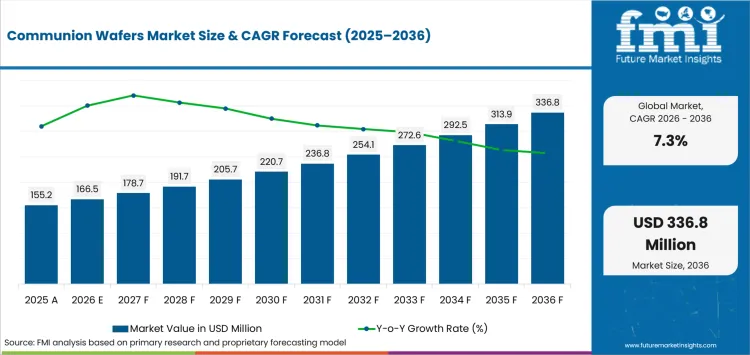
- Market Size (2026)
- USD 166.5 Mn
- Forecast (2036)
- USD 336.8 Mn
- CAGR (2026 to 2036)
- 7.3%
How big is Communion Wafers Market in 2026?
USD 166.5 million in 2026 and USD 336.8 million by 2036 at a 7.3% CAGR.
Communion wafer demand is projected to expand at 7.3% CAGR between 2026 and 2036 because repeated services consume inventory during the year. Bakery products provide an adjacent view of moisture protection and replenishment without defining sacramental demand. Pew Research Center reported in February 2025 that 33% of USA adults attend religious services in person at least monthly. That attendance base supports repeated purchasing, while denomination and service frequency determine actual wafer volumes.
Country conversion depends on whether religious diversity forms reachable worship institutions instead of remaining only a population characteristic. The UAE Ministry of Community Empowerment noted in May 2025 that more than 200 nationalities live in the country. That diversity broadens the pool of potential non-Muslim worship communities, but licensing and congregation formation still determine which institutions distributors can serve repeatedly.
Key Takeaways of Communion Wafers Market
- Repeated communion services produce a replenishment cycle tied to attendance frequency, service calendars, and the number of dietary variants stocked by each congregation.
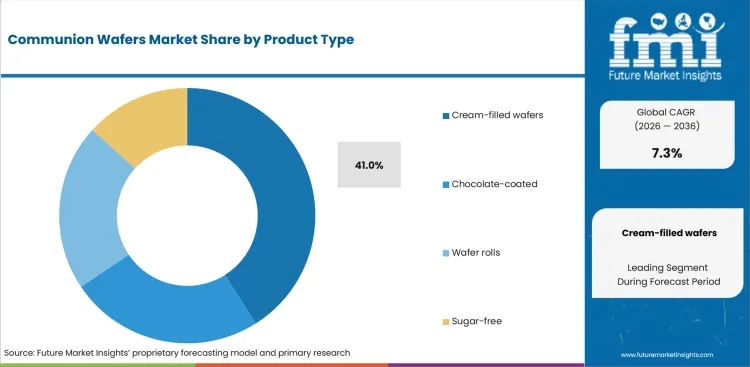
- Based on product type, cream-filled wafers are projected to account for 41.0% in 2026 due to broader Protestant communion formats that permit greater sensory variation.
- By claim - nature, conventional products are estimated to hold 51.0% in 2026 owing to routine orders that do not require specialty dietary claims.
- In 2026, fresh formats are expected to lead the format category with 33.0% share because frequent service schedules can support shorter inventory cycles.
- Denominational ingredient rules and food-label claims can identify different usable products, increasing the need for explicit liturgical eligibility and dietary information.
- Some of the key players in this market include Cavanagh Company, Benedictine Sisters of Perpetual Adoration, Santa Rita Abbey, Valley of Our Lady Monastery, Lifeway Christian Resources, WCC Products, Institutional Commodity Services, and Charles Farris Limited.
Analyst Perspective
"Communion-wafer economics reward fewer ordering errors more than broad assortment because one invalid formulation can remove an entire parish account from consideration. Manufacturers earn repeat value by documenting liturgical eligibility and separating dietary variants, then matching pack size to each congregation's service cadence."
- Nandini Roy Choudhury, Principal Consultant, Future Market Insights
How is the Communion Wafers Market segmented?
The communion wafers market is segmented by product type, claim - nature, format, packaging format, sales channel, and region.
Product type includes cream-filled wafers, chocolate-coated wafers, wafer rolls, and sugar-free wafers. Claim - nature covers conventional, clean label, organic, gluten-free, and fortified options. Format includes fresh, frozen, ambient packaged, chilled, and par-baked products. Packaging spans multipack, single-serve, family or loaf pack, and bulk foodservice. Sales channels include supermarkets and hypermarkets, specialty bakeries, convenience stores, online sales, and foodservice distributors.
What makes Cream-filled Wafers central to the Product Type category?
The product type axis extends beyond Catholic altar hosts because some Protestant services permit greater variation in taste and texture. Digestive wafer products offer a useful processing comparison without establishing sacramental suitability. In July 2025 the United Church of Christ documented a General Synod communion service that offered traditional wafers beside a cookie option.
- Cream-filled wafers are set to lead product type with 41.0% share in 2026 due to broader communion settings that permit sensory differentiation.
- The Synod example makes denomination suitability commercially explicit because one formulation cannot be assumed valid for every communion service or church tradition.
Why does Conventional lead the Claim - Nature category?
Conventional wafers suit routine church orders that prioritize familiar handling over specialty dietary claims. Gluten-free products remain a separate stock line, while gluten-free food labeling provides claim language without deciding sacramental eligibility for ordinary scheduled parish services and seasonal observances.
- By claim - nature, conventional wafers are estimated to hold 51.0% in 2026 owing to routine orders that usually avoid specialty dietary claims.
- The USA Food and Drug Administration stated in 2026 that celiac disease affects about one person in every 100 nationwide. Church offices therefore need separate identification for dietary alternatives because a food claim does not settle sacramental eligibility during routine communion purchasing.
How does Fresh hold the leading position in the Format category?
Fresh formats fit congregations that receive deliveries close to scheduled services and can replace opened stock without long holding periods. Bakery ingredients provide adjacent moisture-control context without defining church demand. In May 2025 the Church of England reported that its 2024 regular worshipping community reached 1.02 million.
- By format, fresh products are forecast to represent 33.0% in 2026 driven by service schedules that can support shorter inventory cycles.
- Long delivery distances and irregular attendance favor ambient formats because opened-stock waste can quickly erase the handling advantage of fresh product for smaller congregations and rural parishes.
What supports Multipack in the Packaging Format category?
Communion orders often require many identical portions for one service, so grouped packs simplify counting and replenishment. Bulk food ingredients provide adjacent case-volume context without substituting for church purchasing. Dietary separation can require smaller secondary packs beside the main order.
- Based on packaging format, multipack is projected to account for 30.0% in 2026 due to standardized portions that reduce repeated handling before services.
- Presbyterian Church (USA) reported in June 2025 that about 20 people served the Lord's Supper to 650 conference participants. Large service teams make pre-service counting and portion staging commercially relevant for grouped communion packs.
What are the drivers, restraints and opportunities in the Communion Wafers Market?
Repeated worship services sustain replenishment, denomination-specific eligibility limits substitution, and clearer dietary separation can support higher-value specialty orders.
- Driver: Congregations consume wafers during scheduled services, so repeated attendance converts directly into inventory replacement instead of installed-base demand.
- Restraint: Liturgical rules and food-label standards classify similar-looking wafers differently, which can make one product unsuitable for a specific communion practice.
- Opportunity: Manufacturers can separate standard, low-gluten, and fully gluten-free offers with clear labels that reduce ordering errors and cross-contact concerns.
Communion demand is rising with monthly and seasonal service participation instead of following a one-time installation cycle. Pew Research Center found in February 2025 that 40% of USA adults participate in religious services at least monthly through in-person or virtual channels. Congregations translate that participation into wafer orders according to service practice and communicant count, so gluten-free prepared food handling is only an adjacent operational comparison.
Product substitution stops whenever liturgical rules and dietary claims answer different questions for church administrators. In February 2025 the Church of England clarified that its churches routinely offer gluten-free bread or wafers alongside non-alcoholic wine. Allergen-free food labeling can describe dietary properties, and church offices require denomination-specific eligibility before they treat visually similar wafers as interchangeable during repeat parish ordering and storage decisions.
Specialty packaging earns value when congregations serve a small dietary subgroup without changing the main service inventory. The Church of England reported in July 2026 that weekly attendance at cathedral services reached about 32,600 during 2025. Clean-label ingredients can inform specialty-food claims, while smaller wafer packs give churches a practical way to separate limited dietary orders from standard stock.
Which country CAGRs are profiled in the Communion Wafers Market?
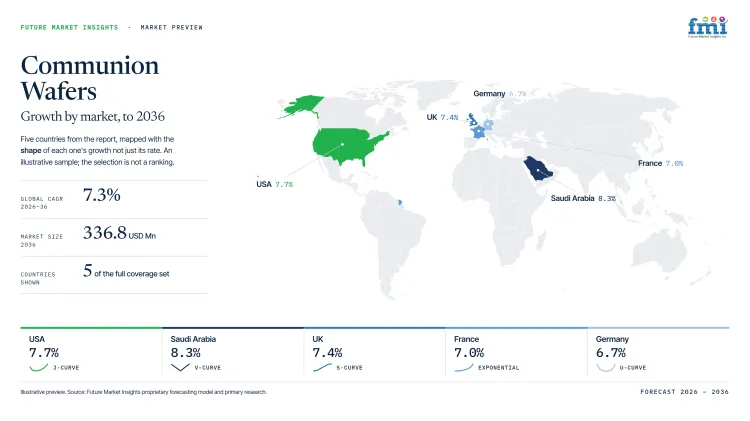
| Country | CAGR |
|---|---|
| Saudi Arabia | 8.3% |
| USA | 7.7% |
| UK | 7.4% |
| France | 7.0% |
| Germany | 6.7% |
How do country-level CAGRs compare in the Communion Wafers Market?
The 1.6-point spread separates Saudi Arabia and Germany from a narrow USA-UK middle band, while France sits between the fastest and slowest markets. This distribution describes access conditions better than current size because each country converts church participation into orders through different institutional, seasonal, and distribution routes for specialist suppliers.
- Saudi religious institutions centralize communion-wafer purchasing through established church and parish supply networks.
- USA demand favors convenient packs that support regular parish ordering and nationwide replenishment.
- UK church accounts favor direct shipments aligned with established sacramental purchasing routines.
- France seasonal church calendars concentrate wafer restocking around major religious observances and parish requirements.
- Germany specialist distributors support recurring parish orders through established ecclesiastical supply channels.
Comparable CAGRs can therefore carry different acquisition costs and account sizes. The full report provides country-level CAGR analysis across North America, Latin America, Europe, East Asia, South Asia, Oceania and the Middle East and Africa.
Country-wise Analysis
- Private congregation relationships give Saudi distributors identifiable purchasing contacts, repeat ordering patterns, and stable delivery arrangements for communion wafers serving expatriate Christian communities. Saudi Arabia is projected to grow at 8.3% CAGR through 2036 because its large expatriate population creates recurring demand for sacramental supplies despite limited public non-Muslim worship infrastructure. GASTAT's 2025 population publication places non-Saudis at 44.4% of the Kingdom's 2024 population, providing manufacturers with a sizeable potential customer base without identifying Christian participation, denomination, or service frequency. Consequently, distributors depend on established private relationships and discreet supply channels to maintain repeat communion-wafer accounts across congregations year after year and seasonal service calendars across recurring institutional accounts.
- Specialist Catholic distributors and national Protestant ministry suppliers give USA congregations direct purchasing routes for communion wafers without depending on mainstream grocery distribution or local retail placement. Pew Research Center reported in February 2025 that 54% of USA Christians belong to a church or another house of worship, supporting a broad institutional account base for recurring replenishment and seasonal services. The USA is estimated to post 7.7% CAGR through 2036, supported by this membership base and extensive parcel networks that reach dispersed parish accounts. Catholic low-gluten requirements also encourage separate product identification and documented handling before specialty hosts become routine inventory within repeat parish purchasing programs.
- Established ecclesiastical distributors allow UK churches to purchase communion wafers alongside candles and other worship consumables, reducing order fragmentation for parishes that already maintain supplier accounts for routine needs. Communion wafer demand in the UK is forecast to expand at 7.4% CAGR through 2036 as repeated services sustain replenishment across mature parish networks. Church of England data released in May 2026 recorded a 2025 regular worshipping community of 1.023 million, up 1.4% annually, indicating a substantial recurring institutional base. However, parish budgets and denominational differences can limit standardization, requiring suppliers to maintain product specifications suited to Anglican and Catholic purchasing requirements.
- France's extensive Catholic parish network gives specialist church suppliers concentrated institutional accounts where communion wafers can be replenished alongside candles, altar supplies, and other sacramental consumables. France is projected to record 7.0% CAGR through 2036, reflecting steady recurring demand supported by established parish procurement rather than rapid channel expansion. The country's mature religious-goods distribution structure allows manufacturers to work through specialized wholesalers serving dioceses, parishes, monasteries, and religious communities, while denomination-specific preferences and local purchasing practices influence product selection. Seasonal Catholic observances can also create periodic replenishment peaks, particularly around Easter and Christmas services.
- Germany's organized Catholic and Protestant church structures provide specialist distributors with identifiable parish and institutional accounts for recurring communion-wafer orders. The German market is expected to advance at 6.7% CAGR through 2036, making it the slowest-growing market in this comparison but still supported by established sacramental purchasing routines. Long-standing ecclesiastical supply channels can combine communion wafers with altar breads, candles, liturgical textiles, and related worship consumables, helping suppliers reduce order fragmentation. At the same time, mature parish procurement, denominational requirements, and demographic changes constrain rapid account expansion, placing greater emphasis on retention, reliable fulfillment, and product consistency within existing institutional customer networks.
Who are the notable companies in the Communion Wafers Market?
Cavanagh Company, Benedictine Sisters of Perpetual Adoration, Santa Rita Abbey, Valley of Our Lady Monastery, Lifeway Christian Resources, WCC Products, Institutional Commodity Services, and Charles Farris Limited.
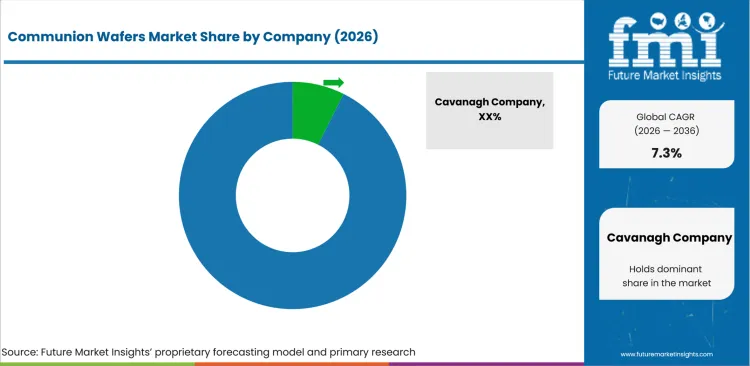
Competition spans specialist host manufacturers, monastic bakeries, prefilled-communion producers, and ecclesiastical distributors. Entry barriers come from liturgical eligibility and production consistency more than corporate scale. Adjacent faith-based product packaging analysis informs sealed-format channel questions without establishing company rank.
- Cavanagh Company and Benedictine Sisters of Perpetual Adoration have documented USA low-gluten host roles, while Santa Rita Abbey and Valley of Our Lady Monastery operate dedicated altar-bread bakeries.
- Lifeway Christian Resources and WCC Products serve Protestant church channels with prefilled formats that include wafers, bread, and ready-to-serve portions.
- Institutional Commodity Services distributes Cavanagh altar bread to institutional accounts, while Charles Farris Limited merchandises Holy Communion consumables within a broader UK church-supply range.
Competitive Benchmarking: Communion Wafers Market
| Company | Wafer Manufacturing Depth | Liturgical / Dietary Specialization | Church-Supply Reach | Geographic Reach |
|---|---|---|---|---|
| Cavanagh Company | High | High | Medium | United States and distributor channels |
| Benedictine Sisters of Perpetual Adoration | Medium | High | Medium | United States |
| Santa Rita Abbey | Medium | Medium | Low | United States |
| Valley of Our Lady Monastery | High | Medium | Low | United States |
| Lifeway Christian Resources | Low | Medium | High | United States and international ministry reach |
| WCC Products | High | Medium | High | United States and wholesale channels |
| Institutional Commodity Services | Low | Medium | Medium | New York and tri-state institutional delivery |
| Charles Farris Limited | Low | Medium | High | United Kingdom |
Scoring basis: High manufacturing depth requires dedicated wafer output with documented scale or multiple communion-host formats. Medium identifies dedicated production without comparable scale evidence, while Low identifies distribution-led participation. High specialization requires verified liturgical or low-gluten status. Medium covers multiple communion formats or documented church-use specifications, while Low identifies limited specialization. High church-supply reach requires a broad direct church channel. Medium indicates specialist regional or national access, while Low reflects a narrower direct customer base.
Key Developments in the Communion Wafers Market
- In May 2026, WCC Products introduced 25-count and 100-count bagged packaging for its communion-cup lines to serve smaller church and retail order quantities.
- In August 2025, Valley of Our Lady Monastery dedicated its new monastery project after construction included a purpose-built communion-wafer workshop for altar-bread production.
- In July 2025, Institutional Commodity Services partnered with Tri-state Janitorial Supply to deliver Cavanagh altar-bread orders for institutional customers.
Key Players in the Communion Wafers Market
Specialist Host and Monastic Bakery Producers
- Cavanagh Company
- Benedictine Sisters of Perpetual Adoration
- Santa Rita Abbey
- Valley of Our Lady Monastery
Prefilled Communion Platforms
- Lifeway Christian Resources
- WCC Products
Institutional and Ecclesiastical Distributors
- Institutional Commodity Services
- Charles Farris Limited
Communion Wafers Market - Report Scope
| Coverage field | Report scope |
|---|---|
| Market breakdown | By product type, claim - nature, format, packaging format, sales channel, and region. |
| Quantitative Units | USD Million. |
| Market Definition | Commercial communion wafers, altar breads, and communion-oriented wafer formats supplied through church, retail, distributor, and direct channels within the defined taxonomy. |
| Regions Covered | North America, Latin America, Western Europe, Eastern Europe, East Asia, South Asia and Pacific, and Middle East and Africa. |
| Countries Covered | UAE, Saudi Arabia, South Korea, USA, UK, and 20+ countries included in the full report. |
| Key Companies Profiled | Cavanagh Company, Benedictine Sisters of Perpetual Adoration, Santa Rita Abbey, Valley of Our Lady Monastery, Lifeway Christian Resources, WCC Products, Institutional Commodity Services, Charles Farris Limited. |
| Forecast Period | 2026 to 2036. |
| Approach | Primary and secondary research with market triangulation. |
Communion Wafers Market - Research Methodology
| Method | Approach |
|---|---|
| Primary Research | FMI analysts gathered input from manufacturers, service providers, technology developers, distributors, end users, procurement teams, and subject-matter experts. Interviews examined purchasing decisions, product or service evaluation, adoption barriers, approval requirements, pricing considerations, and expectations for technical or commercial support. Respondents were also asked what evidence is required before a trial, pilot, or initial order develops into regular purchasing. |
| Desk Research | Desk research covered government statistics, regulatory publications, trade data, industry associations, technical literature, standards, company filings, product information, and official corporate announcements. Sources were reviewed for relevance, publication date, geographic coverage, and consistency with the defined market scope. Claims relating to performance, applications, approvals, capacity, investment, and commercial activity were retained only when supported by credible public evidence. |
| Market Sizing and Forecasting | The market model combined the baseline value with historical performance, segment structure, pricing and volume indicators, adoption levels, company participation, and country-level demand conditions. Forecast assumptions considered economic activity, investment trends, regulatory developments, technology adoption, purchasing cycles, supply availability, and barriers to wider market use. Segment and regional estimates were reconciled before the final market total was calculated. |
| Data Validation | Estimates were checked against multiple independent indicators, including public data, company activity, trade patterns, industry developments, and findings from primary interviews. Validation also tested whether products, services, applications, and company revenues fell within the defined market boundaries. Adjacent categories, unsupported claims, overlapping revenues, and activities without direct market relevance were excluded to reduce double counting and maintain consistency across segments and countries. |
Communion Wafers Market by Segments
Communion Wafers Market segmented by Product Type:
- Cream-filled wafers
- Chocolate-coated
- Wafer rolls
- Sugar-free
Communion Wafers Market segmented by Claim - nature:
- Conventional
- Clean label
- Organic
- Gluten-free
- High-protein / fortified
Communion Wafers Market segmented by Format:
- Fresh
- Frozen
- Ambient packaged
- Chilled
- Par-baked / thaw-and-serve
Communion Wafers Market segmented by Packaging Format:
- Multipack
- Single-serve
- Family / loaf pack
- Bulk foodservice
Communion Wafers Market segmented by Sales Channel:
- Supermarkets & hypermarkets
- Artisan & specialty bakeries
- Convenience & forecourt
- Online & DTC
- Foodservice distributors
Communion Wafers Market by Region:
- North America
- United States
- Canada
- Latin America
- Brazil
- Mexico
- Argentina
- Chile
- Rest of Latin America
- Western Europe
- Germany
- France
- United Kingdom
- Italy
- Spain
- Nordics
- Benelux
- Rest of Western Europe
- Eastern Europe
- Poland
- Czech Republic
- Romania
- Hungary
- Rest of Eastern Europe
- East Asia
- China
- Japan
- South Korea
- South Asia and Pacific
- India
- ASEAN
- Australia and New Zealand
- Rest of South Asia and Pacific
- Middle East and Africa
- Kingdom of Saudi Arabia
- Other GCC Countries
- Türkiye
- South Africa
- Other African Union Countries
- Rest of Middle East and Africa
Research Sources and Bibliography
- Pew Research Center. (2025, February 26). Decline of Christianity in the USA Has Slowed, May Have Leveled Off.
- UAE Ministry of Community Empowerment. (2025, May 7). Ministry of Community Empowerment regulates licensing of places of worship for non-Muslims.
- United Church of Christ. (2025, July 14). Youth at Synod communion service ends with dialogue with Rev. Karen Georgia Thompson.
- USA Food and Drug Administration. (2026). Know Your Nutrition: Empowering Women to Make Informed Food Choices.
- Church of England. (2025, May 16). Church of England attendance rises for fourth year.
- Presbyterian Church (USA). (2025, June 17). The gifts of food and wisdom.
- Southern Baptist Convention. (2025, June). 2025 Book of Reports: Lifeway Christian Resources.
- Church of England. (2025, February 10). No, we're not banning gluten-free bread or non-alcoholic Communion wine.
- Church of England. (2026, July 31). Attendance at Cathedral services rises for fifth year running.
- General Authority for Statistics. (2025). Population Estimates Publication 2024.
- Office of the President, Republic of Korea. (2025, July 9). President Lee Jae Myung hosts luncheon meeting with religious leaders.
- Church of England. (2026, May 13). Church attendance grows for fifth year in a row.
- United States Conference of Catholic Bishops. (2016, April 20). Celiac disease, alcohol intolerance, and the Church's pastoral response.
- Cavanagh Company. (n.d.). Welcome to Cavanagh Altar Bread. Retrieved August 25, 2026.
- Santa Rita Abbey. (2025). Summer-Autumn 2025 update.
- Valley of Our Lady Monastery. (2025, August 24). News: Rite of Dedication Mass and monastery project updates.
- Valley of Our Lady Monastery. (2026, January 26). January 26: Founder’s Day: Saints Robert, Alberic, & Stephen.
- Valley of Our Lady Monastery. (n.d.). Who we are. Retrieved August 25, 2026.
- Benedictine Sisters of Perpetual Adoration. (n.d.). Who we are. Retrieved August 25, 2026.
- Lifeway Christian Resources. (n.d.). About Lifeway Christian Resources. Retrieved August 25, 2026.
- Charles Farris Limited. (2026, January 8). Easter 2026 brochure out now.
- Charles Farris Limited. (2026, May). Church consumables brochure and pricelists.
- Institutional Commodity Services. (2025, July 7). Cavanagh Altar Bread.
- WCC Products. (2026, May 14). Bagged & Ready to Sell: New Bagged Packaging from World Communion Cups.
This bibliography is provided for reader reference and is not exhaustive. The full report contains the complete reference list and detailed citations
This Report Answers
- How large is the communion wafers market in 2026 and what value is forecast for 2036?
- What recurring service conditions support communion wafer demand?
- Why do cream-filled wafers hold the largest product type share in 2026?
- Why do conventional products lead the claim and nature category?
- How do fresh formats and multipack packaging fit church service operations?
- How do the five profiled country CAGRs compare through 2036?
- Which companies manufacture or distribute communion wafers and related service formats?
- What liturgical and dietary conditions limit product substitution?
- Where can specialty packaging reduce handling and qualification friction?
Frequently Asked Questions
How big is the Communion Wafers Market in 2026?
The communion wafers market is valued at USD 166.5 million in 2026 and is projected to reach USD 336.8 million by 2036. Scheduled communion services require repeated inventory replenishment as congregations consume stock during monthly, seasonal, and special observances.
What is the CAGR of the Communion Wafers Market from 2026 to 2036?
The communion wafers market is projected to grow at a CAGR of 7.3% between 2026 and 2036. Expansion follows repeated service demand and wider availability of dietary or service-ready formats for established church accounts.
Which product type leads the Communion Wafers Market?
The cream-filled wafers segment is expected to hold 41.0% of the communion wafers market in 2026, driven by communion settings that permit greater sensory variation. Denominational rules limit those formats because Catholic altar-host requirements exclude many sensory variations accepted in other communion settings.
Which claim and nature segment leads the Communion Wafers Market?
The conventional segment is expected to hold 51.0% of the communion wafers market in 2026, attributable to routine orders that avoid specialty dietary claims. Church offices need separate gluten-free inventory because dietary claims and sacramental eligibility answer different purchasing questions.
How much value will the Communion Wafers Market add between 2026 and 2036?
The communion wafers market is expected to add USD 170.3 million in value between 2026 and 2036. Repeated church purchasing and service-ready formats provide the principal commercial route behind that projected increase.
Which countries are projected to record the highest growth in the Communion Wafers Market?
The UAE is projected to grow at 8.6% CAGR, followed by Saudi Arabia at 8.3% and South Korea at 8.0% through 2036. Institutional access and congregation structure produce different order-conversion conditions for church-supply companies in each country.
Which companies are active in the Communion Wafers Market?
Key companies operating in the communion wafers market include Cavanagh Company, Benedictine Sisters of Perpetual Adoration, Santa Rita Abbey, Valley of Our Lady Monastery, Lifeway Christian Resources, WCC Products, Institutional Commodity Services, and Charles Farris Limited. Their roles span specialist production and church-supply distribution.
Preview the report firsthand - request a free sample
Get SampleGet the brochure for pricing and purchase details.
Get PDFTable of Content
- Key Takeaways
- Market Size and CAGR
- Top Growth Driver
- Fastest Growing Segment
- Leading Region
- Key Companies
- Emerging Opportunities
- Executive Summary
- Global Market Outlook
- Demand-side Trends
- Supply-side Trends
- Technology Roadmap Analysis
- Analysis and Recommendations
- Analyst Perspective (What is happening? Why now? What should investors know?)
- Key Questions Answered
- How large is the market?
- What is the CAGR?
- What are key trends?
- Which region dominates?
- Who are the leaders?
- Market Overview
- Market Coverage / Taxonomy
- Market Definition / Scope / Limitations
- Research Methodology
- Chapter Orientation
- Analytical Lens and Working Hypotheses
- Market Structure, Signals, and Trend Drivers
- Benchmarking and Cross-market Comparability
- Market Sizing, Forecasting, and Opportunity Mapping
- Research Design and Evidence Framework
- Desk Research Programme (Secondary Evidence)
- Expert Input and Fieldwork (Primary Evidence)
- Tooling, Models, and Reference Databases
- Data Engineering and Model Build
- Quality Assurance and Audit Trail
- Market Background
- Market Dynamics (Drivers, Restraints, Opportunity, Trends)
- Scenario Forecast (Optimistic, Likely, Conservative)
- Impact Analysis
- AI Impact
- Sustainability Impact
- Regulatory Impact
- Technology Impact
- Consumer / Buyer Analysis
- Purchase Drivers
- Adoption Barriers
- Buyer Journey
- Opportunity Map Analysis
- Product Life Cycle Analysis
- Supply Chain Analysis
- Investment Feasibility Matrix
- Value Chain Analysis
- PESTLE and Porter's Analysis
- Regulatory Landscape
- Regional Parent Market Outlook
- Production and Consumption Statistics
- Import and Export Statistics
- Global Market Analysis and Forecast, 2021 to 2036
- Historical Market Size Value (USD Million) Analysis, 2021 to 2025
- Current and Future Market Size Value (USD Million) Projections, 2026 to 2036
- Y-o-Y Growth Trend Analysis
- Absolute $ Opportunity Analysis
- Global Market Pricing Analysis, 2021 to 2036
- Global Market Analysis and Forecast, By Product Type, 2021 to 2036
- Introduction / Key Findings
- Historical Market Size Value (USD Million) Analysis By Product Type, 2021 to 2025
- Current and Future Market Size Value (USD Million) Analysis and Forecast By Product Type, 2026 to 2036
- Cream-filled wafers
- Chocolate-coated
- Wafer rolls
- Sugar-free
- Cream-filled wafers
- Y-o-Y Growth Trend Analysis By Product Type, 2021 to 2025
- Absolute $ Opportunity Analysis By Product Type, 2026 to 2036
- Global Market Analysis and Forecast, By Claim / Nature, 2021 to 2036
- Introduction / Key Findings
- Historical Market Size Value (USD Million) Analysis By Claim / Nature, 2021 to 2025
- Current and Future Market Size Value (USD Million) Analysis and Forecast By Claim / Nature, 2026 to 2036
- Conventional
- Clean label
- Organic
- Gluten-free
- High-protein / fortified
- Conventional
- Y-o-Y Growth Trend Analysis By Claim / Nature, 2021 to 2025
- Absolute $ Opportunity Analysis By Claim / Nature, 2026 to 2036
- Global Market Analysis and Forecast, By Format, 2021 to 2036
- Introduction / Key Findings
- Historical Market Size Value (USD Million) Analysis By Format, 2021 to 2025
- Current and Future Market Size Value (USD Million) Analysis and Forecast By Format, 2026 to 2036
- Fresh
- Frozen
- Ambient packaged
- Chilled
- Par-baked / thaw-and-serve
- Fresh
- Y-o-Y Growth Trend Analysis By Format, 2021 to 2025
- Absolute $ Opportunity Analysis By Format, 2026 to 2036
- Global Market Analysis and Forecast, By Packaging Format, 2021 to 2036
- Introduction / Key Findings
- Historical Market Size Value (USD Million) Analysis By Packaging Format, 2021 to 2025
- Current and Future Market Size Value (USD Million) Analysis and Forecast By Packaging Format, 2026 to 2036
- Multipack
- Single-serve
- Family / loaf pack
- Bulk foodservice
- Multipack
- Y-o-Y Growth Trend Analysis By Packaging Format, 2021 to 2025
- Absolute $ Opportunity Analysis By Packaging Format, 2026 to 2036
- Global Market Analysis and Forecast, By Sales Channel, 2021 to 2036
- Introduction / Key Findings
- Historical Market Size Value (USD Million) Analysis By Sales Channel, 2021 to 2025
- Current and Future Market Size Value (USD Million) Analysis and Forecast By Sales Channel, 2026 to 2036
- Supermarkets & hypermarkets
- Artisan & specialty bakeries
- Convenience & forecourt
- Online & DTC
- Foodservice distributors
- Supermarkets & hypermarkets
- Y-o-Y Growth Trend Analysis By Sales Channel, 2021 to 2025
- Absolute $ Opportunity Analysis By Sales Channel, 2026 to 2036
- Global Market Analysis and Forecast, By Region, 2021 to 2036
- Introduction
- Historical Market Size Value (USD Million) Analysis By Region, 2021 to 2025
- Current Market Size Value (USD Million) Analysis and Forecast By Region, 2026 to 2036
- North America
- Latin America
- Western Europe
- Eastern Europe
- East Asia
- South Asia and Pacific
- Middle East & Africa
- Market Attractiveness Analysis By Region
- North America Market Analysis and Forecast, By Country, 2021 to 2036
- Historical Market Size Value (USD Million) Trend Analysis By Market Taxonomy, 2021 to 2025
- Market Size Value (USD Million) Forecast By Market Taxonomy, 2026 to 2036
- By Country
- USA
- Canada
- By Product Type
- By Claim / Nature
- By Format
- By Packaging Format
- By Sales Channel
- By Country
- Market Attractiveness Analysis
- By Country
- By Product Type
- By Claim / Nature
- By Format
- By Packaging Format
- By Sales Channel
- Key Takeaways
- Latin America Market Analysis and Forecast, By Country
- Historical Market Size Value (USD Million) Trend Analysis By Market Taxonomy, 2021 to 2025
- Market Size Value (USD Million) Forecast By Market Taxonomy, 2026 to 2036
- By Country
- Brazil
- Mexico
- Chile
- Rest of Latin America
- By Product Type
- By Claim / Nature
- By Format
- By Packaging Format
- By Sales Channel
- By Country
- Market Attractiveness Analysis
- By Country
- By Product Type
- By Claim / Nature
- By Format
- By Packaging Format
- By Sales Channel
- Key Takeaways
- Western Europe Market Analysis and Forecast, By Country
- Historical Market Size Value (USD Million) Trend Analysis By Market Taxonomy, 2021 to 2025
- Market Size Value (USD Million) Forecast By Market Taxonomy, 2026 to 2036
- By Country
- Germany
- UK
- Italy
- Spain
- France
- Nordic
- BENELUX
- Rest of Western Europe
- By Product Type
- By Claim / Nature
- By Format
- By Packaging Format
- By Sales Channel
- By Country
- Market Attractiveness Analysis
- By Country
- By Product Type
- By Claim / Nature
- By Format
- By Packaging Format
- By Sales Channel
- Key Takeaways
- Eastern Europe Market Analysis and Forecast, By Country
- Historical Market Size Value (USD Million) Trend Analysis By Market Taxonomy, 2021 to 2025
- Market Size Value (USD Million) Forecast By Market Taxonomy, 2026 to 2036
- By Country
- Russia
- Poland
- Hungary
- Balkan & Baltic
- Rest of Eastern Europe
- By Product Type
- By Claim / Nature
- By Format
- By Packaging Format
- By Sales Channel
- By Country
- Market Attractiveness Analysis
- By Country
- By Product Type
- By Claim / Nature
- By Format
- By Packaging Format
- By Sales Channel
- Key Takeaways
- East Asia Market Analysis and Forecast, By Country
- Historical Market Size Value (USD Million) Trend Analysis By Market Taxonomy, 2021 to 2025
- Market Size Value (USD Million) Forecast By Market Taxonomy, 2026 to 2036
- By Country
- China
- Japan
- South Korea
- By Product Type
- By Claim / Nature
- By Format
- By Packaging Format
- By Sales Channel
- By Country
- Market Attractiveness Analysis
- By Country
- By Product Type
- By Claim / Nature
- By Format
- By Packaging Format
- By Sales Channel
- Key Takeaways
- South Asia and Pacific Market Analysis and Forecast, By Country
- Historical Market Size Value (USD Million) Trend Analysis By Market Taxonomy, 2021 to 2025
- Market Size Value (USD Million) Forecast By Market Taxonomy, 2026 to 2036
- By Country
- India
- ASEAN
- Australia & New Zealand
- Rest of South Asia and Pacific
- By Product Type
- By Claim / Nature
- By Format
- By Packaging Format
- By Sales Channel
- By Country
- Market Attractiveness Analysis
- By Country
- By Product Type
- By Claim / Nature
- By Format
- By Packaging Format
- By Sales Channel
- Key Takeaways
- Middle East & Africa Market Analysis and Forecast, By Country
- Historical Market Size Value (USD Million) Trend Analysis By Market Taxonomy, 2021 to 2025
- Market Size Value (USD Million) Forecast By Market Taxonomy, 2026 to 2036
- By Country
- Kingdom of Saudi Arabia
- Other GCC Countries
- Türkiye
- South Africa
- Other African Union
- Rest of Middle East & Africa
- By Product Type
- By Claim / Nature
- By Format
- By Packaging Format
- By Sales Channel
- By Country
- Market Attractiveness Analysis
- By Country
- By Product Type
- By Claim / Nature
- By Format
- By Packaging Format
- By Sales Channel
- Key Takeaways
- Key Countries Market Analysis
- USA
- Pricing Analysis
- Market Share Analysis, 2025
- By Product Type
- By Claim / Nature
- By Format
- By Packaging Format
- By Sales Channel
- Canada
- Pricing Analysis
- Market Share Analysis, 2025
- By Product Type
- By Claim / Nature
- By Format
- By Packaging Format
- By Sales Channel
- Mexico
- Pricing Analysis
- Market Share Analysis, 2025
- By Product Type
- By Claim / Nature
- By Format
- By Packaging Format
- By Sales Channel
- Brazil
- Pricing Analysis
- Market Share Analysis, 2025
- By Product Type
- By Claim / Nature
- By Format
- By Packaging Format
- By Sales Channel
- Chile
- Pricing Analysis
- Market Share Analysis, 2025
- By Product Type
- By Claim / Nature
- By Format
- By Packaging Format
- By Sales Channel
- Germany
- Pricing Analysis
- Market Share Analysis, 2025
- By Product Type
- By Claim / Nature
- By Format
- By Packaging Format
- By Sales Channel
- UK
- Pricing Analysis
- Market Share Analysis, 2025
- By Product Type
- By Claim / Nature
- By Format
- By Packaging Format
- By Sales Channel
- Italy
- Pricing Analysis
- Market Share Analysis, 2025
- By Product Type
- By Claim / Nature
- By Format
- By Packaging Format
- By Sales Channel
- Spain
- Pricing Analysis
- Market Share Analysis, 2025
- By Product Type
- By Claim / Nature
- By Format
- By Packaging Format
- By Sales Channel
- France
- Pricing Analysis
- Market Share Analysis, 2025
- By Product Type
- By Claim / Nature
- By Format
- By Packaging Format
- By Sales Channel
- India
- Pricing Analysis
- Market Share Analysis, 2025
- By Product Type
- By Claim / Nature
- By Format
- By Packaging Format
- By Sales Channel
- ASEAN
- Pricing Analysis
- Market Share Analysis, 2025
- By Product Type
- By Claim / Nature
- By Format
- By Packaging Format
- By Sales Channel
- Australia & New Zealand
- Pricing Analysis
- Market Share Analysis, 2025
- By Product Type
- By Claim / Nature
- By Format
- By Packaging Format
- By Sales Channel
- China
- Pricing Analysis
- Market Share Analysis, 2025
- By Product Type
- By Claim / Nature
- By Format
- By Packaging Format
- By Sales Channel
- Japan
- Pricing Analysis
- Market Share Analysis, 2025
- By Product Type
- By Claim / Nature
- By Format
- By Packaging Format
- By Sales Channel
- South Korea
- Pricing Analysis
- Market Share Analysis, 2025
- By Product Type
- By Claim / Nature
- By Format
- By Packaging Format
- By Sales Channel
- Russia
- Pricing Analysis
- Market Share Analysis, 2025
- By Product Type
- By Claim / Nature
- By Format
- By Packaging Format
- By Sales Channel
- Poland
- Pricing Analysis
- Market Share Analysis, 2025
- By Product Type
- By Claim / Nature
- By Format
- By Packaging Format
- By Sales Channel
- Hungary
- Pricing Analysis
- Market Share Analysis, 2025
- By Product Type
- By Claim / Nature
- By Format
- By Packaging Format
- By Sales Channel
- Kingdom of Saudi Arabia
- Pricing Analysis
- Market Share Analysis, 2025
- By Product Type
- By Claim / Nature
- By Format
- By Packaging Format
- By Sales Channel
- Türkiye
- Pricing Analysis
- Market Share Analysis, 2025
- By Product Type
- By Claim / Nature
- By Format
- By Packaging Format
- By Sales Channel
- South Africa
- Pricing Analysis
- Market Share Analysis, 2025
- By Product Type
- By Claim / Nature
- By Format
- By Packaging Format
- By Sales Channel
- USA
- Market Structure Analysis
- Competition Dashboard
- Competition Benchmarking
- Market Share Analysis of Top Players
- By Regional
- By Product Type
- By Claim / Nature
- By Format
- By Packaging Format
- By Sales Channel
- Emerging Startups
- Innovation Benchmarking
- Competition Analysis
- Competition Deep Dive
- Cavanagh Company
- Overview
- Product Portfolio
- Profitability by Market Segments
- Sales Footprint
- Strategy Overview
- Marketing Strategy
- Product Strategy
- Channel Strategy
- CM Almy
- Broadman & Holman
- Christian Wolf
- Artistic
- Concordia Supply
- Ozanam Industries
- LifeWay Christian Resources
- TrueVine
- Benedictine Sisters Altar Breads
- Cavanagh Company
- Case Studies
- Success Stories
- Recent Developments
- Competition Deep Dive
- Assumptions & Acronyms Used


