

- Industry Size (2025)
- USD 376.8 Mn
- Forecast (2035)
- USD 681.3 Mn
- CAGR (2025 to 2035)
- 6.1%
Compound Semiconductor Hall Elements Market Forecast and Outlook 2025 to 2035
The compound semiconductor hall elements market is on a steady rise, growing from USD 376.8 million in 2025 to an expected USD 681.3 million by 2035. This growth is mainly driven by the shift toward electric vehicles and the wider move to smarter, more automated manufacturing environments. These sensors are used to measure magnetic fields, and compound semiconductor materials such as InSb and GaAs allow them to pick up weaker signals with greater accuracy than standard silicon-based sensors. This makes them particularly valuable in settings where reliability, sensitivity, and performance at extreme temperatures matter.
In an electric vehicle, dozens of hall sensors help monitor everything from battery health to motor speed, and that alone is creating a large and growing base of demand. Beyond automotive use, these sensors are also increasingly found in consumer electronics and industrial systems. They help guide motors in factory equipment, enable precise positioning in robotics, and allow devices like smartphones and wearables to detect orientation and motion. Cost remains a challenge, since compound semiconductor processing is more complex than silicon manufacturing. As electric mobility and automation continue to expand, these higher-performance sensors are expected to become even more common components in the electronics ecosystem.
Quick Stats for Compound Semiconductor Hall Elements Market
- Compound Semiconductor Hall Elements Market Value (2025): USD 376.8 million
- Compound Semiconductor Hall Elements Market Forecast Value (2035): USD 681.3 million
- Compound Semiconductor Hall Elements Market Forecast CAGR: 6.1%
- Leading Material Type in Compound Semiconductor Hall Elements Market: InSb Hall Element
- Key Growth Regions in Compound Semiconductor Hall Elements Market: Asia Pacific, Europe, and North America
- Top Key Players in Compound Semiconductor Hall Elements Market: AKM, Nicera, ChenYang Technologies GmbH & Co. KG, Diodes Incorporated, Shenzhen Junmin Technology, Asensor Technology AB, Lake Shore Cryotronics, Inc.
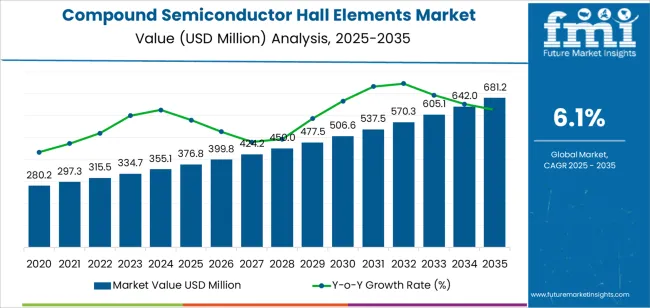
Manufacturing adoption accelerates as automotive suppliers and industrial equipment producers seek to optimize system performance and meet stringent safety requirements in electric vehicle drivetrains and automated manufacturing equipment. The proliferation of electric vehicles creates sustained demand for high-performance current sensors capable of monitoring battery discharge rates, inverter operations, and motor phase currents with exceptional accuracy across wide temperature ranges.
Compound semiconductor materials, including Indium Antimonide, Gallium Arsenide, and Indium Arsenide, offer electron mobility characteristics 10-20 times higher than silicon, enabling Hall sensors to detect weaker magnetic fields and operate reliably in harsh environmental conditions. Consumer electronics manufacturers are integrating compound semiconductor hall elements into smartphone compass modules, gaming controller joysticks, and wearable device applications requiring miniaturized sensors with low power consumption and high sensitivity performance.
The automotive industry's transition toward electrification and advanced driver assistance systems drives substantial growth in hall sensor demand, with modern electric vehicles incorporating 40-60 hall effect sensors across powertrain control, suspension systems, and safety mechanisms. Industrial equipment manufacturers are implementing these sensors in servo motor systems, conveyor positioning, and robotics applications where magnetic sensing provides non-contact operation and immunity to contamination compared to optical or mechanical sensing methods. However, higher material costs compared to silicon-based alternatives and specialized manufacturing process requirements may pose challenges to market expansion in price-sensitive consumer electronics segments and applications where standard silicon hall sensors provide adequate performance characteristics.
Compound Semiconductor Hall Elements Market Year-over-Year Forecast (2025-2035)
Between 2025 and 2030, the compound semiconductor hall elements market is projected to expand from USD 376.8 million to USD 506.7 million, resulting in a value increase of USD 129.9 million, which represents 42.7% of the total forecast growth for the decade. This phase of development will be shaped by rising demand for electric vehicle powertrain sensing solutions and advanced motor control systems, product innovation in high-temperature hall sensor designs and integrated signal conditioning circuits, as well as expanding integration with automotive safety systems and industrial automation platforms. Companies are establishing competitive positions through investment in advanced compound semiconductor processing technologies, miniaturized sensor packaging solutions, and strategic market expansion across automotive electronics, industrial control systems, and consumer device applications.
From 2030 to 2035, the market is forecast to grow from USD 506.7 million to USD 681.3 million, adding another USD 174.6 million, which constitutes 57.3% of the overall ten-year expansion. This period is expected to be characterized by the expansion of specialized sensing systems, including ultra-high sensitivity hall elements for weak magnetic field detection and integrated multi-axis sensor modules tailored for complex positioning requirements, strategic collaborations between compound semiconductor manufacturers and automotive electronics suppliers, and an enhanced focus on sensor miniaturization and power efficiency optimization. The growing emphasis on electric vehicle adoption and smart manufacturing infrastructure will drive demand for advanced, high-performance compound semiconductor hall element solutions across diverse sensing applications.
Compound Semiconductor Hall Elements Market Key Takeaways
| Metric | Value |
|---|---|
| Market Value (2025) | USD 376.8 million |
| Market Forecast Value (2035) | USD 681.3 million |
| Forecast CAGR (2025-2035) | 6.1% |
Why Is the Compound Semiconductor Hall Elements Market Growing?
The compound semiconductor hall elements market grows by enabling electronics manufacturers to achieve superior magnetic sensing performance and operational reliability while meeting demanding accuracy requirements in automotive and industrial applications. Equipment designers face mounting pressure to improve system efficiency and safety performance, with compound semiconductor hall sensors typically providing 10-20 times higher magnetic sensitivity over silicon alternatives, making these specialized components essential for electric vehicle powertrain control and precision industrial automation systems. The automotive electrification movement's need for accurate current sensing creates demand for advanced hall elements that can monitor high-current battery systems, detect motor rotor positions, and ensure safe operation across temperature ranges from -40°C to +150°C in demanding automotive environments.
Industrial automation initiatives promoting brushless motor adoption and precise position feedback drive implementation in servo control systems, robotics applications, and manufacturing equipment, where magnetic sensing performance has a direct impact on system accuracy and operational reliability. The global shift toward electric mobility and smart manufacturing accelerates compound semiconductor hall element demand as automotive suppliers seek sensing solutions that deliver consistent performance in high-electromagnetic-interference environments and industrial equipment manufacturers require sensors capable of reliable operation in contaminated conditions where optical sensors fail. However, higher component costs compared to silicon hall sensors and specialized manufacturing requirements may limit adoption rates among cost-sensitive consumer electronics applications and markets with price-driven purchasing decisions and limited technical differentiation requirements.
How Is the Compound Semiconductor Hall Elements Market Segmented?
The market is segmented by material type, application, and region. By material type, the market is divided into InSb hall element, GaAs hall element, InAs hall element, and others. Based on application, the market is categorized into automotive and transportation, consumer electronics, and industrial and energy. Regionally, the market is divided into Asia Pacific, Europe, North America, Latin America, and Middle East & Africa.
By Material Type, the InSb Hall Element Segment Accounts for a Dominant Market Share
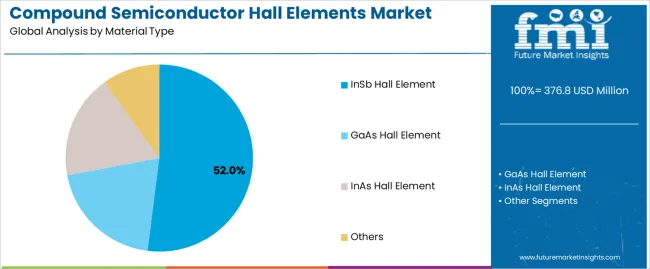
The InSb hall element segment represents the dominant force in the compound semiconductor hall elements market, capturing approximately 52.0% of total market share in 2025. This advanced category encompasses standard sensitivity devices, high-temperature variants, and ultra-low-noise configurations optimized for precision magnetic field measurement, delivering exceptional electron mobility and superior magnetic sensitivity in demanding sensing applications. The InSb hall element segment's market leadership stems from its outstanding material properties including highest electron mobility among practical semiconductor materials, proven reliability in automotive and industrial environments, and compatibility with established sensor packaging and signal conditioning technologies.
The GaAs hall element segment maintains a substantial 28.0% market share, serving applications requiring balanced sensitivity and temperature stability through radiation-hardened designs and integrated amplification circuits. The InAs hall element segment accounts for 12.0% market share, featuring moderate sensitivity characteristics and cost-effective manufacturing processes suitable for consumer electronics applications. Other material types constitute 8.0% market share, encompassing emerging compound semiconductor materials and specialized alloy compositions for niche sensing requirements.
Key advantages driving the InSb hall element segment include:
- Exceptional electron mobility enabling detection of weak magnetic fields with superior signal-to-noise performance
- Wide operating temperature range supporting automotive underhood applications and industrial process control environments
- Proven long-term stability and reliability in high-volume automotive electronics manufacturing and qualification testing
- Established supply chain infrastructure minimizing material sourcing risks and ensuring consistent component availability
By Application, the Automotive and Transportation Segment Accounts for the Largest Market Share
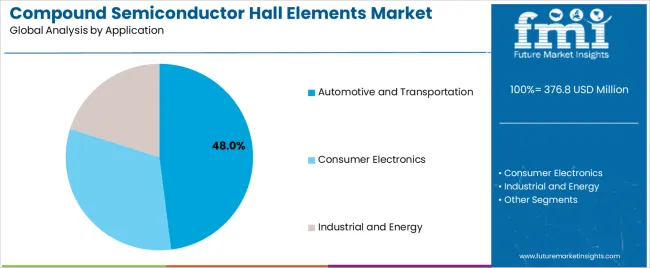
Automotive and transportation applications dominate the compound semiconductor hall elements market with approximately 48.0% market share in 2025, reflecting the extensive adoption of magnetic sensing solutions across electric vehicle powertrain systems, advanced driver assistance features, and conventional automotive electronics platforms. The automotive and transportation segment's market leadership is reinforced by widespread implementation in battery management systems (18.0%), motor position sensing (16.0%), and transmission control applications (14.0%), which provide essential performance advantages and reliability consistency in demanding automotive operating conditions.
The consumer electronics segment represents 29.0% market share through specialized applications including smartphone compass modules (12.0%), gaming controllers (9.0%), and wearable devices (8.0%). Industrial and energy accounts for 23.0% market share, driven by adoption in servo motor control (10.0%), conveyor positioning systems (7.0%), and renewable energy equipment (6.0%).
Key market dynamics supporting application preferences include:
- Automotive applications requiring high-reliability sensing solutions with stringent safety certifications and extended temperature operation
- Consumer electronics demanding miniaturized sensors with ultra-low power consumption and compact integration capabilities
- Industrial systems emphasizing rugged construction and immunity to contamination in harsh manufacturing environments
- Growing electric vehicle adoption creating sustained demand for battery current monitoring and motor control sensing solutions
What are the Drivers, Restraints, and Key Trends of the Compound Semiconductor Hall Elements Market?
The market is driven by three concrete demand factors tied to electrification and automation outcomes. First, electric vehicle market expansion creates increasing requirements for high-performance current sensing solutions, with global EV sales exceeding 14 million vehicles annually in major markets worldwide, requiring reliable compound semiconductor hall sensors for battery management, motor control, and charging system monitoring across multiple sensing points per vehicle. Second, industrial automation growth and brushless motor proliferation drive adoption of precise position sensing technology, with compound semiconductor hall elements enabling smooth motor commutation and accurate feedback in servo systems where positioning errors below 0.1 degrees are required for manufacturing quality and robotic precision. Third, consumer electronics miniaturization and smart device proliferation accelerate deployment across portable applications, with compound semiconductor hall sensors providing compass functionality, gesture recognition, and proximity detection in form factors under 2mm while consuming less than 10 microamperes in active operation modes.
Market restraints include cost premiums affecting high-volume consumer electronics and price-sensitive applications, particularly where silicon-based hall sensors provide adequate sensitivity for less demanding magnetic field detection requirements and where component cost targets below $0.50 per unit drive purchasing decisions toward commodity sensing solutions. Manufacturing complexity requirements for compound semiconductor processing pose scalability challenges for suppliers lacking specialized epitaxial growth equipment, as InSb and GaAs hall element fabrication demands precise material composition control and advanced wafer processing capabilities that differ significantly from standard silicon semiconductor manufacturing. Limited awareness of performance advantages in traditional industrial markets creates additional barriers, as equipment designers accustomed to silicon hall sensors require technical education regarding superior sensitivity, lower noise characteristics, and enhanced temperature stability available through compound semiconductor alternatives.
Key trends indicate accelerated adoption in Asian automotive electronics hubs, particularly China and Japan, where electric vehicle production capabilities and automotive electronics manufacturing are expanding rapidly through government electrification mandates and substantial investment in battery electric vehicle platforms. Technology advancement trends toward integrated sensor modules with built-in signal processing, multi-axis measurement configurations enabling 3D magnetic field mapping, and ultra-miniaturized packages suitable for wearable devices are driving next-generation product development. However, the market thesis could face disruption if magnetoresistive sensing technologies achieve breakthrough cost reductions while maintaining superior sensitivity performance, potentially offering competitive alternatives to compound semiconductor hall elements in specific high-sensitivity applications and precision measurement systems.
How Does the Market Perform by Key Country?
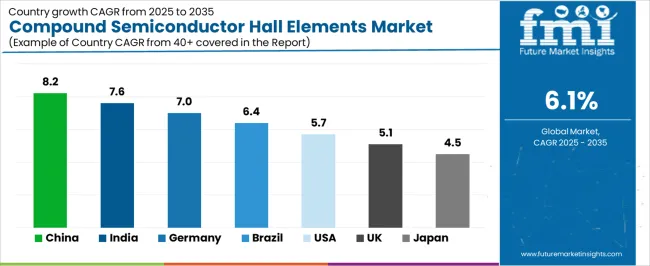
| Country | CAGR (2025-2035) |
|---|---|
| China | 8.2% |
| India | 7.6% |
| Germany | 7.0% |
| Brazil | 6.4% |
| USA | 5.7% |
| UK | 5.1% |
| Japan | 4.5% |
The compound semiconductor hall elements market is gaining momentum worldwide, with China taking the lead thanks to aggressive electric vehicle manufacturing expansion and automotive electronics production capacity growth. Close behind, India benefits from growing automotive electronics manufacturing and government electronics production initiatives, positioning itself as a strategic growth hub in the Asia-Pacific region. Brazil shows strong advancement, where expanding automotive assembly operations and industrial automation infrastructure development strengthen its role in South American electronics supply chains. The USA demonstrates robust growth through electric vehicle adoption and advanced automotive electronics development, signaling continued investment in high-performance sensing solutions. Meanwhile, Japan stands out for its precision sensor manufacturing expertise and automotive electronics integration capabilities, while UK and Germany continue to record consistent progress driven by automotive engineering excellence and industrial equipment manufacturing. Together, China and India anchor the global expansion story, while established markets build stability and technology innovation into the market's growth path.
The report covers an in-depth analysis of 40+ countries top-performing countries are highlighted below.
How is China leading the market?
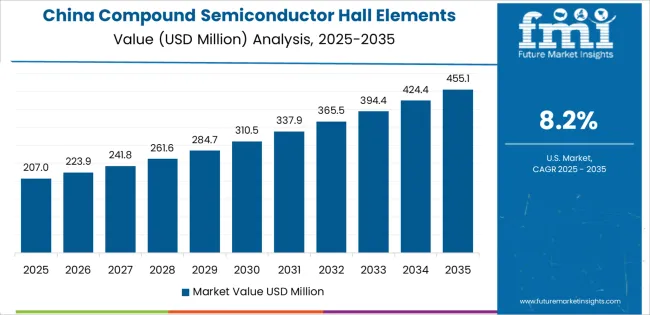
China demonstrates the strongest growth potential in the Compound Semiconductor Hall Elements Market with a CAGR of 8.2% through 2035. The country's leadership position stems from comprehensive electric vehicle manufacturing expansion, intensive automotive electronics development programs, and aggressive new energy vehicle targets driving adoption of advanced magnetic sensing technologies. Growth is concentrated in major automotive electronics regions, including Guangdong, Jiangsu, Shanghai, and Zhejiang, where automotive suppliers, consumer electronics manufacturers, and industrial equipment producers are implementing compound semiconductor hall sensors for performance enhancement and reliability improvement. Distribution channels through electronics component distributors, automotive electronics suppliers, and direct manufacturer relationships expand deployment across electric vehicle clusters, consumer electronics production bases, and industrial automation equipment manufacturing centers. The country's New Energy Vehicle mandate provides policy support for advanced automotive electronics adoption, including subsidies for electric vehicle component development and battery management system implementation.
Key market factors:
- Manufacturing intensity in electric vehicle and automotive electronics production belts with comprehensive industry upgrading programs
- Government support through NEV policies and electronics manufacturing incentives providing 25-35% development subsidies for advanced sensor adoption
- Comprehensive supply chain ecosystem including established electronics component distributors and technical service providers with proven capabilities
- Technology integration featuring automotive battery management systems, industrial servo control platforms, and consumer electronics modules enabling advanced magnetic sensing
How is India emerging as a high-growth market?
In the National Capital Region, Tamil Nadu, Karnataka, and Maharashtra industrial zones, the adoption of compound semiconductor hall element systems is accelerating across automotive electronics manufacturing, consumer electronics production facilities, and industrial automation operations, driven by Make in India initiatives and increasing focus on electronics manufacturing competitiveness. The market demonstrates strong growth momentum with a CAGR of 7.6% through 2035, linked to comprehensive automotive sector expansion and increasing investment in electronics production capabilities. Indian manufacturers are implementing compound semiconductor hall sensor technology and advanced electronics assembly platforms to improve product performance while meeting quality requirements in automotive and consumer electronics supply chains serving domestic and export markets. The country's National Electronics Policy creates sustained demand for advanced sensor solutions, while increasing emphasis on electric vehicle adoption drives implementation of high-performance current sensing systems that enhance battery management efficiency.
- Leading industrial development regions, including Chennai, Bangalore, Pune, and Gurugram, driving compound semiconductor hall element adoption across automotive electronics clusters
- Government incentive programs enabling 30-45% capital subsidy support for electronics manufacturing equipment procurement and technology upgrades
- Technology collaboration agreements accelerating deployment with international sensor manufacturers and automotive electronics technology providers
- Policy support through Production Linked Incentive schemes and electronics manufacturing programs linked to advanced sensor component adoption
How is Germany maintaining regional leadership?
Germany's advanced automotive sector demonstrates sophisticated implementation of compound semiconductor hall element systems, with documented case studies showing 35-40% sensitivity improvement in electric vehicle current sensing applications through optimized sensor selection strategies. The country's automotive electronics infrastructure in major industrial regions, including Bavaria, Baden-Württemberg, North Rhine-Westphalia, and Lower Saxony, showcases integration of precision magnetic sensing technologies with existing automotive control systems, leveraging expertise in electric vehicle engineering and automotive electronics innovation. German automotive suppliers emphasize quality standards and performance optimization, creating demand for reliable compound semiconductor hall sensor solutions that support safety commitments and stringent accuracy requirements. The market maintains strong growth through focus on electric vehicle technology leadership and automotive electronics excellence, with a CAGR of 7.0% through 2035.
Key development areas:
- Automotive electronics manufacturing centers enabling precision sensing implementation with comprehensive qualification and testing programs
- Technical development infrastructure providing skilled electronics engineering workforce with documented 92% optimal sensor integration implementation
- Strategic partnerships between sensor suppliers and automotive electronics manufacturers expanding integrated solution offerings
- Integration of battery management systems and comprehensive vehicle control architectures for optimized electric powertrain operation
How is Brazil developing in automotive electronics?
The Brazilian market leads in Latin American compound semiconductor hall element adoption based on expanding automotive electronics manufacturing operations and growing industrial automation infrastructure in major production centers. The country shows solid potential with a CAGR of 6.4% through 2035, driven by automotive sector investment and increasing domestic demand for electronic control systems across vehicle platforms, industrial equipment, and consumer electronics sectors. Brazilian manufacturers are adopting compound semiconductor hall sensor technology for compliance with automotive electronics standards, particularly in electric power steering systems requiring precise torque sensing and in motor control applications where magnetic position detection impacts system performance. Technology deployment channels through electronics distributors, automotive component representatives, and equipment suppliers expand coverage across automotive supply chains and industrial automation facilities.
Leading market segments:
- Automotive electronics production in São Paulo and southern industrial regions implementing advanced sensing programs
- Technology partnerships with international sensor manufacturers achieving 75% performance improvement targets in magnetic sensing applications
- Strategic collaborations between automotive assemblers and electronics suppliers enabling advanced sensor technology adoption
- Focus on vehicle electrification and automation competitiveness incentivizing precision magnetic sensing component investment
How is the United States Advancing in Technology Innovation?
The USA market leads in advanced compound semiconductor hall element applications based on integration with sophisticated automotive control systems and comprehensive industrial automation platforms for enhanced sensing performance. The country shows solid potential with a CAGR of 5.7% through 2035, driven by electric vehicle adoption and increasing implementation of advanced magnetic sensing technologies across automotive, industrial equipment, and consumer electronics sectors. American manufacturers are deploying compound semiconductor hall sensor systems for high-precision current monitoring requirements, particularly in battery electric vehicle platforms demanding accurate battery management and in industrial servo systems where precise motor commutation directly impacts positioning accuracy. Technology deployment channels through electronics distributors, automotive electronics specialists, and direct manufacturer relationships expand coverage across diverse sensing applications.
Leading market segments:
- Electric vehicle electronics manufacturing in California, Michigan, and southeastern USA regions implementing precision current sensing programs
- Technology partnerships with sensor manufacturers achieving 96% accuracy compliance rates in critical automotive safety applications
- Strategic collaborations between automotive OEMs and electronics suppliers enabling advanced magnetic sensing technology deployment
- Focus on vehicle electrification and autonomous driving systems driving high-performance sensor adoption across automotive platforms
How Does the United Kingdom Demonstrate Steady Electronics Adoption?
The UK market demonstrates consistent implementation focused on automotive electronics production and industrial automation applications, with documented integration of compound semiconductor hall element systems achieving 28-32% sensitivity improvements in electric vehicle sensing operations. The country maintains steady growth momentum with a CAGR of 5.1% through 2035, driven by automotive manufacturing presence and industrial equipment requirements for precision magnetic sensing capabilities in motor control systems. Major industrial regions, including West Midlands, North West England, and South Wales, showcase deployment of advanced sensing technologies that integrate with existing automotive electronics infrastructure and support performance requirements in electric vehicle and industrial automation supply chains.
Key market characteristics:
- Automotive electronics clusters and industrial equipment production facilities driving precision magnetic sensing technology requirements
- Technology partnerships enabling 87% optimal sensor integration implementation through technical support programs
- Collaboration between sensor suppliers and automotive electronics facilities ensuring consistent performance and technical assistance
- Emphasis on electric vehicle development and manufacturing efficiency supporting advanced sensing component adoption in competitive sectors
Why Do InSb Hall Elements Dominate Automotive Requirements in Japan?
Japan's compound semiconductor hall elements market demonstrates sophisticated implementation focused on automotive electronics production and precision consumer device manufacturing, with documented integration of advanced magnetic sensors achieving 32-36% noise reduction in high-sensitivity sensing operations. The country maintains steady growth momentum with a CAGR of 4.5% through 2035, driven by manufacturing excellence culture and emphasis on quality optimization principles aligned with automotive reliability philosophies. Major industrial regions, including Aichi, Kanagawa, Osaka, and Shizuoka, showcase advanced deployment of precision magnetic sensing technologies that integrate seamlessly with automotive control systems and comprehensive electronics manufacturing quality assurance programs.
Key market characteristics:
- Automotive electronics manufacturing and precision sensor production driving advanced magnetic sensing technology requirements with emphasis on reliability
- Technology partnerships enabling 97% performance consistency compliance through optimized sensor design strategies and process control
- Collaboration between sensor manufacturers and automotive electronics producers ensuring integrated solution development and technical support
- Emphasis on manufacturing quality and continuous improvement supporting precision magnetic sensing technology adoption across automotive applications
How is Europe’s Market Split by Country?

The compound semiconductor hall elements market in Europe is projected to grow from USD 140.0 million in 2025 to USD 212.9 million by 2035, registering a CAGR of 4.2% over the forecast period. Germany is expected to maintain its leadership position with a 34.8% market share in 2025, declining slightly to 34.2% by 2035, supported by its extensive automotive electronics manufacturing infrastructure and major automotive engineering centers, including Bavaria, Baden-Württemberg, and North Rhine-Westphalia production regions.
France follows with a 19.5% share in 2025, projected to reach 19.8% by 2035, driven by comprehensive automotive electronics development and electric vehicle manufacturing programs in major industrial regions. The United Kingdom holds a 15.2% share in 2025, expected to reach 15.4% by 2035 through automotive electronics engineering centers and precision sensor manufacturing facilities. Italy commands a 11.7% share in both 2025 and 2035, backed by automotive electronics production and industrial automation equipment manufacturing. Spain accounts for 7.8% in 2025, rising to 8.0% by 2035 on automotive assembly electronics integration and consumer electronics production growth. The Rest of Europe region is anticipated to hold 11.0% in 2025, expanding to 11.9% by 2035, attributed to increasing compound semiconductor hall element adoption in Nordic countries and emerging Central & Eastern European automotive electronics manufacturing operations.
InSb Hall Elements Dominate Automotive Requirements in Japan
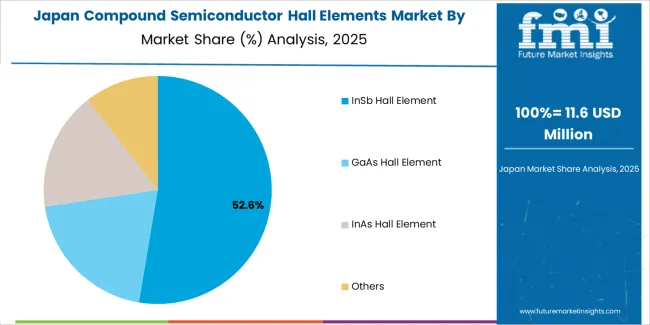
The Japanese compound semiconductor hall elements market demonstrates a mature and performance-focused landscape, characterized by sophisticated integration of InSb-based magnetic sensing systems with existing automotive electronics infrastructure across electric vehicle production, precision consumer electronics manufacturing, and industrial equipment fabrication operations. Japan's emphasis on quality excellence and reliability optimization drives demand for high-sensitivity magnetic sensors that support automotive safety commitments and precision targets in competitive electronics manufacturing environments. The market benefits from strong partnerships between international compound semiconductor providers and domestic automotive electronics suppliers including major automotive tier-one manufacturers, creating comprehensive service ecosystems that prioritize technical support and application engineering programs. Industrial centers in Aichi, Kanagawa, Osaka, and other major automotive production areas showcase advanced electronics implementations where compound semiconductor hall element systems achieve 97% performance consistency compliance through optimized sensor integration and comprehensive validation testing programs.
International Providers Lead Technical Services in South Korea

The South Korean compound semiconductor hall elements market is characterized by growing international technology provider presence, with companies maintaining significant positions through comprehensive technical support and application engineering capabilities for automotive electronics manufacturing and consumer device production applications. The market demonstrates increasing emphasis on electric vehicle electronics and high-performance sensing solutions, as Korean manufacturers increasingly demand advanced magnetic sensors that integrate with domestic automotive control system infrastructure and sophisticated battery management platforms deployed across major automotive manufacturing complexes. Regional electronics component distributors are gaining market share through strategic partnerships with international sensor manufacturers, offering specialized services including technical training programs and application-specific sensing solutions for automotive and consumer electronics production operations. The competitive landscape shows increasing collaboration between multinational compound semiconductor companies and Korean automotive electronics specialists, creating hybrid service models that combine international material technology expertise with local technical support capabilities and rapid response systems.
What is the Competitive Landscape of the Compound Semiconductor Hall Elements Market?
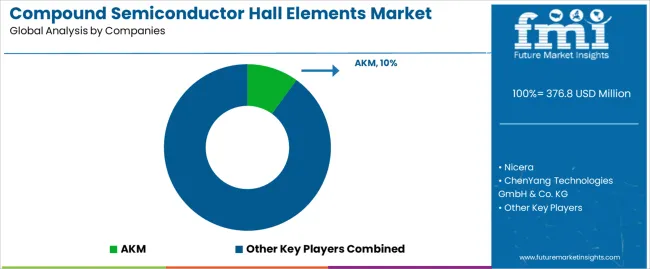
The compound semiconductor hall elements market features approximately 15-20 meaningful players with moderate fragmentation, where the top three companies control roughly 24-28% of global market share through established distribution networks and specialized technology portfolios. Competition centers on magnetic sensitivity performance, temperature stability characteristics, and application engineering support capabilities rather than price competition alone. AKM leads with approximately 10.0% market share through its comprehensive magnetic sensor solutions portfolio and automotive electronics market presence.
Market leaders include AKM, Nicera, and ChenYang Technologies GmbH & Co. KG, which maintain competitive advantages through advanced compound semiconductor processing capabilities, proven automotive qualification experience, and deep expertise in magnetic sensor design across multiple application segments, creating trust and reliability advantages with automotive electronics manufacturers and industrial equipment producers. These companies leverage research and development capabilities in material composition optimization and ongoing technical support relationships to defend market positions while expanding into emerging electric vehicle markets and specialized sensing applications.
Challengers encompass Diodes Incorporated and Shenzhen Junmin Technology, which compete through specialized product offerings and strong regional presence in key electronics manufacturing markets. Product specialists, including Asensor Technology AB and Lake Shore Cryotronics, Inc., focus on specific material types or application markets, offering differentiated capabilities in ultra-high sensitivity sensors, cryogenic measurement solutions, and scientific instrumentation applications.
Regional players and emerging sensor manufacturers create competitive pressure through localized manufacturing advantages and rapid response capabilities, particularly in high-growth markets including China and India, where proximity to automotive electronics clusters provides advantages in technical support responsiveness and customer relationships. Market dynamics favor companies that combine proven magnetic sensing performance with comprehensive application engineering offerings that address the complete sensor integration cycle from material selection through signal conditioning design and system-level qualification testing.
Global Compound Semiconductor Hall Elements Market - Stakeholder Contribution Framework
Compound semiconductor hall elements represent advanced magnetic sensing solutions that enable electronics manufacturers to achieve 10-20 times higher magnetic sensitivity compared to silicon alternatives, delivering superior detection performance and operational reliability with enhanced temperature stability and lower noise characteristics in demanding automotive and industrial applications. With the market projected to grow from USD 376.8 million in 2025 to USD 681.3 million by 2035 at a 6.1% CAGR, these precision sensing components offer compelling advantages - enhanced sensitivity, reliability improvement, and operational efficiency - making them essential for automotive and transportation applications (48.0% market share), consumer electronics (29.0% share), and equipment manufacturers seeking alternatives to silicon hall sensors that compromise performance through limited sensitivity and reduced temperature stability. Scaling market adoption and technology deployment requires coordinated action across electronics industry policy, automotive electrification programs, compound semiconductor manufacturers, electronics design communities, and sensor technology investment capital.
How Governments Could Spur Local Production and Adoption?
- Electronics Manufacturing Programs: Include advanced sensor procurement in electric vehicle subsidy schemes, provide technology development support for compound semiconductor manufacturing facilities, and establish domestic sensor production capabilities that reduce import dependencies in automotive electronics supply chains.
- Research & Innovation Funding: Fund university research on compound semiconductor material development, magnetic sensor design optimization, and signal processing integration for automotive applications. Invest in industry-academic partnerships that advance practical magnetic sensing knowledge for diverse application requirements.
- Infrastructure Development Incentives: Provide grants for establishing compound semiconductor fabrication facilities near automotive electronics clusters, offer equipment financing programs for advanced sensor packaging adoption in electronics assembly facilities, and support supply chain development that ensures reliable sensor component availability for electric vehicle manufacturers.
- Standards & Quality Certification: Establish national testing facilities for magnetic sensor performance verification, develop training programs for sensor application engineers and automotive electronics designers, and create harmonized qualification protocols that facilitate evaluation of hall sensor performance across different automotive platforms.
- Electric Vehicle Programs: Promote automotive electrification through battery management system subsidies, support electric powertrain development initiatives that integrate precision current sensing, and establish incentive programs that reward adoption of high-performance magnetic sensors in vehicle control systems.
How Industry Bodies Could Support Market Development?
- Quality Standards & Certification: Define standardized testing protocols for magnetic sensitivity performance, temperature stability characteristics, and long-term reliability metrics across InSb hall element (52.0% market dominance) and other compound semiconductor sensing systems, enabling reliable performance comparison and informed component selection decisions.
- Best Management Practices: Develop comprehensive guidelines for sensor integration design, signal conditioning circuit optimization, and electromagnetic compatibility management in automotive electronics applications, ensuring consistent sensing performance and maximum reliability across different vehicle platforms and operating conditions.
- Supply Chain Integration Standards: Create technical documentation frameworks for sensor specifications, interface requirements, and qualification testing procedures that facilitate seamless integration across automotive electronics development programs and consumer device manufacturing operations.
- Technical Training & Extension: Establish education programs for electronics engineers, application specialists, and automotive systems designers on optimal magnetic sensor selection, circuit integration techniques, and performance validation methods that ensure successful compound semiconductor hall element implementation.
How OEMs and Technology Players Could Strengthen the Ecosystem?
- Advanced Product Development: Develop next-generation compound semiconductor materials with enhanced electron mobility, optimized sensor geometries with improved thermal stability characteristics, and integrated signal processing circuits that extend performance capabilities while maintaining automotive qualification standards.
- Processing Technology Innovation: Provide efficient epitaxial growth equipment with precise material composition control, advanced packaging systems for miniaturized sensor integration, and comprehensive testing platforms that ensure consistent performance across production batches.
- Application-Specific Solutions: Offer magnetic sensor systems tailored for electric vehicle battery management, specialized configurations for industrial motor control applications, and customized integrated circuits that address specific signal conditioning requirements while maintaining performance objectives.
- Technical Support Services: Build comprehensive customer advisory programs including sensor selection guidance, circuit design assistance, and qualification testing support that help electronics manufacturers achieve target performance levels while maintaining automotive reliability standards.
How Suppliers Could Navigate the Shift?
- Application-Focused Product Lines: Develop specialized compound semiconductor hall elements for automotive and transportation applications (48.0% market dominance), consumer electronics (29.0% share), and industrial segments, with sensor configurations optimized for each application's specific magnetic sensitivity requirements and environmental specifications.
- Geographic Market Strategy: Establish manufacturing and distribution capabilities in high-growth markets like China (8.2% CAGR) and India (7.6% CAGR), while maintaining technical support infrastructure in established automotive electronics markets like Germany (7.0% CAGR) and USA (5.7% CAGR).
- Technology Differentiation: Invest in proprietary compound semiconductor processes, advanced sensor packaging technologies, and comprehensive qualification testing systems that provide superior magnetic sensing performance and enable premium positioning in competitive automotive electronics component markets.
- Customer Partnership Models: Develop long-term relationships with automotive electronics manufacturers, consumer device producers, and industrial equipment suppliers through collaborative application development programs, technical training services, and performance guarantee programs that strengthen customer loyalty.
How Investors and Financial Enablers Could Unlock Value?
- Compound Semiconductor Manufacturing: Finance established hall element manufacturers for production capacity expansion, material processing technology implementation, and quality control system upgrades that serve growing demand in automotive and consumer electronics markets.
- Supply Chain Infrastructure: Provide capital for establishing regional sensor packaging facilities, technical support centers, and application engineering teams that reduce lead times while ensuring consistent technical assistance across automotive electronics and industrial equipment manufacturing regions.
- Innovation & Technology Development: Back semiconductor technology companies developing advanced compound semiconductor materials, integrated sensor modules, and signal processing solutions that enhance magnetic sensing performance while addressing miniaturization requirements and power consumption constraints.
- Market Integration & Consolidation: Support strategic partnerships between compound semiconductor manufacturers and automotive electronics suppliers, finance technical training program development, and enable market consolidation that creates comprehensive magnetic sensing solution providers serving multiple application segments.
Key Players in the Compound Semiconductor Hall Elements Market
- AKM
- Nicera
- ChenYang Technologies GmbH & Co. KG
- Diodes Incorporated
- Shenzhen Junmin Technology
- Asensor Technology AB
- Lake Shore Cryotronics, Inc.
Scope of the Report
| Item | Value |
|---|---|
| Quantitative Units | USD 376.8 million |
| Material Type | InSb Hall Element, GaAs Hall Element, InAs Hall Element, Others |
| Application | Automotive and Transportation, Consumer Electronics, Industrial and Energy |
| Regions Covered | Asia Pacific, Europe, North America, Latin America, Middle East & Africa |
| Country Covered | China, India, Germany, Brazil, USA, UK, Japan, and 40+ countries |
| Key Companies Profiled | AKM, Nicera, ChenYang Technologies GmbH & Co. KG, Diodes Incorporated, Shenzhen Junmin Technology, Asensor Technology AB, Lake Shore Cryotronics, Inc. |
| Additional Attributes | Dollar sales by material type and application categories, regional adoption trends across Asia Pacific, Europe, and North America, competitive landscape with compound semiconductor manufacturers and electronics distribution networks, fabrication facility requirements and specifications, integration with automotive battery management systems and industrial motor control platforms, innovations in compound semiconductor processing and sensor packaging technologies, and development of specialized magnetic sensing solutions with enhanced sensitivity and temperature stability capabilities. |
Compound Semiconductor Hall Elements Market by Segments
Material Type:
- InSb Hall Element
- GaAs Hall Element
- InAs Hall Element
- Others
Application:
- Automotive and Transportation
- Consumer Electronics
- Industrial and Energy
Region:
- Asia Pacific
- China
- India
- Japan
- South Korea
- Australia & New Zealand
- ASEAN
- Rest of Asia Pacific
- Europe
- Germany
- United Kingdom
- France
- Italy
- Spain
- Netherlands
- Nordic
- BENELUX
- Rest of Europe
- North America
- United States
- Canada
- Mexico
- Latin America
- Brazil
- Argentina
- Rest of Latin America
- Middle East & Africa
- Kingdom of Saudi Arabia
- Other GCC Countries
- Turkey
- South Africa
- Other African Union
- Rest of Middle East & Africa
Frequently Asked Questions
How big is the compound semiconductor hall elements market in 2025?
The global compound semiconductor hall elements market is estimated to be valued at USD 376.8 million in 2025.
What will be the size of compound semiconductor hall elements market in 2035?
The market size for the compound semiconductor hall elements market is projected to reach USD 681.2 million by 2035.
How much will be the compound semiconductor hall elements market growth between 2025 and 2035?
The compound semiconductor hall elements market is expected to grow at a 6.1% CAGR between 2025 and 2035.
What are the key product types in the compound semiconductor hall elements market?
The key product types in compound semiconductor hall elements market are insb hall element, gaas hall element, inas hall element and others.
Which application segment to contribute significant share in the compound semiconductor hall elements market in 2025?
In terms of application, automotive and transportation segment to command 48.0% share in the compound semiconductor hall elements market in 2025.
Preview the report firsthand - request a free sample
Get SampleGet the brochure for pricing and purchase details.
Get PDFTable of Content
- Executive Summary
- Global Market Outlook
- Demand-side Trends
- Supply-side Trends
- Technology Roadmap Analysis
- Analysis and Recommendations
- Market Overview
- Market Coverage / Taxonomy
- Market Definition / Scope / Limitations
- Market Background
- Market Dynamics
- Drivers
- Restraints
- Opportunity
- Trends
- Scenario Forecast
- Demand in Optimistic Scenario
- Demand in Likely Scenario
- Demand in Conservative Scenario
- Opportunity Map Analysis
- Product Life Cycle Analysis
- Supply Chain Analysis
- Investment Feasibility Matrix
- Value Chain Analysis
- PESTLE and Porter’s Analysis
- Regulatory Landscape
- Regional Parent Market Outlook
- Production and Consumption Statistics
- Import and Export Statistics
- Market Dynamics
- Global Market Analysis 2020 to 2024 and Forecast, 2025 to 2035
- Historical Market Size Value (USD Million) Analysis, 2020 to 2024
- Current and Future Market Size Value (USD Million) Projections, 2025 to 2035
- Y-o-Y Growth Trend Analysis
- Absolute $ Opportunity Analysis
- Global Market Pricing Analysis 2020 to 2024 and Forecast 2025 to 2035
- Global Market Analysis 2020 to 2024 and Forecast 2025 to 2035, By Material Type
- Introduction / Key Findings
- Historical Market Size Value (USD Million) Analysis By Material Type , 2020 to 2024
- Current and Future Market Size Value (USD Million) Analysis and Forecast By Material Type , 2025 to 2035
- InSb Hall Element
- GaAs Hall Element
- InAs Hall Element
- Others
- Y-o-Y Growth Trend Analysis By Material Type , 2020 to 2024
- Absolute $ Opportunity Analysis By Material Type , 2025 to 2035
- Global Market Analysis 2020 to 2024 and Forecast 2025 to 2035, By Application
- Introduction / Key Findings
- Historical Market Size Value (USD Million) Analysis By Application, 2020 to 2024
- Current and Future Market Size Value (USD Million) Analysis and Forecast By Application, 2025 to 2035
- Automotive and Transportation
- Consumer Electronics
- Industrial and Energy
- Y-o-Y Growth Trend Analysis By Application, 2020 to 2024
- Absolute $ Opportunity Analysis By Application, 2025 to 2035
- Global Market Analysis 2020 to 2024 and Forecast 2025 to 2035, By Region
- Introduction
- Historical Market Size Value (USD Million) Analysis By Region, 2020 to 2024
- Current Market Size Value (USD Million) Analysis and Forecast By Region, 2025 to 2035
- North America
- Latin America
- Western Europe
- Eastern Europe
- East Asia
- South Asia and Pacific
- Middle East & Africa
- Market Attractiveness Analysis By Region
- North America Market Analysis 2020 to 2024 and Forecast 2025 to 2035, By Country
- Historical Market Size Value (USD Million) Trend Analysis By Market Taxonomy, 2020 to 2024
- Market Size Value (USD Million) Forecast By Market Taxonomy, 2025 to 2035
- By Country
- USA
- Canada
- Mexico
- By Material Type
- By Application
- By Country
- Market Attractiveness Analysis
- By Country
- By Material Type
- By Application
- Key Takeaways
- Latin America Market Analysis 2020 to 2024 and Forecast 2025 to 2035, By Country
- Historical Market Size Value (USD Million) Trend Analysis By Market Taxonomy, 2020 to 2024
- Market Size Value (USD Million) Forecast By Market Taxonomy, 2025 to 2035
- By Country
- Brazil
- Chile
- Rest of Latin America
- By Material Type
- By Application
- By Country
- Market Attractiveness Analysis
- By Country
- By Material Type
- By Application
- Key Takeaways
- Western Europe Market Analysis 2020 to 2024 and Forecast 2025 to 2035, By Country
- Historical Market Size Value (USD Million) Trend Analysis By Market Taxonomy, 2020 to 2024
- Market Size Value (USD Million) Forecast By Market Taxonomy, 2025 to 2035
- By Country
- Germany
- UK
- Italy
- Spain
- France
- Nordic
- BENELUX
- Rest of Western Europe
- By Material Type
- By Application
- By Country
- Market Attractiveness Analysis
- By Country
- By Material Type
- By Application
- Key Takeaways
- Eastern Europe Market Analysis 2020 to 2024 and Forecast 2025 to 2035, By Country
- Historical Market Size Value (USD Million) Trend Analysis By Market Taxonomy, 2020 to 2024
- Market Size Value (USD Million) Forecast By Market Taxonomy, 2025 to 2035
- By Country
- Russia
- Poland
- Hungary
- Balkan & Baltic
- Rest of Eastern Europe
- By Material Type
- By Application
- By Country
- Market Attractiveness Analysis
- By Country
- By Material Type
- By Application
- Key Takeaways
- East Asia Market Analysis 2020 to 2024 and Forecast 2025 to 2035, By Country
- Historical Market Size Value (USD Million) Trend Analysis By Market Taxonomy, 2020 to 2024
- Market Size Value (USD Million) Forecast By Market Taxonomy, 2025 to 2035
- By Country
- China
- Japan
- South Korea
- By Material Type
- By Application
- By Country
- Market Attractiveness Analysis
- By Country
- By Material Type
- By Application
- Key Takeaways
- South Asia and Pacific Market Analysis 2020 to 2024 and Forecast 2025 to 2035, By Country
- Historical Market Size Value (USD Million) Trend Analysis By Market Taxonomy, 2020 to 2024
- Market Size Value (USD Million) Forecast By Market Taxonomy, 2025 to 2035
- By Country
- India
- ASEAN
- Australia & New Zealand
- Rest of South Asia and Pacific
- By Material Type
- By Application
- By Country
- Market Attractiveness Analysis
- By Country
- By Material Type
- By Application
- Key Takeaways
- Middle East & Africa Market Analysis 2020 to 2024 and Forecast 2025 to 2035, By Country
- Historical Market Size Value (USD Million) Trend Analysis By Market Taxonomy, 2020 to 2024
- Market Size Value (USD Million) Forecast By Market Taxonomy, 2025 to 2035
- By Country
- Kingdom of Saudi Arabia
- Other GCC Countries
- Turkiye
- South Africa
- Other African Union
- Rest of Middle East & Africa
- By Material Type
- By Application
- By Country
- Market Attractiveness Analysis
- By Country
- By Material Type
- By Application
- Key Takeaways
- Key Countries Market Analysis
- USA
- Pricing Analysis
- Market Share Analysis, 2024
- By Material Type
- By Application
- Canada
- Pricing Analysis
- Market Share Analysis, 2024
- By Material Type
- By Application
- Mexico
- Pricing Analysis
- Market Share Analysis, 2024
- By Material Type
- By Application
- Brazil
- Pricing Analysis
- Market Share Analysis, 2024
- By Material Type
- By Application
- Chile
- Pricing Analysis
- Market Share Analysis, 2024
- By Material Type
- By Application
- Germany
- Pricing Analysis
- Market Share Analysis, 2024
- By Material Type
- By Application
- UK
- Pricing Analysis
- Market Share Analysis, 2024
- By Material Type
- By Application
- Italy
- Pricing Analysis
- Market Share Analysis, 2024
- By Material Type
- By Application
- Spain
- Pricing Analysis
- Market Share Analysis, 2024
- By Material Type
- By Application
- France
- Pricing Analysis
- Market Share Analysis, 2024
- By Material Type
- By Application
- India
- Pricing Analysis
- Market Share Analysis, 2024
- By Material Type
- By Application
- ASEAN
- Pricing Analysis
- Market Share Analysis, 2024
- By Material Type
- By Application
- Australia & New Zealand
- Pricing Analysis
- Market Share Analysis, 2024
- By Material Type
- By Application
- China
- Pricing Analysis
- Market Share Analysis, 2024
- By Material Type
- By Application
- Japan
- Pricing Analysis
- Market Share Analysis, 2024
- By Material Type
- By Application
- South Korea
- Pricing Analysis
- Market Share Analysis, 2024
- By Material Type
- By Application
- Russia
- Pricing Analysis
- Market Share Analysis, 2024
- By Material Type
- By Application
- Poland
- Pricing Analysis
- Market Share Analysis, 2024
- By Material Type
- By Application
- Hungary
- Pricing Analysis
- Market Share Analysis, 2024
- By Material Type
- By Application
- Kingdom of Saudi Arabia
- Pricing Analysis
- Market Share Analysis, 2024
- By Material Type
- By Application
- Turkiye
- Pricing Analysis
- Market Share Analysis, 2024
- By Material Type
- By Application
- South Africa
- Pricing Analysis
- Market Share Analysis, 2024
- By Material Type
- By Application
- USA
- Market Structure Analysis
- Competition Dashboard
- Competition Benchmarking
- Market Share Analysis of Top Players
- By Regional
- By Material Type
- By Application
- Competition Analysis
- Competition Deep Dive
- AKM
- Overview
- Product Portfolio
- Profitability by Market Segments (Product/Age /Sales Channel/Region)
- Sales Footprint
- Strategy Overview
- Marketing Strategy
- Product Strategy
- Channel Strategy
- Nicera
- ChenYang Technologies GmbH & Co. KG
- Diodes Incorporated
- Shenzhen Junmin Technology
- Asensor Technology AB
- Lake Shore Cryotronics, Inc.
- AKM
- Competition Deep Dive
- Assumptions & Acronyms Used
- Research Methodology


