

- Industry Size (2026)
- USD 3.79 Bn
- Forecast (2036)
- USD 8.41 Bn
- CAGR (2026 to 2036)
- 8.3%
Contour Measuring Machines Market Size, Market Forecast and Outlook By FMI

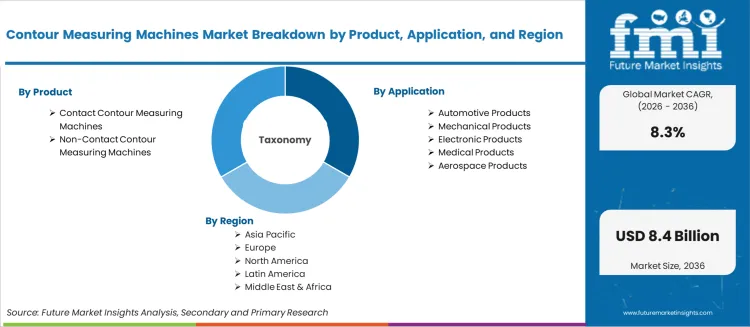
The contour measuring machines market was valued at USD 3.50 billion in 2025, projected to reach USD 3.79 billion in 2026, and is forecast to expand to USD 8.41 billion by 2036 at a 8.3% CAGR. Quality inspection mandates from ISO and industry-specific standards have made contour measurement a non-discretionary line item in precision manufacturing budgets.
Summary of Contour Measuring Machines Market
- Market Snapshot
- The contour measuring machines market is valued at USD Billion 3.50 billion in 2025 and is projected to reach USD Billion 8.41 billion by 2036.
- The industry is expected to grow at a 8.3% CAGR from 2026 to 2036, creating an incremental opportunity of USD Billion 4.62 billion.
- The market is a precision-engineering instrumentation category where measurement accuracy specifications, automation integration capabilities, and industry-specific calibration standards define competitive positioning.
- Demand and Growth Drivers
- Demand is driven by tightening dimensional tolerance requirements across automotive, aerospace, and medical device manufacturing sectors.
- Adoption of inline automated contour measurement is accelerating as manufacturers integrate real-time quality data into production feedback loops.
- Growth is supported by increasing adoption of non-contact optical measurement systems in applications requiring high throughput and surface-sensitive inspection.
- Among key countries, China at 11.2%, India at 10.4%, Germany at 9.5%, Brazil at 8.7%, USA at 7.9%, UK at 7.1%, Japan at 6.2%.
- Product and Segment View
- The market covers Product categories include contact-type stylus profilometers and non-contact optical measurement systems.
- Contact Contour Measuring Machines leads by Product with 52.0% share in 2026.
- Automotive Products leads by Application with 28.0% share in 2026.
- Laboratory Use leads by End Use with 45.0% share in 2026.
- Market scope covers standalone contour measurement instruments, integrated measurement stations with automated part handling, associated software for profile analysis and reporting, and calibration accessories.
- The scope excludes coordinate measuring machines (CMMs), surface roughness-only testers without contour capability, 3D scanning systems designed for reverse engineering, and general-purpose optical microscopes.
- Geography and Competitive Outlook
- China and India are the fastest-growing markets, while UK and Japan represent mature demand bases with steady replacement cycles.
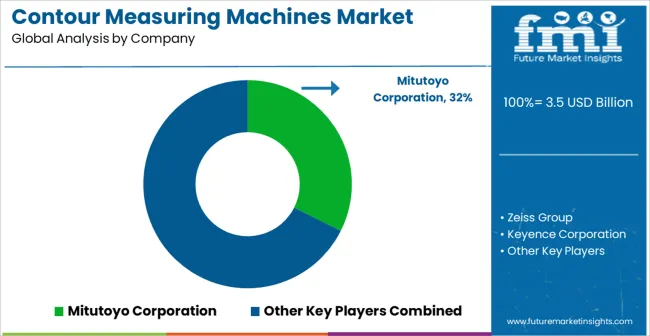
- Competition is shaped by a fragmented vendor landscape, with key players including Mitutoyo Corporation, Zeiss Group, Keyence Corporation, Nikon Corporation, Mahr GmbH, Taylor Hobson Ltd., Wenzel Group GmbH.
- Mitutoyo Corporation holds approximately 32% market share, positioning it as the category leader.
- Analyst Opinion at FMI
- Nikhil Kaitwade, Principal Consultant, opines: 'In my analysis, I have observed that the defining shift in contour measurement is not instrument accuracy alone but the speed of inline measurement integration into production control systems. Manufacturers relying on offline laboratory measurement cycles face quality feedback delays that compound scrap rates in high-volume production environments. Metrology providers unable to deliver sub-second measurement cycle times for automated inspection cells will lose positioning in the fastest-growing segment of the market.'
- Strategic Implications / Executive Takeaways
- Metrology providers must develop inline-capable contour measurement systems with sub-second cycle times to address automated production cell requirements.
- Manufacturing quality directors should evaluate non-contact optical systems for applications where surface sensitivity or throughput demands exceed stylus-based capabilities.
- Capital equipment planners must prioritize measurement platforms with open data interfaces to enable direct integration with manufacturing execution systems.
FMI analysts observe an accelerating shift from manual, laboratory-based contour inspection toward automated, inline measurement systems. This transition is driven by manufacturers seeking to reduce inspection cycle times and integrate measurement data directly into production feedback loops. Non-contact optical systems are gaining adoption in applications where surface sensitivity or throughput requirements preclude physical stylus contact.
All major markets reflect differentiated growth trajectories. China at 11.2% CAGR, India at 10.4% CAGR, Germany at 9.5% CAGR, Brazil at 8.7% CAGR, USA at 7.9% CAGR, UK at 7.1% CAGR, Japan at 6.2% CAGR. Each country path is shaped by local regulatory frameworks, healthcare infrastructure maturity, and industrial demand patterns specific to the region.
Contour Measuring Machines Market Key Takeaways
| Metric | Details |
|---|---|
| Industry Size (2026) | USD 3.79 Billion |
| Industry Value (2036) | USD 8.41 Billion |
| CAGR (2026-2036) | 8.3% |
Source: Future Market Insights, 2026
Contour Measuring Machines Market Definition
The Contour Measuring Machines Market covers surface contour and profile measurement instruments used for dimensional inspection of manufactured components. Product categories include contact-type stylus profilometers and non-contact optical measurement systems. These machines serve automotive, mechanical, electronic, medical, and aerospace product quality assurance applications.
Contour Measuring Machines Market Inclusions
Market scope covers standalone contour measurement instruments, integrated measurement stations with automated part handling, associated software for profile analysis and reporting, and calibration accessories. Global and regional market sizes for the forecast period 2026 to 2036 are covered, segmented by product type, application, and end use.
Contour Measuring Machines Market Exclusions
The scope excludes coordinate measuring machines (CMMs), surface roughness-only testers without contour capability, 3D scanning systems designed for reverse engineering, and general-purpose optical microscopes. Laboratory furniture and environmental control systems are also excluded.
Contour Measuring Machines Market Research Methodology
- Primary Research: Analysts engaged with metrology department heads, quality assurance directors, and precision instrument procurement managers across automotive OEMs and aerospace component manufacturers.
- Desk Research: Data collection included manufacturing quality standards publications, industry metrology conference proceedings, and regulatory inspection requirement databases from automotive and aerospace certification bodies.
- Market-Sizing and Forecasting: Baseline values derive from manufacturing facility count data cross-referenced with metrology instrument adoption rates by industry vertical, applying automation penetration curves to project demand through 2036.
- Data Validation and Update Cycle: Projections are validated against publicly available precision instrument revenue data from major metrology companies and industry trade association market assessments.
Why is the Contour Measuring Machines Market Growing?
Market Overview:
The Contour Measuring Machines market is being shaped by increasing demand for precision measurement solutions across various industries. The current scenario reflects significant adoption in sectors such as automotive, aerospace, manufacturing, and research laboratories where dimensional accuracy is critical. The future outlook is supported by advancements in sensor technologies, automation, and software integration, which are improving the speed and reliability of measurements.
The growing emphasis on quality control, product development, and regulatory compliance is acting as a key driver for market expansion. Rising investments in research and development facilities, as well as the integration of these machines with digital systems for data capture and analysis, are paving the way for new applications.
As industries move towards Industry 4.0 and smart manufacturing, the role of contour measurement in ensuring part integrity and reducing rework is becoming more critical The increasing complexity of components and materials, coupled with the need for rapid prototyping and validation, is expected to open further growth avenues in both established and emerging markets.
Segmental Analysis
The contour measuring machines market is segmented by product type, application, end use, and geographic regions. By product type, contour measuring machines market is divided into Contact Contour Measuring Machines and Non-Contact Contour Measuring Machines. In terms of application, contour measuring machines market is classified into Automotive Products, Mechanical Products, Electronic Products, Medical Products, and Aerospace Products. Based on end use, contour measuring machines market is segmented into Laboratory Use and Industrial Use. Regionally, the contour measuring machines industry is classified into North America, Latin America, Western Europe, Eastern Europe, Balkan & Baltic Countries, Russia & Belarus, Central Asia, East Asia, South Asia & Pacific, and the Middle East & Africa.
Insights into the Contact Contour Measuring Machines Segment
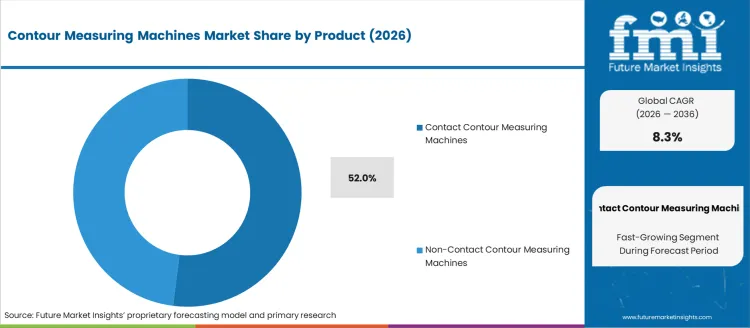
The Contact Contour Measuring Machines segment is expected to hold 52.00% of the Contour Measuring Machines market revenue in 2026, making it the largest product type in the market. This leading position is being driven by its high accuracy and adaptability in measuring surface profiles and dimensions of components with precision. The preference for contact-based systems has been reinforced by their ability to measure intricate geometries and complex contours, which are often required in automotive and industrial manufacturing.
The segment’s growth has been supported by industries where stringent dimensional tolerances are necessary, and measurement reliability is paramount. The compatibility of contact systems with a wide range of materials, including metals, plastics, and composites, has further strengthened their applicability.
In addition, the ability to integrate with computer-aided design systems and data analysis tools has increased their efficiency and utility With increasing demand for parts traceability, compliance, and optimization, the contact contour measuring machines segment is expected to maintain its dominance and continue expanding as a preferred solution for precision measurement tasks.
Insights into the Automotive Products Application Segment

The Automotive Products application segment is projected to account for 28.00% of the total Contour Measuring Machines market revenue in 2026, making it the largest application segment. This is being attributed to the automotive industry’s increasing reliance on precision measurement to ensure component integrity, reduce production waste, and comply with strict safety standards. The segment’s growth has been supported by the rising complexity of automotive parts, where aerodynamic shapes, surface smoothness, and structural strength must be validated through accurate measurement processes.
The adoption of automated manufacturing lines has also necessitated integration with measurement systems capable of providing real-time feedback. As vehicle manufacturers continue to focus on electric mobility, lightweight materials, and advanced driver assistance systems, the need for accurate contour measurement in research and production has increased significantly.
The rising emphasis on reducing manufacturing defects and improving yield rates has further accelerated the demand With growing investments in quality assurance and product optimization, the automotive products segment is expected to remain at the forefront of application-driven demand for contour measurement solutions.
Insights into the Laboratory Use End-Use Segment
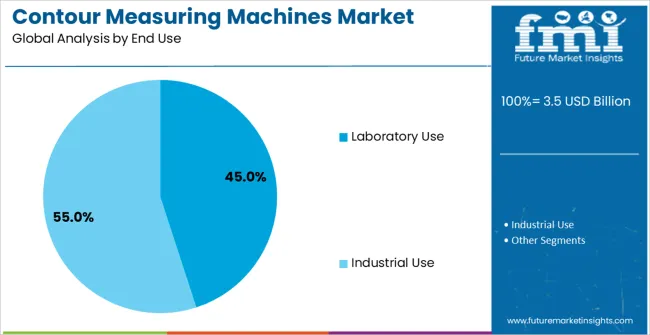
The Laboratory Use segment is expected to hold 45.00% of the Contour Measuring Machines market revenue in 2026, establishing it as the largest end-use category. The prominence of this segment is being driven by its extensive use in research and development, materials testing, and metrology labs where precise measurement is essential for validating prototypes and materials. Laboratories have increasingly been integrating contour measurement technologies to support advanced experimentation and product development across sectors such as automotive, aerospace, electronics, and biomedical engineering.
The flexibility of contour measuring machines to handle a wide variety of surfaces and material types has made them indispensable in laboratory environments. Moreover, the trend toward data-driven research, coupled with stringent regulatory requirements for product certification, has further fueled demand.
The ability to capture highly accurate surface profiles enables researchers to optimize design parameters, improve material properties, and ensure compliance with industry standards As research facilities continue to modernize and adopt integrated testing solutions, laboratory use of contour measuring machines is expected to remain the largest and fastest-growing end-use segment in the market.
Market Overview
Global Contour Measuring Machines Market: Introduction
Contour measuring machines are generally used to evaluate the contour profile, radius, step height, pitch and angle during the production operations. Contour measuring machines are highly effective, reliable thereby providing ease of task. Moreover, handheld contour measuring machines are also available in the market.
Furthermore, the adoption of contour measuring machines enhances the productivity, performance and quality of components and works pieces.
In the global market, manufacturers are providing multi-functioning machines. These machines are capable of measuring contour along with surface measurement feature. This is further expected to have positive impact on the overall sale of contour measuring machines.
The technological innovation coupled with advancement in the contour measuring machines had also led to the increasing usage of automatic non-contact contour measuring machines. The non-contact contour measuring machines segment is expected to remain attractive in the global market throughout the forecast period. As the chances of errors in non-contact machines compared to contact ones have been considerably reduced.
Analysis of Contour Measuring Machines Market By Key Countries
.webp "Top Country Growth Comparison Contour Measuring Machines Market Cagr (2026 2036)")
| Country | CAGR |
|---|---|
| China | 11.2% |
| India | 10.4% |
| Germany | 9.5% |
| Brazil | 8.7% |
| USA | 7.9% |
| UK | 7.1% |
| Japan | 6.2% |
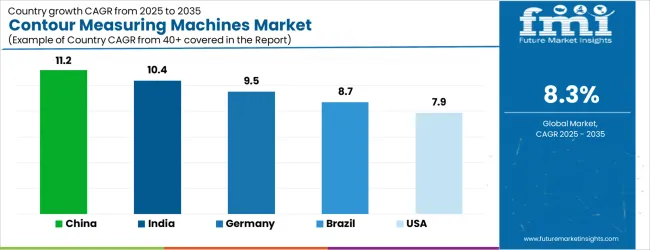
The Contour Measuring Machines Market is expected to register a CAGR of 8.3% during the forecast period, exhibiting varied country level momentum. China leads with the highest CAGR of 11.2%, followed by India at 10.4%. Developed markets such as Germany, France, and the UK continue to expand steadily, while the USA is likely to grow at consistent rates. Japan posts the lowest CAGR at 6.2%, yet still underscores a broadly positive trajectory for the global Contour Measuring Machines Market. In 2025, Germany held a dominant revenue in the Western Europe market and is expected to grow with a CAGR of 9.5%. The USA Contour Measuring Machines Market is estimated to be valued at USD 1.3 billion in 2026 and is anticipated to reach a valuation of USD 1.3 billion by 2036. Sales are projected to rise at a CAGR of 7.9% over the forecast period between 2026 and 2036. While Japan and South Korea markets are estimated to be valued at USD 169.9 million and USD 99.7 million respectively in 2026.
Key Players in the Contour Measuring Machines Market
- Mitutoyo Corporation
- Zeiss Group
- Keyence Corporation
- Nikon Corporation
- Mahr GmbH
- Taylor Hobson Ltd.
- Wenzel Group GmbH
- Renishaw plc
Scope of the Report
| Metric | Value |
|---|---|
| Quantitative Units | USD 3.79 Billion to USD 8.41 Billion, at a CAGR of 8.3% |
| Market Definition | The Contour Measuring Machines Market covers surface contour and profile measurement instruments used for dimensional inspection of manufactured components. Product categories include contact-type stylus profilometers and non-contact optical measurement systems. |
| Segmentation | Product: Contact Contour Measuring Machines, Non-Contact Contour Measuring Machines; Application: Automotive Products, Mechanical Products, Electronic Products, Medical Products, Aerospace Products; End Use: Laboratory Use, Industrial Use |
| Regions Covered | North America, Latin America, Europe, East Asia, South Asia, Oceania, Middle East & Africa |
| Countries Covered | China, India, Germany, Brazil, USA, UK, Japan, and 40 plus countries |
| Key Companies Profiled | Mitutoyo Corporation, Zeiss Group, Keyence Corporation, Nikon Corporation, Mahr GmbH, Taylor Hobson Ltd., Wenzel Group GmbH, Renishaw plc |
| Forecast Period | 2026 to 2036 |
| Approach | Baseline values derive from manufacturing facility count data cross-referenced with metrology instrument adoption rates by industry vertical, applying automation penetration curves to project demand through 2036. |
Contour Measuring Machines Market by Segments
Product Type:
- Contact Contour Measuring Machines
- Non-Contact Contour Measuring Machines
Application:
- Automotive Products
- Mechanical Products
- Electronic Products
- Medical Products
- Aerospace Products
End Use:
- Laboratory Use
- Industrial Use
Region:
- North America
- USA
- Canada
- Mexico
- Latin America
- Brazil
- Chile
- Rest of Latin America
- Western Europe
- Germany
- UK
- Italy
- Spain
- France
- Nordic
- BENELUX
- Rest of Western Europe
- Eastern Europe
- Russia
- Poland
- Hungary
- Balkan & Baltic
- Rest of Eastern Europe
- East Asia
- China
- Japan
- South Korea
- South Asia and Pacific
- India
- ASEAN
- Australia & New Zealand
- Rest of South Asia and Pacific
- Middle East & Africa
- Kingdom of Saudi Arabia
- Other GCC Countries
- Turkiye
- South Africa
- Other African Union
- Rest of Middle East & Africa
Bibliography
- 1. International Organization for Standardization. (2024). ISO 25178 update: Geometrical product specifications for surface texture. ISO.
- 2. European Automobile Manufacturers Association. (2024). ACEA quality assurance standards for component inspection. ACEA.
- 3. National Institute of Standards and Technology. (2024). NIST metrology program annual report. NIST.
- 4. Mitutoyo Corporation. (2025). 2024 annual report. Mitutoyo Corporation.
- 5. World Health Organization. (2024). Good manufacturing practice guidelines for medical device components. WHO.
This bibliography is provided for reader reference. The full Future Market Insights report contains the complete reference list with primary research documentation.
Frequently Asked Questions
How large is the demand for Contour Measuring Machines Market in the global market in 2026?
Demand for contour measuring machines market in the global market is estimated to be valued at USD Billion 3.79 billion in 2026.
What will be the market size of Contour Measuring Machines Market in the global market by 2036?
Market size for contour measuring machines market is projected to reach USD Billion 8.41 billion by 2036.
What is the expected demand growth for Contour Measuring Machines Market between 2026 and 2036?
Demand for contour measuring machines market is expected to grow at a CAGR of 8.3% between 2026 and 2036.
Which Product segment is poised to lead global sales by 2026?
Contact Contour Measuring Machines accounts for 52.0% of product share in 2026.
Which Application segment is poised to lead global sales by 2026?
Automotive Products accounts for 28.0% of application share in 2026.
Which End Use segment is poised to lead global sales by 2026?
Laboratory Use accounts for 45.0% of end use share in 2026.
What is driving demand in China?
China is projected to grow at a CAGR of 11.2% during 2026 to 2036, supported by local regulatory developments and expanding end-use demand.
What is Contour Measuring Machines Market and what is it mainly used for?
The Contour Measuring Machines Market covers surface contour and profile measurement instruments used for dimensional inspection of manufactured components. Product categories include contact-type stylus profilometers and non-contact optical measurement systems.
How does FMI build and validate the Contour Measuring Machines Market forecast?
Baseline values derive from manufacturing facility count data cross-referenced with metrology instrument adoption rates by industry vertical, applying automation penetration curves to project demand through 2036. Projections are validated against publicly available precision instrument revenue data from major metrology companies and industry trade association market assessments.
Preview the report firsthand - request a free sample
Get SampleGet the brochure for pricing and purchase details.
Get PDFTable of Content
- Executive Summary
- Global Market Outlook
- Demand-side Trends
- Supply-side Trends
- Technology Roadmap Analysis
- Analysis and Recommendations
- Market Overview
- Market Coverage / Taxonomy
- Market Definition / Scope / Limitations
- Research Methodology
- Chapter Orientation
- Analytical Lens and Working Hypotheses
- Market Structure, Signals, and Trend Drivers
- Benchmarking and Cross-market Comparability
- Market Sizing, Forecasting, and Opportunity Mapping
- Research Design and Evidence Framework
- Desk Research Programme (Secondary Evidence)
- Company Annual and Sustainability Reports
- Peer-reviewed Journals and Academic Literature
- Corporate Websites, Product Literature, and Technical Notes
- Earnings Decks and Investor Briefings
- Statutory Filings and Regulatory Disclosures
- Technical White Papers and Standards Notes
- Trade Journals, Industry Magazines, and Analyst Briefs
- Conference Proceedings, Webinars, and Seminar Materials
- Government Statistics Portals and Public Data Releases
- Press Releases and Reputable Media Coverage
- Specialist Newsletters and Curated Briefings
- Sector Databases and Reference Repositories
- FMI Internal Proprietary Databases and Historical Market Datasets
- Subscription Datasets and Paid Sources
- Social Channels, Communities, and Digital Listening Inputs
- Additional Desk Sources
- Expert Input and Fieldwork (Primary Evidence)
- Primary Modes
- Qualitative Interviews and Expert Elicitation
- Quantitative Surveys and Structured Data Capture
- Blended Approach
- Why Primary Evidence is Used
- Field Techniques
- Interviews
- Surveys
- Focus Groups
- Observational and In-context Research
- Social and Community Interactions
- Stakeholder Universe Engaged
- C-suite Leaders
- Board Members
- Presidents and Vice Presidents
- R&D and Innovation Heads
- Technical Specialists
- Domain Subject-matter Experts
- Scientists
- Physicians and Other Healthcare Professionals
- Governance, Ethics, and Data Stewardship
- Research Ethics
- Data Integrity and Handling
- Primary Modes
- Tooling, Models, and Reference Databases
- Desk Research Programme (Secondary Evidence)
- Data Engineering and Model Build
- Data Acquisition and Ingestion
- Cleaning, Normalisation, and Verification
- Synthesis, Triangulation, and Analysis
- Quality Assurance and Audit Trail
- Market Background
- Market Dynamics
- Drivers
- Restraints
- Opportunity
- Trends
- Scenario Forecast
- Demand in Optimistic Scenario
- Demand in Likely Scenario
- Demand in Conservative Scenario
- Opportunity Map Analysis
- Product Life Cycle Analysis
- Supply Chain Analysis
- Investment Feasibility Matrix
- Value Chain Analysis
- PESTLE and Porter’s Analysis
- Regulatory Landscape
- Regional Parent Market Outlook
- Production and Consumption Statistics
- Import and Export Statistics
- Market Dynamics
- Global Market Analysis 2021 to 2025 and Forecast, 2026 to 2036
- Historical Market Size Value (USD Million) Analysis, 2021 to 2025
- Current and Future Market Size Value (USD Million) Projections, 2026 to 2036
- Y-o-Y Growth Trend Analysis
- Absolute $ Opportunity Analysis
- Global Market Pricing Analysis 2021 to 2025 and Forecast 2026 to 2036
- Global Market Analysis 2021 to 2025 and Forecast 2026 to 2036, By Product
- Introduction / Key Findings
- Historical Market Size Value (USD Million) Analysis By Product , 2021 to 2025
- Current and Future Market Size Value (USD Million) Analysis and Forecast By Product , 2026 to 2036
- Contact Contour Measuring Machines
- Non-Contact Contour Measuring Machines
- Contact Contour Measuring Machines
- Y-o-Y Growth Trend Analysis By Product , 2021 to 2025
- Absolute $ Opportunity Analysis By Product , 2026 to 2036
- Global Market Analysis 2021 to 2025 and Forecast 2026 to 2036, By Application
- Introduction / Key Findings
- Historical Market Size Value (USD Million) Analysis By Application, 2021 to 2025
- Current and Future Market Size Value (USD Million) Analysis and Forecast By Application, 2026 to 2036
- Automotive Products
- Mechanical Products
- Electronic Products
- Medical Products
- Aerospace Products
- Automotive Products
- Y-o-Y Growth Trend Analysis By Application, 2021 to 2025
- Absolute $ Opportunity Analysis By Application, 2026 to 2036
- Global Market Analysis 2021 to 2025 and Forecast 2026 to 2036, By End Use
- Introduction / Key Findings
- Historical Market Size Value (USD Million) Analysis By End Use, 2021 to 2025
- Current and Future Market Size Value (USD Million) Analysis and Forecast By End Use, 2026 to 2036
- Laboratory Use
- Industrial Use
- Laboratory Use
- Y-o-Y Growth Trend Analysis By End Use, 2021 to 2025
- Absolute $ Opportunity Analysis By End Use, 2026 to 2036
- Global Market Analysis 2021 to 2025 and Forecast 2026 to 2036, By Region
- Introduction
- Historical Market Size Value (USD Million) Analysis By Region, 2021 to 2025
- Current Market Size Value (USD Million) Analysis and Forecast By Region, 2026 to 2036
- North America
- Latin America
- Western Europe
- Eastern Europe
- East Asia
- South Asia and Pacific
- Middle East & Africa
- Market Attractiveness Analysis By Region
- North America Market Analysis 2021 to 2025 and Forecast 2026 to 2036, By Country
- Historical Market Size Value (USD Million) Trend Analysis By Market Taxonomy, 2021 to 2025
- Market Size Value (USD Million) Forecast By Market Taxonomy, 2026 to 2036
- By Country
- USA
- Canada
- Mexico
- By Product
- By Application
- By End Use
- By Country
- Market Attractiveness Analysis
- By Country
- By Product
- By Application
- By End Use
- Key Takeaways
- Latin America Market Analysis 2021 to 2025 and Forecast 2026 to 2036, By Country
- Historical Market Size Value (USD Million) Trend Analysis By Market Taxonomy, 2021 to 2025
- Market Size Value (USD Million) Forecast By Market Taxonomy, 2026 to 2036
- By Country
- Brazil
- Chile
- Rest of Latin America
- By Product
- By Application
- By End Use
- By Country
- Market Attractiveness Analysis
- By Country
- By Product
- By Application
- By End Use
- Key Takeaways
- Western Europe Market Analysis 2021 to 2025 and Forecast 2026 to 2036, By Country
- Historical Market Size Value (USD Million) Trend Analysis By Market Taxonomy, 2021 to 2025
- Market Size Value (USD Million) Forecast By Market Taxonomy, 2026 to 2036
- By Country
- Germany
- UK
- Italy
- Spain
- France
- Nordic
- BENELUX
- Rest of Western Europe
- By Product
- By Application
- By End Use
- By Country
- Market Attractiveness Analysis
- By Country
- By Product
- By Application
- By End Use
- Key Takeaways
- Eastern Europe Market Analysis 2021 to 2025 and Forecast 2026 to 2036, By Country
- Historical Market Size Value (USD Million) Trend Analysis By Market Taxonomy, 2021 to 2025
- Market Size Value (USD Million) Forecast By Market Taxonomy, 2026 to 2036
- By Country
- Russia
- Poland
- Hungary
- Balkan & Baltic
- Rest of Eastern Europe
- By Product
- By Application
- By End Use
- By Country
- Market Attractiveness Analysis
- By Country
- By Product
- By Application
- By End Use
- Key Takeaways
- East Asia Market Analysis 2021 to 2025 and Forecast 2026 to 2036, By Country
- Historical Market Size Value (USD Million) Trend Analysis By Market Taxonomy, 2021 to 2025
- Market Size Value (USD Million) Forecast By Market Taxonomy, 2026 to 2036
- By Country
- China
- Japan
- South Korea
- By Product
- By Application
- By End Use
- By Country
- Market Attractiveness Analysis
- By Country
- By Product
- By Application
- By End Use
- Key Takeaways
- South Asia and Pacific Market Analysis 2021 to 2025 and Forecast 2026 to 2036, By Country
- Historical Market Size Value (USD Million) Trend Analysis By Market Taxonomy, 2021 to 2025
- Market Size Value (USD Million) Forecast By Market Taxonomy, 2026 to 2036
- By Country
- India
- ASEAN
- Australia & New Zealand
- Rest of South Asia and Pacific
- By Product
- By Application
- By End Use
- By Country
- Market Attractiveness Analysis
- By Country
- By Product
- By Application
- By End Use
- Key Takeaways
- Middle East & Africa Market Analysis 2021 to 2025 and Forecast 2026 to 2036, By Country
- Historical Market Size Value (USD Million) Trend Analysis By Market Taxonomy, 2021 to 2025
- Market Size Value (USD Million) Forecast By Market Taxonomy, 2026 to 2036
- By Country
- Kingdom of Saudi Arabia
- Other GCC Countries
- Turkiye
- South Africa
- Other African Union
- Rest of Middle East & Africa
- By Product
- By Application
- By End Use
- By Country
- Market Attractiveness Analysis
- By Country
- By Product
- By Application
- By End Use
- Key Takeaways
- Key Countries Market Analysis
- USA
- Pricing Analysis
- Market Share Analysis, 2025
- By Product
- By Application
- By End Use
- Canada
- Pricing Analysis
- Market Share Analysis, 2025
- By Product
- By Application
- By End Use
- Mexico
- Pricing Analysis
- Market Share Analysis, 2025
- By Product
- By Application
- By End Use
- Brazil
- Pricing Analysis
- Market Share Analysis, 2025
- By Product
- By Application
- By End Use
- Chile
- Pricing Analysis
- Market Share Analysis, 2025
- By Product
- By Application
- By End Use
- Germany
- Pricing Analysis
- Market Share Analysis, 2025
- By Product
- By Application
- By End Use
- UK
- Pricing Analysis
- Market Share Analysis, 2025
- By Product
- By Application
- By End Use
- Italy
- Pricing Analysis
- Market Share Analysis, 2025
- By Product
- By Application
- By End Use
- Spain
- Pricing Analysis
- Market Share Analysis, 2025
- By Product
- By Application
- By End Use
- France
- Pricing Analysis
- Market Share Analysis, 2025
- By Product
- By Application
- By End Use
- India
- Pricing Analysis
- Market Share Analysis, 2025
- By Product
- By Application
- By End Use
- ASEAN
- Pricing Analysis
- Market Share Analysis, 2025
- By Product
- By Application
- By End Use
- Australia & New Zealand
- Pricing Analysis
- Market Share Analysis, 2025
- By Product
- By Application
- By End Use
- China
- Pricing Analysis
- Market Share Analysis, 2025
- By Product
- By Application
- By End Use
- Japan
- Pricing Analysis
- Market Share Analysis, 2025
- By Product
- By Application
- By End Use
- South Korea
- Pricing Analysis
- Market Share Analysis, 2025
- By Product
- By Application
- By End Use
- Russia
- Pricing Analysis
- Market Share Analysis, 2025
- By Product
- By Application
- By End Use
- Poland
- Pricing Analysis
- Market Share Analysis, 2025
- By Product
- By Application
- By End Use
- Hungary
- Pricing Analysis
- Market Share Analysis, 2025
- By Product
- By Application
- By End Use
- Kingdom of Saudi Arabia
- Pricing Analysis
- Market Share Analysis, 2025
- By Product
- By Application
- By End Use
- Turkiye
- Pricing Analysis
- Market Share Analysis, 2025
- By Product
- By Application
- By End Use
- South Africa
- Pricing Analysis
- Market Share Analysis, 2025
- By Product
- By Application
- By End Use
- USA
- Market Structure Analysis
- Competition Dashboard
- Competition Benchmarking
- Market Share Analysis of Top Players
- By Regional
- By Product
- By Application
- By End Use
- Competition Analysis
- Competition Deep Dive
- Mitutoyo Corporation
- Overview
- Product Portfolio
- Profitability by Market Segments (Product/Age /Sales Channel/Region)
- Sales Footprint
- Strategy Overview
- Marketing Strategy
- Product Strategy
- Channel Strategy
- Zeiss Group
- Keyence Corporation
- Nikon Corporation
- Mahr GmbH
- Taylor Hobson Ltd.
- Wenzel Group GmbH
- Renishaw plc
- Mitutoyo Corporation
- Competition Deep Dive
- Assumptions & Acronyms Used


