

- Market Size (2026)
- USD 212.3 Mn
- Forecast (2036)
- USD 326.6 Mn
- CAGR (2026 to 2036)
- 4.4%
How big is Corrugated Partitions Market in 2026?
USD 212.3 million in 2026 and USD 326.6 million by 2036 at a 4.4% CAGR.
Sales in the corrugated partitions market is projected to reach USD 326.6 million by 2036 from USD 212.3 million in 2026 at a 4.4% CAGR. Packaging engineers specify internal separators to control contact damage without increasing outer-pack size or handling steps. UFP Industries announced a third corrugated facility for its protective packaging business in April 2025. UFP's expansion gives industrial accounts more regional capacity for stock and custom corrugated structures once designs pass application trials.
Recovery infrastructure and producer obligations differ by country, which changes the economics of fiber partitions. The American Forest & Paper Association reported in August 2025 that 69%-74% of cardboard available for recovery was recycled in the United States during 2024. That recovery base supports fiber specifications tied to corrugated boxes without requiring a separate end-of-life route. Gulf and Asian accounts place more weight on local supply plus material ratings during qualification of an approved internal separator.
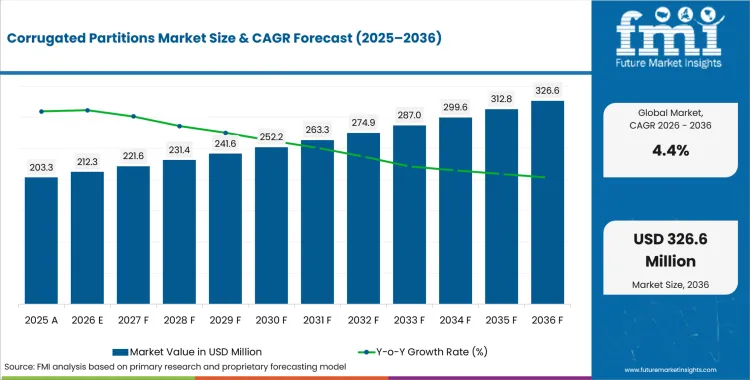
Key Takeaways
- Industrial packaging engineers increase partition use in applications that require better damage control without larger outer-pack dimensions or extra handling.
- Corrugated cell partitions are projected to hold 46.0% share in 2026 owing to configurable cell geometry that separates multiple units inside one outer pack.
- The corrugated & fiber segment is likely to capture 29.0% share in 2026 attributable to familiar converting routes and established recovered-fiber outlets.
- By capacity, 200-1,000 L is forecast to represent 38.0% in 2026 driven by intermediate payloads that justify engineered internal control during routine handling.
- Moisture exposure, chemical compatibility and transport-package qualification can lengthen switching cycles since internal separators must perform inside the complete tested pack.
- Some of the key players in this market include Sonoco, Signode, Nefab, Mondi Group, International Paper, Smurfit Westrock, UFP Industries, and SCHÜTZ.
Analyst Perspective
"Partition economics depend on how much damage the separator prevents without reducing usable pack density or changing the qualified transport configuration. The strongest offers pair fast prototype testing with nearby converting capacity so approved designs can be replenished without repeating the full qualification cycle."
- Nandini Roy Choudhury, Principal Consultant, Future Market Insights
How is the Corrugated Partitions Market segmented?
The corrugated partitions market is segmented by product type, material, capacity, end use, sales channel and region.
Market taxonomy covers product type, material, capacity, end use, sales channel and region within the stated forecast scope. Product type includes corrugated cell partitions, solid board partitions, returnable partitions and die-cut inserts, and material includes corrugated & fiber, rigid plastics, steel & metal and flexible bulk. Capacity covers 200-1,000 L, below 200 L and above 1,000 L, and end use includes chemicals, food ingredients, agriculture, construction & auto and energy & other. Sales channels include direct industrial accounts, distributors and rental & pooling, with regional coverage following the standard FMI taxonomy used later in the article.
What makes corrugated cell partitions central to the product type category?
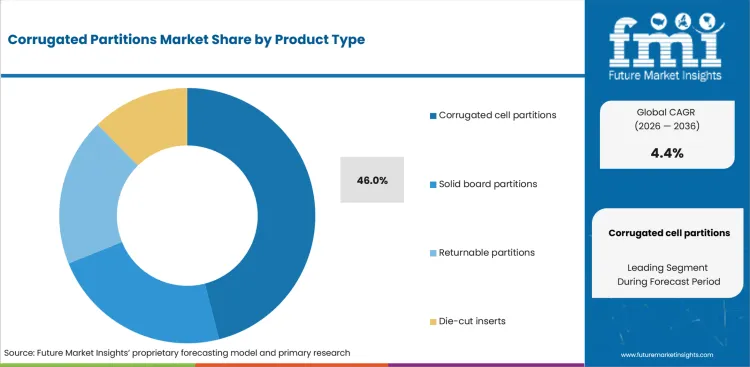
Corrugated cell partitions separate repeated part geometries without forcing a new outer-case design for every item count. In March 2025, Sonoco announced an 8% minimum price increase for converted paperboard products including partitions and protective packaging. The format also fits packaging inserts that use die-cut geometry to preserve spacing during routine handling.
- Based on product type, corrugated cell partitions are projected to account for 46.0% in 2026 due to repeatable cell grids that adjust to spacing and compression requirements.
- Corrugated converters can alter divider count and board grade without redesigning the complete shipping case, reducing tooling disruption during customer-specific qualification and replenishment.
Why does corrugated & fiber lead the material category?
Corrugated & fiber gives industrial shippers stiffness and part separation through converting equipment already used for paper packaging. Coated or treated board must also preserve protection performance if the finished partition is expected to enter established fiber recovery routes.
- By material, corrugated & fiber is estimated to hold 29.0% in 2026 owing to familiar scoring and die-cutting processes plus regional recovered-fiber outlets.
- AF&PA and the Fibre Box Association updated their corrugated repulpability and recyclability test protocol in May 2025. The standard gives coated fiber structures a defined test route before corrugated packaging producers make recyclability claims.
How does 200-1,000 L shape the capacity category?
The 200-1,000 L range covers industrial packages exposed to damaging load movement under routine pallet and forklift handling. SCHÜTZ signed a Saudi licence agreement in January 2025 for local production of 1,000-litre ECOBULK units. Local production places 1,000-litre formats close to intermediate bulk containers used by industrial accounts.
- In 2026, 200-1,000 L is expected to lead capacity with 38.0% share because intermediate payloads justify engineered internal control during repeated handling.
- Partitions at this scale must preserve forklift clearance and control internal shifting during routine warehouse handling, so validation normally covers the complete transport configuration.
What supports chemicals as the leading end use?
Chemical shipments put extra weight on packaging configuration since separator changes can alter cushioning and movement inside a qualified combination package. Fiber drums and other industrial containers also require internal separation that does not interfere with material compatibility or handling.
- Chemicals are set to lead the end use category with 34.0% share in 2026 due to stronger requirements for movement control and package integrity under defined transport conditions.
- PHMSA clarified in March 2026 that changing cushioning material can require renewed UN design testing. Chemical accounts therefore need repeatable packing instructions before a revised separator reaches routine use.
What are the drivers, restraints and opportunities in the Corrugated Partitions Market?
Recyclability requirements increase redesign activity, application-specific qualification slows switching and modular separation within returnable industrial packaging offers a practical expansion route.
- Driver: packaging rules now place recyclability and material use inside the packaging design decision instead of treating them as downstream waste questions.
- Restraint: changes to cushioning or separator geometry can trigger transport testing that delays replacement of an already approved packaging configuration.
- Opportunity: reusable outer packaging can use replaceable internal separators if outer containers and partitions require different service lives.
Packaging rules move redesign upstream
Packaging engineers now consider end-of-life performance during protection specification since material choices affect recovery obligations once packaging enters waste systems. Regulation (EU) 2025/40 entered into force in February 2025 and generally began applying in August 2026 to packaging placed on the EU market. Corrugated partition redesign gains a clearer commercial route as companies reduce difficult material combinations without sacrificing transport packaging protection or compliance.
Qualification work slows substitution
Partition qualification covers the complete transport configuration since separator geometry changes load movement and compression performance. In May 2025, Signode described design-center work that evaluates requirements, builds prototypes and assigns local production following review. Trial packs and line-fit checks can extend approval cycles until a revised specification earns routine orders, especially for low-volume designs that cannot absorb repeated trial failures.
Different service lives support modular designs
Reusable industrial containers and disposable separators often have different replacement cycles, which permits modular maintenance without discarding the outer asset. SCHÜTZ documented its collection and reconditioning route in July 2025 through Green Lifecycle Management and Ticket Service. Partition manufacturers can apply similar service logic to returnable transport packaging by replacing contaminated fiber components and retaining the outer asset for repeated trips.
Which country CAGRs are profiled in the Corrugated Partitions Market?
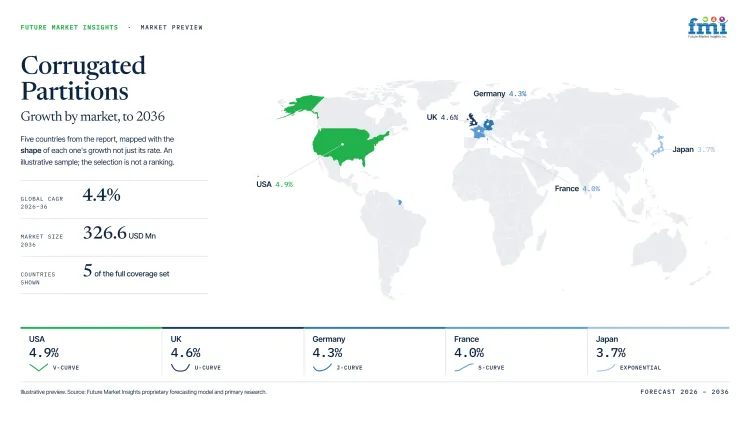
| Country | CAGR |
|---|---|
| USA | 4.9% |
| UK | 4.6% |
| Germany | 4.3% |
| France | 4.0% |
| Japan | 3.7% |
How do country-level CAGRs compare in the Corrugated Partitions Market?
The profiled outlook now spans 1.2 percentage points, with USA leading at 4.9% CAGR during the forecast period and Japan closing the set at 3.7% over the assessment period. USA and UK sit at the upper end, supported by mature corrugated converting networks and mandatory recyclability reporting that create recurring specification reviews.
- USA freight distances make pack density important for long-haul industrial distribution programs.
- UK export manufacturing favors partition designs compatible with standardized corrugated case dimensions.
- Germany’s minimum standard links packaging recyclability assessment to established collection, sorting and recycling practice.
- France’s paper and cardboard recovery base supports fiber partitions where specifications avoid coatings and mixed structures that complicate sorting.
- Japan’s recovered-paper system supports corrugated reuse, but market growth depends on specification replacement inside mature industrial packaging networks.
Revenue conditions differ because qualification speed and supply density vary by country. The full report provides country-level CAGR analysis across North America, Latin America, Europe, East Asia, South Asia, Oceania and the Middle East and Africa.
Country-wise Analysis
- Large USA industrial accounts can source corrugated packaging from regional plants that shorten replenishment once a partition passes plant-level approval. By 2036, USA is projected to grow at 4.9% CAGR, supported by mature fiber recovery and extensive converting capacity. International Paper broke ground on a new Waterloo corrugated box plant in May 2025 with operations scheduled for late 2026, adding another regional supply point for corrugated programs. Moisture or compression exposure can still force heavier board or alternative materials for specific shipping cycles. Fast engineering response therefore carries more commercial weight than divider price alone for approved industrial programs.
- PackUK reporting rules require UK packaging teams to document recyclability beside material cost and damage performance for household-facing programs. Familiar fiber recovery routes give corrugated designs a direct adoption enabler, although coatings and mixed components require accurate material records during account review. Corrugated partition sales in UK are forecast to expand at 4.6% CAGR by 2036, attributable to producer reporting requirements and paper recovery infrastructure. In April 2025, PackUK published RAM v1.1 with red, amber and green recyclability outcomes for household packaging. Industrial partition programs still need transport evidence, which limits direct transfer from household recyclability ratings to load-protection approval.
- German accounts are aligning packaging design with national recyclability assessment and the incoming EU packaging framework. Germany is expected to grow at a 4.3% CAGR through 2036, driven by fiber formats that can be documented under established collection, sorting and recycling practice. ZSVR and the German Environment Agency issued the 2025 minimum standard for determining recyclability of packaging subject to system participation in August 2025, including specific assessment routes for paper and cardboard packaging. Corrugated partitions benefit when they remain mono-material and easy to separate, although coatings, labels or moisture barriers can push designs into additional proof work before account approval.
- French demand is shaped by strong domestic paper and cardboard recycling performance plus account-level pressure to reduce difficult material combinations. France is set to expand at a 4.0% CAGR during the forecast timeline, supported by familiar recovery routes and local converting capacity. ADEME’s EPR portal reports that household packaging and graphic papers placed on the French market reached 6.56 million tonnes in 2023, with 5.08 million tonnes recycled. Industry data published in 2025 also indicates paper and cardboard recycling rates near 89%, rising to 97% for industrial and commercial uses. These conditions support fiber partitions when specifications avoid treatments that undermine sorting or repulping performance.
- Japan’s corrugated partition outlook is steadier because high recovered-paper collection already supports paperboard circularity, while broader packaging demand is mature. Japan is anticipated to post a 3.7% CAGR over the forecast period, with adoption driven by replacement specifications for electronics, industrial components and export packaging. The Paper Recycling Promotion Center reported a 2025 recovered-paper recovery rate of 81.3% in Japan, based on annual paper, paperboard and trade statistics from national data sources. Japan Paper Association also maintains a recovered-paper utilization target of 65% for fiscal 2025. Corrugated partition suppliers therefore emphasize precise fit, clean fiber composition and evidence that separators do not reduce pack density or create mixed-material recovery concerns.
Who are the notable companies in the Corrugated Partitions Market?
Sonoco, Signode, Nefab, Mondi Group, International Paper, Smurfit Westrock, UFP Industries and SCHÜTZ are the notable companies serving this market.
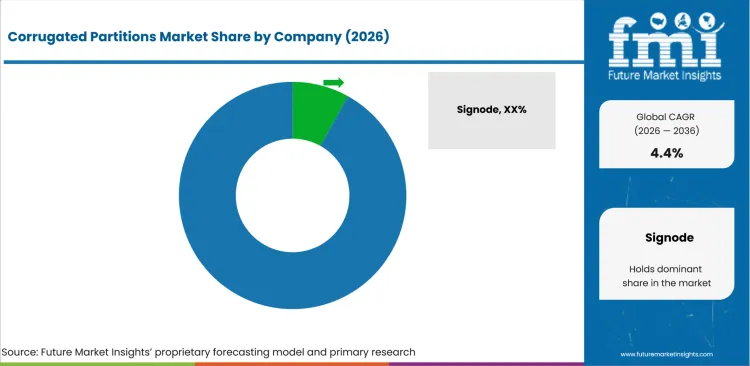
Competition divides among paperboard converters, protective packaging specialists and reusable industrial packaging groups with different qualification roles. Sonoco offers direct partition products, and Signode and Nefab pair corrugated structures with application engineering for custom industrial loads. Mondi Group, International Paper and Smurfit Westrock provide larger corrugated networks that support regional repeat supply once specifications are approved. UFP Industries serves custom industrial packaging, and SCHÜTZ covers reusable bulk systems that can use returnable packaging with replaceable internal separators. Entry barriers center on transport testing plus replenishment reliability since approved designs must fit the host package without changing tested performance.
- Fiber partition and corrugated converting: Sonoco, Mondi Group, International Paper and Smurfit Westrock provide paper-based converting capacity plus customer-specific structural design.
- Engineered protective systems: Signode, Nefab and UFP Industries provide prototyping and application engineering for industrial loads that require custom protective structures.
- Industrial bulk and reusable platforms: SCHÜTZ serves reusable containers that accommodate internal fiber or paper-based honeycomb packaging without replacing the host system.
Competitive Benchmarking: Corrugated Partitions Market
| Company | Partition & insert depth | Custom protective engineering | Corrugated / industrial packaging scale | Geographic reach |
|---|---|---|---|---|
| Sonoco | High | High | High | Global |
| Signode | High | High | Medium | North America and international operations |
| Nefab | High | High | High | Europe, Americas and Asia |
| Mondi Group | Medium | High | High | Europe and international operations |
| International Paper | Medium | Medium | High | North America and Europe |
| Smurfit Westrock | Medium | High | High | Americas and Europe |
| UFP Industries | Medium | High | Medium | United States and selected international operations |
| SCHÜTZ | Low | Medium | High | Europe, Americas, Asia and GCC |
Scoring basis: partition and insert depth is High with at least three documented routes, Medium with two routes and Low with one route. Custom protective engineering is High with design plus prototyping and testing support, Medium with two verified functions and Low with one function. Packaging scale is High with multiple plants or reusable-system networks, Medium with narrower multi-site coverage and Low with one verified operating line. Low is assigned only to a documented narrow or adjacent capability, never to missing public evidence.
Key Developments in the Corrugated Partitions Market
- In June 2026, Mondi Group upgraded its Greven and Ebersdorf corrugated plants after integrating acquired German operations. The investment targeted operating performance and customer service and strengthened local corrugated capacity for engineered protective formats.
- In March 2026, Smurfit Westrock completed the Cartomanabí asset purchase in Ecuador and added more than 50,000 tonnes of corrugated capacity. The acquired operations serve agriculture, protein, FMCG and industrial accounts that also use internal separation and protective structures.
- In April 2025, Nefab acquired Embalajes Echeberria in Spain and expanded its heavy-duty corrugated packaging capacity. The acquisition also increased local design support for industrial customers that specify protective structures for demanding export loads.
Key Players in the Corrugated Partitions Market
Fiber Partition and Corrugated Converting
- Sonoco
- Mondi Group
- International Paper
- Smurfit Westrock
Engineered Protective Packaging
- Signode
- Nefab
- UFP Industries
Industrial Bulk and Reusable Platforms
- SCHÜTZ
Corrugated Partitions Market - Report Scope
| Coverage field | Report scope |
|---|---|
| Market breakdown | By product type, material, capacity, end use, sales channel and region. |
| Quantitative Units | USD million. |
| Market Definition | Commercial revenue from engineered internal-separation and protective partition systems sold within the stated segmentation universe. The scope includes corrugated or solid-board cells, die-cut and returnable divider systems, and partition-enabled internal fitments specified for industrial packages in the stated capacity bands. |
| Regions Covered | North America, Latin America, Western Europe, Eastern Europe, East Asia, South Asia and Pacific, and Middle East and Africa. |
| Countries Covered | Germany, France, Germany, USA, UK, and 20+ countries included in the full report. |
| Key Companies Profiled | Sonoco, Signode, Nefab, Mondi Group, International Paper, Smurfit Westrock, UFP Industries, SCHÜTZ. |
| Forecast Period | 2026 to 2036. |
| Approach | Primary and secondary research with market triangulation. |
Corrugated Partitions Market - Research Methodology
| Method | Approach |
|---|---|
| Primary Research | FMI analysts gathered input from manufacturers, service providers, technology developers, distributors, end users, procurement teams, and subject-matter experts. Interviews examined purchasing decisions, product or service evaluation, adoption barriers, approval requirements, pricing considerations, and expectations for technical or commercial support. Respondents were also asked what evidence is required before a trial, pilot, or initial order develops into regular purchasing. |
| Desk Research | Desk research covered government statistics, regulatory publications, trade data, industry associations, technical literature, standards, company filings, product information, and official corporate announcements. Sources were reviewed for relevance, publication date, geographic coverage, and consistency with the defined market scope. Claims relating to performance, applications, approvals, capacity, investment, and commercial activity were retained only when supported by credible public evidence. |
| Market Sizing and Forecasting | The market model combined the baseline value with historical performance, segment structure, pricing and volume indicators, adoption levels, company participation, and country-level demand conditions. Forecast assumptions considered economic activity, investment trends, regulatory developments, technology adoption, purchasing cycles, supply availability, and barriers to wider market use. Segment and regional estimates were reconciled before the final market total was calculated. |
| Data Validation | Estimates were checked against multiple independent indicators, including public data, company activity, trade patterns, industry developments, and findings from primary interviews. Validation also tested whether products, services, applications, and company revenues fell within the defined market boundaries. Adjacent categories, unsupported claims, overlapping revenues, and activities without direct market relevance were excluded to reduce double counting and maintain consistency across segments and countries. |
Corrugated Partitions Market by Segments
Corrugated Partitions Market segmented by Product Type:
- Corrugated cell partitions
- Solid board partitions
- Returnable partitions
- Die-cut inserts
Corrugated Partitions Market segmented by Material:
- Corrugated & fiber
- Rigid plastics
- Steel & metal
- Flexible bulk
Corrugated Partitions Market segmented by Capacity:
- 200-1,000 L
- Below 200 L
- Above 1,000 L
Corrugated Partitions Market segmented by End Use:
- Chemicals
- Food ingredients
- Agriculture
- Construction & auto
- Energy & other
Corrugated Partitions Market segmented by Sales Channel:
- Direct industrial accounts
- Distributors
- Rental & pooling
Corrugated Partitions Market by Region:
- North America
- United States
- Canada
- Latin America
- Brazil
- Mexico
- Argentina
- Chile
- Western Europe
- Germany
- France
- United Kingdom
- Italy
- Spain
- Benelux
- Nordics
- Eastern Europe
- Poland
- Czech Republic
- Romania
- Hungary
- East Asia
- China
- Japan
- South Korea
- South Asia and Pacific
- India
- ASEAN
- Australia and New Zealand
- Middle East and Africa
- GCC Countries
- South Africa
- Türkiye
- Israel
Research Sources and Bibliography
- UFP Industries. (2025, April 28). UFP Industries Announces 3rd Corrugated Packaging Facility.
- American Forest & Paper Association. (2025, August 12). Paper Industry Announces 2024 USA Paper Recycling Rates.
- Sonoco Products Company. (2025, March 10). Sonoco Implementing Price Increases for Uncoated Recycled Paperboard, Converted Paperboard Products.
- American Forest & Paper Association. (2025, May 29). Industry Publishes Updated Voluntary Standard for Recycling Cardboard.
- SCHÜTZ. (2025, January 7). IBC production in Saudi Arabia: SCHÜTZ and National Plastic Factory Company have signed a licence agreement for a long-term partnership.
- Pipeline and Hazardous Materials Safety Administration. (2026, March 23). Interpretation response #25-0151.
- European Commission, Directorate-General for Environment. (2025, February 11). New rules enter into force for a more sustainable and competitive packaging economy.
- Signode. (2025, May 19). Optimal Outcomes - Custom Protective Packaging.
- SCHÜTZ. (2025, July). Closed material cycle for sustainable packaging.
- Emirates News Agency. (2025, July 3). MOCCAE collaborates with Tadweer Group to launch pilot project for managing targeted product waste.
- General Authority for Statistics, Saudi Arabia. (2025, July 10). Industrial Production Index- May 2025.
- Ministry of Environment, Republic of Korea. (2025, January 7). 포장재 재활용 용이성 등급평가 기준.
- International Paper. (2025, May 22). International Paper Launches Groundbreaking Construction of Massive Box Plant in Waterloo, Iowa.
- PackUK. (2025, April 29). Recyclability Assessment Methodology (RAM) v1.1.
- Mondi Group. (2026, June 1). Mondi strengthens corrugated solutions operations in Germany through targeted site upgrades.
- Smurfit Westrock. (2026, March 3). Smurfit Westrock expands its presence in Ecuador.
- Nefab. (2025, April 23). Nefab Group acquires Embalajes Echeberria.
- Pratt Industries. (2025, April 30). Anthony Pratt announces $5 billion investment.
- Smurfit Westrock. (2026, June 1). Smurfit Westrock announces €600 million investment ahead of Choose France summit.
- International Paper. (2026, May 26). Breaking Ground: New Sustainable Packaging Facility Coming to Mississippi.
- Mondi Group. (2025, April 1). Mondi expands packaging portfolio and capacity by completing acquisition of Schumacher Packaging’s Western Europe operations.
- Packaging Corporation of America. (2025, September 2). Current Report on Form 8-K.
- Packaging Corporation of America. (2025, December 3). Packaging Corporation of America Announces Reconfiguration of Wallula, WA Containerboard Mill.
- Nefab. (2025, August 12). Nefab Group acquires FARUSA Emballage.
- UFP Industries. (2026, August 13). UFP Industries to Expand Structural Packaging Capacity with New South Carolina Manufacturing Facility.
- SCHÜTZ. (2025, July). For the Midwest: SCHÜTZ opens a new plant in Kenosha, Wisconsin.
- Sonoco Products Company. (2026, June 8). Sonoco Implementing Price Increases for Uncoated Recycled Paperboard, Converted Paperboard Products.
- Signode. (2026, March 29). Wood-Free Packaging That Delivers Real Business Impact.
This bibliography is provided for reader reference and is not exhaustive. The full report contains the complete reference list and detailed citations.
This Report Answers
- What is the corrugated partitions market size in 2026 and what value is forecast for 2036?
- Which packaging and industrial handling conditions are increasing demand for corrugated partitions?
- Why do corrugated cell partitions hold the leading position within product type?
- How does corrugated & fiber influence material selection and downstream recovery decisions?
- Why does the 200-1,000 L capacity band hold the leading position?
- How do CAGR expectations compare across Germany, France, Japan, USA and UK?
- Which companies provide fiber partitions, engineered protective systems or industrial packaging platforms?
- What qualification and compatibility constraints slow switching to new partition designs?
Frequently Asked Questions
How big is the corrugated partitions market in 2026?
The corrugated partitions market is valued at USD 212.3 million in 2026 and is projected to reach USD 326.6 million by 2036. Growth is tied to industrial damage control and specification-led redesign of internal protective packaging for repeat shipping cycles.
What is the CAGR of the corrugated partitions market from 2026 to 2036?
The corrugated partitions market is projected to grow at a CAGR of 4.4% between 2026 and 2036. Expansion is supported by corrugated converting capacity, recovery infrastructure and account-specific demand for tested load separation.
Which product type leads the corrugated partitions market?
The corrugated cell partitions segment is expected to hold 46.0% of the corrugated partitions market in 2026, driven by configurable cell geometry for repeated separation. Corrugated plants can change spacing and board grade without redesigning the outer package for each customer part count.
Which countries are projected to record the highest growth in the corrugated partitions market?
UAE is projected to grow at 5.8% CAGR, followed by Saudi Arabia at 5.5% and South Korea at 5.2% through 2036. Growth is supported by EPR implementation, industrial activity and formal packaging-material evaluation in the three fastest profiled markets.
Which companies are active in the corrugated partitions market?
Key companies operating in the corrugated partitions market include Sonoco, Signode, Nefab, Mondi Group, International Paper, Smurfit Westrock, UFP Industries, and SCHÜTZ. These companies compete through converting scale, custom engineering, regional production depth and industrial packaging service coverage once designs are qualified.
Preview the report firsthand - request a free sample
Get SampleGet the brochure for pricing and purchase details.
Get PDFTable of Content
- Key Takeaways
- Market Size and CAGR
- Top Growth Driver
- Fastest Growing Segment
- Leading Region
- Key Companies
- Emerging Opportunities
- Executive Summary
- Global Market Outlook
- Demand-side Trends
- Supply-side Trends
- Technology Roadmap Analysis
- Analysis and Recommendations
- Analyst Perspective (What is happening? Why now? What should investors know?)
- Key Questions Answered
- How large is the market?
- What is the CAGR?
- What are key trends?
- Which region dominates?
- Who are the leaders?
- Market Overview
- Market Coverage / Taxonomy
- Market Definition / Scope / Limitations
- Research Methodology
- Chapter Orientation
- Analytical Lens and Working Hypotheses
- Market Structure, Signals, and Trend Drivers
- Benchmarking and Cross-market Comparability
- Market Sizing, Forecasting, and Opportunity Mapping
- Research Design and Evidence Framework
- Desk Research Programme (Secondary Evidence)
- Expert Input and Fieldwork (Primary Evidence)
- Tooling, Models, and Reference Databases
- Data Engineering and Model Build
- Quality Assurance and Audit Trail
- Market Background
- Market Dynamics (Drivers, Restraints, Opportunity, Trends)
- Scenario Forecast (Optimistic, Likely, Conservative)
- Impact Analysis
- AI Impact
- Sustainability Impact
- Regulatory Impact
- Technology Impact
- Consumer / Buyer Analysis
- Purchase Drivers
- Adoption Barriers
- Buyer Journey
- Opportunity Map Analysis
- Product Life Cycle Analysis
- Supply Chain Analysis
- Investment Feasibility Matrix
- Value Chain Analysis
- PESTLE and Porter's Analysis
- Regulatory Landscape
- Regional Parent Market Outlook
- Production and Consumption Statistics
- Import and Export Statistics
- Global Market Analysis and Forecast, 2021 to 2036
- Historical Market Size Value (USD Million) Analysis, 2021 to 2025
- Current and Future Market Size Value (USD Million) Projections, 2026 to 2036
- Y-o-Y Growth Trend Analysis
- Absolute $ Opportunity Analysis
- Global Market Pricing Analysis, 2021 to 2036
- Global Market Analysis and Forecast, By Product Type, 2021 to 2036
- Introduction / Key Findings
- Historical Market Size Value (USD Million) Analysis By Product Type, 2021 to 2025
- Current and Future Market Size Value (USD Million) Analysis and Forecast By Product Type, 2026 to 2036
- Corrugated cell partitions
- Solid board partitions
- Returnable partitions
- Die-cut inserts
- Corrugated cell partitions
- Y-o-Y Growth Trend Analysis By Product Type, 2021 to 2025
- Absolute $ Opportunity Analysis By Product Type, 2026 to 2036
- Global Market Analysis and Forecast, By Material, 2021 to 2036
- Introduction / Key Findings
- Historical Market Size Value (USD Million) Analysis By Material, 2021 to 2025
- Current and Future Market Size Value (USD Million) Analysis and Forecast By Material, 2026 to 2036
- Corrugated & fiber
- Rigid plastics
- Steel & metal
- Flexible bulk
- Corrugated & fiber
- Y-o-Y Growth Trend Analysis By Material, 2021 to 2025
- Absolute $ Opportunity Analysis By Material, 2026 to 2036
- Global Market Analysis and Forecast, By Capacity, 2021 to 2036
- Introduction / Key Findings
- Historical Market Size Value (USD Million) Analysis By Capacity, 2021 to 2025
- Current and Future Market Size Value (USD Million) Analysis and Forecast By Capacity, 2026 to 2036
- 200-1,000 L
- Below 200 L
- Above 1,000 L
- 200-1,000 L
- Y-o-Y Growth Trend Analysis By Capacity, 2021 to 2025
- Absolute $ Opportunity Analysis By Capacity, 2026 to 2036
- Global Market Analysis and Forecast, By End Use, 2021 to 2036
- Introduction / Key Findings
- Historical Market Size Value (USD Million) Analysis By End Use, 2021 to 2025
- Current and Future Market Size Value (USD Million) Analysis and Forecast By End Use, 2026 to 2036
- Chemicals
- Food ingredients
- Agriculture
- Construction & auto
- Energy & other
- Chemicals
- Y-o-Y Growth Trend Analysis By End Use, 2021 to 2025
- Absolute $ Opportunity Analysis By End Use, 2026 to 2036
- Global Market Analysis and Forecast, By Sales Channel, 2021 to 2036
- Introduction / Key Findings
- Historical Market Size Value (USD Million) Analysis By Sales Channel, 2021 to 2025
- Current and Future Market Size Value (USD Million) Analysis and Forecast By Sales Channel, 2026 to 2036
- Direct industrial accounts
- Distributors
- Rental & pooling
- Direct industrial accounts
- Y-o-Y Growth Trend Analysis By Sales Channel, 2021 to 2025
- Absolute $ Opportunity Analysis By Sales Channel, 2026 to 2036
- Global Market Analysis and Forecast, By Region, 2021 to 2036
- Introduction
- Historical Market Size Value (USD Million) Analysis By Region, 2021 to 2025
- Current Market Size Value (USD Million) Analysis and Forecast By Region, 2026 to 2036
- North America
- Latin America
- Western Europe
- Eastern Europe
- East Asia
- South Asia and Pacific
- Middle East & Africa
- Market Attractiveness Analysis By Region
- North America Market Analysis and Forecast, By Country, 2021 to 2036
- Historical Market Size Value (USD Million) Trend Analysis By Market Taxonomy, 2021 to 2025
- Market Size Value (USD Million) Forecast By Market Taxonomy, 2026 to 2036
- By Country
- USA
- Canada
- By Product Type
- By Material
- By Capacity
- By End Use
- By Sales Channel
- By Country
- Market Attractiveness Analysis
- By Country
- By Product Type
- By Material
- By Capacity
- By End Use
- By Sales Channel
- Key Takeaways
- Latin America Market Analysis and Forecast, By Country
- Historical Market Size Value (USD Million) Trend Analysis By Market Taxonomy, 2021 to 2025
- Market Size Value (USD Million) Forecast By Market Taxonomy, 2026 to 2036
- By Country
- Brazil
- Mexico
- Chile
- Rest of Latin America
- By Product Type
- By Material
- By Capacity
- By End Use
- By Sales Channel
- By Country
- Market Attractiveness Analysis
- By Country
- By Product Type
- By Material
- By Capacity
- By End Use
- By Sales Channel
- Key Takeaways
- Western Europe Market Analysis and Forecast, By Country
- Historical Market Size Value (USD Million) Trend Analysis By Market Taxonomy, 2021 to 2025
- Market Size Value (USD Million) Forecast By Market Taxonomy, 2026 to 2036
- By Country
- Germany
- UK
- Italy
- Spain
- France
- Nordic
- BENELUX
- Rest of Western Europe
- By Product Type
- By Material
- By Capacity
- By End Use
- By Sales Channel
- By Country
- Market Attractiveness Analysis
- By Country
- By Product Type
- By Material
- By Capacity
- By End Use
- By Sales Channel
- Key Takeaways
- Eastern Europe Market Analysis and Forecast, By Country
- Historical Market Size Value (USD Million) Trend Analysis By Market Taxonomy, 2021 to 2025
- Market Size Value (USD Million) Forecast By Market Taxonomy, 2026 to 2036
- By Country
- Russia
- Poland
- Hungary
- Balkan & Baltic
- Rest of Eastern Europe
- By Product Type
- By Material
- By Capacity
- By End Use
- By Sales Channel
- By Country
- Market Attractiveness Analysis
- By Country
- By Product Type
- By Material
- By Capacity
- By End Use
- By Sales Channel
- Key Takeaways
- East Asia Market Analysis and Forecast, By Country
- Historical Market Size Value (USD Million) Trend Analysis By Market Taxonomy, 2021 to 2025
- Market Size Value (USD Million) Forecast By Market Taxonomy, 2026 to 2036
- By Country
- China
- Japan
- South Korea
- By Product Type
- By Material
- By Capacity
- By End Use
- By Sales Channel
- By Country
- Market Attractiveness Analysis
- By Country
- By Product Type
- By Material
- By Capacity
- By End Use
- By Sales Channel
- Key Takeaways
- South Asia and Pacific Market Analysis and Forecast, By Country
- Historical Market Size Value (USD Million) Trend Analysis By Market Taxonomy, 2021 to 2025
- Market Size Value (USD Million) Forecast By Market Taxonomy, 2026 to 2036
- By Country
- India
- ASEAN
- Australia & New Zealand
- Rest of South Asia and Pacific
- By Product Type
- By Material
- By Capacity
- By End Use
- By Sales Channel
- By Country
- Market Attractiveness Analysis
- By Country
- By Product Type
- By Material
- By Capacity
- By End Use
- By Sales Channel
- Key Takeaways
- Middle East & Africa Market Analysis and Forecast, By Country
- Historical Market Size Value (USD Million) Trend Analysis By Market Taxonomy, 2021 to 2025
- Market Size Value (USD Million) Forecast By Market Taxonomy, 2026 to 2036
- By Country
- Kingdom of Saudi Arabia
- Other GCC Countries
- Türkiye
- South Africa
- Other African Union
- Rest of Middle East & Africa
- By Product Type
- By Material
- By Capacity
- By End Use
- By Sales Channel
- By Country
- Market Attractiveness Analysis
- By Country
- By Product Type
- By Material
- By Capacity
- By End Use
- By Sales Channel
- Key Takeaways
- Key Countries Market Analysis
- USA
- Pricing Analysis
- Market Share Analysis, 2025
- By Product Type
- By Material
- By Capacity
- By End Use
- By Sales Channel
- Canada
- Pricing Analysis
- Market Share Analysis, 2025
- By Product Type
- By Material
- By Capacity
- By End Use
- By Sales Channel
- Mexico
- Pricing Analysis
- Market Share Analysis, 2025
- By Product Type
- By Material
- By Capacity
- By End Use
- By Sales Channel
- Brazil
- Pricing Analysis
- Market Share Analysis, 2025
- By Product Type
- By Material
- By Capacity
- By End Use
- By Sales Channel
- Chile
- Pricing Analysis
- Market Share Analysis, 2025
- By Product Type
- By Material
- By Capacity
- By End Use
- By Sales Channel
- Germany
- Pricing Analysis
- Market Share Analysis, 2025
- By Product Type
- By Material
- By Capacity
- By End Use
- By Sales Channel
- UK
- Pricing Analysis
- Market Share Analysis, 2025
- By Product Type
- By Material
- By Capacity
- By End Use
- By Sales Channel
- Italy
- Pricing Analysis
- Market Share Analysis, 2025
- By Product Type
- By Material
- By Capacity
- By End Use
- By Sales Channel
- Spain
- Pricing Analysis
- Market Share Analysis, 2025
- By Product Type
- By Material
- By Capacity
- By End Use
- By Sales Channel
- France
- Pricing Analysis
- Market Share Analysis, 2025
- By Product Type
- By Material
- By Capacity
- By End Use
- By Sales Channel
- India
- Pricing Analysis
- Market Share Analysis, 2025
- By Product Type
- By Material
- By Capacity
- By End Use
- By Sales Channel
- ASEAN
- Pricing Analysis
- Market Share Analysis, 2025
- By Product Type
- By Material
- By Capacity
- By End Use
- By Sales Channel
- Australia & New Zealand
- Pricing Analysis
- Market Share Analysis, 2025
- By Product Type
- By Material
- By Capacity
- By End Use
- By Sales Channel
- China
- Pricing Analysis
- Market Share Analysis, 2025
- By Product Type
- By Material
- By Capacity
- By End Use
- By Sales Channel
- Japan
- Pricing Analysis
- Market Share Analysis, 2025
- By Product Type
- By Material
- By Capacity
- By End Use
- By Sales Channel
- South Korea
- Pricing Analysis
- Market Share Analysis, 2025
- By Product Type
- By Material
- By Capacity
- By End Use
- By Sales Channel
- Russia
- Pricing Analysis
- Market Share Analysis, 2025
- By Product Type
- By Material
- By Capacity
- By End Use
- By Sales Channel
- Poland
- Pricing Analysis
- Market Share Analysis, 2025
- By Product Type
- By Material
- By Capacity
- By End Use
- By Sales Channel
- Hungary
- Pricing Analysis
- Market Share Analysis, 2025
- By Product Type
- By Material
- By Capacity
- By End Use
- By Sales Channel
- Kingdom of Saudi Arabia
- Pricing Analysis
- Market Share Analysis, 2025
- By Product Type
- By Material
- By Capacity
- By End Use
- By Sales Channel
- Türkiye
- Pricing Analysis
- Market Share Analysis, 2025
- By Product Type
- By Material
- By Capacity
- By End Use
- By Sales Channel
- South Africa
- Pricing Analysis
- Market Share Analysis, 2025
- By Product Type
- By Material
- By Capacity
- By End Use
- By Sales Channel
- USA
- Market Structure Analysis
- Competition Dashboard
- Competition Benchmarking
- Market Share Analysis of Top Players
- By Regional
- By Product Type
- By Material
- By Capacity
- By End Use
- By Sales Channel
- Emerging Startups
- Innovation Benchmarking
- Competition Analysis
- Competition Deep Dive
- Signode
- Overview
- Product Portfolio
- Profitability by Market Segments
- Sales Footprint
- Strategy Overview
- Marketing Strategy
- Product Strategy
- Channel Strategy
- Schutz
- Sonoco
- Berry Global
- Greif
- Nefab
- Mondi Group
- International Paper
- Smurfit Westrock
- Mauser Packaging
- Signode
- Case Studies
- Success Stories
- Recent Developments
- Competition Deep Dive
- Assumptions & Acronyms Used


