

- Market Size (2026)
- USD 1494.5 Mn
- Forecast (2036)
- USD 2577.1 Mn
- CAGR (2026 to 2036)
- 5.6%
How big is Cryogenic Coating Systems Market in 2026?
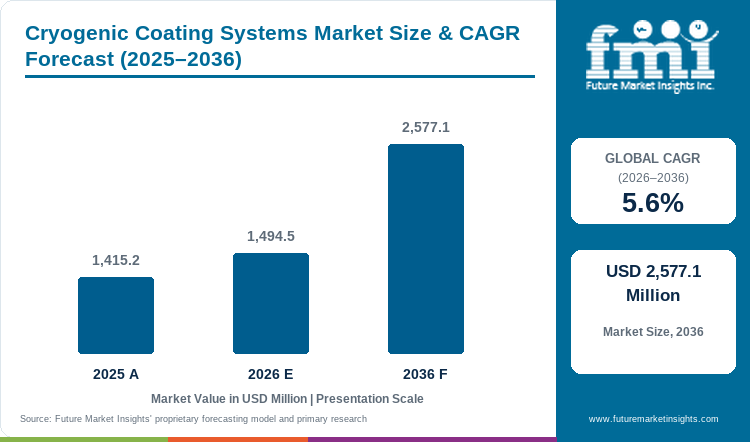
USD 1,494.5 million in 2026 and USD 2,577.1 million by 2036, expanding at 5.6% CAGR.
Sales of cryogenic coating systems are estimated to rise at 5.6% CAGR through 2036, increasing valuation from USD 1,415.2 million in 2025 to USD 1,494.5 million in 2026, and reaching USD 2,577.1 million by 2036. LNG projects turn safety needs into coating plans before shop work starts. In June 2025, the International Energy Agency tracked nearly 290 billion cubic metres of new export capacity. Those projects were already being built. Engineers pair cold-spill coating with thermal insulation coatings to limit heat transfer and rust on steel.
USA demand is forecast at 5.8% CAGR versus 4.8% for Japan through 2036. In April 2025, the U.S. Energy Information Administration said three LNG facilities would add 5.3 Bcf/d of export capacity. New US plants bring coating review into build packages. Japan relies on mature LNG sites and repair work. Longer reviews favor proven systems with support.
Key Takeaways
- New LNG export projects add steel that needs cold, rust, and fire safety before the plant starts service.
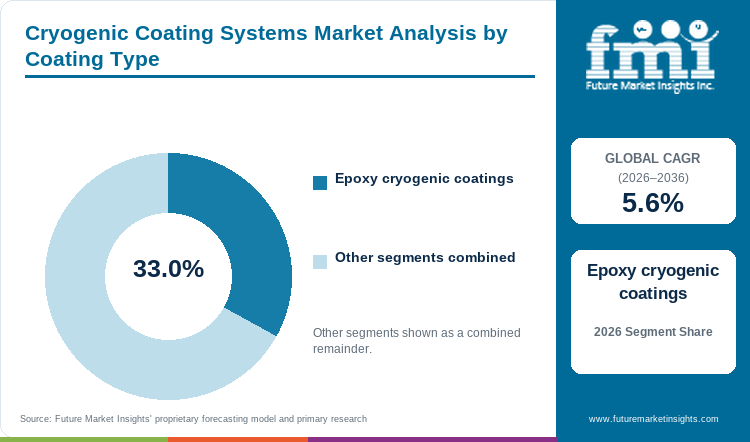
- By coating type, epoxy cryogenic coatings are estimated to hold 33.0% in 2026, supported by thick compatible layers.
- By substrate, carbon steel is forecast to account for 41.0% in 2026, driven by its wide use in frames and process supports.
- In 2026, LNG terminals are expected to lead end use with 35.0% share, attributable to large steel areas and clear cold-release risks.
- Project review and strict coating work raise installed cost. Once a system enters the approved plan, vendor changes become harder.
- Some of the key players in this market include AkzoNobel, PPG, Sherwin-Williams, Hempel, Jotun, Carboline, Kansai Paint, Nippon Paint, Belzona, and Teknos.
Analyst Perspective
"Suppliers win cold-service coating work before site use because systems must pass project review and match the contractor's plan. Local support matters when thick layers, checks, and shutdowns leave little room for errors."
- Nikhil Kaitwade, Principal Consultant, Future Market Insights
How is the cryogenic coating systems market segmented?
Cryogenic Coating Systems Market is segmented by Coating Type, Substrate, End Use, Application Method, Sales Channel, and Region.
The cryogenic coating systems market is segmented by coating type, substrate, end use, application method, sales channel, and region. Coating type includes epoxy, polyurethane, insulation, anti-corrosion, and fire-protection coatings. Substrate includes carbon steel, stainless steel, aluminum, concrete, and composite surfaces. End use includes LNG terminals, industrial gases, hydrogen infrastructure, marine LNG, and chemical plants. Application method shows how crews apply the coating. Sales channel shows who controls the purchase.
How does epoxy chemistry shape demand within the coating type category?
Epoxy systems bond well and resist chemicals in thick coating layers. Engineers compare high-performance epoxy coatings for steel that must resist rust and rough shop handling.
- By coating type, epoxy cryogenic coatings are forecast to represent 33.0% in 2026, supported by compatible thick layers.
- In March 2026, PPG launched two glass-flake epoxy coatings for offshore energy assets. The products added thick epoxy options for harsh work at sea.
Why does carbon steel remain central within the substrate category?
Carbon steel is common in pipe racks, process modules, skirts, and support frames. Its exposed area creates demand for fusion-bonded epoxy coatings and liquid systems used on steel assets in plants.
- By substrate, carbon steel is forecast to represent 41.0% in 2026, driven by wide use in load-bearing structures facing very low temperatures.
- ISO 20088-1 remains current after review. It sets the liquid cryogenic spill test for coating systems installed over carbon steel.
What supports LNG terminals within the end use category?
LNG sites place storage, transfer, loading, and process equipment inside hazard zones. Project plans often pair cold-spill coating with passive fire protection materials. The layers help steel keep its strength during a cold release or fire.
- In 2026, LNG terminals are expected to lead end use at 35.0% share, attributable to large steel areas and clear cold-release risks.
- The International Energy Agency identified nearly 290 billion cubic metres per year of LNG export capacity. The projects remain under construction through 2030.
How does spray application influence the application method category?
Spray equipment covers large steel areas fast and keeps film thickness even. Plural-component equipment is important for 2K coatings because the two parts react soon after mixing during shop work.
- By application method, spray applied systems are forecast at 43.0% in 2026, supported by fast coverage on large steel packages.
- In July 2026, Hempel launched Hempafire Optima 515. The coating can reach 1.5 mm dry film thickness per coat for certified steel fire protection.
Why do EPC contractors control the sales channel category?
EPC contractors turn hazard studies into coating plans before shop work reaches crews. They match corrosion protection coatings with insulation and fire layers. They also set check plans and approved product lists.
- EPC contractors are set to lead sales channel at 34.0% in 2026, linked to control of project rules and package purchases.
- In April 2026, PPG introduced coating products and field services for full project support. The launch shows how material supply and site work can be combined.
What are the drivers, restraints and opportunities in the Cryogenic Coating Systems Market?
LNG capacity additions expand qualified system demand, complex testing slows substitution, and hydrogen infrastructure creates new low-temperature specification work.
- Driver: New LNG trains add more steel that needs rust, insulation, and fire safety before the plant starts service.
- Restraint: Cold-release tests and strict work rules reduce the number of products and coating crews that can enter an approved plan.
- Opportunity: Hydrogen and ammonia projects add storage, transfer, piping, and process assets that need coatings matched to real work conditions.
New LNG plants create more coating demand well before they begin service. The International Energy Agency identified nearly 290 billion cubic metres per year of LNG export capacity from projects under construction through 2030. Owners coat structural steel during module building and site assembly before start-up. Designers pair intumescent coatings with rust-control and thermal layers once release and fire risks are known. EPC teams then set film thickness and check steps in the approved plan. These choices create material orders before start-up and set future repair points. Planned shutdowns bring later checks and repair as the coating system ages. Local crews gain repeat recoating work after the main build ends.
Project review slows vendor changes because each cold-service system must match a set release case. ISO 20088-3 remains current after its 2024 review and covers jet-release tests on carbon steel. Project teams also check primer fit and surface preparation before approving a substitute. Cure time and access for checks can limit work during short shutdowns. Some anti-corrosion coatings work well in normal service but lack low-temperature test proof. Review adds time and cost before a substitute enters the approved plan. Firms with complete test records face fewer barriers once the plan is fixed. Retrofit work feels this pressure most because shutdown time is short and old layers must still match.
Hydrogen and ammonia projects create another demand route beyond LNG. Australia granted major project status in 2026 to the Murchison Green Hydrogen project. The project targets 6 GW of renewable power and about 2 million tonnes of green ammonia each year. New plants need storage vessels and process piping for production and export at each site. Export sites also add cold surfaces that require thermal insulation materials and matching coating layers. Coating firms must prove performance for the real fluid and temperature range before approval. Local stock and trained coating crews can cut shipping delays and rework. Clear repair steps and field support help pilot use become repeat project work.
Which country CAGRs are profiled in the Cryogenic Coating Systems Market?
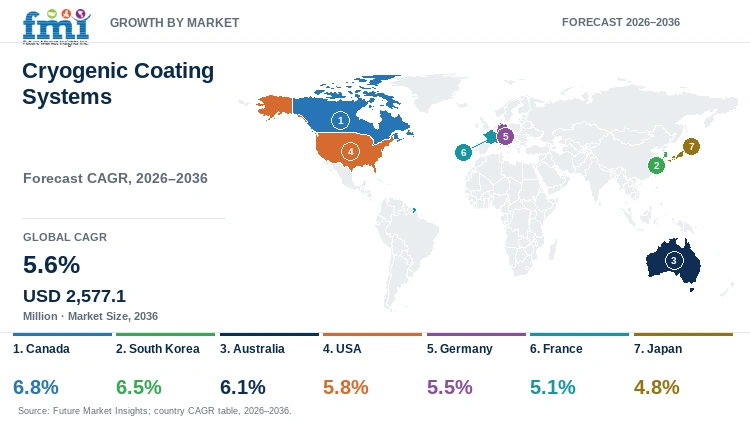
| Country | CAGR |
|---|---|
| Canada | 6.8% |
| South Korea | 6.5% |
| Australia | 6.1% |
| USA | 5.8% |
| Germany | 5.5% |
| France | 5.1% |
| Japan | 4.8% |
How do country-level CAGRs compare in the Cryogenic Coating Systems Market?
Canada and South Korea form the upper group as export projects and shipbuilding add coated steel. Australia and USA mix work with installed assets. Germany, France, and Japan rely more on upgrades. The 2.0-point spread measures forecast speed, not current size.
- Canada links Kitimat expansion with remote service needs that make local coating support more important.
- South Korea turns large shipyard programs into repeat coating work during LNG carrier and module building.
- Australia combines long supply routes with hydrogen projects that raise the need for local stock and trained crews.
- USA combines Gulf Coast LNG construction with repair work that keeps coating demand active during planned shutdowns.
- Germany links terminal upkeep with hydrogen conversion and needs clear records for coating work on older steel.
- France favors planned terminal repair because long bookings and regulated space limit optional coating replacement.
- Japan favors shop coating and short shutdowns because mature LNG assets need careful project review before repairs.
Similar CAGRs can still create different buying conditions. The full report provides country-level CAGR analysis across North America, Latin America, Western Europe, Eastern Europe, East Asia, South Asia and Pacific, and the Middle East and Africa.
Country-wise Analysis
- Gulf Coast LNG projects tie US demand to large EPC packages and coating crews. USA is projected to record 5.8% CAGR through 2036, supported by new LNG projects and a large repair base. In April 2025, the U.S. Energy Information Administration said three new LNG facilities would add 5.3 Bcf/d of nominal export capacity. New plants move coating review into module work before start-up. Existing LNG sites need checks and repair during planned shutdowns. Start-up dates can shift material orders. Local stock and field teams help firms apply thick coatings without delaying build or repair work.
- Germany is changing gas networks while keeping import assets available for energy security and industry. Germany is estimated to post 5.5% CAGR over the forecast period, linked to LNG site upkeep and hydrogen-network conversion. In June 2026, Bundesnetzagentur said the proposed gas and hydrogen network plan would reach 9,241 km by 2037. Much of the route uses existing gas lines. Retrofit work puts more weight on coating fit with older steel. Planned shutdowns limit work time. New project rules must cover changed service conditions. Clear records can shorten engineering review for gas-to-hydrogen work on older steel assets and layers.
- Japanese utilities and engineering groups manage LNG supply through established sites and careful project review. By 2036, Japan is projected to grow at 4.8% CAGR, influenced by LNG security needs and mature assets. In March 2026, METI said about 4 million tonnes of annual LNG imports pass through the Strait of Hormuz. The government also reported inventories near that exposure. Mature LNG sites limit new-build coating work. Planned shutdowns favor shop-applied parts and repair methods with proven fit. Local field support speeds repair approval. Firms protect repeat business by cutting site time and keeping check records complete for each repair.
- South Korean demand is concentrated in shipyards that build LNG carriers and energy modules on repeat schedules. South Korea is projected to record 6.5% CAGR through 2036, tied to LNG building and local coating work. In August 2025, the Ministry of Trade, Industry and Resources reported a five-ship order. The first two were 200,000 m3 LNG carriers. Yard schedules make coating speed a business issue. Class rules can limit product changes. Marine shop work also supports demand for marine coatings on the same steel blocks. Clear coating steps help firms match block building and reduce handover delays on site.
- Remote coastal projects make logistics part of the coating decision in Australia. Through 2036, coating demand in Australia is expected to grow at 6.1% CAGR, supported by LNG repair work and new hydrogen projects. In 2026, the Department of Industry said Murchison Green Hydrogen targets 6 GW of renewable power. It also targets about 2 million tonnes of green ammonia each year. Coastal weather and long supply routes raise rework costs. Project finance can delay orders after review. Firms need local stock and trained crews near ports. Clear repair plans keep planned work from depending on long travel routes.
- Western Canada is moving from first LNG exports toward operation and possible expansion at Kitimat. In Canada, coating demand is predicted to advance at 6.8% CAGR through 2036, driven by an asset base with room to expand. In July 2026, the federal Major Projects Office listed LNG Canada Phase 2 as a national project. Remote access and wet coastal weather make coating work harder. Winter conditions can reduce curing time. Firms can prequalify repair methods before shutdowns. Build contracts can then become repeat repair orders. Local field support also cuts long travel for urgent coating work at Kitimat.
- French LNG demand comes from regulated sites with booked capacity and clear operating rules. France is estimated to post 5.1% CAGR over the forecast period, shaped by site upkeep and booked terminal use. In April 2026, the Commission de régulation de l’énergie listed Montoir at 123 TWh per year. The figure describes regasification capacity, while Fos Cavaou was listed at 117 TWh per year. Long-term bookings tie repair work to planned shutdowns. Tariff review limits optional replacement work. Firms need overcoat systems that match existing layers. Simple repair methods help crews finish work inside short check windows without extra downtime.
Who are the notable companies in the Cryogenic Coating Systems Market?
AkzoNobel, PPG, Sherwin-Williams, Hempel, Jotun, Carboline, Kansai Paint, Nippon Paint, Belzona, and Teknos are active within the defined cryogenic and severe-service protective coating boundary.
Harsh-service coating firms compete with broad suppliers and marine specialists. EPC teams compare test records and field support before sign-off. Large groups work globally. Specialists focus on repair and plant needs.
- AkzoNobel, PPG, Sherwin-Williams, Jotun, and Carboline serve engineered fire and harsh work with broad project support.
- Hempel, Kansai Paint, and Nippon Paint offer broad marine and plant coating ranges that can cover rust-control layers and topcoats.
- Belzona and Teknos focus more on repair work and specialist coating needs that depend on local field support.
Competitive Benchmarking: Cryogenic Coating Systems Market
| Company | Cryogenic or Severe-Service Qualification | Integrated Fire and Corrosion Capability | Application and Field Support | Geographic Reach |
|---|---|---|---|---|
| AkzoNobel | High | High | High | Global |
| PPG | High | High | High | Global |
| Sherwin-Williams | High | High | High | Global |
| Hempel | Medium | High | High | Global |
| Jotun | High | High | High | Global |
| Carboline | High | High | Medium | North America and international |
| Kansai Paint | Low | Medium | Medium | Asia and EMEA |
| Nippon Paint | Low | Medium | Medium | Asia and global marine |
| Belzona | Medium | Medium | High | Global distributor network |
| Teknos | Low | Medium | Medium | Europe and selected global markets |
Scoring basis: High requires harsh-service or certified fire proof. Medium covers plant coatings with narrower hazard proof. Low marks limited cold-test data. Integration rates fire and rust-control breadth. Field support uses published proof.
Key Developments in the Cryogenic Coating Systems Market
- In July 2026, Hempel launched Hempafire Optima 515 for structural steel. It offers up to 150 minutes of certified fire protection.
- In July 2026, Sherwin-Williams added FIRETEX FX1008 and FX2008 intumescent coatings. They offer up to 120 minutes of BS 476 fire protection.
- In March 2026, PPG launched SIGMASHIELD 950 and 899 GF glass-flake epoxy coatings. They target offshore energy, oil and gas, and infrastructure work.
Key Players in the Cryogenic Coating Systems Market
Engineered fire and severe-service protection
- AkzoNobel
- PPG
- Sherwin-Williams
- Jotun
- Carboline
Broad marine and industrial protective portfolios
- Hempel
- Kansai Paint
- Nippon Paint
Repair and specialist coating routes
- Belzona
- Teknos
Cryogenic Coating Systems Market - Report Scope
| Coverage field | Report scope |
|---|---|
| Market breakdown | By coating type, substrate, end use, application method, sales channel, and region. |
| Quantitative Units | USD million. |
| Market Definition | Revenue includes liquid-applied and factory-coated cryogenic coating systems specified for low-temperature or cryogenic service. Application labor, substrate fabrication, standalone bulk insulation, downstream asset revenue, and generic protective coatings are excluded. |
| Regions Covered | North America, Latin America, Western Europe, Eastern Europe, East Asia, South Asia and Pacific, and Middle East and Africa. |
| Countries Covered | Canada, South Korea, Australia, USA, Germany, France, Japan, and 20+ countries included in the full report. |
| Key Companies Profiled | AkzoNobel, PPG, Sherwin-Williams, Hempel, Jotun, Carboline, Kansai Paint, Nippon Paint, Belzona, Teknos. |
| Forecast Period | 2026 to 2036. |
| Approach | Primary and secondary research with market triangulation. |
Cryogenic Coating Systems Market - Research Methodology
| Method | Approach |
|---|---|
| Primary Research | FMI analysts gathered input from manufacturers, service providers, technology developers, distributors, end users, procurement teams, and subject-matter experts. Interviews examined purchasing decisions, product or service evaluation, adoption barriers, approval requirements, pricing considerations, and expectations for technical or commercial support. Respondents were also asked what evidence is required before a trial, pilot, or initial order develops into regular purchasing. |
| Desk Research | Desk research covered government statistics, regulatory publications, trade data, industry associations, technical literature, standards, company filings, product information, and official corporate announcements. Sources were reviewed for relevance, publication date, geographic coverage, and consistency with the defined market scope. Claims relating to performance, applications, approvals, capacity, investment, and commercial activity were retained only when supported by credible public evidence. |
| Market Sizing and Forecasting | The market model combined the baseline value with historical performance, segment structure, pricing and volume indicators, adoption levels, company participation, and country-level demand conditions. Forecast assumptions considered economic activity, investment trends, regulatory developments, technology adoption, purchasing cycles, supply availability, and barriers to wider market use. Segment and regional estimates were reconciled before the final market total was calculated. |
| Data Validation | Estimates were checked against multiple independent indicators, including public data, company activity, trade patterns, industry developments, and findings from primary interviews. Validation also tested whether products, services, applications, and company revenues fell within the defined market boundaries. Adjacent categories, unsupported claims, overlapping revenues, and activities without direct market relevance were excluded to reduce double counting and maintain consistency across segments and countries. |
Cryogenic Coating Systems Market by Segments
Cryogenic Coating Systems Market segmented by Coating Type:
- Epoxy cryogenic coatings
- Polyurethane coatings
- Insulative coatings
- Anti-corrosion coatings
- Fire coatings
Cryogenic Coating Systems Market segmented by Substrate:
- Carbon steel
- Stainless steel
- Aluminum
- Concrete
- Composite surfaces
Cryogenic Coating Systems Market segmented by End Use:
- LNG terminals
- plant gases
- Hydrogen projects
- Marine LNG
- Chemical plants
Cryogenic Coating Systems Market segmented by Application Method:
- Spray applied
- Brush - roller
- Factory coated
- Field repair
Cryogenic Coating Systems Market segmented by Sales Channel:
- EPC contractors
- Coating applicators
- Direct coating firms
- repair distributors
Cryogenic Coating Systems Market by Region:
- North America
- United States
- Canada
- Latin America
- Brazil
- Mexico
- Argentina
- Chile
- Rest of Latin America
- Western Europe
- Germany
- France
- United Kingdom
- Italy
- Spain
- Benelux
- Nordics
- Rest of Western Europe
- Eastern Europe
- Poland
- Czech Republic
- Romania
- Hungary
- Rest of Eastern Europe
- East Asia
- China
- Japan
- South Korea
- South Asia and Pacific
- India
- ASEAN
- Australia and New Zealand
- Rest of South Asia and Pacific
- Middle East and Africa
- GCC Countries
- South Africa
- Türkiye
- Israel
- Rest of Middle East and Africa
Research Sources and Bibliography
- International Energy Agency. (2025, June 6). New data resource tracks global LNG liquefaction capacity additions as markets gear up for record wave of new projects.
- U.S. Energy Information Administration. (2025, April 3). U.S. LNG export capacity is set to expand further as new projects begin operations.
- International Organization for Standardization. (2016). ISO 20088-1:2016 - Determination of the resistance to cryogenic spillage of insulation materials - Part 1: Liquid phase.
- International Organization for Standardization. (2018). ISO 20088-3:2018 - Determination of the resistance to cryogenic spillage of insulation materials - Part 3: Jet release.
- PPG. (2026, March 26). PPG launches new PPG SIGMASHIELD glass flake epoxy coatings for offshore energy sector.
- Hempel. (2026, July 30). Hempel launches new steel fire protection coating designed to reduce paint consumption.
- PPG. (2026, April 20). PPG introduces end-to-end protective coatings solutions, application services for data centers.
- Bundesnetzagentur. (2026, June 15). Bundesnetzagentur launches consultation for Gas and Hydrogen Network Development Plan 2025-2037/2045.
- Ministry of Economy, Trade and Industry, Japan. (2026, March 10). Fourth public-private liaison meeting held to secure stable LNG supply.
- Ministry of Trade, Industry and Resources, Republic of Korea. (2025, August 14). Korea’s Shipbuilding Takes Another Leap with MASGA Project.
- Department of Industry, Science and Resources, Australia. (2026, August). Key projects awarded major project status.
- Government of Canada, Major Projects Office. (2026, July 2). LNG Canada Phase 2.
- Commission de régulation de l’énergie. (2026, April 28). Modifications des modalités de commercialisation des capacités de regazéification additionnelles des terminaux régulés d’Elengy.
- Sherwin-Williams. (2026, July 15). Sherwin-Williams expands its world-class range of solvent-based intumescent coatings.
- AkzoNobel. (2026, May 26). AkzoNobel supplies protective power for flagship energy project in China.
- PPG. (2026, August 31). PPG introduces PPG ONE RANGE portfolio for onboard maintenance.
- Sherwin-Williams. (2026, June 19). New Heat-Flex AEB Eliminates Threat of Corrosion Under Insulation.
- Hempel. (2026, September 14). Hempel secures 3-year global hull coatings agreement with Maersk for fleet dry dockings.
- Jotun. (2026, June 29). Jotun attends Boao conference and signs agreement covering 125 newbuilding vessels.
- Carboline. (2026, February). A/D Firefilm III - Submittal Package Update February 2026.
- Kansai Paint Co., Ltd.. (2026, July 13). Additional Acquisition of Shares in Turkish Consolidated Subsidiary Kansai Altan Boya Sanayi ve Ticaret A.Ş..
- Nippon Paint Marine. (2026, July 20). WAN HAI adopts Nippon Paint Marine hull and surface coatings in newbuild projects.
- Belzona. (2026, January). Belzona Immersion Coating Used in Heat Exchanger Water Box.
- Teknos. (2026). Classification report K4/2026 for TEKNOS FR FACADE exterior fire-retardant coating system.
This bibliography is provided for reader reference and is not exhaustive. The full report contains the complete reference list and detailed citations
This Report Answers
- What is the cryogenic coating systems market size in 2026 and 2036?
- Which LNG project conditions create demand for cryogenic coating systems?
- Why do epoxy cryogenic coatings lead the coating type category?
- How does carbon steel shape coating design and demand?
- Why do LNG terminals lead the end use category?
- How do country CAGRs differ across Canada, South Korea, Australia, USA, Germany, France, and Japan?
- Which firms cover fire, harsh work, marine, or repair coating routes?
- How do review and work rules limit vendor changes?
- What should EPC teams check before approving a cold-service coating system?
Frequently Asked Questions
How big is the cryogenic coating systems market in 2026?
The cryogenic coating systems market is valued at USD 1,494.5 million in 2026 and is forecast at USD 2,577.1 million by 2036. New LNG plants and repair work support demand.
What is the CAGR of the cryogenic coating systems market from 2026 to 2036?
The cryogenic coating systems market is forecast to grow at 5.6% CAGR from 2026 to 2036. New LNG plants and low-temperature projects need coatings that pass project review.
Which coating type leads the cryogenic coating systems market?
Epoxy cryogenic coatings are expected to hold 33.0% of coating type revenue in 2026. Thick layers and strong bonding support use on steel assets.
Which application method leads the cryogenic coating systems market?
Spray applied systems are forecast to represent 43.0% of application method revenue in 2026. Spray equipment covers large steel areas fast and controls coating thickness.
Which companies are active in the cryogenic coating systems market?
Key companies include AkzoNobel, PPG, Sherwin-Williams, Hempel, Jotun, Carboline, Kansai Paint, Nippon Paint, Belzona, and Teknos. They compete on test proof, coating range, field support, and regional reach.
Preview the report firsthand - request a free sample
Get SampleGet the brochure for pricing and purchase details.
Get PDFTable of Content
- Key Takeaways
- Market Size and CAGR
- Top Growth Driver
- Fastest Growing Segment
- Leading Region
- Key Companies
- Emerging Opportunities
- Executive Summary
- Global Market Outlook
- Demand-side Trends
- Supply-side Trends
- Technology Roadmap Analysis
- Analysis and Recommendations
- Analyst Perspective (What is happening? Why now? What should investors know?)
- Key Questions Answered
- How large is the market?
- What is the CAGR?
- What are key trends?
- Which region dominates?
- Who are the leaders?
- Market Overview
- Market Coverage / Taxonomy
- Market Definition / Scope / Limitations
- Research Methodology
- Chapter Orientation
- Analytical Lens and Working Hypotheses
- Market Structure, Signals, and Trend Drivers
- Benchmarking and Cross-market Comparability
- Market Sizing, Forecasting, and Opportunity Mapping
- Research Design and Evidence Framework
- Desk Research Programme (Secondary Evidence)
- Expert Input and Fieldwork (Primary Evidence)
- Tooling, Models, and Reference Databases
- Data Engineering and Model Build
- Quality Assurance and Audit Trail
- Market Background
- Market Dynamics (Drivers, Restraints, Opportunity, Trends)
- Scenario Forecast (Optimistic, Likely, Conservative)
- Impact Analysis
- AI Impact
- Sustainability Impact
- Regulatory Impact
- Technology Impact
- Consumer / Buyer Analysis
- Purchase Drivers
- Adoption Barriers
- Buyer Journey
- Opportunity Map Analysis
- Product Life Cycle Analysis
- Supply Chain Analysis
- Investment Feasibility Matrix
- Value Chain Analysis
- PESTLE and Porter's Analysis
- Regulatory Landscape
- Regional Parent Market Outlook
- Production and Consumption Statistics
- Import and Export Statistics
- Global Market Analysis and Forecast, 2021 to 2036
- Historical Market Size Value (USD Million) Analysis, 2021 to 2025
- Current and Future Market Size Value (USD Million) Projections, 2026 to 2036
- Y-o-Y Growth Trend Analysis
- Absolute $ Opportunity Analysis
- Global Market Pricing Analysis, 2021 to 2036
- Global Market Analysis and Forecast, By Coating Type, 2021 to 2036
- Introduction / Key Findings
- Historical Market Size Value (USD Million) Analysis By Coating Type, 2021 to 2025
- Current and Future Market Size Value (USD Million) Analysis and Forecast By Coating Type, 2026 to 2036
- Epoxy cryogenic coatings
- Polyurethane coatings
- Insulative coatings
- Anti-corrosion coatings
- Fire coatings
- Y-o-Y Growth Trend Analysis By Coating Type, 2021 to 2025
- Absolute $ Opportunity Analysis By Coating Type, 2026 to 2036
- Global Market Analysis and Forecast, By Substrate, 2021 to 2036
- Introduction / Key Findings
- Historical Market Size Value (USD Million) Analysis By Substrate, 2021 to 2025
- Current and Future Market Size Value (USD Million) Analysis and Forecast By Substrate, 2026 to 2036
- Carbon steel
- Stainless steel
- Aluminum
- Concrete
- Composite surfaces
- Y-o-Y Growth Trend Analysis By Substrate, 2021 to 2025
- Absolute $ Opportunity Analysis By Substrate, 2026 to 2036
- Global Market Analysis and Forecast, By End Use, 2021 to 2036
- Introduction / Key Findings
- Historical Market Size Value (USD Million) Analysis By End Use, 2021 to 2025
- Current and Future Market Size Value (USD Million) Analysis and Forecast By End Use, 2026 to 2036
- LNG terminals
- plant gases
- Hydrogen projects
- Marine LNG
- Chemical plants
- Y-o-Y Growth Trend Analysis By End Use, 2021 to 2025
- Absolute $ Opportunity Analysis By End Use, 2026 to 2036
- Global Market Analysis and Forecast, By Application Method, 2021 to 2036
- Introduction / Key Findings
- Historical Market Size Value (USD Million) Analysis By Application Method, 2021 to 2025
- Current and Future Market Size Value (USD Million) Analysis and Forecast By Application Method, 2026 to 2036
- Spray applied
- Brush - roller
- Factory coated
- Field repair
- Y-o-Y Growth Trend Analysis By Application Method, 2021 to 2025
- Absolute $ Opportunity Analysis By Application Method, 2026 to 2036
- Global Market Analysis and Forecast, By Sales Channel, 2021 to 2036
- Introduction / Key Findings
- Historical Market Size Value (USD Million) Analysis By Sales Channel, 2021 to 2025
- Current and Future Market Size Value (USD Million) Analysis and Forecast By Sales Channel, 2026 to 2036
- EPC contractors
- Coating applicators
- Direct coating firms
- repair distributors
- Y-o-Y Growth Trend Analysis By Sales Channel, 2021 to 2025
- Absolute $ Opportunity Analysis By Sales Channel, 2026 to 2036
- Global Market Analysis and Forecast, By Region, 2021 to 2036
- Introduction
- Historical Market Size Value (USD Million) Analysis By Region, 2021 to 2025
- Current Market Size Value (USD Million) Analysis and Forecast By Region, 2026 to 2036
- North America
- Latin America
- Western Europe
- Eastern Europe
- East Asia
- South Asia and Pacific
- Middle East and Africa
- Market Attractiveness Analysis By Region
- North America Market Analysis and Forecast, By Country, 2021 to 2036
- Historical Market Size Value (USD Million) Trend Analysis By Market Taxonomy, 2021 to 2025
- Market Size Value (USD Million) Forecast By Market Taxonomy, 2026 to 2036
- By Country
- United States
- Canada
- By Coating Type
- By Substrate
- By End Use
- By Application Method
- By Sales Channel
- By Country
- Market Attractiveness Analysis
- By Country
- By Coating Type
- By Substrate
- By End Use
- By Application Method
- By Sales Channel
- Key Takeaways
- Latin America Market Analysis and Forecast, By Country
- Historical Market Size Value (USD Million) Trend Analysis By Market Taxonomy, 2021 to 2025
- Market Size Value (USD Million) Forecast By Market Taxonomy, 2026 to 2036
- By Country
- Brazil
- Mexico
- Argentina
- Chile
- Rest of Latin America
- By Coating Type
- By Substrate
- By End Use
- By Application Method
- By Sales Channel
- By Country
- Market Attractiveness Analysis
- By Country
- By Coating Type
- By Substrate
- By End Use
- By Application Method
- By Sales Channel
- Key Takeaways
- Western Europe Market Analysis and Forecast, By Country
- Historical Market Size Value (USD Million) Trend Analysis By Market Taxonomy, 2021 to 2025
- Market Size Value (USD Million) Forecast By Market Taxonomy, 2026 to 2036
- By Country
- Germany
- France
- United Kingdom
- Italy
- Spain
- Benelux
- Nordics
- Rest of Western Europe
- By Coating Type
- By Substrate
- By End Use
- By Application Method
- By Sales Channel
- By Country
- Market Attractiveness Analysis
- By Country
- By Coating Type
- By Substrate
- By End Use
- By Application Method
- By Sales Channel
- Key Takeaways
- Eastern Europe Market Analysis and Forecast, By Country
- Historical Market Size Value (USD Million) Trend Analysis By Market Taxonomy, 2021 to 2025
- Market Size Value (USD Million) Forecast By Market Taxonomy, 2026 to 2036
- By Country
- Poland
- Czech Republic
- Romania
- Hungary
- Rest of Eastern Europe
- By Coating Type
- By Substrate
- By End Use
- By Application Method
- By Sales Channel
- By Country
- Market Attractiveness Analysis
- By Country
- By Coating Type
- By Substrate
- By End Use
- By Application Method
- By Sales Channel
- Key Takeaways
- East Asia Market Analysis and Forecast, By Country
- Historical Market Size Value (USD Million) Trend Analysis By Market Taxonomy, 2021 to 2025
- Market Size Value (USD Million) Forecast By Market Taxonomy, 2026 to 2036
- By Country
- China
- Japan
- South Korea
- By Coating Type
- By Substrate
- By End Use
- By Application Method
- By Sales Channel
- By Country
- Market Attractiveness Analysis
- By Country
- By Coating Type
- By Substrate
- By End Use
- By Application Method
- By Sales Channel
- Key Takeaways
- South Asia and Pacific Market Analysis and Forecast, By Country
- Historical Market Size Value (USD Million) Trend Analysis By Market Taxonomy, 2021 to 2025
- Market Size Value (USD Million) Forecast By Market Taxonomy, 2026 to 2036
- By Country
- India
- ASEAN
- Australia and New Zealand
- Rest of South Asia and Pacific
- By Coating Type
- By Substrate
- By End Use
- By Application Method
- By Sales Channel
- By Country
- Market Attractiveness Analysis
- By Country
- By Coating Type
- By Substrate
- By End Use
- By Application Method
- By Sales Channel
- Key Takeaways
- Middle East and Africa Market Analysis and Forecast, By Country
- Historical Market Size Value (USD Million) Trend Analysis By Market Taxonomy, 2021 to 2025
- Market Size Value (USD Million) Forecast By Market Taxonomy, 2026 to 2036
- By Country
- GCC Countries
- South Africa
- Türkiye
- Israel
- Rest of Middle East and Africa
- By Coating Type
- By Substrate
- By End Use
- By Application Method
- By Sales Channel
- By Country
- Market Attractiveness Analysis
- By Country
- By Coating Type
- By Substrate
- By End Use
- By Application Method
- By Sales Channel
- Key Takeaways
- Key Countries Market Analysis
- United States
- Pricing Analysis
- Market Share Analysis, 2025
- By Coating Type
- By Substrate
- By End Use
- By Application Method
- By Sales Channel
- Canada
- Pricing Analysis
- Market Share Analysis, 2025
- By Coating Type
- By Substrate
- By End Use
- By Application Method
- By Sales Channel
- Mexico
- Pricing Analysis
- Market Share Analysis, 2025
- By Coating Type
- By Substrate
- By End Use
- By Application Method
- By Sales Channel
- Brazil
- Pricing Analysis
- Market Share Analysis, 2025
- By Coating Type
- By Substrate
- By End Use
- By Application Method
- By Sales Channel
- Chile
- Pricing Analysis
- Market Share Analysis, 2025
- By Coating Type
- By Substrate
- By End Use
- By Application Method
- By Sales Channel
- Germany
- Pricing Analysis
- Market Share Analysis, 2025
- By Coating Type
- By Substrate
- By End Use
- By Application Method
- By Sales Channel
- United Kingdom
- Pricing Analysis
- Market Share Analysis, 2025
- By Coating Type
- By Substrate
- By End Use
- By Application Method
- By Sales Channel
- Italy
- Pricing Analysis
- Market Share Analysis, 2025
- By Coating Type
- By Substrate
- By End Use
- By Application Method
- By Sales Channel
- Spain
- Pricing Analysis
- Market Share Analysis, 2025
- By Coating Type
- By Substrate
- By End Use
- By Application Method
- By Sales Channel
- France
- Pricing Analysis
- Market Share Analysis, 2025
- By Coating Type
- By Substrate
- By End Use
- By Application Method
- By Sales Channel
- India
- Pricing Analysis
- Market Share Analysis, 2025
- By Coating Type
- By Substrate
- By End Use
- By Application Method
- By Sales Channel
- ASEAN
- Pricing Analysis
- Market Share Analysis, 2025
- By Coating Type
- By Substrate
- By End Use
- By Application Method
- By Sales Channel
- Australia and New Zealand
- Pricing Analysis
- Market Share Analysis, 2025
- By Coating Type
- By Substrate
- By End Use
- By Application Method
- By Sales Channel
- China
- Pricing Analysis
- Market Share Analysis, 2025
- By Coating Type
- By Substrate
- By End Use
- By Application Method
- By Sales Channel
- Japan
- Pricing Analysis
- Market Share Analysis, 2025
- By Coating Type
- By Substrate
- By End Use
- By Application Method
- By Sales Channel
- South Korea
- Pricing Analysis
- Market Share Analysis, 2025
- By Coating Type
- By Substrate
- By End Use
- By Application Method
- By Sales Channel
- Poland
- Pricing Analysis
- Market Share Analysis, 2025
- By Coating Type
- By Substrate
- By End Use
- By Application Method
- By Sales Channel
- Hungary
- Pricing Analysis
- Market Share Analysis, 2025
- By Coating Type
- By Substrate
- By End Use
- By Application Method
- By Sales Channel
- Türkiye
- Pricing Analysis
- Market Share Analysis, 2025
- By Coating Type
- By Substrate
- By End Use
- By Application Method
- By Sales Channel
- South Africa
- Pricing Analysis
- Market Share Analysis, 2025
- By Coating Type
- By Substrate
- By End Use
- By Application Method
- By Sales Channel
- Australia
- Pricing Analysis
- Market Share Analysis, 2025
- By Coating Type
- By Substrate
- By End Use
- By Application Method
- By Sales Channel
- United States
- Market Structure Analysis
- Competition Dashboard
- Competition Benchmarking
- Market Share Analysis of Top Players
- By Regional
- By Coating Type
- By Substrate
- By End Use
- By Application Method
- By Sales Channel
- Emerging Startups
- Innovation Benchmarking
- Competition Analysis
- Competition Deep Dive
- AkzoNobel
- Overview
- Product Portfolio
- Profitability by Market Segments
- Sales Footprint
- Strategy Overview
- Marketing Strategy
- Product Strategy
- Channel Strategy
- PPG
- Sherwin-Williams
- Hempel
- Jotun
- Carboline
- Kansai Paint
- Nippon Paint
- Belzona
- Teknos
- AkzoNobel
- Case Studies
- Success Stories
- Recent Developments
- Competition Deep Dive
- Assumptions & Acronyms Used


