

- Market Size (2026)
- USD 1477.8 Mn
- Forecast (2036)
- USD 2227 Mn
- CAGR (2026 to 2036)
- 4.2%
How big is Dental Anesthesia Injectable Market in 2026?
USD 1477.8 million in 2026 and USD 2227 million by 2036 at a 4.2% CAGR.
Demand for dental anesthesia injectables is projected to expand at 4.2% CAGR between 2026 and 2036, increasing valuation from USD 1477.8 million in 2026 to USD 2227 million by 2036. Each procedure that uses local anesthesia requires a fresh sterile dose and an agent suited to the planned treatment time. Clinical selection therefore shapes recurring cartridge demand across restorative and surgical dental services in routine practice. The NHS Specialist Pharmacy Service stated in January 2025 that dental cartridges usually combine a local anesthetic with a vasoconstrictor. The guidance explained that vasoconstrictors improve anesthesia depth and duration while reducing bleeding and systemic absorption, supporting demand for several established formulations. Manufacturers convert procedure activity into revenue through dependable supply and clear formulation choices across routine appointment schedules.
Large dental groups can standardize approved anesthetics and plan direct replenishment across several connected treatment locations. Independent practices rely more heavily on distributors that combine cartridges with needles and other treatment supplies. Both purchasing routes require compatible delivery equipment and traceable complaint handling throughout routine clinical use. The American Dental Association reported in April 2025 that a proposed cartridge-syringe standard covered aspirating and self-aspirating devices used with dental local anesthetic cartridges. The proposal shows why injectable packaging remains part of routine product qualification across dental practice accounts. Commercial accounts compare unit price with cartridge fit and dependable delivery across planned appointment schedules. A lower price has limited value if a clinic cannot use its normal syringe or receive replacement stock before scheduled care.
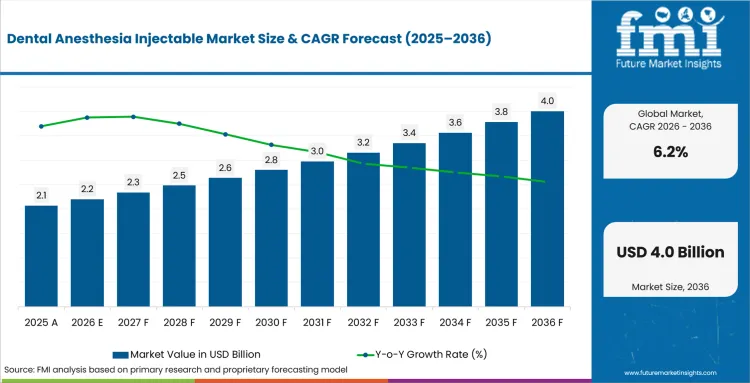
Key Takeaways of Dental Anesthesia Injectable Market
- Routine restorative and surgical procedures create repeat cartridge orders, but dependable availability determines whether scheduled treatment converts into recurring revenue.
- By anesthetic agent, amide local anesthetics are estimated to hold 72.0% in 2026 owing to broad formulation coverage across routine dental procedures.
- Dental clinics are projected to hold 46.0% share in 2026 within end user because practices directly control agent selection and cartridge inventory.
- The distribution channel category is forecast to be led by direct sales at 38.0% share in 2026 due to planned supply agreements across larger dental groups.
- Generic price pressure and sterile cartridge interruptions can weaken margins or cancel procedures even across familiar local anesthetic portfolios.
- Septodont, Pierrel S.p.A., Laboratorios Inibsa, Dentsply Sirona, Henry Schein, Anhil Parenterals, Zymeth Pharmaceutical, and Nippon Shika Yakuhin compete through different manufacturing and distribution roles.
Analyst Perspective
“Dental anesthesia injectables are routine medicines, yet clinics judge them through supply reliability and predictable chairside performance. A low unit price does not protect an established brand during shortages or unexpected cartridge failures. Manufacturers can defend recurring accounts by matching agent choice with consistent packaging and responsive complaint handling. The strongest commercial position combines sterile production discipline with local distribution that reaches practices before scheduled care is disrupted.”
- Anurag Sharma, Principal Analyst, Future Market Insights
How is the Dental Anesthesia Injectable Market segmented?
The dental anesthesia injectable industry is segmented by Product Type, Application, End User, Distribution Channel, Anesthetic Agent, and Region.
The analysis separates the market by product type, application, end user, distribution channel, anesthetic agent, and region. Product type identifies the active formulation supplied within each filled dental cartridge or vial for commercial sale. Application links each injectable order to extraction, restorative care, endodontics, periodontics, and oral surgery procedures. End user distinguishes dental clinics, hospitals, surgery centers, academic institutions, and public treatment facilities across different purchasing routes. Distribution channel records whether finished medicines reach treatment sites through direct contracts, distributors, institutional purchasing, pharmacies, or online business platforms. Anesthetic agent groups injectable products by chemical class and formulation requirements that affect clinical selection. Regional analysis compares approval routes, medicine access, distribution coverage, and purchasing conditions across national dental delivery systems.
What supports amide local anesthetics within the anesthetic agent category?
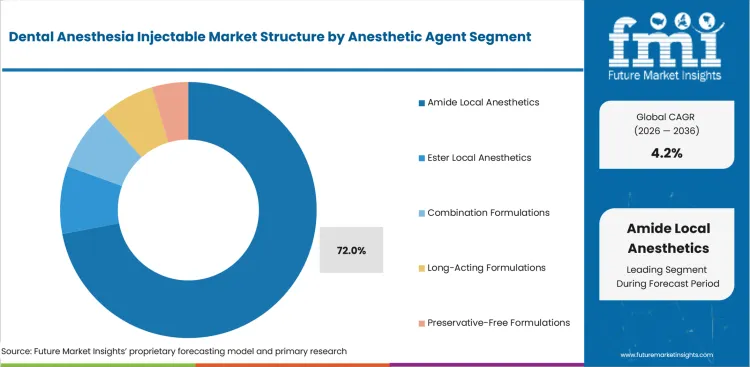
Amide agents include several established dental molecules with different onset and duration profiles across routine treatment plans. Clinicians consider patient history and expected procedure length beside vasoconstrictor exposure during each agent-selection decision. Commercial availability also depends on national registration requirements and current medicine authorization across each intended territory. Laboratorios Inibsa reported in June 2026 that an April 2025 European authorization added ten countries for its articaine and epinephrine product. The authorization expanded registered access for an amide formulation across ten additional national medicine channels and distributor networks.
- The amide local anesthetics segment is likely to capture 72.0% share in 2026 attributable to broad molecule coverage across routine dental procedures. The category includes lidocaine and articaine beside other established agents used across different treatment requirements. Registered alternatives give clinics greater flexibility whenever duration needs or patient history changes the preferred formulation.
- Dental practices adopt amide portfolios that combine familiar dosing with dependable cartridge quality and several duration choices. Manufacturers expand product use through coherent registration files and stable regional supply across established medicine channels. Adverse-event controls and shortages can redirect recurring orders among approved alternatives without changing the wider chemical-class preference.
Why do lidocaine-based injectables lead the product type category?
Lidocaine cartridges support familiar infiltration and nerve-block routines across restorative care and routine oral surgery procedures. Clinicians compare formula strength and vasoconstrictor content without changing their established injection technique or staff training. Leakage or difficult plunger movement can disrupt a routine appointment and weaken confidence in cartridge consistency. The American Dental Association reported in May 2026 that proposed cartridge requirements covered leakage and underfilling tests. Those requirements explain why generic injectables compete through verified packaging quality beside the active-agent price offered to clinics.
- By product type, lidocaine-based injectables are estimated to hold 34.0% in 2026 owing to broad clinical familiarity across routine dental procedures. The position reflects use across several appointment types rather than superior suitability for every patient. Manufacturers protect recurring accounts through dependable cartridge supply and consistent performance across commonly ordered concentrations.
- Independent practices and dental groups purchase lidocaine options that fit standard cartridge syringes and established dosing routines. Adoption depends on available vasoconstrictor choices and prompt investigation of quality complaints across regular clinic schedules. Discounting provides little account protection during supply gaps that interrupt familiar clinical schedules or force short-term changes in formulation.
How does tooth extraction shape demand within the application category?
Tooth extraction requires dependable local anesthesia throughout tissue manipulation and removal during routine or complex procedures. The Australian Institute of Health and Welfare reported in May 2026 that private hospitals provided 86% of dental extraction and restoration hospitalizations during 2024-2025. Private hospital concentration places anesthetic availability and inventory planning inside recurring extraction and restoration workflows. Dental caries can progress into extraction workflows once restorative treatment can no longer preserve the affected tooth.
- In 2026, tooth extraction is expected to lead application with 30.0% share due to the need for dependable anesthesia during tooth removal. The allocation reflects recurring procedures and treatment complexity rather than a universal preference for one molecule. Surgical difficulty and patient history determine the final anesthetic agent across individual extraction cases and treatment plans.
- Oral surgery teams select cartridges that maintain adequate anesthesia throughout tissue elevation and tooth extraction during procedures. Reliable agent performance reduces mid-procedure interruptions and supports smoother scheduling across surgical appointments with longer treatment times. Needle-compatible packaging and clear complaint routes protect treatment schedules from cartridge defects that require replacement stock during planned procedures. Complex extraction cases may require dental sutures during wound closure, extending reliable anesthesia needs beyond tooth removal.
What keeps dental clinics ahead within end user?
Dental clinics control routine injection decisions through dentist-led agent selection and direct management of cartridge inventory. Practices balance approved formulations against storage capacity and scheduled distributor delivery across normal operating weeks. Private insurance creates a repeating service base that requires dependable consumable replenishment throughout the year. The Australian Institute of Health and Welfare reported in November 2025 that private insurers subsidized 51.9 million dental services during 2023-2024. The service volume creates recurring clinic throughput across insured practices; procedure mix determines the injectable anesthetic inventory required.
- Dental clinics are projected to hold 46.0% share in 2026 owing to direct control over agent selection and replenishment. The position reflects outpatient inventory responsibility across independent practices and organized dental groups serving different procedure volumes. Patient history and expected procedure length can change the selected injection plan, so routine schedules require several approved formulations.
- Practice managers maintain safety stock according to appointment mix and expected distributor delivery frequency across normal operating weeks. Frequent replenishment allows metropolitan clinics to use smaller inventory buffers with less exposure to local stock shortages. Remote practices face longer supply routes and greater exposure during medicine shortages, so adoption favors products supported by stable regional inventory and clear substitution guidance.
Which buying mechanism supports direct sales in the distribution channel category?
Direct contracts suit dental groups that use predictable cartridge volumes and require named responsibility for complaints. Smaller practices often prefer distributors that combine anesthetics with routine treatment supplies under one established ordering route. International manufacturing reach can support both purchasing routes through different account service and inventory models. Laboratorios Inibsa confirms that its pain-control products reach national markets through established dental distribution networks. That channel structure shows why injectable drug delivery depends on account planning and local stock coverage rather than one universal purchasing model.
- Direct sales are set to lead the distribution channel with 38.0% share in 2026 due to planned account supply and coordinated complaint handling. The route fits larger dental groups that commit recurring volume across several connected treatment locations. Named escalation contacts improve renewal decisions during shortages or quality investigations that affect several practice locations.
- Multi-site dental organizations use direct agreements to standardize approved agents and align inventory with expected procedure volumes. Regional distributors remain more efficient for remote practices or smaller accounts needing consolidated deliveries across routine treatment supplies. Channel adoption therefore reflects account scale and service coverage rather than one preferred route for every clinic. A compatible dental delivery system reduces retraining needs across locations that share standardized cartridge and syringe specifications.
What are the drivers, restraints, and opportunities in the Dental Anesthesia Injectable Market?
Recurring dental procedures support cartridge demand, while generic pricing and sterile supply risks constrain margins across local anesthetic portfolios.
- Driver: Recurring restorative treatment and oral surgery create repeat demand for sterile local anesthetic cartridges across scheduled procedures.
- Restraint: Generic pricing and strict sterile-production requirements can weaken margins or interrupt clinic inventory during quality problems.
- Opportunity: Duration-specific formulations and safer injection accessories can differentiate familiar medicines through clear improvements in chairside workflow.
Local anesthesia supports fillings and oral surgery across many appointments, creating a recurring demand base for cartridge replenishment. Hospital dental departments also perform repeated procedures that require planned pain control and dependable medicine availability. The Australian Institute of Health and Welfare reported in November 2025 that Australian hospitals recorded 464,685 dental procedures during 2023-2024. The procedure count identifies repeated hospital workflows in which restorative and surgical cases require planned access to local anesthetics. Manufacturers serving injectable medicines convert activity into orders through dependable stock and suitable formulation coverage.
Dental practices can compare familiar active ingredients across several approved brands, which limits pricing flexibility for manufacturers. Sterile production creates a separate barrier through quality deviations and delayed batch release across regulated manufacturing operations. Laboratorios Inibsa reported in December 2025 that its July pharmacovigilance inspection ended positively and its manufacturing authorization was renewed following commissioning of the L6 line. The result shows that continued market access depends on regulated production discipline beside competitive pricing and account service.
Safer handling accessories offers a significant opportunity without requiring clinics to replace familiar anesthetic agents. Laboratorios Inibsa introduced the Prestoject Safety Stand in October 2025 to support safer recapping and more stable chairside organization. The accessory addresses a repeated handling step that accompanies every cartridge injection during routine chairside anesthesia. Manufacturers can capture additional account value by pairing established anesthetics with practical tools that reduce handling risk across routine procedures in busy dental clinics.
Which country CAGRs are profiled in the Dental Anesthesia Injectable Market?
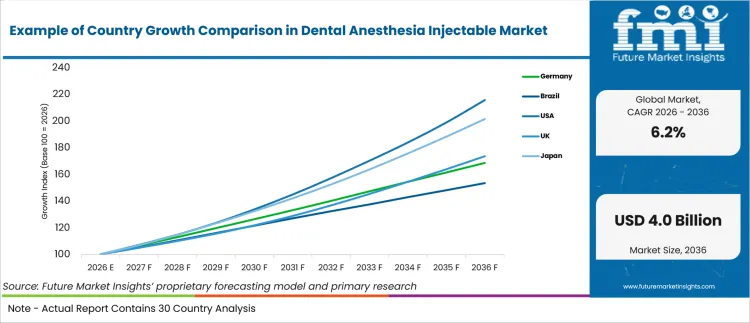
| Country | CAGR |
|---|---|
| USA | 8.0% |
| Japan | 7.3% |
| Australia | 6.7% |
| UK | 5.7% |
| Germany | 5.4% |
| Brazil | 4.4% |
How do country-level CAGRs compare in the Dental Anesthesia Injectable Market?
The profiled forecasts span 3.6 percentage points between the USA and Brazil across the six profiled country estimates. The rates form a gradual sequence rather than dividing into separate and clearly defined growth tiers. The USA and Japan remain within 0.7 percentage points, while Australia sits another 0.6 points lower. The UK and Germany form a close European pair separated by 0.3 percentage points. Brazil remains one percentage point below Germany across the profiled six-country forecast comparison for this market. The spacing suggests that medicine access and distribution quality affect commercial outcomes beside procedure demand.
- The USA and Japan occupy a narrow upper band, yet their commercial routes differ through practice ownership and domestic registration requirements.
- Australia remains between Japan and the European pair, reflecting distribution needs across metropolitan clinics and distant regional practices.
- The UK and Germany show similar rates, although NHS purchasing and German statutory reimbursement create different pricing and stocking conditions.
- Brazil sits below the European pair as public oral-health expansion meets longer import routes and uneven regional medicine availability.
- Product registration and clinic access determine how quickly comparable forecasts convert procedure demand into repeat orders.
Cross-border treatment can add procedure activity in selected destinations, but domestic clinic demand remains the main inventory base. Dental tourism changes the location of some appointments without removing local approval and distribution requirements. The full report provides country-level CAGR analysis across North America, Latin America, Europe, East Asia, South Asia, Oceania and the Middle East and Africa.
Country-wise Analysis
- United States dental practices purchase injectable anesthetics through licensed medicine channels supported by national distributors and manufacturer accounts. Adoption of dental anesthesia injectables in the USA is estimated to expand at 8.0% CAGR through 2036, underpinned by broad private-practice purchasing and national distribution. DailyMed carried a revised Henry Schein label in April 2026 for 1.7 mL lidocaine and epinephrine cartridges used for dental block and infiltration anesthesia. The active label confirms a current regulated product route for the defined injectable market across United States dental practices. FDA listing and pharmacovigilance provide a clear legal framework for commercial supply across national treatment settings. Intermittent medicine shortages can complicate rapid formulation changes across scheduled treatment periods and established clinic formularies. Metropolitan distribution shortens replenishment routes, but rural clinics often need larger inventory buffers during supply disruptions.
- Japan requires locally authorized medicines and Japanese documentation before clinics adopt a new injectable anesthetic. Dental anesthesia injectable sales in Japan are forecast to expand at 7.3% CAGR by 2036, linked to a dense outpatient clinic base and established medicine wholesalers. Domestic product availability supports routine replenishment through regulated national medicine channels serving established dental practices. The Ministry of Health published its December 2025 medical-facility survey in February 2026 and reported 62 fewer dental clinics than one month earlier. The modest decline reinforces the need to serve an established network rather than rely on rapid facility expansion. Nippon Shika Yakuhin supplies a registered mepivacaine cartridge through Japan’s national product-information and medicine distribution route. Conservative quality review can lengthen a change between manufacturers, so overseas entrants need a compliant local partner and sustained technical support.
- Australian clinics depend on registered medicines and national distribution routes that cover long travel distances outside major cities. Australia’s dental anesthesia injectable outlook is anticipated to advance at 6.7% CAGR over the assessment period, supported by recurring subsidized treatment and organized private practice networks. The Australian Institute of Health and Welfare reported in November 2025 that the Child Dental Benefits Schedule subsidized 5.2 million services during 2023-2024. The service volume creates a recurring treatment base across participating clinics; procedure mix determines the required anesthetic inventory. National wholesalers support planned delivery across metropolitan and regional practices through established regulated medicine channels. Remote delivery costs and limited local inventory increase exposure during manufacturer shortages or distributor interruptions. Products with stable distributor stock and clear substitution guidance are better placed to protect treatment continuity across distant clinics.
- United Kingdom clinics obtain local anesthetics through authorized medicines and regulated wholesale distribution across NHS and private practices. The UK dental anesthesia injectable sector is projected to record 5.7% CAGR during the assessment period, shaped by established treatment pathways and strict price discipline. The NHS Specialist Pharmacy Service stated in January 2025 that licensed dental cartridges include lidocaine, articaine, mepivacaine, and prilocaine preparations. The guidance confirms that clinics can select among several active agents and vasoconstrictor combinations within established medicine channels. National wholesalers support pharmacovigilance and scheduled replenishment across many practice locations, but appointment backlogs can delay procedures and repeat anesthetic orders. Familiar agents face limited premium pricing, so manufacturers need dependable availability and documented service performance across NHS and private accounts.
- German dental practices purchase authorized local anesthetics through pharmacies and licensed medicine wholesalers serving established treatment networks. Procedure mix shows a mature treatment system with recurring anesthesia needs across restorative and surgical care. In Germany, dental anesthesia injectable demand is predicted to advance at 5.4% CAGR through 2036. Stable clinic access and formal reimbursement controls influence product selection across the established national dental market. The National Association of Statutory Health Insurance Dentists reported in December 2025 that filling volumes fell 16.2% over ten years and were 8.4 million lower in 2024 than 2014. The decline shows that future demand cannot rely on filling activity across established dental practice networks alone. Extractions and endodontic procedures maintain other recurring anesthesia routes across general dental practices and specialist treatment settings. Statutory fees restrict pricing flexibility, while detailed quality documentation remains essential for new formulations or production changes.
- Brazil combines private dental purchasing with public oral-health programs delivered through regional teams and mobile service units. Dental anesthesia injectable demand in Brazil is forecast to rise at 4.4% CAGR over the forecast period, supported by wider public treatment access and a large private clinic base. The Ministry of Health reported in September 2025 that Brasil Sorridente operated through more than 33,000 oral-health teams and planned 800 new mobile dental units during the year. The expanded network increases the number of treatment locations that require licensed anesthetic supply and dependable regional replenishment. ANVISA registration provides the established legal route for commercial supply across public and private treatment settings. Import lead times and regional distribution gaps can interrupt inventory outside major urban centers and centralized wholesaler routes. Local registration capability and dependable wholesaler coverage remain central to expansion across public and private treatment channels.
Who are the notable companies in the Dental Anesthesia Injectable Market?
The dental anesthesia injectable competitive set includes Septodont, Pierrel S.p.A., Laboratorios Inibsa, Dentsply Sirona, Henry Schein, Anhil Parenterals Pvt. Ltd., Zymeth Pharmaceutical Pvt. Ltd., and Nippon Shika Yakuhin Co., Ltd.
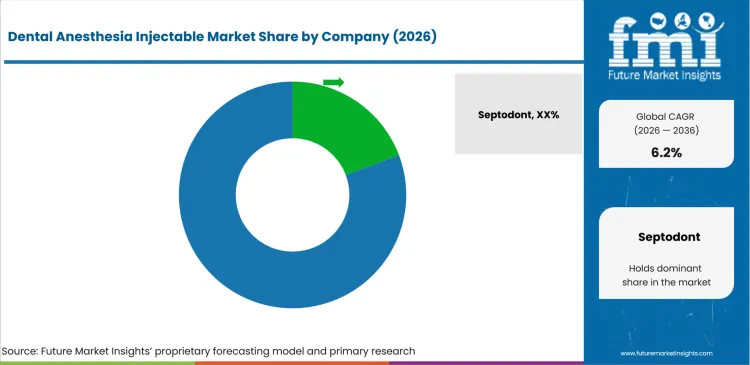
The competitive field is concentrated around a small group of sterile cartridge manufacturers, yet distribution remains more fragmented at country level. Septodont controls Inibsa through a majority interest and combines that network with its own international anesthetic operations. Pierrel competes through registered anesthetic brands and aseptic cartridge production across several national medicine markets. Dentsply Sirona and Henry Schein influence account access through established dental practice and distribution channels. Indian and Japanese manufacturers create narrower entry routes through regional production or national product registrations. New entrants need medicine registration and dependable sterile output beside a distributor that can support recurring clinic orders. Competition therefore turns on supply continuity and local access across dental consumables rather than brand visibility alone.
- Specialized manufacturers include Septodont and its majority-owned Inibsa operation beside Pierrel across regulated dental anesthetic channels. These businesses combine several active agents with controlled cartridge production and multi-country registrations supporting recurring commercial supply. Account retention depends on dependable replenishment and clear complaint response across established regional distributor networks.
- Diversified dental companies include Dentsply Sirona and Henry Schein across established practice accounts and distribution networks. Dentsply Sirona supplies branded injectable anesthetics and connected injection accessories for routine dental treatment procedures. Henry Schein provides broad product access through distribution channels that combine anesthetics with other routine treatment supplies.
- Regional manufacturers include Anhil Parenterals and Zymeth Pharmaceutical beside Nippon Shika Yakuhin across narrower regulated territories. They compete through focused cartridge production or national product availability within established dental medicine channels. Expansion depends on registration capacity and distributor coverage beyond current domestic or regional accounts and treatment networks.
Competitive Benchmarking: Dental Anesthesia Injectable Market
| Company | Injectable Anesthetic Breadth | Cartridge and Delivery Integration | Dental Distribution Capability | Geographic Reach |
|---|---|---|---|---|
| Septodont | High | High | High | Global |
| Pierrel S.p.A. | High | High | High | Global |
| Laboratorios Inibsa | High | High | High | Global |
| Dentsply Sirona | High | Medium | High | Global |
| Henry Schein | High | High | High | Multi-country |
| Anhil Parenterals Pvt. Ltd. | High | Low | Medium | Multi-country |
| Zymeth Pharmaceutical Pvt. Ltd. | High | Low | Medium | Multi-country |
| Nippon Shika Yakuhin Co., Ltd. | Low | Low | Low | Japan |
Key Developments in the Dental Anesthesia Injectable Market
- In January 2025, Septodont and Premier Dental launched BufferPro as a sterile single-use method for buffering one anesthetic cartridge. The companies stated that the product would reach dental distributors during February through established commercial ordering channels. The launch added a chairside option intended to change injection preparation without replacing the underlying anesthetic medicine. Commercial adoption depends on training and distributor availability across practices that already use standard dental cartridges.
- In September 2025, Laboratorios Inibsa described commissioning work for its new L6 dental anesthetic filling line in Spain. The company estimated that three-shift operation could add about 68 million prefilled cartridges annually and lift capacity above 300 million cartridges during 2026. Regular commercial output remained dependent on staff training and aseptic process simulation beside authorization from the Spanish medicines agency.
- In March 2025, Laboratorios Inibsa launched the Monoprotect Inibsa PLUS dental needle line for local anesthesia administration. The company reported a 43% wider inner diameter than its standard needle and linked the design to lower injection resistance and improved aspiration. The launch expanded account coverage through a connected delivery component that clinics can use alongside established cartridge-based anesthesia workflows used across dental practices.
- In May 2026, Septodont entered a global development and commercialization partnership with Dentroid for non-invasive dental pain-management technology. The program remains outside conventional injectable cartridge supply, but it introduces a possible future substitute for selected pain-control uses. Septodont contributes clinical development and international commercialization capabilities across its established dental network and regulatory operations. Regulatory progress and procedure-specific performance will determine whether the technology changes routine injectable demand across relevant treatments.
Dental Anesthesia Injectable Market - Report Scope
| Coverage field | Report scope |
|---|---|
| Market breakdown | Product Type, Application, End User, Distribution Channel, Anesthetic Agent, and Region. |
| Quantitative Units | Revenue in USD Billion and CAGR in %. |
| Market Definition | Injectable local anesthetic medicines supplied in dental cartridges or vials for restorative, endodontic, periodontal, extraction, and oral-surgery procedures. |
| Regions Covered | North America, Latin America, Europe, East Asia, South Asia, Oceania, and Middle East and Africa. |
| Countries Covered | USA, Japan, Australia, UK, Germany, and Brazil. |
| Key Companies Profiled | Septodont, Pierrel S.p.A., Laboratorios Inibsa, Dentsply Sirona, Henry Schein, Anhil Parenterals Pvt. Ltd., Zymeth Pharmaceutical Pvt. Ltd., and Nippon Shika Yakuhin Co., Ltd. |
| Forecast Period | 2026 to 2036. |
| Approach | Hybrid bottom-up and top-down market sizing supported by primary interviews and official desk research. |
Dental Anesthesia Injectable Market - Research Methodology
| Method | Approach |
|---|---|
| Primary Research | FMI analysts gathered input from manufacturers, service providers, technology developers, distributors, end users, procurement teams, and subject-matter experts. Interviews examined purchasing decisions, product or service evaluation, adoption barriers, approval requirements, pricing considerations, and expectations for technical or commercial support. Respondents were also asked what evidence is required before a trial, pilot, or initial order develops into regular purchasing. |
| Desk Research | Desk research covered government statistics, regulatory publications, trade data, industry associations, technical literature, standards, company filings, product information, and official corporate announcements. Sources were reviewed for relevance, publication date, geographic coverage, and consistency with the defined market scope. Claims relating to performance, applications, approvals, capacity, investment, and commercial activity were retained only when supported by credible public evidence. |
| Market Sizing and Forecasting | The market model combined the baseline value with historical performance, segment structure, pricing and volume indicators, adoption levels, company participation, and country-level demand conditions. Forecast assumptions considered economic activity, investment trends, regulatory developments, technology adoption, purchasing cycles, supply availability, and barriers to wider market use. Segment and regional estimates were reconciled before the final market total was calculated. |
| Data Validation | Estimates were checked against multiple independent indicators, including public data, company activity, trade patterns, industry developments, and findings from primary interviews. Validation also tested whether products, services, applications, and company revenues fell within the defined market boundaries. Adjacent categories, unsupported claims, overlapping revenues, and activities without direct market relevance were excluded to reduce double counting and maintain consistency across segments and countries. |
Dental Anesthesia Injectable Market by Segments
Dental Anesthesia Injectable Market segmented by Product Type:
- Lidocaine-Based Injectables
- Articaine-Based Injectables
- Mepivacaine-Based Injectables
- Prilocaine-Based Injectables
- Bupivacaine-Based Injectables
Dental Anesthesia Injectable Market segmented by Application:
- Tooth Extraction
- Restorative Dentistry
- Endodontic Procedures
- Periodontal Procedures
- Oral and Maxillofacial Surgery
Dental Anesthesia Injectable Market segmented by End User:
- Dental Clinics
- Hospitals
- Ambulatory Surgical Centers
- Academic and Research Institutes
- Government and Public Dental Facilities
Dental Anesthesia Injectable Market segmented by Distribution Channel:
- Direct Sales
- Medical and Dental Distributors
- Hospital and Clinic Procurement
- Retail and Pharmacy Distribution
- Online B2B Platforms
Dental Anesthesia Injectable Market segmented by Anesthetic Agent:
- Amide Local Anesthetics
- Ester Local Anesthetics
- Combination Formulations
- Long-Acting Formulations
- Preservative-Free Formulations
Dental Anesthesia Injectable Market by Region:
- North America
- United States
- Canada
- Latin America
- Brazil
- Mexico
- Argentina
- Chile
- Western Europe
- Germany
- France
- United Kingdom
- Italy
- Spain
- Benelux
- Nordics
- Eastern Europe
- Poland
- Czech Republic
- Romania
- Hungary
- East Asia
- China
- Japan
- South Korea
- South Asia and Pacific
- India
- ASEAN
- Australia and New Zealand
- Middle East and Africa
- GCC Countries
- South Africa
- Türkiye
- Israel
Research Sources and Bibliography
- Specialist Pharmacy Service. (2025, January 3). Considering interactions with local anaesthetics in dentistry.
- American Dental Association. (2025, April). ADA standards on cartridge syringes, athletic mouth protectors available for review
- American Dental Association. (2026, May 22). New ADA standards on dental cartridges, water quality available for review
- USA National Library of Medicine. (2026, April 23). LIDOCAINE - lidocaine hydrochloride and epinephrine bitartrate injection, solution.
- Australian Institute of Health and Welfare. (2026, May 22). Types of services provided - Hospitals
- Australian Institute of Health and Welfare. (2025, November 21). Oral health and dental care in Australia, Dental procedures
- Australian Institute of Health and Welfare. (2025, November 21). Oral health and dental care in Australia, Dental care
- Specialist Pharmacy Service. (2025, January 3). Managing interactions with local anaesthetics in dentistry.
- Kassenzahnärztliche Bundesvereinigung. (2025, December 11). Gesundheitspolitischen Herausforderungen mit Fakten begegnen
- Ministry of Health, Labour and Welfare. (2026, February 27).
- Ministry of Health of Brazil. (2025, September 16). Brasil Sorridente devolveu o sorriso e a dignidade ao povo brasileiro
- Septodont. (2025, January 31). Septodont Inc. and Premier Dental Announce the Launch of BufferPro™
- Septodont. (2026, June 5). Septodont and Dentroid Enter a Global Development and Commercialization Partnership to Pioneer Non-invasive Pain Management in Dentistry
- Septodont. (2024, October 29). Septodont closes acquisition of majority stake in Inibsa
- Septodont. (2026). Advancing Dentistry and Pharmaceuticals since 1932
- Laboratorios Inibsa. (2025, September 8). Interview with our Production Manager, Enara Pedroviejo, about the new L6 filling line for dental anesthetics at Inibsa
- Laboratorios Inibsa. (2025, December 1). Interview with Rosanna Jara, Quality Assurance Manager at Inibsa
- Laboratorios Inibsa. (2025, October 6). Prestoject® Safety Stand: Elevating safety & comfort in dental anaesthesia
- Laboratorios Inibsa. (2025, March 26). Monoprotect® Inibsa PLUS Dental Needles: A new standard in safety and efficiency
- Laboratorios Inibsa. (2026, June 15). Interview with Anna Peró, Regulatory Affairs and Pharmacovigilance Manager at Inibsa
This bibliography is provided for reader reference and is not exhaustive. The full report contains the complete reference list and detailed citations
This Report Answers
- What is the projected value of the dental anesthesia injectable market in 2026 and 2036?
- Which product types are included within the dental anesthesia injectable market definition?
- Why do lidocaine-based injectables account for the largest product type share during 2026?
- How does tooth extraction influence recurring demand across the application category?
- Which care settings and distribution channels control cartridge purchasing decisions?
- How do country CAGRs differ across the USA, Japan, Australia, UK, Germany, and Brazil?
- Which companies have verified dental anesthetic portfolios or exact-market distribution capabilities?
- What operational risks can weaken revenue despite continued dental procedure demand?
- Which recent company developments affect manufacturing capacity, registration coverage, or distribution access?
- How were company capabilities assessed within the competitive benchmarking table?
Frequently Asked Questions
How big is the Dental Anesthesia Injectable Market in 2026?
The dental anesthesia injectable market is valued at USD 1,477.8 million in 2026 and is forecast to reach USD 2,227 million by 2036. Growth is supported by routine restorative and surgical dental procedures that require a fresh sterile dose for every appointment, sustaining recurring cartridge demand across dental practices.
What is the CAGR of the Dental Anesthesia Injectable Market from 2026 to 2036?
The dental anesthesia injectable market grows at a CAGR of 4.2% between 2026 and 2036, supported by recurring restorative treatment and oral surgery that create repeat demand for sterile local anesthetic cartridges across scheduled dental procedures worldwide.
Which anesthetic agent leads the Dental Anesthesia Injectable Market?
Amide local anesthetics account for 72.0% of the dental anesthesia injectable market by anesthetic agent in 2026, driven by broad molecule coverage including lidocaine and articaine that gives clinics flexibility whenever duration needs or patient history change the preferred formulation.
How much will the Dental Anesthesia Injectable Market add between 2026 and 2036?
The dental anesthesia injectable market is set to add USD 749.2 million between 2026 and 2036, growing from USD 1,477.8 million to USD 2,227 million as duration-specific formulations and safer injection accessories differentiate familiar medicines across busy dental clinic workflows.
Who are the leading companies in the Dental Anesthesia Injectable Market?
Eight companies lead the dental anesthesia injectable market, including Septodont, Pierrel, Laboratorios Inibsa, Dentsply Sirona, Henry Schein, Anhil Parenterals, Zymeth Pharmaceutical, and Nippon Shika Yakuhin, competing through cartridge manufacturing, delivery-accessory integration, and regional distribution capability across established dental practice networks.
Preview the report firsthand - request a free sample
Get SampleGet the brochure for pricing and purchase details.
Get PDFTable of Content
- Key Takeaways
- Market Size and CAGR
- Top Growth Driver
- Fastest Growing Segment
- Leading Region
- Key Companies
- Emerging Opportunities
- Executive Summary
- Global Market Outlook
- Demand-side Trends
- Supply-side Trends
- Technology Roadmap Analysis
- Analysis and Recommendations
- Analyst Perspective (What is happening? Why now? What should investors know?)
- Key Questions Answered
- How large is the market?
- What is the CAGR?
- What are key trends?
- Which region dominates?
- Who are the leaders?
- Market Overview
- Market Coverage / Taxonomy
- Market Definition / Scope / Limitations
- Research Methodology
- Chapter Orientation
- Analytical Lens and Working Hypotheses
- Market Structure, Signals, and Trend Drivers
- Benchmarking and Cross-market Comparability
- Market Sizing, Forecasting, and Opportunity Mapping
- Research Design and Evidence Framework
- Desk Research Programme (Secondary Evidence)
- Expert Input and Fieldwork (Primary Evidence)
- Tooling, Models, and Reference Databases
- Data Engineering and Model Build
- Quality Assurance and Audit Trail
- Market Background
- Market Dynamics (Drivers, Restraints, Opportunity, Trends)
- Scenario Forecast (Optimistic, Likely, Conservative)
- Impact Analysis
- AI Impact
- Sustainability Impact
- Regulatory Impact
- Technology Impact
- Consumer / Buyer Analysis
- Purchase Drivers
- Adoption Barriers
- Buyer Journey
- Opportunity Map Analysis
- Product Life Cycle Analysis
- Supply Chain Analysis
- Investment Feasibility Matrix
- Value Chain Analysis
- PESTLE and Porter's Analysis
- Regulatory Landscape
- Regional Parent Market Outlook
- Production and Consumption Statistics
- Import and Export Statistics
- Global Market Analysis and Forecast, 2021 to 2036
- Historical Market Size Value (USD Billion) Analysis, 2021 to 2025
- Current and Future Market Size Value (USD Billion) Projections, 2026 to 2036
- Y-o-Y Growth Trend Analysis
- Absolute $ Opportunity Analysis
- Global Market Pricing Analysis, 2021 to 2036
- Global Market Analysis and Forecast, By Product Type, 2021 to 2036
- Introduction / Key Findings
- Historical Market Size Value (USD Billion) Analysis By Product Type, 2021 to 2025
- Current and Future Market Size Value (USD Billion) Analysis and Forecast By Product Type, 2026 to 2036
- Lidocaine-Based Injectables
- 2% Lidocaine with Epinephrine
- 2% Lidocaine without Epinephrine
- Articaine-Based Injectables
- 4% Articaine with Epinephrine 1:100,000
- 4% Articaine with Epinephrine 1:200,000
- Mepivacaine-Based Injectables
- 2% Mepivacaine with Vasoconstrictor
- 3% Mepivacaine Plain
- Prilocaine-Based Injectables
- 4% Prilocaine Plain
- 4% Prilocaine with Epinephrine
- Bupivacaine-Based Injectables
- 0.5% Bupivacaine with Epinephrine
- Long-Acting Bupivacaine Formulations
- Lidocaine-Based Injectables
- Y-o-Y Growth Trend Analysis By Product Type, 2021 to 2025
- Absolute $ Opportunity Analysis By Product Type, 2026 to 2036
- Global Market Analysis and Forecast, By Application, 2021 to 2036
- Introduction / Key Findings
- Historical Market Size Value (USD Billion) Analysis By Application, 2021 to 2025
- Current and Future Market Size Value (USD Billion) Analysis and Forecast By Application, 2026 to 2036
- Tooth Extraction
- Simple Extraction
- Surgical Extraction
- Restorative Dentistry
- Dental Fillings
- Crown & Bridge Procedures
- Endodontic Procedures
- Root Canal Therapy
- Apicoectomy
- Periodontal Procedures
- Gingival Surgery
- Scaling & Root Planing
- Oral & Maxillofacial Surgery
- Dental Implant Surgery
- Bone Grafting Procedures
- Tooth Extraction
- Y-o-Y Growth Trend Analysis By Application, 2021 to 2025
- Absolute $ Opportunity Analysis By Application, 2026 to 2036
- Global Market Analysis and Forecast, By End User, 2021 to 2036
- Introduction / Key Findings
- Historical Market Size Value (USD Billion) Analysis By End User, 2021 to 2025
- Current and Future Market Size Value (USD Billion) Analysis and Forecast By End User, 2026 to 2036
- Dental Clinics
- Private Dental Clinics
- Group Dental Practices
- Hospitals
- General Hospitals
- Specialty Dental Hospitals
- Ambulatory Surgical Centers
- Day Surgery Centers
- Outpatient Oral Surgery Centers
- Academic & Research Institutes
- Dental Universities
- Clinical Research Centers
- Government & Public Dental Facilities
- Community Dental Centers
- Public Oral Healthcare Facilities
- Dental Clinics
- Y-o-Y Growth Trend Analysis By End User, 2021 to 2025
- Absolute $ Opportunity Analysis By End User, 2026 to 2036
- Global Market Analysis and Forecast, By Distribution Channel, 2021 to 2036
- Introduction / Key Findings
- Historical Market Size Value (USD Billion) Analysis By Distribution Channel, 2021 to 2025
- Current and Future Market Size Value (USD Billion) Analysis and Forecast By Distribution Channel, 2026 to 2036
- Direct Sales
- Direct Manufacturer Supply
- Key Account Sales
- Medical & Dental Distributors
- National Distributors
- Regional Distributors
- Hospital & Clinic Procurement
- Group Purchasing Organizations
- Hospital Procurement Contracts
- Retail & Pharmacy Distribution
- Retail Pharmacy Chains
- Independent Pharmacies
- Online B2B Platforms
- E-Procurement Portals
- Digital Healthcare Marketplaces
- Direct Sales
- Y-o-Y Growth Trend Analysis By Distribution Channel, 2021 to 2025
- Absolute $ Opportunity Analysis By Distribution Channel, 2026 to 2036
- Global Market Analysis and Forecast, By Anesthetic Agent, 2021 to 2036
- Introduction / Key Findings
- Historical Market Size Value (USD Billion) Analysis By Anesthetic Agent, 2021 to 2025
- Current and Future Market Size Value (USD Billion) Analysis and Forecast By Anesthetic Agent, 2026 to 2036
- Amide Local Anesthetics
- Lidocaine
- Articaine
- Ester Local Anesthetics
- Procaine
- Benzocaine Injectable Formulations
- Combination Formulations
- Local Anesthetic with Epinephrine
- Multi-Agent Formulations
- Long-Acting Formulations
- Extended-Release Injectables
- Sustained-Release Formulations
- Preservative-Free Formulations
- Single-Dose Vials
- Low-Allergen Formulations
- Amide Local Anesthetics
- Y-o-Y Growth Trend Analysis By Anesthetic Agent, 2021 to 2025
- Absolute $ Opportunity Analysis By Anesthetic Agent, 2026 to 2036
- Global Market Analysis and Forecast, By Region, 2021 to 2036
- Introduction
- Historical Market Size Value (USD Billion) Analysis By Region, 2021 to 2025
- Current Market Size Value (USD Billion) Analysis and Forecast By Region, 2026 to 2036
- North America
- Latin America
- Western Europe
- Eastern Europe
- East Asia
- South Asia and Pacific
- Middle East & Africa
- Market Attractiveness Analysis By Region
- North America Market Analysis and Forecast, By Country, 2021 to 2036
- Historical Market Size Value (USD Billion) Trend Analysis By Market Taxonomy, 2021 to 2025
- Market Size Value (USD Billion) Forecast By Market Taxonomy, 2026 to 2036
- By Country
- USA
- Canada
- By Product Type
- By Application
- By End User
- By Distribution Channel
- By Anesthetic Agent
- By Country
- Market Attractiveness Analysis
- By Country
- By Product Type
- By Application
- By End User
- By Distribution Channel
- By Anesthetic Agent
- Key Takeaways
- Latin America Market Analysis and Forecast, By Country
- Historical Market Size Value (USD Billion) Trend Analysis By Market Taxonomy, 2021 to 2025
- Market Size Value (USD Billion) Forecast By Market Taxonomy, 2026 to 2036
- By Country
- Brazil
- Mexico
- Chile
- Rest of Latin America
- By Product Type
- By Application
- By End User
- By Distribution Channel
- By Anesthetic Agent
- By Country
- Market Attractiveness Analysis
- By Country
- By Product Type
- By Application
- By End User
- By Distribution Channel
- By Anesthetic Agent
- Key Takeaways
- Western Europe Market Analysis and Forecast, By Country
- Historical Market Size Value (USD Billion) Trend Analysis By Market Taxonomy, 2021 to 2025
- Market Size Value (USD Billion) Forecast By Market Taxonomy, 2026 to 2036
- By Country
- Germany
- UK
- Italy
- Spain
- France
- Nordic
- BENELUX
- Rest of Western Europe
- By Product Type
- By Application
- By End User
- By Distribution Channel
- By Anesthetic Agent
- By Country
- Market Attractiveness Analysis
- By Country
- By Product Type
- By Application
- By End User
- By Distribution Channel
- By Anesthetic Agent
- Key Takeaways
- Eastern Europe Market Analysis and Forecast, By Country
- Historical Market Size Value (USD Billion) Trend Analysis By Market Taxonomy, 2021 to 2025
- Market Size Value (USD Billion) Forecast By Market Taxonomy, 2026 to 2036
- By Country
- Russia
- Poland
- Hungary
- Balkan & Baltic
- Rest of Eastern Europe
- By Product Type
- By Application
- By End User
- By Distribution Channel
- By Anesthetic Agent
- By Country
- Market Attractiveness Analysis
- By Country
- By Product Type
- By Application
- By End User
- By Distribution Channel
- By Anesthetic Agent
- Key Takeaways
- East Asia Market Analysis and Forecast, By Country
- Historical Market Size Value (USD Billion) Trend Analysis By Market Taxonomy, 2021 to 2025
- Market Size Value (USD Billion) Forecast By Market Taxonomy, 2026 to 2036
- By Country
- China
- Japan
- South Korea
- By Product Type
- By Application
- By End User
- By Distribution Channel
- By Anesthetic Agent
- By Country
- Market Attractiveness Analysis
- By Country
- By Product Type
- By Application
- By End User
- By Distribution Channel
- By Anesthetic Agent
- Key Takeaways
- South Asia and Pacific Market Analysis and Forecast, By Country
- Historical Market Size Value (USD Billion) Trend Analysis By Market Taxonomy, 2021 to 2025
- Market Size Value (USD Billion) Forecast By Market Taxonomy, 2026 to 2036
- By Country
- India
- ASEAN
- Australia & New Zealand
- Rest of South Asia and Pacific
- By Product Type
- By Application
- By End User
- By Distribution Channel
- By Anesthetic Agent
- By Country
- Market Attractiveness Analysis
- By Country
- By Product Type
- By Application
- By End User
- By Distribution Channel
- By Anesthetic Agent
- Key Takeaways
- Middle East & Africa Market Analysis and Forecast, By Country
- Historical Market Size Value (USD Billion) Trend Analysis By Market Taxonomy, 2021 to 2025
- Market Size Value (USD Billion) Forecast By Market Taxonomy, 2026 to 2036
- By Country
- Kingdom of Saudi Arabia
- Other GCC Countries
- Türkiye
- South Africa
- Other African Union
- Rest of Middle East & Africa
- By Product Type
- By Application
- By End User
- By Distribution Channel
- By Anesthetic Agent
- By Country
- Market Attractiveness Analysis
- By Country
- By Product Type
- By Application
- By End User
- By Distribution Channel
- By Anesthetic Agent
- Key Takeaways
- Key Countries Market Analysis
- USA
- Pricing Analysis
- Market Share Analysis, 2025
- By Product Type
- By Application
- By End User
- By Distribution Channel
- By Anesthetic Agent
- Canada
- Pricing Analysis
- Market Share Analysis, 2025
- By Product Type
- By Application
- By End User
- By Distribution Channel
- By Anesthetic Agent
- Mexico
- Pricing Analysis
- Market Share Analysis, 2025
- By Product Type
- By Application
- By End User
- By Distribution Channel
- By Anesthetic Agent
- Brazil
- Pricing Analysis
- Market Share Analysis, 2025
- By Product Type
- By Application
- By End User
- By Distribution Channel
- By Anesthetic Agent
- Chile
- Pricing Analysis
- Market Share Analysis, 2025
- By Product Type
- By Application
- By End User
- By Distribution Channel
- By Anesthetic Agent
- Germany
- Pricing Analysis
- Market Share Analysis, 2025
- By Product Type
- By Application
- By End User
- By Distribution Channel
- By Anesthetic Agent
- UK
- Pricing Analysis
- Market Share Analysis, 2025
- By Product Type
- By Application
- By End User
- By Distribution Channel
- By Anesthetic Agent
- Italy
- Pricing Analysis
- Market Share Analysis, 2025
- By Product Type
- By Application
- By End User
- By Distribution Channel
- By Anesthetic Agent
- Spain
- Pricing Analysis
- Market Share Analysis, 2025
- By Product Type
- By Application
- By End User
- By Distribution Channel
- By Anesthetic Agent
- France
- Pricing Analysis
- Market Share Analysis, 2025
- By Product Type
- By Application
- By End User
- By Distribution Channel
- By Anesthetic Agent
- India
- Pricing Analysis
- Market Share Analysis, 2025
- By Product Type
- By Application
- By End User
- By Distribution Channel
- By Anesthetic Agent
- ASEAN
- Pricing Analysis
- Market Share Analysis, 2025
- By Product Type
- By Application
- By End User
- By Distribution Channel
- By Anesthetic Agent
- Australia & New Zealand
- Pricing Analysis
- Market Share Analysis, 2025
- By Product Type
- By Application
- By End User
- By Distribution Channel
- By Anesthetic Agent
- China
- Pricing Analysis
- Market Share Analysis, 2025
- By Product Type
- By Application
- By End User
- By Distribution Channel
- By Anesthetic Agent
- Japan
- Pricing Analysis
- Market Share Analysis, 2025
- By Product Type
- By Application
- By End User
- By Distribution Channel
- By Anesthetic Agent
- South Korea
- Pricing Analysis
- Market Share Analysis, 2025
- By Product Type
- By Application
- By End User
- By Distribution Channel
- By Anesthetic Agent
- Russia
- Pricing Analysis
- Market Share Analysis, 2025
- By Product Type
- By Application
- By End User
- By Distribution Channel
- By Anesthetic Agent
- Poland
- Pricing Analysis
- Market Share Analysis, 2025
- By Product Type
- By Application
- By End User
- By Distribution Channel
- By Anesthetic Agent
- Hungary
- Pricing Analysis
- Market Share Analysis, 2025
- By Product Type
- By Application
- By End User
- By Distribution Channel
- By Anesthetic Agent
- Kingdom of Saudi Arabia
- Pricing Analysis
- Market Share Analysis, 2025
- By Product Type
- By Application
- By End User
- By Distribution Channel
- By Anesthetic Agent
- Türkiye
- Pricing Analysis
- Market Share Analysis, 2025
- By Product Type
- By Application
- By End User
- By Distribution Channel
- By Anesthetic Agent
- South Africa
- Pricing Analysis
- Market Share Analysis, 2025
- By Product Type
- By Application
- By End User
- By Distribution Channel
- By Anesthetic Agent
- USA
- Market Structure Analysis
- Competition Dashboard
- Competition Benchmarking
- Market Share Analysis of Top Players
- By Regional
- By Product Type
- By Application
- By End User
- By Distribution Channel
- By Anesthetic Agent
- Emerging Startups
- Innovation Benchmarking
- Competition Analysis
- Competition Deep Dive
- Septodont
- Overview
- Product Portfolio
- Profitability by Market Segments
- Sales Footprint
- Strategy Overview
- Marketing Strategy
- Product Strategy
- Channel Strategy
- Dentsply Sirona
- Kulzer GmbH
- Henry Schein
- Pierrel S.p.A.
- 3M
- Aspen Pharmacare
- Laboratorios Inibsa
- Primex Pharmaceuticals
- Pac-Dent
- Septodont
- Case Studies
- Success Stories
- Recent Developments
- Competition Deep Dive
- Assumptions & Acronyms Used


