

- Market Size (2026)
- USD 1299.3 Mn
- Forecast (2036)
- USD 2348.9 Mn
- CAGR (2026 to 2036)
- 6.1%
How big is Dimensioning Systems Market in 2026?
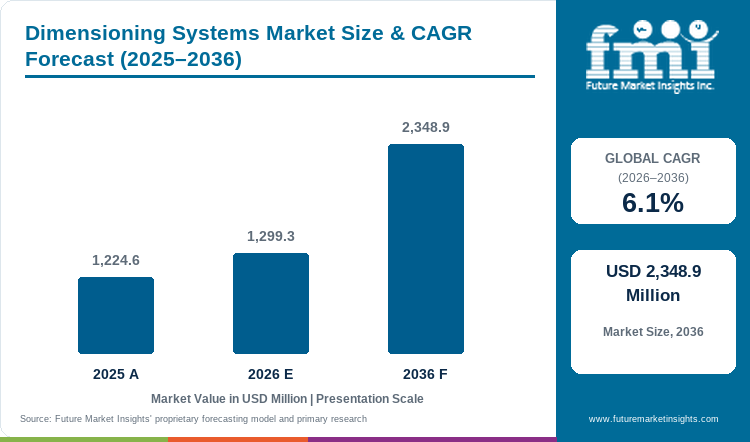
USD 1,299.3 million in 2026 and USD 2,348.9 million by 2036, expanding at 6.1% CAGR.
Sales of dimensioning systems are estimated to rise at 6.1% CAGR through 2036. The value moves from USD 1,224.6 million in 2025 to USD 1,299.3 million in 2026. It is projected to reach USD 2,348.9 million by 2036. Density-based freight rules make full cube records useful before LTL rating. In July 2025 NMFTA moved more than 2,000 items to full density-based classification. These rules make accurate size data more useful for each load. Dimensioning systems pair size data with industrial weighing equipment in one step. Teams can then work out density without a separate hand check. The same record stays ready for rating and billing.
Parcel flow and the cost of changing live systems shape use by country. The Netherlands is projected to grow at 5.8% CAGR through 2036. Japan is projected to grow at 3.8% CAGR through 2036. ACM counted 447 million cross-border parcels in the Netherlands during 2025. It also reported a 7.4% rise from the prior year. Heavy cross-border flow supports e-commerce logistics tools that capture size data at busy hubs. Japan's slower forecast favors small upgrades that reduce downtime. Compact tools can add size checks without replacing a full line.
Key Takeaways
- Density-based freight freight class is increasing demand for billing-ready cube records before shipments enter commercial rating workflows.
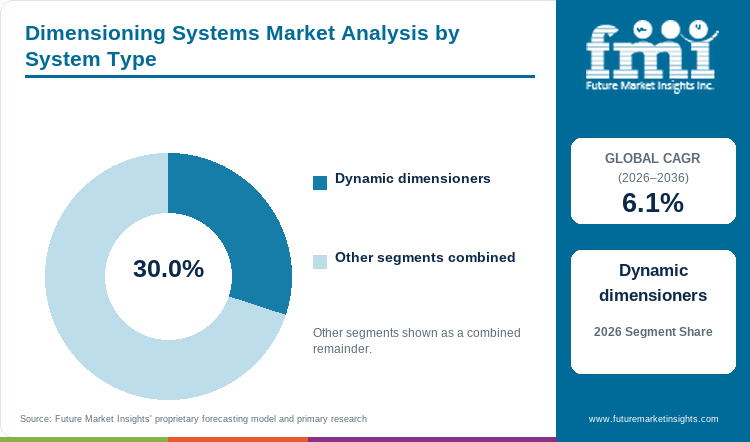
- Dynamic dimensioners are anticipated to record around 30.0% share in 2026, driven by continuous capture at high-volume transfer points.
- 3D camera/vision is projected to hold 31.0% share in 2026, supported by depth sensing across varied package shapes.
- Parcel and postal is expected to lead with 31.0% share in 2026, linked to recurring piece-level rating and sortation needs.
- Trade-use approval and host-system integration remain separate approval tests before measured dimensions can support commercial billing.
- Key players in the parcel-dimensioning systems market include Mettler-Toledo, SICK, Cognex and Cubiscan.
Analyst Perspective
"Dimensioning earns its place in an automated line only when measured geometry stays tied to the correct shipment record at operating speed. Trade-use eligibility and reliable host-system association determine whether that record can support billing without adding a manual stop."
- Nikhil Kaitwade, Principal Consultant, Future Market Insights.
How is the dimensioning systems market segmented?
The dimensioning systems market is segmented by system type, technology, end use, installation and sales channel.
The Dimensioning Systems Market is segmented by system type, technology, end use, installation, sales channel, and region. By system type, the market is categorized into dynamic dimensioners, static dimensioners, pallet dimensioners, parcel dimensioners, and 3D vision dimensioners. Based on technology, it comprises 3D camera/vision, laser scanning, infrared sensing, LiDAR, and weigh-dimension-scan (DWS) systems. By end use, the market covers parcel and postal, warehousing, freight and LTL, e-commerce fulfillment, and airport cargo. In terms of installation, the market includes conveyor-mounted, freestanding, forklift-mounted, and mobile/cart-based systems. By sales channel, it is divided into automation integrators, parcel equipment OEMs, direct technology suppliers, and service/software subscription providers. Regionally, the market is analyzed across North America, Latin America, Western Europe, Eastern Europe, East Asia, South Asia & Pacific, and the Middle East & Africa.
What makes dynamic dimensioners central to the system type category?
Dynamic dimensioners scan parcels as they move through a set scan zone. Datalogic describes the DM3610 as an overhead in-motion unit for three-dimensional checks on conveyors. Teams compare line speed with parcel spacing during setup. Each size record must stay tied to the right shipment.
- By system type dynamic dimensioners are estimated to hold 30.0% in 2026. Their in-motion scan suits busy transfer points.
- Dynamic stations work with barcode scanners. Size and weight can then stay tied to one shipment record through the full auto process.
Why does 3D camera/vision lead the technology category?
3D camera and vision systems make depth records for packs with uneven shapes. Cognex positions the 3D-A1000 for size checks and item detection on moving logistics lines. 3D sensor systems can also keep an image with each record. Teams can use that image to check overhangs and poorly placed parcels.
- In 2026 3D camera/vision is expected to hold 31.0% of technology. Depth sensing helps scan packs with many shapes.
- Image-rich scans help teams review odd cases and software can keep the measured object with its shipment record.
How does parcel and postal anchor the end use category?
Parcel and postal networks move many items through short induction and sortation windows. Datalogic positions DM3610 tools for revenue recovery and auto shipping in parcel work. A clear item ID links parcel sortation robots with dimensioners. That shared record can guide routing for each parcel during daily work.
- Parcel and postal is projected to hold 31.0% of end use in 2026. Each item needs repeat size data for rates and routing.
- High item counts favor auto capture. Each parcel needs the same size data during induction and shipping.
What supports conveyor-mounted installations?
Conveyor-mounted stations make a fixed scan zone around moving items. SICK says the VMS5200 is a legal-for-trade system that can output 3D point-cloud data. This set scan zone helps conveyor systems keep weight and item ID in sync. The same record can then feed routing during parcel handling.
- Conveyor-mounted systems are forecast to hold 42.0% of installation in 2026. Fixed scan zones suit busy sites that need repeat size checks.
- Fixed scan zones support auto flow, which means size data can reach sortation or manifesting systems without extra hand work.
Why do automation integrators lead the sales channel category?
Automation integrators combine dimensioners and scales with item ID tools and controls. Cubiscan describes in-motion DWS projects that link size hardware with conveyor systems in logistics hubs. Integrators also link automated material handling systems with size interfaces during site tests. They then support the site as the line moves into daily use.
- Automation integrators are forecast to represent 35.0% of sales channel in 2026. Many projects need several systems set up as one line.
- Direct technology suppliers still provide key measurement hardware. Integrators often manage controls and software through final site sign-off.
What are the drivers, restraints and opportunities in the Dimensioning Systems Market?
Density-based rating expands automated capture, metrology and integration extend qualification, and modular vision systems lower the deployment threshold.
- Driver: Density-based freight rules make size and weight part of LTL billing. Teams need the data before they rate a load.
- Restraint: Legal-metrology rules and live-system integration add more checks. Operators must pass them before size data can support billing.
- Opportunity: Modular vision-led stations can bring verified size checks to mid-volume freight and parcel sites. They do not need a full conveyor rebuild.
Density-based freight classification raises the cost of incomplete cube records
Freight rating gives teams a clear reason to capture size data before tender. Density now affects more LTL classes. In July 2025 NMFTA moved more than 2,000 items to full density-based classification across the national freight system. The change also replaced the 11-sub density scale with a 13-sub scale. That makes good cube data more useful when teams set a class. Busy freight sites need the same size check on each load. They cannot rely on hand checks done from time to time. Dimensioning systems move this work into induction and shipping. They also keep the result tied to the shipment record. That record can then support classification and billing across repeat LTL work.
Trade-use approval and integration create separate qualification steps
Commercial measurement needs more than basic sensor accuracy because size data may support a regulated charge. NIST says many state and local weights-and-measures offices use Handbook 44 across the United States. The 2026 edition covers several types of dimension measuring devices. It links repeat checks to clear commercial transactions instead of lab tests alone. A live system must also tie size data to item ID and host software. That link lets the record move into billing or shipping. Sites still need field checks and calibration during use. They also need good data matching and service support. These steps help each station stay accurate and ready for use through its working life.
Modular imaging and software can extend dimensioning beyond full conveyor projects
Mid-volume sites can add size capture without rebuilding a full conveyor line or shipping area. Cubiscan introduced the N9 pallet dimensioning system in February 2026 for LTL and warehouse data-capture work that still uses manual cube records. The platform pairs dimensions with photos. It can put shipment proof near the rating step before freight leaves the site. Teams can also use machine vision to review odd cases. This helps when an irregular item needs more detail than a basic length-width-height record. Compact stations can add auto capture to selected lanes. Operators still need accurate size data and the right shipment ID. They also need stable software links while they add the system in stages.
Which country CAGRs are profiled in the Dimensioning Systems Market?
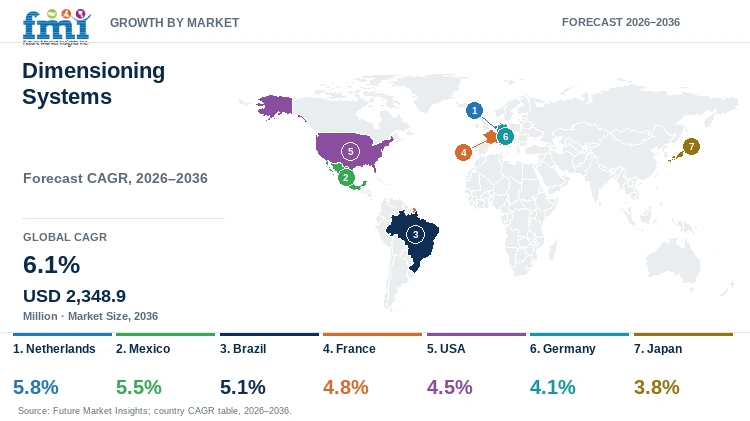
| Country | CAGR |
|---|---|
| Netherlands | 5.8% |
| Mexico | 5.5% |
| Brazil | 5.1% |
| France | 4.8% |
| USA | 4.5% |
| Germany | 4.1% |
| Japan | 3.8% |
How do country-level CAGRs compare in the Dimensioning Systems Market?
Country CAGRs show how fast each of the seven profiled markets may grow. The Netherlands and Mexico gain from cross-border parcel flow and modular tools. Germany and Japan have mature logistics networks. Buyers there place more weight on sign-off work and upgrades that cause less downtime.
- The Netherlands’ high volume of cross-border parcel traffic favors compact dimensioning systems designed for busy logistics sites.
- In Mexico, varying warehouse automation levels encourage phased upgrades that can be implemented in stages.
- Brazil’s cubage-based freight pricing keeps accurate dimensional records central to parcel billing and logistics efficiency.
- France places strong emphasis on system compatibility, with EU requirements making interoperability an important approval factor.
- In the USA, differing operational requirements across regions increase the need for verification, support, and service capabilities.
- Germany’s mature parcel hubs favor dimensioning systems that integrate reliably with conveyor networks and minimize downtime.
- Japan’s established logistics infrastructure often prefers compact upgrades that add dimensioning capabilities with minimal operational disruption.
Similar CAGRs can still create different buying conditions. The full report compares country CAGRs across North America, Latin America, Western Europe, Eastern Europe, East Asia, South Asia and Pacific, and the Middle East and Africa.
Country-wise Analysis
- US parcel and freight networks link system purchases to trade-use rules across many states and local areas. Demand in the USA is forecast to rise at 4.5% CAGR over the forecast period. Billing-ready size data supports this growth. NIST published the 2026 edition of Handbook 44. It says many state and local authorities use the handbook for commercial weighing and measuring equipment. Large networks need the same checks at each site. They also need to avoid long calibration stops or mixed approval results. Rollouts depend on type-evaluation proof and field checks. Local service also matters. It helps checked systems stay in use during normal parcel and freight work.
- German parcel operators use size-scan tools in structured projects at mature hubs. Germany's dimensioning systems outlook is anticipated to grow at 4.1% CAGR over the assessment period. Large national parcel volumes support this outlook. Bundesnetzagentur reported 4.36 billion domestic and international parcels in 2023. Volume rose from the prior year. Integrators must pair mechanical setup with measurement checks at each site. They also need stable links to existing parcel-control systems and service routines. Approved projects favor steady conveyor work and good system support. Service plans also need to protect long equipment life through slow replacement cycles. Local teams can help keep the tools in use with less downtime.
- Japanese logistics networks favor compact tools and careful process changes at busy parcel sites. Adoption of dimensioning systems in Japan is estimated to expand at 3.8% CAGR through 2036. High throughput and low tolerance for downtime shape this outlook. The transport ministry reported 5.03147 billion parcel deliveries in fiscal 2024 across the national courier network. Local sites need service plans that keep stops short. Tightly run hubs have little room for long setup or recalibration work. Suppliers need compact units and sound exception handling. They also need local tech support that works with current site practices. These features help hubs add size checks without slowing the wider parcel flow.
- Brazilian parcel routes cover long distances and sites with very different levels of auto equipment. The Brazil dimensioning systems sector is projected to grow at 5.1% CAGR during the assessment period. Cubage rules that use accurate dimensions support this outlook. Correios commercial terms require size checks for parcels outside set package limits during automated pricing. Buyers can lower rollout risk by starting with rugged work-cell systems. They can add more size checks as each site gains experience. Modular tools suit this mix of old and new setups. Channel partners also need to support setup and service outside the main city hubs. That local help can make wider national rollout easier to manage.
- French parcel networks move high shipment volumes through established hubs with set measurement rules. France's dimensioning systems outlook is anticipated to grow at 4.8% CAGR over the assessment period. Repeat parcel work and EU rules shape this outlook. Arcep reported 1.7 billion parcels distributed in France or exported during 2024. It also recorded a 3.7% annual rise. Mature hubs value partners that can link certified size checks with current controls. These projects need to avoid needless stops in daily work. Multi-site buyers want proven measurement and systems that work well together. They also value service teams that can protect hub uptime across regional networks.
- Mexican courier work combines cross-border parcel flows with warehouses at very different levels of automation. Mexico is estimated to grow at 5.5% CAGR over the forecast period. Parcel activity and step-by-step investment in industrial automation support this growth. INEGI's 2024 Economic Censuses counted 505 economic units in foreign courier and parcel services across the country. Cross-border sites can start size scans on selected lanes before they change the full warehouse. This lowers the need for a large first project. Modular packs make the first rollout easier at mixed-maturity sites. Spanish-language setup support also helps local teams. Operators can add more lanes as host systems become ready.
- Dutch parcel networks handle dense cross-border flow through auto hubs and pickup sites. They also need high uptime. The Netherlands is estimated to grow at 5.8% CAGR over the forecast period. Cross-border parcel flow and the need for compact tools support this outlook. ACM reported 9,309 parcel lockers in 2025. The installed count rose 90.6% from the prior year. Dense pickup networks make compact size capture useful because sites have little spare floor space. Busy hubs use logistics robots and dimensioning systems together. Clear software links help both systems share data during daily work. This matters at peak times when parcel flow is high. It also reduces the need for manual stops.
Who are the notable companies in the Dimensioning Systems Market?
Mettler-Toledo, SICK, Cognex, Cubiscan, Rice Lake Weighing Systems, Honeywell, Datalogic, Zebra Technologies, Scaletronic, and Quantronix are active within the defined dimensioning systems boundary.
Competition includes conveyor DWS and parcel or pallet systems. Vision-led data capture gives buyers another route. Trade-use approval matters when size data supports parcel or freight billing in a live system. Who owns system integration and service can shape long-term results. Good support helps verified size data stay reliable across many sites and daily work schedules.
- Conveyor DWS: Mettler-Toledo, SICK, Datalogic, and Scaletronic compete through high-throughput measurement and site setup.
- Dedicated platforms: Cubiscan, Rice Lake Weighing Systems, and Quantronix cover parcel and pallet work cells. Some routes also support in-motion use.
- Vision-led capture: Cognex, Honeywell, and Zebra Technologies pair size data with images and work data.
Competitive Benchmarking: Dimensioning Systems Market
| Company | Trade-Use Route | In-Motion DWS | 3D Vision and Data | Geographic Reach |
|---|---|---|---|---|
| Mettler-Toledo | High | High | High | Global |
| SICK | High | High | High | Global |
| Cognex | Medium | High | High | Global |
| Cubiscan | High | High | Medium | North America and distributor markets |
| Rice Lake Weighing Systems | High | High | Medium | North America and international distributors |
| Honeywell | High | Low | High | Global |
| Datalogic | High | High | Medium | Global |
| Zebra Technologies | High | Low | High | Global |
| Scaletronic | High | Medium | Low | Europe and project markets |
| Quantronix | High | High | Medium | North America and distributor markets |
Scoring basis: A High trade-use score needs current national approval or clear legal-for-trade certification. A High in-motion DWS score needs direct proof that the system measures items as they move. A High 3D vision/data score needs depth or image capture with a software link. Medium means the source shows a narrower capability. Low means the reviewed evidence does not show a verified route.
Key Developments in the Dimensioning Systems Market
- In May 2026 Australia's National Measurement Institute listed Datalogic's DM3610 as an approved dimensional measuring instrument. The current listing shows a trade-use route for in-motion conveyor dimensioning. It places the unit in a regulated measurement workflow.
- In May 2026 Australia's National Measurement Institute listed SICK's VMS5200 as an approved dimensional measuring instrument. The current listing shows trade-use eligibility for conveyor volume measurement. It places the unit in a regulated commercial workflow.
- In February 2026 Cubiscan introduced the N9 pallet dimensioning system for LTL and warehouse data-capture work. The system pairs dimensions with photos. It supports routine pallet measurement and keeps a clear shipment record.
Key Players in the Dimensioning Systems Market
Conveyor DWS and Automation Integration
- Mettler-Toledo
- SICK
- Datalogic
- Scaletronic
Dedicated Dimensioning and Weighing Platforms
- Cubiscan
- Rice Lake Weighing Systems
- Quantronix
Vision-Led and Enterprise Data Capture
- Cognex
- Honeywell
- Zebra Technologies
Dimensioning Systems Market - Report Scope
| Coverage field | Report scope |
|---|---|
| Market breakdown | By System Type, Technology, End Use, Installation, and Sales Channel. |
| Quantitative Units | USD million. |
| Market Definition | Revenue includes complete dimensioning systems with configured measurement hardware and embedded software plus controllers and integration modules. Standalone conveyors and scales plus barcode readers and cameras sold outside a dimensioning configuration are excluded. |
| Regions Covered | North America, Latin America, Western Europe, Eastern Europe, East Asia, South Asia and Pacific, and Middle East and Africa. |
| Countries Covered | USA, Germany, Japan, Brazil, France, Mexico, Netherlands, and 20+ countries included in the full report. |
| Key Companies Profiled | Mettler-Toledo, SICK, Cognex, Cubiscan, Rice Lake Weighing Systems, Honeywell, Datalogic, Zebra Technologies, Scaletronic, and Quantronix. |
| Forecast Period | 2026 to 2036. |
| Approach | Primary and secondary research with market triangulation. |
Dimensioning Systems Market - Research Methodology
| Method | Approach |
|---|---|
| Primary Research | FMI analysts gathered input from manufacturers, service providers, technology developers, distributors, end users, procurement teams, and subject-matter experts. Interviews examined purchasing decisions, product or service evaluation, adoption barriers, approval requirements, pricing considerations, and expectations for technical or commercial support. Respondents were also asked what evidence is required before a trial, pilot, or initial order develops into regular purchasing. |
| Desk Research | Desk research covered government statistics, regulatory publications, trade data, industry associations, technical literature, standards, company filings, product information, and official corporate announcements. Sources were reviewed for relevance, publication date, geographic coverage, and consistency with the defined market scope. Claims relating to performance, applications, approvals, capacity, investment, and commercial activity were retained only when supported by credible public evidence. |
| Market Sizing and Forecasting | The market model combined the baseline value with historical performance, segment structure, pricing and volume indicators, adoption levels, company participation, and country-level demand conditions. Forecast assumptions considered economic activity, investment trends, regulatory developments, technology adoption, purchasing cycles, supply availability, and barriers to wider market use. Segment and regional estimates were reconciled before the final market total was calculated. |
| Data Validation | Estimates were checked against multiple independent indicators, including public data, company activity, trade patterns, industry developments, and findings from primary interviews. Validation also tested whether products, services, applications, and company revenues fell within the defined market boundaries. Adjacent categories, unsupported claims, overlapping revenues, and activities without direct market relevance were excluded to reduce double counting and maintain consistency across segments and countries. |
Dimensioning Systems Market by Segments
Dimensioning Systems Market segmented by System Type:
- Dynamic dimensioners
- Static dimensioners
- Pallet dimensioners
- Parcel dimensioners
- 3D vision dimensioners
Dimensioning Systems Market segmented by Technology:
- 3D camera/vision
- Laser scanning
- Infrared sensing
- LIDAR
- Weigh-dimension-scan
Dimensioning Systems Market segmented by End Use:
- Parcel and postal
- Warehousing
- Freight and LTL
- E-commerce fulfillment
- Airport cargo
Dimensioning Systems Market segmented by Installation:
- Conveyor-mounted
- Freestanding
- Forklift-mounted
- Mobile/cart-based
Dimensioning Systems Market segmented by Sales Channel:
- Automation integrators
- Parcel equipment OEMs
- Direct technology suppliers
- Service/software subscriptions
Dimensioning Systems Market by Region
- North America
- United States
- Canada
- Latin America
- Brazil
- Mexico
- Argentina
- Chile
- Rest of Latin America
- Western Europe
- Germany
- France
- United Kingdom
- Italy
- Spain
- Benelux
- Nordics
- Rest of Western Europe
- Eastern Europe
- Poland
- Czech Republic
- Romania
- Hungary
- Rest of Eastern Europe
- East Asia
- China
- Japan
- South Korea
- South Asia and Pacific
- India
- ASEAN
- Australia and New Zealand
- Rest of South Asia and Pacific
- Middle East and Africa
- GCC Countries
- South Africa
- Türkiye
- Israel
- Rest of Middle East and Africa
Research Sources and Bibliography
- National Motor Freight Traffic Association. (2025, April 10). How shippers can prepare for the 2025 NMFC changes.
- Autoriteit Consument & Markt. (2026, June 18). Parcel market revenue rises while postal market revenue remains stable.
- Datalogic. (n.d.). DM3610 dimensioning system for legal-for-trade and non-legal-for-trade applications. Retrieved September 20, 2026.
- Cognex. (2026). 3D-A1000 dimensioning system.
- SICK. (2025, June 12). VMS5200-x MID data sheet.
- Cubiscan. (n.d.). Dimensioning systems and parcel dimensioners. Retrieved September 20, 2026.
- National Institute of Standards and Technology. (2026, January 5). NIST Handbook 44: Specifications, tolerances, and other technical requirements for weighing and measuring devices (2026 ed.).
- Bundesnetzagentur. (2025, April 2). Publication of figures for 2023 for the letters and parcels markets.
- Ministry of Land, Infrastructure, Transport and Tourism, Japan. (2025, August 27). Parcel and mail item handling results for fiscal 2024.
- Empresa Brasileira de Correios e Telégrafos. (2025, August 1). Commercial terms.
- Arcep. (2025, October 14). Mail, parcel, and related activities markets in France: 2024.
- Instituto Nacional de Estadística y Geografía. (2025). Economic Censuses 2024: Summary of preliminary timely results.
- Australian Department of Industry, Science and Resources, National Measurement Institute. (2026). Certificates of approval: Dimensional measuring instruments.
- Cubiscan. (2026, February 5). Cubiscan introduces N9 pallet dimensioning system to eliminate LTL reclasses and modernize warehouse data capture.
- METTLER TOLEDO. (2026). Dynamic pallet dimensioning.
- Rice Lake Weighing Systems. (2026, April 10). Boost efficiency with in-motion freight dimensioning.
- Honeywell. (n.d.). AutoCube 8200-1 dimensional measuring instrument. Retrieved September 20, 2026.
- Zebra Technologies. (2026). Advanced AI and machine vision build resilient supply chains.
- Scaletronic. (2023, April 13). Understanding dimensioning and weighing automation: A comprehensive guide.
- Cubiscan. (n.d.). International distributors. Retrieved September 20, 2026.
This bibliography gives readers a selected reference list. It is not intended to be exhaustive. The full report includes the complete source list and detailed citations.
This Report Answers
- What is the Dimensioning Systems Market size from 2026 through 2036?
- Which freight and parcel pressures increase demand for automated dimension capture?
- Why do dynamic dimensioners lead the system type category in 2026?
- How does 3D camera/vision improve measurement and exception-handling workflows across logistics operations?
- Why do conveyor-mounted installations lead the installation category in 2026?
- Which country conditions shape dimensioning system deployment across seven profiled markets?
- Which companies provide conveyor DWS systems and dedicated dimensioning platforms?
- How do trade-use approval and integration requirements limit wider dimensioning adoption?
- What should logistics automation teams evaluate before purchasing dimensioning systems?
Frequently Asked Questions
How big is the dimensioning systems market in 2026?
The dimensioning systems market has a value of USD 1,299.3 million in 2026. It is projected to reach USD 2,348.9 million by 2036. Density-based freight rating makes complete cube records more important before routine commercial LTL rating.
What CAGR is projected for the dimensioning systems market through 2036?
The dimensioning systems market is projected to grow at 6.1% CAGR from 2026 to 2036. Auto size capture becomes more useful when freight teams link size and weight with shipment ID.
Which system type leads the dimensioning systems market in 2026?
Dynamic dimensioners are estimated to hold 30.0% of system type in 2026. They scan items in motion and this cuts hand stops and keeps each result tied to the correct freight record during automated rating.
Which technology leads the dimensioning systems market in 2026?
3D camera/vision is expected to hold 31.0% of technology in 2026. Depth data helps teams scan odd-shaped parcels. Saved images also help with routine exception checks.
Which companies are active in the dimensioning systems market?
Active companies include Mettler-Toledo, SICK, Cognex, Cubiscan, Rice Lake Weighing Systems, and Datalogic. They compete on trade-use routes and in-motion system links. Suppliers also need each size record tied to the correct shipment.
Preview the report firsthand - request a free sample
Get SampleGet the brochure for pricing and purchase details.
Get PDFTable of Content
- Key Takeaways
- Market Size and CAGR
- Top Growth Driver
- Fastest Growing Segment
- Leading Region
- Key Companies
- Emerging Opportunities
- Executive Summary
- Global Market Outlook
- Demand-side Trends
- Supply-side Trends
- Technology Roadmap Analysis
- Analysis and Recommendations
- Analyst Perspective (What is happening? Why now? What should investors know?)
- Key Questions Answered
- How large is the market?
- What is the CAGR?
- What are key trends?
- Which region dominates?
- Who are the leaders?
- Market Overview
- Market Coverage / Taxonomy
- Market Definition / Scope / Limitations
- Research Methodology
- Chapter Orientation
- Analytical Lens and Working Hypotheses
- Market Structure, Signals, and Trend Drivers
- Benchmarking and Cross-market Comparability
- Market Sizing, Forecasting, and Opportunity Mapping
- Research Design and Evidence Framework
- Desk Research Programme (Secondary Evidence)
- Expert Input and Fieldwork (Primary Evidence)
- Tooling, Models, and Reference Databases
- Data Engineering and Model Build
- Quality Assurance and Audit Trail
- Market Background
- Market Dynamics (Drivers, Restraints, Opportunity, Trends)
- Scenario Forecast (Optimistic, Likely, Conservative)
- Impact Analysis
- AI Impact
- Sustainability Impact
- Regulatory Impact
- Technology Impact
- Consumer / Buyer Analysis
- Purchase Drivers
- Adoption Barriers
- Buyer Journey
- Opportunity Map Analysis
- Product Life Cycle Analysis
- Supply Chain Analysis
- Investment Feasibility Matrix
- Value Chain Analysis
- PESTLE and Porter's Analysis
- Regulatory Landscape
- Regional Parent Market Outlook
- Production and Consumption Statistics
- Import and Export Statistics
- Global Market Analysis and Forecast, 2021 to 2036
- Historical Market Size Value (USD Million) Analysis, 2021 to 2025
- Current and Future Market Size Value (USD Million) Projections, 2026 to 2036
- Y-o-Y Growth Trend Analysis
- Absolute $ Opportunity Analysis
- Global Market Pricing Analysis, 2021 to 2036
- Global Market Analysis and Forecast, By System Type, 2021 to 2036
- Introduction / Key Findings
- Historical Market Size Value (USD Million) Analysis By System Type, 2021 to 2025
- Current and Future Market Size Value (USD Million) Analysis and Forecast By System Type, 2026 to 2036
- Dynamic dimensioners
- Static dimensioners
- Pallet dimensioners
- Parcel dimensioners
- 3D vision dimensioners
- Y-o-Y Growth Trend Analysis By System Type, 2021 to 2025
- Absolute $ Opportunity Analysis By System Type, 2026 to 2036
- Global Market Analysis and Forecast, By Technology, 2021 to 2036
- Introduction / Key Findings
- Historical Market Size Value (USD Million) Analysis By Technology, 2021 to 2025
- Current and Future Market Size Value (USD Million) Analysis and Forecast By Technology, 2026 to 2036
- 3D camera/vision
- Laser scanning
- Infrared sensing
- LIDAR
- Weigh-dimension-scan
- Y-o-Y Growth Trend Analysis By Technology, 2021 to 2025
- Absolute $ Opportunity Analysis By Technology, 2026 to 2036
- Global Market Analysis and Forecast, By End Use, 2021 to 2036
- Introduction / Key Findings
- Historical Market Size Value (USD Million) Analysis By End Use, 2021 to 2025
- Current and Future Market Size Value (USD Million) Analysis and Forecast By End Use, 2026 to 2036
- Parcel and postal
- Warehousing
- Freight and LTL
- E-commerce fulfillment
- Airport cargo
- Y-o-Y Growth Trend Analysis By End Use, 2021 to 2025
- Absolute $ Opportunity Analysis By End Use, 2026 to 2036
- Global Market Analysis and Forecast, By Installation, 2021 to 2036
- Introduction / Key Findings
- Historical Market Size Value (USD Million) Analysis By Installation, 2021 to 2025
- Current and Future Market Size Value (USD Million) Analysis and Forecast By Installation, 2026 to 2036
- Conveyor-mounted
- Freestanding
- Forklift-mounted
- Mobile/cart-based
- Y-o-Y Growth Trend Analysis By Installation, 2021 to 2025
- Absolute $ Opportunity Analysis By Installation, 2026 to 2036
- Global Market Analysis and Forecast, By Sales Channel, 2021 to 2036
- Introduction / Key Findings
- Historical Market Size Value (USD Million) Analysis By Sales Channel, 2021 to 2025
- Current and Future Market Size Value (USD Million) Analysis and Forecast By Sales Channel, 2026 to 2036
- Automation integrators
- Parcel equipment OEMs
- Direct technology suppliers
- Service/software subscriptions
- Y-o-Y Growth Trend Analysis By Sales Channel, 2021 to 2025
- Absolute $ Opportunity Analysis By Sales Channel, 2026 to 2036
- Global Market Analysis and Forecast, By Region, 2021 to 2036
- Introduction
- Historical Market Size Value (USD Million) Analysis By Region, 2021 to 2025
- Current Market Size Value (USD Million) Analysis and Forecast By Region, 2026 to 2036
- North America
- Latin America
- Western Europe
- Eastern Europe
- East Asia
- South Asia and Pacific
- Middle East and Africa
- Market Attractiveness Analysis By Region
- North America Market Analysis and Forecast, By Country, 2021 to 2036
- Historical Market Size Value (USD Million) Trend Analysis By Market Taxonomy, 2021 to 2025
- Market Size Value (USD Million) Forecast By Market Taxonomy, 2026 to 2036
- By Country
- United States
- Canada
- By System Type
- By Technology
- By End Use
- By Installation
- By Sales Channel
- By Country
- Market Attractiveness Analysis
- By Country
- By System Type
- By Technology
- By End Use
- By Installation
- By Sales Channel
- Key Takeaways
- Latin America Market Analysis and Forecast, By Country
- Historical Market Size Value (USD Million) Trend Analysis By Market Taxonomy, 2021 to 2025
- Market Size Value (USD Million) Forecast By Market Taxonomy, 2026 to 2036
- By Country
- Brazil
- Mexico
- Argentina
- Chile
- Rest of Latin America
- By System Type
- By Technology
- By End Use
- By Installation
- By Sales Channel
- By Country
- Market Attractiveness Analysis
- By Country
- By System Type
- By Technology
- By End Use
- By Installation
- By Sales Channel
- Key Takeaways
- Western Europe Market Analysis and Forecast, By Country
- Historical Market Size Value (USD Million) Trend Analysis By Market Taxonomy, 2021 to 2025
- Market Size Value (USD Million) Forecast By Market Taxonomy, 2026 to 2036
- By Country
- Germany
- France
- United Kingdom
- Italy
- Spain
- Benelux
- Nordics
- Rest of Western Europe
- By System Type
- By Technology
- By End Use
- By Installation
- By Sales Channel
- By Country
- Market Attractiveness Analysis
- By Country
- By System Type
- By Technology
- By End Use
- By Installation
- By Sales Channel
- Key Takeaways
- Eastern Europe Market Analysis and Forecast, By Country
- Historical Market Size Value (USD Million) Trend Analysis By Market Taxonomy, 2021 to 2025
- Market Size Value (USD Million) Forecast By Market Taxonomy, 2026 to 2036
- By Country
- Poland
- Czech Republic
- Romania
- Hungary
- Rest of Eastern Europe
- By System Type
- By Technology
- By End Use
- By Installation
- By Sales Channel
- By Country
- Market Attractiveness Analysis
- By Country
- By System Type
- By Technology
- By End Use
- By Installation
- By Sales Channel
- Key Takeaways
- East Asia Market Analysis and Forecast, By Country
- Historical Market Size Value (USD Million) Trend Analysis By Market Taxonomy, 2021 to 2025
- Market Size Value (USD Million) Forecast By Market Taxonomy, 2026 to 2036
- By Country
- China
- Japan
- South Korea
- By System Type
- By Technology
- By End Use
- By Installation
- By Sales Channel
- By Country
- Market Attractiveness Analysis
- By Country
- By System Type
- By Technology
- By End Use
- By Installation
- By Sales Channel
- Key Takeaways
- South Asia and Pacific Market Analysis and Forecast, By Country
- Historical Market Size Value (USD Million) Trend Analysis By Market Taxonomy, 2021 to 2025
- Market Size Value (USD Million) Forecast By Market Taxonomy, 2026 to 2036
- By Country
- India
- ASEAN
- Australia and New Zealand
- Rest of South Asia and Pacific
- By System Type
- By Technology
- By End Use
- By Installation
- By Sales Channel
- By Country
- Market Attractiveness Analysis
- By Country
- By System Type
- By Technology
- By End Use
- By Installation
- By Sales Channel
- Key Takeaways
- Middle East and Africa Market Analysis and Forecast, By Country
- Historical Market Size Value (USD Million) Trend Analysis By Market Taxonomy, 2021 to 2025
- Market Size Value (USD Million) Forecast By Market Taxonomy, 2026 to 2036
- By Country
- GCC Countries
- South Africa
- Türkiye
- Israel
- Rest of Middle East and Africa
- By System Type
- By Technology
- By End Use
- By Installation
- By Sales Channel
- By Country
- Market Attractiveness Analysis
- By Country
- By System Type
- By Technology
- By End Use
- By Installation
- By Sales Channel
- Key Takeaways
- Key Countries Market Analysis
- United States
- Pricing Analysis
- Market Share Analysis, 2025
- By System Type
- By Technology
- By End Use
- By Installation
- By Sales Channel
- Canada
- Pricing Analysis
- Market Share Analysis, 2025
- By System Type
- By Technology
- By End Use
- By Installation
- By Sales Channel
- Mexico
- Pricing Analysis
- Market Share Analysis, 2025
- By System Type
- By Technology
- By End Use
- By Installation
- By Sales Channel
- Brazil
- Pricing Analysis
- Market Share Analysis, 2025
- By System Type
- By Technology
- By End Use
- By Installation
- By Sales Channel
- Chile
- Pricing Analysis
- Market Share Analysis, 2025
- By System Type
- By Technology
- By End Use
- By Installation
- By Sales Channel
- Germany
- Pricing Analysis
- Market Share Analysis, 2025
- By System Type
- By Technology
- By End Use
- By Installation
- By Sales Channel
- United Kingdom
- Pricing Analysis
- Market Share Analysis, 2025
- By System Type
- By Technology
- By End Use
- By Installation
- By Sales Channel
- Italy
- Pricing Analysis
- Market Share Analysis, 2025
- By System Type
- By Technology
- By End Use
- By Installation
- By Sales Channel
- Spain
- Pricing Analysis
- Market Share Analysis, 2025
- By System Type
- By Technology
- By End Use
- By Installation
- By Sales Channel
- France
- Pricing Analysis
- Market Share Analysis, 2025
- By System Type
- By Technology
- By End Use
- By Installation
- By Sales Channel
- India
- Pricing Analysis
- Market Share Analysis, 2025
- By System Type
- By Technology
- By End Use
- By Installation
- By Sales Channel
- ASEAN
- Pricing Analysis
- Market Share Analysis, 2025
- By System Type
- By Technology
- By End Use
- By Installation
- By Sales Channel
- Australia and New Zealand
- Pricing Analysis
- Market Share Analysis, 2025
- By System Type
- By Technology
- By End Use
- By Installation
- By Sales Channel
- China
- Pricing Analysis
- Market Share Analysis, 2025
- By System Type
- By Technology
- By End Use
- By Installation
- By Sales Channel
- Japan
- Pricing Analysis
- Market Share Analysis, 2025
- By System Type
- By Technology
- By End Use
- By Installation
- By Sales Channel
- South Korea
- Pricing Analysis
- Market Share Analysis, 2025
- By System Type
- By Technology
- By End Use
- By Installation
- By Sales Channel
- Poland
- Pricing Analysis
- Market Share Analysis, 2025
- By System Type
- By Technology
- By End Use
- By Installation
- By Sales Channel
- Hungary
- Pricing Analysis
- Market Share Analysis, 2025
- By System Type
- By Technology
- By End Use
- By Installation
- By Sales Channel
- Türkiye
- Pricing Analysis
- Market Share Analysis, 2025
- By System Type
- By Technology
- By End Use
- By Installation
- By Sales Channel
- South Africa
- Pricing Analysis
- Market Share Analysis, 2025
- By System Type
- By Technology
- By End Use
- By Installation
- By Sales Channel
- Netherlands
- Pricing Analysis
- Market Share Analysis, 2025
- By System Type
- By Technology
- By End Use
- By Installation
- By Sales Channel
- United States
- Market Structure Analysis
- Competition Dashboard
- Competition Benchmarking
- Market Share Analysis of Top Players
- By Regional
- By System Type
- By Technology
- By End Use
- By Installation
- By Sales Channel
- Emerging Startups
- Innovation Benchmarking
- Competition Analysis
- Competition Deep Dive
- Mettler-Toledo
- Overview
- Product Portfolio
- Profitability by Market Segments
- Sales Footprint
- Strategy Overview
- Marketing Strategy
- Product Strategy
- Channel Strategy
- SICK
- Cognex
- Cubiscan
- Rice Lake Weighing Systems
- Honeywell
- Datalogic
- Zebra Technologies
- Scaletronic
- Quantronix
- Mettler-Toledo
- Case Studies
- Success Stories
- Recent Developments
- Competition Deep Dive
- Assumptions & Acronyms Used


