

- Market Size (2026)
- USD 360.8 Mn
- Forecast (2036)
- USD 628.1 Mn
- CAGR (2026 to 2036)
- 5.7%
How big is Dosing Closures Market in 2026?
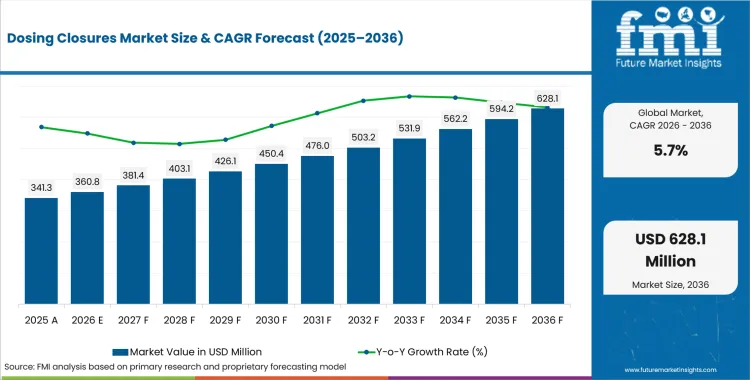
USD 360.8 million in 2026 and USD 628.1 million by 2036 at a 5.7% CAGR.
Demand for dosing closures is projected to rise at a 5.7% CAGR between 2026 and 2036, taking market value from USD 360.8 million to USD 628.1 million. Commercial value rises where a closure meters flow, protects an opening or keeps a package usable after repeated dispensing. Eurostat reported in October 2025 that EU consumers generated 35.3 kg of plastic packaging waste per person in 2023, placing material choice beside dosing performance in sustainable packaging programs with simpler recovery routes.
Country conditions change the cost of converting demand into an approved component. In the United States, healthcare programs can place child resistance beside torque and seal checks during pharmaceutical packaging qualification. The USA Consumer Product Safety Commission recalled about 356,140 iron-supplement packages in April 2026 because they did not meet child-resistant packaging requirements. The recall makes documented closure performance part of sourcing instead of a late compliance check.
Key Takeaways
- Dosing demand is strongest where the closure controls product flow, opening security or repeated-use cleanliness without forcing a new container platform.
- By product type, screw closures are projected to account for 37.0% in 2026 owing to familiar thread geometry and broad capping-line compatibility.
- Within neck finish, 24-28 mm is estimated to hold 38.0% in 2026 attributable to its fit with common bottle formats and dispensing architectures.
- PP is anticipated to represent 38.0% of material demand in 2026 because its stiffness, mouldability and hinge behavior suit high-volume closure production.
- Switching slows if a new closure changes torque, sealing pressure, child-resistance performance or material classification enough to trigger package requalification.
- Some of the key players in this market include AptarGroup, Silgan Dispensing, ALPLA, BERICAP, UNITED CAPS, TriMas Packaging, Guala Closures, and Amcor.
Analyst Perspective
"Dosing closures earn margin during qualification because brands pay for repeatable output and line stability more readily than added mechanical complexity. Strong offers remove a test, tooling change or material conflict without changing the requested dosing behavior."
- Nandini Roy Choudhury, Principal Consultant, Future Market Insights
How is the dosing closures market segmented?
The dosing closures market is segmented by product type, neck finish, material, end use, sales channel and region.
Product type covers screw closures, dispensing closures, child-resistant closures and tamper-evident closures. Neck finish covers 24-28 mm, below 24 mm and above 28 mm. Material includes PP, PE, mono-material recyclable formats and metal or specialty constructions. End use includes food and beverage, home care, personal care and beauty, and pharma. Sales channel covers direct brand contracts, component distributors and online B2B sourcing.
What makes screw closures central to the product type category?
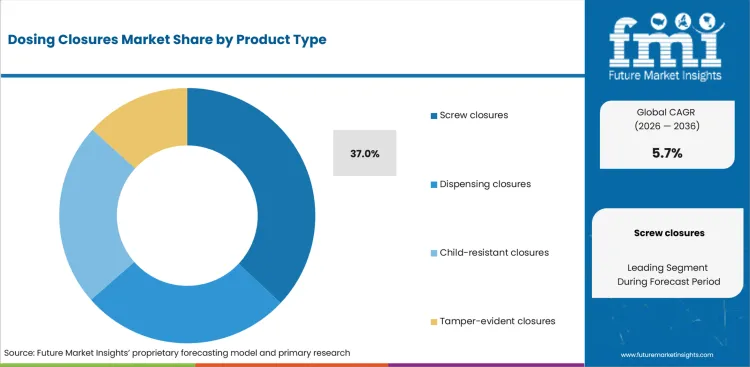
Threaded screw formats let packaging engineers retain a known bottle interface and add liners, tamper bands or controlled-dispensing components. Their practical advantage is predictable torque behavior on filling lines built for standard threads.
- By product type, screw closures are projected to hold 37.0% in 2026 owing to broad neck compatibility and familiar capping controls.
- ALPLA completed its acquisition of Energoplast closure production in Serbia in November 2025, extending regional capacity for plastic caps and closures. The added production base favors established threaded programs where a filler wants another supply point without reopening the full bottle specification.
Why does 24-28 mm lead the neck finish category?
The 24-28 mm range keeps bottle dimensions compact yet leaves enough geometry for threads, tamper bands and flow-control elements. Packaging engineers can preserve a known container interface and change the dispensing feature.
- Within neck finish, 24-28 mm is estimated at 38.0% in 2026 attributable to its fit with personal-care, household and selected healthcare packs.
- Aptar Closures launched Cleo and Airy in April 2026, with Cleo compatible with a 28-400 finish and Airy designed for 28-410. The launch shows why beauty packaging teams can introduce cleaner dispensing without abandoning a familiar neck family.
How does PP anchor the material category?
PP gives closure designers the stiffness needed for threads and tamper features and retains hinge performance for flip-top formats. Its mature injection-moulding route also suits large production runs with tight dimensional control.
- PP is anticipated to represent 38.0% of material demand in 2026 because one resin can support several mechanical functions in a high-volume closure.
- UNITED CAPS introduced the mono-material 26/22 S-SPRING sports cap in May 2026 with a two-piece design intended to simplify recycling streams. The development gives cap and closure programs a route to reduce mixed materials without removing the opening and handling functions users expect.
What supports food and beverage in the end use category?
Food and beverage closures are judged on clean cutoff, leakage control and repeated-use handling. Sauces, oils and drinks also need stable flow after filling and transport, which makes rigid food packaging line compatibility a practical purchasing condition.
- Food and beverage is projected to hold 31.0% of end use demand in 2026 due to frequent dispensing occasions and the cost of product loss from poor flow control.
- BERICAP presented its industrialized sport-cap range for all relevant neck finishes at Drinktec in July 2025, including mono-material HDPE designs. The release places line fit, tamper evidence and consumer handling inside the same food packaging decision.
What are the drivers, restraints and opportunities in the Dosing Closures Market?
Functional dispensing and safety requirements sustain demand, package qualification slows switching, and recyclable closure designs gain value only after they preserve dosing and seal performance.
- Driver: Brand owners specify the closure as a dosing and protection component for products requiring controlled flow, tamper evidence or child resistance.
- Restraint: A closure change can force new torque, seal, line-speed and package-safety testing before a plant accepts the component.
- Opportunity: Mono-material closures can win redesign programs if lower material complexity does not alter dispensing behavior or package integrity.
Safety and dosing functions raise specification depth
Safety requirements turn the closure into a tested package component in regulated liquids. In July 2026, the USA Consumer Product Safety Commission recalled about 4,200 paint-thinner bottles because they lacked required child-resistant packaging. Closure manufacturers serving pharmaceutical plastic packaging and household chemicals therefore need package-level performance evidence before a functional feature converts into repeat orders.
Qualification work slows otherwise attractive conversions
Qualification costs rise once material or geometry changes feed into a wider package assessment. PackUK stated in July 2026 that large producers must use the recyclability assessment methodology and report packaging ratings under EPR. A revised dosing closure can therefore trigger production trials and material documentation on the same SKU. Pump and dispenser programs face similar approval friction if output or line settings change.
Simpler material structures have a clearer redesign route
A simpler resin system has a stronger commercial route where recyclability is now part of packaging design. Germany’s Central Agency Packaging Register published a 2025 minimum standard that points toward a 70% recyclability threshold for packaging from 2030. Closure developers can win redesign work by removing incompatible materials, provided the revised part still meters product and survives the approved capping window.
Which country CAGRs are profiled in the Dosing Closures Market?
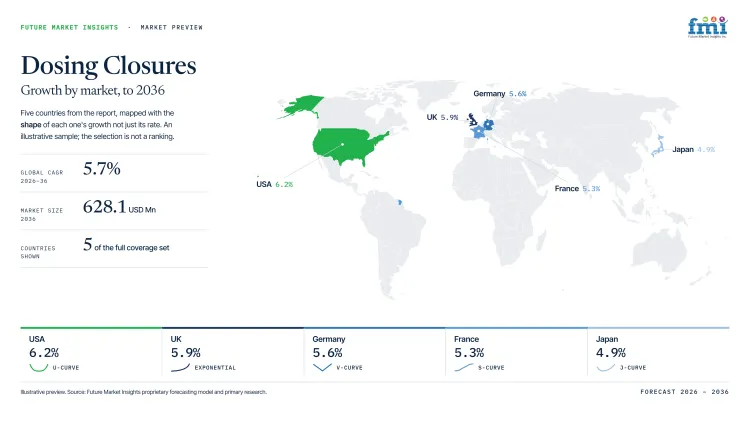
| Country | CAGR |
|---|---|
| UAE | 7.1% |
| Saudi Arabia | 6.8% |
| South Korea | 6.5% |
| USA | 6.2% |
| UK | 5.9% |
| Germany | 5.6% |
| France | 5.3% |
| Japan | 4.9% |
How do country-level CAGRs compare in the Dosing Closures Market?
The country outlook span 2.2 percentage points, with UAE and Saudi Arabia forming the upper Gulf group. South Korea and the USA form a middle band. The UK, Germany and France cluster below 6.0%, and Japan records the lowest profiled rate. Similar forecasts hide different qualification costs and supply conditions.
- The UAE’s push toward pharmaceutical localization is shortening component replenishment routes and strengthening supply resilience.
- Saudi Arabia is expanding domestic qualification opportunities through investments in new pharmaceutical manufacturing facilities.
- South Korea’s recycled-content objectives are increasing scrutiny of resin selection in closure production.
- The USA places strong emphasis on child-resistant packaging compliance, elevating validation and testing requirements.
- The UK’s evolving EPR framework is driving closer evaluation of packaging material costs and sustainability impacts.
- Germany’s advanced waste-sorting infrastructure is raising expectations for closure recyclability and circular design.
- France continues to prioritize plastic reduction goals, keeping closure weight optimization in focus.
- Japan’s collection and recovery systems favor closure materials that support efficient recycling and resource recovery.
Comparable CAGRs can still produce different approval costs and service needs because regulation, recovery systems and manufacturing depth vary by country. The full report provides country-level CAGR analysis across North America, Latin America, Western Europe, Eastern Europe, East Asia, South Asia and Pacific, and Middle East and Africa.
Country-wise Analysis
- UAE pharmaceutical and personal-care converters are working beside a larger local manufacturing base, shortening replenishment routes for qualified packaging components. Dosing closure demand in UAE is forecast to expand at 7.1% CAGR by 2036, aided by localization that brings packaging work closer to product manufacture. Emirates Drug Establishment stated in February 2026 that it had licensed 37 facilities for human pharmaceutical and medical-product production. Local manufacturing gives closure makers more nearby accounts. Imported tooling and application tests can lengthen conversion. A regional stock-and-service model gains an advantage once local application teams document closure performance on the customer’s actual filling line.
- Saudi food, cosmetic and pharmaceutical plants are adding licensed production sites, placing closure qualification at more domestic facilities. The Saudi dosing closures sector is projected to record 6.8% CAGR during the assessment period, reinforced by localization and new regulated manufacturing capacity. SFDA reported in January 2026 that licensed factories and warehouses rose 18% during 2025 to 9,155 facilities. Local plant growth gives closure manufacturers a wider account base, though approvals may remain concentrated among large regulated producers. Regional technical service becomes useful because faster sampling has commercial value only after the closure passes the customer’s defined operating window.
- South Korean packaging programs increasingly evaluate resin choice beside dispensing performance because recycled feedstock targets are moving into mainstream plastic policy. The Ministry of Climate, Energy and Environment announced in April 2026 a target to cut newly produced plastic materials by at least 30% against projected 2030 waste generation. In South Korea, dosing closure demand is predicted to advance at 6.5% CAGR through 2036, tied to package redesign and tight quality controls. Domestic converters bring strong moulding discipline. Mixed-material multi-part closures face pressure because they complicate recycling. New entrants need resin documentation and proof that material simplification does not weaken torque, sealing or dose repeatability.
- US healthcare and household programs often qualify the closure with the complete package, so a low-cost cap can fail if child-resistance evidence is weak. Dosing closure sales in the USA are forecast to expand at 6.2% CAGR over the forecast period, influenced by broad packaged-goods demand and regulated safety applications. In January 2026, CPSC recalled about 148,370 multivitamin bottles because the packaging was not child-resistant and required replacement caps. The large domestic customer base is an enabler, but regulatory failure makes rework expensive after distribution. Manufacturers with repeatable test records and standard neck options can reduce revalidation risk without claiming one closure fits every formulation.
- UK brand owners evaluate household packaging with producer-responsibility costs in view, giving closure materials a direct place in commercial design reviews. The dosing closures outlook in the UK is anticipated to advance at 5.9% CAGR over the assessment period, shaped by mature packaged-goods demand and recyclability reporting. Defra’s April 2026 EPR calculations used 1,387,860 tonnes of plastic packaging placed on the market in the obligated-tonnage data. Established converters provide a large application base. Recyclability ratings can penalize complex components. Closure makers need designs that fit existing filling lines and offer a defensible material classification under UK reporting rules.
- German packaging engineers work inside a mature collection and sorting system, so recyclability claims are tested against a proven recovery route. Germany is estimated to post 5.6% CAGR over the forecast period, supported by packaged-food, household and personal-care demand that still requires consistent closure performance. In January 2026, UBA and ZSVR reported that the mechanical recovery rate for plastic packaging had risen from 42% in 2018 to 70%. Germany’s recovery infrastructure favors compatible mono-material designs. Poor geometry or incompatible components can still undermine recovery. Entry depends on clear technical documentation directly linking closure design to production performance and realistic sorting conditions.
- French food and household brands face pressure to reduce single-use plastic, making closure weight and resin selection visible during package redesign. Dosing closures demand in France is forecast to rise at 5.3% CAGR during the forecast period, influenced by premium consumer packaging and material-reduction programs. The ecological-transition ministry stated in February 2025 that about 43% of the 4.9 million tonnes of plastic consumed annually in France goes to packaging. Strong beauty and cosmetic packaging activity supports functional closures. Added parts can work against material-reduction targets. Manufacturers gain an advantage by proving that a lighter closure still gives clean dispensing and stable package integrity.
- Japanese packaging programs operate beside detailed municipal collection planning, giving proven recovery routes a practical role in resin and component decisions. The environment ministry reported in March 2026 that 1,434 municipalities, or 82.4%, planned separate collection of plastic containers and packaging for fiscal 2026. Adoption of dosing closures in Japan is estimated to expand at 4.9% CAGR through 2036, given mature consumer packaging and steady redesign. High manufacturing standards support precision moulding, though conservative qualification can extend launch timing for unfamiliar closure architectures. A company entering Japan needs consistent technical data and local service more than a broad catalogue of untested variants.
Who are the notable companies in the Dosing Closures Market?
AptarGroup, Silgan Dispensing, ALPLA, BERICAP, UNITED CAPS, TriMas Packaging, Guala Closures and Amcor are the notable companies serving this market.
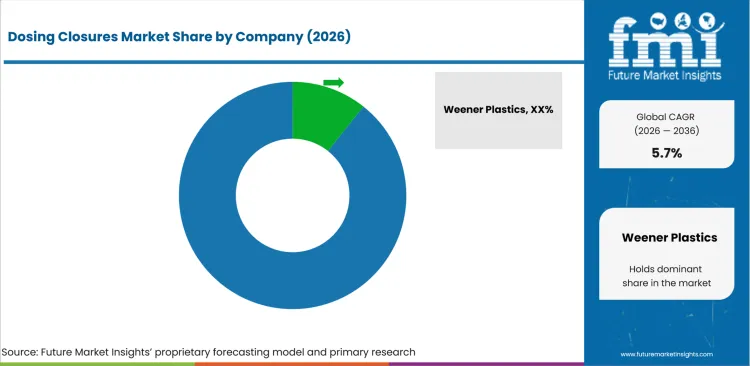
Competition separates engineered dispensing specialists from high-volume closure manufacturers and broader packaging groups. AptarGroup, Silgan Dispensing and TriMas Packaging center on controlled dispensing, whereas ALPLA, BERICAP and UNITED CAPS bring closure manufacturing scale. Guala Closures extends into pharmaceutical formats. Amcor brings dispensing development into a wider rigid-packaging platform.
- AptarGroup, Silgan Dispensing and TriMas Packaging compete on dosing control, application fit and engineered dispensing performance.
- ALPLA, BERICAP and UNITED CAPS compete through closure manufacturing depth, standard neck coverage and regional production access.
- Guala Closures and Amcor extend the field into safety-oriented closures, oral dosing and broader rigid dispensing platforms.
Competitive Benchmarking: Dosing Closures Market
| Company | Dosing / Flow-Control Breadth | Safety & Integrity Systems | Circular-Design Evidence | Geographic Reach |
|---|---|---|---|---|
| AptarGroup | High | High | High | Global |
| Silgan Dispensing | High | High | Medium | Global |
| ALPLA | Medium | Medium | High | Global |
| BERICAP | High | High | High | Global |
| UNITED CAPS | Medium | Medium | High | Europe and Asia-Pacific |
| TriMas Packaging | High | High | High | Global |
| Guala Closures | Medium | High | Medium | Europe, Americas, Asia and Africa |
| Amcor | High | Medium | High | Global |
Scoring basis: High dosing breadth requires at least three documented in-scope routes. Medium covers a narrower set. High safety depth requires multiple documented tamper, child-resistance or integrity routes for regulated applications. High circular-design evidence requires multiple current mono-material, lightweight or recycling-ready actions. Medium requires one directly documented route. Geographic reach records verified operating regions and is not scored on the High-to-Low scale.
Key Developments in the Dosing Closures Market
- In April 2025, Amcor completed its combination with Berry Global, bringing Berry’s rigid packaging and closure activities into the enlarged Amcor portfolio.
- In June 2025, Silgan Dispensing entered a partnership with Avantade to offer its Sofix fragrance sampler through a configurable sampling program for beauty brands.
- In October 2025, Guala Closures signed an agreement to acquire KWK, moving into pharmaceutical closures and precision oral-dosing devices subject to transaction conditions.
Key Players in the Dosing Closures Market
Engineered Dispensing and Dosing Platforms
- AptarGroup
- Silgan Dispensing
- TriMas Packaging
High-Volume Closure Manufacturers
- ALPLA
- BERICAP
- UNITED CAPS
Safety and Broad Packaging Platforms
- Guala Closures
- Amcor
Dosing Closures Market - Report Scope
| Coverage field | Report scope |
|---|---|
| Market breakdown | By product type, neck finish, material, end use, sales channel and region. |
| Quantitative Units | USD million. |
| Market Definition | Closures designed to meter, control or secure product dispensing through threaded, flow-control, child-resistant or tamper-evident package interfaces. |
| Regions Covered | North America, Latin America, Western Europe, Eastern Europe, East Asia, South Asia and Pacific, and Middle East and Africa. |
| Countries Covered | UAE, Saudi Arabia, South Korea, USA, UK, Germany, France, Japan, and additional countries included in the full report. |
| Key Companies Profiled | AptarGroup, Silgan Dispensing, ALPLA, BERICAP, UNITED CAPS, TriMas Packaging, Guala Closures and Amcor. |
| Forecast Period | 2026 to 2036. |
| Research Approach | Primary and desk research supported by market sizing, country analysis and source triangulation within the defined dosing-closure scope. |
Dosing Closures Market - Research Methodology
| Method | Approach |
|---|---|
| Primary Research | FMI analysts gathered input from manufacturers, service providers, technology developers, distributors, end users, procurement teams, and subject-matter experts. Interviews examined purchasing decisions, product or service evaluation, adoption barriers, approval requirements, pricing considerations, and expectations for technical or commercial support. Respondents were also asked what evidence is required before a trial, pilot, or initial order develops into regular purchasing. |
| Desk Research | Desk research covered government statistics, regulatory publications, trade data, industry associations, technical literature, standards, company filings, product information, and official corporate announcements. Sources were reviewed for relevance, publication date, geographic coverage, and consistency with the defined market scope. Claims relating to performance, applications, approvals, capacity, investment, and commercial activity were retained only when supported by credible public evidence. |
| Market Sizing and Forecasting | The market model combined the baseline value with historical performance, segment structure, pricing and volume indicators, adoption levels, company participation, and country-level demand conditions. Forecast assumptions considered economic activity, investment trends, regulatory developments, technology adoption, purchasing cycles, supply availability, and barriers to wider market use. Segment and regional estimates were reconciled before the final market total was calculated. |
| Data Validation | Estimates were checked against multiple independent indicators, including public data, company activity, trade patterns, industry developments, and findings from primary interviews. Validation also tested whether products, services, applications, and company revenues fell within the defined market boundaries. Adjacent categories, unsupported claims, overlapping revenues, and activities without direct market relevance were excluded to reduce double counting and maintain consistency across segments and countries. |
Dosing Closures Market by Segments
Dosing Closures Market segmented by Product Type:
- Screw closures
- Dispensing closures
- Child-resistant closures
- Tamper-evident closures
Dosing Closures Market segmented by Neck Finish:
- 24-28 mm
- Below 24 mm
- Above 28 mm
Dosing Closures Market segmented by Material:
- PP
- PE
- Mono-material recyclable
- Metal & specialty
Dosing Closures Market segmented by End Use:
- Food & beverage
- Home care
- Personal care & beauty
- Pharma
Dosing Closures Market segmented by Sales Channel:
- Direct brand contracts
- Component distributors
- Online B2B
Dosing Closures Market by Region:
- North America
- United States
- Canada
- Latin America
- Brazil
- Mexico
- Argentina
- Chile
- Western Europe
- Germany
- France
- United Kingdom
- Italy
- Spain
- Benelux
- Nordics
- Eastern Europe
- Poland
- Czech Republic
- Romania
- Hungary
- East Asia
- China
- Japan
- South Korea
- South Asia and Pacific
- India
- ASEAN
- Australia and New Zealand
- Middle East and Africa
- GCC Countries
- South Africa
- Türkiye
- Israel
Research Sources and Bibliography
- Eurostat. (2025, October 22). Plastic packaging waste in the EU: 35.3 kg per person
- USA Consumer Product Safety Commission. (2026, April 9). Vitaquest International recalls multiple iron supplement bottles and packets due to risk of serious injury or death from poisoning to young children; violates mandatory standard for child-resistant packaging
- ALPLA. (2025, November 3). Acquisition in Serbia: ALPLA strengthens its role as a system provider in South-East Europe
- AptarGroup. (2026, April 27). Aptar Closures Unveils Breakthrough Inverted Lidless Dispensing Closures for Clean, Single Handed Dispensing in Beauty and Personal Care
- UNITED CAPS. (2026, May 7). New 26/22 S-SPRING from UNITED CAPS Positioned as a Smarter Alternative in the Sports Cap Segment Combining lightweight construction, material efficiency and usability in a mature market
- BERICAP. (2025, July 28). Benefits for the environment and consumers: BERICAP presents closure solutions at Drinktec 2025
- USA Consumer Product Safety Commission. (2026, July 16). Liizousuda Paint Thinner Bottles Recalled Due to Risk of Serious Injury or Death from Child Poisoning; Violate Mandatory Standard for Child-Resistant Packaging; Sold on Amazon.com by Shenzhen Gudebo Technology
- PackUK & Department for Environment, Food & Rural Affairs. (2026, July 1). Assess packaging recyclability: recyclability assessment methodology (RAM) 2027
- Zentrale Stelle Verpackungsregister. (2025, August 29). 2025 minimum standard published - initial touchstone for companies preparing for the EU Packaging and Packaging Waste Regulation (PPWR)
- Emirates News Agency. (2026, February 9). Emirates Drug Establishment launches major initiative to boost UAE pharmaceutical manufacturing
- Saudi Food and Drug Authority. (2026, January 26). SFDA reports 18% growth in licensed factories and warehouses during 2025
- Ministry of Climate, Energy and Environment, Republic of Korea. (2026, April 28). Breaking free from oil imports: toward a sustainable, plastic-free circular economy
- USA Consumer Product Safety Commission. (2026, January 29). Mindbodygreen recalls Ultimate Multivitamin+ dietary supplement bottles due to risk of serious injury or death from child poisoning; violates mandatory standard for child-resistant packaging
- Department for Environment, Food & Rural Affairs. (2026, April 20). Local authority payments and material base fees: breakdown of costs and tonnages
- German Environment Agency & Zentrale Stelle Verpackungsregister. (2026, January 27). Fighting myths with facts - recycling packaging waste in Germany works. The German Environment Agency and ZSVR dispel common misconceptions about plastic and glass recycling
- Ministère de la Transition écologique. (2025, February 10). 5 ans de la loi anti-gaspillage pour une économie circulaire : où en est-on ?
- Ministry of the Environment, Japan. (2026, March 31). 容器包装リサイクル法に基づく令和8年度以降の分別収集見込量の集計結果について
- Amcor. (2025, April 30). Amcor completes combination with Berry Global; Positioned to significantly enhance value for customers and shareholders
- Silgan Dispensing. (2025, June 24). Silgan Dispensing and Avantade announce partnership to streamline fragrance sampling for consumer brands with digital solution
- Guala Closures. (2025, October 13). Guala Closures enters into high-growth pharmaceutical closures market with KWK acquisition
- AptarGroup. (2025, December 1). Aptar acquires Sommaplast, a specialized provider of oral dosing pharma packaging solutions
- BERICAP. (2026, April 9). BERICAP acquires Embankment Plastics in Ireland
- AptarGroup. (2025, February 25). Aptar Closures targets reusable beverage containers market with unique flow control valve-retaining ring combination
- TriMas Corporation. (2025, January 29). TriMas Packaging awarded EcoVadis Gold rating for sustainability efforts
- UNITED CAPS. (2026, May 7). UNITED CAPS Develops 26 FLIP-ON to Solve Everyday Handling Issues in Oil Packaging A lightweight closure that improves usability and efficiency in cost-sensitive markets
- AptarGroup. (2026, July 8). Aptar Closures strengthens portfolio of e-commerce-ready closures for beauty, personal care and home care applications
- Silgan Holdings. (2026, February 4). Silgan Announces Fourth Quarter and Full Year 2025 Results; Expects Continued Growth in 2026
- ALPLA. (2025, June 24). ALPLA acquires closure specialist KM Packaging
- BERICAP. (2025, August 11). BERICAP announces industrial launch of easyconnect cap, a major milestone for the agricultural industry
- UNITED CAPS. (2026, May 8). UNITED CAPS Expands Choice in Carton Packaging with New 27 H-PAK Closure Offering a New Level of Flexibility A practical alternative that fits existing carton packaging systems without adding complexity
- TriMas Corporation. (2025, January 14). TriMas Packaging launches new recyclable foaming pump
- Guala Closures. (2025, October 10). Guala Closures announces strategic acquisition of Metal Crowns to strengthen position in East African market
- Amcor. (2026, March 24). New Magic One takes airless dispensing to a new level
- BERICAP. (n.d.). Certificates. Retrieved September 1, 2026.
This Report Answers
- What is the global Dosing Closures market size, and what value is projected through 2036?
- What factors support the forecast CAGR of 5.7% in the Dosing Closures market?
- Why do screw closures hold the largest share of the market?
- Why is the 24-28 mm closure size range important for product qualification and packaging compatibility?
- Why does polypropylene (PP) account for the largest share of material demand?
- Which countries are expected to post the highest growth rates during the forecast period?
- How do packaging regulations, compliance standards, and qualification requirements affect market adoption?
- Which leading companies are competing in the global Dosing Closures market?
- How are key competitors benchmarked based on product portfolio, innovation, geographic reach, and manufacturing capabilities?
Frequently Asked Questions
How big is the dosing closures market in 2026?
The dosing closures market is valued at USD 360.8 million in 2026 and is projected to reach USD 628.1 million by 2036. Controlled dispensing, package safety and line-compatible redesign provide the main commercial basis for that growth.
What is the CAGR of the dosing closures market from 2026 to 2036?
The dosing closures market is projected to grow at a CAGR of 5.7% between 2026 and 2036. Functional dispensing and packaging redesign place more performance responsibility on the closure.
Which product type leads the dosing closures market?
The screw closures segment is expected to hold 37.0% of the dosing closures market in 2026, owing to familiar thread geometry. The format also accepts liners and dosing components without a new bottle platform.
Which material leads the dosing closures market?
The PP segment is anticipated to represent 38.0% of the dosing closures market in 2026, attributable to stiffness and mouldability. PP also supports threaded and tamper-evident features on high-volume injection-moulding equipment used for closure production.
Which countries are projected to record the highest growth in the dosing closures market?
UAE is projected to grow at 7.1% CAGR, followed by Saudi Arabia at 6.8% and South Korea at 6.5% through 2036. Manufacturing expansion and qualification requirements shape different commercial routes in the three countries.
Which companies are active in the dosing closures market?
Key companies operating in the market include AptarGroup, Silgan Dispensing, ALPLA, BERICAP, UNITED CAPS, TriMas Packaging, Guala Closures, and Amcor. They compete on dispensing design, safety features, application support and regional production coverage.
Preview the report firsthand - request a free sample
Get SampleGet the brochure for pricing and purchase details.
Get PDFTable of Content
- Key Takeaways
- Market Size and CAGR
- Top Growth Driver
- Fastest Growing Segment
- Leading Region
- Key Companies
- Emerging Opportunities
- Executive Summary
- Global Market Outlook
- Demand-side Trends
- Supply-side Trends
- Technology Roadmap Analysis
- Analysis and Recommendations
- Analyst Perspective (What is happening? Why now? What should investors know?)
- Key Questions Answered
- How large is the market?
- What is the CAGR?
- What are key trends?
- Which region dominates?
- Who are the leaders?
- Market Overview
- Market Coverage / Taxonomy
- Market Definition / Scope / Limitations
- Research Methodology
- Chapter Orientation
- Analytical Lens and Working Hypotheses
- Market Structure, Signals, and Trend Drivers
- Benchmarking and Cross-market Comparability
- Market Sizing, Forecasting, and Opportunity Mapping
- Research Design and Evidence Framework
- Desk Research Programme (Secondary Evidence)
- Expert Input and Fieldwork (Primary Evidence)
- Tooling, Models, and Reference Databases
- Data Engineering and Model Build
- Quality Assurance and Audit Trail
- Market Background
- Market Dynamics (Drivers, Restraints, Opportunity, Trends)
- Scenario Forecast (Optimistic, Likely, Conservative)
- Impact Analysis
- AI Impact
- Sustainability Impact
- Regulatory Impact
- Technology Impact
- Consumer / Buyer Analysis
- Purchase Drivers
- Adoption Barriers
- Buyer Journey
- Opportunity Map Analysis
- Product Life Cycle Analysis
- Supply Chain Analysis
- Investment Feasibility Matrix
- Value Chain Analysis
- PESTLE and Porter's Analysis
- Regulatory Landscape
- Regional Parent Market Outlook
- Production and Consumption Statistics
- Import and Export Statistics
- Global Market Analysis and Forecast, 2021 to 2036
- Historical Market Size Value (USD Million) Analysis, 2021 to 2025
- Current and Future Market Size Value (USD Million) Projections, 2026 to 2036
- Y-o-Y Growth Trend Analysis
- Absolute $ Opportunity Analysis
- Global Market Pricing Analysis, 2021 to 2036
- Global Market Analysis and Forecast, By Product Type, 2021 to 2036
- Introduction / Key Findings
- Historical Market Size Value (USD Million) Analysis By Product Type, 2021 to 2025
- Current and Future Market Size Value (USD Million) Analysis and Forecast By Product Type, 2026 to 2036
- Screw closures
- Dispensing closures
- Child-resistant closures
- Tamper-evident closures
- Screw closures
- Y-o-Y Growth Trend Analysis By Product Type, 2021 to 2025
- Absolute $ Opportunity Analysis By Product Type, 2026 to 2036
- Global Market Analysis and Forecast, By Neck Finish, 2021 to 2036
- Introduction / Key Findings
- Historical Market Size Value (USD Million) Analysis By Neck Finish, 2021 to 2025
- Current and Future Market Size Value (USD Million) Analysis and Forecast By Neck Finish, 2026 to 2036
- 24-28 mm
- Below 24 mm
- Above 28 mm
- 24-28 mm
- Y-o-Y Growth Trend Analysis By Neck Finish, 2021 to 2025
- Absolute $ Opportunity Analysis By Neck Finish, 2026 to 2036
- Global Market Analysis and Forecast, By Material, 2021 to 2036
- Introduction / Key Findings
- Historical Market Size Value (USD Million) Analysis By Material, 2021 to 2025
- Current and Future Market Size Value (USD Million) Analysis and Forecast By Material, 2026 to 2036
- PP
- PE
- Mono-material recyclable
- Metal & specialty
- PP
- Y-o-Y Growth Trend Analysis By Material, 2021 to 2025
- Absolute $ Opportunity Analysis By Material, 2026 to 2036
- Global Market Analysis and Forecast, By End Use, 2021 to 2036
- Introduction / Key Findings
- Historical Market Size Value (USD Million) Analysis By End Use, 2021 to 2025
- Current and Future Market Size Value (USD Million) Analysis and Forecast By End Use, 2026 to 2036
- Food & beverage
- Home care
- Personal care & beauty
- Pharma
- Food & beverage
- Y-o-Y Growth Trend Analysis By End Use, 2021 to 2025
- Absolute $ Opportunity Analysis By End Use, 2026 to 2036
- Global Market Analysis and Forecast, By Sales Channel, 2021 to 2036
- Introduction / Key Findings
- Historical Market Size Value (USD Million) Analysis By Sales Channel, 2021 to 2025
- Current and Future Market Size Value (USD Million) Analysis and Forecast By Sales Channel, 2026 to 2036
- Direct brand contracts
- Component distributors
- Online B2B
- Direct brand contracts
- Y-o-Y Growth Trend Analysis By Sales Channel, 2021 to 2025
- Absolute $ Opportunity Analysis By Sales Channel, 2026 to 2036
- Global Market Analysis and Forecast, By Region, 2021 to 2036
- Introduction
- Historical Market Size Value (USD Million) Analysis By Region, 2021 to 2025
- Current Market Size Value (USD Million) Analysis and Forecast By Region, 2026 to 2036
- North America
- Latin America
- Western Europe
- Eastern Europe
- East Asia
- South Asia and Pacific
- Middle East & Africa
- Market Attractiveness Analysis By Region
- North America Market Analysis and Forecast, By Country, 2021 to 2036
- Historical Market Size Value (USD Million) Trend Analysis By Market Taxonomy, 2021 to 2025
- Market Size Value (USD Million) Forecast By Market Taxonomy, 2026 to 2036
- By Country
- USA
- Canada
- By Product Type
- By Neck Finish
- By Material
- By End Use
- By Sales Channel
- By Country
- Market Attractiveness Analysis
- By Country
- By Product Type
- By Neck Finish
- By Material
- By End Use
- By Sales Channel
- Key Takeaways
- Latin America Market Analysis and Forecast, By Country
- Historical Market Size Value (USD Million) Trend Analysis By Market Taxonomy, 2021 to 2025
- Market Size Value (USD Million) Forecast By Market Taxonomy, 2026 to 2036
- By Country
- Brazil
- Mexico
- Chile
- Rest of Latin America
- By Product Type
- By Neck Finish
- By Material
- By End Use
- By Sales Channel
- By Country
- Market Attractiveness Analysis
- By Country
- By Product Type
- By Neck Finish
- By Material
- By End Use
- By Sales Channel
- Key Takeaways
- Western Europe Market Analysis and Forecast, By Country
- Historical Market Size Value (USD Million) Trend Analysis By Market Taxonomy, 2021 to 2025
- Market Size Value (USD Million) Forecast By Market Taxonomy, 2026 to 2036
- By Country
- Germany
- UK
- Italy
- Spain
- France
- Nordic
- BENELUX
- Rest of Western Europe
- By Product Type
- By Neck Finish
- By Material
- By End Use
- By Sales Channel
- By Country
- Market Attractiveness Analysis
- By Country
- By Product Type
- By Neck Finish
- By Material
- By End Use
- By Sales Channel
- Key Takeaways
- Eastern Europe Market Analysis and Forecast, By Country
- Historical Market Size Value (USD Million) Trend Analysis By Market Taxonomy, 2021 to 2025
- Market Size Value (USD Million) Forecast By Market Taxonomy, 2026 to 2036
- By Country
- Russia
- Poland
- Hungary
- Balkan & Baltic
- Rest of Eastern Europe
- By Product Type
- By Neck Finish
- By Material
- By End Use
- By Sales Channel
- By Country
- Market Attractiveness Analysis
- By Country
- By Product Type
- By Neck Finish
- By Material
- By End Use
- By Sales Channel
- Key Takeaways
- East Asia Market Analysis and Forecast, By Country
- Historical Market Size Value (USD Million) Trend Analysis By Market Taxonomy, 2021 to 2025
- Market Size Value (USD Million) Forecast By Market Taxonomy, 2026 to 2036
- By Country
- China
- Japan
- South Korea
- By Product Type
- By Neck Finish
- By Material
- By End Use
- By Sales Channel
- By Country
- Market Attractiveness Analysis
- By Country
- By Product Type
- By Neck Finish
- By Material
- By End Use
- By Sales Channel
- Key Takeaways
- South Asia and Pacific Market Analysis and Forecast, By Country
- Historical Market Size Value (USD Million) Trend Analysis By Market Taxonomy, 2021 to 2025
- Market Size Value (USD Million) Forecast By Market Taxonomy, 2026 to 2036
- By Country
- India
- ASEAN
- Australia & New Zealand
- Rest of South Asia and Pacific
- By Product Type
- By Neck Finish
- By Material
- By End Use
- By Sales Channel
- By Country
- Market Attractiveness Analysis
- By Country
- By Product Type
- By Neck Finish
- By Material
- By End Use
- By Sales Channel
- Key Takeaways
- Middle East & Africa Market Analysis and Forecast, By Country
- Historical Market Size Value (USD Million) Trend Analysis By Market Taxonomy, 2021 to 2025
- Market Size Value (USD Million) Forecast By Market Taxonomy, 2026 to 2036
- By Country
- Kingdom of Saudi Arabia
- Other GCC Countries
- Türkiye
- South Africa
- Other African Union
- Rest of Middle East & Africa
- By Product Type
- By Neck Finish
- By Material
- By End Use
- By Sales Channel
- By Country
- Market Attractiveness Analysis
- By Country
- By Product Type
- By Neck Finish
- By Material
- By End Use
- By Sales Channel
- Key Takeaways
- Key Countries Market Analysis
- USA
- Pricing Analysis
- Market Share Analysis, 2025
- By Product Type
- By Neck Finish
- By Material
- By End Use
- By Sales Channel
- Canada
- Pricing Analysis
- Market Share Analysis, 2025
- By Product Type
- By Neck Finish
- By Material
- By End Use
- By Sales Channel
- Mexico
- Pricing Analysis
- Market Share Analysis, 2025
- By Product Type
- By Neck Finish
- By Material
- By End Use
- By Sales Channel
- Brazil
- Pricing Analysis
- Market Share Analysis, 2025
- By Product Type
- By Neck Finish
- By Material
- By End Use
- By Sales Channel
- Chile
- Pricing Analysis
- Market Share Analysis, 2025
- By Product Type
- By Neck Finish
- By Material
- By End Use
- By Sales Channel
- Germany
- Pricing Analysis
- Market Share Analysis, 2025
- By Product Type
- By Neck Finish
- By Material
- By End Use
- By Sales Channel
- UK
- Pricing Analysis
- Market Share Analysis, 2025
- By Product Type
- By Neck Finish
- By Material
- By End Use
- By Sales Channel
- Italy
- Pricing Analysis
- Market Share Analysis, 2025
- By Product Type
- By Neck Finish
- By Material
- By End Use
- By Sales Channel
- Spain
- Pricing Analysis
- Market Share Analysis, 2025
- By Product Type
- By Neck Finish
- By Material
- By End Use
- By Sales Channel
- France
- Pricing Analysis
- Market Share Analysis, 2025
- By Product Type
- By Neck Finish
- By Material
- By End Use
- By Sales Channel
- India
- Pricing Analysis
- Market Share Analysis, 2025
- By Product Type
- By Neck Finish
- By Material
- By End Use
- By Sales Channel
- ASEAN
- Pricing Analysis
- Market Share Analysis, 2025
- By Product Type
- By Neck Finish
- By Material
- By End Use
- By Sales Channel
- Australia & New Zealand
- Pricing Analysis
- Market Share Analysis, 2025
- By Product Type
- By Neck Finish
- By Material
- By End Use
- By Sales Channel
- China
- Pricing Analysis
- Market Share Analysis, 2025
- By Product Type
- By Neck Finish
- By Material
- By End Use
- By Sales Channel
- Japan
- Pricing Analysis
- Market Share Analysis, 2025
- By Product Type
- By Neck Finish
- By Material
- By End Use
- By Sales Channel
- South Korea
- Pricing Analysis
- Market Share Analysis, 2025
- By Product Type
- By Neck Finish
- By Material
- By End Use
- By Sales Channel
- Russia
- Pricing Analysis
- Market Share Analysis, 2025
- By Product Type
- By Neck Finish
- By Material
- By End Use
- By Sales Channel
- Poland
- Pricing Analysis
- Market Share Analysis, 2025
- By Product Type
- By Neck Finish
- By Material
- By End Use
- By Sales Channel
- Hungary
- Pricing Analysis
- Market Share Analysis, 2025
- By Product Type
- By Neck Finish
- By Material
- By End Use
- By Sales Channel
- Kingdom of Saudi Arabia
- Pricing Analysis
- Market Share Analysis, 2025
- By Product Type
- By Neck Finish
- By Material
- By End Use
- By Sales Channel
- Türkiye
- Pricing Analysis
- Market Share Analysis, 2025
- By Product Type
- By Neck Finish
- By Material
- By End Use
- By Sales Channel
- South Africa
- Pricing Analysis
- Market Share Analysis, 2025
- By Product Type
- By Neck Finish
- By Material
- By End Use
- By Sales Channel
- USA
- Market Structure Analysis
- Competition Dashboard
- Competition Benchmarking
- Market Share Analysis of Top Players
- By Regional
- By Product Type
- By Neck Finish
- By Material
- By End Use
- By Sales Channel
- Emerging Startups
- Innovation Benchmarking
- Competition Analysis
- Competition Deep Dive
- Weener Plastics
- Overview
- Product Portfolio
- Profitability by Market Segments
- Sales Footprint
- Strategy Overview
- Marketing Strategy
- Product Strategy
- Channel Strategy
- United Caps
- AptarGroup
- Sonoco
- Alpla
- Bericap
- Guala Closures
- Silgan Dispensing
- Berry Global
- Amcor
- Weener Plastics
- Case Studies
- Success Stories
- Recent Developments
- Competition Deep Dive
- Assumptions & Acronyms Used


