

- Market Size (2026)
- USD 424.0 Mn
- Forecast (2036)
- USD 1070.1 Mn
- CAGR (2026 to 2036)
- 9.7%
How big is Dough Relaxants Market in 2026?
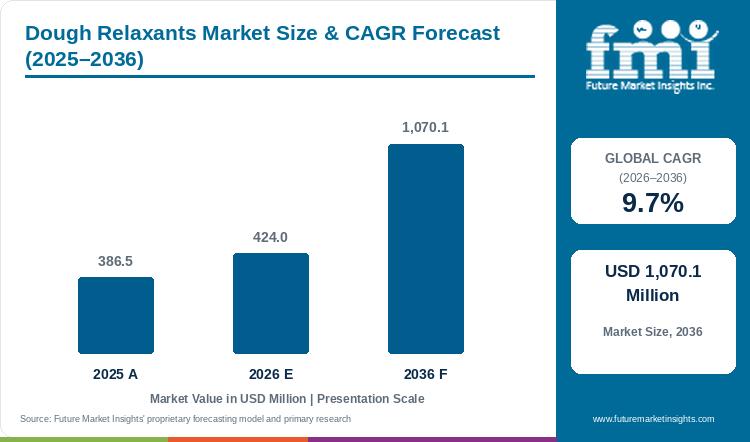
Assessed at USD 386.5 million in 2025 and progressing to USD 424.0 million in 2026, the dough relaxants market valuation is on course to reach USD 1,070.1 million by 2036, supported by a forecast-period CAGR of 9.7%.
The global dough relaxants market was valued at USD 386.5 million in 2025 and is estimated to reach USD 424.0 million in 2026. The market is projected to reach USD 1,070.1 million by 2036, expanding at a compound annual growth rate (CAGR) of 9.7% between 2026 and 2036. Standard grade formulations hold an estimated 38.0% share of 2026 demand, since calibrated endo-protease and L-cysteine activity profiles deliver repeatable relaxation without sheeting shrinkage. Demand for chemical and enzymatic relaxants is supported by rest-time economics, as every minute of dough relaxation on a wire line is floor space and capital that sheeting chemistry can release [10]. That production-floor logic separates the category from the baking enzymes market at 5.1% CAGR, because general enzyme sales follow bread volume while relaxant sales follow line-speed capital projects [8]. Suppliers are building the testing infrastructure to convert that demand, as AB Enzymes opened a Curitiba application laboratory in June 2026 for South American flour calibration [7], dsm-firmenich inaugurated its Princeton Baking Innovation Center in May 2025 for co-development with North American industrial bakers [14], and Puratos unveiled concentrated Cubease dosing at iba 2025 to strip carrier powders from improver handling [4]. Bakeries renew relaxant contracts on shrinkage-free sheeting at doubled line speed, and dosage formats that cut handling labor hold those accounts through 2036.
Key Market Trends & Insights
- By product type: Standard Grade formulations hold an estimated 38.0% share in 2026 because calibrated endo-protease and L-cysteine activity profiles deliver repeatable cost-in-use across continuous lines.
- By form: Powder / Dry blends represent 49.0% in 2026 as dry micro-granulates integrate directly into flour-mill improver premixes without cold-chain storage.
- By application: Bread & Rolls account for 27.0% in 2026 because automated divider-moulder lines require rapid gluten relaxation to prevent pan-fill defects.
- By claim: Conventional systems secure 54.0% in 2026 owing to flexible chemical and enzymatic reducing options under standard industrial bakery regulations.
- By sales channel: Direct to Industrial Bakeries commands 54.0% in 2026 through plant-specific Farinograph and Extensograph qualification trials.
Regional Highlights
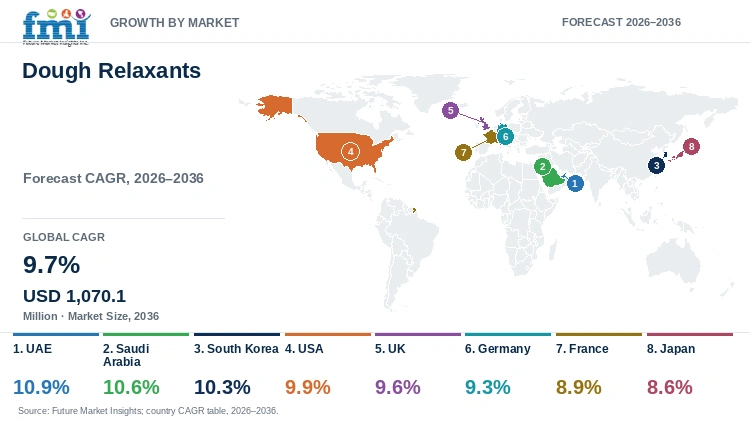
- Top national expansion: The UAE leads national growth projections at a 10.9% CAGR through 2036 under automated flatbread and bakery processing investments.
- Broader country progression: Saudi Arabia tracks at a 10.6% CAGR ahead of South Korea at 10.3% and the USA at 9.9%, whereas Japan advances at an 8.6% CAGR.
Market Size & Forecast
Table 1: Market Size and Forecast for the Dough Relaxants Market (USD million and CAGR percentage), 2025 to 2036
| Metric | Value |
|---|---|
| 2025 Market Size | USD 386.5 million |
| Estimated Market Size in 2026 | USD 424.0 million |
| Projected Market Size by 2036 | USD 1,070.1 million |
| CAGR, 2026 to 2036 | 9.7% |
| Added Revenue, 2026 to 2036 | USD 646.1 million |
Automated pan-bread, tortilla, and biscuit plants confront wide seasonal swings in wheat protein elasticity that cause dough sheets to shrink after rotary cutting. When bakers rely solely on mechanical over-mixing to weaken strong gluten, frictional heat degrades dough rheology and drives up line energy consumption. In July 2025, food chemists reporting in Molecules demonstrated that gliadin-to-glutenin ratios ranging from 1.01 to 1.87 with targeted enzymatic hydrolysis directly govern viscoelastic storage and loss moduli in wheat gluten matrices [2]. Accordingly, plant quality directors pair calibrated protease and sulfhydryl reducing systems with bakery improvers to stabilize sheeting dimensions across fluctuating flour shipments.
Treated-Flour and Active-Dosage Sizing
Table 2: Treated-Flour and Active-Dosage Sizing for the Dough Relaxants Market (USD million and operational ranges), 2025 to 2036
| Metric | 2025 | 2026 | 2036 |
|---|---|---|---|
| Market size (USD million) | 386.5 | 424.0 | 1,070.1 |
| Treated industrial bakery flour (million metric tons) | 48.0 to 54.0 | 52.5 to 59.0 | 122.0 to 138.0 |
| Commercial relaxant & blend volume (thousand metric tons) | 64.5 to 72.0 | 70.5 to 78.8 | 168.0 to 188.0 |
| Treatment cost per metric ton of flour (USD) | 7.1 to 8.0 | 7.2 to 8.1 | 7.7 to 8.8 |
Operational note: Treated-flour ranges apply standard 10 to 90 ppm active L-cysteine or 2 to 27.5 mg TOS/kg flour enzymatic relaxation dosing against commercial bakery improver inclusion rates.
High-speed biscuit and flatbread lines require precise cleavage of interior glutenin peptide bonds or disulfide cross-links so dough sheets hold exact gauge thickness entering tunnel ovens. Global ingredient houses supply pre-standardized dough conditioners that prevent sticky dough buildup on stainless-steel laminating rollers.
Per Capita & Commercial Bakery Line Sizing
Table 3: Per Capita and Bakery Line Spending Indicators for the Dough Relaxants Market (USD), 2025 to 2036
| Metric | 2025 | 2026 | 2036 |
|---|---|---|---|
| World population (billion) | 8.2 | 8.3 | 9.0 |
| Spend per 1,000 people (USD) | 47.1 | 51.1 | 118.9 |
| Annual spend per automated bakery line (USD thousand) | 14.2 to 16.5 | 15.4 to 17.8 | 34.0 to 39.5 |
| Enzymatic & clean-label relaxant share (%) | 42.0% to 46.0% | 44.0% to 48.0% | 58.0% to 63.0% |
Table 4: Industrial Bakery & Channel Spending Indicators for the Dough Relaxants Market (USD and percentages), 2026
| Metric | Value | Institutional Reference Basis |
|---|---|---|
| Market size, 2026 | USD 424.0 million | 2026 global revenue baseline |
| Automated industrial bakery lines global | 26,000 lines | Commercial bread, biscuit, tortilla & pastry lines |
| Market spend per bakery line | USD 16,307.7 | Annualized dough relaxant expenditure |
| Direct to Industrial Bakeries revenue, 2026 | USD 229.0 million | 54.0% sales channel allocation |
Replacing synthetic reducing agents such as sodium metabisulfite requires matching thermal inactivation curves during the initial stages of oven baking. Formulators blend bacterial neutral proteases with bread improvers so gluten softening ceases at 65 degrees Celsius before loaf gas cells rupture.
Analyst Perspective
"Industrial bakeries do not buy dough relaxants as commodity powders; they buy guaranteed sheeting speed and zero pan-shrink across variable wheat harvests. Enzyme and improver suppliers that pair narrow-specificity proteases with on-site rheological calibration will capture multi-year direct supply contracts as bakers phase out sulfites."
- Nandini Roy Choudhury, Principal Consultant, Future Market Insights.
How is the dough relaxants market segmented?
The dough relaxants market is segmented by product type, form, application, claim, and sales channel. In 2026, Standard Grade is projected at 38.0%, Powder / Dry at 49.0%, Bread & Rolls at 27.0%, Conventional at 54.0%, and Direct to Industrial Bakeries at 54.0%.
By product type: Standard Grade, Premium / Specialty Grade, Organic Certified, and Clean Label Grade.
By form: Powder / Dry, Liquid, Paste / Semi-Solid, and Granules / Pieces.
By application: Bread & Rolls, Cakes & Muffins, Biscuits & Cookies, Viennoiserie & Pastry, and Other Bakery & Snacks.
By claim: Conventional, Clean Label, Organic, and Identity-Preserved Non-GMO.
By sales channel: Direct to Industrial Bakeries, Ingredient Distributors, Foodservice & Artisan Supply, and Online B2B.
Why does Standard Grade lead the product type category?
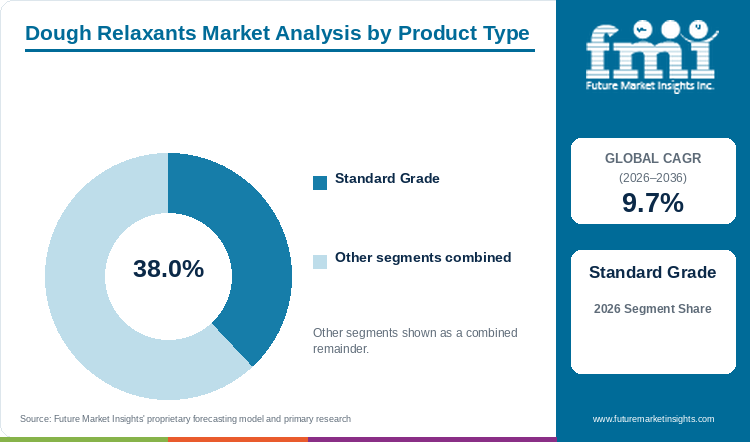
Standard Grade formulations hold an estimated 38.0% of product type demand in 2026, anchored by proven cost-in-use across high-volume bakeries.
Table 5: Product Type Share for the Dough Relaxants Market (percentage share), 2026
| Product Type | Share (2026) |
|---|---|
| Standard Grade | 38.0% |
| Other Segments Combined | 62.0%* |
| Total | 100.0% |
*Note: Remaining product type categories account for the balance of 2026 global dough relaxants demand.
Table 6: Product Type Leadership and Market Growth for the Dough Relaxants Market (segment and CAGR percentage), 2026 to 2036
| Metric | Value |
|---|---|
| Global CAGR (2026 to 2036) | 9.7% |
| Leading Segment | Standard Grade |
Standard Grade relaxants encompassing food-grade L-cysteine hydrochloride, inactivated dry yeast rich in glutathione, and workhorse bacterial neutral proteases provide predictable gluten extensibility at low per-ton flour dosing costs. Procurement teams managing high-throughput lines with protease enzyme suppliers favor Standard Grade systems because pre-calibrated activity units avoid costly recipe re-validation across multiple plant locations.
- Standard Grade holds 38.0% of product type value in 2026 because standardized activity specifications minimize batch-to-batch dosing errors on continuous mixers.
- IFF published an industrial baking technical assessment in May 2025 detailing how targeted enzyme selection governs dough strength and machinability tolerances across high-speed commercial lines [3].
What sustains Powder / Dry leadership in the form segment?
Powder / Dry formats represent 49.0% of the form category in 2026, supported by ambient shelf stability and premix compatibility.
Free-flowing dry powders stabilized on wheat starch or calcium sulfate carriers blend homogeneously into commercial flour-mill improver sacks and automated micro-ingredient loss-in-weight feeders. Unlike liquid enzymes that require chilled storage and peristaltic dosing pumps, dry formulations integrate smoothly into bakery ingredients supply chains across warm tropical and Middle Eastern distribution corridors.
- Powder / Dry options represent 49.0% of the form segment in 2026 as commercial flour mills and premix blenders standardize dry micro-dosing.
- Puratos introduced its concentrated Cubease bakery improver technology at iba 2025 in May 2025, demonstrating how compact solid dosing formats eliminate weighing errors and reduce packaging freight across industrial bakeries [4].
How do Bread & Rolls lead the application category?
Bread & Rolls account for 27.0% of application volume in 2026, driven by high-speed divider, rounder, and pan-moulder throughput.
Continuous pan-bread, hamburger bun, and hot-dog roll lines subject dough pieces to intense mechanical compression during dividing and sheeting that triggers elastic snap-back if gluten resistance is too high. Calibrated dough relaxants allow dough pieces to fill pan corners evenly without tearing the gas-retaining gluten film, complementing alpha-amylase baking enzymes crumb-softening systems.
- Bread & Rolls account for 27.0% of application demand in 2026 because pan-bread and bun plants represent the largest global tonnage of treated bakery flour.
- A May 2026 review in the International Journal of Food Science documented that controlled protease dosing at 0.1% to 0.3% of flour weight hydrolyzes rigid protein networks to improve dough extensibility and crumb uniformity [5].
Why does Conventional lead the claim category?
Conventional formulations secure 54.0% of claim value in 2026, supported by regulatory flexibility and rapid disulfide cleavage.
Conventional claim positioning allows bakery formulators to combine fast-acting L-cysteine reducing agents with fungal or bacterial proteases to achieve immediate dough relaxation during short-time mixing processes. While retail brands actively test clean-label processing aids, high-speed institutional bun and cracker plants retain conventional systems where E-number declarations are permitted and rapid 60-second mixing cycles leave insufficient time for slow enzymatic hydrolysis.
- Conventional products secure 54.0% of claim demand in 2026 as industrial bakeries prioritize immediate disulfide bond reduction and low ingredient cost.
- Corbion presented its clean-label and conventional bakery reformulation systems at IBIE 2025 in September 2025, demonstrating how targeted improver chemistry maintains dough machinability during recipe simplification [6].
What gives Direct to Industrial Bakeries the leading position in sales channel?
Direct to Industrial Bakeries commands 54.0% of sales channel share in 2026, anchored by on-site baking lab qualification.
Because a two-part-per-million overdose of protease can liquefy dough on a conveyor belt, large multi-plant bakery groups contract directly with primary enzyme and improver manufacturers rather than buying uncalibrated catalogue blends. Direct technical sales teams run Alveograph, Extensograph, and pilot-line trials on the customer's exact local wheat flour grist before locking in annual supply agreements.
- Direct to Industrial Bakeries commands 54.0% of sales channel value in 2026 because custom rheological calibration requires direct application-lab partner.
- AB Enzymes inaugurated a new regional office and dedicated baking laboratory in Curitiba, Brazil on June 1, 2026 to conduct direct customer flour trials and protease dosage optimization across South American bakeries [7].
What are the drivers, restraints, and opportunities in the dough relaxants market?
In the dough relaxants market, high-speed bakery automation and variable wheat protein quality are projected to drive adoption whereas narrow proteolytic dosage tolerances restrain uncalibrated use and sulfite-free enzymatic systems unlock clean-label reformulation.
- Driver: Rising line speeds across automated tortilla, biscuit, and pan-bread plants require controlled gluten relaxation to eliminate floor rest time and sheet shrinkage.
- Restraint: Narrow enzymatic dosage tolerances create severe over-hydrolysis risks that collapse loaf volume and cause sticky roller fouling if oven inactivation is delayed.
- Opportunity: Replacing synthetic sodium metabisulfite and chemical reducing agents with self-inactivating proteases and glutathione-rich deactivated yeast unlocks clean-label processing-aid declarations.
Growth Analysis and Future Potential: Qualitative Demand Catalysts
Climate-driven volatility in wheat harvest protein quality is compelling industrial bakeries to rely on enzymatic and reducing dough relaxants to maintain uniform line speeds. When mills supply overly bucky high-gluten flour or sprouted grain lots, unconditioned dough retracts after die-cutting and causes oval biscuit and tortilla rejects. Integrating calibrated bakery proteases enables production managers to standardize extensibility without slowing conveyor throughput. In March 2026, a study in Food Chemistry: X demonstrated that endogenous protease activity in sprouted wheat flour reduced gluten hydrogen bonds by 6.74% and SDS-soluble monomers by 4.2%, confirming why industrial bakers require standardized exogenous relaxants to stabilize dough viscoelasticity [8].
Risk Assessment of the Dough Relaxants Market: Operational and Formulation Friction
Over-proteolysis during prolonged fermentation or line stoppages represents the primary operational risk restraining aggressive protease dosing in commercial bakeries. Unlike chemical reducing agents that react stoichiometrically with disulfide bonds and stop, active proteases continue cleaving peptide backbones until thermal denaturation occurs in the oven. In July 2026, cereal scientists publishing in the Journal of Food Science demonstrated that uncontrolled salivary protease damage in Sunn-pest-affected wheat severely degrades gluten extensibility and Farinograph stability across 10% to 30% flour blends [9]. Bakeries formulating bakery ingredients and flour improvers consequently enforce strict thermal-inactivation ceilings and holding-time cutoffs before qualifying new protease grades.
Commercial Opportunity Analysis: Formulation Differentiation and Value-Add Formats
Ingredient suppliers capture premium margins by engineering sulfite-free enzymatic relaxation systems that qualify as processing aids exempt from consumer allergen and additive declarations. Biscuit and cracker manufacturers are actively phasing out sodium metabisulfite due to occupational asthma hazards and mandatory sulfite allergen labeling above 10 parts per million. Pairing targeted endo-proteases with xylanases in food enzymes solutions reduces water absorption and dough viscosity simultaneously. In July 2026, the EFSA Panel on Food Enzymes published a positive safety evaluation for an extension of use of Aspergillus oryzae endo-1,4-beta-xylanase (strain NZYM-FB) in baking processes at up to 27.5 mg TOS per kilogram of flour [10].
Dough Relaxants Market by Country (2026 to 2036)
FMI country modeling indicates that the UAE leads dough relaxants expansion at a 10.9% CAGR through 2036, while Japan advances at an 8.6% CAGR. Commercial adoption across Middle Eastern automated flatbread plants, East Asian biscuit lines, and Western industrial bakeries hinges on local flour rheological calibration and regulatory enzyme approvals.
Table 7: Country CAGR and Primary Growth Levers for the Dough Relaxants Market (CAGR percentage and operational drivers), 2026 to 2036
| Country | CAGR (2026 to 2036) | Primary Growth Lever |
|---|---|---|
| UAE | 10.9% | UAE Food Cluster bakery automation and imported multi-origin wheat conditioning |
| Saudi Arabia | 10.6% | Industrial flatbread and pan-bread scaling across 3.1M MT wheat import base |
| South Korea | 10.3% | KRW 111.9 trillion food processing sector and export biscuit line automation |
| USA | 9.9% | High-speed bun, tortilla, and cracker lines replacing sulfites with proteases |
| UK | 9.6% | Chorleywood bread process optimization and clean-label biscuit reformulation |
| Germany | 9.3% | Industrial par-baked roll engineering and enzyme technical center trials |
| France | 8.9% | Clean-label E-number removal across laminated pastry and baguette improvers |
| Japan | 8.6% | Precision protease and hemicellulase dosing across domestic and imported wheat |
Source: Future Market Insights analysis
UAE Dough Relaxants Market Outlook (2026 to 2036)
Industrial dough relaxants demand in the UAE is projected to expand at a leading 10.9% CAGR through 2036 across automated Arabic flatbread, samoon roll, and hotel bakery commissaries. Unlike wheat-growing nations with uniform domestic harvests, Emirati flour mills blend imported Black Sea and Australian wheats that require intensive rheological standardization. In August 2026, the USDA Foreign Agricultural Service reported that more than 570 food and beverage processors operate in the UAE under the National Food Security Strategy 2051 and the UAE Food Cluster initiative [11]. Because high ambient factory temperatures accelerate dough fermentation, local bakeries rely on dry-powdered protease and L-cysteine improvers to prevent sheet tearing on high-speed pocket-pita lines.
Key takeaway: In the UAE, multi-origin wheat blending and automated flatbread commissary expansion are projected to drive leading demand for dry-powdered dough relaxants.
Saudi Arabia Dough Relaxants Market Outlook (2026 to 2036)
Whereas Emirati demand centers on hospitality hubs, Saudi Arabia scales industrial pan-bread and biscuit manufacturing across Riyadh and Jeddah industrial cities. Sales of dough relaxants in Saudi Arabia are expected to climb at a 10.6% CAGR between 2026 and 2036 across modernized state-backed and private flour-milling complexes. In December 2025, the USDA Foreign Agricultural Service reported that Saudi wheat imports totaled 3.1 million metric tons with 1.1 million metric tons of domestic wheat production in marketing year 2025/26 to supply domestic bakeries [12]. Industrial bakeries serving pilgrimage hospitality catering and national Saudi grocery chains dose standardized dry relaxant premixes to shorten floor resting times and maximize hourly tunnel-oven throughput.
Key takeaway: In Saudi Arabia, rising industrial wheat milling and high-speed bun and flatbread automation are expected to sustain strong procurement of dough relaxant premixes.
South Korea Dough Relaxants Market Outlook (2026 to 2036)
In contrast to Middle Eastern flatbread plants, South Korea concentrates dough relaxant consumption inside automated cracker and convenience-store bakery factories. In April 2026, the USDA Foreign Agricultural Service reported that Japan’s food processing sector generated USD 174 billion in 2025 even after a 3% contraction, an industrial bread base where enzymatic conditioning is specified line by line [24]. Procurement of dough relaxants in South Korea is forecast to advance at a 10.3% CAGR through 2036 across major confectionery and commercial baking groups. Korean biscuit exporters actively replace chemical sodium metabisulfite with low-temperature bacterial neutral proteases to meet strict clean-label export standards across North American and Asian retail channels.
Key takeaway: In South Korea, export-oriented biscuit manufacturing and clean-label reformulation are forecast to accelerate adoption of enzymatic dough relaxants.
USA Dough Relaxants Market Outlook (2026 to 2036)
Unlike fragmented European artisan markets, demand in the USA is anchored by ultra-high-speed hamburger bun and rotary-moulded cracker plants operating 24-hour production schedules. To support direct customer line trials across North American wheat classes, dsm-firmenich inaugurated its advanced Princeton Baking Innovation Center in New Jersey on May 20, 2025 [14]. American flour tortilla and rotary cracker processors pair fast-acting L-cysteine hydrochloride with bacterial endo-proteases to eliminate hot-press dough bounce-back and maintain uniform piece diameter tolerances inside high-speed automated optical bagging machines. Commercial dough relaxants valuation in the USA is anticipated to progress at a 9.9% CAGR through 2036 across multi-plant wholesale bread and snack bakeries.
Key takeaway: In the USA, high-speed tortilla and bun line automation with domestic baking innovation centers are anticipated to anchor direct industrial relaxant contracts.
UK Dough Relaxants Market Outlook (2026 to 2036)
Dough relaxants expenditure in the UK is estimated to grow at a 9.6% CAGR between 2026 and 2036 across high-speed plant bakeries, rotary biscuit lines, and chilled pastry factories. What distinguishes the UK from continental Europe is the dominance of the high-shear Chorleywood Bread Process with Europe's largest wrapped bread and sweet biscuit manufacturing sector. In March 2026, Kerry Group published technical bakery enzyme findings demonstrating how targeted enzyme systems reduce ingredient costs and preserve dough handling tolerances when British bakers adjust added wheat gluten levels [15]. British grocery private-label charters also compel biscuit makers to replace sodium metabisulfite with clean-label protease and deactivated yeast relaxants.
Key takeaway: In the UK, high-shear plant baking and supermarket clean-label biscuit charters are estimated to drive conversion toward sulfite-free enzymatic relaxants.
Germany Dough Relaxants Market Outlook (2026 to 2036)
Whereas British bakeries rely on high-speed Chorleywood mixing, Germany leads Europe in automated par-baked Brötchen roll lines and frozen laminated dough engineering. German dough relaxants revenue is slated to expand at a 9.3% CAGR across the 2026 to 2036 horizon in industrial bake-off plants and milling improver blenders. In May 2026, the EFSA Panel on Food Enzymes issued a scientific safety evaluation for Genencor International (IFF) glucan 1,4-alpha-maltohydrolase from Bacillus licheniformis strain DP-Dzb115 at 2 to 20 mg TOS per kilogram of flour in baked products [16]. German improver houses combine verified EU-authorized proteases with maltogenic amylases to prevent crust cracking on shock-frozen par-baked rolls.
Key takeaway: In Germany, industrial par-baked roll manufacturing and EU-authorized enzyme blending are slated to sustain demand for precision dough relaxants.
France Dough Relaxants Market Outlook (2026 to 2036)
France diverges from other Western European markets because strict national baguette traditions and retail E-number bans push flour millers toward enzymatic and deactivated-yeast relaxation systems. In April 2025, computational and experimental screening in Pharmaceuticals evaluated 181 wheat papain-like cysteine proteases, confirming that endogenous wheat enzymes Ta-P7 and Triticain-alpha cleave bulk gluten within five minutes at pH 4.6 and 37 degrees Celsius [17]. Demand for dough relaxants in France is likely to increase at an 8.9% CAGR through 2036 across industrial viennoiserie laminating plants and regional flour mills. French laminated pastry producers rely on glutathione-yeast and protease blends to prevent croissant dough shrinkage during three-fold sheeting.
Key takeaway: In France, retail clean-label charters and high-speed viennoiserie lamination are likely to favor deactivated-yeast and protease relaxants over E920 additives.
Japan Dough Relaxants Market Outlook (2026 to 2036)
Unlike Western markets dominated by L-cysteine bread conditioners, Japan emphasizes ultra-precise fungal and bacterial enzyme blends tailored to soft Pullmans and delicate rice-wheat crackers. In June 2025, the EFSA Panel on Food Enzymes evaluated endo-1,4-beta-xylanase produced by Japanese enzyme specialist Shin Nihon Chemical Co. from non-genetically modified Trichoderma citrinoviride strain X31 at 14 mg TOS per kilogram of flour to reduce dough viscosity and improve handling [18]. Domestic specialty fermenters such as Amano Enzyme work closely with Japanese wholesale pan-bread bakeries to balance controlled gluten relaxation against high crumb moisture retention. Japanese dough relaxants sales are predicted to advance at an 8.6% CAGR from 2026 to 2036.
Key takeaway: In Japan, precision fermentation enzyme engineering and soft-crumb bakery standards are predicted to sustain steady adoption of non-GM enzymatic relaxants.
Full report country CAGRs cover: North America; Latin America; Western Europe; Eastern Europe; East Asia; South Asia and Pacific; Middle East and Africa.
Who are the notable companies in the dough relaxants market?
Novonesis, IFF, Kerry Group, AB Enzymes, Amano Enzyme, Palsgaard, Corbion, BASF, Puratos, and dsm-firmenich are the notable companies in the dough relaxants market.
Competitive positioning in the dough relaxants industry separates primary biotechnology enzyme producers, integrated bakery improver houses, and adjacent emulsifier or texture specialists. Novonesis and AB Enzymes with Kerry Group and dsm-firmenich engineer documented proteolytic and rheological enzymes for biscuit and bread relaxation. IFF and Amano Enzyme with Corbion and Puratos supply broad bakery enzyme and concentrated improver systems, whereas Palsgaard and BASF participate via adjacent cake emulsifiers and aerating systems.
- Dedicated Relaxation and Rheology Enzymes: Novonesis, AB Enzymes, Kerry Group, and dsm-firmenich manufacture bacterial and fungal proteases with xylanases that directly cleave gluten networks to reduce dough elasticity.
- Broader Bakery Enzyme and Improver Formulators: IFF, Amano Enzyme, Corbion, and Puratos blend multi-enzyme improvers, deactivated yeast, and dough conditioners tailored to regional wheat flours.
- Adjacent Emulsifier and Texture Pathways: Palsgaard and BASF supply cake gels, polyglycerol esters, and aerating emulsifiers that modify batter viscosity and crumb structure in adjacent bakery lines.
Competitive Benchmarking: Dough Relaxants Market
Table 8: Competitive Benchmarking for the Dough Relaxants Market (qualitative capability ratings), 2026
| Company | Documented Relaxation Activity | Bakery Application Support | Additive-Reduction Fit | Geographic Reach |
|---|---|---|---|---|
| Novonesis | High | High | High | Global biosolutions network; Neutrase protease for biscuit and cracker dough |
| IFF | Medium | High | High | Global enzyme portfolio and EU-evaluated baking hydrolases |
| Kerry Group | High | High | High | Global bakery enzyme and clean-label improver technical centers |
| AB Enzymes | High | High | High | Global VERON protease portfolio; new Curitiba baking lab in June 2026 |
| Amano Enzyme | Medium | Medium | High | Japan, North America, and Europe specialty non-GM baking enzymes |
| Palsgaard | Unscored | High | Medium | Global emulsifier application centers including Navi Mumbai lab in July 2025 |
| Corbion | Medium | High | High | North American and international clean-label dough conditioning systems |
| BASF | Unscored | Medium | Unscored | Global food performance emulsifiers (Spongolit); divested Nutrilife enzymes |
| Puratos | Medium | High | High | Global bakery improver network; launched Cubease dosing cubes in May 2025 |
| dsm-firmenich | High | High | High | Global BakeZyme portfolio; opened Princeton Baking Center in May 2025 |
Scoring basis: Documented Relaxation Activity evaluates published first-party evidence of targeted gluten extensibility or protease relaxation grades such as Neutrase or VERON PS, whereas Bakery Application Support rates pilot-scale test bakery infrastructure. Additive-Reduction Fit measures documented capability to replace chemical reducing agents (such as sodium metabisulfite or L-cysteine) with clean-label enzymatic or yeast-based processing aids.
Key Developments in the Dough Relaxants Market
- AB Enzymes opened a new regional office and dedicated baking application laboratory in Curitiba, Brazil on June 1, 2026 to accelerate customer flour testing and VERON enzyme calibration across South America [7].
- dsm-firmenich inaugurated its advanced Princeton Baking Innovation Center in Princeton, New Jersey on May 20, 2025 to co-develop enzymatic dough conditioning and texture solutions with North American industrial bakers [14].
- Puratos unveiled its concentrated Cubease improver technology at iba 2025 on May 7, 2025, enabling industrial bakeries to dose pre-measured enzymatic improver cubes without bulk carrier powders [4].
Key Players in the Dough Relaxants Market
Dedicated Relaxation and Rheology Enzymes
- Novonesis
- AB Enzymes
- Kerry Group
- dsm-firmenich
Broader Bakery Enzyme and Improver Formulators
- IFF
- Amano Enzyme
- Corbion
- Puratos
Adjacent Emulsifier and Texture Pathways
- Palsgaard
- BASF
Dough Relaxants Market - Report Scope
Table 9: Report Scope for the Dough Relaxants Market (coverage fields and definitions), 2026 to 2036
| Coverage field | Report scope |
|---|---|
| Market breakdown | Product Type; Form; Application; Claim; Sales Channel |
| Quantitative Units | USD Million |
| Market Definition | Includes commercial supplier revenue from dedicated dough-relaxing agents (bacterial and fungal proteases, L-cysteine hydrochloride, glutathione-rich inactivated dry yeast, and food-grade sulfite reducing agents) and the attributable relaxation value within blended bakery improvers. Category Scope Note: Excludes oxidizing dough strengtheners (ascorbic acid, azodicarbonamide, glucose oxidase), standalone crumb-softening alpha-amylases, and cake-batter aerating emulsifiers. |
| Regions Covered | North America; Latin America; Western Europe; Eastern Europe; East Asia; South Asia and Pacific; Middle East and Africa |
| Countries Covered | UAE, Saudi Arabia, South Korea, USA, UK, Germany, France, Japan, and additional countries in the full report |
| Key Companies Covered | Novonesis, IFF, Kerry Group, AB Enzymes, Amano Enzyme, Palsgaard, Corbion, BASF, Puratos, dsm-firmenich |
| Forecast Period | 2026 to 2036 |
| Approach | Primary and secondary research with top-down and bottom-up market triangulation. |
Dough Relaxants Market - Research Methodology
Table 10: Research Methodology for the Dough Relaxants Market (research methods and approach), 2026 edition
| Method | Approach |
|---|---|
| Primary Research | Structured interviews with industrial bakery cereal chemists, enzyme fermentation R&D directors, commercial flour-mill improver formulators, and biscuit plant production managers to validate active ppm and mg TOS/kg flour dosing rates. |
| Secondary Research | Analysis of EFSA Panel on Food Enzymes (FEZ) scientific opinions, USDA FAS Grain and Food Processing Ingredients Annual reports, PubMed and PMC gluten proteolysis studies, and corporate financial filings. |
| Market Sizing and Forecasting | Top-down parent baking ingredients and bakery improvers baselines reconciled against bottom-up treated industrial bakery flour tonnage (52.5M to 59.0M MT in 2026) and active protease/L-cysteine dosage costs per metric ton from 2026 to 2036. |
| Country Forecasting Model | Econometric country projections weight automated bread, tortilla, and biscuit line installations, wheat import protein variability, and clean-label sulfite replacement mandates across eight national markets. |
| Operational Benchmark Traceability | Treated-flour and bakery line spending indicators in Tables 2, 3, and 4 trace to EFSA mg TOS/kg flour regulatory use levels, Journal of Agricultural and Food Chemistry protease activity assays, and USDA FAS national processing registries. |
| Data Triangulation and Validation | Revenue estimates isolate the extensibility and disulfide/peptide-cleavage function across straight actives and blended improvers while strictly excluding oxidizing strengtheners, bulk wheat gluten, and standalone emulsifiers. |
Dough Relaxants Market by Segments
Dough Relaxants Market segmented by Product Type:
- Standard Grade
- Premium / Specialty Grade
- Organic Certified
- Clean Label Grade
Dough Relaxants Market segmented by Form:
- Powder / Dry
- Liquid
- Paste / Semi-Solid
- Granules / Pieces
Dough Relaxants Market segmented by Application:
- Bread & Rolls
- Cakes & Muffins
- Biscuits & Cookies
- Viennoiserie & Pastry
- Other Bakery & Snacks
Dough Relaxants Market segmented by Claim:
- Conventional
- Clean Label
- Organic
- Identity-Preserved Non-GMO
Dough Relaxants Market segmented by Sales Channel:
- Direct to Industrial Bakeries
- Ingredient Distributors
- Foodservice & Artisan Supply
- Online B2B
Dough Relaxants Market by Region
- North America
- United States
- Canada
- Latin America
- Brazil
- Mexico
- Argentina
- Chile
- Western Europe
- Germany
- France
- United Kingdom
- Italy
- Spain
- Benelux
- Nordics
- Eastern Europe
- Poland
- Czech Republic
- Romania
- Hungary
- East Asia
- China
- Japan
- South Korea
- South Asia and Pacific
- India
- ASEAN
- Australia and New Zealand
- Middle East and Africa
- GCC Countries
- South Africa
- Türkiye
- Israel
Research Sources and Bibliography
- [1] Liu, S., Wang, K., Lin, X., Zhang, Y., Yue, Y., Ren, S., Li, H., Liu, R., & Yi, Y. (2026, January 28). Purification and Characterization of a Novel Low-Temperature Protease BsLT with High Potential for Hydrolyzing Wheat Gluten. Journal of Agricultural and Food Chemistry (PubMed PMID 41606951).
- [2] Zadeike, D., Zvirdauskiene, R., & Basinskiene, L. (2025, July 19). Gluten Functionality Modification: The Effect of Enzymes and Ultrasound on the Structure of the Gliadin-Glutenin Complex and Gelling Properties. Molecules, 30(14), 3036 (PubMed PMID 40733302).
- [3] IFF. (2025, May 13). Boosting Dough Strength in Industrial Baking: Enzyme Solutions That Raise the Game. International Flavors & Fragrances Inc. Media Room.
- [4] Puratos. (2025, May 7). Puratos brings a trio of transformative innovations to iba 2025. Puratos Group Press Room.
- [5] Alibekova, Z., Bayisbayeva, M., Shamsudin, R., Bakhtybekova, A., Alibekov, R., & Aimenov, Z. (2026, May 11). Problems and Approaches in the Improvement of Gluten-Free Bread Texture: A Comprehensive Review. International Journal of Food Science, 2026, 5214023 (PubMed PMID 42125225).
- [6] Corbion. (2025, September 2). Corbion leads clean-label reformulation forward at IBIE 2025. Corbion N.V. Media Releases.
- [7] AB Enzymes. (2026, June 1). AB Enzymes Opens New Office and Baking Lab in Curitiba, Brazil. AB Enzymes GmbH Newsroom.
- [8] Pan, J., Li, S., Wang, F., Zheng, J., Liu, Z., Bian, K., Guo, Z., Lin, J., Wen, J., Qi, X., & Guo, J. (2026, March 16). Structural and functional properties of gluten proteins in air-classified sprouted wheat flour and their impact on steamed gluten quality. Food Chemistry: X, 35, 103765 (PubMed PMID 42099908).
- [9] Koksal Kavrak, M., & Masatcioglu, M. T. (2026, July 1). Enhancement of Gluten Quality and Rheology in Sunn Pest (Eurygaster spp.)-Damaged Wheat Flour Using Plant Extracts. Journal of Food Science, 91(7), e71249 (PubMed PMID 42359914).
- [10] EFSA Panel on Food Enzymes (FEZ), Zorn, H., Barat Baviera, J. M., Bolognesi, C., Catania, F., Gadermaier, G., Greiner, R., Mayo, B., Mortensen, A., Roos, Y. H., Solano, M. L. M., Van Loveren, H., Vernis, L., Tokic, V., Cavanna, D., & Liu, Y. (2026, July 6). Safety evaluation of an extension of use of the food enzyme endo 1,4-beta-xylanase from the genetically modified Aspergillus oryzae strain NZYM-FB. EFSA Journal, 24(7), e10181 (PubMed PMID 42440778).
- [11] USDA Foreign Agricultural Service. (2026, August 4). United Arab Emirates: Food Processing Ingredients Annual. U.S. Department of Agriculture GAIN Report TC2026-0014.
- [12] USDA Foreign Agricultural Service. (2025, December 4). Saudi Arabia: Grain and Feed Semi-Annual. U.S. Department of Agriculture GAIN Report SA2025-0021.
- [13] USDA Foreign Agricultural Service. (2026, May 27). South Korea: Food Processing Ingredients Annual. U.S. Department of Agriculture GAIN Report KS2026-0011.
- [14] dsm-firmenich. (2025, May 20). On the rise: dsm-firmenich opens state-of-the-art Princeton Baking Innovation Center in Princeton, NJ. dsm-firmenich AG Press Releases.
- [15] Holt, C. (2026, March 16). How Enzymes Are Reshaping Bakery Performance. Kerry Group plc KerryDigest.
- [16] EFSA Panel on Food Enzymes (FEZ), Zorn, H., Barat Baviera, J. M., Bolognesi, C., Catania, F., Gadermaier, G., Greiner, R., Mayo, B., Mortensen, A., Roos, Y. H., Solano, M. L. M., Van Loveren, H., Vernis, L., Aguilera, J., Fernandez, C., & Liu, Y. (2026, May 8). Safety evaluation of the food enzyme glucan 1,4-alpha-maltohydrolase from the genetically modified Bacillus licheniformis strain DP-Dzb115. EFSA Journal, 24(5), e10086 (PubMed PMID 42110329).
- [17] Savvateeva, L. V., Chepikova, O. E., Solonkina, A. D., Sakharov, A. A., Gorokhovets, N. V., Golovin, A. V., & Zamyatnin, A. A., Jr. (2025, April 18). Computational Screening and Experimental Evaluation of Wheat Proteases for Use in the Enzymatic Therapy of Gluten-Related Disorders. Pharmaceuticals, 18(4), 592 (PubMed PMID 40284026).
- [18] EFSA Panel on Food Enzymes (FEZ), Zorn, H., Barat Baviera, J. M., Bolognesi, C., Catania, F., Gadermaier, G., Greiner, R., Mayo, B., Mortensen, A., Roos, Y. H., Solano, M. L. M., Sramkova, M., Van Loveren, H., Vernis, L., Chesson, A., Herman, L., Kovalkovicova, N., Andryszkiewicz, M., Cavanna, D., Lunardi, S., & Liu, Y. (2025, June 24). Safety evaluation of the food enzyme endo-1,4-beta-xylanase from the non-genetically modified Trichoderma citrinoviride strain X31. EFSA Journal, 23(6), e9482 (PubMed PMID 40557246).
- [19] Novonesis. (2025, June 11). Novonesis launches Optiva LS Prime, helping bakers cut up to 50% added sugar and create more cost-effective baked goods. Novonesis Corporate Newsroom.
- [20] Palsgaard. (2025, July 8). Palsgaard Inaugurates State-of-the-Art Application Centre in Navi Mumbai to Strengthen Regional Customer Support. Palsgaard A/S Newsroom.
- [21] Kerry Group. (2026, February 17). Kerry Group Preliminary Statement of Results for the year ended 31 December 2025. Kerry Group plc Media Releases.
- [22] Zhang, R., Tang, T., Yang, Y., Li, J., Su, Y., Gu, L., & Chang, C. (2026, May 1). Role of Enzymatic Hydrolysis-Induced Macromolecular Interactions of Egg Yolk Plasma in Regulating Texture and Flavor of Gluten-Free Biscuits. Journal of Food Science, 91(5), e71116 (PubMed PMID 42104754).
- [23] Kerry Group. (2026, May 18). EFSA publishes positive scientific opinion on Kerry's Acrylerase, a first-of-its-kind enzyme to reduce acrylamide in instant coffee and coffee substitutes. Kerry Group plc Media Releases.
- [24] U.S. Department of Agriculture, Foreign Agricultural Service. (2026, April). Japan: Food Processing Ingredients Annual. Global Agriculture Information Networkhttps://www.fas.usda.gov/data/gain-report/2026/04/Food%20Processing%20Ingredients%20Annual_Tokyo%20ATO_Japan_JA2026-0012.pdf
This bibliography is provided for reader reference and is not exhaustive. The full report contains the complete reference list and detailed citations.
This Report Answers
- How large is the dough relaxants market in 2026 and what is forecast for 2036?
- Which high-speed sheeting and flour variability pressures support demand for dough relaxants?
- Why does Standard Grade lead the product type category?
- Why does Powder / Dry lead the form category globally?
- How do growth rates differ across the UAE, Saudi Arabia, South Korea, and the USA?
- Which leading companies supply direct protease relaxants versus broader bakery improvers today?
- What limits protease dosing or causes pan-loaf collapse in the dough relaxants market?
- What should industrial bakeries evaluate before switching from sulfites to enzymatic relaxants?
Frequently Asked Questions
How big is the dough relaxants market in 2026, and what is forecast for 2036?
FMI estimates that the global dough relaxants market size stood at USD 386.5 million in 2025 and reached USD 424.0 million in 2026. Overall industry valuation is on track to hit USD 1,070.1 million by 2036 as automated bakeries standardize dough extensibility and replace chemical sulfites.
What is the CAGR for the dough relaxants market from 2026 to 2036?
The dough relaxants sector is projected to expand at a 9.7% CAGR over the 2026 to 2036 window, adding USD 646.1 million across industrial bread and biscuit lines.
Which product type segment leads the dough relaxants market?
Standard Grade formulations hold 38.0% of product type demand in 2026 because calibrated bacterial proteases and L-cysteine systems deliver predictable cost-in-use across continuous lines.
Which form segment leads the dough relaxants market?
Powder / Dry blends represent 49.0% of the form category in 2026 as dry micro-granulates integrate directly into flour-mill improver premixes without cold-chain logistics.
Which country has a notable growth outlook during the assessment period?
The UAE leads national expansion projections at a 10.9% CAGR through 2036, driven by automated flatbread commissary investments and multi-origin imported wheat conditioning.
Who are the key players in the market?
Novonesis, IFF, Kerry Group, AB Enzymes, Amano Enzyme, Palsgaard, Corbion, BASF, Puratos, and dsm-firmenich lead commercial supply across direct enzymatic relaxants and blended bakery improvers.
Preview the report firsthand - request a free sample
Get SampleGet the brochure for pricing and purchase details.
Get PDFTable of Content
- Key Takeaways
- Market Size and CAGR
- Top Growth Driver
- Fastest Growing Segment
- Leading Region
- Key Companies
- Emerging Opportunities
- Executive Summary
- Global Market Outlook
- Demand-side Trends
- Supply-side Trends
- Technology Roadmap Analysis
- Analysis and Recommendations
- Analyst Perspective (What is happening? Why now? What should investors know?)
- Key Questions Answered
- How large is the market?
- What is the CAGR?
- What are key trends?
- Which region dominates?
- Who are the leaders?
- Market Overview
- Market Coverage / Taxonomy
- Market Definition / Scope / Limitations
- Research Methodology
- Chapter Orientation
- Analytical Lens and Working Hypotheses
- Market Structure, Signals, and Trend Drivers
- Benchmarking and Cross-market Comparability
- Market Sizing, Forecasting, and Opportunity Mapping
- Research Design and Evidence Framework
- Desk Research Programme (Secondary Evidence)
- Expert Input and Fieldwork (Primary Evidence)
- Tooling, Models, and Reference Databases
- Data Engineering and Model Build
- Quality Assurance and Audit Trail
- Market Background
- Market Dynamics (Drivers, Restraints, Opportunity, Trends)
- Scenario Forecast (Optimistic, Likely, Conservative)
- Impact Analysis
- AI Impact
- Sustainability Impact
- Regulatory Impact
- Technology Impact
- Consumer / Buyer Analysis
- Purchase Drivers
- Adoption Barriers
- Buyer Journey
- Opportunity Map Analysis
- Product Life Cycle Analysis
- Supply Chain Analysis
- Investment Feasibility Matrix
- Value Chain Analysis
- PESTLE and Porter's Analysis
- Regulatory Landscape
- Regional Parent Market Outlook
- Production and Consumption Statistics
- Import and Export Statistics
- Global Market Analysis and Forecast, 2021 to 2036
- Historical Market Size Value (USD Million) Analysis, 2021 to 2025
- Current and Future Market Size Value (USD Million) Projections, 2026 to 2036
- Y-o-Y Growth Trend Analysis
- Absolute $ Opportunity Analysis
- Global Market Pricing Analysis, 2021 to 2036
- Global Market Analysis and Forecast, By Product Type, 2021 to 2036
- Introduction / Key Findings
- Historical Market Size Value (USD Million) Analysis By Product Type, 2021 to 2025
- Current and Future Market Size Value (USD Million) Analysis and Forecast By Product Type, 2026 to 2036
- Standard Grade
- Premium / Specialty Grade
- Organic Certified
- Clean Label Grade
- Y-o-Y Growth Trend Analysis By Product Type, 2021 to 2025
- Absolute $ Opportunity Analysis By Product Type, 2026 to 2036
- Global Market Analysis and Forecast, By Form, 2021 to 2036
- Introduction / Key Findings
- Historical Market Size Value (USD Million) Analysis By Form, 2021 to 2025
- Current and Future Market Size Value (USD Million) Analysis and Forecast By Form, 2026 to 2036
- Powder / Dry
- Liquid
- Paste / Semi-Solid
- Granules / Pieces
- Y-o-Y Growth Trend Analysis By Form, 2021 to 2025
- Absolute $ Opportunity Analysis By Form, 2026 to 2036
- Global Market Analysis and Forecast, By Application, 2021 to 2036
- Introduction / Key Findings
- Historical Market Size Value (USD Million) Analysis By Application, 2021 to 2025
- Current and Future Market Size Value (USD Million) Analysis and Forecast By Application, 2026 to 2036
- Bread & Rolls
- Cakes & Muffins
- Biscuits & Cookies
- Viennoiserie & Pastry
- Other Bakery & Snacks
- Y-o-Y Growth Trend Analysis By Application, 2021 to 2025
- Absolute $ Opportunity Analysis By Application, 2026 to 2036
- Global Market Analysis and Forecast, By Claim, 2021 to 2036
- Introduction / Key Findings
- Historical Market Size Value (USD Million) Analysis By Claim, 2021 to 2025
- Current and Future Market Size Value (USD Million) Analysis and Forecast By Claim, 2026 to 2036
- Conventional
- Clean Label
- Organic
- Identity-Preserved Non-GMO
- Y-o-Y Growth Trend Analysis By Claim, 2021 to 2025
- Absolute $ Opportunity Analysis By Claim, 2026 to 2036
- Global Market Analysis and Forecast, By Sales Channel, 2021 to 2036
- Introduction / Key Findings
- Historical Market Size Value (USD Million) Analysis By Sales Channel, 2021 to 2025
- Current and Future Market Size Value (USD Million) Analysis and Forecast By Sales Channel, 2026 to 2036
- Direct to Industrial Bakeries
- Ingredient Distributors
- Foodservice & Artisan Supply
- Online B2B
- Y-o-Y Growth Trend Analysis By Sales Channel, 2021 to 2025
- Absolute $ Opportunity Analysis By Sales Channel, 2026 to 2036
- Global Market Analysis and Forecast, By Region, 2021 to 2036
- Introduction
- Historical Market Size Value (USD Million) Analysis By Region, 2021 to 2025
- Current Market Size Value (USD Million) Analysis and Forecast By Region, 2026 to 2036
- North America
- Latin America
- Western Europe
- Eastern Europe
- East Asia
- South Asia and Pacific
- Middle East and Africa
- Market Attractiveness Analysis By Region
- North America Market Analysis and Forecast, By Country, 2021 to 2036
- Historical Market Size Value (USD Million) Trend Analysis By Market Taxonomy, 2021 to 2025
- Market Size Value (USD Million) Forecast By Market Taxonomy, 2026 to 2036
- By Country
- United States
- Canada
- By Product Type
- By Form
- By Application
- By Claim
- By Sales Channel
- By Country
- Market Attractiveness Analysis
- By Country
- By Product Type
- By Form
- By Application
- By Claim
- By Sales Channel
- Key Takeaways
- Latin America Market Analysis and Forecast, By Country
- Historical Market Size Value (USD Million) Trend Analysis By Market Taxonomy, 2021 to 2025
- Market Size Value (USD Million) Forecast By Market Taxonomy, 2026 to 2036
- By Country
- Brazil
- Mexico
- Argentina
- Chile
- By Product Type
- By Form
- By Application
- By Claim
- By Sales Channel
- By Country
- Market Attractiveness Analysis
- By Country
- By Product Type
- By Form
- By Application
- By Claim
- By Sales Channel
- Key Takeaways
- Western Europe Market Analysis and Forecast, By Country
- Historical Market Size Value (USD Million) Trend Analysis By Market Taxonomy, 2021 to 2025
- Market Size Value (USD Million) Forecast By Market Taxonomy, 2026 to 2036
- By Country
- Germany
- France
- United Kingdom
- Italy
- Spain
- Benelux
- Nordics
- By Product Type
- By Form
- By Application
- By Claim
- By Sales Channel
- By Country
- Market Attractiveness Analysis
- By Country
- By Product Type
- By Form
- By Application
- By Claim
- By Sales Channel
- Key Takeaways
- Eastern Europe Market Analysis and Forecast, By Country
- Historical Market Size Value (USD Million) Trend Analysis By Market Taxonomy, 2021 to 2025
- Market Size Value (USD Million) Forecast By Market Taxonomy, 2026 to 2036
- By Country
- Poland
- Czech Republic
- Romania
- Hungary
- By Product Type
- By Form
- By Application
- By Claim
- By Sales Channel
- By Country
- Market Attractiveness Analysis
- By Country
- By Product Type
- By Form
- By Application
- By Claim
- By Sales Channel
- Key Takeaways
- East Asia Market Analysis and Forecast, By Country
- Historical Market Size Value (USD Million) Trend Analysis By Market Taxonomy, 2021 to 2025
- Market Size Value (USD Million) Forecast By Market Taxonomy, 2026 to 2036
- By Country
- China
- Japan
- South Korea
- By Product Type
- By Form
- By Application
- By Claim
- By Sales Channel
- By Country
- Market Attractiveness Analysis
- By Country
- By Product Type
- By Form
- By Application
- By Claim
- By Sales Channel
- Key Takeaways
- South Asia and Pacific Market Analysis and Forecast, By Country
- Historical Market Size Value (USD Million) Trend Analysis By Market Taxonomy, 2021 to 2025
- Market Size Value (USD Million) Forecast By Market Taxonomy, 2026 to 2036
- By Country
- India
- ASEAN
- Australia and New Zealand
- By Product Type
- By Form
- By Application
- By Claim
- By Sales Channel
- By Country
- Market Attractiveness Analysis
- By Country
- By Product Type
- By Form
- By Application
- By Claim
- By Sales Channel
- Key Takeaways
- Middle East and Africa Market Analysis and Forecast, By Country
- Historical Market Size Value (USD Million) Trend Analysis By Market Taxonomy, 2021 to 2025
- Market Size Value (USD Million) Forecast By Market Taxonomy, 2026 to 2036
- By Country
- GCC Countries
- South Africa
- Türkiye
- Israel
- By Product Type
- By Form
- By Application
- By Claim
- By Sales Channel
- By Country
- Market Attractiveness Analysis
- By Country
- By Product Type
- By Form
- By Application
- By Claim
- By Sales Channel
- Key Takeaways
- Key Countries Market Analysis
- United States
- Pricing Analysis
- Market Share Analysis, 2025
- By Product Type
- By Form
- By Application
- By Claim
- By Sales Channel
- Canada
- Pricing Analysis
- Market Share Analysis, 2025
- By Product Type
- By Form
- By Application
- By Claim
- By Sales Channel
- Mexico
- Pricing Analysis
- Market Share Analysis, 2025
- By Product Type
- By Form
- By Application
- By Claim
- By Sales Channel
- Brazil
- Pricing Analysis
- Market Share Analysis, 2025
- By Product Type
- By Form
- By Application
- By Claim
- By Sales Channel
- Chile
- Pricing Analysis
- Market Share Analysis, 2025
- By Product Type
- By Form
- By Application
- By Claim
- By Sales Channel
- Germany
- Pricing Analysis
- Market Share Analysis, 2025
- By Product Type
- By Form
- By Application
- By Claim
- By Sales Channel
- United Kingdom
- Pricing Analysis
- Market Share Analysis, 2025
- By Product Type
- By Form
- By Application
- By Claim
- By Sales Channel
- Italy
- Pricing Analysis
- Market Share Analysis, 2025
- By Product Type
- By Form
- By Application
- By Claim
- By Sales Channel
- Spain
- Pricing Analysis
- Market Share Analysis, 2025
- By Product Type
- By Form
- By Application
- By Claim
- By Sales Channel
- France
- Pricing Analysis
- Market Share Analysis, 2025
- By Product Type
- By Form
- By Application
- By Claim
- By Sales Channel
- India
- Pricing Analysis
- Market Share Analysis, 2025
- By Product Type
- By Form
- By Application
- By Claim
- By Sales Channel
- ASEAN
- Pricing Analysis
- Market Share Analysis, 2025
- By Product Type
- By Form
- By Application
- By Claim
- By Sales Channel
- Australia and New Zealand
- Pricing Analysis
- Market Share Analysis, 2025
- By Product Type
- By Form
- By Application
- By Claim
- By Sales Channel
- China
- Pricing Analysis
- Market Share Analysis, 2025
- By Product Type
- By Form
- By Application
- By Claim
- By Sales Channel
- Japan
- Pricing Analysis
- Market Share Analysis, 2025
- By Product Type
- By Form
- By Application
- By Claim
- By Sales Channel
- South Korea
- Pricing Analysis
- Market Share Analysis, 2025
- By Product Type
- By Form
- By Application
- By Claim
- By Sales Channel
- Poland
- Pricing Analysis
- Market Share Analysis, 2025
- By Product Type
- By Form
- By Application
- By Claim
- By Sales Channel
- Hungary
- Pricing Analysis
- Market Share Analysis, 2025
- By Product Type
- By Form
- By Application
- By Claim
- By Sales Channel
- Türkiye
- Pricing Analysis
- Market Share Analysis, 2025
- By Product Type
- By Form
- By Application
- By Claim
- By Sales Channel
- South Africa
- Pricing Analysis
- Market Share Analysis, 2025
- By Product Type
- By Form
- By Application
- By Claim
- By Sales Channel
- UAE
- Pricing Analysis
- Market Share Analysis, 2025
- By Product Type
- By Form
- By Application
- By Claim
- By Sales Channel
- Saudi Arabia
- Pricing Analysis
- Market Share Analysis, 2025
- By Product Type
- By Form
- By Application
- By Claim
- By Sales Channel
- United States
- Market Structure Analysis
- Competition Dashboard
- Competition Benchmarking
- Market Share Analysis of Top Players
- By Regional
- By Product Type
- By Form
- By Application
- By Claim
- By Sales Channel
- Emerging Startups
- Innovation Benchmarking
- Competition Analysis
- Competition Deep Dive
- Novonesis
- Overview
- Product Portfolio
- Profitability by Market Segments
- Sales Footprint
- Strategy Overview
- Marketing Strategy
- Product Strategy
- Channel Strategy
- IFF
- Kerry Group
- AB Enzymes
- Amano Enzyme
- Palsgaard
- Corbion
- BASF
- Puratos
- dsm-firmenich
- Novonesis
- Case Studies
- Success Stories
- Recent Developments
- Competition Deep Dive
- Assumptions & Acronyms Used


