

- Market Size (2026)
- USD 6.3 Bn
- Forecast (2036)
- USD 10.1 Bn
- CAGR (2026 to 2036)
- 4.9%
How big is Drying Tunnel Systems Market in 2026?
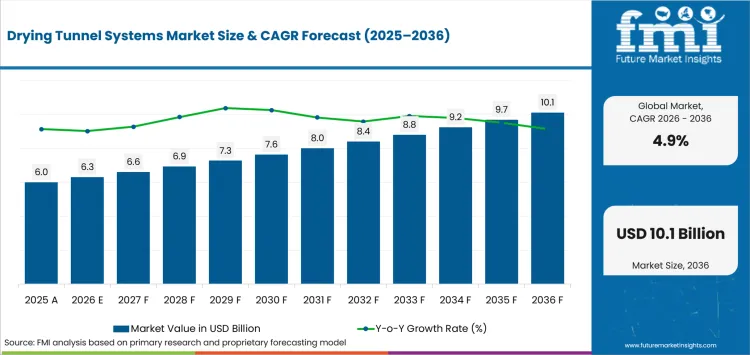
USD 6.3 billion in 2026 and USD 10.1 billion by 2036 at a 4.9% CAGR.
Demand for drying tunnel systems is projected to expand at 4.9% CAGR between 2026 and 2036, increasing valuation from USD 6.3 billion to USD 10.1 billion. Industrial plants replace drying capacity where evaporation or curing constrains line speed and raises heat use. The IEA stated in December 2025 that existing electric technologies can meet most low-temperature heat demand in food, textile and paper manufacturing. Projects advance once line trials prove lower energy per finished unit without weakening cure quality.
Heat-source economics differ by country because plants inherit different fuel exposure and electrical constraints. The Swedish Energy Agency reported in March 2026 that industrial natural-gas use fell 16% during 2025. That decline strengthens the case for electric drying zones where grid capacity can support the load. USA plants with established gas infrastructure may still favor gas or hybrid zones if local power prices weaken payback. Project teams therefore test site load profiles and shutdown windows against the product recipe that must survive the retrofit.
Key Takeaways
- Industrial plants invest in drying tunnels to protect throughput and cure quality with lower heat use during evaporation or curing stages.
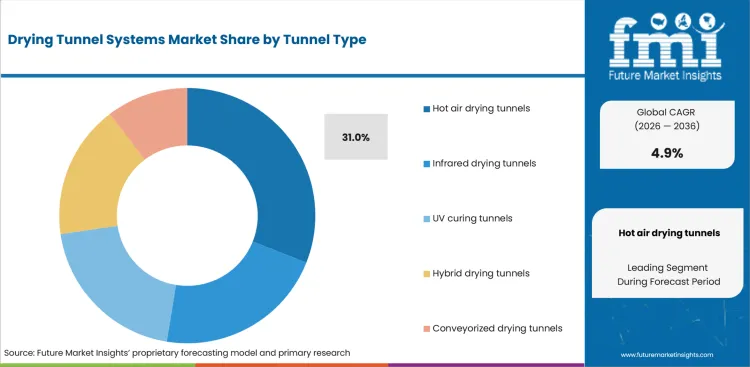
- Based on tunnel type, hot air drying tunnels are projected to account for 31.0% in 2026 due to convection serving diverse moisture-removal recipes.
- By substrate - product, printed sheets - webs are estimated to hold 29.0% in 2026 owing to continuous lines needing uniform treatment before rewinding or finishing.
- Electric is expected to lead heat source demand with 26.0% share in 2026 because controllable power delivery suits resistance and infrared plus UV configurations.
- Brownfield utility limits and line-specific process validation can delay replacement projects even where a newer dryer offers lower nominal energy use.
- Some of the key players in this market include Cefla Finishing, Venjakob, Excelitas Technologies, IST Metz, Bürkle, Spooner Industries, Natgraph, Sakurai, Dubois Equipment, and Giardina Group.
Analyst Perspective
"Dryer bids should be tested against the substrate and line speed that define the customer’s real process window. The better offer proves energy use, cure quality and restart timing before a shutdown is committed."
- Nikhil Kaitwade, Principal Consultant, Future Market Insights
How is the drying tunnel systems market segmented?
The market is segmented by tunnel type, substrate - product, heat source, end use and sales channel.
Tunnel type covers hot air, infrared, UV curing, hybrid and conveyorized drying tunnels. Substrate - product covers printed sheets - webs, coated panels, textiles, food products and industrial parts. Heat source includes electric, gas-fired, steam - thermal oil, infrared and UV - LED. End use covers printing and packaging, wood - furniture finishing, textiles, food processing and industrial coating. Sales channel covers equipment OEMs, system integrators, direct factory projects and aftermarket retrofit.
What makes hot air drying tunnels central to the tunnel type category?
Hot air systems remove water or solvent through controlled convection and let engineers tune airflow without changing coating chemistry. Continuous industrial furnaces use comparable airflow control, but drying tunnels work within a narrower residence-time and substrate-quality window. Natgraph hosted Marabu Italia in February 2025 to test drying conditions for ink on polycarbonate parts under production conditions.
- By tunnel type, hot air drying tunnels are estimated to hold 31.0% in 2026 owing to broad process fit for evaporation-led production steps.
- Application trials remain necessary because air velocity and dwell time must remove volatile content without distorting the substrate or slowing the conveyor line.
Why do printed sheets - webs lead the substrate - product category?
Continuous webs must leave the dryer dry enough for rewinding or further converting without losing tension or surface quality. Web coating equipment imposes the same timing constraint because residence time must track line speed. Natgraph stated in February 2025 that its Air Force Web Series was developed for printed-electronics production at production speed.
- Printed sheets - webs are projected to account for 29.0% of substrate - product demand in 2026 due to continuous handling and width-wise drying requirements.
- Print operators test dryer response at planned press speed because blocking or incomplete cure can damage saleable output after the web leaves the heating zone.
What supports electric heat within the heat source category?
Electric heating gives engineers fast response and direct control over resistance, infrared and UV energy. UV-curable coatings make that control useful because cure dose can change with press speed and substrate sensitivity. Natgraph reported in February 2025 that Diametric Technical achieved more than 40% energy savings after installing a newer UV dryer.
- In 2026, electric is expected to lead heat source demand with 26.0% share because controllable power delivery suits several tunnel architectures and retrofit layouts.
- Available electrical capacity and local utility prices can outweigh efficiency gains on production lines carrying a high continuous load.
Why does printing and packaging lead the end use category?
Printing and packaging place drying directly between ink application and the next converting step. Cure stability determines how much output printing machinery can pass downstream without blocking or under-cure. Excelitas Technologies launched the Phoseon Nexus II UV LED curing platform for flexographic printing in September 2025 with real-time process monitoring for press operation.
- By end use, printing and packaging is forecast to represent 31.0% in 2026 because inline drying governs how quickly printed material reaches downstream operations.
- Packaging printers favor compact systems that match press speed and substrate sensitivity because under-cured output can disrupt rewinding or laminating downstream.
What drives equipment OEMs within the sales channel category?
Drying tunnels must fit upstream applicators and downstream handling before a production line can be accepted. Integration work makes industrial automation compatibility part of the OEM sale. Cefla Finishing announced in May 2025 that its LIGNA program would demonstrate coating lines centered on higher speed and lower energy use.
- Equipment OEMs are set to lead sales channel demand at 42.0% share in 2026 because application engineering and commissioning reduce integration risk for line owners.
- Factory acceptance carries more weight on multi-recipe lines because one engineering team can settle controls and exhaust interfaces before production restarts.
What are the drivers, restraints and opportunities in the Drying Tunnel Systems Market?
Process-heat efficiency supports replacement demand, brownfield utilities slow capital approval and staged retrofit modules let plants improve one drying zone without replacing the full line.
- Driver: Drying stages attract capital after a new process window proves lower heat use without reducing saleable throughput.
- Restraint: Existing electrical capacity and exhaust routing can block otherwise efficient retrofits during a planned shutdown.
- Opportunity: Modular electric and UV upgrades let plants improve one bottleneck without replacing the complete production line.
Drying projects earn capital only if lower heat use survives normal production rates. In July 2025 the IEA estimated that industry represented about 39% of final energy consumption and 80% of final-demand growth since 2019. Pulp drying equipment and comparable lines still need trials that prove energy savings without reducing saleable output.
Brownfield projects can fail at the utility check before equipment price becomes decisive. The USA Department of Energy published its Industrial Electrification Assessment Framework in April 2025 to evaluate facility readiness before conversion. Drying projects need the same discipline because electrical capacity, exhaust routing and shutdown sequencing determine whether a retrofit can be commissioned inside the planned outage.
Retrofit revenue is strongest at plants that can replace one weak curing zone and leave the surrounding line in service. Bürkle stated in May 2025 that easy-CURE UV+ supports both new installations and retrofits to existing UV dryer lines. That format suits roll-to-roll printer lines whose operators cannot absorb a full production shutdown, provided the new zone passes recipe and controls validation.
Which country CAGRs are profiled in the Drying Tunnel Systems Market?
| Country | CAGR |
|---|---|
| Sweden | 5.7% |
| Mexico | 5.4% |
| Brazil | 5.1% |
| Italy | 4.7% |
| USA | 4.4% |
| Germany | 4.1% |
| Japan | 3.8% |
How do country-level CAGRs compare in the Drying Tunnel Systems Market?
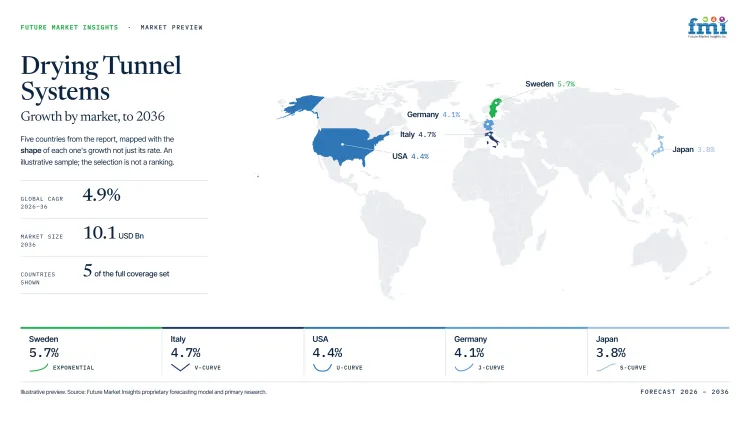
Sweden, Mexico and Brazil form the upper group above 5.0% CAGR. Italy and the USA occupy the middle band. Germany and Japan advance more slowly as replacement timing governs established lines.
- Sweden prioritizes electric heat as fossil use falls.
- Mexico rewards standardized modules on multi-site factory rollouts.
- Brazil requires heat-source flexibility under varied regional utility conditions.
- Italy has several replacement routes in furniture and industrial coating.
- USA projects value retrofits that preserve existing conveyor interfaces.
- Germany expects detailed service planning on highly utilized production assets.
- Japan favors compact retrofits on validated lines.
Similar CAGRs can still convert differently because utility, service and qualification constraints vary by country. The full report provides country-level CAGR analysis across North America, Latin America, Western Europe, Eastern Europe, East Asia, South Asia and Pacific, and the Middle East and Africa.
Country-wise Analysis
- Swedish finishing and print plants enter retrofit review with high electrical exposure because load planning can be as important as the dryer’s rated efficiency on an established line. Drying tunnel demand in Sweden is forecast to grow at 5.7% CAGR over the assessment period, tied to plant programs that verify lower fossil-heat use without changing finish quality. Statistics Sweden updated its industrial electricity series in August 2026 and recorded 21,518 GWh for mining and manufacturing during the first half of 2026, which supports electric upgrades on woodworking machines and finishing lines where connection capacity and recipe trials still determine commissioning timing at older sites.
- USA plants often start with a gas-fired baseline because existing burners and exhaust systems can make full electrical conversion harder than a zone-level retrofit at an operating factory. The EIA reported in May 2026 that industrial natural-gas consumption averaged a record 23.6 Bcf/d in 2025, confirming how deeply gas remains embedded in manufacturing heat. The USA drying tunnel systems outlook is projected to expand at 4.4% CAGR during the forecast period, tied to replacement work on food processing equipment and coating lines that can prove payback under local power prices while staged commissioning limits downtime and electrical capacity narrows the feasible retrofit scope.
- Japanese plants usually protect compact floor layouts and validated recipes because equipment builders must fit new curing zones into production assets that already carry approved operating routines. Adoption of drying tunnel systems in Japan is estimated to expand at 3.8% CAGR through 2036, aided by efficiency programs that reward documented energy savings without encouraging unnecessary line redesign. METI reported in April 2026 that manufacturing energy consumption fell 4.1% in fiscal 2024, which raises the proof standard for replacement projects because limited floor space and conservative acceptance routines favor compact equipment with accessible maintenance and repeatable trial records during scheduled shutdowns.
- German industrial retrofits usually enter capital review with a documented energy baseline and a shutdown plan because mature production lines leave little room for repeated commissioning. Destatis reported in November 2025 that 89.5% of industrial energy use in 2024 went to electricity and heat generation, keeping thermal performance central to plant-level efficiency reviews. Germany is positioned to record 4.1% CAGR over the forecast period, given an installed production base where replacement orders depend on measurable final-energy reduction while exhaust routing and controls integration remain structural constraints that companies must quantify before planned outages during engineering at each site.
- Italian manufacturers often place dryer upgrades inside Transizione 5.0 investment files because metering and pre-project baselines become part of the equipment sale instead of an engineering afterthought. MIMIT’s February 2025 FAQ confirms minimum energy reductions of 3% for a production facility or 5% for the affected process, so equipment companies need traceable calculations before a project can support the incentive case. Drying tunnel systems sales in Italy are forecast to expand at 4.7% CAGR by 2036, attributable to modernization projects that value verified energy performance while documentation can slow smaller projects unless standard test records and commissioning data shorten formal review without sacrificing line validation.
- Mexican manufacturing sites can add new equipment faster than local service networks expand because commissioning distance and spare-parts availability can decide whether a dryer reaches stable output on schedule. The Secretariat of Economy reported in August 2026 that manufacturing FDI rose 9.3% year over year in the first half, which widens the installed base for packaging machinery and related finishing equipment. Mexico is set to post 5.4% CAGR over the forecast period, propelled by factory investment that expands addressable projects while utilities and trained technicians remain the main frictions outside established corridors where nearby service teams gain an advantage during ramp-up and maintenance.
- Brazilian dryer projects face uneven capital timing because food and packaging investment can strengthen while textile or printing plants defer modernization during weaker industrial cycles. The Brazilian drying tunnel systems sector is anticipated to advance at 5.1% CAGR during the assessment period, supported by manufacturing renewal that lowers operating cost per finished unit and broadens retrofit demand. IBGE reported in July 2026 that industrial output grew 1.4% during the first five months of the year, which masks uneven end-use spending and leaves equipment firms competing on flexible service coverage and financing terms while application teams validate different substrates without lengthening commissioning.
Who are the notable companies in the Drying Tunnel Systems Market?
Cefla Finishing, Venjakob, Excelitas Technologies, IST Metz, Bürkle, Spooner Industries, Natgraph, Sakurai, Dubois Equipment, and Giardina Group are the notable companies serving this market.
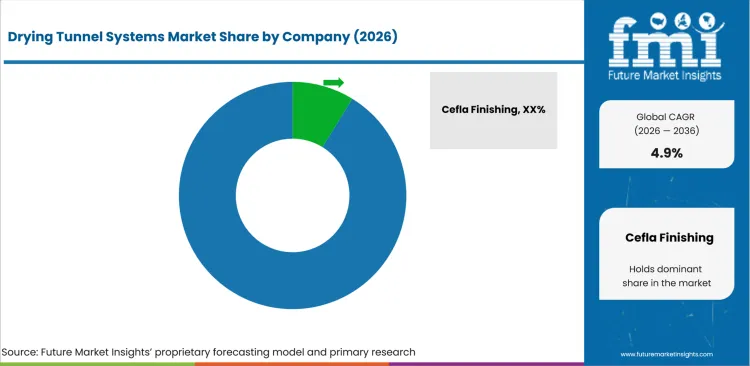
Competition divides between integrated finishing-line builders, radiation-curing specialists and web-drying engineers. Projects become harder to win once line owners require recipe trials, controls integration and field service before a planned shutdown.
- Cefla Finishing and Venjakob serve integrated coating lines together with Bürkle. Dubois Equipment and Giardina Group address similar finishing projects with engineered material handling.
- Excelitas Technologies and IST Metz specialize in infrared, UV and LED energy delivery for curing or industrial heating applications.
- Spooner Industries, Natgraph and Sakurai address web or print workflows where transport stability and inline drying determine usable production output.
Competitive Benchmarking: Drying Tunnel Systems Market
| Company | Drying Technology Breadth | Line Integration Depth | Application Support | Geographic Reach |
|---|---|---|---|---|
| Cefla Finishing | High | High | High | Global |
| Venjakob | High | High | High | Europe and international sales |
| Excelitas Technologies | High | Medium | High | Global |
| IST Metz | High | Medium | High | Global |
| Bürkle | High | High | High | Europe and international sales |
| Spooner Industries | High | High | High | Europe, North America and international projects |
| Natgraph | Medium | High | High | United Kingdom and international sales |
| Sakurai | Medium | Medium | High | Asia, Europe and North America |
| Dubois Equipment | High | High | Medium | North America and international projects |
| Giardina Group | High | High | High | Europe, North America and international sales |
Scoring basis: High technology breadth requires at least three documented drying or curing routes. Medium requires two routes and Low identifies one. High integration depth requires complete-line plus retrofit evidence. Medium identifies one route and Low covers stand-alone supply. High application support requires documented trials plus multi-region service. Medium covers one route and Low identifies a documented narrow support model.
Key Developments in the Drying Tunnel Systems Market
- In March 2026, IST Metz introduced FREEcure for roll-to-roll converters as a UVC curing route developed with BASF that can reduce or eliminate photoinitiator demand.
- In May 2025, Giardina Group presented an integrated LIGNA roller line with two UV curing tunnels and scheduled live demonstrations with coating manufacturers.
- In May 2025, Bürkle introduced easy-Coater ultrafoil as a compact UV surface-finishing system that reduces process steps and floor-space requirements.
Key Players in the Drying Tunnel Systems Market
Integrated Finishing and Coating-Line Builders
- Cefla Finishing
- Venjakob
- Bürkle
- Dubois Equipment
- Giardina Group
Radiation and Specialty-Curing Suppliers
- Excelitas Technologies
- IST Metz
Web, Print and Conveyor-Drying Specialists
- Spooner Industries
- Natgraph
- Sakurai
Drying Tunnel Systems Market - Report Scope
| Coverage field | Report scope |
|---|---|
| Market breakdown | By tunnel type, substrate - product, heat source, end use, sales channel and region. |
| Quantitative Units | USD billion. |
| Market Definition | Industrial tunnel equipment that dries, cures or thermally conditions moving substrates and products within continuous production lines. |
| Regions Covered | North America, Latin America, Western Europe, Eastern Europe, East Asia, South Asia and Pacific, and Middle East and Africa. |
| Countries Covered | Sweden, Mexico, Brazil, Italy, USA, Germany, Japan, and 20+ countries included in the full report. |
| Key Companies Profiled | Cefla Finishing, Venjakob, Excelitas Technologies, IST Metz, Bürkle, Spooner Industries, Natgraph, Sakurai, Dubois Equipment, and Giardina Group. |
| Forecast Period | 2026 to 2036. |
| Approach | Primary and secondary research with market triangulation. |
Drying Tunnel Systems Market - Research Methodology
| Method | Approach |
|---|---|
| Primary Research | FMI analysts gathered input from manufacturers, service providers, technology developers, distributors, end users, procurement teams, and subject-matter experts. Interviews examined purchasing decisions, product or service evaluation, adoption barriers, approval requirements, pricing considerations, and expectations for technical or commercial support. Respondents were also asked what evidence is required before a trial, pilot, or initial order develops into regular purchasing. |
| Desk Research | Desk research covered government statistics, regulatory publications, trade data, industry associations, technical literature, standards, company filings, product information, and official corporate announcements. Sources were reviewed for relevance, publication date, geographic coverage, and consistency with the defined market scope. Claims relating to performance, applications, approvals, capacity, investment, and commercial activity were retained only when supported by credible public evidence. |
| Market Sizing and Forecasting | The market model combined the baseline value with historical performance, segment structure, pricing and volume indicators, adoption levels, company participation, and country-level demand conditions. Forecast assumptions considered economic activity, investment trends, regulatory developments, technology adoption, purchasing cycles, supply availability, and barriers to wider market use. Segment and regional estimates were reconciled before the final market total was calculated. |
| Data Validation | Estimates were checked against multiple independent indicators, including public data, company activity, trade patterns, industry developments, and findings from primary interviews. Validation also tested whether products, services, applications, and company revenues fell within the defined market boundaries. Adjacent categories, unsupported claims, overlapping revenues, and activities without direct market relevance were excluded to reduce double counting and maintain consistency across segments and countries. |
Drying Tunnel Systems Market by Segments
Drying Tunnel Systems Market segmented by Tunnel Type:
- Hot air drying tunnels
- Infrared drying tunnels
- UV curing tunnels
- Hybrid drying tunnels
- Conveyorized drying tunnels
Drying Tunnel Systems Market segmented by Substrate - Product:
- Printed sheets - webs
- Coated panels
- Textiles
- Food products
- Industrial parts
Drying Tunnel Systems Market segmented by Heat Source:
- Electric
- Gas-fired
- Steam - thermal oil
- Infrared
- UV - LED
Drying Tunnel Systems Market segmented by End Use:
- Printing and packaging
- Wood - furniture finishing
- Textiles
- Food processing
- Industrial coating
Drying Tunnel Systems Market segmented by Sales Channel:
- Equipment OEMs
- System integrators
- Direct factory projects
- Aftermarket retrofit
Drying Tunnel Systems Market by Region:
- North America
- United States
- Canada
- Latin America
- Brazil
- Mexico
- Argentina
- Chile
- Western Europe
- Germany
- France
- United Kingdom
- Italy
- Spain
- Benelux
- Nordics
- Eastern Europe
- Poland
- Czech Republic
- Romania
- Hungary
- East Asia
- China
- Japan
- South Korea
- South Asia and Pacific
- India
- ASEAN
- Australia and New Zealand
- Middle East and Africa
- GCC Countries
- South Africa
- Türkiye
- Israel
Research Sources and Bibliography
- International Energy Agency. (2025, December 23). Renewables for Industry
- Swedish Energy Agency. (2026, March 18). Industrins och energiproducenters bränsleanvändning år 2025
- Natgraph. (2025, February 20). Marabu Italia in our Drying Solutions Centre - trailing ink for Italian helmet
- Natgraph. (2025, February 7). Air Force Dryer Series and Air Force Web Series developed for printed electronics
- Natgraph. (2025, February 6). Diametric Technical Ltd with Natgraph’s UV Dryer - achieving over 40% energy savings!
- Excelitas Technologies. (2025, September 2). Excelitas Introduces Phoseon Nexus II UV LED Curing Platform for Flexographic Printing with Advanced Monitoring Capabilities and Improved System Reliability
- Cefla. (2025, May 27). Cefla Finishing at LIGNA 2025: innovation, sustainability and digitalization take centre-stage
- International Energy Agency. (2025, July 1). Industrial facilities could save billions by implementing energy management
- USA Department of Energy. (2025, April 22). Industrial Electrification Assessment Framework
- Robert Bürkle GmbH. (2025, May 5). Easy-Cure UV+: New generation of UV curing technology
- Statistics Sweden. (2026, August 13). Electricity consumption in the extraction of minerals and manufacturing industry by industry SNI2007. Monthly 2009M01 - 2026M06
- USA Energy Information Administration. (2026, May 15). USA industrial natural gas consumption expected to hit records in 2026 and 2027
- Ministry of Economy, Trade and Industry. (2026, April 14). FY2024 Energy Supply and Demand Report (Revised Report)
- Statistisches Bundesamt. (2025, November 14). Energieverbrauch der Industrie 2024 um 1,9 % gestiegen
- Ministero delle Imprese e del Made in Italy. (2025, February 21). FAQ Transizione 5.0
- Secretaría de Economía. (2026, August 24). México registra un máximo histórico de Inversión Extranjera Directa (IED) para un primer semestre: 34 mil 968 millones de dólares en 2026
- Instituto Brasileiro de Geografia e Estatística. (2026, July 3). Industrial production changes -0.2% in May
- IST Metz. (2026, March 17). FREEcure: A new era of UVC curing for roll-to-roll converters
- Giardina Group. (2025, May 13). Giardina Group: ready for Ligna (Hall 16, Stand A12)
- Robert Bürkle GmbH. (2025, May 10). BÜRKLE presents its new UV curing technology at LIGNA 2025
- Venjakob. (2026, April). Venjakob at the PaintExpo 2026
- Excelitas Technologies. (2026, March 31). Excelitas to display UV curing and intelligent infrared solutions for metal coatings at PaintExpo 2026
- Spooner Industries. (n.d.). About Us
- Sakurai Graphic Systems Corporation. (2025, June 17). Business Report 2025
- Dubois Equipment. (n.d.). About
- IST Metz. (2026, January 13). LEDcure NX - Water-cooled LED UV system
- Cefla. (2025, July 21). The balance between innovation and sustainability with Cefla Finishing solutions for Taizhou Rayard
- Giardina Group. (2026, July 31). Giardina Group: ready for IWF Atlanta 2026
- Cefla. (2026, August 26). Taking major industrial players towards Industry 4.0: how Cefla Finishing redefined production efficiency at Puertas Proma
- Venjakob. (2025, March 25). Venjakob Maschinenbau at the Battery Show Europe 2025
- Excelitas Technologies. (2026, September 1). Excelitas Introduces Enhanced OmniCure AC Series UV LED Curing Systems with Higher Performance, Greater Efficiency, and Expanded Application Flexibility
- IST Metz. (2026, June 25). Phoenix Color trusts LEDcure NX from IST METZ
- Robert Bürkle GmbH. (2026, January 30). Robert Bürkle GmbH at Holz-Handwerk 2026
- Natgraph. (2025, April 24). Preview of New Conformal Coating System for PCBs
- Sakurai Graphic Systems Corporation. (2025, November 21). April 2026: The long-awaited new size arrives in the MS-DDS series!
- Giardina Group. (2025, December 12). 3P Evolution: the new line designed by Giardina Group
- Venjakob. (n.d.). Media Center. Retrieved September 6, 2026.
This bibliography is provided for reader reference and is not exhaustive. The full report contains the complete reference list and detailed citations
This Report Answers
- How large is the drying tunnel systems market in 2026 and 2036?
- Which process-heat conditions support new drying tunnel investment?
- Why do hot air drying tunnels hold the leading tunnel type share?
- How do printed sheets - webs shape continuous drying requirements?
- What limits brownfield dryer replacement in established production lines?
- How do country growth rates differ among the seven profiled markets?
- Which capabilities distinguish drying tunnel system companies during competitive evaluation?
- How do equipment OEMs and specialist curing suppliers serve different project needs?
Frequently Asked Questions
How big is the drying tunnel systems market in 2026?
The drying tunnel systems market is valued at USD 6.3 billion in 2026 and is projected to reach USD 10.1 billion by 2036. Industrial plants invest where controlled drying protects throughput and reduces process-heat use.
What is the CAGR of the drying tunnel systems market from 2026 to 2036?
The drying tunnel systems market is projected to grow at a CAGR of 4.9% between 2026 and 2036. Replacement projects gain approval where line trials prove energy savings without weakening cure quality or production speed.
Which tunnel type leads the drying tunnel systems market?
The hot air drying tunnels segment is expected to hold 31.0% of the drying tunnel systems market in 2026, attributable to broad compatibility with evaporation-driven processes. Engineers can adjust airflow and residence time for different substrates without changing the entire heating architecture.
How much incremental opportunity will the drying tunnel systems market generate between 2026 and 2036?
The drying tunnel systems market is expected to gain USD 3.8 billion in value between 2026 and 2036. The increase follows replacement and retrofit spending where plants can improve heat use without sacrificing line output.
Which companies are active in the drying tunnel systems market?
Key companies operating in the market include Cefla Finishing, Venjakob, Excelitas Technologies, IST Metz, Bürkle, Spooner Industries, Natgraph, Sakurai, Dubois Equipment, and Giardina Group. These companies compete on drying technology breadth, line integration and application support.
Preview the report firsthand - request a free sample
Get SampleGet the brochure for pricing and purchase details.
Get PDFTable of Content
- Key Takeaways
- Market Size and CAGR
- Top Growth Driver
- Fastest Growing Segment
- Leading Region
- Key Companies
- Emerging Opportunities
- Executive Summary
- Global Market Outlook
- Demand-side Trends
- Supply-side Trends
- Technology Roadmap Analysis
- Analysis and Recommendations
- Analyst Perspective (What is happening? Why now? What should investors know?)
- Key Questions Answered
- How large is the market?
- What is the CAGR?
- What are key trends?
- Which region dominates?
- Who are the leaders?
- Market Overview
- Market Coverage / Taxonomy
- Market Definition / Scope / Limitations
- Research Methodology
- Chapter Orientation
- Analytical Lens and Working Hypotheses
- Market Structure, Signals, and Trend Drivers
- Benchmarking and Cross-market Comparability
- Market Sizing, Forecasting, and Opportunity Mapping
- Research Design and Evidence Framework
- Desk Research Programme (Secondary Evidence)
- Expert Input and Fieldwork (Primary Evidence)
- Tooling, Models, and Reference Databases
- Data Engineering and Model Build
- Quality Assurance and Audit Trail
- Market Background
- Market Dynamics (Drivers, Restraints, Opportunity, Trends)
- Scenario Forecast (Optimistic, Likely, Conservative)
- Impact Analysis
- AI Impact
- Sustainability Impact
- Regulatory Impact
- Technology Impact
- Consumer / Buyer Analysis
- Purchase Drivers
- Adoption Barriers
- Buyer Journey
- Opportunity Map Analysis
- Product Life Cycle Analysis
- Supply Chain Analysis
- Investment Feasibility Matrix
- Value Chain Analysis
- PESTLE and Porter's Analysis
- Regulatory Landscape
- Regional Parent Market Outlook
- Production and Consumption Statistics
- Import and Export Statistics
- Global Market Analysis and Forecast, 2021 to 2036
- Historical Market Size Value (USD Billion) Analysis, 2021 to 2025
- Current and Future Market Size Value (USD Billion) Projections, 2026 to 2036
- Y-o-Y Growth Trend Analysis
- Absolute $ Opportunity Analysis
- Global Market Pricing Analysis, 2021 to 2036
- Global Market Analysis and Forecast, By Tunnel Type, 2021 to 2036
- Introduction / Key Findings
- Historical Market Size Value (USD Billion) Analysis By Tunnel Type, 2021 to 2025
- Current and Future Market Size Value (USD Billion) Analysis and Forecast By Tunnel Type, 2026 to 2036
- Hot air drying tunnels
- Infrared drying tunnels
- UV curing tunnels
- Hybrid drying tunnels
- Conveyorized drying tunnels
- Hot air drying tunnels
- Y-o-Y Growth Trend Analysis By Tunnel Type, 2021 to 2025
- Absolute $ Opportunity Analysis By Tunnel Type, 2026 to 2036
- Global Market Analysis and Forecast, By Substrate / Product, 2021 to 2036
- Introduction / Key Findings
- Historical Market Size Value (USD Billion) Analysis By Substrate / Product, 2021 to 2025
- Current and Future Market Size Value (USD Billion) Analysis and Forecast By Substrate / Product, 2026 to 2036
- Printed sheets/webs
- Coated panels
- Textiles
- Food products
- Industrial parts
- Printed sheets/webs
- Y-o-Y Growth Trend Analysis By Substrate / Product, 2021 to 2025
- Absolute $ Opportunity Analysis By Substrate / Product, 2026 to 2036
- Global Market Analysis and Forecast, By Heat Source, 2021 to 2036
- Introduction / Key Findings
- Historical Market Size Value (USD Billion) Analysis By Heat Source, 2021 to 2025
- Current and Future Market Size Value (USD Billion) Analysis and Forecast By Heat Source, 2026 to 2036
- Electric
- Gas-fired
- Steam/thermal oil
- Infrared
- UV/LED
- Electric
- Y-o-Y Growth Trend Analysis By Heat Source, 2021 to 2025
- Absolute $ Opportunity Analysis By Heat Source, 2026 to 2036
- Global Market Analysis and Forecast, By End Use, 2021 to 2036
- Introduction / Key Findings
- Historical Market Size Value (USD Billion) Analysis By End Use, 2021 to 2025
- Current and Future Market Size Value (USD Billion) Analysis and Forecast By End Use, 2026 to 2036
- Printing and packaging
- Wood/furniture finishing
- Textiles
- Food processing
- Industrial coating
- Printing and packaging
- Y-o-Y Growth Trend Analysis By End Use, 2021 to 2025
- Absolute $ Opportunity Analysis By End Use, 2026 to 2036
- Global Market Analysis and Forecast, By Sales Channel, 2021 to 2036
- Introduction / Key Findings
- Historical Market Size Value (USD Billion) Analysis By Sales Channel, 2021 to 2025
- Current and Future Market Size Value (USD Billion) Analysis and Forecast By Sales Channel, 2026 to 2036
- Equipment OEMs
- System integrators
- Direct factory projects
- Aftermarket retrofit
- Equipment OEMs
- Y-o-Y Growth Trend Analysis By Sales Channel, 2021 to 2025
- Absolute $ Opportunity Analysis By Sales Channel, 2026 to 2036
- Global Market Analysis and Forecast, By Region, 2021 to 2036
- Introduction
- Historical Market Size Value (USD Billion) Analysis By Region, 2021 to 2025
- Current Market Size Value (USD Billion) Analysis and Forecast By Region, 2026 to 2036
- North America
- Latin America
- Western Europe
- Eastern Europe
- East Asia
- South Asia and Pacific
- Middle East & Africa
- Market Attractiveness Analysis By Region
- North America Market Analysis and Forecast, By Country, 2021 to 2036
- Historical Market Size Value (USD Billion) Trend Analysis By Market Taxonomy, 2021 to 2025
- Market Size Value (USD Billion) Forecast By Market Taxonomy, 2026 to 2036
- By Country
- USA
- Canada
- By Tunnel Type
- By Substrate / Product
- By Heat Source
- By End Use
- By Sales Channel
- By Country
- Market Attractiveness Analysis
- By Country
- By Tunnel Type
- By Substrate / Product
- By Heat Source
- By End Use
- By Sales Channel
- Key Takeaways
- Latin America Market Analysis and Forecast, By Country
- Historical Market Size Value (USD Billion) Trend Analysis By Market Taxonomy, 2021 to 2025
- Market Size Value (USD Billion) Forecast By Market Taxonomy, 2026 to 2036
- By Country
- Brazil
- Mexico
- Chile
- Rest of Latin America
- By Tunnel Type
- By Substrate / Product
- By Heat Source
- By End Use
- By Sales Channel
- By Country
- Market Attractiveness Analysis
- By Country
- By Tunnel Type
- By Substrate / Product
- By Heat Source
- By End Use
- By Sales Channel
- Key Takeaways
- Western Europe Market Analysis and Forecast, By Country
- Historical Market Size Value (USD Billion) Trend Analysis By Market Taxonomy, 2021 to 2025
- Market Size Value (USD Billion) Forecast By Market Taxonomy, 2026 to 2036
- By Country
- Germany
- UK
- Italy
- Spain
- France
- Nordic
- BENELUX
- Rest of Western Europe
- By Tunnel Type
- By Substrate / Product
- By Heat Source
- By End Use
- By Sales Channel
- By Country
- Market Attractiveness Analysis
- By Country
- By Tunnel Type
- By Substrate / Product
- By Heat Source
- By End Use
- By Sales Channel
- Key Takeaways
- Eastern Europe Market Analysis and Forecast, By Country
- Historical Market Size Value (USD Billion) Trend Analysis By Market Taxonomy, 2021 to 2025
- Market Size Value (USD Billion) Forecast By Market Taxonomy, 2026 to 2036
- By Country
- Russia
- Poland
- Hungary
- Balkan & Baltic
- Rest of Eastern Europe
- By Tunnel Type
- By Substrate / Product
- By Heat Source
- By End Use
- By Sales Channel
- By Country
- Market Attractiveness Analysis
- By Country
- By Tunnel Type
- By Substrate / Product
- By Heat Source
- By End Use
- By Sales Channel
- Key Takeaways
- East Asia Market Analysis and Forecast, By Country
- Historical Market Size Value (USD Billion) Trend Analysis By Market Taxonomy, 2021 to 2025
- Market Size Value (USD Billion) Forecast By Market Taxonomy, 2026 to 2036
- By Country
- China
- Japan
- South Korea
- By Tunnel Type
- By Substrate / Product
- By Heat Source
- By End Use
- By Sales Channel
- By Country
- Market Attractiveness Analysis
- By Country
- By Tunnel Type
- By Substrate / Product
- By Heat Source
- By End Use
- By Sales Channel
- Key Takeaways
- South Asia and Pacific Market Analysis and Forecast, By Country
- Historical Market Size Value (USD Billion) Trend Analysis By Market Taxonomy, 2021 to 2025
- Market Size Value (USD Billion) Forecast By Market Taxonomy, 2026 to 2036
- By Country
- India
- ASEAN
- Australia & New Zealand
- Rest of South Asia and Pacific
- By Tunnel Type
- By Substrate / Product
- By Heat Source
- By End Use
- By Sales Channel
- By Country
- Market Attractiveness Analysis
- By Country
- By Tunnel Type
- By Substrate / Product
- By Heat Source
- By End Use
- By Sales Channel
- Key Takeaways
- Middle East & Africa Market Analysis and Forecast, By Country
- Historical Market Size Value (USD Billion) Trend Analysis By Market Taxonomy, 2021 to 2025
- Market Size Value (USD Billion) Forecast By Market Taxonomy, 2026 to 2036
- By Country
- Kingdom of Saudi Arabia
- Other GCC Countries
- Türkiye
- South Africa
- Other African Union
- Rest of Middle East & Africa
- By Tunnel Type
- By Substrate / Product
- By Heat Source
- By End Use
- By Sales Channel
- By Country
- Market Attractiveness Analysis
- By Country
- By Tunnel Type
- By Substrate / Product
- By Heat Source
- By End Use
- By Sales Channel
- Key Takeaways
- Key Countries Market Analysis
- USA
- Pricing Analysis
- Market Share Analysis, 2025
- By Tunnel Type
- By Substrate / Product
- By Heat Source
- By End Use
- By Sales Channel
- Canada
- Pricing Analysis
- Market Share Analysis, 2025
- By Tunnel Type
- By Substrate / Product
- By Heat Source
- By End Use
- By Sales Channel
- Mexico
- Pricing Analysis
- Market Share Analysis, 2025
- By Tunnel Type
- By Substrate / Product
- By Heat Source
- By End Use
- By Sales Channel
- Brazil
- Pricing Analysis
- Market Share Analysis, 2025
- By Tunnel Type
- By Substrate / Product
- By Heat Source
- By End Use
- By Sales Channel
- Chile
- Pricing Analysis
- Market Share Analysis, 2025
- By Tunnel Type
- By Substrate / Product
- By Heat Source
- By End Use
- By Sales Channel
- Germany
- Pricing Analysis
- Market Share Analysis, 2025
- By Tunnel Type
- By Substrate / Product
- By Heat Source
- By End Use
- By Sales Channel
- UK
- Pricing Analysis
- Market Share Analysis, 2025
- By Tunnel Type
- By Substrate / Product
- By Heat Source
- By End Use
- By Sales Channel
- Italy
- Pricing Analysis
- Market Share Analysis, 2025
- By Tunnel Type
- By Substrate / Product
- By Heat Source
- By End Use
- By Sales Channel
- Spain
- Pricing Analysis
- Market Share Analysis, 2025
- By Tunnel Type
- By Substrate / Product
- By Heat Source
- By End Use
- By Sales Channel
- France
- Pricing Analysis
- Market Share Analysis, 2025
- By Tunnel Type
- By Substrate / Product
- By Heat Source
- By End Use
- By Sales Channel
- India
- Pricing Analysis
- Market Share Analysis, 2025
- By Tunnel Type
- By Substrate / Product
- By Heat Source
- By End Use
- By Sales Channel
- ASEAN
- Pricing Analysis
- Market Share Analysis, 2025
- By Tunnel Type
- By Substrate / Product
- By Heat Source
- By End Use
- By Sales Channel
- Australia & New Zealand
- Pricing Analysis
- Market Share Analysis, 2025
- By Tunnel Type
- By Substrate / Product
- By Heat Source
- By End Use
- By Sales Channel
- China
- Pricing Analysis
- Market Share Analysis, 2025
- By Tunnel Type
- By Substrate / Product
- By Heat Source
- By End Use
- By Sales Channel
- Japan
- Pricing Analysis
- Market Share Analysis, 2025
- By Tunnel Type
- By Substrate / Product
- By Heat Source
- By End Use
- By Sales Channel
- South Korea
- Pricing Analysis
- Market Share Analysis, 2025
- By Tunnel Type
- By Substrate / Product
- By Heat Source
- By End Use
- By Sales Channel
- Russia
- Pricing Analysis
- Market Share Analysis, 2025
- By Tunnel Type
- By Substrate / Product
- By Heat Source
- By End Use
- By Sales Channel
- Poland
- Pricing Analysis
- Market Share Analysis, 2025
- By Tunnel Type
- By Substrate / Product
- By Heat Source
- By End Use
- By Sales Channel
- Hungary
- Pricing Analysis
- Market Share Analysis, 2025
- By Tunnel Type
- By Substrate / Product
- By Heat Source
- By End Use
- By Sales Channel
- Kingdom of Saudi Arabia
- Pricing Analysis
- Market Share Analysis, 2025
- By Tunnel Type
- By Substrate / Product
- By Heat Source
- By End Use
- By Sales Channel
- Türkiye
- Pricing Analysis
- Market Share Analysis, 2025
- By Tunnel Type
- By Substrate / Product
- By Heat Source
- By End Use
- By Sales Channel
- South Africa
- Pricing Analysis
- Market Share Analysis, 2025
- By Tunnel Type
- By Substrate / Product
- By Heat Source
- By End Use
- By Sales Channel
- USA
- Market Structure Analysis
- Competition Dashboard
- Competition Benchmarking
- Market Share Analysis of Top Players
- By Regional
- By Tunnel Type
- By Substrate / Product
- By Heat Source
- By End Use
- By Sales Channel
- Emerging Startups
- Innovation Benchmarking
- Competition Analysis
- Competition Deep Dive
- Cefla Finishing
- Overview
- Product Portfolio
- Profitability by Market Segments
- Sales Footprint
- Strategy Overview
- Marketing Strategy
- Product Strategy
- Channel Strategy
- Venjakob
- Heraeus Noblelight
- IST Metz
- Bürkle
- Spooner Industries
- Natgraph
- Sakurai
- Dubois Equipment
- Giardina Group
- Cefla Finishing
- Case Studies
- Success Stories
- Recent Developments
- Competition Deep Dive
- Assumptions & Acronyms Used


