

- Market Size (2026)
- USD 104.0 Mn
- Forecast (2036)
- USD 1434.0 Mn
- CAGR (2026 to 2036)
- 30.0%
How big is Drywall & Interior Finishing Robots Market in 2026?
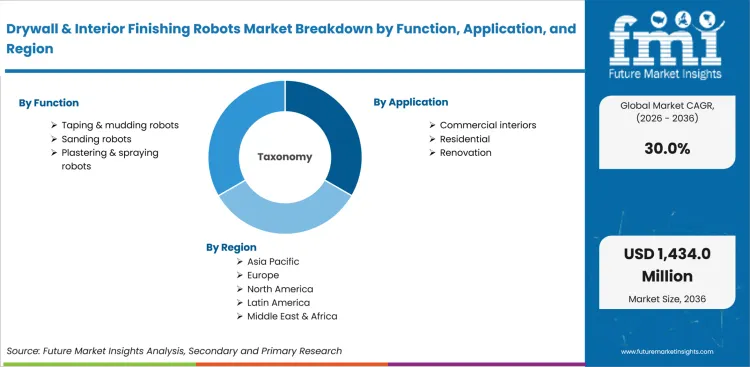
USD 104.0 million in 2026 and USD 1,434.0 million by 2036 at a 30.0% CAGR.
Sales of drywall and interior finishing robots are estimated to rise at 30.0% CAGR through 2036. Valuation is projected to increase from USD 104.0 million in 2026 to USD 1,434.0 million by 2036. The industry outlook is expected to remain positive, supported by demand for taping and sanding tasks that require repetitive overhead motion and leave visible defects when performed inconsistently. According to the USA Bureau of Labor Statistics, there were 12,840 drywall tapers nationwide in May 2025, with mean annual pay of USD 72,710. These cost and labor availability benchmarks are anticipated to strengthen the business case for automated finishing by allowing contractors to compare crew hours directly with robotic application. Connected commercial interiors give painting robots enough repeated surface area to protect machine time and reduce correction work.
United States contractors can test these systems across larger commercial programs with established field service and stable access to replacement parts. European contractors face a longer equipment review that places greater weight on site safety records during every new machine rollout. The USA Census Bureau reported on July 1, 2026 that private nonresidential construction reached an annual rate of USD 738.7 billion in May 2026. That construction base creates more projects with repeated partitions and planned work zones that can support steady robot use. Project managers need to match machine reach with doorway width and ceiling height to avoid losing productive time during setup. High-wall jobs may use aerial work platforms within the same access and safety plan for upper surfaces.
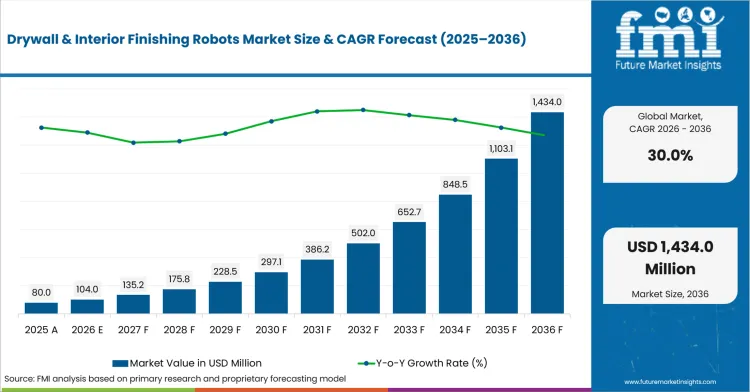
Key Takeaways of Drywall & Interior Finishing Robots Market
- Demand for drywall & interior finishing robots is driven by repeated finishing work across long partitions with strict surface standards, where a visible defect can force costly correction near project closeout.
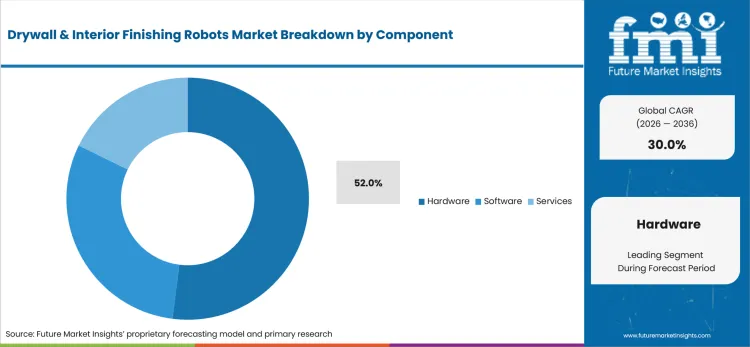
- By component, hardware is expected to lead with 52.0% share in 2026, reflecting the upfront cost of mobile platforms and material delivery systems.
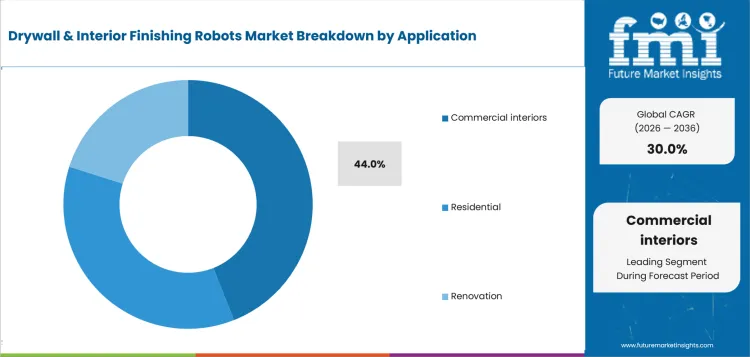
- Commercial interiors are the dominant application segment, projected to hold 44.0% share in 2026, reflecting standardized partitions and larger, connected work areas.
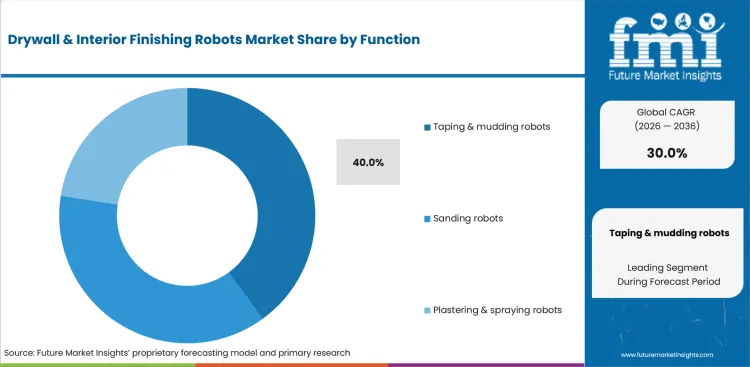
- Taping and mudding robots are estimated to lead the function category with 40.0% share in 2026, supported by repeated seam treatment requirements across wall sections.
- Robots-as-a-service models are anticipated to lead business model adoption with 46.0% share, while drywall contractors are expected to hold 48.0% of end-user demand, reflecting the physical strain of repeated overhead taping and sanding work.
- The United States and European Union are expected to grow at 31.0% and 29.0% CAGR respectively through 2036, with growth differences reflecting deployment speed and approval processes rather than variation in underlying demand.
- Competition centers on Oshkosh/JLG, Okibo, Legend Robot Technology, and Fangshi Robotics, with vendors differentiating through access-platform integration, autonomous navigation-free sanding, size-specific machine offerings, and combined putty-sanding-spraying capability.
Analyst Perspective
"Commercial adoption of wall finishing robots is being driven by dependable productivity on active construction sites rather than performance demonstrated under ideal conditions. Contractors are selecting systems that maintain finish quality across varying room layouts, minimize setup time between work areas, and remain easy to transport throughout the project. Suppliers that support their equipment with responsive field service, operator training, and reliable maintenance are likely to secure repeat business as automation becomes more common in construction finishing."
- Nikhil Kaitwade, Principal Consultant at Future Market Insights
How is the Drywall & Interior Finishing Robots Market segmented?
Industry is segmented by function, application, component, end user, business model, and region
Market segmentation evaluates function, application, components, end users, business models, and regions to reflect differences in workflows, purchasing behavior, and operating conditions. Functional analysis separates joint treatment from sanding and coating tasks, which require distinct tool control across varying interior layouts. Application analysis contrasts commercial interiors with residential construction and renovation, where room sizes and work sequences differ materially. Component analysis covers hardware, software and lifetime support services, while end‑user analysis distinguishes drywall contractors from general contractors and developers that control different stages of the finishing process. Business model analysis compares direct purchase, leasing, and robots‑as‑a‑service approaches across fluctuating project pipelines, and regional analysis weighs project repetition and labor pressure against local service coverage.
What supports taping and mudding robots within the function category?
Joint treatment gives robots a defined task with a clear quality target across every board seam. IAARC researchers published a July 2025 test of a mobile collaborative arm for drywall finishing. The robot removed up to 0.18 millimeters of material in the upper test range, compared with 0.19 millimeters for manual finishing. The close result shows that industrial robots can match normal surface removal on repeated seams with stable access. This evidence matters most on projects that offer enough connected wall length to recover setup time.
- By function, taping and mudding robots are projected to account for 40.0% in 2026 owing to the repeated work required at every seam. Each wall section needs compound placement followed by several finish passes during preparation for the final sanding stage. Long partition runs let the machine repeat this cycle without frequent transport or repeated recalibration between wall sections.
- Drywall firms are expected to favor this function on commercial floors with repeated wall sections and stable access. Small renovation rooms shorten the usable route and raise setup time across each individual wall seam. A project needs enough connected joints to recover transport and calibration costs during scheduled finishing work. This test gives contractors a better measure of value than a brief speed demonstration on a prepared wall.
How do commercial interiors shape demand within the application category?
Commercial interiors provide larger connected work areas than most residential projects or occupied renovation sites. The USA Census Bureau reported on July 1, 2026 that public educational construction reached an annual rate of USD 113.4 billion in May 2026. Schools and campus buildings often repeat corridors and classrooms across several floors within one construction program. That layout supports planned work zones with steadier machine use and fewer transport breaks between rooms. Terrestrial laser scanning can confirm wall positions and travel paths during site setup for these larger projects.
- In 2026, commercial interiors are expected to lead application demand with a 44.0% share due to repeated room layouts and larger work areas. One robot can serve several connected rooms through a planned route that limits transport and setup time. The strongest use case appears on offices or schools that repeat one partition design across several floors.
- General contractors are expected to test robotic finishing on projects that repeat one partition system across several floors. Design changes and blocked rooms can break the planned route and prevent the machine from completing enough wall area. Project schedules need a protected finishing period with open access to every room on the floor. The handoff from framing to finishing matters more than top speed measured during a short demonstration.
What makes hardware central to the component category?
Hardware carries the largest cost through the mobile base and material delivery system for the machine. The Construction Innovation and Technology Fund listed the NOVA-S compact painting robot in its register during July 2026. The register placed spraying output at 260 square meters per hour on walls and 330 square meters on ceilings. Those rates depend on stable movement and controlled material flow across each planned surface during every pass. Three-dimensional laser scanners support distance control and surface mapping, but software cannot correct an unstable base or uneven material flow.
- By component, hardware is estimated to hold 52.0% in 2026 due to the cost of mobile bases and material systems. The machine must pass through doors and hold a stable tool path across the planned surface. Early spending centers on movement and material control that directly affect finish quality during every shift.
- Installed fleets produce operating records across several projects and support greater spending on software and services. Route updates can reduce setup time across familiar buildings and planned maintenance can limit avoidable downtime. Pumps and end tools remain the main early budget items due to their direct control over material delivery. The spending balance changes with a larger fleet and a more regular pipeline of finishing projects.
How do drywall contractors evaluate the end-user case?
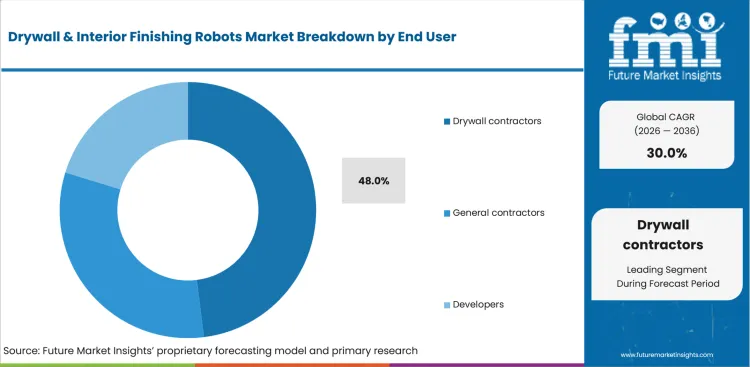
Drywall contractors control the work sequence from joint treatment through final surface inspection on active projects. The USA Bureau of Labor Statistics reported in August 2025 that drywall installation and taping occupations accounted for 118,600 workers during 2024. That employment base gives contractors a clear reference for comparing crew hours with machine hours on the same work package. Automation can reduce repeated application work without replacing the trade knowledge needed for material choice and final acceptance.
- By end user, drywall contractors are estimated to hold 48.0% of demand in 2026 due to their control of taping and sanding labor. They can compare completed wall area with recorded crew hours on the same controlled work package. This direct test makes utilization and finish quality easier to judge under normal site conditions.
- Developers and general contractors may rent equipment for selected projects rather than build a permanent finishing operation. Drywall contractors bring deeper knowledge of compound flow and surface acceptance during the same work stage. Their direct involvement helps identify defects early and adjust material delivery without delaying the next trade during the planned shift.
What drives robots as a service within the business model category?
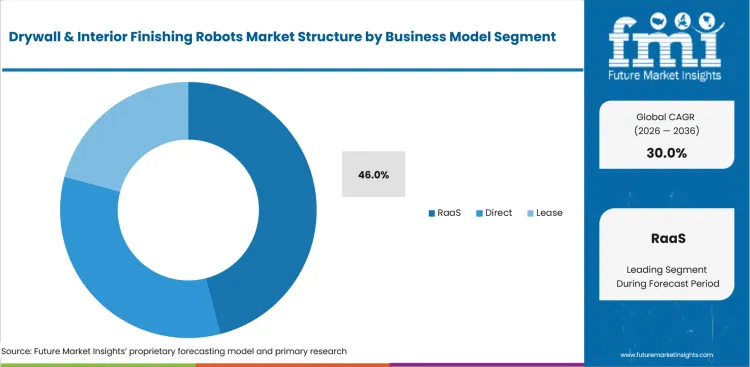
Service access reduces the risk of buying a specialist machine for an uneven project pipeline. The USA Bureau of Labor Statistics reported in August 2025 that self-employed workers represented 19.5% of drywall installers and tapers during 2024. This trade structure supports shared fleets that include training and maintenance within each project charge. Robotics as a service can match machine access to changing project locations without leaving a purchased asset idle. Poor dispatch planning can erase that value through late delivery or slow repair during scheduled finishing work.
- Robots as a service are set to lead the business model category with a 46.0% share in 2026. The service model lowers upfront exposure and places greater maintenance responsibility with the equipment provider during each project. A project fee lets a drywall firm test completed wall area without carrying an idle specialist asset.
- Rental operators and service firms are expected to favor subscription fleets on projects with known wall quantities. Each contract needs clear repair times and damage terms that match the planned finishing period. A low fee offers little value if transport delays or missing parts remove the scheduled work window for the contractor.
What are the drivers, restraints, and opportunities in the Drywall & Interior Finishing Robots Market?
Repeated overhead finishing is expected to support automation adoption, although tight room layouts and shifting work fronts may limit utilization, creating opportunities for broader uptake through improved service access and high‑wall finishing systems.
- Driver: Repeated overhead finishing and strict surface checks are expected to support automation across long wall sections.
- Restraint: Tight rooms and changing work fronts are anticipated to reduce productive machine hours across renovation projects.
- Opportunity: High-wall systems and service access are projected to open projects that cannot support a permanent machine purchase.
Repeated overhead work creates an automation case across taping and coating tasks that demand steady tool control. Okibo announced its BLASTER dual-nozzle system on February 11, 2026 for use with the EG7 and EG7+ platforms. The system covers a standard four-foot board width in two passes and was used on a commercial project in Jacksonville. This development shows that material delivery can improve output without relying on faster travel across the floor. The commercial gain comes from connected work areas that keep compound or paint flow steady throughout the planned shift.
Room layout remains the main commercial restraint for high-wall machines that need clear access and enough turning space. Regulation (EU) 2023/1230 is scheduled to apply from January 20, 2027 across the European Union. The rules require machinery safety records and conformity work for equipment placed on the regional market. Complete technical documents carry greater value during approval and local service planning for regional contractors. A fast robot can lose productive time if reach and transport width do not match the floor plan.
Service access creates an opening for drywall firms that cannot support a permanent fleet across changing project schedules. Okibo announced a Southern United States partnership with AWF-AI on March 9, 2026 for regional rollout. The agreement began with four robots and plans for a local operator training center that supports later fleet growth. This model brings instruction and repair support closer to active projects with fixed finishing windows. This service model lets smart construction equipment compete on completed wall area rather than equipment ownership.
Which country CAGRs are profiled in the Drywall & Interior Finishing Robots Market?
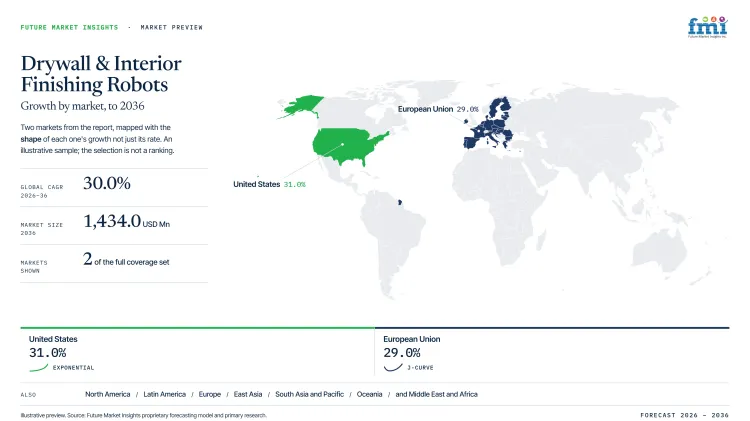
| Country / Region | CAGR |
|---|---|
| United States | 31.0% |
| European Union | 29.0% |
Source: FMI's proprietary forecasting model and primary research
How do country-level CAGRs compare in the Drywall & Interior Finishing Robots Market?
The country comparison spans 2.0 percentage points and reflects a closely aligned growth outlook across the drywall & interior finishing robots market. The United States leads at 31.0% CAGR, while the European Union follows at 29.0%. The narrow difference indicates that both markets are accelerating adoption of construction robotics, although the pace is influenced by labor availability, building practices and investment in automated construction technologies.
-
The United States records the higher CAGR at 31.0% as contractors increasingly evaluate robotic systems for drywall installation, taping, sanding and finishing to improve project consistency, shorten construction schedules and address persistent shortages of skilled finishing workers.
-
The European Union follows 2.0 percentage points behind the United States. Demand reflects growing interest in construction automation for residential, commercial and institutional projects where robotic finishing systems help improve productivity and deliver consistent surface quality. Adoption levels differ across member states because building methods, renovation activity and investment priorities vary across the region.
Comparable CAGRs can still produce different market entry conditions. Differences in construction labor availability, automation readiness, project economics and acceptance of robotic building technologies influence deployment timelines and long-term commercial opportunities. The full report provides country-level CAGR analysis across North America, Latin America, Europe, East Asia, South Asia, Oceania and the Middle East and Africa.
Country-wise Analysis
- Large United States building programs give finishing robots a clearer route to repeat work across several floors. Demand in the United States is forecast to rise at 31.0% CAGR from 2026 to 2036, supported by larger commercial programs and wider domestic service coverage. The Bureau of Labor Statistics reported in August 2025 that the relevant occupations are projected to create 8,800 openings each year from 2024 through 2034. That replacement need strengthens the case for tools that reduce repeated overhead work without removing skilled inspection. Oshkosh and JLG provide an established field-service base for Canvas technology across North America on large projects. Contractors are likely to judge each system by completed wall area and repair response during the planned finishing period.
- European contractors face the same need for labor relief within a more formal machinery review process. The European Union profile is projected to record 29.0% CAGR from 2026 to 2036, reflecting higher labor costs and slower approval across national markets. Eurostat reported on June 16, 2026 that hourly labor costs in EU construction rose 4.2% during the first quarter from one year earlier. The increase improves the case for reducing repeated manual passes across large commercial interiors and public buildings. Equipment providers need clear conformity records and local maintenance coverage for each operating country in the region. Regular use depends on approval readiness and repair support as much as machine speed during a controlled test.
Who are the notable companies in the Drywall & Interior Finishing Robots Market?
Oshkosh Corporation and JLG, Okibo, Legend Robot Technology, and Fangshi Robotics are notable developers across drywall joint finishing, high-wall sanding and coating, putty application, and integrated wall preparation.
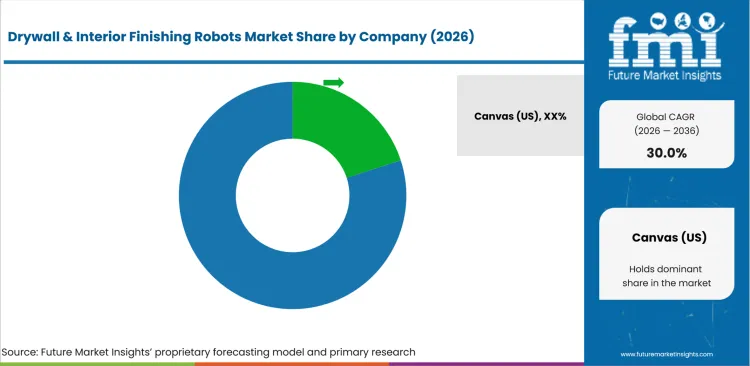
Competition covers joint finishing and high-wall coating plus integrated putty and paint application across several machine designs. Canvas technology gives Oshkosh and JLG a direct position in robotic drywall work through an established access platform. Okibo focuses on autonomous sanding and coating systems that reach tall interior surfaces without external navigation markers. Legend Robot Technology offers separate machine sizes for residential rooms and larger commercial projects with high ceilings. Fangshi Robotics combines putty application and sanding with latex-paint spraying inside one integrated interior-finishing platform. These systems share work zones with crews, so collaborative robots need reliable stopping controls and simple restart procedures. Doorway access and local service coverage then decide which platform fits an active project best.
- Oshkosh and JLG combine Canvas drywall-finishing technology with an established access-equipment platform and North American field service. This position suits large interiors that need elevated reach and planned movement across open floors. Commercial value depends on steady compound delivery and quick recovery from pump or sensor faults.
- Okibo competes through autonomous navigation and high-wall reach within a chassis designed for interior doorways. Its systems work without external markers or separate navigation hardware across the planned work zone. Commercial performance depends on stable sensing and precise material control across changing wall shapes during active use.
- Legend Robot Technology offers shorter machines for residential rooms and 6.2-meter models for public or commercial interiors. The range lets contractors match machine size to ceiling height and floor access for the project. This choice reduces the risk of placing oversized equipment inside compact rooms during the planned shift.
- Fangshi Robotics combines putty spray-scraping with sanding and latex-paint application inside its 433D interior-finishing platform. This task range reduces handoffs between wall preparation and final coating across repeated apartment layouts. The same doorway and turning limits affect compact construction equipment on occupied interior sites during each planned shift.
Competitive Benchmarking: Drywall & Interior Finishing Robots Market
| Company | Drywall Finishing Depth | High-Wall Reach | Autonomous Navigation | Service Presence |
|---|---|---|---|---|
| Canvas / JLG (Oshkosh) | High | High | Medium | North America |
| Okibo | High | High | High | United States and Israel |
| Legend Robot Technology | Medium | High | High | North America and Asia |
| Fangshi Robotics | Medium | Medium | High | China and India |
Scoring basis: High indicates direct evidence of broad capability in the listed area. Medium indicates documented capability with narrower task or regional coverage.
Source: Official pages from Oshkosh Corporation, Okibo, Legend Robot Technology, and Fangshi Robotics.
Key Developments in the Drywall & Interior Finishing Robots Market
- January 2026, Oshkosh Corporation, acquired the core technology developed by Canvas and presented a JLG boom lift with a robotic end effector at CES 2026. The combination links robotic drywall finishing with an established access platform and a North American field-service network with regular parts access. Large commercial projects gain a clearer path from a technical trial to supported use across active construction sites.
- December 2025, Okibo, launched the EG7+ across the United States following its debut at the Hensel Phelps innovation event. The robot reaches 24 feet and covers sanding plus painting and Level 4 finishing within one mobile platform. Its 27-inch body supports movement through interior doorways during finishing work across tall commercial spaces. The broader task range can reduce equipment changes across one planned finishing sequence on site.
- February 2026, Legend Robot Technology, introduced its North American mobile spraying fleet at CONEXPO-CON/AGG. The launch included 6.2-meter latex-paint and putty-spraying models designed for broad walls and high ceilings. Three-dimensional sensing and path planning support continuous coverage across commercial interiors with repeated surfaces and open access. The fleet gives contractors separate machine sizes for residential rooms and larger public projects across the region.
- November 2025, Fangshi Robotics, sent its first batch of construction robots to India through a local partnership that included operator training. The delivery included the 433D interior-finishing platform for projects planned across Mumbai, Pune, Bengaluru, and New Delhi as part of the same regional expansion. The rollout links combined putty and paint tasks with repeated urban building programs across India.
Key Players in the Drywall & Interior Finishing Robots Market
Integrated Access and Drywall Finishing Platforms
- Canvas technology in Oshkosh Corporation and JLG
Autonomous Drywall and High-Wall Finishing Specialists
- Okibo
Putty and Paint Application Robotics
- Legend Robot Technology
- Fangshi Robotics
Drywall & Interior Finishing Robots Market - Report Scope
| Report Attribute | Coverage |
|---|---|
| Market Breakdown | Function, Application, Component, End User, Business Model, and Region |
| Market Definition | Robotic systems for drywall and interior finishing cover taping and mudding plus sanding and plastering; the scope extends to putty application and wall spraying or painting. |
| Regions Covered | North America, Latin America, Europe, East Asia, South Asia and Pacific, Oceania, and Middle East and Africa |
| Countries Covered | United States, Canada, Brazil, Mexico, Germany, United Kingdom, France, China, Japan, South Korea, India, and other countries within the regional model |
| Key Companies Profiled | Canvas technology in Oshkosh and JLG, Okibo, Legend Robot Technology, and Fangshi Robotics |
| Approach | A bottom-up demand assessment based on interior finishing tasks and site layouts, integrated with company capability analysis and validated through country-level forecast reconciliation. |
Source: Future Market Insights - analysis driven by proprietary forecasting models and primary research
Drywall & Interior Finishing Robots Market - Research Methodology
| Method | Application |
|---|---|
| Primary Research | FMI analysts gathered input from manufacturers, service providers, technology developers, distributors, end users, procurement teams, and subject-matter experts. Interviews examined purchasing decisions, product or service evaluation, adoption barriers, approval requirements, pricing considerations, and expectations for technical or commercial support. Respondents were also asked what evidence is required before a trial, pilot, or initial order develops into regular purchasing. |
| Desk Research | Desk research covered government statistics, regulatory publications, trade data, industry associations, technical literature, standards, company filings, product information, and official corporate announcements. Sources were reviewed for relevance, publication date, geographic coverage, and consistency with the defined market scope. Claims relating to performance, applications, approvals, capacity, investment, and commercial activity were retained only when supported by credible public evidence. |
| Market Sizing and Forecasting | The market model combined the baseline value with historical performance, segment structure, pricing and volume indicators, adoption levels, company participation, and country-level demand conditions. Forecast assumptions considered economic activity, investment trends, regulatory developments, technology adoption, purchasing cycles, supply availability, and barriers to wider market use. Segment and regional estimates were reconciled before the final market total was calculated. |
| Data Validation | Estimates were checked against multiple independent indicators, including public data, company activity, trade patterns, industry developments, and findings from primary interviews. Validation also tested whether products, services, applications, and company revenues fell within the defined market boundaries. Adjacent categories, unsupported claims, overlapping revenues, and activities without direct market relevance were excluded to reduce double counting and maintain consistency across segments and countries. |
Drywall & Interior Finishing Robots Market by Segments
Drywall & Interior Finishing Robots Market segmented by Function:
- Taping and mudding robots
- Sanding robots
- Plastering and spraying robots
Drywall & Interior Finishing Robots Market segmented by Application:
- Commercial interiors
- Residential projects
- Renovation work
Drywall & Interior Finishing Robots Market segmented by Component:
- Hardware
- Software
- Services
Drywall & Interior Finishing Robots Market segmented by End User:
- Drywall contractors
- General contractors
- Developers
Drywall & Interior Finishing Robots Market segmented by Business Model:
- Robots as a service
- Direct purchase
- Lease arrangements
Drywall & Interior Finishing Robots Market by Region:
- North America
- United States
- Canada
- Latin America
- Brazil
- Mexico
- Rest of Latin America
- Europe
- Germany
- United Kingdom
- France
- Italy
- Spain
- Nordics
- Benelux
- Rest of Europe
- East Asia
- China
- Japan
- South Korea
- South Asia and Pacific
- India
- ASEAN
- Australia and New Zealand
- Rest of South Asia and Pacific
- Oceania
- Australia
- New Zealand
- Pacific Islands
- Middle East and Africa
- Gulf Cooperation Council
- South Africa
- Türkiye
- North Africa
- Rest of Middle East and Africa
Research Sources and Bibliography
- Bureau of Labor Statistics. (2026, May 15). Occupational employment and wages - May 2025.
- Bureau of Labor Statistics. (2025, August 28). Occupational projections and worker characteristics.
- USA Census Bureau. (2026, July 1). May 2026 construction spending.
- International Association for Automation and Robotics in Construction. (2025, July). Drywall finishing with collaborative robot arm in off-site construction.
- Construction Innovation and Technology Fund. (2026). Robotics register. Retrieved July 2026.
- Okibo. (2026, February 11). Okibo Unleashes BLASTER Technology: A Breakthrough in Autonomous High-Speed Coating for the Construction Industry.
- Okibo. (2026, March 9). Okibo Accelerates Southern USA Expansion Through Strategic Partnership With Autonomous Workforce - AI Solutions LLC.
- Oshkosh Corporation. (2026, January 6). Oshkosh Brings Autonomy, AI, Connectivity and Electrification to CES 2026.
- Okibo. (2025, December 9). Okibo Announces National Launch of EG7+ Robot Following Successful Premiere at Hensel Phelps Innovation Day.
- Legend Robot Technology. (2026, February 24). From Singapore Success to North American Solutions: Legend Robot Unveils First-of-its-Kind Mobile Spraying Fleet at CONEXPO.
- Fangshi Robotics. (2025, November 25). Fangshi Robots Successfully Enter Indian Market.
- European Parliament and Council of the European Union. (2023). Regulation (EU) 2023/1230 on machinery. Current text retrieved July 2026.
- Eurostat. (2026, June 16). Annual increase in labour costs at 3.2% in the euro area.
This bibliography is provided for reader reference. It uses primary government sources plus standards-body and official company announcements.
This Report Answers
- How large is the drywall and interior finishing robots market in 2026 and 2036?
- Which finishing function holds the largest 2026 share?
- Why do commercial interiors provide a favorable use case for robotic finishing?
- How do hardware and service costs shape adoption?
- Why do drywall contractors lead end-user demand?
- How do United States and European Union growth profiles compare?
- Which companies are developing drywall or interior wall-finishing robots?
- What limits utilization on active construction sites?
Frequently Asked Questions
What is driving growth in the Drywall & Interior Finishing Robots Market?
Long wall runs let robots repeat taping and sanding with fewer setup changes during each shift. Strict surface standards make consistent material flow commercially valuable across large interior projects with visible finishes.
Who are the key players in the Drywall & Interior Finishing Robots Market?
Oshkosh and JLG combine Canvas technology with established access equipment and field service across North America. Okibo, Legend Robot Technology and Fangshi Robotics focus on autonomous wall preparation and coating systems.
What is a notable restraint in the Drywall & Interior Finishing Robots Market?
Tight rooms reduce productive machine hours and increase transport time across renovation projects with short wall sections. Irregular layouts can erase the savings measured during a controlled demonstration on a prepared surface.
Why should executives track the Drywall & Interior Finishing Robots Market?
The market tests whether construction robotics can deliver repeatable value across active building sites and renovation projects. Successful systems may shift skilled labor toward setup and final surface inspection across larger connected wall areas.
What business problem does the Drywall & Interior Finishing Robots Market address?
These robots address slow and physically demanding wall-finishing work that must meet a strict visible quality standard. They can reduce repeated manual passes and make material flow more consistent across the planned finishing shift.
What should procurement leaders evaluate before selecting suppliers?
Project teams should compare machine reach and transport width with the actual floor plan and work sequence. Service response and material compatibility should carry equal weight during equipment selection for active construction projects.
What limits return on investment for purchasers?
Low utilization limits returns on projects with changing work fronts and short wall sections that interrupt machine routes. Setup delays can remove projected savings from a prepared demonstration during live construction work with changing access.
How do suppliers build long-term account confidence?
Equipment providers build contractor confidence through reliable field service and clear records of completed wall area. Drywall firms need proof that finish quality remains stable across materials and normal site conditions.
Preview the report firsthand - request a free sample
Get SampleGet the brochure for pricing and purchase details.
Get PDFTable of Content
- Key Takeaways
- Market Size and CAGR
- Top Growth Driver
- Fastest Growing Segment
- Leading Region
- Key Companies
- Emerging Opportunities
- Executive Summary
- Global Market Outlook
- Demand-side Trends
- Supply-side Trends
- Technology Roadmap Analysis
- Analysis and Recommendations
- Analyst Perspective (What is happening? Why now? What should investors know?)
- Key Questions Answered
- How large is the market?
- What is the CAGR?
- What are key trends?
- Which region dominates?
- Who are the leaders?
- Market Overview
- Market Coverage / Taxonomy
- Market Definition / Scope / Limitations
- Research Methodology
- Chapter Orientation
- Analytical Lens and Working Hypotheses
- Market Structure, Signals, and Trend Drivers
- Benchmarking and Cross-market Comparability
- Market Sizing, Forecasting, and Opportunity Mapping
- Research Design and Evidence Framework
- Desk Research Programme (Secondary Evidence)
- Expert Input and Fieldwork (Primary Evidence)
- Tooling, Models, and Reference Databases
- Data Engineering and Model Build
- Quality Assurance and Audit Trail
- Market Background
- Market Dynamics (Drivers, Restraints, Opportunity, Trends)
- Scenario Forecast (Optimistic, Likely, Conservative)
- Impact Analysis
- AI Impact
- Sustainability Impact
- Regulatory Impact
- Technology Impact
- Consumer / Buyer Analysis
- Purchase Drivers
- Adoption Barriers
- Buyer Journey
- Opportunity Map Analysis
- Product Life Cycle Analysis
- Supply Chain Analysis
- Investment Feasibility Matrix
- Value Chain Analysis
- PESTLE and Porter's Analysis
- Regulatory Landscape
- Regional Parent Market Outlook
- Production and Consumption Statistics
- Import and Export Statistics
- Global Market Analysis and Forecast, 2021 to 2036
- Historical Market Size Value (USD Million) Analysis, 2021 to 2025
- Current and Future Market Size Value (USD Million) Projections, 2026 to 2036
- Y-o-Y Growth Trend Analysis
- Absolute $ Opportunity Analysis
- Global Market Pricing Analysis, 2021 to 2036
- Global Market Analysis and Forecast, By Function, 2021 to 2036
- Introduction / Key Findings
- Historical Market Size Value (USD Million) Analysis By Function, 2021 to 2025
- Current and Future Market Size Value (USD Million) Analysis and Forecast By Function, 2026 to 2036
- Taping & mudding robots
- Sanding robots
- Plastering & spraying robots
- Taping & mudding robots
- Y-o-Y Growth Trend Analysis By Function, 2021 to 2025
- Absolute $ Opportunity Analysis By Function, 2026 to 2036
- Global Market Analysis and Forecast, By Application, 2021 to 2036
- Introduction / Key Findings
- Historical Market Size Value (USD Million) Analysis By Application, 2021 to 2025
- Current and Future Market Size Value (USD Million) Analysis and Forecast By Application, 2026 to 2036
- Commercial interiors
- Residential
- Renovation
- Commercial interiors
- Y-o-Y Growth Trend Analysis By Application, 2021 to 2025
- Absolute $ Opportunity Analysis By Application, 2026 to 2036
- Global Market Analysis and Forecast, By Component, 2021 to 2036
- Introduction / Key Findings
- Historical Market Size Value (USD Million) Analysis By Component, 2021 to 2025
- Current and Future Market Size Value (USD Million) Analysis and Forecast By Component, 2026 to 2036
- Hardware
- Software
- Services
- Hardware
- Y-o-Y Growth Trend Analysis By Component, 2021 to 2025
- Absolute $ Opportunity Analysis By Component, 2026 to 2036
- Global Market Analysis and Forecast, By End User, 2021 to 2036
- Introduction / Key Findings
- Historical Market Size Value (USD Million) Analysis By End User, 2021 to 2025
- Current and Future Market Size Value (USD Million) Analysis and Forecast By End User, 2026 to 2036
- Drywall contractors
- General contractors
- Developers
- Drywall contractors
- Y-o-Y Growth Trend Analysis By End User, 2021 to 2025
- Absolute $ Opportunity Analysis By End User, 2026 to 2036
- Global Market Analysis and Forecast, By Business Model, 2021 to 2036
- Introduction / Key Findings
- Historical Market Size Value (USD Million) Analysis By Business Model, 2021 to 2025
- Current and Future Market Size Value (USD Million) Analysis and Forecast By Business Model, 2026 to 2036
- RaaS
- Direct
- Lease
- RaaS
- Y-o-Y Growth Trend Analysis By Business Model, 2021 to 2025
- Absolute $ Opportunity Analysis By Business Model, 2026 to 2036
- Global Market Analysis and Forecast, By Region, 2021 to 2036
- Introduction
- Historical Market Size Value (USD Million) Analysis By Region, 2021 to 2025
- Current Market Size Value (USD Million) Analysis and Forecast By Region, 2026 to 2036
- North America
- Latin America
- Western Europe
- Eastern Europe
- East Asia
- South Asia and Pacific
- Middle East & Africa
- Market Attractiveness Analysis By Region
- North America Market Analysis and Forecast, By Country, 2021 to 2036
- Historical Market Size Value (USD Million) Trend Analysis By Market Taxonomy, 2021 to 2025
- Market Size Value (USD Million) Forecast By Market Taxonomy, 2026 to 2036
- By Country
- USA
- Canada
- By Function
- By Application
- By Component
- By End User
- By Business Model
- By Country
- Market Attractiveness Analysis
- By Country
- By Function
- By Application
- By Component
- By End User
- By Business Model
- Key Takeaways
- Latin America Market Analysis and Forecast, By Country
- Historical Market Size Value (USD Million) Trend Analysis By Market Taxonomy, 2021 to 2025
- Market Size Value (USD Million) Forecast By Market Taxonomy, 2026 to 2036
- By Country
- Brazil
- Mexico
- Chile
- Rest of Latin America
- By Function
- By Application
- By Component
- By End User
- By Business Model
- By Country
- Market Attractiveness Analysis
- By Country
- By Function
- By Application
- By Component
- By End User
- By Business Model
- Key Takeaways
- Western Europe Market Analysis and Forecast, By Country
- Historical Market Size Value (USD Million) Trend Analysis By Market Taxonomy, 2021 to 2025
- Market Size Value (USD Million) Forecast By Market Taxonomy, 2026 to 2036
- By Country
- Germany
- UK
- Italy
- Spain
- France
- Nordic
- BENELUX
- Rest of Western Europe
- By Function
- By Application
- By Component
- By End User
- By Business Model
- By Country
- Market Attractiveness Analysis
- By Country
- By Function
- By Application
- By Component
- By End User
- By Business Model
- Key Takeaways
- Eastern Europe Market Analysis and Forecast, By Country
- Historical Market Size Value (USD Million) Trend Analysis By Market Taxonomy, 2021 to 2025
- Market Size Value (USD Million) Forecast By Market Taxonomy, 2026 to 2036
- By Country
- Russia
- Poland
- Hungary
- Balkan & Baltic
- Rest of Eastern Europe
- By Function
- By Application
- By Component
- By End User
- By Business Model
- By Country
- Market Attractiveness Analysis
- By Country
- By Function
- By Application
- By Component
- By End User
- By Business Model
- Key Takeaways
- East Asia Market Analysis and Forecast, By Country
- Historical Market Size Value (USD Million) Trend Analysis By Market Taxonomy, 2021 to 2025
- Market Size Value (USD Million) Forecast By Market Taxonomy, 2026 to 2036
- By Country
- China
- Japan
- South Korea
- By Function
- By Application
- By Component
- By End User
- By Business Model
- By Country
- Market Attractiveness Analysis
- By Country
- By Function
- By Application
- By Component
- By End User
- By Business Model
- Key Takeaways
- South Asia and Pacific Market Analysis and Forecast, By Country
- Historical Market Size Value (USD Million) Trend Analysis By Market Taxonomy, 2021 to 2025
- Market Size Value (USD Million) Forecast By Market Taxonomy, 2026 to 2036
- By Country
- India
- ASEAN
- Australia & New Zealand
- Rest of South Asia and Pacific
- By Function
- By Application
- By Component
- By End User
- By Business Model
- By Country
- Market Attractiveness Analysis
- By Country
- By Function
- By Application
- By Component
- By End User
- By Business Model
- Key Takeaways
- Middle East & Africa Market Analysis and Forecast, By Country
- Historical Market Size Value (USD Million) Trend Analysis By Market Taxonomy, 2021 to 2025
- Market Size Value (USD Million) Forecast By Market Taxonomy, 2026 to 2036
- By Country
- Kingdom of Saudi Arabia
- Other GCC Countries
- Türkiye
- South Africa
- Other African Union
- Rest of Middle East & Africa
- By Function
- By Application
- By Component
- By End User
- By Business Model
- By Country
- Market Attractiveness Analysis
- By Country
- By Function
- By Application
- By Component
- By End User
- By Business Model
- Key Takeaways
- Key Countries Market Analysis
- USA
- Pricing Analysis
- Market Share Analysis, 2025
- By Function
- By Application
- By Component
- By End User
- By Business Model
- Canada
- Pricing Analysis
- Market Share Analysis, 2025
- By Function
- By Application
- By Component
- By End User
- By Business Model
- Mexico
- Pricing Analysis
- Market Share Analysis, 2025
- By Function
- By Application
- By Component
- By End User
- By Business Model
- Brazil
- Pricing Analysis
- Market Share Analysis, 2025
- By Function
- By Application
- By Component
- By End User
- By Business Model
- Chile
- Pricing Analysis
- Market Share Analysis, 2025
- By Function
- By Application
- By Component
- By End User
- By Business Model
- Germany
- Pricing Analysis
- Market Share Analysis, 2025
- By Function
- By Application
- By Component
- By End User
- By Business Model
- UK
- Pricing Analysis
- Market Share Analysis, 2025
- By Function
- By Application
- By Component
- By End User
- By Business Model
- Italy
- Pricing Analysis
- Market Share Analysis, 2025
- By Function
- By Application
- By Component
- By End User
- By Business Model
- Spain
- Pricing Analysis
- Market Share Analysis, 2025
- By Function
- By Application
- By Component
- By End User
- By Business Model
- France
- Pricing Analysis
- Market Share Analysis, 2025
- By Function
- By Application
- By Component
- By End User
- By Business Model
- India
- Pricing Analysis
- Market Share Analysis, 2025
- By Function
- By Application
- By Component
- By End User
- By Business Model
- ASEAN
- Pricing Analysis
- Market Share Analysis, 2025
- By Function
- By Application
- By Component
- By End User
- By Business Model
- Australia & New Zealand
- Pricing Analysis
- Market Share Analysis, 2025
- By Function
- By Application
- By Component
- By End User
- By Business Model
- China
- Pricing Analysis
- Market Share Analysis, 2025
- By Function
- By Application
- By Component
- By End User
- By Business Model
- Japan
- Pricing Analysis
- Market Share Analysis, 2025
- By Function
- By Application
- By Component
- By End User
- By Business Model
- South Korea
- Pricing Analysis
- Market Share Analysis, 2025
- By Function
- By Application
- By Component
- By End User
- By Business Model
- Russia
- Pricing Analysis
- Market Share Analysis, 2025
- By Function
- By Application
- By Component
- By End User
- By Business Model
- Poland
- Pricing Analysis
- Market Share Analysis, 2025
- By Function
- By Application
- By Component
- By End User
- By Business Model
- Hungary
- Pricing Analysis
- Market Share Analysis, 2025
- By Function
- By Application
- By Component
- By End User
- By Business Model
- Kingdom of Saudi Arabia
- Pricing Analysis
- Market Share Analysis, 2025
- By Function
- By Application
- By Component
- By End User
- By Business Model
- Türkiye
- Pricing Analysis
- Market Share Analysis, 2025
- By Function
- By Application
- By Component
- By End User
- By Business Model
- South Africa
- Pricing Analysis
- Market Share Analysis, 2025
- By Function
- By Application
- By Component
- By End User
- By Business Model
- USA
- Market Structure Analysis
- Competition Dashboard
- Competition Benchmarking
- Market Share Analysis of Top Players
- By Regional
- By Function
- By Application
- By Component
- By End User
- By Business Model
- Emerging Startups
- Innovation Benchmarking
- Competition Analysis
- Competition Deep Dive
- Canvas (US)
- Overview
- Product Portfolio
- Profitability by Market Segments
- Sales Footprint
- Strategy Overview
- Marketing Strategy
- Product Strategy
- Channel Strategy
- OKIBO (IL)
- Mud Robotics (US)
- Canvas (US)
- Case Studies
- Success Stories
- Recent Developments
- Competition Deep Dive
- Assumptions & Acronyms Used


