

- Market Size (2026)
- USD 4.3 Bn
- Forecast (2036)
- USD 7.3 Bn
- CAGR (2026 to 2036)
- 5.6%
How big is Dynamic Brake Resistors Market in 2026?
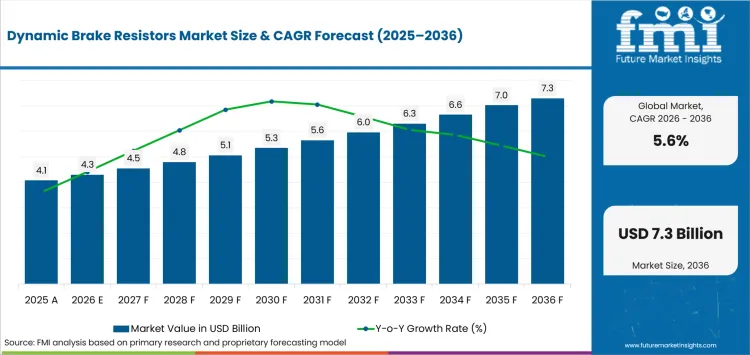
USD 4.3 billion in 2026 and USD 7.3 billion by 2036 at a 5.6% CAGR.
Demand for dynamic brake resistors is projected to expand at 5.6% CAGR between 2026 and 2036, lifting the market from USD 4.3 billion to USD 7.3 billion. Controlled electric motion increases deceleration events that return energy to the drive DC link. Korea’s Ministry of Trade, Industry and Resources recorded 519 company responses to its AI Factory demand survey in May 2025. More motor-drive installations increase the number of systems that need a braking-energy path when regeneration is unavailable.
Rail projects provide a second purchasing route since traction braking equipment must survive repeated thermal and mechanical loading. In July 2025 CINEA selected 94 transport projects and directed 77% of the funding to rail. The programme includes ERTMS work on trains and tracks in eleven EU member states. Rail investment does not guarantee resistor orders, but it expands the asset base for braking assemblies entering new-build or replacement specifications.
Key Takeaways
- Demand rises with VFD-controlled machinery and electric traction as rapid deceleration returns energy toward the DC link.
- By resistor type, grid resistors are estimated to hold 31.0% share in 2026 owing to rugged bank construction for repeated braking duty.
- In 2026, 10-100 kW is expected to lead power rating with 36.0% share due to the range’s fit with many factory-drive duties.
- Variable frequency drives are set to lead the application category with 31.0% share in 2026, attributable to direct control over resistance limits and stopping duty.
- Application-specific ohmic limits and pulse energy can extend qualification if a mismatched resistor might trip the drive or exceed enclosure temperature.
- Key players in the dynamic brake resistors market include Cressall Resistors, Post Glover Resistors, Vishay, Telema, TE Connectivity, Fortress Resistors, Hilkar, Frizlen, Betech, and Powerohm Resistors.
Analyst Perspective
"Dynamic brake resistors are specified at the drive level because resistance limits and braking duty determine whether a stop is electrically viable. Commercial value therefore depends on thermal design, enclosure fit and engineering support that keep the approved resistor usable through the equipment life."
- Nikhil Kaitwade, Principal Consultant, Future Market Insights
How is the dynamic brake resistors market segmented?
The market is segmented by resistor type, power rating, application, end use, sales channel and region.
Resistor types include grid resistors, wirewound resistors, stainless steel resistor banks, liquid-cooled resistors and modular brake resistor units. Power ratings cover below 10 kW, 10-100 kW, 100 kW-1 MW and above 1 MW. Applications include variable frequency drives, cranes/hoists, mining trucks, rail traction and renewable energy systems. End uses cover industrial automation, mining, rail/transport, energy/utilities and material handling. Sales channels include drive OEMs, electrical distributors, system integrators and MRO/service.
Why do variable frequency drives lead the application category?
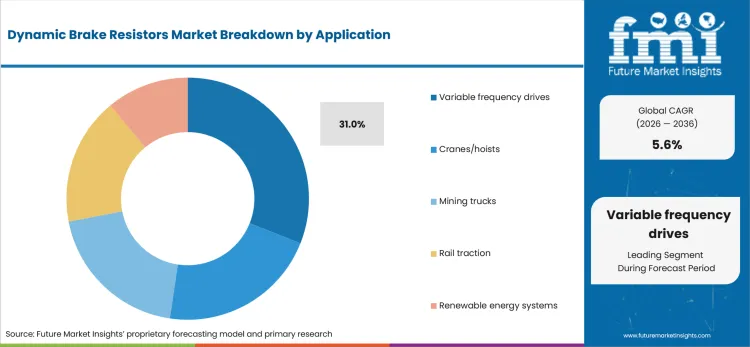
The VFD sets the permissible resistance window and controls the braking transistor or chopper, so dynamic braking is specified from the drive. The adjacent braking resistor category follows those design-in decisions closely. In January 2025 South Korea’s Ministry of SMEs and Startups said manufacturing robots and data-driven smart factories would reach more than 1,700 manufacturing SMEs.
- Variable frequency drives are forecast to represent 31.0% application share in 2026 due to direct control over resistance limits and stopping duty.
- OEM reference data shortens selection. The resistor must still match load inertia with stop frequency and the available cooling path.
Why do grid resistors lead the resistor type category?
Grid resistors spread pulse energy through exposed metal elements and can be assembled into serviceable banks for heavy braking duty. Rail and large motion systems expose railway traction motors to repeated deceleration. In January 2025 the USA Department of Transportation funded 123 rail-crossing projects covering work or studies at more than 1,000 crossings.
- The grid resistor segment is likely to capture 31.0% share in 2026 attributable to overload tolerance and scalable bank construction.
- Rail and heavy industrial projects qualify grid banks against pulse energy, vibration and cooling limits during assembly release testing.
Why does 10-100 kW lead the power rating category?
The 10-100 kW range covers machine drives that need meaningful braking power without a megawatt-class resistor bank. It aligns with electric motor systems in conveyors and production equipment. IEC published Amendment 1 to IEC 61800-9-2 in December 2025, updating efficiency determination and classification for adjustable-speed power drive systems. This range is common in mid-sized industrial motion systems.
- In 2026, 10-100 kW is expected to lead power rating with 36.0% share. The range fits many industrial stopping duties.
- Engineers size this class from the drive maker’s resistance floor and braking power, then verify enclosure temperature at the intended mounting point.
Why does industrial automation lead the end use category?
Factory automation concentrates short acceleration and stopping cycles in one site, which gives braking resistors repeated thermal duty. The installed base also grows with industrial robots and automated material flow. The International Federation of Robotics reported in September 2025 that South Korea installed 30,600 industrial robots in 2024. The installed-base effect is commercially important.
- Industrial automation is set to lead the end use category with 29.0% share in 2026, tied to dense use of VFD and servo axes.
- Standardized drive families let plants reuse qualified resistor designs, but changed inertia or cycle time requires a fresh braking calculation.
Why do drive OEMs lead the sales channel category?
Drive OEMs influence resistor selection early in machine design because their DC-bus limits define the safe ohmic range. This design-in position also shapes braking resistors in material handling equipment. At SPS 2025 TE Connectivity presented multiple braking-resistor series for industrial controls with varied ratings and enclosure options. Early specification can shape later replacement choices.
- Drive OEMs are projected to hold 37.0% sales channel share in 2026. Compatibility guidance can place the resistor inside the drive package.
- System integrators shape enclosure and thermal protection, while MRO channels gain importance after an installed assembly needs replacement.
What are the drivers, restraints and opportunities in the Dynamic Brake Resistors Market?
More controlled electric motion increases braking-energy events, application-specific sizing slows approval, and higher-density resistor designs widen the range of duties that can be served.
- Driver: Factory automation and electric traction place more motors under controlled deceleration, increasing the number of systems that need a braking-energy path.
- Restraint: Each resistor must stay inside the drive’s resistance limits and absorb specified pulse energy without exceeding thermal or enclosure constraints.
- Opportunity: Higher power density and better thermal monitoring can serve harder braking duties once conventional air-cooled units become too large.
Controlled Motion Increases the Installed Braking Requirement
Automation investment increases the number of motor axes that accelerate and stop under electronic control. South Korea’s industry ministry opened 32 new AI Factory projects in April 2026 after gathering demand from more than 400 companies and institutions. That pipeline increases industrial automation projects that set resistor sizing during drive integration. Orders depend on proving the resistance window and braking duty during production release.
Drive Safety and Thermal Limits Slow Qualification
A braking resistor must dissipate energy without pushing the drive outside its electrical or thermal safety limits. IEC issued Corrigendum 2 to IEC 61800-5-1 in December 2025 for adjustable-speed power drive safety requirements. The update keeps variable frequency drives tied to documented safety and test records. Substitution can therefore take longer than a simple resistance match if enclosure temperature or protection settings change.
Higher-Density Resistor Production Opens Heavier Duty Routes
Higher-duty braking requires more heat to leave a smaller package without shortening resistor life. In August 2026 Vishay introduced the RPWA 650 thick-film power resistor with 650 W continuous power and optional temperature sensing. The release does not establish dynamic-braking adoption by itself. It does show how higher power density and thermal feedback can reduce package size until an application engineer validates pulse energy and cooling.
Which country CAGRs are profiled in the Dynamic Brake Resistors Market?
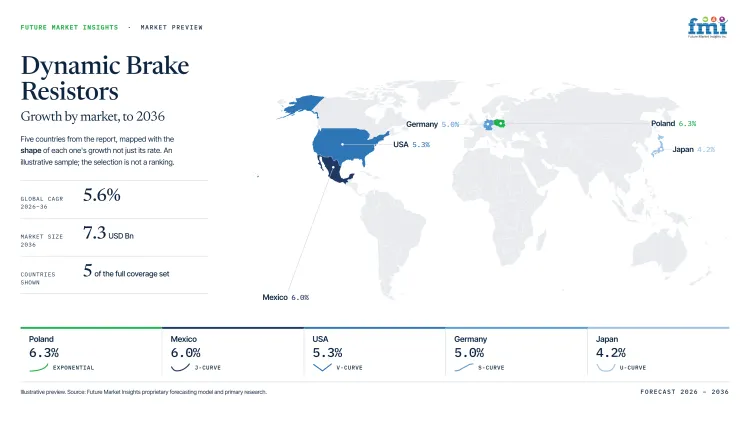
| Country | CAGR |
|---|---|
| Poland | 6.3% |
| Mexico | 6.0% |
| South Korea | 5.6% |
| USA | 5.3% |
| Germany | 5.0% |
| France | 4.6% |
| Japan | 4.2% |
How do country-level CAGRs compare in the Dynamic Brake Resistors Market?
Poland and Mexico form the upper band above 6.0%. South Korea and the USA follow through automation or replacement activity. Germany, France and Japan depend more on installed-base renewal and longer qualification cycles.
- Poland secures traction choices during tender design.
- Mexico gains design-in points during railway commissioning planning.
- South Korea concentrates braking duty inside automated factories.
- USA replacement work depends on installed-drive compatibility.
- Germany requires detailed records for component substitutions.
- France links access to scheduled rail possessions.
- Japan relies on integrators for automation qualification.
Similar CAGRs therefore mask different order routes. The full report provides country-level CAGR analysis across North America, Latin America, Western Europe, Eastern Europe, East Asia, South Asia and Pacific, and the Middle East and Africa.
Country-wise Analysis
- Polish rail renewal places braking hardware into traction specifications while modernized lines are being prepared for service, making early engineering support valuable during tender design and fleet qualification for new electric traction packages. The Ministry of Development Funds and Regional Policy said in February 2025 that at least 800 km of railway lines would be modernized or built under the national recovery programme for rail infrastructure. Poland is projected to expand at 6.3% CAGR through 2036 given new rail work that opens specification windows during commissioning, and railway rolling stock references and documented thermal performance improve access to later replacement work over the full equipment life.
- Mexico is building passenger and freight corridors as industrial plants continue to use drive-controlled cranes and conveyors, giving resistor manufacturers two different routes into new equipment specifications and later replacement work. Dynamic brake resistor demand is forecast to rise at 6.0% CAGR through 2036, attributable to new transport assets that allow braking components to be selected at design stage ahead of long-term service and fixed fleet maintenance routines. In April 2025 the federal government announced the first 774 km of passenger railway and 240 km of freight lines, but uneven local stock and crane systems support can complicate commissioning outside major industrial centres.
- South Korean factories are fitting more automation into existing production floors, so compact braking assemblies must match established cabinets and drive families without extending retrofit downtime or forcing wider electrical redesign. In October 2025 the Ministry of Trade, Industry and Resources said AI Factory pilots had passed 100 with a target of 500 by 2030 as manufacturers tested more AI-controlled production equipment. Dynamic brake resistor sales are estimated to expand at 5.6% CAGR over the forecast period. Retrofit activity increases controlled motion but uneven integration among smaller manufacturers keeps local sizing support important during plant-level commissioning.
- USA replacement demand comes from a large installed base of industrial drives and rail equipment, so resistor substitutes need documented compatibility for service release and entry into established maintenance programmes. In April 2026 the Federal Railroad Administration opened FY2025-2026 CRISI funding of up to USD 2.039 billion for eligible rail projects, extending the pipeline of equipment renewal and safety work. The USA is anticipated to record 5.3% CAGR through 2036 as modernization introduces new specifications and installed assets generate replacement orders, and fragmented OEM references make North American engineering coverage a practical advantage during both tendering and field replacement.
- German machine builders require detailed drive documentation and safety reviews for component changes, raising the proof needed to replace an installed braking resistor inside established automation platforms. Destatis stated in February 2026 that machinery and equipment production fell 2.6% in 2025, confirming softer new-equipment conditions for industrial component manufacturers and increasing the relative importance of replacement business. Germany is forecast to grow at 5.0% CAGR through 2036 given a mature installed base that supports replacement demand, but long validation cycles limit rapid supplier substitutions without repeatable pulse and enclosure data during OEM and retrofit approval.
- French rail maintenance runs through planned possessions that give component teams narrow installation windows, so replacement resistors need verified fit and dependable lead times ahead of crew access or traction-equipment isolation. Dynamic brake resistor demand is projected to advance at 4.6% CAGR through 2036 because renewal work sustains replacement needs despite limited major new-build activity and substitution approvals remain tightly scheduled. SNCF Réseau listed 1,600 major projects for 2025 with 1,044 km of renewed track and 520 switches replaced or removed. Suppliers that secure compatibility approval ahead of maintenance windows can provide more reliable field support.
- Japanese automation projects place strong weight on documented integration and service continuity, so braking components face a higher qualification threshold than a simple resistance match or a catalogue cross-reference from another drive family. The Ministry of Economy, Trade and Industry launched the RING Project in June 2025 to address regional labour shortages and noted that many SMEs lack specialist robot-deployment knowledge needed for automation projects. Japan is forecast to post 4.2% CAGR through 2036 as integrators extend controlled motion into smaller factories, though slower qualification favors firms with clear duty-cycle calculations and local engineering partners for smaller factory projects in Japan.
Who are the notable companies in the Dynamic Brake Resistors Market?
Cressall Resistors, Post Glover Resistors, Vishay, Telema, TE Connectivity, Fortress Resistors, Hilkar, Frizlen, Betech and Powerohm Resistors are notable companies serving this market.
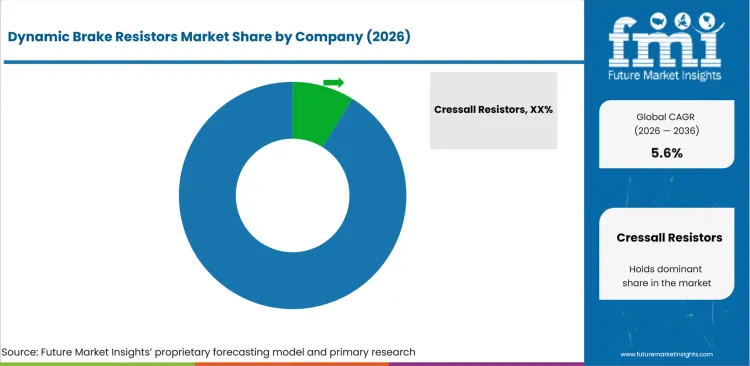
Competition separates into engineered power-resistor manufacturers, diversified component groups and drive-channel specialists. Rail and severe-duty projects place greater weight on thermal design plus qualification records. Factory retrofits give more weight to drive cross-references, enclosure fit and local response time. The comparison therefore measures documented braking range and integration evidence instead of company size.
- Engineered power-resistor platforms include Cressall Resistors and Post Glover Resistors. Telema and Fortress Resistors also cover custom or high-duty braking assemblies. Hilkar and Frizlen extend the specialist set.
- Diversified component groups: Vishay and TE Connectivity serve braking applications alongside broader passive-component and industrial portfolios.
- Drive-channel specialists: Betech and Powerohm Resistors compete close to VFD selection, replacement and application support.
Competitive Benchmarking: Dynamic Brake Resistors Market
| Company | Braking-Duty Range | Cooling and Enclosure Options | Drive and Traction Integration | Geographic Reach |
|---|---|---|---|---|
| Cressall Resistors | High | High | High | Global |
| Post Glover Resistors | High | Medium | High | North America with international Telema-group reach |
| Vishay | Medium | Medium | Medium | Global |
| Telema | High | High | High | Global |
| TE Connectivity | Medium | Medium | High | Global |
| Fortress Resistors | Medium | High | High | Australia and New Zealand with Telema-group reach |
| Hilkar | High | Medium | High | Türkiye with international sales |
| Frizlen | High | High | High | Europe with international sales |
| Betech | Low | Low | Medium | United Kingdom |
| Powerohm Resistors | High | High | High | North America with international sales |
Scoring basis: High braking-duty range requires documented coverage from standard industrial units into custom high-power or severe-duty applications. Medium covers more than one defined braking range and Low denotes narrow documented coverage. High cooling breadth requires multiple enclosure or cooling routes. High integration depth requires direct VFD or traction documentation plus application support. Geographic reach records evidenced commercial coverage and is not a reputation score.
Key Developments in the Dynamic Brake Resistors Market
- In March 2025 Cressall Resistors secured resistor contracts for five North Sea HVDC projects and extended its production exposure to high-energy resistor equipment with demanding thermal duty.
- In April 2025 Vishay introduced the ISOA200 thick-film power resistor with 200 W dissipation and 140 J pulse handling to extend compact high-energy resistor options for industrial power circuits.
- In December 2025, Frizlen began expanding its parts-production area by roughly 50% and added robot-assisted bending capacity for large resistance devices.
Key Players in the Dynamic Brake Resistors Market
Engineered Power-Resistor Platforms
- Cressall Resistors
- Post Glover Resistors
- Telema
- Fortress Resistors
- Hilkar
- Frizlen
Diversified Component and Connectivity Suppliers
- Vishay
- TE Connectivity
Application and Drive-Channel Specialists
- Betech
- Powerohm Resistors
Dynamic Brake Resistors Market - Report Scope
| Coverage field | Report scope |
|---|---|
| Market breakdown | By resistor type, power rating, application, end use, sales channel and region. |
| Quantitative Units | USD billion. |
| Market Definition | Revenue includes dynamic brake resistor components and resistor assemblies sold for dynamic or rheostatic braking within the stated segment universe. Downstream finished equipment and adjacent braking technologies are excluded. |
| Regions Covered | North America, Latin America, Western Europe, Eastern Europe, East Asia, South Asia and Pacific, Middle East and Africa. |
| Countries Covered | Poland, Mexico, South Korea, USA, Germany, France, Japan, and more than twenty-five additional countries in the full report. |
| Key Companies Profiled | Cressall Resistors, Post Glover Resistors, Vishay, Telema, TE Connectivity, Fortress Resistors, Hilkar, Frizlen, Betech, Powerohm Resistors. |
| Forecast Period | 2026 to 2036. |
| Approach | Primary and secondary research with market triangulation. |
Dynamic Brake Resistors Market - Research Methodology
| Method | Approach |
|---|---|
| Primary Research | FMI analysts gathered input from manufacturers, service providers, technology developers, distributors, end users, procurement teams, and subject-matter experts. Interviews examined purchasing decisions, product or service evaluation, adoption barriers, approval requirements, pricing considerations, and expectations for technical or commercial support. Respondents were also asked what evidence is required before a trial, pilot, or initial order develops into regular purchasing. |
| Desk Research | Desk research covered government statistics, regulatory publications, trade data, industry associations, technical literature, standards, company filings, product information, and official corporate announcements. Sources were reviewed for relevance, publication date, geographic coverage, and consistency with the defined market scope. Claims relating to performance, applications, approvals, capacity, investment, and commercial activity were retained only when supported by credible public evidence. |
| Market Sizing and Forecasting | The market model combined the baseline value with historical performance, segment structure, pricing and volume indicators, adoption levels, company participation, and country-level demand conditions. Forecast assumptions considered economic activity, investment trends, regulatory developments, technology adoption, purchasing cycles, supply availability, and barriers to wider market use. Segment and regional estimates were reconciled before the final market total was calculated. |
| Data Validation | Estimates were checked against multiple independent indicators, including public data, company activity, trade patterns, industry developments, and findings from primary interviews. Validation also tested whether products, services, applications, and company revenues fell within the defined market boundaries. Adjacent categories, unsupported claims, overlapping revenues, and activities without direct market relevance were excluded to reduce double counting and maintain consistency across segments and countries. |
Dynamic Brake Resistors Market by Segments
Dynamic Brake Resistors Market segmented by Resistor Type:
- Grid resistors
- Wirewound resistors
- Stainless steel resistor banks
- Liquid-cooled resistors
- Modular brake resistor units
Dynamic Brake Resistors Market segmented by Power Rating:
- 10-100 kW
- Below 10 kW
- 100 kW-1 MW
- Above 1 MW
Dynamic Brake Resistors Market segmented by Application:
- Variable frequency drives
- Cranes/hoists
- Mining trucks
- Rail traction
- Renewable energy systems
Dynamic Brake Resistors Market segmented by End Use:
- Industrial automation
- Mining
- Rail/transport
- Energy/utilities
- Material handling
Dynamic Brake Resistors Market segmented by Sales Channel:
- Drive OEMs
- Electrical distributors
- System integrators
- MRO/service
Dynamic Brake Resistors Market by Region:
- North America
- United States
- Canada
- Latin America
- Brazil
- Mexico
- Argentina
- Chile
- Western Europe
- Germany
- France
- United Kingdom
- Italy
- Spain
- Benelux
- Nordics
- Eastern Europe
- Poland
- Czech Republic
- Romania
- Hungary
- East Asia
- China
- Japan
- South Korea
- South Asia and Pacific
- India
- ASEAN
- Australia and New Zealand
- Middle East and Africa
- GCC Countries
- South Africa
- Türkiye
- Israel
Research Sources and Bibliography
- Ministry of Trade, Industry and Resources, Republic of Korea. (2025, May 26).
- European Climate, Infrastructure and Environment Executive Agency. (2025, July 3). CEF Transport: €2.8 billion for 94 projects to boost sustainable and connected mobility across Europe.
- USA Department of Transportation. (2025, January 10). INVESTING IN AMERICA: Biden-Harris Administration Announces Over $1.1 Billion in New Rail Grants to Reduce Train-Vehicle Collisions and Blocked Railroad Crossings.
- International Electrotechnical Commission. (2025, December 23). IEC 61800-9-2:2023/AMD1:2025.
- Ministry of SMEs and Startups, Republic of Korea. (2025, January 10). Ministry of SMEs and Startups Announces Plan for 2025.
- International Federation of Robotics. (2025, September 25). World Robotics 2025 report - INDUSTRIAL ROBOTS - released by IFR.
- TE Connectivity. (2025, November). TE Connectivity at SPS 2025.
- Ministry of Trade, Industry and Resources, Republic of Korea. (2026, April 29).
- International Electrotechnical Commission. (2025, December 19). IEC 61800-5-1:2022/COR2:2025.
- Vishay Intertechnology. (2026, August 20). Vishay Intertechnology Thick Film Power Resistors Deliver Increased Power Density to Save Space and Simplify Design.
- Ministry of Development Funds and Regional Policy, Poland. (2025, February 25). Railway investments under the NRP: at least 800 km of modern lines.
- Presidencia de la República, Gobierno de México. (2025, April 2). Gobierno de México informa inversión de 157 mil mdp para la construcción de los primeros 774 km de trenes de pasajeros y 240 km para carga.
- Ministry of Trade, Industry and Resources, Republic of Korea. (2025, October 1).
- USA Department of Transportation. (2026, April 22). Notice of Funding Opportunity for the Fiscal Year 2025 and 2026 Consolidated Rail Infrastructure and Safety Improvements Program.
- German Federal Statistical Office. (2026, February 6). Production in December 2025: -1.9% on the previous month.
- SNCF Réseau. (2025, February 17). Carte nationale des principaux chantiers en 2025.
- Ministry of Economy, Trade and Industry, Japan. (2025, June 30). Robotics & Regional Initiative Networking Group Established to Solve Regional Labor Shortages.
- Cressall Resistors. (2025, March 20). Supporting renewable energy transmission.
- Vishay Intertechnology. (2025, April 23). Vishay Intertechnology Thick Film Power Resistor With Optional NTC Thermistor and PC-TIM Simplifies Designs and Saves Board Space.
- FRIZLEN. (2025, December 3). We are building for the future.
- Cressall Resistors. (2026). Cressall Resistors for demanding applications around the world.
- Post Glover Resistors. (2026). Corporate Information.
- Telema. (2026). ESG & Certifications.
- DQS GmbH. (2025, January 26). ISO 9001:2015 Certificate - Hilkar Elektrik Anonim Şirketi.
- Betech. (2026). Experts in Industrial Drives.
- Hubbell / Powerohm Resistors. (2026). Power Resistor Solutions.
- TE Connectivity. (2025, February 28). TE Connectivity expands Energy smart grid site in Germany.
- TE Connectivity. (2025, April 1). TE Connectivity completes acquisition of Richards Manufacturing.
- Vishay Intertechnology. (2025, December 2). Vishay Intertechnology’s New Factory in Mexico Certified to IATF 16949:2016.
- Vishay Intertechnology. (2025, November 19). Vishay Intertechnology AEC-Q200 Qualified, 30 W Thick Film Power Resistor Offers High Reliability for Automotive Applications.
- TE Connectivity. (2026, July 23). TE Connectivity to acquire advanced power solutions leader Astrodyne TDI.
- Vishay Intertechnology. (2025, October 15). Vishay Intertechnology AEC-Q200 Qualified, 50 W Thick Film Power Resistor Offers High Reliability for Automotive Applications.
This bibliography is provided for reader reference and is not exhaustive. The full report contains the complete reference list and detailed citations
This Report Answers
- How large is the dynamic brake resistors market in 2026 and what value is forecast for 2036?
- Which operating conditions increase dynamic brake resistor demand in industrial and traction systems?
- Why do grid resistors hold the leading position within resistor type?
- Why does the 10-100 kW band account for the largest approved power-rating share?
- Why do variable frequency drives lead the application category?
- How do country growth rates differ among the seven profiled countries?
- Which companies compete through engineered braking platforms or broader component channels?
- What electrical and thermal checks can delay approval of a braking resistor?
Frequently Asked Questions
How big is the dynamic brake resistors market in 2026?
The dynamic brake resistors market is valued at USD 4.3 billion in 2026 and is projected to reach USD 7.3 billion by 2036. Growth follows wider use of controlled electric motion in factories and traction systems.
What is the CAGR of the dynamic brake resistors market from 2026 to 2036?
The dynamic brake resistors market is projected to grow at a CAGR of 5.6% between 2026 and 2036. Expansion is tied to VFD-controlled automation, electric traction and replacement of braking assemblies on installed equipment.
Which resistor type leads the dynamic brake resistors market?
The grid resistors segment is expected to hold 31.0% of the dynamic brake resistors market in 2026, owing to rugged bank construction for repeated braking duty. Grid designs also scale into higher-energy industrial and traction applications.
Which power rating leads the dynamic brake resistors market?
The 10–100 kW segment is projected to hold 36.0% of the dynamic brake resistors market in 2026. Its position comes from broad fit with factory drives and material-handling equipment that require moderate braking power.
Which countries are projected to record the highest growth in the dynamic brake resistors market?
Poland is projected to grow at 6.3% CAGR followed by Mexico at 6.0% and South Korea at 5.6% through 2036. Their faster rates come from rail construction or factory upgrades that open earlier specification points.
Which companies are active in the dynamic brake resistors market?
Key companies include Cressall Resistors, Post Glover Resistors, Vishay, Telema, TE Connectivity, Fortress Resistors, Hilkar, Frizlen, Betech and Powerohm Resistors. Competition centers on braking-duty range, thermal design, drive compatibility and application support.
Preview the report firsthand - request a free sample
Get SampleGet the brochure for pricing and purchase details.
Get PDFTable of Content
- Key Takeaways
- Market Size and CAGR
- Top Growth Driver
- Fastest Growing Segment
- Leading Region
- Key Companies
- Emerging Opportunities
- Executive Summary
- Global Market Outlook
- Demand-side Trends
- Supply-side Trends
- Technology Roadmap Analysis
- Analysis and Recommendations
- Analyst Perspective (What is happening? Why now? What should investors know?)
- Key Questions Answered
- How large is the market?
- What is the CAGR?
- What are key trends?
- Which region dominates?
- Who are the leaders?
- Market Overview
- Market Coverage / Taxonomy
- Market Definition / Scope / Limitations
- Research Methodology
- Chapter Orientation
- Analytical Lens and Working Hypotheses
- Market Structure, Signals, and Trend Drivers
- Benchmarking and Cross-market Comparability
- Market Sizing, Forecasting, and Opportunity Mapping
- Research Design and Evidence Framework
- Desk Research Programme (Secondary Evidence)
- Expert Input and Fieldwork (Primary Evidence)
- Tooling, Models, and Reference Databases
- Data Engineering and Model Build
- Quality Assurance and Audit Trail
- Market Background
- Market Dynamics (Drivers, Restraints, Opportunity, Trends)
- Scenario Forecast (Optimistic, Likely, Conservative)
- Impact Analysis
- AI Impact
- Sustainability Impact
- Regulatory Impact
- Technology Impact
- Consumer / Buyer Analysis
- Purchase Drivers
- Adoption Barriers
- Buyer Journey
- Opportunity Map Analysis
- Product Life Cycle Analysis
- Supply Chain Analysis
- Investment Feasibility Matrix
- Value Chain Analysis
- PESTLE and Porter's Analysis
- Regulatory Landscape
- Regional Parent Market Outlook
- Production and Consumption Statistics
- Import and Export Statistics
- Global Market Analysis and Forecast, 2021 to 2036
- Historical Market Size Value (USD Billion) Analysis, 2021 to 2025
- Current and Future Market Size Value (USD Billion) Projections, 2026 to 2036
- Y-o-Y Growth Trend Analysis
- Absolute $ Opportunity Analysis
- Global Market Pricing Analysis, 2021 to 2036
- Global Market Analysis and Forecast, By Resistor Type, 2021 to 2036
- Introduction / Key Findings
- Historical Market Size Value (USD Billion) Analysis By Resistor Type, 2021 to 2025
- Current and Future Market Size Value (USD Billion) Analysis and Forecast By Resistor Type, 2026 to 2036
- Grid resistors
- Wirewound resistors
- Stainless steel resistor banks
- Liquid-cooled resistors
- Modular brake resistor units
- Grid resistors
- Y-o-Y Growth Trend Analysis By Resistor Type, 2021 to 2025
- Absolute $ Opportunity Analysis By Resistor Type, 2026 to 2036
- Global Market Analysis and Forecast, By Power Rating, 2021 to 2036
- Introduction / Key Findings
- Historical Market Size Value (USD Billion) Analysis By Power Rating, 2021 to 2025
- Current and Future Market Size Value (USD Billion) Analysis and Forecast By Power Rating, 2026 to 2036
- 10–100 kW
- Below 10 kW
- 100 kW–1 MW
- Above 1 MW
- 10–100 kW
- Y-o-Y Growth Trend Analysis By Power Rating, 2021 to 2025
- Absolute $ Opportunity Analysis By Power Rating, 2026 to 2036
- Global Market Analysis and Forecast, By Application, 2021 to 2036
- Introduction / Key Findings
- Historical Market Size Value (USD Billion) Analysis By Application, 2021 to 2025
- Current and Future Market Size Value (USD Billion) Analysis and Forecast By Application, 2026 to 2036
- Variable frequency drives
- Cranes/hoists
- Mining trucks
- Rail traction
- Renewable energy systems
- Variable frequency drives
- Y-o-Y Growth Trend Analysis By Application, 2021 to 2025
- Absolute $ Opportunity Analysis By Application, 2026 to 2036
- Global Market Analysis and Forecast, By End Use, 2021 to 2036
- Introduction / Key Findings
- Historical Market Size Value (USD Billion) Analysis By End Use, 2021 to 2025
- Current and Future Market Size Value (USD Billion) Analysis and Forecast By End Use, 2026 to 2036
- Industrial automation
- Mining
- Rail/transport
- Energy/utilities
- Material handling
- Industrial automation
- Y-o-Y Growth Trend Analysis By End Use, 2021 to 2025
- Absolute $ Opportunity Analysis By End Use, 2026 to 2036
- Global Market Analysis and Forecast, By Sales Channel, 2021 to 2036
- Introduction / Key Findings
- Historical Market Size Value (USD Billion) Analysis By Sales Channel, 2021 to 2025
- Current and Future Market Size Value (USD Billion) Analysis and Forecast By Sales Channel, 2026 to 2036
- Drive OEMs
- Electrical distributors
- System integrators
- MRO/service
- Drive OEMs
- Y-o-Y Growth Trend Analysis By Sales Channel, 2021 to 2025
- Absolute $ Opportunity Analysis By Sales Channel, 2026 to 2036
- Global Market Analysis and Forecast, By Region, 2021 to 2036
- Introduction
- Historical Market Size Value (USD Billion) Analysis By Region, 2021 to 2025
- Current Market Size Value (USD Billion) Analysis and Forecast By Region, 2026 to 2036
- North America
- Latin America
- Western Europe
- Eastern Europe
- East Asia
- South Asia and Pacific
- Middle East & Africa
- Market Attractiveness Analysis By Region
- North America Market Analysis and Forecast, By Country, 2021 to 2036
- Historical Market Size Value (USD Billion) Trend Analysis By Market Taxonomy, 2021 to 2025
- Market Size Value (USD Billion) Forecast By Market Taxonomy, 2026 to 2036
- By Country
- USA
- Canada
- By Resistor Type
- By Power Rating
- By Application
- By End Use
- By Sales Channel
- By Country
- Market Attractiveness Analysis
- By Country
- By Resistor Type
- By Power Rating
- By Application
- By End Use
- By Sales Channel
- Key Takeaways
- Latin America Market Analysis and Forecast, By Country
- Historical Market Size Value (USD Billion) Trend Analysis By Market Taxonomy, 2021 to 2025
- Market Size Value (USD Billion) Forecast By Market Taxonomy, 2026 to 2036
- By Country
- Brazil
- Mexico
- Chile
- Rest of Latin America
- By Resistor Type
- By Power Rating
- By Application
- By End Use
- By Sales Channel
- By Country
- Market Attractiveness Analysis
- By Country
- By Resistor Type
- By Power Rating
- By Application
- By End Use
- By Sales Channel
- Key Takeaways
- Western Europe Market Analysis and Forecast, By Country
- Historical Market Size Value (USD Billion) Trend Analysis By Market Taxonomy, 2021 to 2025
- Market Size Value (USD Billion) Forecast By Market Taxonomy, 2026 to 2036
- By Country
- Germany
- UK
- Italy
- Spain
- France
- Nordic
- BENELUX
- Rest of Western Europe
- By Resistor Type
- By Power Rating
- By Application
- By End Use
- By Sales Channel
- By Country
- Market Attractiveness Analysis
- By Country
- By Resistor Type
- By Power Rating
- By Application
- By End Use
- By Sales Channel
- Key Takeaways
- Eastern Europe Market Analysis and Forecast, By Country
- Historical Market Size Value (USD Billion) Trend Analysis By Market Taxonomy, 2021 to 2025
- Market Size Value (USD Billion) Forecast By Market Taxonomy, 2026 to 2036
- By Country
- Russia
- Poland
- Hungary
- Balkan & Baltic
- Rest of Eastern Europe
- By Resistor Type
- By Power Rating
- By Application
- By End Use
- By Sales Channel
- By Country
- Market Attractiveness Analysis
- By Country
- By Resistor Type
- By Power Rating
- By Application
- By End Use
- By Sales Channel
- Key Takeaways
- East Asia Market Analysis and Forecast, By Country
- Historical Market Size Value (USD Billion) Trend Analysis By Market Taxonomy, 2021 to 2025
- Market Size Value (USD Billion) Forecast By Market Taxonomy, 2026 to 2036
- By Country
- China
- Japan
- South Korea
- By Resistor Type
- By Power Rating
- By Application
- By End Use
- By Sales Channel
- By Country
- Market Attractiveness Analysis
- By Country
- By Resistor Type
- By Power Rating
- By Application
- By End Use
- By Sales Channel
- Key Takeaways
- South Asia and Pacific Market Analysis and Forecast, By Country
- Historical Market Size Value (USD Billion) Trend Analysis By Market Taxonomy, 2021 to 2025
- Market Size Value (USD Billion) Forecast By Market Taxonomy, 2026 to 2036
- By Country
- India
- ASEAN
- Australia & New Zealand
- Rest of South Asia and Pacific
- By Resistor Type
- By Power Rating
- By Application
- By End Use
- By Sales Channel
- By Country
- Market Attractiveness Analysis
- By Country
- By Resistor Type
- By Power Rating
- By Application
- By End Use
- By Sales Channel
- Key Takeaways
- Middle East & Africa Market Analysis and Forecast, By Country
- Historical Market Size Value (USD Billion) Trend Analysis By Market Taxonomy, 2021 to 2025
- Market Size Value (USD Billion) Forecast By Market Taxonomy, 2026 to 2036
- By Country
- Kingdom of Saudi Arabia
- Other GCC Countries
- Türkiye
- South Africa
- Other African Union
- Rest of Middle East & Africa
- By Resistor Type
- By Power Rating
- By Application
- By End Use
- By Sales Channel
- By Country
- Market Attractiveness Analysis
- By Country
- By Resistor Type
- By Power Rating
- By Application
- By End Use
- By Sales Channel
- Key Takeaways
- Key Countries Market Analysis
- USA
- Pricing Analysis
- Market Share Analysis, 2025
- By Resistor Type
- By Power Rating
- By Application
- By End Use
- By Sales Channel
- Canada
- Pricing Analysis
- Market Share Analysis, 2025
- By Resistor Type
- By Power Rating
- By Application
- By End Use
- By Sales Channel
- Mexico
- Pricing Analysis
- Market Share Analysis, 2025
- By Resistor Type
- By Power Rating
- By Application
- By End Use
- By Sales Channel
- Brazil
- Pricing Analysis
- Market Share Analysis, 2025
- By Resistor Type
- By Power Rating
- By Application
- By End Use
- By Sales Channel
- Chile
- Pricing Analysis
- Market Share Analysis, 2025
- By Resistor Type
- By Power Rating
- By Application
- By End Use
- By Sales Channel
- Germany
- Pricing Analysis
- Market Share Analysis, 2025
- By Resistor Type
- By Power Rating
- By Application
- By End Use
- By Sales Channel
- UK
- Pricing Analysis
- Market Share Analysis, 2025
- By Resistor Type
- By Power Rating
- By Application
- By End Use
- By Sales Channel
- Italy
- Pricing Analysis
- Market Share Analysis, 2025
- By Resistor Type
- By Power Rating
- By Application
- By End Use
- By Sales Channel
- Spain
- Pricing Analysis
- Market Share Analysis, 2025
- By Resistor Type
- By Power Rating
- By Application
- By End Use
- By Sales Channel
- France
- Pricing Analysis
- Market Share Analysis, 2025
- By Resistor Type
- By Power Rating
- By Application
- By End Use
- By Sales Channel
- India
- Pricing Analysis
- Market Share Analysis, 2025
- By Resistor Type
- By Power Rating
- By Application
- By End Use
- By Sales Channel
- ASEAN
- Pricing Analysis
- Market Share Analysis, 2025
- By Resistor Type
- By Power Rating
- By Application
- By End Use
- By Sales Channel
- Australia & New Zealand
- Pricing Analysis
- Market Share Analysis, 2025
- By Resistor Type
- By Power Rating
- By Application
- By End Use
- By Sales Channel
- China
- Pricing Analysis
- Market Share Analysis, 2025
- By Resistor Type
- By Power Rating
- By Application
- By End Use
- By Sales Channel
- Japan
- Pricing Analysis
- Market Share Analysis, 2025
- By Resistor Type
- By Power Rating
- By Application
- By End Use
- By Sales Channel
- South Korea
- Pricing Analysis
- Market Share Analysis, 2025
- By Resistor Type
- By Power Rating
- By Application
- By End Use
- By Sales Channel
- Russia
- Pricing Analysis
- Market Share Analysis, 2025
- By Resistor Type
- By Power Rating
- By Application
- By End Use
- By Sales Channel
- Poland
- Pricing Analysis
- Market Share Analysis, 2025
- By Resistor Type
- By Power Rating
- By Application
- By End Use
- By Sales Channel
- Hungary
- Pricing Analysis
- Market Share Analysis, 2025
- By Resistor Type
- By Power Rating
- By Application
- By End Use
- By Sales Channel
- Kingdom of Saudi Arabia
- Pricing Analysis
- Market Share Analysis, 2025
- By Resistor Type
- By Power Rating
- By Application
- By End Use
- By Sales Channel
- Türkiye
- Pricing Analysis
- Market Share Analysis, 2025
- By Resistor Type
- By Power Rating
- By Application
- By End Use
- By Sales Channel
- South Africa
- Pricing Analysis
- Market Share Analysis, 2025
- By Resistor Type
- By Power Rating
- By Application
- By End Use
- By Sales Channel
- USA
- Market Structure Analysis
- Competition Dashboard
- Competition Benchmarking
- Market Share Analysis of Top Players
- By Regional
- By Resistor Type
- By Power Rating
- By Application
- By End Use
- By Sales Channel
- Emerging Startups
- Innovation Benchmarking
- Competition Analysis
- Competition Deep Dive
- Cressall Resistors
- Overview
- Product Portfolio
- Profitability by Market Segments
- Sales Footprint
- Strategy Overview
- Marketing Strategy
- Product Strategy
- Channel Strategy
- Post Glover Resistors
- Vishay
- Telema
- TE Connectivity
- Fortress Resistors
- Hilkar
- Frizlen
- Betech
- Powerohm Resistors
- Cressall Resistors
- Case Studies
- Success Stories
- Recent Developments
- Competition Deep Dive
- Assumptions & Acronyms Used


