

- Market Size (2026)
- USD 780.7 Mn
- Forecast (2036)
- USD 1579.4 Mn
- CAGR (2026 to 2036)
- 7.3%
How big is EBR Solvents Market in 2026?
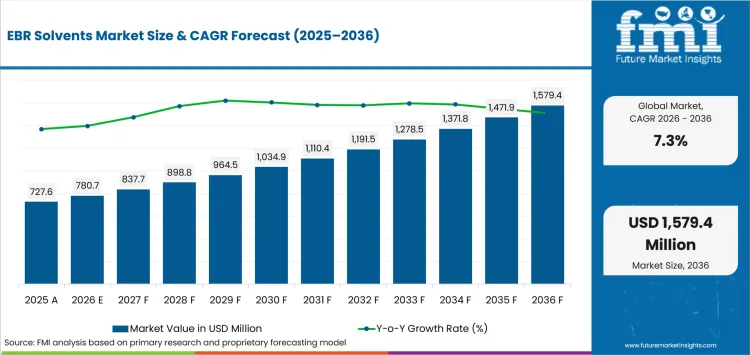
USD 780.7 million in 2026 and USD 1,579.4 million by 2036 at a 7.3% CAGR.
Demand for EBR solvents is projected to expand at 7.3% CAGR between 2026 and 2036. Valuation is expected to increase from USD 780.7 million in 2026 to USD 1,579.4 million by 2036. Qualified coating recipes consume ancillary solvent during each production cycle, so wafer starts raise EBR solvent demand for edge cleaning and related track rinses. Fujifilm listed high-purity lithographic ancillary solvents in its October 2025 wafer-processing portfolio, confirming continued integration with active lithography supply.
New fabs create fresh chemical qualification windows while mature production lines defend established process recipes in existing fabs. Singapore EDB reported in April 2025 that UMC’s new 22 nm phase would lift its Singapore capacity above one million wafers annually after volume production starts in 2026. UMC’s commissioning schedule gives new solvent candidates more qualification events than stable lines with unchanged process ownership.
Key Takeaways of EBR Solvents Market
- Each qualified lithography coating cycle consumes process chemistry after the recipe enters production, so EBR solvent orders follow wafer throughput.
- By solvent type, PGMEA-based solvents are estimated to hold 34.0% in 2026 owing to qualified resist compatibility that supports repeatable edge cleaning.
- 300 mm wafers are projected to hold 49.0% of wafer-size demand in 2026 attributable to their concentration in high-volume logic and memory fabs.
- In 2026, photoresist edge bead removal is expected to lead process use with 38.0% share because spin coating leaves a thicker resist ridge near the wafer perimeter.
- Qualification work slows switching as replacement solvents must preserve resist removal and meet metallic, particulate and residue limits under the installed track recipe.
- Some of the key players in this market include FUJIFILM Electronic Materials, Sumitomo Chemical, Chemtronics Co., Ltd., Dongjin Semichem, San Fu Chemical, Merck KGaA, Tokyo Ohka Kogyo, and Entegris.
Analyst Perspective
“EBR solvent selection should start with residue and impurity performance under the exact resist recipe rather than nominal solvent cost. Commercial value is earned when the chemical producer can reproduce that result during volume ramps and controlled change events.”
- Nikhil Kaitwade, Principal Consultant, Future Market Insights
How is the EBR Solvents Market segmented?
The EBR solvents market is segmented by solvent type, wafer size, process use, purity grade and sales channel.
Solvent type covers PGMEA-based solvents, ethyl lactate blends, NMP alternatives, cyclohexanone blends, fluorinated specialty solvents and low-residue solvent blends. Wafer size includes 300 mm, 200 mm, advanced packaging and compound semiconductor wafers. Process use covers photoresist edge bead removal, backside rinse, coater cup cleaning, track system cleaning and advanced packaging EBR. Purity grade includes VLSI, electronic, ULSI or advanced-node and custom fab-qualified grades. Sales channels cover direct fab supply, semiconductor chemical distributors, track-equipment-qualified supply and local blending or tolling.
What supports VLSI Grade within the Purity Grade category?
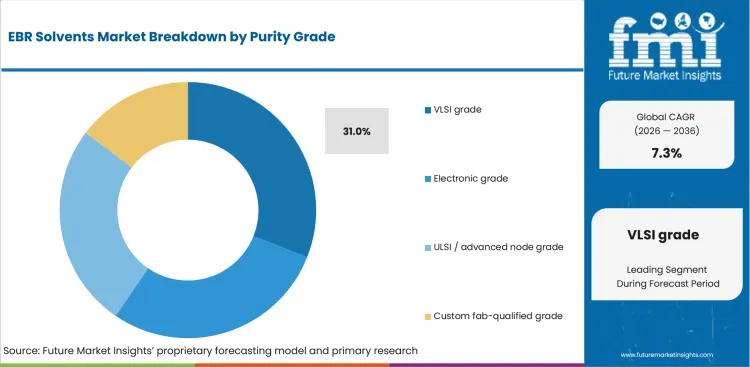
VLSI grade serves fabs that need semiconductor-level impurity control without moving every recipe to a custom grade. A Chemtronics Korea Exchange filing in March 2025 described 5N PGMEA production with metallic impurities controlled at ppt levels during qualification. The filing confirms trace-metal control as part of lithography chemistry approval.
- By purity grade, VLSI grade is forecast to represent 31.0% in 2026 owing to trace-contamination limits that apply to qualified lithography chemicals.
- Electronic materials producers that document metal and particle control can shorten technical comparison work, though each fab retains responsibility for recipe qualification.
What makes PGMEA-based solvents central to the Solvent Type category?
PGMEA-based chemistry fits proven resist-processing workflows that need predictable solvency without changing the broader solvent-management system. A Chemtronics filing in February 2026 described 5N PGMEA for cleaning and EUV lithography with metallic impurities below 10 ppt. The filing ties high-purity PGMEA directly to photoresist chemicals and semiconductor thinner use.
- By solvent type, PGMEA-based solvents are estimated to hold 34.0% in 2026 owing to compatibility with qualified photoresist coating and edge-cleaning recipes.
- Photoresist ancillaries require controlled impurity profiles during lot release, so producers that reproduce solvent behavior between engineering and production batches reduce requalification risk.
Why do 300 mm wafers lead the Wafer size category?
Logic and memory fabs concentrate solvent consumption on 300 mm platforms as track recipes repeat over large wafer starts. TSMC reported 15.0 million 12-inch-equivalent wafer shipments during 2025 and said 2 nm entered high-volume manufacturing in the fourth quarter. TSMC’s shipment scale ties semiconductor wafers directly to ancillary chemistry demand.
- In 2026, 300 mm wafers are expected to lead wafer-size demand with 49.0% share given the concentration of coating cycles on this production format.
- Extreme ultraviolet lithography raises recipe sensitivity at advanced nodes, increasing the value of consistent solvent delivery during qualification and production.
How does Photoresist edge bead removal lead the Process Use category?
Photoresist edge bead removal treats the resist ridge formed at wafer perimeter after coating. Sandia National Laboratories reported in June 2025 that optimized PR cast and EBR rinse timing removed nearly 100% of defect clusters during testing. Sandia’s result links EBR control to defect reduction instead of cleaning alone.
- Photoresist edge bead removal is projected to hold 38.0% of process-use demand in 2026 owing to perimeter-bead control during spin coating.
- Photoresist stripper chemistry addresses a separate removal step, so fabs qualify EBR solvent against its own dispense timing and wafer-edge contamination limits during production.
What are the drivers, restraints and opportunities in the EBR Solvents Market?
Fab commissioning expands recurring solvent demand, qualification work limits switching speed and closed-loop recovery offers a service-led route for qualified chemistry.
- Driver: New wafer capacity increases the number of lithography recipes that need qualified edge-cleaning solvent before sustained production begins.
- Restraint: Tight impurity and process-control requirements extend evaluation work whenever a fab changes solvent chemistry, packaging or supply route.
- Opportunity: On-site solvent recovery offers a repeat-service route if recycled EBR streams meet the electronic-grade specification required for reuse.
Fab Ramps Expand Qualified Solvent Consumption
New fabs require chemistry qualification during commissioning and generate repeat solvent revenue once wafer throughput reaches commercial scale. In January 2025 the USA Department of Commerce said CHIPS deals covered 22 states, while planned electronics manufacturing investment had reached nearly USD 450 billion. CHIPS-backed projects enlarge the installed base for semiconductor fabrication materials only after process teams approve chemistry for production recipes.
Qualification Costs Slow Chemistry Switching
EBR chemistry contacts resist-coated wafers and track hardware, so fabs treat impurity control as part of process ownership. Entegris stated in its February 2026 Form 10-K that its cleaning solutions include edge bead removal and that switching specified products may raise yield risk. The documented coupling between process specification and yield explains why photoresist electronic chemicals need dedicated evaluation before commercial substitution.
Closed-Loop Solvent Recovery Opens a New Service Route
Waste handling can become a revenue route if recovery preserves chemical quality and fab traceability. UMC opened its Circular Economy and Recycling Innovation Center in December 2025, where partners process waste edge bead remover into industrial-grade products with an electronic-grade reuse goal. Chemical producers serving ancillary lithography chemicals can compete on recovery logistics alongside fresh-solvent supply under documented reuse specifications.
Which country CAGRs are profiled in the EBR Solvents Market?
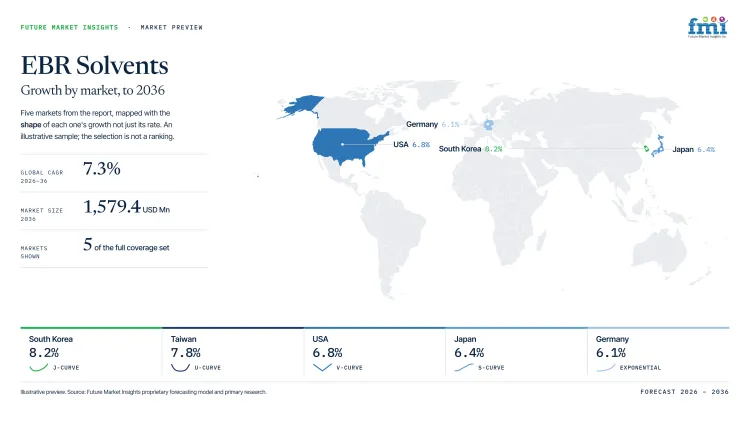
| Country | CAGR |
|---|---|
| South Korea | 8.2% |
| Taiwan | 7.8% |
| USA | 6.8% |
| Japan | 6.4% |
| Germany | 6.1% |
How do country-level CAGRs compare in the EBR Solvents Market?
The five-country forecast spans 2.1 percentage points, from South Korea at 8.2% to Germany at 6.1%. South Korea and Taiwan form the upper band as concentrated advanced-node capacity creates more qualification opportunities for process chemicals. The USA occupies the middle-high range, while Japan and Germany follow more mature and established qualification pathways.
- South Korea combines dense memory production with a strong chemical manufacturing base, supporting faster response during fab line ramps.
- Taiwan concentrates advanced-node manufacturing within major science parks, enabling shorter feedback loops for recipe and process-chemical changes.
- USA greenfield fab investments create new qualification windows, while site-specific EHS reviews shape chemical approvals and supplier selection.
- Japan benefits from long-standing materials relationships that reduce supply risk while supporting continuity for established lithography processes.
- Germany relies on established semiconductor and specialty-chemical supply networks, with mature qualification practices supporting stable process-chemical adoption.
Similar CAGRs conceal different qualification economics and service requirements for chemical producers. The full report provides country-level CAGR analysis across North America, Latin America, Europe, East Asia, South Asia, Oceania and the Middle East and Africa.
Country-wise Analysis
- South Korean fabs operate within dense memory clusters where line ramps place immediate pressure on local chemical inventory and technical response during high-volume qualification work. EBR solvent demand is forecast to expand at 8.2% CAGR through 2036 owing to repeated recipe approvals, while Korea.net reported in July 2026 that Samsung Electronics and SK hynix joined plans for a second national semiconductor production hub. Local chemical producers gain from nearby memory fabs, yet simultaneous capacity construction raises the burden of preserving identical purity performance between qualification and production lots before new recipes convert into sustained commercial orders at major production campuses nationwide.
- Taiwanese fabs run concentrated advanced-node roadmaps that shorten the response time available for solvent troubleshooting during recipe changes and rapid customer volume ramps. The Ministry of Economic Affairs stated in March 2025 that TSMC continued 2 nm and 1.4 nm-or-below investment in Taiwan, which keeps generating new solvent qualification work at clustered science parks. EBR solvent demand is projected to rise at 7.8% CAGR through 2036 because dense local manufacturing supports fast failure analysis, yet residue and trace-metal limits require international chemical companies to maintain nearby inventory and engineering access before new recipes reach sustained commercial production volumes in Taiwan.
- US solvent qualification is increasingly linked to new fabs and pilot facilities where chemical specifications are established alongside equipment commissioning and initial process development. The Commerce Department selected Arizona State University Research Park in January 2025 for a planned 300 mm front-end and advanced-packaging research facility, creating another domestic route for collaborative process trials. EBR solvent demand is forecast to grow at 6.8% CAGR through 2036, supported by expanding fabrication activity. However, site-specific EHS reviews and recipe ownership require secure distribution and local technical coverage because qualification at one fab does not automatically transfer to another production site.
- Japanese fabs source from a mature materials base where long-standing supplier relationships make process consistency more important than short-term solvent pricing during qualification decisions. EBR solvent demand is projected to expand at 6.4% CAGR through 2036, supported by leading-edge process development. METI stated in April 2025 that Rapidus planned to launch a pilot production line and customer design environment during fiscal 2025. Established chemical manufacturing supports rapid audits and technical discussions, while incumbent suppliers face high substitution thresholds requiring strong performance evidence, local application engineering, and repeatable high-purity production.
- German semiconductor operations benefit from an established specialty-chemical and industrial manufacturing ecosystem that supports controlled qualification and reliable supply of high-purity process materials. EBR solvent demand is forecast to expand at 6.1% CAGR through 2036, reflecting gradual capacity expansion and continued process development. Mature supplier relationships can support consistent chemical specifications, while stringent quality, environmental, and workplace requirements make documentation, traceability, and batch-to-batch purity important during qualification. Local technical support and dependable logistics therefore remain important for converting successful solvent trials into recurring production volumes.
Who are the notable companies in the EBR Solvents Market?
FUJIFILM Electronic Materials, Sumitomo Chemical, Chemtronics Co., Ltd., Dongjin Semichem, San Fu Chemical, Merck KGaA, Tokyo Ohka Kogyo, and Entegris are the notable companies serving this market.
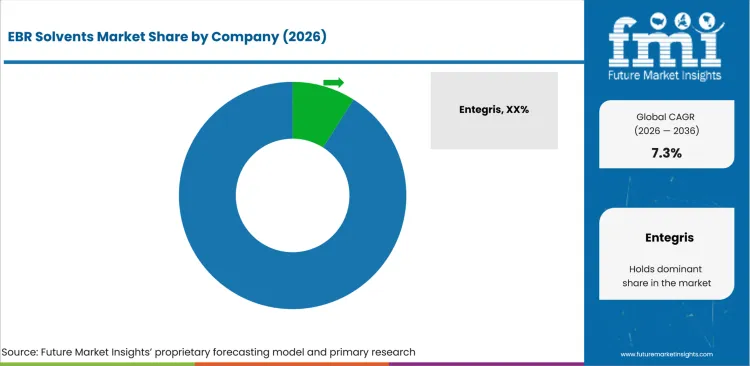
Competition centers on direct EBR or thinner evidence, semiconductor-grade impurity control and qualification support near major fabs. Fujifilm, Chemtronics, Dongjin Semichem and San Fu Chemical document solvent or thinner positions linked to lithography. Sumitomo Chemical, Merck KGaA and Tokyo Ohka Kogyo extend the comparison through patterning materials and semiconductor process chemicals. Entegris documents edge bead removal cleaning chemistry and liquid contamination-control infrastructure used in semiconductor manufacturing.
- Direct EBR and thinner providers: FUJIFILM Electronic Materials, Chemtronics Co., Ltd., Dongjin Semichem and San Fu Chemical document direct solvent or cleaning relevance.
- Integrated patterning platforms: Sumitomo Chemical, Merck KGaA and Tokyo Ohka Kogyo document photoresist, rinse or adjacent lithography-material infrastructure.
- Wafer-cleaning and purity platform: Entegris documents edge bead removal cleaning chemistry plus liquid contamination-control support for semiconductor manufacturing.
Competitive Benchmarking: EBR Solvents Market
| Company | EBR / Thinner Fit | Ultra-High-Purity Control | Fab-Proximate Support | Geographic Reach |
|---|---|---|---|---|
| FUJIFILM Electronic Materials | High | High | High | Japan, USA, Europe and Asia |
| Sumitomo Chemical | High | High | High | Japan, South Korea and global sales |
| Chemtronics Co., Ltd. | High | High | Medium | South Korea with global semiconductor customer deliveries |
| Dongjin Semichem | High | Medium | High | South Korea plus 15+ overseas sites |
| San Fu Chemical | High | High | Medium | Taiwan and regional semiconductor customers |
| Merck KGaA | Medium | High | High | North America, Europe and Asia-Pacific semiconductor support |
| Tokyo Ohka Kogyo | Medium | High | High | Japan, South Korea and overseas fab regions |
| Entegris | High | High | High | North America, South Korea and global semiconductor markets |
Scoring basis: High EBR fit requires direct EBR, photoresist thinner or lithographic ancillary solvent evidence. Medium EBR fit identifies adjacent lithography or cleaning chemistry without direct EBR naming. High purity control requires explicit high-purity production or dedicated quality evaluation, while Medium requires documented semiconductor-grade process control. High fab-proximate support requires production or technical coverage in multiple major fab regions, while Medium reflects narrower documented local coverage.
Key Developments in the EBR Solvents Market
- In December 2025, Merck KGaA inaugurated its 150,000-square-meter Kaohsiung campus covering thin films plus formulation materials and specialty gases for advanced chip production.
- In November 2025, FUJIFILM Electronic Materials started operations at a new Shizuoka development and evaluation building that strengthens quality testing for advanced semiconductor materials.
- In February 2025, Sumitomo Chemical decided to expand advanced photoresist development and mass-production evaluation facilities at its Osaka Works for front-end and back-end processes.
Key Players in the EBR Solvents Market
EBR, Thinner and Process-Chemical Platforms
- FUJIFILM Electronic Materials
- Sumitomo Chemical
- Chemtronics Co., Ltd.
- Dongjin Semichem
- San Fu Chemical
Patterning and High-Purity Materials
- Merck KGaA
- Tokyo Ohka Kogyo
Wafer-Cleaning and Purity Platform
- Entegris
EBR Solvents Market - Report Scope
| Coverage field | Report scope |
|---|---|
| Market breakdown | By solvent type, wafer size, process use, purity grade, sales channel and region. |
| Quantitative Units | USD Million. |
| Market Definition | Commercial EBR solvents and high-purity solvent blends used for photoresist edge bead removal plus closely related qualified rinse functions. |
| Regions Covered | North America, Latin America, Europe, East Asia, South Asia and Pacific, and Middle East and Africa. |
| Countries Covered | South Korea, Taiwan, Singapore, USA, Japan, and 20+ countries included in the full report. |
| Key Companies Profiled | FUJIFILM Electronic Materials, Sumitomo Chemical, Chemtronics Co., Ltd., Dongjin Semichem, San Fu Chemical, Merck KGaA, Tokyo Ohka Kogyo, and Entegris. |
| Forecast Period | 2026 to 2036. |
| Approach | Primary and secondary research with market triangulation. |
EBR Solvents Market - Research Methodology
| Method | Approach |
|---|---|
| Primary Research | FMI analysts gathered input from manufacturers, service providers, technology developers, distributors, end users, procurement teams, and subject-matter experts. Interviews examined purchasing decisions, product or service evaluation, adoption barriers, approval requirements, pricing considerations, and expectations for technical or commercial support. Respondents were also asked what evidence is required before a trial, pilot, or initial order develops into regular purchasing. |
| Desk Research | Desk research covered government statistics, regulatory publications, trade data, industry associations, technical literature, standards, company filings, product information, and official corporate announcements. Sources were reviewed for relevance, publication date, geographic coverage, and consistency with the defined market scope. Claims relating to performance, applications, approvals, capacity, investment, and commercial activity were retained only when supported by credible public evidence. |
| Market Sizing and Forecasting | The market model combined the baseline value with historical performance, segment structure, pricing and volume indicators, adoption levels, company participation, and country-level demand conditions. Forecast assumptions considered economic activity, investment trends, regulatory developments, technology adoption, purchasing cycles, supply availability, and barriers to wider market use. Segment and regional estimates were reconciled before the final market total was calculated. |
| Data Validation | Estimates were checked against multiple independent indicators, including public data, company activity, trade patterns, industry developments, and findings from primary interviews. Validation also tested whether products, services, applications, and company revenues fell within the defined market boundaries. Adjacent categories, unsupported claims, overlapping revenues, and activities without direct market relevance were excluded to reduce double counting and maintain consistency across segments and countries. |
EBR Solvents Market by Segments
EBR Solvents Market segmented by Solvent Type:
- PGMEA-based solvents
- Ethyl lactate blends
- NMP alternatives
- Cyclohexanone blends
- Fluorinated specialty solvents
- Low-residue solvent blends
EBR Solvents Market segmented by Wafer Size:
- 300 mm wafers
- 200 mm wafers
- Advanced packaging wafers
- Compound semiconductor wafers
EBR Solvents Market segmented by Process Use:
- Photoresist edge bead removal
- Backside rinse
- Coater cup cleaning
- Track system cleaning
- Advanced packaging EBR
EBR Solvents Market segmented by Purity Grade:
- VLSI grade
- Electronic grade
- ULSI / advanced node grade
- Custom fab-qualified grade
EBR Solvents Market segmented by Sales Channel:
- Direct fab supply
- Semiconductor chemical distributors
- Track equipment qualified supply
- Local blending / tolling
EBR Solvents Market by Region:
- North America
- United States
- Canada
- Latin America
- Brazil
- Mexico
- Chile
- Rest of Latin America
- Western Europe
- Germany
- United Kingdom
- Italy
- Spain
- France
- Nordics
- Benelux
- Rest of Western Europe
- Eastern Europe
- Russia
- Poland
- Hungary
- Balkan and Baltic States
- Rest of Eastern Europe
- East Asia
- China
- Japan
- South Korea
- South Asia and Pacific
- India
- ASEAN
- Australia and New Zealand
- Rest of South Asia and Pacific
- Middle East and Africa
- Kingdom of Saudi Arabia
- Other GCC Countries
- Türkiye
- South Africa
- Other African Union Countries
- Rest of Middle East and Africa
Research Sources and Bibliography
- FUJIFILM Corporation. (2025, October 2). Fujifilm to Showcase “One-Stop Solutions” Approach at SEMICON West 2025.
- Singapore Economic Development Board. (2025, April 1). UMC unveils new fab expansion in Singapore in grand opening ceremony.
- Chemtronics Co., Ltd. (2026, February 27). 주주총회 소집공고 (제29기 정기).
- Taiwan Semiconductor Manufacturing Company Limited. (2026). TSMC 2025 Annual Report Website.
- Sandia National Laboratories. (2025, June 1). Optimization of edge bead removal (EBR) process to enhance defect reduction in optical lithography.
- Chemtronics Co., Ltd. (2025, March 7). 주주총회 소집공고 (제28기 정기).
- USA Department of Commerce. (2025, January 17). USA Department of Commerce Announces CHIPS Incentives Awards with Corning, Edwards Vacuum, and Infinera to Increase Domestic Production Capacity of Chips and Equipment Critical for USA Technological Leadership.
- Entegris, Inc. (2026, February 12). Form 10-K for fiscal year ended December 31, 2025.
- United Microelectronics Corporation. (2025, December 10). UMC Circular Economy & Recycling Innovation Center begins operations.
- Korea.net. (2026, July 1). Massive KRW 896T investment to build 2nd chip hub in SW region.
- Ministry of Economic Affairs, R.O.C. (2025, March 4). 台積電對美投資,鞏固全球半導體領導地位.
- Singapore Economic Development Board. (2026, January 27). Micron breaks ground on advanced wafer fabrication facility in Singapore.
- USA Department of Commerce. (2025, January 6). Biden-Harris Administration Announces Arizona State University Research Park as Planned Site for Third CHIPS for America R&D Flagship Facility.
- Ministry of Economy, Trade and Industry, Japan. (2025, April 1). Press Conference by Minister Muto (Excerpt).
- Dongjin Semichem Co., Ltd. (2026, March 19). 사업보고서 (제53기).
- San Fu Chemical Co., Ltd. (2026). 2025 San Fu Chemical Annual Report.
- Sumitomo Chemical Co., Ltd. (2025). Investors’ Handbook 2025.
- Merck KGaA, Darmstadt, Germany. (2026). Electronics - Merck KGaA, Darmstadt, Germany Annual Report 2025.
- Merck KGaA, Darmstadt, Germany. (2025, December 1). Inaugurates Semiconductor Solutions Site in Taiwan to Support AI Growth.
- FUJIFILM Corporation. (2025, November 25). Fujifilm Announces Completion of a New Building for Advanced Semiconductor Materials in Shizuoka.
- Sumitomo Chemical Co., Ltd. (2025, February 26). Sumitomo Chemical to Expand Evaluation Facilities for Photoresists for Advanced Semiconductor Manufacturing Processes at the Osaka Works to Strengthen Its Development and Mass Production Evaluation Systems for Front-End and Back-End Processes.
- FUJIFILM Corporation. (2026, February 27). Fujifilm Completes Investment in Rapidus.
- TOKYO OHKA KOGYO CO., LTD. (2026, June 8). Notice Regarding the Commencement of Operations at the Aso Kumamoto Site of Aso Plant.
- Sumitomo Chemical Co., Ltd. (2026, April 9). Sumitomo Chemical to Establish New Technology Center for Photoresists for Advanced Semiconductors at Its Osaka Works.
- Entegris, Inc. (2025, July 18). Entegris Opens New Korea Technology Center.
- Chemtronics Co., Ltd. (2025, March 19). 신규 시설투자 등.
- Merck KGaA, Darmstadt, Germany. (2026, August 6). Robust Q2 2026 Performance, Full-Year Guidance Upgraded.
- Brewer Science, Inc. (2026, June 18). Brewer Science to Acquire Semiconductor Chemical Business Line from Heraeus Epurio.
- JSR Corporation. (2026, May 27). JSR Corporation/Inpria Corporation and Entegris Announce Non-Exclusive Cross-Licensing to EUV Lithography.
This bibliography is provided for reader reference and is not exhaustive. The full report contains the complete reference list and detailed citations.
This Report Answers
- What is the EBR solvents market size in 2026 and what value is projected for 2036?
- Which operating conditions turn new semiconductor fab capacity into repeat EBR solvent demand?
- Why do PGMEA-based solvents hold the leading share within the solvent type category?
- How does the 300 mm wafer installed base influence EBR solvent consumption and qualification?
- Why does photoresist edge bead removal account for the largest process-use share?
- How do South Korea, Taiwan, Singapore, the USA and Japan differ in growth and qualification conditions?
- Which companies show direct EBR, thinner or wafer-cleaning capability?
- What purity and process-control requirements slow solvent switching in semiconductor fabs?
- Where can closed-loop recovery establish new commercial routes for qualified EBR chemistry?
Frequently Asked Questions
How big is the EBR solvents market in 2026?
The EBR solvents market is valued at USD 780.7 million in 2026 and is projected to reach USD 1,579.4 million by 2036. Growth follows repeated lithography solvent consumption as new fabs commission and existing lines run at higher utilization.
What is the CAGR of the EBR solvents market from 2026 to 2036?
The EBR solvents market is projected to grow at a CAGR of 7.3% between 2026 and 2036. Expansion is supported by fab commissioning, higher wafer throughput and repeated qualification of edge-cleaning chemistry.
Which solvent type leads the EBR solvents market?
The PGMEA-based solvents segment is expected to hold 34.0% of the EBR solvents market in 2026, supported by documented compatibility with photoresist coating and edge-cleaning recipes. Qualified impurity control strengthens its position as fabs need repeatable removal performance between engineering and production lots.
Which wafer size leads the EBR solvents market?
The 300 mm wafer segment is expected to hold 49.0% of the EBR solvents market in 2026, attributable to its concentration in high-volume logic and memory production. Repeated coating cycles make this format the largest solvent-consuming wafer class within the approved 2026 segmentation.
Which companies are active in the EBR solvents market?
Key companies operating in the market include FUJIFILM Electronic Materials, Sumitomo Chemical, Chemtronics Co., Ltd., Dongjin Semichem, San Fu Chemical, Merck KGaA, Tokyo Ohka Kogyo, and Entegris. These companies compete on solvent fit, impurity control and fab-side technical support during qualifying recipe changes.
Preview the report firsthand - request a free sample
Get SampleGet the brochure for pricing and purchase details.
Get PDFTable of Content
- Key Takeaways
- Market Size and CAGR
- Top Growth Driver
- Fastest Growing Segment
- Leading Region
- Key Companies
- Emerging Opportunities
- Executive Summary
- Global Market Outlook
- Demand-side Trends
- Supply-side Trends
- Technology Roadmap Analysis
- Analysis and Recommendations
- Analyst Perspective (What is happening? Why now? What should investors know?)
- Key Questions Answered
- How large is the market?
- What is the CAGR?
- What are key trends?
- Which region dominates?
- Who are the leaders?
- Market Overview
- Market Coverage / Taxonomy
- Market Definition / Scope / Limitations
- Research Methodology
- Chapter Orientation
- Analytical Lens and Working Hypotheses
- Market Structure, Signals, and Trend Drivers
- Benchmarking and Cross-market Comparability
- Market Sizing, Forecasting, and Opportunity Mapping
- Research Design and Evidence Framework
- Desk Research Programme (Secondary Evidence)
- Expert Input and Fieldwork (Primary Evidence)
- Tooling, Models, and Reference Databases
- Data Engineering and Model Build
- Quality Assurance and Audit Trail
- Market Background
- Market Dynamics (Drivers, Restraints, Opportunity, Trends)
- Scenario Forecast (Optimistic, Likely, Conservative)
- Impact Analysis
- AI Impact
- Sustainability Impact
- Regulatory Impact
- Technology Impact
- Consumer / Buyer Analysis
- Purchase Drivers
- Adoption Barriers
- Buyer Journey
- Opportunity Map Analysis
- Product Life Cycle Analysis
- Supply Chain Analysis
- Investment Feasibility Matrix
- Value Chain Analysis
- PESTLE and Porter's Analysis
- Regulatory Landscape
- Regional Parent Market Outlook
- Production and Consumption Statistics
- Import and Export Statistics
- Global Market Analysis and Forecast, 2021 to 2036
- Historical Market Size Value (USD Million) Analysis, 2021 to 2025
- Current and Future Market Size Value (USD Million) Projections, 2026 to 2036
- Y-o-Y Growth Trend Analysis
- Absolute $ Opportunity Analysis
- Global Market Pricing Analysis, 2021 to 2036
- Global Market Analysis and Forecast, By Solvent Type, 2021 to 2036
- Introduction / Key Findings
- Historical Market Size Value (USD Million) Analysis By Solvent Type, 2021 to 2025
- Current and Future Market Size Value (USD Million) Analysis and Forecast By Solvent Type, 2026 to 2036
- PGMEA-based solvents
- Ethyl lactate blends
- NMP alternatives
- Cyclohexanone blends
- Fluorinated specialty solvents
- Low-residue solvent blends
- PGMEA-based solvents
- Y-o-Y Growth Trend Analysis By Solvent Type, 2021 to 2025
- Absolute $ Opportunity Analysis By Solvent Type, 2026 to 2036
- Global Market Analysis and Forecast, By Wafer Size, 2021 to 2036
- Introduction / Key Findings
- Historical Market Size Value (USD Million) Analysis By Wafer Size, 2021 to 2025
- Current and Future Market Size Value (USD Million) Analysis and Forecast By Wafer Size, 2026 to 2036
- 300 mm wafers
- 200 mm wafers
- Advanced packaging wafers
- Compound semiconductor wafers
- 300 mm wafers
- Y-o-Y Growth Trend Analysis By Wafer Size, 2021 to 2025
- Absolute $ Opportunity Analysis By Wafer Size, 2026 to 2036
- Global Market Analysis and Forecast, By Process Use, 2021 to 2036
- Introduction / Key Findings
- Historical Market Size Value (USD Million) Analysis By Process Use, 2021 to 2025
- Current and Future Market Size Value (USD Million) Analysis and Forecast By Process Use, 2026 to 2036
- Photoresist edge bead removal
- Backside rinse
- Coater cup cleaning
- Track system cleaning
- Advanced packaging EBR
- Photoresist edge bead removal
- Y-o-Y Growth Trend Analysis By Process Use, 2021 to 2025
- Absolute $ Opportunity Analysis By Process Use, 2026 to 2036
- Global Market Analysis and Forecast, By Purity Grade, 2021 to 2036
- Introduction / Key Findings
- Historical Market Size Value (USD Million) Analysis By Purity Grade, 2021 to 2025
- Current and Future Market Size Value (USD Million) Analysis and Forecast By Purity Grade, 2026 to 2036
- VLSI grade
- Electronic grade
- ULSI / advanced node grade
- Custom fab-qualified grade
- VLSI grade
- Y-o-Y Growth Trend Analysis By Purity Grade, 2021 to 2025
- Absolute $ Opportunity Analysis By Purity Grade, 2026 to 2036
- Global Market Analysis and Forecast, By Sales Channel, 2021 to 2036
- Introduction / Key Findings
- Historical Market Size Value (USD Million) Analysis By Sales Channel, 2021 to 2025
- Current and Future Market Size Value (USD Million) Analysis and Forecast By Sales Channel, 2026 to 2036
- Direct fab supply
- Semiconductor chemical distributors
- Track equipment qualified supply
- Local blending / tolling
- Direct fab supply
- Y-o-Y Growth Trend Analysis By Sales Channel, 2021 to 2025
- Absolute $ Opportunity Analysis By Sales Channel, 2026 to 2036
- Global Market Analysis and Forecast, By Region, 2021 to 2036
- Introduction
- Historical Market Size Value (USD Million) Analysis By Region, 2021 to 2025
- Current Market Size Value (USD Million) Analysis and Forecast By Region, 2026 to 2036
- North America
- Latin America
- Western Europe
- Eastern Europe
- East Asia
- South Asia and Pacific
- Middle East & Africa
- Market Attractiveness Analysis By Region
- North America Market Analysis and Forecast, By Country, 2021 to 2036
- Historical Market Size Value (USD Million) Trend Analysis By Market Taxonomy, 2021 to 2025
- Market Size Value (USD Million) Forecast By Market Taxonomy, 2026 to 2036
- By Country
- USA
- Canada
- By Solvent Type
- By Wafer Size
- By Process Use
- By Purity Grade
- By Sales Channel
- By Country
- Market Attractiveness Analysis
- By Country
- By Solvent Type
- By Wafer Size
- By Process Use
- By Purity Grade
- By Sales Channel
- Key Takeaways
- Latin America Market Analysis and Forecast, By Country
- Historical Market Size Value (USD Million) Trend Analysis By Market Taxonomy, 2021 to 2025
- Market Size Value (USD Million) Forecast By Market Taxonomy, 2026 to 2036
- By Country
- Brazil
- Mexico
- Chile
- Rest of Latin America
- By Solvent Type
- By Wafer Size
- By Process Use
- By Purity Grade
- By Sales Channel
- By Country
- Market Attractiveness Analysis
- By Country
- By Solvent Type
- By Wafer Size
- By Process Use
- By Purity Grade
- By Sales Channel
- Key Takeaways
- Western Europe Market Analysis and Forecast, By Country
- Historical Market Size Value (USD Million) Trend Analysis By Market Taxonomy, 2021 to 2025
- Market Size Value (USD Million) Forecast By Market Taxonomy, 2026 to 2036
- By Country
- Germany
- UK
- Italy
- Spain
- France
- Nordic
- BENELUX
- Rest of Western Europe
- By Solvent Type
- By Wafer Size
- By Process Use
- By Purity Grade
- By Sales Channel
- By Country
- Market Attractiveness Analysis
- By Country
- By Solvent Type
- By Wafer Size
- By Process Use
- By Purity Grade
- By Sales Channel
- Key Takeaways
- Eastern Europe Market Analysis and Forecast, By Country
- Historical Market Size Value (USD Million) Trend Analysis By Market Taxonomy, 2021 to 2025
- Market Size Value (USD Million) Forecast By Market Taxonomy, 2026 to 2036
- By Country
- Russia
- Poland
- Hungary
- Balkan & Baltic
- Rest of Eastern Europe
- By Solvent Type
- By Wafer Size
- By Process Use
- By Purity Grade
- By Sales Channel
- By Country
- Market Attractiveness Analysis
- By Country
- By Solvent Type
- By Wafer Size
- By Process Use
- By Purity Grade
- By Sales Channel
- Key Takeaways
- East Asia Market Analysis and Forecast, By Country
- Historical Market Size Value (USD Million) Trend Analysis By Market Taxonomy, 2021 to 2025
- Market Size Value (USD Million) Forecast By Market Taxonomy, 2026 to 2036
- By Country
- China
- Japan
- South Korea
- By Solvent Type
- By Wafer Size
- By Process Use
- By Purity Grade
- By Sales Channel
- By Country
- Market Attractiveness Analysis
- By Country
- By Solvent Type
- By Wafer Size
- By Process Use
- By Purity Grade
- By Sales Channel
- Key Takeaways
- South Asia and Pacific Market Analysis and Forecast, By Country
- Historical Market Size Value (USD Million) Trend Analysis By Market Taxonomy, 2021 to 2025
- Market Size Value (USD Million) Forecast By Market Taxonomy, 2026 to 2036
- By Country
- India
- ASEAN
- Australia & New Zealand
- Rest of South Asia and Pacific
- By Solvent Type
- By Wafer Size
- By Process Use
- By Purity Grade
- By Sales Channel
- By Country
- Market Attractiveness Analysis
- By Country
- By Solvent Type
- By Wafer Size
- By Process Use
- By Purity Grade
- By Sales Channel
- Key Takeaways
- Middle East & Africa Market Analysis and Forecast, By Country
- Historical Market Size Value (USD Million) Trend Analysis By Market Taxonomy, 2021 to 2025
- Market Size Value (USD Million) Forecast By Market Taxonomy, 2026 to 2036
- By Country
- Kingdom of Saudi Arabia
- Other GCC Countries
- Türkiye
- South Africa
- Other African Union
- Rest of Middle East & Africa
- By Solvent Type
- By Wafer Size
- By Process Use
- By Purity Grade
- By Sales Channel
- By Country
- Market Attractiveness Analysis
- By Country
- By Solvent Type
- By Wafer Size
- By Process Use
- By Purity Grade
- By Sales Channel
- Key Takeaways
- Key Countries Market Analysis
- USA
- Pricing Analysis
- Market Share Analysis, 2025
- By Solvent Type
- By Wafer Size
- By Process Use
- By Purity Grade
- By Sales Channel
- Canada
- Pricing Analysis
- Market Share Analysis, 2025
- By Solvent Type
- By Wafer Size
- By Process Use
- By Purity Grade
- By Sales Channel
- Mexico
- Pricing Analysis
- Market Share Analysis, 2025
- By Solvent Type
- By Wafer Size
- By Process Use
- By Purity Grade
- By Sales Channel
- Brazil
- Pricing Analysis
- Market Share Analysis, 2025
- By Solvent Type
- By Wafer Size
- By Process Use
- By Purity Grade
- By Sales Channel
- Chile
- Pricing Analysis
- Market Share Analysis, 2025
- By Solvent Type
- By Wafer Size
- By Process Use
- By Purity Grade
- By Sales Channel
- Germany
- Pricing Analysis
- Market Share Analysis, 2025
- By Solvent Type
- By Wafer Size
- By Process Use
- By Purity Grade
- By Sales Channel
- UK
- Pricing Analysis
- Market Share Analysis, 2025
- By Solvent Type
- By Wafer Size
- By Process Use
- By Purity Grade
- By Sales Channel
- Italy
- Pricing Analysis
- Market Share Analysis, 2025
- By Solvent Type
- By Wafer Size
- By Process Use
- By Purity Grade
- By Sales Channel
- Spain
- Pricing Analysis
- Market Share Analysis, 2025
- By Solvent Type
- By Wafer Size
- By Process Use
- By Purity Grade
- By Sales Channel
- France
- Pricing Analysis
- Market Share Analysis, 2025
- By Solvent Type
- By Wafer Size
- By Process Use
- By Purity Grade
- By Sales Channel
- India
- Pricing Analysis
- Market Share Analysis, 2025
- By Solvent Type
- By Wafer Size
- By Process Use
- By Purity Grade
- By Sales Channel
- ASEAN
- Pricing Analysis
- Market Share Analysis, 2025
- By Solvent Type
- By Wafer Size
- By Process Use
- By Purity Grade
- By Sales Channel
- Australia & New Zealand
- Pricing Analysis
- Market Share Analysis, 2025
- By Solvent Type
- By Wafer Size
- By Process Use
- By Purity Grade
- By Sales Channel
- China
- Pricing Analysis
- Market Share Analysis, 2025
- By Solvent Type
- By Wafer Size
- By Process Use
- By Purity Grade
- By Sales Channel
- Japan
- Pricing Analysis
- Market Share Analysis, 2025
- By Solvent Type
- By Wafer Size
- By Process Use
- By Purity Grade
- By Sales Channel
- South Korea
- Pricing Analysis
- Market Share Analysis, 2025
- By Solvent Type
- By Wafer Size
- By Process Use
- By Purity Grade
- By Sales Channel
- Russia
- Pricing Analysis
- Market Share Analysis, 2025
- By Solvent Type
- By Wafer Size
- By Process Use
- By Purity Grade
- By Sales Channel
- Poland
- Pricing Analysis
- Market Share Analysis, 2025
- By Solvent Type
- By Wafer Size
- By Process Use
- By Purity Grade
- By Sales Channel
- Hungary
- Pricing Analysis
- Market Share Analysis, 2025
- By Solvent Type
- By Wafer Size
- By Process Use
- By Purity Grade
- By Sales Channel
- Kingdom of Saudi Arabia
- Pricing Analysis
- Market Share Analysis, 2025
- By Solvent Type
- By Wafer Size
- By Process Use
- By Purity Grade
- By Sales Channel
- Türkiye
- Pricing Analysis
- Market Share Analysis, 2025
- By Solvent Type
- By Wafer Size
- By Process Use
- By Purity Grade
- By Sales Channel
- South Africa
- Pricing Analysis
- Market Share Analysis, 2025
- By Solvent Type
- By Wafer Size
- By Process Use
- By Purity Grade
- By Sales Channel
- USA
- Market Structure Analysis
- Competition Dashboard
- Competition Benchmarking
- Market Share Analysis of Top Players
- By Regional
- By Solvent Type
- By Wafer Size
- By Process Use
- By Purity Grade
- By Sales Channel
- Emerging Startups
- Innovation Benchmarking
- Competition Analysis
- Competition Deep Dive
- Entegris
- Overview
- Product Portfolio
- Profitability by Market Segments
- Sales Footprint
- Strategy Overview
- Marketing Strategy
- Product Strategy
- Channel Strategy
- DuPont
- Merck KGaA
- FUJIFILM Electronic Materials
- Tokyo Ohka Kogyo
- Kanto Chemical
- Technic
- Avantor
- Soulbrain
- Chang Chun Group
- Entegris
- Case Studies
- Success Stories
- Recent Developments
- Competition Deep Dive
- Assumptions & Acronyms Used


