

- Market Size (2026)
- USD 2.3 Bn
- Forecast (2036)
- USD 6.7 Bn
- CAGR (2026 to 2036)
- 11.3%
How big is Egg-Free & Fermented Egg Replacement Ingredients Market in 2026?
USD 2.3 billion in 2026 and USD 6.7 billion by 2036 at an 11.3% CAGR.
Demand for egg-free and fermented egg replacement ingredients is projected to expand at 11.3% CAGR between 2026 and 2036. Industry valuation is expected to rise from USD 2.3 billion in 2026 to USD 6.7 billion by 2036. Food manufacturers need binding and foaming alongside emulsification and gelation without relying entirely on volatile shell-egg supply. The USDA reported in June 2025 that avian influenza outbreaks caused the depopulation of over 41 million laying hens during the most affected months of the 2024 to 2025 outbreak period. The disruption increased input risk for industrial food producers with fixed production schedules and standardized recipes. Validated plant-based eggs provide adjustable specifications for recipes that need several egg functions through one ingredient system. Fermented egg protein supports applications that need controlled egg-white behavior with predictable foaming and heat-set performance. Commercial adoption depends on matching each ingredient with the intended process and dependable technical support.
United States commercialization now has a formal regulatory reference for fermentation-derived ovalbumin across several commercial food applications. FDA issued a "no questions" letter for GRAS Notice 1249 on September 22, 2025, for Trichoderma reesei ovalbumin used in baked goods and beverages. The notice also covers defined sauce and confectionery uses listed under the reviewed commercial production conditions. European entry follows a separate sequence through Union-list authorization and national enforcement of approved conditions. Singapore requires pre-market approval for precision-fermentation foods through scientific safety evidence covering each intended production route. These routes place regulatory documentation beside recipe testing and separate legal access from proven line performance. Manufacturers entering bakery ingredients need regulatory dossiers matching the exact organism and commercial production method. Developers of egg substitutes also need technical support that converts laboratory functionality into repeatable commercial output.
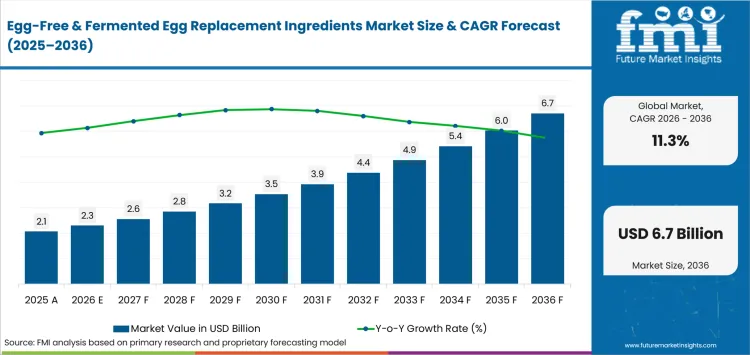
Key Takeaways of Egg-Free & Fermented Egg Replacement Ingredients Market
- Egg supply volatility and multi-function reformulation needs are increasing demand for ingredients that protect production continuity across bakery and sauce recipes.
- Based on type, plant-based egg is projected to account for 39.2% in 2026 due to blended systems that reproduce several recipe functions.
- By application, bakery is forecast to represent 34.9% in 2026 driven by repeated needs for aeration and binding during heat-set processing.
- Precision-fermented ovalbumin broadens the replacement range for recipes that need familiar egg-white behavior under a controlled ingredient specification.
- Approval requirements and recipe-specific performance differences remain material barriers across national markets and commercial production lines.
- The EVERY Company and Onego Bio compete through fermentation-derived proteins designed for several commercial food applications. Just Food Company and Revyve use plant or yeast routes; ENEO and Ingredion, alongside Roquette and Puratos, compete through functional ingredient systems for bakery and sauce applications
Analyst Perspective
"Egg replacement decisions fail if teams compare ingredient labels instead of the exact functions required in each recipe. Plant systems cover several functions through blended formulations; bakery lines must confirm aeration and heat-set structure at commercial speed. Fermented ovalbumin offers familiar egg-white behavior, yet legal clearance and allergen controls remain separate from technical performance. Strong commercial programs connect regulatory evidence with line trials and dependable supply throughout expansion into additional products."
- Nandini Roy Choudhury, Principal Analyst, Future Market Insights
How is the Egg-Free & Fermented Egg Replacement Ingredients Market segmented?
The egg-free and fermented egg replacement ingredients industry is segmented by type, application, and region.
The market separates type according to the ingredient route used to reproduce functional performance across commercial food formulations. Plant-based egg combines pulse proteins with starches and hydrocolloids that address several recipe requirements through one blended system. Precision-fermented ovalbumin uses microbial production to create the principal egg-white protein under a controlled manufacturing specification. Aquafaba relies on legume cooking liquid; starch and protein blends combine several materials around a defined recipe target. Application analysis distinguishes bakery and sauces from beverages and confectionery through different needs for aeration and heat response. Regional analysis compares legal status with supply access and formulation support across each profiled country.
What supports demand for plant-based egg within the type category?
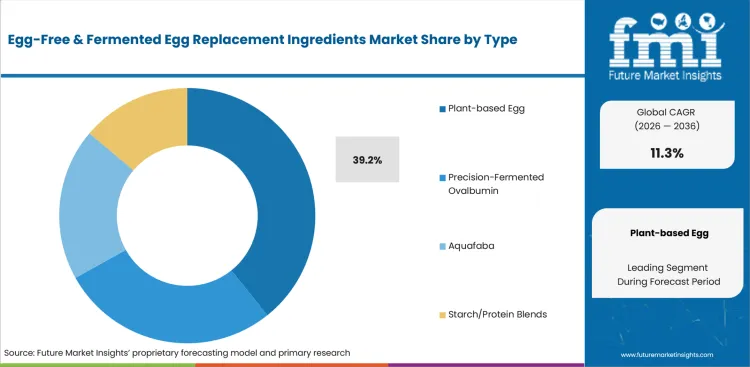
Plant-based egg systems combine pulse proteins with starches and hydrocolloids to reproduce several functions through blended formulations. Ingredion published a May 2025 technical article explaining how proteins and functional systems support egg replacement in commercial baking. Industrial recipes require repeatable performance across full production batches rather than concepts developed through small laboratory tests. Plant-based protein systems let formulators adjust binding and aeration without replacing established equipment or controls. Application support remains essential; one blend rarely performs identically across every recipe and processing condition.
- Plant-based egg is projected to hold 39.2% share in 2026 owing to adaptable combinations designed around defined recipe targets. Formulators adjust protein and starch ratios without changing the complete production route or established line controls. The segment gains commercial strength through specifications that address several functional gaps within one qualification program for food manufacturers.
- Commercial bakeries and sauce manufacturers use plant-based systems to reduce shell-egg dependence without adding a fermentation approval route. Chickpea protein and faba formulations support binding or emulsion control across selected commercial products and established food-processing conditions. Adoption weakens if flavor masking and heat stability require repeated reformulation across every recipe in a manufacturer portfolio.
What makes bakery central to the application category?
Bakery production combines aeration and binding with heat-set structure during one controlled manufacturing cycle across high-volume commercial lines. Puratos announced a September 2025 joint venture with Guelph Foods to expand plant-based egg-wash alternatives across China and Asia-Pacific. The partnership links regional UHT capacity with bakery application support for commercial manufacturers across several product categories. Bakers need stable behavior throughout mixing and proofing so dough structure remains consistent during production. Alternative protein formulations gain repeat orders through recipe-specific evidence and predictable scale-up support at each manufacturing location.
- Based on application, bakery is projected to account for 34.9% in 2026 due to repeated requirements for aeration and heat-set structure. Cakes and cookies require aeration and binding alongside heat-set structure throughout high-volume commercial production cycles. The segment reflects frequent reformulation across high-volume products instead of simple replacement of one raw material.
- Industrial bakers evaluate egg-free systems through line trials that measure batter density and final crumb across planned shelf life. Successful programs document dosage limits and process tolerances for each recipe under routine production conditions. Commercial use expands through application laboratories that resolve failures without requiring redesigned equipment or disrupted production layouts.
What are the drivers, restraints, and opportunities in the Egg-Free & Fermented Egg Replacement Ingredients Market?
Egg supply volatility strengthens reformulation demand; application-specific performance slows qualification; documented approval and scale-up routes create commercial openings.
- Driver: Egg supply disruptions raise the value of functional alternatives that protect scheduled food production from sudden ingredient shortages.
- Restraint: Functional performance changes across recipes and processing conditions, increasing trial costs during the path toward routine production.
- Opportunity: Approved fermentation proteins and scalable plant systems create recurring contracts for providers that combine compliant dossiers with application support.
Volatile shell-egg availability gives food manufacturers a direct reason to qualify alternative ingredients against future supply interruptions. USDA Economic Research Service confirmed in April 2026 that retail egg prices averaged 21.9% higher across 2025 than during 2024, within its annual review of U.S. food-at-home prices. Price movement does not guarantee conversion; every recipe carries separate performance requirements and production risks. Egg-white substitutes become commercially relevant through validated output and dependable delivery across scheduled production cycles. Manufacturers reduce disruption exposure by maintaining qualified alternatives for products with repeated egg use and predictable demand patterns.
Regulatory approval applies to the exact organism and production process under specified uses, which lengthens entry for fermentation-derived proteins. Singapore Food Agency stated in June 2026 that novel-food applicants must provide safety assessments supported by scientific evidence. Product developers also need allergen controls; fermentation-derived ovalbumin remains an egg protein under food-labeling requirements. Legal clearance cannot replace application testing across dosage and processing conditions for each intended formulation. Commercial timelines improve through coordinated regulatory dossiers and recipe trials within the same development plan.
A shared authorization route creates a commercial opening for providers serving several European customers through one compliant ingredient specification. Finnish Food Authority stated in June 2026 that foods appearing on the European Union list are permitted under listed conditions. The framework reduces repeated country-level authorization work following a successful dossier and verified product specification. National enforcement and exact labeling requirements continue to shape commercial access across individual European Union member states. Food emulsifiers and protein systems gain wider value through dossiers covering several intended applications without weakening safety evidence.
Which country CAGRs are profiled in the Egg-Free & Fermented Egg Replacement Ingredients Market?
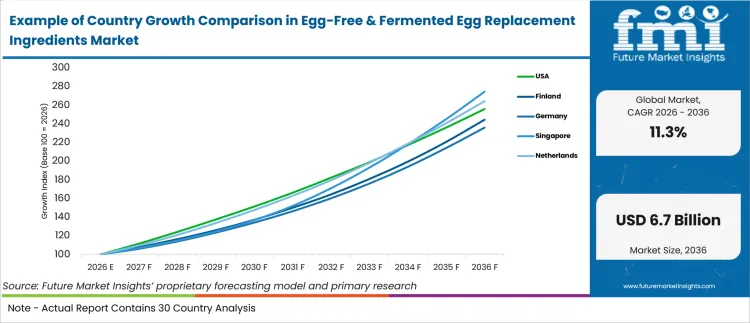
| Country | CAGR |
|---|---|
| USA | 9.8% |
| Finland | 9.4% |
| Germany | 9.0% |
| Singapore | 10.6% |
| Netherlands | 10.2% |
How do country-level CAGRs compare in the Egg-Free & Fermented Egg Replacement Ingredients Market?
The country forecasts are concentrated within a narrow range, indicating similar momentum across the egg-free & fermented egg replacement ingredients market. Singapore and the Netherlands lead a closely aligned upper group, supported by growing interest in innovative protein technologies and alternative ingredient platforms. The USA follows within a short distance of this cluster and remains closely connected to the broader market trend. Finland and Germany form a second group with limited separation between their forecasts, reflecting steady progress in ingredient development and food formulation innovation.
- Singapore shows a notable position within the comparison as investments in food technology and precision fermentation support the development of next-generation egg replacement ingredients.
- The Netherlands remains closely aligned with Singapore through its strong alternative protein ecosystem and continued focus on commercializing innovative food ingredient technologies.
- The USA benefits from growing demand for plant-based and allergen-friendly products, encouraging manufacturers to expand the use of egg replacement systems across multiple food categories.
- Finland maintains steady momentum through advances in sustainable food production and increasing interest in fermentation-based ingredient development.
- Germany reflects continued market expansion as food manufacturers pursue clean-label reformulation strategies and seek functional alternatives to conventional egg ingredients.
Comparable CAGRs do not create identical market conditions across countries. Differences in food technology infrastructure, fermentation capabilities, regulatory frameworks and product development priorities can influence commercialization timelines and adoption routes. Similar growth forecasts may therefore reflect distinct innovation strategies and ingredient deployment models across individual markets. The full report provides country-level CAGR analysis across North America, Latin America, Europe, East Asia, South Asia, Oceania and the Middle East and Africa.
Country-wise Analysis
- United States commercialization uses an established GRAS notification route and a large industrial bakery base for application trials. In March 2025 Onego Bio announced a proposed Wisconsin facility with output equivalent to six million laying hens. The United States egg-free and fermented egg replacement ingredients sector is projected to record 9.8% CAGR during the assessment period, supported by a defined GRAS route and planned domestic fermentation capacity. The planned facility strengthens future domestic supply, but commercial operations are not scheduled to begin until 2028. Current entry plans require pilot material and documented allergen controls with recipe evidence across each intended use.
- Finnish food businesses must confirm Union-list authorization for every novel fermentation-derived ingredient entering the national market. Egg-free and fermented egg replacement ingredient demand in Finland is forecast to rise at 9.4% CAGR over the forecast period, shaped by the shared European authorization route and local food-science capability. The Finnish Food Authority reported in June 2026 that EFSA has a nine-month assessment period for a complete application. A Commission decision requires up to seven additional months within the same European authorization process. The shared route provides one approval pathway across the European Union; incomplete safety files delay formulation schedules. Commercial programs require allergen evidence and process-control records that match every intended commercial food application.
- German formulators operate within the European Union authorization system and an established bakery ingredient network serving commercial manufacturers. Adoption of egg-free and fermented egg replacement ingredients in Germany is estimated to expand at 9.0% CAGR through 2036, supported by established bakery networks and national novel-food oversight. The German Federal Institute for Risk Assessment identifies BVL as the national contact for novel-food classification and approved operating conditions. Local application expertise supports plant-based reformulation; fermentation-derived ovalbumin needs Union-list access and precise allergen communication. Providers should combine legal documentation with local technical support throughout commercial bakery qualification programs and recurring production reviews.
- Singapore requires pre-market approval for precision-fermentation foods under the reviewed production process and intended commercial uses. Singapore Food Agency stated in December 2025 that a complete novel-food evaluation generally requires nine to twelve months. Egg-free and fermented egg replacement ingredient sales in Singapore are forecast to expand at 10.6% CAGR by 2036, enabled by a defined pre-market approval framework for precision-fermentation foods. Regulatory clarity supports well-documented ingredients and local application work; process changes or broader uses trigger another review. Commercial plans require time for dossier updates and technical trials across regional bakery and sauce programs.
- Dutch ingredient developers operate within the European Union novel-food regime and a concentrated food-technology network around Wageningen and Brabant. The Netherlands egg-free and fermented egg replacement ingredients outlook is anticipated to advance at 10.2% CAGR over the assessment period, reinforced by operating yeast-protein capacity and nearby application support. Revyve reported in October 2025 that its Dinteloord team had brought a first-of-a-kind plant into operation and produced sellable yeast proteins at industrial scale. The operating base gives local manufacturers sample access and nearby application support; novel ingredients continue to require Union-list authorization. Commercial entry should combine local trials with documented legal status and dependable production capacity for recurring sales.
Who are the notable companies in the Egg-Free & Fermented Egg Replacement Ingredients Market?
The EVERY Company, Onego Bio, Just Food Company, Revyve, BENEO, Ingredion Incorporated, Roquette Frères, and Puratos Group are the notable companies shaping this market.
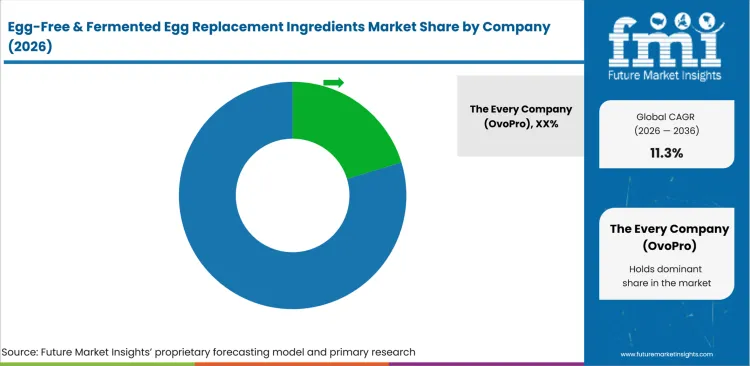
Key players in the market such as The EVERY Company and Onego Bio supply fermentation-derived proteins that reproduce egg-white functions across bakery and sauce applications. Just Food Company commercializes mung-bean egg formats across foodservice menus and large-scale prepared-food production systems. Revyve provides yeast proteins for egg reduction in bakery and sauce formulations that require several texture functions. BENEO and Ingredion support plant-based reformulation through pulse proteins and broader texture systems for industrial recipes. Roquette contributes pea proteins for bakery and sauce applications; Puratos provides plant-based egg-wash alternatives supported by bakery application expertise. Competitive strength depends on legal access and available output across each intended market region and application. Food manufacturers also require technical support that resolves recipe failures during qualification trials and production scale-up.
Competitive Benchmarking: Egg-Free & Fermented Egg Replacement Ingredients Market
| Company | Functional Egg Replacement | Fermentation-Derived Protein | Bakery Application Support | Geographic Reach |
|---|---|---|---|---|
| The EVERY Company | High | High | High | North America and selected global markets |
| Onego Bio | High | High | High | North America and Europe |
| Just Food Company | High | Low | Medium | North America and selected international markets |
| Revyve | High | Medium | High | Europe with global commercial expansion |
| BENEO | Medium | Low | Medium | Global |
| Ingredion Incorporated | High | Low | High | Global |
| Roquette Frères | Medium | Low | Medium | Global |
| Puratos Group | Medium | Low | High | Global |
Key Developments in the Egg-Free & Fermented Egg Replacement Ingredients Market
- In June 2026, The EVERY Company expanded its manufacturing agreement with Huvepharma to quadruple production capacity for OvoPro fermentation-derived egg protein. The company reported steady industrial output and regular metric-tonne deliveries through Biovet facilities in Bulgaria. The expansion increases supply available for baked goods and other commercial foods across several manufacturing channels. Larger batch availability improves cost control for food manufacturers transitioning from evaluation to recurring supply contracts.
- In March 2026, Onego Bio entered a collaboration with Sigma Foods to evaluate Bioalbumen through feasibility work and commercially relevant application trials. The program includes prototype development across foods that need egg-protein functionality and greater supply resilience during commercial production. The collaboration creates direct formulation evidence for a multinational food producer across several intended applications. Commercial progress depends on trial results that translate into approved recipes and repeatable production specifications.
- In September 2025, Revyve secured new funding to expand production of egg-replacing yeast proteins at its Dinteloord facility. The company reported that the plant was already supplying industrial volumes to several commercial food manufacturers. Added capacity supports bakery and sauce manufacturers that need emulsification or foaming without conventional egg ingredients. Expansion value depends on consistent quality and responsive application support across commercial recipes and production conditions.
- In April 2025, BENEO inaugurated a pulse-processing plant in Obrigheim that converts locally grown faba beans into food ingredients. The company identified egg replacement among the uses supported by pulse-derived proteins from the site. European food manufacturers gain another regional source for functional plant proteins across bakery and other commercial food categories. Each formulation requires testing for flavor and heat response under commercial processing conditions and planned storage periods.
Key Players in the Egg-Free & Fermented Egg Replacement Ingredients Market
Fermentation-Derived Protein Developers
- The EVERY Company
- Onego Bio
- Revyve
Plant-Based Egg Platforms
- Just Food Company
Functional Ingredient and Bakery Solution Providers
- BENEO
- Ingredion Incorporated
- Roquette Frères
- Puratos Group
Egg-Free & Fermented Egg Replacement Ingredients Market - Report Scope
| Coverage field | Report scope |
|---|---|
| Market breakdown | Type, application, and region. |
| Quantitative Units | Revenue in USD Billion, CAGR in %. |
| Market Definition | Commercially supplied plant-based egg systems, aquafaba ingredients, starch-protein blends and precision-fermented ovalbumin used to replace egg functions in food formulations. Finished consumer egg products and conventional shell-egg ingredients remain outside scope. |
| Regions Covered | North America, Latin America, Western Europe, Eastern Europe, East Asia, South Asia and Pacific, and Middle East and Africa. |
| Countries Covered | USA, Finland, Germany, Singapore, and the Netherlands. |
| Key Companies Profiled | The EVERY Company, Onego Bio, Just Food Company, Revyve, BENEO, Ingredion Incorporated, Roquette Frères, and Puratos Group. |
| Forecast Period | 2026 to 2036. |
| Approach | Hybrid bottom-up and top-down market sizing supported by manufacturer interviews and authoritative desk research across defined applications. |
Egg-Free & Fermented Egg Replacement Ingredients Market - Research Methodology
| Method | Approach |
|---|---|
| Primary Research | FMI analysts gathered input from manufacturers, service providers, technology developers, distributors, end users, procurement teams, and subject-matter experts. Interviews examined purchasing decisions, product or service evaluation, adoption barriers, approval requirements, pricing considerations, and expectations for technical or commercial support. Respondents were also asked what evidence is required before a trial, pilot, or initial order develops into regular purchasing. |
| Desk Research | Desk research covered government statistics, regulatory publications, trade data, industry associations, technical literature, standards, company filings, product information, and official corporate announcements. Sources were reviewed for relevance, publication date, geographic coverage, and consistency with the defined market scope. Claims relating to performance, applications, approvals, capacity, investment, and commercial activity were retained only when supported by credible public evidence. |
| Market Sizing and Forecasting | The market model combined the baseline value with historical performance, segment structure, pricing and volume indicators, adoption levels, company participation, and country-level demand conditions. Forecast assumptions considered economic activity, investment trends, regulatory developments, technology adoption, purchasing cycles, supply availability, and barriers to wider market use. Segment and regional estimates were reconciled before the final market total was calculated. |
| Data Validation | Estimates were checked against multiple independent indicators, including public data, company activity, trade patterns, industry developments, and findings from primary interviews. Validation also tested whether products, services, applications, and company revenues fell within the defined market boundaries. Adjacent categories, unsupported claims, overlapping revenues, and activities without direct market relevance were excluded to reduce double counting and maintain consistency across segments and countries. |
Egg-Free & Fermented Egg Replacement Ingredients Market by Segments
Egg-Free & Fermented Egg Replacement Ingredients Market segmented by Type:
- Plant-based Egg
- Precision-Fermented Ovalbumin
- Aquafaba
- Starch/Protein Blends
Egg-Free & Fermented Egg Replacement Ingredients Market segmented by Application:
- Bakery
- Sauces
- Beverages
- Confectionery
Egg-Free & Fermented Egg Replacement Ingredients Market by Region:
- North America
- United States
- Canada
- Latin America
- Brazil
- Mexico
- Argentina
- Chile
- Western Europe
- Germany
- France
- United Kingdom
- Italy
- Spain
- Benelux
- Nordics
- Eastern Europe
- Poland
- Czech Republic
- Romania
- Hungary
- East Asia
- China
- Japan
- South Korea
- South Asia and Pacific
- India
- ASEAN
- Australia and New Zealand
- Middle East and Africa
- GCC Countries
- South Africa
- Türkiye
- Israel
Research Sources and Bibliography
- Grossen, G. (2025, June 3). Retail egg prices fall, following declining wholesale prices.
- Sinclair, W., & Stewart, H. (2026, April 30). U.S. food-at-home prices increased 2.3 percent in 2025, compared with 2024.
- U.S. Food and Drug Administration. (2025, September 16). GRN No. 1249: Ovalbumin produced by Trichoderma reesei "TR112"
- Ingredion. (2025, May 22). The role of egg replacements in baking.
- Puratos. (2025, September 12). Puratos and Guelph Announced Strategic Joint Venture to Ignite a New Chapter for Asia Pacific Bakery Industry.
- Singapore Food Agency. (2026, June 17). Overview of pre-market approval framework for novel food.
- Finnish Food Authority. (2026, June 3). Union list of authorised novel foods.
- Onego Bio. (2025, March 12). Onego Bio Chooses Jefferson County, Wisconsin for Flagship Egg Protein Manufacturing Facility.
- Finnish Food Authority. (2026, June 3). Applying for novel food authorisation.
- German Federal Institute for Risk Assessment. (n.d.). Novel Food.
- Singapore Food Agency. (2025, December 8). Guidelines on applying for pre-market approval for a novel food.
- Revyve. (2025, October 2). The Revyve Way by Stijn Janssen.
- The EVERY Company. (2026, June 15). EVERY and Huvepharma Announce 4x Production Capacity Expansion.
- Onego Bio. (2026, March 5). Onego Bio and Sigma Foods Enter Collaboration to Strengthen Egg Protein Innovation and Supply Resilience.
- Revyve. (2025, September 23). Revyve Secures €24 Million Funding to Boost Egg-Replacing Yeast Proteins.
- BENEO. (2025, April 11). BENEO inaugurates new pulse-processing plant.
- The EVERY Company. (2026, March 11). Healthier Comforts Brings EVERY’s Animal-Free Egg White Protein to Home Kitchens for the First Time.
This bibliography is provided for reader reference and is not exhaustive. The full report contains the complete reference list and detailed citations.
This Report Answers
- How large is the egg-free and fermented egg replacement ingredients market in 2026 and 2036?
- Which supply and formulation pressures support investment in egg replacement ingredients?
- Why does plant-based egg hold the largest type share in 2026?
- Why does bakery account for the largest application share in 2026?
- How do regulatory routes differ across the United States, Finland, Germany, Singapore, and the Netherlands?
- Which companies provide fermentation-derived proteins, plant-based egg platforms, or functional ingredient systems?
- What limits routine adoption across recipes and commercial production lines?
- How should manufacturers compare regulatory status, technical support, and supply readiness?
- Which developments are expanding commercial capacity and application validation?
Frequently Asked Questions
How big is the Egg-Free & Fermented Egg Replacement Ingredients Market in 2026?
The egg-free & fermented egg replacement ingredients market is valued at USD 2.3 billion in 2026 and is forecast to reach USD 6.7 billion by 2036, supported by egg supply volatility from avian influenza outbreaks and growing food manufacturer demand for functional alternatives that protect scheduled production across bakery and sauce recipes.
What is the CAGR of the Egg-Free & Fermented Egg Replacement Ingredients Market from 2026 to 2036?
The egg-free & fermented egg replacement ingredients market is projected to grow at a CAGR of 11.3% between 2026 and 2036, supported by rising shell-egg prices, expanding regulatory approval routes for precision-fermented ovalbumin, and growing industrial bakery demand for multi-function replacement systems with dependable supply and application support.
Which type leads the Egg-Free & Fermented Egg Replacement Ingredients Market?
Plant-based egg accounts for 39.2% of the egg-free & fermented egg replacement ingredients market by type in 2026, driven by adaptable blended systems combining pulse proteins with starches and hydrocolloids that allow formulators to adjust binding and aeration ratios without changing established production equipment or line controls.
How much will the Egg-Free & Fermented Egg Replacement Ingredients Market add between 2026 and 2036?
The egg-free & fermented egg replacement ingredients market is set to add USD 4.4 billion between 2026 and 2036, growing from USD 2.3 billion to USD 6.7 billion as egg supply disruptions, GRAS approvals for fermentation-derived ovalbumin, and expanding plant-based bakery reformulation programs accelerate ingredient adoption across commercial food manufacturing globally.
Who are the leading companies in the Egg-Free & Fermented Egg Replacement Ingredients Market?
Leading companies in the egg-free & fermented egg replacement ingredients market include The EVERY Company, Onego Bio, Revyve, Just Food Company, BENEO, Ingredion, Roquette Frères, and Puratos Group, competing across fermentation-derived protein development, plant-based egg platforms, and functional ingredient and bakery solution systems with global and regional manufacturing reach.
Preview the report firsthand - request a free sample
Get SampleGet the brochure for pricing and purchase details.
Get PDFTable of Content
- Key Takeaways
- Market Size and CAGR
- Top Growth Driver
- Fastest Growing Segment
- Leading Region
- Key Companies
- Emerging Opportunities
- Executive Summary
- Global Market Outlook
- Demand-side Trends
- Supply-side Trends
- Technology Roadmap Analysis
- Analysis and Recommendations
- Analyst Perspective (What is happening? Why now? What should investors know?)
- Key Questions Answered
- How large is the market?
- What is the CAGR?
- What are key trends?
- Which region dominates?
- Who are the leaders?
- Market Overview
- Market Coverage / Taxonomy
- Market Definition / Scope / Limitations
- Research Methodology
- Chapter Orientation
- Analytical Lens and Working Hypotheses
- Market Structure, Signals, and Trend Drivers
- Benchmarking and Cross-market Comparability
- Market Sizing, Forecasting, and Opportunity Mapping
- Research Design and Evidence Framework
- Desk Research Programme (Secondary Evidence)
- Expert Input and Fieldwork (Primary Evidence)
- Tooling, Models, and Reference Databases
- Data Engineering and Model Build
- Quality Assurance and Audit Trail
- Market Background
- Market Dynamics (Drivers, Restraints, Opportunity, Trends)
- Scenario Forecast (Optimistic, Likely, Conservative)
- Impact Analysis
- AI Impact
- Sustainability Impact
- Regulatory Impact
- Technology Impact
- Consumer / Buyer Analysis
- Purchase Drivers
- Adoption Barriers
- Buyer Journey
- Opportunity Map Analysis
- Product Life Cycle Analysis
- Supply Chain Analysis
- Investment Feasibility Matrix
- Value Chain Analysis
- PESTLE and Porter's Analysis
- Regulatory Landscape
- Regional Parent Market Outlook
- Production and Consumption Statistics
- Import and Export Statistics
- Global Market Analysis and Forecast, 2021 to 2036
- Historical Market Size Value (USD Billion) Analysis, 2021 to 2025
- Current and Future Market Size Value (USD Billion) Projections, 2026 to 2036
- Y-o-Y Growth Trend Analysis
- Absolute $ Opportunity Analysis
- Global Market Pricing Analysis, 2021 to 2036
- Global Market Analysis and Forecast, By Type, 2021 to 2036
- Introduction / Key Findings
- Historical Market Size Value (USD Billion) Analysis By Type, 2021 to 2025
- Current and Future Market Size Value (USD Billion) Analysis and Forecast By Type, 2026 to 2036
- Plant-based Egg
- Precision-Fermented Ovalbumin
- Aquafaba
- Starch/Protein Blends
- Plant-based Egg
- Y-o-Y Growth Trend Analysis By Type, 2021 to 2025
- Absolute $ Opportunity Analysis By Type, 2026 to 2036
- Global Market Analysis and Forecast, By Application, 2021 to 2036
- Introduction / Key Findings
- Historical Market Size Value (USD Billion) Analysis By Application, 2021 to 2025
- Current and Future Market Size Value (USD Billion) Analysis and Forecast By Application, 2026 to 2036
- Bakery
- Sauces
- Beverages
- Confectionery
- Bakery
- Y-o-Y Growth Trend Analysis By Application, 2021 to 2025
- Absolute $ Opportunity Analysis By Application, 2026 to 2036
- Global Market Analysis and Forecast, By Region, 2021 to 2036
- Introduction
- Historical Market Size Value (USD Billion) Analysis By Region, 2021 to 2025
- Current Market Size Value (USD Billion) Analysis and Forecast By Region, 2026 to 2036
- North America
- Latin America
- Western Europe
- Eastern Europe
- East Asia
- South Asia and Pacific
- Middle East & Africa
- Market Attractiveness Analysis By Region
- North America Market Analysis and Forecast, By Country, 2021 to 2036
- Historical Market Size Value (USD Billion) Trend Analysis By Market Taxonomy, 2021 to 2025
- Market Size Value (USD Billion) Forecast By Market Taxonomy, 2026 to 2036
- By Country
- USA
- Canada
- By Type
- By Application
- By Country
- Market Attractiveness Analysis
- By Country
- By Type
- By Application
- Key Takeaways
- Latin America Market Analysis and Forecast, By Country
- Historical Market Size Value (USD Billion) Trend Analysis By Market Taxonomy, 2021 to 2025
- Market Size Value (USD Billion) Forecast By Market Taxonomy, 2026 to 2036
- By Country
- Brazil
- Mexico
- Chile
- Rest of Latin America
- By Type
- By Application
- By Country
- Market Attractiveness Analysis
- By Country
- By Type
- By Application
- Key Takeaways
- Western Europe Market Analysis and Forecast, By Country
- Historical Market Size Value (USD Billion) Trend Analysis By Market Taxonomy, 2021 to 2025
- Market Size Value (USD Billion) Forecast By Market Taxonomy, 2026 to 2036
- By Country
- Germany
- UK
- Italy
- Spain
- France
- Nordic
- BENELUX
- Rest of Western Europe
- By Type
- By Application
- By Country
- Market Attractiveness Analysis
- By Country
- By Type
- By Application
- Key Takeaways
- Eastern Europe Market Analysis and Forecast, By Country
- Historical Market Size Value (USD Billion) Trend Analysis By Market Taxonomy, 2021 to 2025
- Market Size Value (USD Billion) Forecast By Market Taxonomy, 2026 to 2036
- By Country
- Russia
- Poland
- Hungary
- Balkan & Baltic
- Rest of Eastern Europe
- By Type
- By Application
- By Country
- Market Attractiveness Analysis
- By Country
- By Type
- By Application
- Key Takeaways
- East Asia Market Analysis and Forecast, By Country
- Historical Market Size Value (USD Billion) Trend Analysis By Market Taxonomy, 2021 to 2025
- Market Size Value (USD Billion) Forecast By Market Taxonomy, 2026 to 2036
- By Country
- China
- Japan
- South Korea
- By Type
- By Application
- By Country
- Market Attractiveness Analysis
- By Country
- By Type
- By Application
- Key Takeaways
- South Asia and Pacific Market Analysis and Forecast, By Country
- Historical Market Size Value (USD Billion) Trend Analysis By Market Taxonomy, 2021 to 2025
- Market Size Value (USD Billion) Forecast By Market Taxonomy, 2026 to 2036
- By Country
- India
- ASEAN
- Australia & New Zealand
- Rest of South Asia and Pacific
- By Type
- By Application
- By Country
- Market Attractiveness Analysis
- By Country
- By Type
- By Application
- Key Takeaways
- Middle East & Africa Market Analysis and Forecast, By Country
- Historical Market Size Value (USD Billion) Trend Analysis By Market Taxonomy, 2021 to 2025
- Market Size Value (USD Billion) Forecast By Market Taxonomy, 2026 to 2036
- By Country
- Kingdom of Saudi Arabia
- Other GCC Countries
- Türkiye
- South Africa
- Other African Union
- Rest of Middle East & Africa
- By Type
- By Application
- By Country
- Market Attractiveness Analysis
- By Country
- By Type
- By Application
- Key Takeaways
- Key Countries Market Analysis
- USA
- Pricing Analysis
- Market Share Analysis, 2025
- By Type
- By Application
- Canada
- Pricing Analysis
- Market Share Analysis, 2025
- By Type
- By Application
- Mexico
- Pricing Analysis
- Market Share Analysis, 2025
- By Type
- By Application
- Brazil
- Pricing Analysis
- Market Share Analysis, 2025
- By Type
- By Application
- Chile
- Pricing Analysis
- Market Share Analysis, 2025
- By Type
- By Application
- Germany
- Pricing Analysis
- Market Share Analysis, 2025
- By Type
- By Application
- UK
- Pricing Analysis
- Market Share Analysis, 2025
- By Type
- By Application
- Italy
- Pricing Analysis
- Market Share Analysis, 2025
- By Type
- By Application
- Spain
- Pricing Analysis
- Market Share Analysis, 2025
- By Type
- By Application
- France
- Pricing Analysis
- Market Share Analysis, 2025
- By Type
- By Application
- India
- Pricing Analysis
- Market Share Analysis, 2025
- By Type
- By Application
- ASEAN
- Pricing Analysis
- Market Share Analysis, 2025
- By Type
- By Application
- Australia & New Zealand
- Pricing Analysis
- Market Share Analysis, 2025
- By Type
- By Application
- China
- Pricing Analysis
- Market Share Analysis, 2025
- By Type
- By Application
- Japan
- Pricing Analysis
- Market Share Analysis, 2025
- By Type
- By Application
- South Korea
- Pricing Analysis
- Market Share Analysis, 2025
- By Type
- By Application
- Russia
- Pricing Analysis
- Market Share Analysis, 2025
- By Type
- By Application
- Poland
- Pricing Analysis
- Market Share Analysis, 2025
- By Type
- By Application
- Hungary
- Pricing Analysis
- Market Share Analysis, 2025
- By Type
- By Application
- Kingdom of Saudi Arabia
- Pricing Analysis
- Market Share Analysis, 2025
- By Type
- By Application
- Türkiye
- Pricing Analysis
- Market Share Analysis, 2025
- By Type
- By Application
- South Africa
- Pricing Analysis
- Market Share Analysis, 2025
- By Type
- By Application
- USA
- Market Structure Analysis
- Competition Dashboard
- Competition Benchmarking
- Market Share Analysis of Top Players
- By Regional
- By Type
- By Application
- Emerging Startups
- Innovation Benchmarking
- Competition Analysis
- Competition Deep Dive
- The Every Company (OvoPro)
- Overview
- Product Portfolio
- Profitability by Market Segments
- Sales Footprint
- Strategy Overview
- Marketing Strategy
- Product Strategy
- Channel Strategy
- Onego Bio
- Eat Just
- Float Foods
- Formo
- PlantEgg
- The Every Company (OvoPro)
- Case Studies
- Success Stories
- Recent Developments
- Competition Deep Dive
- Assumptions & Acronyms Used


