

- Market Size (2026)
- USD 415.2 Mn
- Forecast (2036)
- USD 965.0 Mn
- CAGR (2026 to 2036)
- 8.8%
How big is Egg Wash Alternatives Market in 2026?
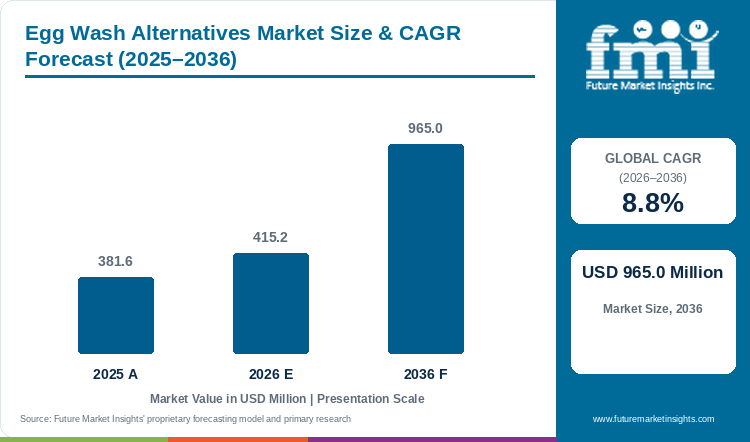
Accounting for USD 381.6 million in 2025 and rising to USD 415.2 million in 2026, the egg wash alternatives market is projected to expand to USD 965.0 million by 2036, advancing at a CAGR of 8.8%.
In September 2025, Puratos formed a strategic joint venture with Guelph Foods to scale ultra-high-temperature plant-based glazes across Asia-Pacific, a move that told converters where egg-price risk was headed before the quotes came down [1]. The global egg wash alternatives market was valued at USD 381.6 million in 2025 and is estimated to reach USD 415.2 million in 2026. The market is projected to reach USD 965.0 million by 2036, expanding at a compound annual growth rate (CAGR) of 8.8% between 2026 and 2036. Liquid formats are projected to capture 39.0% of 2026 type demand because UHT bag-in-box glazes meter directly onto spinning-disc sprayers without powder-dust handling. Demand for the substitution is supported by avian influenza whiplash in shell-egg pricing, which turned a two-cent gloss decision into a hedging question for tunnel-oven bakeries [2]. That volatility premium separates the category from the egg wash substitute baseline growing at 5.9% CAGR, since broader reformulation adoption now rides CIP sanitation savings on top of price fear [8]. Corbion launched Vantage 11E and Vantage 12E egg replacers in April 2025 within a full bakery replacement portfolio [3], and Arla Foods Ingredients expanded US whey-protein capacity through its March 2025 Valley Queen agreement [19]. Bakeries sign glaze contracts against egg futures curves, and the suppliers that hold browning parity across substrate fat contents keep the switch economics positive through 2036.
Key Market Trends & Insights
- By type: Liquid Formats are projected to capture 39.0% of the type segment in 2026 because UHT bag-in-box glazes meter directly onto spinning-disc sprayers.
- By form: Powder / Dry concentrates are estimated to command 48.0% of the form segment in 2026 as ambient warehouse storage eliminates water shipping costs.
- By application: Bread & Rolls are expected to concentrate 29.0% of the application segment in 2026 because continuous bun lines require uniform Maillard browning and sesame adhesion.
- By claim: Conventional formulations are forecast to generate 55.0% of the claim segment in 2026 owing to cost-effective starch and protein blending.
- By sales channel: Direct to Industrial Bakeries is anticipated to account for 57.0% of the sales channel segment in 2026 through on-line nozzle and oven-color trials.
Regional Highlights
- Top national expansion: The UAE is projected to lead national growth at a 10.1% CAGR through 2036 under ambient UHT glaze adoption across hotel and airline kitchens.
- Broader country progression: Saudi Arabia is expected to expand at a 9.8% CAGR ahead of the USA at 9.5% and South Korea at 9.1%, while Japan is forecast to advance at a 7.8% CAGR.
Market Size & Forecast
Table 1: Market Size and Forecast for the Egg Wash Alternatives Market (USD million and CAGR percentage), 2025 to 2036
| Metric | Value |
|---|---|
| 2025 Market Size | USD 381.6 million |
| Estimated Market Size in 2026 | USD 415.2 million |
| Projected Market Size by 2036 | USD 965.0 million |
| CAGR, 2026 to 2036 | 8.8% |
| Added Revenue, 2026 to 2036 | USD 549.8 million |
Sanitation downtime at the glazing station is a major operational driver pushing plant managers to phase out liquid whole egg. Pasteurized egg washes coagulate inside warm spray manifolds and leave protein biofilms on conveyor mesh belts that require up to two hours of chemical flushing per shift. Through its September 2025 joint venture with China-based Guelph Foods, Puratos Group NV is expanding localized UHT egg replacement ingredients and plant-based glaze capacity that runs cleanly through spinning-disc sprayers [1]. Investments in aseptic UHT packaging allow multi-site bakery groups to replace refrigerated egg totes with ambient bag-in-box pouches that connect directly to dosing pumps.
Bakery Surface-Glazing Throughput and Dosage Sizing
Table 2: Surface-Glazing Throughput and Dosage Sizing for the Egg Wash Alternatives Market (USD million and operational ranges), 2025 to 2036
| Metric | 2025 | 2026 | 2036 |
|---|---|---|---|
| Market size (USD million) | 381.6 | 415.2 | 965.0 |
| Glazed bakery & pastry units finished (billion pieces) | 68.5 to 76.0 | 74.0 to 82.5 | 158.0 to 176.0 |
| Ready-to-use glaze solution equivalent (thousand MT) | 136.0 to 152.0 | 148.0 to 165.0 | 316.0 to 352.0 |
| Average topical application cost per 1,000 buns (USD) | 4.80 to 5.60 | 4.90 to 5.75 | 5.30 to 6.20 |
Operational note: Application volumes reflect 1.5 to 2.5 grams of wet glaze deposition per 60-to-85-gram bun or croissant and 1:4 to 1:5 water reconstitution ratios for dry powder concentrates.
Wrapper line speed also shapes how bakery QA teams evaluate surface glazes. If a carbohydrate glaze remains tacky after exiting the cooling spiral, crusts stick to polyethylene flow-wrappers and mar the visual surface, which is why industrial pastry plants pair non-sticky lipid-dextrin glazes with internal vegan egg products to achieve a dry 60-degree specular gloss above 45 GU.
Per Capita & Industrial Glazing Station Indicators
Table 3: Per Capita and Facility Spending Indicators for the Egg Wash Alternatives Market (USD), 2025 to 2036
| Metric | 2025 | 2026 | 2036 |
|---|---|---|---|
| World population (billion) | 8.2 | 8.3 | 9.0 |
| Spend per 1,000 people (USD) | 46.5 | 50.0 | 107.2 |
| Annual glaze spend per industrial bakery line (USD) | 18,500 to 21,800 | 20,100 to 23,600 | 43,500 to 51,000 |
| Direct industrial bakery contract share (%) | 55.0% to 58.0% | 56.0% to 59.0% | 62.0% to 66.0% |
Table 4: Bakery Plant & Glazing Station Spending Indicators for the Egg Wash Alternatives Market (USD and percentages), 2026
| Metric | Value | Institutional Reference Basis |
|---|---|---|
| Market size, 2026 | USD 415.2 million | 2026 global valuation baseline |
| Commercial bakery glazing lines globally | 19,200 lines | Industrial bun, brioche, and viennoiserie finishing registry |
| Market spend per glazing line | USD 21,625.0 | Annualized topical egg-wash alternative expenditure |
| Direct industrial bakery allocation, 2026 | USD 236.7 million | 57.0% sales-channel segment allocation |
Overspray waste reduction on airless spinning-disc applicators directly improves per-tray unit economics. Because low-viscosity UHT emulsions atomize more evenly than viscous whole egg and cut overspray losses by 25% to 35%, procurement teams benchmark topical coatings against plant-based eggs and dairy whey washes on net cost per 1,000 finished buns.
Analyst Perspective
"Bakery QA directors do not approve an egg wash alternative simply because it removes shell eggs from the purchasing ledger. Suppliers must prove identical Maillard Lab* crust color, zero nozzle clogging across eight-hour shifts, and non-tacky film drying inside flow-wrappers before a trial converts into a plant-wide contract."
- Nandini Roy Choudhury, Principal Analyst at Future Market Insights
How is the egg wash alternatives market segmented?
The egg wash alternatives market is segmented by type, form, application, claim, and sales channel. In 2026, Liquid Formats is projected at 39.0%, Powder / Dry at 48.0%, Bread & Rolls at 29.0%, Conventional at 55.0%, and Direct to Industrial Bakeries at 57.0%.
By type: Liquid Formats, Powdered Formats, Frozen, and Specialty Functional.
By form: Powder / Dry, Liquid, Paste / Semi-Solid, and Granules / Pieces.
By application: Bread & Rolls, Cakes & Muffins, Biscuits & Cookies, Viennoiserie & Pastry, and Other Bakery & Snacks.
By claim: Conventional, Clean Label, Organic, and Non-GMO / Identity Preserved.
By sales channel: Direct to Industrial Bakeries, Ingredient Distributors, Foodservice & Artisan Supply, and Online B2B.
Why do Liquid Formats lead the type segment?
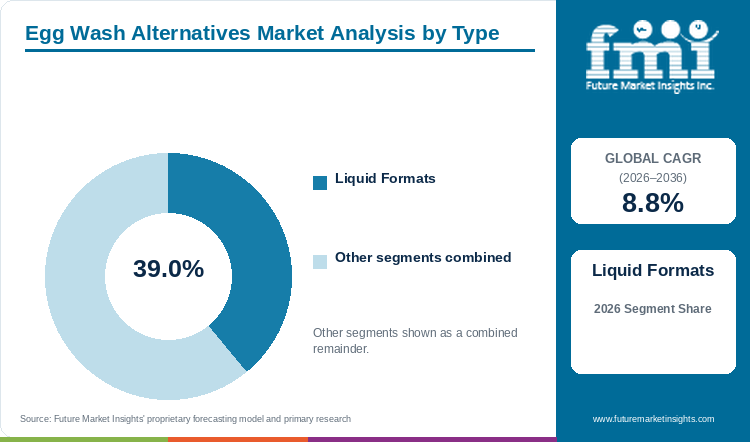
Liquid Formats are projected to capture 39.0% of the type segment in 2026, supported by plug-and-play spray dosing.
Table 5: Type Share for the Egg Wash Alternatives Market (percentage share), 2026
| Type | Share (2026) |
|---|---|
| Liquid Formats | 39.0% |
| Other Segments Combined | 61.0%* |
| Total | 100.0% |
*Note: Remaining type subsegments sum to 100.0% of 2026 egg wash alternatives demand.
Table 6: Type Leadership and Market Growth for the Egg Wash Alternatives Market (segment and CAGR percentage), 2026 to 2036
| Metric | Value |
|---|---|
| Global CAGR (2026 to 2036) | 8.8% |
| Leading Segment | Liquid Formats |
Automated brioche and burger-bun bakeries favor ready-to-use Liquid Formats under the product-configuration Type axis because aseptic bag-in-box pouches plug directly into peristaltic spray pumps without hydration tanks. Factory homogenization prevents shear-induced phase separation on spinning-disc atomizers and works paired with bakery emulsions across continuous proof-and-bake tunnels.
- Liquid Formats are projected to account for 39.0% of the type segment in 2026 because zero-prep UHT packaging eliminates hydration errors at the finishing station.
- A September 2026 study in the International Journal of Biological Macromolecules demonstrated that ultrasound-assisted pH-shifting of pea protein isolate and egg white protein complexes achieved a 96.8% emulsion stability index with uniform sub-micron droplet dispersion [4].
Why does Powder / Dry define the largest form segment?
Powder / Dry supplies are estimated to secure 48.0% of the form segment in 2026, driven by ambient freight savings.
Within the physical Form segmentation, shipping 80% water in ready-to-use liquid totes inflates cross-border freight charges for multi-country bakery distributors. Instantized Powder / Dry glaze concentrates formulated with pea protein or egg albumin protein replacers allow regional commissaries to hydrate batches on site to match custom brush or roller viscosities.
- Powder / Dry options are estimated to command 48.0% of the form segment in 2026 as 12-to-18-month dry sack stability simplifies distributor inventory management.
- An August 2025 study published in the Journal of the Science of Food and Agriculture confirmed that optimizing hydrocolloid and aquafaba powder concentrations controlled suspension viscosity and moisture retention during high-heat baking [5].
What keeps Bread & Rolls ahead in the application segment?
Bread & Rolls are expected to command 29.0% of the application segment in 2026, reflecting continuous bun glazing and seed adhesion.
Quick-service restaurant bun lines and soft dinner-roll plants operate 40,000-piece-per-hour schedules through inline spray hoods prior to sesame seed seeding. Topical coatings must deliver immediate wet tack before oven entry and bake into a flexible golden film that resists flaking during high-speed bagging paired with egg emulsifiers.
- Bread & Rolls are expected to hold 29.0% of the application segment in 2026 because continuous QSR bun production generates year-round glaze consumption.
- In April 2025, Corbion launched Vantage 11E and Vantage 12E in North America as part of its egg-replacement portfolio that includes allergen-friendly egg wash alternatives for commercial bread and bun lines [3].
Why does Conventional lead the claim segment?
Conventional formulations are forecast to generate 55.0% of the claim segment in 2026, owing to broad starch-dextrin formulation latitude.
Reproduction of the warm amber Maillard hue and high specular sheen of whole egg at 180 to 220 degrees Celsius requires precise ratios of dextrose reducing sugars and modified starch film-formers. Conventional specifications let formulators blend octenyl-succinate starches with whey or legume proteins without paying organic certification surcharges.
- Conventional is forecast to account for 55.0% of the claim segment in 2026 because unrestricted dextrin and emulsifier selection lowers per-unit glazing cost.
- A February 2025 study in the International Journal of Biological Macromolecules showed that complexing whey protein isolate fibrils with octenyl succinate starch at pH 6.0 enhanced interfacial film stability and surface elasticity in baked applications [6].
What gives Direct to Industrial Bakeries the leading position in the sales channel segment?
Direct to Industrial Bakeries is anticipated to account for 57.0% of the sales channel segment in 2026, reinforced by on-line spray calibration.
Replacement of a surface wash on an automated pastry or bun line requires calibrating nozzle pressure and oven steam dampers to prevent pale spots or burnt sugar rings. Glaze manufacturers therefore send technical engineers directly into industrial bakeries to run multi-shift spray trials and verify allergen swabbing protocols before signing annual supply agreements.
- Direct to Industrial Bakeries is anticipated to capture 57.0% of the sales channel segment in 2026 because high-volume supply contracts require on-site spray equipment validation.
- In September 2025, Puratos and Guelph Foods formed their Asia-Pacific joint venture to pair UHT glaze manufacturing directly with industrial bakery R&D and technical service [1].
What are the drivers, restraints, and opportunities in the egg wash alternatives market?
In the egg wash alternatives market, avian influenza egg-price volatility and CIP sanitation savings propel topical glaze substitution whereas substrate-specific browning variance and dairy-allergen cross-labeling restrain rapid switching and UHT aseptic bag-in-box systems create global expansion opportunities.
- Driver: Wholesale shell-egg price swings and finishing-line Salmonella sanitation downtime drive industrial bakeries toward shelf-stable glazes.
- Restraint: Oven-profile color shifts across different dough substrates and separate milk-allergen declarations on whey glazes slow recipe requalification.
- Opportunity: Ambient UHT plant-based sprays and precision-fermented or upcycled protein glazes unlock multi-site bakery chain contracts.
Growth Analysis and Future Potential: Qualitative Demand Catalysts
Commercial bakeries consuming liquid pasteurized egg solely for surface shine face severe budget exposure whenever avian influenza outbreaks tighten flock inventories. Unlike internal cake-batter eggs that provide structural coagulation, topical egg washes perform a purely cosmetic Maillard browning and seed-adhesion role that plant-protein and carbohydrate emulsions replicate at 20% to 35% lower cost-in-use. FMI procurement audits confirm that industrial bakeries evaluate topical glazes paired with broader egg protein hedging programs to eliminate refrigerated liquid-egg tanks from the finishing floor. In November 2025, Post Holdings (parent of Michael Foods) reported that its Foodservice segment net sales rose 14.5% to USD 2,641.0 million in fiscal 2025 due in part to incremental avian-influenza egg pricing [7]. Persistent price premiums on conventional foodservice egg liquids give bakery purchasing directors a direct financial incentive to lock in fixed-price alternative glazes.
Risk Assessment of the Egg Wash Alternatives Market: Operational and Formulation Friction
Uniform colorimetry across diverse baking temperatures and dual egg-versus-milk allergen declarations represent the primary technical hurdles delaying commercial conversion. A reducing-sugar and pea-protein glaze calibrated for 210-degree-Celsius hamburger buns can char on long-bake artisan loaves or fail to develop gloss on low-temperature steamed pastries. An August 2026 review from Aarhus University and Palsgaard A/S published in Critical Reviews in Food Science and Nutrition emphasized that trial-and-error egg replacement fails when colloidal interactions between plant proteins and starches are not mapped across real mixing and baking temperatures [8]. also bakeries replacing egg washes with whey-protein glazes such as Arla Nutrilac must still declare milk allergens on pack, which pushes clean-label brands toward 100% animal-free egg protein or legume-based coatings.
Commercial Opportunity Analysis: Formulation Differentiation and Value-Add Formats
Ingredient innovators capture premium margins by engineering ambient UHT plant-based glazes and upcycled seed-protein coatings that require zero refrigeration and zero allergen declarations. Multi-unit retail bake-off chains and airline caterers now specify 10-liter aseptic bag-in-box liquids and airless sprays that eliminate brush cross-contamination. Formulators are also pairing legume and upcycled oilseed proteins with precision-fermented egg white protein to match authentic albumen sheen without poultry inputs. In August 2026, a study in the Journal of Food Science demonstrated that ultrasound-assisted alkaline extraction of red grape seed protein increased protein recovery to 8.2% (54.37% protein content) and oil-binding capacity to 6.49 g/g for functional bakery egg replacement [9]. Verified non-sticky film drying and 9-month ambient stability enable suppliers to convert regional bake-off trials into global QSR and supermarket supply agreements.
Egg Wash Alternatives Market by Country (2026 to 2036)
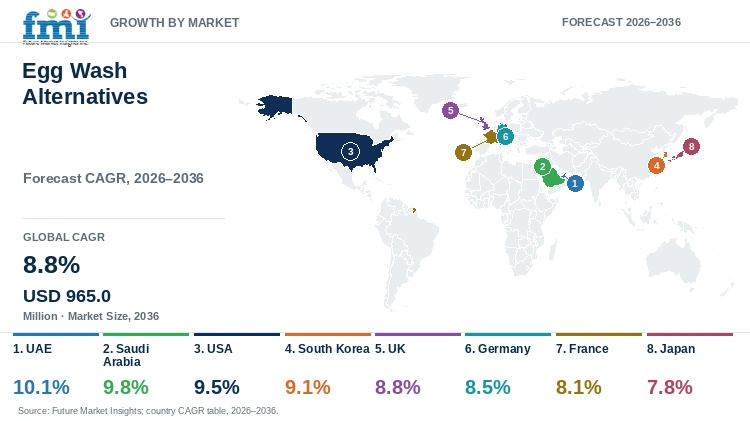
As per FMI, the UAE is projected to lead egg wash alternatives expansion across evaluated national markets at a 10.1% CAGR through 2036, whereas Japan is forecast to advance at a 7.8% CAGR. Commercial adoption across Middle Eastern central kitchens and East Asian or European industrial bakeries depends on shell-egg price hedging, UHT cold-chain savings, and statutory allergen labeling.
Table 7: Country CAGR and Primary Growth Levers for the Egg Wash Alternatives Market (CAGR percentage and operational drivers), 2026 to 2036
| Country | CAGR (2026 to 2036) | Primary Growth Lever |
|---|---|---|
| UAE | 10.1% | National Food Catalogue digital traceability and ambient UHT glaze adoption |
| Saudi Arabia | 9.8% | SFDA port-of-entry compliance screening and healthy-nutrition technical rules |
| USA | 9.5% | 50.7 million hen HPAI depopulation hedging and high-speed QSR bun-line conversion |
| South Korea | 9.1% | Imported functional ingredient demand and strict MFDS egg-allergen separation |
| UK | 8.8% | FSA Codex ED05 allergen threshold governance and recall risk reduction |
| Germany | 8.5% | 14.9% industrial energy inflation favoring fast-browning bake-off glazes |
| France | 8.1% | High-gloss viennoiserie finish standards and 6.4% bakery-pastry retail growth |
| Japan | 7.8% | April 2025 Food Supply Emergency Act hedging and CAA egg/milk labeling |
Source: Future Market Insights analysis
UAE Egg Wash Alternatives Market Outlook (2026 to 2036)
Sales of egg wash alternatives in the UAE are projected to expand at a leading 10.1% CAGR from 2026 to 2036 across airline catering hubs and industrial bakeries. Unlike temperate markets that store chilled liquid egg in bulk tanks, high summer temperatures and strict microbial rules in Dubai and Abu Dhabi favor ambient UHT bag-in-box glazes. In September 2026, the UAE Food and Beverages Manufacturers Group announced the National Food Catalogue and digital traceability initiatives for Future Food Forum 2026 to strengthen local food manufacturing resilience [10]. Mandatory municipal food product registration and halal documentation still require international glaze exporters to validate every emulsifier before commercial trials begin.
Key takeaway: In the UAE, digital food-supply traceability and airline commissary hygiene rules are projected to drive UHT liquid glaze adoption.
Saudi Arabia Egg Wash Alternatives Market Outlook (2026 to 2036)
Intensive port-of-entry food safety screening and rapid expansion of industrial bun plants in Saudi Arabia encourage operators to replace short-life liquid egg washes with sterile UHT coatings. Commercial egg wash alternatives revenue in Saudi Arabia is forecast to climb at a 9.8% CAGR between 2026 and 2036 across Riyadh and Jeddah commissaries. In July 2026, the Saudi Food and Drug Authority intercepted over 301 tons of non-compliant imported food products during Q2 2026 [11] after adopting three new healthy-nutrition technical regulations in February 2025 [12]. High ambient Gulf warehousing temperatures nonetheless compel ingredient suppliers to prove zero emulsion phase separation across six-month storage intervals in domestic bakeries.
Key takeaway: In Saudi Arabia, strict SFDA port-of-entry screening and healthy-nutrition regulations are forecast to accelerate aseptic bakery glaze procurement.
USA Egg Wash Alternatives Market Outlook (2026 to 2036)
Severe avian-influenza flock losses and high-speed QSR bun-line sanitation costs make the USA the most active testing ground for industrial topical egg replacement. In June 2025, the USDA Economic Research Service reported that Highly Pathogenic Avian Influenza depopulated 50.7 million egg-laying hens between October 2024 and March 2025, pushing average wholesale egg prices to USD 8.20 per dozen in February 2025 [2]. Demand for egg wash alternatives in the USA is anticipated to advance at a 9.5% CAGR from 2026 through 2036 across commercial bread and bun plants. Plant conversion still requires multi-shift conveyor and seed-adhesion qualification runs to prevent high-speed wrapper sticking and optical color rejection.
Key takeaway: In the USA, hedging against 50.7-million-hen HPAI supply shocks is anticipated to anchor plant-wide conversion to UHT and powdered glazes.
South Korea Egg Wash Alternatives Market Outlook (2026 to 2036)
Strict national allergen-labeling separation between egg and milk proteins in South Korea compels commercial bakeries to audit topical glaze formulas before making egg-free packaging claims. According to the May 2025 USDA Foreign Agricultural Service Food Processing Ingredients Annual report for South Korea, domestic food processors depend heavily on imported functional proteins and intermediate bakery inputs [13]. High visual gloss standards on packaged sweet buns and convenience-store pastries push R&D teams toward precision pea-protein and dextrin glazes, although customs clearance fees add cost for small distributor lots. Revenue in the South Korea egg wash alternatives market is estimated to rise at a 9.1% CAGR between 2026 and 2036.
Key takeaway: In South Korea, strict egg-versus-milk allergen labeling and premium bun gloss standards are estimated to drive legume-based glaze adoption.
UK Egg Wash Alternatives Market Outlook (2026 to 2036)
The UK is projected to record an 8.8% CAGR in the egg wash alternatives market from 2026 to 2036 across supermarket in-store bakeries and savory pastry manufacturers. Heightened allergen recall scrutiny and precautionary labeling governance push commissaries in the UK to eliminate raw liquid egg from shared pastry glazing lines. In June 2026, the UK Food Standards Agency published its formal policy position on the Codex Precautionary Allergen Labelling standard and ED05 reference thresholds [14], while the May 2026 FSA Consumer Insights Tracker showed 44% of consumers monitoring food recall alerts [15]. Retailer private-label margin pressure still requires glaze suppliers to demonstrate lower applied cost per finished sausage roll or glazed bun.
Key takeaway: In the UK, FSA precautionary allergen threshold governance and recall avoidance are projected to support ready-to-spray vegan glazes.
Germany Egg Wash Alternatives Market Outlook (2026 to 2036)
Elevated industrial oven energy tariffs and discount supermarket bake-off expansion in Germany create strong demand for fast-browning topical glazes. Sales of egg wash alternatives in Germany are expected to climb at an 8.5% CAGR over the 2026 to 2036 forecast period. In October 2026, the Federal Statistical Office in Germany (Destatis) reported that energy product prices rose 14.9% year-on-year in September 2026 while retail food price inflation remained capped at 0.4% [16]. Because commercial bakers cannot pass higher oven energy bills onto discount grocers, processors favor reducing-sugar and legume glazes that reach target golden-brown crust color in shorter bake cycles while complying with EU allergen rules.
Key takeaway: In Germany, 14.9% energy price inflation and discount bake-off cost caps are expected to sustain demand for fast-browning glazes.
France Egg Wash Alternatives Market Outlook (2026 to 2036)
Rigorous golden-brown color and blister-free sheen tolerances on laminated croissants and brioche in France set the highest sensory qualification bar in Europe for alternative washes. In June 2025, INSEE reported in its annual commercial retail account that bakery-pastry specialized retail sales volume in France expanded by 6.4% paired with steady food retail recovery [17]. Commercial turnover in the France egg wash alternatives market is slated to grow at an 8.1% CAGR from 2026 to 2036 across automated industrial viennoiserie plants and national retail bake-off chains. Artisan baker attachment to traditional whole-egg dorure still restricts glaze adoption in independent patisseries unless industrial bake-off trials prove identical crust colorimetry.
Key takeaway: In France, 6.4% bakery-pastry retail volume expansion and strict croissant gloss tolerances are slated to guide selective UHT glaze qualification.
Japan Egg Wash Alternatives Market Outlook (2026 to 2036)
Mandatory Consumer Affairs Agency allergen declarations designating egg and milk among top specific raw materials in Japan incentivize packaged-bun processors to qualify plant-based surface glazes. In April 2025, the Ministry of Agriculture, Forestry and Fisheries established its First Basic Plan under the Act on Countermeasures for Difficult Food Supply Situations to mitigate livestock infectious disease disruptions across domestic food supply chains [18]. Because domestic convenience-store buyers in Japan enforce narrow optical Lab* color tolerances on packaged melonpan and red-bean buns, industrial processors conduct extended pilot runs before switching coatings. Commercial revenue in the Japan egg wash alternatives market is forecast to advance at a 7.8% CAGR from 2026 to 2036.
Key takeaway: In Japan, national livestock-disease supply contingency planning and convenience-store optical color standards are forecast to support precision plant-based glazes.
Full report country CAGRs cover: North America; Latin America; Western Europe; Eastern Europe; East Asia; South Asia and Pacific; Middle East and Africa.
Who are the notable companies in the egg wash alternatives market?
AAK, Bunge, Cargill, Fuji Oil Holdings, Wilmar International, Lactalis Ingredients, FrieslandCampina Ingredients, Arla Foods Ingredients, Michael Foods, and Corbion are the notable companies evaluated in this market.
FMI analysis indicates that the competitive arena spans direct topical-glaze and egg-replacement system formulators, dairy-protein ingredient suppliers, and specialty bakery lipid refiners. Arla Foods Ingredients documents direct egg-free pastry glaze applications using Nutrilac whey proteins and Corbion explicitly includes allergen-friendly egg wash alternatives in its egg-replacement portfolio, whereas lipid suppliers provide emulsion oils and Michael Foods establishes the conventional liquid-egg cost baseline.
- Dairy-Protein & Whey Glaze Suppliers: Arla Foods Ingredients and Lactalis Ingredients with FrieslandCampina Ingredients supply whey protein isolates and dairy solids used in Maillard browning glazes.
- Egg-Replacement Systems & Conventional Egg Baselines: Corbion and Michael Foods represent functional egg-replacement and allergen-friendly wash systems as well as conventional pasteurized liquid-egg benchmarks.
- Bakery Lipid & Emulsion-Oil Platform Suppliers: AAK and Bunge along with Cargill, Fuji Oil Holdings, and Wilmar International supply micro-emulsified vegetable oils and specialty fats that impart surface gloss.
Competitive Benchmarking: Egg Wash Alternatives Market
Table 8: Competitive Benchmarking for the Egg Wash Alternatives Market (qualitative capability ratings), 2026
| Company | Topical Glaze Proof | Bakery Trial Support | Functional Input Breadth | Geographic Reach |
|---|---|---|---|---|
| AAK | Unscored | High | High | Europe, North America, and Asia-Pacific bakery innovation centers |
| Bunge | Unscored | Medium | High | North America and Europe specialty oils and lecithins |
| Cargill | Unscored | High | High | Europe, North America, and Asia-Pacific bakery ingredients |
| Fuji Oil Holdings | Unscored | Medium | High | Japan, China, and Southeast Asia emulsified fats and soy proteins |
| Wilmar International | Unscored | Medium | High | Asia, Middle East, and Africa specialty fats and oils |
| Lactalis Ingredients | Unscored | Medium | Medium | European and international dairy powders and whey proteins |
| FrieslandCampina Ingredients | Unscored | Unscored | Medium | Europe, Asia, and North America whey protein isolates |
| Arla Foods Ingredients | High | High | High | Europe, North America, and Latin America Nutrilac bakery glazes |
| Michael Foods | Unscored | Medium | Unscored | United States foodservice and industrial liquid-egg baseline |
| Corbion | Medium | High | Medium | North America and Europe egg-replacement and wash-alternative systems |
Scoring basis: Topical Glaze Proof is rated High for a specifically documented egg-free pastry glaze application (Arla Nutrilac) and Medium for a stated allergen-friendly egg-wash-alternative portfolio (Corbion). Unscored entries indicate companies supplying lipid, dairy, or conventional egg inputs without a verified standalone finished glaze SKU.
Key Developments in the Egg Wash Alternatives Market
- Corbion launched Vantage 11E and Vantage 12E egg replacers in April 2025 within its comprehensive bakery egg-replacement portfolio that includes allergen-friendly egg wash alternatives [3].
- Arla Foods Ingredients expanded whey-protein capacity in the USA via its March 2025 Valley Queen agreement and demonstrated Nutrilac functional concepts at Fi Europe in November 2025 and SupplySide Global in October 2026 [19] [20].
- Puratos Group NV formed a strategic joint venture in September 2025 with China-based Guelph Foods to scale UHT plant-based egg wash alternatives across Asia-Pacific industrial bakeries [1].
Key Players in the Egg Wash Alternatives Market
Bakery Oils and Lipid-Platform Suppliers
- AAK
- Bunge
- Cargill
- Fuji Oil Holdings
- Wilmar International
Dairy-Derived Protein and Functional Ingredient Suppliers
- Lactalis Ingredients
- FrieslandCampina Ingredients
- Arla Foods Ingredients
Egg Procurement and Functional Replacement Specialists
- Michael Foods
- Corbion
Egg Wash Alternatives Market - Report Scope
Table 9: Report Scope for the Egg Wash Alternatives Market (coverage fields and definitions), 2026 to 2036
| Coverage field | Report scope |
|---|---|
| Market breakdown | Type; Form; Application; Claim; Sales Channel |
| Quantitative Units | USD Million |
| Market Definition | Includes commercial B2B revenue from formulated egg wash alternatives (both ready-to-use UHT/chilled liquids and dry powder concentrates) sold specifically as topical pre-bake or post-bake finishing glazes for bakery products. Category Scope Note: Excludes finished baked goods revenue, conventional pasteurized liquid egg wash, internal batter/dough egg replacers not sold for surface glazing, and unallocated bulk oils or dairy powders. |
| Regions Covered | North America; Latin America; Western Europe; Eastern Europe; East Asia; South Asia and Pacific; Middle East and Africa |
| Countries Covered | UAE, Saudi Arabia, USA, South Korea, UK, Germany, France, Japan, and additional countries in the full report |
| Key Companies Covered | AAK, Bunge, Cargill, Fuji Oil Holdings, Wilmar International, Lactalis Ingredients, FrieslandCampina Ingredients, Arla Foods Ingredients, Michael Foods, Corbion |
| Forecast Period | 2026 to 2036 |
| Approach | Primary and secondary research with top-down and bottom-up market triangulation. |
Egg Wash Alternatives Market - Research Methodology
Table 10: Research Methodology for the Egg Wash Alternatives Market (research methods and approach), 2026 edition
| Method | Approach |
|---|---|
| Primary Research | Structured interviews with industrial bakery finishing-line engineers, UHT glaze formulators, allergen-compliance QA managers, and bakery ingredient distributors to validate spray-nozzle dosing rates and cost per 1,000 glazed units. |
| Secondary Research | Audit of USDA Economic Research Service poultry and egg price series, USDA Foreign Agricultural Service GAIN country reports, national food-allergen labeling statutes (EU 1169/2011, UK FSA, MFDS, CAA Japan), PubMed protein-emulsion studies, and corporate filings. |
| Market Sizing and Forecasting | Bottom-up mass-balance models tracking 1.5 to 2.5 grams of wet glaze deposition per finished bun or pastry and 1:4 to 1:5 powder reconstitution ratios reconciled against top-down specialty bakery glaze turnover from 2025 to 2036. |
| Country Forecasting Model | Econometric national projections weight commercial bun and viennoiserie line counts, shell-egg wholesale price volatility, UHT cold-chain freight savings, and statutory allergen inspection regimes across eight national markets. |
| Operational Benchmark Traceability | Glazing throughput and per-line spending indicators in Tables 2, 3, and 4 trace to USDA ERS egg-layer depopulation logs, USDA FAS processor registries, and peer-reviewed pea and whey protein emulsion trials. |
| Data Triangulation and Validation | Revenue estimates strictly isolate topical surface-finishing glazes from parent internal batter egg replacers, bulk vegetable oils, and commodity whey powder sales to eliminate double counting. |
Egg Wash Alternatives Market by Segments
Egg Wash Alternatives Market segmented by Type:
- Liquid Formats
- Powdered Formats
- Frozen
- Specialty Functional
Egg Wash Alternatives Market segmented by Form:
- Powder / Dry
- Liquid
- Paste / Semi-Solid
- Granules / Pieces
Egg Wash Alternatives Market segmented by Application:
- Bread & Rolls
- Cakes & Muffins
- Biscuits & Cookies
- Viennoiserie & Pastry
- Other Bakery & Snacks
Egg Wash Alternatives Market segmented by Claim:
- Conventional
- Clean Label
- Organic
- Non-GMO / Identity Preserved
Egg Wash Alternatives Market segmented by Sales Channel:
- Direct to Industrial Bakeries
- Ingredient Distributors
- Foodservice & Artisan Supply
- Online B2B
Egg Wash Alternatives Market by Region
- North America
- United States
- Canada
- Latin America
- Brazil
- Mexico
- Argentina
- Chile
- Western Europe
- Germany
- France
- United Kingdom
- Italy
- Spain
- Benelux
- Nordics
- Eastern Europe
- Poland
- Czech Republic
- Romania
- Hungary
- East Asia
- China
- Japan
- South Korea
- South Asia and Pacific
- India
- ASEAN
- Australia and New Zealand
- Middle East and Africa
- GCC Countries
- South Africa
- Türkiye
- Israel
Research Sources and Bibliography
- [1] Puratos Group NV. (2025, September 12). Puratos and Guelph Announced Strategic Joint Venture to Ignite a New Chapter for Asia Pacific Bakery Industry. Puratos Global Newsroom.
- [2] Grossen, G. (2025, June 3). Retail egg prices fall, following declining wholesale prices. U.S. Department of Agriculture, Economic Research Service Charts of Note.
- [3] Corbion N.V. (2025, April 7). Corbion Launches Innovative Egg Replacers to Empower Bakeries Amid Supply Challenges. Corbion Media Releases.
- [4] Sheng, C., Liu, X., Cui, X., Wang, X., Yan, Z., Zhang, T., Liu, J., & Zhang, R. (2026, September 18). Tailoring egg white protein and pea protein isolate complexes by ultrasound-assisted pH-shifting for stabilizing high internal phase Pickering emulsions as structured fat replacers in ice cream: Oral tribology and structural transfer. International Journal of Biological Macromolecules, 154553 (PubMed PMID 42759636).
- [5] Ates, E. G., Karslı, G. T., Ozcan, O. D., Özvural, E. B., & Oztop, M. H. (2025, August 22). Psyllium and its role in improving rheology and structural properties of aquafaba cakes. Journal of the Science of Food and Agriculture, 106(1), 92-102 (PubMed PMID 40844206).
- [6] Zhao, M., Qu, X., Niu, W., Wu, L., Li, Z., Dong, D., Wu, Z., Li, J., Yuan, C., & Cui, B. (2025, February 10). Foaming properties of the complex of whey protein isolate fibrils and octenyl succinate starch and the application in angel cake. International Journal of Biological Macromolecules, 304(Pt 2), 140921 (PubMed PMID 39938819).
- [7] Post Holdings, Inc. (2025, November 20). Post Holdings Reports Results for the Fourth Quarter and Fiscal Year 2025. Post Holdings Investor Relations.
- [8] Laursen, N. F., Pérez, B., Nielsen, K. E., Skovsgaard, M. B., Christensen, C. H., & Corredig, M. (2026, August 11). The functional role of eggs and plant-based alternatives in cake systems: design considerations based on colloidal and structural dynamics. Critical Reviews in Food Science and Nutrition, 1-14 (PubMed PMID 42576651).
- [9] Esendemir, Y. D., Alradwan, M., Yildiz, S., Onay, İ., Kiziltaş, S., & Karadeniz, T. (2026, August 10). Ultrasound-Extracted Red Grape Seed Protein as a Partial Egg Replacer in Cake Formulation. Journal of Food Science, 91(8), e71366 (PubMed PMID 42608664).
- [10] Emirates News Agency (WAM). (2026, September 25). Future Food Forum 2026 to launch National Food Catalogue. UAE Food and Beverages Manufacturers Group Official Release via WAM.
- [11] Saudi Press Agency. (2026, July 23). SFDA Intercepts over 300 Tons of Non-Compliant Food Products in Q2 2026. Saudi Food and Drug Authority Official Release via SPA.
- [12] Saudi Press Agency. (2025, February 27). SFDA Issues Three New Regulations to Promote Healthy Nutrition. Saudi Food and Drug Authority Official Release via SPA.
- [13] U.S. Department of Agriculture, Foreign Agricultural Service. (2025, May 5). South Korea: Food Processing Ingredients Annual. USDA FAS GAIN Report KS2025-0011.
- [14] UK Food Standards Agency. (2026, June 25). FSA Position on the Codex Precautionary Allergen Labelling Standard Including Allergen Thresholds. UK Government Official Policy Publication FSA 25-12-05.
- [15] UK Food Standards Agency. (2026, May 19). Consumer Insights Tracker (January 2026 - March 2026). UK Food Standards Agency Science and Research Bulletin.
- [16] German Federal Statistical Office (Destatis). (2026, October 13). Inflation rate at +3.3% in September 2026. Statistisches Bundesamt Press Release No. 364.
- [17] Institut national de la statistique et des études économiques (INSEE). (2025, June 24). Le compte du commerce en 2024. INSEE Première No. 2058.
- [18] Ministry of Agriculture, Forestry and Fisheries, Japan. (2025, April 11). First Basic Plan for Food, Agriculture, and Rural Areas based on the Act on Countermeasures for Difficult Food Supply Situations. MAFF Japan Official Policy Reference.
- [19] Arla Foods Ingredients Group P/S. (2025, November 11). Arla Foods Ingredients showcases innovation expertise with new high-protein concepts. Arla Foods Ingredients Press Centre.
- [20] Arla Foods Ingredients Group P/S. (2026, October 6). Arla Foods Ingredients showcases personalised clear shake innovation at SupplySide Global. Arla Foods Ingredients Press Centre.
- [21] Royal FrieslandCampina N.V. (2026, February 18). 2025 Results of Royal FrieslandCampina N.V. FrieslandCampina Global News.
- [22] Lactalis Ingredients. (2026, July 2). Lactalis Publishes Its 2025 Sustainability Report. Lactalis Ingredients Newsroom.
This bibliography is provided for reader reference and is not exhaustive. The full report contains the complete reference list and detailed citations.
This Report Answers
- How large is the egg wash alternatives market in 2026 and what is forecast for 2036?
- Which egg-procurement and finishing-line sanitation pressures support demand for egg wash alternatives?
- Why do Liquid Formats lead the type segment?
- Why does Powder / Dry lead the form segment globally?
- How do growth rates differ across the UAE, Saudi Arabia, the USA, and South Korea?
- Which leading companies supply verified topical glazes versus functional protein or lipid inputs today?
- What limits adoption or supplier switching in the egg wash alternatives market?
- What should bakery QA teams evaluate before contracting an egg wash alternative?
Frequently Asked Questions
How big is the egg wash alternatives market in 2026, and what is forecast for 2036?
According to FMI, the global egg wash alternatives market size is estimated to reach USD 415.2 million in 2026 from USD 381.6 million in 2025. Industry valuation is forecast to hit USD 965.0 million by 2036 as commercial bakeries replace raw liquid egg washes at the surface-finishing station.
What is the CAGR for the egg wash alternatives market from 2026 to 2036?
Future Market Insights projects an 8.8% compound annual growth rate between 2026 and 2036, generating an anticipated USD 549.8 million in added market value across industrial and foodservice bakery lines.
Which type segment leads the egg wash alternatives market?
Liquid Formats are projected to capture 39.0% of the type segment in 2026 because ready-to-spray UHT glazes connect directly to automated spinning-disc and nozzle applicators without hydration delays.
Which form segment leads the egg wash alternatives market?
Powder / Dry supplies are estimated to secure 48.0% of the form segment in 2026 as ambient dry concentrates eliminate water freight costs and offer extended warehouse stability.
Which country has a notable growth outlook during the assessment period?
The UAE is projected to lead evaluated national growth at a 10.1% CAGR through 2036, supported by digital supply-chain traceability and ambient UHT glaze adoption across hospitality commissaries.
Who are the key players in the market?
AAK, Bunge, Cargill, Fuji Oil Holdings, Wilmar International, Lactalis Ingredients, FrieslandCampina Ingredients, Arla Foods Ingredients, Michael Foods, and Corbion are evaluated across topical bakery glazes and functional lipid, dairy-protein, or conventional egg baselines.
Preview the report firsthand - request a free sample
Get SampleGet the brochure for pricing and purchase details.
Get PDFTable of Content
- Key Takeaways
- Market Size and CAGR
- Top Growth Driver
- Fastest Growing Segment
- Leading Region
- Key Companies
- Emerging Opportunities
- Executive Summary
- Global Market Outlook
- Demand-side Trends
- Supply-side Trends
- Technology Roadmap Analysis
- Analysis and Recommendations
- Analyst Perspective (What is happening? Why now? What should investors know?)
- Key Questions Answered
- How large is the market?
- What is the CAGR?
- What are key trends?
- Which region dominates?
- Who are the leaders?
- Market Overview
- Market Coverage / Taxonomy
- Market Definition / Scope / Limitations
- Research Methodology
- Chapter Orientation
- Analytical Lens and Working Hypotheses
- Market Structure, Signals, and Trend Drivers
- Benchmarking and Cross-market Comparability
- Market Sizing, Forecasting, and Opportunity Mapping
- Research Design and Evidence Framework
- Desk Research Programme (Secondary Evidence)
- Expert Input and Fieldwork (Primary Evidence)
- Tooling, Models, and Reference Databases
- Data Engineering and Model Build
- Quality Assurance and Audit Trail
- Market Background
- Market Dynamics (Drivers, Restraints, Opportunity, Trends)
- Scenario Forecast (Optimistic, Likely, Conservative)
- Impact Analysis
- AI Impact
- Sustainability Impact
- Regulatory Impact
- Technology Impact
- Consumer / Buyer Analysis
- Purchase Drivers
- Adoption Barriers
- Buyer Journey
- Opportunity Map Analysis
- Product Life Cycle Analysis
- Supply Chain Analysis
- Investment Feasibility Matrix
- Value Chain Analysis
- PESTLE and Porter's Analysis
- Regulatory Landscape
- Regional Parent Market Outlook
- Production and Consumption Statistics
- Import and Export Statistics
- Global Market Analysis and Forecast, 2021 to 2036
- Historical Market Size Value (USD Million) Analysis, 2021 to 2025
- Current and Future Market Size Value (USD Million) Projections, 2026 to 2036
- Y-o-Y Growth Trend Analysis
- Absolute $ Opportunity Analysis
- Global Market Pricing Analysis, 2021 to 2036
- Global Market Analysis and Forecast, By Type, 2021 to 2036
- Introduction / Key Findings
- Historical Market Size Value (USD Million) Analysis By Type, 2021 to 2025
- Current and Future Market Size Value (USD Million) Analysis and Forecast By Type, 2026 to 2036
- Liquid Formats
- Powdered Formats
- Frozen
- Specialty Functional
- Y-o-Y Growth Trend Analysis By Type, 2021 to 2025
- Absolute $ Opportunity Analysis By Type, 2026 to 2036
- Global Market Analysis and Forecast, By Form, 2021 to 2036
- Introduction / Key Findings
- Historical Market Size Value (USD Million) Analysis By Form, 2021 to 2025
- Current and Future Market Size Value (USD Million) Analysis and Forecast By Form, 2026 to 2036
- Powder / Dry
- Liquid
- Paste / Semi-Solid
- Granules / Pieces
- Y-o-Y Growth Trend Analysis By Form, 2021 to 2025
- Absolute $ Opportunity Analysis By Form, 2026 to 2036
- Global Market Analysis and Forecast, By Application, 2021 to 2036
- Introduction / Key Findings
- Historical Market Size Value (USD Million) Analysis By Application, 2021 to 2025
- Current and Future Market Size Value (USD Million) Analysis and Forecast By Application, 2026 to 2036
- Bread & Rolls
- Cakes & Muffins
- Biscuits & Cookies
- Viennoiserie & Pastry
- Other Bakery & Snacks
- Y-o-Y Growth Trend Analysis By Application, 2021 to 2025
- Absolute $ Opportunity Analysis By Application, 2026 to 2036
- Global Market Analysis and Forecast, By Claim, 2021 to 2036
- Introduction / Key Findings
- Historical Market Size Value (USD Million) Analysis By Claim, 2021 to 2025
- Current and Future Market Size Value (USD Million) Analysis and Forecast By Claim, 2026 to 2036
- Conventional
- Clean Label
- Organic
- Non-GMO / Identity Preserved
- Y-o-Y Growth Trend Analysis By Claim, 2021 to 2025
- Absolute $ Opportunity Analysis By Claim, 2026 to 2036
- Global Market Analysis and Forecast, By Sales Channel, 2021 to 2036
- Introduction / Key Findings
- Historical Market Size Value (USD Million) Analysis By Sales Channel, 2021 to 2025
- Current and Future Market Size Value (USD Million) Analysis and Forecast By Sales Channel, 2026 to 2036
- Direct to Industrial Bakeries
- Ingredient Distributors
- Foodservice & Artisan Supply
- Online B2B
- Y-o-Y Growth Trend Analysis By Sales Channel, 2021 to 2025
- Absolute $ Opportunity Analysis By Sales Channel, 2026 to 2036
- Global Market Analysis and Forecast, By Region, 2021 to 2036
- Introduction
- Historical Market Size Value (USD Million) Analysis By Region, 2021 to 2025
- Current Market Size Value (USD Million) Analysis and Forecast By Region, 2026 to 2036
- North America
- Latin America
- Western Europe
- Eastern Europe
- East Asia
- South Asia and Pacific
- Middle East and Africa
- Market Attractiveness Analysis By Region
- North America Market Analysis and Forecast, By Country, 2021 to 2036
- Historical Market Size Value (USD Million) Trend Analysis By Market Taxonomy, 2021 to 2025
- Market Size Value (USD Million) Forecast By Market Taxonomy, 2026 to 2036
- By Country
- United States
- Canada
- By Type
- By Form
- By Application
- By Claim
- By Sales Channel
- By Country
- Market Attractiveness Analysis
- By Country
- By Type
- By Form
- By Application
- By Claim
- By Sales Channel
- Key Takeaways
- Latin America Market Analysis and Forecast, By Country
- Historical Market Size Value (USD Million) Trend Analysis By Market Taxonomy, 2021 to 2025
- Market Size Value (USD Million) Forecast By Market Taxonomy, 2026 to 2036
- By Country
- Brazil
- Mexico
- Argentina
- Chile
- By Type
- By Form
- By Application
- By Claim
- By Sales Channel
- By Country
- Market Attractiveness Analysis
- By Country
- By Type
- By Form
- By Application
- By Claim
- By Sales Channel
- Key Takeaways
- Western Europe Market Analysis and Forecast, By Country
- Historical Market Size Value (USD Million) Trend Analysis By Market Taxonomy, 2021 to 2025
- Market Size Value (USD Million) Forecast By Market Taxonomy, 2026 to 2036
- By Country
- Germany
- France
- United Kingdom
- Italy
- Spain
- Benelux
- Nordics
- By Type
- By Form
- By Application
- By Claim
- By Sales Channel
- By Country
- Market Attractiveness Analysis
- By Country
- By Type
- By Form
- By Application
- By Claim
- By Sales Channel
- Key Takeaways
- Eastern Europe Market Analysis and Forecast, By Country
- Historical Market Size Value (USD Million) Trend Analysis By Market Taxonomy, 2021 to 2025
- Market Size Value (USD Million) Forecast By Market Taxonomy, 2026 to 2036
- By Country
- Poland
- Czech Republic
- Romania
- Hungary
- By Type
- By Form
- By Application
- By Claim
- By Sales Channel
- By Country
- Market Attractiveness Analysis
- By Country
- By Type
- By Form
- By Application
- By Claim
- By Sales Channel
- Key Takeaways
- East Asia Market Analysis and Forecast, By Country
- Historical Market Size Value (USD Million) Trend Analysis By Market Taxonomy, 2021 to 2025
- Market Size Value (USD Million) Forecast By Market Taxonomy, 2026 to 2036
- By Country
- China
- Japan
- South Korea
- By Type
- By Form
- By Application
- By Claim
- By Sales Channel
- By Country
- Market Attractiveness Analysis
- By Country
- By Type
- By Form
- By Application
- By Claim
- By Sales Channel
- Key Takeaways
- South Asia and Pacific Market Analysis and Forecast, By Country
- Historical Market Size Value (USD Million) Trend Analysis By Market Taxonomy, 2021 to 2025
- Market Size Value (USD Million) Forecast By Market Taxonomy, 2026 to 2036
- By Country
- India
- ASEAN
- Australia and New Zealand
- By Type
- By Form
- By Application
- By Claim
- By Sales Channel
- By Country
- Market Attractiveness Analysis
- By Country
- By Type
- By Form
- By Application
- By Claim
- By Sales Channel
- Key Takeaways
- Middle East and Africa Market Analysis and Forecast, By Country
- Historical Market Size Value (USD Million) Trend Analysis By Market Taxonomy, 2021 to 2025
- Market Size Value (USD Million) Forecast By Market Taxonomy, 2026 to 2036
- By Country
- GCC Countries
- South Africa
- Türkiye
- Israel
- By Type
- By Form
- By Application
- By Claim
- By Sales Channel
- By Country
- Market Attractiveness Analysis
- By Country
- By Type
- By Form
- By Application
- By Claim
- By Sales Channel
- Key Takeaways
- Key Countries Market Analysis
- United States
- Pricing Analysis
- Market Share Analysis, 2025
- By Type
- By Form
- By Application
- By Claim
- By Sales Channel
- Canada
- Pricing Analysis
- Market Share Analysis, 2025
- By Type
- By Form
- By Application
- By Claim
- By Sales Channel
- Mexico
- Pricing Analysis
- Market Share Analysis, 2025
- By Type
- By Form
- By Application
- By Claim
- By Sales Channel
- Brazil
- Pricing Analysis
- Market Share Analysis, 2025
- By Type
- By Form
- By Application
- By Claim
- By Sales Channel
- Chile
- Pricing Analysis
- Market Share Analysis, 2025
- By Type
- By Form
- By Application
- By Claim
- By Sales Channel
- Germany
- Pricing Analysis
- Market Share Analysis, 2025
- By Type
- By Form
- By Application
- By Claim
- By Sales Channel
- United Kingdom
- Pricing Analysis
- Market Share Analysis, 2025
- By Type
- By Form
- By Application
- By Claim
- By Sales Channel
- Italy
- Pricing Analysis
- Market Share Analysis, 2025
- By Type
- By Form
- By Application
- By Claim
- By Sales Channel
- Spain
- Pricing Analysis
- Market Share Analysis, 2025
- By Type
- By Form
- By Application
- By Claim
- By Sales Channel
- France
- Pricing Analysis
- Market Share Analysis, 2025
- By Type
- By Form
- By Application
- By Claim
- By Sales Channel
- India
- Pricing Analysis
- Market Share Analysis, 2025
- By Type
- By Form
- By Application
- By Claim
- By Sales Channel
- ASEAN
- Pricing Analysis
- Market Share Analysis, 2025
- By Type
- By Form
- By Application
- By Claim
- By Sales Channel
- Australia and New Zealand
- Pricing Analysis
- Market Share Analysis, 2025
- By Type
- By Form
- By Application
- By Claim
- By Sales Channel
- China
- Pricing Analysis
- Market Share Analysis, 2025
- By Type
- By Form
- By Application
- By Claim
- By Sales Channel
- Japan
- Pricing Analysis
- Market Share Analysis, 2025
- By Type
- By Form
- By Application
- By Claim
- By Sales Channel
- South Korea
- Pricing Analysis
- Market Share Analysis, 2025
- By Type
- By Form
- By Application
- By Claim
- By Sales Channel
- Poland
- Pricing Analysis
- Market Share Analysis, 2025
- By Type
- By Form
- By Application
- By Claim
- By Sales Channel
- Hungary
- Pricing Analysis
- Market Share Analysis, 2025
- By Type
- By Form
- By Application
- By Claim
- By Sales Channel
- Türkiye
- Pricing Analysis
- Market Share Analysis, 2025
- By Type
- By Form
- By Application
- By Claim
- By Sales Channel
- South Africa
- Pricing Analysis
- Market Share Analysis, 2025
- By Type
- By Form
- By Application
- By Claim
- By Sales Channel
- UAE
- Pricing Analysis
- Market Share Analysis, 2025
- By Type
- By Form
- By Application
- By Claim
- By Sales Channel
- Saudi Arabia
- Pricing Analysis
- Market Share Analysis, 2025
- By Type
- By Form
- By Application
- By Claim
- By Sales Channel
- United States
- Market Structure Analysis
- Competition Dashboard
- Competition Benchmarking
- Market Share Analysis of Top Players
- By Regional
- By Type
- By Form
- By Application
- By Claim
- By Sales Channel
- Emerging Startups
- Innovation Benchmarking
- Competition Analysis
- Competition Deep Dive
- AAK
- Overview
- Product Portfolio
- Profitability by Market Segments
- Sales Footprint
- Strategy Overview
- Marketing Strategy
- Product Strategy
- Channel Strategy
- Bunge
- Cargill
- Fuji Oil Holdings
- Wilmar International
- Lactalis Ingredients
- FrieslandCampina Ingredients
- Arla Foods Ingredients
- Michael Foods
- Corbion
- AAK
- Case Studies
- Success Stories
- Recent Developments
- Competition Deep Dive
- Assumptions & Acronyms Used


