

- Market Size (2026)
- USD 775.6 Mn
- Forecast (2036)
- USD 1656.7 Mn
- CAGR (2026 to 2036)
- 7.9%
How big is Electrolyzer Catalyst Inks Market in 2026?
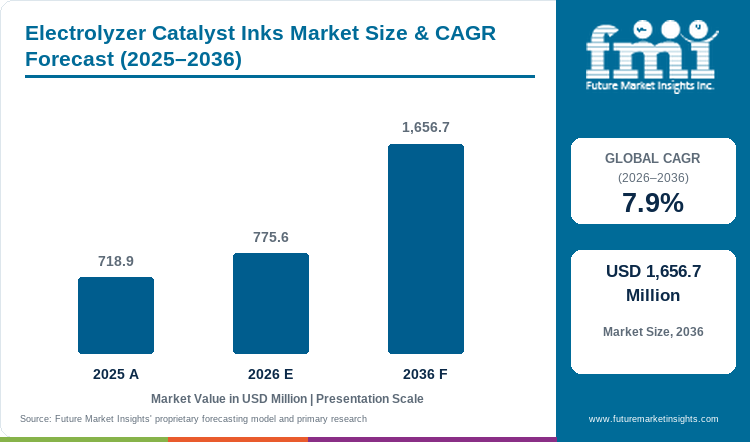
USD 775.6 million in 2026 and USD 1,656.7 million by 2036 at a 7.9% CAGR.
Sales of electrolyzer catalyst inks are estimated to rise at 7.9% CAGR through 2036, increasing valuation from USD 718.9 million in 2025 to USD 775.6 million in 2026, and reaching USD 1,656.7 million by 2036. Scale-up is moving hydrogen electrolyzers from pilot assembly into repeat coating programs. DOE selected 52 projects for USD 750 million in March 2024. The awards included manufacturing and component-supply work. Ink suppliers win repeat orders by keeping catalyst loading and ink flow inside approved coating limits.
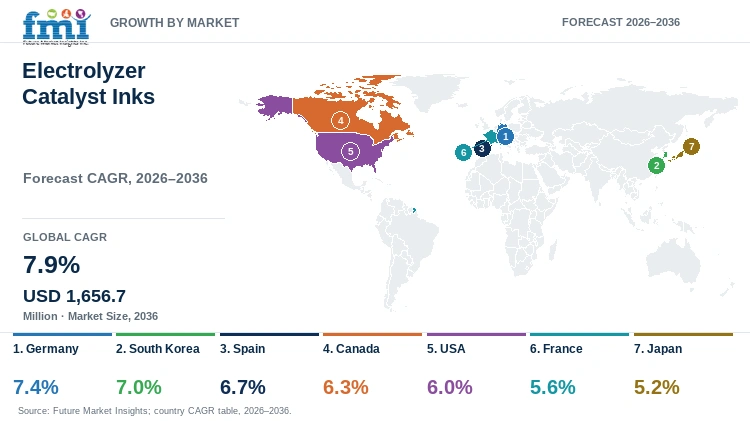
Germany is projected to grow at 7.4% CAGR through 2036 compared with 5.2% for Japan. Large European hydrogen projects give German suppliers an earlier route into production testing. The European Commission approved Hy2Infra in February 2024 with 33 projects and 3.2 GW of large-scale electrolyzers. Japanese buyers use a slower sample-to-production process. Both countries require steady electrochemical performance. They also require clear batch records. Those checks shape how quickly a new ink reaches repeat orders.
Key Takeaways
- More electrolyzer output raises demand for catalyst inks that stay stable during repeat coating.
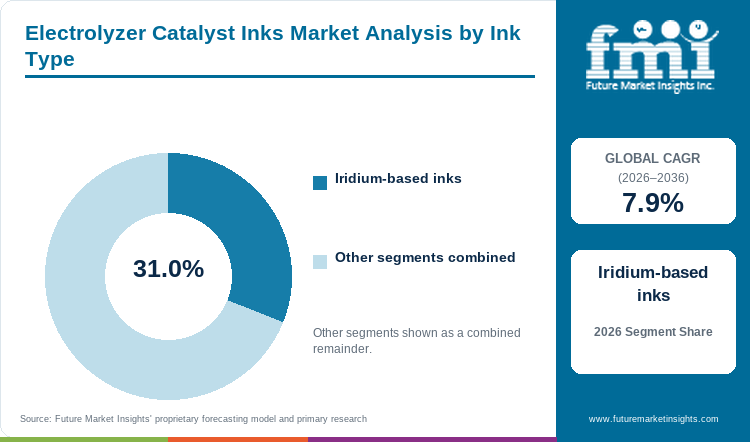
- By ink type, iridium-based inks are estimated to hold 31.0% share in 2026, supported by durable chemistry for acidic PEM anodes.
- In 2026, PEM electrolyzers are expected to lead electrolyzer type with 48.0% share, driven by strict control at the membrane and catalyst layer.
- By solvent system, water-alcohol inks are forecast to represent 35.0% share in 2026, influenced by easier control of wetting and drying.
- Ink aging and customer coating limits slow vendor changes because each new ink must pass process and life tests.
- Some of the key players in this market include Heraeus Precious Metals, Pajarito Powder, Johnson Matthey, Umicore, AGC Inc., W. L. Gore & Associates, Evonik Industries AG, Industrie De Nora S.p.A., and Asahi Kasei Corp.
Analyst Perspective
"Customers pay for catalyst inks that stay stable during mixing and coating. Makers can cut approval time by using less precious metal without making the electrode process harder to control."
- Nikhil Kaitwade, Principal Consultant, Future Market Insights
How is the electrolyzer catalyst inks market segmented?
Electrolyzer Catalyst Inks Market is segmented by Ink Type, Electrolyzer Type, Solvent System, End Use, Sales Channel, and Region. Forecast period from 2026 to 2036.
The report groups the market by ink type, electrolyzer type, solvent system, end use, sales channel and region. Ink type covers iridium, platinum, nickel, mixed metal oxide and PGM-reduced inks. Electrolyzer type includes PEM, alkaline, AEM and SOEC pilot systems. Solvent system covers water-alcohol, Nafion-based, aqueous and custom inks. End use covers green hydrogen, industrial hydrogen, pilot work and stack OEMs. Sales channel covers OEMs, catalyst makers, MEA makers and lab suppliers.
What makes iridium-based inks central to the ink type category?
PEM anodes use oxygen-evolution catalysts in acidic conditions that limit the choice of durable materials. Pajarito Powder reported in March 2026 that its IrOx catalyst passed 1,000 A/g at 1.5 V. Developers still test platinum-group metals while they work to lower iridium use.
- Based on ink type, iridium-based inks are projected to account for 31.0% in 2026, attributable to durable chemistry for acidic PEM anodes.
- Approval teams test lower loading against coating quality because uneven coverage can speed electrode wear.
Why do PEM electrolyzers shape formulation demand within the electrolyzer type category?
PEM stacks place the catalyst layer beside a proton membrane and porous transport layer. DOE projects on low-iridium membrane electrode assemblies test loading and service life together. Suppliers tune inks for proton exchange membranes because the coating must work with the full electrode.
- By electrolyzer type, PEM electrolyzers are estimated to hold 48.0% in 2026, driven by valuable catalyst layers and strict control at the membrane.
- OEM approval checks membrane chemistry together with porosity and coating behavior. A supplier change can trigger new electrode tests.
How do water-alcohol inks support the solvent system category?
Water-alcohol blends let teams adjust wetting and drying without one fixed solvent mix. National Laboratory of the Rockies work on high-performance catalysts links solvent choice and mixing settings with ink flow and coating quality. Ionomer content and solids loading can change that working range.
- In 2026, water-alcohol inks are expected to lead solvent system with 35.0% share, influenced by useful wetting and steady drying during electrode coating.
- Plant teams test settling and ink flow during storage because solvent balance can change after mixing.
What supports green hydrogen systems within the end use category?
Green hydrogen projects give ink makers a clear path from electrolyzer use to repeat electrode output. Spain set a 12 GW electrolyzer target for 2030 in its 2024 national energy plan. The same project flow links inks with hydrogen energy storage and factory hydrogen use.
- Green hydrogen systems are likely to capture 42.0% share in 2026, supported by project needs for efficient and long-life catalyst layers.
- Orders repeat once projects lock the stack design plus the coating route and material approval schedule.
Why do electrolyzer OEMs lead the sales channel category?
Electrolyzer OEMs control stack warranties and approve the final catalyst-layer process. DOE roll-to-roll research treats coating speed and quality checks as key plant limits. Direct OEM programs also connect with electrolyzer-as-a-service models that make uptime and replacement support part of the buying decision.
- Electrolyzer OEMs are set to lead the sales channel category with 39.0% share in 2026, tied to final approval of electrode and stack performance.
- Catalyst makers and MEA firms remain important. OEM approval still decides if an ink reaches repeat use.
What are the drivers, restraints and opportunities in the Electrolyzer Catalyst Inks Market?
Manufacturing scale raises qualified ink demand, formulation sensitivity delays switching, and lower-PGM designs create a focused route for new formulations.
- Driver: Higher-volume electrolyzer production raises demand for catalyst inks that keep loading and layer quality steady at production scale.
- Restraint: Ink behavior can change during storage and processing. Customers therefore need more coating tests before they approve a new formula.
- Opportunity: Lower-PGM catalyst layers can cut metal use if suppliers keep coatings even and recover valuable material from production scrap.
Electrolyzer scale-up turns catalyst ink from a lab material into a controlled plant input. DOE's 2025 clean-hydrogen liftoff analysis said U.S. output may need roughly 20 to 25 GW each year by 2030. Large coating lines need stable lots and routine daily checks because automated equipment leaves less room for manual fixes. Ink makers must keep solids content and coating response inside an approved range. Electrolysis hydrogen generation projects create repeat ink demand once electrode output becomes steady. Project news alone does not create the same buying pattern. Teams pay more attention to batch control as coating volume rises. Stable lots help vendors move from trial orders into regular supply.
Ink stability can slow a vendor change even when a new catalyst works well in a cell test. DOE-backed labs measure particle size and ink flow because catalyst particles interact with ionomer content and solvent choice. A batch that settles or thickens can change catalyst loading during a plant run. Operators then repeat mixing and coating tests before approval. The same problem can shorten shelf life and tighten change rules. PEM fuel cells face similar coating issues, but electrolyzers have different water and gas flow needs. Direct process data becomes important during approval. Vendors can cut switching delays by recording hold time and preparation steps plus lot behavior during plant approval.
Using less precious metal gives ink makers a clear cost goal, but the new ink must still coat evenly. Johnson Matthey reported in May 2026 that iridium could remain in modest deficit as commercial PEM electrolysis grows. Tighter iridium supply raises interest in low-loading catalyst layers and metal recovery. Vendors can pair ink design with membrane recycling methods for plant scrap. Lower catalyst loading changes the balance between particles and ionomer, which can alter ink flow and coating results. Sales depend on proving that the new ink works at the customer's planned coating scale. Recycling can cut iridium loss during process trials. The route gains value as OEM tests move into repeat output.
Which country CAGRs are profiled in the Electrolyzer Catalyst Inks Market?
| Country | CAGR |
|---|---|
| Germany | 7.4% |
| South Korea | 7.0% |
| Spain | 6.7% |
| Canada | 6.3% |
| USA | 6.0% |
| France | 5.6% |
| Japan | 5.2% |
How do country-level CAGRs compare in the Electrolyzer Catalyst Inks Market?
Germany, South Korea and Spain form the upper forecast group. Canada and the USA sit in the middle, while France and Japan grow more slowly. The spread reflects project timing and approval routes rather than current country revenue.
- German project teams need local support because electrode approval must match equipment delivery schedules.
- South Korea links part deadlines to clean-hydrogen rules and the set timetable of its power bidding system.
- Spain groups several equipment orders inside hydrogen hubs, creating focused ink testing and coating work.
- Canada needs wide service coverage because project costs and hydrogen uses differ between resource regions.
- USA programs favor local process support as makers add automated coating and local quality checks.
- France uses strong membrane and polymer skills to keep catalyst-layer tests close to local hydrogen programs.
- Japan puts more weight on sample-to-production control, so vendors need clear test records and steady production lots.
Similar CAGRs can still produce different order sizes because manufacturing scale and approval depth vary by country. The full report provides country-level CAGR analysis across North America, Latin America, Europe, East Asia, South Asia, Oceania and the Middle East and Africa.
Country-wise Analysis
- Germany is adding electrolyzer plants that give vendors a clear output target. Germany is projected to record 7.4% CAGR through 2036, supported by planned national capacity. The federal hydrogen plan targets at least 10 GW of local electrolysis capacity in 2030. Large stack programs need more coating lots to pass repeat checks before release. Ink vendors also record material changes for customer and project audits. Equipment and hydrogen infrastructure use separate schedules. Local support can shorten the move from pilot coating to repeat orders. Steady inks also help vendors keep approvals as stack makers raise output during larger plant runs.
- South Korea links clean-hydrogen demand to a power-market bidding system with set rules. Demand for electrolyzer catalyst inks in South Korea is forecast to rise at 7.0% CAGR through 2036, tied to power-market demand. MOTIE opened the clean hydrogen power bidding market in May 2024. Vendors align ink approval with clean-hydrogen rules and plant start dates. Local fuel cells also build skill with cell systems and hydrogen quality. The main limit is the gap between approved power projects and repeat part orders. Local testing can narrow that gap for new catalyst and ionomer mixes. Clear coating data can help vendors enter projects before full operating demand begins.
- Spain is grouping renewable-hydrogen projects near industrial sites with large planned electrolyzer blocks. Adoption of electrolyzer catalyst inks in Spain is estimated to expand at 6.7% CAGR through 2036, supported by planned capacity. The 2024 national energy plan targets 12 GW of electrolyzers by 2030. Firm financing and offtake are needed before capacity targets become coating orders. Vendors need inks that move from test samples to large coating runs without changing electrode results. Project timing remains a local limit because several plants can change schedules together. Local support is most useful during first-stack tests. Steady scale-up can turn clustered projects into repeat module demand.
- Canadian hydrogen projects span several provinces and uses, so service reach affects vendor choice. Sales of electrolyzer catalyst inks in Canada are forecast to expand at 6.3% CAGR by 2036, supported by project incentives. The federal Clean Hydrogen Investment Tax Credit offers 15% to 40% support for eligible projects. The credit favors lower-carbon production but does not remove equipment approval work. Vendors must match batch records to each project's stack design. Long shipping routes make late ink changes costly. Regional stock can limit disruption during testing. Remote support becomes more useful as pilot orders move into regular production lots.
- US buyers are linking catalyst-layer approval with local production and project finance. Demand for electrolyzer catalyst inks in the USA is forecast to rise at 6.0% CAGR over the forecast period, supported by domestic production programs. DOE closed a USD 1.66 billion loan guarantee for up to six Plug Power hydrogen facilities in January 2025. Larger local projects raise the value of tracked lots and fast process support. Each ink still must pass the customer's membrane and coating conditions before volume increases. Uneven project timing remains a key limit. Local testing can protect approved inks as schedules change. Strong change control also helps vendors keep repeat orders during scale-up.
- France is pairing its industry plan with a slower electrolyzer buildout. The outlook for electrolyzer catalyst inks in France is anticipated to rise at 5.6% CAGR through 2036, shaped by revised national targets. The 2025 plan targets up to 4.5 GW of electrolysis by 2030 and 8 GW by 2035. Local membrane and chemical skills keep interface tests close to PEM development. The slower target path puts more weight on projects that reach firm operation. Vendors should match stock to customer approval schedules. Local service can protect approved inks during design changes. Sales depend on projects moving from plans into operating equipment.
- Japan puts proof of reliable results ahead of fast material changes in cell production. Japan's demand for electrolyzer catalyst inks is set to expand at 5.2% CAGR through 2036, linked to long-term hydrogen plans. METI discussed a national hydrogen-use target of 12 million tons for 2040 in April 2023. The long demand horizon supports development work but does not shorten vendor approval. Buyers expect the same quality from samples and production lots. Vendors must explain ink flow beside cell results. National goals still need to become approved stack programs. Local-language support can reduce repeat review as an ink moves into series use.
Who are the notable companies in the Electrolyzer Catalyst Inks Market?
Heraeus Precious Metals, Pajarito Powder, Johnson Matthey, Umicore, AGC Inc., W. L. Gore & Associates, Evonik Industries AG, Industrie De Nora S.p.A., and Asahi Kasei Corp.
Competition centers on catalysts, ionomers, electrode coatings and system approval. Catalyst firms control particle chemistry. Polymer firms shape the contact layer. System firms set the production rules that inks must meet.
- Heraeus Precious Metals, Pajarito Powder, Johnson Matthey and Umicore supply catalyst know-how that shapes ink loading and mixing.
- AGC Inc., W. L. Gore & Associates and Evonik Industries AG supply polymers or membranes used at catalyst-layer contact points.
- Industrie De Nora S.p.A. and Asahi Kasei Corp. use electrode or electrolyzer systems that shape coating approval.
Competitive Benchmarking: Electrolyzer Catalyst Inks Market
| Company | Catalyst-layer material control | Electrolyzer validation depth | Scale-up support | Geographic Reach |
|---|---|---|---|---|
| Heraeus Precious Metals | High | High | High | Global |
| Pajarito Powder | High | High | Medium | United States and international customers |
| Johnson Matthey | High | High | High | Global |
| Umicore | High | Medium | High | Global |
| AGC Inc. | High | High | High | Global |
| W. L. Gore & Associates | Medium | High | High | Global |
| Evonik Industries AG | Medium | High | High | Global |
| Industrie De Nora S.p.A. | Medium | High | High | Global |
| Asahi Kasei Corp. | Medium | High | High | Global |
Scoring basis: High material control requires direct proof for catalysts, ionomers or electrodes. Medium means partial control. High validation needs public electrolyzer tests or use. High scale-up support needs current plant or project proof.
Key Developments in the Electrolyzer Catalyst Inks Market
- In July 2026, Industrie De Nora S.p.A. received the final Moeve order tranche for 300 MW of electrolytic cells with coated electrodes.
- In May 2026, Heraeus Precious Metals signed an MoU with VSParticle to develop PEM porous transport electrodes using iridium loading below 0.2 mg/cm².
- In March 2026, Asahi Kasei Corp. began installing a 1 MW-class alkaline-water electrolyzer at Finland's first commercial hydrogen refueling station.
Key Players in the Electrolyzer Catalyst Inks Market
Catalyst and precious-metal specialists
- Heraeus Precious Metals
- Pajarito Powder
- Johnson Matthey
- Umicore
Ionomer and membrane-interface specialists
- AGC Inc.
- W. L. Gore & Associates
- Evonik Industries AG
Electrode and electrolyzer integration specialists
- Industrie De Nora S.p.A.
- Asahi Kasei Corp.
Electrolyzer Catalyst Inks Market - Report Scope
| Coverage field | Report scope |
|---|---|
| Market breakdown | By ink type, electrolyzer type, solvent system, end use, sales channel and region. |
| Quantitative Units | USD million. |
| Market Definition | Commercial preformulated catalyst dispersions used to deposit electrocatalyst layers in PEM, alkaline, AEM and pilot SOEC electrolyzers. Raw catalyst powders, standalone membranes, finished electrodes, MEAs, stacks and finished electrolyzers are excluded. |
| Regions Covered | North America, Latin America, Western Europe, Eastern Europe, East Asia, South Asia and Pacific, and Middle East and Africa. |
| Countries Covered | Germany, South Korea, Spain, Canada, USA, France, Japan, and 20+ countries included in the full report. |
| Key Companies Profiled | Heraeus Precious Metals, Pajarito Powder, Johnson Matthey, Umicore, AGC Inc., W. L. Gore & Associates, Evonik Industries AG, Industrie De Nora S.p.A., Asahi Kasei Corp.. |
| Forecast Period | 2026 to 2036. |
| Approach | Primary and secondary research with market triangulation. |
Electrolyzer Catalyst Inks Market - Research Methodology
| Method | Approach |
|---|---|
| Primary Research | FMI analysts gathered input from manufacturers, service providers, technology developers, distributors, end users, procurement teams, and subject-matter experts. Interviews examined purchasing decisions, product or service evaluation, adoption barriers, approval requirements, pricing considerations, and expectations for technical or commercial support. Respondents were also asked what evidence is required before a trial, pilot, or initial order develops into regular purchasing. |
| Desk Research | Desk research covered government statistics, regulatory publications, trade data, industry associations, technical literature, standards, company filings, product information, and official corporate announcements. Sources were reviewed for relevance, publication date, geographic coverage, and consistency with the defined market scope. Claims relating to performance, applications, approvals, capacity, investment, and commercial activity were retained only when supported by credible public evidence. |
| Market Sizing and Forecasting | The market model combined the baseline value with historical performance, segment structure, pricing and volume indicators, adoption levels, company participation, and country-level demand conditions. Forecast assumptions considered economic activity, investment trends, regulatory developments, technology adoption, purchasing cycles, supply availability, and barriers to wider market use. Segment and regional estimates were reconciled before the final market total was calculated. |
| Data Validation | Estimates were checked against multiple independent indicators, including public data, company activity, trade patterns, industry developments, and findings from primary interviews. Validation also tested whether products, services, applications, and company revenues fell within the defined market boundaries. Adjacent categories, unsupported claims, overlapping revenues, and activities without direct market relevance were excluded to reduce double counting and maintain consistency across segments and countries. |
Electrolyzer Catalyst Inks Market by Segments
Electrolyzer Catalyst Inks Market segmented by Ink Type:
- Iridium-based inks
- Platinum-based inks
- Nickel-based inks
- Mixed metal oxide inks
- PGM-reduced inks
Electrolyzer Catalyst Inks Market segmented by Electrolyzer Type:
- PEM electrolyzers
- Alkaline electrolyzers
- AEM electrolyzers
- SOEC pilot systems
Electrolyzer Catalyst Inks Market segmented by Solvent System:
- Water-alcohol inks
- Nafion-based inks
- Aqueous inks
- Custom dispersion systems
Electrolyzer Catalyst Inks Market segmented by End Use:
- Green hydrogen systems
- Industrial hydrogen
- R&D and pilot lines
- Electrolyzer stack OEMs
Electrolyzer Catalyst Inks Market segmented by Sales Channel:
- Electrolyzer OEMs
- Catalyst suppliers
- Membrane electrode assembly makers
- R&D and laboratory suppliers
Electrolyzer Catalyst Inks Market by Region:
- North America
- United States
- Canada
- Latin America
- Brazil
- Mexico
- Chile
- Rest of Latin America
- Western Europe
- Germany
- United Kingdom
- Italy
- Spain
- France
- Nordics
- Benelux
- Rest of Western Europe
- Eastern Europe
- Russia
- Poland
- Hungary
- Balkan and Baltic States
- Rest of Eastern Europe
- East Asia
- China
- Japan
- South Korea
- South Asia and Pacific
- India
- ASEAN
- Australia and New Zealand
- Rest of South Asia and Pacific
- Middle East and Africa
- Kingdom of Saudi Arabia
- Other GCC Countries
- Türkiye
- South Africa
- Other African Union Countries
- Rest of Middle East and Africa
Research Sources and Bibliography
- U.S. Department of Energy. (2024, March 13). Funding Selections for Hydrogen Electrolysis, Manufacturing, and Recycling Activities under the Infrastructure Investment and Jobs Act.
- European Commission. (2024, February 15). Hydrogen value chain - Third hydrogen IPCEI: IPCEI Hy2Infra.
- Pajarito Powder. (2026, March 2). Pajarito Powder’s IrOx Catalyst Surpasses 1,000 A/g Mass Activity Threshold.
- U.S. Department of Energy. (2025, March 10). Low Iridium and Platinum Loading Membrane Electrode Assemblies for Electrolysis.
- National Renewable Energy Laboratory. (2024). Aging Iridium Oxide Catalyst Inks: A Formulation Strategy to Enhance Ink Processability for Polymer Electrolyte Membrane Water Electrolyzers.
- Ministry for the Ecological Transition and the Demographic Challenge, Spain. (2024, September 24). El Gobierno aprueba la actualización del Plan Nacional Integrado de Energía y Clima 2023-2030.
- U.S. Department of Energy. (2024). DOE National Laboratory Consortium to Advance High-Volume Manufacturing of Critical Hydrogen Technologies.
- U.S. Department of Energy. (2025, July). Pathways to Commercial Liftoff: Clean Hydrogen.
- U.S. Department of Energy. (2023). Understanding Catalyst Inks and Ionomer Dispersions.
- Johnson Matthey. (2026, May 14). Johnson Matthey publishes 2026 PGM market report.
- Federal Ministry for Economic Affairs and Climate Action, Germany. (2023). Hydrogen: a key element of the energy transition.
- Ministry of Trade, Industry and Energy, Republic of Korea. (2024, May 24). World’s first clean hydrogen power bidding market opened.
- Department of Finance Canada. (2024). Clean Hydrogen Investment Tax Credit.
- U.S. Department of Energy. (2025, January 16). DOE Announces $1.66 Billion Loan Guarantee to Plug Power to Produce and Liquify Clean Hydrogen Fuel.
- Government of France. (2025, April 16). Le Gouvernement actualise la Stratégie nationale de l’hydrogène décarboné.
- Ministry of Economy, Trade and Industry, Japan. (2023, April 4). Press Conference by Minister Nishimura (Excerpt).
- Industrie De Nora S.p.A.. (2026, July 6). De Nora receives final tranche of orders for Moeve, the Largest Green Hydrogen project in Southern Europe.
- Heraeus Precious Metals. (2026, May 19). Heraeus Precious Metals and VSParticle Sign MoU to Bring New Low Iridium PTE Products to the Market.
- Asahi Kasei Corp. (2026, March 12). Asahi Kasei Begins Installation of Containerized Alkaline-Water Electrolyzer at Finland’s First Commercial Hydrogen Refueling Station.
- Evonik Industries AG. (2026, June 10). More cost-efficient green hydrogen: Evonik launches pilot plant for high-performance membrane.
- Asahi Kasei Corp. (2026, August 19). Asahi Kasei’s Capacity Expansion for Water Electrolysis and Chlor-Alkali Equipment in Kawasaki Awarded Regional Economic Incentives.
- Industrie De Nora S.p.A.. (2026, August 5). De Nora and Maffei Sarda Silicati announce the completion of the Dragonfly Plant for the Production of Green Hydrogen in Sardinia.
- Evonik Industries AG. (2026, June 17). Evonik opens Anion Exchange Membrane application technology center in Shanghai.
- Asahi Kasei Corp. (2026, January 28). Green ammonia demonstration plant of JGC begins producing ammonia using hydrogen from Asahi Kasei.
- Heraeus Precious Metals. (2026, August 10). Smoltek Hydrogen and Heraeus Precious Metals Advance Next-Generation Ultra-Low Iridium Electrolysis Technology.
- Pajarito Powder. (2026, January 12). Pajarito Powder Expands Complete Catalyst Portfolio Spanning Fuel Cells and Electrolyzers.
- Johnson Matthey. (2026, March 4). Johnson Matthey and Syensqo demonstrate circular recovery of critical materials from hydrogen technologies.
- AGC Inc.. (2026, May 19). AGC’s FORBLUE i-SERIES Fluorinated Electrolyte Polymer Dispersion Adopted as Electrode Material for PEM Water Electrolysis Demonstration System.
- W. L. Gore & Associates. (2026, June 24). W. L. Gore & Associates Release New Ultra-low Degradation Data Advancing PEM Durability For Water Electrolysis.
- Umicore. (2026, March 31). Umicore opens innovation center in Shanghai.
- Industrie De Nora S.p.A.. (2026, February 24). The Board of Directors approves Preliminary Results as of 31 December 2025.
- Asahi Kasei Corp. (2026, March 19). Tanahashi Prize recognizes the robust long-term operation of the 10MW alkaline-water electrolysis system by Asahi Kasei.
This bibliography is provided for reader reference and is not exhaustive. The full report contains the complete reference list and detailed citations
This Report Answers
- How large is the electrolyzer catalyst inks market in 2026 and 2036?
- What makes catalyst inks repeat production inputs?
- Why do iridium-based inks hold 31.0% of ink type demand?
- Why do PEM electrolyzers hold 48.0% of electrolyzer type demand?
- How do solvents affect coating approval?
- Why do country growth paths differ?
- Which companies shape catalyst-layer approval?
- How does ink aging slow supplier switching?
Frequently Asked Questions
How big is the electrolyzer catalyst inks market in 2026?
The electrolyzer catalyst inks market is valued at USD 775.6 million in 2026 and is projected to reach USD 1,656.7 million by 2036. Repeat orders grow as suppliers pass coating and durability tests for regular production.
What is the CAGR of the electrolyzer catalyst inks market from 2026 to 2036?
The electrolyzer catalyst inks market is projected to grow at 7.9% CAGR from 2026 to 2036. Larger coating lines need inks that keep flow and catalyst loading steady from lot to lot.
Which ink type leads the electrolyzer catalyst inks market in 2026?
The iridium-based segment is projected to account for 31.0% of ink type revenue in the electrolyzer catalyst inks market in 2026. Acidic PEM anodes still require durable oxygen-evolution catalysts during production.
Which electrolyzer type leads the electrolyzer catalyst inks market in 2026?
The PEM electrolyzer segment is estimated to hold 48.0% of electrolyzer type demand in the electrolyzer catalyst inks market in 2026. Tight membrane integration makes coating and interface control part of supplier approval.
Which companies are active in the electrolyzer catalyst inks market?
Key companies include Heraeus Precious Metals, Pajarito Powder, Johnson Matthey, Umicore, AGC Inc., W. L. Gore & Associates, Evonik Industries AG, Industrie De Nora S.p.A., and Asahi Kasei Corp. They cover catalysts plus membranes and electrode testing.
What slows approval of a new catalyst ink?
Ink stability can change during storage and coating. Buyers repeat mixing and coating tests before they approve a new ink for repeat use.
What business problem do catalyst inks solve?
Catalyst inks turn active particles into a liquid that can coat a controlled electrode. They help plants control catalyst loading plus ionomer contact and drying.
What should electrolyzer OEM teams check before buying catalyst inks?
OEM teams should check loading plus ink flow and shelf life before approval. They should also confirm the ink works with their coating line and lot controls.
What can reduce return on investment for catalyst inks?
A lower ink price can lose value if it causes extra mixing or uneven coating. Scrap plus repeat approval can erase savings and delay regular output.
What supports long-term demand for catalyst inks?
Long-term demand depends on more electrolyzer production and steady progress in lower-loading catalyst layers. Vendors also need stable inks plus coating support and clear approval data.
Preview the report firsthand - request a free sample
Get SampleGet the brochure for pricing and purchase details.
Get PDFTable of Content
- Key Takeaways
- Market Size and CAGR
- Top Growth Driver
- Fastest Growing Segment
- Leading Region
- Key Companies
- Emerging Opportunities
- Executive Summary
- Global Market Outlook
- Demand-side Trends
- Supply-side Trends
- Technology Roadmap Analysis
- Analysis and Recommendations
- Analyst Perspective (What is happening? Why now? What should investors know?)
- Key Questions Answered
- How large is the market?
- What is the CAGR?
- What are key trends?
- Which region dominates?
- Who are the leaders?
- Market Overview
- Market Coverage / Taxonomy
- Market Definition / Scope / Limitations
- Research Methodology
- Chapter Orientation
- Analytical Lens and Working Hypotheses
- Market Structure, Signals, and Trend Drivers
- Benchmarking and Cross-market Comparability
- Market Sizing, Forecasting, and Opportunity Mapping
- Research Design and Evidence Framework
- Desk Research Programme (Secondary Evidence)
- Expert Input and Fieldwork (Primary Evidence)
- Tooling, Models, and Reference Databases
- Data Engineering and Model Build
- Quality Assurance and Audit Trail
- Market Background
- Market Dynamics (Drivers, Restraints, Opportunity, Trends)
- Scenario Forecast (Optimistic, Likely, Conservative)
- Impact Analysis
- AI Impact
- Sustainability Impact
- Regulatory Impact
- Technology Impact
- Consumer / Buyer Analysis
- Purchase Drivers
- Adoption Barriers
- Buyer Journey
- Opportunity Map Analysis
- Product Life Cycle Analysis
- Supply Chain Analysis
- Investment Feasibility Matrix
- Value Chain Analysis
- PESTLE and Porter's Analysis
- Regulatory Landscape
- Regional Parent Market Outlook
- Production and Consumption Statistics
- Import and Export Statistics
- Global Market Analysis and Forecast, 2021 to 2036
- Historical Market Size Value (USD Million) Analysis, 2021 to 2025
- Current and Future Market Size Value (USD Million) Projections, 2026 to 2036
- Y-o-Y Growth Trend Analysis
- Absolute $ Opportunity Analysis
- Global Market Pricing Analysis, 2021 to 2036
- Global Market Analysis and Forecast, By Ink Type, 2021 to 2036
- Introduction / Key Findings
- Historical Market Size Value (USD Million) Analysis By Ink Type, 2021 to 2025
- Current and Future Market Size Value (USD Million) Analysis and Forecast By Ink Type, 2026 to 2036
- Iridium-based inks
- Platinum-based inks
- Nickel-based inks
- Mixed metal oxide inks
- PGM-reduced inks
- Y-o-Y Growth Trend Analysis By Ink Type, 2021 to 2025
- Absolute $ Opportunity Analysis By Ink Type, 2026 to 2036
- Global Market Analysis and Forecast, By Electrolyzer Type, 2021 to 2036
- Introduction / Key Findings
- Historical Market Size Value (USD Million) Analysis By Electrolyzer Type, 2021 to 2025
- Current and Future Market Size Value (USD Million) Analysis and Forecast By Electrolyzer Type, 2026 to 2036
- PEM electrolyzers
- Alkaline electrolyzers
- AEM electrolyzers
- SOEC pilot systems
- Y-o-Y Growth Trend Analysis By Electrolyzer Type, 2021 to 2025
- Absolute $ Opportunity Analysis By Electrolyzer Type, 2026 to 2036
- Global Market Analysis and Forecast, By Solvent System, 2021 to 2036
- Introduction / Key Findings
- Historical Market Size Value (USD Million) Analysis By Solvent System, 2021 to 2025
- Current and Future Market Size Value (USD Million) Analysis and Forecast By Solvent System, 2026 to 2036
- Water-alcohol inks
- Nafion-based inks
- Aqueous inks
- Custom dispersion systems
- Y-o-Y Growth Trend Analysis By Solvent System, 2021 to 2025
- Absolute $ Opportunity Analysis By Solvent System, 2026 to 2036
- Global Market Analysis and Forecast, By End Use, 2021 to 2036
- Introduction / Key Findings
- Historical Market Size Value (USD Million) Analysis By End Use, 2021 to 2025
- Current and Future Market Size Value (USD Million) Analysis and Forecast By End Use, 2026 to 2036
- Green hydrogen systems
- Industrial hydrogen
- R&D and pilot lines
- Electrolyzer stack OEMs
- Y-o-Y Growth Trend Analysis By End Use, 2021 to 2025
- Absolute $ Opportunity Analysis By End Use, 2026 to 2036
- Global Market Analysis and Forecast, By Sales Channel, 2021 to 2036
- Introduction / Key Findings
- Historical Market Size Value (USD Million) Analysis By Sales Channel, 2021 to 2025
- Current and Future Market Size Value (USD Million) Analysis and Forecast By Sales Channel, 2026 to 2036
- Electrolyzer OEMs
- Catalyst suppliers
- Membrane electrode assembly makers
- R&D and laboratory suppliers
- Y-o-Y Growth Trend Analysis By Sales Channel, 2021 to 2025
- Absolute $ Opportunity Analysis By Sales Channel, 2026 to 2036
- Global Market Analysis and Forecast, By Region, 2021 to 2036
- Introduction
- Historical Market Size Value (USD Million) Analysis By Region, 2021 to 2025
- Current Market Size Value (USD Million) Analysis and Forecast By Region, 2026 to 2036
- North America
- Latin America
- Western Europe
- Eastern Europe
- East Asia
- South Asia and Pacific
- Middle East and Africa
- Market Attractiveness Analysis By Region
- North America Market Analysis and Forecast, By Country, 2021 to 2036
- Historical Market Size Value (USD Million) Trend Analysis By Market Taxonomy, 2021 to 2025
- Market Size Value (USD Million) Forecast By Market Taxonomy, 2026 to 2036
- By Country
- United States
- Canada
- By Ink Type
- By Electrolyzer Type
- By Solvent System
- By End Use
- By Sales Channel
- By Country
- Market Attractiveness Analysis
- By Country
- By Ink Type
- By Electrolyzer Type
- By Solvent System
- By End Use
- By Sales Channel
- Key Takeaways
- Latin America Market Analysis and Forecast, By Country
- Historical Market Size Value (USD Million) Trend Analysis By Market Taxonomy, 2021 to 2025
- Market Size Value (USD Million) Forecast By Market Taxonomy, 2026 to 2036
- By Country
- Brazil
- Mexico
- Chile
- Rest of Latin America
- By Ink Type
- By Electrolyzer Type
- By Solvent System
- By End Use
- By Sales Channel
- By Country
- Market Attractiveness Analysis
- By Country
- By Ink Type
- By Electrolyzer Type
- By Solvent System
- By End Use
- By Sales Channel
- Key Takeaways
- Western Europe Market Analysis and Forecast, By Country
- Historical Market Size Value (USD Million) Trend Analysis By Market Taxonomy, 2021 to 2025
- Market Size Value (USD Million) Forecast By Market Taxonomy, 2026 to 2036
- By Country
- Germany
- United Kingdom
- Italy
- Spain
- France
- Nordics
- Benelux
- Rest of Western Europe
- By Ink Type
- By Electrolyzer Type
- By Solvent System
- By End Use
- By Sales Channel
- By Country
- Market Attractiveness Analysis
- By Country
- By Ink Type
- By Electrolyzer Type
- By Solvent System
- By End Use
- By Sales Channel
- Key Takeaways
- Eastern Europe Market Analysis and Forecast, By Country
- Historical Market Size Value (USD Million) Trend Analysis By Market Taxonomy, 2021 to 2025
- Market Size Value (USD Million) Forecast By Market Taxonomy, 2026 to 2036
- By Country
- Russia
- Poland
- Hungary
- Balkan and Baltic States
- Rest of Eastern Europe
- By Ink Type
- By Electrolyzer Type
- By Solvent System
- By End Use
- By Sales Channel
- By Country
- Market Attractiveness Analysis
- By Country
- By Ink Type
- By Electrolyzer Type
- By Solvent System
- By End Use
- By Sales Channel
- Key Takeaways
- East Asia Market Analysis and Forecast, By Country
- Historical Market Size Value (USD Million) Trend Analysis By Market Taxonomy, 2021 to 2025
- Market Size Value (USD Million) Forecast By Market Taxonomy, 2026 to 2036
- By Country
- China
- Japan
- South Korea
- By Ink Type
- By Electrolyzer Type
- By Solvent System
- By End Use
- By Sales Channel
- By Country
- Market Attractiveness Analysis
- By Country
- By Ink Type
- By Electrolyzer Type
- By Solvent System
- By End Use
- By Sales Channel
- Key Takeaways
- South Asia and Pacific Market Analysis and Forecast, By Country
- Historical Market Size Value (USD Million) Trend Analysis By Market Taxonomy, 2021 to 2025
- Market Size Value (USD Million) Forecast By Market Taxonomy, 2026 to 2036
- By Country
- India
- ASEAN
- Australia and New Zealand
- Rest of South Asia and Pacific
- By Ink Type
- By Electrolyzer Type
- By Solvent System
- By End Use
- By Sales Channel
- By Country
- Market Attractiveness Analysis
- By Country
- By Ink Type
- By Electrolyzer Type
- By Solvent System
- By End Use
- By Sales Channel
- Key Takeaways
- Middle East and Africa Market Analysis and Forecast, By Country
- Historical Market Size Value (USD Million) Trend Analysis By Market Taxonomy, 2021 to 2025
- Market Size Value (USD Million) Forecast By Market Taxonomy, 2026 to 2036
- By Country
- Kingdom of Saudi Arabia
- Other GCC Countries
- Türkiye
- South Africa
- Other African Union Countries
- Rest of Middle East and Africa
- By Ink Type
- By Electrolyzer Type
- By Solvent System
- By End Use
- By Sales Channel
- By Country
- Market Attractiveness Analysis
- By Country
- By Ink Type
- By Electrolyzer Type
- By Solvent System
- By End Use
- By Sales Channel
- Key Takeaways
- Key Countries Market Analysis
- United States
- Pricing Analysis
- Market Share Analysis, 2025
- By Ink Type
- By Electrolyzer Type
- By Solvent System
- By End Use
- By Sales Channel
- Canada
- Pricing Analysis
- Market Share Analysis, 2025
- By Ink Type
- By Electrolyzer Type
- By Solvent System
- By End Use
- By Sales Channel
- Mexico
- Pricing Analysis
- Market Share Analysis, 2025
- By Ink Type
- By Electrolyzer Type
- By Solvent System
- By End Use
- By Sales Channel
- Brazil
- Pricing Analysis
- Market Share Analysis, 2025
- By Ink Type
- By Electrolyzer Type
- By Solvent System
- By End Use
- By Sales Channel
- Chile
- Pricing Analysis
- Market Share Analysis, 2025
- By Ink Type
- By Electrolyzer Type
- By Solvent System
- By End Use
- By Sales Channel
- Germany
- Pricing Analysis
- Market Share Analysis, 2025
- By Ink Type
- By Electrolyzer Type
- By Solvent System
- By End Use
- By Sales Channel
- United Kingdom
- Pricing Analysis
- Market Share Analysis, 2025
- By Ink Type
- By Electrolyzer Type
- By Solvent System
- By End Use
- By Sales Channel
- Italy
- Pricing Analysis
- Market Share Analysis, 2025
- By Ink Type
- By Electrolyzer Type
- By Solvent System
- By End Use
- By Sales Channel
- Spain
- Pricing Analysis
- Market Share Analysis, 2025
- By Ink Type
- By Electrolyzer Type
- By Solvent System
- By End Use
- By Sales Channel
- France
- Pricing Analysis
- Market Share Analysis, 2025
- By Ink Type
- By Electrolyzer Type
- By Solvent System
- By End Use
- By Sales Channel
- India
- Pricing Analysis
- Market Share Analysis, 2025
- By Ink Type
- By Electrolyzer Type
- By Solvent System
- By End Use
- By Sales Channel
- ASEAN
- Pricing Analysis
- Market Share Analysis, 2025
- By Ink Type
- By Electrolyzer Type
- By Solvent System
- By End Use
- By Sales Channel
- Australia and New Zealand
- Pricing Analysis
- Market Share Analysis, 2025
- By Ink Type
- By Electrolyzer Type
- By Solvent System
- By End Use
- By Sales Channel
- China
- Pricing Analysis
- Market Share Analysis, 2025
- By Ink Type
- By Electrolyzer Type
- By Solvent System
- By End Use
- By Sales Channel
- Japan
- Pricing Analysis
- Market Share Analysis, 2025
- By Ink Type
- By Electrolyzer Type
- By Solvent System
- By End Use
- By Sales Channel
- South Korea
- Pricing Analysis
- Market Share Analysis, 2025
- By Ink Type
- By Electrolyzer Type
- By Solvent System
- By End Use
- By Sales Channel
- Russia
- Pricing Analysis
- Market Share Analysis, 2025
- By Ink Type
- By Electrolyzer Type
- By Solvent System
- By End Use
- By Sales Channel
- Poland
- Pricing Analysis
- Market Share Analysis, 2025
- By Ink Type
- By Electrolyzer Type
- By Solvent System
- By End Use
- By Sales Channel
- Hungary
- Pricing Analysis
- Market Share Analysis, 2025
- By Ink Type
- By Electrolyzer Type
- By Solvent System
- By End Use
- By Sales Channel
- Kingdom of Saudi Arabia
- Pricing Analysis
- Market Share Analysis, 2025
- By Ink Type
- By Electrolyzer Type
- By Solvent System
- By End Use
- By Sales Channel
- Türkiye
- Pricing Analysis
- Market Share Analysis, 2025
- By Ink Type
- By Electrolyzer Type
- By Solvent System
- By End Use
- By Sales Channel
- South Africa
- Pricing Analysis
- Market Share Analysis, 2025
- By Ink Type
- By Electrolyzer Type
- By Solvent System
- By End Use
- By Sales Channel
- United States
- Market Structure Analysis
- Competition Dashboard
- Competition Benchmarking
- Market Share Analysis of Top Players
- By Regional
- By Ink Type
- By Electrolyzer Type
- By Solvent System
- By End Use
- By Sales Channel
- Emerging Startups
- Innovation Benchmarking
- Competition Analysis
- Competition Deep Dive
- Heraeus Precious Metals
- Overview
- Product Portfolio
- Profitability by Market Segments
- Sales Footprint
- Strategy Overview
- Marketing Strategy
- Product Strategy
- Channel Strategy
- Pajarito Powder
- Johnson Matthey
- Umicore
- AGC Inc.
- W. L. Gore & Associates
- Evonik Industries AG
- Industrie De Nora S.p.A.
- Asahi Kasei Corp.
- Heraeus Precious Metals
- Case Studies
- Success Stories
- Recent Developments
- Competition Deep Dive
- Assumptions & Acronyms Used


