

- Market Size (2026)
- USD 1.6 Bn
- Forecast (2036)
- USD 4.5 Bn
- CAGR (2026 to 2036)
- 10.8%
How big is the Extractable and Leachable Testing Market in 2026?
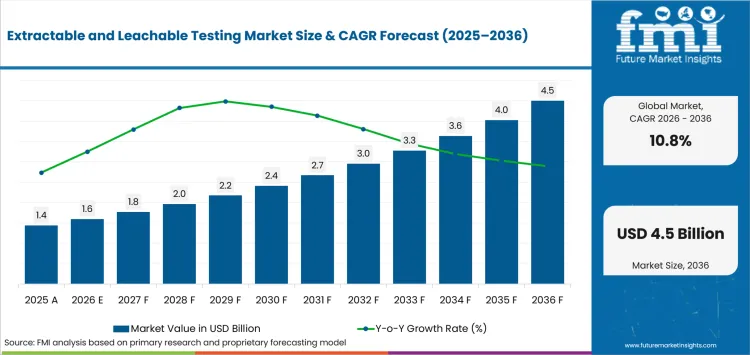
USD 1.6 billion in 2026 and USD 4.5 billion by 2036 at a 10.8% CAGR.
Sales are projected to rise from USD 1.6 billion in 2026 to USD 4.5 billion by 2036 at a 10.8% CAGR. Pharmaceutical sponsors use outsourced testing services to connect material screening with stability evidence and toxicological interpretation across regulated product lifecycles.
Every new medicine uses a product-specific packaging or delivery configuration that requires compatibility evidence across regulated storage and patient-use conditions. FDA approved 46 novel drugs during 2025 across products entering distinct commercial configurations. Specialist analytical laboratory services convert these launches into packaging studies and stability-linked leachables monitoring.
Key Takeaways of Extractable And Leachable Testing Market
- Demand rises as regulated product teams connect material screening with stability evidence and toxicological interpretation across development lifecycles.
- Extractable testing is projected to represent 42.0% of service demand in 2026 due to early material screening and analytical target selection.
- Pharmaceutical packaging is estimated to account for 38.0% of sample-type demand in 2026 owing to recurring container closure qualification.
- Chromatography-based analysis is forecast to capture 49.0% of technology demand in 2026 supported by broad volatile and non-volatile compound coverage.
- Matrix interference and unknown identification extend study schedules as laboratories develop methods for low-level compounds and stability samples.
- Eurofins Scientific SE, SGS SA, Intertek Group plc, Charles River Laboratories International, Inc., Nelson Laboratories, LLC, Pace Life Sciences, LLC, Element Materials Technology and NAMSA serve regulated testing routes.
Analyst Perspective
"An E&L program loses commercial value if a laboratory reports unknown peaks without preserving signal changes across extraction and stability conditions. Laboratories gain an advantage by connecting compound identification with toxicological thresholds and material-change decisions so regulatory questions do not delay product programs."
- Nikhil Kaitwade, Principal Consultant, Future Market Insights
How is the Extractable and Leachable Testing Market segmented?
The extractable and leachable testing industry is segmented by service, sample type, application, end user, technology and region.
The market is organized by testing assignment, sample type, application, commissioning organization, analytical platform and region. Services cover extractable testing, leachable testing, method development and regulatory consulting for regulated product programs. Sample types include pharmaceutical packaging, medical devices, manufacturing systems and combination products requiring coordinated chemical studies. Applications span pharmaceuticals, biopharmaceuticals and medical devices. Commissioning organizations include drug companies and specialist research organizations. Technologies cover chromatography, spectroscopy, elemental analysis and other methods for difficult compound identification within medical device analytical testing programs.
What supports extractable testing within the service category?
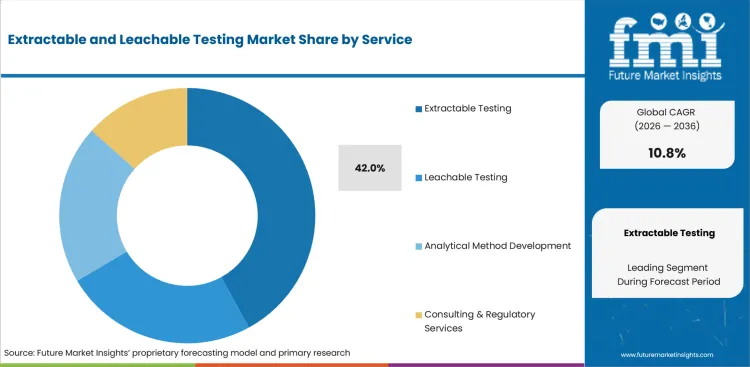
Extractable studies establish worst-case compound profiles that guide material decisions ahead of regulated stability testing. Each profile guides healthcare regulatory affairs planning by defining targets and material risks that later leachables methods must address.
- Extractable testing is set to lead the service category with 42.0% share in 2026 due to early material screening and analytical target selection across regulated product programs.
- Material characterization and container closure studies identify volatile, non-volatile and elemental compounds ahead of long stability protocols. Leachable testing then measures product-specific migration under normal storage conditions across the proposed commercial shelf life.
Why does pharmaceutical packaging shape sample-type demand?
Packaging components remain in direct contact with drug products during regulated storage and commercial distribution. Glass containers, polymer systems and elastomeric closures require tailored extraction conditions as material composition changes compound profiles and analytical response.
- By sample type, pharmaceutical packaging is forecast to represent 38.0% in 2026 driven by recurring container closure qualification across launches and post-approval material changes.
- Medical devices require exposure-based chemical characterization for each contact route. bioprocessing systems need evidence across single-use bags, tubing and filtration workflows. Combination products add device and packaging interfaces that laboratories must evaluate within one coordinated protocol.
What makes pharmaceuticals central to the application category?
Pharmaceutical applications connect packaging compatibility with product stability and patient exposure across oral, injectable and ophthalmic formulations. Large molecule bioanalytical testing adds matrix complexity for biologics. Protein formulations change compound recovery and identification during low-level analysis.
- Based on application, pharmaceuticals are projected to account for 44.0% in 2026 due to recurring studies across regulated dosage forms and manufacturing components.
- Biopharmaceutical programs require low-level detection around sensitive proteins and single-use manufacturing equipment during extended stability studies. Medical-device applications align extraction conditions with contact duration and route so toxicologists estimate patient exposure accurately.
Why does chromatography-based analysis lead the technology category?
Chromatographic separation resolves complex mixtures so mass spectrometry identifies unknown compounds at low concentrations. Liquid chromatography systems support non-volatile analysis across complex samples requiring broad compound separation and low-level detection. Gas chromatography captures volatile and semi-volatile species requiring tailored extraction and preparation methods.
- The technology category is forecast to be led by chromatography-based analysis at 49.0% share in 2026 due to broad coverage of volatile and non-volatile regulated compounds.
- Spectroscopy and elemental analysis strengthen inorganic or molecular assessment with ICP-MS and FTIR methods. Difficult identifications unresolved by routine chromatographic screening require nuclear magnetic resonance or thermal analysis.
What are the drivers, restraints and opportunities in the Extractable and Leachable Testing Market?
Risk-based expectations increase connected E&L evidence demand as analytical uncertainty extends schedules and integrated programs reduce handoff losses.
- Driver: Risk-based guidance connects material knowledge with patient-exposure control and requires product-specific justification for extraction conditions and analytical thresholds.
- Restraint: Unknown compounds and matrix interference extend method development as stability-linked programs wait for scheduled samples and product-specific analytical decisions.
- Opportunity: Integrated laboratories retain compound histories across material screening, stability monitoring and toxicological assessment to reduce repeated interpretation during one product lifecycle.
Regulatory programs require a documented chain from material knowledge to measured patient exposure for each product. FDA issued draft ICH Q3E guidance in November 2025 for pharmaceutical products and regulated manufacturing components. The document defines a risk-based framework for product-specific extraction conditions and control decisions.
Matrix effects in complex formulations suppress analytical signals or produce unknown peaks that routine screens do not resolve. Additional separation work delays method validation and scheduled stability samples extend toxicological review across regulated product timelines.
Integrated laboratories retain compound histories across extractables screening, leachables monitoring and toxicological interpretation within one governed assignment. Closed system bioprocessing increases polymer component inventories. Laboratories preserving methods across stages answer product-specific questions without repeating earlier analytical work.
Which country CAGRs are profiled in the Extractable and Leachable Testing Market?
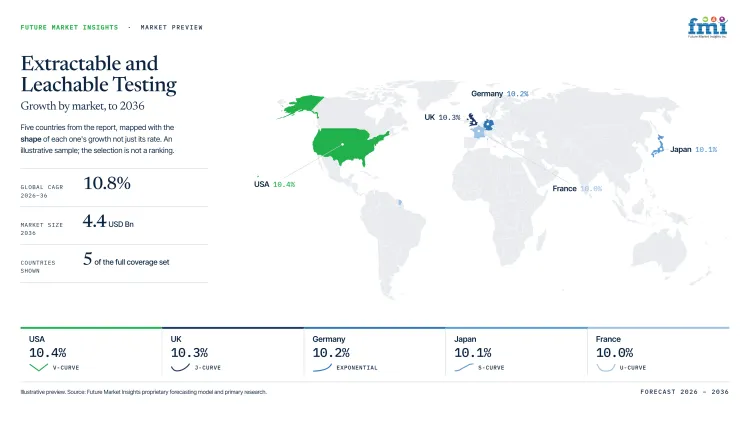
| Country | CAGR |
|---|---|
| United States | 10.4% |
| United Kingdom | 10.3% |
| Germany | 10.2% |
| Japan | 10.1% |
| France | 10.0% |
How do country-level CAGRs compare in the Extractable and Leachable Testing Market?
The five approved country CAGRs span 0.4 percentage point across established pharmaceutical systems. These forecasts describe growth pace instead of current market size across the profiled countries.
- The United States defines the upper value as dense pharmaceutical development networks sustain mature external laboratory capacity.
- The United Kingdom is 0.1 percentage point lower as cross-border filing support balances separate national procedures.
- Germany occupies the midpoint as active manufacturing clusters face demanding method-transfer requirements.
- Japan remains close to Germany as structured regulator consultation offsets slow transfer across translated technical records.
- France closes the range at 10.0% and retains broad domestic pharmaceutical production coverage.
Comparable CAGRs can produce different market entry conditions. The full report provides country-level CAGR analysis across North America, Latin America, Europe, East Asia, South Asia and Pacific, and the Middle East and Africa.
Country-wise Analysis
- United States sponsors use dense GMP laboratory networks to connect packaging studies with stability samples and toxicological review across injectable medicines, combination products and single-use manufacturing systems distributed nationwide. USP General Chapter <665> became official on May 1, 2026 and gives laboratories a defined qualification reference for plastic components used in pharmaceutical manufacturing across product-development and commercial production programs. Extractable and leachable testing in the United States is estimated to expand at 10.4% CAGR through 2036 as compendial clarity supports orders, although specialist capacity remains concentrated around major laboratory hubs and extends turnaround for sponsors operating outside those regions.
- United Kingdom sponsors coordinate packaging studies with domestic laboratories and regulatory specialists serving national filings, multinational stability programs and distributed manufacturing sites across several drug-delivery formats. MHRA opened consultation on draft ICH Q3E guidance in November 2025 and clarified the framework covering packaging, delivery systems and regulated manufacturing components used across complex product lifecycles. The United Kingdom's extractable and leachable testing outlook is anticipated to advance at 10.3% CAGR over the assessment period as coordinated study planning supports orders. Separate national and European procedures increase documentation work for multinational products and cross-border method transfers across regulated commercial supply networks.
- Germany combines pharmaceutical manufacturing clusters with European laboratory networks that transfer validated methods across domestic production sites, regional submissions and multisite quality systems serving broad regulated portfolios. Destatis reported a provisional 10.0% monthly increase in pharmaceutical output during May 2025 and provided a current workload signal for the country's established manufacturing base and specialist analytical testing demand. Germany is estimated to post 10.2% CAGR over the forecast period as active production supports testing orders, although demanding documentation and reproducibility requirements complicate method transfer across national and centralized European reviews for complex multisite products and stability programs serving several dosage forms.
- Japan sponsors rely on PMDA consultation routes and domestic analytical laboratories to coordinate packaging studies across local development portfolios, imported reference materials and multinational manufacturing programs requiring translated technical records. PMDA opened comments on draft ICH Q3E guidance in September 2025 and scheduled an October briefing for domestic development and specialist laboratory teams planning complex regulated testing studies. Extractable and leachable testing demand in Japan is forecast to rise at 10.1% CAGR over the forecast period. Translated dossiers and cross-border method transfers extend coordination between domestic and global sites serving complex multinational products worldwide.
- France supports regulated pharmaceutical development with domestic manufacturing sites and European laboratory networks that coordinate stability evidence across national products, cross-border submissions and distributed production programs serving several dosage forms. The industry ministry reported 260 pharmaceutical laboratories across more than 400 industrial sites in May 2026 and confirmed a broad operating base for development, production and specialist regulated analytical assignments. Extractable and leachable testing sales in France are forecast to expand at 10.0% CAGR by 2036 as domestic activity supports orders, although lengthy stability schedules and uneven specialist toxicology access delays completion across national and multinational regulated product programs.
Who are the notable companies in the Extractable and Leachable Testing Market?
Eurofins Scientific SE, SGS SA, Intertek Group plc, Nelson Laboratories, LLC, Pace Life Sciences, LLC, Element Materials Technology and NAMSA are the notable companies serving this market.
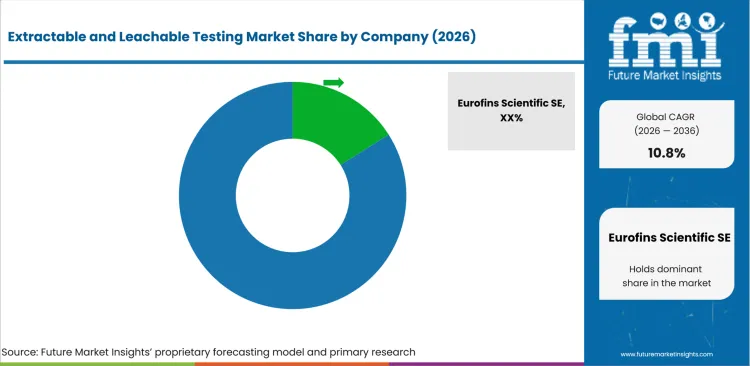
Global laboratory networks compete with specialist pharmaceutical laboratories and medical-device chemistry providers in a moderately fragmented field with demanding qualification barriers. Medical-device manufacturers value laboratories that connect preclinical medical device testing with chemical characterization and toxicological review. Pharmaceutical sponsors compare similar continuity across healthcare analytical testing programs serving packaging and stability assignments.
- Eurofins Scientific SE, SGS SA and Intertek Group plc operate multinational laboratory networks serving pharmaceutical and medical-device programs.
- Charles River Laboratories International, Inc.. Nelson Laboratories, LLC and NAMSA combine chemical characterization with toxicological or regulatory support for medical devices and combination products.
- Pace Life Sciences, LLC and Element Materials Technology support pharmaceutical programs with extractables studies, leachables stability work and method development.
Competitive Benchmarking: Extractable and Leachable Testing Market
| Company | Full E&L Study Breadth | Toxicology and Regulatory Support | Pharmaceutical and Medical Device Coverage | Geographic Reach |
|---|---|---|---|---|
| Eurofins Scientific SE | High | High | High | Global |
| SGS SA | High | High | High | Global |
| Intertek Group plc | High | High | High | Global |
| Charles River Laboratories International, Inc. | Medium | High | High | China with global client support |
| Nelson Laboratories, LLC | High | High | High | North America, Europe and Asia |
| Pace Life Sciences, LLC | High | Medium | High | North America |
| Element Materials Technology | High | High | High | Global |
| NAMSA | Medium | High | Low | United States and Europe |
Key Developments in the Extractable and Leachable Testing Market
- In October 2025, Intertek launched extractables and leachables testing at its GMP laboratory in Reinach for pharmaceutical products subject to new Korean Pharmacopeia requirements. The service connects method development and toxicological assessment with a mandatory compliance route for new and imported medicines.
- In February 2025, NAMSA completed its acquisition of WuXi AppTec's United States medical-device testing operations. The transaction expanded E&L laboratory capacity alongside biocompatibility and regulatory consulting for manufacturers requiring coordinated biological safety programs.
- In January 2025, Nelson Labs installed two Dual-LC Orbitrap Exploris 120 systems at its Leuven laboratory for non-volatile extractables and leachables screening. The upgrade increased compound-identification sensitivity and instrument capacity without changing established screening principles.
Key Players in the Extractable and Leachable Testing Market
Global Testing Networks
- Eurofins Scientific SE
- SGS SA
- Intertek Group plc
Integrated Life Sciences Laboratories
- Charles River Laboratories International, Inc.
- Pace Life Sciences, LLC
- Element Materials Technology
Medical Device E&L Specialists
- Nelson Laboratories, LLC
- NAMSA
Extractable and Leachable Testing Market - Report Scope
| Coverage field | Report scope |
|---|---|
| Market breakdown | By service, sample type, application, end user, technology and region. |
| Quantitative Units | Revenue in USD billion CAGR in %. |
| Market Definition | Commercial extractable and leachable testing services used to evaluate regulated packaging, devices, manufacturing systems and combination products. |
| Regions Covered | North America, Latin America, Europe, East Asia, South Asia and Pacific, and Middle East and Africa. |
| Countries Covered | United States, United Kingdom, Germany, Japan, France, and 20+ countries included in the full report. |
| Key Companies Profiled | Eurofins Scientific SE, SGS SA, Intertek Group plc, Charles River Laboratories International, Inc., Nelson Laboratories, LLC, Pace Life Sciences, LLC, Element Materials Technology and NAMSA. |
| Forecast Period | 2026 to 2036. |
| Approach | Primary and secondary research with market triangulation. |
Extractable and Leachable Testing Market - Research Methodology
| Method | Approach |
|---|---|
| Primary Research | FMI analysts gathered input from manufacturers, service providers, technology developers, distributors, end users, procurement teams, and subject-matter experts. Interviews examined purchasing decisions, product or service evaluation, adoption barriers, approval requirements, pricing considerations, and expectations for technical or commercial support. Respondents were also asked what evidence is required before a trial, pilot, or initial order develops into regular purchasing. |
| Desk Research | Desk research covered government statistics, regulatory publications, trade data, industry associations, technical literature, standards, company filings, product information, and official corporate announcements. Sources were reviewed for relevance, publication date, geographic coverage, and consistency with the defined market scope. Claims relating to performance, applications, approvals, capacity, investment, and commercial activity were retained only when supported by credible public evidence. |
| Market Sizing and Forecasting | The market model combined the baseline value with historical performance, segment structure, pricing and volume indicators, adoption levels, company participation, and country-level demand conditions. Forecast assumptions considered economic activity, investment trends, regulatory developments, technology adoption, purchasing cycles, supply availability, and barriers to wider market use. Segment and regional estimates were reconciled before the final market total was calculated. |
| Data Validation | Estimates were checked against multiple independent indicators, including public data, company activity, trade patterns, industry developments, and findings from primary interviews. Validation also tested whether products, services, applications, and company revenues fell within the defined market boundaries. Adjacent categories, unsupported claims, overlapping revenues, and activities without direct market relevance were excluded to reduce double counting and maintain consistency across segments and countries. |
Extractable and Leachable Testing Market by Segments
Extractable and Leachable Testing Market segmented by Service:
- Extractable Testing
- Material Characterization
- Container Closure System Testing
- Single-use System Testing
- Leachable Testing
- Stability Leachable Studies
- Routine Leachable Monitoring
- Targeted Leachable Analysis
- Analytical Method Development
- Method Validation
- Method Optimization
- Reference Standard Development
- Consulting & Regulatory Services
- Risk Assessment
- Regulatory Documentation
- Compliance Support
Extractable and Leachable Testing Market segmented by Sample Type:
- Pharmaceutical Packaging
- Glass Containers
- Polymer Containers
- Elastomeric Closures
- Medical Devices
- Implantable Devices
- Drug Delivery Devices
- Disposable Medical Devices
- Biopharmaceutical Manufacturing Systems
- Single-use Bags
- Tubing & Connectors
- Filtration Systems
- Combination Products
- Prefilled Syringes
- Auto-injectors
- Inhalation Devices
Extractable and Leachable Testing Market segmented by Application:
- Pharmaceuticals
- Oral Drug Products
- Injectable Drug Products
- Ophthalmic Products
- Biopharmaceuticals
- Monoclonal Antibodies
- Cell & Gene Therapies
- Vaccines
- Medical Devices
- Implantable Devices
- Diagnostic Devices
- Drug-device Combination Products
Extractable and Leachable Testing Market segmented by End User:
- Pharmaceutical Companies
- Innovator Companies
- Generic Manufacturers
- Specialty Pharma Companies
- Biotechnology Companies
- Biologics Developers
- Cell & Gene Therapy Companies
- Biosimilar Developers
- Contract Research Organizations
- Analytical Testing Laboratories
- Contract Development Organizations
- Clinical Research Organizations
Extractable and Leachable Testing Market segmented by Technology:
- Chromatography-based Analysis
- Gas Chromatography-Mass Spectrometry
- Liquid Chromatography-Mass Spectrometry
- High-performance Liquid Chromatography
- Spectroscopy & Elemental Analysis
- Inductively Coupled Plasma-Mass Spectrometry
- Fourier Transform Infrared Spectroscopy
- Ultraviolet-visible Spectroscopy
- Other Analytical Techniques
- Nuclear Magnetic Resonance
- Headspace Analysis
- Thermal Analysis
Extractable and Leachable Testing Market by Region:
- North America
- United States
- Canada
- Mexico
- Latin America
- Brazil
- Chile
- Rest of Latin America
- Western Europe
- Germany
- United Kingdom
- Italy
- Spain
- France
- Nordics
- Benelux
- Rest of Western Europe
- Eastern Europe
- Russia
- Poland
- Hungary
- Balkan and Baltic States
- Rest of Eastern Europe
- East Asia
- China
- Japan
- South Korea
- South Asia and Pacific
- India
- ASEAN
- Australia and New Zealand
- Rest of South Asia and Pacific
- Middle East and Africa
- Kingdom of Saudi Arabia
- Other GCC Countries
- Türkiye
- South Africa
- Other African Union Countries
- Rest of Middle East and Africa
Research Sources and Bibliography
- USA Food and Drug Administration. (2026). Novel Drug Approvals for 2025.
- USA Food and Drug Administration. (2025, November). Q3E Guideline for Extractables and Leachables.
- United States Pharmacopeia. (2026, May 1). USP solutions to solve your challenges with Extractables and Leachables.
- Medicines and Healthcare products Regulatory Agency. (2025, November 19). Consultation on the International Council for Harmonisation Guideline Q3E for Extractables and Leachables.
- Federal Statistical Office of Germany / Trading Economics. (2025, July 7). Germany industrial production rose 1.2% m/m in May 2025, driven by pharmaceutical output (+10.0%), automotive (+4.9%), and energy (+10.8%).
- Pharmaceuticals and Medical Devices Agency. (2025, September 22). ICH Q3E
- Direction générale des Entreprises. (2026, May 26). La filière santé.
- Intertek Group plc. (2025, October 1). Intertek Pharmaceutical Services launches expert extractables and leachables testing services for compliance with new Korean Pharmacopeia requirements.
- NAMSA. (2025, March 3). NAMSA completes acquisition of WuXi AppTec US medical device testing business.
- Nelson Laboratories, LLC. (2025, January 28). Nelson Labs Leuven unveils analytical upgrade for non-volatile extractables and leachables screening.
- Eurofins Medical Device Services. (2026, May 12). Building what’s next in MedTech.
- SGS SA. (2024, March). How to get ready for new General USP Chapters <665> and <1665>.
- Element Materials Technology. (2024, March 21). Element launches rapid response pharmaceutical testing service.
- Nelson Laboratories, LLC. (2025, April 17). Nelson Labs celebrates 40 years of excellence in science and service.
- NAMSA. (2026, January 8). NAMSA announces strategic acquisition of select assets of Labcorp’s early development medical device testing business.
- Pace Life Sciences. (2025, July 29). Pace Life Sciences achieves fourth consecutive positive FDA inspection.
This bibliography is provided for reader reference and is not exhaustive. The full report contains the complete reference list and detailed citations.
This Report Answers
- How large is the extractable and leachable testing market in 2026 and 2036?
- Which operating conditions support demand for extractable and leachable testing services?
- Which service category accounts for the largest 2026 share?
- How does sample type influence study design and laboratory selection?
- Which application category supports recurring testing assignments?
- Which analytical technology provides broad compound coverage?
- How do country growth rates differ across the profiled market set?
- Which companies provide pharmaceutical and medical-device E&L services?
Frequently Asked Questions
How big is the Extractable and Leachable Testing Market in 2026?
USD 1.6 billion represents the Extractable and Leachable Testing Market in 2026 across regulated pharmaceutical packaging, manufacturing systems and medical devices. Product-specific compound identification plus stability monitoring support the projected increase to USD 4.5 billion by 2036 as laboratories connect material profiles with patient-exposure assessment.
What is the CAGR of the Extractable and Leachable Testing Market from 2026 to 2036?
The 10.8% CAGR describes the Extractable and Leachable Testing Market from 2026 to 2036 across regulated product-development programs. Growth depends on methods that identify low-level compounds in difficult matrices and support consistent regulatory interpretation across packaging, device and manufacturing-system studies.
Which service category holds the largest share of the Extractable and Leachable Testing Market?
Extractable testing holds 42.0% of the Extractable and Leachable Testing Market by service during 2026. Controlled worst-case studies establish potential compound profiles and prioritize analytical targets ahead of product-specific stability monitoring, material-change decisions and toxicological review across regulated pharmaceutical and medical-device programs.
Which sample type accounts for the largest share of the Extractable and Leachable Testing Market?
Pharmaceutical packaging accounts for 38.0% of the Extractable and Leachable Testing Market by sample type during 2026. Container closure systems require recurring qualification for new products and post-approval material changes across regulated stability programs, commercial distribution conditions and patient-use configurations.
Which companies are active in the Extractable and Leachable Testing Market?
Companies are profiled in the Extractable and Leachable Testing Market across pharmaceutical and medical-device services. Eurofins Scientific SE, SGS SA, Intertek Group plc, WuXi AppTec Co., Ltd., Nelson Laboratories, LLC, Pace Life Sciences, LLC, Element Materials Technology and NAMSA serve distinct testing routes.
Preview the report firsthand - request a free sample
Get SampleGet the brochure for pricing and purchase details.
Get PDFTable of Content
- Key Takeaways
- Market Size and CAGR
- Top Growth Driver
- Fastest Growing Segment
- Leading Region
- Key Companies
- Emerging Opportunities
- Executive Summary
- Global Market Outlook
- Demand-side Trends
- Supply-side Trends
- Technology Roadmap Analysis
- Analysis and Recommendations
- Analyst Perspective (What is happening? Why now? What should investors know?)
- Key Questions Answered
- How large is the market?
- What is the CAGR?
- What are key trends?
- Which region dominates?
- Who are the leaders?
- Market Overview
- Market Coverage / Taxonomy
- Market Definition / Scope / Limitations
- Research Methodology
- Chapter Orientation
- Analytical Lens and Working Hypotheses
- Market Structure, Signals, and Trend Drivers
- Benchmarking and Cross-market Comparability
- Market Sizing, Forecasting, and Opportunity Mapping
- Research Design and Evidence Framework
- Desk Research Programme (Secondary Evidence)
- Expert Input and Fieldwork (Primary Evidence)
- Tooling, Models, and Reference Databases
- Data Engineering and Model Build
- Quality Assurance and Audit Trail
- Market Background
- Market Dynamics (Drivers, Restraints, Opportunity, Trends)
- Scenario Forecast (Optimistic, Likely, Conservative)
- Impact Analysis
- AI Impact
- Sustainability Impact
- Regulatory Impact
- Technology Impact
- Consumer / Buyer Analysis
- Purchase Drivers
- Adoption Barriers
- Buyer Journey
- Opportunity Map Analysis
- Product Life Cycle Analysis
- Supply Chain Analysis
- Investment Feasibility Matrix
- Value Chain Analysis
- PESTLE and Porter's Analysis
- Regulatory Landscape
- Regional Parent Market Outlook
- Production and Consumption Statistics
- Import and Export Statistics
- Global Market Analysis and Forecast, 2021 to 2036
- Historical Market Size Value (USD Billion) Analysis, 2021 to 2025
- Current and Future Market Size Value (USD Billion) Projections, 2026 to 2036
- Y-o-Y Growth Trend Analysis
- Absolute $ Opportunity Analysis
- Global Market Pricing Analysis, 2021 to 2036
- Global Market Analysis and Forecast, By Service, 2021 to 2036
- Introduction / Key Findings
- Historical Market Size Value (USD Billion) Analysis By Service, 2021 to 2025
- Current and Future Market Size Value (USD Billion) Analysis and Forecast By Service, 2026 to 2036
- Extractable Testing
- Material Characterization
- Container Closure System Testing
- Single-use System Testing
- Leachable Testing
- Stability Leachable Studies
- Routine Leachable Monitoring
- Targeted Leachable Analysis
- Analytical Method Development
- Method Validation
- Method Optimization
- Reference Standard Development
- Consulting & Regulatory Services
- Risk Assessment
- Regulatory Documentation
- Compliance Support
- Extractable Testing
- Y-o-Y Growth Trend Analysis By Service, 2021 to 2025
- Absolute $ Opportunity Analysis By Service, 2026 to 2036
- Global Market Analysis and Forecast, By Sample Type, 2021 to 2036
- Introduction / Key Findings
- Historical Market Size Value (USD Billion) Analysis By Sample Type, 2021 to 2025
- Current and Future Market Size Value (USD Billion) Analysis and Forecast By Sample Type, 2026 to 2036
- Pharmaceutical Packaging
- Glass Containers
- Polymer Containers
- Elastomeric Closures
- Medical Devices
- Implantable Devices
- Drug Delivery Devices
- Disposable Medical Devices
- Biopharmaceutical Manufacturing Systems
- Single-use Bags
- Tubing & Connectors
- Filtration Systems
- Combination Products
- Prefilled Syringes
- Auto-injectors
- Inhalation Devices
- Pharmaceutical Packaging
- Y-o-Y Growth Trend Analysis By Sample Type, 2021 to 2025
- Absolute $ Opportunity Analysis By Sample Type, 2026 to 2036
- Global Market Analysis and Forecast, By Application, 2021 to 2036
- Introduction / Key Findings
- Historical Market Size Value (USD Billion) Analysis By Application, 2021 to 2025
- Current and Future Market Size Value (USD Billion) Analysis and Forecast By Application, 2026 to 2036
- Pharmaceuticals
- Oral Drug Products
- Injectable Drug Products
- Ophthalmic Products
- Biopharmaceuticals
- Monoclonal Antibodies
- Cell & Gene Therapies
- Vaccines
- Medical Devices
- Implantable Devices
- Diagnostic Devices
- Drug-device Combination Products
- Pharmaceuticals
- Y-o-Y Growth Trend Analysis By Application, 2021 to 2025
- Absolute $ Opportunity Analysis By Application, 2026 to 2036
- Global Market Analysis and Forecast, By End User, 2021 to 2036
- Introduction / Key Findings
- Historical Market Size Value (USD Billion) Analysis By End User, 2021 to 2025
- Current and Future Market Size Value (USD Billion) Analysis and Forecast By End User, 2026 to 2036
- Pharmaceutical Companies
- Innovator Companies
- Generic Manufacturers
- Specialty Pharma Companies
- Biotechnology Companies
- Biologics Developers
- Cell & Gene Therapy Companies
- Biosimilar Developers
- Contract Research Organizations
- Analytical Testing Laboratories
- Contract Development Organizations
- Clinical Research Organizations
- Pharmaceutical Companies
- Y-o-Y Growth Trend Analysis By End User, 2021 to 2025
- Absolute $ Opportunity Analysis By End User, 2026 to 2036
- Global Market Analysis and Forecast, By Technology, 2021 to 2036
- Introduction / Key Findings
- Historical Market Size Value (USD Billion) Analysis By Technology, 2021 to 2025
- Current and Future Market Size Value (USD Billion) Analysis and Forecast By Technology, 2026 to 2036
- Chromatography-based Analysis
- Gas Chromatography-Mass Spectrometry
- Liquid Chromatography-Mass Spectrometry
- High-performance Liquid Chromatography
- Spectroscopy & Elemental Analysis
- Inductively Coupled Plasma-Mass Spectrometry
- Fourier Transform Infrared Spectroscopy
- Ultraviolet-visible Spectroscopy
- Other Analytical Techniques
- Nuclear Magnetic Resonance
- Headspace Analysis
- Thermal Analysis
- Chromatography-based Analysis
- Y-o-Y Growth Trend Analysis By Technology, 2021 to 2025
- Absolute $ Opportunity Analysis By Technology, 2026 to 2036
- Global Market Analysis and Forecast, By Region, 2021 to 2036
- Introduction
- Historical Market Size Value (USD Billion) Analysis By Region, 2021 to 2025
- Current Market Size Value (USD Billion) Analysis and Forecast By Region, 2026 to 2036
- North America
- Latin America
- Western Europe
- Eastern Europe
- East Asia
- South Asia and Pacific
- Middle East & Africa
- Market Attractiveness Analysis By Region
- North America Market Analysis and Forecast, By Country, 2021 to 2036
- Historical Market Size Value (USD Billion) Trend Analysis By Market Taxonomy, 2021 to 2025
- Market Size Value (USD Billion) Forecast By Market Taxonomy, 2026 to 2036
- By Country
- USA
- Canada
- By Service
- By Sample Type
- By Application
- By End User
- By Technology
- By Country
- Market Attractiveness Analysis
- By Country
- By Service
- By Sample Type
- By Application
- By End User
- By Technology
- Key Takeaways
- Latin America Market Analysis and Forecast, By Country
- Historical Market Size Value (USD Billion) Trend Analysis By Market Taxonomy, 2021 to 2025
- Market Size Value (USD Billion) Forecast By Market Taxonomy, 2026 to 2036
- By Country
- Brazil
- Mexico
- Chile
- Rest of Latin America
- By Service
- By Sample Type
- By Application
- By End User
- By Technology
- By Country
- Market Attractiveness Analysis
- By Country
- By Service
- By Sample Type
- By Application
- By End User
- By Technology
- Key Takeaways
- Western Europe Market Analysis and Forecast, By Country
- Historical Market Size Value (USD Billion) Trend Analysis By Market Taxonomy, 2021 to 2025
- Market Size Value (USD Billion) Forecast By Market Taxonomy, 2026 to 2036
- By Country
- Germany
- UK
- Italy
- Spain
- France
- Nordic
- BENELUX
- Rest of Western Europe
- By Service
- By Sample Type
- By Application
- By End User
- By Technology
- By Country
- Market Attractiveness Analysis
- By Country
- By Service
- By Sample Type
- By Application
- By End User
- By Technology
- Key Takeaways
- Eastern Europe Market Analysis and Forecast, By Country
- Historical Market Size Value (USD Billion) Trend Analysis By Market Taxonomy, 2021 to 2025
- Market Size Value (USD Billion) Forecast By Market Taxonomy, 2026 to 2036
- By Country
- Russia
- Poland
- Hungary
- Balkan & Baltic
- Rest of Eastern Europe
- By Service
- By Sample Type
- By Application
- By End User
- By Technology
- By Country
- Market Attractiveness Analysis
- By Country
- By Service
- By Sample Type
- By Application
- By End User
- By Technology
- Key Takeaways
- East Asia Market Analysis and Forecast, By Country
- Historical Market Size Value (USD Billion) Trend Analysis By Market Taxonomy, 2021 to 2025
- Market Size Value (USD Billion) Forecast By Market Taxonomy, 2026 to 2036
- By Country
- China
- Japan
- South Korea
- By Service
- By Sample Type
- By Application
- By End User
- By Technology
- By Country
- Market Attractiveness Analysis
- By Country
- By Service
- By Sample Type
- By Application
- By End User
- By Technology
- Key Takeaways
- South Asia and Pacific Market Analysis and Forecast, By Country
- Historical Market Size Value (USD Billion) Trend Analysis By Market Taxonomy, 2021 to 2025
- Market Size Value (USD Billion) Forecast By Market Taxonomy, 2026 to 2036
- By Country
- India
- ASEAN
- Australia & New Zealand
- Rest of South Asia and Pacific
- By Service
- By Sample Type
- By Application
- By End User
- By Technology
- By Country
- Market Attractiveness Analysis
- By Country
- By Service
- By Sample Type
- By Application
- By End User
- By Technology
- Key Takeaways
- Middle East & Africa Market Analysis and Forecast, By Country
- Historical Market Size Value (USD Billion) Trend Analysis By Market Taxonomy, 2021 to 2025
- Market Size Value (USD Billion) Forecast By Market Taxonomy, 2026 to 2036
- By Country
- Kingdom of Saudi Arabia
- Other GCC Countries
- Türkiye
- South Africa
- Other African Union
- Rest of Middle East & Africa
- By Service
- By Sample Type
- By Application
- By End User
- By Technology
- By Country
- Market Attractiveness Analysis
- By Country
- By Service
- By Sample Type
- By Application
- By End User
- By Technology
- Key Takeaways
- Key Countries Market Analysis
- USA
- Pricing Analysis
- Market Share Analysis, 2025
- By Service
- By Sample Type
- By Application
- By End User
- By Technology
- Canada
- Pricing Analysis
- Market Share Analysis, 2025
- By Service
- By Sample Type
- By Application
- By End User
- By Technology
- Mexico
- Pricing Analysis
- Market Share Analysis, 2025
- By Service
- By Sample Type
- By Application
- By End User
- By Technology
- Brazil
- Pricing Analysis
- Market Share Analysis, 2025
- By Service
- By Sample Type
- By Application
- By End User
- By Technology
- Chile
- Pricing Analysis
- Market Share Analysis, 2025
- By Service
- By Sample Type
- By Application
- By End User
- By Technology
- Germany
- Pricing Analysis
- Market Share Analysis, 2025
- By Service
- By Sample Type
- By Application
- By End User
- By Technology
- UK
- Pricing Analysis
- Market Share Analysis, 2025
- By Service
- By Sample Type
- By Application
- By End User
- By Technology
- Italy
- Pricing Analysis
- Market Share Analysis, 2025
- By Service
- By Sample Type
- By Application
- By End User
- By Technology
- Spain
- Pricing Analysis
- Market Share Analysis, 2025
- By Service
- By Sample Type
- By Application
- By End User
- By Technology
- France
- Pricing Analysis
- Market Share Analysis, 2025
- By Service
- By Sample Type
- By Application
- By End User
- By Technology
- India
- Pricing Analysis
- Market Share Analysis, 2025
- By Service
- By Sample Type
- By Application
- By End User
- By Technology
- ASEAN
- Pricing Analysis
- Market Share Analysis, 2025
- By Service
- By Sample Type
- By Application
- By End User
- By Technology
- Australia & New Zealand
- Pricing Analysis
- Market Share Analysis, 2025
- By Service
- By Sample Type
- By Application
- By End User
- By Technology
- China
- Pricing Analysis
- Market Share Analysis, 2025
- By Service
- By Sample Type
- By Application
- By End User
- By Technology
- Japan
- Pricing Analysis
- Market Share Analysis, 2025
- By Service
- By Sample Type
- By Application
- By End User
- By Technology
- South Korea
- Pricing Analysis
- Market Share Analysis, 2025
- By Service
- By Sample Type
- By Application
- By End User
- By Technology
- Russia
- Pricing Analysis
- Market Share Analysis, 2025
- By Service
- By Sample Type
- By Application
- By End User
- By Technology
- Poland
- Pricing Analysis
- Market Share Analysis, 2025
- By Service
- By Sample Type
- By Application
- By End User
- By Technology
- Hungary
- Pricing Analysis
- Market Share Analysis, 2025
- By Service
- By Sample Type
- By Application
- By End User
- By Technology
- Kingdom of Saudi Arabia
- Pricing Analysis
- Market Share Analysis, 2025
- By Service
- By Sample Type
- By Application
- By End User
- By Technology
- Türkiye
- Pricing Analysis
- Market Share Analysis, 2025
- By Service
- By Sample Type
- By Application
- By End User
- By Technology
- South Africa
- Pricing Analysis
- Market Share Analysis, 2025
- By Service
- By Sample Type
- By Application
- By End User
- By Technology
- USA
- Market Structure Analysis
- Competition Dashboard
- Competition Benchmarking
- Market Share Analysis of Top Players
- By Regional
- By Service
- By Sample Type
- By Application
- By End User
- By Technology
- Emerging Startups
- Innovation Benchmarking
- Competition Analysis
- Competition Deep Dive
- Eurofins Scientific SE
- Overview
- Product Portfolio
- Profitability by Market Segments
- Sales Footprint
- Strategy Overview
- Marketing Strategy
- Product Strategy
- Channel Strategy
- SGS SA
- Intertek Group plc
- Charles River Laboratories International, Inc.
- Charles River Laboratories International, Inc.
- Nelson Laboratories, LLC
- Pace Analytical Services LLC
- Element Materials Technology
- NAMSA
- Toxikon Corporation
- Eurofins Scientific SE
- Case Studies
- Success Stories
- Recent Developments
- Competition Deep Dive
- Assumptions & Acronyms Used


