

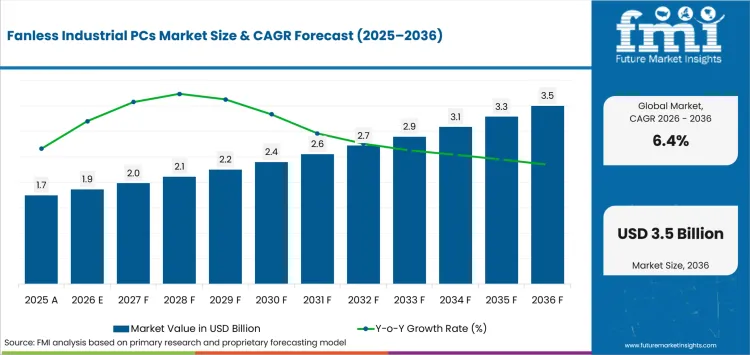
- Market Size (2026)
- USD 1.9 Bn
- Forecast (2036)
- USD 3.5 Bn
- CAGR (2026 to 2036)
- 6.4%
How big is Fanless Industrial PCs Market in 2026?
USD 1.9 billion in 2026 and USD 3.5 billion by 2036 at a 6.4% CAGR.
Demand for fanless industrial PCs is projected to expand at 6.4% CAGR between 2026 and 2036, increasing valuation from USD 1.9 billion in 2026 to USD 3.5 billion by 2036. Robot-cell growth increases the number of machine locations that need PC-class control or vision processing. The International Federation of Robotics recorded 542,000 industrial robot installations in 2024 in its September 2025 release. Fanless hardware fits those nodes where local compute must run without a cooling fan.
Country growth differs with automation density and the age of installed production equipment. Robot density reached 1,220 units per 10k manufacturing employees in South Korea versus 307 in the United States according to the International Federation of Robotics in April 2026. Dense plants give integrators more chances to reuse one qualified computer image on multiple cells. Brownfield plants place more weight on legacy interfaces and replacement continuity.
Key Takeaways
- Machine-level automation raises fanless industrial PC demand through local control and vision workloads that need reliable computing close to equipment.
- Based on processor type, Intel Atom - Celeron is projected to account for 29.0% in 2026 due to low-power x86 compatibility in control and gateway workloads.
- By mounting, DIN-rail is estimated to hold 25.0% in 2026 owing to control-cabinet layouts that place computing beside PLCs.
- The standard fanless segment is likely to capture 31.0% share in 2026 attributable to indoor control cabinets that need passive cooling without full sealing.
- Thermal validation and software-image qualification can delay approval if machine builders cannot reuse one configuration through a product cycle.
- Some of the key players in this market include Advantech, OnLogic, Kontron, Axiomtek, Vecow, AAEON, Cincoze, DFI, Moxa, and Siemens.
Analyst Perspective
"Fanless industrial PC selection starts with sustained thermal load and interface fit because processor headroom alone does not clear a machine qualification. The better commercial platform keeps a validated software image available through machine builds and field replacements."
- Nikhil Kaitwade, Principal Consultant, Future Market Insights
How is the fanless industrial PCs market segmented?
The market is segmented by processor type, mounting, protection, end use and sales channel.
Processor type includes Intel Atom - Celeron, Intel Core, ARM-based, AI edge accelerator PCs and rugged Xeon-class PCs. Mounting covers DIN-rail, wall mount, panel - shelf mount, machine mount and vehicle mount. Protection includes standard fanless, IP-rated sealed, wide-temperature, shock - vibration hardened and dustproof compact designs. End use covers factory automation, machine vision, transportation, energy - utilities and logistics automation. Sales channels include industrial automation distributors, direct OEM supply, system integrators and e-commerce - catalog purchasing.
Why does Intel Atom - Celeron lead the processor type category?
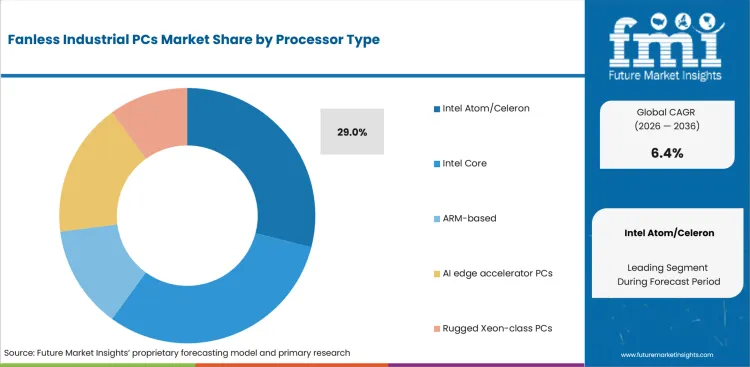
Control gateways often need x86 software continuity more than workstation-class compute. Kontron released the fanless KBox E-430 in November 2025 with Intel Atom x7000RE options for smart manufacturing and gateway work. The platform brings current industrial embedded systems processing into a compact machine-side form.
- Based on processor type, Intel Atom - Celeron is projected to account for 29.0% in 2026 due to low-power x86 compatibility in control and gateway deployments.
- Machine builders can retain validated Windows or Linux images through a processor refresh and reduce software requalification on equipment that must stay serviceable for years in long production programs.
Why does DIN-rail lead the mounting category?
DIN-rail puts the computer beside PLCs and network hardware inside the control cabinet. Axiomtek released the fanless ICO230 in February 2025 for factory automation and wayside systems. Its installation format follows the panel practice used by DIN-rail industrial PCs. Short cable runs simplify serial and Ethernet service.
- In 2026, DIN-rail is expected to lead mounting with 25.0% share because established cabinet layouts keep computing close to controls and I/O.
- Panel builders can reuse the same rail position for power and communication links on repeat machine designs without adding a separate computer enclosure inside crowded cabinets.
Why does standard fanless lead the protection category?
Indoor control cabinets already limit direct water exposure and heavy contamination. Standard fanless systems remove the cooling fan without paying for a sealed enclosure. Advantech launched the fanless UNO-2372V3 in December 2025 for industrial IoT control and edge automation.
- The standard fanless segment is projected to hold 31.0% share in 2026 owing to indoor installations that need passive cooling without full sealing.
- Plant engineers can keep service access and reserve IP-rated or shock-hardened designs for locations that actually require those protections. Routine maintenance also stays straightforward inside indoor control cabinets and reduces service downtime during inspection.
Why does factory automation lead the end use category?
Factory automation puts computing at individual machines and inspection points. Local systems can host HMI software and image analysis without sending every task to a remote server. Cincoze launched its MAGNET DIN-rail computer line in October 2025 for tasks served by industrial machine vision.
- By end use, factory automation is forecast to represent 34.0% in 2026 driven by repeated control and data-processing points on production equipment.
- Factories can standardize hardware once one qualified fanless PC image runs on several machine families. Field replacement then avoids a full software rebuild on repeat production lines. Maintenance teams can reuse spare units.
Why do industrial automation distributors lead the sales channel category?
Industrial automation distributors influence the engineering decision before a fanless PC order. Kontron changed its USA distribution strategy in November 2025 and named Mouser Electronics plus WDL Systems among specialized partners. The channel can place industrial Ethernet hardware and PC support in one purchasing path.
- Industrial automation distributors are set to lead the sales channel with 36.0% share in 2026 due to configuration support and local stock during qualification.
- Regional inventory and application support reduce replacement delays for installed machines that cannot wait for factory-direct shipment. Local stock also gives service teams a faster replacement path.
What are the drivers, restraints and opportunities in the Fanless Industrial PCs Market?
Automation retrofits increase machine-level computing demand while qualification work can delay approval. Edge AI raises platform value after thermal and software checks clear.
- Driver: Brownfield automation upgrades place more computing beside machines that need local control or inspection.
- Restraint: Up-front hardware cost plus integration and training work can push approval into a later capital cycle.
- Opportunity: Fanless platforms with on-device AI can capture vision and predictive-maintenance workloads once thermal limits and software images are validated.
Legacy Equipment Modernization Expands Machine-Level Computing
Brownfield plants need compact computers that fit existing equipment without forcing cabinet redesign. AAEON released the BOXER-6407-TWL in April 2026 for legacy-system modernization and space-constrained installations such as semiconductor equipment. Keeping the enclosure and local interface set can move industrial PC replacements to current processing without reopening mechanical qualification.
Qualification Costs Slow Conversion at Smaller Facilities
Technical interest does not remove the cost of validating a new industrial PC. The USA Department of Energy said in January 2025 that small and medium manufacturers need better access to smart-manufacturing assistance and training. Thermal and software-image checks can delay a hardware change when engineering work exceeds the expected operating gain.
Edge AI Raises the Value of Qualified Fanless Platforms
On-device inference raises the value of a fanless PC once sustained loads fit its thermal envelope. Vecow adopted Intel Core 200S processors in October 2025 for fanless systems aimed at AI vision and robotics. Camera bandwidth and stable software toolchains determine whether a pilot becomes a repeat hardware program.
Which country CAGRs are profiled in the Fanless Industrial PCs Market?
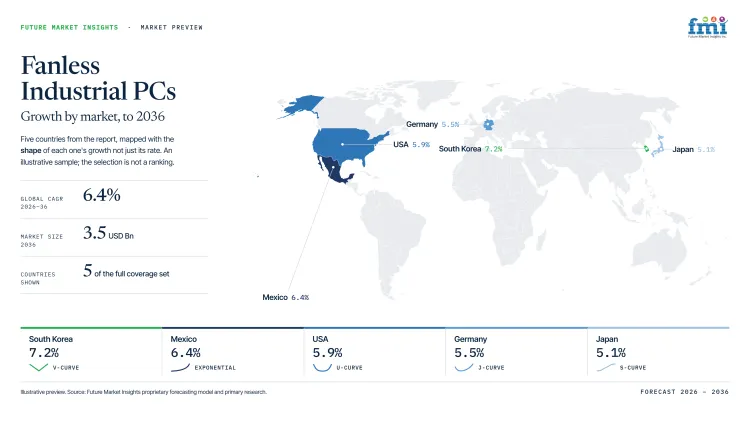
| Country | CAGR |
|---|---|
| South Korea | 7.2% |
| Mexico | 6.4% |
| Australia | 6.1% |
| USA | 5.9% |
| Germany | 5.5% |
| France | 5.4% |
| Japan | 5.1% |
How do country-level CAGRs compare in the Fanless Industrial PCs Market?
The country forecasts span 2.1 percentage points from South Korea at 7.2% to Japan at 5.1%. Mexico and Australia form the next tier at 6.4% and 6.1%, with the USA follows at 5.9% while Germany and France cluster near 5.5%. The narrow spread hides different replacement cycles and service requirements.
- South Korea combines dense electronics production with recurring machine-control replacement cycles.
- Mexico is adding export-manufacturing lines that need industrial computing from the outset.
- Australia needs rugged automation hardware beyond its main manufacturing corridors.
- USA projects mix new equipment with long-lived brownfield assets.
- German machine builders value reliable product availability in export equipment programs.
- French projects require clear plant-level payback before standardizing industrial computing hardware.
- Japanese renewal programs favor low-disruption upgrades on established production machinery.
Similar rates can hide different operating conditions. The full report provides country-level CAGR analysis across North America, Latin America, Western Europe, Eastern Europe, East Asia, South Asia and Pacific and the Middle East and Africa.
Country-wise Analysis
- South Korean electronics and machinery plants operate one of the world's densest robot bases and reuse computing platforms on many machine cells. By 2036, South Korea is projected to grow at 7.2% CAGR driven by repeated machine-level computing needs in highly automated facilities. The Ministry of SMEs and Startups said in January 2025 that manufacturing robots plus data-driven and autonomous factories would reach more than 1,700 manufacturing SMEs through smart factory programs. Public support brings compact computers into smaller plants but integration skills still limit repeat deployment. Korean-language engineering support plus stable I/O images improve the route from funded installations to repeat specifications.
- USA machine builders use a broad network of integrators and industrial distributors for fanless PCs in new and existing production lines. Local projects keep older field interfaces even as control software and vision workloads move to current processors. Fanless industrial PC demand in the USA is forecast to rise at 5.9% CAGR over the forecast period supported by brownfield upgrades. The International Federation of Robotics recorded 38,000 USA industrial robot installations in 2025 in its June 2026 release. Configuration variety slows qualification so regional stock plus long-lifecycle software images carry extra weight as the installed base for industrial automation hardware expands.
- Japanese manufacturers put unusual weight on preserving validated production knowledge during equipment renewal and avoid unnecessary control changes. Adoption of fanless industrial PCs in Japan is anticipated to expand at 5.1% CAGR through 2036 attributable to modernization of mature production assets. The Government of Japan reported in January 2025 that skilled precision-manufacturing workers fell from more than 250 thousand in 2000 to about 150,000 in 2020. Predictive maintenance systems and local inspection software can shift repeat diagnostic work away from scarce specialists. Migration risk is the main friction so long support cycles plus legacy serial interfaces carry more value than rapid processor turnover.
- German machine builders treat interoperability and documented industrial interfaces as core purchasing criteria for equipment sold into customer plants. Export equipment must run for long service periods under standards that can outlast one processor generation. The German fanless industrial PCs sector is projected to record 5.5% CAGR during the assessment period driven by connected production and local edge processing. BMWE's May 2026 Manufacturing-X publication centers on open data spaces and standardized interfaces for industrial data exchange. Standardized interfaces raise the usefulness of factory-floor edge AI beside installed controls but mixed-age machinery raises protocol checks and rewards long software support.
- Mexican fanless PC demand is shaped by export-oriented automotive and electronics plants that follow multinational equipment standards. Fanless industrial PC sales in Mexico are forecast to expand at 6.4% CAGR by 2036 supported by new industrial capacity and local supplier development. Mexico's Presidency announced the first 15 development poles in 14 states in June 2025 with several locations targeting manufacturing investment. New plants give system integrators room to standardize edge computers beside assembly and inspection equipment. Export cycles can alter capital timing so Spanish-language engineering support plus regional spare inventory reduce replacement delays outside the largest service hubs between cycles.
- French manufacturers are adding AI tools to automation projects but digital readiness remains uneven among smaller firms and budgets stay selective. Machine-level computing competes with software spending for the same plant investment budget. Fanless industrial PC demand in France is expected to grow at 5.4% CAGR through 2036 attributable to gradual industrial AI uptake. The Direction générale des Entreprises reported in July 2025 that 13% of French SMEs used a turnkey AI solution. Edge AI gateways still need machine-vision cases with measurable payback and local commissioning support before a mid-sized factory can justify a standard hardware platform for repeat deployment.
- Australian industrial computing demand is dispersed between manufacturing sites and resource operations with long service distances outside major cities. Local maintenance access can weigh as heavily as processor choice on projects that cannot tolerate extended field downtime. In Australia, fanless industrial PC demand is predicted to advance at 6.1% CAGR through 2036 driven by automation investment and remote operating needs. The Australian Government announced in March 2026 that CRC-P round 18 would fund 27 projects and included robotics and automation work. Distance raises service costs after deployment so remote diagnostics plus local spares become practical entry requirements for industrial computing manufacturers.
Who are the notable companies in the Fanless Industrial PCs Market?
Advantech, OnLogic, Kontron, Axiomtek, Vecow, AAEON, Cincoze, DFI, Moxa and Siemens are notable companies serving this market.
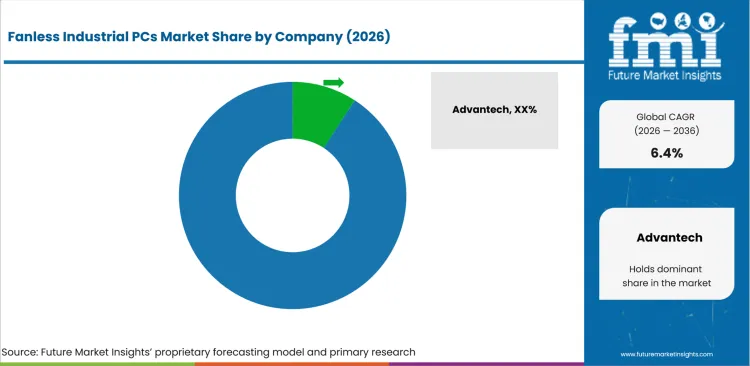
The field splits between broad automation groups and industrial computing specialists. Machine builders compare industrial I/O depth plus environmental qualification and lifecycle support. Processor choice becomes decisive after those requirements are clear.
- Advantech and Kontron pair industrial computing with wider automation access. Moxa and Siemens enter through plant infrastructure relationships.
- OnLogic and Axiomtek focus on rugged edge form factors. Cincoze and Vecow address harsher environments and tailored expansion.
- AAEON and DFI focus on compact computing and current AI processor architectures for machine vision and autonomous equipment.
Competitive Benchmarking: Fanless Industrial PCs Market
| Company | Industrial I/O and Mounting Breadth | Environmental Hardening and Certifications | Edge AI Acceleration Readiness | Geographic Reach |
|---|---|---|---|---|
| Advantech | High | High | High | Americas, Europe and Asia-Pacific |
| OnLogic | Medium | High | High | North America and Europe |
| Kontron | High | High | High | Europe, Americas and Asia |
| Axiomtek | High | High | High | Americas, Europe and Asia |
| Vecow | High | High | High | Americas, Europe and Asia |
| AAEON | High | High | High | Global |
| Cincoze | High | High | High | Americas, Europe and Asia |
| DFI | Medium | Medium | High | Asia, Europe and Americas |
| Moxa | High | High | Medium | Global |
| Siemens | High | High | High | Global |
Scoring basis: High I/O and mounting breadth requires several documented industrial interfaces and installation formats. Medium marks narrower coverage and Low marks a documented limitation. High environmental hardening requires wide-temperature design plus shock or vibration protection and relevant certification. Medium marks narrower protection. High edge AI readiness requires integrated NPU or GPU options plus deployment support. Medium confirms narrower acceleration coverage. Geographic reach is descriptive.
Key Developments in the Fanless Industrial PCs Market
- In February 2026, AAEON released the BOXER-8653AI-PLUS for multi-camera AI inference. The platform gives inspection and robotics projects local accelerator capacity but machine approval still depends on camera compatibility and software support.
- In January 2026, DFI documented Intel ESQ qualification for the EC70A-MTH fanless system. The qualification gives factory automation and AMR integrators a defined edge-inference platform but application-level thermal and interface validation still governs deployment.
- In October 2025, Advantech launched the MIC-780 with Intel Core Ultra processing and an integrated NPU. The fanless box PC raises local AI capacity for control and vision. Repeat deployment still depends on stable software images.
Key Players in the Fanless Industrial PCs Market
Automation-Integrated Industrial Computing Platforms
- Advantech
- Kontron
- Moxa
- Siemens
Rugged and Application-Specific Edge Systems
- OnLogic
- Axiomtek
- Vecow
- Cincoze
Embedded AI and Compact Computing Specialists
- AAEON
- DFI
Fanless Industrial PCs Market - Report Scope
| Coverage field | Report scope |
|---|---|
| Market breakdown | By processor type, mounting, protection, end use, sales channel and region. |
| Quantitative Units | USD billion. |
| Market Definition | Commercial fanless industrial PCs and PC-class fanless edge computers used for industrial control, machine data processing, machine vision and related edge workloads. |
| Regions Covered | North America, Latin America, Western Europe, Eastern Europe, East Asia, South Asia and Pacific and Middle East and Africa. |
| Countries Covered | South Korea, Mexico, Australia, USA, Germany, France, Japan and 20+ countries included in the full report. |
| Key Companies Profiled | Advantech, OnLogic, Kontron, Axiomtek, Vecow, AAEON, Cincoze, DFI, Moxa and Siemens. |
| Forecast Period | 2026 to 2036. |
| Approach | Primary and secondary research with market triangulation. |
Fanless Industrial PCs Market - Research Methodology
| Method | Approach |
|---|---|
| Primary Research | FMI analysts gathered input from manufacturers, service providers, technology developers, distributors, end users, procurement teams, and subject-matter experts. Interviews examined purchasing decisions, product or service evaluation, adoption barriers, approval requirements, pricing considerations, and expectations for technical or commercial support. Respondents were also asked what evidence is required before a trial, pilot, or initial order develops into regular purchasing. |
| Desk Research | Desk research covered government statistics, regulatory publications, trade data, industry associations, technical literature, standards, company filings, product information, and official corporate announcements. Sources were reviewed for relevance, publication date, geographic coverage, and consistency with the defined market scope. Claims relating to performance, applications, approvals, capacity, investment, and commercial activity were retained only when supported by credible public evidence. |
| Market Sizing and Forecasting | The market model combined the baseline value with historical performance, segment structure, pricing and volume indicators, adoption levels, company participation, and country-level demand conditions. Forecast assumptions considered economic activity, investment trends, regulatory developments, technology adoption, purchasing cycles, supply availability, and barriers to wider market use. Segment and regional estimates were reconciled before the final market total was calculated. |
| Data Validation | Estimates were checked against multiple independent indicators, including public data, company activity, trade patterns, industry developments, and findings from primary interviews. Validation also tested whether products, services, applications, and company revenues fell within the defined market boundaries. Adjacent categories, unsupported claims, overlapping revenues, and activities without direct market relevance were excluded to reduce double counting and maintain consistency across segments and countries. |
Fanless Industrial PCs Market by Segments
Fanless Industrial PCs Market segmented by Processor Type:
- Intel Atom - Celeron
- Intel Core
- ARM-based
- AI edge accelerator PCs
- Rugged Xeon-class PCs
Fanless Industrial PCs Market segmented by Mounting:
- DIN-rail
- Wall mount
- Panel - shelf mount
- Machine mount
- Vehicle mount
Fanless Industrial PCs Market segmented by Protection:
- Standard fanless
- IP-rated sealed
- Wide-temperature
- Shock - vibration hardened
- Dustproof compact
Fanless Industrial PCs Market segmented by End Use:
- Factory automation
- Machine vision
- Transportation
- Energy - utilities
- Logistics automation
Fanless Industrial PCs Market segmented by Sales Channel:
- Industrial automation distributors
- Direct OEM supply
- System integrators
- E-commerce - catalog
Fanless Industrial PCs Market by Region:
- North America
- United States
- Canada
- Latin America
- Brazil
- Mexico
- Argentina
- Chile
- Western Europe
- Germany
- France
- United Kingdom
- Italy
- Spain
- Benelux
- Nordics
- Eastern Europe
- Poland
- Czech Republic
- Romania
- Hungary
- East Asia
- China
- Japan
- South Korea
- South Asia and Pacific
- India
- ASEAN
- Australia and New Zealand
- Middle East and Africa
- GCC Countries
- South Africa
- Türkiye
- Israel
Research Sources and Bibliography
- International Federation of Robotics. (2025, September 25). World Robotics 2025 report - Industrial Robots - Global Robot Demand in Factories Doubles Over 10 Years.
- International Federation of Robotics. (2026, April 8). Robot Density Surges in Europe, Asia, and Americas.
- Kontron. (2025, November 6). Kontron's Industrial Computer KBox E-430-AML/ADN/AMH/ADH with Intel Atom x7000E-, Intel Core i3 N- & Intel N-Series Processors.
- Axiomtek. (2025, February 5). Axiomtek Unveils the ICO230, a RISC-Based DIN-Rail Fanless Embedded System for Edge Communication in Factory Automation, Wayside Systems, and Renewable Energy.
- Advantech. (2025, December 10). Advantech Unveils UNO-2372V3: Intelligent and Integrated Edge Automation Computer for Industrial IoT Applications.
- Cincoze. (2025, October 16). Cincoze Launches New MAGNET Product Line - High-Performance DIN-Rail Embedded Computers for Machine Vision.
- Kontron. (2025, November 3). Kontron Launches New Distribution Strategy and Gains Broadest Embedded Module Roadmap in the Western Hemisphere.
- AAEON. (2026, April 23). AAEON Releases the BOXER-6407-TWL, an Ultra-Slim PC Designed for Legacy System Modernization.
- USA Department of Energy. (2025, January 15). USA Department of Energy Announces Nearly $13 Million to Incentivize Smart Manufacturing at Small- And Medium-Sized Facilities.
- Vecow. (2025, October 30). Vecow Deploys Intel Core 200S Series Processors Across Robust Edge IPC Lineup for AIoT.
- Ministry of SMEs and Startups, Republic of Korea. (2025, January 10). Ministry of SMEs and Startups Announces Plan for 2025.
- International Federation of Robotics. (2026, June 18). US Robot Industry Returns to Double Digit Growth.
- Government of Japan. (2025, January 24). AI in Manufacturing: New Japanese Software Takes on Skilled Work with High Efficiency.
- Federal Ministry for Economic Affairs and Energy. (2026, May 11). Manufacturing-X: The future of industrial value creation is connected (accessible).
- Presidencia de la República, Mexico. (2025, June 26). Plan México: Presidenta Claudia Sheinbaum pone en marcha los primeros 15 Polos de Desarrollo Económico para el Bienestar en 14 estados.
- Direction générale des Entreprises. (2025, July 2). 'Osez l'IA' : le plan pour diffuser l'IA dans toutes les entreprises.
- Senator the Hon Tim Ayres. (2026, March 11). Albanese Government backing cooperative research with $66 million in grant funding.
- AAEON. (2026, February 3). AAEON Releases the BOXER-8653AI-PLUS, an Embedded AI System for Multi-Camera AI Inferencing Applications.
- DFI. (2026, January 30). DFI EC70A-MTH: Intel ESQ-Qualified AI Edge System for Metro AI Suite Devices - Built for Factory Automation.
- Advantech. (2025, October 17). Advantech Launches MIC-780: The First Fanless Industrial Box PC Powered by Intel Core Ultra Processors with Integrated NPU.
- Advantech. (2026, August 17). Advantech Launches UNO-2484V3, a High-Performance Fanless Edge Automation Computer for Industrial Edge Applications.
- Siemens. (2026, April 21). Siemens Industrial Edge ecosystem strengthens data and AI integration.
- Kontron. (2025, January 30). Kontron presents the KBox A-251-AML/ADN, a new and compact industrial PC for edge/gateway applications.
- Axiomtek. (2025, August 21). Axiomtek Launches eBOX630B Slim, Rugged, and AI-Ready Embedded System Powered by Intel Core Ultra.
- AAEON. (2025, October 7). AAEON Expands Embedded In-Vehicle AI System Portfolio with the BOXER-8655AI.
- Cincoze. (2026, March 26). Cincoze Launches DX-1300 High-Performance Compact Industrial Computer: The Essential Edge Computing Core for Space-Constrained Environments.
- DFI. (2025, June 24). Intelligent Video at the Edge: DFI, DEEPX, and Network Optix Power Scalable AI Surveillance.
- Moxa. (2025, November 6). Moxa Introduces Its First AI-ready Rackmount x86 IPCs for Reliable and Scalable Edge AI.
- Siemens. (2025, June 11). Siemens and NVIDIA expand partnership to accelerate AI capabilities in manufacturing.
- Axiomtek. (2025, September 1). Axiomtek and Axelera AI Together to Deliver Edge AI Solutions for Machine Vision Applications.
- Advantech. (2026, January 6). Advantech Unveils Next-Gen AI Box PC, UNO-258, Powered by Intel Core Ultra Series 3 Processors.
- Axiomtek. (2025, September 3). Axiomtek and Orbbec Partner to Deliver Seamless Integration of AIE510-ONX Edge AI System with Gemini 335Lg 3D Stereo Vision Cameras.
- Vecow. (2026, January 27). Vecow Launches SPC-8000 Powered by Intel Processor N-series: An Ultra-Compact Fanless Smart Engine for Edge AI.
- Kontron. (2026, March 11). Kontron KBox A-151 EAI Now Powered by SiMa.ai Physical AI for 50+ TOPS Performance in Industrial Edge Applications.
- Advantech. (2026, June 8). Advantech Launches MIC-760 Compact Fanless Edge Controller for Mobile Manipulator Robots.
- Axiomtek. (2025, May 27). Axiomtek and eRaySecure Forge Strategic Partnership to Advance AI Vision Solutions.
- Vecow. (2026, August 27). Vecow Advances Edge AI Deployment with NVIDIA JetPack 7.2 Support across Jetson Orin and Thor Platforms.
- DFI. (2025, March 24). Revolutionizing Factory Safety with DFI Ultra Compact Fanless Systems: Preventing Industrial Accidents and Minimizing Business Losses.
- Moxa. (2026, July 22). Moxa's New-gen Arm Computers Achieve IEC 62443-4-2 SL2 Certification to Strengthen Edge Security.
This bibliography is provided for reader reference and is not exhaustive. The full report contains the complete reference list and detailed citations.
This Report Answers
- What are the global Fanless Industrial PC market values in 2026 and 2036?
- Which processor type segment holds the largest share of the Fanless Industrial PC market in 2026?
- Why does DIN-rail mounting account for the leading share of mounting configurations?
- Why do standard fanless industrial PCs lead the market by protection type?
- Why does factory automation represent the largest end-use segment for fanless industrial PCs?
- How do distributors influence product qualification, procurement decisions, maintenance support, and replacement cycles?
- Why do market growth rates and CAGRs differ across the countries profiled in the report?
- Which leading companies compete in the global Fanless Industrial PC market, and how do their capabilities and product portfolios compare?
Frequently Asked Questions
How big is the fanless industrial PCs market in 2026?
The fanless industrial PCs market is valued at USD 1.9 billion in 2026 and is projected to reach USD 3.5 billion by 2036. Machine-level control and local vision processing keep computing close to industrial equipment.
What is the CAGR of the fanless industrial PCs market from 2026 to 2036?
The fanless industrial PCs market is projected to grow at a CAGR of 6.4% between 2026 and 2036. Expansion follows brownfield automation upgrades and higher use of local edge processing.
Which processor type leads the fanless industrial PCs market?
The Intel Atom - Celeron segment is expected to hold 29.0% of the fanless industrial PCs market in 2026, attributable to low-power x86 compatibility for control and gateway workloads. Lower processor power leaves more thermal margin for passive cooling.
Which mounting type leads the fanless industrial PCs market?
The DIN-rail segment is expected to hold 25.0% of the fanless industrial PCs market in 2026, driven by control-cabinet layouts that place computing beside PLCs and networking hardware. The format also limits extra enclosure work on repeat machine designs.
Which countries are projected to record the highest growth in the fanless industrial PCs market?
South Korea is projected to grow at 7.2% CAGR followed by Mexico at 6.4% and Australia at 6.1% through 2036. Their growth routes differ through robot density and new manufacturing capacity and remote-site automation.
Which companies are active in the fanless industrial PCs market?
Key companies operating in the market include Advantech, OnLogic, Kontron, Axiomtek, Vecow, AAEON, Cincoze, DFI, Moxa, and Siemens. Their positions differ through industrial I/O breadth and environmental qualification and edge AI support.
Preview the report firsthand - request a free sample
Get SampleGet the brochure for pricing and purchase details.
Get PDFTable of Content
- Key Takeaways
- Market Size and CAGR
- Top Growth Driver
- Fastest Growing Segment
- Leading Region
- Key Companies
- Emerging Opportunities
- Executive Summary
- Global Market Outlook
- Demand-side Trends
- Supply-side Trends
- Technology Roadmap Analysis
- Analysis and Recommendations
- Analyst Perspective (What is happening? Why now? What should investors know?)
- Key Questions Answered
- How large is the market?
- What is the CAGR?
- What are key trends?
- Which region dominates?
- Who are the leaders?
- Market Overview
- Market Coverage / Taxonomy
- Market Definition / Scope / Limitations
- Research Methodology
- Chapter Orientation
- Analytical Lens and Working Hypotheses
- Market Structure, Signals, and Trend Drivers
- Benchmarking and Cross-market Comparability
- Market Sizing, Forecasting, and Opportunity Mapping
- Research Design and Evidence Framework
- Desk Research Programme (Secondary Evidence)
- Expert Input and Fieldwork (Primary Evidence)
- Tooling, Models, and Reference Databases
- Data Engineering and Model Build
- Quality Assurance and Audit Trail
- Market Background
- Market Dynamics (Drivers, Restraints, Opportunity, Trends)
- Scenario Forecast (Optimistic, Likely, Conservative)
- Impact Analysis
- AI Impact
- Sustainability Impact
- Regulatory Impact
- Technology Impact
- Consumer / Buyer Analysis
- Purchase Drivers
- Adoption Barriers
- Buyer Journey
- Opportunity Map Analysis
- Product Life Cycle Analysis
- Supply Chain Analysis
- Investment Feasibility Matrix
- Value Chain Analysis
- PESTLE and Porter's Analysis
- Regulatory Landscape
- Regional Parent Market Outlook
- Production and Consumption Statistics
- Import and Export Statistics
- Global Market Analysis and Forecast, 2021 to 2036
- Historical Market Size Value (USD Billion) Analysis, 2021 to 2025
- Current and Future Market Size Value (USD Billion) Projections, 2026 to 2036
- Y-o-Y Growth Trend Analysis
- Absolute $ Opportunity Analysis
- Global Market Pricing Analysis, 2021 to 2036
- Global Market Analysis and Forecast, By Processor Type, 2021 to 2036
- Introduction / Key Findings
- Historical Market Size Value (USD Billion) Analysis By Processor Type, 2021 to 2025
- Current and Future Market Size Value (USD Billion) Analysis and Forecast By Processor Type, 2026 to 2036
- Intel Atom/Celeron
- Intel Core
- ARM-based
- AI edge accelerator PCs
- Rugged Xeon-class PCs
- Intel Atom/Celeron
- Y-o-Y Growth Trend Analysis By Processor Type, 2021 to 2025
- Absolute $ Opportunity Analysis By Processor Type, 2026 to 2036
- Global Market Analysis and Forecast, By Mounting, 2021 to 2036
- Introduction / Key Findings
- Historical Market Size Value (USD Billion) Analysis By Mounting, 2021 to 2025
- Current and Future Market Size Value (USD Billion) Analysis and Forecast By Mounting, 2026 to 2036
- DIN-rail
- Wall mount
- Panel/shelf mount
- Machine mount
- Vehicle mount
- DIN-rail
- Y-o-Y Growth Trend Analysis By Mounting, 2021 to 2025
- Absolute $ Opportunity Analysis By Mounting, 2026 to 2036
- Global Market Analysis and Forecast, By Protection, 2021 to 2036
- Introduction / Key Findings
- Historical Market Size Value (USD Billion) Analysis By Protection, 2021 to 2025
- Current and Future Market Size Value (USD Billion) Analysis and Forecast By Protection, 2026 to 2036
- Standard fanless
- IP-rated sealed
- Wide-temperature
- Shock/vibration hardened
- Dustproof compact
- Standard fanless
- Y-o-Y Growth Trend Analysis By Protection, 2021 to 2025
- Absolute $ Opportunity Analysis By Protection, 2026 to 2036
- Global Market Analysis and Forecast, By End Use, 2021 to 2036
- Introduction / Key Findings
- Historical Market Size Value (USD Billion) Analysis By End Use, 2021 to 2025
- Current and Future Market Size Value (USD Billion) Analysis and Forecast By End Use, 2026 to 2036
- Factory automation
- Machine vision
- Transportation
- Energy/utilities
- Logistics automation
- Factory automation
- Y-o-Y Growth Trend Analysis By End Use, 2021 to 2025
- Absolute $ Opportunity Analysis By End Use, 2026 to 2036
- Global Market Analysis and Forecast, By Sales Channel, 2021 to 2036
- Introduction / Key Findings
- Historical Market Size Value (USD Billion) Analysis By Sales Channel, 2021 to 2025
- Current and Future Market Size Value (USD Billion) Analysis and Forecast By Sales Channel, 2026 to 2036
- Industrial automation distributors
- Direct OEM supply
- System integrators
- E-commerce/catalog
- Industrial automation distributors
- Y-o-Y Growth Trend Analysis By Sales Channel, 2021 to 2025
- Absolute $ Opportunity Analysis By Sales Channel, 2026 to 2036
- Global Market Analysis and Forecast, By Region, 2021 to 2036
- Introduction
- Historical Market Size Value (USD Billion) Analysis By Region, 2021 to 2025
- Current Market Size Value (USD Billion) Analysis and Forecast By Region, 2026 to 2036
- North America
- Latin America
- Western Europe
- Eastern Europe
- East Asia
- South Asia and Pacific
- Middle East & Africa
- Market Attractiveness Analysis By Region
- North America Market Analysis and Forecast, By Country, 2021 to 2036
- Historical Market Size Value (USD Billion) Trend Analysis By Market Taxonomy, 2021 to 2025
- Market Size Value (USD Billion) Forecast By Market Taxonomy, 2026 to 2036
- By Country
- USA
- Canada
- By Processor Type
- By Mounting
- By Protection
- By End Use
- By Sales Channel
- By Country
- Market Attractiveness Analysis
- By Country
- By Processor Type
- By Mounting
- By Protection
- By End Use
- By Sales Channel
- Key Takeaways
- Latin America Market Analysis and Forecast, By Country
- Historical Market Size Value (USD Billion) Trend Analysis By Market Taxonomy, 2021 to 2025
- Market Size Value (USD Billion) Forecast By Market Taxonomy, 2026 to 2036
- By Country
- Brazil
- Mexico
- Chile
- Rest of Latin America
- By Processor Type
- By Mounting
- By Protection
- By End Use
- By Sales Channel
- By Country
- Market Attractiveness Analysis
- By Country
- By Processor Type
- By Mounting
- By Protection
- By End Use
- By Sales Channel
- Key Takeaways
- Western Europe Market Analysis and Forecast, By Country
- Historical Market Size Value (USD Billion) Trend Analysis By Market Taxonomy, 2021 to 2025
- Market Size Value (USD Billion) Forecast By Market Taxonomy, 2026 to 2036
- By Country
- Germany
- UK
- Italy
- Spain
- France
- Nordic
- BENELUX
- Rest of Western Europe
- By Processor Type
- By Mounting
- By Protection
- By End Use
- By Sales Channel
- By Country
- Market Attractiveness Analysis
- By Country
- By Processor Type
- By Mounting
- By Protection
- By End Use
- By Sales Channel
- Key Takeaways
- Eastern Europe Market Analysis and Forecast, By Country
- Historical Market Size Value (USD Billion) Trend Analysis By Market Taxonomy, 2021 to 2025
- Market Size Value (USD Billion) Forecast By Market Taxonomy, 2026 to 2036
- By Country
- Russia
- Poland
- Hungary
- Balkan & Baltic
- Rest of Eastern Europe
- By Processor Type
- By Mounting
- By Protection
- By End Use
- By Sales Channel
- By Country
- Market Attractiveness Analysis
- By Country
- By Processor Type
- By Mounting
- By Protection
- By End Use
- By Sales Channel
- Key Takeaways
- East Asia Market Analysis and Forecast, By Country
- Historical Market Size Value (USD Billion) Trend Analysis By Market Taxonomy, 2021 to 2025
- Market Size Value (USD Billion) Forecast By Market Taxonomy, 2026 to 2036
- By Country
- China
- Japan
- South Korea
- By Processor Type
- By Mounting
- By Protection
- By End Use
- By Sales Channel
- By Country
- Market Attractiveness Analysis
- By Country
- By Processor Type
- By Mounting
- By Protection
- By End Use
- By Sales Channel
- Key Takeaways
- South Asia and Pacific Market Analysis and Forecast, By Country
- Historical Market Size Value (USD Billion) Trend Analysis By Market Taxonomy, 2021 to 2025
- Market Size Value (USD Billion) Forecast By Market Taxonomy, 2026 to 2036
- By Country
- India
- ASEAN
- Australia & New Zealand
- Rest of South Asia and Pacific
- By Processor Type
- By Mounting
- By Protection
- By End Use
- By Sales Channel
- By Country
- Market Attractiveness Analysis
- By Country
- By Processor Type
- By Mounting
- By Protection
- By End Use
- By Sales Channel
- Key Takeaways
- Middle East & Africa Market Analysis and Forecast, By Country
- Historical Market Size Value (USD Billion) Trend Analysis By Market Taxonomy, 2021 to 2025
- Market Size Value (USD Billion) Forecast By Market Taxonomy, 2026 to 2036
- By Country
- Kingdom of Saudi Arabia
- Other GCC Countries
- Türkiye
- South Africa
- Other African Union
- Rest of Middle East & Africa
- By Processor Type
- By Mounting
- By Protection
- By End Use
- By Sales Channel
- By Country
- Market Attractiveness Analysis
- By Country
- By Processor Type
- By Mounting
- By Protection
- By End Use
- By Sales Channel
- Key Takeaways
- Key Countries Market Analysis
- USA
- Pricing Analysis
- Market Share Analysis, 2025
- By Processor Type
- By Mounting
- By Protection
- By End Use
- By Sales Channel
- Canada
- Pricing Analysis
- Market Share Analysis, 2025
- By Processor Type
- By Mounting
- By Protection
- By End Use
- By Sales Channel
- Mexico
- Pricing Analysis
- Market Share Analysis, 2025
- By Processor Type
- By Mounting
- By Protection
- By End Use
- By Sales Channel
- Brazil
- Pricing Analysis
- Market Share Analysis, 2025
- By Processor Type
- By Mounting
- By Protection
- By End Use
- By Sales Channel
- Chile
- Pricing Analysis
- Market Share Analysis, 2025
- By Processor Type
- By Mounting
- By Protection
- By End Use
- By Sales Channel
- Germany
- Pricing Analysis
- Market Share Analysis, 2025
- By Processor Type
- By Mounting
- By Protection
- By End Use
- By Sales Channel
- UK
- Pricing Analysis
- Market Share Analysis, 2025
- By Processor Type
- By Mounting
- By Protection
- By End Use
- By Sales Channel
- Italy
- Pricing Analysis
- Market Share Analysis, 2025
- By Processor Type
- By Mounting
- By Protection
- By End Use
- By Sales Channel
- Spain
- Pricing Analysis
- Market Share Analysis, 2025
- By Processor Type
- By Mounting
- By Protection
- By End Use
- By Sales Channel
- France
- Pricing Analysis
- Market Share Analysis, 2025
- By Processor Type
- By Mounting
- By Protection
- By End Use
- By Sales Channel
- India
- Pricing Analysis
- Market Share Analysis, 2025
- By Processor Type
- By Mounting
- By Protection
- By End Use
- By Sales Channel
- ASEAN
- Pricing Analysis
- Market Share Analysis, 2025
- By Processor Type
- By Mounting
- By Protection
- By End Use
- By Sales Channel
- Australia & New Zealand
- Pricing Analysis
- Market Share Analysis, 2025
- By Processor Type
- By Mounting
- By Protection
- By End Use
- By Sales Channel
- China
- Pricing Analysis
- Market Share Analysis, 2025
- By Processor Type
- By Mounting
- By Protection
- By End Use
- By Sales Channel
- Japan
- Pricing Analysis
- Market Share Analysis, 2025
- By Processor Type
- By Mounting
- By Protection
- By End Use
- By Sales Channel
- South Korea
- Pricing Analysis
- Market Share Analysis, 2025
- By Processor Type
- By Mounting
- By Protection
- By End Use
- By Sales Channel
- Russia
- Pricing Analysis
- Market Share Analysis, 2025
- By Processor Type
- By Mounting
- By Protection
- By End Use
- By Sales Channel
- Poland
- Pricing Analysis
- Market Share Analysis, 2025
- By Processor Type
- By Mounting
- By Protection
- By End Use
- By Sales Channel
- Hungary
- Pricing Analysis
- Market Share Analysis, 2025
- By Processor Type
- By Mounting
- By Protection
- By End Use
- By Sales Channel
- Kingdom of Saudi Arabia
- Pricing Analysis
- Market Share Analysis, 2025
- By Processor Type
- By Mounting
- By Protection
- By End Use
- By Sales Channel
- Türkiye
- Pricing Analysis
- Market Share Analysis, 2025
- By Processor Type
- By Mounting
- By Protection
- By End Use
- By Sales Channel
- South Africa
- Pricing Analysis
- Market Share Analysis, 2025
- By Processor Type
- By Mounting
- By Protection
- By End Use
- By Sales Channel
- USA
- Market Structure Analysis
- Competition Dashboard
- Competition Benchmarking
- Market Share Analysis of Top Players
- By Regional
- By Processor Type
- By Mounting
- By Protection
- By End Use
- By Sales Channel
- Emerging Startups
- Innovation Benchmarking
- Competition Analysis
- Competition Deep Dive
- Advantech
- Overview
- Product Portfolio
- Profitability by Market Segments
- Sales Footprint
- Strategy Overview
- Marketing Strategy
- Product Strategy
- Channel Strategy
- OnLogic
- Kontron
- Axiomtek
- Vecow
- AAEON
- Cincoze
- DFI
- Moxa
- Siemens
- Advantech
- Case Studies
- Success Stories
- Recent Developments
- Competition Deep Dive
- Assumptions & Acronyms Used


