

- Market Size (2026)
- USD 960 Mn
- Forecast (2036)
- USD 5285.9 Mn
- CAGR (2026 to 2036)
- 18.6%
How big is Federated Learning Healthcare Market size?
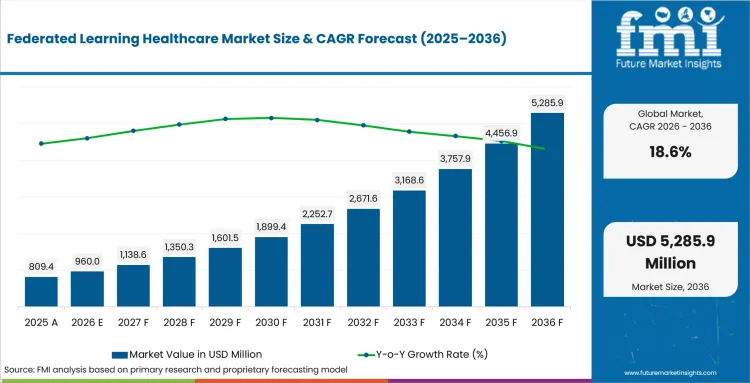
USD 960.0 million in 2026 and USD 5,285.9 million by 2036 at an 18.6% CAGR.
Sales of federated learning healthcare are estimated to rise at 18.6% CAGR through 2036, increasing valuation from USD 960 million in 2026 to USD 5,285.9 million by 2036. Decentralized machine learning allows hospital systems and research sponsors to analyze distributed patient data without transferring sensitive records into a centralized database. Flower Labs announced expansion plans during March 2025 to connect 108 hospitals by 2026 for the BloodCounts consortium. This large-scale initiative proves the commercial viability of coordinating locally stored medical records. Software vendors achieve successful commercial conversion only after their pilot projects demonstrate repeatable algorithmic performance with controlled data synchronization and accountable model reviews.
Regional healthcare systems enforce distinct operational priorities on adopting privacy-preserving artificial intelligence platforms. Health networks in Germany and South Korea strongly focus on formal governance standards and rigorous cross-institution validation. System interoperability and controlled clinical deployment remain the primary technical objectives for medical providers in Japan and the United States. NHS England published figures during May 2026 confirming active support for 545 research projects as of December 2025. Building a secure research capacity directly widens the commercial buyer base for suppliers that offer governed orchestration and auditable model exchanges.
Key Takeaways for the Federated Learning Healthcare Market
- Demand for federated learning healthcare is supported by privacy-sensitive collaboration across pharmaceutical sponsors and research institutions seeking combined model evidence without centralizing source records.
- Cloud-based deployment is anticipated to lead deployment model with 40.0% share in 2026, guided by shared orchestration services and centralized software maintenance across distributed institutions.
- Direct enterprise sales are estimated to garner 38.0% share of distribution channel in 2026, aided by custom governance design and institution-specific integration work.
- Heterogeneous data structures and complex participant governance restrict dependable implementation, extending validation cycles and raising correction work across participating sites.
- Competition focuses on NVIDIA Corporation, Owkin, Rhino Federated Computing, Intel Corporation, Flower Labs GmbH, Apheris AI GmbH, OASYS NOW, and Tune Insight SA, with providers differentiated by orchestration depth and healthcare evidence.
Analyst Perspective
“Healthcare institutions approve federated learning deployments only after validation duties and oversight responsibilities are clearly assigned. Buyers examine model-update controls and responsibility for site-level variation during platform review. Durable adoption follows deployments translating privacy-preserving collaboration into clinical research evidence and recurring operational use.”
- Anurag Sharma, Principal Analyst for Healthcare at Future Market Insights
How is Federated Learning Healthcare Market segmented?
The federated learning healthcare industry is segmented by product type, application, end user, distribution channel, deployment model, and region.
The federated learning healthcare industry is segmented by product type, application, end user, distribution channel, deployment model, and region. Product type coverage includes federated learning platforms, federated analytics solutions, privacy-preserving AI solutions, federated model management software, and edge AI healthcare platforms. Application coverage addresses medical imaging, clinical research and drug discovery, disease diagnosis, remote patient monitoring, and population health analytics. End-user coverage spans hospitals and healthcare providers, pharmaceutical and biotechnology companies, academic and research institutes, contract research organizations, and government and public health agencies. Distribution channel coverage includes direct enterprise sales, cloud marketplaces, technology partners and system integrators, healthcare software distributors, and online SaaS platforms. Deployment model coverage includes cloud-based deployment, hybrid deployment, on-premise deployment, edge deployment, and multi-institution deployment. Regional coverage includes North America, Europe, East Asia, South Asia and Pacific, Latin America, the Middle East, and Africa.
What supports federated learning platforms across product type demand?
Researchers writing in iScience reported a 0.948 AUROC for in-hospital mortality prediction in September 2024, demonstrating technical value from institution-specific feature learning. Such evidence supports platform evaluation across artificial intelligence in healthcare programs needing local data custody and combined predictive evidence. Federated learning platforms coordinate model training across hospitals retaining local control of patient records. Platform review covers client-specific features and site-level performance reporting.
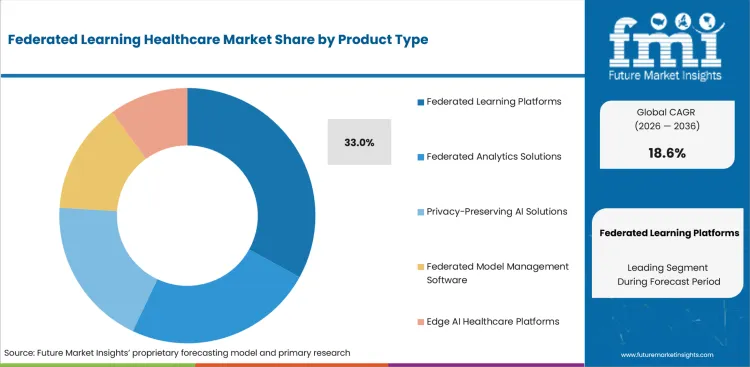
- Federated learning platforms are predicted to represent 33.0% share in 2026, driven by central orchestration functions coordinating local training and controlled model aggregation. Hospital buyers examine audit records and model-convergence evidence during technical approval.
- Federated analytics solutions and privacy-preserving AI solutions support distributed querying and protected computation across participating institutions. Federated model management software and edge AI healthcare platforms extend control into model versioning and local device execution.
Why does medical imaging lead application demand?
Medical imaging offers a defined workflow for distributed model training across radiology and pathology records. Image variation across scanners and institutions creates a direct need for local training and combined validation. Flower Labs reported 86% accuracy across Eye2Gene’s top five gene candidates in March 2025, showing how federated imaging workflows support privacy-preserving diagnosis.
- Medical imaging is anticipated to account for 30.0% share of application in 2026, led by distributed radiology and pathology datasets requiring institution-level custody. Clinical teams assess annotation consistency and scanner variation during model acceptance.
- Clinical trials support software solutions connect clinical research & drug discovery with trial optimization and biomarker work. Remote patient monitoring and population health analytics create additional demand across remote healthcare programs using decentralized patient records.
What supports hospitals & healthcare providers across end user demand?
Hospitals & healthcare providers control patient records and clinical infrastructure needed for federated training. Enterprise approval involves information-security teams and research governance committees. Healthcare analytics supports evidence review across distributed clinical programs. A Nature Communications study published in February 2025 evaluated federated models across 5 California hospitals, demonstrating direct participation by institutional data holders. Hospital purchasing patterns favor suppliers presenting local custody controls and documented support obligations.
- Based on end user, hospitals & healthcare providers are likely to hold 37.0% share in 2026 due to ownership of clinical records and responsibility for care-delivery infrastructure. Supplier review covers local integration work and evidence from representative patient populations.
- Pharmaceutical & biotechnology companies and academic & research institutes use federated networks for drug research and multi-center studies. Contract research organizations and government & public health agencies add program-management and population-level demand across population health management platforms.
How does direct enterprise sales shape distribution channel demand?
Owkin announced a 5-year partnership with Leeds Teaching Hospitals in September 2025, covering curated health-record datasets and ethical review for each project. Contract depth favors direct supplier engagement over standardized channel purchases. Direct enterprise sales promote contracts requiring institution-specific connectors and negotiated support duties. Healthcare buyers often require healthcare IT integration and technical qualification across every participating institution.
- By distribution channel, direct enterprise sales are expected to secure 38.0% share in 2026 owing to customized governance design and integration across healthcare enterprises. Account teams document model ownership and service responsibilities during contract review.
- Cloud marketplace and technology partners & system integrators support standardized access and implementation assistance. Healthcare software distributors and online SaaS platforms address smaller programs seeking packaged deployment and subscription-based administration.
What keeps cloud-based deployment central within deployment model?
Cloud-based deployment centralizes orchestration and monitoring without requiring centralized patient records. Distributed clients maintain local datasets as aggregation services coordinate model updates and security checks. Intel's March 2025 Tiber Secure Federated AI announcement referenced OpenFL's deployment across 71 healthcare sites through the FeTS initiative, demonstrating distributed federated scale across institutional data holders. Buyer assessment links healthcare cloud infrastructure with identity controls and outage recovery. Healthcare API compatibility also influences connector planning across institutional nodes.
- Cloud-based deployment is projected to command 40.0% share in 2026, driven by centrally managed orchestration and software updates across participating sites. Customers assess encryption and regional hosting during platform approval.
- Hybrid deployment and on-premise deployment preserve local infrastructure control for regulated workloads. Edge deployment and multi-institution deployment support local processing across medical devices and formal research consortium networks.
What are drivers, restraints, and opportunities in Federated Learning Healthcare Market?
Privacy-sensitive collaboration supports platform adoption across health-data holders, and heterogeneous infrastructure delays enterprise conversion.
- Driver: Multi-institution research teams need model training across separate clinical repositories under strict patient-data controls. Federated platforms coordinate local computation and aggregated updates across participating hospitals under institution-specific custody rules.
- Restraint: Inconsistent schemas and unequal computing capacity complicate synchronized training across participating healthcare organizations. Corrective mapping and repeated validation increase implementation effort during clinical acceptance of combined model results.
- Opportunity: Managed federation services may combine secure orchestration with harmonization support for hospitals lacking internal engineering capacity. Suppliers offering auditable updates and local deployment assistance may convert isolated research pilots into recurring multi-site programs.
Hospital networks seek larger training cohorts without surrendering custody of source records. Owkin reported a federated research network spanning 3 continents in September 2025, proving an operational route for decentralized oncology analysis across separate health systems. International participation expands model diversity and creates demand for managed federation services. Clinical acceptance remains dependent on local validation and documented model behavior.
Governance gaps restrict implementation even under technically successful model training. A npj Digital Medicine review published in July 2025 found only 7 studies focused on federated-learning governance, exposing limited empirical guidance for contracts and participant withdrawal. Vendors need implementation records defining approval authority and remediation duties. Unresolved responsibilities are likely to delay renewal and network expansion.
Secure multi-site imaging creates an opening for platforms combining orchestration with clinical validation support. NVIDIA described a medical-imaging federation expanding to a third site in September 2025, demonstrating progression from controlled cohorts into multi-institution training. Suppliers pairing AI radiology worklist orchestration with federated controls may support diagnostic teams across separate institutions. Revenue quality relies on repeat use beyond demonstration projects.
How are country CAGRs aligned in Federated Learning Healthcare Market?
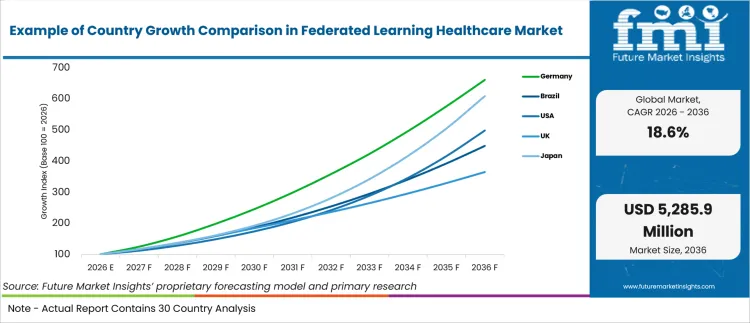
| Country or Market | CAGR |
|---|---|
| Germany | 20.8% |
| South Korea | 20.3% |
| Japan | 19.8% |
| USA | 17.4% |
| Australia | 17.0% |
| Brazil | 16.2% |
| UK | 13.8% |
Source: Future Market Insights analysis, 2026.
How do country-level CAGRs compare in Federated Learning Healthcare Market?
Country comparison shows a gradual step-down across profiled markets. Germany occupies the upper forecast position, followed by South Korea and Japan. The United States and Australia form the middle band. Brazil and United Kingdom complete the disclosed comparison. A 7.0 percentage-point spread separates Germany from United Kingdom. National positions reflect differing governance readiness and healthcare-data infrastructure.
- Germany establishes Europe as the lead development cluster across disclosed markets.
- South Korea follows Germany with a limited difference across the assessment period.
- Japan completes the upper group based on health-data service development and institutional AI training.
- The United States and Australia form the middle forecast band led by established clinical information systems.
- Brazil and United Kingdom complete the disclosed range under separate public-health and secure-data programs.
Markets carrying similar CAGRs are likely to present different entry conditions depending on governance review and local support requirements. Full report coverage extends across North America, Europe, East Asia, South Asia and Pacific, Latin America, Middle East and Africa.
Country-wise Analysis
- Federated learning healthcare market in Germany is forecast to expand at 20.8% CAGR from 2026 to 2036, influenced by a national federated research-data foundation and rigorous governance review. Medical Informatics Initiative reported cooperation through 4 consortia in June 2024, creating a structured base for distributed model assessment. Common data definitions and institutional approvals improve supplier access to multi-site validation projects.
- Ministry of Health and Welfare reported implementation across 4 medical institutions in December 2025, expanding institutional skills for controlled AI adoption. Specialist vendors benefit from reference projects proving site uptime and model oversight. Industry in South Korea is estimated to scale at 20.3% CAGR during 2026 to 2036, led by Clinical AI training and hospital-led implementation.
- Federated suppliers need local governance support and compatibility with domestic clinical systems. Adoption in Japan is set to rise at 19.8% CAGR by 2036, driven by personal health record service development and coordinated health-data use. Ministry of Economy, Trade and Industry reported 20 business operators creating PHR service models in July 2025, demonstrating organized participation across health-data services.
- Office of the National Coordinator for Health Information Technology reported 76% hospital participation across all 4 measured interoperability domains in February 2026, demonstrating established exchange capability. Demand in the United States is projected to grow at 17.4% CAGR between 2026 and 2036, backed by hospital interoperability and enterprise deployment readiness. Existing exchange capability reduces connector discovery work across multi-hospital model programs.
- Sector in Australia is likely to increase at 17.0% CAGR during the forecast period due to sustained harmonization demand and distributed general-practice records. Platform vendors need adaptable extraction and validation functions across separate software environments. Australian Institute of Health and Welfare reported in September 2025 that 4,399 practices had used the leading clinical information system, demonstrating a substantial base of locally held electronic records.
- Federated Learning Healthcare sales in Brazil are anticipated to record 16.2% CAGR from 2026 to 2036, supported by public-health platform development and local service integration. Distributed clinical projects require Portuguese-language support and governance suited to public health institutions. Pan American Health Organization reported 3 strategic initiatives advancing under a national technical cooperation agreement in September 2025, strengthening public-health implementation capacity.
- Established platform governance creates a buyer base familiar with controlled analytics and institutional data custody. Industry in the United Kingdom is estimated to advance at 13.8% CAGR between 2026 and 2036, as secure national data platforms shape United Kingdom approval conditions. NHS England reported 139 trusts live on its Federated Data Platform at the end of May 2026, demonstrating operational adoption across hospital organizations.
Who are notable companies in Federated Learning Healthcare Market?
NVIDIA Corporation, Owkin, Rhino Federated Computing, Intel Corporation, Flower Labs GmbH, Apheris AI GmbH, OASYS NOW, and Tune Insight SA are notable companies driving the federated learning healthcare sector.
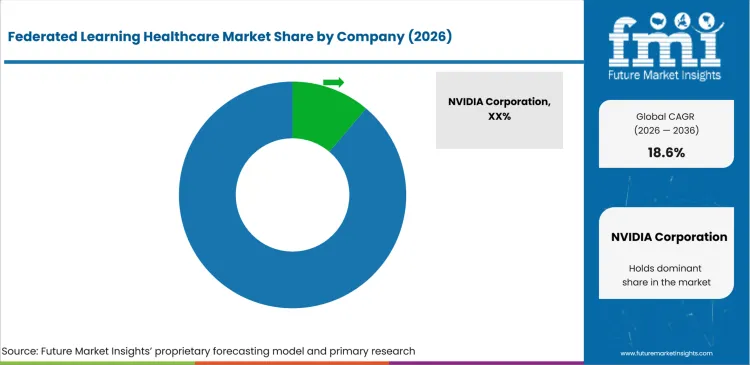
Competition for the market centers on healthcare network access and deployment support. Framework providers concentrate on model aggregation and secure client coordination. Healthcare-network specialists emphasize curated institutional relationships and governed data access. Confidential-computing providers focus on protected model updates and encrypted analytics. Buyers examine implementation evidence and responsibility for failed site participation during renewal.
- NVIDIA Corporation and Intel Corporation compete through federated-learning frameworks and secure distributed computing services. Enterprise teams assess framework compatibility and infrastructure support across cloud and on-premise nodes.
- Owkin and Rhino Federated Computing compete based on healthcare research networks and controlled analytics across institutional datasets. Pharmaceutical sponsors and cancer centers assess governance support and access to clinically curated data.
- Flower Labs GmbH and Apheris AI GmbH compete through federated infrastructure supporting research and life-sciences programs. Development teams examine framework flexibility and administration across distributed data holders.
- OASYS NOW and Tune Insight SA compete through genomics collaboration and encrypted multi-party computation. Healthcare institutions assess data-custody controls and integration with existing clinical systems.
Competitive Benchmarking: Federated Learning Healthcare Market
| Company | Federated Workflow | Healthcare Data Access | Privacy Controls | Service Reach |
|---|---|---|---|---|
| NVIDIA Corporation | High | Medium | High | Global |
| Owkin | High | High | High | Multi-country |
| Rhino Federated Computing | High | High | High | Multi-country |
| Intel Corporation | High | Medium | High | Global |
| Flower Labs GmbH | High | Medium | High | Global |
| Apheris AI GmbH | High | High | High | International programs |
| OASYS NOW | Medium | High | High | Europe and partner networks |
| Tune Insight SA | High | High | High | Europe and international partnerships |
Source: Future Market Insights analysis, 2026.
Key Developments in Federated Learning Healthcare Market
- In October 2025, Rhino Federated Computing supported the Cancer AI Alliance’s first collaborative platform for federated cancer research. Participating centers gained a shared model-development structure without transferring raw clinical data.
- In October 2025, Flower Labs made its federated platform deployable within NHS Secure Research Environments. Compatibility with controlled research infrastructure reduced a technical barrier for hospital participation in international federated projects.
- In February 2026, Tune Insight and Softway Medical announced a partnership for industrial federated computing across European medical research. Joint deployment targets distributed analysis without health-data transfer, expanding institution-level access across hospitals and research networks.
Key Players in Federated Learning Healthcare Market
Core Technology and Product Providers
- NVIDIA Corporation
- Intel Corporation
- Flower Labs GmbH
Healthcare Network and Research Platforms
- Owkin
- Rhino Federated Computing
- Apheris AI GmbH
Privacy and Confidential Analytics Specialists
- OASYS NOW
- Tune Insight SA
Federated Learning Healthcare Market - Report Scope
| Coverage field | Report scope |
|---|---|
| Market breakdown | Federated learning healthcare market breakdown includes product type, application, end user, distribution channel, deployment model, and region. |
| Quantitative Units | Revenue in USD Million, CAGR in %. |
| Market Definition | Federated Learning Healthcare covers software and services training or evaluating machine-learning models across hospitals and health-data holders without centralizing source records. Included functions cover orchestration, aggregation, federated analytics, privacy controls, model management, and local execution. Generic analytics lacking distributed model or query functions are excluded. |
| Regions Covered | North America, Europe, East Asia, South Asia and Pacific, Latin America, Middle East and Africa. |
| Countries Covered | Germany, South Korea, Japan, USA, Australia, Brazil, and UK. |
| Key Companies Profiled | NVIDIA Corporation, Owkin, Rhino Federated Computing, Intel Corporation, Flower Labs GmbH, Apheris AI GmbH, OASYS NOW, and Tune Insight SA. |
| Forecast Period | 2026 to 2036. |
| Approach | Hybrid bottom-up and top-down methodology uses segment shares and country CAGRs. Company activity, deployment evidence, and buyer adoption support final reconciliation. |
Source: Future Market Insights analysis, 2026.
Federated Learning Healthcare Market - Research Methodology
| Method | Approach |
|---|---|
| Primary Research | FMI analysts gathered input from manufacturers, service providers, technology developers, distributors, end users, procurement teams, and subject-matter experts. Interviews examined purchasing decisions, product or service evaluation, adoption barriers, approval requirements, pricing considerations, and expectations for technical or commercial support. Respondents were also asked what evidence is required before a trial, pilot, or initial order develops into regular purchasing. |
| Desk Research | Desk research covered government statistics, regulatory publications, trade data, industry associations, technical literature, standards, company filings, product information, and official corporate announcements. Sources were reviewed for relevance, publication date, geographic coverage, and consistency with the defined market scope. Claims relating to performance, applications, approvals, capacity, investment, and commercial activity were retained only when supported by credible public evidence. |
| Market Sizing and Forecasting | The market model combined the baseline value with historical performance, segment structure, pricing and volume indicators, adoption levels, company participation, and country-level demand conditions. Forecast assumptions considered economic activity, investment trends, regulatory developments, technology adoption, purchasing cycles, supply availability, and barriers to wider market use. Segment and regional estimates were reconciled before the final market total was calculated. |
| Data Validation | Estimates were checked against multiple independent indicators, including public data, company activity, trade patterns, industry developments, and findings from primary interviews. Validation also tested whether products, services, applications, and company revenues fell within the defined market boundaries. Adjacent categories, unsupported claims, overlapping revenues, and activities without direct market relevance were excluded to reduce double counting and maintain consistency across segments and countries. |
Source: Future Market Insights analysis, 2026.
Federated Learning Healthcare Market segmentation
Federated Learning Healthcare Market segmented by Product Type:
- Federated Learning Platforms
- Federated Analytics Solutions
- Privacy-Preserving AI Solutions
- Federated Model Management Software
- Edge AI Healthcare Platforms
Federated Learning Healthcare Market segmented by Application:
- Medical Imaging
- Clinical Research & Drug Discovery
- Disease Diagnosis
- Remote Patient Monitoring
- Population Health Analytics
Federated Learning Healthcare Market segmented by End User:
- Hospitals & Healthcare Providers
- Pharmaceutical & Biotechnology Companies
- Academic & Research Institutes
- Contract Research Organizations
- Government & Public Health Agencies
Federated Learning Healthcare Market segmented by Distribution Channel:
- Direct Enterprise Sales
- Cloud Marketplace
- Technology Partners & System Integrators
- Healthcare Software Distributors
- Online SaaS Platforms
Federated Learning Healthcare Market segmented by Deployment Model:
- Cloud-Based Deployment
- Hybrid Deployment
- On-Premise Deployment
- Edge Deployment
- Multi-Institution Deployment
Federated Learning Healthcare Market segmented by Region:
- North America
- United States
- Canada
- Latin America
- Brazil
- Mexico
- Argentina
- Chile
- Western Europe
- Germany
- France
- United Kingdom
- Italy
- Spain
- Benelux
- Nordics
- Eastern Europe
- Poland
- Czech Republic
- Romania
- Hungary
- East Asia
- China
- Japan
- South Korea
- South Asia and Pacific
- India
- ASEAN
- Australia and New Zealand
- Middle East and Africa
- GCC Countries
- South Africa
- Türkiye
- Israel
Research Sources and Bibliography
- Flower Labs. (2025, March 20). Announcing BloodCounts! and Flower partnership.
- NHS England. (2026, May 29). Data for Research and Development Programme: Evaluation.
- Kim, T. H., Yu, J. Y., Jang, W. S., Heo, S. C., Sung, M., Hong, J., Chung, K., & Park, Y. R. (2024, September 13). PPFL: A personalized progressive federated learning method for leveraging different healthcare institution-specific features. iScience, 27(10), 110943.
- Flower Labs. (2025, March 7). Revolutionizing healthcare with federated AI.
- Kuo, T.-T., Gabriel, R. A., Koola, J., Schooley, R. T., & Ohno-Machado, L. (2025, February 5). Distributed cross-learning for equitable federated models: Privacy-preserving prediction on data from five California hospitals. Nature Communications, 16, 1371.
- Owkin. (2025, September 29). Owkin partners with Leeds Teaching Hospitals to drive forward medical research using health data.
- Intel Corporation. (2025, March 3). Introducing Intel Tiber Secure Federated AI.
- Owkin. (2025, September 10). Groundbreaking new method enables secure, collaborative cancer research across borders.
- Eden, R., Chukwudi, I., Bain, C., Barbieri, S., Callaway, L., de Jersey, S., George, Y., Gorse, A.-D., Lawley, M., Marendy, P., McPhail, S. M., Nguyen, A., Samadbeik, M., & Sullivan, C. (2025, July 10). A scoping review of the governance of federated learning in healthcare. npj Digital Medicine, 8, 427.
- NVIDIA. (2025, September 24). NVIDIA FLARE Day 2025.
- Medical Informatics Initiative. (2024, June 27). Medical Informatics Initiative lays foundations for EHDS.
- Ministry of Health and Welfare. (2025, December 10). Driving change in hospitals through medical AI.
- Ministry of Economy, Trade and Industry. (2025, July 10). Experience-based events and displays to promote PHR data utilization on the theme “Unlock a New Wellness Era with PHR” held at Expo 2025 Osaka, Kansai.
- Office of the National Coordinator for Health Information Technology. (2026, February). Electronic health information exchange by hospitals.
- Australian Institute of Health and Welfare. (2025, September 30). Practice Incentives Program Quality Improvement Measures: Annual data update 2024-25.
- Pan American Health Organization. (2025, September 2). Projects cooperate to SUS’ digital transformation.
- NHS England. (2026, June 12). NHS Federated Data Platform uptake and benefits.
- Rhino Federated Computing. (2025, October 1). Cancer AI Alliance unveils first collaborative AI platform for cancer research built on the Rhino Federated Computing Platform.
- Flower Labs. (2025, October 15). Scaling federated AI for the NHS in secure research environments.
- Tune Insight. (2026, February 11). Softway Medical and Tune Insight partner to accelerate medical research in Europe - without compromising on privacy.
This bibliography is provided for reader reference and is not exhaustive. The full report contains the complete reference list and detailed citations.
This Report Answers
- How do product type, application, end user, distribution channel, and deployment model influence federated learning healthcare demand?
- What criteria guide hospitals evaluating federated learning platforms prior to enterprise deployment?
- Why do country CAGRs differ across Germany, South Korea, Japan, USA, Australia, Brazil, and UK?
- What companies compete through orchestration depth and healthcare research networks?
- How are forecasts validated through bottom-up and top-down analysis using independent indicators?
- What evidence supports healthcare institution review prior to multi-site model deployment?
- Why do data harmonization and governance records influence platform selection?
- How does heterogeneous infrastructure limit return across integration and validation work?
- How do clinical review records influence approval across research and information-security teams?
- What company capabilities improve long-term confidence and recurring platform use?
Frequently Asked Questions
How big is the Federated Learning Healthcare Market in 2026?
The federated learning healthcare market is valued at USD 960.0 million in 2026 and is forecast to reach USD 5285.9 million by 2036. Growth is supported by hospital systems and research sponsors adopting decentralized machine learning platforms that analyze distributed patient data without transferring sensitive records into centralized databases across participating institutions.
What is the CAGR of the Federated Learning Healthcare Market from 2026 to 2036?
The federated learning healthcare market grows at a CAGR of 18.6% between 2026 and 2036, supported by healthcare institutions approving federated platforms once those systems demonstrate repeatable algorithmic performance with controlled data synchronization and clearly assigned validation duties and oversight responsibilities across multi-site clinical programs.
Which deployment model leads the Federated Learning Healthcare Market?
Cloud-based deployment accounts for 40.0% of the federated learning healthcare market by deployment model in 2026, driven by centrally managed orchestration and software updates that coordinate model training across distributed institutions while each participating site maintains local custody of patient records throughout the program.
How much will the Federated Learning Healthcare Market add between 2026 and 2036?
The federated learning healthcare market is set to add USD 4325.9 million between 2026 and 2036, growing from USD 960.0 million to USD 5285.9 million as federated learning platforms, privacy-preserving AI solutions, and managed federation services enter funded clinical research and enterprise deployment pathways across a widening base of hospital and pharmaceutical programs.
Who are the leading companies in the Federated Learning Healthcare Market?
Five companies lead the federated learning healthcare market, including NVIDIA Corporation, Owkin, Rhino Federated Computing, Intel Corporation, and Flower Labs GmbH, competing through federated learning frameworks, curated healthcare research networks, secure distributed computing, and privacy-preserving orchestration platforms across multi-institution clinical and research programs worldwide.
Preview the report firsthand - request a free sample
Get SampleGet the brochure for pricing and purchase details.
Get PDFTable of Content
- Key Takeaways
- Market Size and CAGR
- Top Growth Driver
- Fastest Growing Segment
- Leading Region
- Key Companies
- Emerging Opportunities
- Executive Summary
- Global Market Outlook
- Demand-side Trends
- Supply-side Trends
- Technology Roadmap Analysis
- Analysis and Recommendations
- Analyst Perspective (What is happening? Why now? What should investors know?)
- Key Questions Answered
- How large is the market?
- What is the CAGR?
- What are key trends?
- Which region dominates?
- Who are the leaders?
- Market Overview
- Market Coverage / Taxonomy
- Market Definition / Scope / Limitations
- Research Methodology
- Chapter Orientation
- Analytical Lens and Working Hypotheses
- Market Structure, Signals, and Trend Drivers
- Benchmarking and Cross-market Comparability
- Market Sizing, Forecasting, and Opportunity Mapping
- Research Design and Evidence Framework
- Desk Research Programme (Secondary Evidence)
- Expert Input and Fieldwork (Primary Evidence)
- Tooling, Models, and Reference Databases
- Data Engineering and Model Build
- Quality Assurance and Audit Trail
- Market Background
- Market Dynamics (Drivers, Restraints, Opportunity, Trends)
- Scenario Forecast (Optimistic, Likely, Conservative)
- Impact Analysis
- AI Impact
- Sustainability Impact
- Regulatory Impact
- Technology Impact
- Consumer / Buyer Analysis
- Purchase Drivers
- Adoption Barriers
- Buyer Journey
- Opportunity Map Analysis
- Product Life Cycle Analysis
- Supply Chain Analysis
- Investment Feasibility Matrix
- Value Chain Analysis
- PESTLE and Porter's Analysis
- Regulatory Landscape
- Regional Parent Market Outlook
- Production and Consumption Statistics
- Import and Export Statistics
- Global Market Analysis and Forecast, 2021 to 2036
- Historical Market Size Value (USD Million) Analysis, 2021 to 2025
- Current and Future Market Size Value (USD Million) Projections, 2026 to 2036
- Y-o-Y Growth Trend Analysis
- Absolute $ Opportunity Analysis
- Global Market Pricing Analysis, 2021 to 2036
- Global Market Analysis and Forecast, By Product Type, 2021 to 2036
- Introduction / Key Findings
- Historical Market Size Value (USD Million) Analysis By Product Type, 2021 to 2025
- Current and Future Market Size Value (USD Million) Analysis and Forecast By Product Type, 2026 to 2036
- Federated Learning Platforms
- Cross-Silo Federated Learning
- Cross-Device Federated Learning
- Federated Analytics Solutions
- Distributed Data Analytics
- Federated Query Processing
- Privacy-Preserving AI Solutions
- Differential Privacy
- Homomorphic Encryption
- Federated Model Management Software
- Model Aggregation Platforms
- Model Orchestration Tools
- Edge AI Healthcare Platforms
- Healthcare Edge Devices
- IoT-Enabled AI Platforms
- Federated Learning Platforms
- Y-o-Y Growth Trend Analysis By Product Type, 2021 to 2025
- Absolute $ Opportunity Analysis By Product Type, 2026 to 2036
- Global Market Analysis and Forecast, By Application, 2021 to 2036
- Introduction / Key Findings
- Historical Market Size Value (USD Million) Analysis By Application, 2021 to 2025
- Current and Future Market Size Value (USD Million) Analysis and Forecast By Application, 2026 to 2036
- Medical Imaging
- Radiology Image Analysis
- Pathology Image Analysis
- Clinical Research & Drug Discovery
- Clinical Trial Optimization
- Biomarker Discovery
- Disease Diagnosis
- Oncology Diagnosis
- Neurological Disease Diagnosis
- Remote Patient Monitoring
- Chronic Disease Monitoring
- Wearable Health Monitoring
- Population Health Analytics
- Predictive Healthcare Analytics
- Public Health Surveillance
- Medical Imaging
- Y-o-Y Growth Trend Analysis By Application, 2021 to 2025
- Absolute $ Opportunity Analysis By Application, 2026 to 2036
- Global Market Analysis and Forecast, By End User, 2021 to 2036
- Introduction / Key Findings
- Historical Market Size Value (USD Million) Analysis By End User, 2021 to 2025
- Current and Future Market Size Value (USD Million) Analysis and Forecast By End User, 2026 to 2036
- Hospitals & Healthcare Providers
- Multispecialty Hospitals
- Community Healthcare Systems
- Pharmaceutical & Biotechnology Companies
- Pharmaceutical Companies
- Biotechnology Companies
- Academic & Research Institutes
- Medical Universities
- Clinical Research Institutes
- Contract Research Organizations
- Full-Service CROs
- Specialty CROs
- Government & Public Health Agencies
- Healthcare Authorities
- Public Research Agencies
- Hospitals & Healthcare Providers
- Y-o-Y Growth Trend Analysis By End User, 2021 to 2025
- Absolute $ Opportunity Analysis By End User, 2026 to 2036
- Global Market Analysis and Forecast, By Distribution Channel, 2021 to 2036
- Introduction / Key Findings
- Historical Market Size Value (USD Million) Analysis By Distribution Channel, 2021 to 2025
- Current and Future Market Size Value (USD Million) Analysis and Forecast By Distribution Channel, 2026 to 2036
- Direct Enterprise Sales
- Healthcare Enterprise Contracts
- Custom AI Solutions
- Cloud Marketplace
- Public Cloud Marketplace
- Private Cloud Marketplace
- Technology Partners & System Integrators
- Healthcare IT Integrators
- AI Solution Partners
- Healthcare Software Distributors
- Value-Added Resellers
- Healthcare Software Vendors
- Online SaaS Platforms
- Subscription-Based Platforms
- Digital AI Marketplaces
- Direct Enterprise Sales
- Y-o-Y Growth Trend Analysis By Distribution Channel, 2021 to 2025
- Absolute $ Opportunity Analysis By Distribution Channel, 2026 to 2036
- Global Market Analysis and Forecast, By Deployment Model, 2021 to 2036
- Introduction / Key Findings
- Historical Market Size Value (USD Million) Analysis By Deployment Model, 2021 to 2025
- Current and Future Market Size Value (USD Million) Analysis and Forecast By Deployment Model, 2026 to 2036
- Cloud-Based Deployment
- Public Cloud
- Private Cloud
- Hybrid Deployment
- On-Premise + Cloud
- Multi-Cloud Deployment
- On-Premise Deployment
- Hospital Data Centers
- Research Institute Servers
- Edge Deployment
- Edge AI Gateways
- Medical IoT Devices
- Multi-Institution Deployment
- Research Consortium Networks
- Hospital Collaboration Networks
- Cloud-Based Deployment
- Y-o-Y Growth Trend Analysis By Deployment Model, 2021 to 2025
- Absolute $ Opportunity Analysis By Deployment Model, 2026 to 2036
- Global Market Analysis and Forecast, By Region, 2021 to 2036
- Introduction
- Historical Market Size Value (USD Million) Analysis By Region, 2021 to 2025
- Current Market Size Value (USD Million) Analysis and Forecast By Region, 2026 to 2036
- North America
- Latin America
- Western Europe
- Eastern Europe
- East Asia
- South Asia and Pacific
- Middle East & Africa
- Market Attractiveness Analysis By Region
- North America Market Analysis and Forecast, By Country, 2021 to 2036
- Historical Market Size Value (USD Million) Trend Analysis By Market Taxonomy, 2021 to 2025
- Market Size Value (USD Million) Forecast By Market Taxonomy, 2026 to 2036
- By Country
- USA
- Canada
- By Product Type
- By Application
- By End User
- By Distribution Channel
- By Deployment Model
- By Country
- Market Attractiveness Analysis
- By Country
- By Product Type
- By Application
- By End User
- By Distribution Channel
- By Deployment Model
- Key Takeaways
- Latin America Market Analysis and Forecast, By Country
- Historical Market Size Value (USD Million) Trend Analysis By Market Taxonomy, 2021 to 2025
- Market Size Value (USD Million) Forecast By Market Taxonomy, 2026 to 2036
- By Country
- Brazil
- Mexico
- Chile
- Rest of Latin America
- By Product Type
- By Application
- By End User
- By Distribution Channel
- By Deployment Model
- By Country
- Market Attractiveness Analysis
- By Country
- By Product Type
- By Application
- By End User
- By Distribution Channel
- By Deployment Model
- Key Takeaways
- Western Europe Market Analysis and Forecast, By Country
- Historical Market Size Value (USD Million) Trend Analysis By Market Taxonomy, 2021 to 2025
- Market Size Value (USD Million) Forecast By Market Taxonomy, 2026 to 2036
- By Country
- Germany
- UK
- Italy
- Spain
- France
- Nordic
- BENELUX
- Rest of Western Europe
- By Product Type
- By Application
- By End User
- By Distribution Channel
- By Deployment Model
- By Country
- Market Attractiveness Analysis
- By Country
- By Product Type
- By Application
- By End User
- By Distribution Channel
- By Deployment Model
- Key Takeaways
- Eastern Europe Market Analysis and Forecast, By Country
- Historical Market Size Value (USD Million) Trend Analysis By Market Taxonomy, 2021 to 2025
- Market Size Value (USD Million) Forecast By Market Taxonomy, 2026 to 2036
- By Country
- Russia
- Poland
- Hungary
- Balkan & Baltic
- Rest of Eastern Europe
- By Product Type
- By Application
- By End User
- By Distribution Channel
- By Deployment Model
- By Country
- Market Attractiveness Analysis
- By Country
- By Product Type
- By Application
- By End User
- By Distribution Channel
- By Deployment Model
- Key Takeaways
- East Asia Market Analysis and Forecast, By Country
- Historical Market Size Value (USD Million) Trend Analysis By Market Taxonomy, 2021 to 2025
- Market Size Value (USD Million) Forecast By Market Taxonomy, 2026 to 2036
- By Country
- China
- Japan
- South Korea
- By Product Type
- By Application
- By End User
- By Distribution Channel
- By Deployment Model
- By Country
- Market Attractiveness Analysis
- By Country
- By Product Type
- By Application
- By End User
- By Distribution Channel
- By Deployment Model
- Key Takeaways
- South Asia and Pacific Market Analysis and Forecast, By Country
- Historical Market Size Value (USD Million) Trend Analysis By Market Taxonomy, 2021 to 2025
- Market Size Value (USD Million) Forecast By Market Taxonomy, 2026 to 2036
- By Country
- India
- ASEAN
- Australia & New Zealand
- Rest of South Asia and Pacific
- By Product Type
- By Application
- By End User
- By Distribution Channel
- By Deployment Model
- By Country
- Market Attractiveness Analysis
- By Country
- By Product Type
- By Application
- By End User
- By Distribution Channel
- By Deployment Model
- Key Takeaways
- Middle East & Africa Market Analysis and Forecast, By Country
- Historical Market Size Value (USD Million) Trend Analysis By Market Taxonomy, 2021 to 2025
- Market Size Value (USD Million) Forecast By Market Taxonomy, 2026 to 2036
- By Country
- Kingdom of Saudi Arabia
- Other GCC Countries
- Türkiye
- South Africa
- Other African Union
- Rest of Middle East & Africa
- By Product Type
- By Application
- By End User
- By Distribution Channel
- By Deployment Model
- By Country
- Market Attractiveness Analysis
- By Country
- By Product Type
- By Application
- By End User
- By Distribution Channel
- By Deployment Model
- Key Takeaways
- Key Countries Market Analysis
- USA
- Pricing Analysis
- Market Share Analysis, 2025
- By Product Type
- By Application
- By End User
- By Distribution Channel
- By Deployment Model
- Canada
- Pricing Analysis
- Market Share Analysis, 2025
- By Product Type
- By Application
- By End User
- By Distribution Channel
- By Deployment Model
- Mexico
- Pricing Analysis
- Market Share Analysis, 2025
- By Product Type
- By Application
- By End User
- By Distribution Channel
- By Deployment Model
- Brazil
- Pricing Analysis
- Market Share Analysis, 2025
- By Product Type
- By Application
- By End User
- By Distribution Channel
- By Deployment Model
- Chile
- Pricing Analysis
- Market Share Analysis, 2025
- By Product Type
- By Application
- By End User
- By Distribution Channel
- By Deployment Model
- Germany
- Pricing Analysis
- Market Share Analysis, 2025
- By Product Type
- By Application
- By End User
- By Distribution Channel
- By Deployment Model
- UK
- Pricing Analysis
- Market Share Analysis, 2025
- By Product Type
- By Application
- By End User
- By Distribution Channel
- By Deployment Model
- Italy
- Pricing Analysis
- Market Share Analysis, 2025
- By Product Type
- By Application
- By End User
- By Distribution Channel
- By Deployment Model
- Spain
- Pricing Analysis
- Market Share Analysis, 2025
- By Product Type
- By Application
- By End User
- By Distribution Channel
- By Deployment Model
- France
- Pricing Analysis
- Market Share Analysis, 2025
- By Product Type
- By Application
- By End User
- By Distribution Channel
- By Deployment Model
- India
- Pricing Analysis
- Market Share Analysis, 2025
- By Product Type
- By Application
- By End User
- By Distribution Channel
- By Deployment Model
- ASEAN
- Pricing Analysis
- Market Share Analysis, 2025
- By Product Type
- By Application
- By End User
- By Distribution Channel
- By Deployment Model
- Australia & New Zealand
- Pricing Analysis
- Market Share Analysis, 2025
- By Product Type
- By Application
- By End User
- By Distribution Channel
- By Deployment Model
- China
- Pricing Analysis
- Market Share Analysis, 2025
- By Product Type
- By Application
- By End User
- By Distribution Channel
- By Deployment Model
- Japan
- Pricing Analysis
- Market Share Analysis, 2025
- By Product Type
- By Application
- By End User
- By Distribution Channel
- By Deployment Model
- South Korea
- Pricing Analysis
- Market Share Analysis, 2025
- By Product Type
- By Application
- By End User
- By Distribution Channel
- By Deployment Model
- Russia
- Pricing Analysis
- Market Share Analysis, 2025
- By Product Type
- By Application
- By End User
- By Distribution Channel
- By Deployment Model
- Poland
- Pricing Analysis
- Market Share Analysis, 2025
- By Product Type
- By Application
- By End User
- By Distribution Channel
- By Deployment Model
- Hungary
- Pricing Analysis
- Market Share Analysis, 2025
- By Product Type
- By Application
- By End User
- By Distribution Channel
- By Deployment Model
- Kingdom of Saudi Arabia
- Pricing Analysis
- Market Share Analysis, 2025
- By Product Type
- By Application
- By End User
- By Distribution Channel
- By Deployment Model
- Türkiye
- Pricing Analysis
- Market Share Analysis, 2025
- By Product Type
- By Application
- By End User
- By Distribution Channel
- By Deployment Model
- South Africa
- Pricing Analysis
- Market Share Analysis, 2025
- By Product Type
- By Application
- By End User
- By Distribution Channel
- By Deployment Model
- USA
- Market Structure Analysis
- Competition Dashboard
- Competition Benchmarking
- Market Share Analysis of Top Players
- By Regional
- By Product Type
- By Application
- By End User
- By Distribution Channel
- By Deployment Model
- Emerging Startups
- Innovation Benchmarking
- Competition Analysis
- Competition Deep Dive
- NVIDIA Corporation
- Overview
- Product Portfolio
- Profitability by Market Segments
- Sales Footprint
- Strategy Overview
- Marketing Strategy
- Product Strategy
- Channel Strategy
- Owkin
- Rhino Health
- Intel Corporation
- Google LLC
- Microsoft Corporation
- IBM Corporation
- Philips Healthcare
- Siemens Healthineers
- Medtronic plc
- NVIDIA Corporation
- Case Studies
- Success Stories
- Recent Developments
- Competition Deep Dive
- Assumptions & Acronyms Used


