

- Market Size (2026)
- USD 506.0 Mn
- Forecast (2036)
- USD 1220.1 Mn
- CAGR (2026 to 2036)
- 9.2%
How big is Fermented & Cultured Flour Market in 2026?
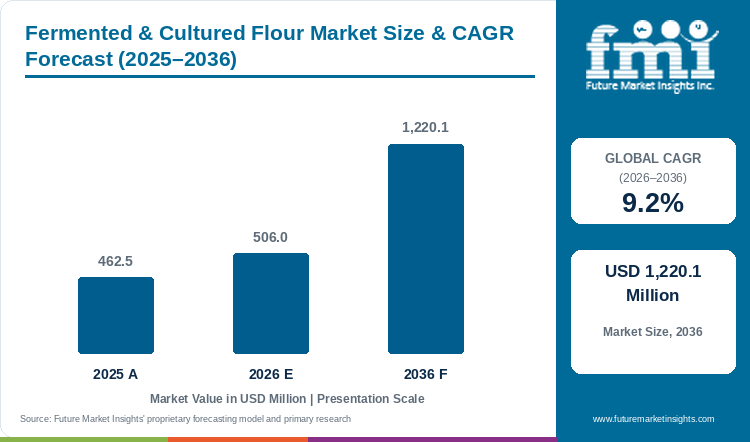
Tracking from USD 462.5 million in 2025 to USD 506.0 million in 2026, the global fermented & cultured flour market valuation is projected to hit USD 1,220.1 million by 2036, backed by a 9.2% CAGR.
Supermarket clean-label policies that ban synthetic calcium propionate (E282) and sorbic acid are forcing industrial bakeries to adopt microbially fermented cereal flours so wrapped bread does not mold on retail shelves. To verify how natural fermentation replaces synthetic chemicals, in August 2025 food microbiologist Ricardo Hernández-Figueroa and colleagues publishing in Microbiologia Research evaluated clean-label fermented wheat additives and proved that organic acids produced during controlled cereal fermentation inhibit Penicillium and Aspergillus mold growth in preservative-free bread [1]. Because of this industry-wide preservative replacement shift, global fermented & cultured flour market value climbs beyond its 2025 base of USD 462.5 million toward a 2026 mark of USD 506.0 million and a 2036 target of USD 1,220.1 million, recording a 9.2% annual growth rate and USD 714.1 million in incremental value. Within the functional type category, Cultured Wheat Mold-Inhibitor Flour is expected to command 46.8% of 2026 functional type demand because bakers pair fermented wheat powders with clean-label food ingredients, whereas organic-acid yeast inhibition and wheat-allergen labeling rules cap unbuffered inclusion rates.
Key Market Trends & Insights
- By functional type: Cultured Wheat Mold-Inhibitor Flour is expected to command a 46.8% share of the functional type segment in 2026 because direct 0.5% to 2.0% grist dosing replaces chemical propionates in wrapped loaves.
- By physical form: Within the physical form category, Spray- & Drum-Dried Powder is projected to represent 68.4% of volume in 2026 by enabling ambient silo storage and gravimetric micro-feeder dosing.
- By bakery application: Sliced Pan Bread, Buns & Rolls are estimated to attain 43.7% across bakery applications in 2026, driven by multi-week wrapped grocery shelf-life mandates.
- By primary function: Clean-Label Preservative Replacement is anticipated to generate 56.2% of primary function demand in 2026, supported by retailer additive blacklists across North America and Europe.
- By sales channel: Mill-direct contracting under Direct B2B Industrial Bakery Supply is forecast to secure 57.5% of 2026 sales volume through custom titratable-acidity buffering and challenge-test support.
Regional Highlights
- USA clean-label pan-bread conversion: The USA tops national demand at a 10.3% annual rate through 2036, driven by commercial bakeries replacing synthetic calcium propionate with cultured wheat flour.
- European sourdough heritage and Asian adoption: France records 9.8% yearly growth ahead of Germany (9.4%) paired with a 9.0% yearly pace in the UK and a 7.5% annual gain in Japan.
Market Size & Forecast
Table 1: Market Size and Forecast for the Fermented & Cultured Flour Market (USD million and CAGR percentage), 2025 to 2036
| Metric | Value |
|---|---|
| 2025 Market Size | USD 462.5 million |
| Estimated Market Size in 2026 | USD 506.0 million |
| Projected Market Size by 2036 | USD 1,220.1 million |
| CAGR, 2026 to 2036 | 9.2% |
| Added Revenue, 2026 to 2036 | USD 714.1 million |
Commercial bakeries face steep supermarket chargebacks when packaged loaves develop visible mold or stale crumb before their printed sell-by dates. To reduce these unsaleable bread returns without declaring artificial E-numbers, bakery R&D teams use wheat and rye flours fermented with Propionibacterium freudenreichii and heterofermentative lactic acid bacteria paired with artisanal sourdough breads starter systems. In December 2025, food technologist Alice Marianelli and co-authors at Pisa University published a machine-learning shelf-life study in Foods showing that traditional sourdough fermentation acts as a biological preservation model that delays microbial spoilage and crumb staling across commercial bakery loaves [2].
Bioreactor Fermentation Throughput & Acidity Sizing
Table 2: Bioreactor Fermentation Throughput and Acidity Sizing for the Fermented & Cultured Flour Market (USD million and operational ranges), 2025 to 2036
| Metric | 2025 | 2026 | 2036 |
|---|---|---|---|
| Market size (USD million) | 462.5 | 506.0 | 1,220.1 |
| Commercial fermented & cultured flour output (thousand metric tons) | 134.0 to 149.0 | 145.0 to 161.0 | 325.0 to 362.0 |
| Realized B2B contract price per metric ton (USD) | 3,120 to 3,480 | 3,180 to 3,550 | 3,380 to 3,790 |
| Typical bakery flour inclusion rate (% of flour weight) | 0.5% to 4.5% | 0.6% to 5.0% | 0.8% to 6.0% |
Operational note: Output tonnage covers spray-dried and drum-dried powders as well as paste and stabilized liquid microbially fermented cereal flours while excluding unfermented enzyme-active malt and vital wheat gluten.
In 2026, realized B2B contract prices range from USD 3,180/ton to USD 3,550/ton because running submerged cereal bioreactors for 24 to 72 hours followed by gentle spray- or drum-drying requires high capital and energy expenditure. Even so, commercial bakeries willingly absorb this per-ton price because dosing just 0.6% to 5.0% dry fermentate with natural food preservation systems delivers 14-to-28-day ambient mold protection at a low cost per loaf.
Per Capita & Commercial Bakery Line Sizing
Table 3: Per Capita and Bakery Line Valuation Indicators for the Fermented & Cultured Flour Market (USD), 2025 to 2036
| Metric | 2025 | 2026 | 2036 |
|---|---|---|---|
| World population (billion) | 8.2 | 8.3 | 9.0 |
| Market value per 1,000 people (USD) | 56.4 | 61.0 | 135.6 |
| Annual cultured flour procurement per automated bakery line (USD thousand) | 92.0 to 114.0 | 98.0 to 122.0 | 185.0 to 232.0 |
| Share of wrapped pan-bread lines using clean-label fermentates (%) | 34.0% to 39.0% | 36.5% to 42.0% | 58.0% to 66.0% |
Table 4: Bakery Line & Functional Allocation Indicators for the Fermented & Cultured Flour Market (USD and percentages), 2026
| Metric | Value | Institutional Reference Basis |
|---|---|---|
| Market size, 2026 | USD 506.0 million | 2026 global fermented & cultured flour valuation baseline |
| Automated industrial & in-store bakery lines served | 4,850 lines | Global commercial wrapped bread, bun, tortilla & hearth lines |
| Cultured wheat mold-inhibitor share, 2026 | 46.8% (USD 236.8 million allocation) | 46.8% functional type segment allocation |
| Spray- & drum-dried powder share, 2026 | 68.4% (USD 346.1 million allocation) | 68.4% physical form segment allocation |
Automated bakery lines budget USD 98.0-122.0 thousand per line in 2026 and scale toward a 2036 outlay of USD 185.0-232.0 thousand because the share of wrapped pan-bread lines running clean-label fermentates rises toward 58.0%-66.0%. In addition, retrofitting bakery processing lines with automated loss-in-weight dry preferment feeders helps plant managers eliminate the labor and sanitation downtime so that bakeries avoid maintaining liquid mother-sponge tanks on the floor.
Analyst Perspective
"Industrial bakeries replacing calcium propionate cannot tolerate loaf-volume depression or sour flavor drift in mainstream sandwich bread. Ingredient suppliers that pair neutral-flavor cultured wheat mold inhibitors with aromatic dried sourdough flours and rapid mold-challenge validation will capture the largest share of clean-label bakery conversions."
- Nandini Roy Choudhury, Principal Consultant, Future Market Insights.
How is the fermented & cultured flour market segmented?
Five primary axes organize the fermented & cultured flour market: functional type and physical form with bakery application as well as primary function and sales channel. Top 2026 allocations sit with Cultured Wheat Mold-Inhibitor Flour (46.8%) and Spray- & Drum-Dried Powder (68.4%) along with Sliced Pan Bread, Buns & Rolls (43.7%) and Clean-Label Preservative Replacement (56.2%).
By functional type: Cultured Wheat Mold-Inhibitor Flour, Dried Devitalized Sourdough & Preferment Flour, Active / Stabilized Sourdough Starter Flour, and Fermented Rye, Spelt & Multigrain Flour.
By physical form: Spray- & Drum-Dried Powder, Paste & Crumb Concentrate, and Stabilized Liquid Slurry.
By bakery application: Sliced Pan Bread, Buns & Rolls, Artisan Hearth Loaves & Baguettes, Pizza Crusts, Flatbreads & Tortillas, Croissants, Brioche & Viennoiserie, and Crackers, Wafer Sheets & Savory Snacks.
By primary function: Clean-Label Preservative Replacement, Flavor & Crumb Acidity Profiling, Dough Rheology & Extensibility Conditioning, and Phytic-Acid & FODMAP Reduction.
By sales channel: Channel distribution spans Direct B2B Industrial Bakery Supply, Bakery & Foodservice Ingredient Distributors, and Retail & Artisan Bakery Packs.
Why does Cultured Wheat Mold-Inhibitor Flour lead the functional type category?
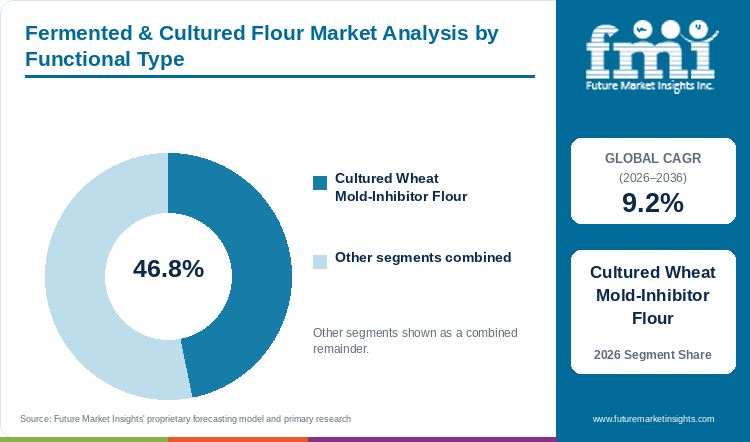
Cultured Wheat Mold-Inhibitor Flour is expected to command a 46.8% share of the functional type segment in 2026 because it replaces synthetic propionate salts without souring sandwich bread.
Table 5: Functional Type Share for the Fermented & Cultured Flour Market (percentage share), 2026
| Functional Type | Share (2026) |
|---|---|
| Cultured Wheat Mold-Inhibitor Flour | 46.8% |
| Other Segments Combined* | 53.2% |
| Total | 100.0% |
*Calculated as the balance remaining after deducting the leading segment's reported share from 100.0%.
Table 6: Functional Type Leadership and Market Growth for the Fermented & Cultured Flour Market (segment and CAGR percentage), 2026 to 2036
| Metric | Value |
|---|---|
| Global CAGR (2026 to 2036) | 9.2% |
| Leading Segment | Cultured Wheat Mold-Inhibitor Flour |
Mainstream sandwich-bread and burger-bun brands cannot use high-acidity aromatic sourdoughs for mold control because consumers reject sharp vinegar notes in white pan loaves. To solve this sensory constraint, ingredient suppliers ferment wheat flour with propionic and lactic acid bacteria to create neutral-flavored mold inhibitors that blend directly with clean-label flavor formulations. In June 2026, microbiologist Dan Tong and colleagues in the International Journal of Food Microbiology isolated functional Lactiplantibacillus plantarum MT213 from traditional sourdough and proved that it blocks Aspergillus and Penicillium mold outgrowth in wheat bread [3].
- Within the functional type breakdown, Cultured Wheat Mold-Inhibitor Flour is expected to generate 46.8% of 2026 segment demand through drop-in replacement of E282 calcium propionate in wrapped sandwich loaves.
- To explain why bakeries also buy pre-stabilized sourdough starters, in January 2025 food scientist Charlotte Munch-Andersen and co-authors at the Norwegian University of Life Sciences showed in the International Journal of Food Microbiology that fermentation length and flour ash content directly govern organic-acid stability in liquid starters [4].
Why does Spray- & Drum-Dried Powder lead physical form?
By eliminating refrigerated tanker freight and stabilizing organic-acid titers for 12 months, Spray- & Drum-Dried Powder is projected to represent 68.4% of the physical form category in 2026.
Liquid sourdough slurries and high-moisture pastes impose refrigerated tanker freight costs and require dedicated CIP-cleaned holding tanks that many mid-sized bakeries lack. Because spray- and drum-dried fermented flours keep moisture below 8% and store at ambient warehouse temperatures for 12 months, commercial bakeries and producers of home baking ingredient mixes overwhelmingly prefer dry powder formats that meter directly through existing flour scales.
- To eliminate cold-chain storage and automate dry micro-feeder dosing, commercial bakeries help Spray- & Drum-Dried Powder secure 68.4% of physical form volume in 2026.
- To capitalize on this preference for ambient dry handling, in March 2025 GoodMills Innovation documented that its CARAT (Item no. 100863) triple-fermented wholegrain wheat powder in 25-kilogram dry sacks is dosed at 18 kg with 82 kg of type 550 wheat flour per 100 kg of wholemeal flour [5].
What keeps Sliced Pan Bread, Buns & Rolls ahead by bakery application?
Across the bakery application breakdown, Sliced Pan Bread, Buns & Rolls are estimated to capture 43.7% of 2026 demand due to high water activity inside sealed retail bags.
Whereas crusty hearth baguettes are sold in open paper sleeves for same-day consumption, sliced pan breads and burger buns are sealed inside polyethylene bags at high water activity (0.94 to 0.97) for two to three weeks of grocery distribution. Because bag condensation rapidly triggers Penicillium spore germination, industrial pan-bread plants represent the largest buyers of cultured wheat flour and commercial food preservation formulations.
- Because wrapped sandwich loaves and QSR hamburger buns require multi-week ambient mold control, Sliced Pan Bread, Buns & Rolls are estimated to claim 43.7% of the bakery application segment in 2026.
- To prove how co-fermentation extends pan-bread shelf life, in July 2025 food scientist Yuqing Wu at Jiangnan University demonstrated in Food Research International that sourdough co-fermented with Fructilactobacillus sanfranciscensis and Propionibacterium freudenreichii for 24 hours boosts lactic and propionic acids while extending mold-free bread shelf life to the ninth day [6].
Why does Clean-Label Preservative Replacement lead primary function?
Clean-Label Preservative Replacement is anticipated to generate a 56.2% share of the primary function segment in 2026, supported by grocery chemical-preservative blacklists.
Although artisan bakers purchase sourdough powders primarily for tangy flavor, high-volume plant bakeries allocate the majority of their fermented flour budgets to replacing chemical preservatives prohibited by supermarket clean-label charters. Because cultured wheat flour delivers functional organic-acid antimycotic protection while declaring simply as cultured wheat flour, manufacturers use it across pan loaves and gluten-free tortilla wraps (via fermented rice or corn analogs) to retain national retail listings.
- Driven by mandatory removal of synthetic propionates across retail bakery banners, Clean-Label Preservative Replacement is anticipated to generate 56.2% of primary function demand in 2026.
- To quantify this preservation window, a May 2026 study in the Journal of Food Science mapping 5% to 50% compound sourdough inclusion showed that a 20% addition rate increases loaf specific volume by 17% and delays visible mold beyond 150 CFU/g from Day 5 to Day 9 [7].
What gives Direct B2B Industrial Bakery Supply the leading sales channel position?
Direct B2B Industrial Bakery Supply is forecast to represent 57.5% of 2026 channel volume via joint microbial challenge-test validation.
Substitution of calcium propionate on a 10,000-loaf-per-hour tunnel oven line cannot be handled through generic wholesale catalog orders because even minor shifts in dough pH can stall baker's yeast fermentation. As a result, industrial bakeries contract directly with fermentation suppliers that run inoculated fünf-strain mold challenge tests and customize buffering salts for each plant's sponge-and-dough cycle.
- Joint mold-challenge testing on high-speed tunnel ovens positions Direct B2B Industrial Bakery Supply at 57.5% of 2026 channel volume.
- To expand this direct B2B analytical support, in October 2025 ADM opened its new Central Milling Laboratory in Decatur, Illinois baking roughly 30 loaves daily across 31 North America facilities to standardize dough rheology testing for commercial bakery accounts [8].
What are the drivers, restraints, and opportunities in the fermented & cultured flour market?
Retailer bans on synthetic propionates and bakery food-waste reduction drive fermented & cultured flour adoption. Meanwhile, FDA nutrition-labeling scrutiny and acid-induced yeast inhibition restrain over-dosing while multi-strain prebiotic and aroma preferments create new margin opportunities.
- Driver: Supermarket clean-label mandates and retail bread-return penalties compel industrial bakeries to replace E282 calcium propionate with cultured wheat mold-inhibitor flours.
- Restraint: FDA front-of-package nutrition and allergen labeling rules combined with yeast-proof delays at high titratable acidity cap unbuffered inclusion rates.
- Opportunity: Co-fermented multi-strain sourdough powders that combine antimycotic organic acids with targeted volatile aroma esters and prebiotic fiber enrichment command premium B2B pricing.
Growth Analysis and Future Potential: Qualitative Demand Catalysts
Supermarket chains and commercial bakeries are accelerating cultured flour adoption because extending ambient mold-free shelf life by three to seven days directly cuts unsaleable retail bread waste. When fermented wheat flours rich in propionic and lactic acids lower dough pH into the 4.8 to 5.3 window, undissociated acid molecules penetrate fungal cell membranes and work effectively with modified food starch anti-staling systems. To highlight this commercial waste-reduction driver, in July 2025 Manildra Group detailed how natural fermented wheat preservation systems reduce commercial bakery bread returns without artificial chemical numbers [9]. While Manildra's starch-based GemMate competes for preservation budgets, only protein-retaining fermented cereal flours are counted in this market's revenue.
Risk Assessment of the Fermented & Cultured Flour Market: Operational and Formulation Friction
Strict allergen and front-of-pack nutrition labeling regulations combine with acid-induced yeast inhibition to cap how much unbuffered cultured flour a bakery can dose. During May 2025, FDA regulators advanced Front-of-Package Nutrition Labeling rulemaking paired with strict wheat-allergen and sodium disclosure requirements for packaged bakery products sold in the USA [10]. Because of these federal rules, compliance teams must declare wheat allergens on all cultured wheat shipments and cannot claim gluten-free status on fermented wheat ingredients. In addition, dosing unbuffered cultured wheat powder above 2.0% weakens gluten extensibility and slows baker's yeast gas evolution by 12% to 18%, which forces bakeries to run costly pilot-line proofing trials.
Commercial Opportunity Analysis: Formulation Differentiation and Value-Add Formats
Ingredient suppliers are capturing higher B2B margins by engineering multi-strain fermented cereal-and-pulse flours that deliver prebiotic gut-health benefits and authentic sourdough aroma in short 90-minute bake cycles. When bakeries blend these spray-dried wheat and chickpea fermentates with insoluble dietary fiber concentrates, they can market digestive-wellness loaves without running 18-hour artisanal bulk fermentations. To validate this prebiotic formulation angle, in June 2025 microbiologist Fatih Koc and colleagues at University College Cork and Bursa Uludağ University published an in-vitro colonic fermentation study in Food & Function showing that fermented flours made with wholegrain wheat and chickpea substrates significantly elevate short-chain fatty acid synthesis and beneficial Bifidobacterium abundance [11].
Fermented & Cultured Flour Market by Country (2026 to 2036)
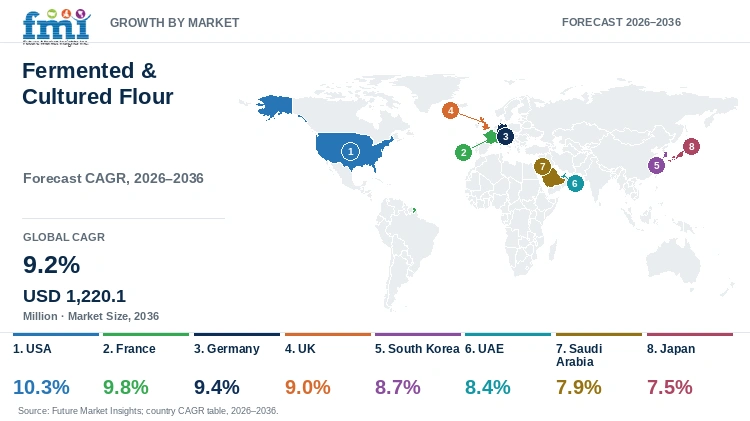
Cross-country bakery procurement patterns show the USA topping fermented & cultured flour expansion at a 10.3% yearly rate to 2036 with France (9.8%) and Germany (9.4%) next in line, whereas Japan is projected to grow at a 7.5% annual pace. While grocery clean-label preservative bans across North America and Western Europe accelerate preservative replacement, warm-climate ambient bread distribution in the Middle East also drives national adoption rates.
Table 7: Country CAGR and Primary Growth Levers for the Fermented & Cultured Flour Market (CAGR percentage and operational drivers), 2026 to 2036
| Country | CAGR (2026 to 2036) | Primary Growth Lever |
|---|---|---|
| USA | 10.3% | Retailer clean-label E282 calcium propionate replacement in sliced pan bread & buns |
| France | 9.8% | Artisanal sourdough biodiversity and clean-label brioche/pain de mie fermentation |
| Germany | 9.4% | Industrial rye-and-wheat sourdough standardization across 3,200+ bread varieties |
| UK | 9.0% | Wrapped sandwich-loaf mold control and domestic bread-wheat milling upgrades |
| South Korea | 8.7% | Acid-tolerant sourdough strain evolution and convenience-store bakery shelf life |
| UAE | 8.4% | High-humidity Gulf bread distribution and bioactive spelt/wheat sourdough demand |
| Saudi Arabia | 7.9% | USDA-tracked Middle East wheat import expansion and ambient pan-bread transit |
| Japan | 7.5% | Clinical resistant-starch wheat bread launches and mild shokupan fermentation aroma |
Source: Future Market Insights analysis
USA Fermented & Cultured Flour Market Outlook (2026 to 2036)
Unlike European markets where crusty hearth loaves are baked locally each morning, bread consumption in the USA is dominated by wrapped sliced sandwich loaves and burger buns shipped across multi-state grocery distribution networks requiring 14 to 28 days of mold-free shelf life. Across the USA, commercial procurement of fermented & cultured flour is projected to log a 10.3% yearly increase through 2036, driven by major supermarket chains enforcing clean-label bans on synthetic E282 calcium propionate. During June 2026, FDA officials released the 2026 Human Foods Program Guidance Agenda prioritizing updated food-allergen and microbiological sanitation compliance across commercial bakery plants in the USA [12]. However, strict wheat-allergen labeling rules prevent cultured wheat from entering gluten-free bakery lines.
Key takeaway: In the USA, supermarket clean-label preservative bans and long-distance interstate bread distribution are projected to drive cultured wheat mold-inhibitor flour contracts.
France Fermented & Cultured Flour Market Outlook (2026 to 2036)
Bakery demand in France is split between independent boulangeries using wild levain and packaged-bakery plants removing sorbates and propionates from supermarket brioche and pain de mie. In November 2025, fermentation scientist Patricia Bechara and colleagues at INRAE and Université Paris-Saclay published a study in the Journal of Applied Microbiology characterizing wheat sourdough communities dominated by Saccharomyces cerevisiae and Kazachstania humilis with Lactiplantibacillus plantarum [13]. While industrial bakers in France adopt CERECLEAN fermented wheat flour to hit clean-label retail charters, traditional baguette decrees restrict mold-inhibitor dosing to packaged lines. Demand across France for fermented & cultured flour is expected to progress at 9.8% annually through 2036, owing to supermarket clean-label reformulation.
Key takeaway: In France, INRAE-characterized sourdough biodiversity and clean-label pain de mie reformulation are expected to sustain strong fermented wheat flour adoption.
Germany Fermented & Cultured Flour Market Outlook (2026 to 2036)
Unlike wheat-only bread markets, Germany requires lactic and acetic sourdough acidification as a structural necessity because rye flour pentosans and alpha-amylase collapse Mischbrot and Vollkornbrot loaves unless dough pH drops below 4.5. In March 2025, the Deutsches Brotinstitut documented more than 3,200 registered bread specialties in the national bread register, many of which depend on controlled cereal acidification to build elastic crumb structure [14]. Industrial bakery procurement of fermented & cultured flour in Germany is estimated to register a 9.4% yearly gain between 2026 and 2036, supported by multi-outlet Filialbäckereien replacing labor-intensive 20-hour liquid sponges with standardized dried rye and spelt sourdough powders, although discount grocery price competition squeezes supplier margins.
Key takeaway: In Germany, industrial standardization across more than 3,200 bread specialties and branch-bakery commissaries is estimated to anchor dried rye and wheat sourdough flour demand.
UK Fermented & Cultured Flour Market Outlook (2026 to 2036)
Because over 75% of bread sold in the UK consists of wrapped Chorleywood-process sandwich loaves and crumpets with high moisture content, plant bakeries face intense retailer pressure to replace E282 calcium propionate without slowing 3-hour no-time dough cycles. In October 2026, DEFRA agricultural statisticians in London released provisional 2026 cereal production estimates for England detailing domestic milling wheat harvest volumes and quality parameters supplying commercial flour mills across the UK [15]. Plant-bakery demand in the UK for fermented & cultured flour is anticipated to climb on a 9.0% annual curve through 2036 because major bakeries blend neutral cultured wheat flour with dried sourdough improvers, even though variable domestic wheat protein requires careful acidity buffering.
Key takeaway: In the UK, Chorleywood-process pan-bread reformulation away from E282 calcium propionate is anticipated to drive cultured wheat flour procurement.
South Korea Fermented & Cultured Flour Market Outlook (2026 to 2036)
Commercial bakery usage of fermented & cultured flour in South Korea is forecast to achieve an 8.7% annual growth pace through 2036, fueled by metropolitan café franchises and convenience-store sandwich plants adopting clean-label mold inhibitors and European-style dried sourdough powders. Because centralized commissary bakeries in Gyeonggi Province ship chilled and ambient sandwiches nationwide, they require consistent total titratable acidity across imported hard wheat flours so proof times do not drift. To support this technical need, in January 2025 food biotechnologist Ji A Byun and colleagues at Korea University demonstrated in the International Journal of Food Microbiology that adaptive evolution of Fructilactobacillus sanfranciscensis under lactic-acid stress boosts organic-acid fermentation efficiency in sourdough bread [16].
Key takeaway: In South Korea, Korea University sourdough strain innovation and convenience-store clean-label bread launches are forecast to accelerate fermented wheat and sourdough powder imports.
UAE Fermented & Cultured Flour Market Outlook (2026 to 2036)
Summer temperatures exceeding 40 °C and coastal humidity across Gulf distribution routes create severe Penicillium and Aspergillus mold-spoilage losses for packaged flatbreads and burger buns in the UAE. Commercial bakery procurement of fermented & cultured flour in the UAE is projected to log an 8.4% yearly gain from 2026 through 2036, attributable to industrial bakeries in Dubai and Sharjah pairing cultured wheat mold inhibitors with functional sourdough concentrates. To validate the wellness appeal of these loaves for luxury hotel bakeries, a September 2025 study in Foods led by Costanza Cicchi showed that wheat and spelt sourdoughs fermented for 18 hours with selected Lactobacillus strains reach pH 3.92 to 3.98 and double intestinal-barrier bioactive peptides [17].
Key takeaway: In the UAE, warm-climate ambient bread shelf-life pressures and hospitality demand for bioactive sourdough loaves are projected to sustain cultured wheat flour imports.
Saudi Arabia Fermented & Cultured Flour Market Outlook (2026 to 2036)
During April 2026, USDA Economic Research Service analysts in their Wheat Sector at a Glance report identified Saudi Arabia and the wider Middle East as primary global growth markets for milling-quality wheat imports due to demographic expansion and arid farming limits [18]. Because centralized industrial bakeries in Riyadh and Jeddah truck packaged pan breads and burger buns across long desert routes, preventing microbial rope and mold spoilage without synthetic E-numbers is a top operational priority. Bakery demand across Saudi Arabia for fermented & cultured flour is likely to experience a 7.9% annual growth rate through 2036 through industrial bakeries adopting spray-dried cultured wheat powders, although cost competition from cheap synthetic calcium propionate slows economy-tier conversion.
Key takeaway: In Saudi Arabia, long-haul desert bread distribution and expanding milling-wheat processing capacity are likely to support steady adoption of dry cultured wheat mold inhibitors.
Japan Fermented & Cultured Flour Market Outlook (2026 to 2036)
Whereas European consumers favor tangy sourdough crusts, shoppers in Japan demand ultra-soft white shokupan pullman loaves and filled convenience-store buns because any sharp acetic vinegar odor causes immediate retail rejection. During June 2025, clinical nutrition researcher Yuta Kikuchi and co-authors in Japan published a randomized double-blind crossover trial in Bioscience Biotechnology and Biochemistry showing that bread formulated with high-resistant-starch wheat flour significantly improves intestinal regularity in healthy adults across Japan [19]. Wholesale bakery adoption of fermented & cultured flour in Japan is projected to see a 7.5% yearly expansion rate through 2036 across metropolitan retail channels, where major commercial baking groups dose mild lactic-fermented wheat preferments that extend crumb softness without sourness.
Key takeaway: In Japan, wholesale bakery demand for mild-aroma shokupan preferments and functional wheat bread formulations is projected to support steady fermented wheat flour uptake.
Full report country CAGRs cover: North America; Latin America; Western Europe; Eastern Europe; East Asia; South Asia and Pacific; Middle East and Africa.
Who are the notable companies in the fermented & cultured flour market?
Limagrain Ingredients, GoodMills Group, Puratos Group, Lesaffre, IREKS GmbH, Ernst Böcker GmbH & Co. KG, Kerry Group, Manildra Group, Ardent Mills, and ADM are the notable companies in the fermented & cultured flour market.
Competitive differentiation in the fermented & cultured flour sector divides between clean-label antimycotic fermentate producers and specialist European sourdough houses. Limagrain Ingredients (via CERECLEAN) and Kerry Group supply cultured wheat mold-inhibitor flours calibrated to replace calcium propionate in high-speed sliced bread lines. European fermentation specialists GoodMills Group (through GoodMills Innovation) and Puratos Group (Sapore) compete with Lesaffre (Livendo) and Germany-based producers IREKS GmbH and Ernst Böcker GmbH & Co. KG in operating industrial cereal fermentation reactors for dried and liquid sourdough flours. Meanwhile, Manildra Group supplies adjacent cereal fermentates while Ardent Mills and ADM provide large-scale milling and dough-conditioning platforms.
- Clean-Label Antimycotic & Functional Cultured Wheat Leaders: Limagrain Ingredients and Kerry Group as well as Manildra Group engineer fermented wheat shelf-life systems that replace synthetic E282 propionates.
- Industrial Sourdough & Aromatic Preferment Specialists: GoodMills Group and Puratos Group along with Lesaffre and Germany-based sourdough houses IREKS GmbH and Ernst Böcker GmbH & Co. KG produce dried powder and liquid cereal sourdough flours.
- Integrated Milling & Bakery Formulation Platforms: Ardent Mills and ADM operate multi-mill grain processing and analytical dough-testing laboratories supporting custom fermented bakery blends.
Competitive Benchmarking: Fermented & Cultured Flour Market
Table 8: Competitive Benchmarking for the Fermented & Cultured Flour Market (qualitative capability ratings), 2026
| Company | Cultured & Sourdough Flour Portfolio | Mold-Challenge & Rheology Support | Strain Library & Acidity Standardization | Geographic Reach |
|---|---|---|---|---|
| Limagrain Ingredients | High | High | High | France, Western Europe & global B2B export |
| GoodMills Group | High | High | High | Germany, Austria, Poland & European bakery network |
| Puratos Group | High | High | High | Global (100+ countries; Europe, Americas, APAC) |
| Lesaffre | High | High | High | Global fermentation & Baking Center network |
| IREKS GmbH | High | High | High | Germany, Europe & 90+ international bakery markets |
| Ernst Böcker GmbH & Co. KG | High | Medium | High | Germany, Europe & specialty global sourdough export |
| Kerry Group | High | High | High | Global (North America, Europe, APAC, LATAM, MEA) |
| Manildra Group | Medium | High | Medium | Australia, North America & Asia-Pacific export |
| Ardent Mills | Medium | High | Medium | North America (USA, Canada, Puerto Rico) |
| ADM | Medium | High | Medium | North America, UK & global B2B milling network |
Scoring basis: Cultured & Sourdough Flour Portfolio evaluates documented fermented cereal flour SKUs. Mold-Challenge & Rheology Support assesses in-house fungal challenge testing and pilot-line baking labs, while Strain Library & Acidity Standardization reflects proprietary LAB/propionibacteria starter banks and TTA control.
Key Developments in the Fermented & Cultured Flour Market
- In June 2025, Puratos Group unveiled its proprietary Vitus wheat sourdough starter as the signature fermentation base for the new artisanal bakery opened inside the Louvre Museum in Paris [20].
- During March 2026, Puratos Group announced a definitive agreement to acquire Dawn Foods, combining Puratos's global Sapore sourdough fermentation platforms with Dawn's North America and international bakery distribution network [21].
- In February 2026, Kerry Group reported full-year 2025 revenue of EUR 6.76 billion with 3.0% Taste & Nutrition volume growth led by bakery food-protection and fermentation preservation technologies [22].
Key Players in the Fermented & Cultured Flour Market
Clean-Label Antimycotic & Functional Cultured Wheat Leaders
- Limagrain Ingredients
- Kerry Group
- Manildra Group
Industrial Sourdough & Aromatic Preferment Specialists
- GoodMills Group
- Puratos Group
- Lesaffre
- IREKS GmbH
- Ernst Böcker GmbH & Co. KG
Integrated Milling & Bakery Formulation Platforms
- Ardent Mills
- ADM
Fermented & Cultured Flour Market - Report Scope
Table 9: Report Scope for the Fermented & Cultured Flour Market (coverage fields and definitions), 2026 to 2036
| Coverage field | Report scope |
|---|---|
| Market breakdown | Functional Type; Physical Form; Bakery Application; Primary Function; Sales Channel; Region |
| Quantitative Units | USD Million |
| Market Definition | Includes commercial B2B and retail supplier revenue from cereal, ancient-wheat, and pulse flours that have undergone controlled microbial fermentation (via lactic acid bacteria, propionibacteria, or sourdough yeast cultures) and subsequent drying or stabilization for use as clean-label mold inhibitors, dried/liquid sourdough flours, and rheological preferments. Category Scope & Overlap Note: Fermented spelt, einkorn, and rye sourdough flours are counted exclusively in this report under Fermented Rye, Spelt & Multigrain Flour; unfermented sprouted/malted flours, unfermented heritage wheat flours, isolated wheatstarch-only fermentates, pure starter cultures sold without a flour substrate, and finished baked goods are excluded. |
| Regions Covered | North America; Latin America; Western Europe; Eastern Europe; East Asia; South Asia and Pacific; Middle East and Africa |
| Countries Covered | USA, France, Germany, UK, South Korea, UAE, Saudi Arabia, Japan, and additional countries in the full report |
| Key Companies Covered | Limagrain Ingredients, GoodMills Group, Puratos Group, Lesaffre, IREKS GmbH, Ernst Böcker GmbH & Co. KG, Kerry Group, Manildra Group, Ardent Mills, ADM |
| Forecast Period | 2026 to 2036 |
| Approach | Primary and secondary research with top-down and bottom-up market triangulation. |
Fermented & Cultured Flour Market - Research Methodology
Table 10: Research Methodology for the Fermented & Cultured Flour Market (research methods and approach), 2026 edition
| Method | Approach |
|---|---|
| Primary Research | Structured interviews with industrial fermentation directors, commercial pan-bread QA microbiologists, sourdough master bakers, and clean-label ingredient procurement leads to verify inclusion rates (0.5% to 5.0%), mold-challenge protocols, and B2B contract pricing. |
| Secondary Research | Review of 2025-2026 peer-reviewed food microbiology studies (Microbiologia Research, Food Research International, Journal of Food Science, International Journal of Food Microbiology, Foods, Food & Function, Journal of Applied Microbiology), FDA 2025-2026 food labeling guidance, DEFRA 2026 cereal reports, and Deutsches Brotinstitut records. |
| Market Sizing and Forecasting | Bottom-up bioreactor fermentation and spray/drum-drying tonnage reconciled against commercial wrapped-bread and artisan-bakery clean-label reformulation budgets from 2025 through 2036. |
| Country Forecasting Model | Econometric country projections weight wrapped pan-bread output, supermarket clean-label preservative phaseout schedules, traditional sourdough consumption, and ambient temperature/humidity spoilage risk across eight national markets. |
| Operational Benchmark Traceability | Fermentation batch throughput, organic-acid inclusion windows, and per-line procurement indicators in Tables 2, 3, and 4 trace to published mold-inhibition challenge studies and supplier specification sheets. |
| Data Triangulation and Validation | Segment and regional estimates are cross-checked against supplier fermentation capacity and bakery reformulation audits while enforcing a strict primary-process boundary that excludes unfermented sprouted flours, unfermented heritage wheat flours, and pure microbial cultures without a flour carrier. |
Fermented & Cultured Flour Market by Segments
Fermented & Cultured Flour Market segmented by Functional Type:
- Cultured Wheat Mold-Inhibitor Flour
- Dried Devitalized Sourdough & Preferment Flour
- Active / Stabilized Sourdough Starter Flour
- Fermented Rye, Spelt & Multigrain Flour
Fermented & Cultured Flour Market segmented by Physical Form:
- Spray- & Drum-Dried Powder
- Paste & Crumb Concentrate
- Stabilized Liquid Slurry
Fermented & Cultured Flour Market segmented by Bakery Application:
- Sliced Pan Bread, Buns & Rolls
- Artisan Hearth Loaves & Baguettes
- Pizza Crusts, Flatbreads & Tortillas
- Croissants, Brioche & Viennoiserie
- Crackers, Wafer Sheets & Savory Snacks
Fermented & Cultured Flour Market segmented by Primary Function:
- Clean-Label Preservative Replacement
- Flavor & Crumb Acidity Profiling
- Dough Rheology & Extensibility Conditioning
- Phytic-Acid & FODMAP Reduction
Fermented & Cultured Flour Market segmented by Sales Channel:
- Direct B2B Industrial Bakery Supply
- Bakery & Foodservice Ingredient Distributors
- Retail & Artisan Bakery Packs
Fermented & Cultured Flour Market by Region
- North America
- United States
- Canada
- Latin America
- Brazil
- Mexico
- Argentina
- Chile
- Western Europe
- Germany
- France
- United Kingdom
- Italy
- Spain
- Benelux
- Nordics
- Eastern Europe
- Poland
- Czech Republic
- Romania
- Hungary
- East Asia
- China
- Japan
- South Korea
- South Asia and Pacific
- India
- ASEAN
- Australia and New Zealand
- Middle East and Africa
- GCC Countries
- South Africa
- Türkiye
- Israel
Research Sources and Bibliography
- [1] Hernández-Figueroa, R. H., Mani-López, E., Palou, E., & López-Malo, A. (2025, August 01). Evaluation of Clean-Label Additives to Inhibit Molds and Extend the Shelf Life of Preservative-Free Bread. Microbiologia Research, 16(8), 179 (MDPI).
- [2] Marianelli, A., Offei, C. A., Macaluso, M., Mercanti, N., Casu, B., & Zinnai, A. (2025, December 10). A Machine Learning Model to Reframe the Concept of Shelf-Life in Bakery Products: PDO Sourdough as a Technological Preservation Model. Foods, 14(24), 4236 (PubMed PMID 41464943).
- [3] Tong, D., Zhang, Y., Zhang, T., Wang, Z., Wang, S., Xu, X., & Ning, Y. (2026, June 16). Functional Lactiplantibacillus plantarum MT213 screened from traditional sourdough and its promising in-situ preservation in steamed bread. International Journal of Food Microbiology, 455, 111756 (PubMed PMID 41932006).
- [4] Munch-Andersen, C. B., Porcellato, D., Devold, T. G., & Østlie, H. M. (2025, January 02). The impact of fermentation length and dough composition on the stability of liquid sourdough starters. International Journal of Food Microbiology, 426, 110932 (PubMed PMID 39395354).
- [5] GoodMills Innovation GmbH. (2025, March 12). CARAT® - GoodMills Innovation. GoodMills Group.
- [6] Wu, Y., Wang, T., Jin, Y., Zhang, Y., Xu, D., & Xu, X. (2025, July 09). Biopreservation technology of sourdough co-fermented with Fructilactobacillus sanfranciscensis and Propionibacterium freudenreichii: Effects and mechanisms for enhancing bread quality and extending shelf life. Food Research International, 219, 117001 (PubMed PMID 40922219).
- [7] Wu, Y., Wang, T., Xu, D., & Xu, X. (2026, May 01). Fructilactobacillus sanfranciscensis-Propionibacterium freudenreichii Compound Sourdough: An Operational Addition Window (5%-50%) for Bread Quality and Shelf Life. Journal of Food Science, 91(5), e71042 (PubMed PMID 42143571).
- [8] ADM. (2025, October 14). ADM Advances Quality Capabilities with opening of New Central Lab-Milling | ADM. ADM Newsroom.
- [9] Manildra Group. (2025, July 09). Natural Ingredient Reduces Food Waste - Manildra Group. Manildra Group Newsroom.
- [10] U.S. Food and Drug Administration (FDA). (2025, May 08). Front-of-Package Nutrition Labeling | FDA. U.S. Department of Health and Human Services.
- [11] Koc, F., Sabuncu, M., Yavuz, G. G., Düven, G., Abdo, R. M. K., Bağci, U., Şahan, Y., Toğay, S. Ö., Ross, R. P., & Stanton, C. (2025, June 16). Exploring tarhana's prebiotic potential using different flours in an in vitro fermentation model. Food & Function, 16(12), 4754-4771 (PubMed PMID 40422929).
- [12] U.S. Food and Drug Administration (FDA). (2026, June 29). FDA Releases 2026 Human Foods Program Guidance Agenda | FDA. U.S. Department of Health and Human Services.
- [13] Bechara, P., Arnould, L., Rué, O., El Rammouz, R., Abi-Nakhoul, P., Legras, J.-L., Sicard, D., & Ayoub, M.-J. (2025, November 04). Insights into the microbial species diversity and specific making techniques behind Lebanese sourdough breads. Journal of Applied Microbiology, 136(11), lxaf266 (PubMed PMID 41147712).
- [14] Deutsches Brotinstitut e.V. (2025, March 01). Brotkultur · Deutsches Brotinstitut e.V. Deutsches Brotinstitut.
- [15] UK Department for Environment, Food & Rural Affairs (DEFRA). (2026, October 08). Provisional cereal and oilseed production estimates for England 2026 - GOV.UK. GOV.UK.
- [16] Byun, J. A., Han, N. R., Yun, E. J., Cheon, S., Song, S., Shim, S., Lee, S. H., & Kim, K. H. (2025, January 30). Enhancing lactic acid tolerance in Fructilactobacillus sanfranciscensis via adaptive evolution for sourdough fermentation applications. International Journal of Food Microbiology, 428, 110978 (PubMed PMID 39603089).
- [17] Cicchi, C., Leri, M., Bucciantini, M., Galli, V., Guerrini, S., Jiménez-Ortas, Á., Ceacero-Heras, D., Martínez-Augustín, O., Pazzagli, L., & Luti, S. (2025, September 12). Sourdough Breads Made with Selected Lactobacillus Strains and Spelt Flour Contain Peptides That Positively Impact Intestinal Barrier. Foods, 14(18), 3184 (PubMed PMID 41008158).
- [18] U.S. Department of Agriculture, Economic Research Service (USDA ERS). (2026, April 08). Wheat - Wheat Sector at a Glance | Economic Research Service. U.S. Department of Agriculture.
- [19] Kikuchi, Y., Otomo, Y., Toyota, K., Noma, S., & Ebihara, S. (2025, June 23). Effects of the bread containing resistant starch from wheat (Triticum aestivum) on the improvement in bowel movements: a randomized, double-blind, placebo-controlled, crossover study. Bioscience, Biotechnology, and Biochemistry, 89(7), 1015-1023 (PubMed PMID 40156576).
- [20] Puratos Group. (2025, June 11). Puratos's Vitus Sourdough Unveiled as Signature Starter at New Louvre Museum Bakery | Puratos. Puratos Press Releases.
- [21] Puratos Group. (2026, March 10). Puratos to Acquire Dawn Foods | Puratos. Puratos Newsroom.
- [22] Kerry Group plc. (2026, February 17). Kerry Group preliminary results for the year ended 31 December 2025. Kerry Group News & Media.
- [23] Kerry Group plc. (2026, October 22). Kerry Group Q3 Interim Management Statement 2026. Kerry Group News & Media.
This bibliography is provided for reader reference and is not exhaustive. The full report contains the complete reference list and detailed citations.
This Report Answers
- What is the fermented & cultured flour market valuation in 2026 and projection for 2036?
- How do organic-acid fermentates replace synthetic calcium propionate in commercial bread?
- Why does Cultured Wheat Mold-Inhibitor Flour lead the functional type breakdown?
- What gives Spray- & Drum-Dried Powder the largest share of physical form?
- How do national growth rates compare across the USA, France, Germany, and the UK?
- Which companies lead in antimycotic cultured wheat versus aromatic sourdough flours?
- Why do FDA labeling rules and yeast inhibition constrain formulation?
- Which titratable acidity and challenge-test metrics should bakery buyers verify before contracting?
Frequently Asked Questions
How big is the fermented & cultured flour market in 2026, and what is forecast for 2036?
Starting from a 2025 baseline of USD 462.5 million, global fermented & cultured flour demand is estimated at USD 506.0 million in 2026 and reaches USD 1,220.1 million by 2036 as commercial bakeries eliminate synthetic propionate salts.
What is the CAGR for the fermented & cultured flour market from 2026 to 2036?
Global fermented & cultured flour adoption is projected to post a 9.2% compound annual growth rate from 2026 through 2036, delivering USD 714.1 million in incremental annual revenue across global bakery ingredient channels.
Which functional type segment leads the fermented & cultured flour market?
Cultured Wheat Mold-Inhibitor Flour is expected to command 46.8% of the functional type segment in 2026, owing to widespread replacement of synthetic calcium propionate (E282) in wrapped pan loaves.
Which physical form segment holds the largest share in 2026?
Spray- & Drum-Dried Powder is projected to represent 68.4% of physical form volume in 2026, attributable to ambient silo handling and 12-month shelf stability without refrigeration.
Which country records the fastest CAGR through 2036?
The USA leads national expansion at a 10.3% CAGR between 2026 and 2036, supported by retailer clean-label mandates across sliced sandwich breads, burger buns, and flour tortillas.
Which companies are the key players in the fermented & cultured flour market?
Limagrain Ingredients, GoodMills Group, Puratos Group, Lesaffre, IREKS GmbH, Ernst Böcker GmbH & Co. KG, Kerry Group, Manildra Group, Ardent Mills, and ADM are the notable companies in the fermented & cultured flour market.
Preview the report firsthand - request a free sample
Get SampleGet the brochure for pricing and purchase details.
Get PDFTable of Content
- Key Takeaways
- Market Size and CAGR
- Top Growth Driver
- Fastest Growing Segment
- Leading Region
- Key Companies
- Emerging Opportunities
- Executive Summary
- Global Market Outlook
- Demand-side Trends
- Supply-side Trends
- Technology Roadmap Analysis
- Analysis and Recommendations
- Analyst Perspective (What is happening? Why now? What should investors know?)
- Key Questions Answered
- How large is the market?
- What is the CAGR?
- What are key trends?
- Which region dominates?
- Who are the leaders?
- Market Overview
- Market Coverage / Taxonomy
- Market Definition / Scope / Limitations
- Research Methodology
- Chapter Orientation
- Analytical Lens and Working Hypotheses
- Market Structure, Signals, and Trend Drivers
- Benchmarking and Cross-market Comparability
- Market Sizing, Forecasting, and Opportunity Mapping
- Research Design and Evidence Framework
- Desk Research Programme (Secondary Evidence)
- Expert Input and Fieldwork (Primary Evidence)
- Tooling, Models, and Reference Databases
- Data Engineering and Model Build
- Quality Assurance and Audit Trail
- Market Background
- Market Dynamics (Drivers, Restraints, Opportunity, Trends)
- Scenario Forecast (Optimistic, Likely, Conservative)
- Impact Analysis
- AI Impact
- Sustainability Impact
- Regulatory Impact
- Technology Impact
- Consumer / Buyer Analysis
- Purchase Drivers
- Adoption Barriers
- Buyer Journey
- Opportunity Map Analysis
- Product Life Cycle Analysis
- Supply Chain Analysis
- Investment Feasibility Matrix
- Value Chain Analysis
- PESTLE and Porter's Analysis
- Regulatory Landscape
- Regional Parent Market Outlook
- Production and Consumption Statistics
- Import and Export Statistics
- Global Market Analysis and Forecast, 2021 to 2036
- Historical Market Size Value (USD Million) Analysis, 2021 to 2025
- Current and Future Market Size Value (USD Million) Projections, 2026 to 2036
- Y-o-Y Growth Trend Analysis
- Absolute $ Opportunity Analysis
- Global Market Pricing Analysis, 2021 to 2036
- Global Market Analysis and Forecast, By Functional Type, 2021 to 2036
- Introduction / Key Findings
- Historical Market Size Value (USD Million) Analysis By Functional Type, 2021 to 2025
- Current and Future Market Size Value (USD Million) Analysis and Forecast By Functional Type, 2026 to 2036
- Cultured Wheat Mold-Inhibitor Flour
- Dried Devitalized Sourdough & Preferment Flour
- Active / Stabilized Sourdough Starter Flour
- Fermented Rye, Spelt & Multigrain Flour
- Y-o-Y Growth Trend Analysis By Functional Type, 2021 to 2025
- Absolute $ Opportunity Analysis By Functional Type, 2026 to 2036
- Global Market Analysis and Forecast, By Physical Form, 2021 to 2036
- Introduction / Key Findings
- Historical Market Size Value (USD Million) Analysis By Physical Form, 2021 to 2025
- Current and Future Market Size Value (USD Million) Analysis and Forecast By Physical Form, 2026 to 2036
- Spray- & Drum-Dried Powder
- Paste & Crumb Concentrate
- Stabilized Liquid Slurry
- Y-o-Y Growth Trend Analysis By Physical Form, 2021 to 2025
- Absolute $ Opportunity Analysis By Physical Form, 2026 to 2036
- Global Market Analysis and Forecast, By Bakery Application, 2021 to 2036
- Introduction / Key Findings
- Historical Market Size Value (USD Million) Analysis By Bakery Application, 2021 to 2025
- Current and Future Market Size Value (USD Million) Analysis and Forecast By Bakery Application, 2026 to 2036
- Sliced Pan Bread, Buns & Rolls
- Artisan Hearth Loaves & Baguettes
- Pizza Crusts, Flatbreads & Tortillas
- Croissants, Brioche & Viennoiserie
- Crackers, Wafer Sheets & Savory Snacks
- Y-o-Y Growth Trend Analysis By Bakery Application, 2021 to 2025
- Absolute $ Opportunity Analysis By Bakery Application, 2026 to 2036
- Global Market Analysis and Forecast, By Primary Function, 2021 to 2036
- Introduction / Key Findings
- Historical Market Size Value (USD Million) Analysis By Primary Function, 2021 to 2025
- Current and Future Market Size Value (USD Million) Analysis and Forecast By Primary Function, 2026 to 2036
- Clean-Label Preservative Replacement
- Flavor & Crumb Acidity Profiling
- Dough Rheology & Extensibility Conditioning
- Phytic-Acid & FODMAP Reduction
- Y-o-Y Growth Trend Analysis By Primary Function, 2021 to 2025
- Absolute $ Opportunity Analysis By Primary Function, 2026 to 2036
- Global Market Analysis and Forecast, By Sales Channel, 2021 to 2036
- Introduction / Key Findings
- Historical Market Size Value (USD Million) Analysis By Sales Channel, 2021 to 2025
- Current and Future Market Size Value (USD Million) Analysis and Forecast By Sales Channel, 2026 to 2036
- Direct B2B Industrial Bakery Supply
- Bakery & Foodservice Ingredient Distributors
- Retail & Artisan Bakery Packs
- Y-o-Y Growth Trend Analysis By Sales Channel, 2021 to 2025
- Absolute $ Opportunity Analysis By Sales Channel, 2026 to 2036
- Global Market Analysis and Forecast, By Region, 2021 to 2036
- Introduction
- Historical Market Size Value (USD Million) Analysis By Region, 2021 to 2025
- Current Market Size Value (USD Million) Analysis and Forecast By Region, 2026 to 2036
- North America
- Latin America
- Western Europe
- Eastern Europe
- East Asia
- South Asia and Pacific
- Middle East and Africa
- Market Attractiveness Analysis By Region
- North America Market Analysis and Forecast, By Country, 2021 to 2036
- Historical Market Size Value (USD Million) Trend Analysis By Market Taxonomy, 2021 to 2025
- Market Size Value (USD Million) Forecast By Market Taxonomy, 2026 to 2036
- By Country
- United States
- Canada
- By Functional Type
- By Physical Form
- By Bakery Application
- By Primary Function
- By Sales Channel
- By Country
- Market Attractiveness Analysis
- By Country
- By Functional Type
- By Physical Form
- By Bakery Application
- By Primary Function
- By Sales Channel
- Key Takeaways
- Latin America Market Analysis and Forecast, By Country
- Historical Market Size Value (USD Million) Trend Analysis By Market Taxonomy, 2021 to 2025
- Market Size Value (USD Million) Forecast By Market Taxonomy, 2026 to 2036
- By Country
- Brazil
- Mexico
- Argentina
- Chile
- By Functional Type
- By Physical Form
- By Bakery Application
- By Primary Function
- By Sales Channel
- By Country
- Market Attractiveness Analysis
- By Country
- By Functional Type
- By Physical Form
- By Bakery Application
- By Primary Function
- By Sales Channel
- Key Takeaways
- Western Europe Market Analysis and Forecast, By Country
- Historical Market Size Value (USD Million) Trend Analysis By Market Taxonomy, 2021 to 2025
- Market Size Value (USD Million) Forecast By Market Taxonomy, 2026 to 2036
- By Country
- Germany
- France
- United Kingdom
- Italy
- Spain
- Benelux
- Nordics
- By Functional Type
- By Physical Form
- By Bakery Application
- By Primary Function
- By Sales Channel
- By Country
- Market Attractiveness Analysis
- By Country
- By Functional Type
- By Physical Form
- By Bakery Application
- By Primary Function
- By Sales Channel
- Key Takeaways
- Eastern Europe Market Analysis and Forecast, By Country
- Historical Market Size Value (USD Million) Trend Analysis By Market Taxonomy, 2021 to 2025
- Market Size Value (USD Million) Forecast By Market Taxonomy, 2026 to 2036
- By Country
- Poland
- Czech Republic
- Romania
- Hungary
- By Functional Type
- By Physical Form
- By Bakery Application
- By Primary Function
- By Sales Channel
- By Country
- Market Attractiveness Analysis
- By Country
- By Functional Type
- By Physical Form
- By Bakery Application
- By Primary Function
- By Sales Channel
- Key Takeaways
- East Asia Market Analysis and Forecast, By Country
- Historical Market Size Value (USD Million) Trend Analysis By Market Taxonomy, 2021 to 2025
- Market Size Value (USD Million) Forecast By Market Taxonomy, 2026 to 2036
- By Country
- China
- Japan
- South Korea
- By Functional Type
- By Physical Form
- By Bakery Application
- By Primary Function
- By Sales Channel
- By Country
- Market Attractiveness Analysis
- By Country
- By Functional Type
- By Physical Form
- By Bakery Application
- By Primary Function
- By Sales Channel
- Key Takeaways
- South Asia and Pacific Market Analysis and Forecast, By Country
- Historical Market Size Value (USD Million) Trend Analysis By Market Taxonomy, 2021 to 2025
- Market Size Value (USD Million) Forecast By Market Taxonomy, 2026 to 2036
- By Country
- India
- ASEAN
- Australia and New Zealand
- By Functional Type
- By Physical Form
- By Bakery Application
- By Primary Function
- By Sales Channel
- By Country
- Market Attractiveness Analysis
- By Country
- By Functional Type
- By Physical Form
- By Bakery Application
- By Primary Function
- By Sales Channel
- Key Takeaways
- Middle East and Africa Market Analysis and Forecast, By Country
- Historical Market Size Value (USD Million) Trend Analysis By Market Taxonomy, 2021 to 2025
- Market Size Value (USD Million) Forecast By Market Taxonomy, 2026 to 2036
- By Country
- GCC Countries
- South Africa
- Türkiye
- Israel
- By Functional Type
- By Physical Form
- By Bakery Application
- By Primary Function
- By Sales Channel
- By Country
- Market Attractiveness Analysis
- By Country
- By Functional Type
- By Physical Form
- By Bakery Application
- By Primary Function
- By Sales Channel
- Key Takeaways
- Key Countries Market Analysis
- United States
- Pricing Analysis
- Market Share Analysis, 2025
- By Functional Type
- By Physical Form
- By Bakery Application
- By Primary Function
- By Sales Channel
- Canada
- Pricing Analysis
- Market Share Analysis, 2025
- By Functional Type
- By Physical Form
- By Bakery Application
- By Primary Function
- By Sales Channel
- Mexico
- Pricing Analysis
- Market Share Analysis, 2025
- By Functional Type
- By Physical Form
- By Bakery Application
- By Primary Function
- By Sales Channel
- Brazil
- Pricing Analysis
- Market Share Analysis, 2025
- By Functional Type
- By Physical Form
- By Bakery Application
- By Primary Function
- By Sales Channel
- Chile
- Pricing Analysis
- Market Share Analysis, 2025
- By Functional Type
- By Physical Form
- By Bakery Application
- By Primary Function
- By Sales Channel
- Germany
- Pricing Analysis
- Market Share Analysis, 2025
- By Functional Type
- By Physical Form
- By Bakery Application
- By Primary Function
- By Sales Channel
- United Kingdom
- Pricing Analysis
- Market Share Analysis, 2025
- By Functional Type
- By Physical Form
- By Bakery Application
- By Primary Function
- By Sales Channel
- Italy
- Pricing Analysis
- Market Share Analysis, 2025
- By Functional Type
- By Physical Form
- By Bakery Application
- By Primary Function
- By Sales Channel
- Spain
- Pricing Analysis
- Market Share Analysis, 2025
- By Functional Type
- By Physical Form
- By Bakery Application
- By Primary Function
- By Sales Channel
- France
- Pricing Analysis
- Market Share Analysis, 2025
- By Functional Type
- By Physical Form
- By Bakery Application
- By Primary Function
- By Sales Channel
- India
- Pricing Analysis
- Market Share Analysis, 2025
- By Functional Type
- By Physical Form
- By Bakery Application
- By Primary Function
- By Sales Channel
- ASEAN
- Pricing Analysis
- Market Share Analysis, 2025
- By Functional Type
- By Physical Form
- By Bakery Application
- By Primary Function
- By Sales Channel
- Australia and New Zealand
- Pricing Analysis
- Market Share Analysis, 2025
- By Functional Type
- By Physical Form
- By Bakery Application
- By Primary Function
- By Sales Channel
- China
- Pricing Analysis
- Market Share Analysis, 2025
- By Functional Type
- By Physical Form
- By Bakery Application
- By Primary Function
- By Sales Channel
- Japan
- Pricing Analysis
- Market Share Analysis, 2025
- By Functional Type
- By Physical Form
- By Bakery Application
- By Primary Function
- By Sales Channel
- South Korea
- Pricing Analysis
- Market Share Analysis, 2025
- By Functional Type
- By Physical Form
- By Bakery Application
- By Primary Function
- By Sales Channel
- Poland
- Pricing Analysis
- Market Share Analysis, 2025
- By Functional Type
- By Physical Form
- By Bakery Application
- By Primary Function
- By Sales Channel
- Hungary
- Pricing Analysis
- Market Share Analysis, 2025
- By Functional Type
- By Physical Form
- By Bakery Application
- By Primary Function
- By Sales Channel
- Türkiye
- Pricing Analysis
- Market Share Analysis, 2025
- By Functional Type
- By Physical Form
- By Bakery Application
- By Primary Function
- By Sales Channel
- South Africa
- Pricing Analysis
- Market Share Analysis, 2025
- By Functional Type
- By Physical Form
- By Bakery Application
- By Primary Function
- By Sales Channel
- UAE
- Pricing Analysis
- Market Share Analysis, 2025
- By Functional Type
- By Physical Form
- By Bakery Application
- By Primary Function
- By Sales Channel
- Saudi Arabia
- Pricing Analysis
- Market Share Analysis, 2025
- By Functional Type
- By Physical Form
- By Bakery Application
- By Primary Function
- By Sales Channel
- United States
- Market Structure Analysis
- Competition Dashboard
- Competition Benchmarking
- Market Share Analysis of Top Players
- By Regional
- By Functional Type
- By Physical Form
- By Bakery Application
- By Primary Function
- By Sales Channel
- Emerging Startups
- Innovation Benchmarking
- Competition Analysis
- Competition Deep Dive
- Limagrain Ingredients
- Overview
- Product Portfolio
- Profitability by Market Segments
- Sales Footprint
- Strategy Overview
- Marketing Strategy
- Product Strategy
- Channel Strategy
- GoodMills Group
- Puratos Group
- Lesaffre
- IREKS GmbH
- Ernst Böcker GmbH & Co. KG
- Kerry Group
- Manildra Group
- Ardent Mills
- ADM
- Limagrain Ingredients
- Case Studies
- Success Stories
- Recent Developments
- Competition Deep Dive
- Assumptions & Acronyms Used


