

- Market Size (2026)
- USD 439.8 Mn
- Forecast (2036)
- USD 949.5 Mn
- CAGR (2026 to 2036)
- 8.0%
How big is GCC Oud Fragrances Market in 2026?
USD 439.8 Million in 2026 and USD 949.5 Million by 2036 at an 8.0% CAGR.
The GCC oud fragrances market is projected to rise from USD 439.8 million in 2026 to USD 949.5 million by 2036 at 8.0% CAGR. Saudi Arabia supplies the largest recurring discovery pool because fragrance purchases sit beside domestic travel, pilgrimage and gifting. In June 2025, the Ministry of Tourism reported about 116 million domestic and inbound tourists during 2024. High visitor traffic expands discovery occasions for global perfume demand and regional scent houses during peak retail periods.
Channel economics differ across the Gulf because dense premium retail in the UAE supports fast assortment rotation and cross-border replenishment. Dubai Municipality reported in October 2025 that Dubai entry points handled more than 90% of UAE imports and monitored over 500,000 imported products. That regulatory scale rewards brands that coordinate registration with flavors and fragrances planning before committing inventory to repeated launches.
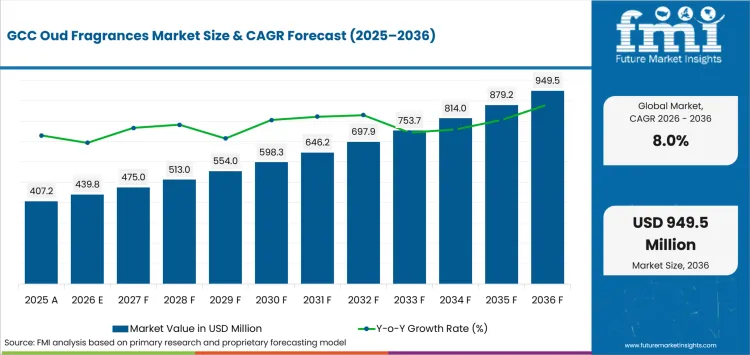
Key Takeaways of GCC Oud Fragrances market
- Oud demand gains commercial depth when cultural fragrance use intersects with gifting, tourism and digital replenishment across GCC retail hubs.
- Oud eau de parfum is estimated to hold 39.0% by product type in 2026 owing to familiar spray use and broad scent-layering options.
- Conventional formulations are projected to account for 54.0% share in 2026 because established perfumery materials support consistent scent performance across price tiers.
- By format, cream & balm formats are anticipated to represent 27.0% share in 2026 as close-to-skin application supports layering and gift-set extensions.
- Natural oud provenance and country-specific cosmetic registration raise documentation costs and slow launches that depend on frequent formulation or packaging changes.
- Key players in the GCC oud fragrances market include Arabian Oud, Ajmal Perfumes, Swiss Arabian, Givaudan, dsm-firmenich, Coty, L'Oréal, and Puig.
Analyst Perspective
"Regional oud houses earn more when sampling leads to repeat purchases without weakening the scent cues that justify premium pricing. Global fragrance groups need Gulf-based perfumery support and disciplined registration files to turn broader portfolios into credible local launches."
- Rahul Pandita, Principal Consultant, Future Market Insights
How is the GCC Oud Fragrances Market segmented?
The market is segmented by product type, nature, format, price positioning, and sales channel.
Product type covers oud eau de parfum, pure oud oils, oud-blend attars and bakhoor & home oud. Nature includes conventional, vegan & cruelty-free, natural & organic, dermocosmetic / clinical and fragrance-free & sensitive. Format covers cream & balm, liquid & serum, stick & solid, spray & mist, sheet & patch and powder. Price positioning includes mass, masstige, premium and professional. Sales channel covers e-commerce & DTC, specialty beauty retail, pharmacies & drugstores, supermarkets & hypermarkets and salons & spas.
What drives E-commerce & DTC in the Sales channel category?
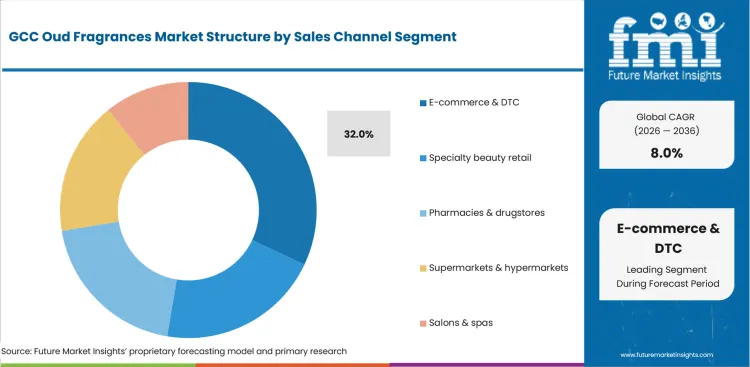
E-commerce & DTC extends the buying window after physical sampling and gives fragrance houses control over note descriptions, discovery sets and replenishment across multiple GCC markets without duplicating permanent store inventory. The same direct model supports adjacent hair perfume offers without requiring another specialist counter.
- E-commerce & DTC is forecast to hold 32.0% of sales channel in 2026 because direct storefronts keep regional assortments visible beyond a single retail visit.
- L'Oréal reported in April 2025 that online remained a key growth driver across SAPMENA-SSA and was especially important in Saudi Arabia during repeat purchase cycles across channels.
What makes Oud eau de parfum central to the Product type category?
Oud eau de parfum translates a familiar regional scent profile into a spray format that fits personal use, gifting and online replenishment. Brands can adjust projection with fragrance fixatives while keeping the oud identity visible across floral, woody or gourmand compositions.
- Oud eau de parfum is estimated to hold 39.0% of product type in 2026 because spray application lowers the ritual barrier associated with concentrated oils.
- Coty introduced five unisex Jawhara eau de parfums in November 2025 with oud among the collection's defining Middle Eastern notes. The range entered the lifestyle fragrance segment below USD 25 to broaden trial beyond premium-only perfume purchases.
Why does Conventional lead the Nature category?
Conventional formulations fit the broadest commercial brief because perfumers retain access to established aroma materials and standardized alcohol-based delivery systems. Claim-led alternatives such as halal cosmetics add screening requirements that narrow some assortments without changing the core demand for scent performance.
- Conventional is projected to account for 54.0% of nature in 2026 owing to formulation flexibility across mainstream and prestige fragrance programs with repeatable technical dossiers.
- Conventional fragrance programs draw on a broad standardized ingredient palette before local registration narrows the commercial formula. IFRA's July 2025 Transparency List catalogued 3,312 fragrance ingredients and 379 functional ingredients used in fragrance creation worldwide.
What supports Mass in the Price positioning category?
Mass pricing expands trial among consumers who recognize oud but do not want premium oil or gift-set ticket sizes. Accessible bottles also give brands room to refresh perfume packs for seasonal gifting without forcing the scent proposition into luxury-only retail.
- Mass is anticipated to hold 36.0% of price positioning in 2026 as lower entry prices support experimentation, seasonal gifting and multi-scent purchasing across younger consumer groups.
- Coty reported in August 2025 that FY2025 consumer beauty fragrance sales rose 8% and described its fragrance business as active across high and low price tiers with continued category outperformance.
What are the drivers, restraints and opportunities in the GCC Oud Fragrances Market?
Cultural use and travel-linked discovery support demand, while provenance and registration increase launch friction and local fragrance creation improves regional brief conversion.
- Driver: Gifting and tourism widen discovery occasions for oud-led fragrances across specialist retail, malls and travel-linked shopping routes.
- Restraint: Agarwood provenance records and national cosmetic notification requirements increase the cost of cross-border assortment changes.
- Opportunity: Regional creative teams shorten the distance between global formulation resources and the scent references used in GCC consumer briefs.
Tourism and Gifting Multiply Discovery Occasions
High-traffic events concentrate sampling and gifting into short retail windows that matter for oud discovery across Gulf travel periods. Qatar News Agency reported in June 2026 that the 13th Teeb AlHazm Oud and Perfumes Exhibition was scheduled at AlHazm Galleria. Brands that pair event sampling with luxury packaging and digital replenishment can extend purchases after visitors leave the venue and preserve a direct route into repeat fragrance orders.
Notification and Provenance Raise Launch Costs
Cross-border fragrance launches become costly when formulas or claims require fresh technical review across separate national systems. In June 2025, the Saudi Food and Drug Authority adopted updated Gulf technical regulations governing cosmetic safety and cosmetic claims. Houses carrying fragranced personal care extensions therefore need stable ingredient records and country-ready dossiers before frequent assortment changes move into Saudi retail.
Local Creation Shortens the Brief-to-Shelf Cycle
Local fragrance creation gives brand teams faster access to perfumers who understand the scent references used in GCC briefs. dsm-firmenich opened Po ONE Lab in Riyadh in February 2026 and introduced seven fragrances inspired by Saudi destinations. That proximity supports faster brief refinement before formula registration and launch investment are committed at scale across premium retail and direct digital channels.
Which country CAGRs are profiled in the GCC Oud Fragrances Market?
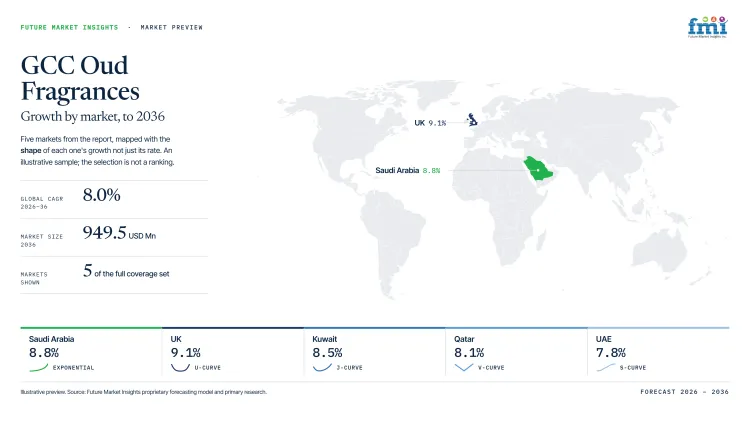
| Country | CAGR |
|---|---|
| Saudi Arabia | 9.1% |
| Kuwait | 8.5% |
| Qatar | 8.1% |
| UAE | 7.8% |
| Oman | 7.4% |
How do country-level CAGRs compare in the GCC Oud Fragrances Market?
The 1.7-point spread places Saudi Arabia among the leading countries in GCC, while Kuwait and Qatar form the middle band. The UAE and Omann grows more slowly despite deeper premium retail and adjacent organic cosmetics traffic. Country ranking therefore turns on discovery routes and compliance burden rather than retail scale alone.
- Saudi Arabia converts pilgrimage traffic and domestic gifting into repeated fragrance trial through specialist retail channels.
- Kuwait rewards selective assortments across its compact mall and specialist-store network base.
- Qatar concentrates sampling around hospitality events and premium mall traffic during seasonal demand.
- UAE retailers rotate fragrance assortments quickly across a high-volume import and tourism network.
- Oman supports selective oud growth through destination tourism, domestic travel and culture-led retail discovery.
Comparable CAGRs produce different entry economics because country-specific channels convert discovery differently. The full report provides country-level CAGR analysis across North America, Latin America, Europe, East Asia, South Asia, Oceania and the Middle East and Africa.
Country-wise Analysis
- Saudi Arabia's selling calendar concentrates fragrance discovery around pilgrimage travel, mall traffic and domestic gifting periods that regional houses already plan around. GASTAT reported that 1,673,230 pilgrims performed Hajj in 2025, including 1,506,576 pilgrims arriving from outside the Kingdom, while oud fragrance demand in Saudi Arabia is forecast to rise at 9.1% CAGR through 2036. The top ranking reflects strong local scent familiarity, recurring visitor-linked trial and specialist retail depth; registration work and agarwood provenance records still make complete dossiers important for converting temporary visitor traffic into repeat digital orders across GCC-facing retail programs.
- Kuwait's compact mall network lets established GCC fragrance houses service a limited number of high-traffic locations with relatively short replenishment routes. The Central Statistical Bureau recorded about 4.88 million residents at the beginning of 2025, and the mixed national population broadens scent preferences across gifting and fragrance wardrobe purchases. Kuwait is anticipated to post 8.5% CAGR over the forecast period, supported by specialist retail repeat trial. The smaller addressable base raises the test for SKU productivity and rewards houses that refresh selective assortments without tying up inventory in slow-moving counters during seasonal gifting cycles.
- Qatar concentrates fragrance discovery around premium malls, hospitality calendars and event-led sampling, giving niche houses a short route to affluent gifting demand. Qatar Tourism reported in January 2026 that 2025 visitor arrivals reached 5.1 million and more than 600 events were hosted during the year. GCC oud fragrance demand in Qatar is estimated to expand at 8.1% CAGR through 2036, propelled by visitor-linked trial; the narrower permanent channel base still makes shelf productivity decisive and favors selective assortments that turn temporary discovery into repeat online orders rather than broad permanent listings across Doha retail locations.
- UAE fragrance operators work inside Dubai's dense import network, premium malls and regional distribution routes, enabling fast assortment turnover across neighboring Gulf markets. Oud fragrance demand in the UAE is projected to advance at 7.8% CAGR through 2036, underpinned by international visitor traffic that sustains sampling, though imported products continue to face recurring registration and laboratory controls. The Dubai Media Office reported in August 2025 that the city welcomed 9.88 million international visitors during the first half, creating a large discovery pool for compliant houses and placing a premium on local registration support plus dependable digital replenishment after mall or travel-retail sampling across Dubai's premium retail corridors.
- Oman's oud fragrance opportunity is more selective, anchored in destination tourism, domestic travel and culture-led retail discovery rather than the dense premium-mall turnover seen in larger GCC hubs. The National Centre for Statistics and Information published its Tourism Statistics Bulletin 2024 in August 2025, providing the latest official tourism indicators for the Sultanate after 2024. Oman is projected to record 7.4% CAGR through 2036, supported by visitor discovery and local gifting. A smaller permanent specialist-retail base keeps SKU productivity and digital replenishment central to profitable expansion across Muscat, Dhofar and selective tourism corridors.
Who are the notable companies in the GCC Oud Fragrances Market?
Arabian Oud, Ajmal Perfumes, Swiss Arabian, Givaudan, dsm-firmenich, Coty, L'Oréal, and Puig are the notable companies profiled in this market.
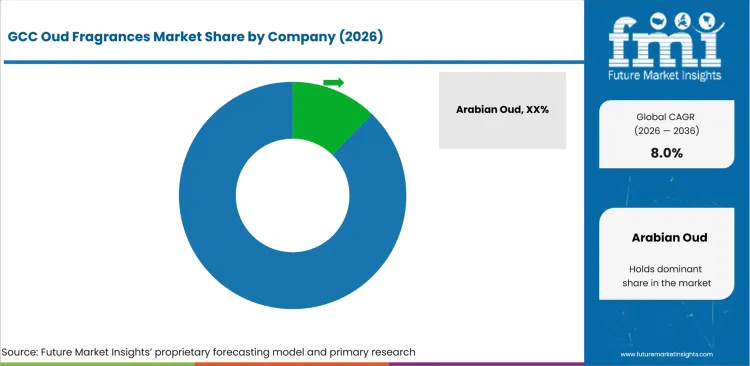
Regional oud houses compete closest to the consumer while fragrance-creation specialists shape formulas and global groups scale branded portfolios. Entry barriers come from store access, perfumer resources and repeat compliance work rather than corporate size. Upstream creation houses also influence choices in aroma ingredients before finished fragrances reach GCC counters.
- Arabian Oud, Ajmal Perfumes and Swiss Arabian compete closest to the consumer using GCC stores and oud-centered fragrance assortments.
- Givaudan and dsm-firmenich compete upstream using fine-fragrance creation centers and regional customer development resources.
- Coty, L'Oréal and Puig compete across global fragrance brands with licensing portfolios and multi-market distribution systems.
Competitive Benchmarking: GCC Oud Fragrances Market
| Company | Oud Portfolio Evidence | Fragrance-Creation Infrastructure | GCC Route-to-Market | Geographic Reach |
|---|---|---|---|---|
| Arabian Oud | High | Medium | High | GCC core and international |
| Ajmal Perfumes | High | Medium | High | GCC core and 45+ export markets |
| Swiss Arabian | High | Medium | High | GCC core and global online |
| Givaudan | Low | High | Medium | Global with Dubai creative center |
| dsm-firmenich | Low | High | Medium | Global with Middle East sites |
| Coty | Medium | High | Medium | 120+ countries and territories |
| L'Oréal | Medium | High | Medium | Global with dedicated GCC cluster |
| Puig | Low | High | Medium | Global premium beauty markets |
Key Developments in the GCC Oud Fragrances Market
- In March 2026, L'Oréal completed its acquisition of Kering Beauté including Creed and signed fifty-year Bottega Veneta and Balenciaga fragrance licences.
- In October 2025, Swiss Arabian launched three fragrances across flagship collections including Enigma of Taif with distribution via GCC boutiques and global online channels.
- In October 2025, Givaudan partnered with Louvre Abu Dhabi and created the museum's signature scent Universal Breeze for a new olfactory visitor program.
Key Players in the GCC Oud Fragrances Market
Regional Oud Houses
- Arabian Oud
- Ajmal Perfumes
- Swiss Arabian
Fragrance-Creation Specialists
- Givaudan
- dsm-firmenich
Global Branded-Fragrance Groups
- Coty
- L'Oréal
- Puig
GCC Oud Fragrances Market - Report Scope
| Coverage field | Report scope |
|---|---|
| Market breakdown | By product type, nature, format, price positioning, sales channel and region. |
| Quantitative Units | Revenue in USD Million and CAGR in %. |
| Market Definition | Commercial oud-centered personal and home fragrances sold across defined product formats, price tiers and retail channels. |
| Countries Covered | Oman ,Saudi Arabia, Kuwait, Qatar, UAE, and 20+ countries included in the full report. |
| Key Companies Profiled | Arabian Oud, Ajmal Perfumes, Swiss Arabian, Givaudan, dsm-firmenich, Coty, L'Oréal, Puig. |
| Forecast Period | 2026 to 2036. |
| Approach | Primary and secondary research with market triangulation. |
GCC Oud Fragrances Market - Research Methodology
| Method | Approach |
|---|---|
| Primary Research | FMI analysts gathered input from manufacturers, service providers, technology developers, distributors, end users, procurement teams, and subject-matter experts. Interviews examined purchasing decisions, product or service evaluation, adoption barriers, approval requirements, pricing considerations, and expectations for technical or commercial support. Respondents were also asked what evidence is required before a trial, pilot, or initial order develops into regular purchasing. |
| Desk Research | Desk research covered government statistics, regulatory publications, trade data, industry associations, technical literature, standards, company filings, product information, and official corporate announcements. Sources were reviewed for relevance, publication date, geographic coverage, and consistency with the defined market scope. Claims relating to performance, applications, approvals, capacity, investment, and commercial activity were retained only when supported by credible public evidence. |
| Market Sizing and Forecasting | The market model combined the baseline value with historical performance, segment structure, pricing and volume indicators, adoption levels, company participation, and country-level demand conditions. Forecast assumptions considered economic activity, investment trends, regulatory developments, technology adoption, purchasing cycles, supply availability, and barriers to wider market use. Segment and regional estimates were reconciled before the final market total was calculated. |
| Data Validation | Estimates were checked against multiple independent indicators, including public data, company activity, trade patterns, industry developments, and findings from primary interviews. Validation also tested whether products, services, applications, and company revenues fell within the defined market boundaries. Adjacent categories, unsupported claims, overlapping revenues, and activities without direct market relevance were excluded to reduce double counting and maintain consistency across segments and countries. |
GCC Oud Fragrances Market by Segments
GCC Oud Fragrances Market segmented by Product Type:
- Oud eau de parfum
- Pure oud oils
- Oud-blend attars
- Bakhoor & home oud
GCC Oud Fragrances Market segmented by Nature:
- Conventional
- Vegan & cruelty-free
- Natural & organic
- Dermocosmetic / clinical
- Fragrance-free & sensitive
GCC Oud Fragrances Market segmented by Format:
- Cream & balm
- Liquid & serum
- Stick & solid
- Spray & mist
- Sheet & patch
- Powder
GCC Oud Fragrances Market segmented by Price Positioning:
- Mass
- Masstige
- Premium
- Professional
GCC Oud Fragrances Market segmented by Sales Channel:
- E-commerce & DTC
- Specialty beauty retail
- Pharmacies & drugstores
- Supermarkets & hypermarkets
- Salons & spas
Research Sources and Bibliography
- Ministry of Tourism, Saudi Arabia. (2025, June 22). Saudi Arabia tops 100 million tourist mark for the second year in a row.
- Dubai Municipality. (2025, October 27). Product safety at Beautyworld Middle East 2025.
- Coty Inc. (2025, November 14). An aura takes hold: Coty's Jawhara collection captivates consumers with premium fragrance artistry.
- International Fragrance Association. (2025, July 10). IFRA launches updated Transparency List: A comprehensive overview of ingredients used in fragrance creation worldwide.
- Coty Inc. (2025, August 20). Coty reports FY25 and Q4 results; targets sequential LFL and EBITDA trend improvement in FY26.
- L'Oréal. (2025, April 17). First quarter 2025 sales.
- Qatar News Agency. (2026, January 22). Qatar Tourism marks 2025 as a year of global milestones and resilient growth.
- Office for Product Safety and Standards. (2026, July 17). New data on UK cosmetic product safety notifications.
- dsm-firmenich. (2026, February 4). dsm-firmenich continues expansion in the Middle East with a new creative concept in Riyadh.
- Saudi Food and Drug Authority. (2025, June 24). "الغذاء والدواء" تعتمد تحديثات جديدة للوائح الفنية الخليجية لتنظيم منتجات التجميل.
- General Authority for Statistics. (2025, June 5). Hajj Statistics Publication 2025.
- Central Statistical Bureau, Kuwait. (2025). Population Estimates in Kuwait by Age, Nationality and Sex at 1-1-2025.
- Qatar News Agency. (2026, June 30). Qatar Calendar presents diverse range of family, cultural, and entertainment events throughout July.
- Government of Dubai Media Office. (2025, August 3). Dubai welcomes 9.88 million international visitors in first half of 2025.
- Arabian Oud. (n.d.). World of Arabian Oud. Retrieved August 18, 2026.
- Ajmal Perfumes. (n.d.). About us. Retrieved August 18, 2026.
- Swiss Arabian. (n.d.). Become a franchisee. Retrieved August 18, 2026.
- Givaudan. (n.d.). The heart of fine fragrance creation. Retrieved August 18, 2026.
- dsm-firmenich. (n.d.). Our locations. Retrieved August 18, 2026.
- Coty Inc. (2025, October 31). Coty champions eco-desirability and transparency in FY25 report.
- L'Oréal. (2026). L’Oréal in the Gulf Cooperation Council (GCC).
- Puig. (2026, February 18). Puig achieves strong growth and record sales over €5bn.
- Swiss Arabian. (2025, October 28). Swiss Arabian unveils three new perfume launches.
- Givaudan. (2025, October 22). Givaudan and Louvre Abu Dhabi partner together to bring art to life through an unforgettable olfactory journey.
- L'Oréal. (2026, March 31). L’Oréal completes the acquisition of Kering Beauté within the framework of its strategic alliance with Kering.
- International Flavors & Fragrances Inc. (2025, April 16). IFF opens Dubai Creative Center with Perfumery Art Studio.
- Dubai Science Park. (2026, February 10). Robertet Middle East & Africa inaugurates its regional headquarters at Dubai Science Park.
- Symrise AG. (2025, October 27). Symrise takes over Beauty World Middle East with an inspiring ‘Beach Club’ experience.
- The Estée Lauder Companies Inc. (2025, November 13). The Estée Lauder Companies Makes Strategic Minority Investment in Mexican Luxury Fragrance Brand XINÚ.
- Interparfums, Inc. (2026, January 28). Interparfums, Inc. announces exclusive worldwide license agreement with David Beckham.
- Swiss Arabian. (n.d.). FAQs. Retrieved August 18, 2026.
- International Flavors & Fragrances Inc. (2026, May 28). LMR by IFF inaugurates new experimental field in Grasse.
- Symrise AG. (2025, July 2). Symrise subsidiary SFA NEROLI opens a new fragrance ecosystem in Grasse.
- The Estée Lauder Companies Inc. (2026, May 1). The Estée Lauder Companies reports fiscal 2026 third quarter results.
- Givaudan. (2026, February 17). Givaudan to invest CHF 55 million in Grasse, France to build Campus 52.
- dsm-firmenich. (2025, December 4). dsm-firmenich dévoile la collection de parfums Cloud Dancer inspirée par la couleur PANTONE® de l'année 2026.
- Coty Inc. (2026, May 4). Coty announces third quarter fiscal year 2026 results.
- L'Oréal. (2025, February 7). L’Oréal Groupe signs an exclusive agreement with Jacquemus.
- Puig. (2025, October 30). Q3 2025 sales update.
This bibliography is provided for reader reference and is not exhaustive. The full report contains the complete reference list and detailed citations
This Report Answers
- How large is the GCC oud fragrances market in 2026 and 2036?
- What turns cultural oud use into repeat GCC fragrance purchases?
- Why does oud eau de parfum lead product type in 2026?
- Why do conventional formulations lead nature in 2026?
- How does e-commerce & DTC extend post-sampling fragrance replenishment?
- How do growth conditions differ across the five profiled countries?
- Which compliance frictions slow cross-border oud fragrance launches?
- Which companies compete across retail, creation and global fragrance portfolios?
Frequently Asked Questions
How big is the GCC Oud Fragrances Market in 2026?
The GCC oud fragrances market is valued at USD 439.8 million in 2026 and is projected to reach USD 949.5 million by 2036. Growth is supported by gifting occasions, tourism-linked discovery and digital replenishment across GCC specialist and premium retail channels.
What is the CAGR of the GCC Oud Fragrances Market from 2026 to 2036?
The GCC oud fragrances market is projected to grow at a CAGR of 8.0% between 2026 and 2036. Expansion is supported by recurring fragrance use, wider retail discovery and locally adapted scent development.
Which nature segment leads the GCC Oud Fragrances Market?
The conventional segment is expected to hold 54.0% of the GCC oud fragrances market in 2026, driven by formulation flexibility across mainstream and prestige fragrance programs. Established perfumery materials also support repeatable technical dossiers across broad commercial assortments and recurring product registrations.
Which product type leads the GCC Oud Fragrances Market?
The oud eau de parfum segment is expected to hold 39.0% of the GCC oud fragrances market in 2026, driven by familiar spray application across personal use and gifting. Its format also supports online replenishment without requiring the application ritual associated with concentrated oils.
Which companies are active in the GCC Oud Fragrances Market?
Key companies operating in the GCC oud fragrances market include Arabian Oud, Ajmal Perfumes, Swiss Arabian, Givaudan, dsm-firmenich, Coty, L'Oréal and Puig. Their competitive positions differ by direct retail access, fragrance-creation resources and global brand portfolios across regional and international channels.
Preview the report firsthand - request a free sample
Get SampleGet the brochure for pricing and purchase details.
Get PDFTable of Content
- Key Takeaways
- Market Size and CAGR
- Top Growth Driver
- Fastest Growing Segment
- Leading Region
- Key Companies
- Emerging Opportunities
- Executive Summary
- GCC Countries Market Outlook
- Demand-side Trends
- Supply-side Trends
- Technology Roadmap Analysis
- Analysis and Recommendations
- Analyst Perspective (What is happening? Why now? What should investors know?)
- Key Questions Answered
- How large is the market?
- What is the CAGR?
- What are key trends?
- Which region dominates?
- Who are the leaders?
- Market Overview
- Market Coverage / Taxonomy
- Market Definition / Scope / Limitations
- Research Methodology
- Chapter Orientation
- Analytical Lens and Working Hypotheses
- Market Structure, Signals, and Trend Drivers
- Benchmarking and Cross-market Comparability
- Market Sizing, Forecasting, and Opportunity Mapping
- Research Design and Evidence Framework
- Desk Research Programme (Secondary Evidence)
- Expert Input and Fieldwork (Primary Evidence)
- Tooling, Models, and Reference Databases
- Data Engineering and Model Build
- Quality Assurance and Audit Trail
- Market Background
- Market Dynamics (Drivers, Restraints, Opportunity, Trends)
- Scenario Forecast (Optimistic, Likely, Conservative)
- Impact Analysis
- AI Impact
- Sustainability Impact
- Regulatory Impact
- Technology Impact
- Consumer / Buyer Analysis
- Purchase Drivers
- Adoption Barriers
- Buyer Journey
- Opportunity Map Analysis
- Product Life Cycle Analysis
- Supply Chain Analysis
- Investment Feasibility Matrix
- Value Chain Analysis
- PESTLE and Porter's Analysis
- Regulatory Landscape
- Regional Parent Market Outlook
- Production and Consumption Statistics
- Import and Export Statistics
- GCC Countries Market Analysis and Forecast, 2021 to 2036
- Historical Market Size Value (USD Million) Analysis, 2021 to 2025
- Current and Future Market Size Value (USD Million) Projections, 2026 to 2036
- Y-o-Y Growth Trend Analysis
- Absolute $ Opportunity Analysis
- GCC Countries Market Pricing Analysis, 2021 to 2036
- GCC Countries Market Analysis and Forecast, By Product type, 2021 to 2036
- Introduction / Key Findings
- Historical Market Size Value (USD Million) Analysis By Product type, 2021 to 2025
- Current and Future Market Size Value (USD Million) Analysis and Forecast By Product type, 2026 to 2036
- Oud eau de parfum
- Pure oud oils
- Oud-blend attars
- Bakhoor & home oud
- Oud eau de parfum
- Y-o-Y Growth Trend Analysis By Product type, 2021 to 2025
- Absolute $ Opportunity Analysis By Product type, 2026 to 2036
- GCC Countries Market Analysis and Forecast, By Nature, 2021 to 2036
- Introduction / Key Findings
- Historical Market Size Value (USD Million) Analysis By Nature, 2021 to 2025
- Current and Future Market Size Value (USD Million) Analysis and Forecast By Nature, 2026 to 2036
- Conventional
- Vegan & cruelty-free
- Natural & organic
- Dermocosmetic / clinical
- Fragrance-free & sensitive
- Conventional
- Y-o-Y Growth Trend Analysis By Nature, 2021 to 2025
- Absolute $ Opportunity Analysis By Nature, 2026 to 2036
- GCC Countries Market Analysis and Forecast, By Price Positioning, 2021 to 2036
- Introduction / Key Findings
- Historical Market Size Value (USD Million) Analysis By Price Positioning, 2021 to 2025
- Current and Future Market Size Value (USD Million) Analysis and Forecast By Price Positioning, 2026 to 2036
- Mass pricing
- Masstige
- Premium
- Professional
- Mass pricing
- Y-o-Y Growth Trend Analysis By Price Positioning, 2021 to 2025
- Absolute $ Opportunity Analysis By Price Positioning, 2026 to 2036
- GCC Countries Market Analysis and Forecast, By Sales Channel, 2021 to 2036
- Introduction / Key Findings
- Historical Market Size Value (USD Million) Analysis By Sales Channel, 2021 to 2025
- Current and Future Market Size Value (USD Million) Analysis and Forecast By Sales Channel, 2026 to 2036
- E-commerce & DTC
- Specialty beauty retail
- Pharmacies & drugstores
- Supermarkets & hypermarkets
- Salons & spas
- E-commerce & DTC
- Y-o-Y Growth Trend Analysis By Sales Channel, 2021 to 2025
- Absolute $ Opportunity Analysis By Sales Channel, 2026 to 2036
- GCC Countries Market Analysis and Forecast, By Region, 2021 to 2036
- Introduction
- Historical Market Size Value (USD Million) Analysis By Region, 2021 to 2025
- Current Market Size Value (USD Million) Analysis and Forecast By Region, 2026 to 2036
- GCC Countries
- Market Attractiveness Analysis By Region
- GCC Countries Market Analysis and Forecast, By Country, 2021 to 2036
- Historical Market Size Value (USD Million) Trend Analysis By Market Taxonomy, 2021 to 2025
- Market Size Value (USD Million) Forecast By Market Taxonomy, 2026 to 2036
- By Country
- Saudi Arabia
- Kuwait
- Qatar
- UAE
- Oman
- By Product type
- By Nature
- By Price Positioning
- By Sales Channel
- By Country
- Market Attractiveness Analysis
- By Country
- By Product type
- By Nature
- By Price Positioning
- By Sales Channel
- Key Takeaways
- Key Countries Market Analysis
- Saudi Arabia
- Pricing Analysis
- Market Share Analysis, 2025
- By Product type
- By Nature
- By Price Positioning
- By Sales Channel
- Kuwait
- Pricing Analysis
- Market Share Analysis, 2025
- By Product type
- By Nature
- By Price Positioning
- By Sales Channel
- Qatar
- Pricing Analysis
- Market Share Analysis, 2025
- By Product type
- By Nature
- By Price Positioning
- By Sales Channel
- UAE
- Pricing Analysis
- Market Share Analysis, 2025
- By Product type
- By Nature
- By Price Positioning
- By Sales Channel
- Oman
- Pricing Analysis
- Market Share Analysis, 2025
- By Product type
- By Nature
- By Price Positioning
- By Sales Channel
- Saudi Arabia
- Market Structure Analysis
- Competition Dashboard
- Competition Benchmarking
- Market Share Analysis of Top Players
- By Regional
- By Product type
- By Nature
- By Price Positioning
- By Sales Channel
- Emerging Startups
- Innovation Benchmarking
- Competition Analysis
- Competition Deep Dive
- Picnic Works (US)
- Overview
- Product Portfolio
- Profitability by Market Segments
- Sales Footprint
- Strategy Overview
- Marketing Strategy
- Product Strategy
- Channel Strategy
- Hyper Robotics (IL)
- xRobotics (US)
- Picnic Works (US)
- Case Studies
- Success Stories
- Recent Developments
- Competition Deep Dive
- Assumptions & Acronyms Used


