

- Industry Size (2026)
- USD 760 Mn
- Forecast (2036)
- USD 2980 Mn
- CAGR (2026 to 2036)
- 14.6%
Generative Design Tools for Recyclable Packaging Market Forecast and Outlook 2026 to 2036
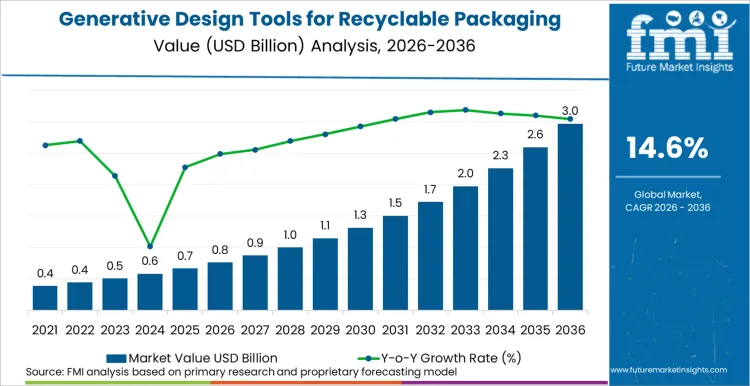
The global generative design tools for recyclable packaging market is likely to total USD 760 million in 2026 and is expected to rise to USD 2,980 million by 2036, advancing at a 14.6% CAGR. FMI analysis indicates that this expansion is being powered by a structural shift: packaging design is moving from periodic renovation every few years to continuous compliance-led re-architecture, where even “stable” packs are repeatedly reworked to remain aligned with evolving recyclability thresholds, lightweighting economics, and disclosure scrutiny.
Regulatory pressure is converting sustainability intent into measurable engineering constraints. The PPWR has been published as Regulation (EU) 2025/40, and the Commission has also communicated its entry-into-force timing and general application schedule, creating a time-bound conversion runway that raises the strategic value of rapid, repeatable redesign throughput. Regulation (EU) 2024/1781 (ESPR) is reinforcing the broader policy direction: product design decisions must increasingly be “rules-aligned” rather than “preference-led,” strengthening investment logic around governed digital design environments.
FMI also observes a portfolio governance dynamic. Packaging leaders are under pressure to convert recyclability goals into repeatable internal rules that can be executed across teams and suppliers. This drives demand for design environments that support constraint standardization, shorten re-approval loops, and reduce divergence between design intent and manufacturing reality, without turning redesign into a long-cycle bottleneck.
Summary of Generative Design Tools for Recyclable Packaging Market
- The generative design tools for recyclable packaging market comprises digital CAD and AI-driven optimization platforms used to govern packaging geometry, lightweighting, and recyclability-first design decisions across FMCG packaging, packaging engineering, and sustainability-led R&D functions.
- The defined scope is structured under FMI taxonomy with segmentation across end use, tool type, design focus, and technology approach, excluding packaging materials, manufacturing equipment, and downstream recycling operations.
- The generative design tools for recyclable packaging market is projected to grow at a CAGR of 14.6% from 2026 to 2036, expanding from USD 760 million in 2026 to USD 2,980 million by 2036, based on FMI proprietary forecasting models integrating regulatory timelines, redesign cycle economics, and portfolio-scale adoption analysis.
- The sector is transitioning from isolated design innovation tools toward governed, constraint-driven design environments that institutionalize recyclability compliance, lightweighting discipline, and repeatable redesign throughput across large SKU portfolios, supported by primary interviews and compliance-aligned scenario modeling.
- Competition is concentrated among major industrial software providers such as Autodesk, Siemens Digital Industries, PTC, and Dassault Systèmes, with competitive advantage increasingly defined by enterprise governance fit, ecosystem scalability, and the ability to support continuous PPWR- and ESPR-aligned redesign programs.
- India is projected to record the fastest growth at a 15.6% CAGR through 2036, while the United States retains the largest value share, supported by large FMCG packaging portfolios and the operational value of reducing redesign cycle-time volatility at scale.
Generative Design Tools for Recyclable Packaging Market Key Takeaways
| Metric | Value |
|---|---|
| Expected Value (2026E) | USD 760 million |
| Forecast Value (2036F) | USD 2,980 million |
| CAGR (2026-2036) | 14.6% |
Source: Future Market Insights (FMI) analysis, based on proprietary forecasting model and primary research
Why is the Generative Design Tools for Recyclable Packaging Market Growing?
The market is growing because recyclable packaging has shifted from a materials problem into a design-governance problem. PPWR-era compliance is pushing firms to prove that pack structures align with recyclability requirements at scale, which intensifies the volume of redesign decisions and the cost of inconsistency. That elevates demand for digital design systems that reduce the organizational friction of redesign—especially the repetitive rework created when internal teams and suppliers interpret constraints differently across regions.
A second growth engine is the economics of lightweighting under constraint. In high-volume packaging, small changes to material intensity cascade into significant cost outcomes, yet lightweighting must now coexist with recyclability-first geometry discipline. This drives adoption where organizations need to simultaneously meet internal cost targets and external recyclability thresholds without triggering repeated redesign loops.
Growth is reinforced by audit and disclosure pressure. Packaging commitments and evolving governance expectations are pushing companies to demonstrate systematic progress across portfolios, not isolated wins. This favors design environments that can institutionalize repeatable decision quality, reducing exception-based design that becomes expensive to defend at scale.
What is the Segment Profile of Generative Design Tools for Recyclable Packaging Market?
The segment landscape reflects where organizations are allocating budgets to reduce redesign friction and compliance risk. As requested, FMI retains only the maximum-share segment analysis within each category, and deepens the rationale to match the level of profiling used in the Thermal Runaway Shields reference.
Why is FMCG & packaging design sustaining leadership among end uses?
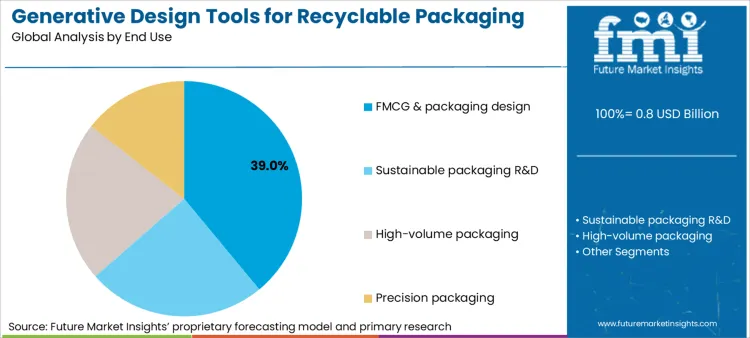
FMCG & packaging design (39%) dominates because it concentrates the highest redesign frequency and the greatest risk exposure from non-aligned packaging decisions. In FMCG portfolios, value is created when organizations reduce the number of design turns needed to arrive at an approved recyclable format. The economic driver is not a single redesign, it is the compounding benefit of shrinking the average redesign cycle time across hundreds or thousands of SKUs.
FMI also sees a governance multiplier. FMCG packaging decisions are typically distributed across brand teams, regional packaging owners, converter engineering, and sometimes retailer requirements. This creates a decision variance problem: different stakeholders can interpret recyclability constraints differently, triggering rework and delay. Tools win budget here when they support constraint consistency, helping companies avoid redesign churn caused by late-stage compliance interpretation changes, especially as PPWR application approaches.
A second FMCG-specific driver is the speed-to-market penalty. In fast-moving categories, redesign bottlenecks are costly because they interfere with product refresh cycles, promotions, and line extensions. As a result, FMCG buyers prioritize design environments that reduce cycle-time volatility-where engineering decisions become more repeatable, less dependent on individual experts, and less likely to collapse into multi-round “fix and resubmit” loops with suppliers.
Why are generative CAD platforms holding the largest share by tool type?
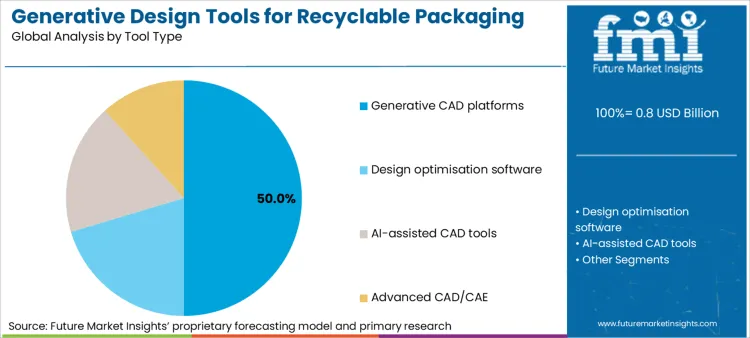
Generative CAD platforms (50%) lead because enterprises are consolidating around environments that function as the authoritative geometry layer—the place where packaging design decisions are finalized and governed. In practice, packaging redesign programs often fail at scale due to fragmentation: different tools, different assumptions, and different rule interpretations across teams. This category wins share because it supports consolidation of design authority, reducing the cost of tool switching and minimizing translation losses across stakeholders.
FMI also observes a procurement logic shift: buyers increasingly treat these platforms as enterprise infrastructure, not creative tools. The decision criteria therefore skew toward stability, governance, and cross-team standardization. The strategic payoff is fewer design disagreements that surface late when tooling, supplier validation, or internal sustainability review discovers a constraint conflict.
This is particularly important under PPWR-driven timelines, where companies want to avoid redesign surges close to application milestones. In that context, consolidation into authoritative CAD environments reduces the risk of “parallel redesign paths” emerging across regions and suppliers, which can inflate costs and slow approvals.
How is lightweight & mono-material design defining the dominant design focus?
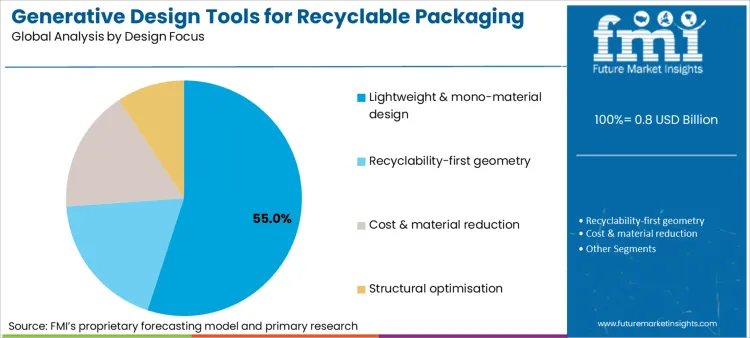
Lightweight & mono-material design (55%) dominates because it is the most scalable design doctrine that simultaneously addresses two board-level imperatives: material cost-out and recyclability alignment. It is not adopted because it is fashionable; it is adopted because it offers a repeatable portfolio strategy: simplify material variety, reduce structural complexity, and minimize redesign exceptions that are expensive to justify.
FMI analysis finds that this design focus also acts as a supplier alignment mechanism. Converters and material suppliers can more easily standardize on fewer base-material pathways and fewer structural variants, reducing the friction of qualification and reducing the probability that redesign decisions conflict with recyclability requirements in specific markets.
Crucially, the dominance of this design focus is reinforced by PPWR’s orientation toward packaging waste outcomes and the Commission’s framing around minimizing packaging and improving recyclability. As these pressures rise, organizations are increasingly forced to treat material simplification as the safest pathway to reduce regulatory interpretation risk, particularly when portfolios span multiple jurisdictions and collection realities.
Why is AI-driven topology optimisation the leading technology approach (55%)?
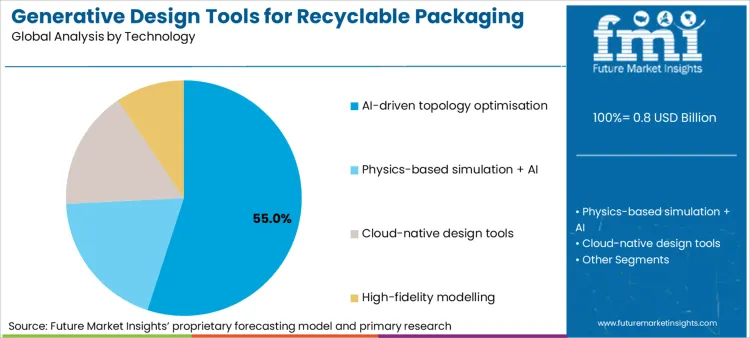
AI-driven topology optimisation (55%) leads because it supports decision velocity under hard constraints. In recyclable packaging programs, the primary bottleneck is rarely ideation; it is the number of iterations required to reconcile cost, manufacturability, and recyclability constraints across stakeholders. This technology approach gains share when it reduces iteration loops and helps organizations converge faster on compliant geometries-especially in high-volume FMCG environments where redesign throughput is the binding constraint.
FMI also observes that adoption is highest where companies are moving from “expert-driven redesign” to systematized redesign. In other words, firms want packaging outcomes that are less dependent on individual designer experience and more dependent on a repeatable process that can be scaled across teams. AI-driven optimisation aligns with that procurement logic because it can be embedded into governance workflows as a repeatable step-reducing redesign variance across regions and suppliers.
This logic strengthens as PPWR milestones near: organizations prioritize technologies that reduce late-stage surprises and compress overall redesign timelines, converting compliance into an operational discipline rather than a high-risk end-of-project gate.
What Drivers, Restraints, Opportunities, and Trends Prevail in the Generative Design Tools for Recyclable Packaging Market?
The strongest driver is the conversion of recyclability ambition into enforceable, time-bound requirements. PPWR (Regulation (EU) 2025/40) and the Commission’s communicated entry-into-force and application framing are accelerating enterprise demand for systems that can sustain continuous redesign without creating governance chaos. ESPR further reinforces the policy trajectory toward ecodesign requirements, strengthening the rationale for governed design environments that can withstand audit and compliance scrutiny.
Scaling is restrained by organizational adoption friction. Packaging redesign spans brand owners, converters, and material suppliers, often across multiple countries. Even when tool budgets exist, the harder problem is aligning decision rights, constraints interpretation, and approval authority. This slows rollout velocity and can delay value realization.
The highest-value opportunity lies in compliance operationalization where organizations embed recyclability-first constraints into ongoing packaging refresh programs, minimizing the risk of late-cycle redesign surges as regulatory milestones approach. This is most compelling for FMCG owners with large portfolios and high redesign frequency, where reducing cycle-time volatility is monetizable.
The dominant trend is a shift from isolated innovation projects to portfolio-scale standardization, building internal rulesets and redesign playbooks that can be executed repeatedly across packaging families and regions. The market is increasingly rewarding vendors and adopters that reduce variance and rework, not those that maximize novelty.
How is the Generative Design Tools for Recyclable Packaging Market Analyzed in Key Countries?
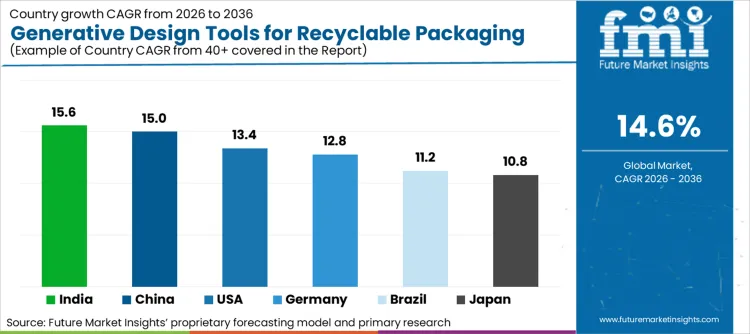
| Country | CAGR (2026–2036) |
|---|---|
| USA | 13.4% |
| Germany | 12.8% |
| China | 15.0% |
| Japan | 10.8% |
| India | 15.6% |
| Brazil | 11.2% |
Source: Future Market Insights (FMI) analysis, based on proprietary forecasting model and primary research
How is the USA scaling adoption through FMCG-led portfolio governance?
The USA is projected to expand at a 13.4% CAGR, driven by the scale of FMCG packaging portfolios and the operational value of shortening redesign cycles. FMI observes that U.S. demand tends to be programmatic: enterprises frame recyclable packaging as a multi-year portfolio transformation, where the primary KPI is the rate at which legacy packs can be converted without disrupting commercial calendars.
The U.S. adoption curve is also shaped by the economics of redesign throughput. Companies with large SKU estates benefit disproportionately from systems that reduce redesign iteration counts and stabilize approvals—because delay costs compound across many packs. This creates strong demand for environments that can enforce internal constraints and reduce “late discovery” of compliance conflicts that would otherwise trigger rework with suppliers.
Why is Germany anchored in compliance-grade engineering discipline within the EU context?
Germany’s market growth at a 12.8% CAGR reflects an engineering-driven packaging culture operating inside the EU compliance environment. PPWR’s published status and the Commission’s timing communications increase the urgency of building defensible redesign pipelines that can be repeated across portfolios and supplier ecosystems.
Germany also benefits from strong institutional infrastructure around packaging data, reporting, and minimum standards. For example, the Central Packaging Register (ZSVR) updates the minimum standard documentation annually, illustrating how compliance expectations can evolve and why enterprises prioritize governed, repeatable decision-making rather than ad hoc redesign.
FMI analysis indicates that this environment favors tools that help companies maintain consistency across engineering teams, converters, and cross-border supply chains, reducing the risk of divergent interpretations that increase redesign churn.
How is China’s growth fueled by high-volume packaging economics and industrial pacing?
China is forecast to grow at a 15.0% CAGR, driven by the economics of high-volume packaging production and the value of rapid iteration cycles at scale. In high-throughput packaging environments, small efficiency gains in redesign convergence can translate into large aggregate cost outcomes across major production runs.
Policy direction also reinforces the adoption backdrop. China’s 2021–2025 plastic pollution control action plan has been framed as whole-chain control of plastic pollution, which increases the strategic importance of packaging redesign programs that reduce waste and improve downstream outcomes. FMI observes that this combination, industrial scale plus policy pressure, supports investment in design environments that can standardize constraint-driven redesign across high-volume packaging families.
What defines Japan’s measured growth in precision packaging contexts?
Japan’s 10.8% CAGR reflects a more disciplined adoption pattern, where decision-making is strongly governed and packaging changes often require cross-functional alignment. The country’s policy environment includes the Act on Promotion of Resource Circulation for Plastics effective April 1, 2022, reinforcing a national direction of improving plastic resource circulation and supporting systematic approaches to plastics management.
FMI analysis finds that Japan’s adoption is less rush conversion and more controlled scaling. Tools gain traction when they reduce ambiguity, support consistency across packaging families, and enable stable deployment pathways across quality-sensitive packaging categories where redesign volatility is viewed as operational risk.
Why is India emerging as the fastest growth market for this category?
India leads at 15.6% CAGR, reflecting rapid packaging modernization combined with tightening compliance execution. The Central Pollution Control Board (CPCB) operates the EPR portal for plastic packaging, anchoring formalized registration and compliance processes that increase the importance of disciplined packaging governance at enterprise scale. The Plastic Waste Management (Amendment) Rules, 2022 also explicitly frame EPR responsibilities for plastic packaging waste, contributing to a stronger compliance backdrop that encourages structured redesign programs rather than piecemeal changes.
FMI observes that India’s growth is also powered by portfolio expansion: fast-growing FMCG consumption increases the number of packs in market circulation, which increases the operational payoff from reducing material intensity and standardizing recyclable formats across packaging families. This makes redesign throughput and supplier alignment central to market adoption, rather than niche innovation.
How is Brazil building demand through reverse logistics and compliance formalization?
Brazil’s 11.2% CAGR reflects a growing formalization of reverse logistics governance under the PNRS framework, with regulatory developments including Decree 10.936/2022 and Decree 11.413/2023 often discussed as strengthening oversight and traceability expectations. In addition, legal and policy commentary highlights ongoing regulatory attention to reverse logistics obligations for packaging, which tends to raise pressure on brand owners and packaging stakeholders to improve packaging outcomes and documentation.
FMI analysis indicates that this environment favors tools that enable structured redesign planning—where companies can execute packaging shifts with repeatable rules and reduced redesign churn, particularly in cost-sensitive consumer markets where inefficiency is penalized.
How Competitive is the Generative Design Tools for Recyclable Packaging Market?
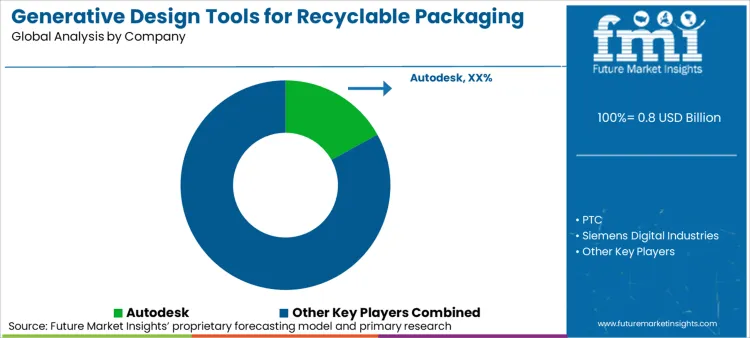
The competitive landscape is characterized by high intensity as major industrial software ecosystems position themselves as the “system of record” for recyclable packaging redesign. Competition is increasingly determined by who can support portfolio-scale standardization and supplier-network execution—because the economic value is created by reducing redesign cycle time across many packs, not by isolated innovation.
FMI observes that competitive advantage is strengthening around three strategic axes: enterprise governance fit (constraints, approvals, audit defensibility), ecosystem scalability across brand–converter–supplier networks, and ability to support continuous redesign pacing aligned to PPWR/ESPR timing without redesign bottlenecks.
Key Players Profiled
- Autodesk
- PTC
- Siemens Digital Industries
- Dassault Systèmes
- ZWCAD
- Alibaba Cloud Design
- Fujitsu
- Hexagon
Market Definition
The generative design tools for recyclable packaging market comprises revenues generated from digital design environments used by packaging stakeholders to institutionalize recyclability-first geometry decision-making under material intensity, regulatory, and governance constraints. The market captures deployments across FMCG packaging design programs, packaging engineering organizations, and sustainability-led packaging R&D functions where redesign throughput and compliance defensibility are core value drivers.
The scope includes major tool categories spanning generative CAD platforms and AI-driven optimisation approaches used within packaging design workflows. The scope excludes packaging materials, packaging manufacturing equipment, and downstream recycling operations.
Scope of Report
| Items | Values |
|---|---|
| Quantitative Units | USD 760 Million |
| End Use | FMCG & packaging design, Sustainable packaging R&D, High-volume packaging, Precision packaging, Others |
| Tool Type | Generative CAD platforms, Design optimisation software, AI-assisted CAD tools, Advanced CAD/CAE |
| Design Focus | Lightweight & mono-material design, Recyclability-first geometry, Cost & material reduction, Structural optimisation |
| Technology | AI-driven topology optimisation, Physics-based simulation + AI, Cloud-native design tools, High-fidelity modelling |
| Countries Covered | USA, Germany, China, Japan, India, Brazil |
| Regions Covered | North America, Europe, Latin America, Asia Pacific, Middle East & Africa |
| Key Companies | Autodesk, PTC, Siemens Digital Industries, Dassault Systèmes, ZWCAD, Alibaba Cloud Design, Fujitsu, Hexagon |
Source: Future Market Insights (FMI) analysis, based on proprietary forecasting model and primary research
Generative Design Tools for Recyclable Packaging Market Key Segments
End Use
- FMCG & packaging design
- Sustainable packaging R&D
- High-volume packaging
- Precision packaging
- Others
Tool Type
- Generative CAD platforms
- Design optimisation software
- AI-assisted CAD tools
- Advanced CAD/CAE
Design Focus
- Lightweight & mono-material design
- Recyclability-first geometry
- Cost & material reduction
- Structural optimisation
Technology
- AI-driven topology optimisation
- Physics-based simulation + AI
- Cloud-native design tools
- High-fidelity modelling
Region
- North America
- Latin America
- Europe
- Asia Pacific
- Middle East & Africa
Bibliography
- Central Pollution Control Board. (n.d.). Centralized EPR Portal for Plastic Packaging. CPCB, Government of India.
- Government of India. (2022). The Plastic Waste Management (Amendment) Rules, 2022. (PDF).
- Government of Japan. (2022). Act on Promotion of Resource Circulation for Plastics (overview / implementation context). Government of Japan.
- Japan Containers and Packaging Recycling Association. (n.d.). Profile and policy timeline (resource circulation act effective April 1, 2022). JCPRA.
- Brazilian legal commentary source. (2024). PNRS reverse logistics updates referencing Decrees 10.936/2022 and 11.413/2023.
-
Frequently Asked Questions
- What is the market value of the generative design tools for recyclable packaging market in 2026?
- The generative design tools for recyclable packaging market is estimated to be valued at USD 760 million in 2026.
- What is the projected market value by 2036 and the expected CAGR from 2026 to 2036?
- By 2036, the market is projected to reach USD 2,980 million, expanding at a 14.6% CAGR.
- Which end-use segment accounts for the largest share in the market?
- The FMCG & packaging design segment accounts for the largest share at 39%.
- Which tool type dominates the generative design tools market?
- Generative CAD platforms dominate the market with a 50% share, as enterprises consolidate around authoritative design environments to standardize packaging geometry decisions.
- Which design focus and technology lead market value concentration?
- Lightweight & mono-material design and AI-driven topology optimisation lead the market, each holding a 55% share.
Frequently Asked Questions
How big is the generative design tools for recyclable packaging market in 2026?
The global generative design tools for recyclable packaging market is estimated to be valued at USD 0.8 billion in 2026.
What will be the size of generative design tools for recyclable packaging market in 2036?
The market size for the generative design tools for recyclable packaging market is projected to reach USD 3.0 billion by 2036.
How much will be the generative design tools for recyclable packaging market growth between 2026 and 2036?
The generative design tools for recyclable packaging market is expected to grow at a 14.6% CAGR between 2026 and 2036.
What are the key product types in the generative design tools for recyclable packaging market?
The key product types in generative design tools for recyclable packaging market are fmcg & packaging design , sustainable packaging r&d, high-volume packaging and precision packaging.
Which tool type segment to contribute significant share in the generative design tools for recyclable packaging market in 2026?
In terms of tool type, generative cad platforms segment to command 50.0% share in the generative design tools for recyclable packaging market in 2026.
Preview the report firsthand - request a free sample
Get SampleGet the brochure for pricing and purchase details.
Get PDFTable of Content
- Executive Summary
- Global Market Outlook
- Demand-side Trends
- Supply-side Trends
- Technology Roadmap Analysis
- Analysis and Recommendations
- Market Overview
- Market Coverage / Taxonomy
- Market Definition / Scope / Limitations
- Research Methodology
- Chapter Orientation
- Analytical Lens and Working Hypotheses
- Market Structure, Signals, and Trend Drivers
- Benchmarking and Cross-market Comparability
- Market Sizing, Forecasting, and Opportunity Mapping
- Research Design and Evidence Framework
- Desk Research Programme (Secondary Evidence)
- Company Annual and Sustainability Reports
- Peer-reviewed Journals and Academic Literature
- Corporate Websites, Product Literature, and Technical Notes
- Earnings Decks and Investor Briefings
- Statutory Filings and Regulatory Disclosures
- Technical White Papers and Standards Notes
- Trade Journals, Industry Magazines, and Analyst Briefs
- Conference Proceedings, Webinars, and Seminar Materials
- Government Statistics Portals and Public Data Releases
- Press Releases and Reputable Media Coverage
- Specialist Newsletters and Curated Briefings
- Sector Databases and Reference Repositories
- FMI Internal Proprietary Databases and Historical Market Datasets
- Subscription Datasets and Paid Sources
- Social Channels, Communities, and Digital Listening Inputs
- Additional Desk Sources
- Expert Input and Fieldwork (Primary Evidence)
- Primary Modes
- Qualitative Interviews and Expert Elicitation
- Quantitative Surveys and Structured Data Capture
- Blended Approach
- Why Primary Evidence is Used
- Field Techniques
- Interviews
- Surveys
- Focus Groups
- Observational and In-context Research
- Social and Community Interactions
- Stakeholder Universe Engaged
- C-suite Leaders
- Board Members
- Presidents and Vice Presidents
- R&D and Innovation Heads
- Technical Specialists
- Domain Subject-matter Experts
- Scientists
- Physicians and Other Healthcare Professionals
- Governance, Ethics, and Data Stewardship
- Research Ethics
- Data Integrity and Handling
- Primary Modes
- Tooling, Models, and Reference Databases
- Desk Research Programme (Secondary Evidence)
- Data Engineering and Model Build
- Data Acquisition and Ingestion
- Cleaning, Normalisation, and Verification
- Synthesis, Triangulation, and Analysis
- Quality Assurance and Audit Trail
- Market Background
- Market Dynamics
- Drivers
- Restraints
- Opportunity
- Trends
- Scenario Forecast
- Demand in Optimistic Scenario
- Demand in Likely Scenario
- Demand in Conservative Scenario
- Opportunity Map Analysis
- Product Life Cycle Analysis
- Supply Chain Analysis
- Investment Feasibility Matrix
- Value Chain Analysis
- PESTLE and Porter’s Analysis
- Regulatory Landscape
- Regional Parent Market Outlook
- Production and Consumption Statistics
- Import and Export Statistics
- Market Dynamics
- Global Market Analysis 2021 to 2025 and Forecast, 2026 to 2036
- Historical Market Size Value (USD Million) Analysis, 2021 to 2025
- Current and Future Market Size Value (USD Million) Projections, 2026 to 2036
- Y-o-Y Growth Trend Analysis
- Absolute $ Opportunity Analysis
- Global Market Pricing Analysis 2021 to 2025 and Forecast 2026 to 2036
- Global Market Analysis 2021 to 2025 and Forecast 2026 to 2036, By End Use
- Introduction / Key Findings
- Historical Market Size Value (USD Million) Analysis By End Use , 2021 to 2025
- Current and Future Market Size Value (USD Million) Analysis and Forecast By End Use , 2026 to 2036
- FMCG & packaging design
- Sustainable packaging R&D
- High-volume packaging
- Precision packaging
- FMCG & packaging design
- Y-o-Y Growth Trend Analysis By End Use , 2021 to 2025
- Absolute $ Opportunity Analysis By End Use , 2026 to 2036
- Global Market Analysis 2021 to 2025 and Forecast 2026 to 2036, By Tool Type
- Introduction / Key Findings
- Historical Market Size Value (USD Million) Analysis By Tool Type, 2021 to 2025
- Current and Future Market Size Value (USD Million) Analysis and Forecast By Tool Type, 2026 to 2036
- Generative CAD platforms
- Design optimisation software
- AI-assisted CAD tools
- Advanced CAD/CAE
- Generative CAD platforms
- Y-o-Y Growth Trend Analysis By Tool Type, 2021 to 2025
- Absolute $ Opportunity Analysis By Tool Type, 2026 to 2036
- Global Market Analysis 2021 to 2025 and Forecast 2026 to 2036, By Design Focus
- Introduction / Key Findings
- Historical Market Size Value (USD Million) Analysis By Design Focus, 2021 to 2025
- Current and Future Market Size Value (USD Million) Analysis and Forecast By Design Focus, 2026 to 2036
- Lightweight & mono-material design
- Recyclability-first geometry
- Cost & material reduction
- Structural optimisation
- Lightweight & mono-material design
- Y-o-Y Growth Trend Analysis By Design Focus, 2021 to 2025
- Absolute $ Opportunity Analysis By Design Focus, 2026 to 2036
- Global Market Analysis 2021 to 2025 and Forecast 2026 to 2036, By Technology
- Introduction / Key Findings
- Historical Market Size Value (USD Million) Analysis By Technology, 2021 to 2025
- Current and Future Market Size Value (USD Million) Analysis and Forecast By Technology, 2026 to 2036
- AI-driven topology optimisation
- Physics-based simulation + AI
- Cloud-native design tools
- High-fidelity modelling
- AI-driven topology optimisation
- Y-o-Y Growth Trend Analysis By Technology, 2021 to 2025
- Absolute $ Opportunity Analysis By Technology, 2026 to 2036
- Global Market Analysis 2021 to 2025 and Forecast 2026 to 2036, By Region
- Introduction
- Historical Market Size Value (USD Million) Analysis By Region, 2021 to 2025
- Current Market Size Value (USD Million) Analysis and Forecast By Region, 2026 to 2036
- North America
- Latin America
- Western Europe
- Eastern Europe
- East Asia
- South Asia and Pacific
- Middle East & Africa
- Market Attractiveness Analysis By Region
- North America Market Analysis 2021 to 2025 and Forecast 2026 to 2036, By Country
- Historical Market Size Value (USD Million) Trend Analysis By Market Taxonomy, 2021 to 2025
- Market Size Value (USD Million) Forecast By Market Taxonomy, 2026 to 2036
- By Country
- USA
- Canada
- Mexico
- By End Use
- By Tool Type
- By Design Focus
- By Technology
- By Country
- Market Attractiveness Analysis
- By Country
- By End Use
- By Tool Type
- By Design Focus
- By Technology
- Key Takeaways
- Latin America Market Analysis 2021 to 2025 and Forecast 2026 to 2036, By Country
- Historical Market Size Value (USD Million) Trend Analysis By Market Taxonomy, 2021 to 2025
- Market Size Value (USD Million) Forecast By Market Taxonomy, 2026 to 2036
- By Country
- Brazil
- Chile
- Rest of Latin America
- By End Use
- By Tool Type
- By Design Focus
- By Technology
- By Country
- Market Attractiveness Analysis
- By Country
- By End Use
- By Tool Type
- By Design Focus
- By Technology
- Key Takeaways
- Western Europe Market Analysis 2021 to 2025 and Forecast 2026 to 2036, By Country
- Historical Market Size Value (USD Million) Trend Analysis By Market Taxonomy, 2021 to 2025
- Market Size Value (USD Million) Forecast By Market Taxonomy, 2026 to 2036
- By Country
- Germany
- UK
- Italy
- Spain
- France
- Nordic
- BENELUX
- Rest of Western Europe
- By End Use
- By Tool Type
- By Design Focus
- By Technology
- By Country
- Market Attractiveness Analysis
- By Country
- By End Use
- By Tool Type
- By Design Focus
- By Technology
- Key Takeaways
- Eastern Europe Market Analysis 2021 to 2025 and Forecast 2026 to 2036, By Country
- Historical Market Size Value (USD Million) Trend Analysis By Market Taxonomy, 2021 to 2025
- Market Size Value (USD Million) Forecast By Market Taxonomy, 2026 to 2036
- By Country
- Russia
- Poland
- Hungary
- Balkan & Baltic
- Rest of Eastern Europe
- By End Use
- By Tool Type
- By Design Focus
- By Technology
- By Country
- Market Attractiveness Analysis
- By Country
- By End Use
- By Tool Type
- By Design Focus
- By Technology
- Key Takeaways
- East Asia Market Analysis 2021 to 2025 and Forecast 2026 to 2036, By Country
- Historical Market Size Value (USD Million) Trend Analysis By Market Taxonomy, 2021 to 2025
- Market Size Value (USD Million) Forecast By Market Taxonomy, 2026 to 2036
- By Country
- China
- Japan
- South Korea
- By End Use
- By Tool Type
- By Design Focus
- By Technology
- By Country
- Market Attractiveness Analysis
- By Country
- By End Use
- By Tool Type
- By Design Focus
- By Technology
- Key Takeaways
- South Asia and Pacific Market Analysis 2021 to 2025 and Forecast 2026 to 2036, By Country
- Historical Market Size Value (USD Million) Trend Analysis By Market Taxonomy, 2021 to 2025
- Market Size Value (USD Million) Forecast By Market Taxonomy, 2026 to 2036
- By Country
- India
- ASEAN
- Australia & New Zealand
- Rest of South Asia and Pacific
- By End Use
- By Tool Type
- By Design Focus
- By Technology
- By Country
- Market Attractiveness Analysis
- By Country
- By End Use
- By Tool Type
- By Design Focus
- By Technology
- Key Takeaways
- Middle East & Africa Market Analysis 2021 to 2025 and Forecast 2026 to 2036, By Country
- Historical Market Size Value (USD Million) Trend Analysis By Market Taxonomy, 2021 to 2025
- Market Size Value (USD Million) Forecast By Market Taxonomy, 2026 to 2036
- By Country
- Kingdom of Saudi Arabia
- Other GCC Countries
- Turkiye
- South Africa
- Other African Union
- Rest of Middle East & Africa
- By End Use
- By Tool Type
- By Design Focus
- By Technology
- By Country
- Market Attractiveness Analysis
- By Country
- By End Use
- By Tool Type
- By Design Focus
- By Technology
- Key Takeaways
- Key Countries Market Analysis
- USA
- Pricing Analysis
- Market Share Analysis, 2025
- By End Use
- By Tool Type
- By Design Focus
- By Technology
- Canada
- Pricing Analysis
- Market Share Analysis, 2025
- By End Use
- By Tool Type
- By Design Focus
- By Technology
- Mexico
- Pricing Analysis
- Market Share Analysis, 2025
- By End Use
- By Tool Type
- By Design Focus
- By Technology
- Brazil
- Pricing Analysis
- Market Share Analysis, 2025
- By End Use
- By Tool Type
- By Design Focus
- By Technology
- Chile
- Pricing Analysis
- Market Share Analysis, 2025
- By End Use
- By Tool Type
- By Design Focus
- By Technology
- Germany
- Pricing Analysis
- Market Share Analysis, 2025
- By End Use
- By Tool Type
- By Design Focus
- By Technology
- UK
- Pricing Analysis
- Market Share Analysis, 2025
- By End Use
- By Tool Type
- By Design Focus
- By Technology
- Italy
- Pricing Analysis
- Market Share Analysis, 2025
- By End Use
- By Tool Type
- By Design Focus
- By Technology
- Spain
- Pricing Analysis
- Market Share Analysis, 2025
- By End Use
- By Tool Type
- By Design Focus
- By Technology
- France
- Pricing Analysis
- Market Share Analysis, 2025
- By End Use
- By Tool Type
- By Design Focus
- By Technology
- India
- Pricing Analysis
- Market Share Analysis, 2025
- By End Use
- By Tool Type
- By Design Focus
- By Technology
- ASEAN
- Pricing Analysis
- Market Share Analysis, 2025
- By End Use
- By Tool Type
- By Design Focus
- By Technology
- Australia & New Zealand
- Pricing Analysis
- Market Share Analysis, 2025
- By End Use
- By Tool Type
- By Design Focus
- By Technology
- China
- Pricing Analysis
- Market Share Analysis, 2025
- By End Use
- By Tool Type
- By Design Focus
- By Technology
- Japan
- Pricing Analysis
- Market Share Analysis, 2025
- By End Use
- By Tool Type
- By Design Focus
- By Technology
- South Korea
- Pricing Analysis
- Market Share Analysis, 2025
- By End Use
- By Tool Type
- By Design Focus
- By Technology
- Russia
- Pricing Analysis
- Market Share Analysis, 2025
- By End Use
- By Tool Type
- By Design Focus
- By Technology
- Poland
- Pricing Analysis
- Market Share Analysis, 2025
- By End Use
- By Tool Type
- By Design Focus
- By Technology
- Hungary
- Pricing Analysis
- Market Share Analysis, 2025
- By End Use
- By Tool Type
- By Design Focus
- By Technology
- Kingdom of Saudi Arabia
- Pricing Analysis
- Market Share Analysis, 2025
- By End Use
- By Tool Type
- By Design Focus
- By Technology
- Turkiye
- Pricing Analysis
- Market Share Analysis, 2025
- By End Use
- By Tool Type
- By Design Focus
- By Technology
- South Africa
- Pricing Analysis
- Market Share Analysis, 2025
- By End Use
- By Tool Type
- By Design Focus
- By Technology
- USA
- Market Structure Analysis
- Competition Dashboard
- Competition Benchmarking
- Market Share Analysis of Top Players
- By Regional
- By End Use
- By Tool Type
- By Design Focus
- By Technology
- Competition Analysis
- Competition Deep Dive
- Autodesk
- Overview
- Product Portfolio
- Profitability by Market Segments (Product/Age /Sales Channel/Region)
- Sales Footprint
- Strategy Overview
- Marketing Strategy
- Product Strategy
- Channel Strategy
- PTC
- Siemens Digital Industries
- Dassault Systèmes
- ZWCAD
- Alibaba Cloud Design
- Autodesk
- Competition Deep Dive
- Assumptions & Acronyms Used


